Cambridge A Level History 9389 — 2014 May/June Paper 1 · Variant 1
9389/11/M/J/14 · 40 marks · ≈45 min
The question paper and its mark scheme, free to read here and free to download. This is Cambridge’s own paper, exactly as it was sat.
Question paper8 pages
Mark scheme8 pages
Answers below. Sit the paper first if you are practising.
Paper as text
Question paper, page 1
This document consists of 7 printed pages and 1 blank page. DC (NH/SLM) 84010/3 © UCLES 2014 [Turn over * 8 5 0 4 7 6 4 6 6 5 * HISTORY 9389/11 Paper 1 Document Question May/June 2014 1 hour Additional Materials: Answer Booklet/Paper READ THESE INSTRUCTIONS FIRST If you have been given an Answer Booklet, follow the instructions on the front cover of the Booklet. Write your Centre number, candidate number and name on all the work you hand in. Write in dark blue or black pen. Do not use staples, paper clips, glue or correction fluid. DO NOT WRITE IN ANY BARCODES. This paper contains three sections: Section A: European Option Section B: American Option Section C: International Option Answer both parts of the question from one section only. At the end of the examination, fasten all your work securely together. The marks are given in brackets [ ] at the end of each part question. Cambridge International Examinations Cambridge International Advanced Subsidiary Level
Question paper, page 2
2 9389/11/M/J/14 © UCLES 2014 Section A: European Option Liberalism and Nationalism in Italy and Germany, 1848–1871 Revolutions in Italy, 1848 1 Read the sources and then answer both parts of the question. Source A Once a constitution has been announced in Naples, what is going to happen in Piedmont, in Tuscany, even in Rome, where the power of the government is today very limited? It is too easy to predict. In the present state of warlike excitement, a condition shared even by some reasonable persons, who can be sure that a challenge will not be issued to Austria because of the passionate feelings that do not listen to reason or to wisdom? Then we shall have war, a war of principles as terrible in its effects as those produced by religious fanaticism. The Belgian ambassador in Rome, writing in his despatches, January 1848. Source B The government has been changed but this has not stopped the excitement from growing daily. People broke up the machinery of the old government but with little wisdom. They got rid of the bad but did not find the good to replace it. The rogues remained. The old incompetent substitutes did not know what to do. Everybody gossiped. They complained of everything in the streets. They had gained a new constitution by shouting so everybody thought that he could get a job by shouting. In the political clubs there was much talking about everything under the sun. Those who talked fastest and expressed the most fantastic plans were the most applauded. The press was unrestricted. It published a mixture of lies and truth. The masses said, ‘What liberty is this if there is no work and we are starving? The king was previously one man and ate for one. Now we have a thousand governors and they eat for a thousand. We must look after our own interests.’ The peasants invaded the countryside and divided the land that belonged to the king or to the landlords who had taken over the land and were hated because they had got rich through moneylending and greed. In the city of Naples, the mob considered attacking and looting houses. People became crazy. Settembrini, a moderate reformer, describes the disorder in Naples, February 1848. Source C The most bitter and most skilful enemy of those clergy who defend the Pope is Gioberti. He is not content with getting the Jesuits expelled from every state in Italy, even from Rome, but he also seeks to enlarge his own role and to raise himself to the level of a statesman, creating the hope for a new future in Italy. Another Italian, the lawyer Mazzini, equally clever and more energetic than Gioberti, has set himself up with the same intention. He wants to put himself at the head of the united republican party. Gioberti has declared himself the head of the party of constitutional monarchy. The Belgian ambassador describes the divisions in Rome, October 1848.
Question paper, page 3
3 9389/11/M/J/14 © UCLES 2014 [Turn over Source D Revolutions spread through Italy in 1848 but differences between regimes sharpened separatism in the states. Gioberti summoned a congress of representatives in October to discuss a federation of Italian states but he met with no success. The monarchists were divided from republicans like Mazzini. On the other hand Manin’s republicanism in Venice was that of the old Venetian city-state, not Mazzini’s variety which preached republicanism as the pre-condition of national unity, and he took care to destroy the influence of Mazzini’s supporters. A contemporary wrote, ‘There was no unity of direction. Therefore there was no unity as Italians.’ A modern historian describes the differences between the Italian revolutionaries in 1848. Answer both parts of the question with reference to the sources. (a) Compare and contrast Sources B and C as evidence of the reasons why many Italians wanted change in 1848. [15] (b) How far do these sources show that Italian nationalism was the reason for the revolutions in Italy in 1848? [25]
Question paper, page 4
4 9389/11/M/J/14 © UCLES 2014 Section B: American Option The Origins of the Civil War, 1846–1861 The Compromise of 1850 2 Read the sources and then answer both parts of the question. Source A The agitation on the subject of slavery now raging throughout the land presents a most extraordinary spectacle. Congress, after a protracted session of nearly ten months, succeeded in passing a system of measures which are believed to be just to all parts of the republic and ought to be satisfactory to the people. The South has not triumphed over the North nor has the North achieved a victory over the South. Neither party has made humiliating concessions to the other. And yet we find that the agitation has reopened in the two extremes of the Union with renewed vigour and increased violence. In the South, the measures of adjustment are denounced as a disgraceful surrender of Southern rights to Northern abolitionists. In the North, the same measures are denounced with equal violence as a total abandonment of the rights of freemen in order to conciliate slave power. From a speech by Stephen Douglas, 23 October 1850. Source B When the so-called compromise measures passed both houses of Congress and received the approval of the President, there was some prospect of domestic tranquillity. These measures were, unquestionably, of Southern origin and so framed as to promote and encourage Southern interests. The South gained all its points in the game of legislation and left the North, if not a victim to superior tact and finesse, at least a dupe to systematised threat and bombast. It was reasonable to expect that the South would be satisfied with the concessions and advantages of the compromise measures. The result is far different; they quarrel with their own men and their own propositions. They imagine a danger and they proceed to act with emergency. They will admit no discussion – they will concede nothing – but swagger on as they have done since the formation of our union. They have their way and are not content! If the similar fanaticism were encouraged in this section by argument and plaudit, we would never hear the end of Southern declamation and wordy resistance. From the ‘Lewisburg Chronicle’, Lewisburg, Pennsylvania, 30 October 1850.
Question paper, page 5
5 9389/11/M/J/14 © UCLES 2014 [Turn over Source C By the Compromise of 1850, the South, in some particulars, sacrificed its essential interests. It gave away the magnificent empire of California. It recognised the principle of Squatter Sovereignty. Above all, it consented to the abolition of the slave trade in the District of Columbia. What indemnity did the South receive for these important concessions? The Fugitive Slave Law and nothing more. The act was drawn with care and ability and is wanting in no provision essential to its satisfactory operation. In view of the adversary’s strength, it was something to gain even so inadequate a compensation for all our sacrifices. Considering the extremity of our distress, the enactment of the Fugitive Slave Law was in some sort a triumph for the South. From the ‘Charleston Mercury’, 25 May 1857. Source D Out of Congress the abolitionists were aroused almost to a pitch of frenzy by the passage of the Compromise measures and the Fugitive Slave Law. Addresses were immediately issued by thousands, which freely circulated in all Northern States, counselling resistance to the law under every circumstance. Conventions were held of whites and negroes, in which death was proclaimed to every slaveholder who attempted to carry out the infamous enactment. The tide of runaway slaves from the South, which had been flowing for so many years, swelled into a flood. Where one slave formerly made a successful escape, scores made good their flight now. New England became the goal of the fugitives and here they found friends without number, who furnished them with the means for extending their journey to the Canadian provinces. From Felix de Fontaine, ‘History of American Abolitionism’, 1861. Answer both parts of the question with reference to the sources. (a) To what extent do Sources B and C agree about the role of the South in the making of the 1850 Compromise? [15] (b) How far do these sources support the assertion that the 1850 Compromise was favourable to the North? [25]
Question paper, page 6
6 9389/11/M/J/14 © UCLES 2014 Section C: International Option The Search for International Peace and Security, 1919–1945 The League of Nations and the Italian Invasion of Abyssinia 3 Read the sources and then answer both parts of the question. Source A A cartoon from a British newspaper, February 1935. It shows Mussolini with the British and French Foreign Ministers who are looking at a ‘Map of the Western Front’. Source B There is no sign of any weakening in overwhelming support for the Covenant, nor any sign that members of the League would be unwilling to shoulder their obligations should the situation demand it. The only nation which has shown a marked lack of enthusiasm for effective action against Italy is France. The French are concerned about Germany and cannot bring themselves to take any step which could weaken a united front against the German peril. Britain’s view that the failure of the League to act firmly against Italy at this time would fatally weaken it in any future crisis does not appeal with equal force to the French. French support of the League does not rest on a conception of international law. They regard it mainly as an instrument of French policy, to be used when it is convenient to France. Their aim is not to antagonise Italy while keeping the League alive for another crisis when it may be of value to them. Telegram to the British government from the British Minister for League of Nations’ Affairs in Geneva, September 1935.
Question paper, page 7
7 9389/11/M/J/14 © UCLES 2014 Source C Mr Baldwin assured us that Britain held faithfully to all its pledges with regard to the League. However, he said that taking action against Italy raised extremely difficult questions. He explained the great gravity of the European situation, including the danger that Mussolini might make a ‘mad dog’ attack on the British fleet. Though this would, in the long run, lead to the defeat of Italy, the war might last a long time and produce both losses and serious diplomatic complications. He added that Britain could not rely on effective support from any other member of the League. With the exception of Britain (and its own preparations had fallen far into arrears) none of the members of the League seemed in a position to take decisive action against Italy. As for France, the whole French nation had a horror of war and could hardly be mobilised by any provocation short of actual invasion. Report of a League of Nations’ delegation following a meeting with Stanley Baldwin, the British Prime Minister, December 1935. Source D In the case of Manchuria, the League did nothing but utter verbal protests against Japan’s action in attacking China. Manchuria was far off. Abyssinia, and still more Italy, was nearer. In that case, economic sanctions were decided on, but they were weak sanctions. We refused to impose the only two sanctions which would have been effective – the cutting off of oil supplies and the closing of the Suez Canal. We did enough to irritate and embarrass Italy, but not enough to prevent her from accomplishing her conquest. The League’s powerlessness to protect states which were the victims of aggression became so evident that, when Germany took Czechoslovakia and Poland, there was no appeal to the League even by the victims themselves. If I draw this sombre picture, it is not to engage in vain recriminations over the past. I do not forget that certain French governments had their share in these backslidings. From a speech by the French delegate at the last meeting of the League of Nations, April 1946. Answer both parts of the question with reference to the sources. (a) Compare and contrast Sources B and C as evidence about Britain’s attitude towards the Italian invasion of Abyssinia. [15] (b) How far do Sources A–D support the view that France was responsible for the League of Nations’ failure to take effective action in response to Italy’s invasion of Abyssinia? [25]
Question paper, page 8
8 9389/11/M/J/14 © UCLES 2014 BLANK PAGE Copyright Acknowledgements: Section A Source D © R Gildea; Barricades and Borders: Europe 1800–1914; Oxford University Press; 1987. Section C Source A © David Low; Self-Portrait ; Evening Standard; 15 February 1935; Ref: DL0929; www.cartoons.ac.uk. Permission to reproduce items where third-party owned material protected by copyright is included has been sought and cleared where possible. Every reasonable effort has been made by the publisher (UCLES) to trace copyright holders, but if any items requiring clearance have unwittingly been included, the publisher will be pleased to make amends at the earliest possible opportunity. Cambridge International Examinations is part of the Cambridge Assessment Group. Cambridge Assessment is the brand name of University of Cambridge Local Examinations Syndicate (UCLES), which is itself a department of the University of Cambridge.
Mark scheme, page 1
CAMBRIDGE INTERNATIONAL EXAMINATIONS GCE Advanced Subsidiary Level MARK SCHEME for the May/June 2014 series 9389 HISTORY 9389/11 Paper 11 (Document Question), maximum raw mark 40 This mark scheme is published as an aid to teachers and candidates, to indicate the requirements of the examination. It shows the basis on which Examiners were instructed to award marks. It does not indicate the details of the discussions that took place at an Examiners’ meeting before marking began, which would have considered the acceptability of alternative answers. Mark schemes should be read in conjunction with the question paper and the Principal Examiner Report for Teachers. Cambridge will not enter into discussions about these mark schemes. Cambridge is publishing the mark schemes for the May/June 2014 series for most IGCSE, GCE Advanced Level and Advanced Subsidiary Level components and some Ordinary Level components.
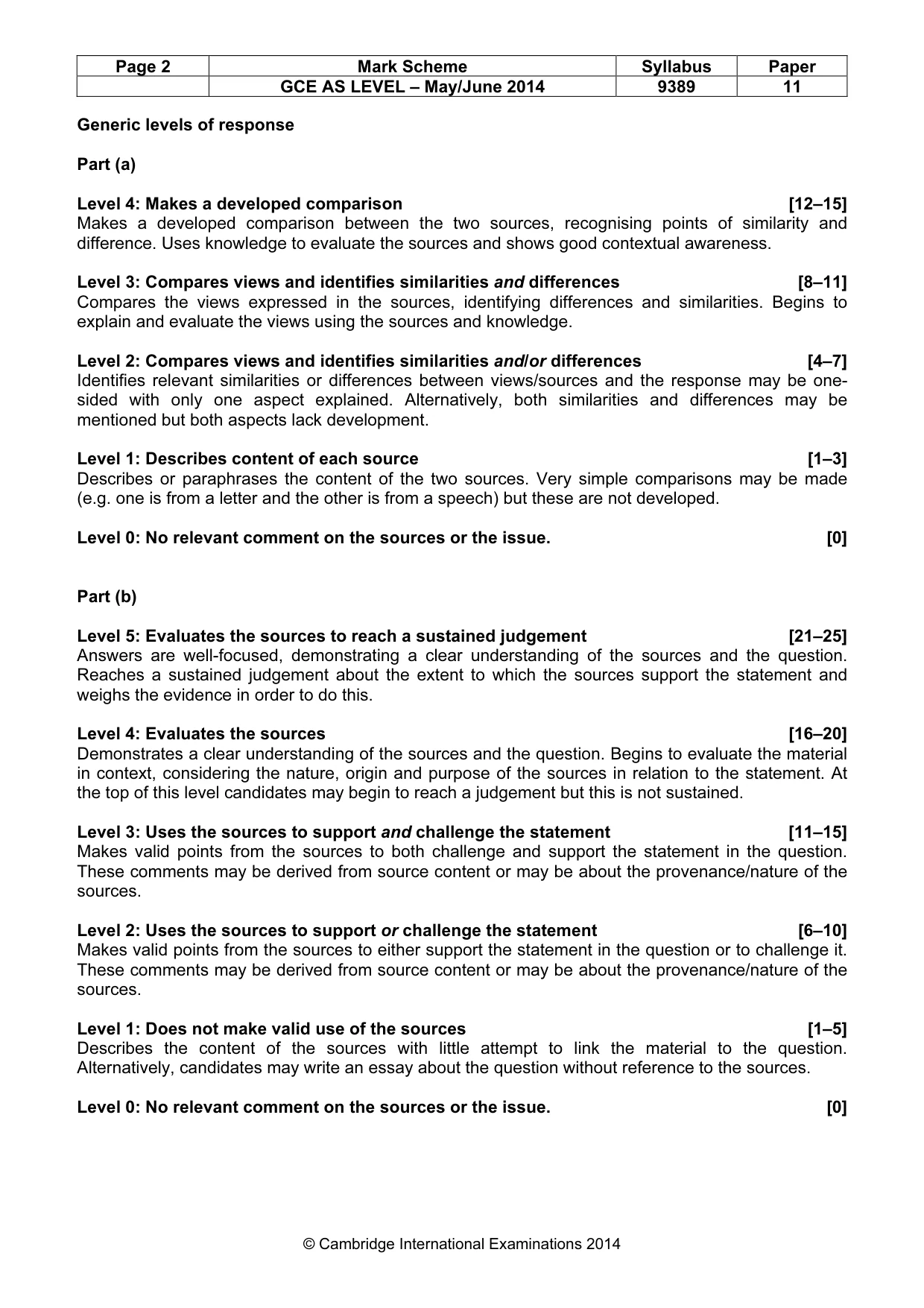
Mark scheme, page 2
Page 2 Mark Scheme Syllabus Paper GCE AS LEVEL – May/June 2014 9389 11 © Cambridge International Examinations 2014 Generic levels of response Part (a) Level 4: Makes a developed comparison [12–15] Makes a developed comparison between the two sources, recognising points of similarity and difference. Uses knowledge to evaluate the sources and shows good contextual awareness. Level 3: Compares views and identifies similarities and differences [8–11] Compares the views expressed in the sources, identifying differences and similarities. Begins to explain and evaluate the views using the sources and knowledge. Level 2: Compares views and identifies similarities and/or differences [4–7] Identifies relevant similarities or differences between views/sources and the response may be one- sided with only one aspect explained. Alternatively, both similarities and differences may be mentioned but both aspects lack development. Level 1: Describes content of each source [1–3] Describes or paraphrases the content of the two sources. Very simple comparisons may be made (e.g. one is from a letter and the other is from a speech) but these are not developed. Level 0: No relevant comment on the sources or the issue. [0] Part (b) Level 5: Evaluates the sources to reach a sustained judgement [21–25] Answers are well-focused, demonstrating a clear understanding of the sources and the question. Reaches a sustained judgement about the extent to which the sources support the statement and weighs the evidence in order to do this. Level 4: Evaluates the sources [16–20] Demonstrates a clear understanding of the sources and the question. Begins to evaluate the material in context, considering the nature, origin and purpose of the sources in relation to the statement. At the top of this level candidates may begin to reach a judgement but this is not sustained. Level 3: Uses the sources to support and challenge the statement [11–15] Makes valid points from the sources to both challenge and support the statement in the question. These comments may be derived from source content or may be about the provenance/nature of the sources. Level 2: Uses the sources to support or challenge the statement [6–10] Makes valid points from the sources to either support the statement in the question or to challenge it. These comments may be derived from source content or may be about the provenance/nature of the sources. Level 1: Does not make valid use of the sources [1–5] Describes the content of the sources with little attempt to link the material to the question. Alternatively, candidates may write an essay about the question without reference to the sources. Level 0: No relevant comment on the sources or the issue. [0]
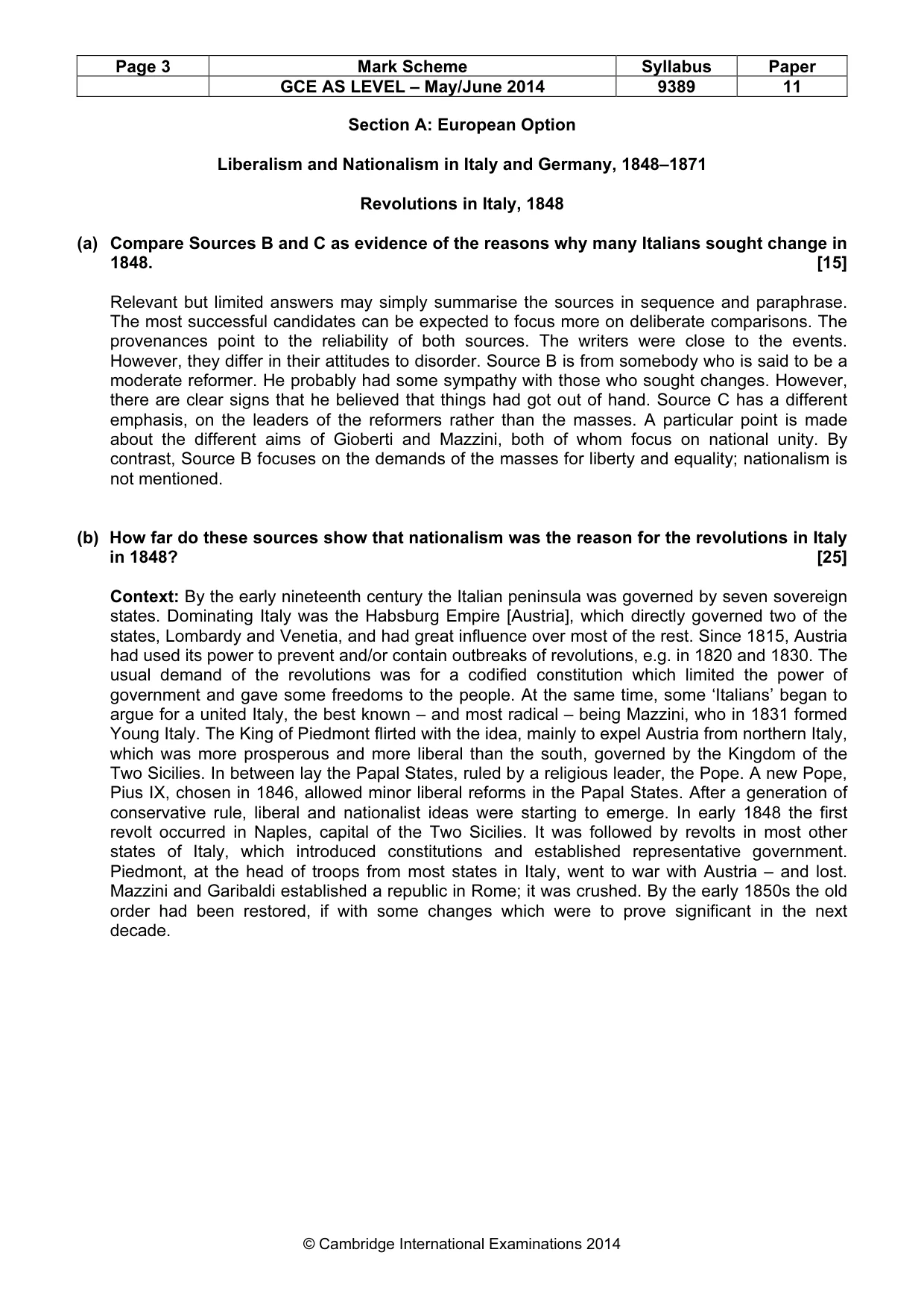
Mark scheme, page 3
Page 3 Mark Scheme Syllabus Paper GCE AS LEVEL – May/June 2014 9389 11 © Cambridge International Examinations 2014 Section A: European Option Liberalism and Nationalism in Italy and Germany, 1848–1871 Revolutions in Italy, 1848 (a) Compare Sources B and C as evidence of the reasons why many Italians sought change in 1848. [15] Relevant but limited answers may simply summarise the sources in sequence and paraphrase. The most successful candidates can be expected to focus more on deliberate comparisons. The provenances point to the reliability of both sources. The writers were close to the events. However, they differ in their attitudes to disorder. Source B is from somebody who is said to be a moderate reformer. He probably had some sympathy with those who sought changes. However, there are clear signs that he believed that things had got out of hand. Source C has a different emphasis, on the leaders of the reformers rather than the masses. A particular point is made about the different aims of Gioberti and Mazzini, both of whom focus on national unity. By contrast, Source B focuses on the demands of the masses for liberty and equality; nationalism is not mentioned. (b) How far do these sources show that nationalism was the reason for the revolutions in Italy in 1848? [25] Context: By the early nineteenth century the Italian peninsula was governed by seven sovereign states. Dominating Italy was the Habsburg Empire [Austria], which directly governed two of the states, Lombardy and Venetia, and had great influence over most of the rest. Since 1815, Austria had used its power to prevent and/or contain outbreaks of revolutions, e.g. in 1820 and 1830. The usual demand of the revolutions was for a codified constitution which limited the power of government and gave some freedoms to the people. At the same time, some ‘Italians’ began to argue for a united Italy, the best known – and most radical – being Mazzini, who in 1831 formed Young Italy. The King of Piedmont flirted with the idea, mainly to expel Austria from northern Italy, which was more prosperous and more liberal than the south, governed by the Kingdom of the Two Sicilies. In between lay the Papal States, ruled by a religious leader, the Pope. A new Pope, Pius IX, chosen in 1846, allowed minor liberal reforms in the Papal States. After a generation of conservative rule, liberal and nationalist ideas were starting to emerge. In early 1848 the first revolt occurred in Naples, capital of the Two Sicilies. It was followed by revolts in most other states of Italy, which introduced constitutions and established representative government. Piedmont, at the head of troops from most states in Italy, went to war with Austria – and lost. Mazzini and Garibaldi established a republic in Rome; it was crushed. By the early 1850s the old order had been restored, if with some changes which were to prove significant in the next decade.
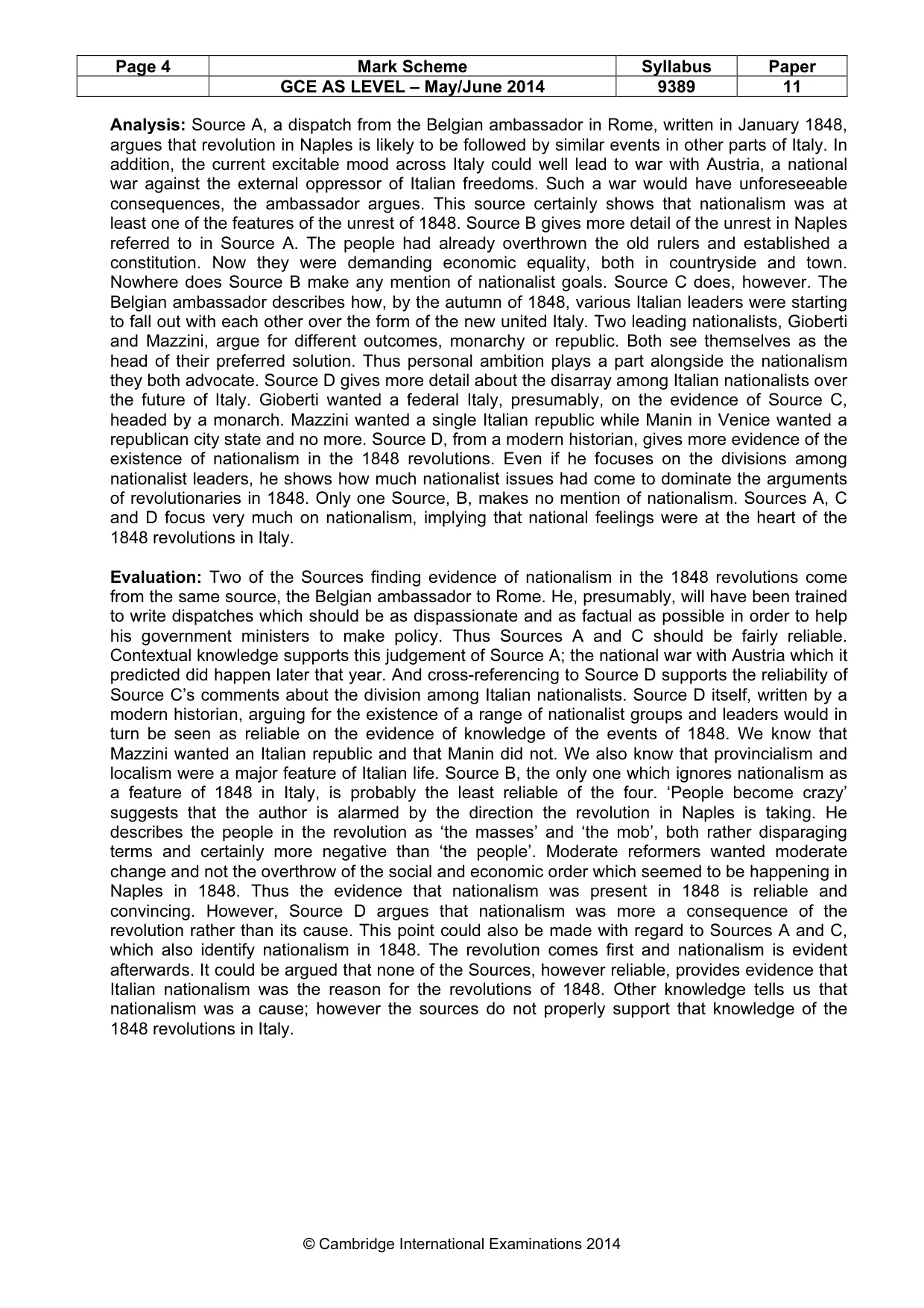
Mark scheme, page 4
Page 4 Mark Scheme Syllabus Paper GCE AS LEVEL – May/June 2014 9389 11 © Cambridge International Examinations 2014 Analysis: Source A, a dispatch from the Belgian ambassador in Rome, written in January 1848, argues that revolution in Naples is likely to be followed by similar events in other parts of Italy. In addition, the current excitable mood across Italy could well lead to war with Austria, a national war against the external oppressor of Italian freedoms. Such a war would have unforeseeable consequences, the ambassador argues. This source certainly shows that nationalism was at least one of the features of the unrest of 1848. Source B gives more detail of the unrest in Naples referred to in Source A. The people had already overthrown the old rulers and established a constitution. Now they were demanding economic equality, both in countryside and town. Nowhere does Source B make any mention of nationalist goals. Source C does, however. The Belgian ambassador describes how, by the autumn of 1848, various Italian leaders were starting to fall out with each other over the form of the new united Italy. Two leading nationalists, Gioberti and Mazzini, argue for different outcomes, monarchy or republic. Both see themselves as the head of their preferred solution. Thus personal ambition plays a part alongside the nationalism they both advocate. Source D gives more detail about the disarray among Italian nationalists over the future of Italy. Gioberti wanted a federal Italy, presumably, on the evidence of Source C, headed by a monarch. Mazzini wanted a single Italian republic while Manin in Venice wanted a republican city state and no more. Source D, from a modern historian, gives more evidence of the existence of nationalism in the 1848 revolutions. Even if he focuses on the divisions among nationalist leaders, he shows how much nationalist issues had come to dominate the arguments of revolutionaries in 1848. Only one Source, B, makes no mention of nationalism. Sources A, C and D focus very much on nationalism, implying that national feelings were at the heart of the 1848 revolutions in Italy. Evaluation: Two of the Sources finding evidence of nationalism in the 1848 revolutions come from the same source, the Belgian ambassador to Rome. He, presumably, will have been trained to write dispatches which should be as dispassionate and as factual as possible in order to help his government ministers to make policy. Thus Sources A and C should be fairly reliable. Contextual knowledge supports this judgement of Source A; the national war with Austria which it predicted did happen later that year. And cross-referencing to Source D supports the reliability of Source C’s comments about the division among Italian nationalists. Source D itself, written by a modern historian, arguing for the existence of a range of nationalist groups and leaders would in turn be seen as reliable on the evidence of knowledge of the events of 1848. We know that Mazzini wanted an Italian republic and that Manin did not. We also know that provincialism and localism were a major feature of Italian life. Source B, the only one which ignores nationalism as a feature of 1848 in Italy, is probably the least reliable of the four. ‘People become crazy’ suggests that the author is alarmed by the direction the revolution in Naples is taking. He describes the people in the revolution as ‘the masses’ and ‘the mob’, both rather disparaging terms and certainly more negative than ‘the people’. Moderate reformers wanted moderate change and not the overthrow of the social and economic order which seemed to be happening in Naples in 1848. Thus the evidence that nationalism was present in 1848 is reliable and convincing. However, Source D argues that nationalism was more a consequence of the revolution rather than its cause. This point could also be made with regard to Sources A and C, which also identify nationalism in 1848. The revolution comes first and nationalism is evident afterwards. It could be argued that none of the Sources, however reliable, provides evidence that Italian nationalism was the reason for the revolutions of 1848. Other knowledge tells us that nationalism was a cause; however the sources do not properly support that knowledge of the 1848 revolutions in Italy.
Mark scheme, page 5
Page 5 Mark Scheme Syllabus Paper GCE AS LEVEL – May/June 2014 9389 11 © Cambridge International Examinations 2014 Section B: American Option The Origins of the Civil War, 1846–1861 The Compromise of 1850 Indicative Content (a) To what extent do Sources B and C agree the role of the South in the making of the 1850 Compromise? [15] Sources B and C agree that the South had a role in making the 1850 Compromise. There is agreement, only implicit in Source B, that the Compromise included the Fugitive Slave Law. However, they provide contrasting views of the role of the South. Source B states that the South was dominant: the Compromise measures were ‘unquestionably’ of Southern origin, drafted to ‘promote and encourage Southern interests’. Coming from a Northern newspaper, Source B is implicitly critical of Northern politicians who have been ‘a dupe’ to the threats of the South. Its more predictable anti-South slant comes in the second paragraph, which shows the South falling out among themselves after the Compromise has been agreed. Source C maintains that the South had a subordinate role, given ‘the adversary’s strength’, by which it meant the North’s. Source C lists the many concessions which it believes the South has made, the Fugitive Slave Act being its only gain. The difference might be explained by the almost seven-year gap between the two sources. Source B is an immediate Northern response to news of the Compromise, whereas Source C is a more reflective piece, following the implementation of the 1850 agreement. Source C is quite restrained given that the South must have known by then that many Northern states were disobeying the Fugitive Slave Act. (b) How far do these sources support the assertion that the 1850 Compromise was favourable to the North? [25] Context: The 1850 Compromise was a complex series of laws and policies which involved both sections making some concessions – which was an essential part of the US political process. The North conceded a new Fugitive Slave law, harsher than its predecessor, which the South expected Northern states to uphold thereafter. The South conceded the entry of California into the USA as a free state – it had wanted the state divided – and the abolition of the slave trade in Washington DC. Also both compromised over the territories of New Mexico and Utah: the North abandoned the Wilmot Proviso, the South conceded the principle of popular sovereignty. The South had conceded something which they could not affect thereafter – the governance of the new lands – in an attempt to make gains with regard to fugitive slaves which were to prove illusory. The North had conceded something the success of which depended upon its cooperation. Many Northern states refused to cooperate. Between 1854 and 1858 nine of them passed Personal Liberty Laws of some kind or other, most giving fugitive slaves the right to trial by jury if they appealed to state courts. These laws became a major source of contention between North and South.
Mark scheme, page 6
Page 6 Mark Scheme Syllabus Paper GCE AS LEVEL – May/June 2014 9389 11 © Cambridge International Examinations 2014 Analysis: Source A contrasts the author’s positive view of the 1850 Compromise with the critical responses he notes from both North and South. He asserts that in Congress both sides made concessions. In the North and South, however, the Compromise was much criticised. Written around the same time, Source B certainly argues that the terms of the Compromise benefited the South and disadvantaged the North. Most of Source C argues that the terms of the Fugitive Slave Act favoured the South. Turning to the North, Source D argues that many abolitionists saw the concessions made by the North as so great as to require civil disobedience. They certainly did not see this part of the Compromise as a victory. Thus while two sources are general and contemporary to the Compromise, the other two focus on a specific element of the Compromise and from a later vantage point. Evaluation: Taking the four Sources in sequence, two are Northern, one Southern, while Source D’s origin is uncertain. [In fact, Felix de Fontaine was a Northern journalist who reported for the South during the civil war.] The author of one of the Northern sources, Stephen Douglas, is often mistakenly seen as a Southerner, which might affect some candidates’ evaluation. The dates of the four sources are significant: Sources A and B are immediate responses to the Compromise being agreed. Source A claims a lot for the Compromise, probably because its author played a major part in bringing it about. Source B, the second Northern source, argues that the South dominated the making of the Compromise. The Southern source, C, argues that given the unequal balance of sectional power, the South gained what seemed a major concession, the Fugitive Slave law. Sources B and C could be contrasted; one argues that the ‘opposite’ side had made gains, the other that its own side had. Which is the more reliable? Written a few years later, Source D explains the initial fury of Northern abolitionists against the Fugitive Slave law and their later support for actions which undermined the law. With regard to the implementation of the Compromise, Sources C and D are most significant. Source C refers to other aspects of the 1850 Compromise, those which clearly benefited the North – though it’s a Southern source which highlights the point. Source D shows widespread Northern opposition to the Fugitive Slave Act, which Northerners did not see as favourable. However, in that the Fugitive Slave Act brought together ‘whites and negroes’ who worked together to resist the implementation of the law, it could be argued that the Act worked to the benefit of the North. Both sources are in their different ways partisan. Source D claims to be a history of abolitionism but published at the start of the civil war, this history is likely to argue for or against abolitionism. Contextual knowledge would show that both C and D are reliable. This evaluation of the sources should help candidates modify the quote to draw a distinction between the theory and the practice of the 1850 Compromise. The theory of the Compromise, the intentions of the politicians who had negotiated it, was that the Compromise favoured neither North nor South, as shown by Source A. The practice, however, was very different, as shown by Source D.
Mark scheme, page 7
Page 7 Mark Scheme Syllabus Paper GCE AS LEVEL – May/June 2014 9389 11 © Cambridge International Examinations 2014 Section C: International Option The Search for International Peace and Security, 1919–1945 The League of Nations and the Italian Invasion of Abyssinia (a) Compare and contrast Sources B and C as evidence about Britain’s attitude towards the Italian invasion of Abyssinia. [15] The British Minister for League of Nations Affairs (Source B) argues that it is essential for the League to take decisive action against Italy since failure to do so would seriously weaken the League in the future. He continues that Britain, along with all the other members of the League with the exception of France, remains committed to upholding the terms of the Covenant. This implies that Britain is prepared to take action against Italy’s aggression in Abyssinia and to support collective security measures decided on by the League – sanctions and collective military action under Article 16. The British Prime Minister, Stanley Baldwin (Source C), also states that Britain is prepared to stand ‘faithfully to all its pledges with regard to the League’. However, he gives reasons why it might not be possible for Britain to support decisive action against Italy including ‘the great gravity of the European situation’ – the resurgence of Hitler’s Germany was a cause for concern. There was a risk that Mussolini might retaliate if Britain supported decisive measures against Italy. The two major European powers in the League of Nations were Britain and France. France was clearly unwilling to take action against Italy (as confirmed in Source B). Baldwin argued that ‘none of the members of the League seemed in a position to take decisive action against Italy’. While these countries might claim to support the Covenant (as stated in Source B), they were not ready or willing to support the League in taking collective military action in defence of Abyssinia. Finally, Britain was not adequately prepared to go to war. Source B comes from a private telegram, never intended for public scrutiny and, therefore, likely to be an accurate reflection of discussions held by members of the League in Geneva. While member nations, with the exception of France, claimed to offer full support to the League over the issue of the Italian invasion of Abyssinia, none were prepared to take the only action which was likely to be effective – collective security measures. Source C reflects the realistic and pragmatic views of a leading European statesman. Despite claiming that Britain is fully supportive of the League, he is effectively saying that Britain is not prepared to take decisive action against Italy. Baldwin is putting Britain’s national self-interest ahead of its responsibilities to the League. (b) How far do Sources A–D support the view that France was responsible for the League of Nations’ failure to take effective action in response to Italy’s invasion of Abyssinia. [25] Context: In April 1935 the UK, France and Italy signed the Stresa Front, Ramsay Macdonald for the UK, Laval for France and Mussolini for Italy. This was aimed at Germany, especially following the attempt at Anschluss the previous year. At the same time the situation in Abyssinia continued to deteriorate as Mussolini put more pressure on the country. In October 1935, Italy invaded Abyssinia. In November the League imposed limited sanctions, on arms sales finance and some goods. They hit Abyssinia harder than they did Italy. Oil was not on the list though the UK made some attempts to extend sanctions. However, the UK refused to close the Suez Canal to Italian ships. In December 1935 the British and French government drew up plans to divide Abyssinia between Abyssinia and Italy. These plans became known as the Hoare-Laval Pact. Before they were accepted by Italy, the plans were published in the French press. The public response to the Pact was so hostile, especially in Britain, that the Pact had to be abandoned and Hoare had to resign. Some in Britain blamed the French government for leaking the terms of the Pact. By May 1936 Italian troops had entered Addis Ababa. In July 1936 the League withdrew sanctions on Italy. In December 1937 Italy left the League.
Mark scheme, page 8
Page 8 Mark Scheme Syllabus Paper GCE AS LEVEL – May/June 2014 9389 11 © Cambridge International Examinations 2014 Analysis: Main support for the hypothesis comes from Source B, which sees France as having no genuine commitment to the League of Nations, simply wishing to exploit the League to further its own national interests. While all the other members of the League are prepared to take action against Italy, France was more concerned with keeping Italy in the alliance against Germany. Similarly, Source C argues that France, with its ‘horror of war’ would only be prepared to resort to military action if its own borders were threatened. Source A shows Laval as more concerned with European affairs than with events in Abyssinia. Source D confirms that ‘certain French governments had their share in these backslidings’, doing little to support the League in taking action against Italy. The sources also contain evidence which challenges the hypothesis. Source A shows that Mussolini himself had seriously damaged the League’s credibility. Despite being a member of the League, Italy was openly defying its agreements under the Covenant. That Mussolini’s actions had effectively split the League is demonstrated by the fact that he is depicted between the representation of the League and politicians of the two major powers, France and Britain. Like France, Britain is depicted as more concerned with the European situation than with events in Abyssinia. While accepting that France was partly responsible for the League’s failure to take effective action against Italy, the French delegate (Source D) implies that France was not solely to blame. Source C shows that Britain was reluctant to take action against Italy, the Prime Minister claiming that Britain supported the Covenant while, at the same time, making excuses for not doing so over Abyssinia. Source B claims that all the members of the League, with the exception of France, were prepared to take decisive action against Italy, yet Source D makes it clear that such action was never taken, merely token sanctions which had little effect other than angering Mussolini. Evaluation: Source A, the cartoon, is based on the opinions of the artist and the newspaper in which it was published, but is also likely to reflect (and even to have helped shape) public opinion in Britain. The cartoon is critical of Mussolini, but also of the British and French governments for refusing to support the League, which is left vulnerable and confused. It was published before Italy began its invasion and makes an accurate prediction regarding the League’s inability to act effectively against it. Source B comes from a private telegram and is likely to be an accurate reflection of discussions held by members of the League in Geneva. National representatives were, perhaps, naïve in assuming that their governments, concerned with wider issues of international diplomacy, would support them in their desire to take decisive action against Italy. Source C, being the report of the League of Nations delegation, is likely to be an accurate reflection of what Baldwin said. It is clear from Baldwin’s comments that Britain was neither willing nor able to support decisive action against Italy, especially given the reluctance of France. The meeting took place at the time when the League was considering what action, if any, to take against Italy. Source D, a statement made over ten years after the League’s failure to take effective action against Italy, has the advantage of hindsight and appreciates that the Abyssinian crisis effectively led to the demise of the League. It is critical of the fact that member states failed to act decisively, including France. The fact that a French delegate is publicly criticising the actions of past French governments gives the source a certain reliability.
What you needed in this session
Cambridge’s own grade thresholds for 2014 May/June, Paper 1 · Variant 1. A higher threshold means an easier paper — the bar moves with how the cohort did.