Cambridge A Level Geography 9696 — 2022 Oct/Nov Paper 4 · Variant 2
9696/42/O/N/22 · 11 questions · 60 marks · ≈68 min
The question paper and its mark scheme, free to read here and free to download. This is Cambridge’s own paper, exactly as it was sat.
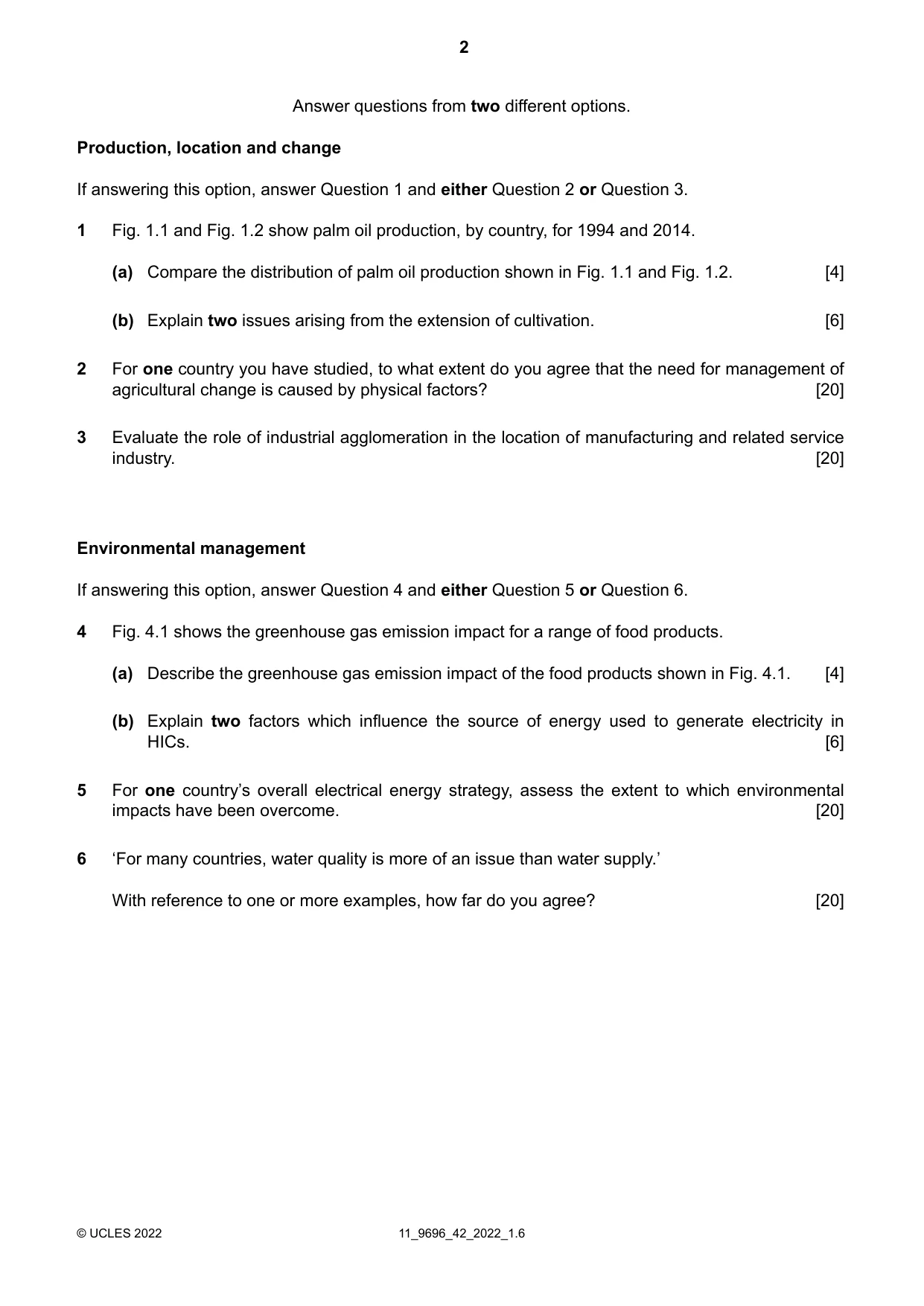
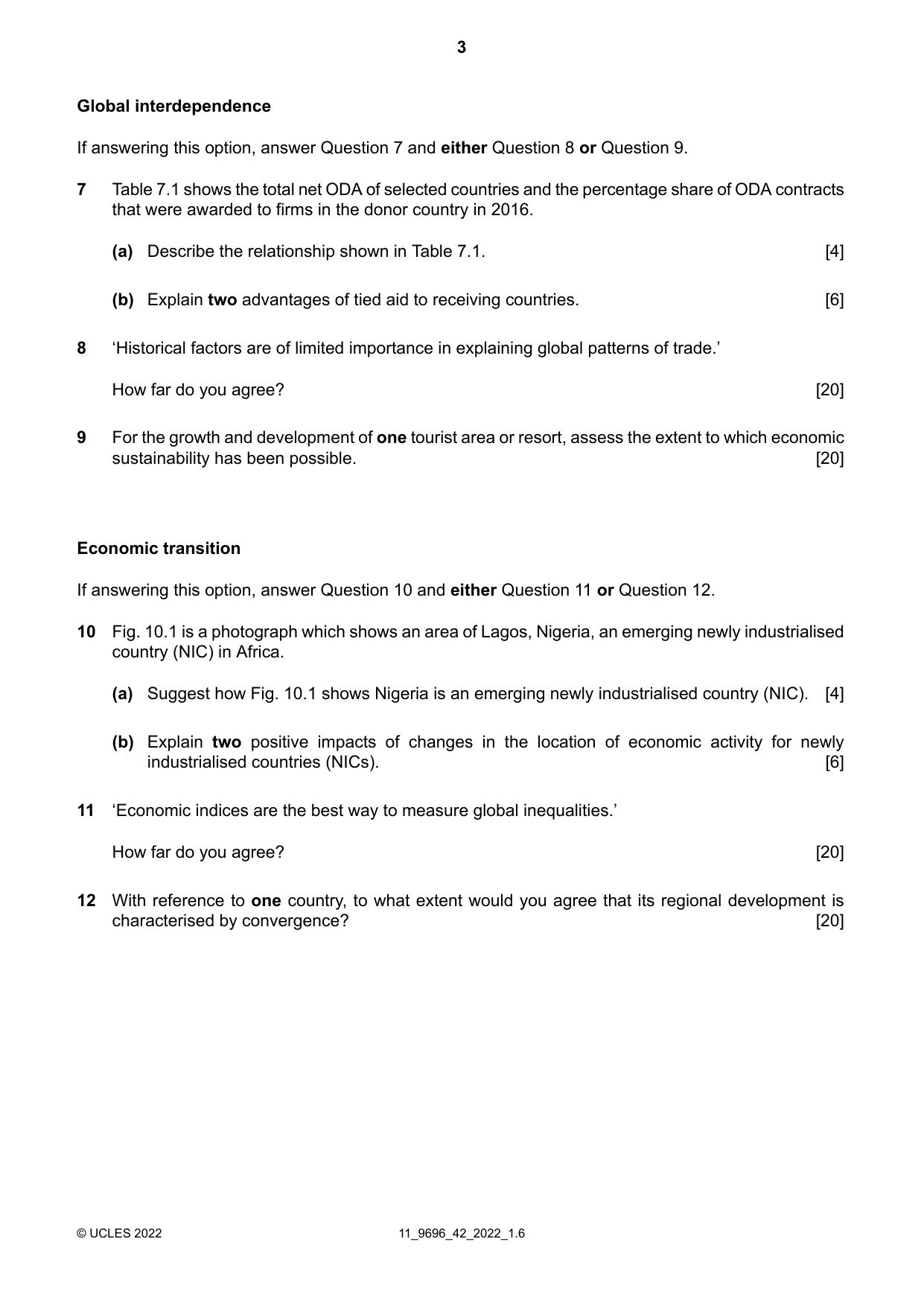
Question paper4 pages


Mark scheme22 pages
Answers below. Sit the paper first if you are practising.









Questions as text
Question 1
1 Fig. 1.1 and Fig. 1.2 show palm oil production, by country, for 1994 and 2014. (a) Compare the distribution of palm oil production shown in Fig. 1.1 and Fig. 1.2. [4] (b) Explain two issues arising from the extension of cultivation. [6]
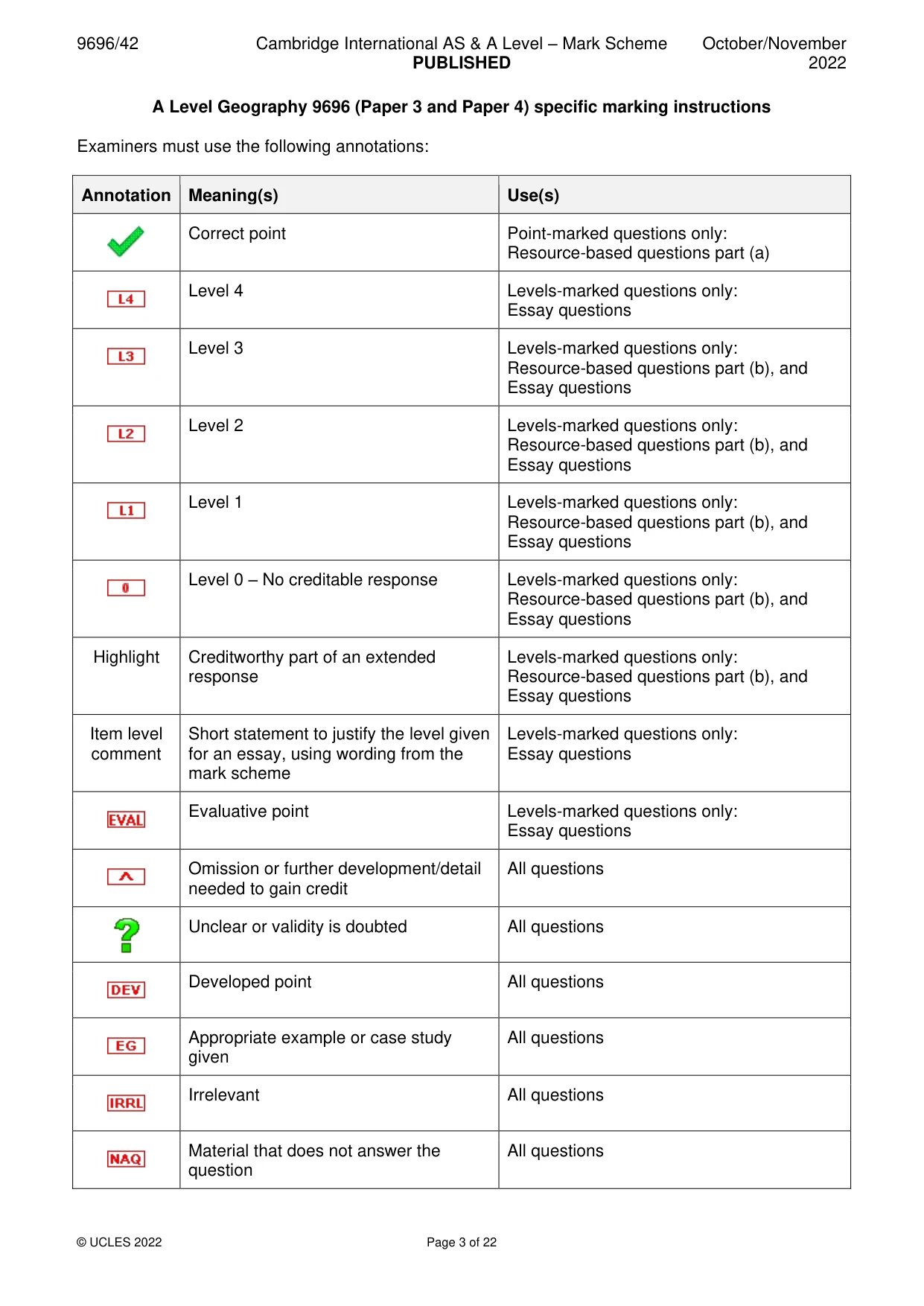
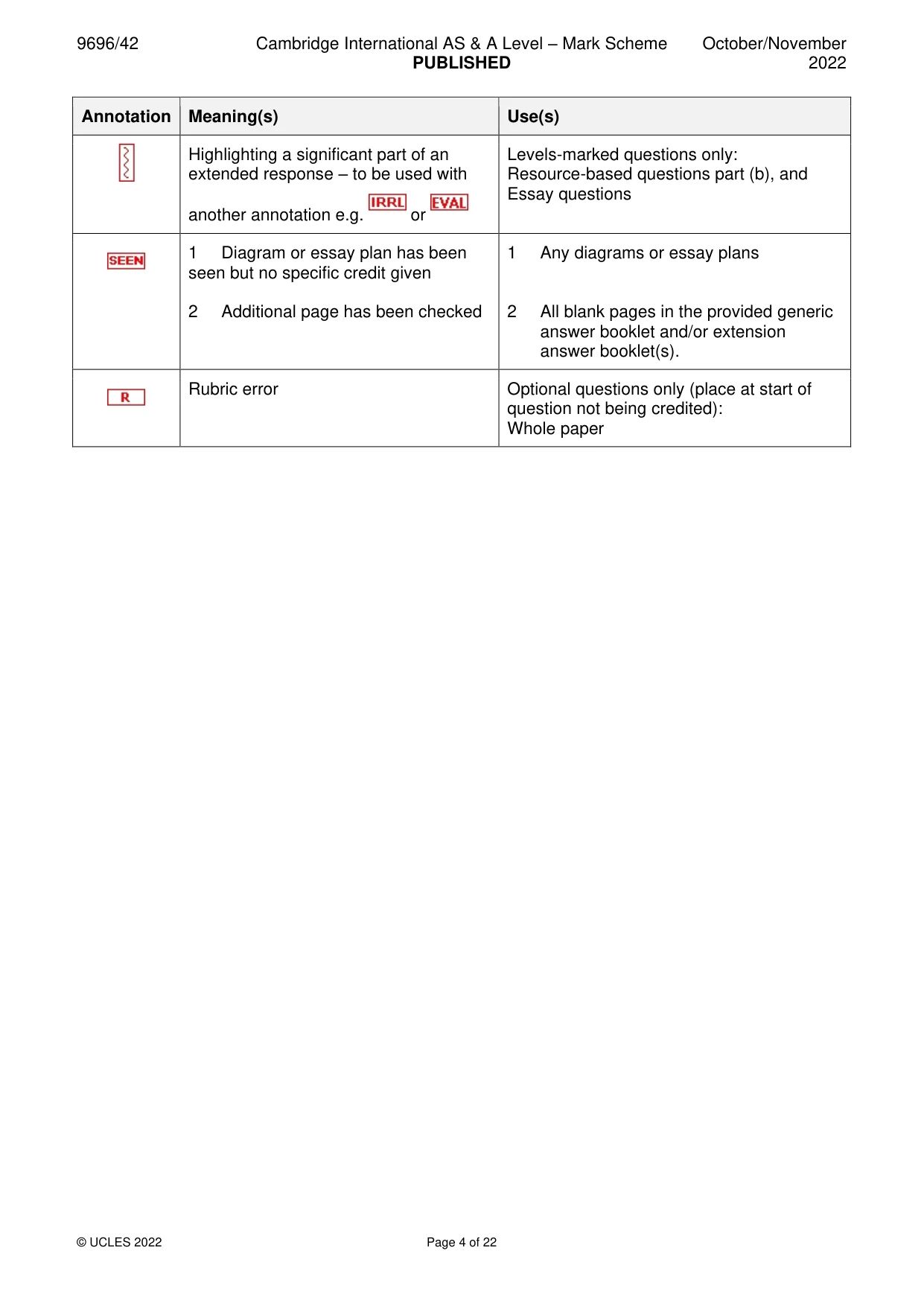
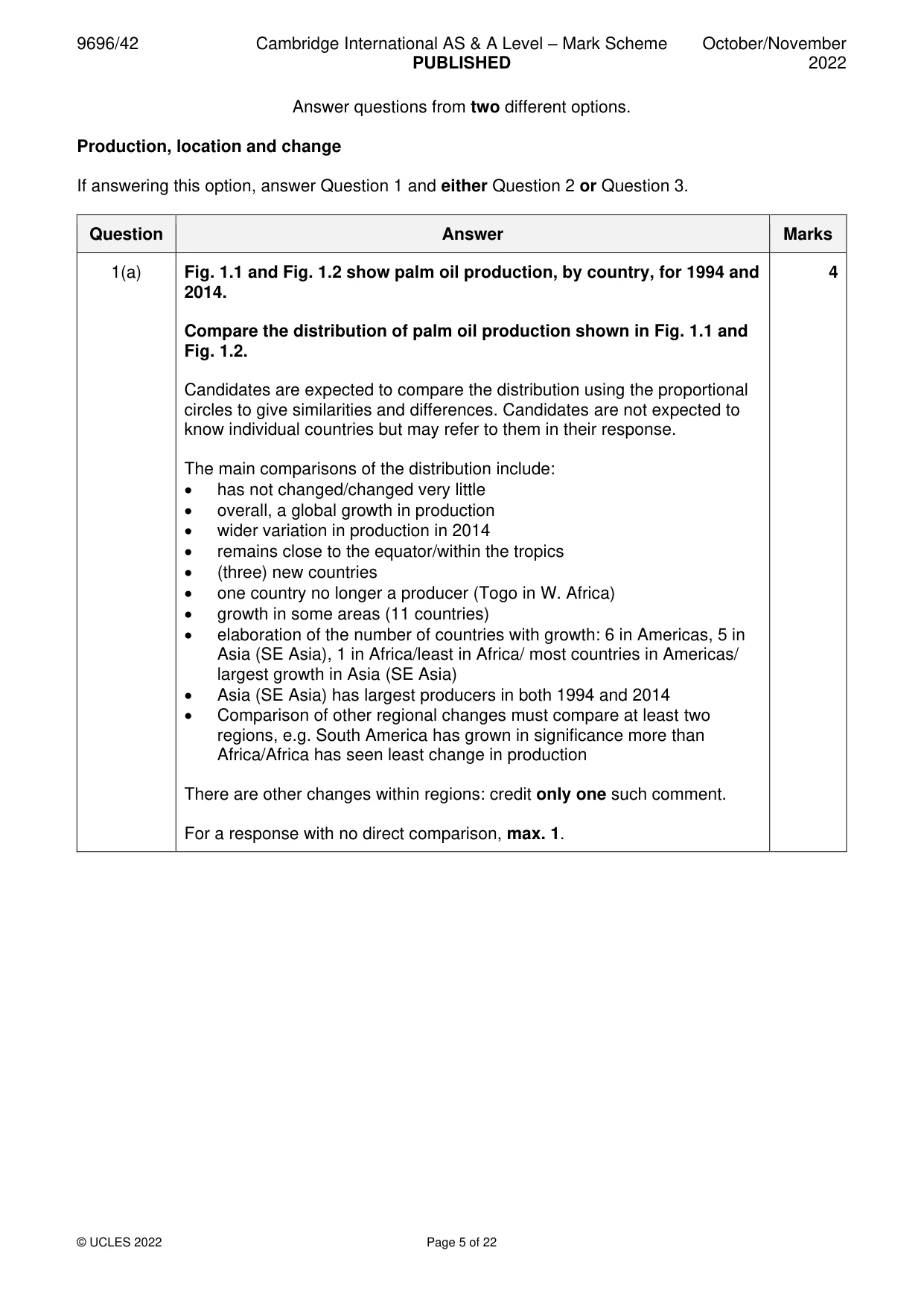
Mark scheme: Question Answer Marks 1(a) Fig. 1.1 and Fig. 1.2 show palm oil production, by country, for 1994 and 4 2014. Compare the distribution of palm oil production shown in Fig. 1.1 and Fig. 1.2. Candidates are expected to compare the distribution using the proportional circles to give similarities and differences. Candidates are not expected to know individual countries but may refer to them in their response. The main comparisons of the distribution include: • has not changed/changed very little • overall, a global growth in production • wider variation in production in 2014 • remains close to the equator/within the tropics • (three) new countries • one country no longer a producer (Togo in W. Africa) • growth in some areas (11 countries) • elaboration of the number of countries with growth: 6 in Americas, 5 in Asia (SE Asia), 1 in Africa/least in Africa/ most countries in Americas/ largest growth in Asia (SE Asia) • Asia (SE Asia) has largest producers in both 1994 and 2014 • Comparison of other regional changes must compare at least two regions, e.g. South America has grown in significance more than Africa/Africa has seen least change in production There are other changes within regions: credit only one such comment. For a response with no direct comparison, max. 1. 1(b) Explain two issues arising from the extension of cultivation. 6 Most candidates will take an approach to extension of cultivation as expansion of the area under cultivation or agricultural practices. Cultivation can simply be defined as: loosening and breaking up (tilling) of the soil in preparation for planting and/or promoting growth through destroying weeds and by increasing soil aeration and water infiltration. Credit will be awarded for comment on agricultural extension, i.e. education of farmers to expand their knowledge and skills in agricultural cultivation. Better responses will be well founded in the context of extension of cultivation through methods such as irrigation, terracing, use of marginal land, reclamation of wetlands, deforestation. Issues arising from extension of cultivation are wide ranging and might include aspects more normally associated with intensification or broadly increasing production such as the use of chemicals, fertiliser and machinery. Expect candidates to consider issues related to factors such as: • deforestation • pressure on water supply/pollution • soil degradation and erosion • desertification • salinisation • habitat loss/diversification • finance • land tenure • markets • others For responses founded on agricultural extension, consider the concept as extension of farmers’ knowledge and skills, technical advice and information organisation, motivation and self-confidence. Issues might be for farmers or from procedures involved and could include: • inertia/refusal to change • lack of confidence/experience • poor communication • lack of accountability • diseconomies of scale • other valid issues Identification only of two issues max. 1. Max. 4 for explanation of only one issue. Award marks based on the quality of explanation and breadth of the response using the marking levels below. Level 3 (5–6) Response clearly explains two issues arising from the extension of cultivation. Response is well founded in detailed knowledge and strong conceptual understanding of the topic. Examples used are appropriate and integrated effectively into the response. 1(b) Level 2 (3–4) Response explains two issues arising from the extension of cultivation. Response develops on a largely secure base of knowledge and understanding. Examples may lack detail or development. Level 1 (1–2) Response describes issues arising from the extension of cultivation. Knowledge is basic and understanding may be inaccurate. Examples are in name only or lacking entirely. Level 0 (0) No creditable response.
Q2 · For one country you have studied, to what extent do you agree that the need for…
2 For one country you have studied, to what extent do you agree that the need for management of agricultural change is caused by physical factors? [20]
Mark scheme: 2 For one country you have studied, to what extent do you agree that the 20 need for management of agricultural change is caused by physical factors? Candidates are free to develop their own approach to the question and responses will vary depending on the example(s) chosen. Whichever approach is chosen, essays which address the question and support their argument with relevant examples will be credited. The direction of the response and evaluation made will depend on the approach chosen, and any evaluation is therefore valid if argued and based on evidence. It is expected that candidates will focus their response on physical factors (relief, rainfall, climate, rock and soil type) and assess their importance either relative to each other or against other factors, such as social, economic or political. Candidates should include the need for management as a result of the physical factors for their chosen case study and how they were managed at the local scale. If more than one country, mark all and credit best or better. Award marks based on the quality of the response using the marking levels below. Level 4 (16–20) Response thoroughly discusses to what extent the need for management of agricultural change is caused by physical factors. An effective and sustained evaluation with a sound conclusion. Response is well founded in detailed exemplar knowledge and strong conceptual understanding of the topic. Examples used are appropriate and integrated effectively into the response. Level 3 (11–15) Response discusses to what extent the need for management of agricultural change is caused by physical factors but may be unbalanced. Response is broadly evaluative in character, comprising some explanatory or narrative content and a conclusion. Response develops on a largely secure base of knowledge and understanding with the use of example(s). Level 2 (6–10) Response demonstrates some knowledge and understanding of to what extent the need for management of agricultural change is caused by physical factors. Response is mainly descriptive or explanatory in approach and contains a brief or thinly supported evaluation. Responses without the use of example(s) to support the response will not get above the middle of Level 2 (8 marks). Level 1 (1–5) Response makes a few general points about the need for management of agricultural change and/or physical factors. A descriptive response comprising a few simple points. Knowledge is basic and understanding may be poor and lack relevance to the question set. Level 0 (0) No creditable response.
Q3 · Evaluate the role of industrial agglomeration in the location of manufacturing and…
3 Evaluate the role of industrial agglomeration in the location of manufacturing and related service industry. [20] Environmental management If answering this option, answer Question 4 and either Question 5 or Question 6.
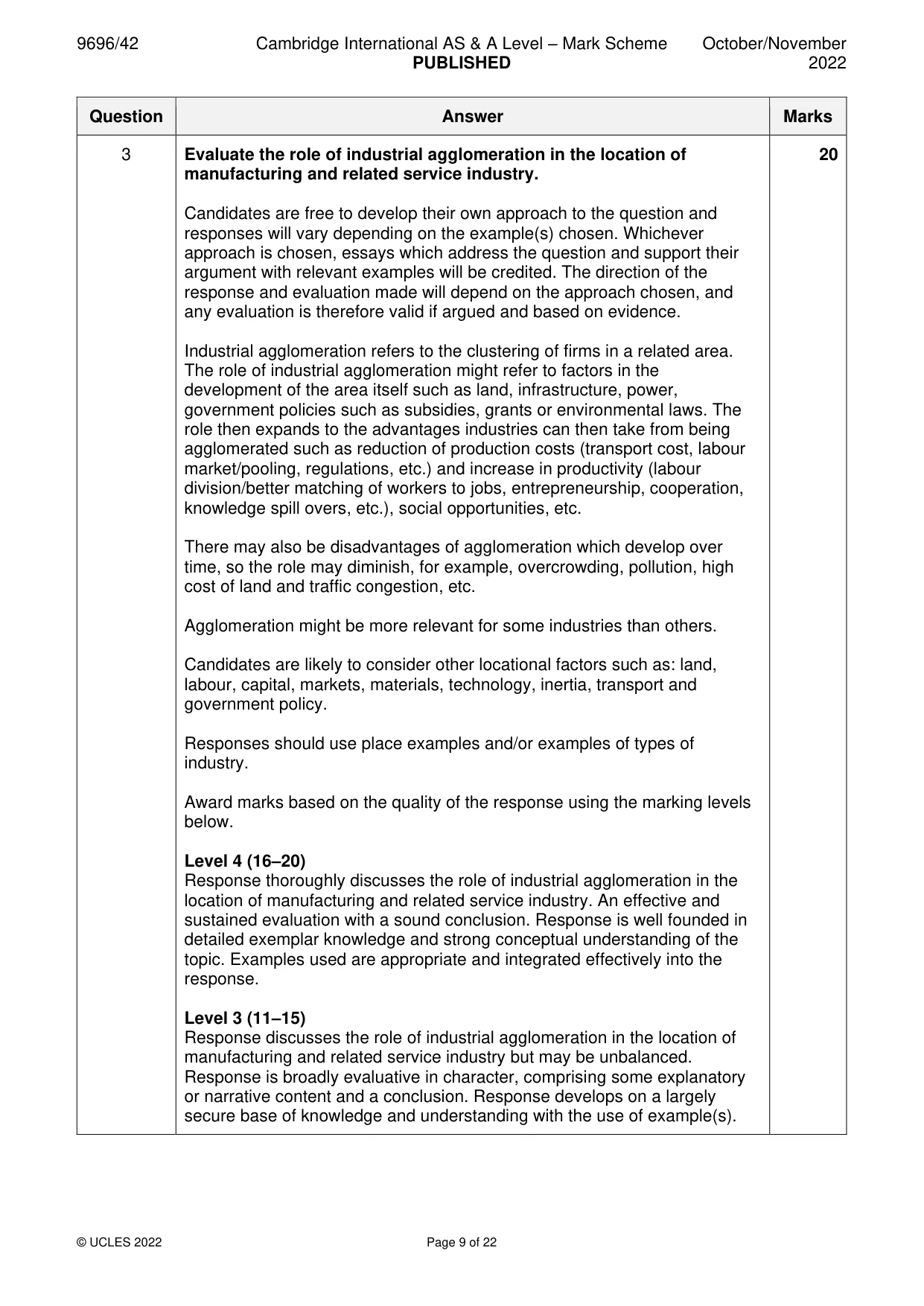
Mark scheme: 3 Evaluate the role of industrial agglomeration in the location of 20 manufacturing and related service industry. Candidates are free to develop their own approach to the question and responses will vary depending on the example(s) chosen. Whichever approach is chosen, essays which address the question and support their argument with relevant examples will be credited. The direction of the response and evaluation made will depend on the approach chosen, and any evaluation is therefore valid if argued and based on evidence. Industrial agglomeration refers to the clustering of firms in a related area. The role of industrial agglomeration might refer to factors in the development of the area itself such as land, infrastructure, power, government policies such as subsidies, grants or environmental laws. The role then expands to the advantages industries can then take from being agglomerated such as reduction of production costs (transport cost, labour market/pooling, regulations, etc.) and increase in productivity (labour division/better matching of workers to jobs, entrepreneurship, cooperation, knowledge spill overs, etc.), social opportunities, etc. There may also be disadvantages of agglomeration which develop over time, so the role may diminish, for example, overcrowding, pollution, high cost of land and traffic congestion, etc. Agglomeration might be more relevant for some industries than others. Candidates are likely to consider other locational factors such as: land, labour, capital, markets, materials, technology, inertia, transport and government policy. Responses should use place examples and/or examples of types of industry. Award marks based on the quality of the response using the marking levels below. Level 4 (16–20) Response thoroughly discusses the role of industrial agglomeration in the location of manufacturing and related service industry. An effective and sustained evaluation with a sound conclusion. Response is well founded in detailed exemplar knowledge and strong conceptual understanding of the topic. Examples used are appropriate and integrated effectively into the response. Level 3 (11–15) Response discusses the role of industrial agglomeration in the location of manufacturing and related service industry but may be unbalanced. Response is broadly evaluative in character, comprising some explanatory or narrative content and a conclusion. Response develops on a largely secure base of knowledge and understanding with the use of example(s). 3 Level 2 (6–10) Response demonstrates some knowledge and understanding of the role of industrial agglomeration in the location of manufacturing and related service industry. Response is mainly descriptive or explanatory in approach and contains a brief or thinly supported evaluation. Responses without the use of example(s) to support the response will not get above the middle of Level 2 (8 marks). Level 1 (1–5) Response makes a few general points about the role of industrial agglomeration in the location of manufacturing and related service industry. A descriptive response comprising a few simple points. Knowledge is basic and understanding may be poor and lack relevance to the question set. Level 0 (0) No creditable response. Environmental management If answering this option, answer Question 4 and either Question 5 or Question 6.
Q4 · The greenhouse gas emission impact for a range of food products
4 Fig. 4.1 shows the greenhouse gas emission impact for a range of food products. (a) Describe the greenhouse gas emission impact of the food products shown in Fig. 4.1. [4] (b) Explain two factors which influence the source of energy used to generate electricity in HICs. [6]
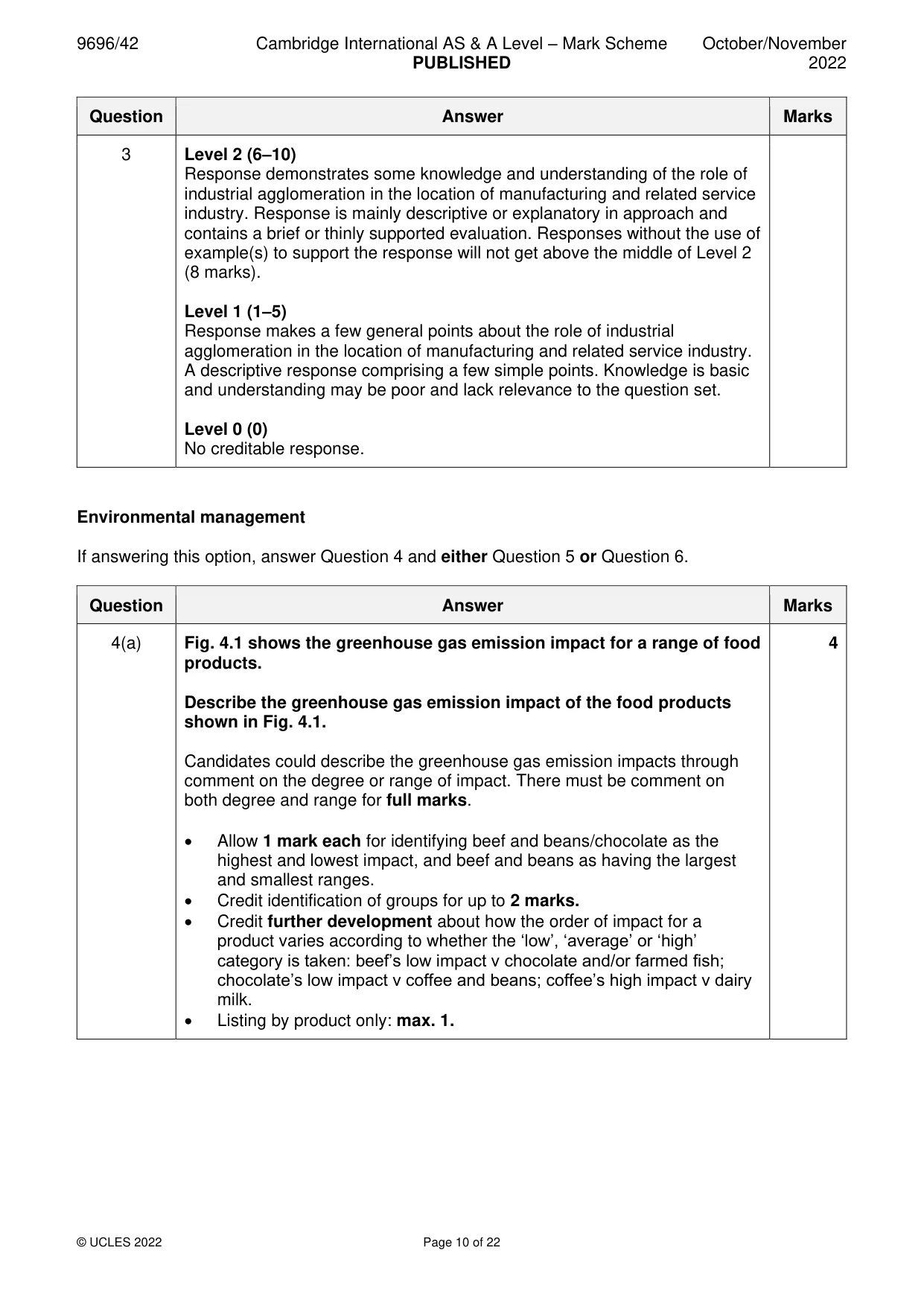
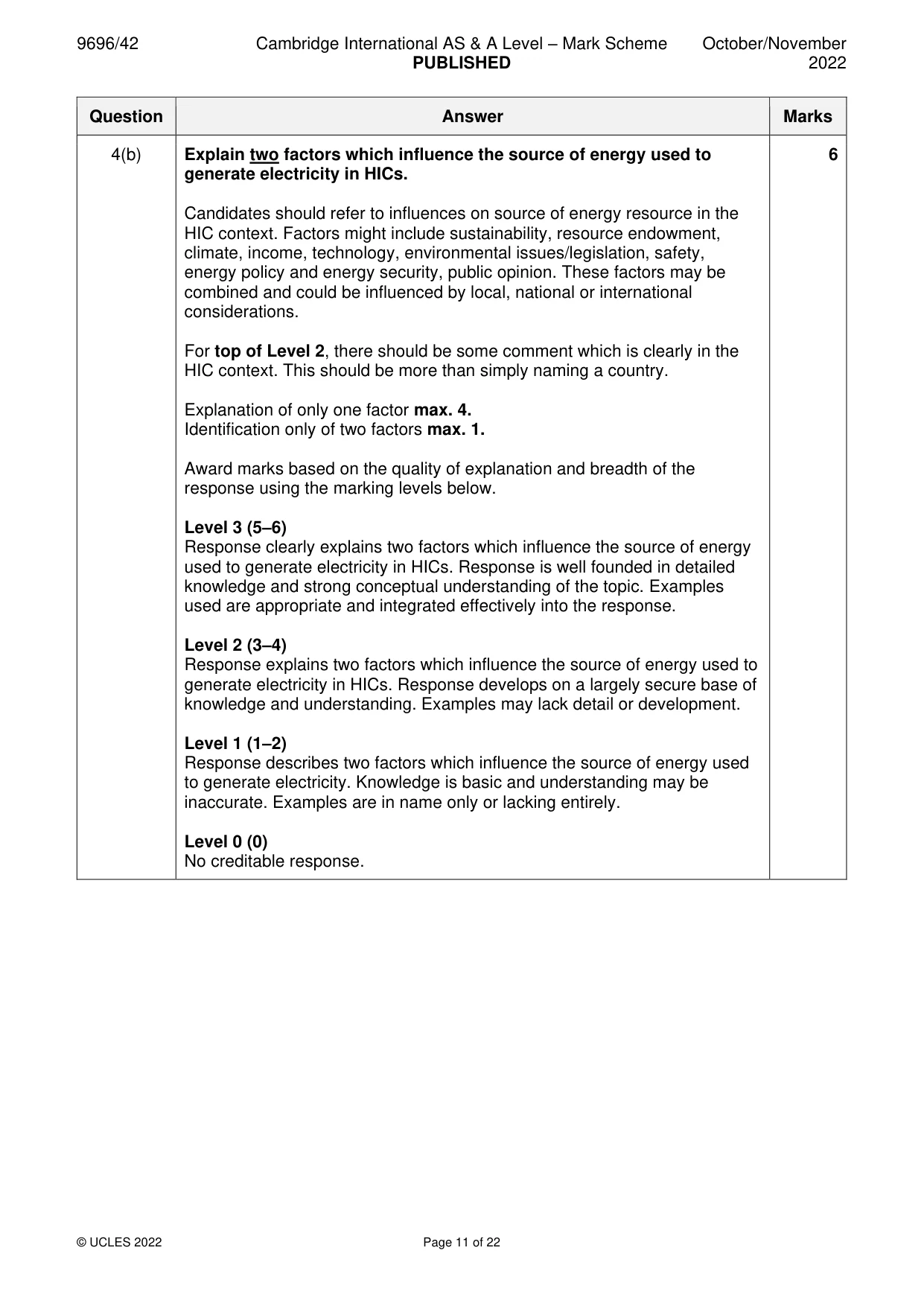
Mark scheme: 4(a) Fig. 4.1 shows the greenhouse gas emission impact for a range of food 4 products. Describe the greenhouse gas emission impact of the food products shown in Fig. 4.1. Candidates could describe the greenhouse gas emission impacts through comment on the degree or range of impact. There must be comment on both degree and range for full marks. • Allow 1 mark each for identifying beef and beans/chocolate as the highest and lowest impact, and beef and beans as having the largest and smallest ranges. • Credit identification of groups for up to 2 marks. • Credit further development about how the order of impact for a product varies according to whether the ‘low’, ‘average’ or ‘high’ category is taken: beef’s low impact v chocolate and/or farmed fish; chocolate’s low impact v coffee and beans; coffee’s high impact v dairy milk. • Listing by product only: max. 1. 4(b) Explain two factors which influence the source of energy used to 6 generate electricity in HICs. Candidates should refer to influences on source of energy resource in the HIC context. Factors might include sustainability, resource endowment, climate, income, technology, environmental issues/legislation, safety, energy policy and energy security, public opinion. These factors may be combined and could be influenced by local, national or international considerations. For top of Level 2, there should be some comment which is clearly in the HIC context. This should be more than simply naming a country. Explanation of only one factor max. 4. Identification only of two factors max. 1. Award marks based on the quality of explanation and breadth of the response using the marking levels below. Level 3 (5–6) Response clearly explains two factors which influence the source of energy used to generate electricity in HICs. Response is well founded in detailed knowledge and strong conceptual understanding of the topic. Examples used are appropriate and integrated effectively into the response. Level 2 (3–4) Response explains two factors which influence the source of energy used to generate electricity in HICs. Response develops on a largely secure base of knowledge and understanding. Examples may lack detail or development. Level 1 (1–2) Response describes two factors which influence the source of energy used to generate electricity. Knowledge is basic and understanding may be inaccurate. Examples are in name only or lacking entirely. Level 0 (0) No creditable response.
Q5 · For one country’s overall electrical energy strategy, assess the extent to which…
5 For one country’s overall electrical energy strategy, assess the extent to which environmental impacts have been overcome. [20]
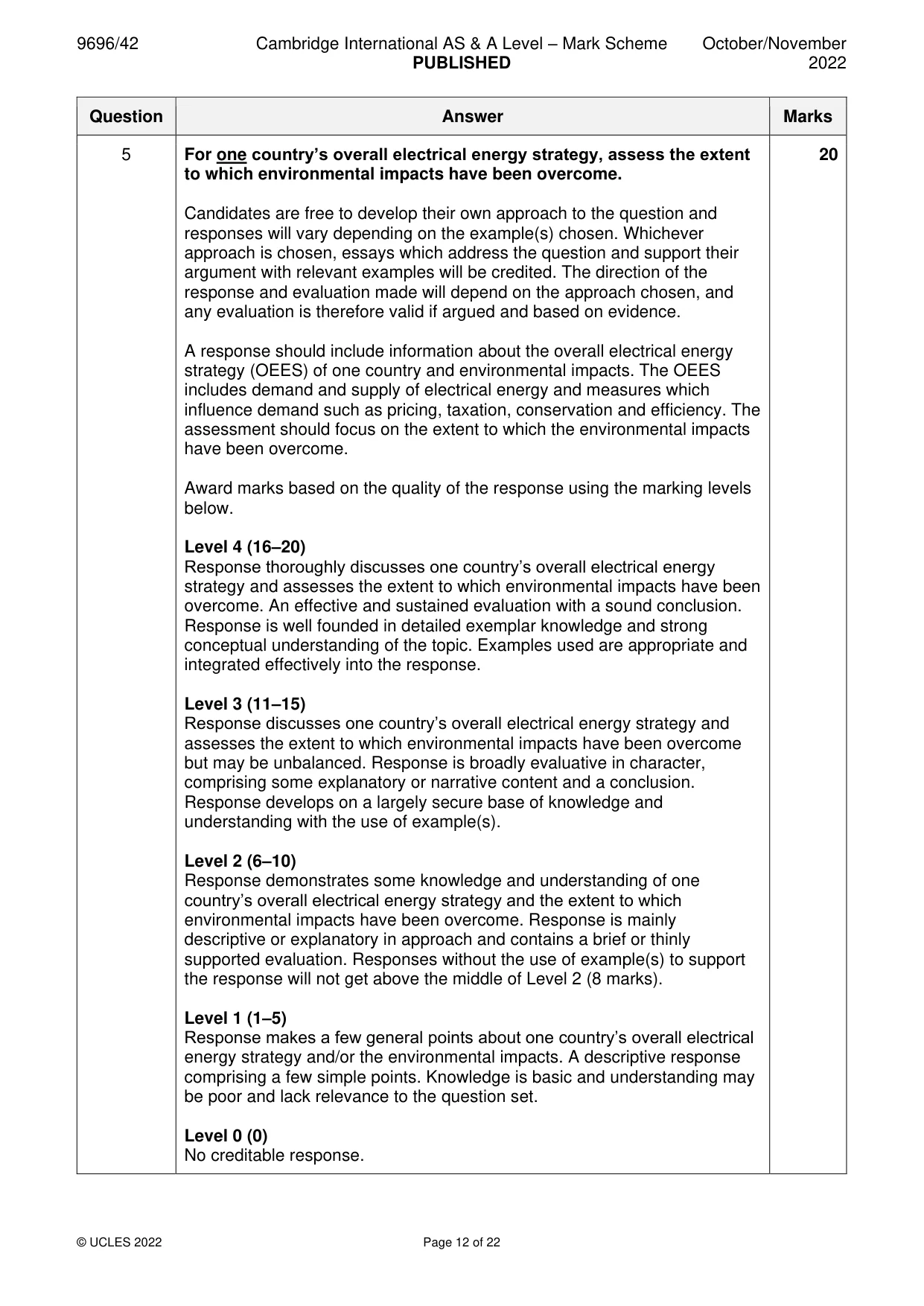
Mark scheme: 5 For one country’s overall electrical energy strategy, assess the extent 20 to which environmental impacts have been overcome. Candidates are free to develop their own approach to the question and responses will vary depending on the example(s) chosen. Whichever approach is chosen, essays which address the question and support their argument with relevant examples will be credited. The direction of the response and evaluation made will depend on the approach chosen, and any evaluation is therefore valid if argued and based on evidence. A response should include information about the overall electrical energy strategy (OEES) of one country and environmental impacts. The OEES includes demand and supply of electrical energy and measures which influence demand such as pricing, taxation, conservation and efficiency. The assessment should focus on the extent to which the environmental impacts have been overcome. Award marks based on the quality of the response using the marking levels below. Level 4 (16–20) Response thoroughly discusses one country’s overall electrical energy strategy and assesses the extent to which environmental impacts have been overcome. An effective and sustained evaluation with a sound conclusion. Response is well founded in detailed exemplar knowledge and strong conceptual understanding of the topic. Examples used are appropriate and integrated effectively into the response. Level 3 (11–15) Response discusses one country’s overall electrical energy strategy and assesses the extent to which environmental impacts have been overcome but may be unbalanced. Response is broadly evaluative in character, comprising some explanatory or narrative content and a conclusion. Response develops on a largely secure base of knowledge and understanding with the use of example(s). Level 2 (6–10) Response demonstrates some knowledge and understanding of one country’s overall electrical energy strategy and the extent to which environmental impacts have been overcome. Response is mainly descriptive or explanatory in approach and contains a brief or thinly supported evaluation. Responses without the use of example(s) to support the response will not get above the middle of Level 2 (8 marks). Level 1 (1–5) Response makes a few general points about one country’s overall electrical energy strategy and/or the environmental impacts. A descriptive response comprising a few simple points. Knowledge is basic and understanding may be poor and lack relevance to the question set. Level 0 (0) No creditable response.
Q6 · ‘For many countries, water quality is more of an issue than water supply.’ With reference…
6 ‘For many countries, water quality is more of an issue than water supply.’ With reference to one or more examples, how far do you agree? [20] Global interdependence If answering this option, answer Question 7 and either Question 8 or Question 9.
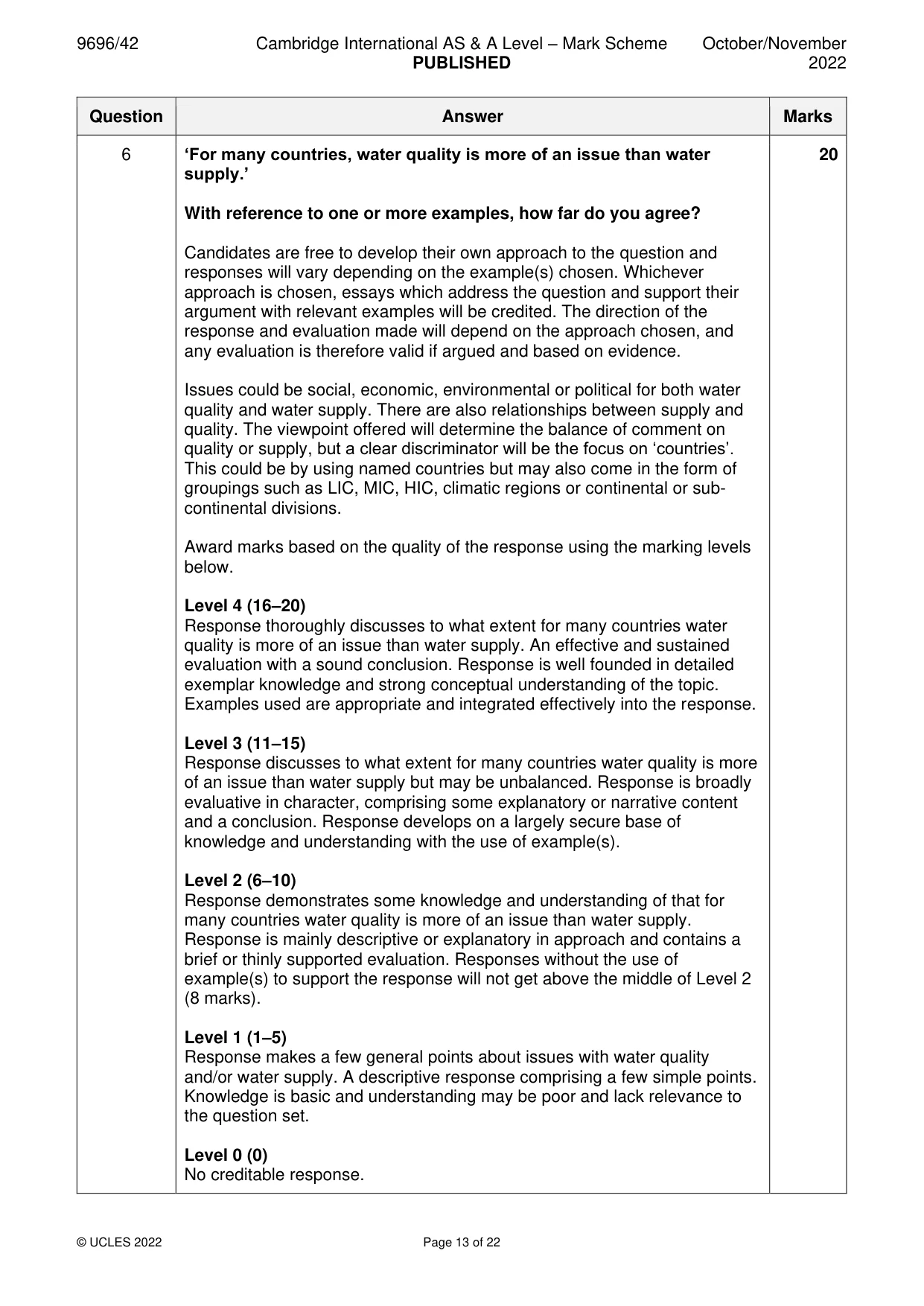
Mark scheme: 6 ‘For many countries, water quality is more of an issue than water 20 supply.’ With reference to one or more examples, how far do you agree? Candidates are free to develop their own approach to the question and responses will vary depending on the example(s) chosen. Whichever approach is chosen, essays which address the question and support their argument with relevant examples will be credited. The direction of the response and evaluation made will depend on the approach chosen, and any evaluation is therefore valid if argued and based on evidence. Issues could be social, economic, environmental or political for both water quality and water supply. There are also relationships between supply and quality. The viewpoint offered will determine the balance of comment on quality or supply, but a clear discriminator will be the focus on ‘countries’. This could be by using named countries but may also come in the form of groupings such as LIC, MIC, HIC, climatic regions or continental or sub- continental divisions. Award marks based on the quality of the response using the marking levels below. Level 4 (16–20) Response thoroughly discusses to what extent for many countries water quality is more of an issue than water supply. An effective and sustained evaluation with a sound conclusion. Response is well founded in detailed exemplar knowledge and strong conceptual understanding of the topic. Examples used are appropriate and integrated effectively into the response. Level 3 (11–15) Response discusses to what extent for many countries water quality is more of an issue than water supply but may be unbalanced. Response is broadly evaluative in character, comprising some explanatory or narrative content and a conclusion. Response develops on a largely secure base of knowledge and understanding with the use of example(s). Level 2 (6–10) Response demonstrates some knowledge and understanding of that for many countries water quality is more of an issue than water supply. Response is mainly descriptive or explanatory in approach and contains a brief or thinly supported evaluation. Responses without the use of example(s) to support the response will not get above the middle of Level 2 (8 marks). Level 1 (1–5) Response makes a few general points about issues with water quality and/or water supply. A descriptive response comprising a few simple points. Knowledge is basic and understanding may be poor and lack relevance to the question set. Level 0 (0) No creditable response. Global interdependence If answering this option, answer Question 7 and either Question 8 or Question 9.
Q7 · The total net ODA of selected countries and the percentage share of ODA contracts that…
7 Table 7.1 shows the total net ODA of selected countries and the percentage share of ODA contracts that were awarded to firms in the donor country in 2016. (a) Describe the relationship shown in Table 7.1. [4] (b) Explain two advantages of tied aid to receiving countries. [6]
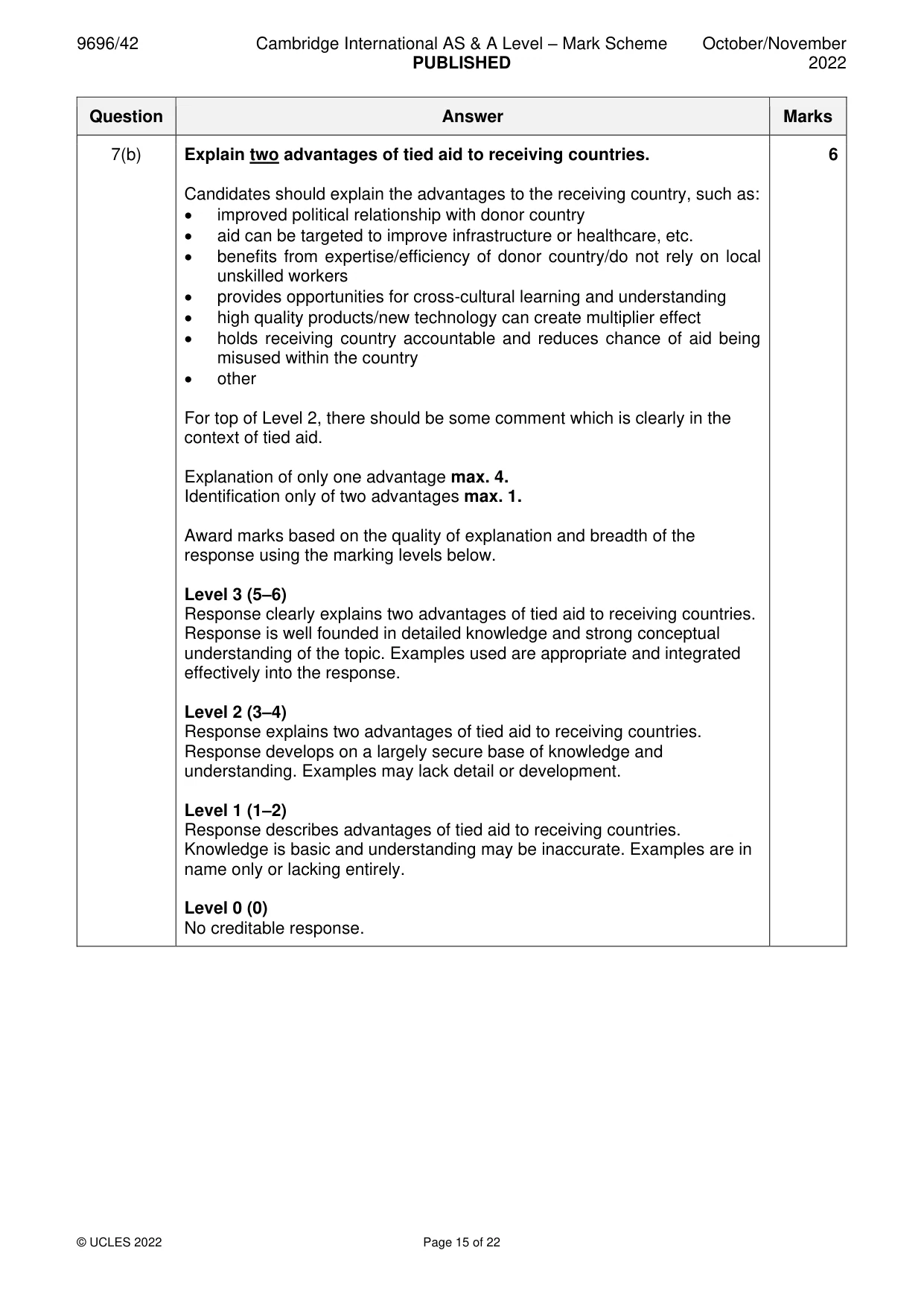
Mark scheme: 7(a) Table 7.1 shows the total net ODA of selected countries and the 4 percentage share of ODA contracts that were awarded to firms in the donor country in 2016. Describe the relationship shown in Table 7.1. Candidates should examine the relationship between the two variables shown in the table. They should describe and offer evidence and comment on what they find, such as: • there is no clear relationship/some positive, some negative evidence • the second highest donor (Germany at $24 736) has the second smallest (14%) • Australia/Finland/New Zealand have moderate to low ODA but relatively high % contracts given to firms in their country • evidence of a positive relationship at both the top and bottom of the donors USA and UK/Luxembourg and Portugal • evidence of a negative relationship, e.g. France, Canada and Switzerland • other valid comment using evidence 7(b) Explain two advantages of tied aid to receiving countries. 6 Candidates should explain the advantages to the receiving country, such as: • improved political relationship with donor country • aid can be targeted to improve infrastructure or healthcare, etc. • benefits from expertise/efficiency of donor country/do not rely on local unskilled workers • provides opportunities for cross-cultural learning and understanding • high quality products/new technology can create multiplier effect • holds receiving country accountable and reduces chance of aid being misused within the country • other For top of Level 2, there should be some comment which is clearly in the context of tied aid. Explanation of only one advantage max. 4. Identification only of two advantages max. 1. Award marks based on the quality of explanation and breadth of the response using the marking levels below. Level 3 (5–6) Response clearly explains two advantages of tied aid to receiving countries. Response is well founded in detailed knowledge and strong conceptual understanding of the topic. Examples used are appropriate and integrated effectively into the response. Level 2 (3–4) Response explains two advantages of tied aid to receiving countries. Response develops on a largely secure base of knowledge and understanding. Examples may lack detail or development. Level 1 (1–2) Response describes advantages of tied aid to receiving countries. Knowledge is basic and understanding may be inaccurate. Examples are in name only or lacking entirely. Level 0 (0) No creditable response.
Q8 · ‘Historical factors are of limited importance in explaining global patterns of trade.’…
8 ‘Historical factors are of limited importance in explaining global patterns of trade.’ How far do you agree? [20]
Mark scheme: 8 ‘Historical factors are of limited importance in explaining global 20 patterns of trade.’ How far do you agree? Candidates are free to develop their own approach to the question and responses will vary depending on the example(s) chosen. Whichever approach is chosen, essays which address the question and support their argument with relevant examples will be credited. The direction of the response and evaluation made will depend on the approach chosen, and any evaluation is therefore valid if argued and based on evidence. The nature of the statement allows candidates to balance the response with varying attention to historical factors and invites them to consider other factors such as resource endowment, locational advantage, trade agreements and changes in the global market. Candidates should, however, display knowledge of global patterns of trade, which may be described by value, volume, nature of product or direction. There may be comment on the balance between LIC/MIC/HIC but expect other comment on emerging economies and probably the rise of China, intra-regional or extra-regional flows and the dynamic nature of global patterns of trade. Reference to clear global patterns of trade may be a characteristic of a better response. Award marks based on the quality of the response using the marking levels below. Level 4 (16–20) Response thoroughly discusses whether historical factors are of limited importance in explaining global patterns of trade. An effective and sustained evaluation with a sound conclusion. Response is well founded in detailed exemplar knowledge and strong conceptual understanding of the topic. Examples used are appropriate and integrated effectively into the response. Level 3 (11–15) Response discusses whether historical factors are of limited importance in explaining global patterns of trade but may be unbalanced. Response is broadly evaluative in character, comprising some explanatory or narrative content and a conclusion. Response develops on a largely secure base of knowledge and understanding with the use of example(s). Level 2 (6–10) Response demonstrates some knowledge and understanding of historical factors and their importance in explaining global patterns of trade. Response is mainly descriptive or explanatory in approach and contains a brief or thinly supported evaluation. Responses without the use of example(s) to support the response will not get above the middle of Level 2 (8 marks). Level 1 (1–5) Response makes a few general points about historical factors and their importance in explaining global patterns of trade. A descriptive response comprising a few simple points. Knowledge is basic and understanding may be poor and lack relevance to the question set. Level 0 (0) No creditable response.
Q9 · For the growth and development of one tourist area or resort, assess the extent to which…
9 For the growth and development of one tourist area or resort, assess the extent to which economic sustainability has been possible. [20] Economic transition If answering this option, answer Question 10 and either Question 11 or Question 12.
Mark scheme: 9 For the growth and development of one tourist area or resort, assess 20 the extent to which economic sustainability has been possible. Candidates are free to develop their own approach to the question and responses will vary depending on the example(s) chosen. Whichever approach is chosen, essays which address the question and support their argument with relevant examples will be credited. The direction of the response and evaluation made will depend on the approach chosen, and any evaluation is therefore valid if argued and based on evidence. Candidates should focus their essay on the extent to which economic sustainability has been possible. The essay should be about economic sustainability (profit, capital, attracting FDI, jobs, etc.). Reference to environmental or societal sustainability has relevance if assessed with economic sustainability as the focus. It is likely that the sustainability of tourism on the destination’s economy will show balance or both positives (such as the multiplier effect) and negatives (such as leakage). If more than one destination is included, mark both and credit the better. If focus is on a country without any specific locational details, treat as generic max. 8. Award marks based on the quality of the response using the marking levels below. Level 4 (16–20) Response thoroughly discusses, for the growth and development of one tourist area or resort, the extent to which economic sustainability has been possible. An effective and sustained evaluation with a sound conclusion. Response is well founded in detailed exemplar knowledge and strong conceptual understanding of the topic. Examples used are appropriate and integrated effectively into the response. Level 3 (11–15) Response discusses for the growth and development of one tourist area or resort, the extent to which economic sustainability has been possible but may be unbalanced. Response is broadly evaluative in character, comprising some explanatory or narrative content and a conclusion. Response develops on a largely secure base of knowledge and understanding with the use of example(s). Level 2 (6–10) Response demonstrates some knowledge and understanding of the growth and development of one tourist area or resort, whether economic sustainability has been possible. Response is mainly descriptive or explanatory in approach and contains a brief or thinly supported evaluation. Responses without the use of example(s) to support the response will not get above the middle of Level 2 (8 marks). 9 Level 1 (1–5) Response makes a few general points about the growth and development of one tourist destination or resort and/or economic sustainability. A descriptive response comprising a few simple points. Knowledge is basic and understanding may be poor and lack relevance to the question set. Level 0 (0) No creditable response. Economic transition If answering this option, answer Question 10 and either Question 11 or Question 12.
Q10 · A photograph which shows an area of Lagos, Nigeria, an emerging newly industrialised…
10 Fig. 10.1 is a photograph which shows an area of Lagos, Nigeria, an emerging newly industrialised country (NIC) in Africa. (a) Suggest how Fig. 10.1 shows Nigeria is an emerging newly industrialised country (NIC). [4] (b) Explain two positive impacts of changes in the location of economic activity for newly industrialised countries (NICs). [6]
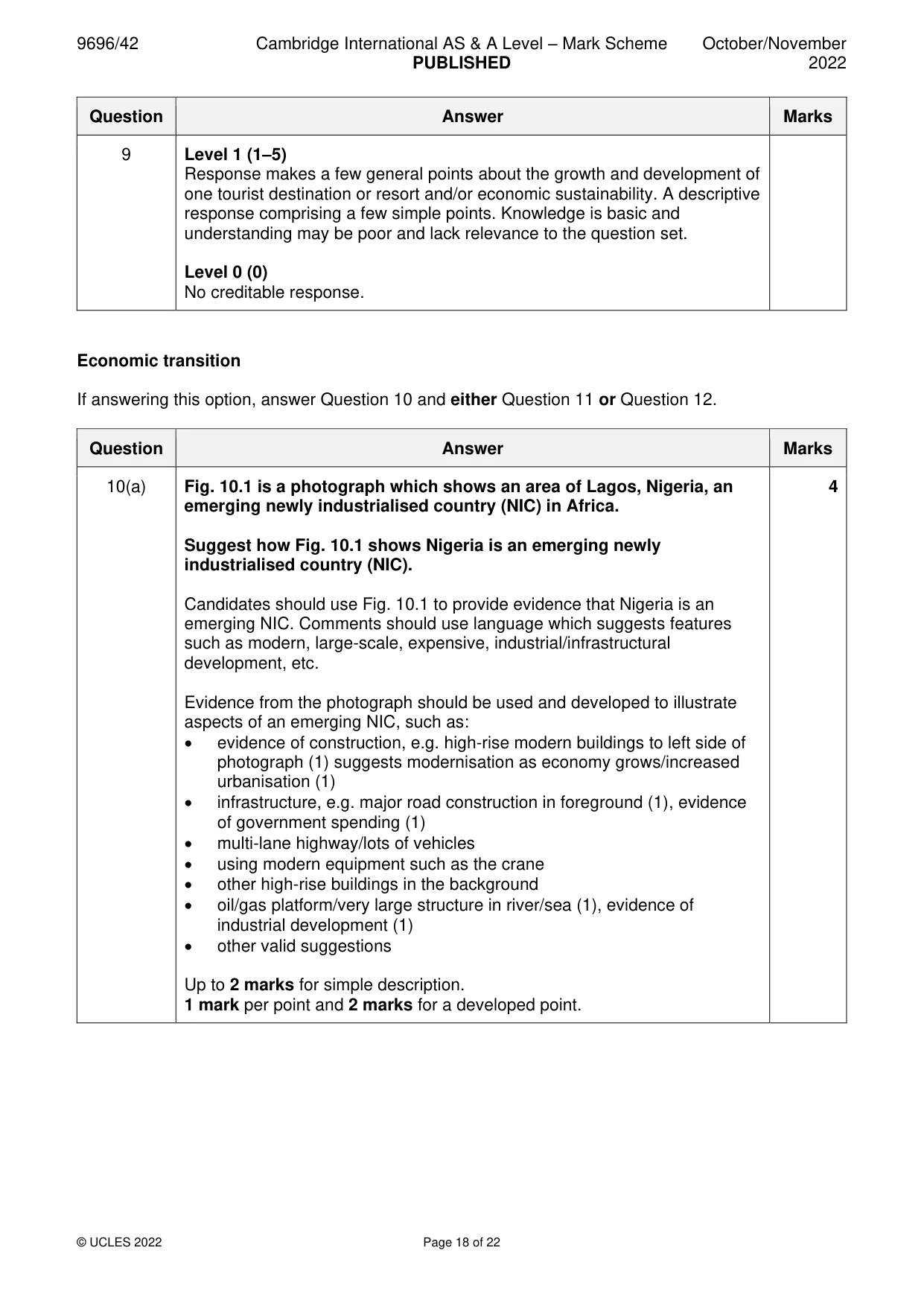
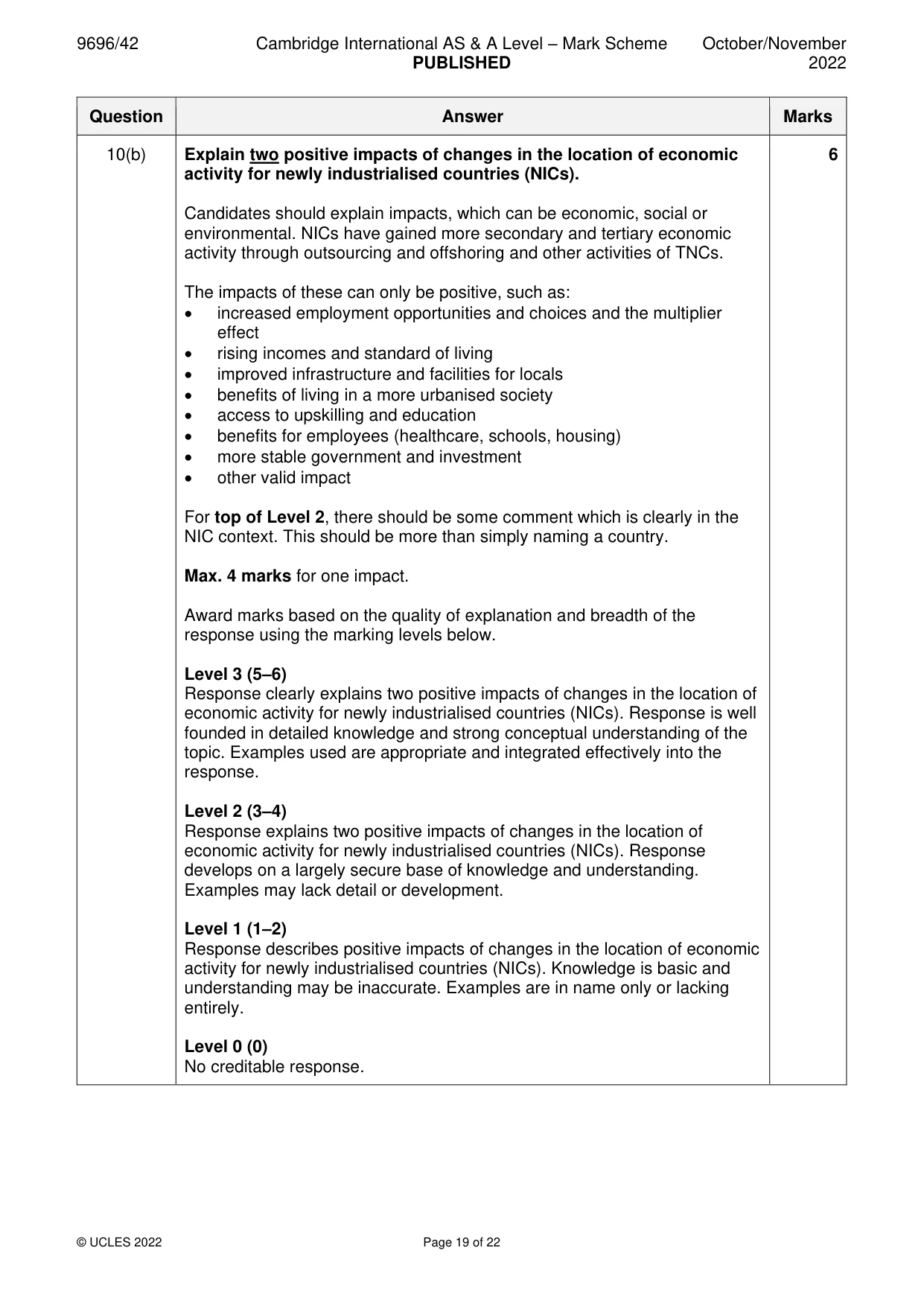
Mark scheme: 10(a) Fig. 10.1 is a photograph which shows an area of Lagos, Nigeria, an 4 emerging newly industrialised country (NIC) in Africa. Suggest how Fig. 10.1 shows Nigeria is an emerging newly industrialised country (NIC). Candidates should use Fig. 10.1 to provide evidence that Nigeria is an emerging NIC. Comments should use language which suggests features such as modern, large-scale, expensive, industrial/infrastructural development, etc. Evidence from the photograph should be used and developed to illustrate aspects of an emerging NIC, such as: • evidence of construction, e.g. high-rise modern buildings to left side of photograph (1) suggests modernisation as economy grows/increased urbanisation (1) • infrastructure, e.g. major road construction in foreground (1), evidence of government spending (1) • multi-lane highway/lots of vehicles • using modern equipment such as the crane • other high-rise buildings in the background • oil/gas platform/very large structure in river/sea (1), evidence of industrial development (1) • other valid suggestions Up to 2 marks for simple description. 1 mark per point and 2 marks for a developed point. 10(b) Explain two positive impacts of changes in the location of economic 6 activity for newly industrialised countries (NICs). Candidates should explain impacts, which can be economic, social or environmental. NICs have gained more secondary and tertiary economic activity through outsourcing and offshoring and other activities of TNCs. The impacts of these can only be positive, such as: • increased employment opportunities and choices and the multiplier effect • rising incomes and standard of living • improved infrastructure and facilities for locals • benefits of living in a more urbanised society • access to upskilling and education • benefits for employees (healthcare, schools, housing) • more stable government and investment • other valid impact For top of Level 2, there should be some comment which is clearly in the NIC context. This should be more than simply naming a country. Max. 4 marks for one impact. Award marks based on the quality of explanation and breadth of the response using the marking levels below. Level 3 (5–6) Response clearly explains two positive impacts of changes in the location of economic activity for newly industrialised countries (NICs). Response is well founded in detailed knowledge and strong conceptual understanding of the topic. Examples used are appropriate and integrated effectively into the response. Level 2 (3–4) Response explains two positive impacts of changes in the location of economic activity for newly industrialised countries (NICs). Response develops on a largely secure base of knowledge and understanding. Examples may lack detail or development. Level 1 (1–2) Response describes positive impacts of changes in the location of economic activity for newly industrialised countries (NICs). Knowledge is basic and understanding may be inaccurate. Examples are in name only or lacking entirely. Level 0 (0) No creditable response.
Q11 · ‘Economic indices are the best way to measure global inequalities.’ How far do you agree?
11 ‘Economic indices are the best way to measure global inequalities.’ How far do you agree? [20]
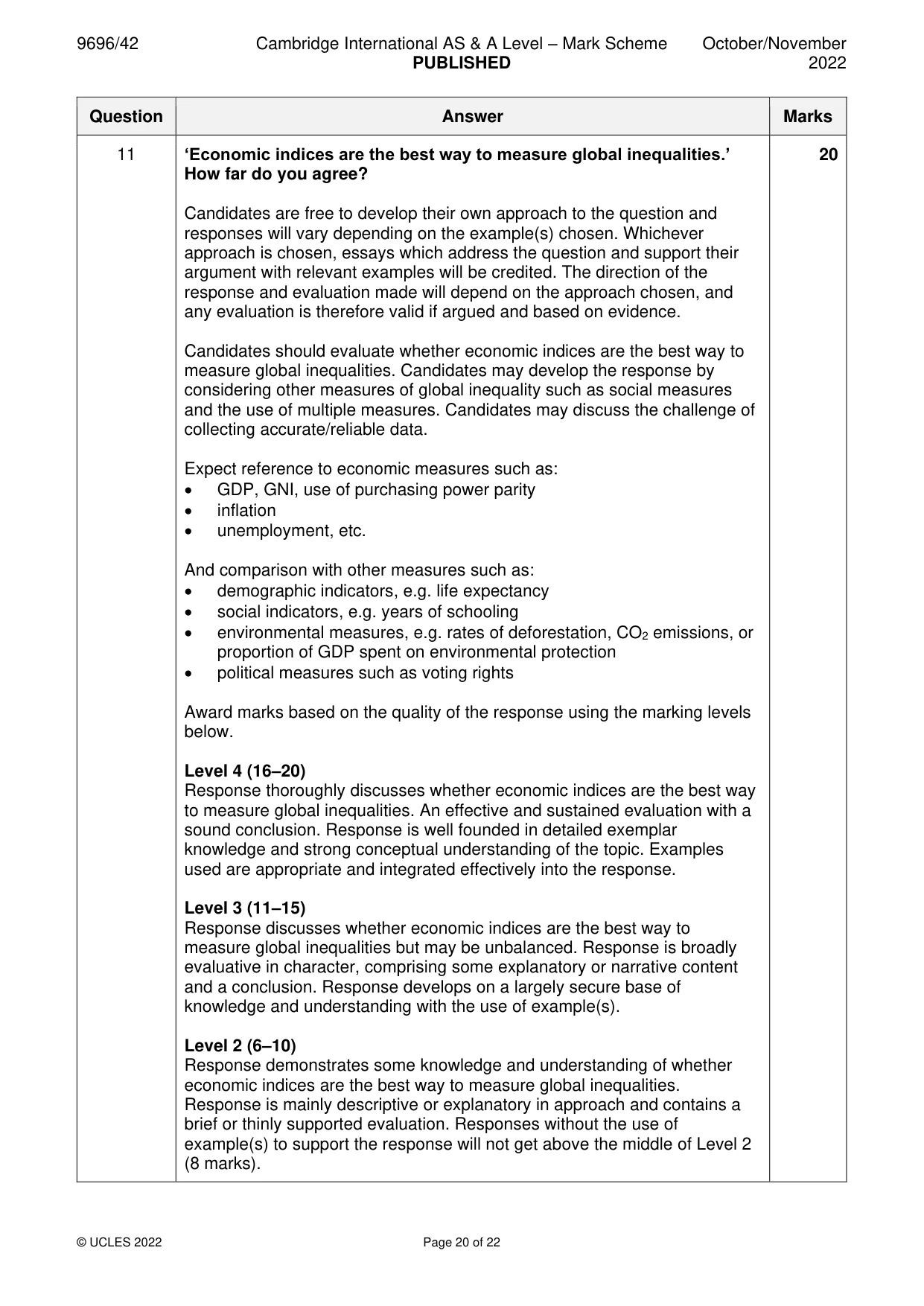
Mark scheme: 11 ‘Economic indices are the best way to measure global inequalities.’ 20 How far do you agree? Candidates are free to develop their own approach to the question and responses will vary depending on the example(s) chosen. Whichever approach is chosen, essays which address the question and support their argument with relevant examples will be credited. The direction of the response and evaluation made will depend on the approach chosen, and any evaluation is therefore valid if argued and based on evidence. Candidates should evaluate whether economic indices are the best way to measure global inequalities. Candidates may develop the response by considering other measures of global inequality such as social measures and the use of multiple measures. Candidates may discuss the challenge of collecting accurate/reliable data. Expect reference to economic measures such as: • GDP, GNI, use of purchasing power parity • inflation • unemployment, etc. And comparison with other measures such as: • demographic indicators, e.g. life expectancy • social indicators, e.g. years of schooling • environmental measures, e.g. rates of deforestation, CO2 emissions, or proportion of GDP spent on environmental protection • political measures such as voting rights Award marks based on the quality of the response using the marking levels below. Level 4 (16–20) Response thoroughly discusses whether economic indices are the best way to measure global inequalities. An effective and sustained evaluation with a sound conclusion. Response is well founded in detailed exemplar knowledge and strong conceptual understanding of the topic. Examples used are appropriate and integrated effectively into the response. Level 3 (11–15) Response discusses whether economic indices are the best way to measure global inequalities but may be unbalanced. Response is broadly evaluative in character, comprising some explanatory or narrative content and a conclusion. Response develops on a largely secure base of knowledge and understanding with the use of example(s). Level 2 (6–10) Response demonstrates some knowledge and understanding of whether economic indices are the best way to measure global inequalities. Response is mainly descriptive or explanatory in approach and contains a brief or thinly supported evaluation. Responses without the use of example(s) to support the response will not get above the middle of Level 2 (8 marks). 11 Level 1 (1–5) Response makes a few general points about how economic indices can be used as a way to measure global inequalities. A descriptive response comprising a few simple points. Knowledge is basic and understanding may be poor and lack relevance to the question set. Level 0 (0) No creditable response.
What was in this paper
The subtopics covered by these 11 questions, and how many questions each got. Open one in a new tab to see every Cambridge question on it.
2Environmental degradation1International debt and international aid1Manufacturing and related service industry1National development1The globalisation of economic activity1The human impact1The management of a tourist destination1The management of agricultural change1Trade flows and trading patterns1What you needed in this session
Cambridge’s own grade thresholds for 2022 Oct/Nov, Paper 4 · Variant 2. A higher threshold means an easier paper — the bar moves with how the cohort did.