Cambridge A Level Geography 9696 — 2025 Oct/Nov Paper 4 · Variant 2
9696/42/O/N/25 · 11 questions · 60 marks · ≈68 min
The question paper and its mark scheme, free to read here and free to download. This is Cambridge’s own paper, exactly as it was sat.
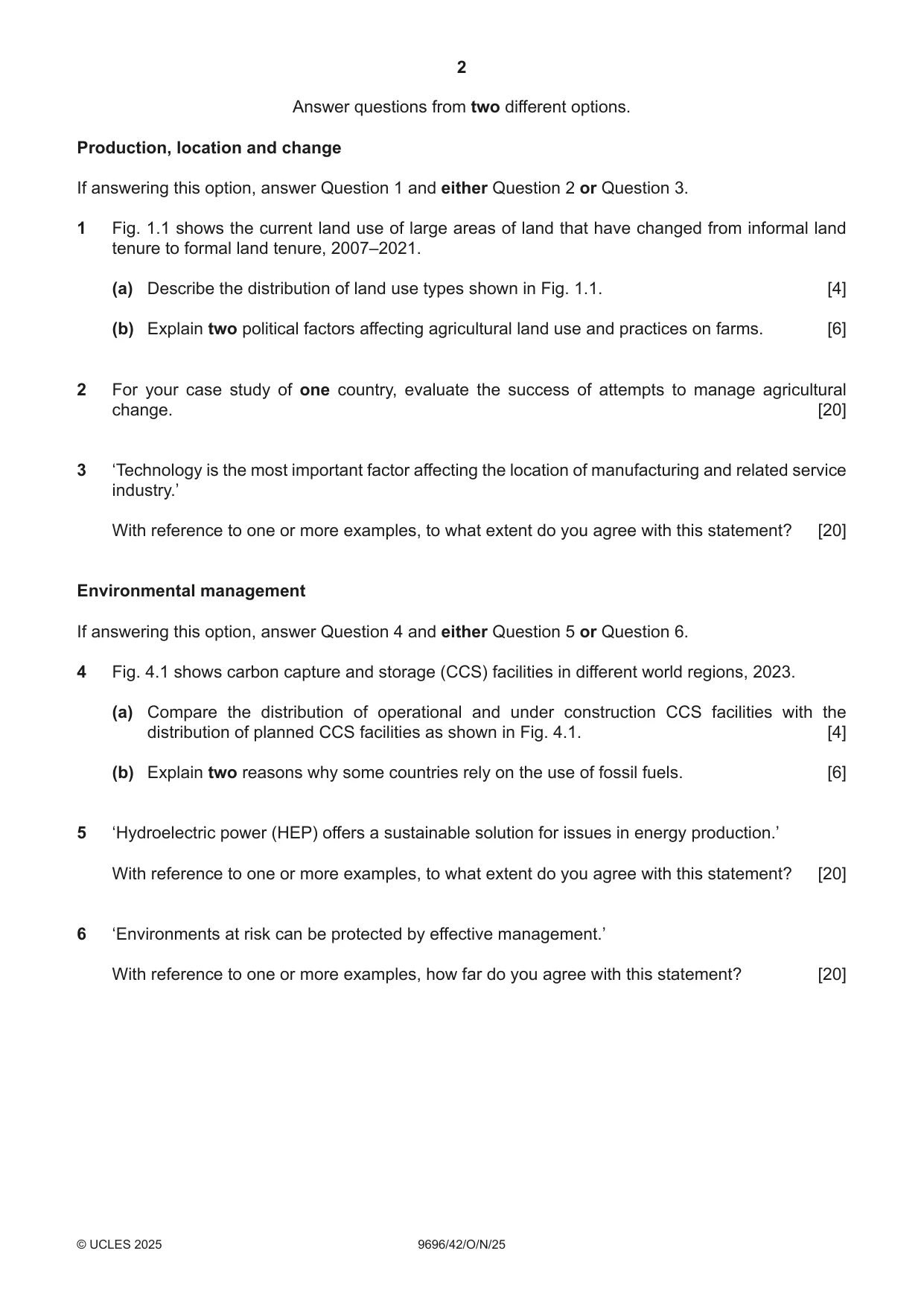
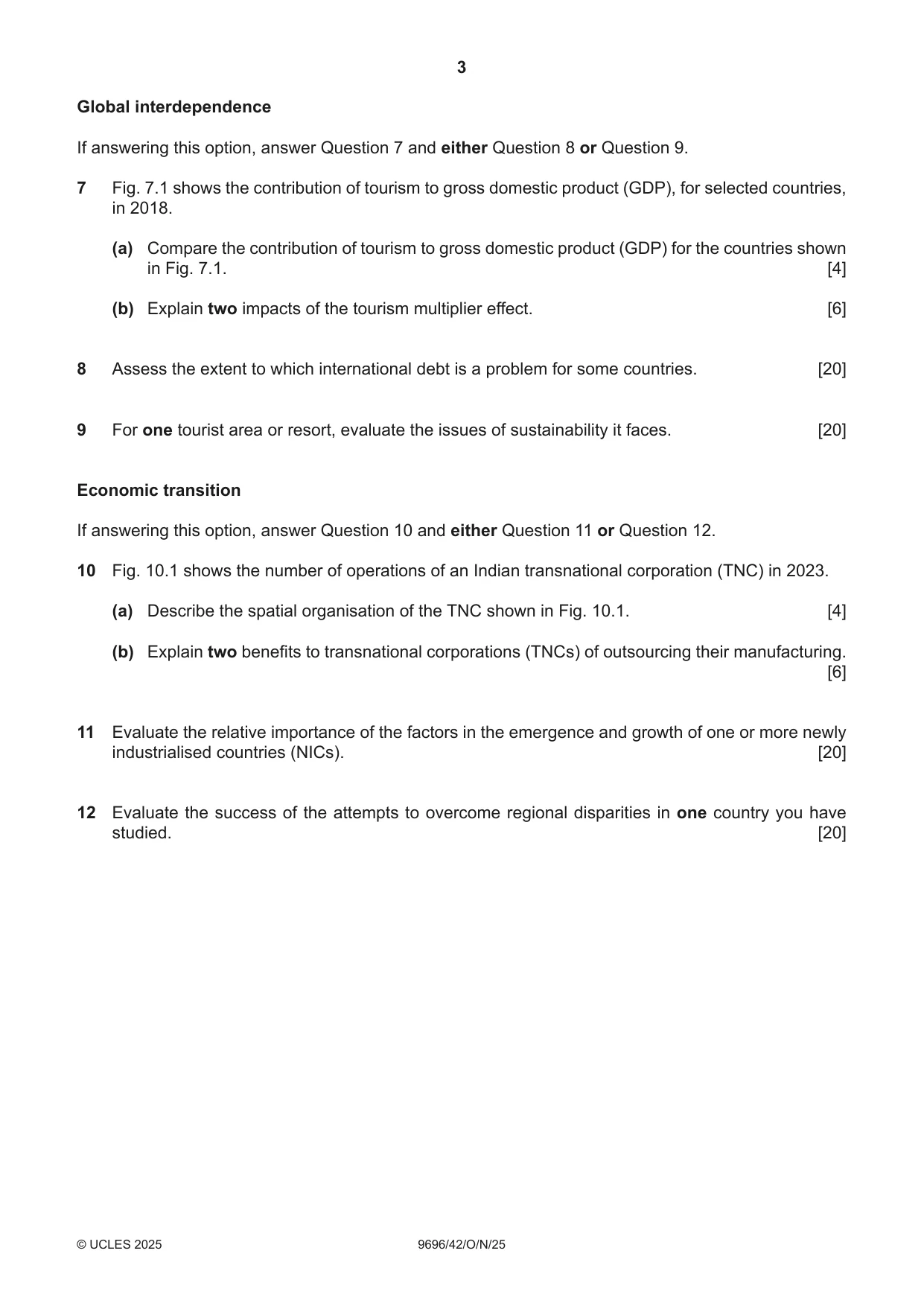
Question paper4 pages


Mark scheme29 pages
Answers below. Sit the paper first if you are practising.






Questions as text
Q1 · The current land use of large areas of land that have changed from informal land tenure…
1 Fig. 1.1 shows the current land use of large areas of land that have changed from informal land tenure to formal land tenure, 2007–2021. (a) Describe the distribution of land use types shown in Fig. 1.1. [4] (b) Explain two political factors affecting agricultural land use and practices on farms. [6]
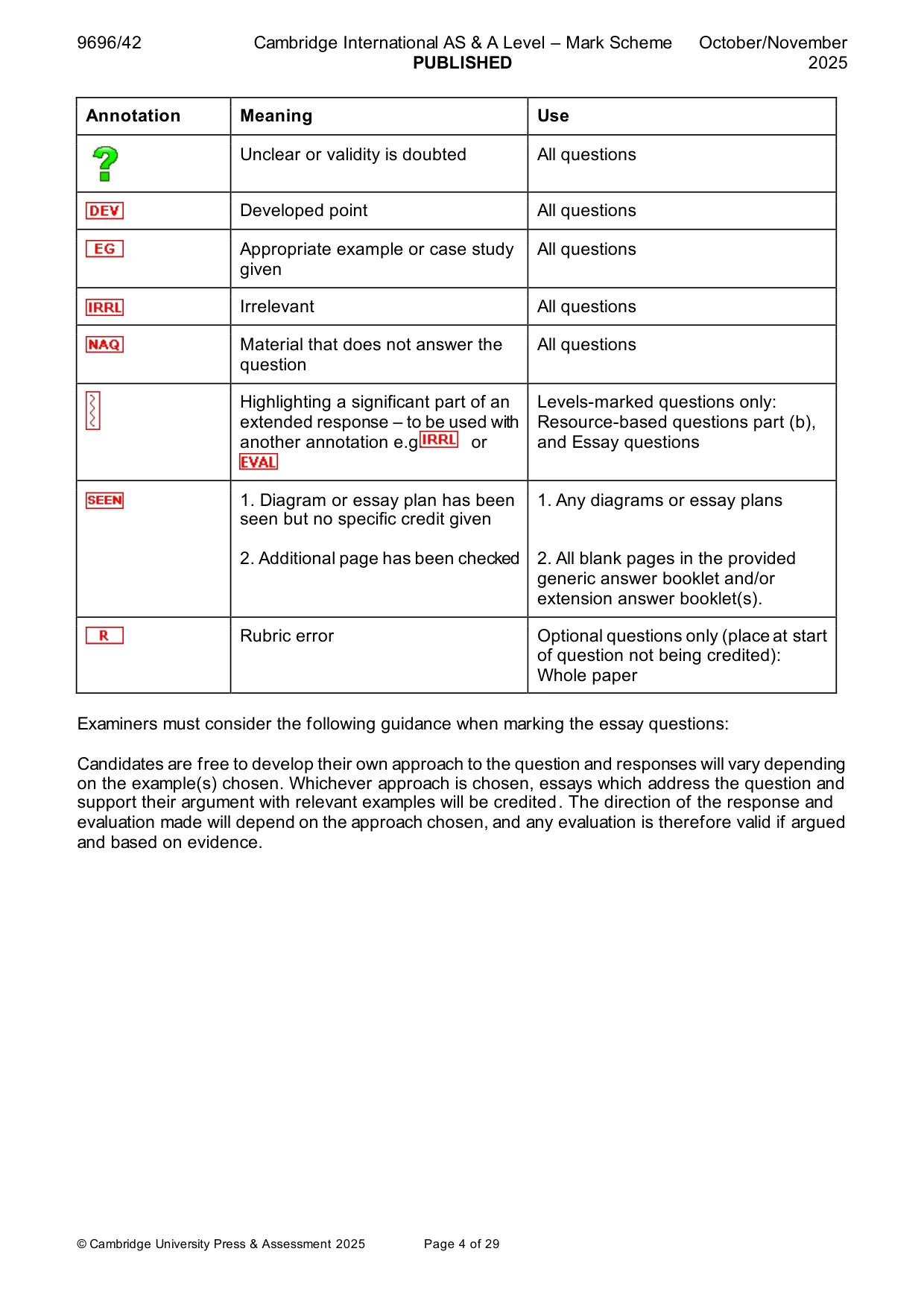
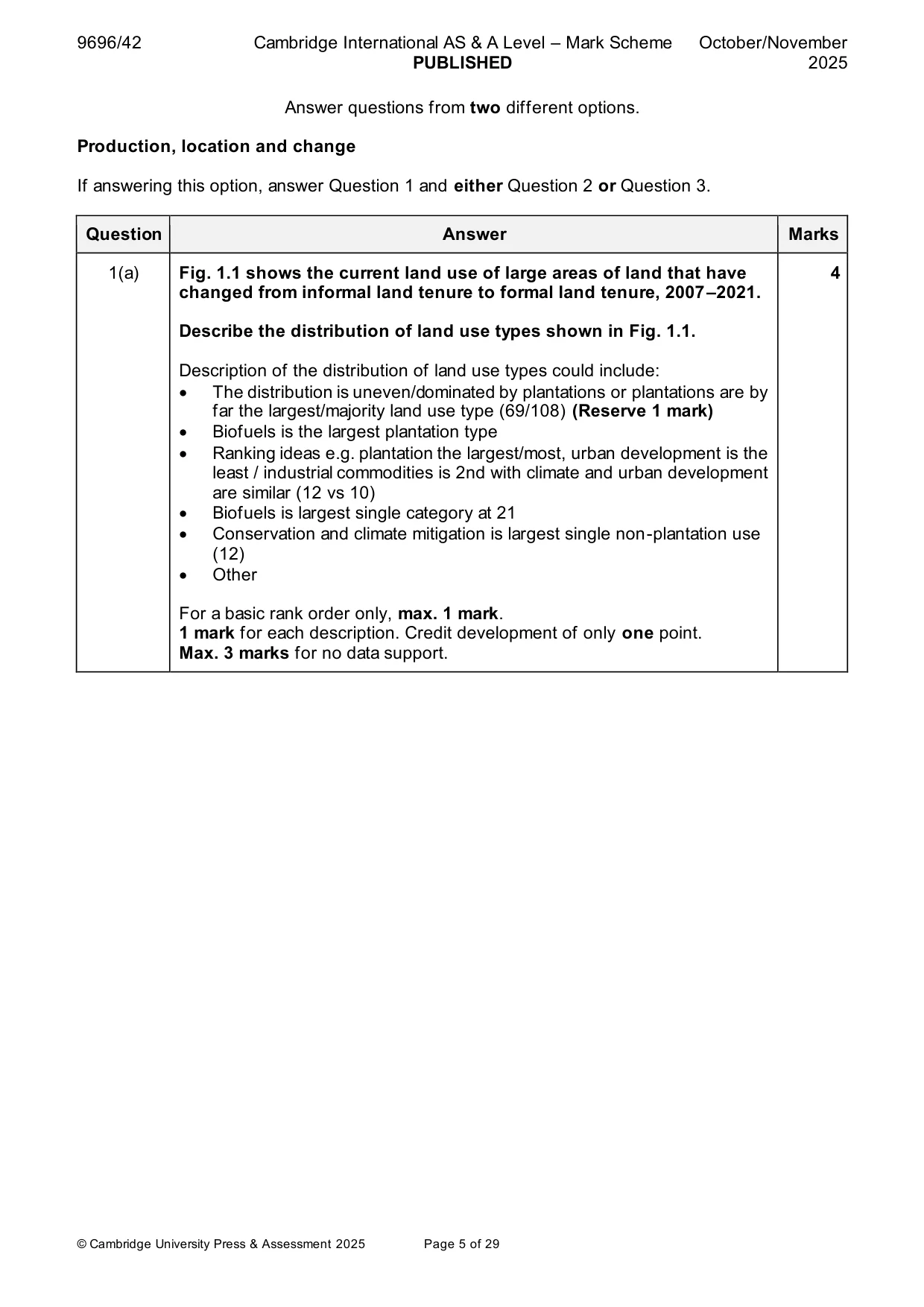
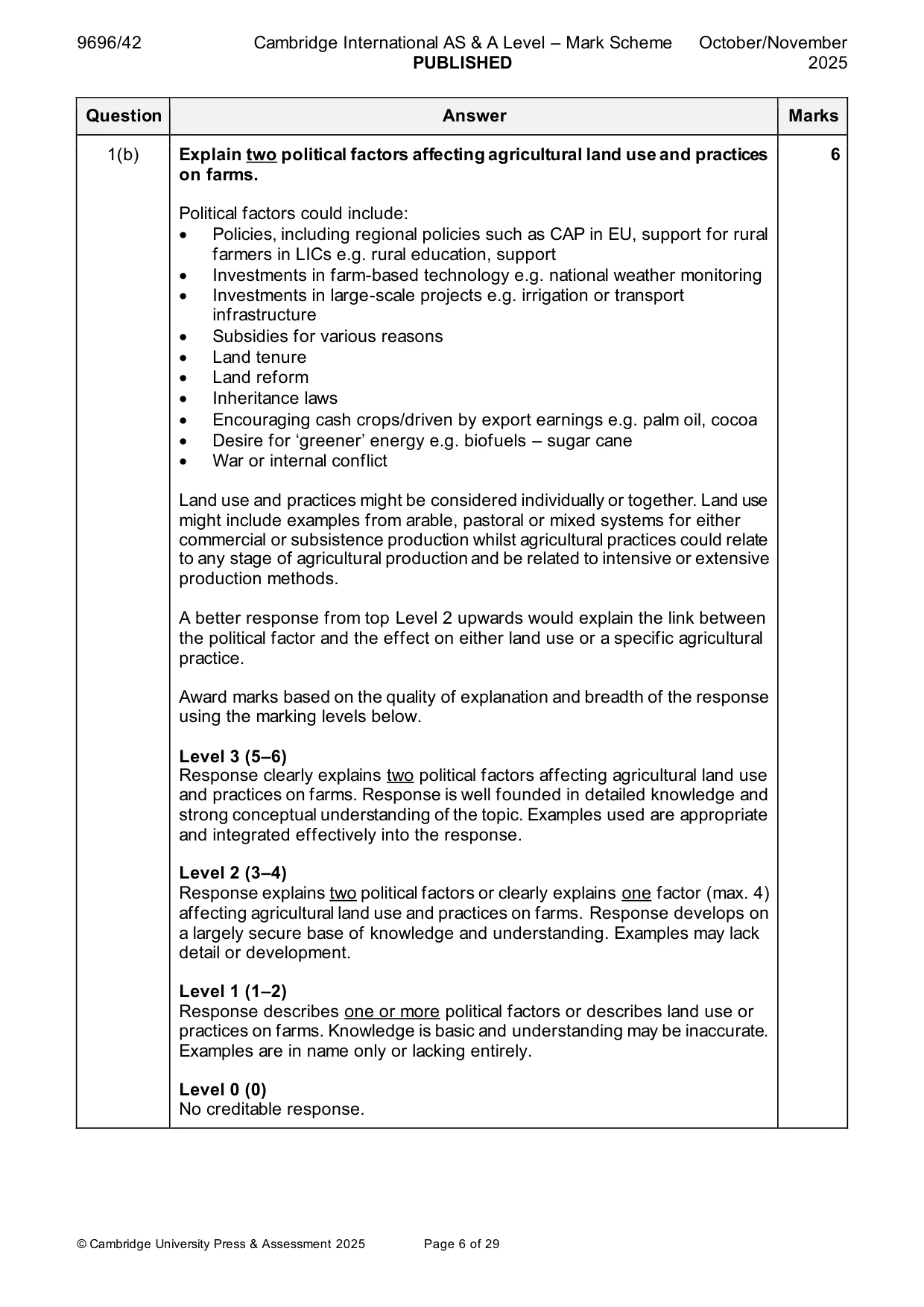
Mark scheme: Question Answer Marks 1(a) Fig. 1.1 shows the current land use of large areas of land that have 4 changed from informal land tenure to formal land tenure, 2007–2021. Describe the distribution of land use types shown in Fig. 1.1. Description of the distribution of land use types could include: • The distribution is uneven/dominated by plantations or plantations are by far the largest/majority land use type (69/108) (Reserve 1 mark) • Biofuels is the largest plantation type • Ranking ideas e.g. plantation the largest/most, urban development is the least / industrial commodities is 2nd with climate and urban development are similar (12 vs 10) • Biofuels is largest single category at 21 • Conservation and climate mitigation is largest single non-plantation use (12) • Other For a basic rank order only, max. 1 mark. 1 mark for each description. Credit development of only one point. Max. 3 marks for no data support. 1(b) Explain two political factors affecting agricultural land use and practices 6 on farms. Political factors could include: • Policies, including regional policies such as CAP in EU, support for rural farmers in LICs e.g. rural education, support • Investments in farm-based technology e.g. national weather monitoring • Investments in large-scale projects e.g. irrigation or transport infrastructure • Subsidies for various reasons • Land tenure • Land reform • Inheritance laws • Encouraging cash crops/driven by export earnings e.g. palm oil, cocoa • Desire for ‘greener’ energy e.g. biofuels – sugar cane • War or internal conflict Land use and practices might be considered individually or together. Land use might include examples from arable, pastoral or mixed systems for either commercial or subsistence production whilst agricultural practices could relate to any stage of agricultural production and be related to intensive or extensive production methods. A better response from top Level 2 upwards would explain the link between the political factor and the effect on either land use or a specific agricultural practice. Award marks based on the quality of explanation and breadth of the response using the marking levels below. Level 3 (5–6) Response clearly explains two political factors affecting agricultural land use and practices on farms. Response is well founded in detailed knowledge and strong conceptual understanding of the topic. Examples used are appropriate and integrated effectively into the response. Level 2 (3–4) Response explains two political factors or clearly explains one factor (max. 4) affecting agricultural land use and practices on farms. Response develops on a largely secure base of knowledge and understanding. Examples may lack detail or development. Level 1 (1–2) Response describes one or more political factors or describes land use or practices on farms. Knowledge is basic and understanding may be inaccurate. Examples are in name only or lacking entirely. Level 0 (0) No creditable response.
Q2 · For your case study of one country, evaluate the success of attempts to manage…
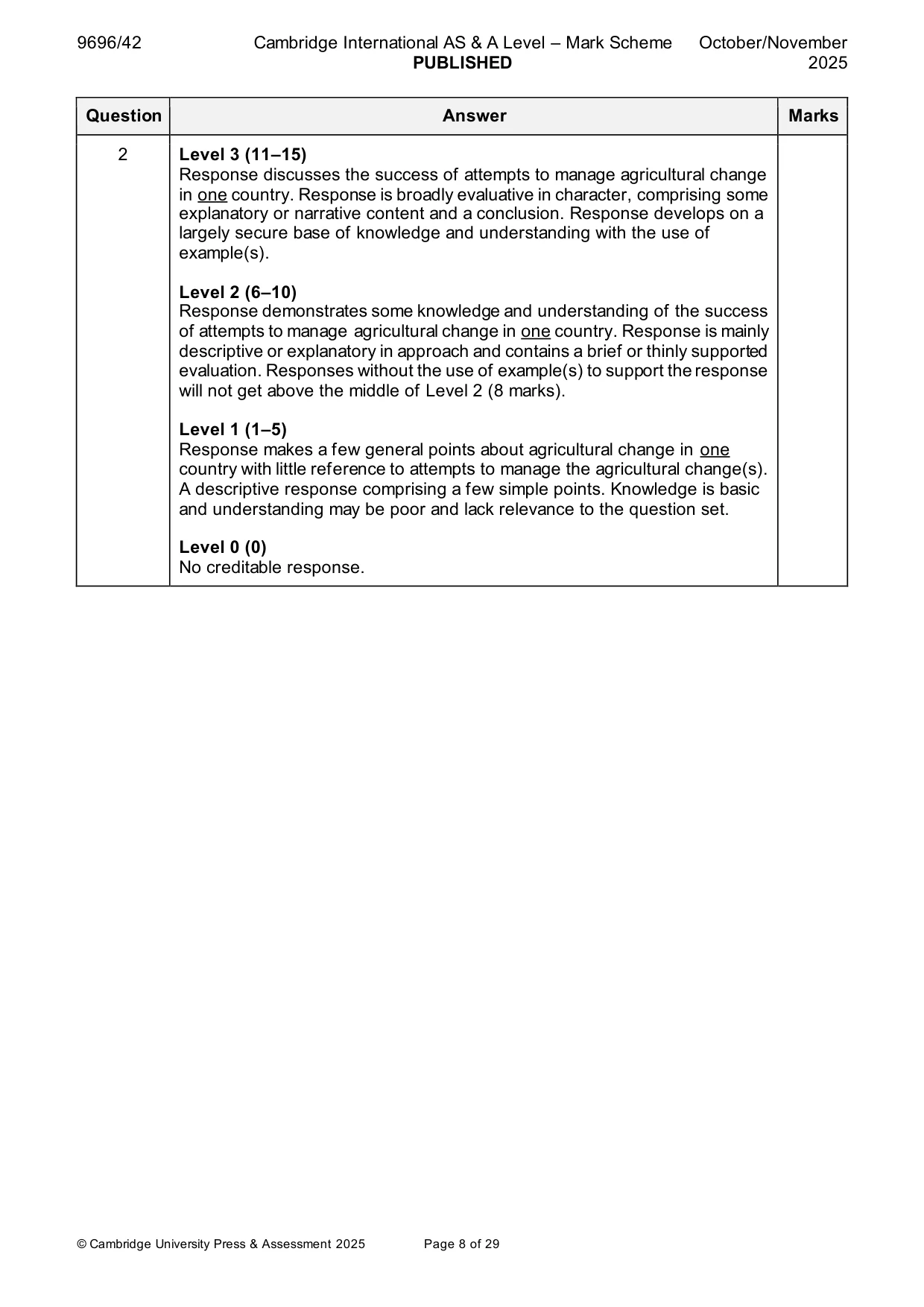
2 For your case study of one country, evaluate the success of attempts to manage agricultural change. [20]
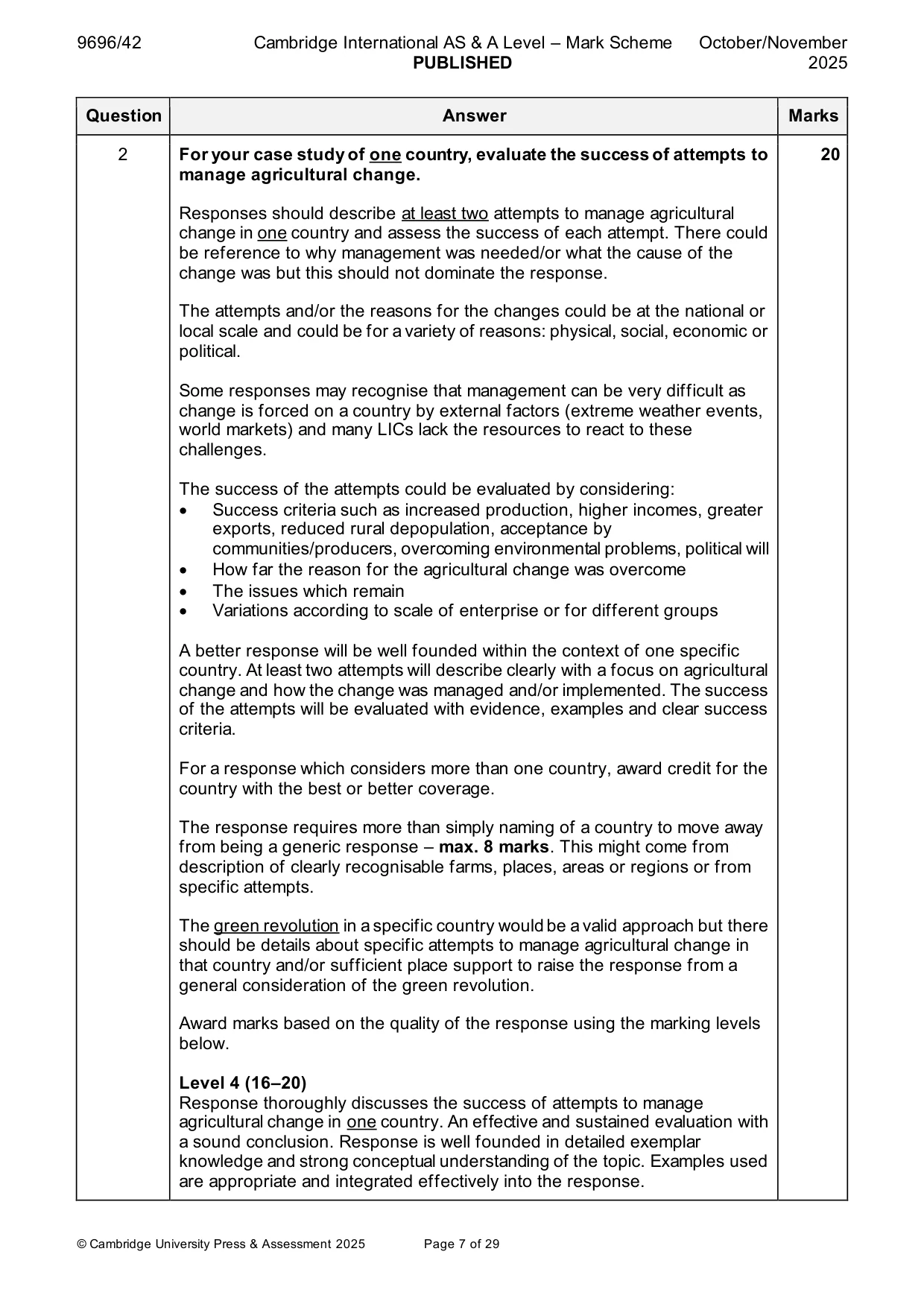
Mark scheme: 2 For your case study of one country, evaluate the success of attempts to 20 manage agricultural change. Responses should describe at least two attempts to manage agricultural change in one country and assess the success of each attempt. There could be reference to why management was needed/or what the cause of the change was but this should not dominate the response. The attempts and/or the reasons for the changes could be at the national or local scale and could be for a variety of reasons: physical, social, economic or political. Some responses may recognise that management can be very difficult as change is forced on a country by external factors (extreme weather events, world markets) and many LICs lack the resources to react to these challenges. The success of the attempts could be evaluated by considering: • Success criteria such as increased production, higher incomes, greater exports, reduced rural depopulation, acceptance by communities/producers, overcoming environmental problems, political will • How far the reason for the agricultural change was overcome • The issues which remain • Variations according to scale of enterprise or for different groups A better response will be well founded within the context of one specific country. At least two attempts will describe clearly with a focus on agricultural change and how the change was managed and/or implemented. The success of the attempts will be evaluated with evidence, examples and clear success criteria. For a response which considers more than one country, award credit for the country with the best or better coverage. The response requires more than simply naming of a country to move away from being a generic response – max. 8 marks. This might come from description of clearly recognisable farms, places, areas or regions or from specific attempts. The green revolution in a specific country would be a valid approach but there should be details about specific attempts to manage agricultural change in that country and/or sufficient place support to raise the response from a general consideration of the green revolution. Award marks based on the quality of the response using the marking levels below. Level 4 (16–20) Response thoroughly discusses the success of attempts to manage agricultural change in one country. An effective and sustained evaluation with a sound conclusion. Response is well founded in detailed exemplar knowledge and strong conceptual understanding of the topic. Examples used are appropriate and integrated effectively into the response. 2 Level 3 (11–15) Response discusses the success of attempts to manage agricultural change in one country. Response is broadly evaluative in character, comprising some explanatory or narrative content and a conclusion. Response develops on a largely secure base of knowledge and understanding with the use of example(s). Level 2 (6–10) Response demonstrates some knowledge and understanding of the success of attempts to manage agricultural change in one country. Response is mainly descriptive or explanatory in approach and contains a brief or thinly supported evaluation. Responses without the use of example(s) to support the response will not get above the middle of Level 2 (8 marks). Level 1 (1–5) Response makes a few general points about agricultural change in one country with little reference to attempts to manage the agricultural change(s). A descriptive response comprising a few simple points. Knowledge is basic and understanding may be poor and lack relevance to the question set. Level 0 (0) No creditable response.
Q3 · ‘Technology is the most important factor affecting the location of manufacturing and…
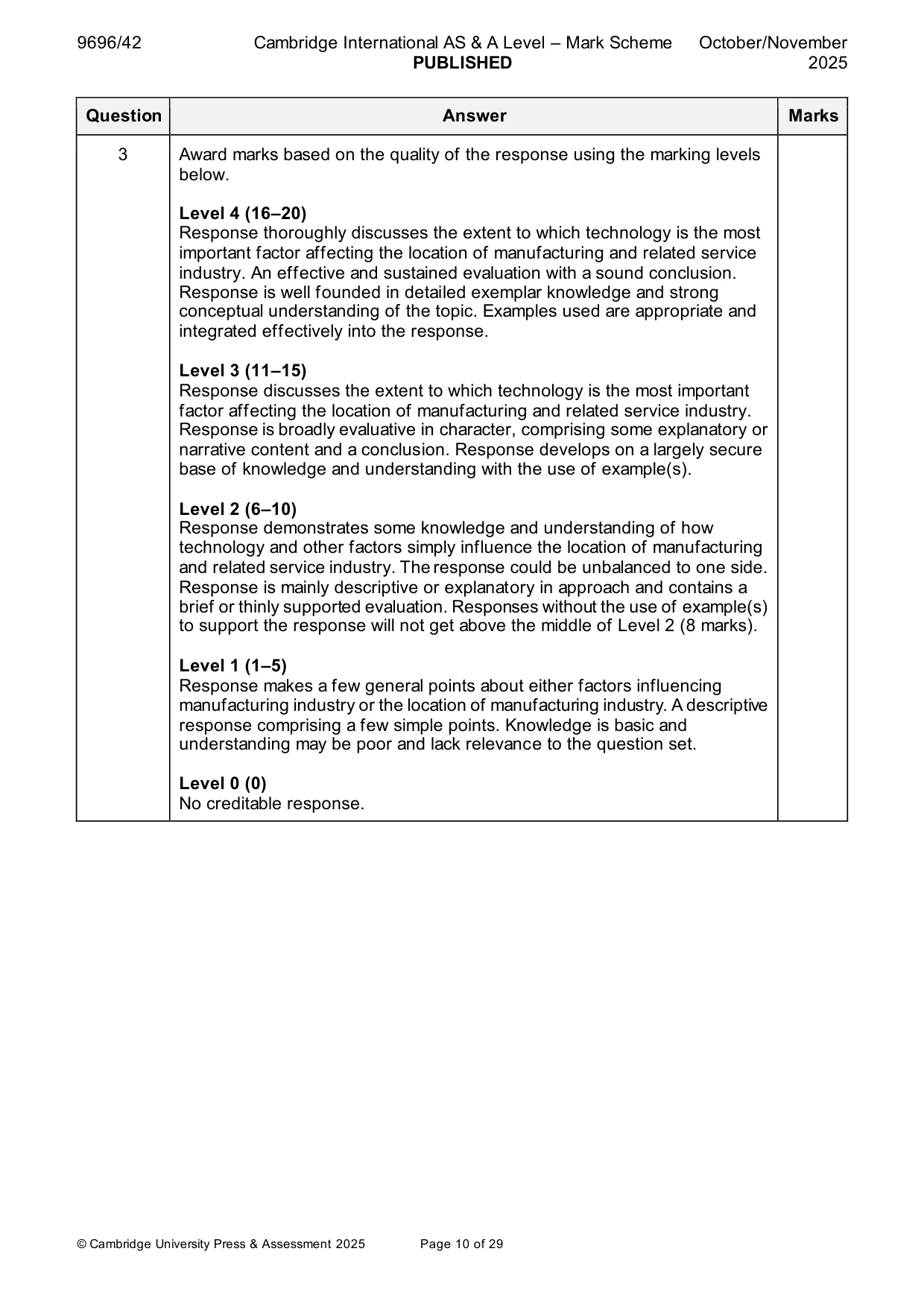
3 ‘Technology is the most important factor affecting the location of manufacturing and related service industry.’ With reference to one or more examples, to what extent do you agree with this statement? [20] Environmental management If answering this option, answer Question 4 and either Question 5 or Question 6.
Mark scheme: 3 ‘Technology is the most important factor affecting the location of 20 manufacturing and related service industry.’ With reference to one or more examples, to what extent do you agree with this statement? Candidates should know about factors which influence the location of manufacturing and related service industries: land, labour, capital, markets, materials, technology, economies and diseconomies of scale, inertia, transport, government policies, and be able to assess the importance of technology as a factor. The examples used could be at any scale of manufacturing and its related services. Whatever factors are considered, there should be reference to location. The response should have a reasonable coverage of technology and its role in the location of manufacturing and related service industry, whilst its importance could be evaluated through consideration of other factors. Any form of technology from quite basic ideas about mechanisation to more advanced use of technology could be used and might be linked to any stage of the production process from materials acquisition, through production and to marketing, research and development of products. More recent developments in technology include automation and robotics; smart production processes; assistance in supply chain management and communication between different stages of the production process; monitoring efficiency of machinery and production processes and making practices more sustainable e.g. waste management and energy efficiency. Comment on technology and location could consider factors which: • Strengthen production in existing locations • Those which enable location to change • Include the whole or parts of the manufacturing process • Enable the choice of location to become footloose The evaluation might develop through consideration of different examples of where technology or other factors are of varying levels of importance e.g. software development compared to heavy industry. However, it is likely that better responses will show an understanding of the mobile nature of technology, and/or that the skills needed to use technology are of equal (if not more) importance. These better responses might also consider that the role of technology in location of manufacturing is more about how it impacts on other factors such as markets, labour, etc. than a direct impact on location decisions. 3 Award marks based on the quality of the response using the marking levels below. Level 4 (16–20) Response thoroughly discusses the extent to which technology is the most important factor affecting the location of manufacturing and related service industry. An effective and sustained evaluation with a sound conclusion. Response is well founded in detailed exemplar knowledge and strong conceptual understanding of the topic. Examples used are appropriate and integrated effectively into the response. Level 3 (11–15) Response discusses the extent to which technology is the most important factor affecting the location of manufacturing and related service industry. Response is broadly evaluative in character, comprising some explanatory or narrative content and a conclusion. Response develops on a largely secure base of knowledge and understanding with the use of example(s). Level 2 (6–10) Response demonstrates some knowledge and understanding of how technology and other factors simply influence the location of manufacturing and related service industry. The response could be unbalanced to one side. Response is mainly descriptive or explanatory in approach and contains a brief or thinly supported evaluation. Responses without the use of example(s) to support the response will not get above the middle of Level 2 (8 marks). Level 1 (1–5) Response makes a few general points about either factors influencing manufacturing industry or the location of manufacturing industry. A descriptive response comprising a few simple points. Knowledge is basic and understanding may be poor and lack relevance to the question set. Level 0 (0) No creditable response. Environmental management If answering this option, answer Question 4 and either Question 5 or Question 6.
Q4 · Carbon capture and storage (CCS) facilities in different world regions, 2023
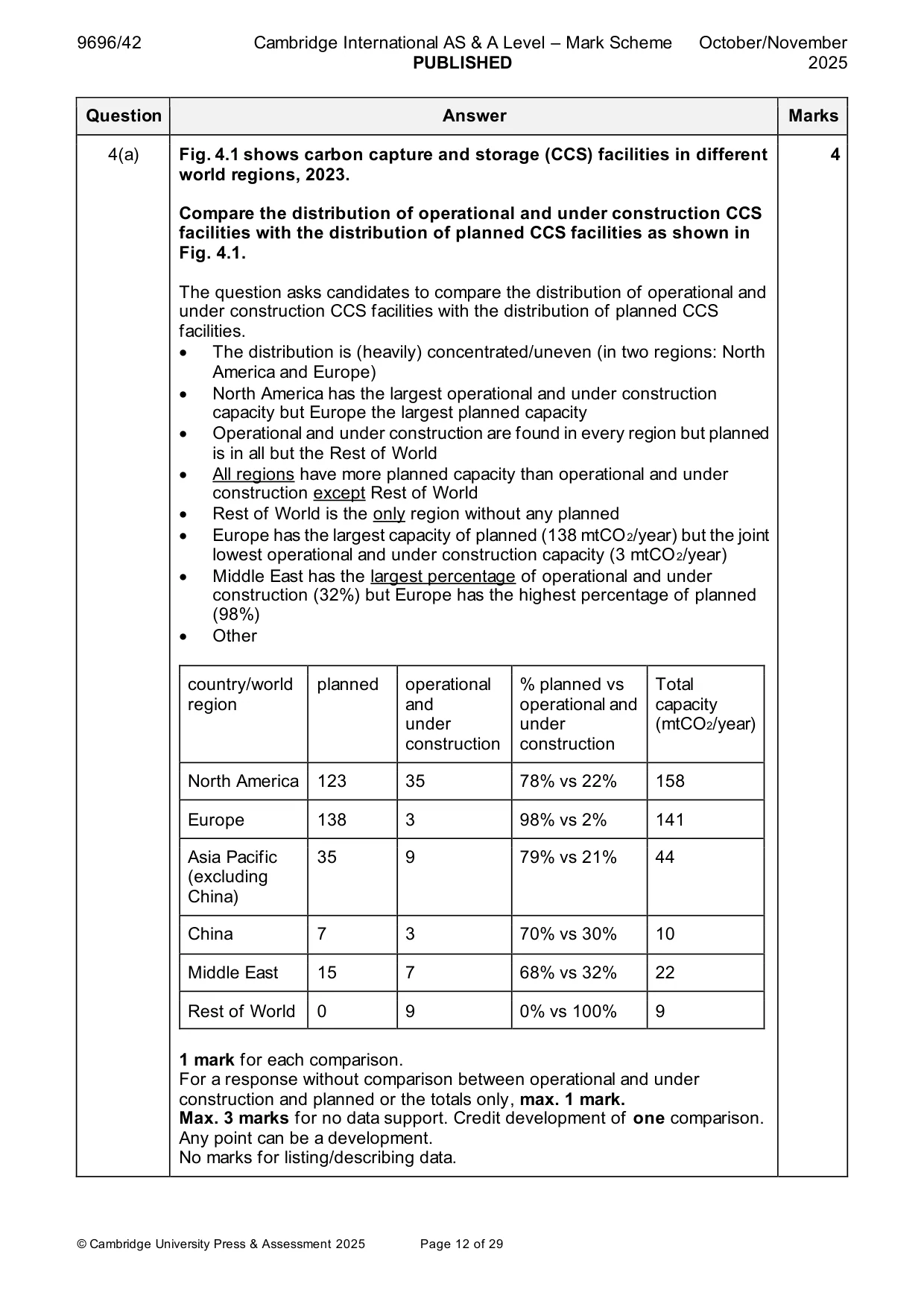
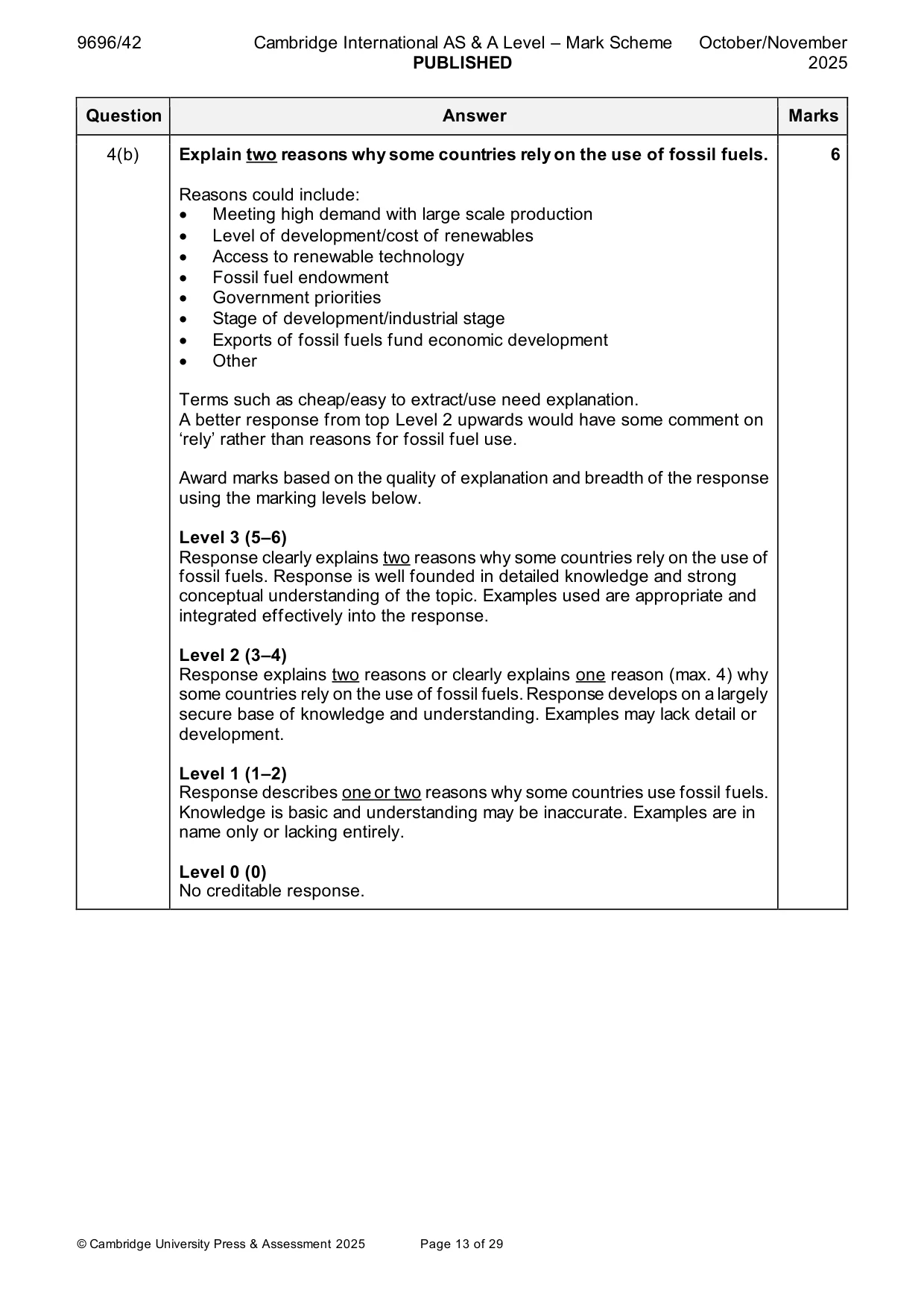
4 Fig. 4.1 shows carbon capture and storage (CCS) facilities in different world regions, 2023. (a) Compare the distribution of operational and under construction CCS facilities with the distribution of planned CCS facilities as shown in Fig. 4.1. [4] (b) Explain two reasons why some countries rely on the use of fossil fuels. [6]
Mark scheme: 4(a) Fig. 4.1 shows carbon capture and storage (CCS) facilities in different 4 world regions, 2023. Compare the distribution of operational and under construction CCS facilities with the distribution of planned CCS facilities as shown in Fig. 4.1. The question asks candidates to compare the distribution of operational and under construction CCS facilities with the distribution of planned CCS facilities. • The distribution is (heavily) concentrated/uneven (in two regions: North America and Europe) • North America has the largest operational and under construction capacity but Europe the largest planned capacity • Operational and under construction are found in every region but planned is in all but the Rest of World • All regions have more planned capacity than operational and under construction except Rest of World • Rest of World is the only region without any planned • Europe has the largest capacity of planned (138 mtCO2/year) but the joint lowest operational and under construction capacity (3 mtCO2/year) • Middle East has the largest percentage of operational and under construction (32%) but Europe has the highest percentage of planned (98%) • Other country/world planned operational % planned vs Total region and operational and capacity under under (mtCO2/year) construction construction North America 123 35 78% vs 22% 158 Europe 138 3 98% vs 2% 141 Asia Pacific 35 9 79% vs 21% 44 (excluding China) China 7 3 70% vs 30% 10 Middle East 15 7 68% vs 32% 22 Rest of World 0 9 0% vs 100% 9 1 mark for each comparison. For a response without comparison between operational and under construction and planned or the totals only, max. 1 mark. Max. 3 marks for no data support. Credit development of one comparison. Any point can be a development. No marks for listing/describing data. 4(b) Explain two reasons why some countries rely on the use of fossil fuels. 6 Reasons could include: • Meeting high demand with large scale production • Level of development/cost of renewables • Access to renewable technology • Fossil fuel endowment • Government priorities • Stage of development/industrial stage • Exports of fossil fuels fund economic development • Other Terms such as cheap/easy to extract/use need explanation. A better response from top Level 2 upwards would have some comment on ‘rely’ rather than reasons for fossil fuel use. Award marks based on the quality of explanation and breadth of the response using the marking levels below. Level 3 (5–6) Response clearly explains two reasons why some countries rely on the use of fossil fuels. Response is well founded in detailed knowledge and strong conceptual understanding of the topic. Examples used are appropriate and integrated effectively into the response. Level 2 (3–4) Response explains two reasons or clearly explains one reason (max. 4) why some countries rely on the use of fossil fuels. Response develops on a largely secure base of knowledge and understanding. Examples may lack detail or development. Level 1 (1–2) Response describes one or two reasons why some countries use fossil fuels. Knowledge is basic and understanding may be inaccurate. Examples are in name only or lacking entirely. Level 0 (0) No creditable response.
Q5 · ‘Hydroelectric power (HEP) offers a sustainable solution for issues in energy…
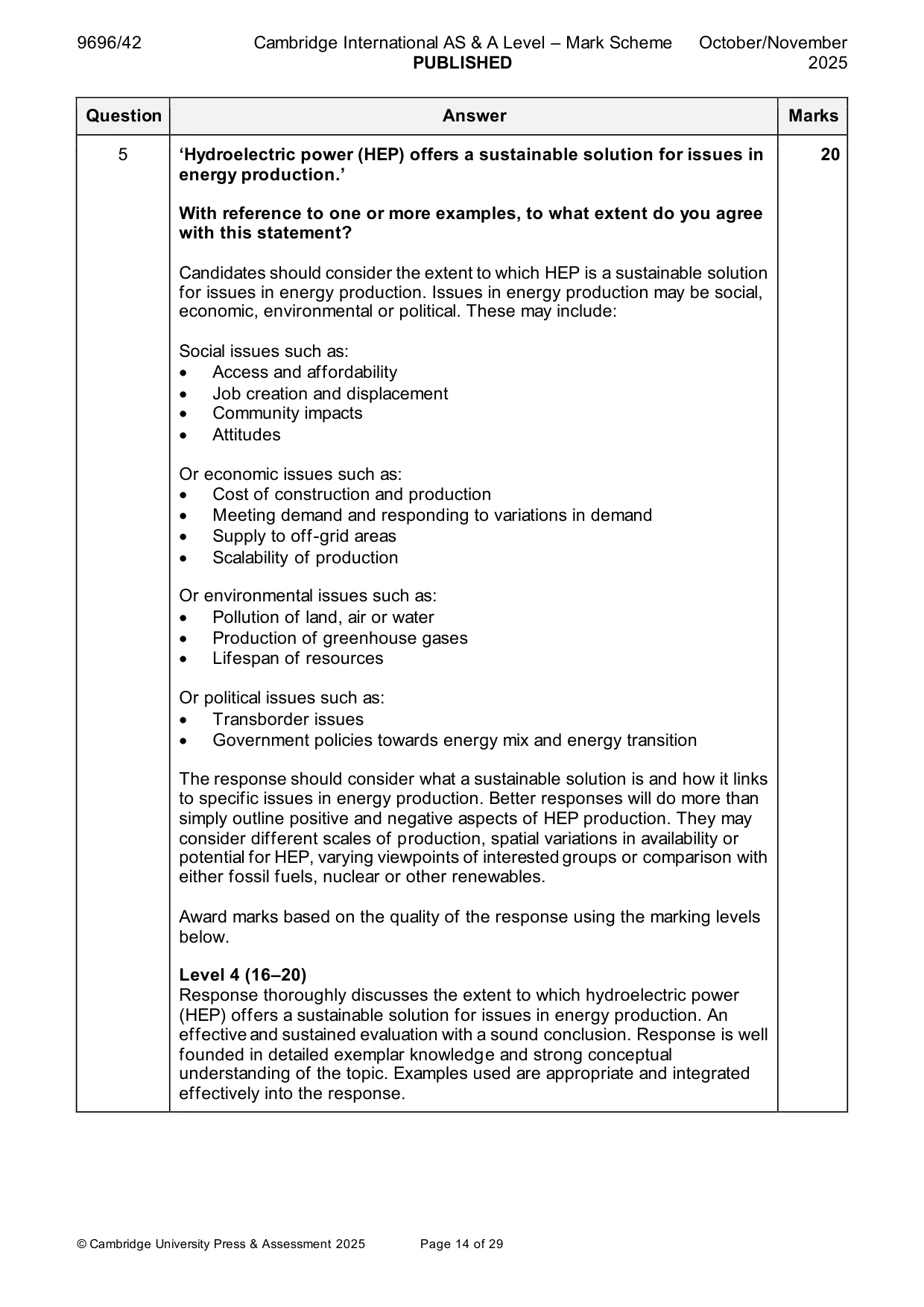
5 ‘Hydroelectric power (HEP) offers a sustainable solution for issues in energy production.’ With reference to one or more examples, to what extent do you agree with this statement? [20]
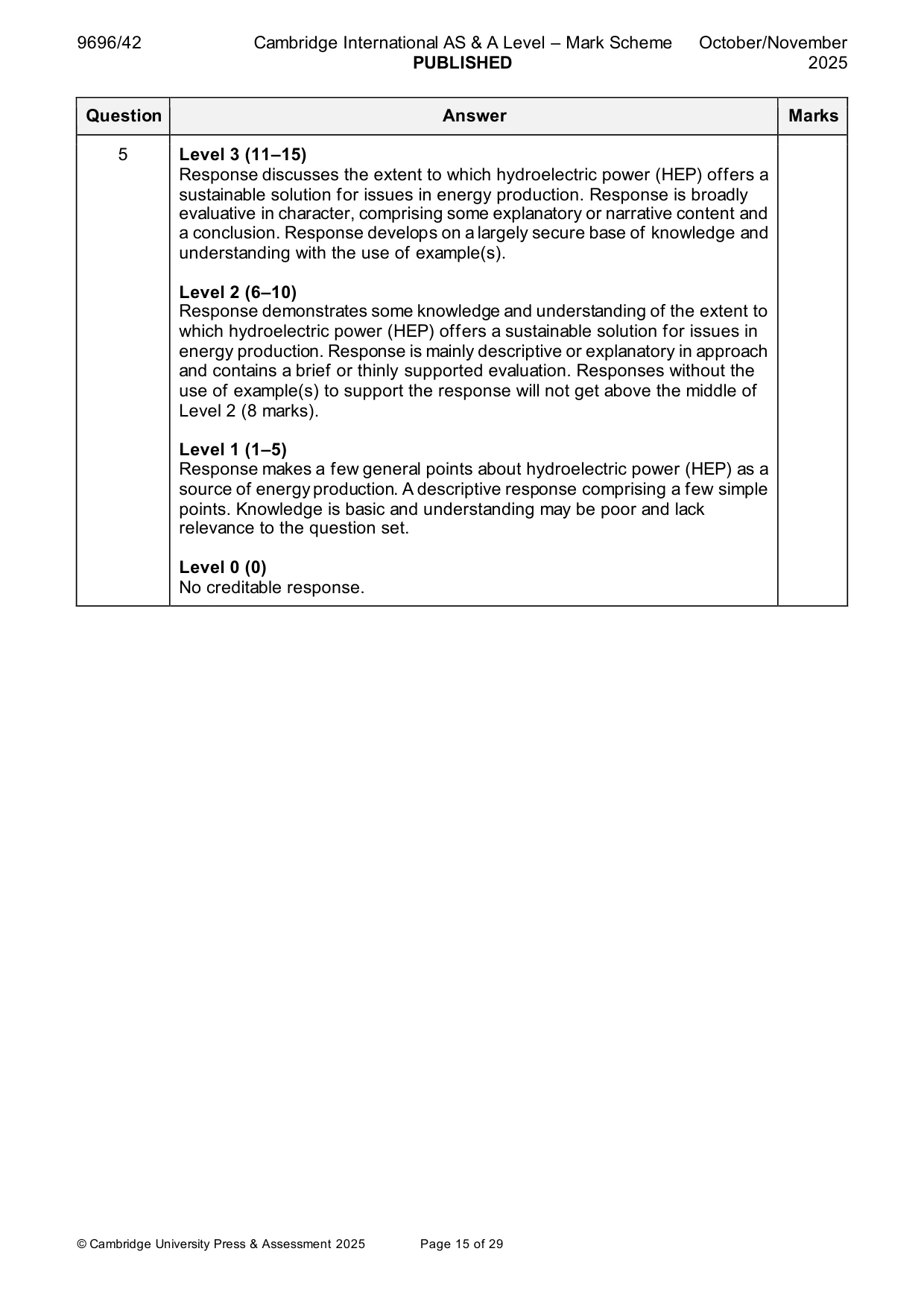
Mark scheme: 5 ‘Hydroelectric power (HEP) offers a sustainable solution for issues in 20 energy production.’ With reference to one or more examples, to what extent do you agree with this statement? Candidates should consider the extent to which HEP is a sustainable solution for issues in energy production. Issues in energy production may be social, economic, environmental or political. These may include: Social issues such as: • Access and affordability • Job creation and displacement • Community impacts • Attitudes Or economic issues such as: • Cost of construction and production • Meeting demand and responding to variations in demand • Supply to off-grid areas • Scalability of production Or environmental issues such as: • Pollution of land, air or water • Production of greenhouse gases • Lifespan of resources Or political issues such as: • Transborder issues • Government policies towards energy mix and energy transition The response should consider what a sustainable solution is and how it links to specific issues in energy production. Better responses will do more than simply outline positive and negative aspects of HEP production. They may consider different scales of production, spatial variations in availability or potential for HEP, varying viewpoints of interested groups or comparison with either fossil fuels, nuclear or other renewables. Award marks based on the quality of the response using the marking levels below. Level 4 (16–20) Response thoroughly discusses the extent to which hydroelectric power (HEP) offers a sustainable solution for issues in energy production. An effective and sustained evaluation with a sound conclusion. Response is well founded in detailed exemplar knowledge and strong conceptual understanding of the topic. Examples used are appropriate and integrated effectively into the response. 5 Level 3 (11–15) Response discusses the extent to which hydroelectric power (HEP) offers a sustainable solution for issues in energy production. Response is broadly evaluative in character, comprising some explanatory or narrative content and a conclusion. Response develops on a largely secure base of knowledge and understanding with the use of example(s). Level 2 (6–10) Response demonstrates some knowledge and understanding of the extent to which hydroelectric power (HEP) offers a sustainable solution for issues in energy production. Response is mainly descriptive or explanatory in approach and contains a brief or thinly supported evaluation. Responses without the use of example(s) to support the response will not get above the middle of Level 2 (8 marks). Level 1 (1–5) Response makes a few general points about hydroelectric power (HEP) as a source of energy production. A descriptive response comprising a few simple points. Knowledge is basic and understanding may be poor and lack relevance to the question set. Level 0 (0) No creditable response.
Q6 · ‘Environments at risk can be protected by effective management.’ With reference to one or…
6 ‘Environments at risk can be protected by effective management.’ With reference to one or more examples, how far do you agree with this statement? [20] Global interdependence If answering this option, answer Question 7 and either Question 8 or Question 9.
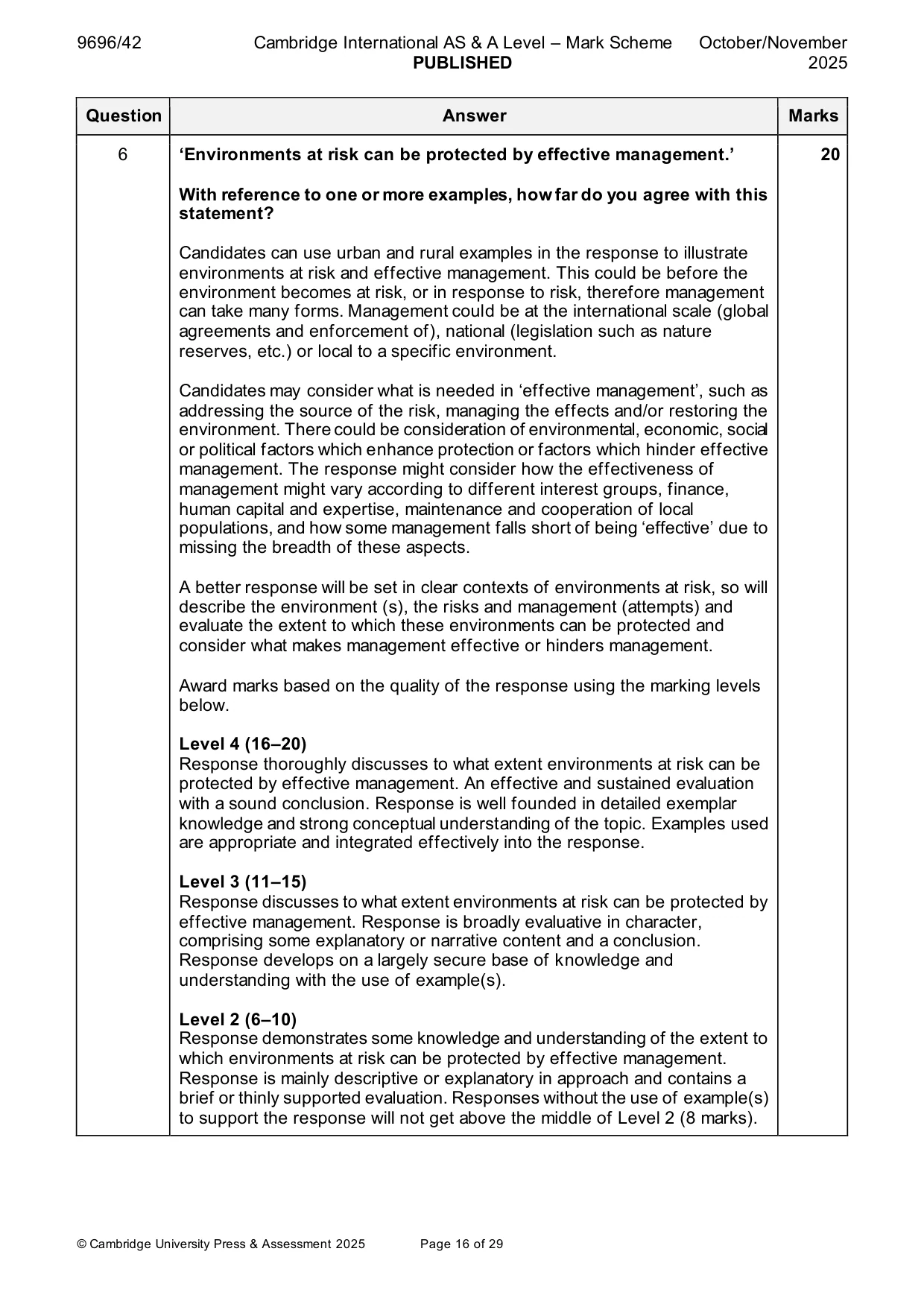
Mark scheme: 6 ‘Environments at risk can be protected by effective management.’ 20 With reference to one or more examples, how far do you agree with this statement? Candidates can use urban and rural examples in the response to illustrate environments at risk and effective management. This could be before the environment becomes at risk, or in response to risk, therefore management can take many forms. Management could be at the international scale (global agreements and enforcement of), national (legislation such as nature reserves, etc.) or local to a specific environment. Candidates may consider what is needed in ‘effective management’, such as addressing the source of the risk, managing the effects and/or restoring the environment. There could be consideration of environmental, economic, social or political factors which enhance protection or factors which hinder effective management. The response might consider how the effectiveness of management might vary according to different interest groups, finance, human capital and expertise, maintenance and cooperation of local populations, and how some management falls short of being ‘effective’ due to missing the breadth of these aspects. A better response will be set in clear contexts of environments at risk, so will describe the environment (s), the risks and management (attempts) and evaluate the extent to which these environments can be protected and consider what makes management effective or hinders management. Award marks based on the quality of the response using the marking levels below. Level 4 (16–20) Response thoroughly discusses to what extent environments at risk can be protected by effective management. An effective and sustained evaluation with a sound conclusion. Response is well founded in detailed exemplar knowledge and strong conceptual understanding of the topic. Examples used are appropriate and integrated effectively into the response. Level 3 (11–15) Response discusses to what extent environments at risk can be protected by effective management. Response is broadly evaluative in character, comprising some explanatory or narrative content and a conclusion. Response develops on a largely secure base of knowledge and understanding with the use of example(s). Level 2 (6–10) Response demonstrates some knowledge and understanding of the extent to which environments at risk can be protected by effective management. Response is mainly descriptive or explanatory in approach and contains a brief or thinly supported evaluation. Responses without the use of example(s) to support the response will not get above the middle of Level 2 (8 marks). 6 Level 1 (1–5) Response makes a few general points about environments at risk and/or management. A descriptive response comprising a few simple points. Knowledge is basic and understanding may be poor and lack relevance to the question set. Level 0 (0) No creditable response. Global interdependence If answering this option, answer Question 7 and either Question 8 or Question 9.
Q7 · The contribution of tourism to gross domestic product (GDP), for selected countries, in…
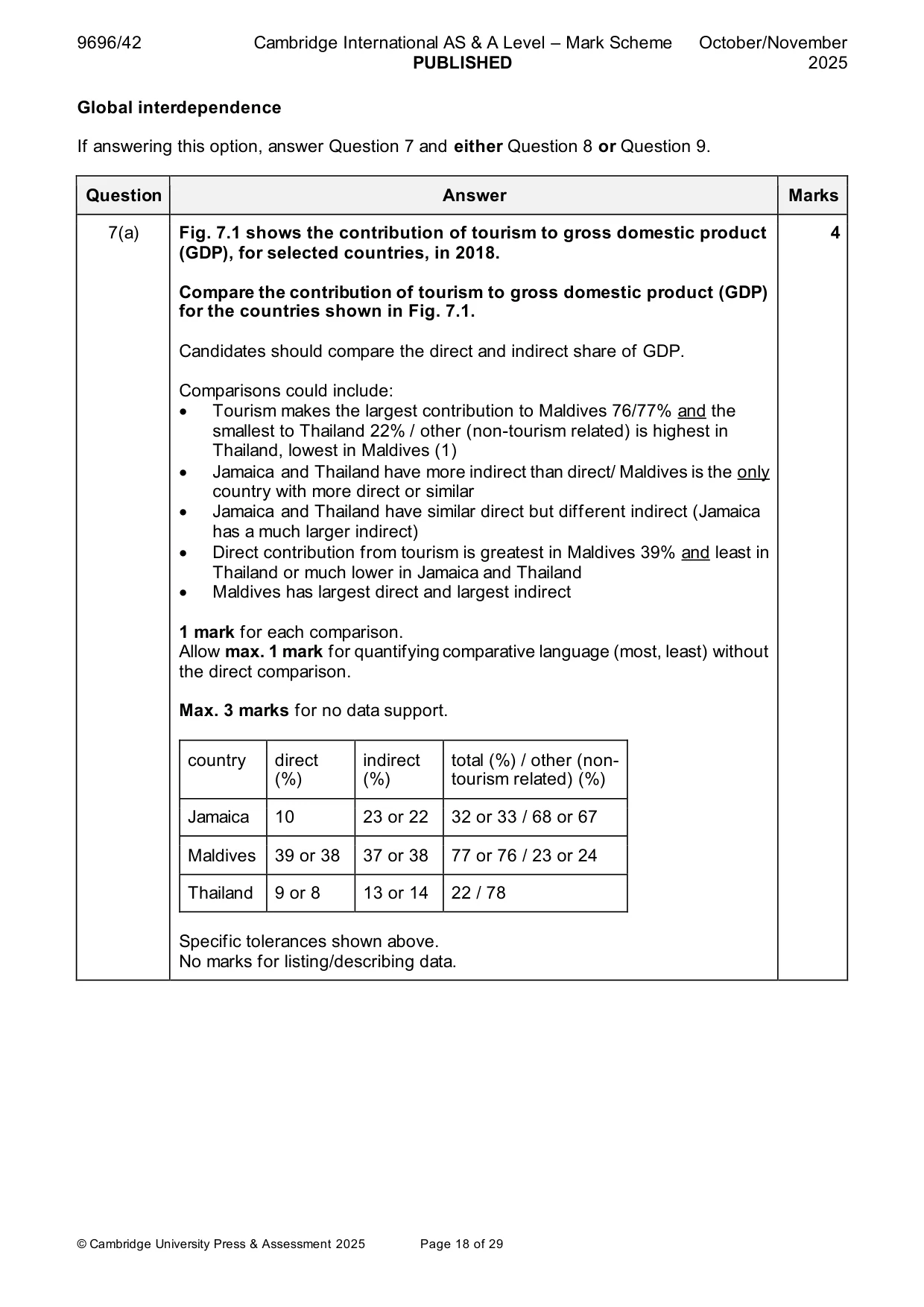
7 Fig. 7.1 shows the contribution of tourism to gross domestic product (GDP), for selected countries, in 2018. (a) Compare the contribution of tourism to gross domestic product (GDP) for the countries shown in Fig. 7.1. [4] (b) Explain two impacts of the tourism multiplier effect. [6]
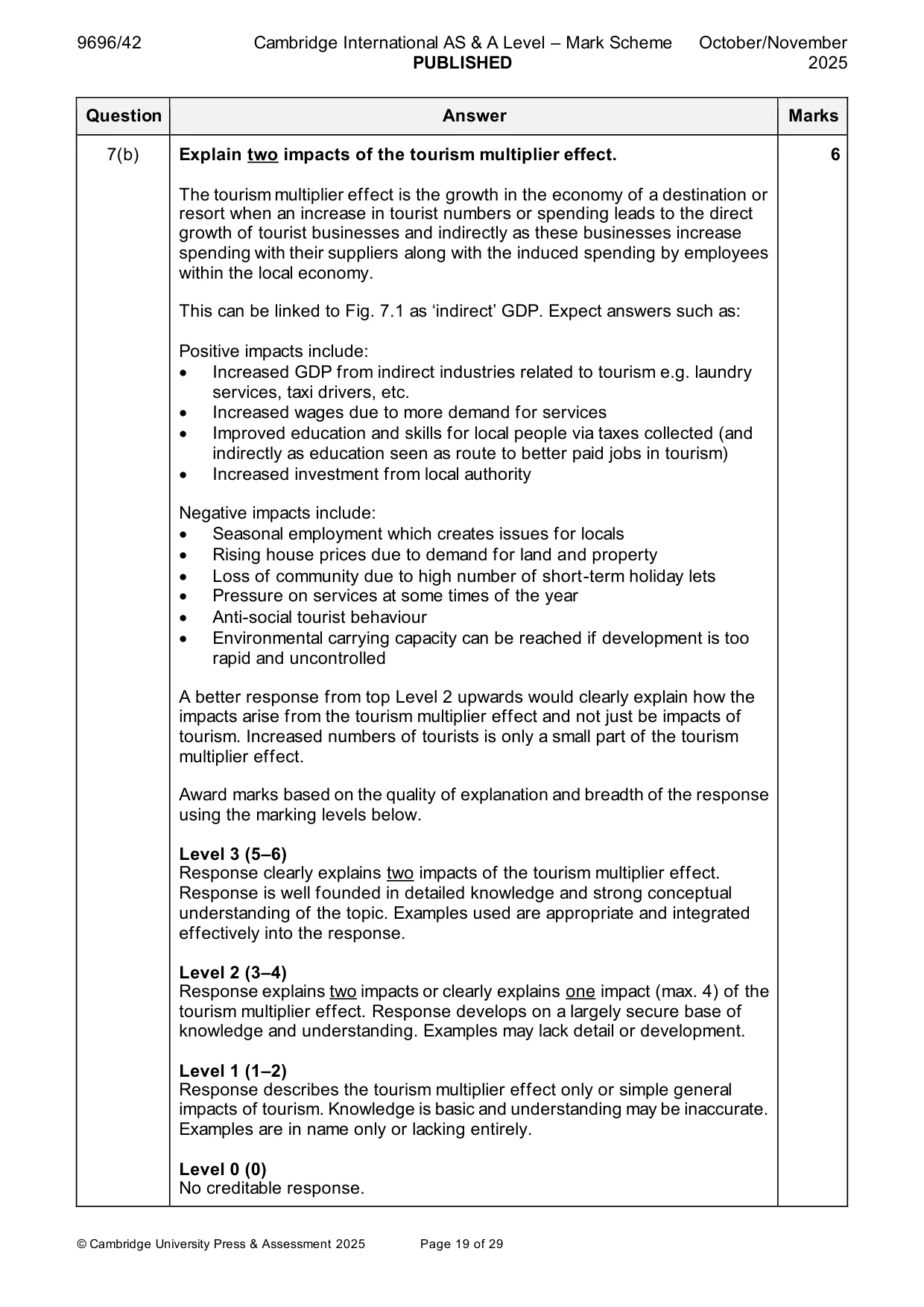
Mark scheme: 7(a) Fig. 7.1 shows the contribution of tourism to gross domestic product 4 (GDP), for selected countries, in 2018. Compare the contribution of tourism to gross domestic product (GDP) for the countries shown in Fig. 7.1. Candidates should compare the direct and indirect share of GDP. Comparisons could include: • Tourism makes the largest contribution to Maldives 76/77% and the smallest to Thailand 22% / other (non-tourism related) is highest in Thailand, lowest in Maldives (1) • Jamaica and Thailand have more indirect than direct/ Maldives is the only country with more direct or similar • Jamaica and Thailand have similar direct but different indirect (Jamaica has a much larger indirect) • Direct contribution from tourism is greatest in Maldives 39% and least in Thailand or much lower in Jamaica and Thailand • Maldives has largest direct and largest indirect 1 mark for each comparison. Allow max. 1 mark for quantifying comparative language (most, least) without the direct comparison. Max. 3 marks for no data support. country direct indirect total (%) / other (non- (%) (%) tourism related) (%) Jamaica 10 23 or 22 32 or 33 / 68 or 67 Maldives 39 or 38 37 or 38 77 or 76 / 23 or 24 Thailand 9 or 8 13 or 14 22 / 78 Specific tolerances shown above. No marks for listing/describing data. 7(b) Explain two impacts of the tourism multiplier effect. 6 The tourism multiplier effect is the growth in the economy of a destination or resort when an increase in tourist numbers or spending leads to the direct growth of tourist businesses and indirectly as these businesses increase spending with their suppliers along with the induced spending by employees within the local economy. This can be linked to Fig. 7.1 as ‘indirect’ GDP. Expect answers such as: Positive impacts include: • Increased GDP from indirect industries related to tourism e.g. laundry services, taxi drivers, etc. • Increased wages due to more demand for services • Improved education and skills for local people via taxes collected (and indirectly as education seen as route to better paid jobs in tourism) • Increased investment from local authority Negative impacts include: • Seasonal employment which creates issues for locals • Rising house prices due to demand for land and property • Loss of community due to high number of short-term holiday lets • Pressure on services at some times of the year • Anti-social tourist behaviour • Environmental carrying capacity can be reached if development is too rapid and uncontrolled A better response from top Level 2 upwards would clearly explain how the impacts arise from the tourism multiplier effect and not just be impacts of tourism. Increased numbers of tourists is only a small part of the tourism multiplier effect. Award marks based on the quality of explanation and breadth of the response using the marking levels below. Level 3 (5–6) Response clearly explains two impacts of the tourism multiplier effect. Response is well founded in detailed knowledge and strong conceptual understanding of the topic. Examples used are appropriate and integrated effectively into the response. Level 2 (3–4) Response explains two impacts or clearly explains one impact (max. 4) of the tourism multiplier effect. Response develops on a largely secure base of knowledge and understanding. Examples may lack detail or development. Level 1 (1–2) Response describes the tourism multiplier effect only or simple general impacts of tourism. Knowledge is basic and understanding may be inaccurate. Examples are in name only or lacking entirely. Level 0 (0) No creditable response.
Q8 · Assess the extent to which international debt is a problem for some countries
8 Assess the extent to which international debt is a problem for some countries. [20]
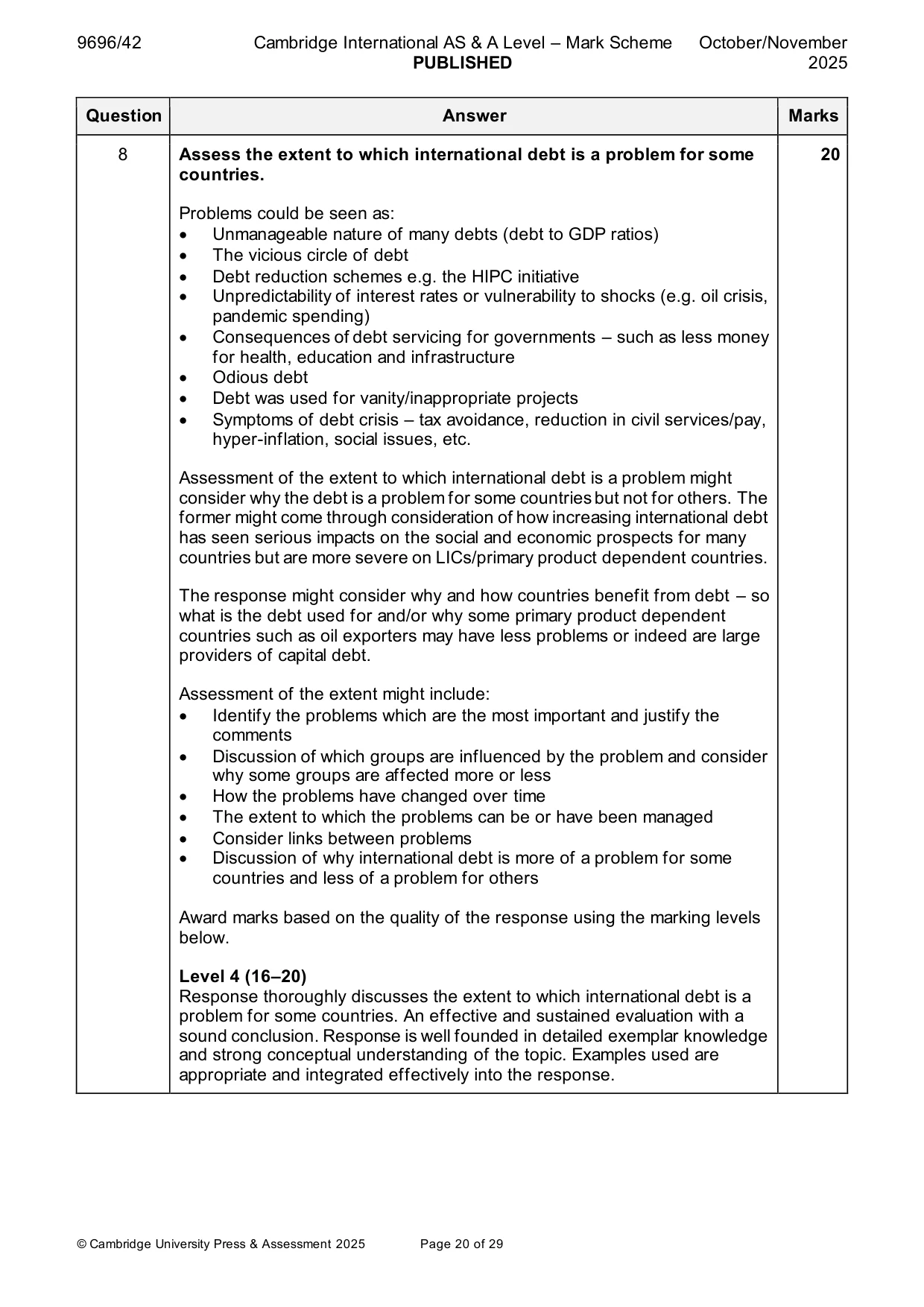
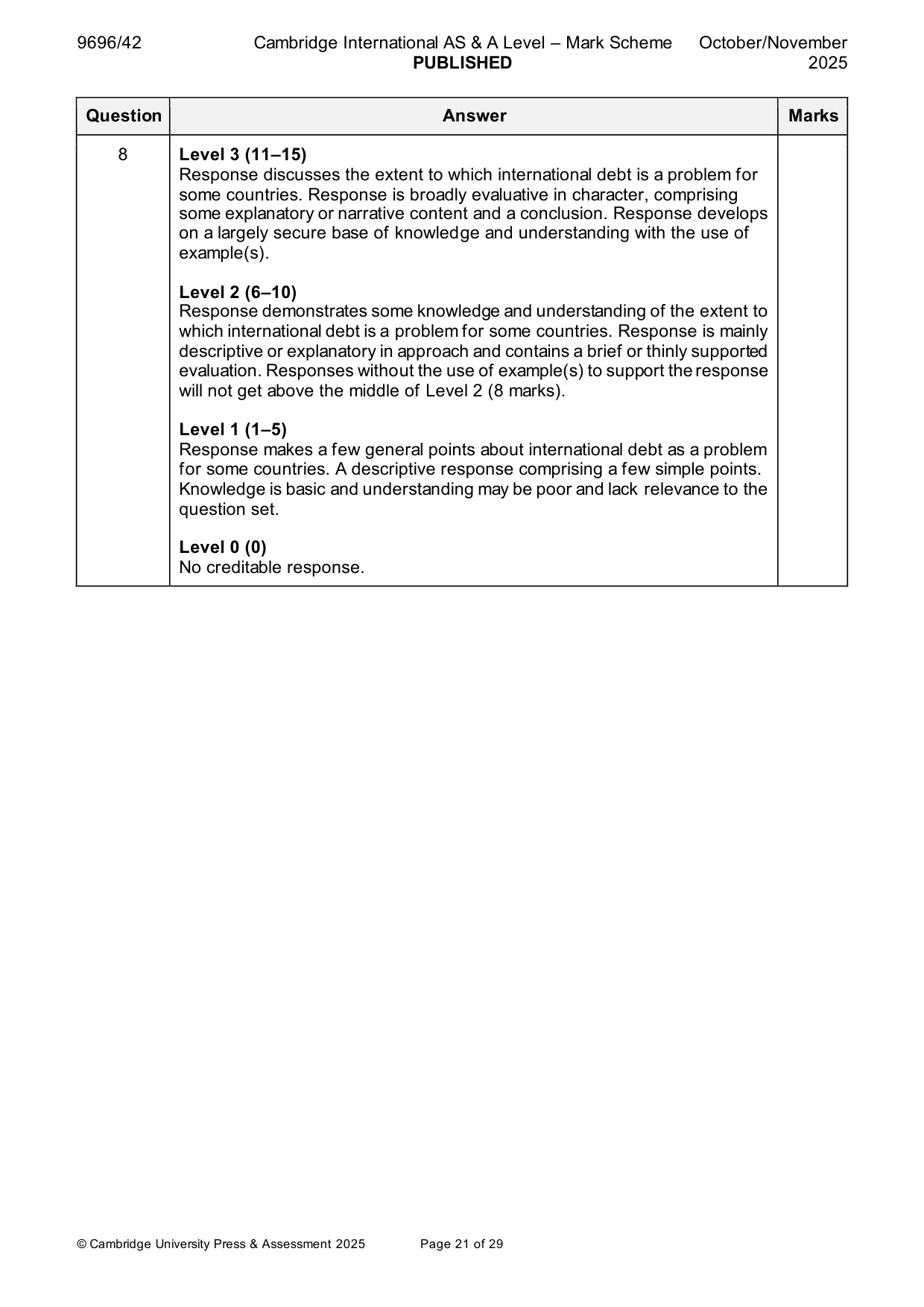
Mark scheme: 8 Assess the extent to which international debt is a problem for some 20 countries. Problems could be seen as: • Unmanageable nature of many debts (debt to GDP ratios) • The vicious circle of debt • Debt reduction schemes e.g. the HIPC initiative • Unpredictability of interest rates or vulnerability to shocks (e.g. oil crisis, pandemic spending) • Consequences of debt servicing for governments – such as less money for health, education and infrastructure • Odious debt • Debt was used for vanity/inappropriate projects • Symptoms of debt crisis – tax avoidance, reduction in civil services/pay, hyper-inflation, social issues, etc. Assessment of the extent to which international debt is a problem might consider why the debt is a problem for some countries but not for others. The former might come through consideration of how increasing international debt has seen serious impacts on the social and economic prospects for many countries but are more severe on LICs/primary product dependent countries. The response might consider why and how countries benefit from debt – so what is the debt used for and/or why some primary product dependent countries such as oil exporters may have less problems or indeed are large providers of capital debt. Assessment of the extent might include: • Identify the problems which are the most important and justify the comments • Discussion of which groups are influenced by the problem and consider why some groups are affected more or less • How the problems have changed over time • The extent to which the problems can be or have been managed • Consider links between problems • Discussion of why international debt is more of a problem for some countries and less of a problem for others Award marks based on the quality of the response using the marking levels below. Level 4 (16–20) Response thoroughly discusses the extent to which international debt is a problem for some countries. An effective and sustained evaluation with a sound conclusion. Response is well founded in detailed exemplar knowledge and strong conceptual understanding of the topic. Examples used are appropriate and integrated effectively into the response. 8 Level 3 (11–15) Response discusses the extent to which international debt is a problem for some countries. Response is broadly evaluative in character, comprising some explanatory or narrative content and a conclusion. Response develops on a largely secure base of knowledge and understanding with the use of example(s). Level 2 (6–10) Response demonstrates some knowledge and understanding of the extent to which international debt is a problem for some countries. Response is mainly descriptive or explanatory in approach and contains a brief or thinly supported evaluation. Responses without the use of example(s) to support the response will not get above the middle of Level 2 (8 marks). Level 1 (1–5) Response makes a few general points about international debt as a problem for some countries. A descriptive response comprising a few simple points. Knowledge is basic and understanding may be poor and lack relevance to the question set. Level 0 (0) No creditable response.
Q9 · For one tourist area or resort, evaluate the issues of sustainability it faces
9 For one tourist area or resort, evaluate the issues of sustainability it faces. [20] Economic transition If answering this option, answer Question 10 and either Question 11 or Question 12.
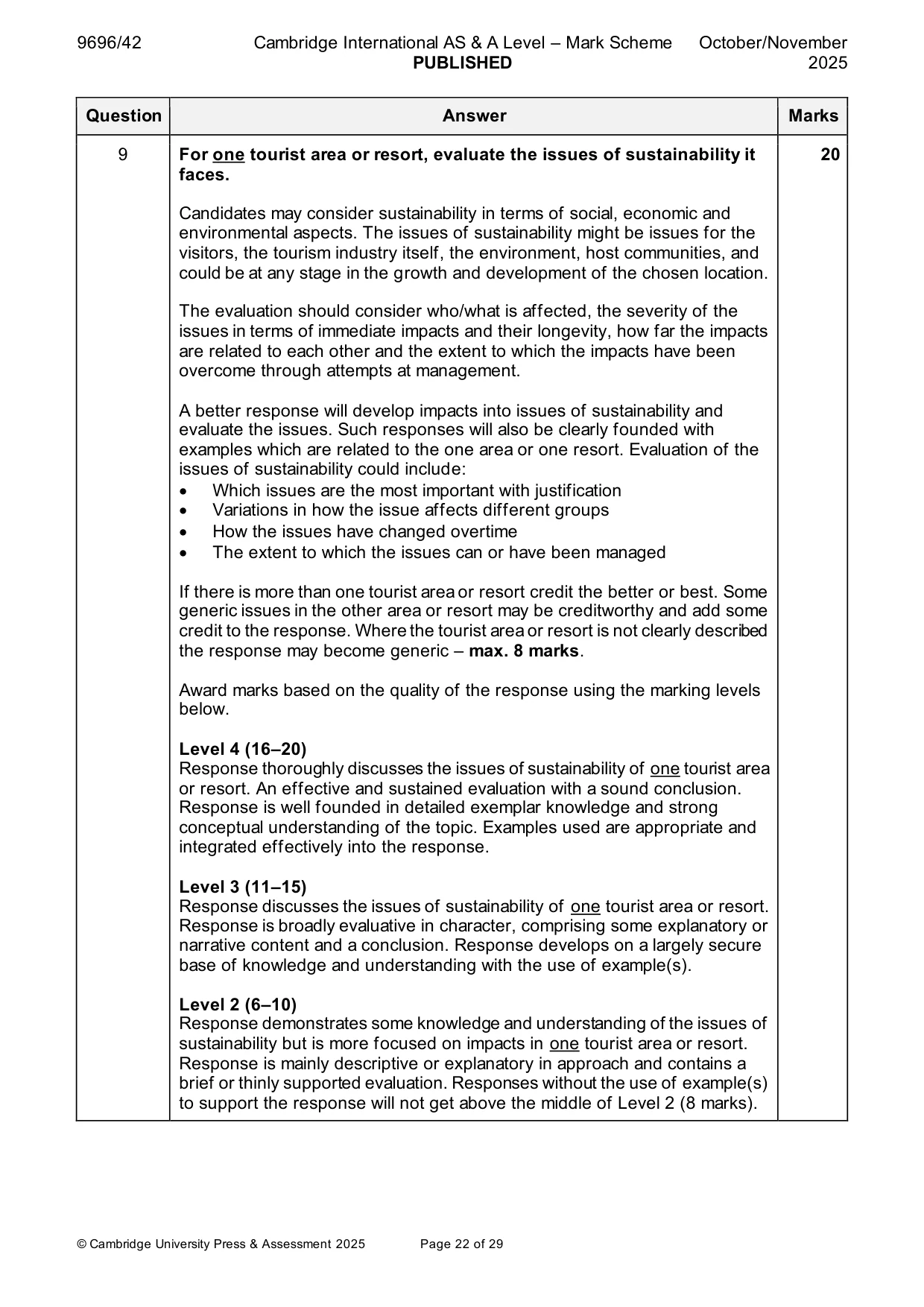
Mark scheme: 9 For one tourist area or resort, evaluate the issues of sustainability it 20 faces. Candidates may consider sustainability in terms of social, economic and environmental aspects. The issues of sustainability might be issues for the visitors, the tourism industry itself, the environment, host communities, and could be at any stage in the growth and development of the chosen location. The evaluation should consider who/what is affected, the severity of the issues in terms of immediate impacts and their longevity, how far the impacts are related to each other and the extent to which the impacts have been overcome through attempts at management. A better response will develop impacts into issues of sustainability and evaluate the issues. Such responses will also be clearly founded with examples which are related to the one area or one resort. Evaluation of the issues of sustainability could include: • Which issues are the most important with justification • Variations in how the issue affects different groups • How the issues have changed overtime • The extent to which the issues can or have been managed If there is more than one tourist area or resort credit the better or best. Some generic issues in the other area or resort may be creditworthy and add some credit to the response. Where the tourist area or resort is not clearly described the response may become generic – max. 8 marks. Award marks based on the quality of the response using the marking levels below. Level 4 (16–20) Response thoroughly discusses the issues of sustainability of one tourist area or resort. An effective and sustained evaluation with a sound conclusion. Response is well founded in detailed exemplar knowledge and strong conceptual understanding of the topic. Examples used are appropriate and integrated effectively into the response. Level 3 (11–15) Response discusses the issues of sustainability of one tourist area or resort. Response is broadly evaluative in character, comprising some explanatory or narrative content and a conclusion. Response develops on a largely secure base of knowledge and understanding with the use of example(s). Level 2 (6–10) Response demonstrates some knowledge and understanding of the issues of sustainability but is more focused on impacts in one tourist area or resort. Response is mainly descriptive or explanatory in approach and contains a brief or thinly supported evaluation. Responses without the use of example(s) to support the response will not get above the middle of Level 2 (8 marks). 9 Level 1 (1–5) Response makes a few general points about tourism in one tourist area or resort. A descriptive response comprising a few simple points. Knowledge is basic and understanding may be poor and lack relevance to the question set. Level 0 (0) No creditable response. Economic transition If answering this option, answer Question 10 and either Question 11 or Question 12.
Q10 · The number of operations of an Indian transnational corporation (TNC) in 2023
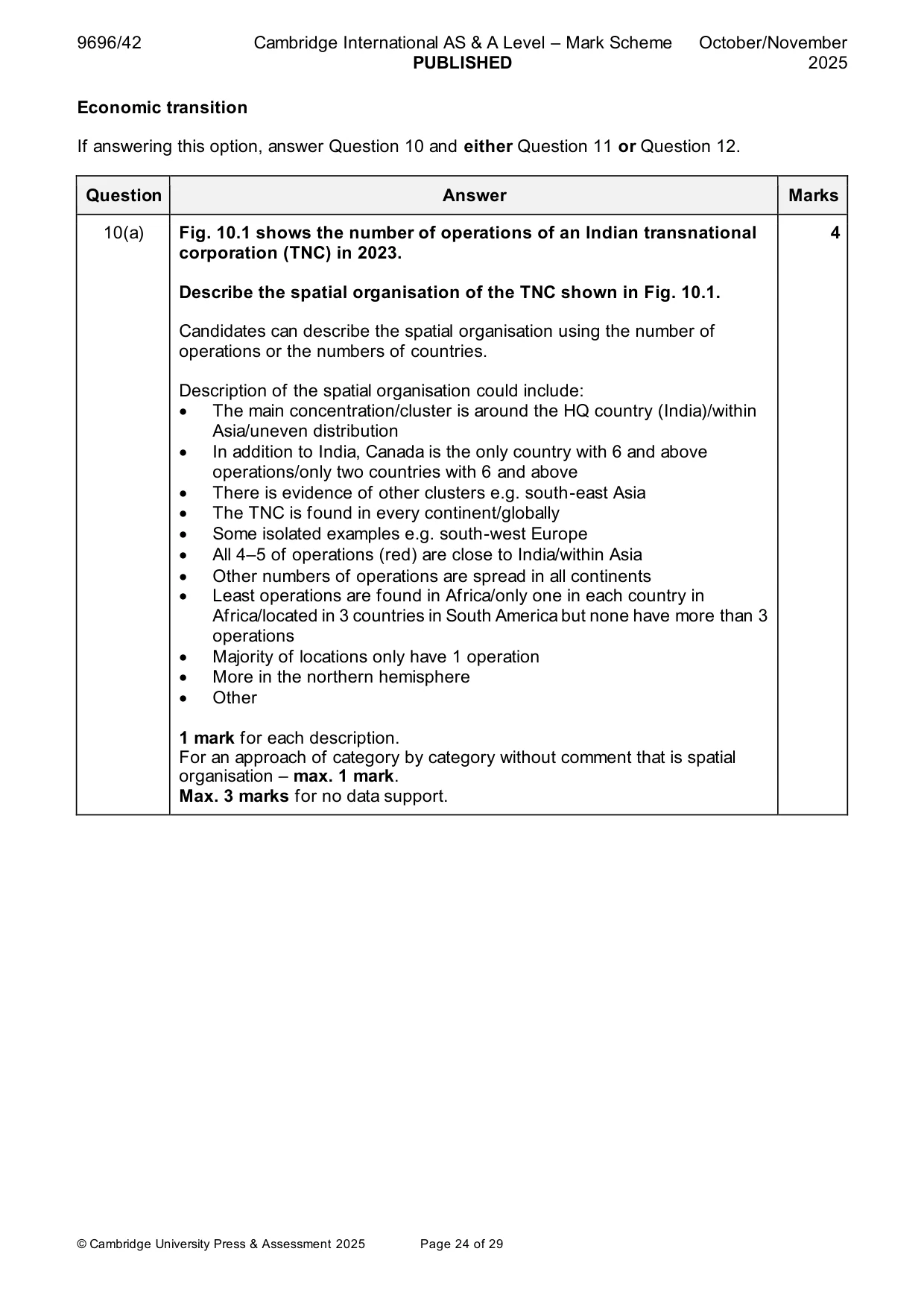
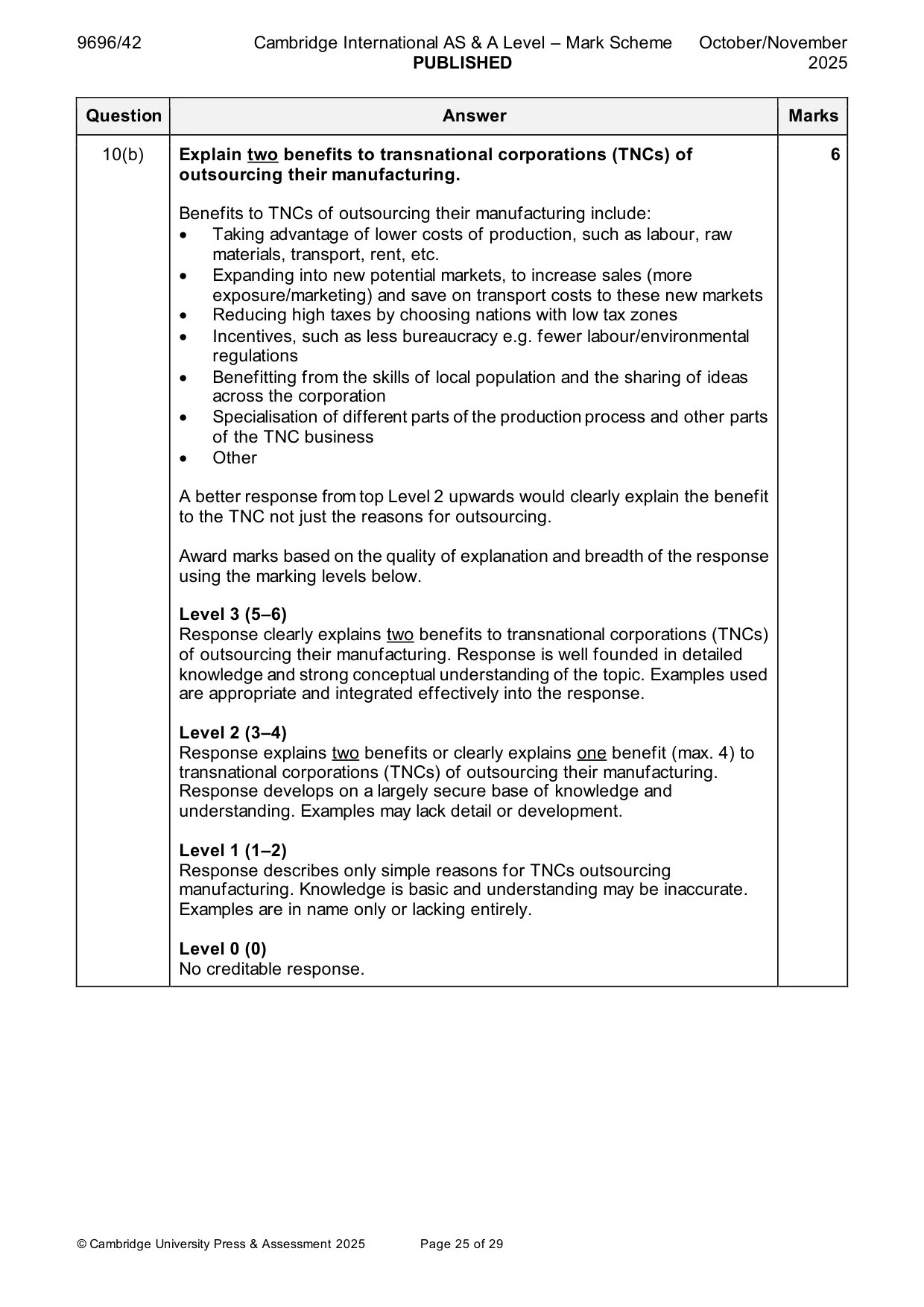
10 Fig. 10.1 shows the number of operations of an Indian transnational corporation (TNC) in 2023. (a) Describe the spatial organisation of the TNC shown in Fig. 10.1. [4] (b) Explain two benefits to transnational corporations (TNCs) of outsourcing their manufacturing. [6]
Mark scheme: 10(a) Fig. 10.1 shows the number of operations of an Indian transnational 4 corporation (TNC) in 2023. Describe the spatial organisation of the TNC shown in Fig. 10.1. Candidates can describe the spatial organisation using the number of operations or the numbers of countries. Description of the spatial organisation could include: • The main concentration/cluster is around the HQ country (India)/within Asia/uneven distribution • In addition to India, Canada is the only country with 6 and above operations/only two countries with 6 and above • There is evidence of other clusters e.g. south-east Asia • The TNC is found in every continent/globally • Some isolated examples e.g. south-west Europe • All 4–5 of operations (red) are close to India/within Asia • Other numbers of operations are spread in all continents • Least operations are found in Africa/only one in each country in Africa/located in 3 countries in South America but none have more than 3 operations • Majority of locations only have 1 operation • More in the northern hemisphere • Other 1 mark for each description. For an approach of category by category without comment that is spatial organisation – max. 1 mark. Max. 3 marks for no data support. 10(b) Explain two benefits to transnational corporations (TNCs) of 6 outsourcing their manufacturing. Benefits to TNCs of outsourcing their manufacturing include: • Taking advantage of lower costs of production, such as labour, raw materials, transport, rent, etc. • Expanding into new potential markets, to increase sales (more exposure/marketing) and save on transport costs to these new markets • Reducing high taxes by choosing nations with low tax zones • Incentives, such as less bureaucracy e.g. fewer labour/environmental regulations • Benefitting from the skills of local population and the sharing of ideas across the corporation • Specialisation of different parts of the production process and other parts of the TNC business • Other A better response from top Level 2 upwards would clearly explain the benefit to the TNC not just the reasons for outsourcing. Award marks based on the quality of explanation and breadth of the response using the marking levels below. Level 3 (5–6) Response clearly explains two benefits to transnational corporations (TNCs) of outsourcing their manufacturing. Response is well founded in detailed knowledge and strong conceptual understanding of the topic. Examples used are appropriate and integrated effectively into the response. Level 2 (3–4) Response explains two benefits or clearly explains one benefit (max. 4) to transnational corporations (TNCs) of outsourcing their manufacturing. Response develops on a largely secure base of knowledge and understanding. Examples may lack detail or development. Level 1 (1–2) Response describes only simple reasons for TNCs outsourcing manufacturing. Knowledge is basic and understanding may be inaccurate. Examples are in name only or lacking entirely. Level 0 (0) No creditable response.
Q11 · Evaluate the relative importance of the factors in the emergence and growth of one or…
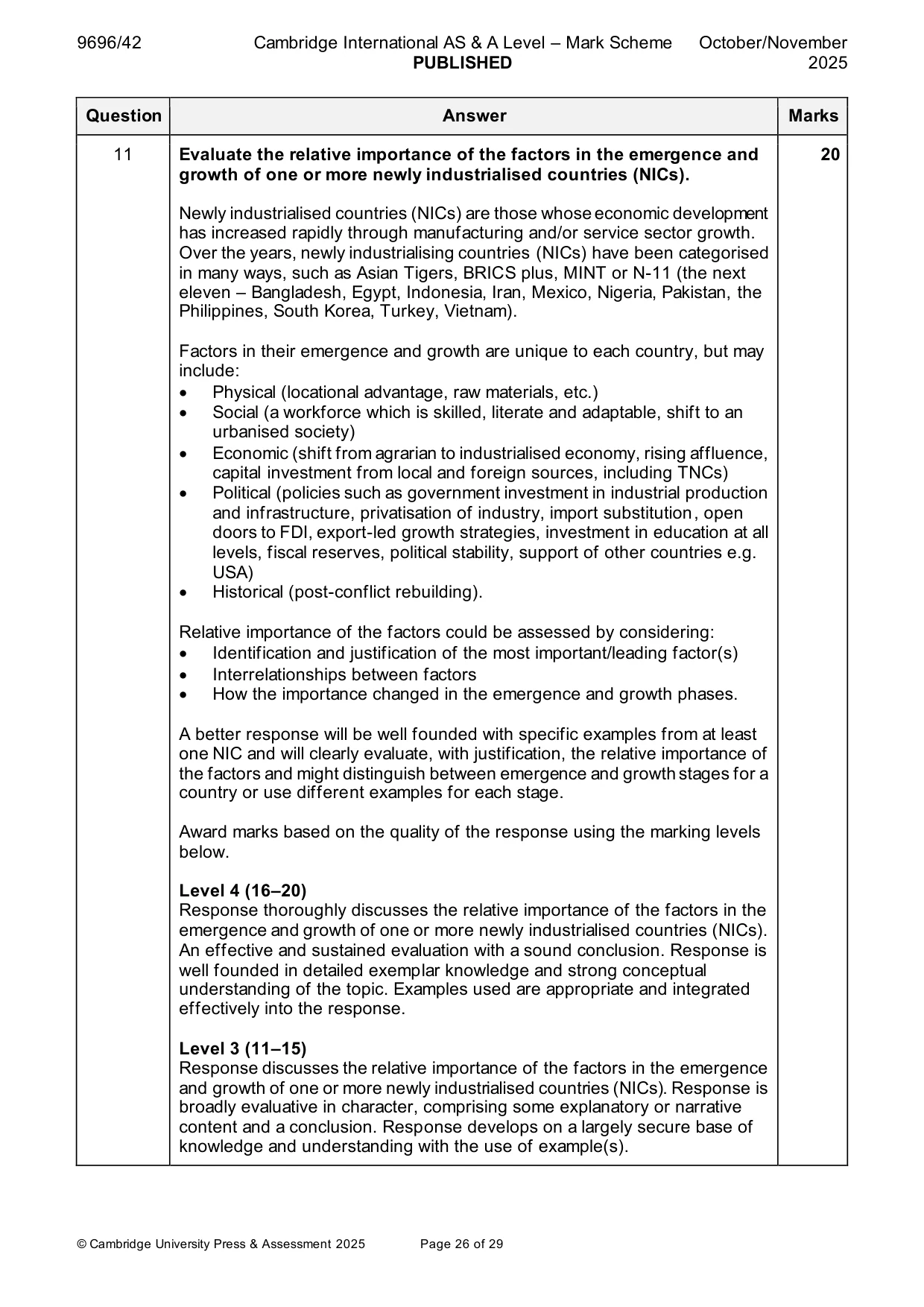
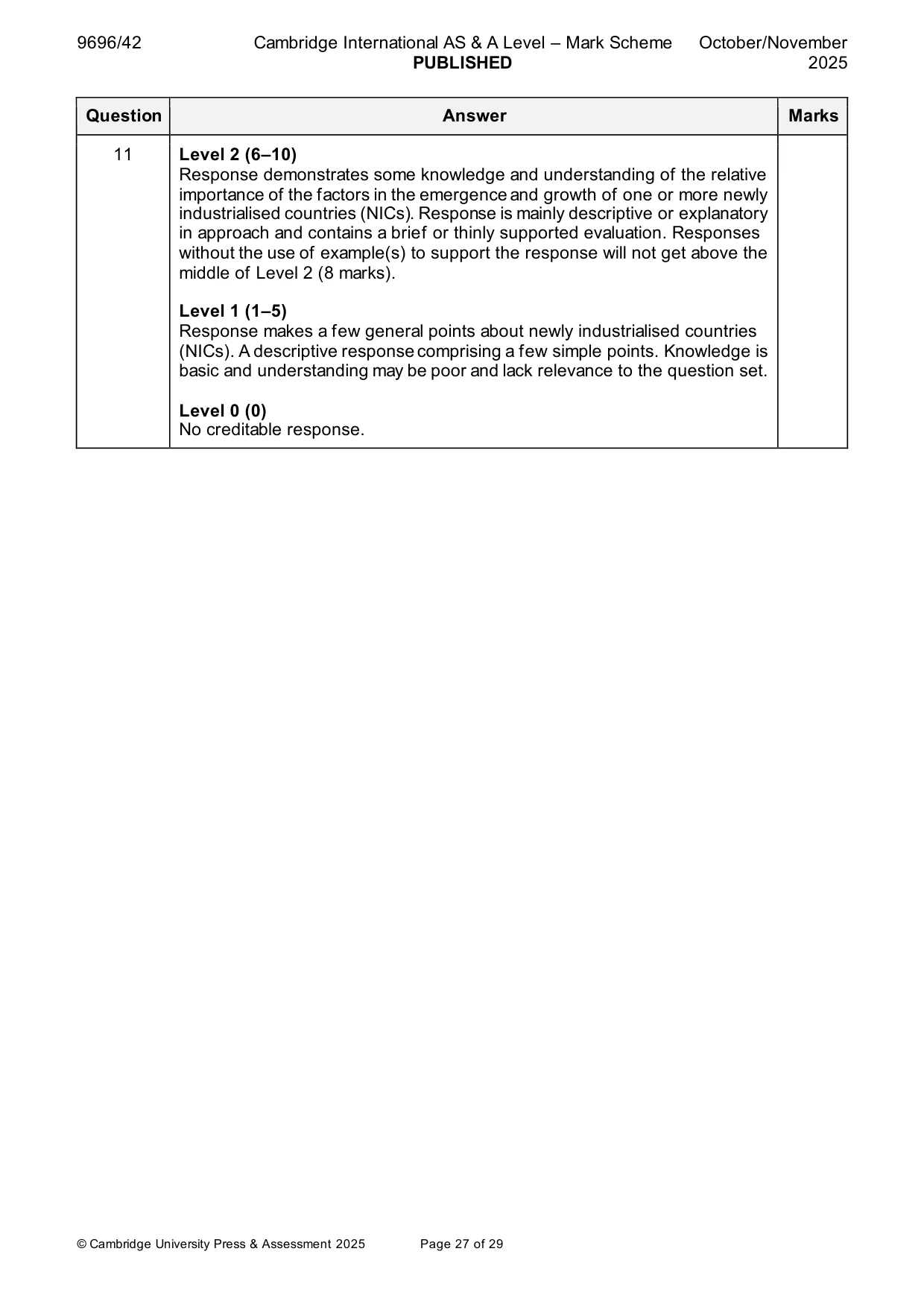
11 Evaluate the relative importance of the factors in the emergence and growth of one or more newly industrialised countries (NICs). [20]
Mark scheme: 11 Evaluate the relative importance of the factors in the emergence and 20 growth of one or more newly industrialised countries (NICs). Newly industrialised countries (NICs) are those whose economic development has increased rapidly through manufacturing and/or service sector growth. Over the years, newly industrialising countries (NICs) have been categorised in many ways, such as Asian Tigers, BRICS plus, MINT or N-11 (the next eleven – Bangladesh, Egypt, Indonesia, Iran, Mexico, Nigeria, Pakistan, the Philippines, South Korea, Turkey, Vietnam). Factors in their emergence and growth are unique to each country, but may include: • Physical (locational advantage, raw materials, etc.) • Social (a workforce which is skilled, literate and adaptable, shift to an urbanised society) • Economic (shift from agrarian to industrialised economy, rising affluence, capital investment from local and foreign sources, including TNCs) • Political (policies such as government investment in industrial production and infrastructure, privatisation of industry, import substitution, open doors to FDI, export-led growth strategies, investment in education at all levels, fiscal reserves, political stability, support of other countries e.g. USA) • Historical (post-conflict rebuilding). Relative importance of the factors could be assessed by considering: • Identification and justification of the most important/leading factor(s) • Interrelationships between factors • How the importance changed in the emergence and growth phases. A better response will be well founded with specific examples from at least one NIC and will clearly evaluate, with justification, the relative importance of the factors and might distinguish between emergence and growth stages for a country or use different examples for each stage. Award marks based on the quality of the response using the marking levels below. Level 4 (16–20) Response thoroughly discusses the relative importance of the factors in the emergence and growth of one or more newly industrialised countries (NICs). An effective and sustained evaluation with a sound conclusion. Response is well founded in detailed exemplar knowledge and strong conceptual understanding of the topic. Examples used are appropriate and integrated effectively into the response. Level 3 (11–15) Response discusses the relative importance of the factors in the emergence and growth of one or more newly industrialised countries (NICs). Response is broadly evaluative in character, comprising some explanatory or narrative content and a conclusion. Response develops on a largely secure base of knowledge and understanding with the use of example(s). 11 Level 2 (6–10) Response demonstrates some knowledge and understanding of the relative importance of the factors in the emergence and growth of one or more newly industrialised countries (NICs). Response is mainly descriptive or explanatory in approach and contains a brief or thinly supported evaluation. Responses without the use of example(s) to support the response will not get above the middle of Level 2 (8 marks). Level 1 (1–5) Response makes a few general points about newly industrialised countries (NICs). A descriptive response comprising a few simple points. Knowledge is basic and understanding may be poor and lack relevance to the question set. Level 0 (0) No creditable response.
What was in this paper
The subtopics covered by these 11 questions, and how many questions each got. Open one in a new tab to see every Cambridge question on it.
2Sustainable energy supplies2Agricultural systems and food production1International debt and international aid1The development of international tourism1The globalisation of economic activity1The management of a degraded environment1The management of a tourist destination1The management of agricultural change1What you needed in this session
Cambridge’s own grade thresholds for 2025 Oct/Nov, Paper 4 · Variant 2. A higher threshold means an easier paper — the bar moves with how the cohort did.