Cambridge A Level Geography 9696 — 2025 May/June Paper 4 · Variant 2
9696/42/M/J/25 · 60 marks · ≈68 min
The question paper and its mark scheme, free to read here and free to download. This is Cambridge’s own paper, exactly as it was sat.
Question paper4 pages

Mark scheme27 pages
Answers below. Sit the paper first if you are practising.


Paper as text
Question paper, page 1
This document has 4 pages. Any blank pages are indicated. [Turn over * 2 4 1 1 4 5 6 9 5 3 * Cambridge International AS & A Level GEOGRAPHY 9696/42 Paper 4 Advanced Human Geography Options May/June 2025 1 hour 30 minutes You must answer on the enclosed answer booklet. You will need: Answer booklet (enclosed) Insert (enclosed) INSTRUCTIONS ● Answer four questions in total: Answer questions from two options. For each option, follow the instructions inside on which questions to answer. ● Follow the instructions on the front cover of the answer booklet. If you need additional answer paper, ask the invigilator for a continuation booklet. ● Sketch maps and diagrams should be drawn whenever they serve to illustrate an answer. ● You should make reference to appropriate examples studied in the field or the classroom, even where such examples are not specifically requested by the question. INFORMATION ● The total mark for this paper is 60. ● The number of marks for each question or part question is shown in brackets [ ]. ● The insert contains all the resources referred to in the questions. LICs = low income countries. MICs = middle income countries. HICs = high income countries. DC (DE) 343392/2 © UCLES 2025
Question paper, page 2
2 9696/42/M/J/25 © UCLES 2025 Answer questions from two different options. Production, location and change If answering this option, answer Question 1 and either Question 2 or Question 3. 1 Fig. 1.1 shows functional linkages in the car and engine manufacturing industry in the UK, an HIC in Europe. (a) Describe the functional linkages shown in Fig. 1.1. [4] (b) Explain two disadvantages of the type of manufacturing system shown in Fig. 1.1. [6] 2 How far do you agree that extending the area under cultivation has more advantages than disadvantages? [20] 3 ‘The informal sector of manufacturing and services has an important role in the economy and society of some countries.’ With reference to examples, how far do you agree with this statement? [20] Environmental management If answering this option, answer Question 4 and either Question 5 or Question 6. 4 Fig. 4.1 shows the percentage of global electricity produced from renewable sources, 2008–2020 and estimated to 2026. (a) Describe the main changes shown in Fig. 4.1. [4] (b) Explain two environmental problems of using renewable sources to produce electrical energy. [6] 5 Assess the extent to which levels of development affect the balance of energy sources (energy mix) used to produce electrical energy at the national scale. [20] 6 How far do you agree that rising demand is the main cause of water quality issues? [20]
Question paper, page 3
3 9696/42/M/J/25 © UCLES 2025 Global interdependence If answering this option, answer Question 7 and either Question 8 or Question 9. 7 Fig. 7.1 shows manufactured goods as a percentage of total exports, for LICs, MICs and HICs, 2001–2019. (a) Compare the trends for LICs, MICs and HICs shown in Fig. 7.1. [4] (b) Suggest why primary products are the main export for some countries. [6] 8 ‘Setting a minimum price to pay producers is the most important characteristic of Fairtrade.’ How far do you agree with this statement? [20] 9 Assess the extent to which the internet is the most important factor in the growth of international tourism. [20] Economic transition If answering this option, answer Question 10 and either Question 11 or Question 12. 10 Fig. 10.1 shows countries by income group in 2022. (a) Describe the distribution of HICs shown in Fig. 10.1. [4] (b) Explain two advantages of using social measures and indices of inequality. [6] 11 Assess the role of transnational corporations (TNCs) in the globalisation of economic activity. [20] 12 With reference to one country, assess the extent to which regional disparities have been solved by its regional development policy. [20]
Question paper, page 4
4 9696/42/M/J/25 © UCLES 2025 The boundaries and names shown, the designations used and the presentation of material on any maps contained in this question paper/insert do not imply official endorsement or acceptance by Cambridge Assessment International Education concerning the legal status of any country, territory, or area or any of its authorities, or of the delimitation of its frontiers or boundaries. Permission to reproduce items where third-party owned material protected by copyright is included has been sought and cleared where possible. Every reasonable effort has been made by the publisher (UCLES) to trace copyright holders, but if any items requiring clearance have unwittingly been included, the publisher will be pleased to make amends at the earliest possible opportunity. To avoid the issue of disclosure of answer-related information to candidates, all copyright acknowledgements are reproduced online in the Cambridge Assessment International Education Copyright Acknowledgements Booklet. This is produced for each series of examinations and is freely available to download at www.cambridgeinternational.org after the live examination series. Cambridge Assessment International Education is part of Cambridge Assessment. Cambridge Assessment is the brand name of the University of Cambridge Local Examinations Syndicate (UCLES), which is a department of the University of Cambridge. BLANK PAGE
Mark scheme, page 1
This document consists of 27 printed pages. © Cambridge University Press & Assessment 2025 [Turn over Cambridge International AS & A Level GEOGRAPHY 9696/42 Paper 4 Advanced Human Geography Options May/June 2025 MARK SCHEME Maximum Mark: 60 Published This mark scheme is published as an aid to teachers and candidates, to indicate the requirements of the examination. It shows the basis on which Examiners were instructed to award marks. It does not indicate the details of the discussions that took place at an Examiners’ meeting before marking began, which would have considered the acceptability of alternative answers. Mark schemes should be read in conjunction with the question paper and the Principal Examiner Report for Teachers. Cambridge International will not enter into discussions about these mark schemes. Cambridge International is publishing the mark schemes for the May/June 2025 series for most Cambridge IGCSE, Cambridge International A and AS Level components, and some Cambridge O Level components.
Mark scheme, page 2
9696/42 Cambridge International AS & A Level – Mark Scheme PUBLISHED May/June 2025 © Cambridge University Press & Assessment 2025 Page 2 of 27 Generic Marking Principles These general marking principles must be applied by all examiners when marking candidate answers. They should be applied alongside the specific content of the mark scheme or generic level descriptions for a question. Each question paper and mark scheme will also comply with these marking principles. GENERIC MARKING PRINCIPLE 1: Marks must be awarded in line with: • the specific content of the mark scheme or the generic level descriptors for the question • the specific skills defined in the mark scheme or in the generic level descriptors for the question • the standard of response required by a candidate as exemplified by the standardisation scripts. GENERIC MARKING PRINCIPLE 2: Marks awarded are always whole marks (not half marks, or other fractions). GENERIC MARKING PRINCIPLE 3: Marks must be awarded positively: • marks are awarded for correct/valid answers, as defined in the mark scheme. However, credit is given for valid answers which go beyond the scope of the syllabus and mark scheme, referring to your Team Leader as appropriate • marks are awarded when candidates clearly demonstrate what they know and can do • marks are not deducted for errors • marks are not deducted for omissions • answers should only be judged on the quality of spelling, punctuation and grammar when these features are specifically assessed by the question as indicated by the mark scheme. The meaning, however, should be unambiguous. GENERIC MARKING PRINCIPLE 4: Rules must be applied consistently, e.g. in situations where candidates have not followed instructions or in the application of generic level descriptors. GENERIC MARKING PRINCIPLE 5: Marks should be awarded using the full range of marks defined in the mark scheme for the question (however; the use of the full mark range may be limited according to the quality of the candidate responses seen). GENERIC MARKING PRINCIPLE 6: Marks awarded are based solely on the requirements as defined in the mark scheme. Marks should not be awarded with grade thresholds or grade descriptors in mind.
Mark scheme, page 3
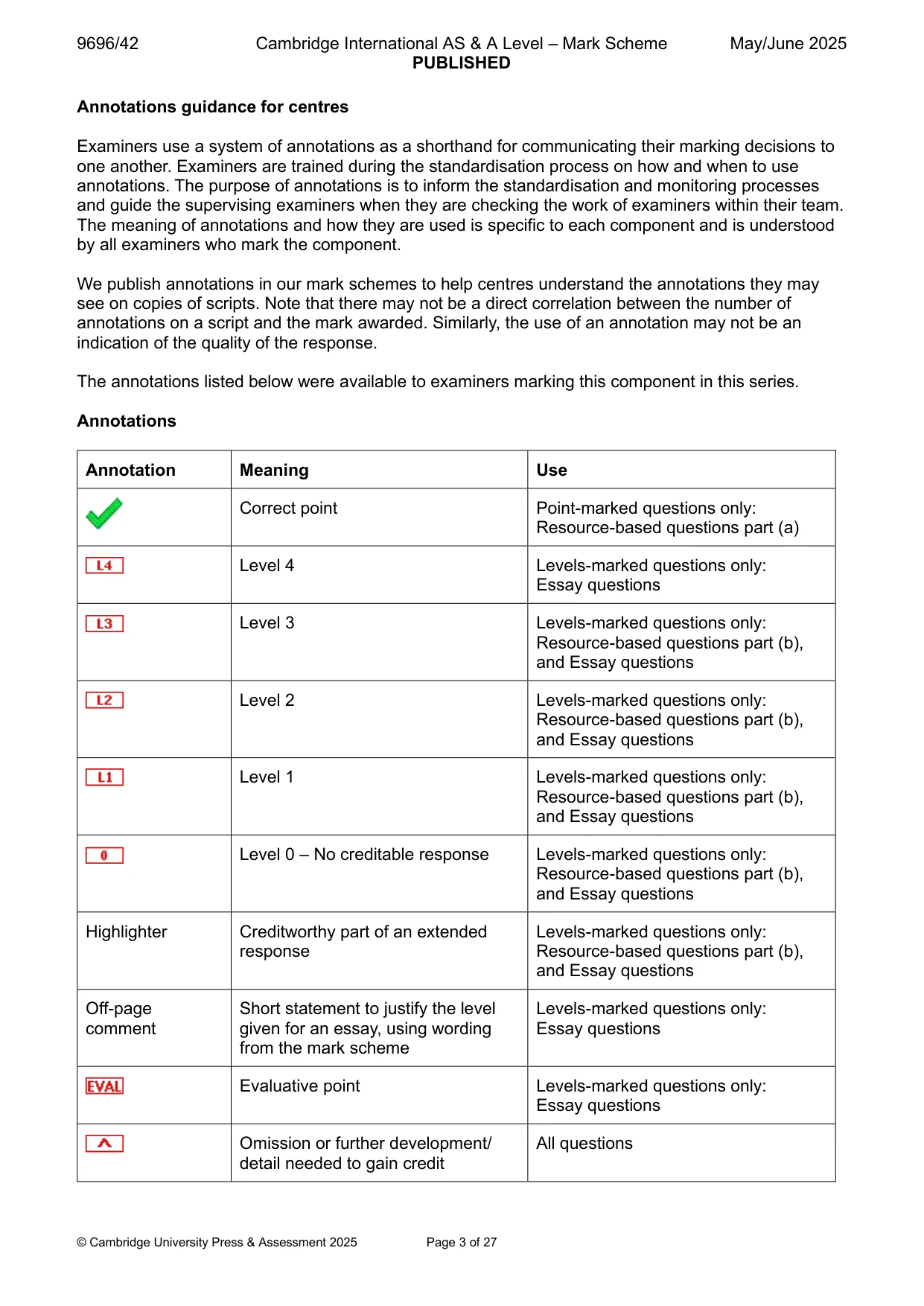
9696/42 Cambridge International AS & A Level – Mark Scheme PUBLISHED May/June 2025 © Cambridge University Press & Assessment 2025 Page 3 of 27 Annotations guidance for centres Examiners use a system of annotations as a shorthand for communicating their marking decisions to one another. Examiners are trained during the standardisation process on how and when to use annotations. The purpose of annotations is to inform the standardisation and monitoring processes and guide the supervising examiners when they are checking the work of examiners within their team. The meaning of annotations and how they are used is specific to each component and is understood by all examiners who mark the component. We publish annotations in our mark schemes to help centres understand the annotations they may see on copies of scripts. Note that there may not be a direct correlation between the number of annotations on a script and the mark awarded. Similarly, the use of an annotation may not be an indication of the quality of the response. The annotations listed below were available to examiners marking this component in this series. Annotations Annotation Meaning Use Correct point Point-marked questions only: Resource-based questions part (a) Level 4 Levels-marked questions only: Essay questions Level 3 Levels-marked questions only: Resource-based questions part (b), and Essay questions Level 2 Levels-marked questions only: Resource-based questions part (b), and Essay questions Level 1 Levels-marked questions only: Resource-based questions part (b), and Essay questions Level 0 – No creditable response Levels-marked questions only: Resource-based questions part (b), and Essay questions Highlighter Creditworthy part of an extended response Levels-marked questions only: Resource-based questions part (b), and Essay questions Off-page comment Short statement to justify the level given for an essay, using wording from the mark scheme Levels-marked questions only: Essay questions Evaluative point Levels-marked questions only: Essay questions Omission or further development/ detail needed to gain credit All questions
Mark scheme, page 4
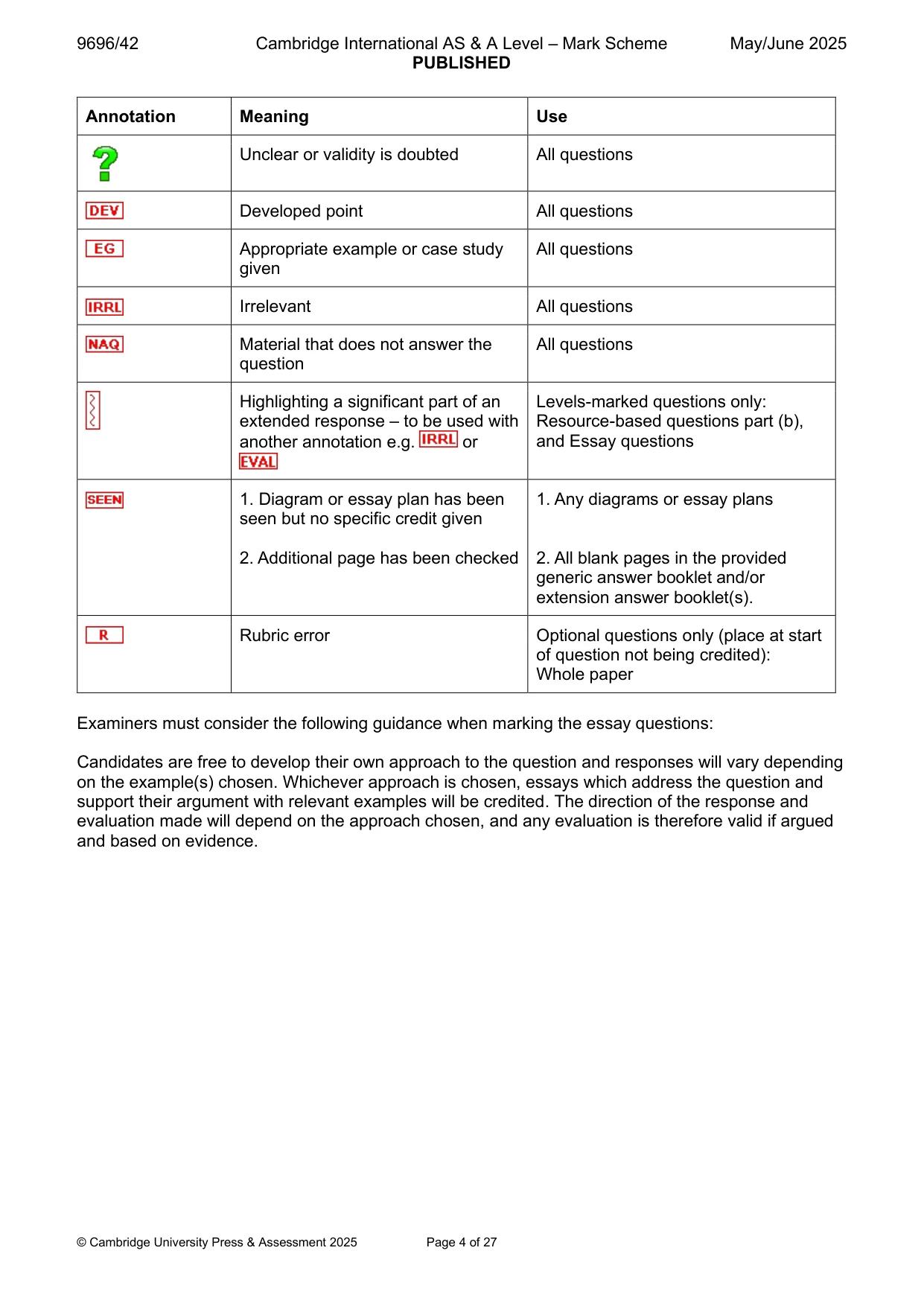
9696/42 Cambridge International AS & A Level – Mark Scheme PUBLISHED May/June 2025 © Cambridge University Press & Assessment 2025 Page 4 of 27 Annotation Meaning Use Unclear or validity is doubted All questions Developed point All questions Appropriate example or case study given All questions Irrelevant All questions Material that does not answer the question All questions Highlighting a significant part of an extended response – to be used with another annotation e.g. or Levels-marked questions only: Resource-based questions part (b), and Essay questions 1. Diagram or essay plan has been seen but no specific credit given 2. Additional page has been checked 1. Any diagrams or essay plans 2. All blank pages in the provided generic answer booklet and/or extension answer booklet(s). Rubric error Optional questions only (place at start of question not being credited): Whole paper Examiners must consider the following guidance when marking the essay questions: Candidates are free to develop their own approach to the question and responses will vary depending on the example(s) chosen. Whichever approach is chosen, essays which address the question and support their argument with relevant examples will be credited. The direction of the response and evaluation made will depend on the approach chosen, and any evaluation is therefore valid if argued and based on evidence.
Mark scheme, page 5
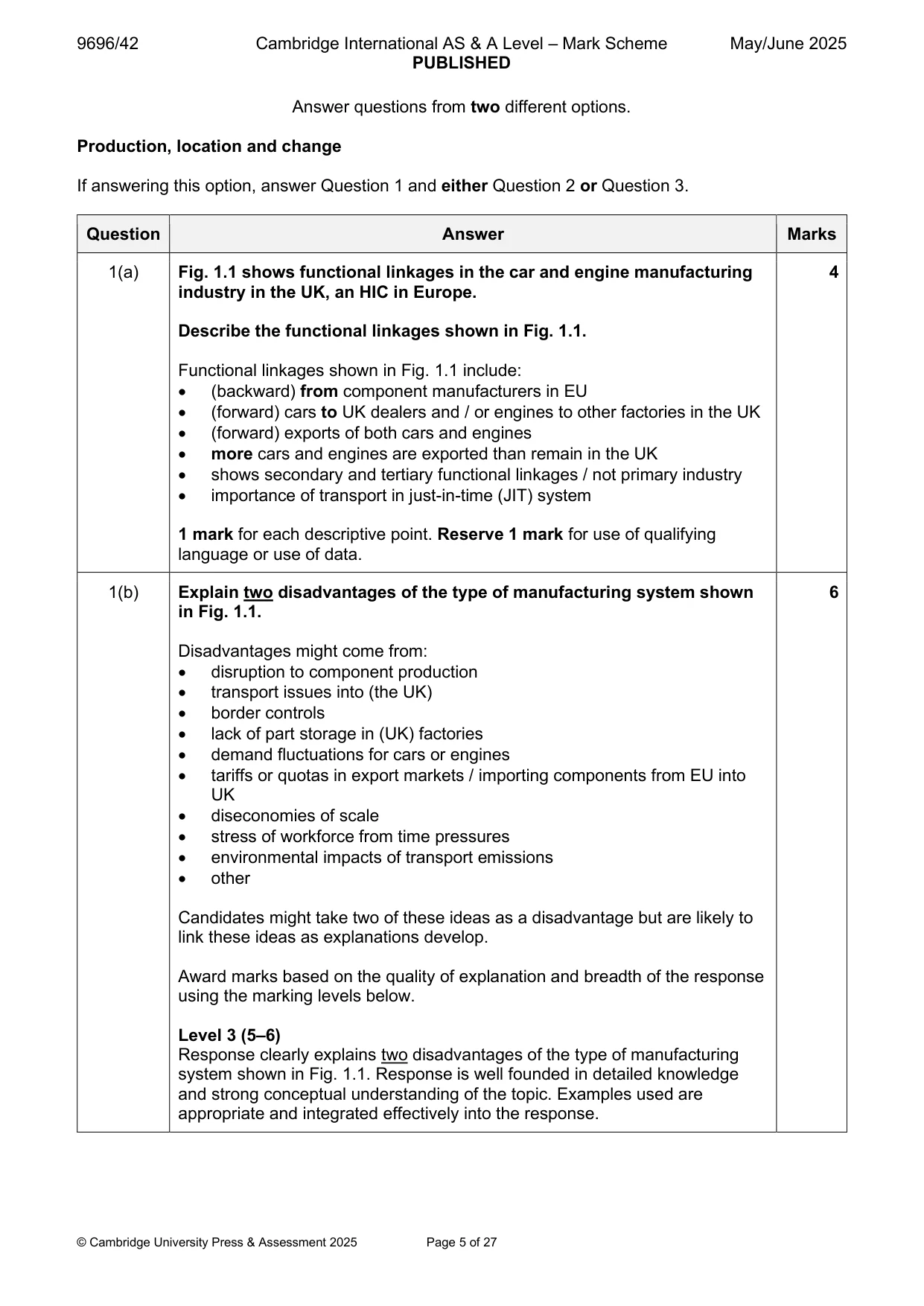
9696/42 Cambridge International AS & A Level – Mark Scheme PUBLISHED May/June 2025 © Cambridge University Press & Assessment 2025 Page 5 of 27 Answer questions from two different options. Production, location and change If answering this option, answer Question 1 and either Question 2 or Question 3. Question Answer Marks 1(a) Fig. 1.1 shows functional linkages in the car and engine manufacturing industry in the UK, an HIC in Europe. Describe the functional linkages shown in Fig. 1.1. Functional linkages shown in Fig. 1.1 include: • (backward) from component manufacturers in EU • (forward) cars to UK dealers and / or engines to other factories in the UK • (forward) exports of both cars and engines • more cars and engines are exported than remain in the UK • shows secondary and tertiary functional linkages / not primary industry • importance of transport in just-in-time (JIT) system 1 mark for each descriptive point. Reserve 1 mark for use of qualifying language or use of data. 4 1(b) Explain two disadvantages of the type of manufacturing system shown in Fig. 1.1. Disadvantages might come from: • disruption to component production • transport issues into (the UK) • border controls • lack of part storage in (UK) factories • demand fluctuations for cars or engines • tariffs or quotas in export markets / importing components from EU into UK • diseconomies of scale • stress of workforce from time pressures • environmental impacts of transport emissions • other Candidates might take two of these ideas as a disadvantage but are likely to link these ideas as explanations develop. Award marks based on the quality of explanation and breadth of the response using the marking levels below. Level 3 (5–6) Response clearly explains two disadvantages of the type of manufacturing system shown in Fig. 1.1. Response is well founded in detailed knowledge and strong conceptual understanding of the topic. Examples used are appropriate and integrated effectively into the response. 6
Mark scheme, page 6
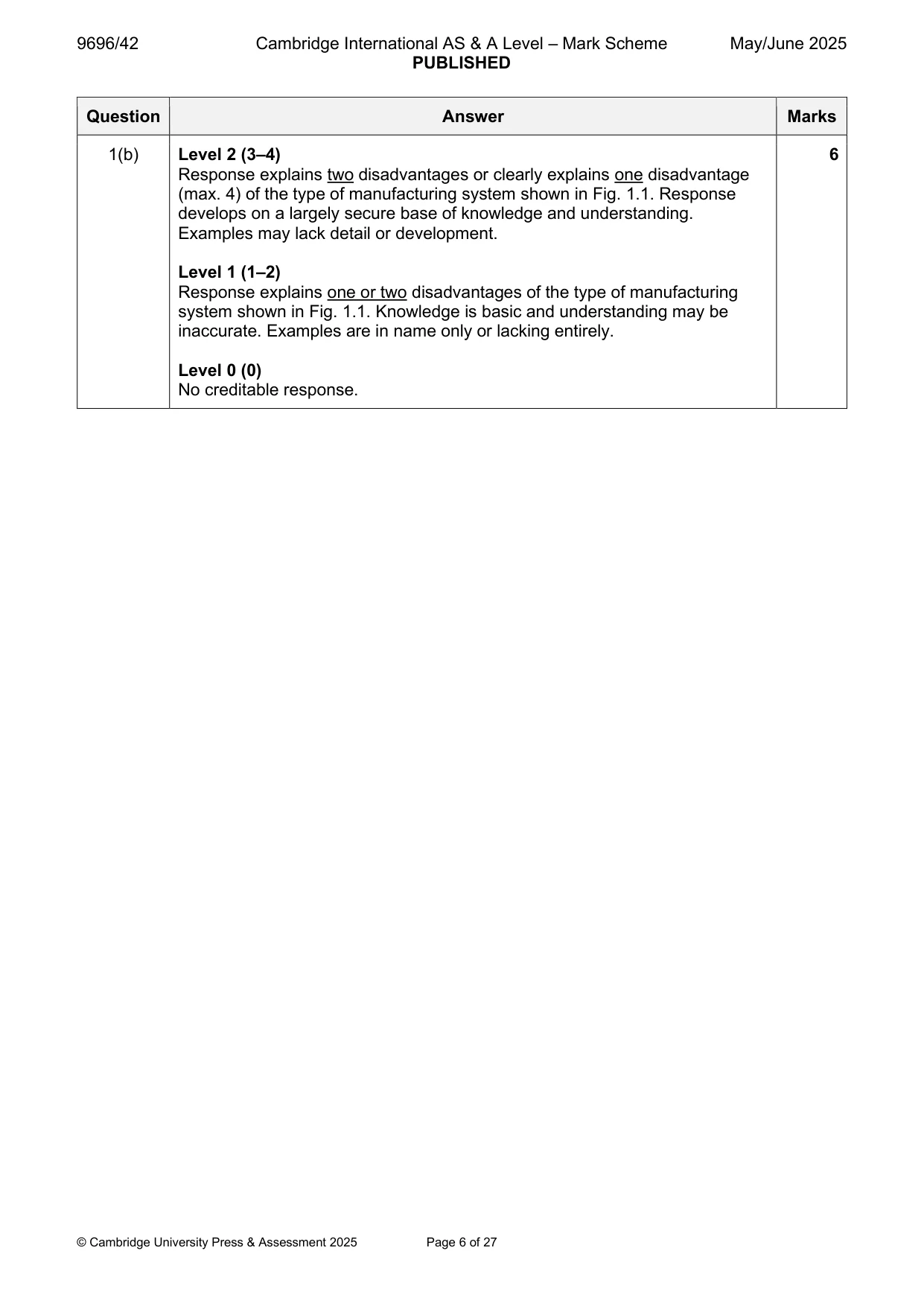
9696/42 Cambridge International AS & A Level – Mark Scheme PUBLISHED May/June 2025 © Cambridge University Press & Assessment 2025 Page 6 of 27 Question Answer Marks 1(b) Level 2 (3–4) Response explains two disadvantages or clearly explains one disadvantage (max. 4) of the type of manufacturing system shown in Fig. 1.1. Response develops on a largely secure base of knowledge and understanding. Examples may lack detail or development. Level 1 (1–2) Response explains one or two disadvantages of the type of manufacturing system shown in Fig. 1.1. Knowledge is basic and understanding may be inaccurate. Examples are in name only or lacking entirely. Level 0 (0) No creditable response. 6
Mark scheme, page 7
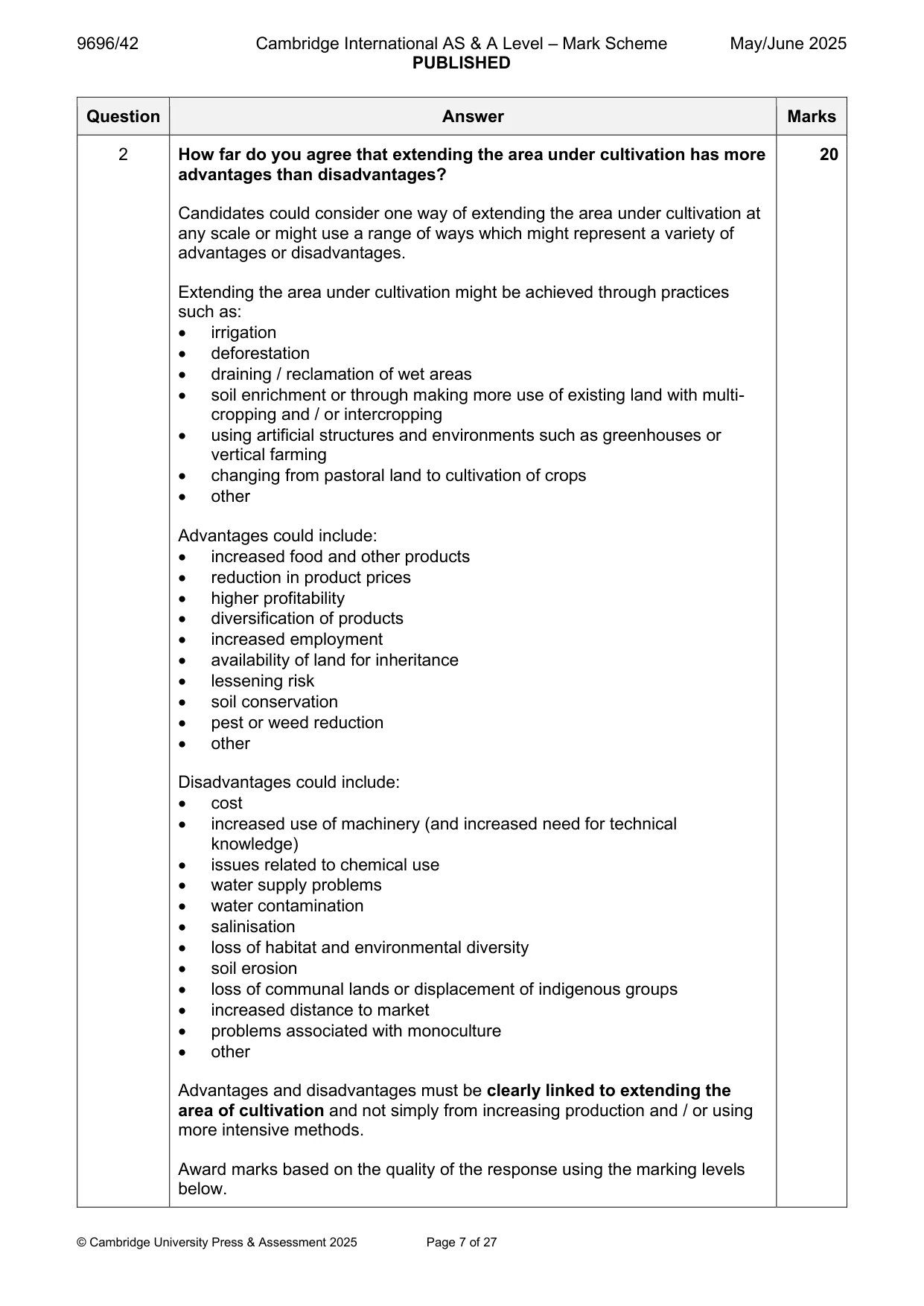
9696/42 Cambridge International AS & A Level – Mark Scheme PUBLISHED May/June 2025 © Cambridge University Press & Assessment 2025 Page 7 of 27 Question Answer Marks 2 How far do you agree that extending the area under cultivation has more advantages than disadvantages? Candidates could consider one way of extending the area under cultivation at any scale or might use a range of ways which might represent a variety of advantages or disadvantages. Extending the area under cultivation might be achieved through practices such as: • irrigation • deforestation • draining / reclamation of wet areas • soil enrichment or through making more use of existing land with multi- cropping and / or intercropping • using artificial structures and environments such as greenhouses or vertical farming • changing from pastoral land to cultivation of crops • other Advantages could include: • increased food and other products • reduction in product prices • higher profitability • diversification of products • increased employment • availability of land for inheritance • lessening risk • soil conservation • pest or weed reduction • other Disadvantages could include: • cost • increased use of machinery (and increased need for technical knowledge) • issues related to chemical use • water supply problems • water contamination • salinisation • loss of habitat and environmental diversity • soil erosion • loss of communal lands or displacement of indigenous groups • increased distance to market • problems associated with monoculture • other Advantages and disadvantages must be clearly linked to extending the area of cultivation and not simply from increasing production and / or using more intensive methods. Award marks based on the quality of the response using the marking levels below. 20
Mark scheme, page 8
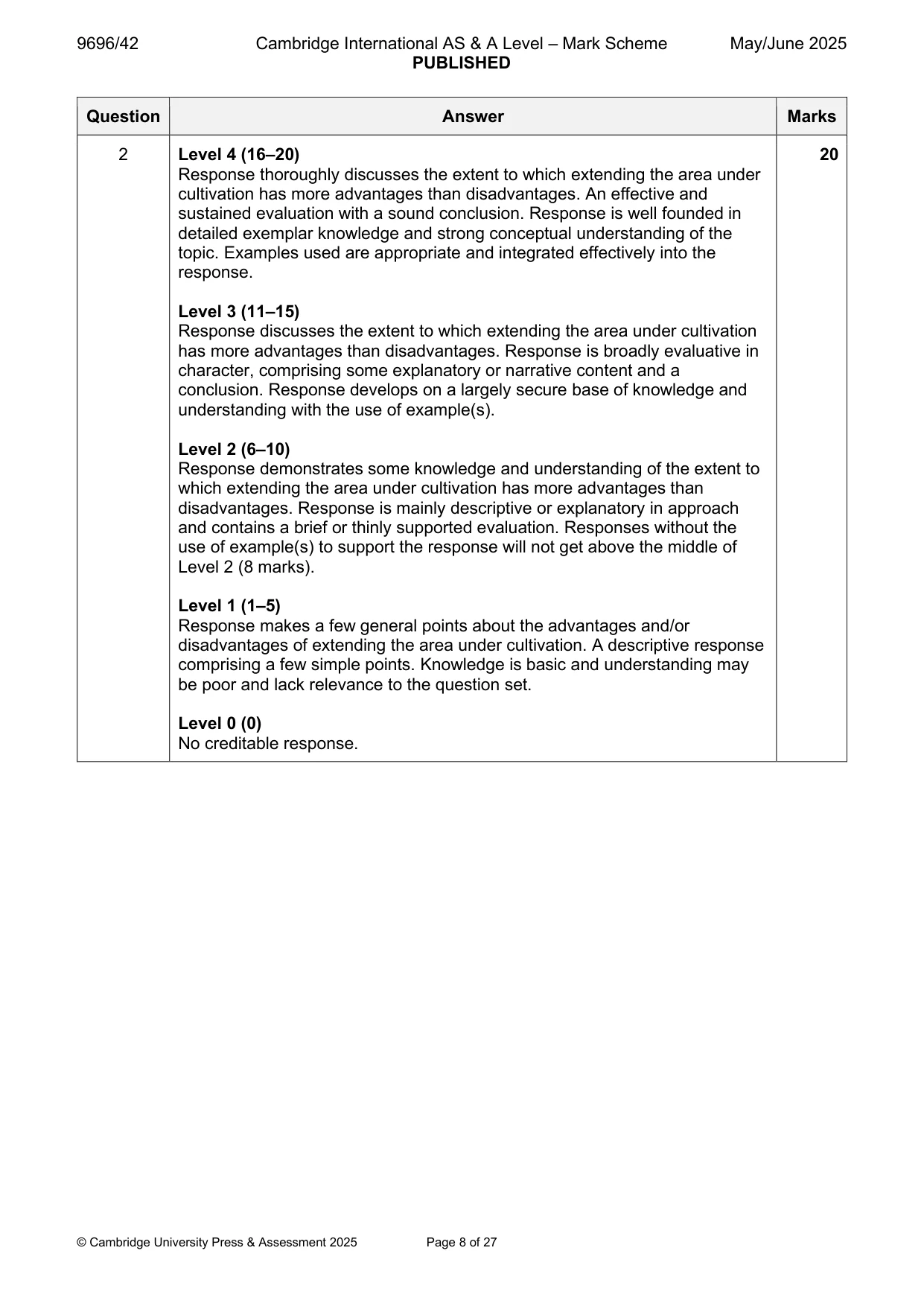
9696/42 Cambridge International AS & A Level – Mark Scheme PUBLISHED May/June 2025 © Cambridge University Press & Assessment 2025 Page 8 of 27 Question Answer Marks 2 Level 4 (16–20) Response thoroughly discusses the extent to which extending the area under cultivation has more advantages than disadvantages. An effective and sustained evaluation with a sound conclusion. Response is well founded in detailed exemplar knowledge and strong conceptual understanding of the topic. Examples used are appropriate and integrated effectively into the response. Level 3 (11–15) Response discusses the extent to which extending the area under cultivation has more advantages than disadvantages. Response is broadly evaluative in character, comprising some explanatory or narrative content and a conclusion. Response develops on a largely secure base of knowledge and understanding with the use of example(s). Level 2 (6–10) Response demonstrates some knowledge and understanding of the extent to which extending the area under cultivation has more advantages than disadvantages. Response is mainly descriptive or explanatory in approach and contains a brief or thinly supported evaluation. Responses without the use of example(s) to support the response will not get above the middle of Level 2 (8 marks). Level 1 (1–5) Response makes a few general points about the advantages and/or disadvantages of extending the area under cultivation. A descriptive response comprising a few simple points. Knowledge is basic and understanding may be poor and lack relevance to the question set. Level 0 (0) No creditable response. 20
Mark scheme, page 9
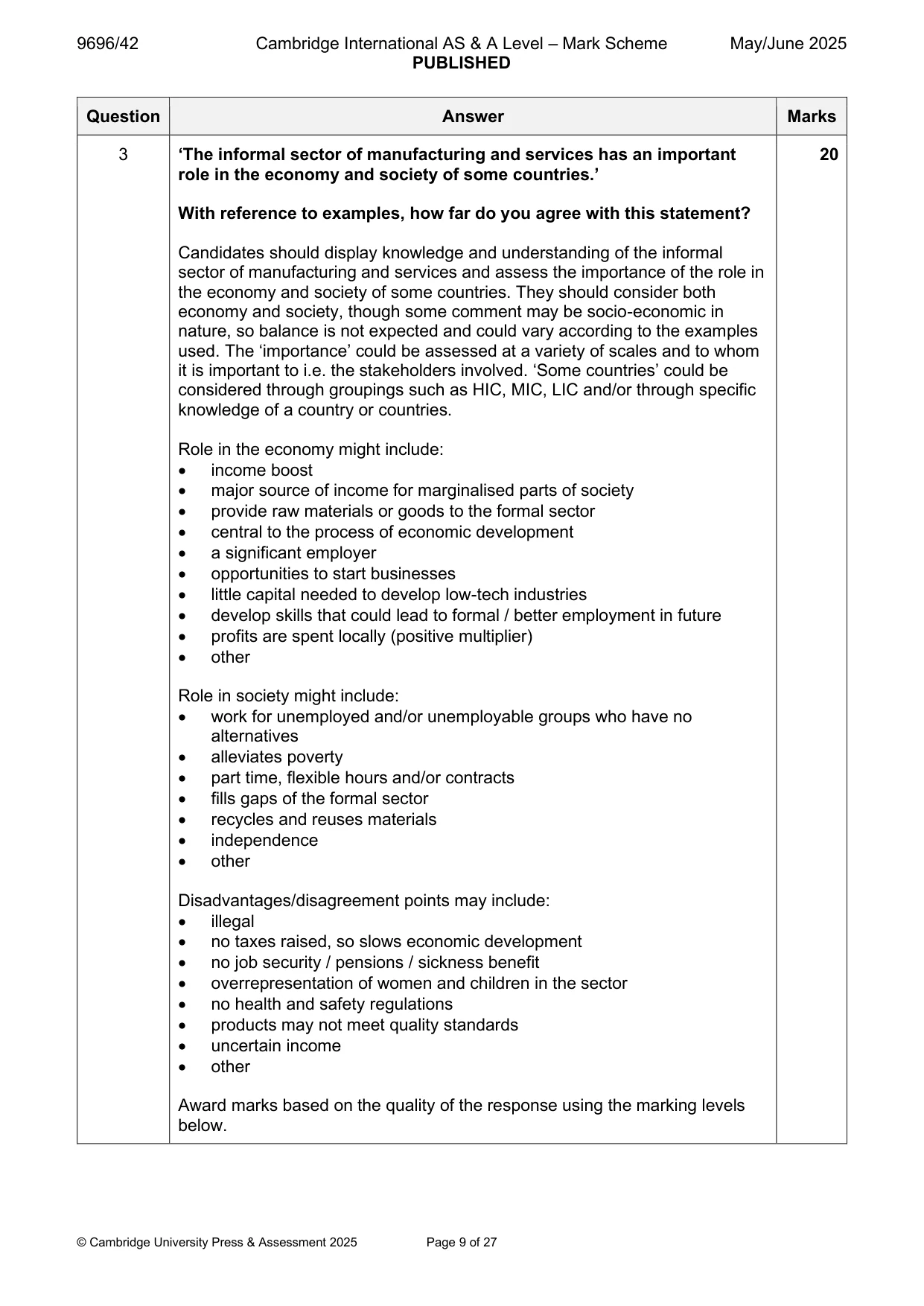
9696/42 Cambridge International AS & A Level – Mark Scheme PUBLISHED May/June 2025 © Cambridge University Press & Assessment 2025 Page 9 of 27 Question Answer Marks 3 ‘The informal sector of manufacturing and services has an important role in the economy and society of some countries.’ With reference to examples, how far do you agree with this statement? Candidates should display knowledge and understanding of the informal sector of manufacturing and services and assess the importance of the role in the economy and society of some countries. They should consider both economy and society, though some comment may be socio-economic in nature, so balance is not expected and could vary according to the examples used. The ‘importance’ could be assessed at a variety of scales and to whom it is important to i.e. the stakeholders involved. ‘Some countries’ could be considered through groupings such as HIC, MIC, LIC and/or through specific knowledge of a country or countries. Role in the economy might include: • income boost • major source of income for marginalised parts of society • provide raw materials or goods to the formal sector • central to the process of economic development • a significant employer • opportunities to start businesses • little capital needed to develop low-tech industries • develop skills that could lead to formal / better employment in future • profits are spent locally (positive multiplier) • other Role in society might include: • work for unemployed and/or unemployable groups who have no alternatives • alleviates poverty • part time, flexible hours and/or contracts • fills gaps of the formal sector • recycles and reuses materials • independence • other Disadvantages/disagreement points may include: • illegal • no taxes raised, so slows economic development • no job security / pensions / sickness benefit • overrepresentation of women and children in the sector • no health and safety regulations • products may not meet quality standards • uncertain income • other Award marks based on the quality of the response using the marking levels below. 20
Mark scheme, page 10
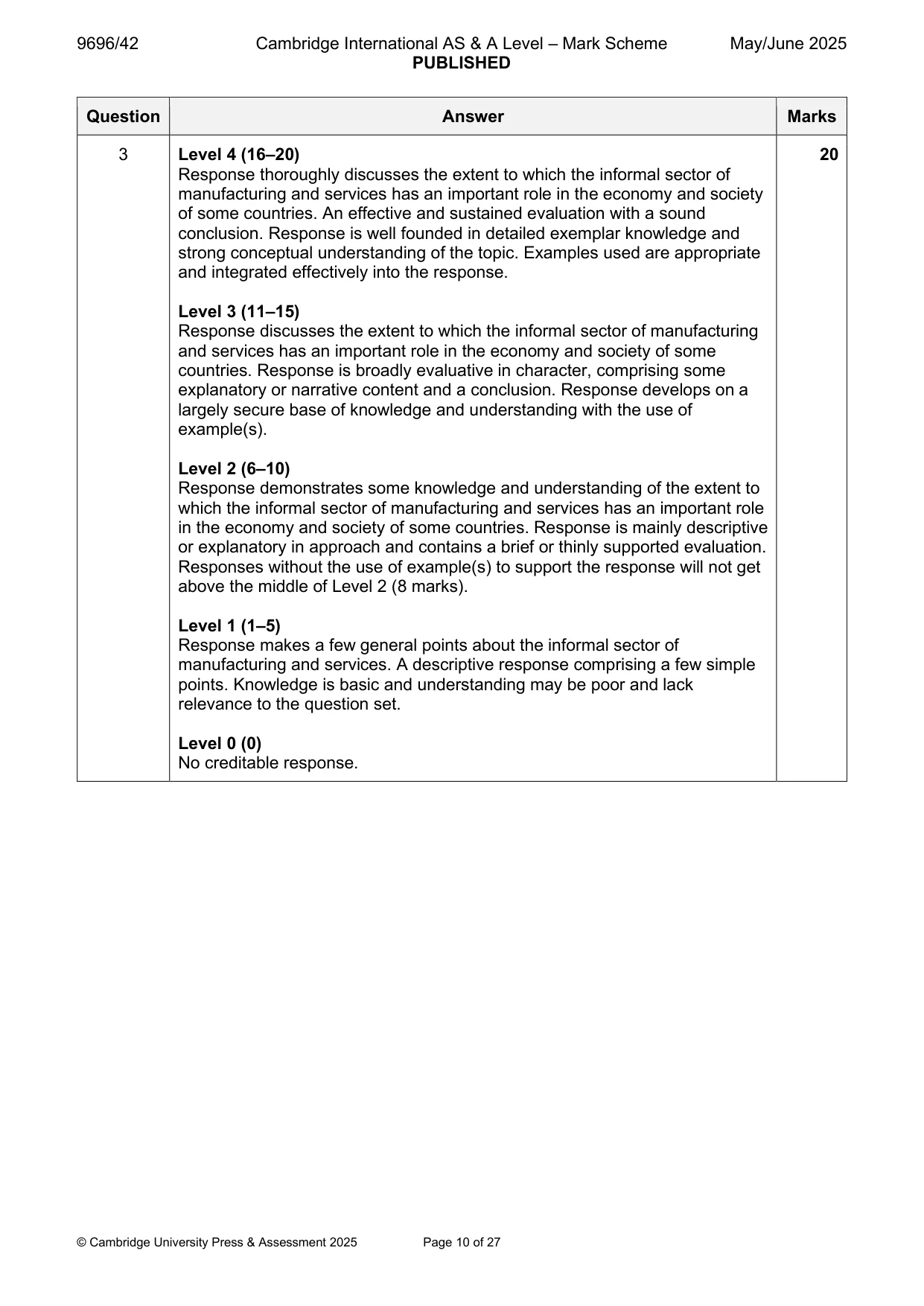
9696/42 Cambridge International AS & A Level – Mark Scheme PUBLISHED May/June 2025 © Cambridge University Press & Assessment 2025 Page 10 of 27 Question Answer Marks 3 Level 4 (16–20) Response thoroughly discusses the extent to which the informal sector of manufacturing and services has an important role in the economy and society of some countries. An effective and sustained evaluation with a sound conclusion. Response is well founded in detailed exemplar knowledge and strong conceptual understanding of the topic. Examples used are appropriate and integrated effectively into the response. Level 3 (11–15) Response discusses the extent to which the informal sector of manufacturing and services has an important role in the economy and society of some countries. Response is broadly evaluative in character, comprising some explanatory or narrative content and a conclusion. Response develops on a largely secure base of knowledge and understanding with the use of example(s). Level 2 (6–10) Response demonstrates some knowledge and understanding of the extent to which the informal sector of manufacturing and services has an important role in the economy and society of some countries. Response is mainly descriptive or explanatory in approach and contains a brief or thinly supported evaluation. Responses without the use of example(s) to support the response will not get above the middle of Level 2 (8 marks). Level 1 (1–5) Response makes a few general points about the informal sector of manufacturing and services. A descriptive response comprising a few simple points. Knowledge is basic and understanding may be poor and lack relevance to the question set. Level 0 (0) No creditable response. 20
Mark scheme, page 11
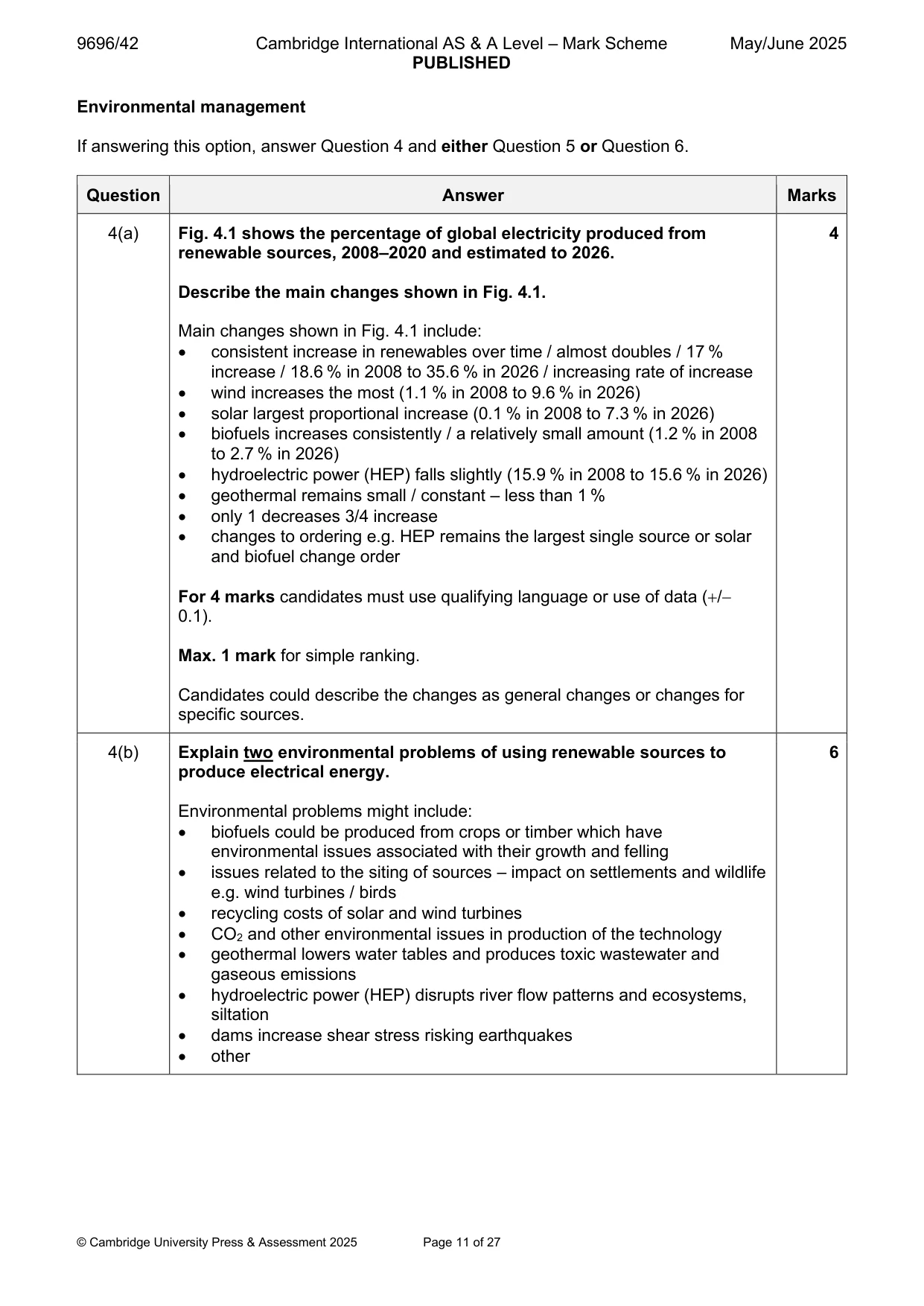
9696/42 Cambridge International AS & A Level – Mark Scheme PUBLISHED May/June 2025 © Cambridge University Press & Assessment 2025 Page 11 of 27 Environmental management If answering this option, answer Question 4 and either Question 5 or Question 6. Question Answer Marks 4(a) Fig. 4.1 shows the percentage of global electricity produced from renewable sources, 2008–2020 and estimated to 2026. Describe the main changes shown in Fig. 4.1. Main changes shown in Fig. 4.1 include: • consistent increase in renewables over time / almost doubles / 17 % increase / 18.6 % in 2008 to 35.6 % in 2026 / increasing rate of increase • wind increases the most (1.1 % in 2008 to 9.6 % in 2026) • solar largest proportional increase (0.1 % in 2008 to 7.3 % in 2026) • biofuels increases consistently / a relatively small amount (1.2 % in 2008 to 2.7 % in 2026) • hydroelectric power (HEP) falls slightly (15.9 % in 2008 to 15.6 % in 2026) • geothermal remains small / constant – less than 1 % • only 1 decreases 3/4 increase • changes to ordering e.g. HEP remains the largest single source or solar and biofuel change order For 4 marks candidates must use qualifying language or use of data (+/− 0.1). Max. 1 mark for simple ranking. Candidates could describe the changes as general changes or changes for specific sources. 4 4(b) Explain two environmental problems of using renewable sources to produce electrical energy. Environmental problems might include: • biofuels could be produced from crops or timber which have environmental issues associated with their growth and felling • issues related to the siting of sources – impact on settlements and wildlife e.g. wind turbines / birds • recycling costs of solar and wind turbines • CO2 and other environmental issues in production of the technology • geothermal lowers water tables and produces toxic wastewater and gaseous emissions • hydroelectric power (HEP) disrupts river flow patterns and ecosystems, siltation • dams increase shear stress risking earthquakes • other 6
Mark scheme, page 12
9696/42 Cambridge International AS & A Level – Mark Scheme PUBLISHED May/June 2025 © Cambridge University Press & Assessment 2025 Page 12 of 27 Question Answer Marks 4(b) Award marks based on the quality of explanation and breadth of the response using the marking levels below. Level 3 (5–6) Response clearly explains two environmental problems of using renewable sources to produce electrical energy. Response is well founded in detailed knowledge and strong conceptual understanding of the topic. Examples used are appropriate and integrated effectively into the response. Level 2 (3–4) Response explains two environmental problems or clearly explains one environmental problem (max. 4) of using renewable sources to produce electrical energy. Response develops on a largely secure base of knowledge and understanding. Examples may lack detail or development. Level 1 (1–2) Response explains one or two environmental problems of using renewable sources to produce electrical energy. Knowledge is basic and understanding may be inaccurate. Examples are in name only or lacking entirely. Level 0 (0) No creditable response. 6
Mark scheme, page 13
9696/42 Cambridge International AS & A Level – Mark Scheme PUBLISHED May/June 2025 © Cambridge University Press & Assessment 2025 Page 13 of 27 Question Answer Marks 5 Assess the extent to which levels of development affect the balance of energy sources (energy mix) used to produce electrical energy at the national scale. ‘Levels of development’ might be considered through income groups such as LIC/MIC and HIC or by using examples of named countries. This links to level of demand which varies between countries widely. For ‘the balance of energy sources (energy mix) used to produce electrical energy’, candidates could take an approach of fossil fuels compared to renewables or be more specific about sources used. Other factors include: • resource endowment • climate • sustainability • pollution • established technology for conventional sources • issues with energy transition to renewables • energy policy • energy security • international agreements/targets • influence of e.g. TNCs, consumers, environmental NGOs, etc. • other A higher-level response (mid-Level 3 upwards) is likely to consider inter- relationships between factors. Award marks based on the quality of the response using the marking levels below. Level 4 (16–20) Response thoroughly discusses the extent to which levels of development affect the balance of energy sources (energy mix) used to produce electrical energy at the national scale. An effective and sustained evaluation with a sound conclusion. Response is well founded in detailed exemplar knowledge and strong conceptual understanding of the topic. Examples used are appropriate and integrated effectively into the response. Level 3 (11–15) Response discusses the extent to which levels of development affect the balance of energy sources (energy mix) used to produce electrical energy at the national scale. Response is broadly evaluative in character, comprising some explanatory or narrative content and a conclusion. Response develops on a largely secure base of knowledge and understanding with the use of example(s). 20
Mark scheme, page 14
9696/42 Cambridge International AS & A Level – Mark Scheme PUBLISHED May/June 2025 © Cambridge University Press & Assessment 2025 Page 14 of 27 Question Answer Marks 5 Level 2 (6–10) Response demonstrates some knowledge and understanding of the extent to which levels of development affect the balance of energy sources (energy mix) used to produce electrical energy at the national scale. Response is mainly descriptive or explanatory in approach and contains a brief or thinly supported evaluation. Responses without the use of example(s) to support the response will not get above the middle of Level 2 (8 marks). Level 1 (1–5) Response makes a few general points about energy sources in a country. A descriptive response comprising a few simple points. Knowledge is basic and understanding may be poor and lack relevance to the question set. Level 0 (0) No creditable response 20
Mark scheme, page 15
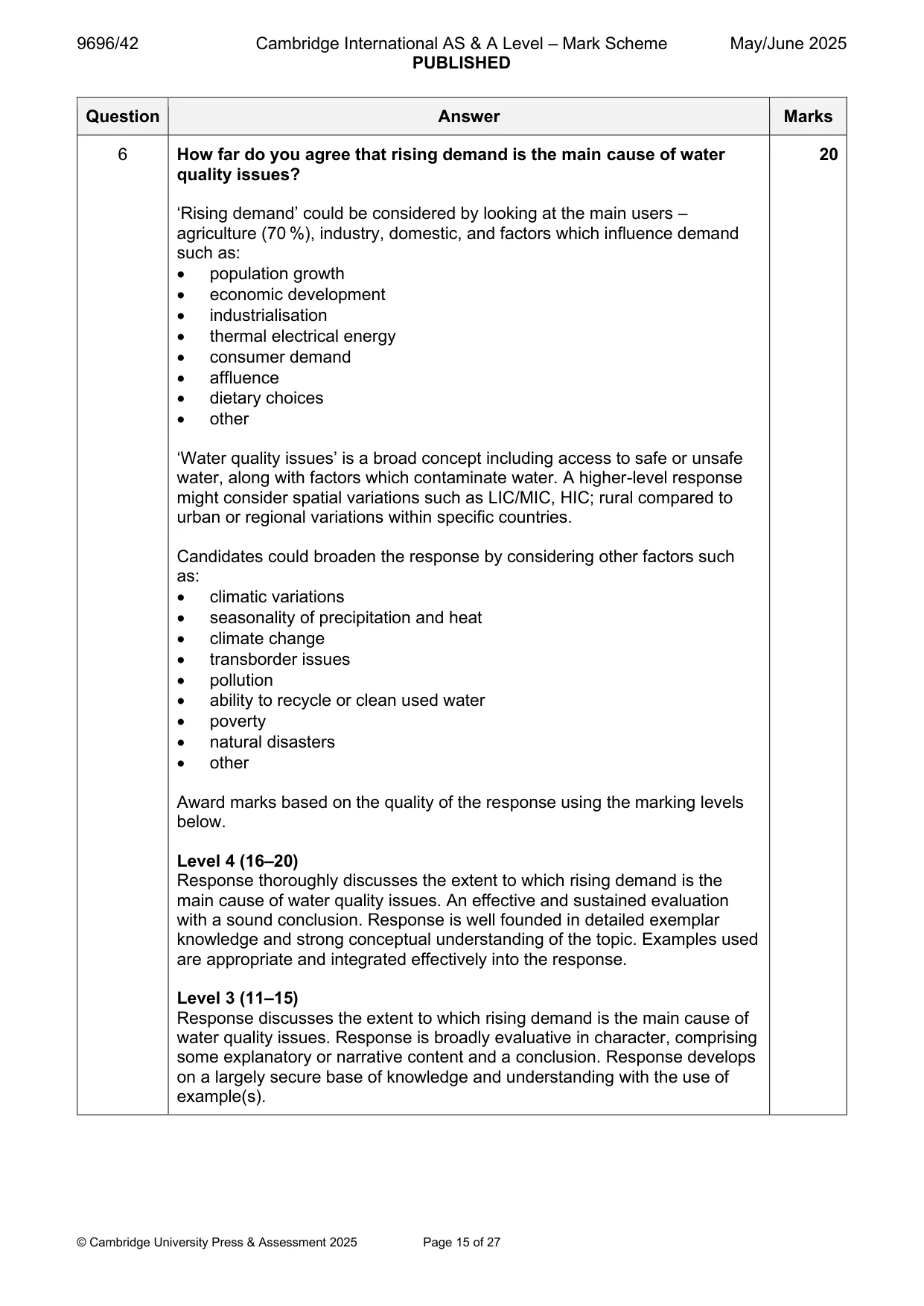
9696/42 Cambridge International AS & A Level – Mark Scheme PUBLISHED May/June 2025 © Cambridge University Press & Assessment 2025 Page 15 of 27 Question Answer Marks 6 How far do you agree that rising demand is the main cause of water quality issues? ‘Rising demand’ could be considered by looking at the main users – agriculture (70 %), industry, domestic, and factors which influence demand such as: • population growth • economic development • industrialisation • thermal electrical energy • consumer demand • affluence • dietary choices • other ‘Water quality issues’ is a broad concept including access to safe or unsafe water, along with factors which contaminate water. A higher-level response might consider spatial variations such as LIC/MIC, HIC; rural compared to urban or regional variations within specific countries. Candidates could broaden the response by considering other factors such as: • climatic variations • seasonality of precipitation and heat • climate change • transborder issues • pollution • ability to recycle or clean used water • poverty • natural disasters • other Award marks based on the quality of the response using the marking levels below. Level 4 (16–20) Response thoroughly discusses the extent to which rising demand is the main cause of water quality issues. An effective and sustained evaluation with a sound conclusion. Response is well founded in detailed exemplar knowledge and strong conceptual understanding of the topic. Examples used are appropriate and integrated effectively into the response. Level 3 (11–15) Response discusses the extent to which rising demand is the main cause of water quality issues. Response is broadly evaluative in character, comprising some explanatory or narrative content and a conclusion. Response develops on a largely secure base of knowledge and understanding with the use of example(s). 20
Mark scheme, page 16
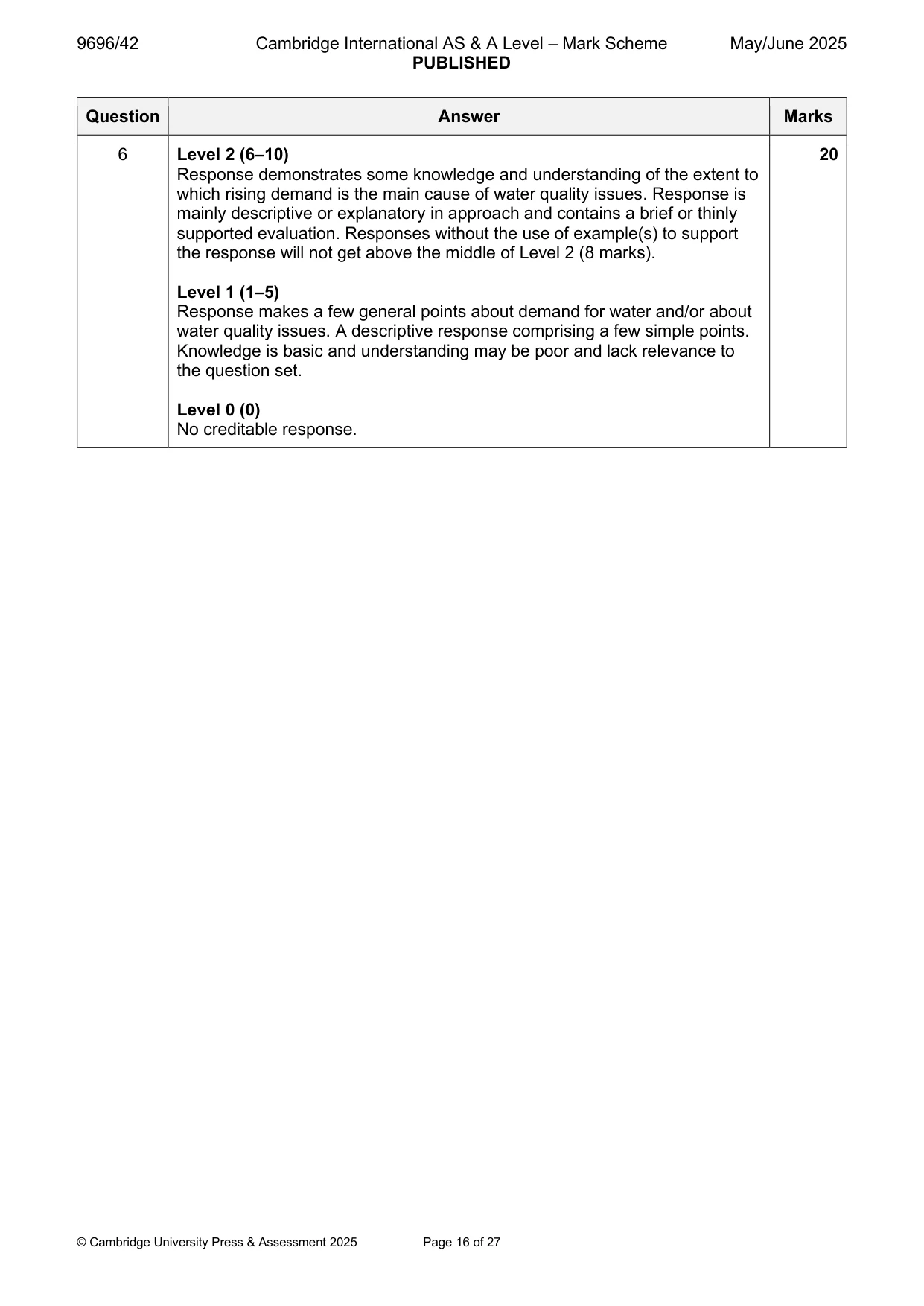
9696/42 Cambridge International AS & A Level – Mark Scheme PUBLISHED May/June 2025 © Cambridge University Press & Assessment 2025 Page 16 of 27 Question Answer Marks 6 Level 2 (6–10) Response demonstrates some knowledge and understanding of the extent to which rising demand is the main cause of water quality issues. Response is mainly descriptive or explanatory in approach and contains a brief or thinly supported evaluation. Responses without the use of example(s) to support the response will not get above the middle of Level 2 (8 marks). Level 1 (1–5) Response makes a few general points about demand for water and/or about water quality issues. A descriptive response comprising a few simple points. Knowledge is basic and understanding may be poor and lack relevance to the question set. Level 0 (0) No creditable response. 20
Mark scheme, page 17
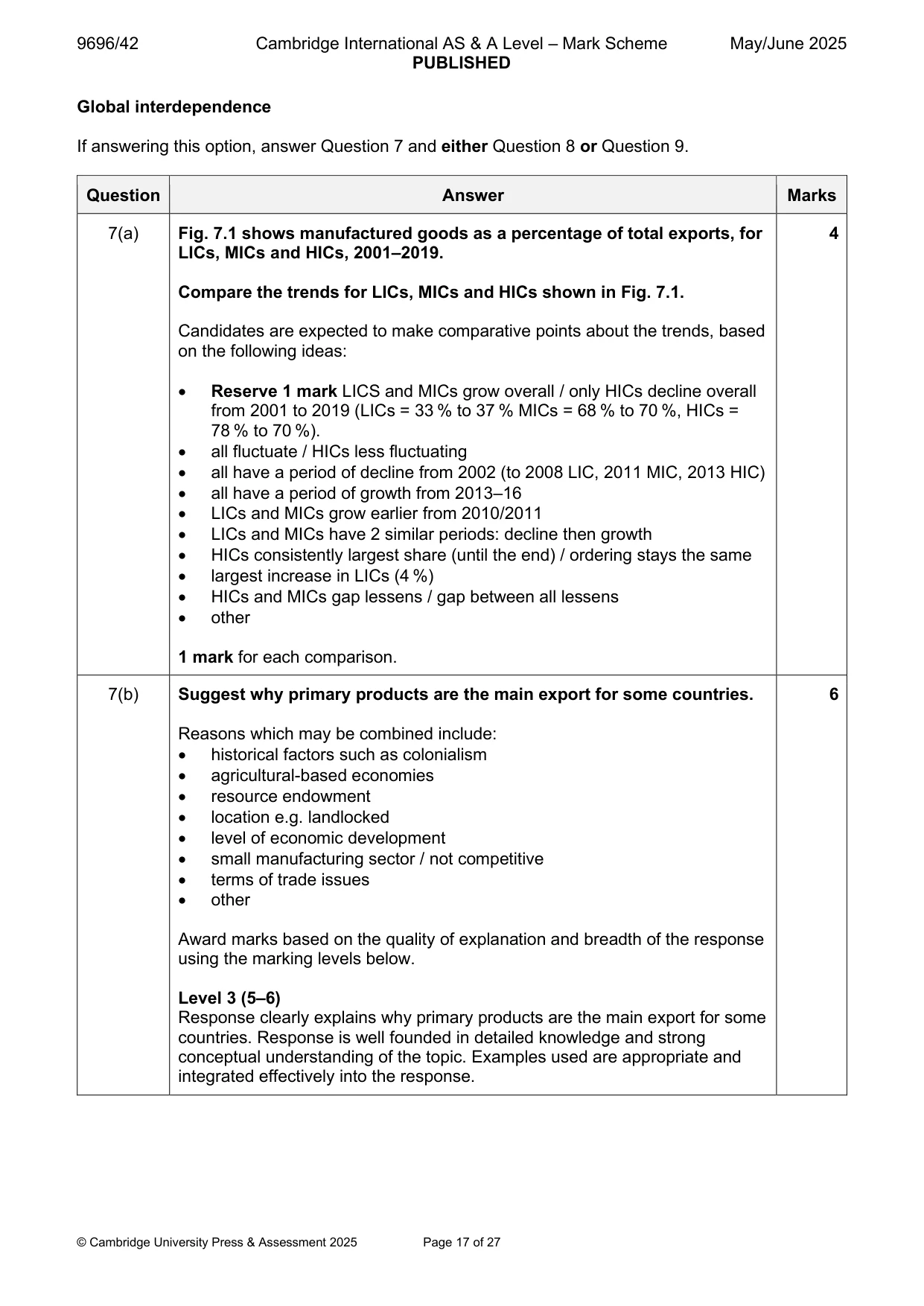
9696/42 Cambridge International AS & A Level – Mark Scheme PUBLISHED May/June 2025 © Cambridge University Press & Assessment 2025 Page 17 of 27 Global interdependence If answering this option, answer Question 7 and either Question 8 or Question 9. Question Answer Marks 7(a) Fig. 7.1 shows manufactured goods as a percentage of total exports, for LICs, MICs and HICs, 2001–2019. Compare the trends for LICs, MICs and HICs shown in Fig. 7.1. Candidates are expected to make comparative points about the trends, based on the following ideas: • Reserve 1 mark LICS and MICs grow overall / only HICs decline overall from 2001 to 2019 (LICs = 33 % to 37 % MICs = 68 % to 70 %, HICs = 78 % to 70 %). • all fluctuate / HICs less fluctuating • all have a period of decline from 2002 (to 2008 LIC, 2011 MIC, 2013 HIC) • all have a period of growth from 2013–16 • LICs and MICs grow earlier from 2010/2011 • LICs and MICs have 2 similar periods: decline then growth • HICs consistently largest share (until the end) / ordering stays the same • largest increase in LICs (4 %) • HICs and MICs gap lessens / gap between all lessens • other 1 mark for each comparison. 4 7(b) Suggest why primary products are the main export for some countries. Reasons which may be combined include: • historical factors such as colonialism • agricultural-based economies • resource endowment • location e.g. landlocked • level of economic development • small manufacturing sector / not competitive • terms of trade issues • other Award marks based on the quality of explanation and breadth of the response using the marking levels below. Level 3 (5–6) Response clearly explains why primary products are the main export for some countries. Response is well founded in detailed knowledge and strong conceptual understanding of the topic. Examples used are appropriate and integrated effectively into the response. 6
Mark scheme, page 18
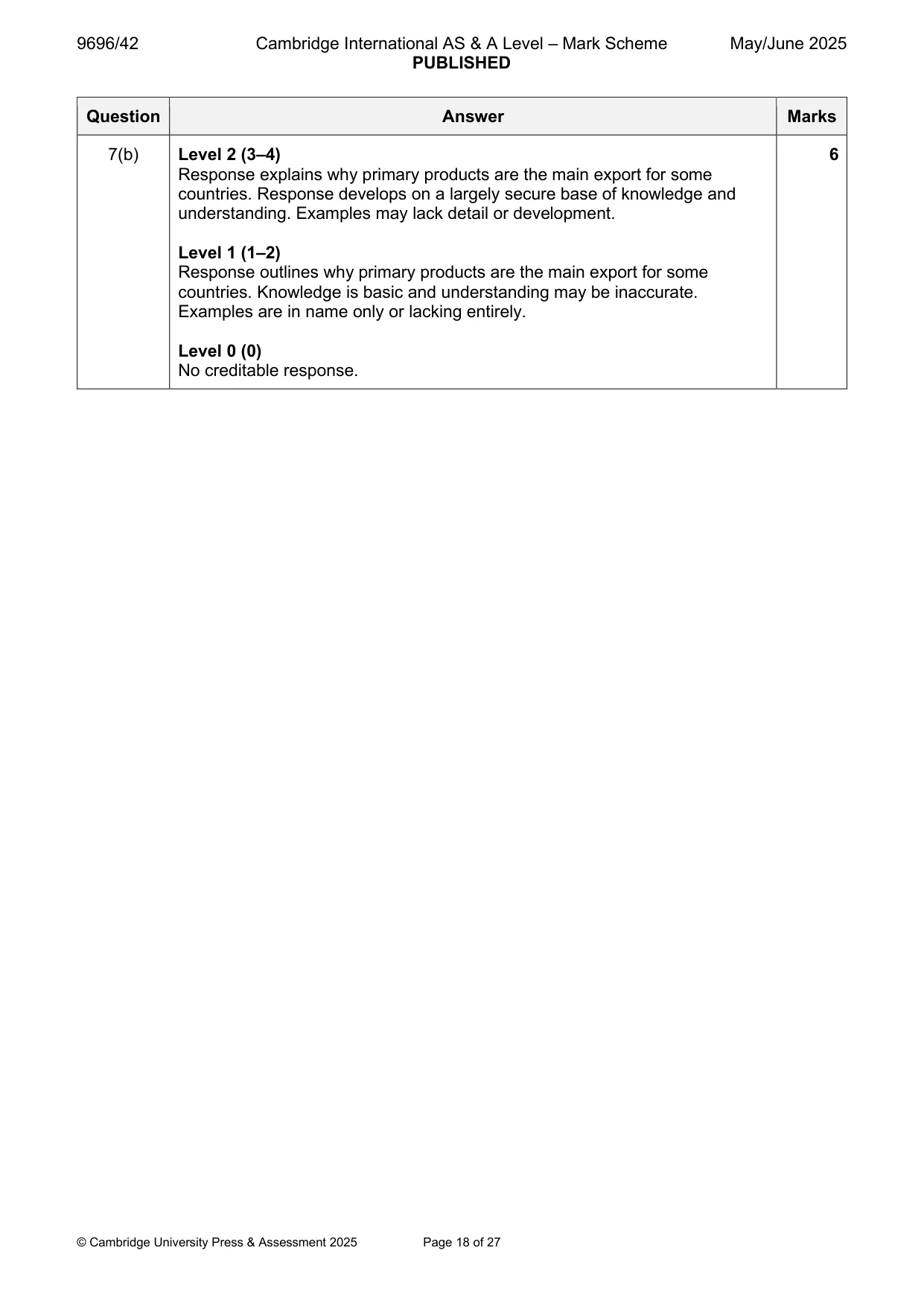
9696/42 Cambridge International AS & A Level – Mark Scheme PUBLISHED May/June 2025 © Cambridge University Press & Assessment 2025 Page 18 of 27 Question Answer Marks 7(b) Level 2 (3–4) Response explains why primary products are the main export for some countries. Response develops on a largely secure base of knowledge and understanding. Examples may lack detail or development. Level 1 (1–2) Response outlines why primary products are the main export for some countries. Knowledge is basic and understanding may be inaccurate. Examples are in name only or lacking entirely. Level 0 (0) No creditable response. 6
Mark scheme, page 19
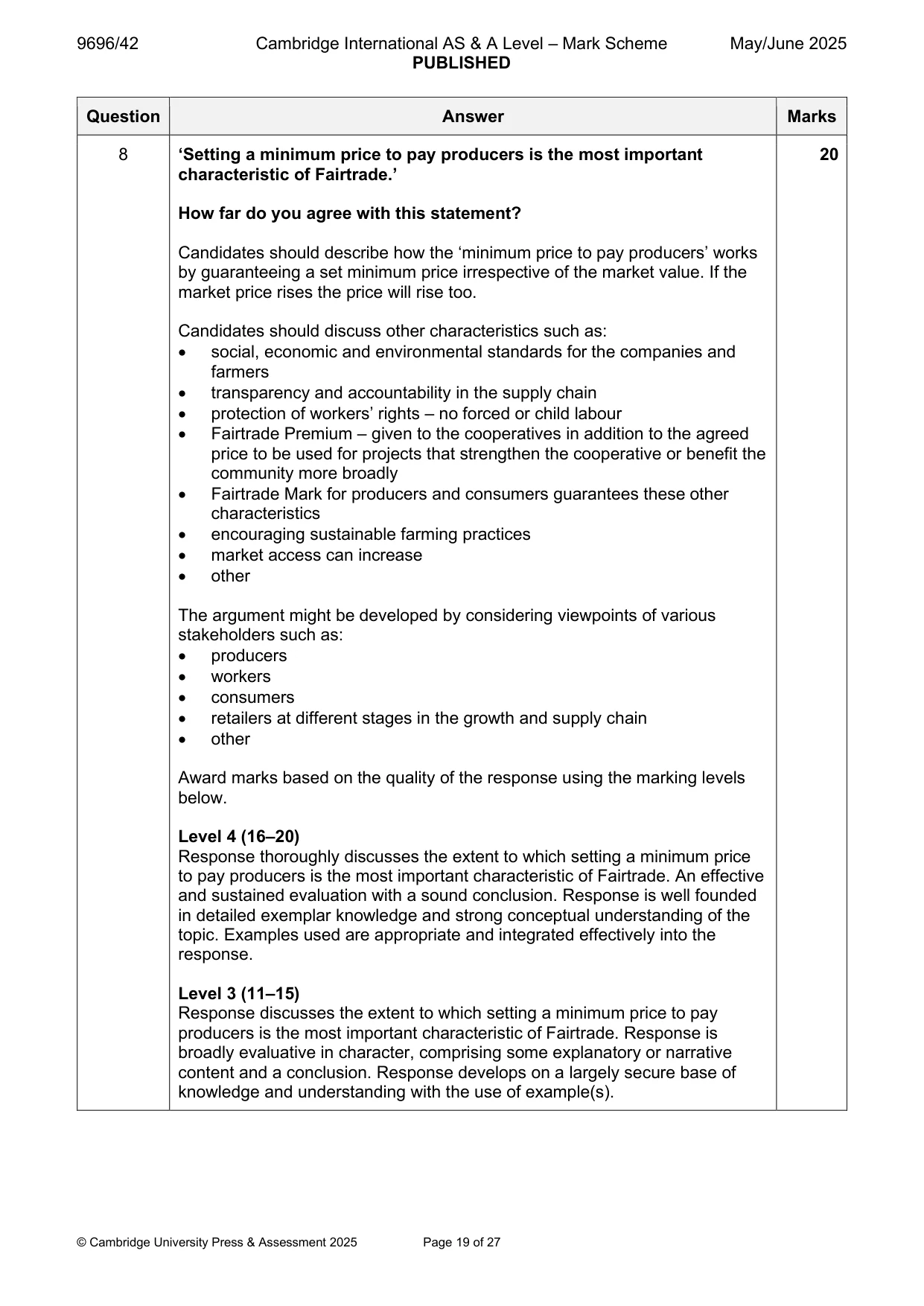
9696/42 Cambridge International AS & A Level – Mark Scheme PUBLISHED May/June 2025 © Cambridge University Press & Assessment 2025 Page 19 of 27 Question Answer Marks 8 ‘Setting a minimum price to pay producers is the most important characteristic of Fairtrade.’ How far do you agree with this statement? Candidates should describe how the ‘minimum price to pay producers’ works by guaranteeing a set minimum price irrespective of the market value. If the market price rises the price will rise too. Candidates should discuss other characteristics such as: • social, economic and environmental standards for the companies and farmers • transparency and accountability in the supply chain • protection of workers’ rights – no forced or child labour • Fairtrade Premium – given to the cooperatives in addition to the agreed price to be used for projects that strengthen the cooperative or benefit the community more broadly • Fairtrade Mark for producers and consumers guarantees these other characteristics • encouraging sustainable farming practices • market access can increase • other The argument might be developed by considering viewpoints of various stakeholders such as: • producers • workers • consumers • retailers at different stages in the growth and supply chain • other Award marks based on the quality of the response using the marking levels below. Level 4 (16–20) Response thoroughly discusses the extent to which setting a minimum price to pay producers is the most important characteristic of Fairtrade. An effective and sustained evaluation with a sound conclusion. Response is well founded in detailed exemplar knowledge and strong conceptual understanding of the topic. Examples used are appropriate and integrated effectively into the response. Level 3 (11–15) Response discusses the extent to which setting a minimum price to pay producers is the most important characteristic of Fairtrade. Response is broadly evaluative in character, comprising some explanatory or narrative content and a conclusion. Response develops on a largely secure base of knowledge and understanding with the use of example(s). 20
Mark scheme, page 20
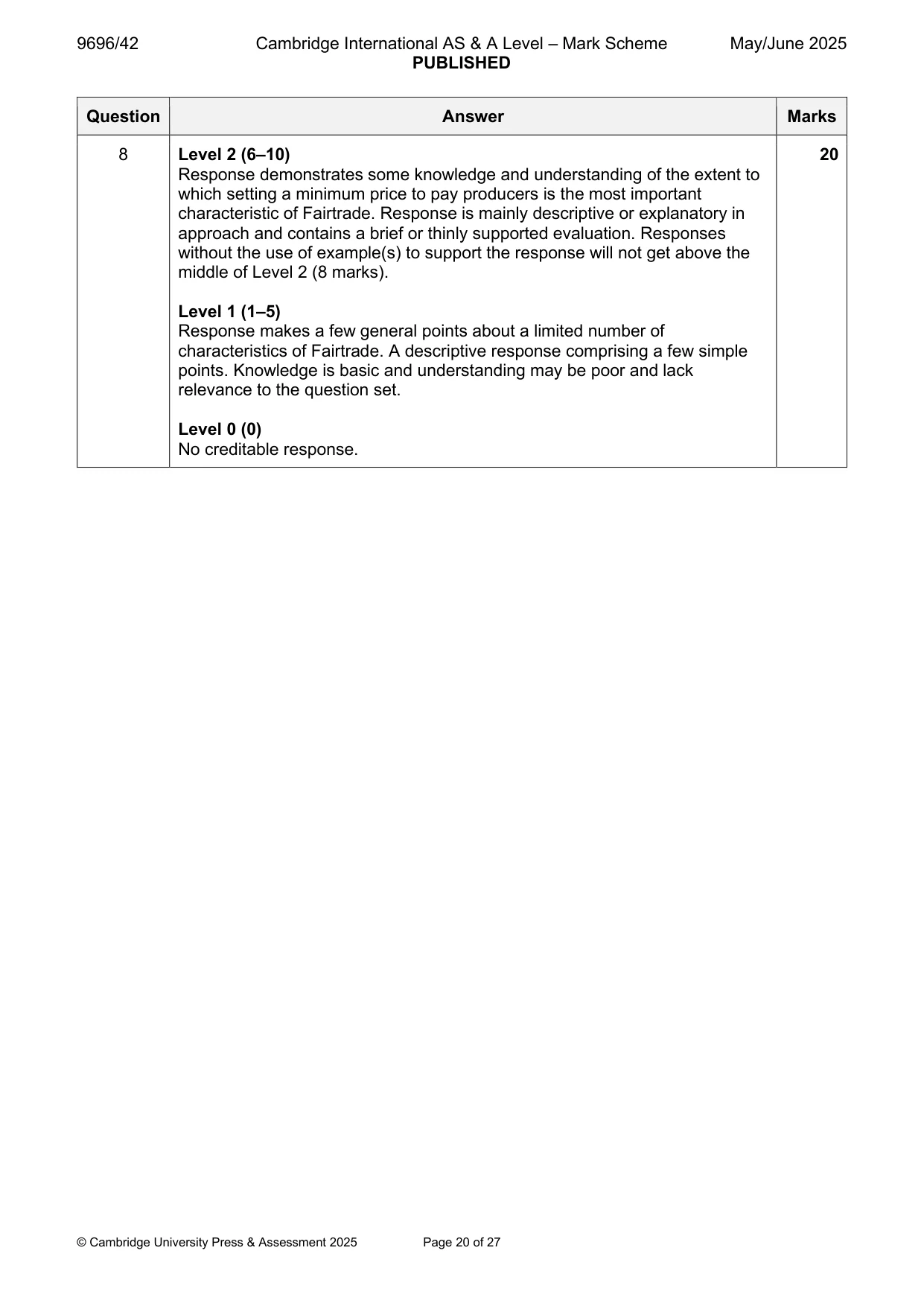
9696/42 Cambridge International AS & A Level – Mark Scheme PUBLISHED May/June 2025 © Cambridge University Press & Assessment 2025 Page 20 of 27 Question Answer Marks 8 Level 2 (6–10) Response demonstrates some knowledge and understanding of the extent to which setting a minimum price to pay producers is the most important characteristic of Fairtrade. Response is mainly descriptive or explanatory in approach and contains a brief or thinly supported evaluation. Responses without the use of example(s) to support the response will not get above the middle of Level 2 (8 marks). Level 1 (1–5) Response makes a few general points about a limited number of characteristics of Fairtrade. A descriptive response comprising a few simple points. Knowledge is basic and understanding may be poor and lack relevance to the question set. Level 0 (0) No creditable response. 20
Mark scheme, page 21
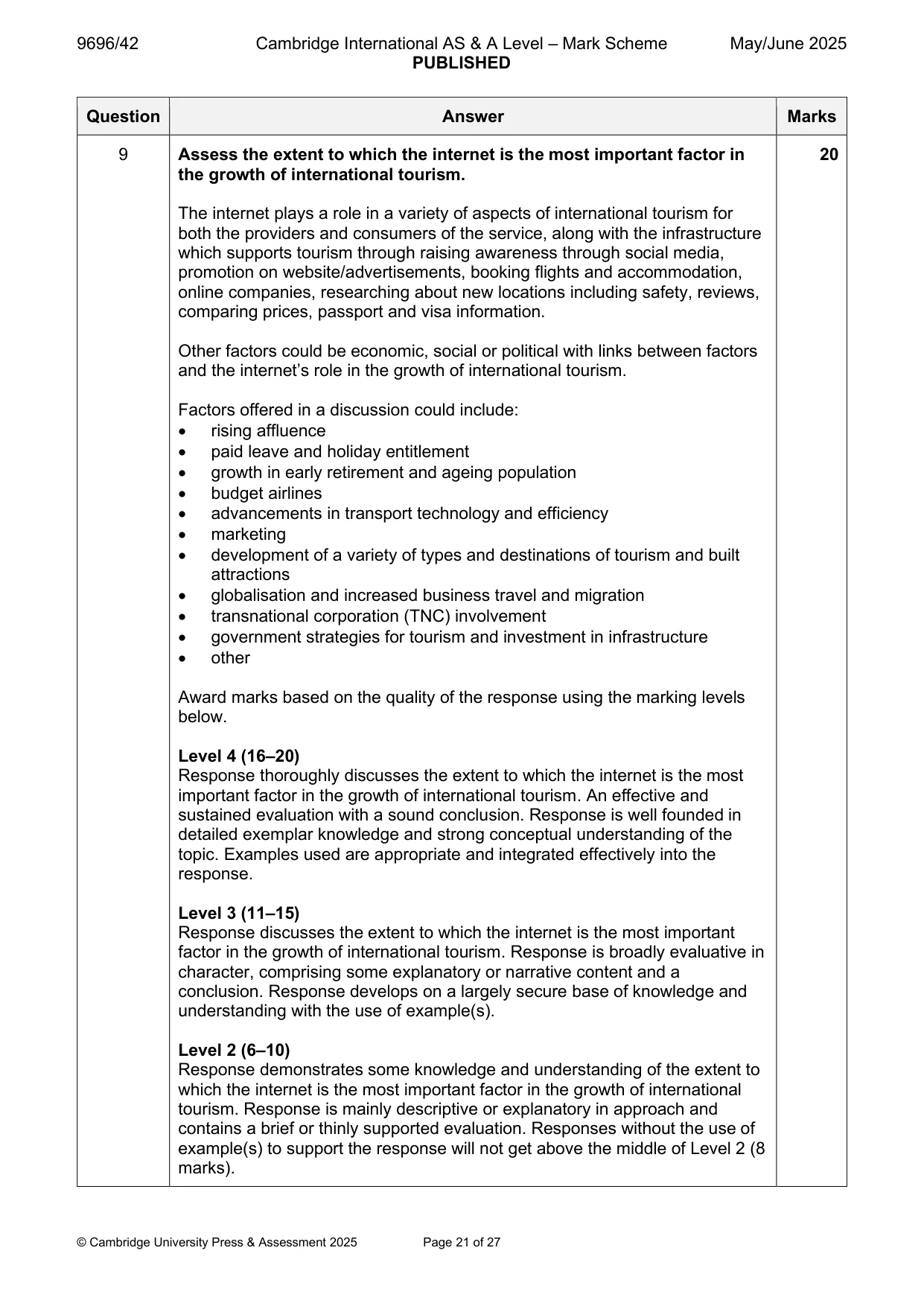
9696/42 Cambridge International AS & A Level – Mark Scheme PUBLISHED May/June 2025 © Cambridge University Press & Assessment 2025 Page 21 of 27 Question Answer Marks 9 Assess the extent to which the internet is the most important factor in the growth of international tourism. The internet plays a role in a variety of aspects of international tourism for both the providers and consumers of the service, along with the infrastructure which supports tourism through raising awareness through social media, promotion on website/advertisements, booking flights and accommodation, online companies, researching about new locations including safety, reviews, comparing prices, passport and visa information. Other factors could be economic, social or political with links between factors and the internet’s role in the growth of international tourism. Factors offered in a discussion could include: • rising affluence • paid leave and holiday entitlement • growth in early retirement and ageing population • budget airlines • advancements in transport technology and efficiency • marketing • development of a variety of types and destinations of tourism and built attractions • globalisation and increased business travel and migration • transnational corporation (TNC) involvement • government strategies for tourism and investment in infrastructure • other Award marks based on the quality of the response using the marking levels below. Level 4 (16–20) Response thoroughly discusses the extent to which the internet is the most important factor in the growth of international tourism. An effective and sustained evaluation with a sound conclusion. Response is well founded in detailed exemplar knowledge and strong conceptual understanding of the topic. Examples used are appropriate and integrated effectively into the response. Level 3 (11–15) Response discusses the extent to which the internet is the most important factor in the growth of international tourism. Response is broadly evaluative in character, comprising some explanatory or narrative content and a conclusion. Response develops on a largely secure base of knowledge and understanding with the use of example(s). Level 2 (6–10) Response demonstrates some knowledge and understanding of the extent to which the internet is the most important factor in the growth of international tourism. Response is mainly descriptive or explanatory in approach and contains a brief or thinly supported evaluation. Responses without the use of example(s) to support the response will not get above the middle of Level 2 (8 marks). 20
Mark scheme, page 22
9696/42 Cambridge International AS & A Level – Mark Scheme PUBLISHED May/June 2025 © Cambridge University Press & Assessment 2025 Page 22 of 27 Question Answer Marks 9 Level 1 (1–5) Response makes a few general points about the growth of international tourism. A descriptive response comprising a few simple points. Knowledge is basic and understanding may be poor and lack relevance to the question set. Level 0 (0) No creditable response. 20
Mark scheme, page 23
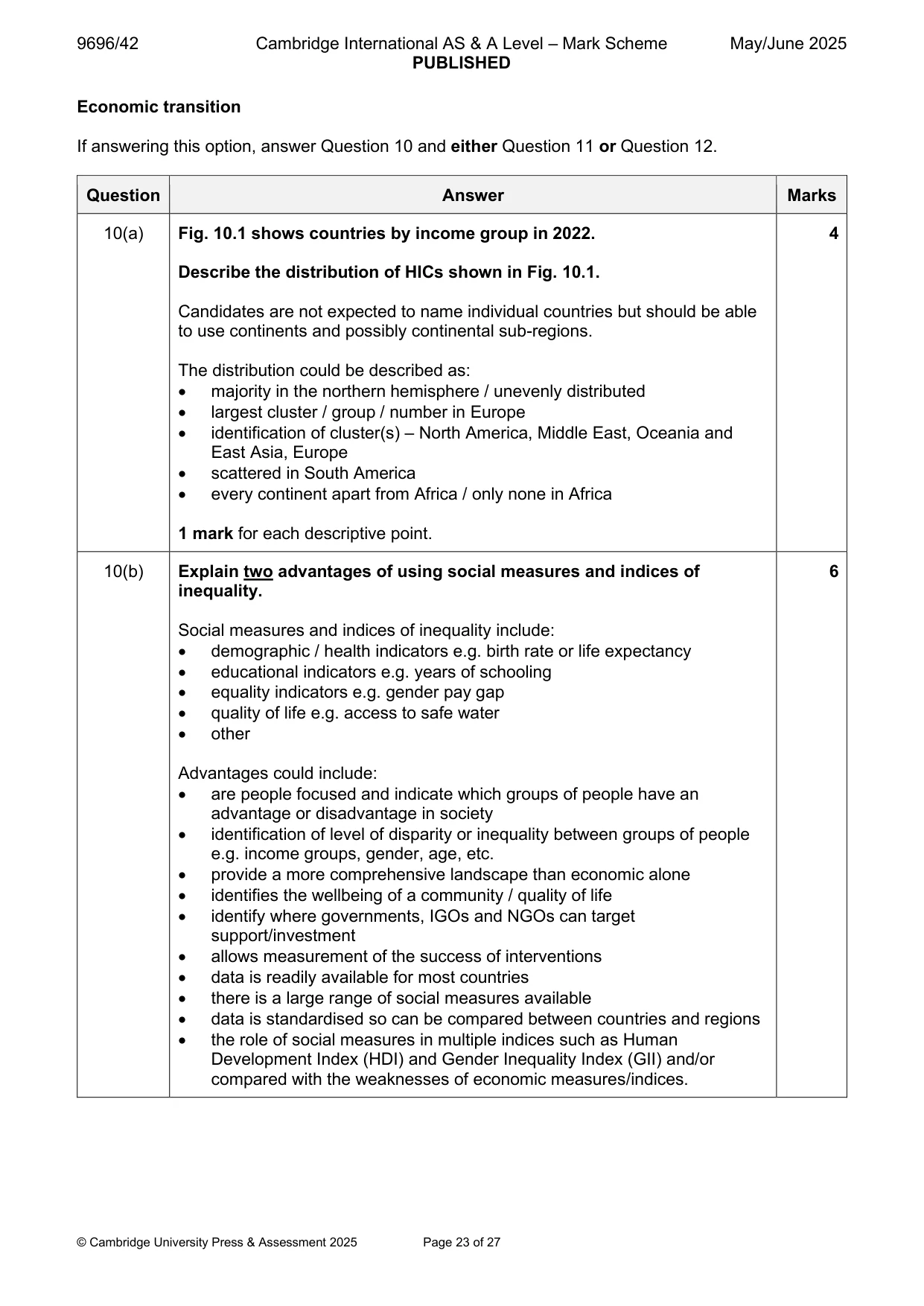
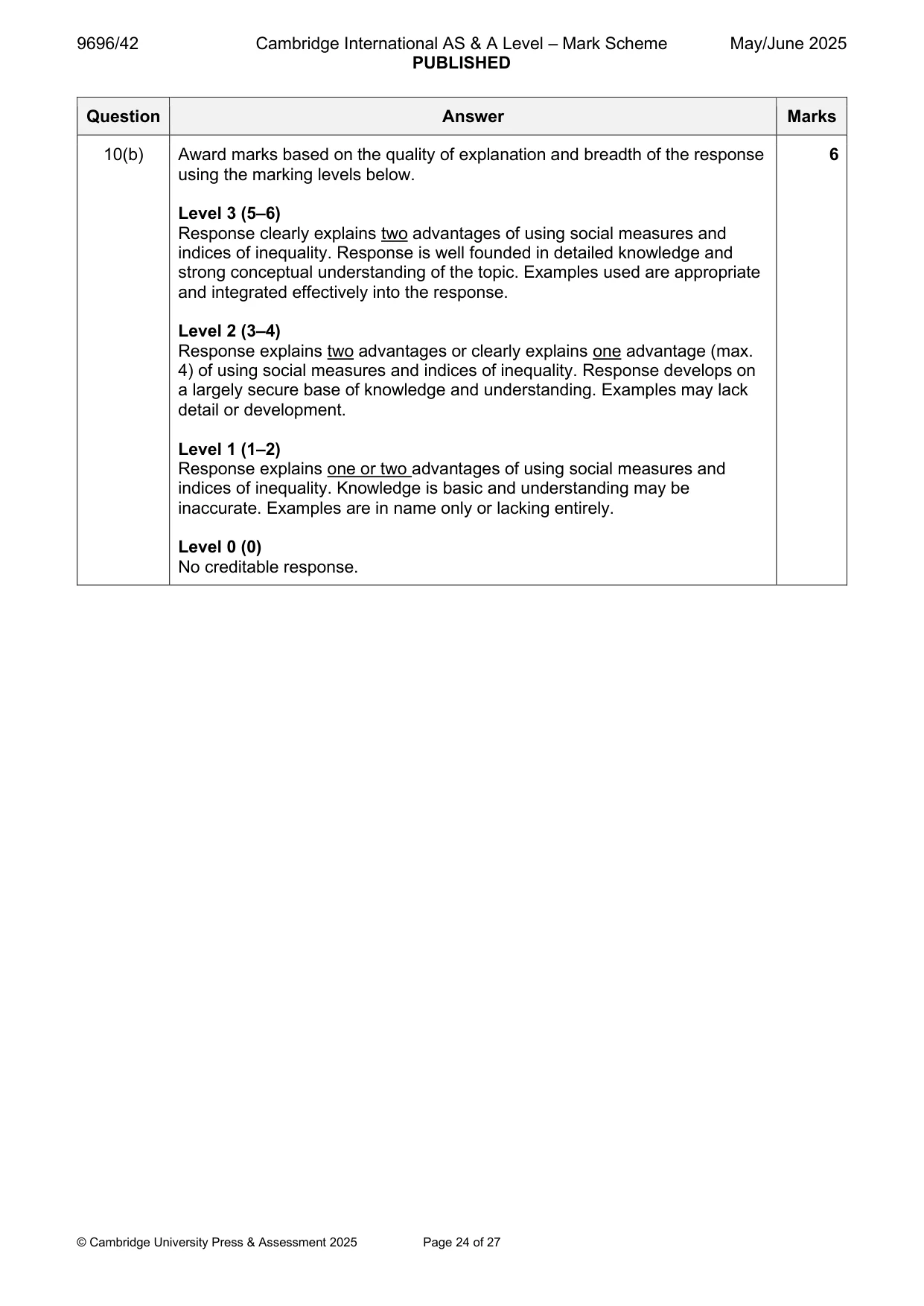
9696/42 Cambridge International AS & A Level – Mark Scheme PUBLISHED May/June 2025 © Cambridge University Press & Assessment 2025 Page 23 of 27 Economic transition If answering this option, answer Question 10 and either Question 11 or Question 12. Question Answer Marks 10(a) Fig. 10.1 shows countries by income group in 2022. Describe the distribution of HICs shown in Fig. 10.1. Candidates are not expected to name individual countries but should be able to use continents and possibly continental sub-regions. The distribution could be described as: • majority in the northern hemisphere / unevenly distributed • largest cluster / group / number in Europe • identification of cluster(s) – North America, Middle East, Oceania and East Asia, Europe • scattered in South America • every continent apart from Africa / only none in Africa 1 mark for each descriptive point. 4 10(b) Explain two advantages of using social measures and indices of inequality. Social measures and indices of inequality include: • demographic / health indicators e.g. birth rate or life expectancy • educational indicators e.g. years of schooling • equality indicators e.g. gender pay gap • quality of life e.g. access to safe water • other Advantages could include: • are people focused and indicate which groups of people have an advantage or disadvantage in society • identification of level of disparity or inequality between groups of people e.g. income groups, gender, age, etc. • provide a more comprehensive landscape than economic alone • identifies the wellbeing of a community / quality of life • identify where governments, IGOs and NGOs can target support/investment • allows measurement of the success of interventions • data is readily available for most countries • there is a large range of social measures available • data is standardised so can be compared between countries and regions • the role of social measures in multiple indices such as Human Development Index (HDI) and Gender Inequality Index (GII) and/or compared with the weaknesses of economic measures/indices. 6
Mark scheme, page 24
9696/42 Cambridge International AS & A Level – Mark Scheme PUBLISHED May/June 2025 © Cambridge University Press & Assessment 2025 Page 24 of 27 Question Answer Marks 10(b) Award marks based on the quality of explanation and breadth of the response using the marking levels below. Level 3 (5–6) Response clearly explains two advantages of using social measures and indices of inequality. Response is well founded in detailed knowledge and strong conceptual understanding of the topic. Examples used are appropriate and integrated effectively into the response. Level 2 (3–4) Response explains two advantages or clearly explains one advantage (max. 4) of using social measures and indices of inequality. Response develops on a largely secure base of knowledge and understanding. Examples may lack detail or development. Level 1 (1–2) Response explains one or two advantages of using social measures and indices of inequality. Knowledge is basic and understanding may be inaccurate. Examples are in name only or lacking entirely. Level 0 (0) No creditable response. 6
Mark scheme, page 25
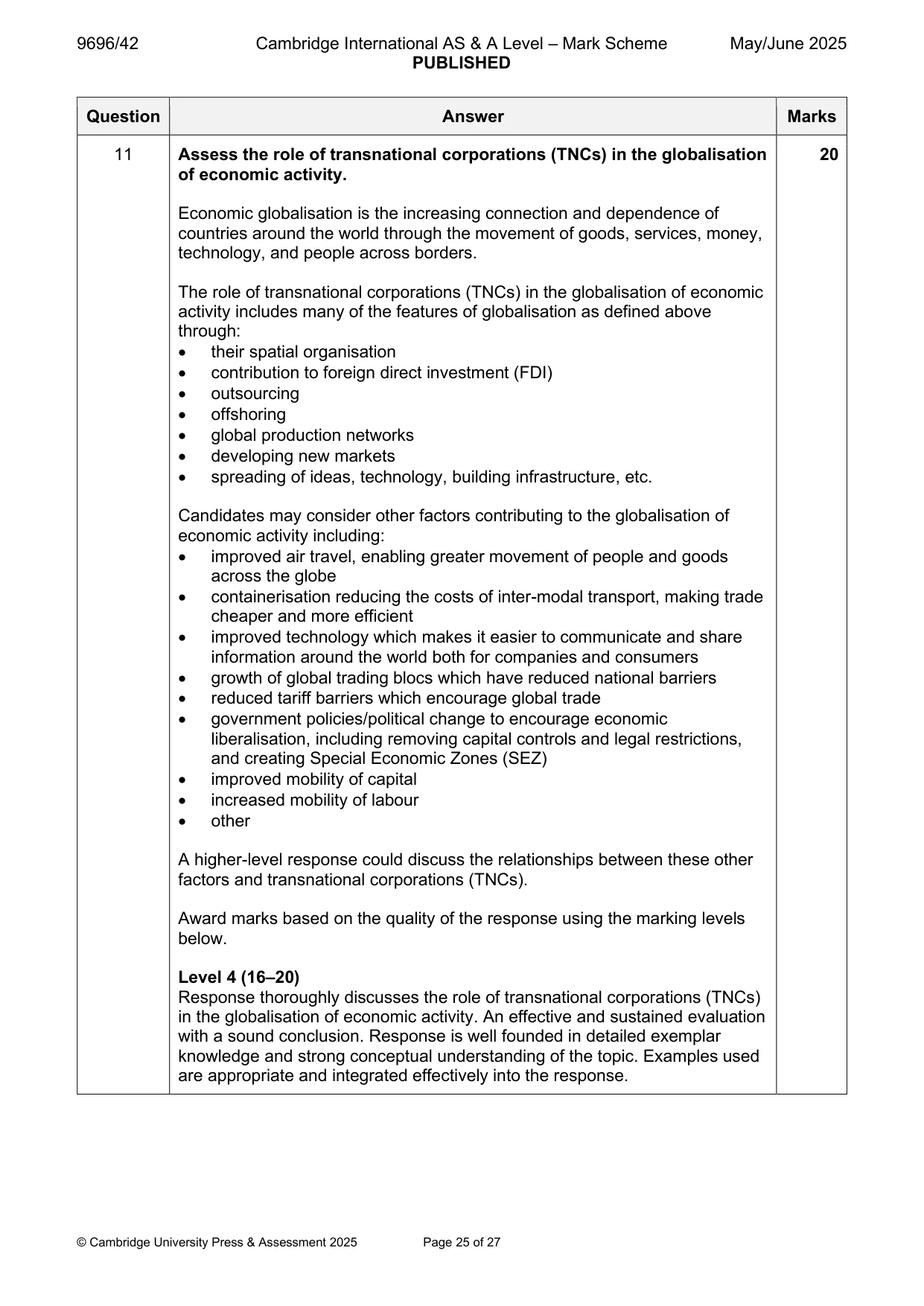
9696/42 Cambridge International AS & A Level – Mark Scheme PUBLISHED May/June 2025 © Cambridge University Press & Assessment 2025 Page 25 of 27 Question Answer Marks 11 Assess the role of transnational corporations (TNCs) in the globalisation of economic activity. Economic globalisation is the increasing connection and dependence of countries around the world through the movement of goods, services, money, technology, and people across borders. The role of transnational corporations (TNCs) in the globalisation of economic activity includes many of the features of globalisation as defined above through: • their spatial organisation • contribution to foreign direct investment (FDI) • outsourcing • offshoring • global production networks • developing new markets • spreading of ideas, technology, building infrastructure, etc. Candidates may consider other factors contributing to the globalisation of economic activity including: • improved air travel, enabling greater movement of people and goods across the globe • containerisation reducing the costs of inter-modal transport, making trade cheaper and more efficient • improved technology which makes it easier to communicate and share information around the world both for companies and consumers • growth of global trading blocs which have reduced national barriers • reduced tariff barriers which encourage global trade • government policies/political change to encourage economic liberalisation, including removing capital controls and legal restrictions, and creating Special Economic Zones (SEZ) • improved mobility of capital • increased mobility of labour • other A higher-level response could discuss the relationships between these other factors and transnational corporations (TNCs). Award marks based on the quality of the response using the marking levels below. Level 4 (16–20) Response thoroughly discusses the role of transnational corporations (TNCs) in the globalisation of economic activity. An effective and sustained evaluation with a sound conclusion. Response is well founded in detailed exemplar knowledge and strong conceptual understanding of the topic. Examples used are appropriate and integrated effectively into the response. 20
Mark scheme, page 26
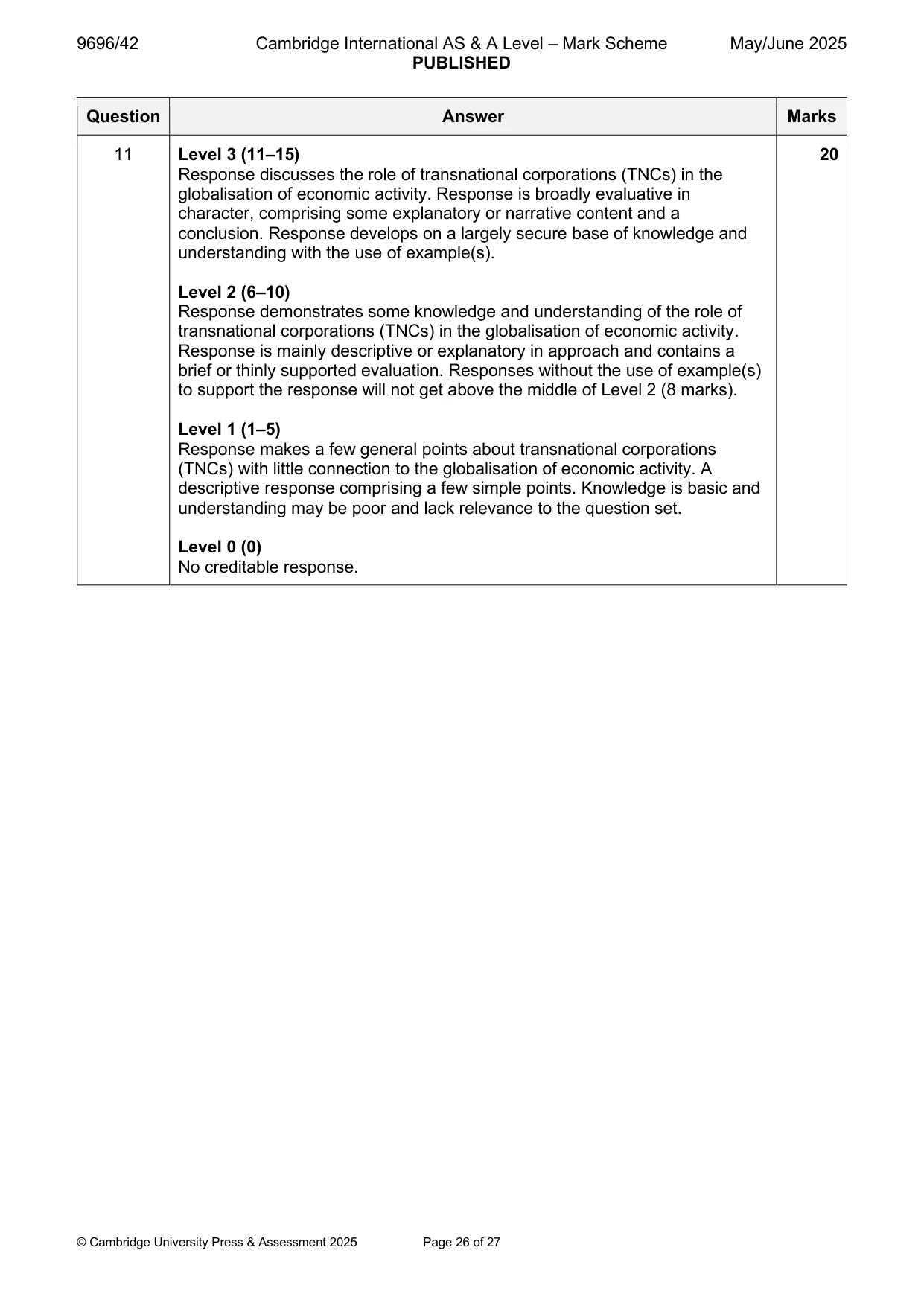
9696/42 Cambridge International AS & A Level – Mark Scheme PUBLISHED May/June 2025 © Cambridge University Press & Assessment 2025 Page 26 of 27 Question Answer Marks 11 Level 3 (11–15) Response discusses the role of transnational corporations (TNCs) in the globalisation of economic activity. Response is broadly evaluative in character, comprising some explanatory or narrative content and a conclusion. Response develops on a largely secure base of knowledge and understanding with the use of example(s). Level 2 (6–10) Response demonstrates some knowledge and understanding of the role of transnational corporations (TNCs) in the globalisation of economic activity. Response is mainly descriptive or explanatory in approach and contains a brief or thinly supported evaluation. Responses without the use of example(s) to support the response will not get above the middle of Level 2 (8 marks). Level 1 (1–5) Response makes a few general points about transnational corporations (TNCs) with little connection to the globalisation of economic activity. A descriptive response comprising a few simple points. Knowledge is basic and understanding may be poor and lack relevance to the question set. Level 0 (0) No creditable response. 20
Mark scheme, page 27
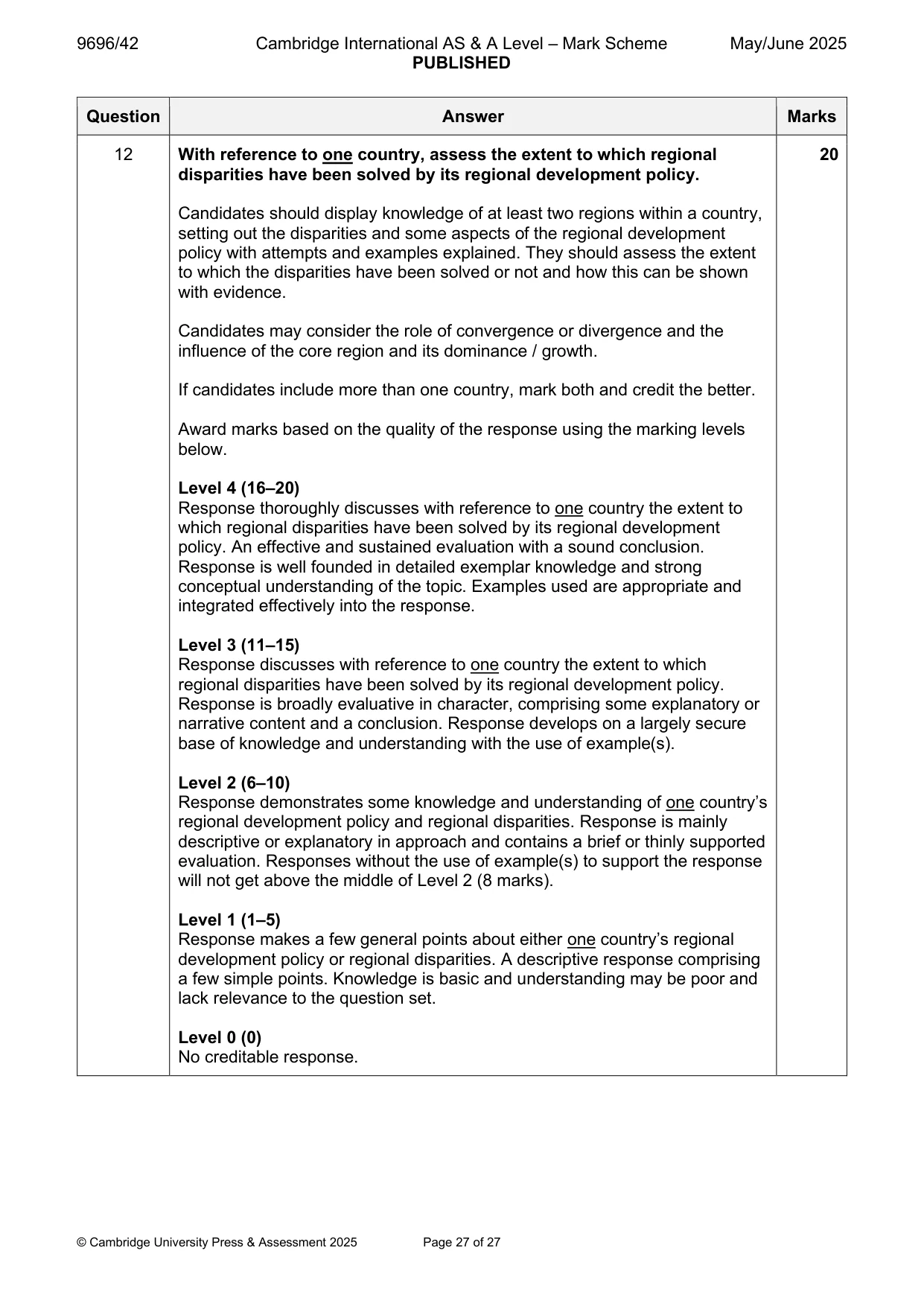
9696/42 Cambridge International AS & A Level – Mark Scheme PUBLISHED May/June 2025 © Cambridge University Press & Assessment 2025 Page 27 of 27 Question Answer Marks 12 With reference to one country, assess the extent to which regional disparities have been solved by its regional development policy. Candidates should display knowledge of at least two regions within a country, setting out the disparities and some aspects of the regional development policy with attempts and examples explained. They should assess the extent to which the disparities have been solved or not and how this can be shown with evidence. Candidates may consider the role of convergence or divergence and the influence of the core region and its dominance / growth. If candidates include more than one country, mark both and credit the better. Award marks based on the quality of the response using the marking levels below. Level 4 (16–20) Response thoroughly discusses with reference to one country the extent to which regional disparities have been solved by its regional development policy. An effective and sustained evaluation with a sound conclusion. Response is well founded in detailed exemplar knowledge and strong conceptual understanding of the topic. Examples used are appropriate and integrated effectively into the response. Level 3 (11–15) Response discusses with reference to one country the extent to which regional disparities have been solved by its regional development policy. Response is broadly evaluative in character, comprising some explanatory or narrative content and a conclusion. Response develops on a largely secure base of knowledge and understanding with the use of example(s). Level 2 (6–10) Response demonstrates some knowledge and understanding of one country’s regional development policy and regional disparities. Response is mainly descriptive or explanatory in approach and contains a brief or thinly supported evaluation. Responses without the use of example(s) to support the response will not get above the middle of Level 2 (8 marks). Level 1 (1–5) Response makes a few general points about either one country’s regional development policy or regional disparities. A descriptive response comprising a few simple points. Knowledge is basic and understanding may be poor and lack relevance to the question set. Level 0 (0) No creditable response. 20
What you needed in this session
Cambridge’s own grade thresholds for 2025 May/June, Paper 4 · Variant 2. A higher threshold means an easier paper — the bar moves with how the cohort did.