Cambridge A Level Geography 9696 — 2022 Oct/Nov Paper 2 · Variant 2
9696/22/O/N/22 · 6 questions · 60 marks · ≈68 min
The question paper and its mark scheme, free to read here and free to download. This is Cambridge’s own paper, exactly as it was sat.
Question paper4 pages
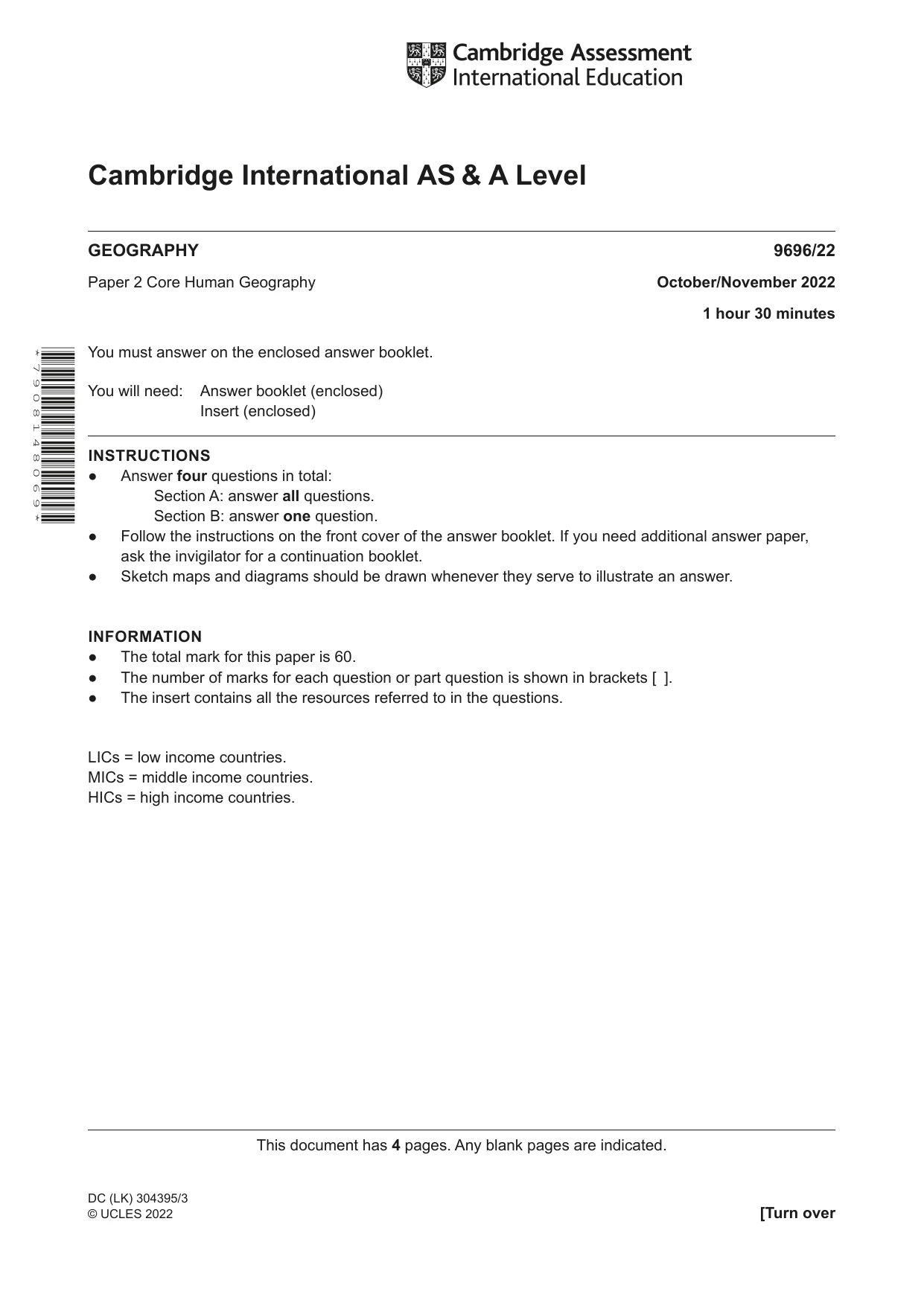
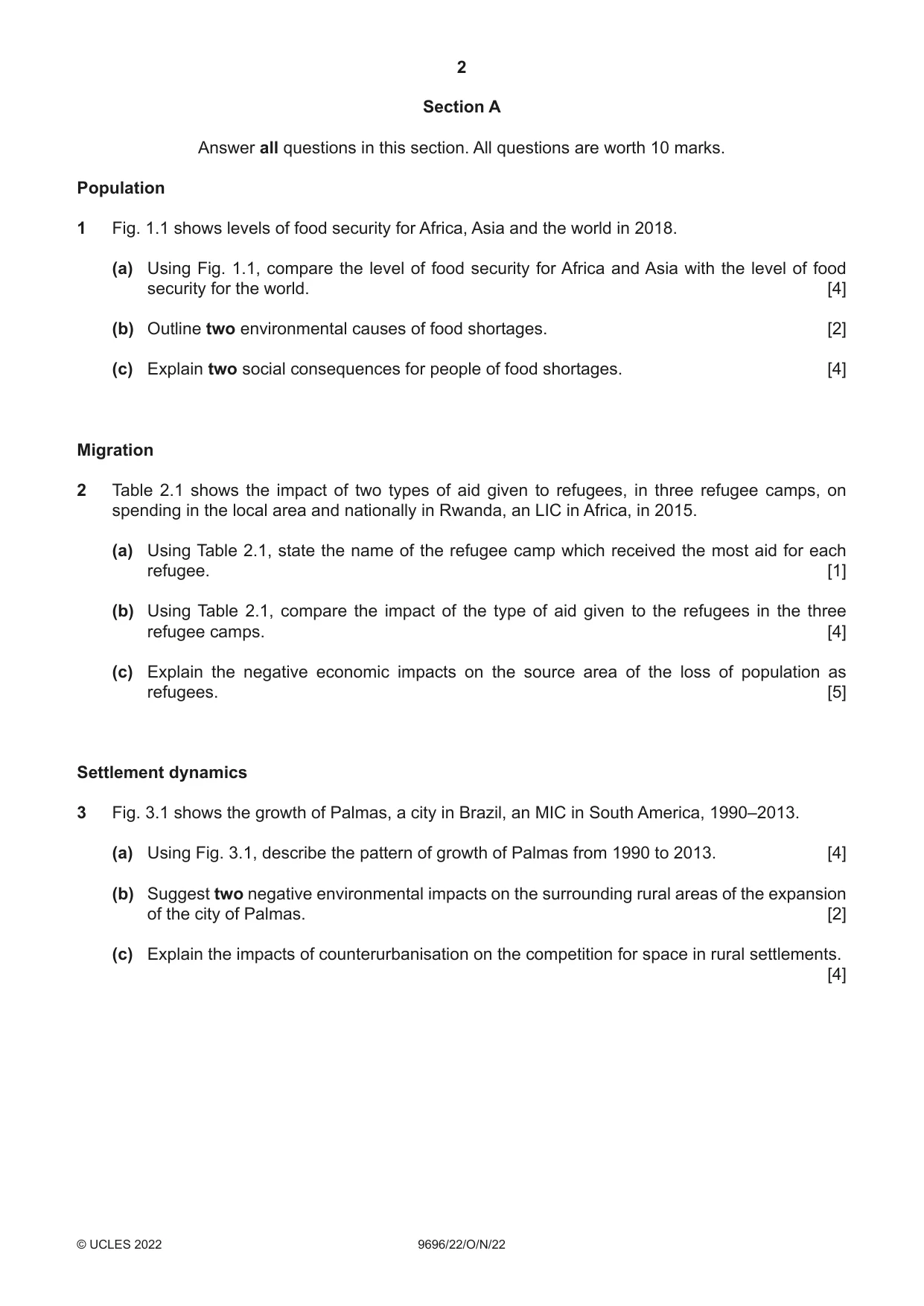
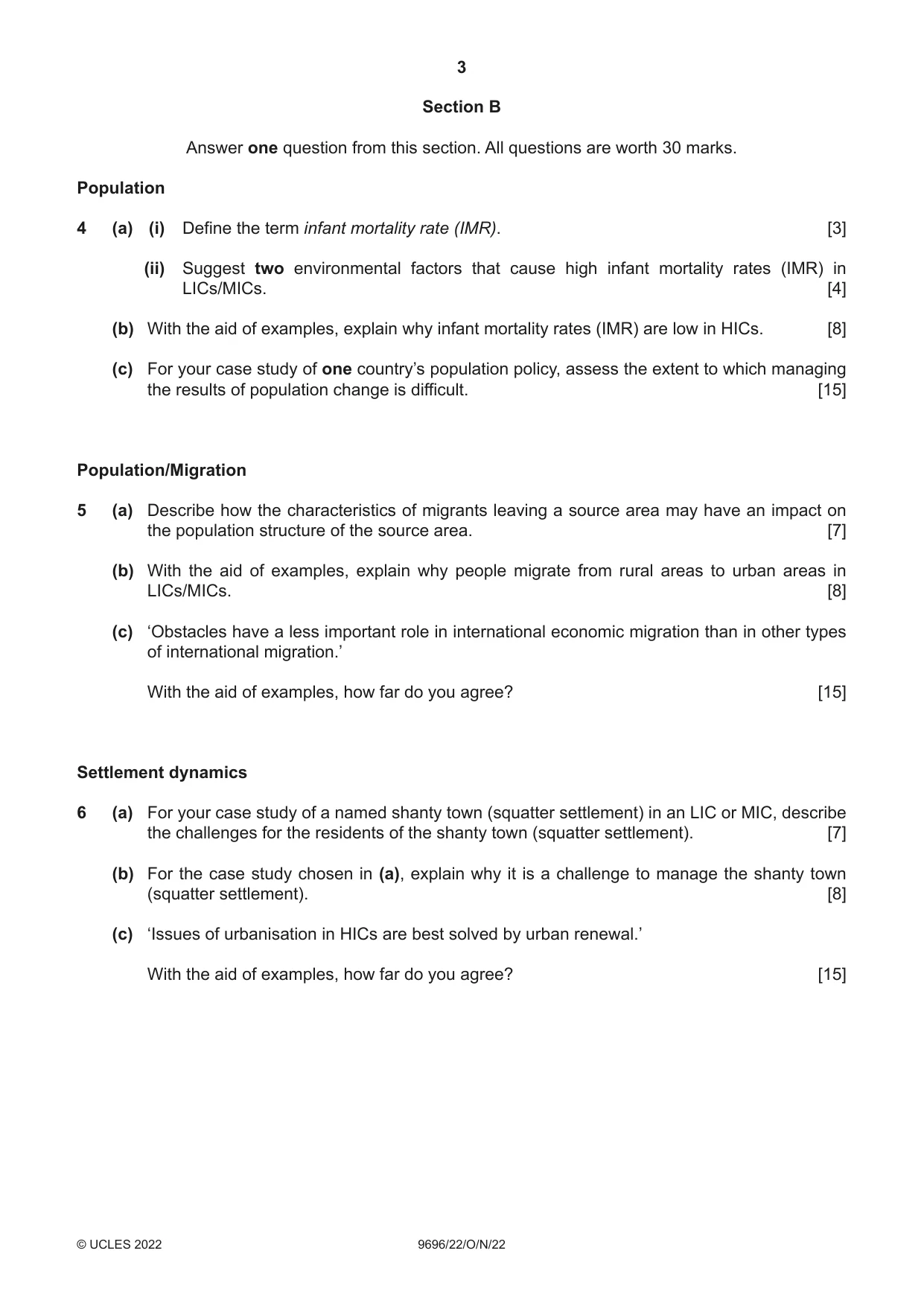

Mark scheme21 pages
Answers below. Sit the paper first if you are practising.




Questions as text
Q1 · Levels of food security for Africa, Asia and the world in 2018
1 Fig. 1.1 shows levels of food security for Africa, Asia and the world in 2018. (a) Using Fig. 1.1, compare the level of food security for Africa and Asia with the level of food security for the world. [4] (b) Outline two environmental causes of food shortages. [2] (c) Explain two social consequences for people of food shortages. [4] Migration
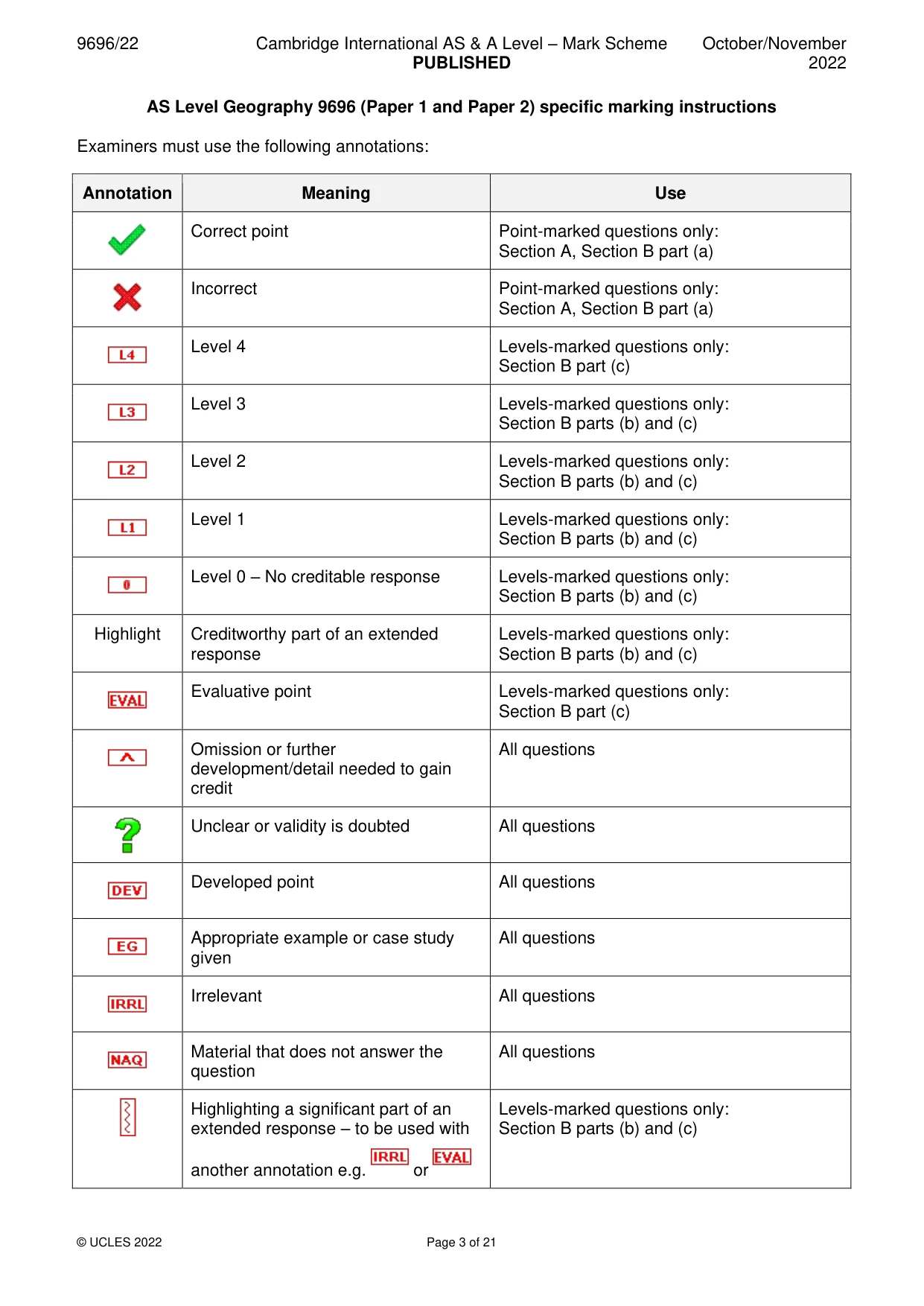
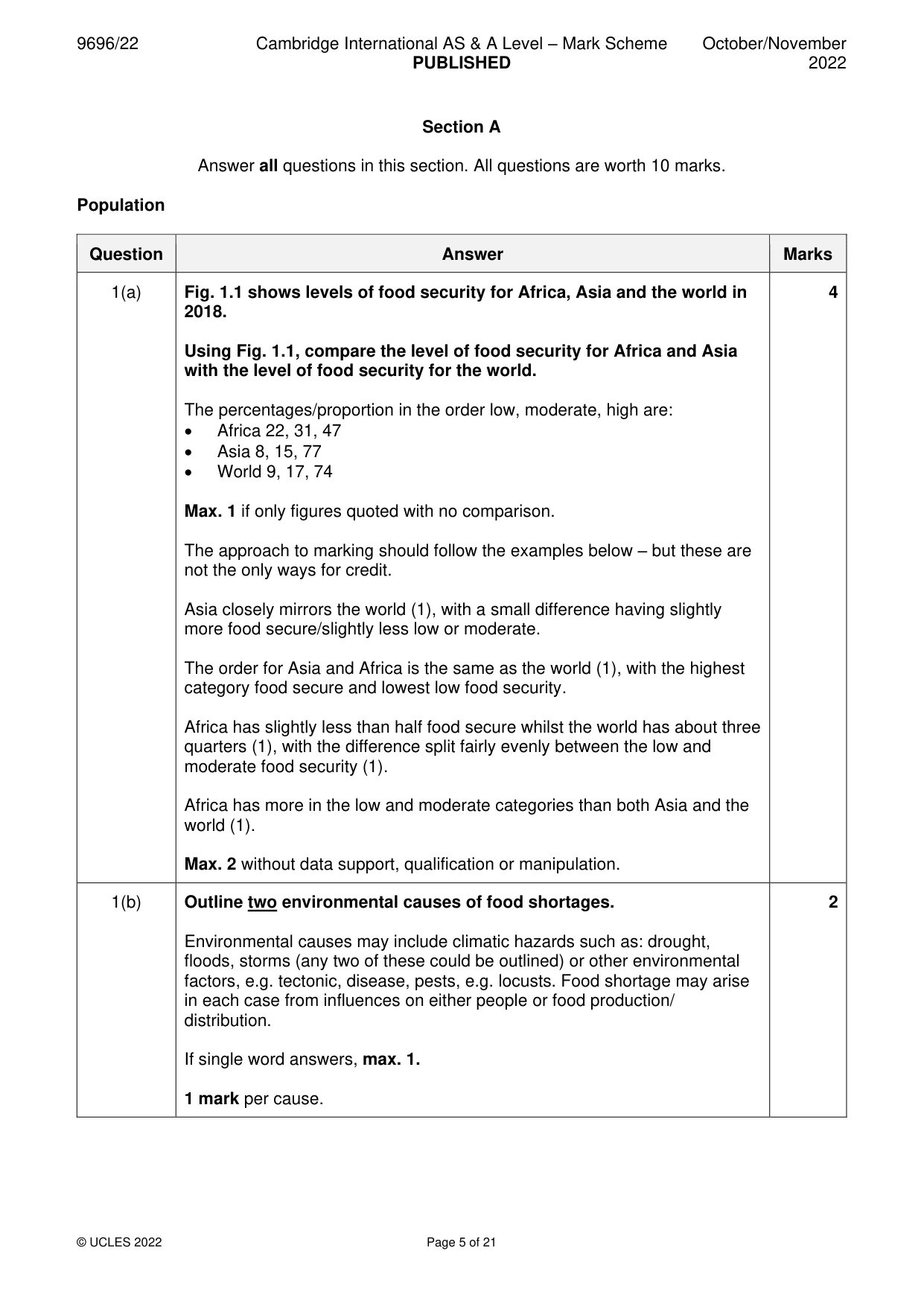
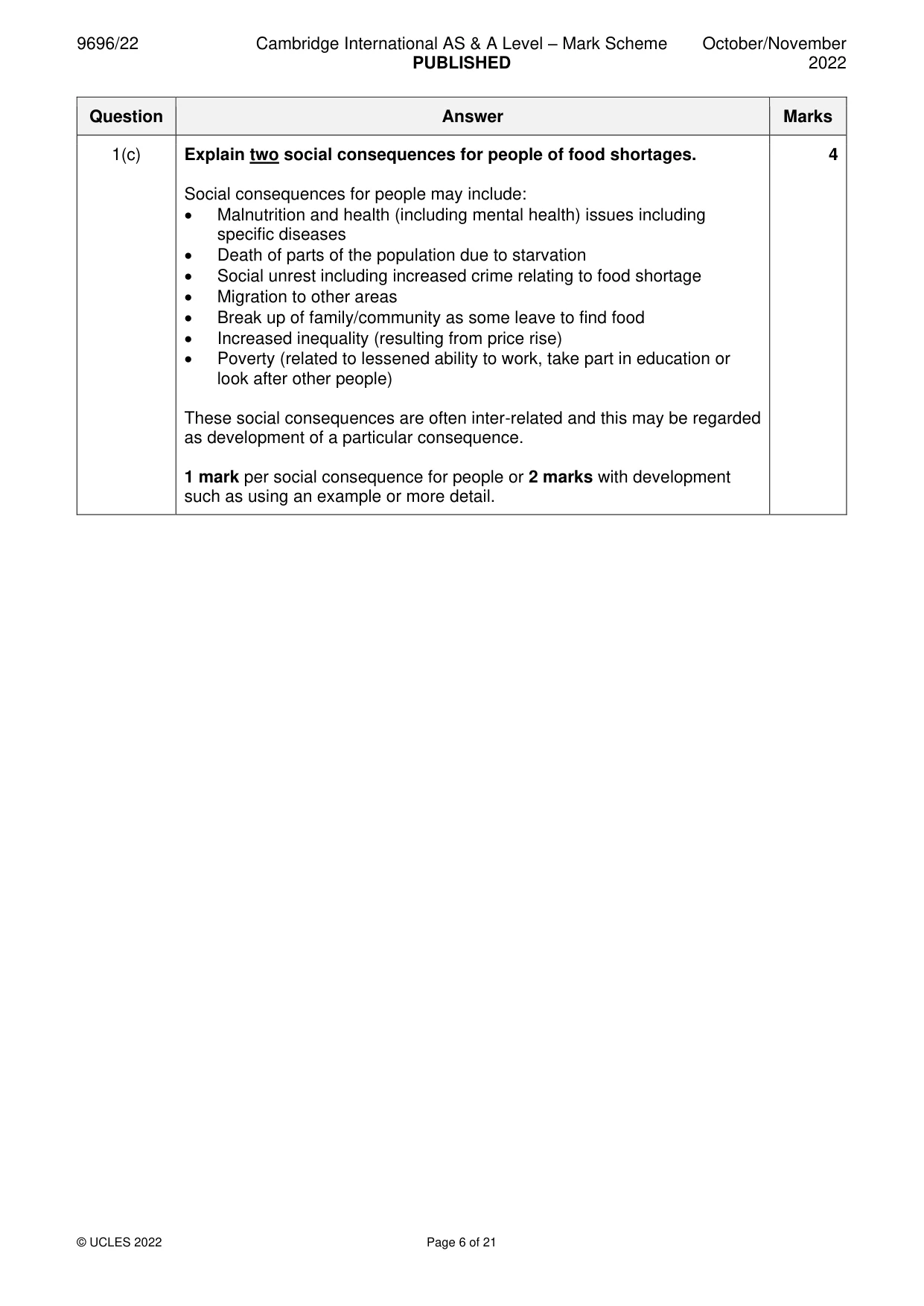
Mark scheme: Question Answer Marks 1(a) Fig. 1.1 shows levels of food security for Africa, Asia and the world in 4 2018. Using Fig. 1.1, compare the level of food security for Africa and Asia with the level of food security for the world. The percentages/proportion in the order low, moderate, high are: • Africa 22, 31, 47 • Asia 8, 15, 77 • World 9, 17, 74 Max. 1 if only figures quoted with no comparison. The approach to marking should follow the examples below – but these are not the only ways for credit. Asia closely mirrors the world (1), with a small difference having slightly more food secure/slightly less low or moderate. The order for Asia and Africa is the same as the world (1), with the highest category food secure and lowest low food security. Africa has slightly less than half food secure whilst the world has about three quarters (1), with the difference split fairly evenly between the low and moderate food security (1). Africa has more in the low and moderate categories than both Asia and the world (1). Max. 2 without data support, qualification or manipulation. 1(b) Outline two environmental causes of food shortages. 2 Environmental causes may include climatic hazards such as: drought, floods, storms (any two of these could be outlined) or other environmental factors, e.g. tectonic, disease, pests, e.g. locusts. Food shortage may arise in each case from influences on either people or food production/ distribution. If single word answers, max. 1. 1 mark per cause. 1(c) Explain two social consequences for people of food shortages. 4 Social consequences for people may include: • Malnutrition and health (including mental health) issues including specific diseases • Death of parts of the population due to starvation • Social unrest including increased crime relating to food shortage • Migration to other areas • Break up of family/community as some leave to find food • Increased inequality (resulting from price rise) • Poverty (related to lessened ability to work, take part in education or look after other people) These social consequences are often inter-related and this may be regarded as development of a particular consequence. 1 mark per social consequence for people or 2 marks with development such as using an example or more detail. Migration
Q2 · The impact of two types of aid given to refugees, in three refugee camps, on spending in…
2 Table 2.1 shows the impact of two types of aid given to refugees, in three refugee camps, on spending in the local area and nationally in Rwanda, an LIC in Africa, in 2015. (a) Using Table 2.1, state the name of the refugee camp which received the most aid for each refugee. [1] (b) Using Table 2.1, compare the impact of the type of aid given to the refugees in the three refugee camps. [4] (c) Explain the negative economic impacts on the source area of the loss of population as refugees. [5] Settlement dynamics
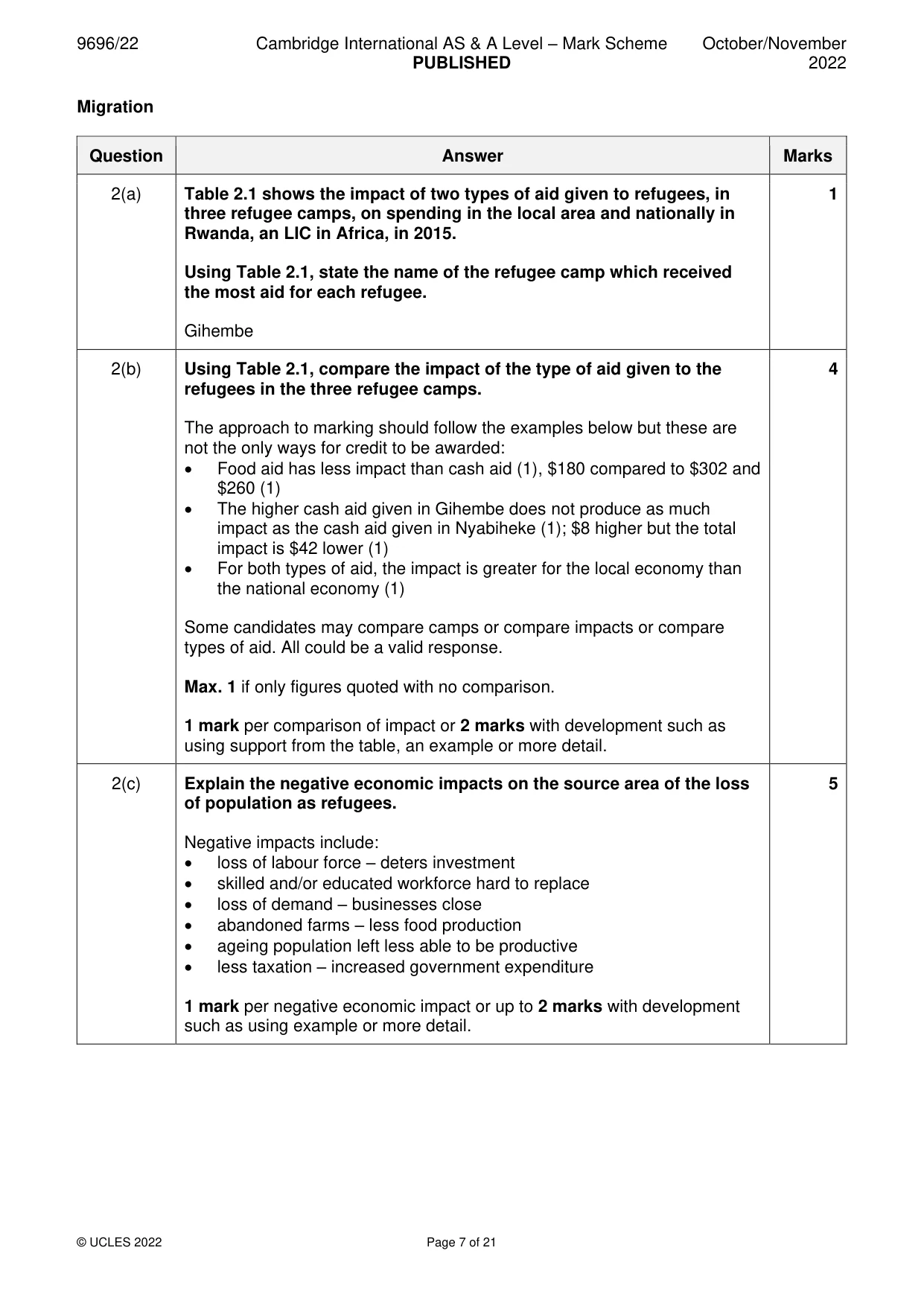
Mark scheme: 2(a) Table 2.1 shows the impact of two types of aid given to refugees, in 1 three refugee camps, on spending in the local area and nationally in Rwanda, an LIC in Africa, in 2015. Using Table 2.1, state the name of the refugee camp which received the most aid for each refugee. Gihembe 2(b) Using Table 2.1, compare the impact of the type of aid given to the 4 refugees in the three refugee camps. The approach to marking should follow the examples below but these are not the only ways for credit to be awarded: • Food aid has less impact than cash aid (1), $180 compared to $302 and $260 (1) • The higher cash aid given in Gihembe does not produce as much impact as the cash aid given in Nyabiheke (1); $8 higher but the total impact is $42 lower (1) • For both types of aid, the impact is greater for the local economy than the national economy (1) Some candidates may compare camps or compare impacts or compare types of aid. All could be a valid response. Max. 1 if only figures quoted with no comparison. 1 mark per comparison of impact or 2 marks with development such as using support from the table, an example or more detail. 2(c) Explain the negative economic impacts on the source area of the loss 5 of population as refugees. Negative impacts include: • loss of labour force – deters investment • skilled and/or educated workforce hard to replace • loss of demand – businesses close • abandoned farms – less food production • ageing population left less able to be productive • less taxation – increased government expenditure 1 mark per negative economic impact or up to 2 marks with development such as using example or more detail. Settlement dynamics
Q3 · The growth of Palmas, a city in Brazil, an MIC in South America, 1990–2013
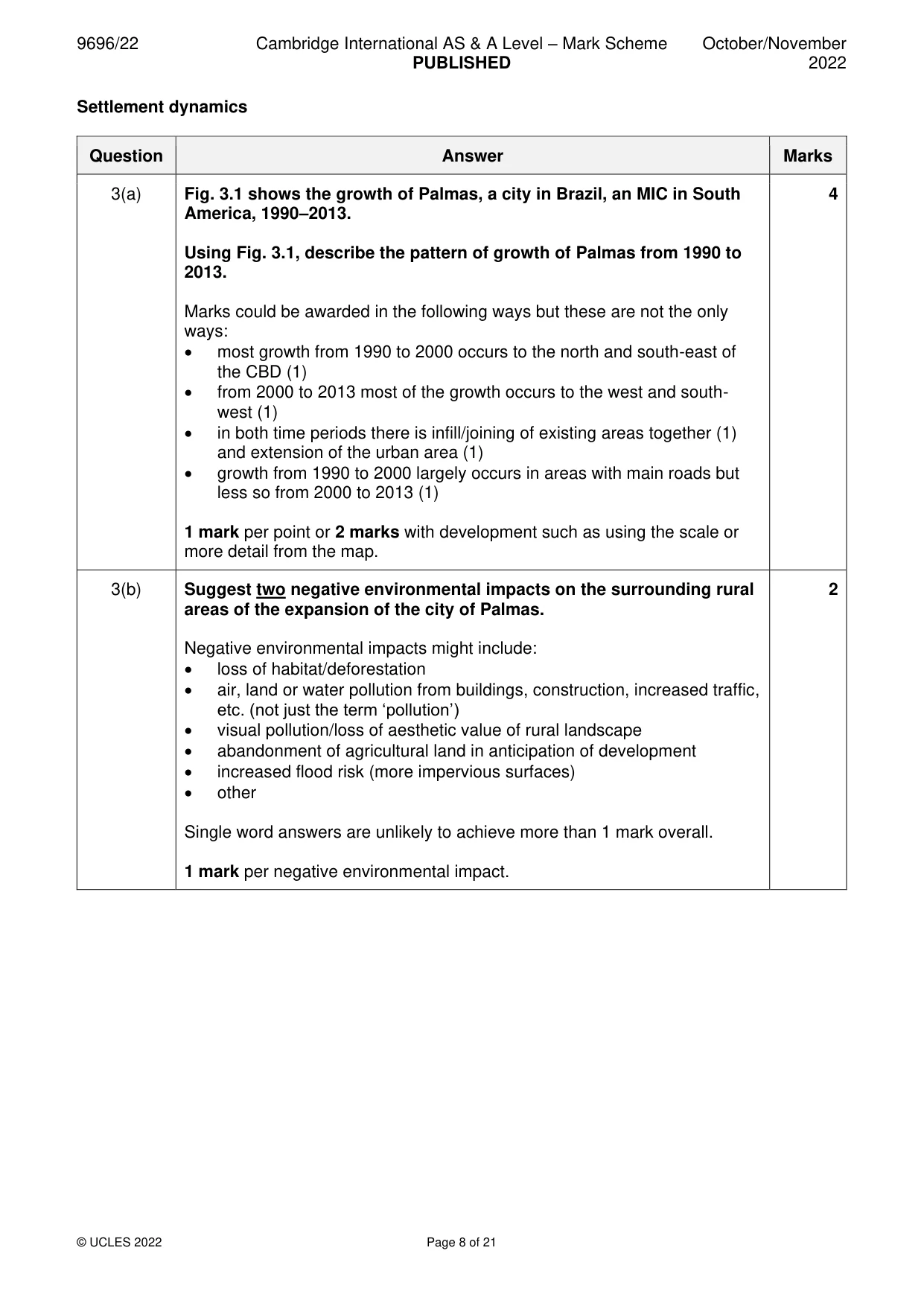
3 Fig. 3.1 shows the growth of Palmas, a city in Brazil, an MIC in South America, 1990–2013. (a) Using Fig. 3.1, describe the pattern of growth of Palmas from 1990 to 2013. [4] (b) Suggest two negative environmental impacts on the surrounding rural areas of the expansion of the city of Palmas. [2] (c) Explain the impacts of counterurbanisation on the competition for space in rural settlements. [4]
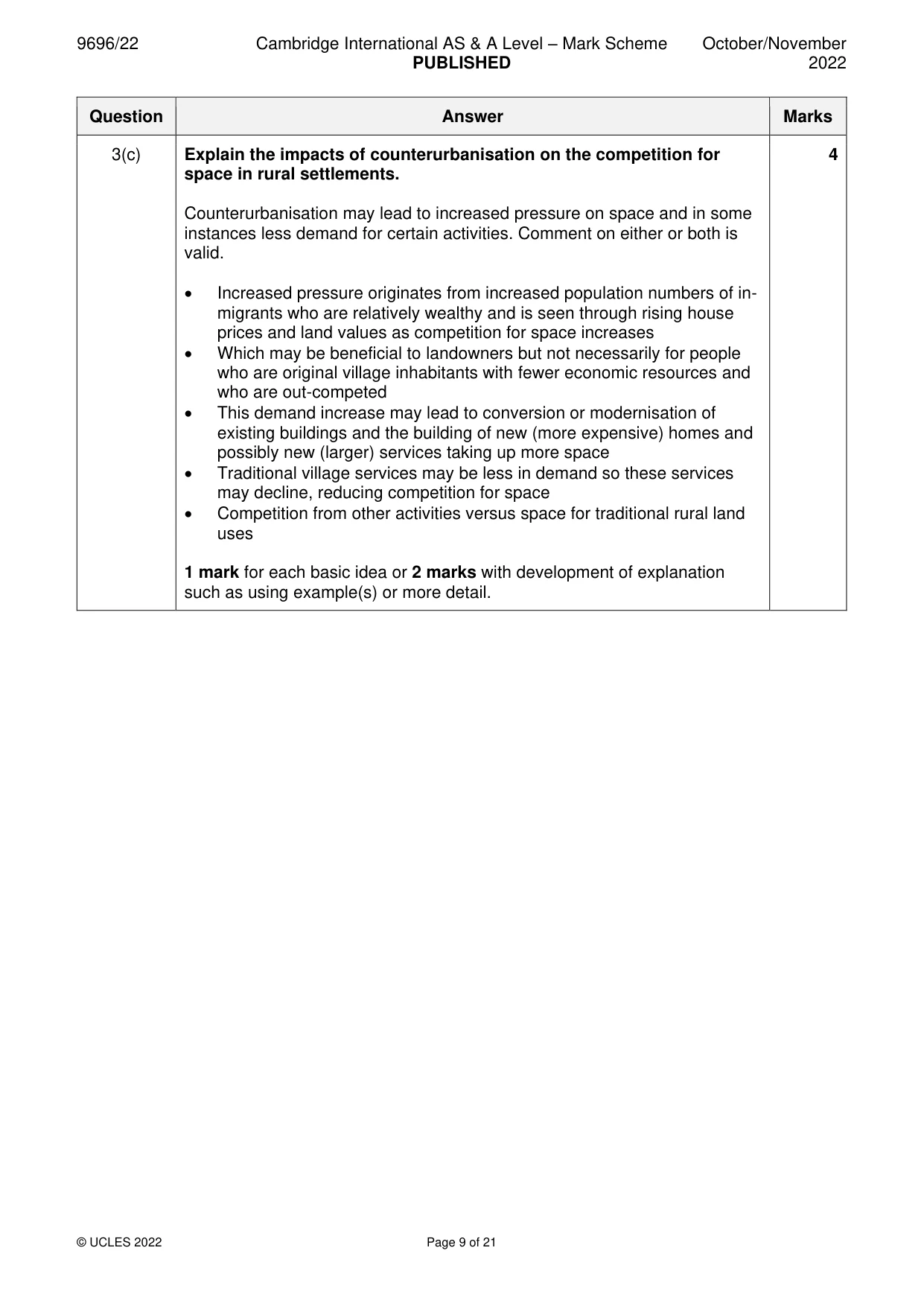
Mark scheme: 3(a) Fig. 3.1 shows the growth of Palmas, a city in Brazil, an MIC in South 4 America, 1990–2013. Using Fig. 3.1, describe the pattern of growth of Palmas from 1990 to 2013. Marks could be awarded in the following ways but these are not the only ways: • most growth from 1990 to 2000 occurs to the north and south-east of the CBD (1) • from 2000 to 2013 most of the growth occurs to the west and south- west (1) • in both time periods there is infill/joining of existing areas together (1) and extension of the urban area (1) • growth from 1990 to 2000 largely occurs in areas with main roads but less so from 2000 to 2013 (1) 1 mark per point or 2 marks with development such as using the scale or more detail from the map. 3(b) Suggest two negative environmental impacts on the surrounding rural 2 areas of the expansion of the city of Palmas. Negative environmental impacts might include: • loss of habitat/deforestation • air, land or water pollution from buildings, construction, increased traffic, etc. (not just the term ‘pollution’) • visual pollution/loss of aesthetic value of rural landscape • abandonment of agricultural land in anticipation of development • increased flood risk (more impervious surfaces) • other Single word answers are unlikely to achieve more than 1 mark overall. 1 mark per negative environmental impact. 3(c) Explain the impacts of counterurbanisation on the competition for 4 space in rural settlements. Counterurbanisation may lead to increased pressure on space and in some instances less demand for certain activities. Comment on either or both is valid. • Increased pressure originates from increased population numbers of in- migrants who are relatively wealthy and is seen through rising house prices and land values as competition for space increases • Which may be beneficial to landowners but not necessarily for people who are original village inhabitants with fewer economic resources and who are out-competed • This demand increase may lead to conversion or modernisation of existing buildings and the building of new (more expensive) homes and possibly new (larger) services taking up more space • Traditional village services may be less in demand so these services may decline, reducing competition for space • Competition from other activities versus space for traditional rural land uses 1 mark for each basic idea or 2 marks with development of explanation such as using example(s) or more detail. Section B Answer one question from this section. All questions are worth 30 marks. Population
Q4 · Define the term infant mortality rate (IMR)
4 (a) (i) Define the term infant mortality rate (IMR). [3] (ii) Suggest two environmental factors that cause high infant mortality rates (IMR) in LICs/MICs. [4] (b) With the aid of examples, explain why infant mortality rates (IMR) are low in HICs. [8] (c) For your case study of one country’s population policy, assess the extent to which managing the results of population change is difficult. [15] Population/Migration
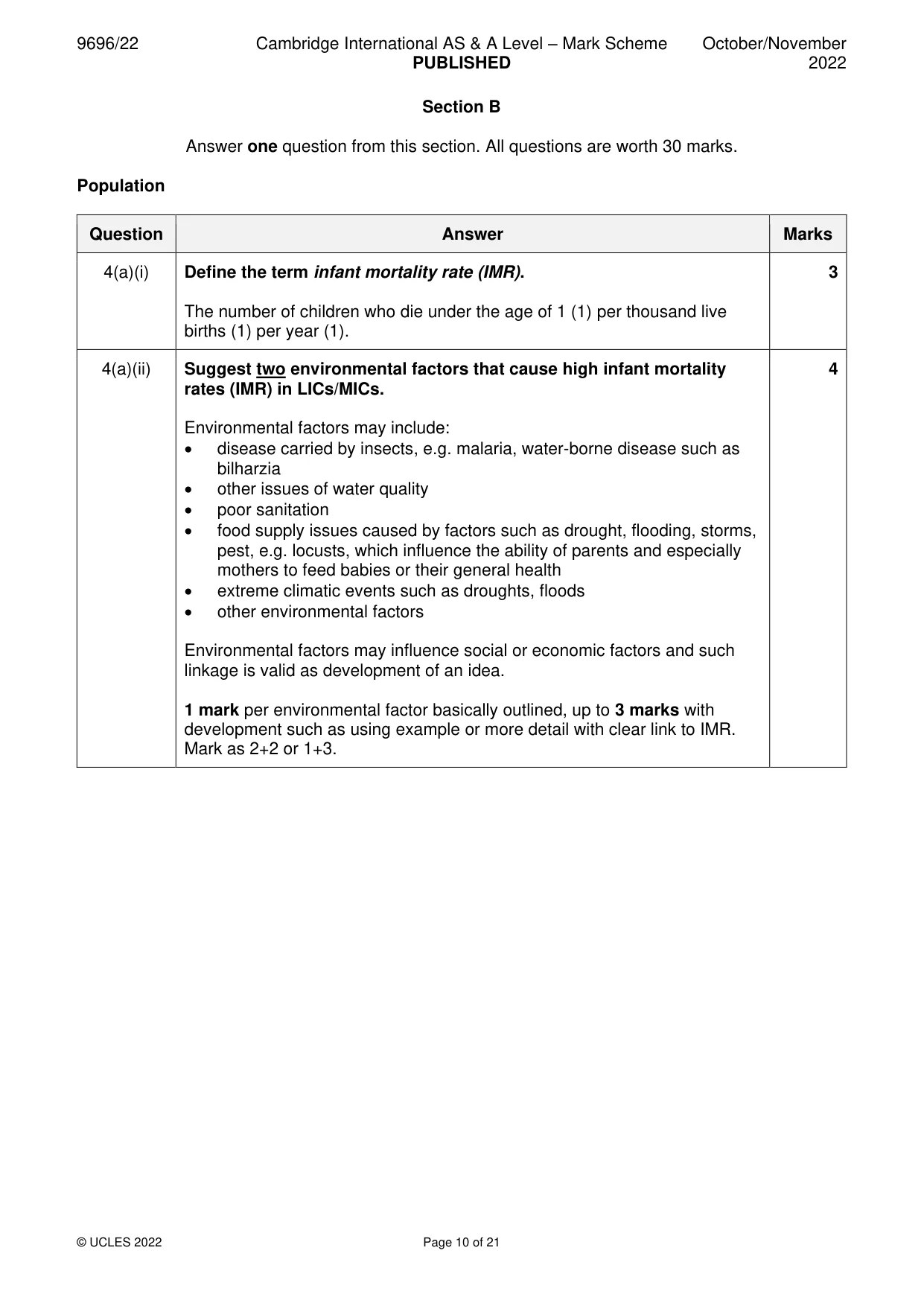
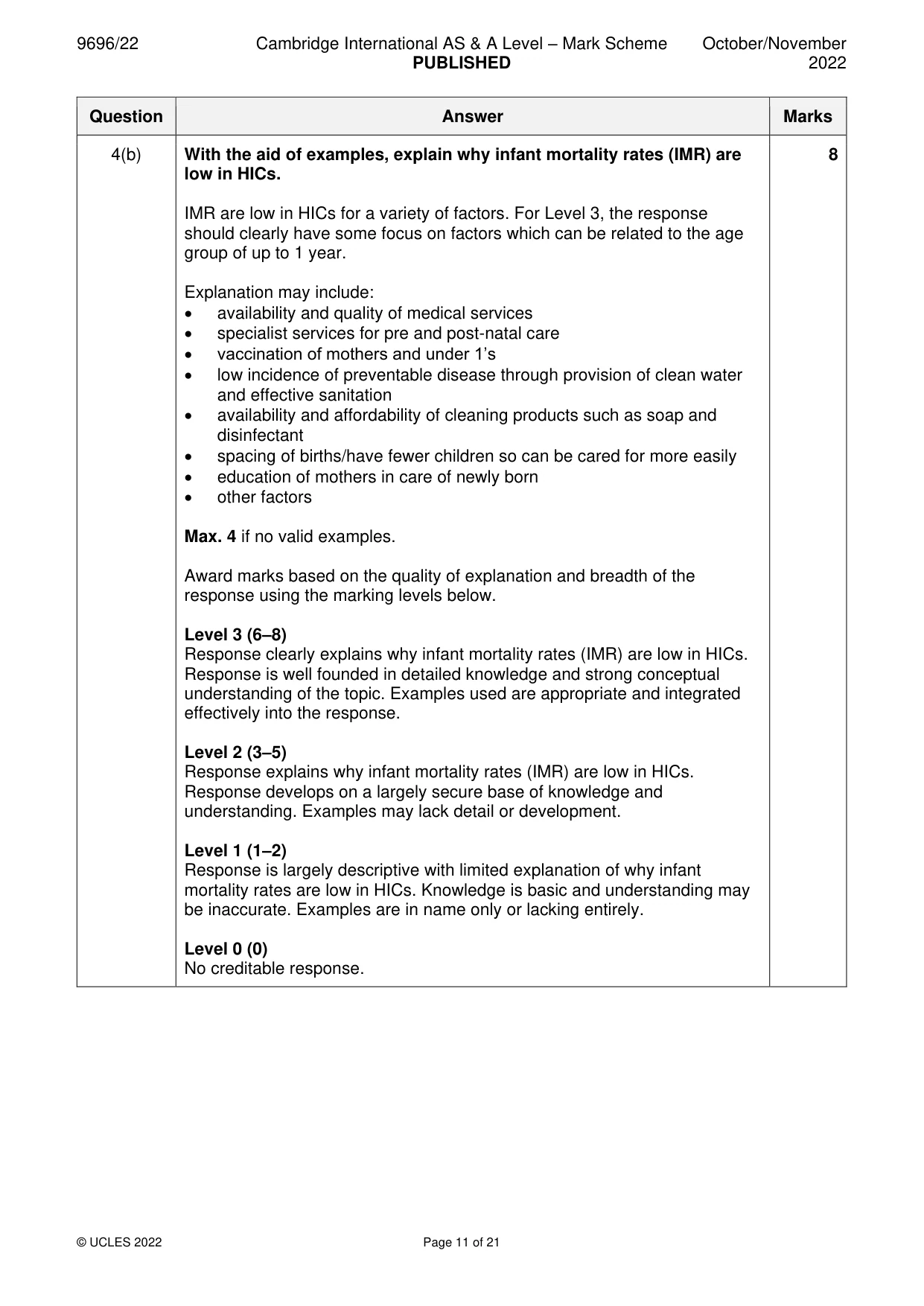
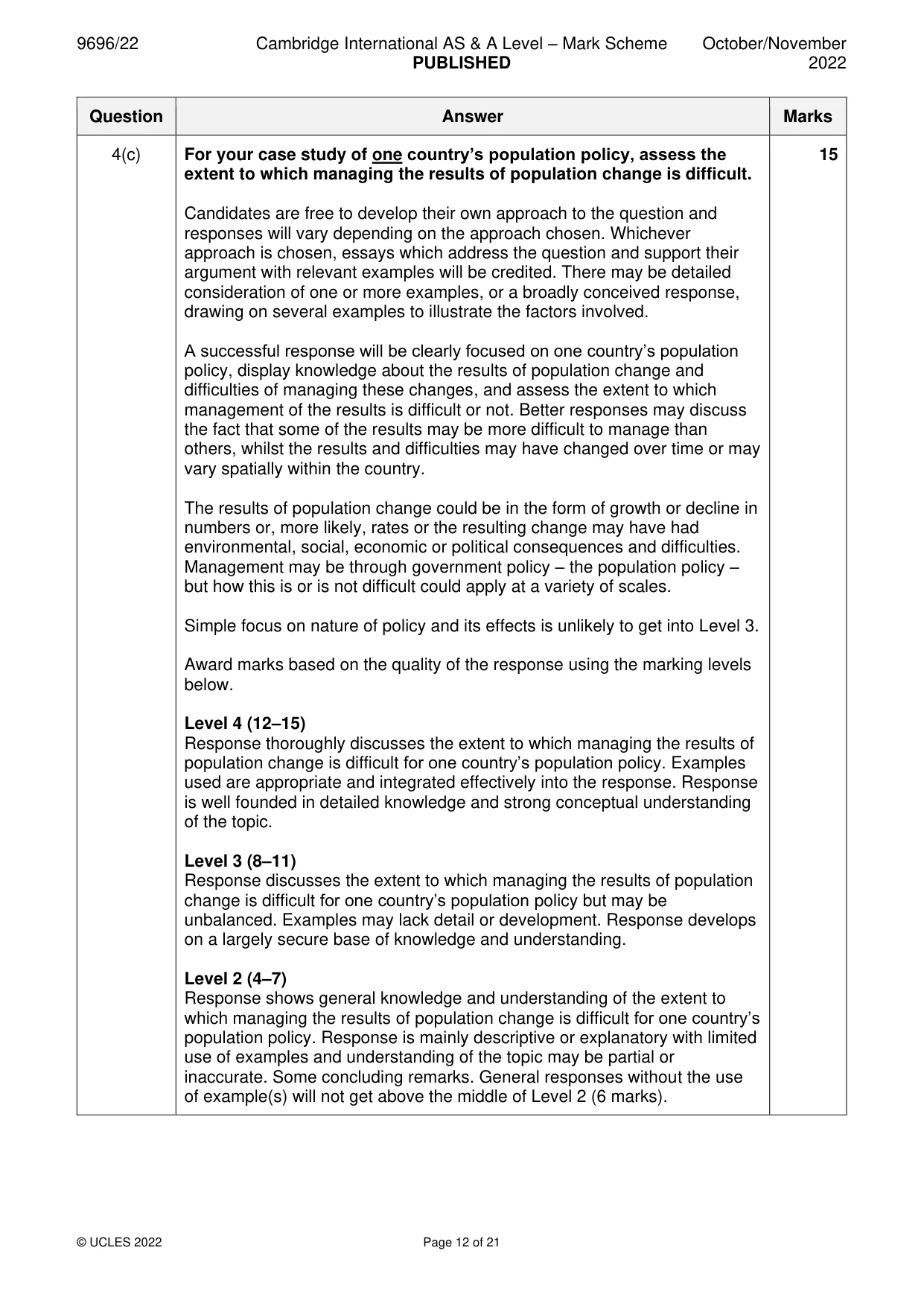
Mark scheme: 4(a)(i) Define the term infant mortality rate (IMR). 3 The number of children who die under the age of 1 (1) per thousand live births (1) per year (1). 4(a)(ii) Suggest two environmental factors that cause high infant mortality 4 rates (IMR) in LICs/MICs. Environmental factors may include: • disease carried by insects, e.g. malaria, water-borne disease such as bilharzia • other issues of water quality • poor sanitation • food supply issues caused by factors such as drought, flooding, storms, pest, e.g. locusts, which influence the ability of parents and especially mothers to feed babies or their general health • extreme climatic events such as droughts, floods • other environmental factors Environmental factors may influence social or economic factors and such linkage is valid as development of an idea. 1 mark per environmental factor basically outlined, up to 3 marks with development such as using example or more detail with clear link to IMR. Mark as 2+2 or 1+3. 4(b) With the aid of examples, explain why infant mortality rates (IMR) are 8 low in HICs. IMR are low in HICs for a variety of factors. For Level 3, the response should clearly have some focus on factors which can be related to the age group of up to 1 year. Explanation may include: • availability and quality of medical services • specialist services for pre and post-natal care • vaccination of mothers and under 1’s • low incidence of preventable disease through provision of clean water and effective sanitation • availability and affordability of cleaning products such as soap and disinfectant • spacing of births/have fewer children so can be cared for more easily • education of mothers in care of newly born • other factors Max. 4 if no valid examples. Award marks based on the quality of explanation and breadth of the response using the marking levels below. Level 3 (6–8) Response clearly explains why infant mortality rates (IMR) are low in HICs. Response is well founded in detailed knowledge and strong conceptual understanding of the topic. Examples used are appropriate and integrated effectively into the response. Level 2 (3–5) Response explains why infant mortality rates (IMR) are low in HICs. Response develops on a largely secure base of knowledge and understanding. Examples may lack detail or development. Level 1 (1–2) Response is largely descriptive with limited explanation of why infant mortality rates are low in HICs. Knowledge is basic and understanding may be inaccurate. Examples are in name only or lacking entirely. Level 0 (0) No creditable response. 4(c) For your case study of one country’s population policy, assess the 15 extent to which managing the results of population change is difficult. Candidates are free to develop their own approach to the question and responses will vary depending on the approach chosen. Whichever approach is chosen, essays which address the question and support their argument with relevant examples will be credited. There may be detailed consideration of one or more examples, or a broadly conceived response, drawing on several examples to illustrate the factors involved. A successful response will be clearly focused on one country’s population policy, display knowledge about the results of population change and difficulties of managing these changes, and assess the extent to which management of the results is difficult or not. Better responses may discuss the fact that some of the results may be more difficult to manage than others, whilst the results and difficulties may have changed over time or may vary spatially within the country. The results of population change could be in the form of growth or decline in numbers or, more likely, rates or the resulting change may have had environmental, social, economic or political consequences and difficulties. Management may be through government policy – the population policy – but how this is or is not difficult could apply at a variety of scales. Simple focus on nature of policy and its effects is unlikely to get into Level 3. Award marks based on the quality of the response using the marking levels below. Level 4 (12–15) Response thoroughly discusses the extent to which managing the results of population change is difficult for one country’s population policy. Examples used are appropriate and integrated effectively into the response. Response is well founded in detailed knowledge and strong conceptual understanding of the topic. Level 3 (8–11) Response discusses the extent to which managing the results of population change is difficult for one country’s population policy but may be unbalanced. Examples may lack detail or development. Response develops on a largely secure base of knowledge and understanding. Level 2 (4–7) Response shows general knowledge and understanding of the extent to which managing the results of population change is difficult for one country’s population policy. Response is mainly descriptive or explanatory with limited use of examples and understanding of the topic may be partial or inaccurate. Some concluding remarks. General responses without the use of example(s) will not get above the middle of Level 2 (6 marks). 4(c) Level 1 (1–3) Response may broadly discuss the population policy of one country which lacks focus on the results of population change and difficulties of managing the results but does not address the question and does not come to a convincing conclusion. Response is descriptive, knowledge is basic and understanding is poor. Level 0 (0) No creditable response. Population/Migration
Q5 · Describe how the characteristics of migrants leaving a source area may have an impact on…
5 (a) Describe how the characteristics of migrants leaving a source area may have an impact on the population structure of the source area. [7] (b) With the aid of examples, explain why people migrate from rural areas to urban areas in LICs/MICs. [8] (c) ‘Obstacles have a less important role in international economic migration than in other types of international migration.’ With the aid of examples, how far do you agree? [15] Settlement dynamics
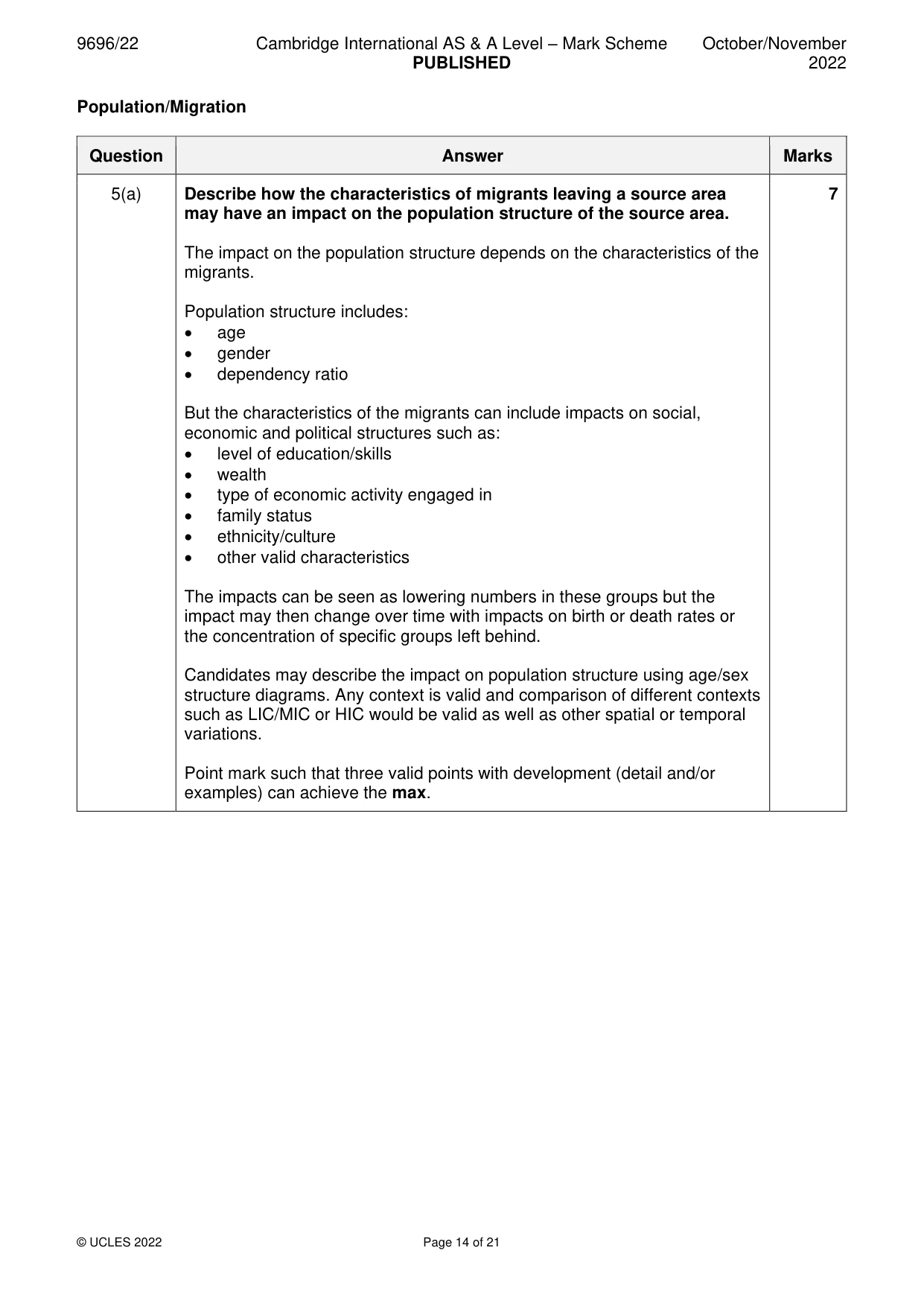
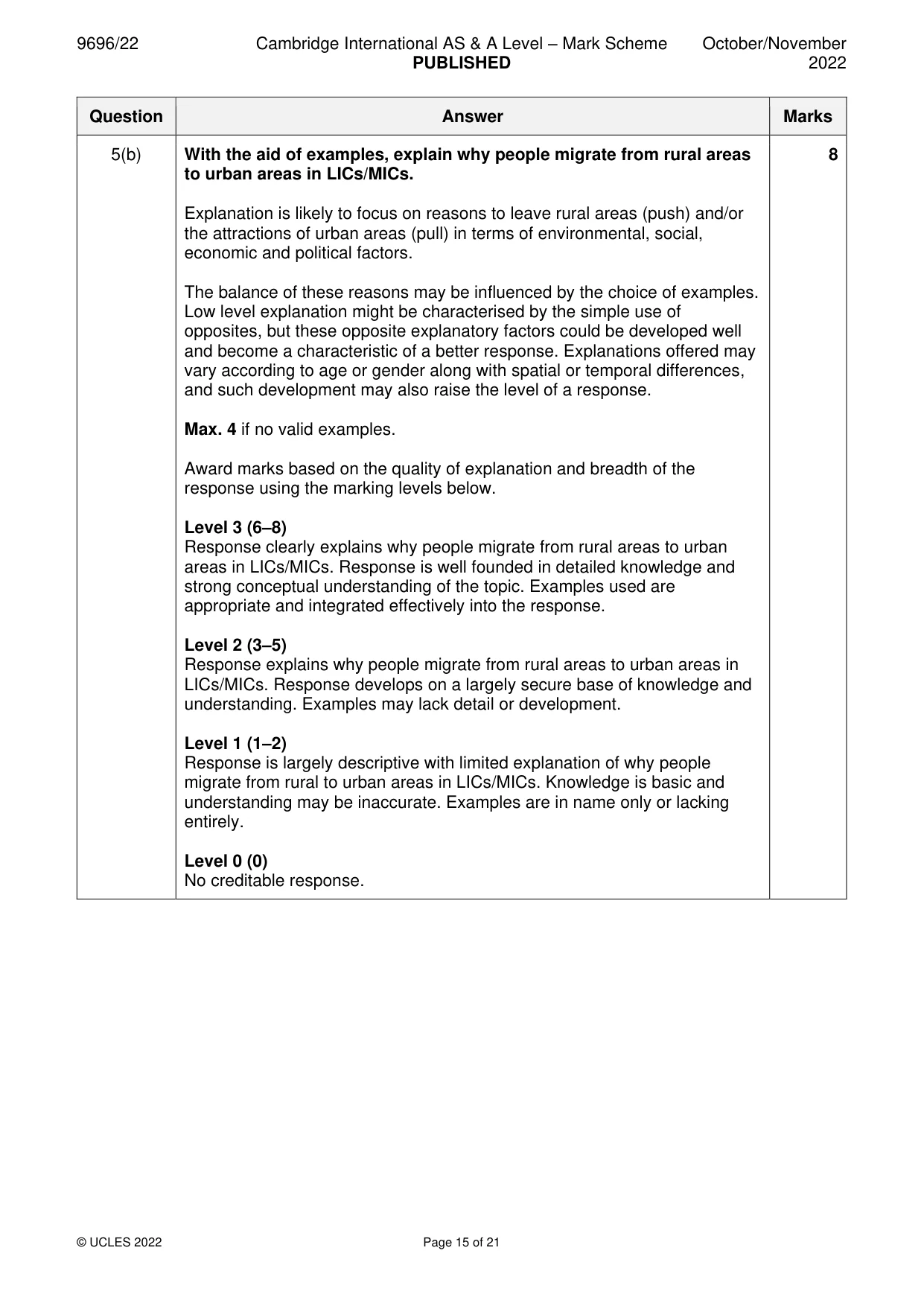
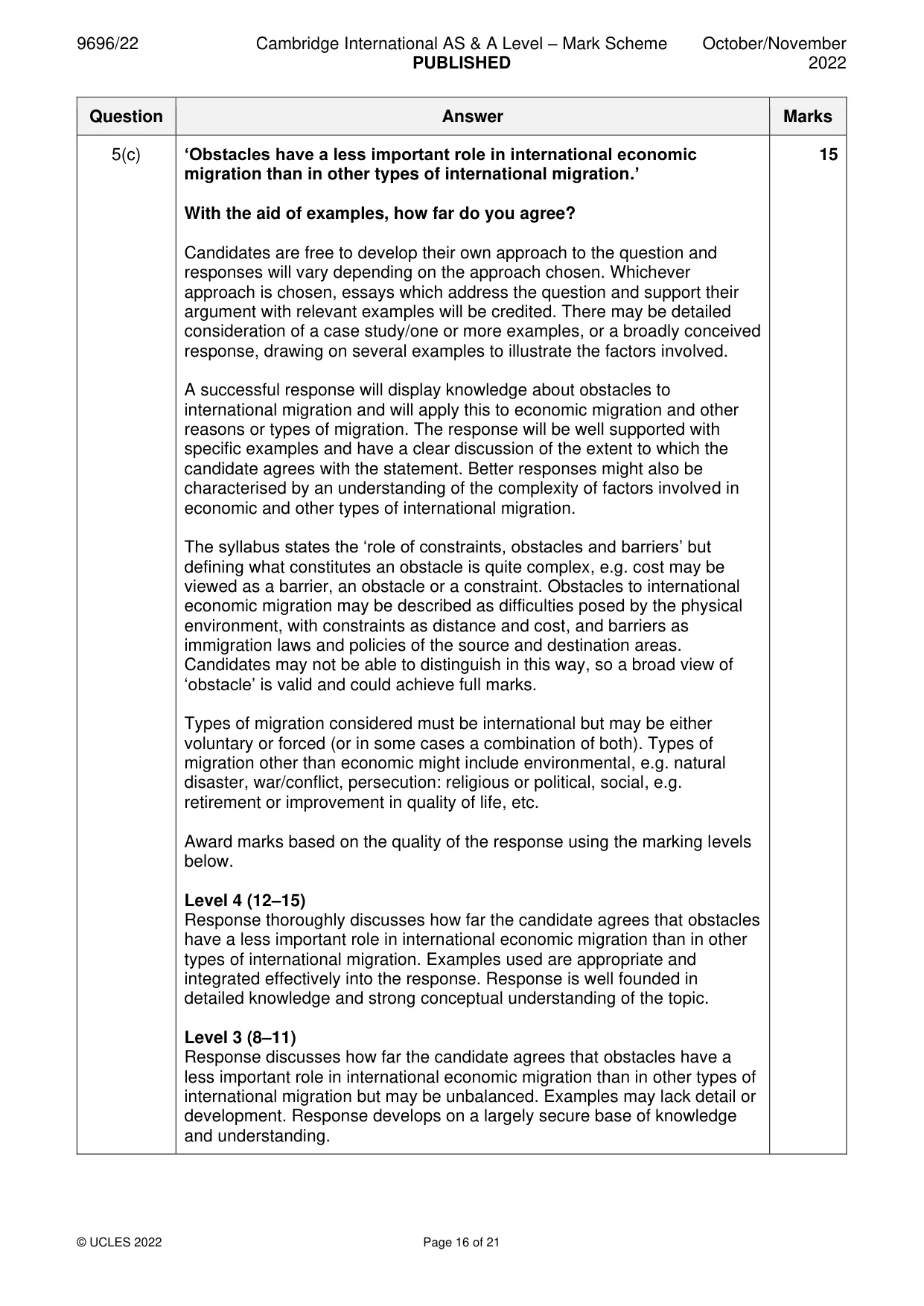
Mark scheme: 5(a) Describe how the characteristics of migrants leaving a source area 7 may have an impact on the population structure of the source area. The impact on the population structure depends on the characteristics of the migrants. Population structure includes: • age • gender • dependency ratio But the characteristics of the migrants can include impacts on social, economic and political structures such as: • level of education/skills • wealth • type of economic activity engaged in • family status • ethnicity/culture • other valid characteristics The impacts can be seen as lowering numbers in these groups but the impact may then change over time with impacts on birth or death rates or the concentration of specific groups left behind. Candidates may describe the impact on population structure using age/sex structure diagrams. Any context is valid and comparison of different contexts such as LIC/MIC or HIC would be valid as well as other spatial or temporal variations. Point mark such that three valid points with development (detail and/or examples) can achieve the max. 5(b) With the aid of examples, explain why people migrate from rural areas 8 to urban areas in LICs/MICs. Explanation is likely to focus on reasons to leave rural areas (push) and/or the attractions of urban areas (pull) in terms of environmental, social, economic and political factors. The balance of these reasons may be influenced by the choice of examples. Low level explanation might be characterised by the simple use of opposites, but these opposite explanatory factors could be developed well and become a characteristic of a better response. Explanations offered may vary according to age or gender along with spatial or temporal differences, and such development may also raise the level of a response. Max. 4 if no valid examples. Award marks based on the quality of explanation and breadth of the response using the marking levels below. Level 3 (6–8) Response clearly explains why people migrate from rural areas to urban areas in LICs/MICs. Response is well founded in detailed knowledge and strong conceptual understanding of the topic. Examples used are appropriate and integrated effectively into the response. Level 2 (3–5) Response explains why people migrate from rural areas to urban areas in LICs/MICs. Response develops on a largely secure base of knowledge and understanding. Examples may lack detail or development. Level 1 (1–2) Response is largely descriptive with limited explanation of why people migrate from rural to urban areas in LICs/MICs. Knowledge is basic and understanding may be inaccurate. Examples are in name only or lacking entirely. Level 0 (0) No creditable response. 5(c) ‘Obstacles have a less important role in international economic 15 migration than in other types of international migration.’ With the aid of examples, how far do you agree? Candidates are free to develop their own approach to the question and responses will vary depending on the approach chosen. Whichever approach is chosen, essays which address the question and support their argument with relevant examples will be credited. There may be detailed consideration of a case study/one or more examples, or a broadly conceived response, drawing on several examples to illustrate the factors involved. A successful response will display knowledge about obstacles to international migration and will apply this to economic migration and other reasons or types of migration. The response will be well supported with specific examples and have a clear discussion of the extent to which the candidate agrees with the statement. Better responses might also be characterised by an understanding of the complexity of factors involved in economic and other types of international migration. The syllabus states the ‘role of constraints, obstacles and barriers’ but defining what constitutes an obstacle is quite complex, e.g. cost may be viewed as a barrier, an obstacle or a constraint. Obstacles to international economic migration may be described as difficulties posed by the physical environment, with constraints as distance and cost, and barriers as immigration laws and policies of the source and destination areas. Candidates may not be able to distinguish in this way, so a broad view of ‘obstacle’ is valid and could achieve full marks. Types of migration considered must be international but may be either voluntary or forced (or in some cases a combination of both). Types of migration other than economic might include environmental, e.g. natural disaster, war/conflict, persecution: religious or political, social, e.g. retirement or improvement in quality of life, etc. Award marks based on the quality of the response using the marking levels below. Level 4 (12–15) Response thoroughly discusses how far the candidate agrees that obstacles have a less important role in international economic migration than in other types of international migration. Examples used are appropriate and integrated effectively into the response. Response is well founded in detailed knowledge and strong conceptual understanding of the topic. Level 3 (8–11) Response discusses how far the candidate agrees that obstacles have a less important role in international economic migration than in other types of international migration but may be unbalanced. Examples may lack detail or development. Response develops on a largely secure base of knowledge and understanding. 5(c) Level 2 (4–7) Response shows general knowledge and understanding of how far the candidate agrees that obstacles have a less important role in international economic migration than in other types of international migration. Response is mainly descriptive or explanatory with limited use of examples, and understanding of the topic may be partial or inaccurate. Some concluding remarks. General responses without the use of example(s) will not get above the middle of Level 2 (6 marks). Level 1 (1–3) Response may broadly discuss obstacles to migration but does not address the question and does not come to a convincing conclusion. Response is descriptive, knowledge is basic and understanding is poor. Level 0 (0) No creditable response. Settlement dynamics
Q6 · For your case study of a named shanty town (squatter settlement) in an LIC or MIC…
6 (a) For your case study of a named shanty town (squatter settlement) in an LIC or MIC, describe the challenges for the residents of the shanty town (squatter settlement). [7] (b) For the case study chosen in (a), explain why it is a challenge to manage the shanty town (squatter settlement). [8] (c) ‘Issues of urbanisation in HICs are best solved by urban renewal.’ With the aid of examples, how far do you agree? [15]
Mark scheme: 6(a) For your case study of a named shanty town (squatter settlement) in 7 an LIC or MIC, describe the challenges for the residents of the shanty town (squatter settlement). The challenges for residents are related to problems such as: • housing: quantity, quality, density • standard of services • infrastructure provision such as water, electricity, transport, etc. • refuse collection • occurrence of diseases/fires, etc. • employment issues • education • land tenure issues • other valid challenges A better response will elaborate at least two problems and link these to the context of challenges for the residents. For example, the problem of low quality housing is a challenge because it leads to diseases such as respiratory infections and further consequences, or is a challenge because of a lack of financial resources to improve the housing. The challenges may be social, economic, environmental or political in nature. Point mark such that three valid points with development (detail and/or examples) can achieve the max. If purely generic, then max. 3. 6(b) For the case study chosen in (a), explain why it is a challenge to 8 manage the shanty town (squatter settlement). The explanation of why it is a challenge to manage the shanty town (squatter settlement) may focus upon one or more groups involved in the management. This may be the residents, their local representatives, politicians at different levels of government, other outside bodies such as NGOs. The challenges may be related to cost, funding, political policies or will of the government, willingness of people to respond, skills, education, space, land cost and ownership issues, physical characteristics of the site, crime and gangs, etc. Award marks based on the quality of explanation and breadth of the response using the marking levels below. Max. 4 if no link to relevant shanty town (squatter settlement). Level 3 (6–8) Response clearly explains why it is a challenge to manage the shanty town (squatter settlement). Response is well founded in detailed knowledge and strong conceptual understanding of the topic. Examples used are appropriate and integrated effectively into the response. Level 2 (3–5) Response explains why it is a challenge to manage the shanty town (squatter settlement). Response develops on a largely secure base of knowledge and understanding. Examples may lack detail or development. Level 1 (1–2) Response is largely descriptive with limited explanation of why it is a challenge to manage the shanty town (squatter settlement). Knowledge is basic and understanding may be inaccurate. Examples are in name only or lacking entirely. Level 0 (0) No creditable response. 6(c) ‘Issues of urbanisation in HICs are best solved by urban renewal.’ 15 With the aid of examples, how far do you agree? Candidates are free to develop their own approach to the question and responses will vary depending on the approach chosen. Whichever approach is chosen, essays which address the question and support their argument with relevant examples will be credited. There may be detailed consideration of a case study/one or more examples, or a broadly conceived response, drawing on several examples to illustrate the factors involved. Issues of urbanisation in HICs might include issues in any part of the city and may be social, economic, environmental or political. The issues might refer to the built environment, infrastructure or for people. Candidates may discuss how the issues may not be relevant for the urban renewal approach. Candidates may consider other solutions such as gentrification, counterurbanisation, re-imaging, etc. which may vary in effectiveness over time/space. Award marks based on the quality of the response using the marking levels below. Level 4 (12–15) Response thoroughly discusses how far the candidate agrees that the issues of urbanisation in HICs are best solved by urban renewal. Examples used are appropriate and integrated effectively into the response. Response is well founded in detailed knowledge and strong conceptual understanding of the topic. Level 3 (8–11) Response discusses how far the candidate agrees that the issues of urbanisation in HICs are best solved by urban renewal but may be unbalanced towards urban renewal or to other ways. Examples may lack detail or development. Response develops on a largely secure base of knowledge and understanding. Level 2 (4–7) Response shows general knowledge and understanding of issues of urbanisation in HICs and urban renewal but with limited links between the two aspects. Response is mainly descriptive or explanatory with limited use of examples and understanding of the topic may be partial or inaccurate. Some concluding remarks. General responses without the use of example(s) will not get above the middle of Level 2 (6 marks). Level 1 (1–3) Response may broadly discuss issues of urbanisation in HICs or urban renewal but does not address the question and does not come to a convincing conclusion. Response is descriptive, knowledge is basic and understanding is poor. 6(c) Level 0 (0) No creditable response.
What was in this paper
The subtopics covered by these 6 questions, and how many questions each got. Open one in a new tab to see every Cambridge question on it.
What you needed in this session
Cambridge’s own grade thresholds for 2022 Oct/Nov, Paper 2 · Variant 2. A higher threshold means an easier paper — the bar moves with how the cohort did.