Cambridge A Level Geography 9696 — 2021 Oct/Nov Paper 4 · Variant 2
9696/42/O/N/21 · 12 questions · 60 marks · ≈68 min
The question paper and its mark scheme, free to read here and free to download. This is Cambridge’s own paper, exactly as it was sat.
Question paper4 pages


Mark scheme25 pages
Answers below. Sit the paper first if you are practising.



Questions as text
Question 1
1 Fig. 1.1 and Fig. 1.2 show simplified maps of two locations. (a) Contrast the locations of the industrial sites in Fig. 1.1 and Fig. 1.2. [4] (b) Explain how markets affect the location of manufacturing industry. [6]
Mark scheme: Question Answer Marks 1(a) Fig. 1.1 and Fig. 1.2 show simplified maps of two locations. 4 Contrast the locations of the industrial sites in Fig. 1.1 and Fig. 1.2. Candidates should contrast the locations of industrial sites in Fig. 1.1 and Fig. 1.2. They may refer to Fig.1.1/Fig.1.2 and/or sites A/B. Contrasts are the differences between the two locations and should be direct contrasts. Contrasts may include reference to locational factors such as: • Road transport • Harbour/port access • Settlement size • Market 1 mark for each valid contrast. 2 marks for a developed contrast. e.g. B is nearer a larger settlement (1), so has greater access to a labour force/market (1); or A has one main road whereas B has more roads (1) giving better access to the CBD/using the motorway for (faster) access to other areas (1). 1 mark maximum for no direct contrasts/separate descriptions of each location. 1(b) Explain how markets affect the location of manufacturing industry. 6 Candidates may make suggestions such as: • Markets are the place where manufactured/processed goods can be sold/traded and may have a considerable influence on where manufacturing is located • Proximity to a market saves on transport costs • Weight or volume gaining tend to locate close to the market • Perishable vs non-perishable manufactured products • Response to fashion and local preferences of a market may lead to spread of manufacturing into different regions • Avoidance of tariffs and/or quotas • Size of market • Export-oriented industries may require access to a port or airport/transport hubs • Other Candidates may refer to the resource but there is no requirement to do so. Award marks based on the quality of explanation and breadth of the response using the marking levels below. Level 3 (5–6) Response explains how markets affect the location of manufacturing industry. Response is well founded in detailed knowledge and strong conceptual understanding of the topic. Examples used are appropriate and integrated effectively into the response. Level 2 (3–4) Response explains how markets affect the location of manufacturing industry which may be undeveloped. Response develops on a largely secure base of knowledge and understanding. Examples may lack detail or development. Level 1 (1–2) Response explains how markets affect the location of manufacturing industry in a limited manner. Knowledge is basic and understanding may be inaccurate. Examples are in name only or lacking entirely. Level 0 (0) No creditable response.
Q2 · ‘Difficulties in food production are overcome by effective management of agricultural…
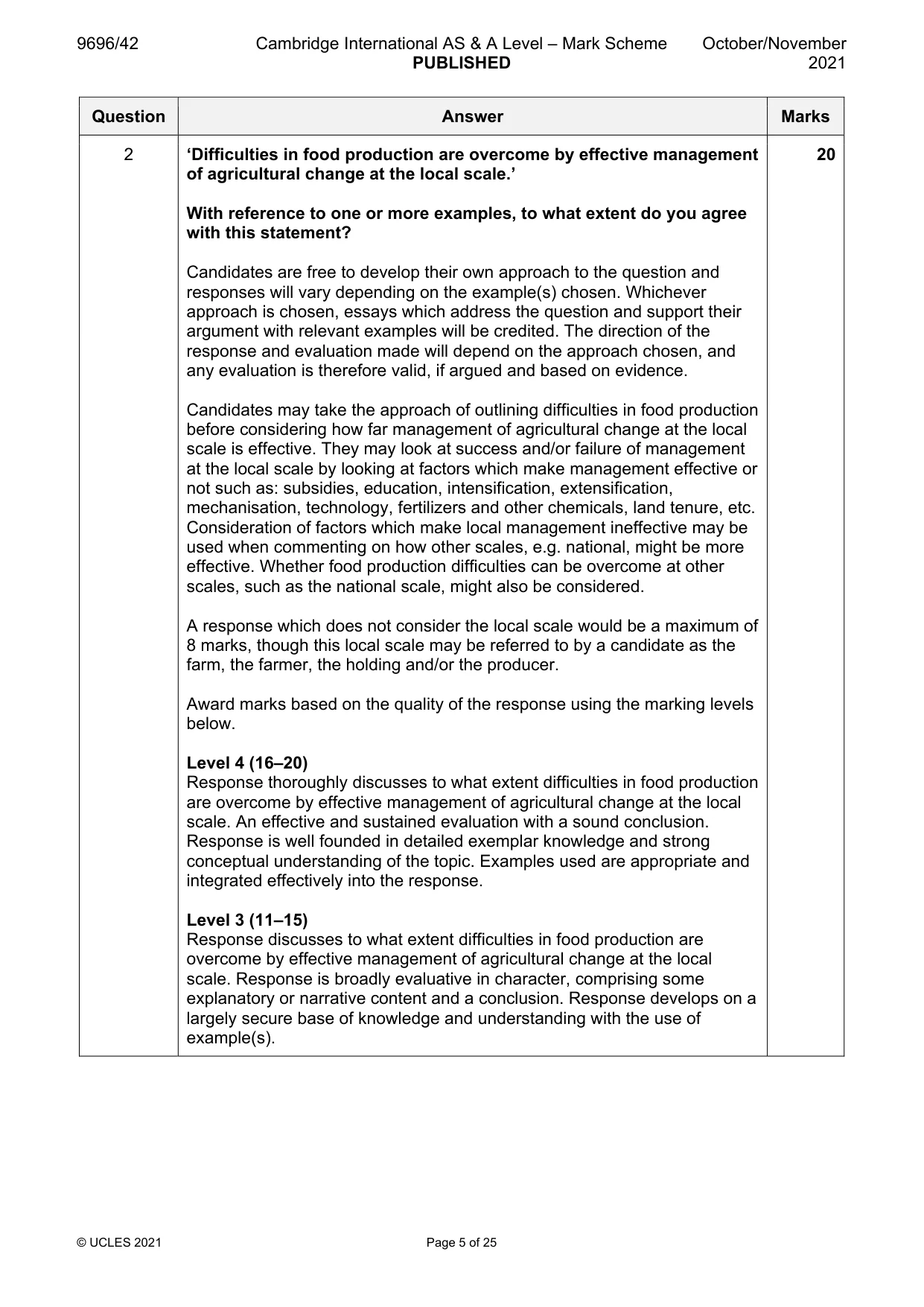
2 ‘Difficulties in food production are overcome by effective management of agricultural change at the local scale.’ With reference to one or more examples, to what extent do you agree with this statement? [20]
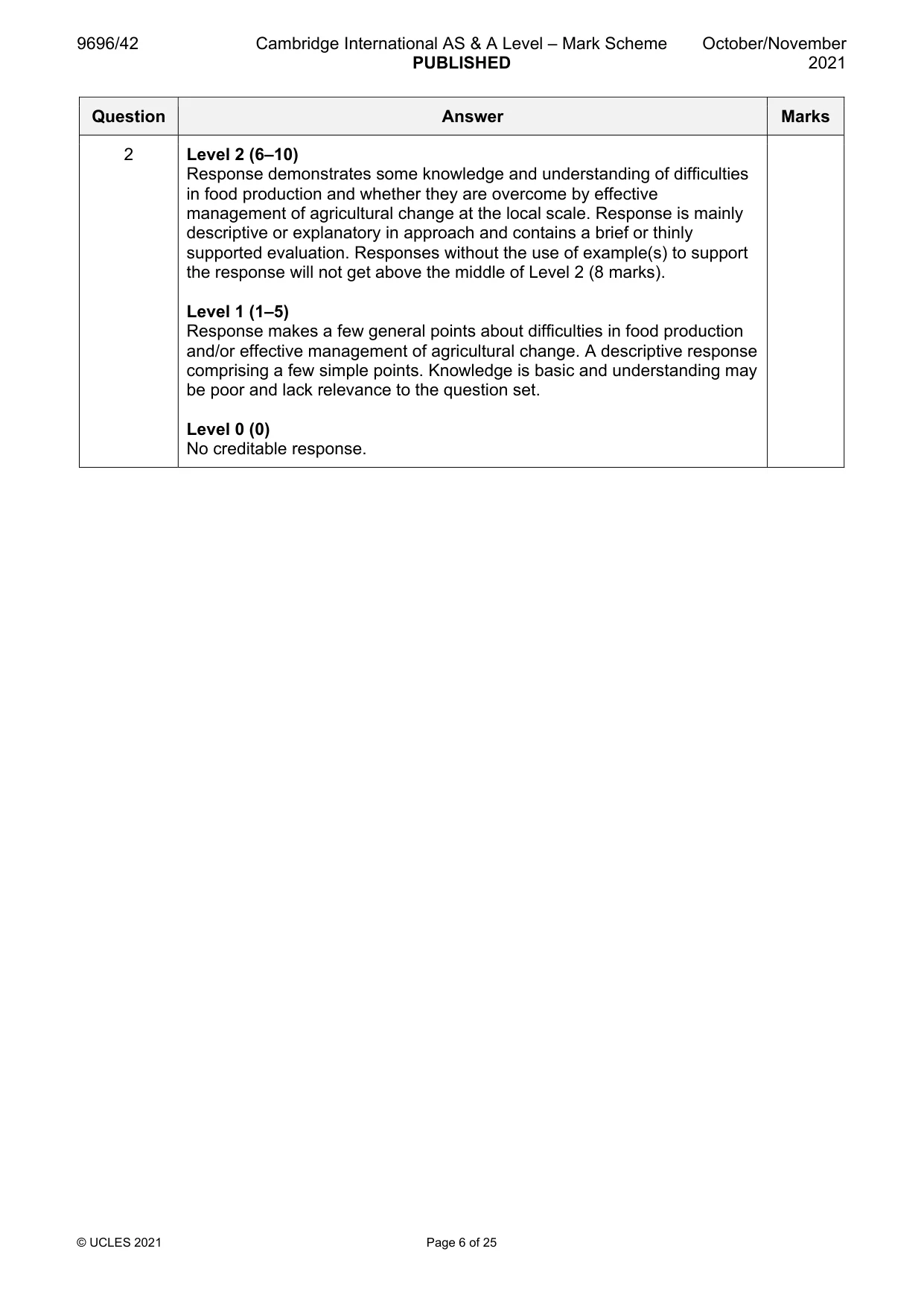
Mark scheme: 2 ‘Difficulties in food production are overcome by effective management 20 of agricultural change at the local scale.’ With reference to one or more examples, to what extent do you agree with this statement? Candidates are free to develop their own approach to the question and responses will vary depending on the example(s) chosen. Whichever approach is chosen, essays which address the question and support their argument with relevant examples will be credited. The direction of the response and evaluation made will depend on the approach chosen, and any evaluation is therefore valid, if argued and based on evidence. Candidates may take the approach of outlining difficulties in food production before considering how far management of agricultural change at the local scale is effective. They may look at success and/or failure of management at the local scale by looking at factors which make management effective or not such as: subsidies, education, intensification, extensification, mechanisation, technology, fertilizers and other chemicals, land tenure, etc. Consideration of factors which make local management ineffective may be used when commenting on how other scales, e.g. national, might be more effective. Whether food production difficulties can be overcome at other scales, such as the national scale, might also be considered. A response which does not consider the local scale would be a maximum of 8 marks, though this local scale may be referred to by a candidate as the farm, the farmer, the holding and/or the producer. Award marks based on the quality of the response using the marking levels below. Level 4 (16–20) Response thoroughly discusses to what extent difficulties in food production are overcome by effective management of agricultural change at the local scale. An effective and sustained evaluation with a sound conclusion. Response is well founded in detailed exemplar knowledge and strong conceptual understanding of the topic. Examples used are appropriate and integrated effectively into the response. Level 3 (11–15) Response discusses to what extent difficulties in food production are overcome by effective management of agricultural change at the local scale. Response is broadly evaluative in character, comprising some explanatory or narrative content and a conclusion. Response develops on a largely secure base of knowledge and understanding with the use of example(s). 2 Level 2 (6–10) Response demonstrates some knowledge and understanding of difficulties in food production and whether they are overcome by effective management of agricultural change at the local scale. Response is mainly descriptive or explanatory in approach and contains a brief or thinly supported evaluation. Responses without the use of example(s) to support the response will not get above the middle of Level 2 (8 marks). Level 1 (1–5) Response makes a few general points about difficulties in food production and/or effective management of agricultural change. A descriptive response comprising a few simple points. Knowledge is basic and understanding may be poor and lack relevance to the question set. Level 0 (0) No creditable response.
Q3 · To what extent has industrial policy caused changes in the character and organisation of…
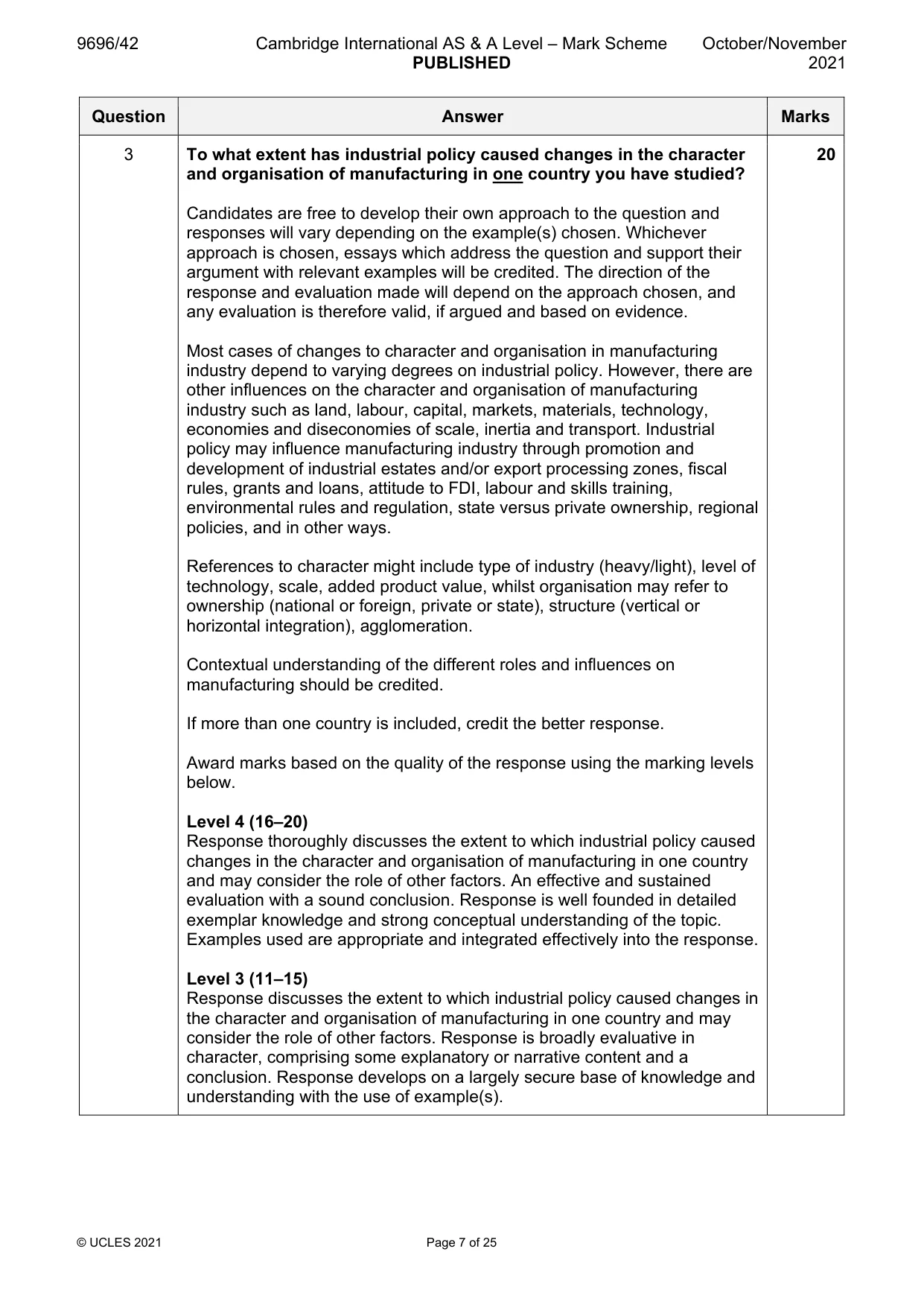
3 To what extent has industrial policy caused changes in the character and organisation of manufacturing in one country you have studied? [20] Environmental management If answering this option, answer Question 4 and either Question 5 or Question 6.
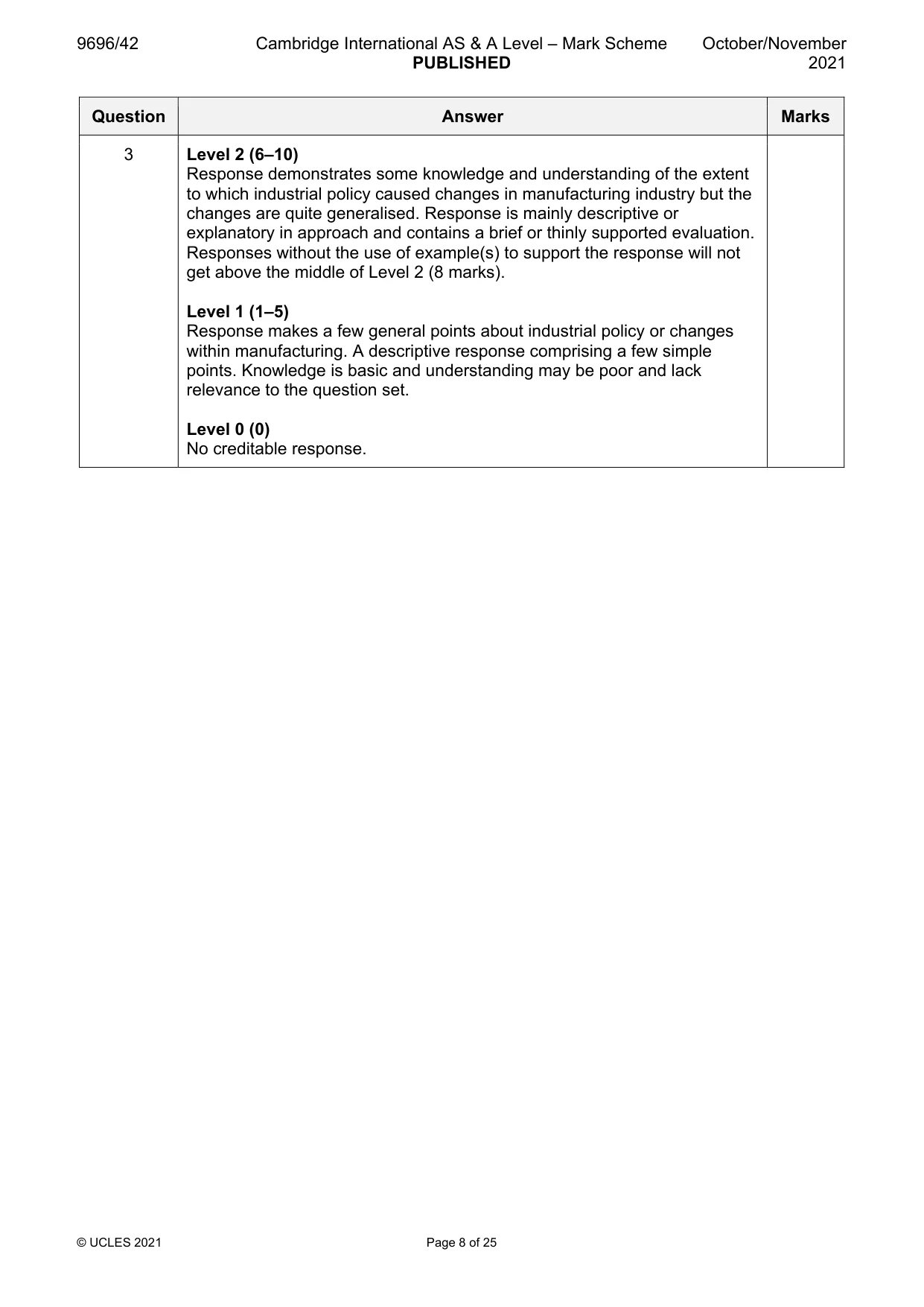
Mark scheme: 3 To what extent has industrial policy caused changes in the character 20 and organisation of manufacturing in one country you have studied? Candidates are free to develop their own approach to the question and responses will vary depending on the example(s) chosen. Whichever approach is chosen, essays which address the question and support their argument with relevant examples will be credited. The direction of the response and evaluation made will depend on the approach chosen, and any evaluation is therefore valid, if argued and based on evidence. Most cases of changes to character and organisation in manufacturing industry depend to varying degrees on industrial policy. However, there are other influences on the character and organisation of manufacturing industry such as land, labour, capital, markets, materials, technology, economies and diseconomies of scale, inertia and transport. Industrial policy may influence manufacturing industry through promotion and development of industrial estates and/or export processing zones, fiscal rules, grants and loans, attitude to FDI, labour and skills training, environmental rules and regulation, state versus private ownership, regional policies, and in other ways. References to character might include type of industry (heavy/light), level of technology, scale, added product value, whilst organisation may refer to ownership (national or foreign, private or state), structure (vertical or horizontal integration), agglomeration. Contextual understanding of the different roles and influences on manufacturing should be credited. If more than one country is included, credit the better response. Award marks based on the quality of the response using the marking levels below. Level 4 (16–20) Response thoroughly discusses the extent to which industrial policy caused changes in the character and organisation of manufacturing in one country and may consider the role of other factors. An effective and sustained evaluation with a sound conclusion. Response is well founded in detailed exemplar knowledge and strong conceptual understanding of the topic. Examples used are appropriate and integrated effectively into the response. Level 3 (11–15) Response discusses the extent to which industrial policy caused changes in the character and organisation of manufacturing in one country and may consider the role of other factors. Response is broadly evaluative in character, comprising some explanatory or narrative content and a conclusion. Response develops on a largely secure base of knowledge and understanding with the use of example(s). 3 Level 2 (6–10) Response demonstrates some knowledge and understanding of the extent to which industrial policy caused changes in manufacturing industry but the changes are quite generalised. Response is mainly descriptive or explanatory in approach and contains a brief or thinly supported evaluation. Responses without the use of example(s) to support the response will not get above the middle of Level 2 (8 marks). Level 1 (1–5) Response makes a few general points about industrial policy or changes within manufacturing. A descriptive response comprising a few simple points. Knowledge is basic and understanding may be poor and lack relevance to the question set. Level 0 (0) No creditable response. Environmental management If answering this option, answer Question 4 and either Question 5 or Question 6.
Q4 · Use of water by sector, for the world, in 2020 and projected for 2030 and 2050
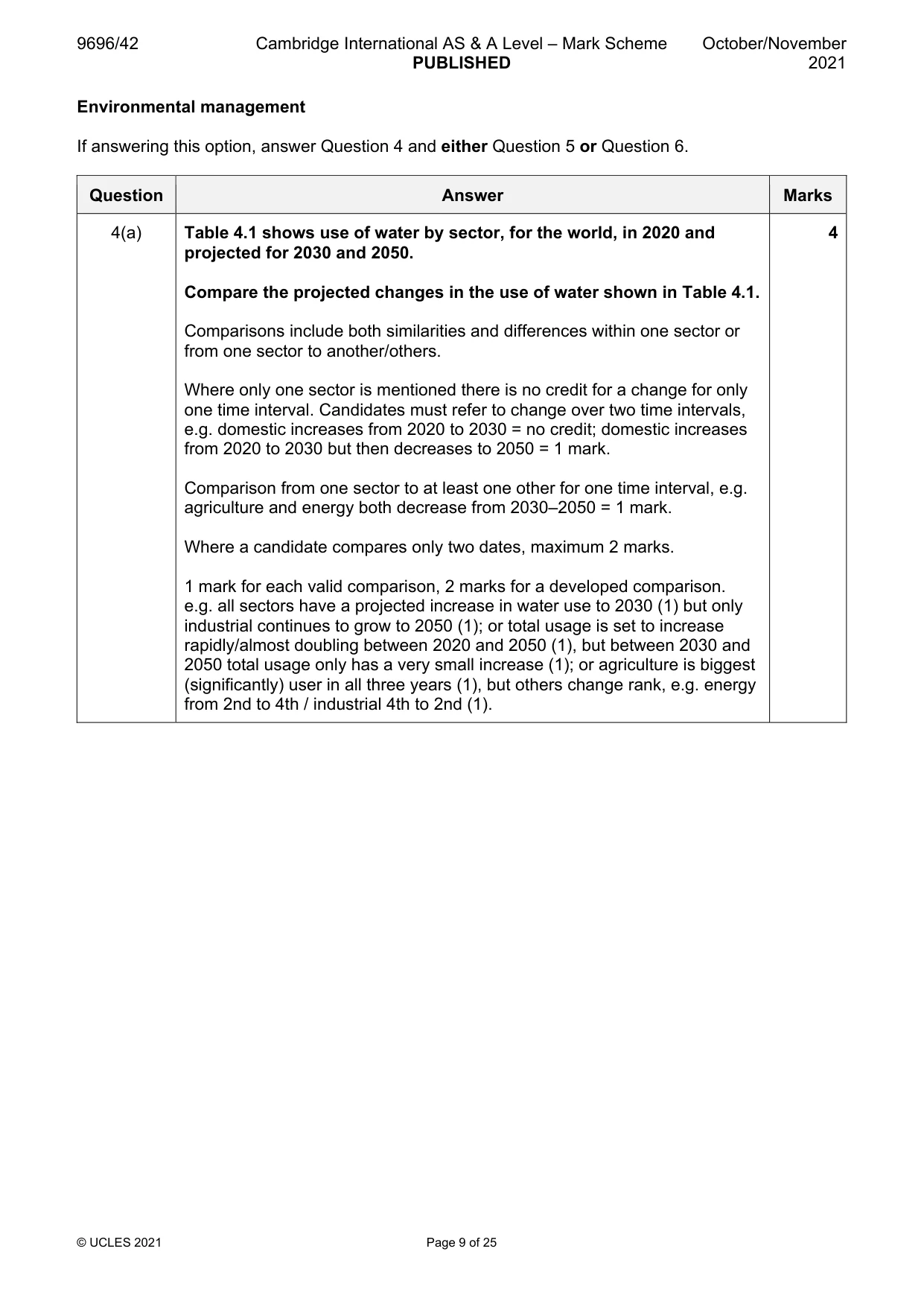
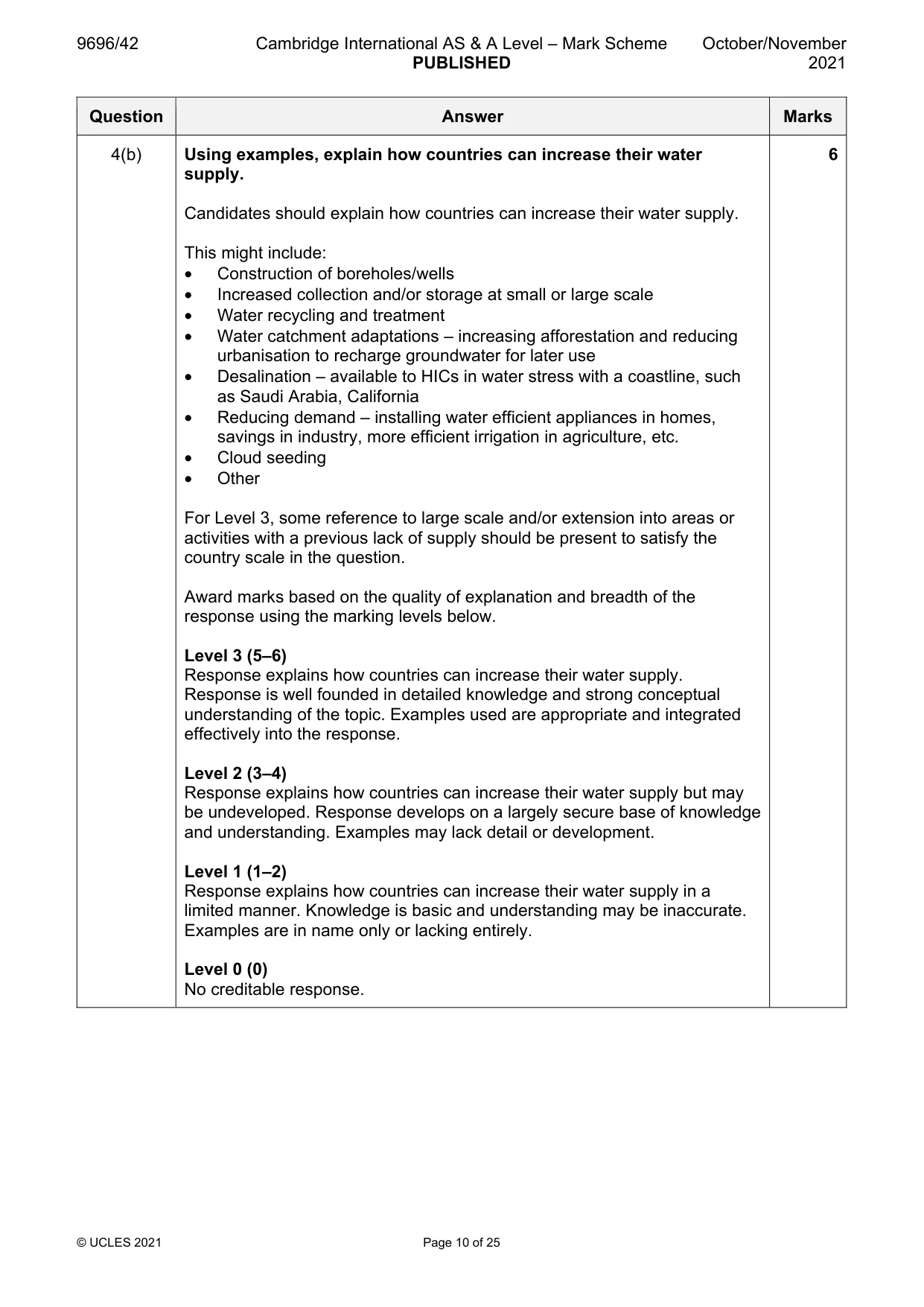
4 Table 4.1 shows use of water by sector, for the world, in 2020 and projected for 2030 and 2050. (a) Compare the projected changes in the use of water shown in Table 4.1. [4] (b) Using examples, explain how countries can increase their water supply. [6]
Mark scheme: 4(a) Table 4.1 shows use of water by sector, for the world, in 2020 and 4 projected for 2030 and 2050. Compare the projected changes in the use of water shown in Table 4.1. Comparisons include both similarities and differences within one sector or from one sector to another/others. Where only one sector is mentioned there is no credit for a change for only one time interval. Candidates must refer to change over two time intervals, e.g. domestic increases from 2020 to 2030 = no credit; domestic increases from 2020 to 2030 but then decreases to 2050 = 1 mark. Comparison from one sector to at least one other for one time interval, e.g. agriculture and energy both decrease from 2030–2050 = 1 mark. Where a candidate compares only two dates, maximum 2 marks. 1 mark for each valid comparison, 2 marks for a developed comparison. e.g. all sectors have a projected increase in water use to 2030 (1) but only industrial continues to grow to 2050 (1); or total usage is set to increase rapidly/almost doubling between 2020 and 2050 (1), but between 2030 and 2050 total usage only has a very small increase (1); or agriculture is biggest (significantly) user in all three years (1), but others change rank, e.g. energy from 2nd to 4th / industrial 4th to 2nd (1). 4(b) Using examples, explain how countries can increase their water 6 supply. Candidates should explain how countries can increase their water supply. This might include: • Construction of boreholes/wells • Increased collection and/or storage at small or large scale • Water recycling and treatment • Water catchment adaptations – increasing afforestation and reducing urbanisation to recharge groundwater for later use • Desalination – available to HICs in water stress with a coastline, such as Saudi Arabia, California • Reducing demand – installing water efficient appliances in homes, savings in industry, more efficient irrigation in agriculture, etc. • Cloud seeding • Other For Level 3, some reference to large scale and/or extension into areas or activities with a previous lack of supply should be present to satisfy the country scale in the question. Award marks based on the quality of explanation and breadth of the response using the marking levels below. Level 3 (5–6) Response explains how countries can increase their water supply. Response is well founded in detailed knowledge and strong conceptual understanding of the topic. Examples used are appropriate and integrated effectively into the response. Level 2 (3–4) Response explains how countries can increase their water supply but may be undeveloped. Response develops on a largely secure base of knowledge and understanding. Examples may lack detail or development. Level 1 (1–2) Response explains how countries can increase their water supply in a limited manner. Knowledge is basic and understanding may be inaccurate. Examples are in name only or lacking entirely. Level 0 (0) No creditable response.
Q5 · To what extent is climate the main factor influencing trends in demand for renewable…
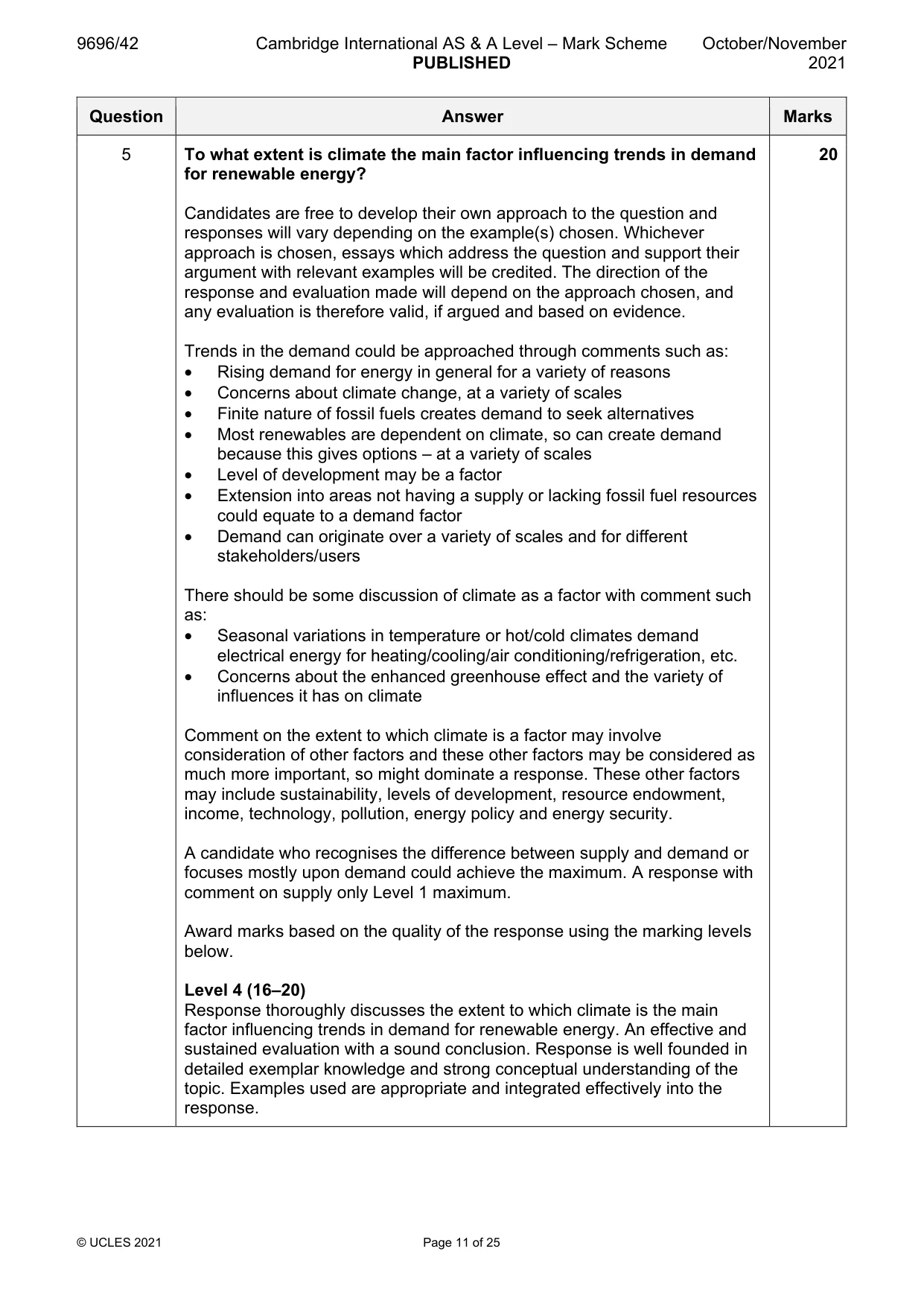
5 To what extent is climate the main factor influencing trends in demand for renewable energy? [20]
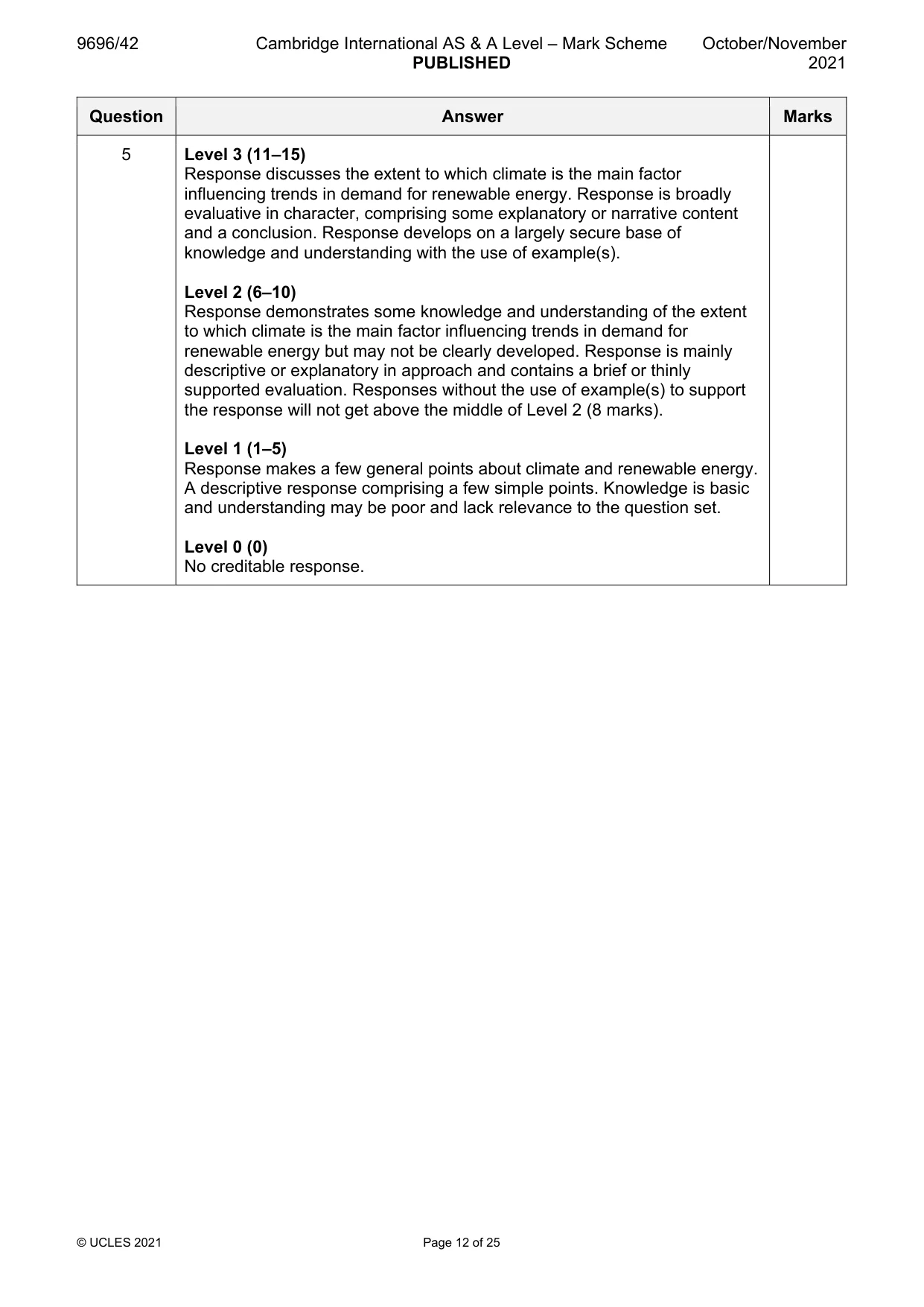
Mark scheme: 5 To what extent is climate the main factor influencing trends in demand 20 for renewable energy? Candidates are free to develop their own approach to the question and responses will vary depending on the example(s) chosen. Whichever approach is chosen, essays which address the question and support their argument with relevant examples will be credited. The direction of the response and evaluation made will depend on the approach chosen, and any evaluation is therefore valid, if argued and based on evidence. Trends in the demand could be approached through comments such as: • Rising demand for energy in general for a variety of reasons • Concerns about climate change, at a variety of scales • Finite nature of fossil fuels creates demand to seek alternatives • Most renewables are dependent on climate, so can create demand because this gives options – at a variety of scales • Level of development may be a factor • Extension into areas not having a supply or lacking fossil fuel resources could equate to a demand factor • Demand can originate over a variety of scales and for different stakeholders/users There should be some discussion of climate as a factor with comment such as: • Seasonal variations in temperature or hot/cold climates demand electrical energy for heating/cooling/air conditioning/refrigeration, etc. • Concerns about the enhanced greenhouse effect and the variety of influences it has on climate Comment on the extent to which climate is a factor may involve consideration of other factors and these other factors may be considered as much more important, so might dominate a response. These other factors may include sustainability, levels of development, resource endowment, income, technology, pollution, energy policy and energy security. A candidate who recognises the difference between supply and demand or focuses mostly upon demand could achieve the maximum. A response with comment on supply only Level 1 maximum. Award marks based on the quality of the response using the marking levels below. Level 4 (16–20) Response thoroughly discusses the extent to which climate is the main factor influencing trends in demand for renewable energy. An effective and sustained evaluation with a sound conclusion. Response is well founded in detailed exemplar knowledge and strong conceptual understanding of the topic. Examples used are appropriate and integrated effectively into the response. 5 Level 3 (11–15) Response discusses the extent to which climate is the main factor influencing trends in demand for renewable energy. Response is broadly evaluative in character, comprising some explanatory or narrative content and a conclusion. Response develops on a largely secure base of knowledge and understanding with the use of example(s). Level 2 (6–10) Response demonstrates some knowledge and understanding of the extent to which climate is the main factor influencing trends in demand for renewable energy but may not be clearly developed. Response is mainly descriptive or explanatory in approach and contains a brief or thinly supported evaluation. Responses without the use of example(s) to support the response will not get above the middle of Level 2 (8 marks). Level 1 (1–5) Response makes a few general points about climate and renewable energy. A descriptive response comprising a few simple points. Knowledge is basic and understanding may be poor and lack relevance to the question set. Level 0 (0) No creditable response.
Q6 · ‘Overcoming issues created by the attempts to improve a degraded environment is important…
6 ‘Overcoming issues created by the attempts to improve a degraded environment is important for successful management.’ With reference to one or more examples, how far do you agree? [20] Global interdependence If answering this option, answer Question 7 and either Question 8 or Question 9.
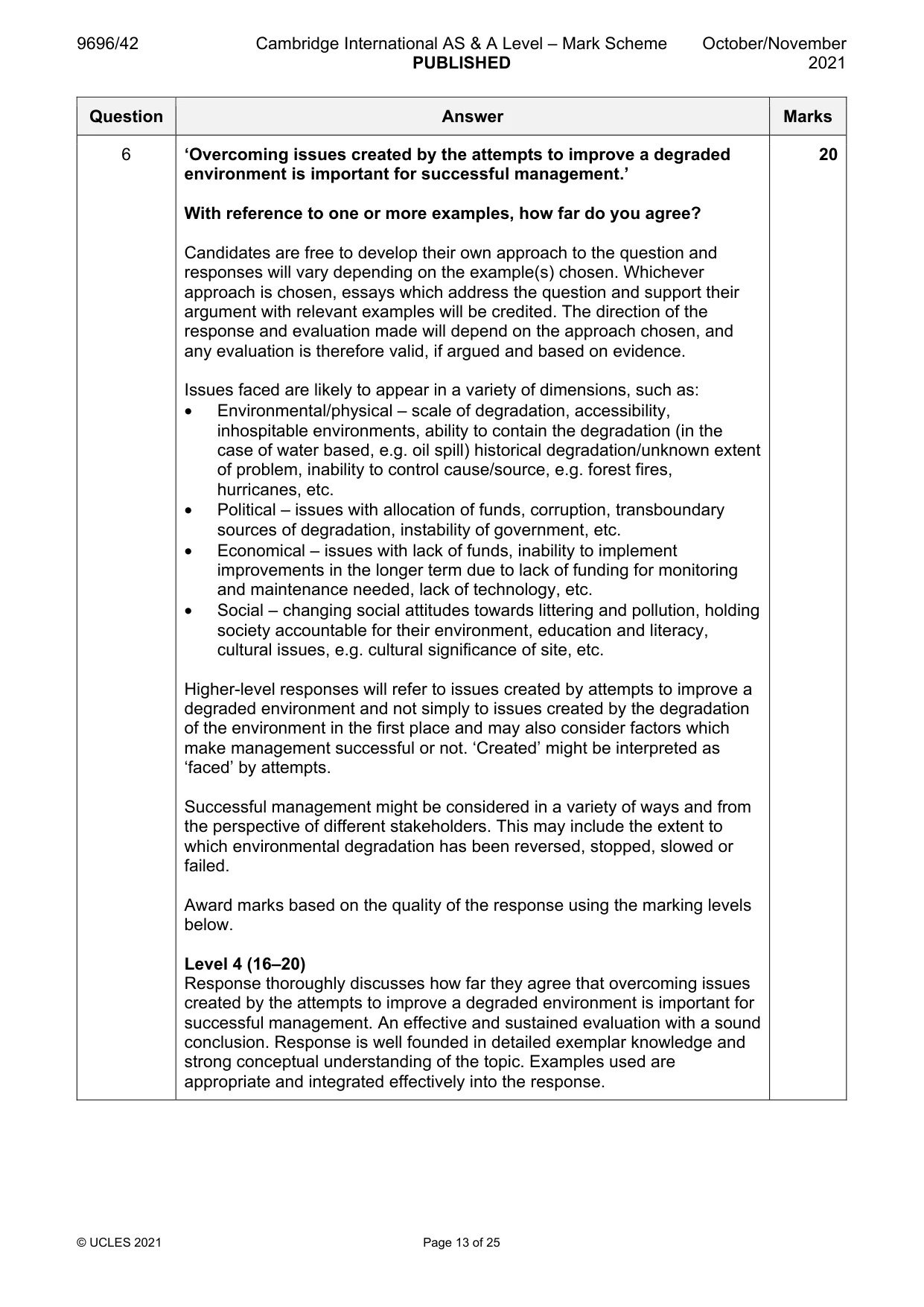
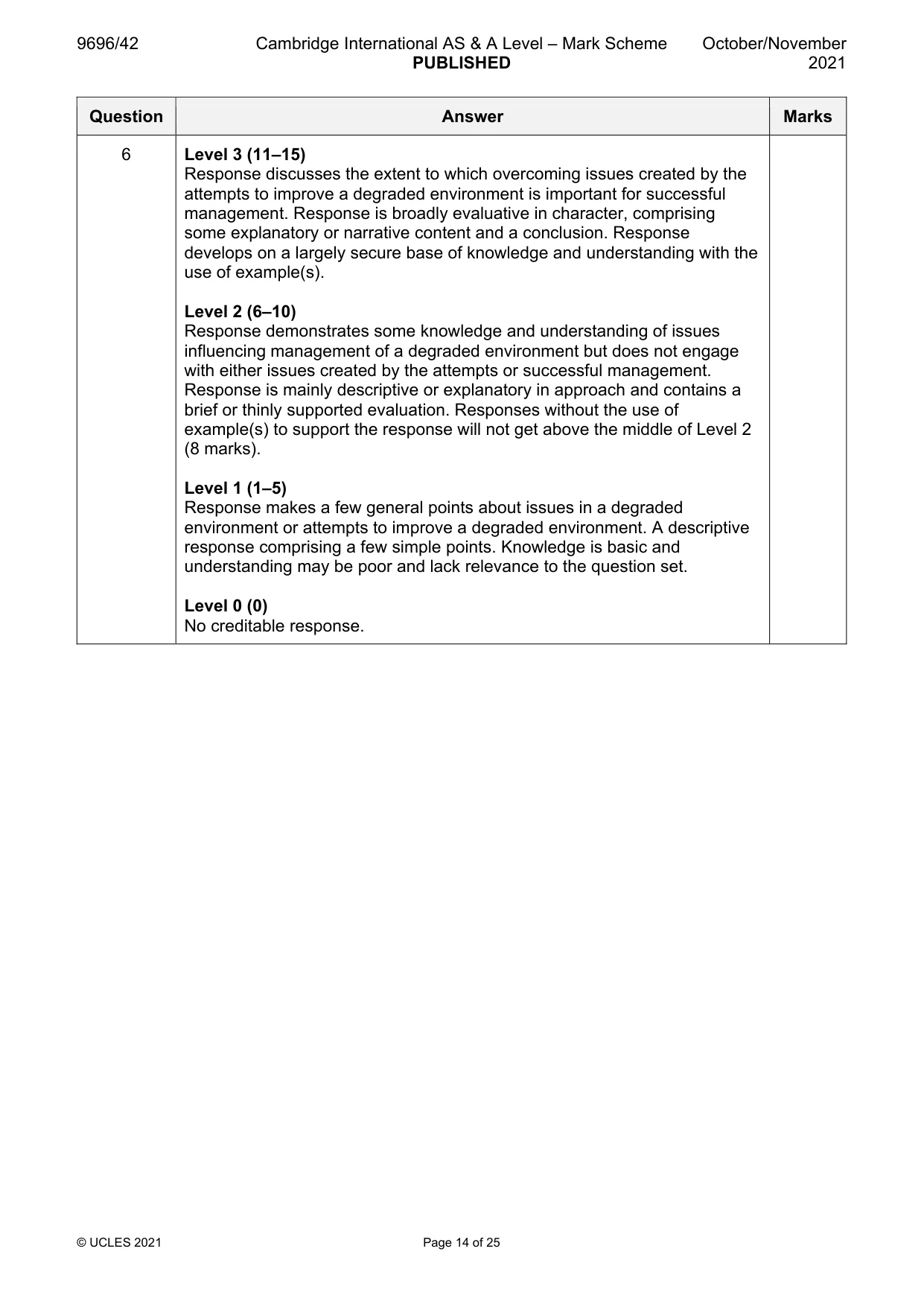
Mark scheme: 6 ‘Overcoming issues created by the attempts to improve a degraded 20 environment is important for successful management.’ With reference to one or more examples, how far do you agree? Candidates are free to develop their own approach to the question and responses will vary depending on the example(s) chosen. Whichever approach is chosen, essays which address the question and support their argument with relevant examples will be credited. The direction of the response and evaluation made will depend on the approach chosen, and any evaluation is therefore valid, if argued and based on evidence. Issues faced are likely to appear in a variety of dimensions, such as: • Environmental/physical – scale of degradation, accessibility, inhospitable environments, ability to contain the degradation (in the case of water based, e.g. oil spill) historical degradation/unknown extent of problem, inability to control cause/source, e.g. forest fires, hurricanes, etc. • Political – issues with allocation of funds, corruption, transboundary sources of degradation, instability of government, etc. • Economical – issues with lack of funds, inability to implement improvements in the longer term due to lack of funding for monitoring and maintenance needed, lack of technology, etc. • Social – changing social attitudes towards littering and pollution, holding society accountable for their environment, education and literacy, cultural issues, e.g. cultural significance of site, etc. Higher-level responses will refer to issues created by attempts to improve a degraded environment and not simply to issues created by the degradation of the environment in the first place and may also consider factors which make management successful or not. ‘Created’ might be interpreted as ‘faced’ by attempts. Successful management might be considered in a variety of ways and from the perspective of different stakeholders. This may include the extent to which environmental degradation has been reversed, stopped, slowed or failed. Award marks based on the quality of the response using the marking levels below. Level 4 (16–20) Response thoroughly discusses how far they agree that overcoming issues created by the attempts to improve a degraded environment is important for successful management. An effective and sustained evaluation with a sound conclusion. Response is well founded in detailed exemplar knowledge and strong conceptual understanding of the topic. Examples used are appropriate and integrated effectively into the response. 6 Level 3 (11–15) Response discusses the extent to which overcoming issues created by the attempts to improve a degraded environment is important for successful management. Response is broadly evaluative in character, comprising some explanatory or narrative content and a conclusion. Response develops on a largely secure base of knowledge and understanding with the use of example(s). Level 2 (6–10) Response demonstrates some knowledge and understanding of issues influencing management of a degraded environment but does not engage with either issues created by the attempts or successful management. Response is mainly descriptive or explanatory in approach and contains a brief or thinly supported evaluation. Responses without the use of example(s) to support the response will not get above the middle of Level 2 (8 marks). Level 1 (1–5) Response makes a few general points about issues in a degraded environment or attempts to improve a degraded environment. A descriptive response comprising a few simple points. Knowledge is basic and understanding may be poor and lack relevance to the question set. Level 0 (0) No creditable response. Global interdependence If answering this option, answer Question 7 and either Question 8 or Question 9.
Q7 · A photograph which shows part of a port on the River Tagus in Portugal, an HIC in Europe
7 Fig. 7.1 is a photograph which shows part of a port on the River Tagus in Portugal, an HIC in Europe. (a) Using evidence from Fig. 7.1, suggest how the location encourages trade flows. [4] (b) Explain why some places have locational advantage for global trade. [6]
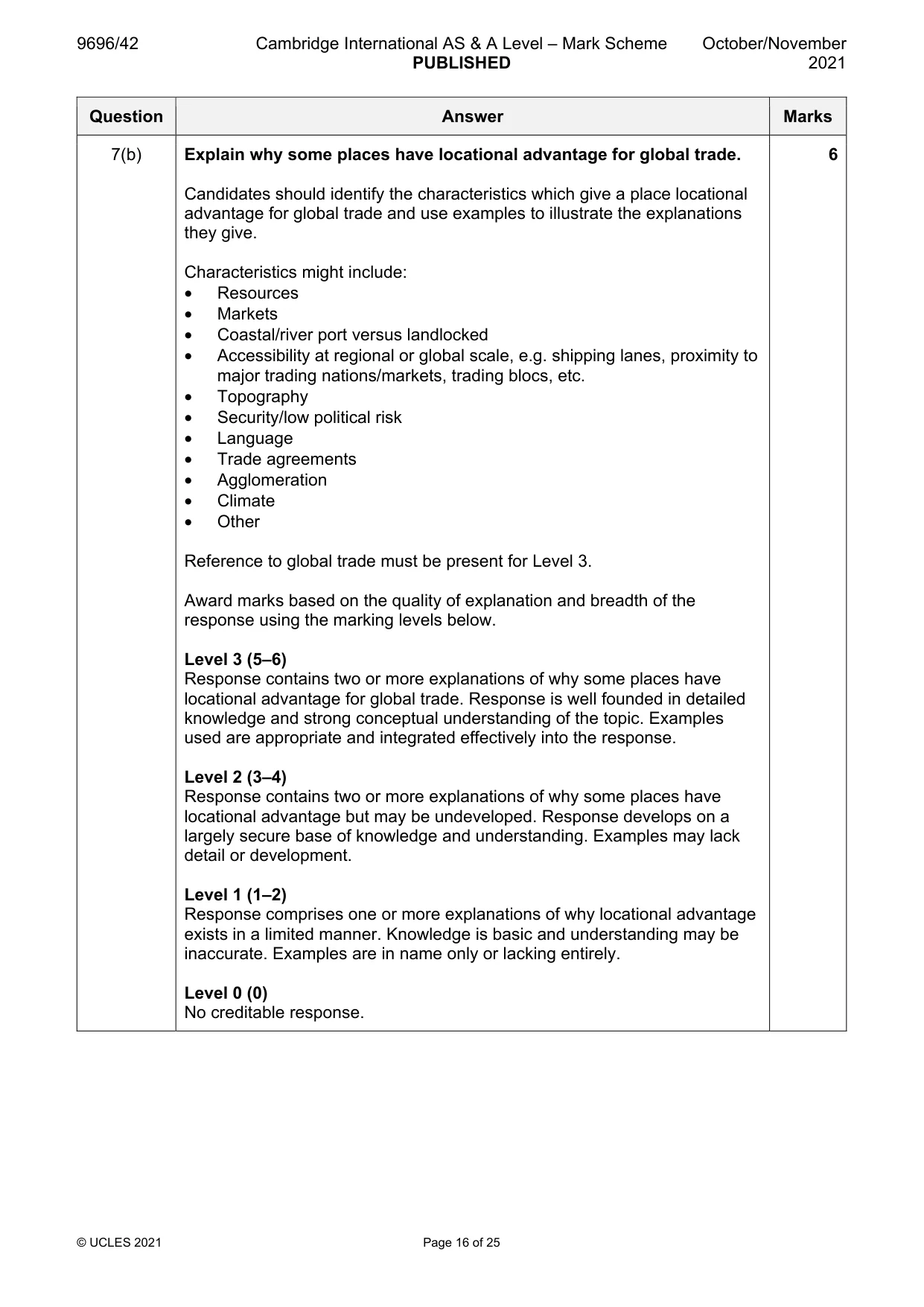
Mark scheme: 7(a) Fig. 7.1 is a photograph which shows part of a port on the River Tagus 4 in Portugal, an HIC in Europe. Using evidence from Fig. 7.1, suggest how the location encourages trade flows. Candidates should identify and describe features from the photograph which may encourage trade flows. Candidates may suggest simple observations for 1 mark: • Modern facilities needed for container ships, e.g. cranes • Large and small ships/break of bulk point • Large flat area in centre good for storage • Water transport is cheapest method of moving large volumes or heavy goods • Access to Europe for imports and exports • Other valid feature(s) Or more developed points for 2 marks: • Containers are easy to load and secure (1) and can be used across different modes of transport (1) [water and rail are clearly visible, road is possible] • Presence of river, roads and railways, (bridge in the distance) to transport goods (1) to markets or from producers/links to hinterland (1) Maximum 2 marks if no mention of points relevant to trade and or trade flows such as: imports/exports, goods, markets/producers, volume and others. 7(b) Explain why some places have locational advantage for global trade. 6 Candidates should identify the characteristics which give a place locational advantage for global trade and use examples to illustrate the explanations they give. Characteristics might include: • Resources • Markets • Coastal/river port versus landlocked • Accessibility at regional or global scale, e.g. shipping lanes, proximity to major trading nations/markets, trading blocs, etc. • Topography • Security/low political risk • Language • Trade agreements • Agglomeration • Climate • Other Reference to global trade must be present for Level 3. Award marks based on the quality of explanation and breadth of the response using the marking levels below. Level 3 (5–6) Response contains two or more explanations of why some places have locational advantage for global trade. Response is well founded in detailed knowledge and strong conceptual understanding of the topic. Examples used are appropriate and integrated effectively into the response. Level 2 (3–4) Response contains two or more explanations of why some places have locational advantage but may be undeveloped. Response develops on a largely secure base of knowledge and understanding. Examples may lack detail or development. Level 1 (1–2) Response comprises one or more explanations of why locational advantage exists in a limited manner. Knowledge is basic and understanding may be inaccurate. Examples are in name only or lacking entirely. Level 0 (0) No creditable response.
Q8 · To what extent does international aid improve the lives of people in receiving countries?
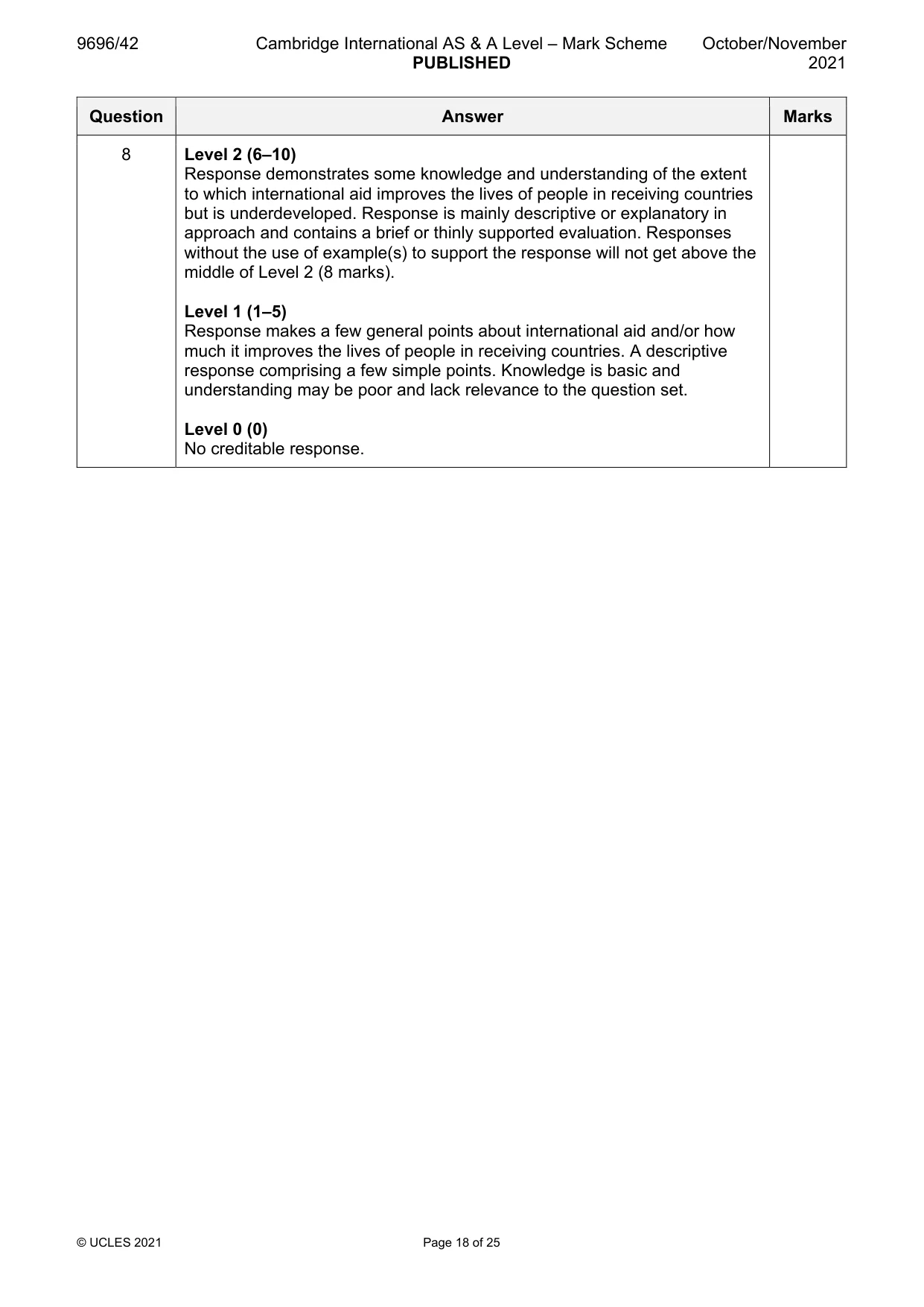
8 To what extent does international aid improve the lives of people in receiving countries? [20]
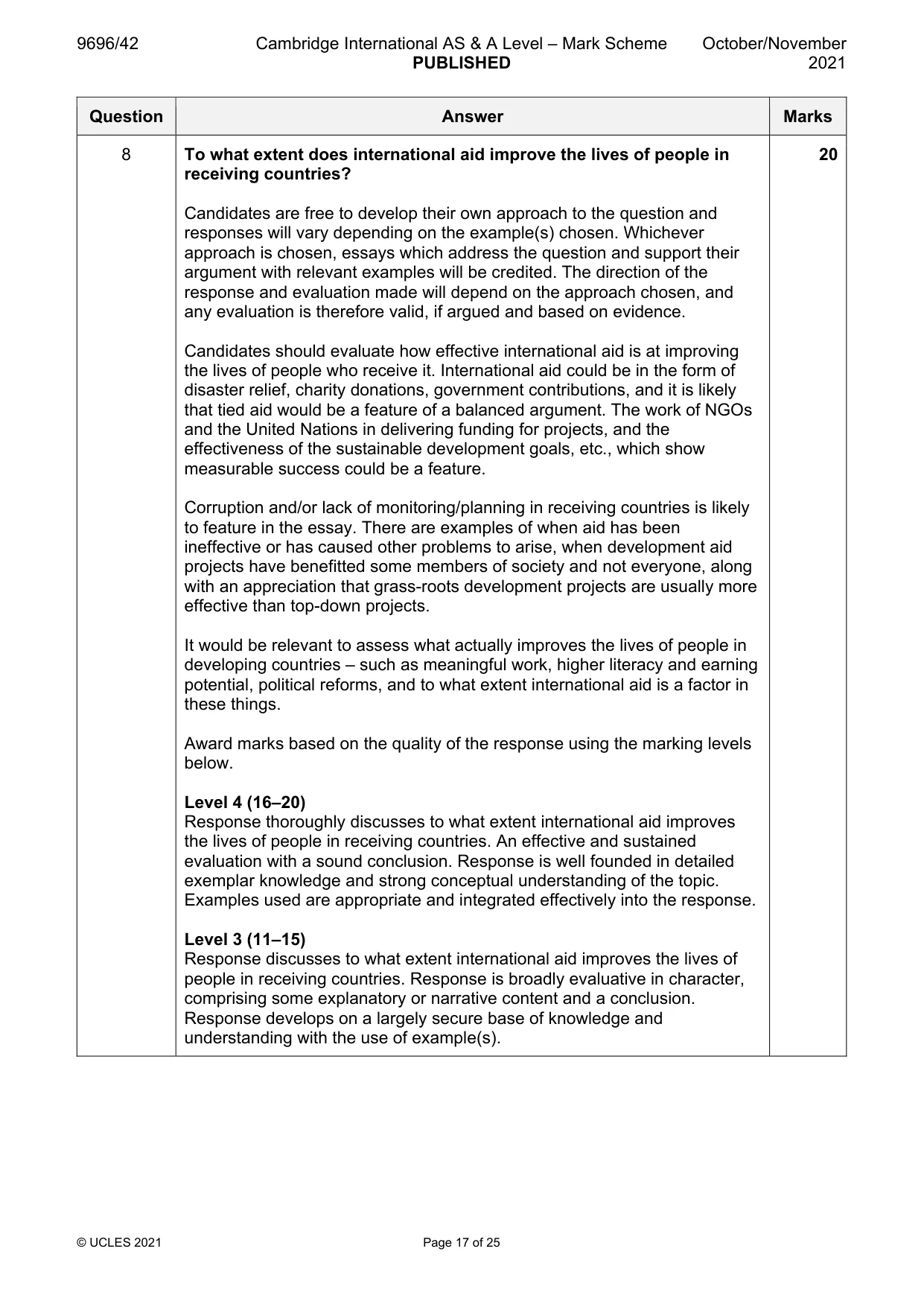
Mark scheme: 8 To what extent does international aid improve the lives of people in 20 receiving countries? Candidates are free to develop their own approach to the question and responses will vary depending on the example(s) chosen. Whichever approach is chosen, essays which address the question and support their argument with relevant examples will be credited. The direction of the response and evaluation made will depend on the approach chosen, and any evaluation is therefore valid, if argued and based on evidence. Candidates should evaluate how effective international aid is at improving the lives of people who receive it. International aid could be in the form of disaster relief, charity donations, government contributions, and it is likely that tied aid would be a feature of a balanced argument. The work of NGOs and the United Nations in delivering funding for projects, and the effectiveness of the sustainable development goals, etc., which show measurable success could be a feature. Corruption and/or lack of monitoring/planning in receiving countries is likely to feature in the essay. There are examples of when aid has been ineffective or has caused other problems to arise, when development aid projects have benefitted some members of society and not everyone, along with an appreciation that grass-roots development projects are usually more effective than top-down projects. It would be relevant to assess what actually improves the lives of people in developing countries – such as meaningful work, higher literacy and earning potential, political reforms, and to what extent international aid is a factor in these things. Award marks based on the quality of the response using the marking levels below. Level 4 (16–20) Response thoroughly discusses to what extent international aid improves the lives of people in receiving countries. An effective and sustained evaluation with a sound conclusion. Response is well founded in detailed exemplar knowledge and strong conceptual understanding of the topic. Examples used are appropriate and integrated effectively into the response. Level 3 (11–15) Response discusses to what extent international aid improves the lives of people in receiving countries. Response is broadly evaluative in character, comprising some explanatory or narrative content and a conclusion. Response develops on a largely secure base of knowledge and understanding with the use of example(s). 8 Level 2 (6–10) Response demonstrates some knowledge and understanding of the extent to which international aid improves the lives of people in receiving countries but is underdeveloped. Response is mainly descriptive or explanatory in approach and contains a brief or thinly supported evaluation. Responses without the use of example(s) to support the response will not get above the middle of Level 2 (8 marks). Level 1 (1–5) Response makes a few general points about international aid and/or how much it improves the lives of people in receiving countries. A descriptive response comprising a few simple points. Knowledge is basic and understanding may be poor and lack relevance to the question set. Level 0 (0) No creditable response.
Q9 · Evaluate the impacts of tourism on the local economy of one or more tourist destinations
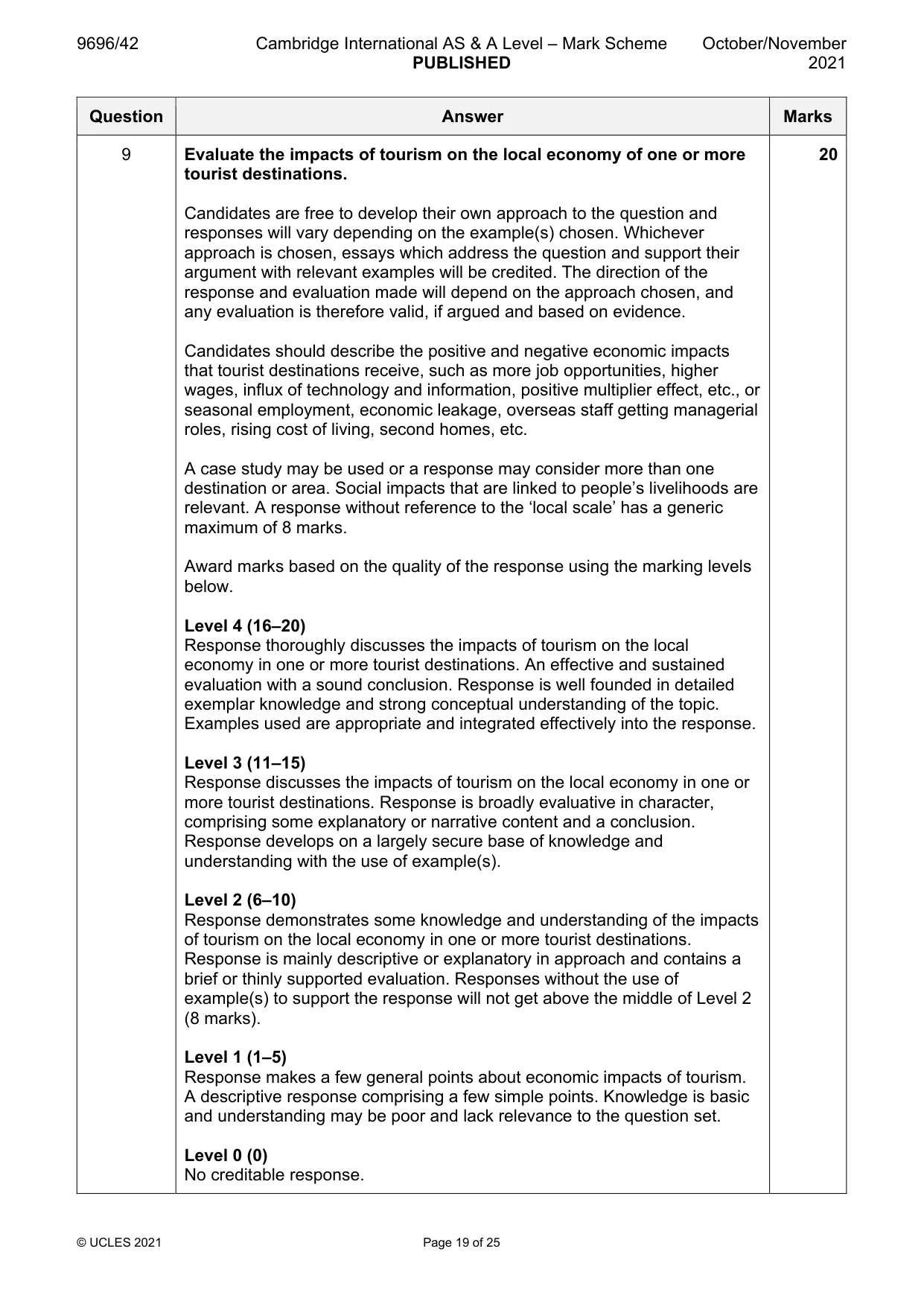
9 Evaluate the impacts of tourism on the local economy of one or more tourist destinations. [20] Economic transition If answering this option, answer Question 10 and either Question 11 or Question 12.
Mark scheme: 9 Evaluate the impacts of tourism on the local economy of one or more 20 tourist destinations. Candidates are free to develop their own approach to the question and responses will vary depending on the example(s) chosen. Whichever approach is chosen, essays which address the question and support their argument with relevant examples will be credited. The direction of the response and evaluation made will depend on the approach chosen, and any evaluation is therefore valid, if argued and based on evidence. Candidates should describe the positive and negative economic impacts that tourist destinations receive, such as more job opportunities, higher wages, influx of technology and information, positive multiplier effect, etc., or seasonal employment, economic leakage, overseas staff getting managerial roles, rising cost of living, second homes, etc. A case study may be used or a response may consider more than one destination or area. Social impacts that are linked to people’s livelihoods are relevant. A response without reference to the ‘local scale’ has a generic maximum of 8 marks. Award marks based on the quality of the response using the marking levels below. Level 4 (16–20) Response thoroughly discusses the impacts of tourism on the local economy in one or more tourist destinations. An effective and sustained evaluation with a sound conclusion. Response is well founded in detailed exemplar knowledge and strong conceptual understanding of the topic. Examples used are appropriate and integrated effectively into the response. Level 3 (11–15) Response discusses the impacts of tourism on the local economy in one or more tourist destinations. Response is broadly evaluative in character, comprising some explanatory or narrative content and a conclusion. Response develops on a largely secure base of knowledge and understanding with the use of example(s). Level 2 (6–10) Response demonstrates some knowledge and understanding of the impacts of tourism on the local economy in one or more tourist destinations. Response is mainly descriptive or explanatory in approach and contains a brief or thinly supported evaluation. Responses without the use of example(s) to support the response will not get above the middle of Level 2 (8 marks). Level 1 (1–5) Response makes a few general points about economic impacts of tourism. A descriptive response comprising a few simple points. Knowledge is basic and understanding may be poor and lack relevance to the question set. Level 0 (0) No creditable response. Economic transition If answering this option, answer Question 10 and either Question 11 or Question 12.
Q10 · Estimated female employment by sector, for the world, 1991–2018
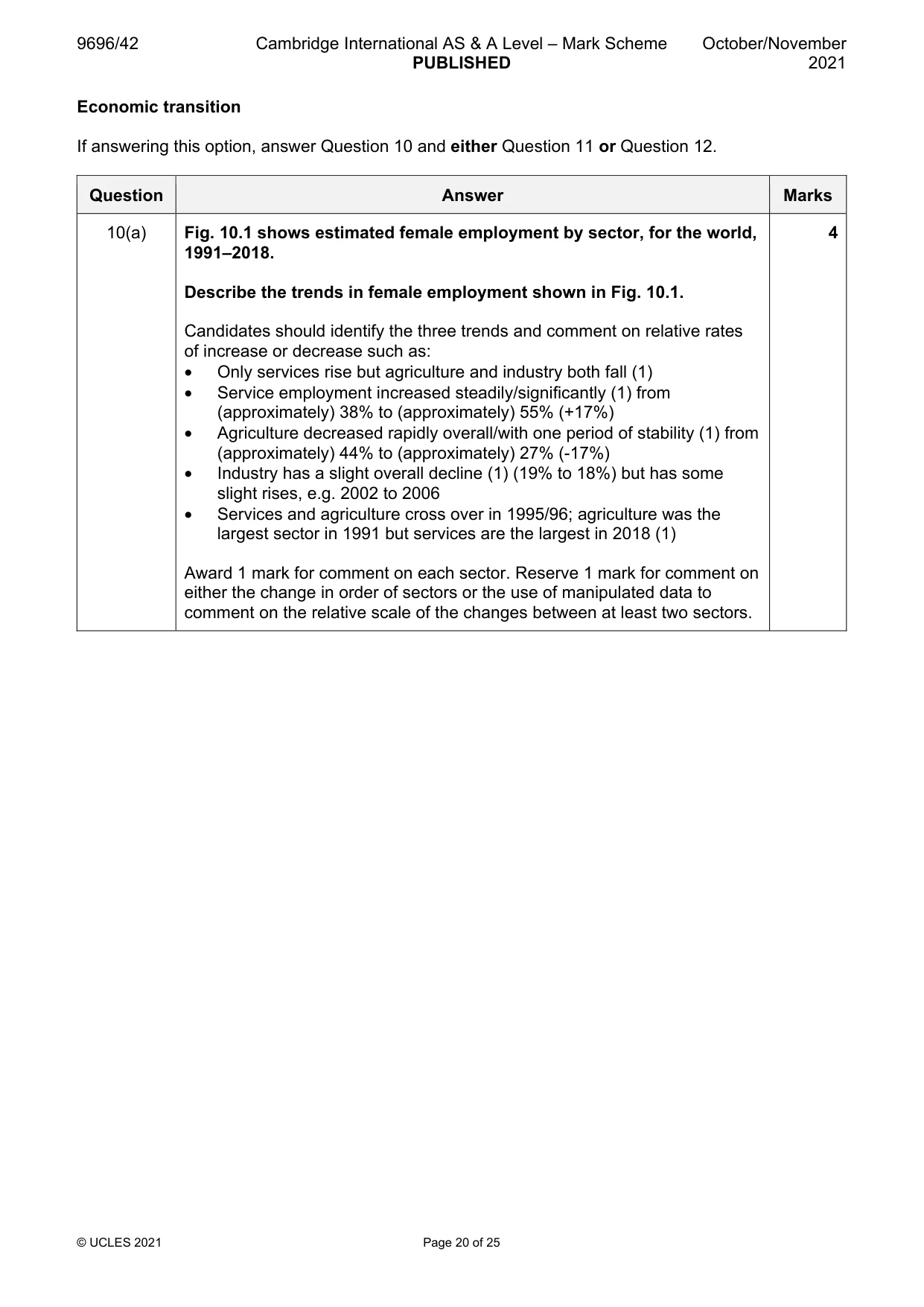
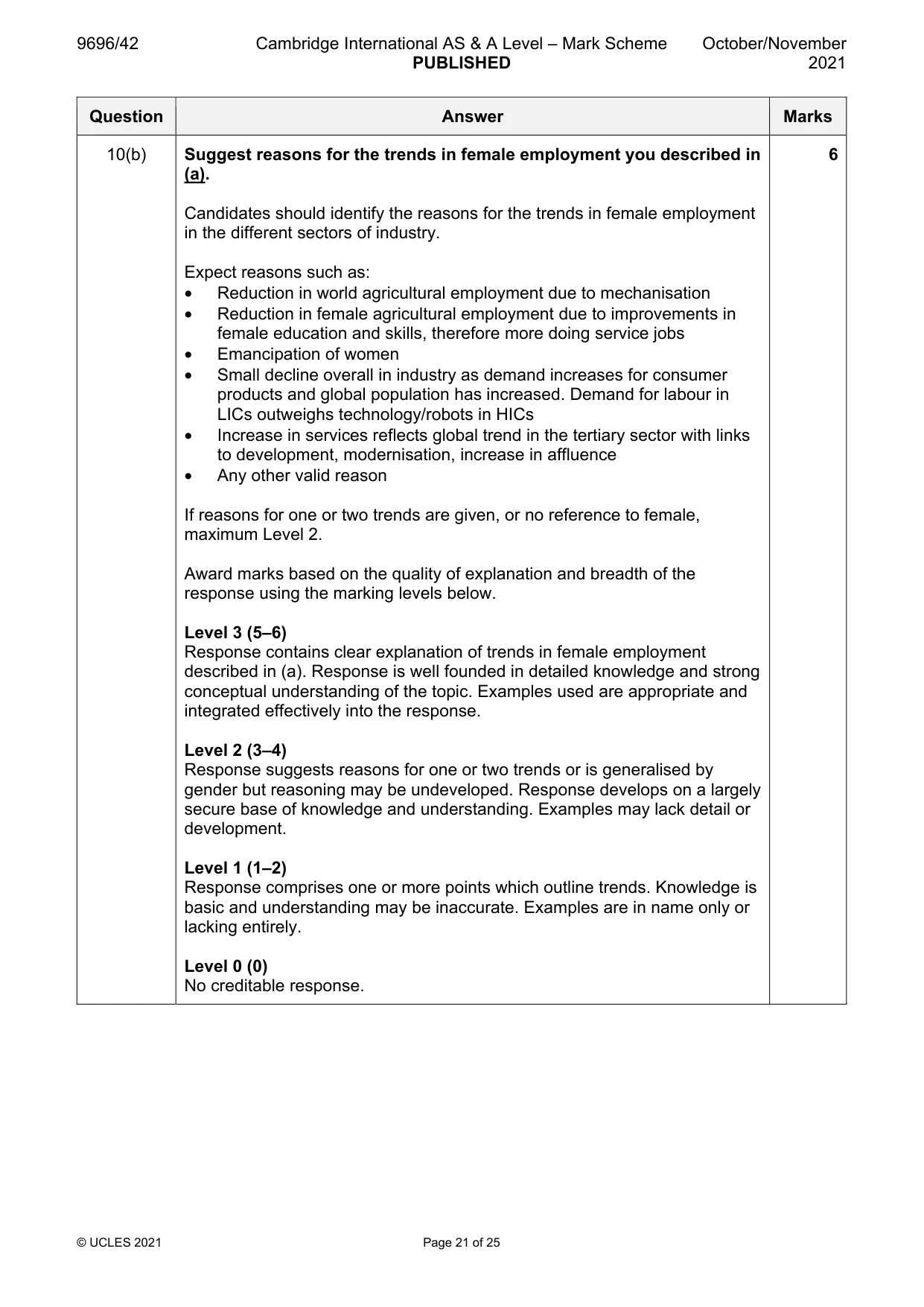
10 Fig. 10.1 shows estimated female employment by sector, for the world, 1991–2018. (a) Describe the trends in female employment shown in Fig. 10.1. [4] (b) Suggest reasons for the trends in female employment you described in (a). [6]
Mark scheme: 10(a) Fig. 10.1 shows estimated female employment by sector, for the world, 4 1991–2018. Describe the trends in female employment shown in Fig. 10.1. Candidates should identify the three trends and comment on relative rates of increase or decrease such as: • Only services rise but agriculture and industry both fall (1) • Service employment increased steadily/significantly (1) from (approximately) 38% to (approximately) 55% (+17%) • Agriculture decreased rapidly overall/with one period of stability (1) from (approximately) 44% to (approximately) 27% (-17%) • Industry has a slight overall decline (1) (19% to 18%) but has some slight rises, e.g. 2002 to 2006 • Services and agriculture cross over in 1995/96; agriculture was the largest sector in 1991 but services are the largest in 2018 (1) Award 1 mark for comment on each sector. Reserve 1 mark for comment on either the change in order of sectors or the use of manipulated data to comment on the relative scale of the changes between at least two sectors. 10(b) Suggest reasons for the trends in female employment you described in 6 (a). Candidates should identify the reasons for the trends in female employment in the different sectors of industry. Expect reasons such as: • Reduction in world agricultural employment due to mechanisation • Reduction in female agricultural employment due to improvements in female education and skills, therefore more doing service jobs • Emancipation of women • Small decline overall in industry as demand increases for consumer products and global population has increased. Demand for labour in LICs outweighs technology/robots in HICs • Increase in services reflects global trend in the tertiary sector with links to development, modernisation, increase in affluence • Any other valid reason If reasons for one or two trends are given, or no reference to female, maximum Level 2. Award marks based on the quality of explanation and breadth of the response using the marking levels below. Level 3 (5–6) Response contains clear explanation of trends in female employment described in (a). Response is well founded in detailed knowledge and strong conceptual understanding of the topic. Examples used are appropriate and integrated effectively into the response. Level 2 (3–4) Response suggests reasons for one or two trends or is generalised by gender but reasoning may be undeveloped. Response develops on a largely secure base of knowledge and understanding. Examples may lack detail or development. Level 1 (1–2) Response comprises one or more points which outline trends. Knowledge is basic and understanding may be inaccurate. Examples are in name only or lacking entirely. Level 0 (0) No creditable response.
Q11 · Evaluate the importance of different factors in the emergence and growth of newly…
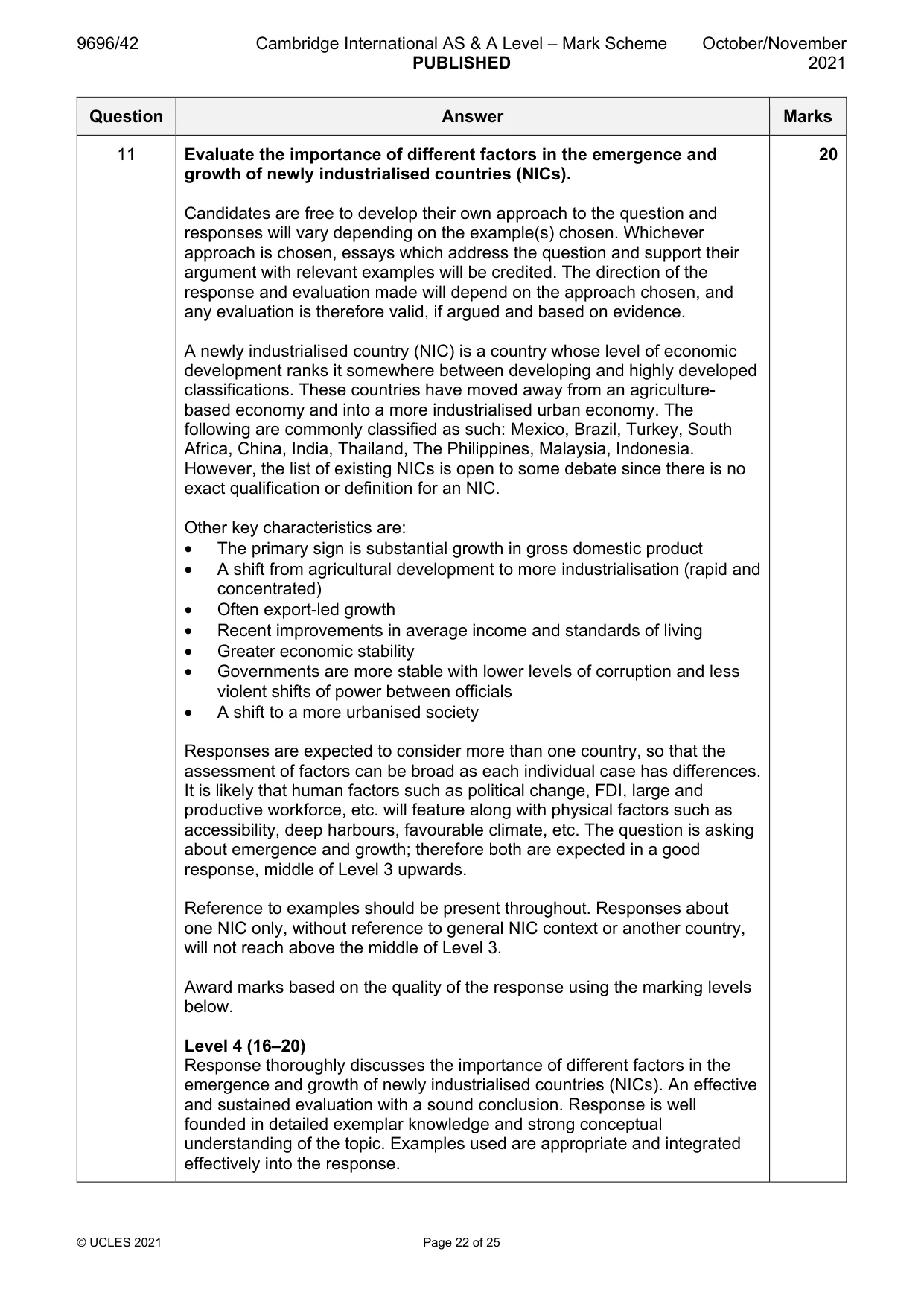
11 Evaluate the importance of different factors in the emergence and growth of newly industrialised countries (NICs). [20]
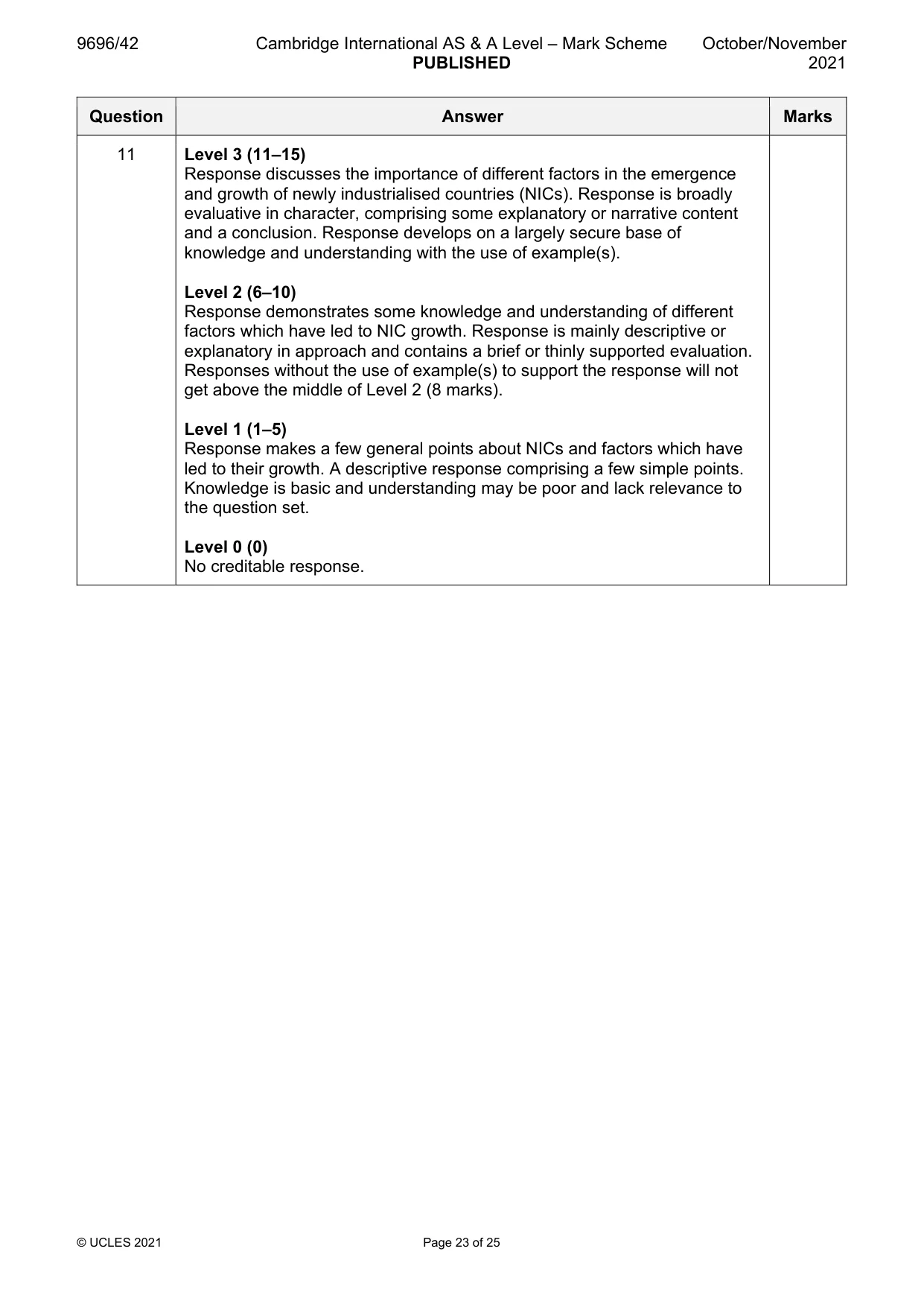
Mark scheme: 11 Evaluate the importance of different factors in the emergence and 20 growth of newly industrialised countries (NICs). Candidates are free to develop their own approach to the question and responses will vary depending on the example(s) chosen. Whichever approach is chosen, essays which address the question and support their argument with relevant examples will be credited. The direction of the response and evaluation made will depend on the approach chosen, and any evaluation is therefore valid, if argued and based on evidence. A newly industrialised country (NIC) is a country whose level of economic development ranks it somewhere between developing and highly developed classifications. These countries have moved away from an agriculture- based economy and into a more industrialised urban economy. The following are commonly classified as such: Mexico, Brazil, Turkey, South Africa, China, India, Thailand, The Philippines, Malaysia, Indonesia. However, the list of existing NICs is open to some debate since there is no exact qualification or definition for an NIC. Other key characteristics are: • The primary sign is substantial growth in gross domestic product • A shift from agricultural development to more industrialisation (rapid and concentrated) • Often export-led growth • Recent improvements in average income and standards of living • Greater economic stability • Governments are more stable with lower levels of corruption and less violent shifts of power between officials • A shift to a more urbanised society Responses are expected to consider more than one country, so that the assessment of factors can be broad as each individual case has differences. It is likely that human factors such as political change, FDI, large and productive workforce, etc. will feature along with physical factors such as accessibility, deep harbours, favourable climate, etc. The question is asking about emergence and growth; therefore both are expected in a good response, middle of Level 3 upwards. Reference to examples should be present throughout. Responses about one NIC only, without reference to general NIC context or another country, will not reach above the middle of Level 3. Award marks based on the quality of the response using the marking levels below. Level 4 (16–20) Response thoroughly discusses the importance of different factors in the emergence and growth of newly industrialised countries (NICs). An effective and sustained evaluation with a sound conclusion. Response is well founded in detailed exemplar knowledge and strong conceptual understanding of the topic. Examples used are appropriate and integrated effectively into the response. 11 Level 3 (11–15) Response discusses the importance of different factors in the emergence and growth of newly industrialised countries (NICs). Response is broadly evaluative in character, comprising some explanatory or narrative content and a conclusion. Response develops on a largely secure base of knowledge and understanding with the use of example(s). Level 2 (6–10) Response demonstrates some knowledge and understanding of different factors which have led to NIC growth. Response is mainly descriptive or explanatory in approach and contains a brief or thinly supported evaluation. Responses without the use of example(s) to support the response will not get above the middle of Level 2 (8 marks). Level 1 (1–5) Response makes a few general points about NICs and factors which have led to their growth. A descriptive response comprising a few simple points. Knowledge is basic and understanding may be poor and lack relevance to the question set. Level 0 (0) No creditable response.
Q12 · ‘Attracting foreign direct investment (FDI) is important in attempts to overcome regional…
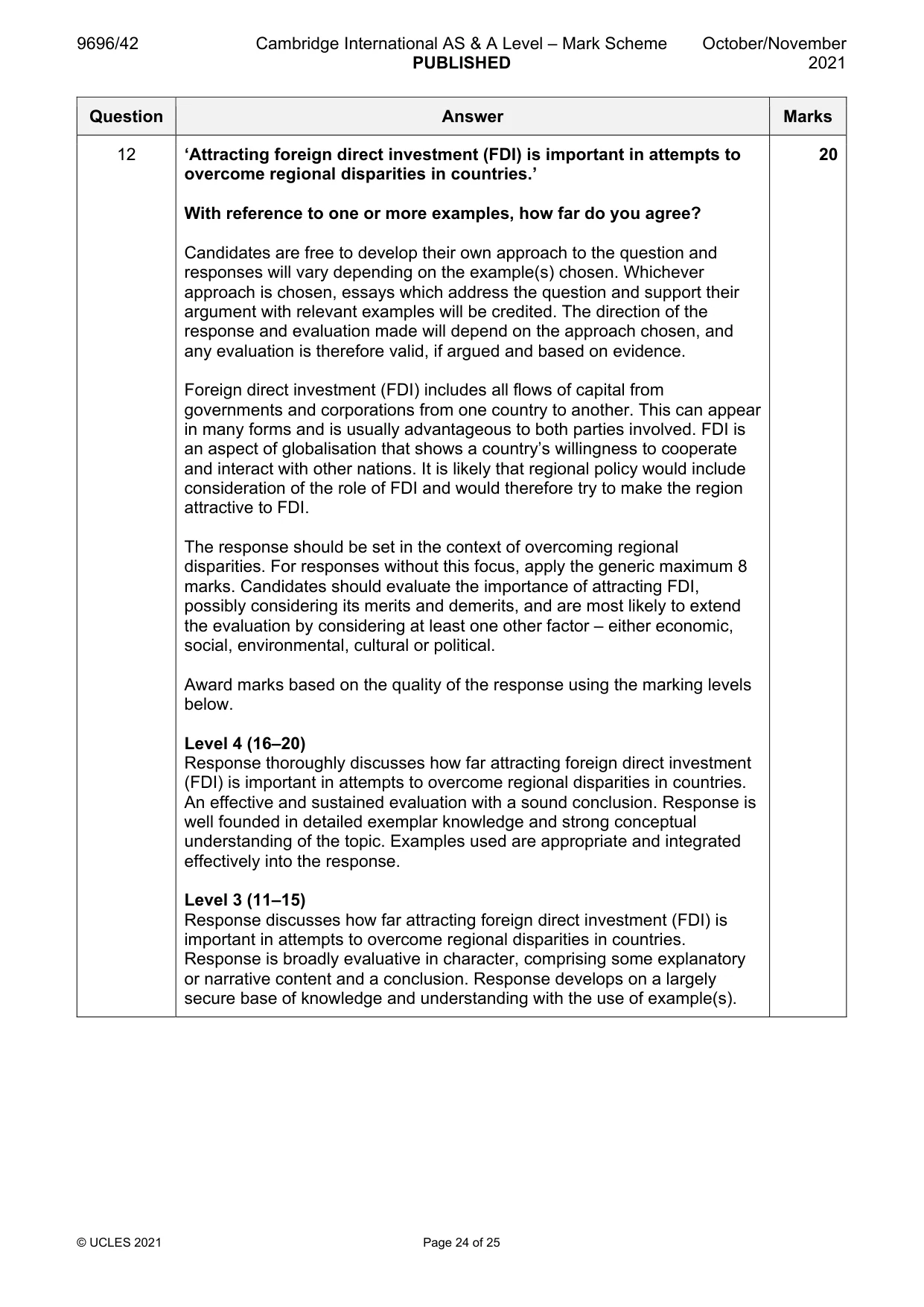
12 ‘Attracting foreign direct investment (FDI) is important in attempts to overcome regional disparities in countries.’ With reference to one or more examples, how far do you agree? [20]
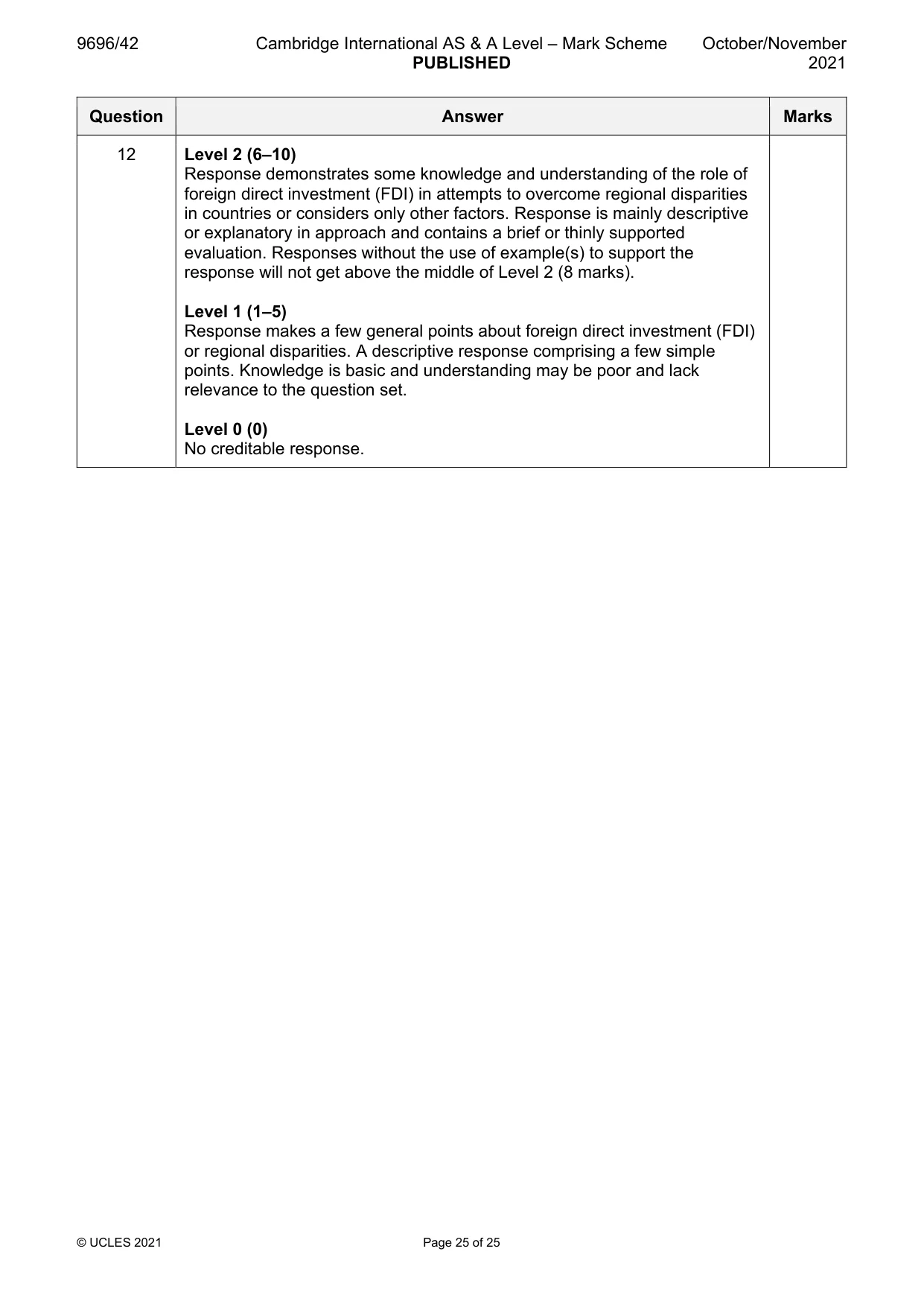
Mark scheme: 12 ‘Attracting foreign direct investment (FDI) is important in attempts to 20 overcome regional disparities in countries.’ With reference to one or more examples, how far do you agree? Candidates are free to develop their own approach to the question and responses will vary depending on the example(s) chosen. Whichever approach is chosen, essays which address the question and support their argument with relevant examples will be credited. The direction of the response and evaluation made will depend on the approach chosen, and any evaluation is therefore valid, if argued and based on evidence. Foreign direct investment (FDI) includes all flows of capital from governments and corporations from one country to another. This can appear in many forms and is usually advantageous to both parties involved. FDI is an aspect of globalisation that shows a country’s willingness to cooperate and interact with other nations. It is likely that regional policy would include consideration of the role of FDI and would therefore try to make the region attractive to FDI. The response should be set in the context of overcoming regional disparities. For responses without this focus, apply the generic maximum 8 marks. Candidates should evaluate the importance of attracting FDI, possibly considering its merits and demerits, and are most likely to extend the evaluation by considering at least one other factor – either economic, social, environmental, cultural or political. Award marks based on the quality of the response using the marking levels below. Level 4 (16–20) Response thoroughly discusses how far attracting foreign direct investment (FDI) is important in attempts to overcome regional disparities in countries. An effective and sustained evaluation with a sound conclusion. Response is well founded in detailed exemplar knowledge and strong conceptual understanding of the topic. Examples used are appropriate and integrated effectively into the response. Level 3 (11–15) Response discusses how far attracting foreign direct investment (FDI) is important in attempts to overcome regional disparities in countries. Response is broadly evaluative in character, comprising some explanatory or narrative content and a conclusion. Response develops on a largely secure base of knowledge and understanding with the use of example(s). 12 Level 2 (6–10) Response demonstrates some knowledge and understanding of the role of foreign direct investment (FDI) in attempts to overcome regional disparities in countries or considers only other factors. Response is mainly descriptive or explanatory in approach and contains a brief or thinly supported evaluation. Responses without the use of example(s) to support the response will not get above the middle of Level 2 (8 marks). Level 1 (1–5) Response makes a few general points about foreign direct investment (FDI) or regional disparities. A descriptive response comprising a few simple points. Knowledge is basic and understanding may be poor and lack relevance to the question set. Level 0 (0) No creditable response.
What was in this paper
The subtopics covered by these 12 questions, and how many questions each got. Open one in a new tab to see every Cambridge question on it.
3International debt and international aid1Sustainable energy supplies1The development of international tourism1The human impact1The management of a degraded environment1The management of agricultural change1The management of change in manufacturing industry1The management of regional development1Trade flows and trading patterns1What you needed in this session
Cambridge’s own grade thresholds for 2021 Oct/Nov, Paper 4 · Variant 2. A higher threshold means an easier paper — the bar moves with how the cohort did.