Cambridge A Level Geography 9696 — 2021 Oct/Nov Paper 4 · Variant 3
9696/43/O/N/21 · 12 questions · 60 marks · ≈68 min
The question paper and its mark scheme, free to read here and free to download. This is Cambridge’s own paper, exactly as it was sat.
Question paper4 pages

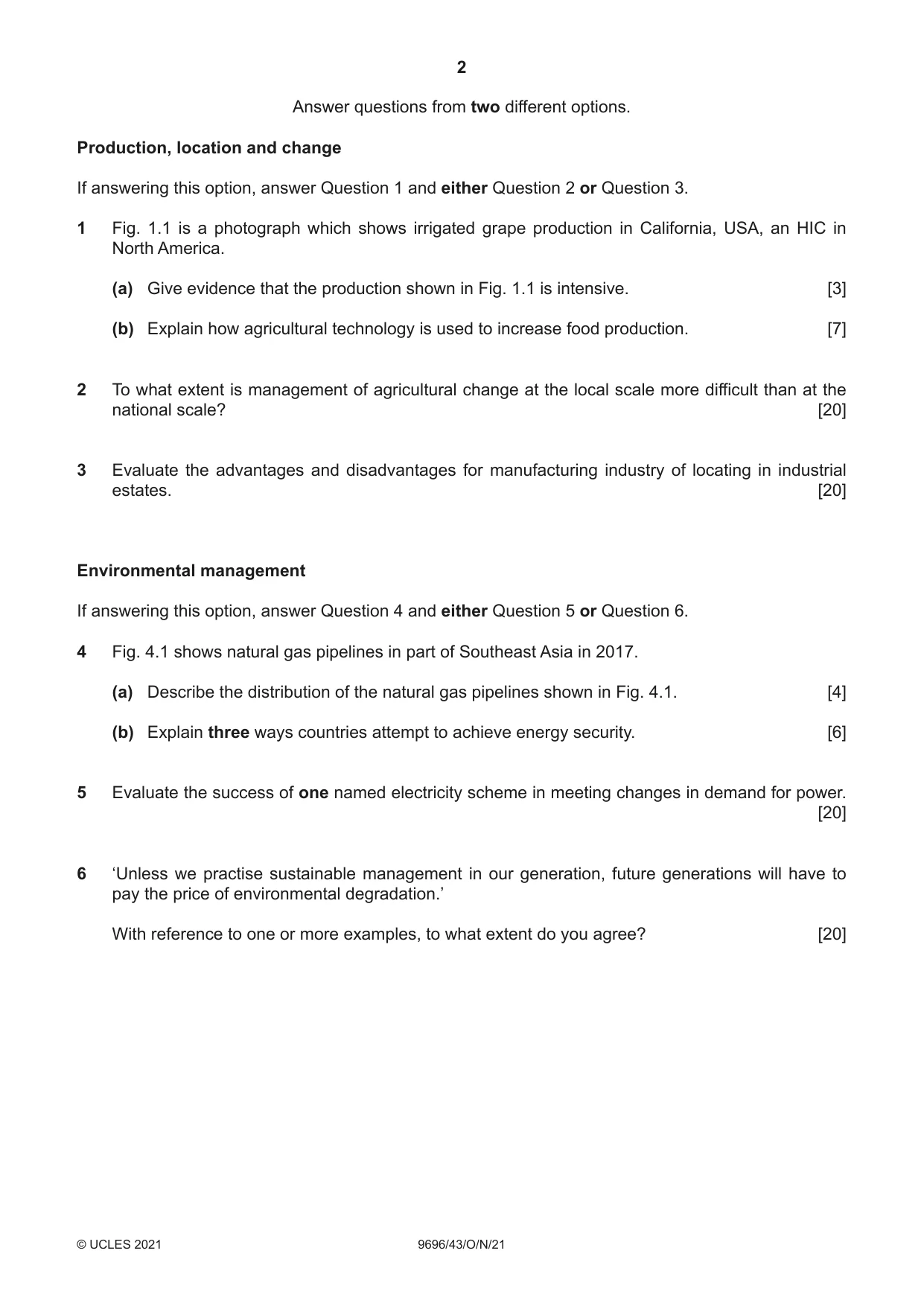
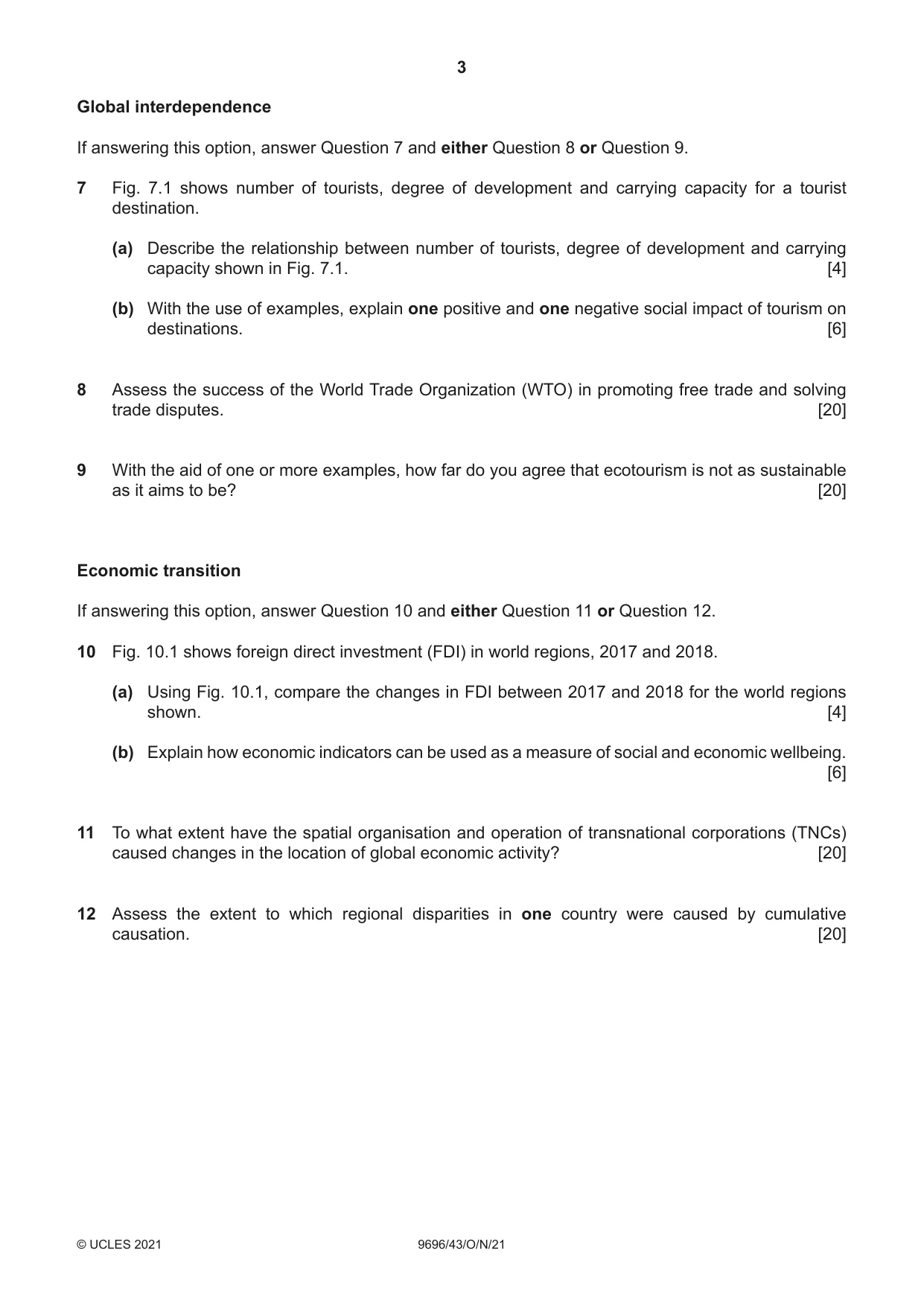

Mark scheme26 pages
Answers below. Sit the paper first if you are practising.



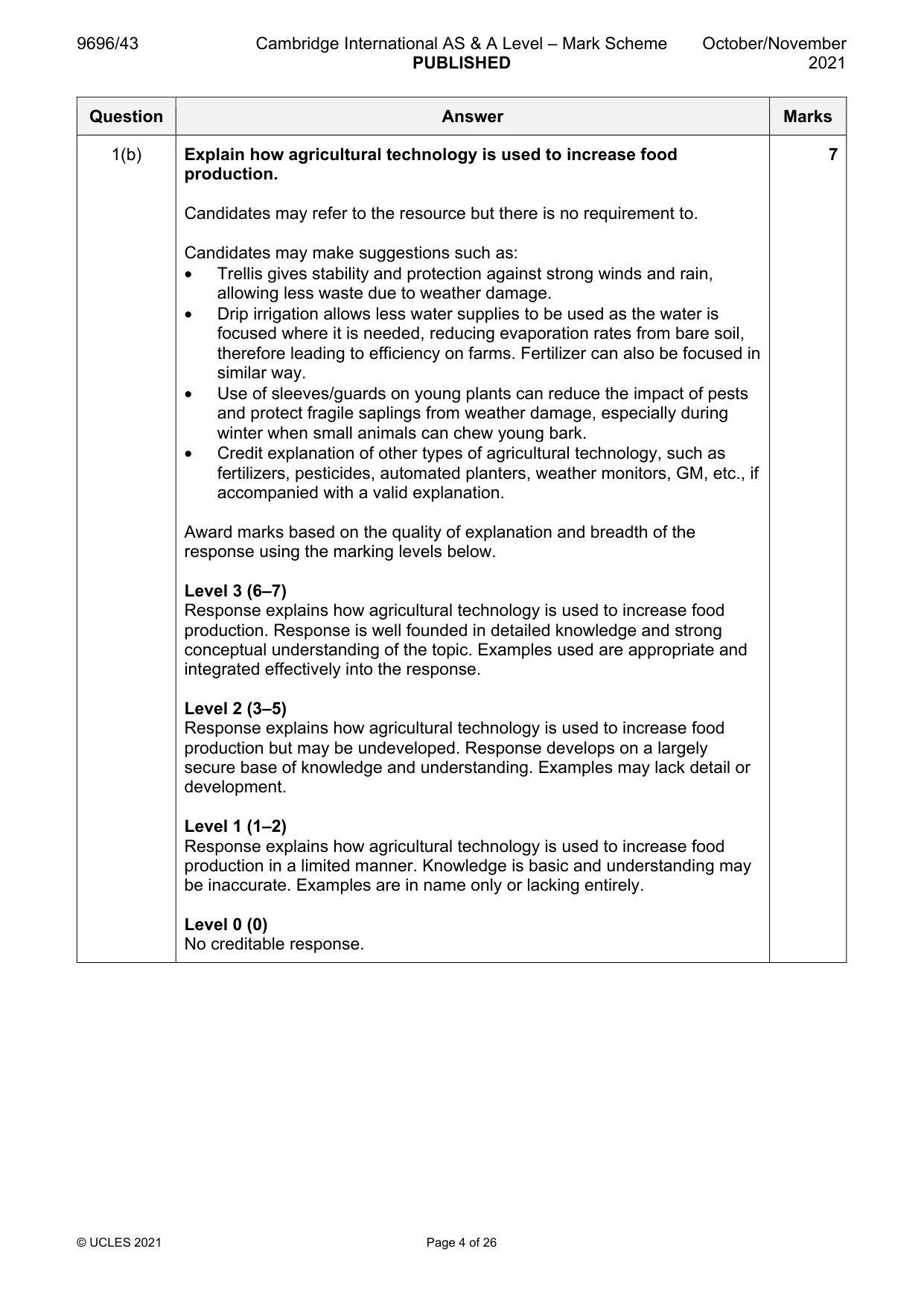
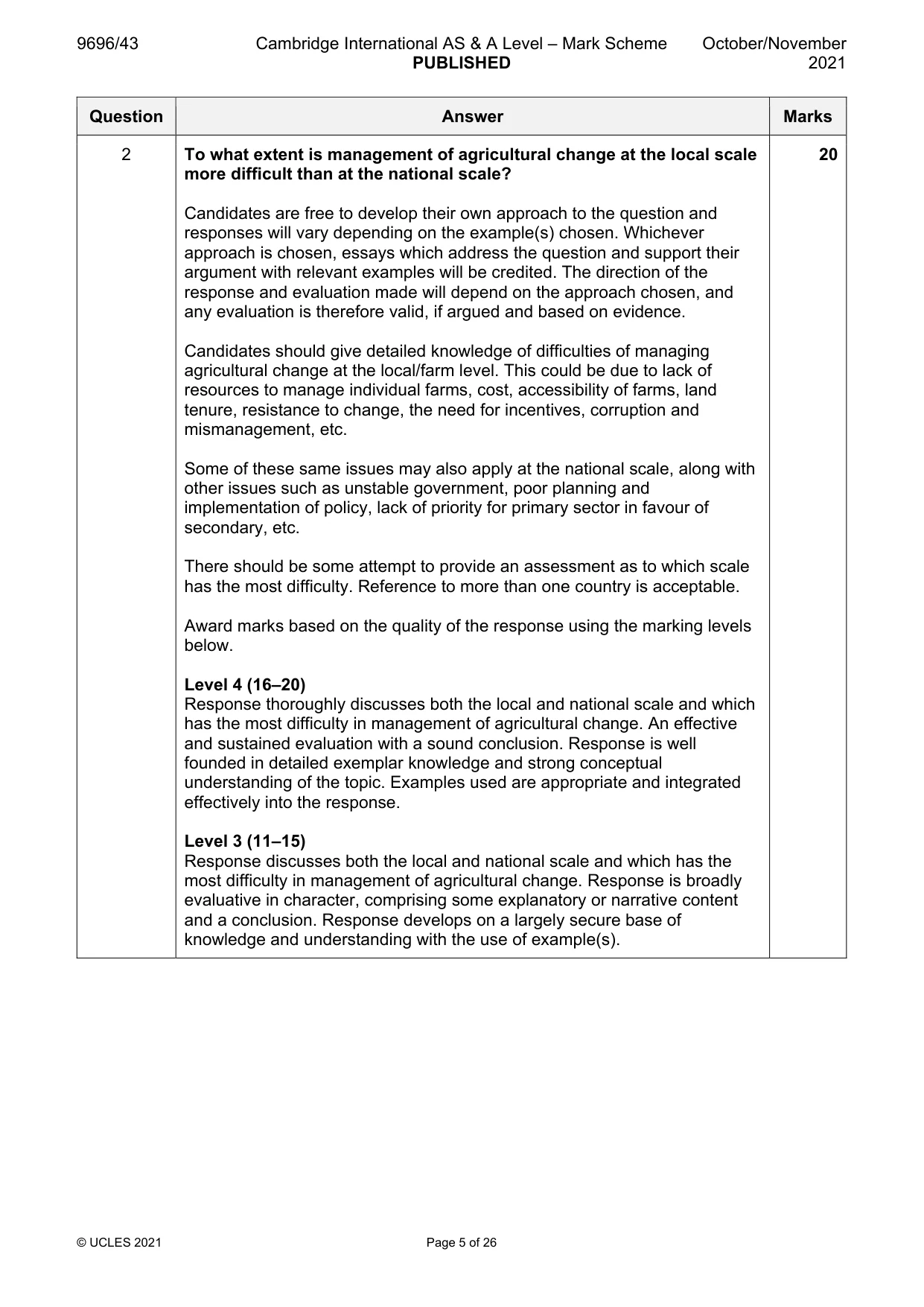



Questions as text
Q1 · A photograph which shows irrigated grape production in California, USA, an HIC in North…
1 Fig. 1.1 is a photograph which shows irrigated grape production in California, USA, an HIC in North America. (a) Give evidence that the production shown in Fig. 1.1 is intensive. [3] (b) Explain how agricultural technology is used to increase food production. [7]
Mark scheme: Question Answer Marks 1(a) Fig. 1.1 is a photograph which shows irrigated grape production in 3 California, USA, an HIC in North America. Give evidence that the production shown in Fig. 1.1 is intensive. Candidates may suggest the following: • Grown in rows/along furrows • Plantation style/large commercial farm • Trellis system/support for vines as they grow • Base of vines have sleeves/guards to protect from cold/pests/give support • Black pipes are likely to be for drip irrigation (must be a developed point) • No sign of weeds or unused land • Signs of mechanisation (tracks) Credit candidates who note that although the vineyard covers a large area it shows signs of intensification. 1 mark for each valid description using evidence from the photograph. 1(b) Explain how agricultural technology is used to increase food 7 production. Candidates may refer to the resource but there is no requirement to. Candidates may make suggestions such as: • Trellis gives stability and protection against strong winds and rain, allowing less waste due to weather damage. • Drip irrigation allows less water supplies to be used as the water is focused where it is needed, reducing evaporation rates from bare soil, therefore leading to efficiency on farms. Fertilizer can also be focused in similar way. • Use of sleeves/guards on young plants can reduce the impact of pests and protect fragile saplings from weather damage, especially during winter when small animals can chew young bark. • Credit explanation of other types of agricultural technology, such as fertilizers, pesticides, automated planters, weather monitors, GM, etc., if accompanied with a valid explanation. Award marks based on the quality of explanation and breadth of the response using the marking levels below. Level 3 (6–7) Response explains how agricultural technology is used to increase food production. Response is well founded in detailed knowledge and strong conceptual understanding of the topic. Examples used are appropriate and integrated effectively into the response. Level 2 (3–5) Response explains how agricultural technology is used to increase food production but may be undeveloped. Response develops on a largely secure base of knowledge and understanding. Examples may lack detail or development. Level 1 (1–2) Response explains how agricultural technology is used to increase food production in a limited manner. Knowledge is basic and understanding may be inaccurate. Examples are in name only or lacking entirely. Level 0 (0) No creditable response.
Q2 · To what extent is management of agricultural change at the local scale more difficult…
2 To what extent is management of agricultural change at the local scale more difficult than at the national scale? [20]
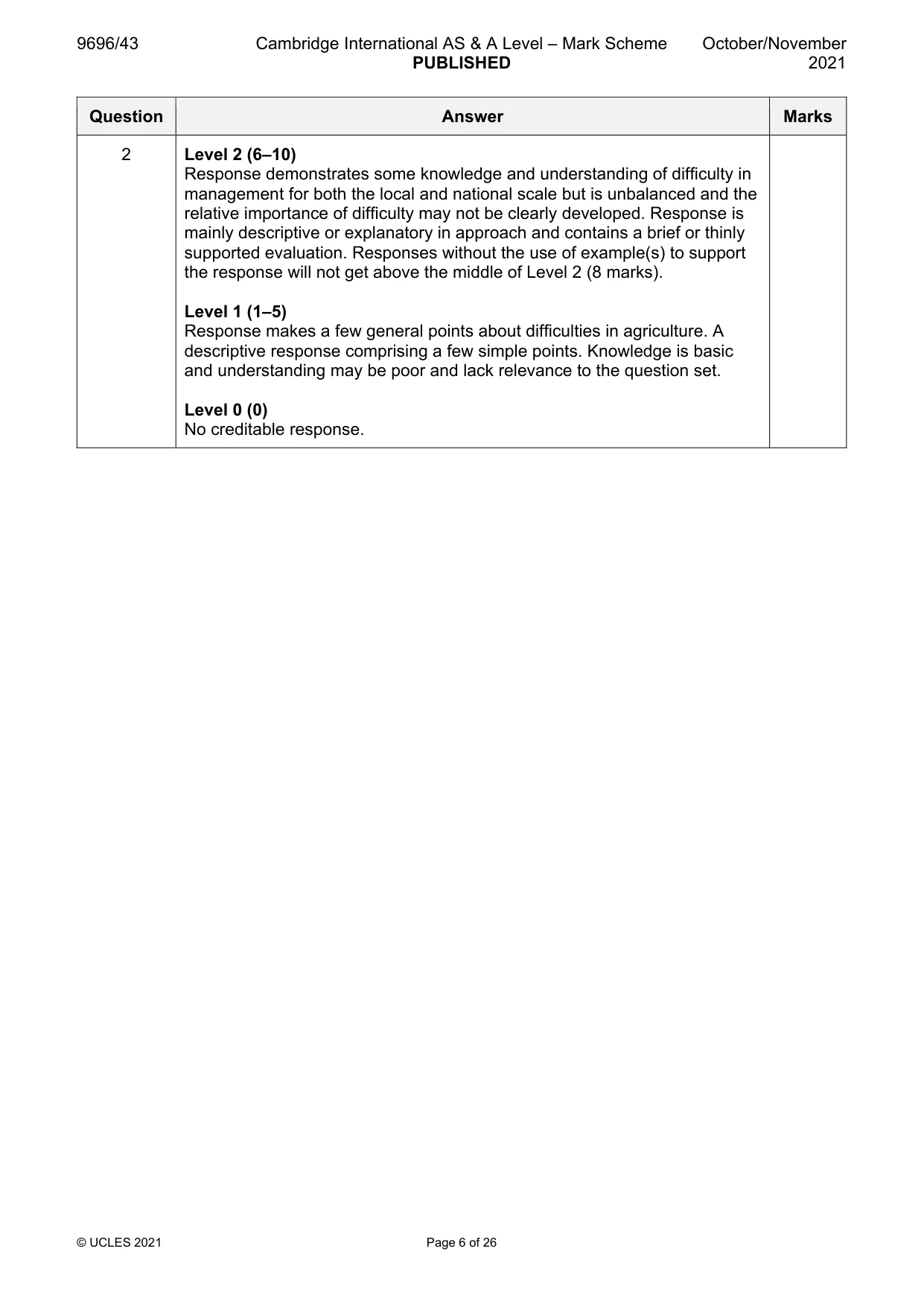
Mark scheme: 2 To what extent is management of agricultural change at the local scale 20 more difficult than at the national scale? Candidates are free to develop their own approach to the question and responses will vary depending on the example(s) chosen. Whichever approach is chosen, essays which address the question and support their argument with relevant examples will be credited. The direction of the response and evaluation made will depend on the approach chosen, and any evaluation is therefore valid, if argued and based on evidence. Candidates should give detailed knowledge of difficulties of managing agricultural change at the local/farm level. This could be due to lack of resources to manage individual farms, cost, accessibility of farms, land tenure, resistance to change, the need for incentives, corruption and mismanagement, etc. Some of these same issues may also apply at the national scale, along with other issues such as unstable government, poor planning and implementation of policy, lack of priority for primary sector in favour of secondary, etc. There should be some attempt to provide an assessment as to which scale has the most difficulty. Reference to more than one country is acceptable. Award marks based on the quality of the response using the marking levels below. Level 4 (16–20) Response thoroughly discusses both the local and national scale and which has the most difficulty in management of agricultural change. An effective and sustained evaluation with a sound conclusion. Response is well founded in detailed exemplar knowledge and strong conceptual understanding of the topic. Examples used are appropriate and integrated effectively into the response. Level 3 (11–15) Response discusses both the local and national scale and which has the most difficulty in management of agricultural change. Response is broadly evaluative in character, comprising some explanatory or narrative content and a conclusion. Response develops on a largely secure base of knowledge and understanding with the use of example(s). 2 Level 2 (6–10) Response demonstrates some knowledge and understanding of difficulty in management for both the local and national scale but is unbalanced and the relative importance of difficulty may not be clearly developed. Response is mainly descriptive or explanatory in approach and contains a brief or thinly supported evaluation. Responses without the use of example(s) to support the response will not get above the middle of Level 2 (8 marks). Level 1 (1–5) Response makes a few general points about difficulties in agriculture. A descriptive response comprising a few simple points. Knowledge is basic and understanding may be poor and lack relevance to the question set. Level 0 (0) No creditable response.
Q3 · Evaluate the advantages and disadvantages for manufacturing industry of locating in…
3 Evaluate the advantages and disadvantages for manufacturing industry of locating in industrial estates. [20] Environmental management If answering this option, answer Question 4 and either Question 5 or Question 6.
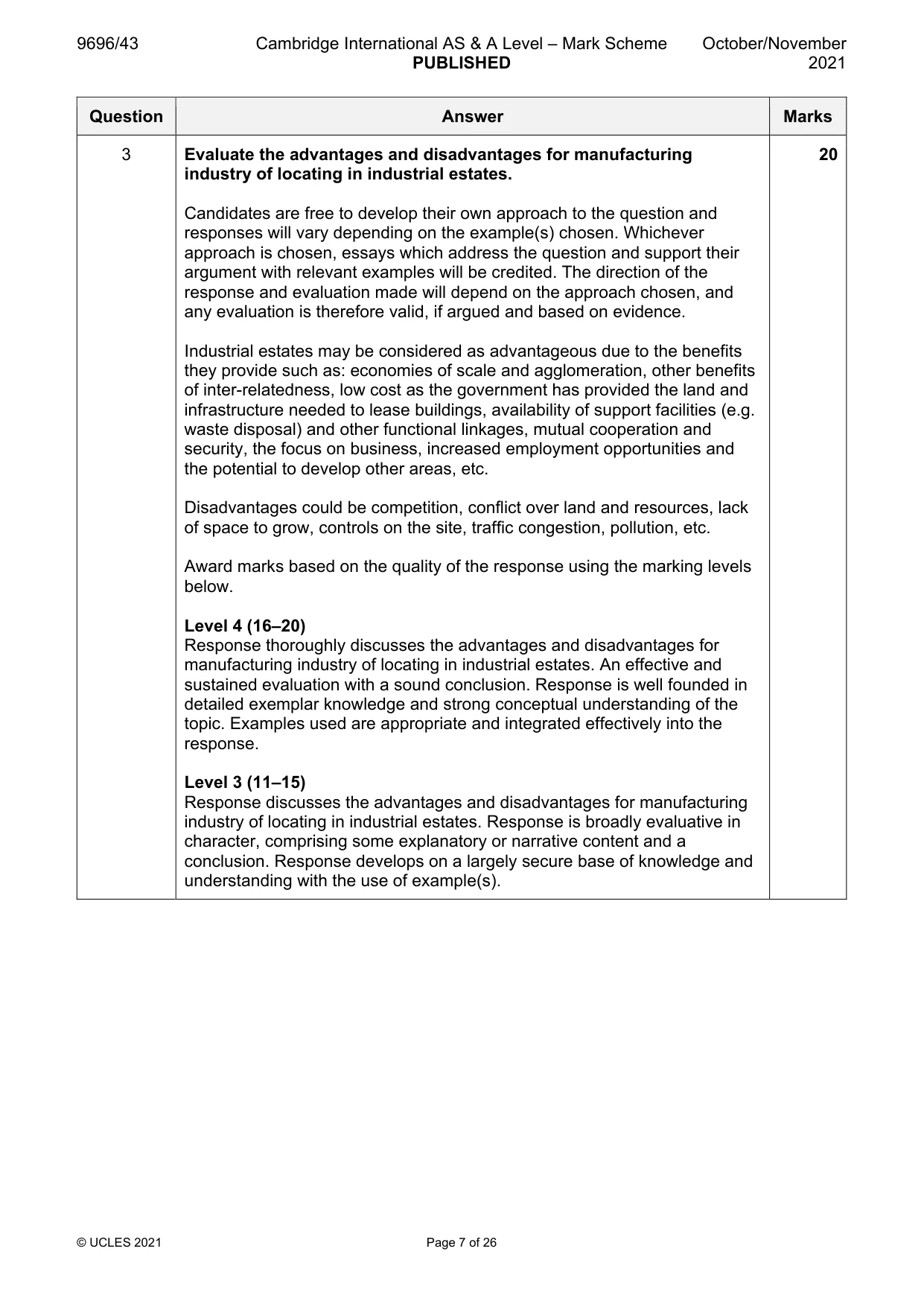
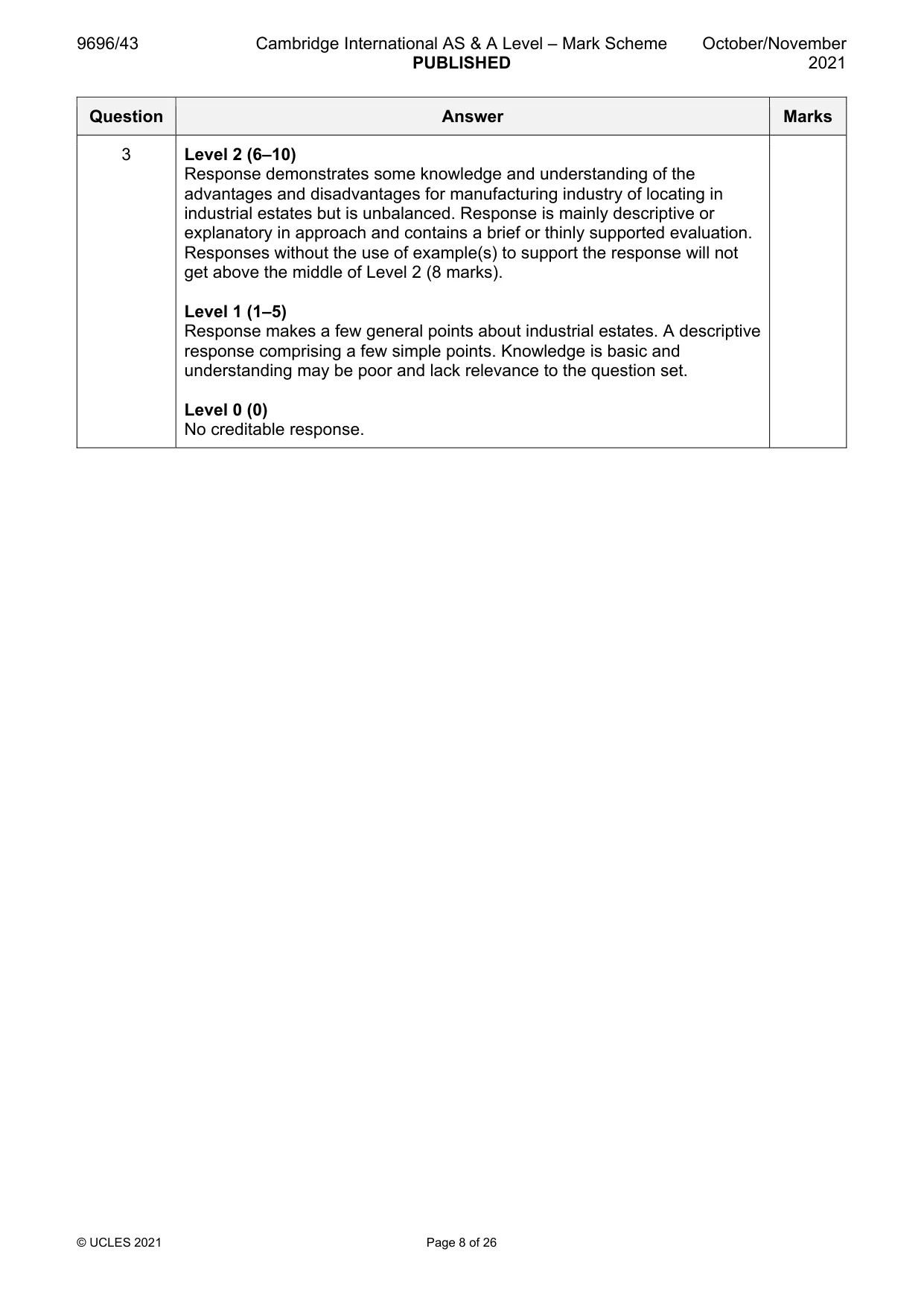
Mark scheme: 3 Evaluate the advantages and disadvantages for manufacturing 20 industry of locating in industrial estates. Candidates are free to develop their own approach to the question and responses will vary depending on the example(s) chosen. Whichever approach is chosen, essays which address the question and support their argument with relevant examples will be credited. The direction of the response and evaluation made will depend on the approach chosen, and any evaluation is therefore valid, if argued and based on evidence. Industrial estates may be considered as advantageous due to the benefits they provide such as: economies of scale and agglomeration, other benefits of inter-relatedness, low cost as the government has provided the land and infrastructure needed to lease buildings, availability of support facilities (e.g. waste disposal) and other functional linkages, mutual cooperation and security, the focus on business, increased employment opportunities and the potential to develop other areas, etc. Disadvantages could be competition, conflict over land and resources, lack of space to grow, controls on the site, traffic congestion, pollution, etc. Award marks based on the quality of the response using the marking levels below. Level 4 (16–20) Response thoroughly discusses the advantages and disadvantages for manufacturing industry of locating in industrial estates. An effective and sustained evaluation with a sound conclusion. Response is well founded in detailed exemplar knowledge and strong conceptual understanding of the topic. Examples used are appropriate and integrated effectively into the response. Level 3 (11–15) Response discusses the advantages and disadvantages for manufacturing industry of locating in industrial estates. Response is broadly evaluative in character, comprising some explanatory or narrative content and a conclusion. Response develops on a largely secure base of knowledge and understanding with the use of example(s). 3 Level 2 (6–10) Response demonstrates some knowledge and understanding of the advantages and disadvantages for manufacturing industry of locating in industrial estates but is unbalanced. Response is mainly descriptive or explanatory in approach and contains a brief or thinly supported evaluation. Responses without the use of example(s) to support the response will not get above the middle of Level 2 (8 marks). Level 1 (1–5) Response makes a few general points about industrial estates. A descriptive response comprising a few simple points. Knowledge is basic and understanding may be poor and lack relevance to the question set. Level 0 (0) No creditable response. Environmental management If answering this option, answer Question 4 and either Question 5 or Question 6.
Q4 · Natural gas pipelines in part of Southeast Asia in 2017
4 Fig. 4.1 shows natural gas pipelines in part of Southeast Asia in 2017. (a) Describe the distribution of the natural gas pipelines shown in Fig. 4.1. [4] (b) Explain three ways countries attempt to achieve energy security. [6]
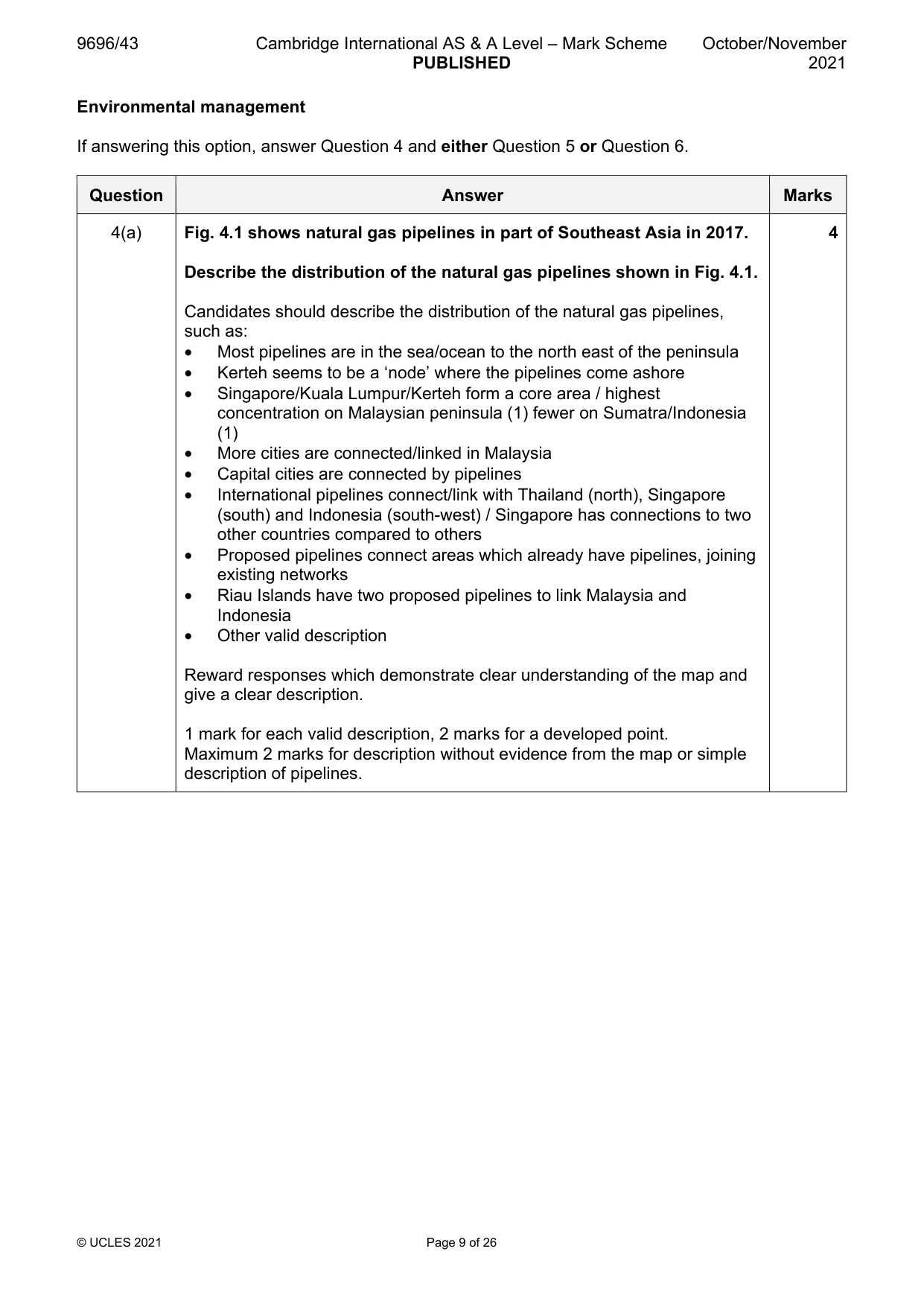
Mark scheme: 4(a) Fig. 4.1 shows natural gas pipelines in part of Southeast Asia in 2017. 4 Describe the distribution of the natural gas pipelines shown in Fig. 4.1. Candidates should describe the distribution of the natural gas pipelines, such as: • Most pipelines are in the sea/ocean to the north east of the peninsula • Kerteh seems to be a ‘node’ where the pipelines come ashore • Singapore/Kuala Lumpur/Kerteh form a core area / highest concentration on Malaysian peninsula (1) fewer on Sumatra/Indonesia (1) • More cities are connected/linked in Malaysia • Capital cities are connected by pipelines • International pipelines connect/link with Thailand (north), Singapore (south) and Indonesia (south-west) / Singapore has connections to two other countries compared to others • Proposed pipelines connect areas which already have pipelines, joining existing networks • Riau Islands have two proposed pipelines to link Malaysia and Indonesia • Other valid description Reward responses which demonstrate clear understanding of the map and give a clear description. 1 mark for each valid description, 2 marks for a developed point. Maximum 2 marks for description without evidence from the map or simple description of pipelines. 4(b) Explain three ways countries attempt to achieve energy security. 6 Candidates should suggest ways that countries attempt to achieve energy security. Energy security is access to reliable and affordable sources of energy. Energy security has many aspects: long-term energy security mainly deals with timely investments to supply energy in line with economic developments and environmental needs. On the other hand, short-term energy security focuses on the ability of the energy system to react promptly to sudden changes in the supply-demand balance. This involves the application of knowledge of issues in energy security in the context of HICs, MICs and LICs. Expect ways from a variety of dimensions, such as economic, social and political. Energy security can be achieved in many ways, such as diversifying the energy mix to make sure that the country is not dependent on one source; by increasing renewables; by importing from neighbouring countries which may involve some level of international cooperation/geopolitics; by ensuring a build-up of stocks; by reducing demand or improving efficiencies in industry, etc. Maximum 2 marks if no reference to any aspect of energy security. Award marks based on the quality of explanation and breadth of the response using the marking levels below. Level 3 (5–6) Response contains clear explanation of three ways countries attempt to achieve energy security. Response is well founded in detailed knowledge and strong conceptual understanding of the topic. Examples used are appropriate and integrated effectively into the response. Level 2 (3–4) Response explains at least two ways countries attempt to achieve energy security. Response develops on a largely secure base of knowledge and understanding. Examples may lack detail or development. Level 1 (1–2) Response comprises one or more ways countries can achieve energy security in a limited manner/no reference to any aspect of energy security. Knowledge is basic and understanding may be inaccurate. Examples are in name only or lacking entirely. Level 0 (0) No creditable response.
Q5 · Evaluate the success of one named electricity scheme in meeting changes in demand for…
5 Evaluate the success of one named electricity scheme in meeting changes in demand for power. [20]
Mark scheme: 5 Evaluate the success of one named electricity scheme in meeting 20 changes in demand for power. Candidates are free to develop their own approach to the question and responses will vary depending on the example(s) chosen. Whichever approach is chosen, essays which address the question and support their argument with relevant examples will be credited. The direction of the response and evaluation made will depend on the approach chosen, and any evaluation is therefore valid, if argued and based on evidence. Candidates should evaluate the success of the scheme in the context of meeting demand. Demand can change in the short-term, e.g. fluctuations throughout the day, as well as moderate to longer term changes caused by population increase, changes in level of economic development, industrialisation, etc. It is most likely to involve economic issues such as unit cost and energy security, and social issues such as public opinion leading to changes in demand. Candidates may question the amount of power production and its success compared to other sources of electrical energy in the evaluative comments, or the sustainability in the future, as demand is likely to increase. A response about a strategy rather than a scheme will not get above Level 2. Award marks based on the quality of the response using the marking levels below. Level 4 (16–20) Response thoroughly discusses the success of one named electricity scheme in meeting changes in demand for power. An effective and sustained evaluation with a sound conclusion. Response is well founded in detailed exemplar knowledge and strong conceptual understanding of the topic. Examples used are appropriate and integrated effectively into the response. Level 3 (11–15) Response discusses the success of one named electricity scheme in meeting changes in demand for power. Response is broadly evaluative in character, comprising some explanatory or narrative content and a conclusion. Response develops on a largely secure base of knowledge and understanding with the use of example(s). 5 Level 2 (6–10) Response demonstrates some knowledge and understanding of the success of one named electricity scheme but meeting demand may not be fully developed. Response is mainly descriptive or explanatory in approach and contains a brief or thinly supported evaluation. Responses without the use of example(s) to support the response will not get above the middle of Level 2 (8 marks). Level 1 (1–5) Response makes a few general points about a named scheme and/or how it has met demand. A descriptive response comprising a few simple points. Knowledge is basic and understanding may be poor and lack relevance to the question set. Level 0 (0) No creditable response.
Q6 · ‘Unless we practise sustainable management in our generation, future generations will…
6 ‘Unless we practise sustainable management in our generation, future generations will have to pay the price of environmental degradation.’ With reference to one or more examples, to what extent do you agree? [20] Global interdependence If answering this option, answer Question 7 and either Question 8 or Question 9.
Mark scheme: 6 ‘Unless we practise sustainable management in our generation, future 20 generations will have to pay the price of environmental degradation.’ With reference to one or more examples, to what extent do you agree? Candidates are free to develop their own approach to the question and responses will vary depending on the example(s) chosen. Whichever approach is chosen, essays which address the question and support their argument with relevant examples will be credited. The direction of the response and evaluation made will depend on the approach chosen, and any evaluation is therefore valid, if argued and based on evidence. Based on the quote, candidates may argue that if environmental management is done in a sustainable way, then degradation does not always have to be a feature. Examples may be used to illustrate this, which could be from any case study post-1980. It is expected that the examples used will illustrate sustainable management and unsustainable management. Candidates may assess the impact of climate change due to overuse of fossil fuels and the need for humankind to change practices. Consideration of the variations in the timescale of both sustainable and non-sustainable management practices could be used to develop the evaluative element. Scale can be variable from local, national and global, and environmental degradation can refer to land, air or water. There are various examples of sustainable management, such as clean- up/removal of source of degradation, habitat restoration, reintroducing lost species, afforestation, national parks, etc., and their effectiveness at reducing degradation. This question allows for a moral argument to form, for stewardship of the planet, which is a feature of many religions, cultures and arguably current Western world views. Award marks based on the quality of the response using the marking levels below. Level 4 (16–20) Response thoroughly discusses the extent to which, unless we practise sustainable management in our generation, future generations will have to pay the price of environmental degradation. An effective and sustained evaluation with a sound conclusion. Response is well founded in detailed exemplar knowledge and strong conceptual understanding of the topic. Examples used are appropriate and integrated effectively into the response. Level 3 (11–15) Response discusses the extent to which, unless we practise sustainable management in our generation, future generations will have to pay the price of environmental degradation. Response is broadly evaluative in character, comprising some explanatory or narrative content and a conclusion. Response develops on a largely secure base of knowledge and understanding with the use of example(s). 6 Level 2 (6–10) Response demonstrates some knowledge and understanding of the view that unless we practise sustainable management in our generation, future generations will have to pay the price of environmental degradation. Response is mainly descriptive or explanatory in approach and contains a brief or thinly supported evaluation. Responses without the use of example(s) to support the response will not get above the middle of Level 2 (8 marks). Level 1 (1–5) Response makes a few general points about practising sustainable management and/or environmental degradation. A descriptive response comprising a few simple points. Knowledge is basic and understanding may be poor and lack relevance to the question set. Level 0 (0) No creditable response. Global interdependence If answering this option, answer Question 7 and either Question 8 or Question 9.
Q7 · Number of tourists, degree of development and carrying capacity for a tourist destination
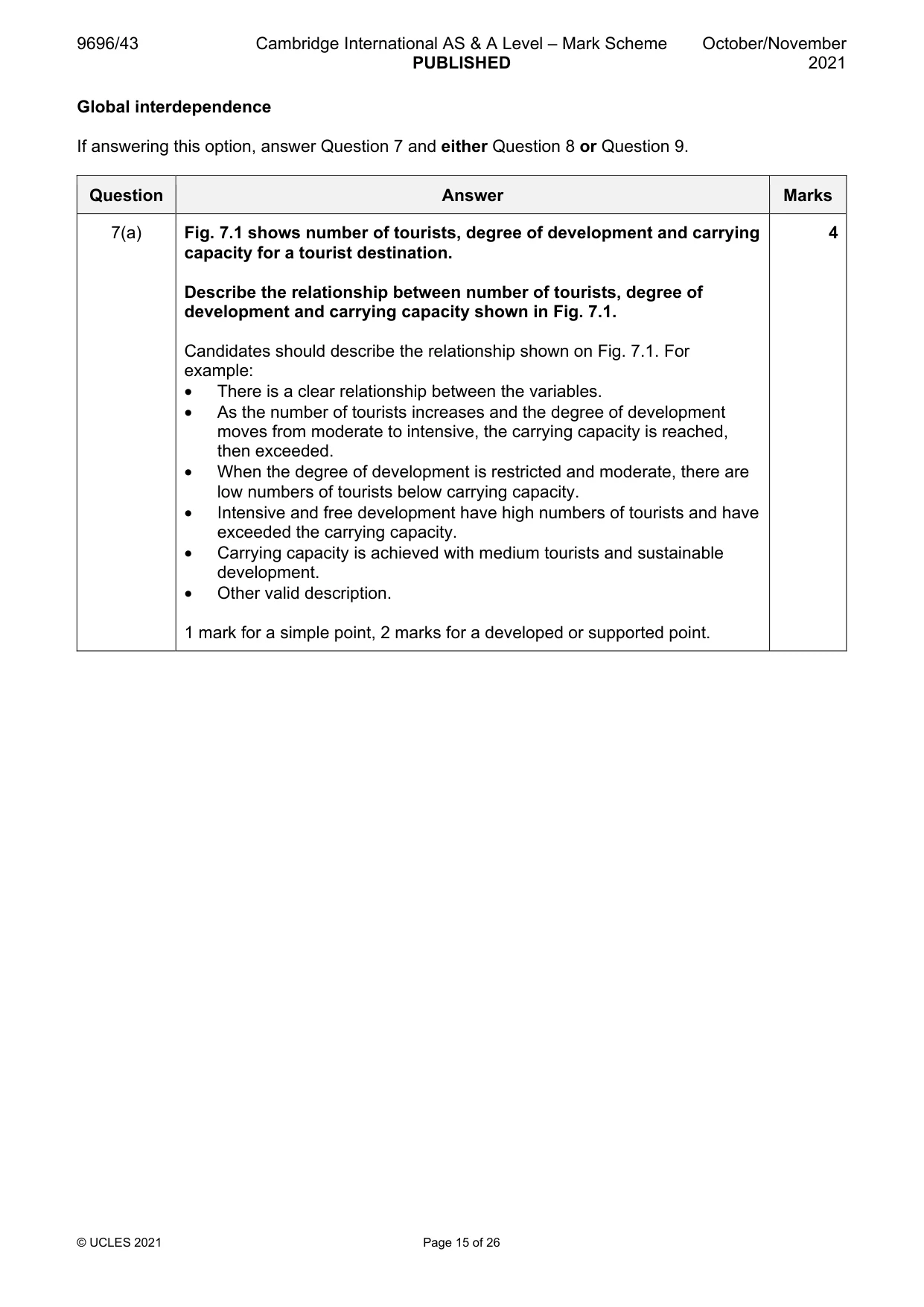
7 Fig. 7.1 shows number of tourists, degree of development and carrying capacity for a tourist destination. (a) Describe the relationship between number of tourists, degree of development and carrying capacity shown in Fig. 7.1. [4] (b) With the use of examples, explain one positive and one negative social impact of tourism on destinations. [6]
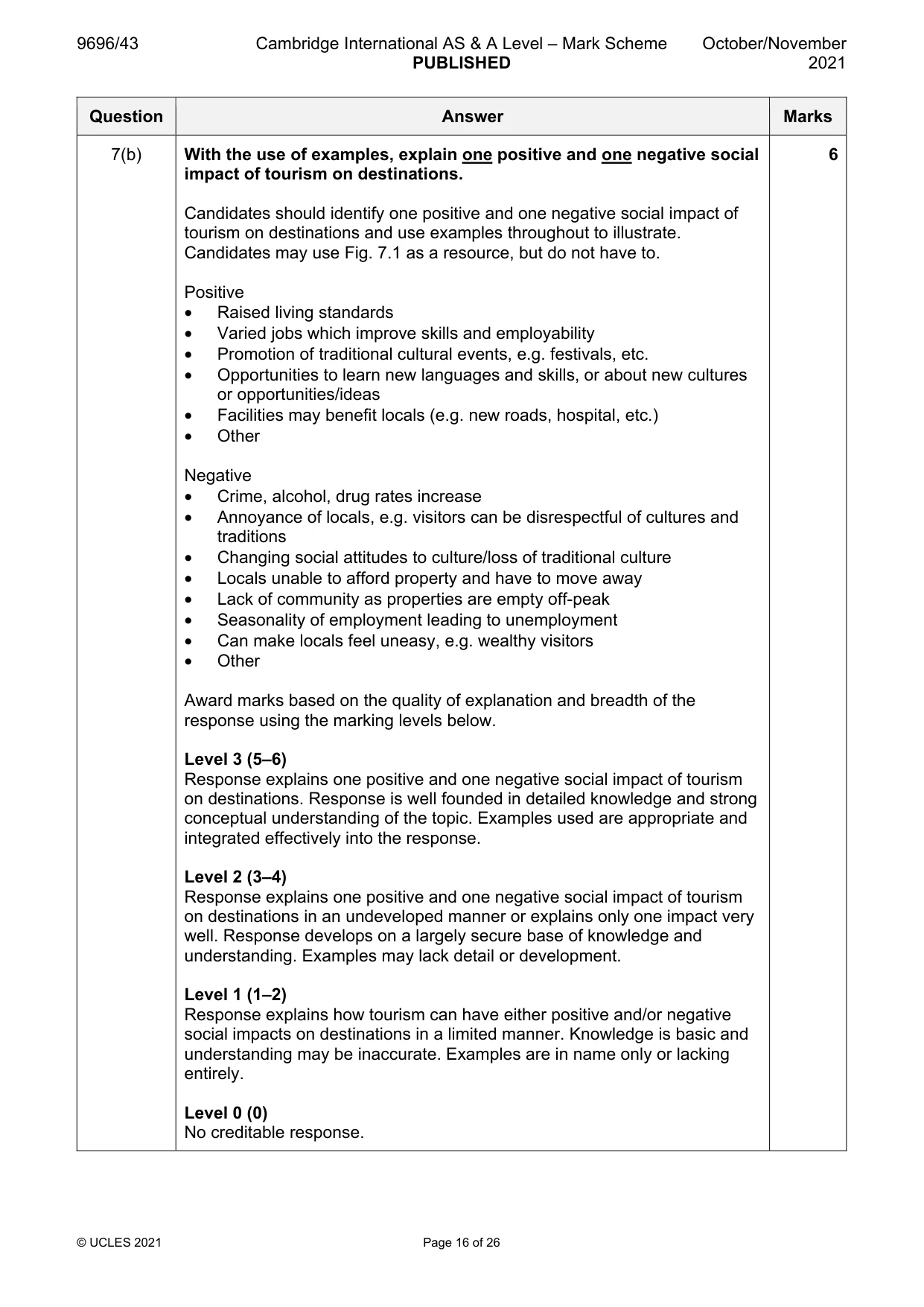
Mark scheme: 7(a) Fig. 7.1 shows number of tourists, degree of development and carrying 4 capacity for a tourist destination. Describe the relationship between number of tourists, degree of development and carrying capacity shown in Fig. 7.1. Candidates should describe the relationship shown on Fig. 7.1. For example: • There is a clear relationship between the variables. • As the number of tourists increases and the degree of development moves from moderate to intensive, the carrying capacity is reached, then exceeded. • When the degree of development is restricted and moderate, there are low numbers of tourists below carrying capacity. • Intensive and free development have high numbers of tourists and have exceeded the carrying capacity. • Carrying capacity is achieved with medium tourists and sustainable development. • Other valid description. 1 mark for a simple point, 2 marks for a developed or supported point. 7(b) With the use of examples, explain one positive and one negative social 6 impact of tourism on destinations. Candidates should identify one positive and one negative social impact of tourism on destinations and use examples throughout to illustrate. Candidates may use Fig. 7.1 as a resource, but do not have to. Positive • Raised living standards • Varied jobs which improve skills and employability • Promotion of traditional cultural events, e.g. festivals, etc. • Opportunities to learn new languages and skills, or about new cultures or opportunities/ideas • Facilities may benefit locals (e.g. new roads, hospital, etc.) • Other Negative • Crime, alcohol, drug rates increase • Annoyance of locals, e.g. visitors can be disrespectful of cultures and traditions • Changing social attitudes to culture/loss of traditional culture • Locals unable to afford property and have to move away • Lack of community as properties are empty off-peak • Seasonality of employment leading to unemployment • Can make locals feel uneasy, e.g. wealthy visitors • Other Award marks based on the quality of explanation and breadth of the response using the marking levels below. Level 3 (5–6) Response explains one positive and one negative social impact of tourism on destinations. Response is well founded in detailed knowledge and strong conceptual understanding of the topic. Examples used are appropriate and integrated effectively into the response. Level 2 (3–4) Response explains one positive and one negative social impact of tourism on destinations in an undeveloped manner or explains only one impact very well. Response develops on a largely secure base of knowledge and understanding. Examples may lack detail or development. Level 1 (1–2) Response explains how tourism can have either positive and/or negative social impacts on destinations in a limited manner. Knowledge is basic and understanding may be inaccurate. Examples are in name only or lacking entirely. Level 0 (0) No creditable response.
Q8 · Assess the success of the World Trade Organization (WTO) in promoting free trade and…
8 Assess the success of the World Trade Organization (WTO) in promoting free trade and solving trade disputes. [20]
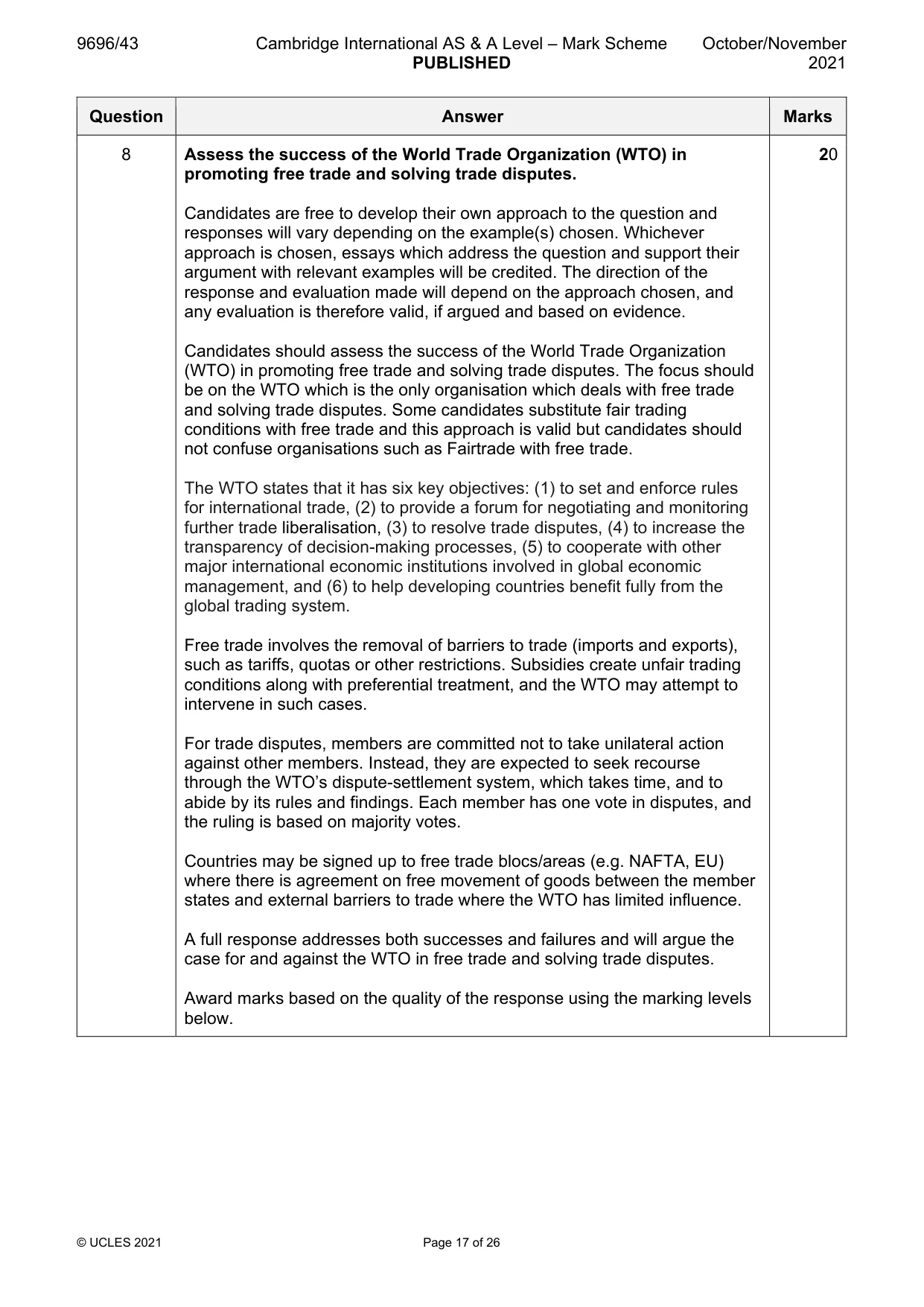
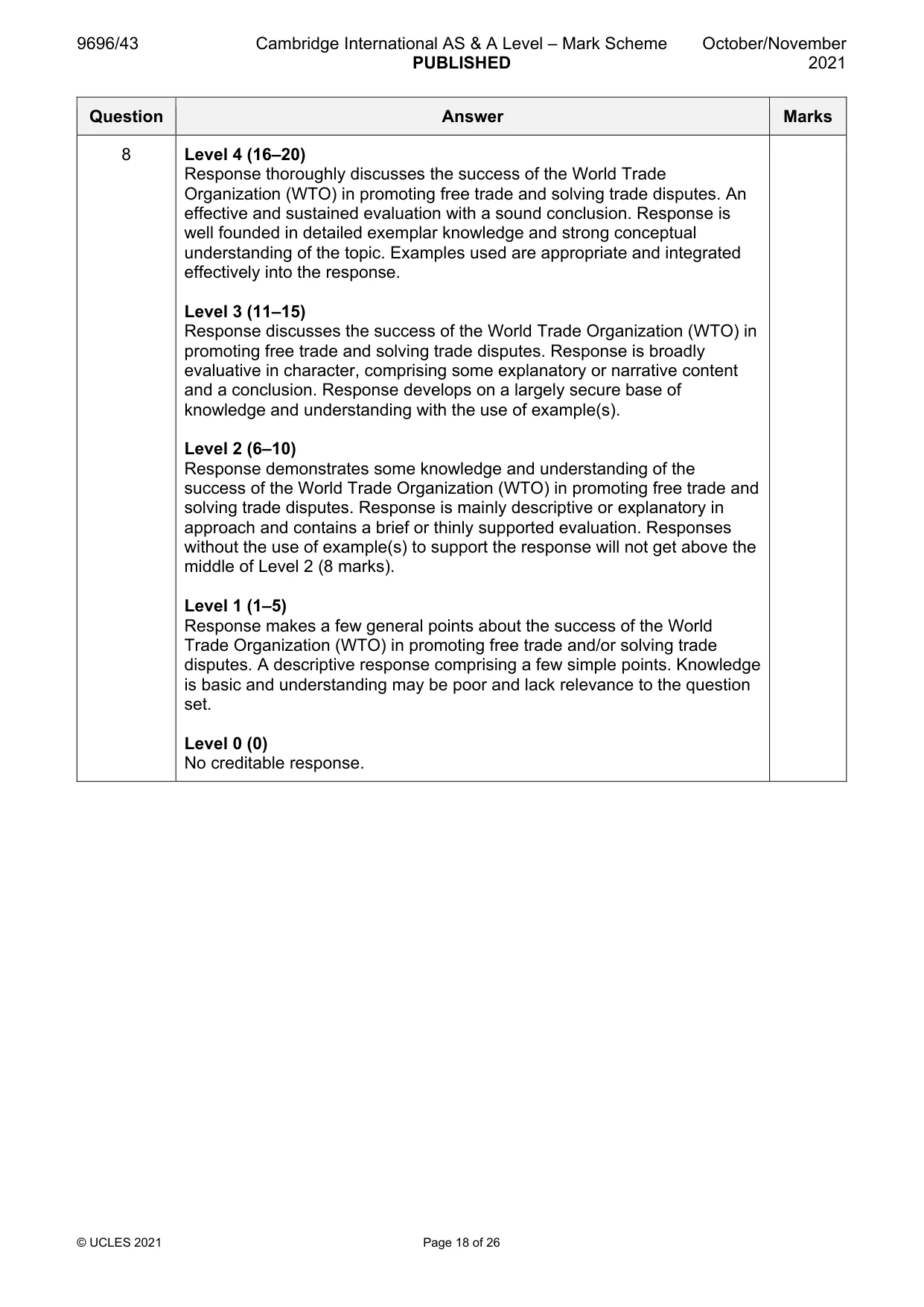
Mark scheme: 8 Assess the success of the World Trade Organization (WTO) in 20 promoting free trade and solving trade disputes. Candidates are free to develop their own approach to the question and responses will vary depending on the example(s) chosen. Whichever approach is chosen, essays which address the question and support their argument with relevant examples will be credited. The direction of the response and evaluation made will depend on the approach chosen, and any evaluation is therefore valid, if argued and based on evidence. Candidates should assess the success of the World Trade Organization (WTO) in promoting free trade and solving trade disputes. The focus should be on the WTO which is the only organisation which deals with free trade and solving trade disputes. Some candidates substitute fair trading conditions with free trade and this approach is valid but candidates should not confuse organisations such as Fairtrade with free trade. The WTO states that it has six key objectives: (1) to set and enforce rules for international trade, (2) to provide a forum for negotiating and monitoring further trade liberalisation, (3) to resolve trade disputes, (4) to increase the transparency of decision-making processes, (5) to cooperate with other major international economic institutions involved in global economic management, and (6) to help developing countries benefit fully from the global trading system. Free trade involves the removal of barriers to trade (imports and exports), such as tariffs, quotas or other restrictions. Subsidies create unfair trading conditions along with preferential treatment, and the WTO may attempt to intervene in such cases. For trade disputes, members are committed not to take unilateral action against other members. Instead, they are expected to seek recourse through the WTO’s dispute-settlement system, which takes time, and to abide by its rules and findings. Each member has one vote in disputes, and the ruling is based on majority votes. Countries may be signed up to free trade blocs/areas (e.g. NAFTA, EU) where there is agreement on free movement of goods between the member states and external barriers to trade where the WTO has limited influence. A full response addresses both successes and failures and will argue the case for and against the WTO in free trade and solving trade disputes. Award marks based on the quality of the response using the marking levels below. 8 Level 4 (16–20) Response thoroughly discusses the success of the World Trade Organization (WTO) in promoting free trade and solving trade disputes. An effective and sustained evaluation with a sound conclusion. Response is well founded in detailed exemplar knowledge and strong conceptual understanding of the topic. Examples used are appropriate and integrated effectively into the response. Level 3 (11–15) Response discusses the success of the World Trade Organization (WTO) in promoting free trade and solving trade disputes. Response is broadly evaluative in character, comprising some explanatory or narrative content and a conclusion. Response develops on a largely secure base of knowledge and understanding with the use of example(s). Level 2 (6–10) Response demonstrates some knowledge and understanding of the success of the World Trade Organization (WTO) in promoting free trade and solving trade disputes. Response is mainly descriptive or explanatory in approach and contains a brief or thinly supported evaluation. Responses without the use of example(s) to support the response will not get above the middle of Level 2 (8 marks). Level 1 (1–5) Response makes a few general points about the success of the World Trade Organization (WTO) in promoting free trade and/or solving trade disputes. A descriptive response comprising a few simple points. Knowledge is basic and understanding may be poor and lack relevance to the question set. Level 0 (0) No creditable response.
Q9 · With the aid of one or more examples, how far do you agree that ecotourism is not as…
9 With the aid of one or more examples, how far do you agree that ecotourism is not as sustainable as it aims to be? [20] Economic transition If answering this option, answer Question 10 and either Question 11 or Question 12.
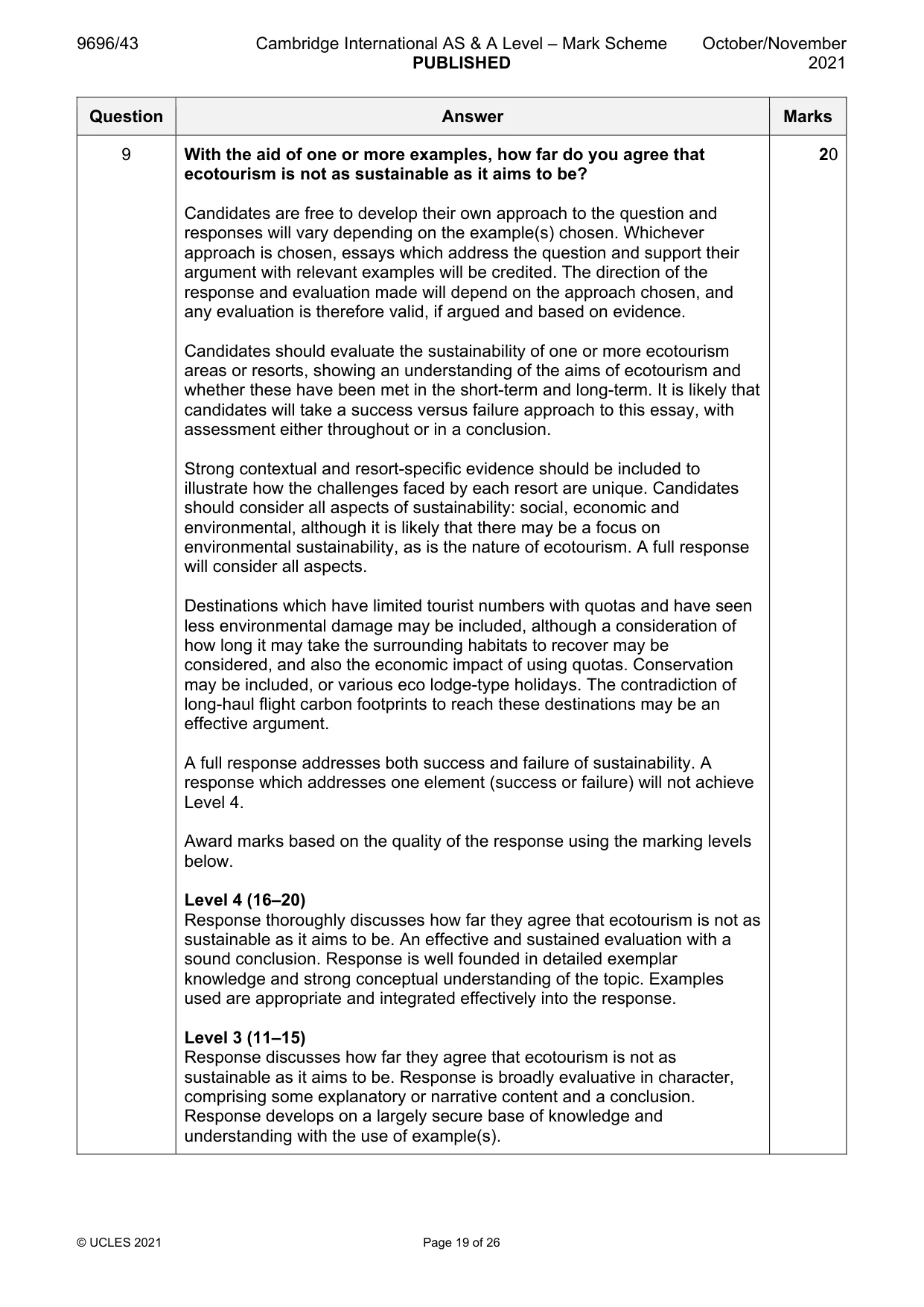
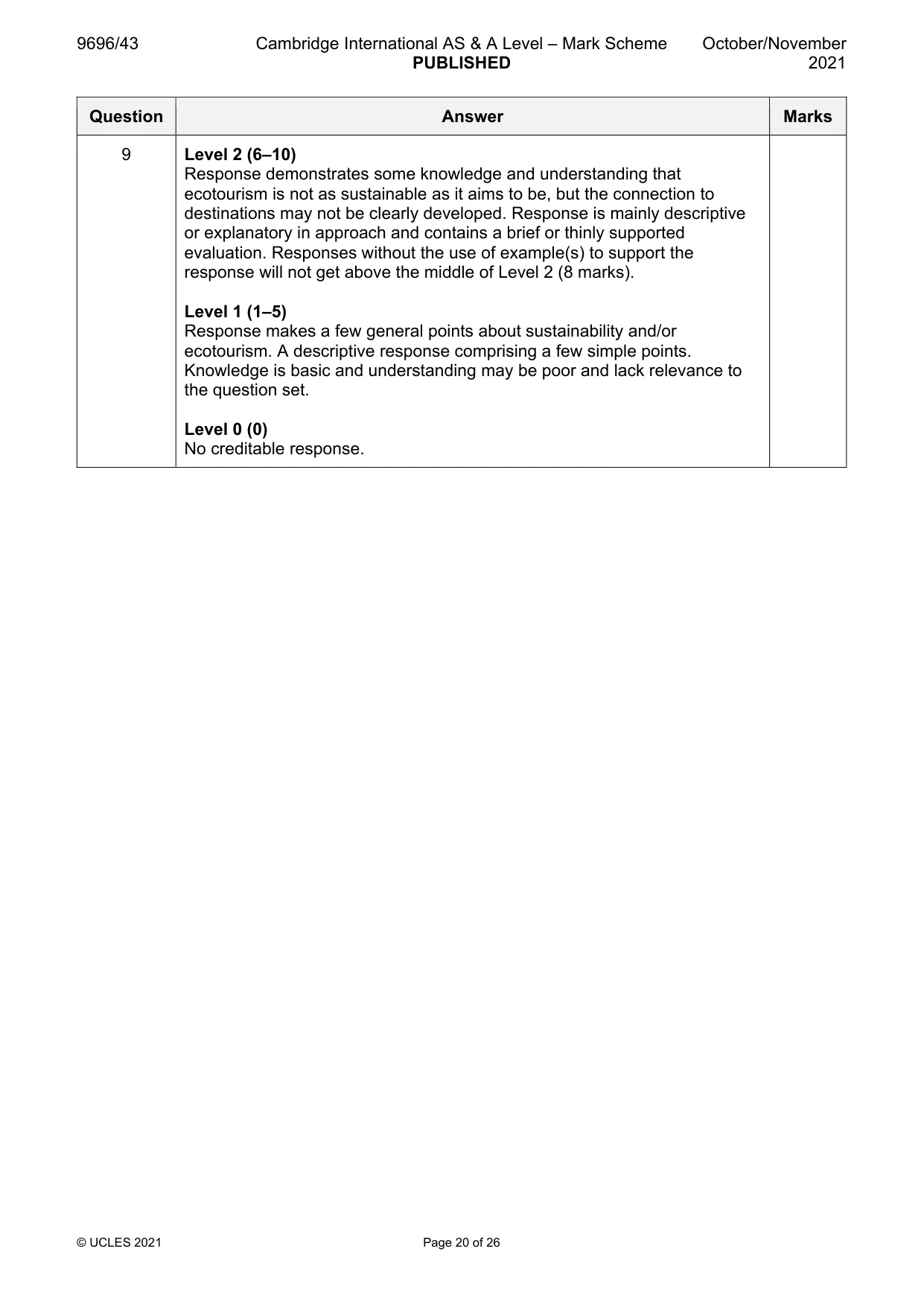
Mark scheme: 9 With the aid of one or more examples, how far do you agree that 20 ecotourism is not as sustainable as it aims to be? Candidates are free to develop their own approach to the question and responses will vary depending on the example(s) chosen. Whichever approach is chosen, essays which address the question and support their argument with relevant examples will be credited. The direction of the response and evaluation made will depend on the approach chosen, and any evaluation is therefore valid, if argued and based on evidence. Candidates should evaluate the sustainability of one or more ecotourism areas or resorts, showing an understanding of the aims of ecotourism and whether these have been met in the short-term and long-term. It is likely that candidates will take a success versus failure approach to this essay, with assessment either throughout or in a conclusion. Strong contextual and resort-specific evidence should be included to illustrate how the challenges faced by each resort are unique. Candidates should consider all aspects of sustainability: social, economic and environmental, although it is likely that there may be a focus on environmental sustainability, as is the nature of ecotourism. A full response will consider all aspects. Destinations which have limited tourist numbers with quotas and have seen less environmental damage may be included, although a consideration of how long it may take the surrounding habitats to recover may be considered, and also the economic impact of using quotas. Conservation may be included, or various eco lodge-type holidays. The contradiction of long-haul flight carbon footprints to reach these destinations may be an effective argument. A full response addresses both success and failure of sustainability. A response which addresses one element (success or failure) will not achieve Level 4. Award marks based on the quality of the response using the marking levels below. Level 4 (16–20) Response thoroughly discusses how far they agree that ecotourism is not as sustainable as it aims to be. An effective and sustained evaluation with a sound conclusion. Response is well founded in detailed exemplar knowledge and strong conceptual understanding of the topic. Examples used are appropriate and integrated effectively into the response. Level 3 (11–15) Response discusses how far they agree that ecotourism is not as sustainable as it aims to be. Response is broadly evaluative in character, comprising some explanatory or narrative content and a conclusion. Response develops on a largely secure base of knowledge and understanding with the use of example(s). 9 Level 2 (6–10) Response demonstrates some knowledge and understanding that ecotourism is not as sustainable as it aims to be, but the connection to destinations may not be clearly developed. Response is mainly descriptive or explanatory in approach and contains a brief or thinly supported evaluation. Responses without the use of example(s) to support the response will not get above the middle of Level 2 (8 marks). Level 1 (1–5) Response makes a few general points about sustainability and/or ecotourism. A descriptive response comprising a few simple points. Knowledge is basic and understanding may be poor and lack relevance to the question set. Level 0 (0) No creditable response. Economic transition If answering this option, answer Question 10 and either Question 11 or Question 12.
Q10 · Foreign direct investment (FDI) in world regions, 2017 and 2018
10 Fig. 10.1 shows foreign direct investment (FDI) in world regions, 2017 and 2018. (a) Using Fig. 10.1, compare the changes in FDI between 2017 and 2018 for the world regions shown. [4] (b) Explain how economic indicators can be used as a measure of social and economic wellbeing. [6]
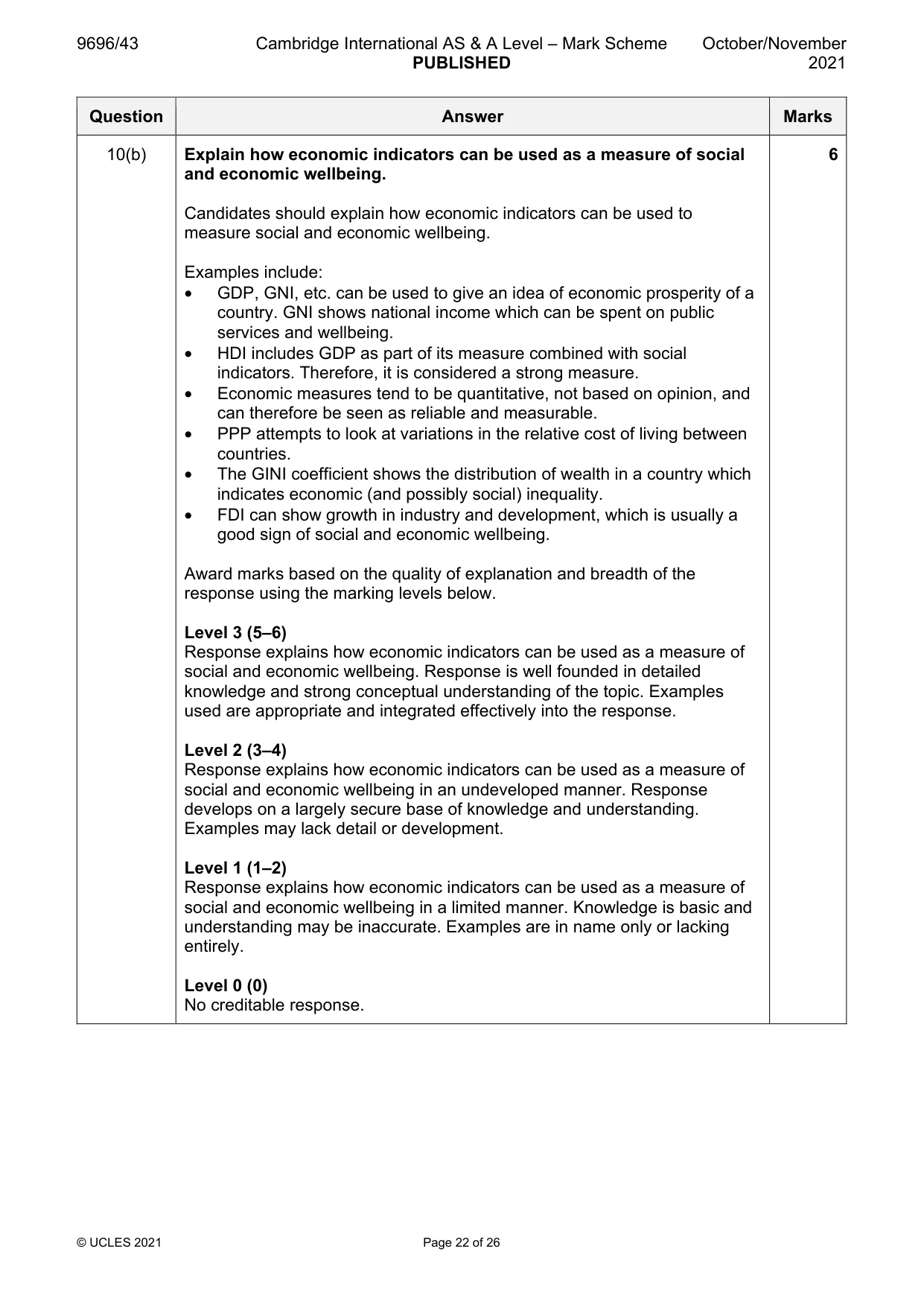
Mark scheme: 10(a) Fig. 10.1 shows foreign direct investment (FDI) in world regions, 2017 4 and 2018. Using Fig. 10.1, compare the changes in FDI between 2017 and 2018 for the world regions shown. Candidates should compare the changes in FDI for the world regions between 2017 and 2018. For example: • Most have little change • Europe, though, has a very big change – decrease from $370bn to $100bn whereas others have small changes • Latin America and the Caribbean, and Africa have the smallest changes in real terms (less than $20bn) • North America, Latin America and the Caribbean, and Europe (3 out of the 5) have decreased • Comment on rate of change, for example, for the two which increase, Africa has negligible increase and Asia has a noticeable increase • Asia and Africa maintain their rank / Europe has the biggest change in rank, it falls from 2nd place in 2017 to 4th place in 2018 • Other Award 1 mark for each point of comparison identified. 10(b) Explain how economic indicators can be used as a measure of social 6 and economic wellbeing. Candidates should explain how economic indicators can be used to measure social and economic wellbeing. Examples include: • GDP, GNI, etc. can be used to give an idea of economic prosperity of a country. GNI shows national income which can be spent on public services and wellbeing. • HDI includes GDP as part of its measure combined with social indicators. Therefore, it is considered a strong measure. • Economic measures tend to be quantitative, not based on opinion, and can therefore be seen as reliable and measurable. • PPP attempts to look at variations in the relative cost of living between countries. • The GINI coefficient shows the distribution of wealth in a country which indicates economic (and possibly social) inequality. • FDI can show growth in industry and development, which is usually a good sign of social and economic wellbeing. Award marks based on the quality of explanation and breadth of the response using the marking levels below. Level 3 (5–6) Response explains how economic indicators can be used as a measure of social and economic wellbeing. Response is well founded in detailed knowledge and strong conceptual understanding of the topic. Examples used are appropriate and integrated effectively into the response. Level 2 (3–4) Response explains how economic indicators can be used as a measure of social and economic wellbeing in an undeveloped manner. Response develops on a largely secure base of knowledge and understanding. Examples may lack detail or development. Level 1 (1–2) Response explains how economic indicators can be used as a measure of social and economic wellbeing in a limited manner. Knowledge is basic and understanding may be inaccurate. Examples are in name only or lacking entirely. Level 0 (0) No creditable response.
Q11 · To what extent have the spatial organisation and operation of transnational corporations…
11 To what extent have the spatial organisation and operation of transnational corporations (TNCs) caused changes in the location of global economic activity? [20]
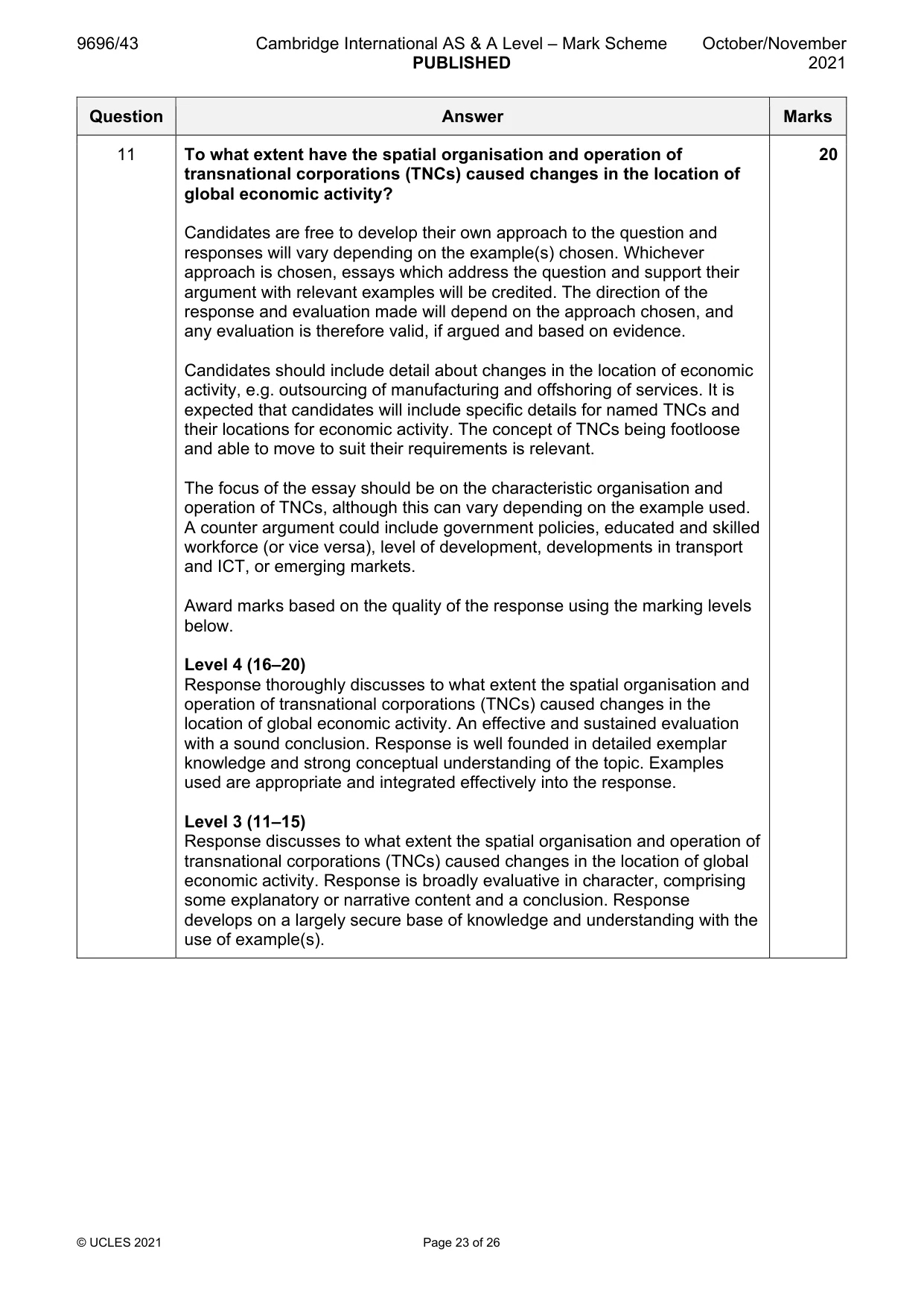
Mark scheme: 11 To what extent have the spatial organisation and operation of 20 transnational corporations (TNCs) caused changes in the location of global economic activity? Candidates are free to develop their own approach to the question and responses will vary depending on the example(s) chosen. Whichever approach is chosen, essays which address the question and support their argument with relevant examples will be credited. The direction of the response and evaluation made will depend on the approach chosen, and any evaluation is therefore valid, if argued and based on evidence. Candidates should include detail about changes in the location of economic activity, e.g. outsourcing of manufacturing and offshoring of services. It is expected that candidates will include specific details for named TNCs and their locations for economic activity. The concept of TNCs being footloose and able to move to suit their requirements is relevant. The focus of the essay should be on the characteristic organisation and operation of TNCs, although this can vary depending on the example used. A counter argument could include government policies, educated and skilled workforce (or vice versa), level of development, developments in transport and ICT, or emerging markets. Award marks based on the quality of the response using the marking levels below. Level 4 (16–20) Response thoroughly discusses to what extent the spatial organisation and operation of transnational corporations (TNCs) caused changes in the location of global economic activity. An effective and sustained evaluation with a sound conclusion. Response is well founded in detailed exemplar knowledge and strong conceptual understanding of the topic. Examples used are appropriate and integrated effectively into the response. Level 3 (11–15) Response discusses to what extent the spatial organisation and operation of transnational corporations (TNCs) caused changes in the location of global economic activity. Response is broadly evaluative in character, comprising some explanatory or narrative content and a conclusion. Response develops on a largely secure base of knowledge and understanding with the use of example(s). 11 Level 2 (6–10) Response demonstrates some knowledge and understanding of the spatial organisation and operation of transnational corporations (TNCs) that caused changes in the location of global economic activity. Response is mainly descriptive or explanatory in approach and contains a brief or thinly supported evaluation. Responses without the use of example(s) to support the response will not get above the middle of Level 2 (8 marks). Level 1 (1–5) Response makes a few general points about the spatial organisation and operation of transnational corporations (TNCs) and/or changes in the location of global economic activity. A descriptive response comprising a few simple points. Knowledge is basic and understanding may be poor and lack relevance to the question set. Level 0 (0) No creditable response.
Q12 · Assess the extent to which regional disparities in one country were caused by cumulative…
12 Assess the extent to which regional disparities in one country were caused by cumulative causation. [20]
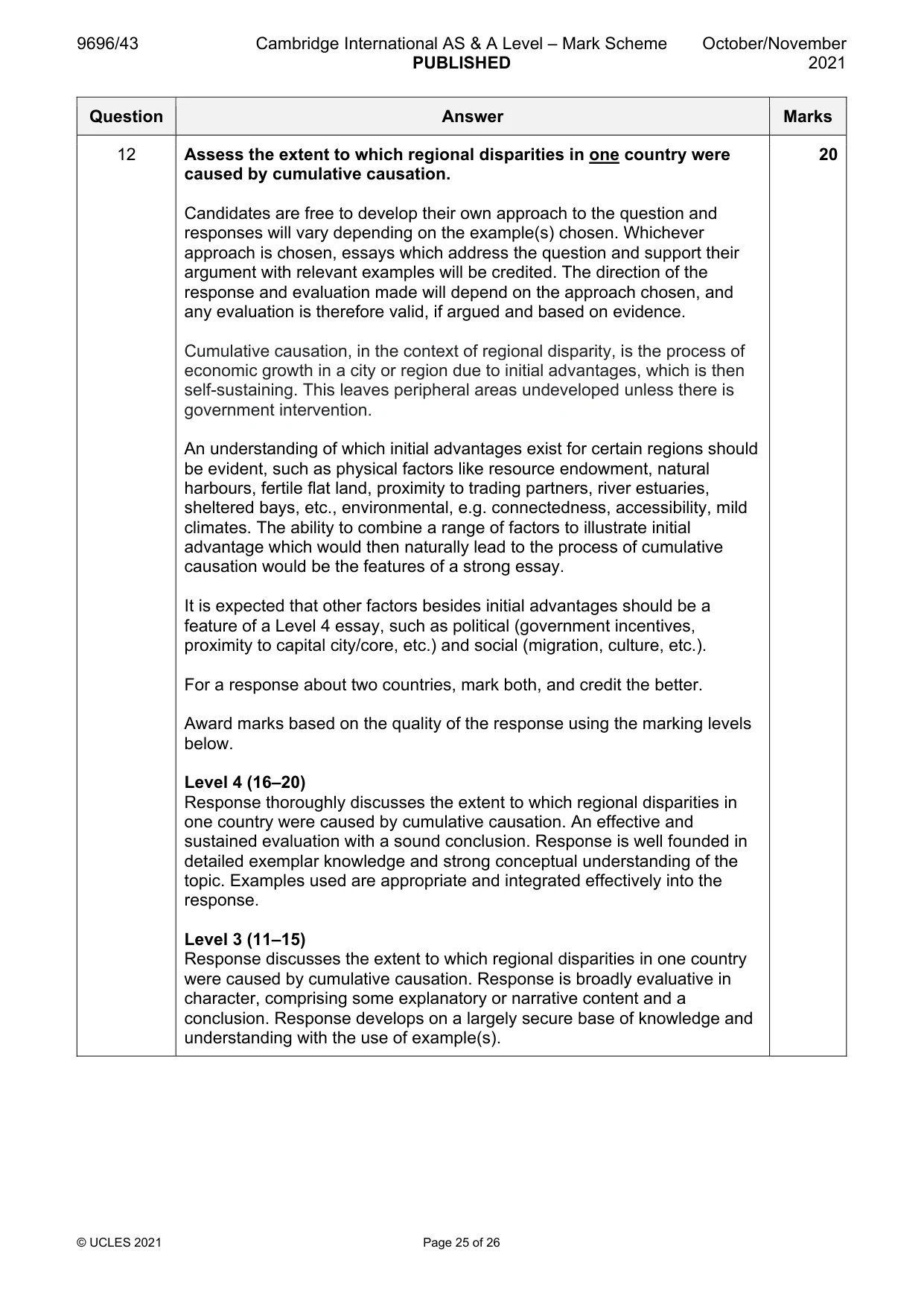
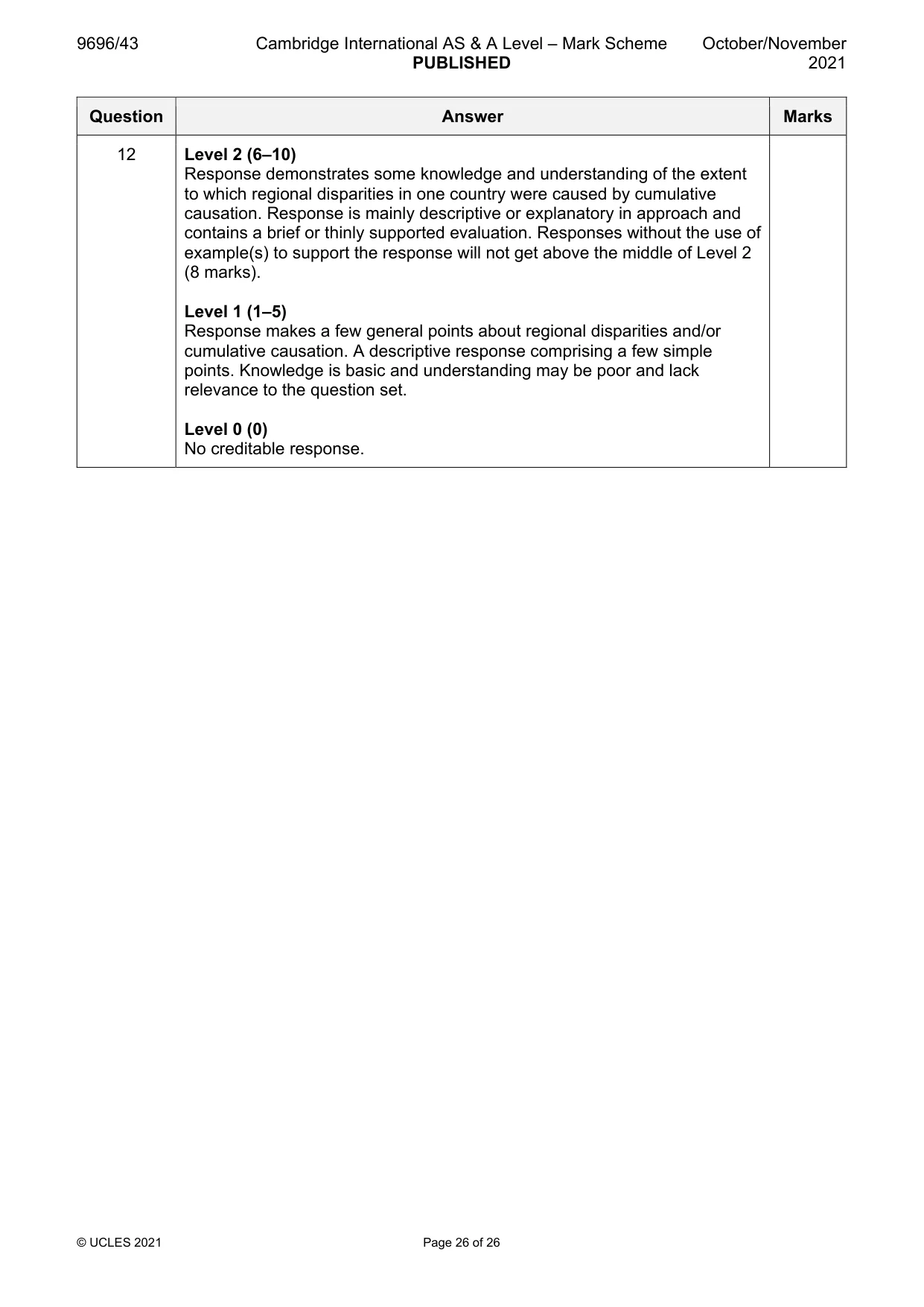
Mark scheme: 12 Assess the extent to which regional disparities in one country were 20 caused by cumulative causation. Candidates are free to develop their own approach to the question and responses will vary depending on the example(s) chosen. Whichever approach is chosen, essays which address the question and support their argument with relevant examples will be credited. The direction of the response and evaluation made will depend on the approach chosen, and any evaluation is therefore valid, if argued and based on evidence. Cumulative causation, in the context of regional disparity, is the process of economic growth in a city or region due to initial advantages, which is then self-sustaining. This leaves peripheral areas undeveloped unless there is government intervention. An understanding of which initial advantages exist for certain regions should be evident, such as physical factors like resource endowment, natural harbours, fertile flat land, proximity to trading partners, river estuaries, sheltered bays, etc., environmental, e.g. connectedness, accessibility, mild climates. The ability to combine a range of factors to illustrate initial advantage which would then naturally lead to the process of cumulative causation would be the features of a strong essay. It is expected that other factors besides initial advantages should be a feature of a Level 4 essay, such as political (government incentives, proximity to capital city/core, etc.) and social (migration, culture, etc.). For a response about two countries, mark both, and credit the better. Award marks based on the quality of the response using the marking levels below. Level 4 (16–20) Response thoroughly discusses the extent to which regional disparities in one country were caused by cumulative causation. An effective and sustained evaluation with a sound conclusion. Response is well founded in detailed exemplar knowledge and strong conceptual understanding of the topic. Examples used are appropriate and integrated effectively into the response. Level 3 (11–15) Response discusses the extent to which regional disparities in one country were caused by cumulative causation. Response is broadly evaluative in character, comprising some explanatory or narrative content and a conclusion. Response develops on a largely secure base of knowledge and understanding with the use of example(s). 12 Level 2 (6–10) Response demonstrates some knowledge and understanding of the extent to which regional disparities in one country were caused by cumulative causation. Response is mainly descriptive or explanatory in approach and contains a brief or thinly supported evaluation. Responses without the use of example(s) to support the response will not get above the middle of Level 2 (8 marks). Level 1 (1–5) Response makes a few general points about regional disparities and/or cumulative causation. A descriptive response comprising a few simple points. Knowledge is basic and understanding may be poor and lack relevance to the question set. Level 0 (0) No creditable response.
What was in this paper
The subtopics covered by these 12 questions, and how many questions each got. Open one in a new tab to see every Cambridge question on it.
2Agricultural systems and food production1Manufacturing and related service industry1National development1Regional development within countries1The development of international tourism1The globalisation of economic activity1The management of a degraded environment1The management of a tourist destination1The management of agricultural change1Trade flows and trading patterns1What you needed in this session
Cambridge’s own grade thresholds for 2021 Oct/Nov, Paper 4 · Variant 3. A higher threshold means an easier paper — the bar moves with how the cohort did.