Cambridge A Level Geography 9696 — 2020 Oct/Nov Paper 3 · Variant 1
9696/31/O/N/20 · 12 questions · 60 marks · ≈68 min
The question paper and its mark scheme, free to read here and free to download. This is Cambridge’s own paper, exactly as it was sat.
Question paper4 pages

Mark scheme18 pages
Answers below. Sit the paper first if you are practising.



Questions as text
Q1 · A climate graph for Kampala, Uganda, in Africa
1 Fig. 1.1 is a climate graph for Kampala, Uganda, in Africa. (a) Describe the climate of Kampala shown in Fig. 1.1. [4] (b) Suggest reasons for the variation in precipitation shown in Fig. 1.1. [6]
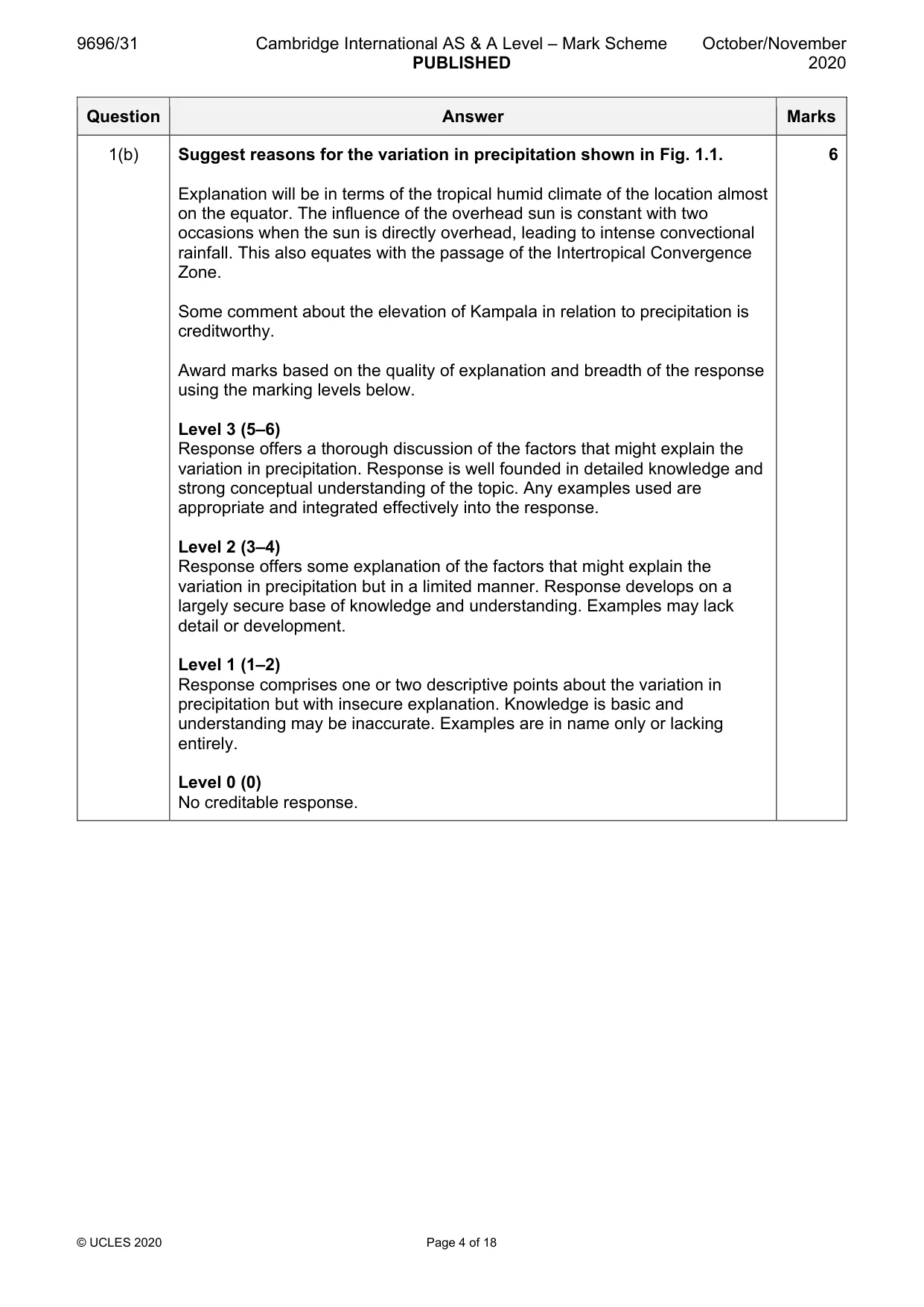
Mark scheme: Question Answer Marks 1(a) Fig. 1.1 is a climate graph for Kampala, Uganda, in Africa. 4 Describe the climate of Kampala shown in Fig. 1.1. The general points that could be noted are: • It is hot all year round • It is humid/wet all year round For precipitation: • Two (double) maxima in April and November with April having the highest amount • Minima in January and July For temperature: • Very low range of annual temperature Accurate use of data to illustrate one of the above points gets 1 mark. Description of both temperature and precipitation needed for 4 marks. 1(b) Suggest reasons for the variation in precipitation shown in Fig. 1.1. 6 Explanation will be in terms of the tropical humid climate of the location almost on the equator. The influence of the overhead sun is constant with two occasions when the sun is directly overhead, leading to intense convectional rainfall. This also equates with the passage of the Intertropical Convergence Zone. Some comment about the elevation of Kampala in relation to precipitation is creditworthy. Award marks based on the quality of explanation and breadth of the response using the marking levels below. Level 3 (5–6) Response offers a thorough discussion of the factors that might explain the variation in precipitation. Response is well founded in detailed knowledge and strong conceptual understanding of the topic. Any examples used are appropriate and integrated effectively into the response. Level 2 (3–4) Response offers some explanation of the factors that might explain the variation in precipitation but in a limited manner. Response develops on a largely secure base of knowledge and understanding. Examples may lack detail or development. Level 1 (1–2) Response comprises one or two descriptive points about the variation in precipitation but with insecure explanation. Knowledge is basic and understanding may be inaccurate. Examples are in name only or lacking entirely. Level 0 (0) No creditable response.
Q2 · Assess the extent to which the characteristics of soil profiles in savanna ecosystems are…
2 Assess the extent to which the characteristics of soil profiles in savanna ecosystems are the result of climatic characteristics. [20]
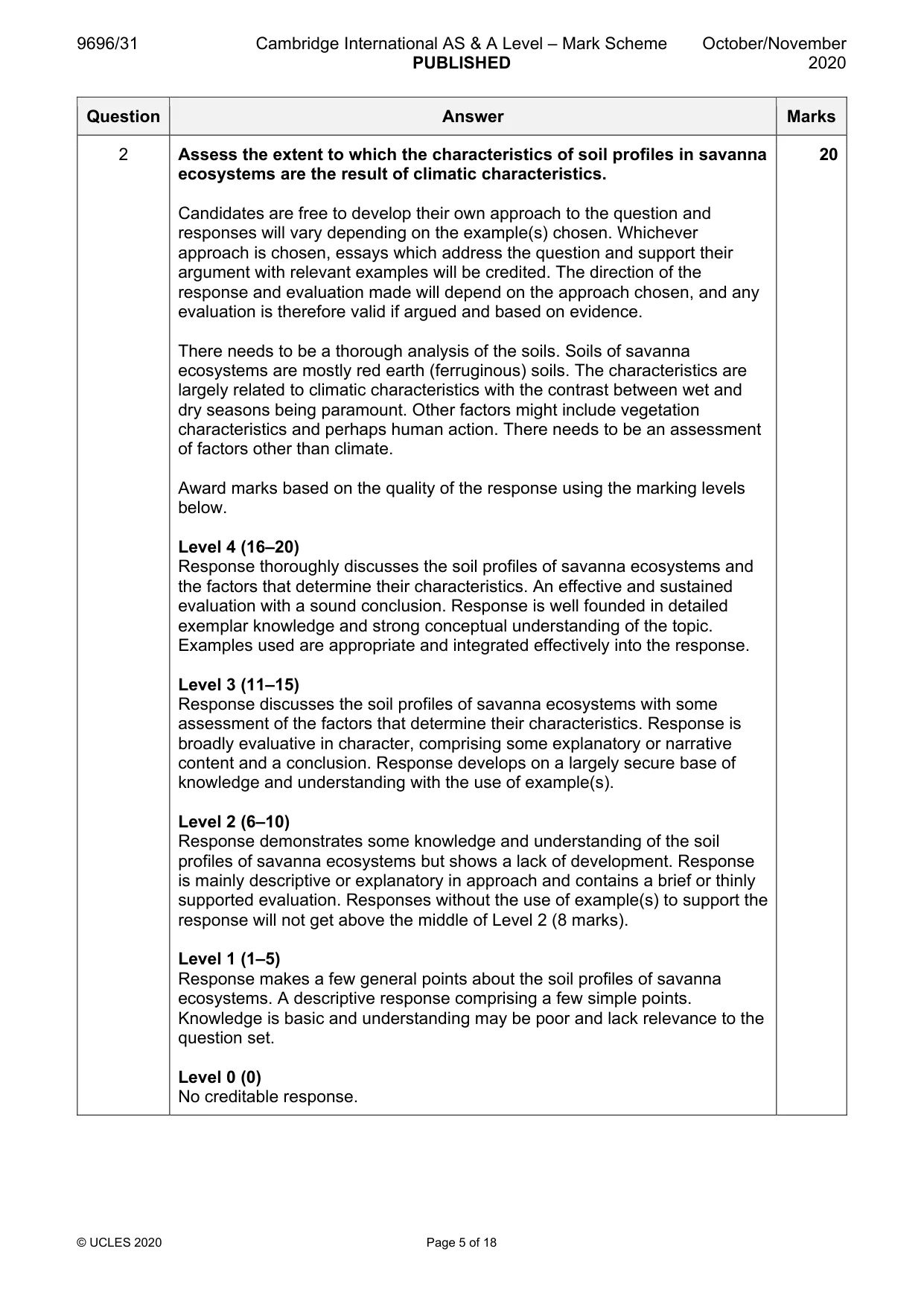
Mark scheme: 2 Assess the extent to which the characteristics of soil profiles in savanna 20 ecosystems are the result of climatic characteristics. Candidates are free to develop their own approach to the question and responses will vary depending on the example(s) chosen. Whichever approach is chosen, essays which address the question and support their argument with relevant examples will be credited. The direction of the response and evaluation made will depend on the approach chosen, and any evaluation is therefore valid if argued and based on evidence. There needs to be a thorough analysis of the soils. Soils of savanna ecosystems are mostly red earth (ferruginous) soils. The characteristics are largely related to climatic characteristics with the contrast between wet and dry seasons being paramount. Other factors might include vegetation characteristics and perhaps human action. There needs to be an assessment of factors other than climate. Award marks based on the quality of the response using the marking levels below. Level 4 (16–20) Response thoroughly discusses the soil profiles of savanna ecosystems and the factors that determine their characteristics. An effective and sustained evaluation with a sound conclusion. Response is well founded in detailed exemplar knowledge and strong conceptual understanding of the topic. Examples used are appropriate and integrated effectively into the response. Level 3 (11–15) Response discusses the soil profiles of savanna ecosystems with some assessment of the factors that determine their characteristics. Response is broadly evaluative in character, comprising some explanatory or narrative content and a conclusion. Response develops on a largely secure base of knowledge and understanding with the use of example(s). Level 2 (6–10) Response demonstrates some knowledge and understanding of the soil profiles of savanna ecosystems but shows a lack of development. Response is mainly descriptive or explanatory in approach and contains a brief or thinly supported evaluation. Responses without the use of example(s) to support the response will not get above the middle of Level 2 (8 marks). Level 1 (1–5) Response makes a few general points about the soil profiles of savanna ecosystems. A descriptive response comprising a few simple points. Knowledge is basic and understanding may be poor and lack relevance to the question set. Level 0 (0) No creditable response.
Q3 · Describe some of the problems of sustainable management of either the tropical rainforest…
3 Describe some of the problems of sustainable management of either the tropical rainforest ecosystem or the savanna ecosystem and evaluate attempted solutions to the problems. [20] Coastal environments If answering this option, answer Question 4 and either Question 5 or Question 6.
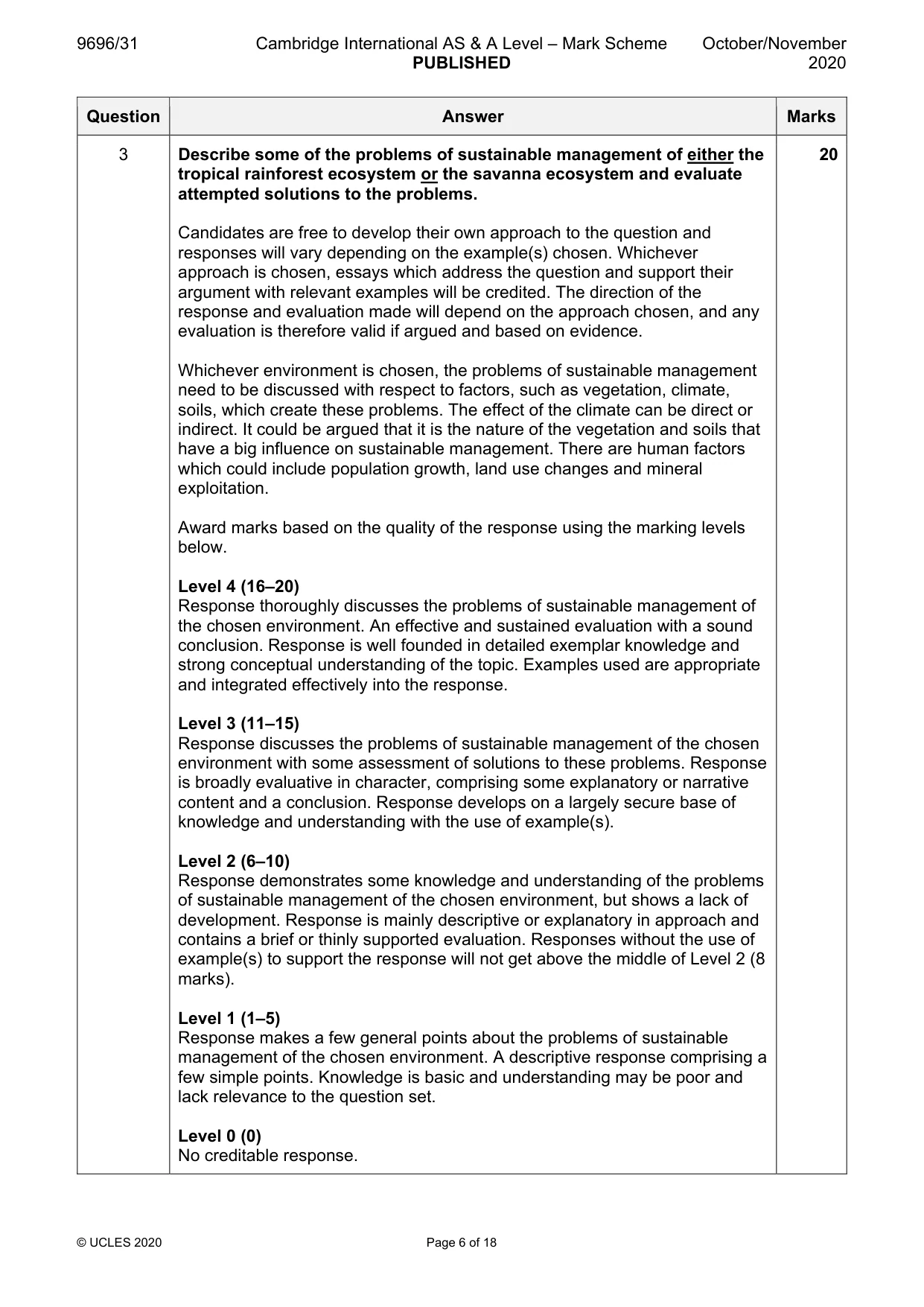
Mark scheme: 3 Describe some of the problems of sustainable management of either the 20 tropical rainforest ecosystem or the savanna ecosystem and evaluate attempted solutions to the problems. Candidates are free to develop their own approach to the question and responses will vary depending on the example(s) chosen. Whichever approach is chosen, essays which address the question and support their argument with relevant examples will be credited. The direction of the response and evaluation made will depend on the approach chosen, and any evaluation is therefore valid if argued and based on evidence. Whichever environment is chosen, the problems of sustainable management need to be discussed with respect to factors, such as vegetation, climate, soils, which create these problems. The effect of the climate can be direct or indirect. It could be argued that it is the nature of the vegetation and soils that have a big influence on sustainable management. There are human factors which could include population growth, land use changes and mineral exploitation. Award marks based on the quality of the response using the marking levels below. Level 4 (16–20) Response thoroughly discusses the problems of sustainable management of the chosen environment. An effective and sustained evaluation with a sound conclusion. Response is well founded in detailed exemplar knowledge and strong conceptual understanding of the topic. Examples used are appropriate and integrated effectively into the response. Level 3 (11–15) Response discusses the problems of sustainable management of the chosen environment with some assessment of solutions to these problems. Response is broadly evaluative in character, comprising some explanatory or narrative content and a conclusion. Response develops on a largely secure base of knowledge and understanding with the use of example(s). Level 2 (6–10) Response demonstrates some knowledge and understanding of the problems of sustainable management of the chosen environment, but shows a lack of development. Response is mainly descriptive or explanatory in approach and contains a brief or thinly supported evaluation. Responses without the use of example(s) to support the response will not get above the middle of Level 2 (8 marks). Level 1 (1–5) Response makes a few general points about the problems of sustainable management of the chosen environment. A descriptive response comprising a few simple points. Knowledge is basic and understanding may be poor and lack relevance to the question set. Level 0 (0) No creditable response. Coastal environments If answering this option, answer Question 4 and either Question 5 or Question 6.
Q4 · Marine processes operating on a coastline in north-east USA, in 2017
4 Fig. 4.1 shows marine processes operating on a coastline in north-east USA, in 2017. (a) Describe the pattern of marine processes shown in Fig. 4.1. [4] (b) Suggest two reasons for variations in rates of marine deposition. [6]
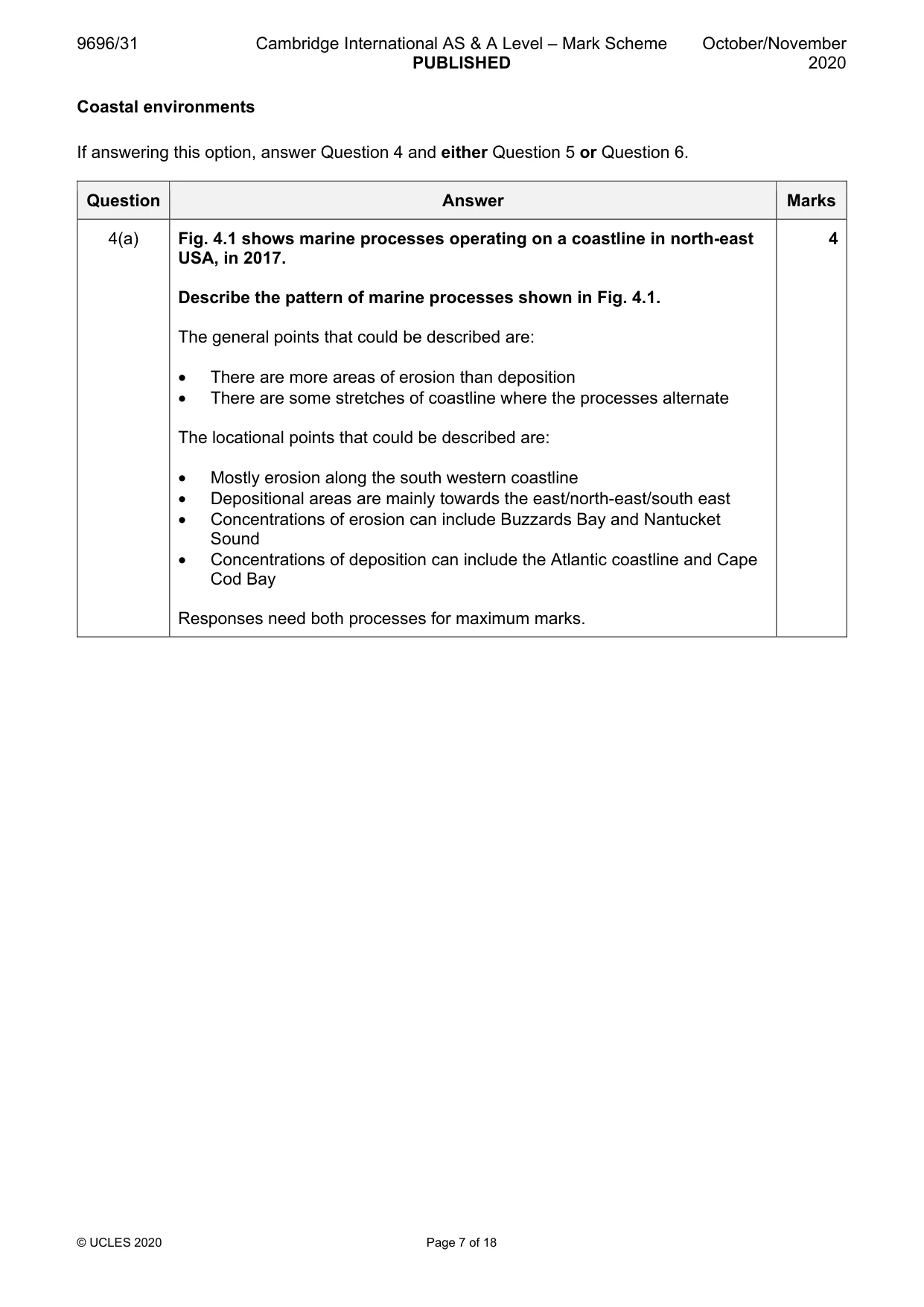
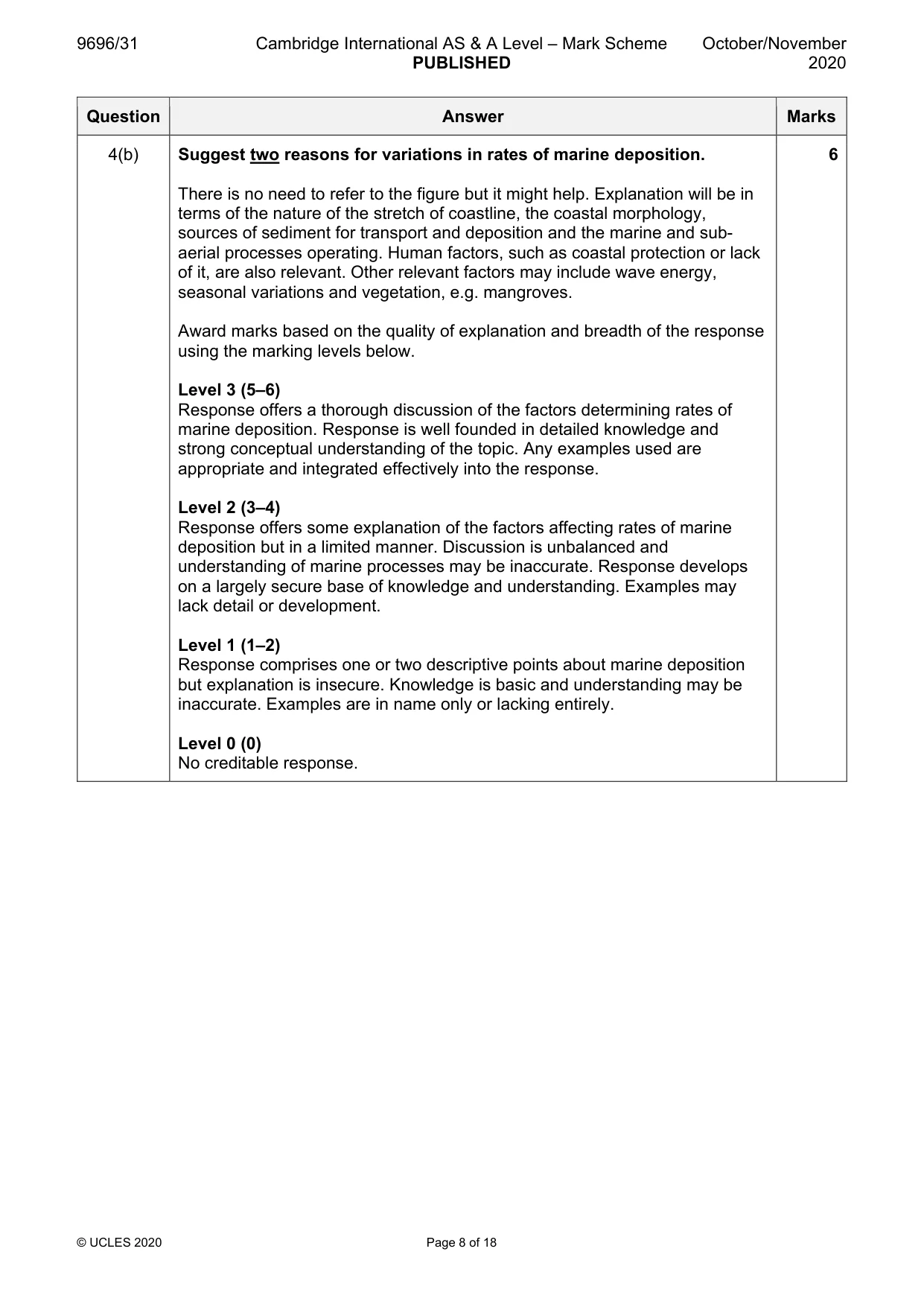
Mark scheme: 4(a) Fig. 4.1 shows marine processes operating on a coastline in north-east 4 USA, in 2017. Describe the pattern of marine processes shown in Fig. 4.1. The general points that could be described are: • There are more areas of erosion than deposition • There are some stretches of coastline where the processes alternate The locational points that could be described are: • Mostly erosion along the south western coastline • Depositional areas are mainly towards the east/north-east/south east • Concentrations of erosion can include Buzzards Bay and Nantucket Sound • Concentrations of deposition can include the Atlantic coastline and Cape Cod Bay Responses need both processes for maximum marks. 4(b) Suggest two reasons for variations in rates of marine deposition. 6 There is no need to refer to the figure but it might help. Explanation will be in terms of the nature of the stretch of coastline, the coastal morphology, sources of sediment for transport and deposition and the marine and sub- aerial processes operating. Human factors, such as coastal protection or lack of it, are also relevant. Other relevant factors may include wave energy, seasonal variations and vegetation, e.g. mangroves. Award marks based on the quality of explanation and breadth of the response using the marking levels below. Level 3 (5–6) Response offers a thorough discussion of the factors determining rates of marine deposition. Response is well founded in detailed knowledge and strong conceptual understanding of the topic. Any examples used are appropriate and integrated effectively into the response. Level 2 (3–4) Response offers some explanation of the factors affecting rates of marine deposition but in a limited manner. Discussion is unbalanced and understanding of marine processes may be inaccurate. Response develops on a largely secure base of knowledge and understanding. Examples may lack detail or development. Level 1 (1–2) Response comprises one or two descriptive points about marine deposition but explanation is insecure. Knowledge is basic and understanding may be inaccurate. Examples are in name only or lacking entirely. Level 0 (0) No creditable response.
Q5 · Assess the extent to which rock type and rock structure are important factors in…
5 Assess the extent to which rock type and rock structure are important factors in explaining the characteristics of coastal cliffs. [20]
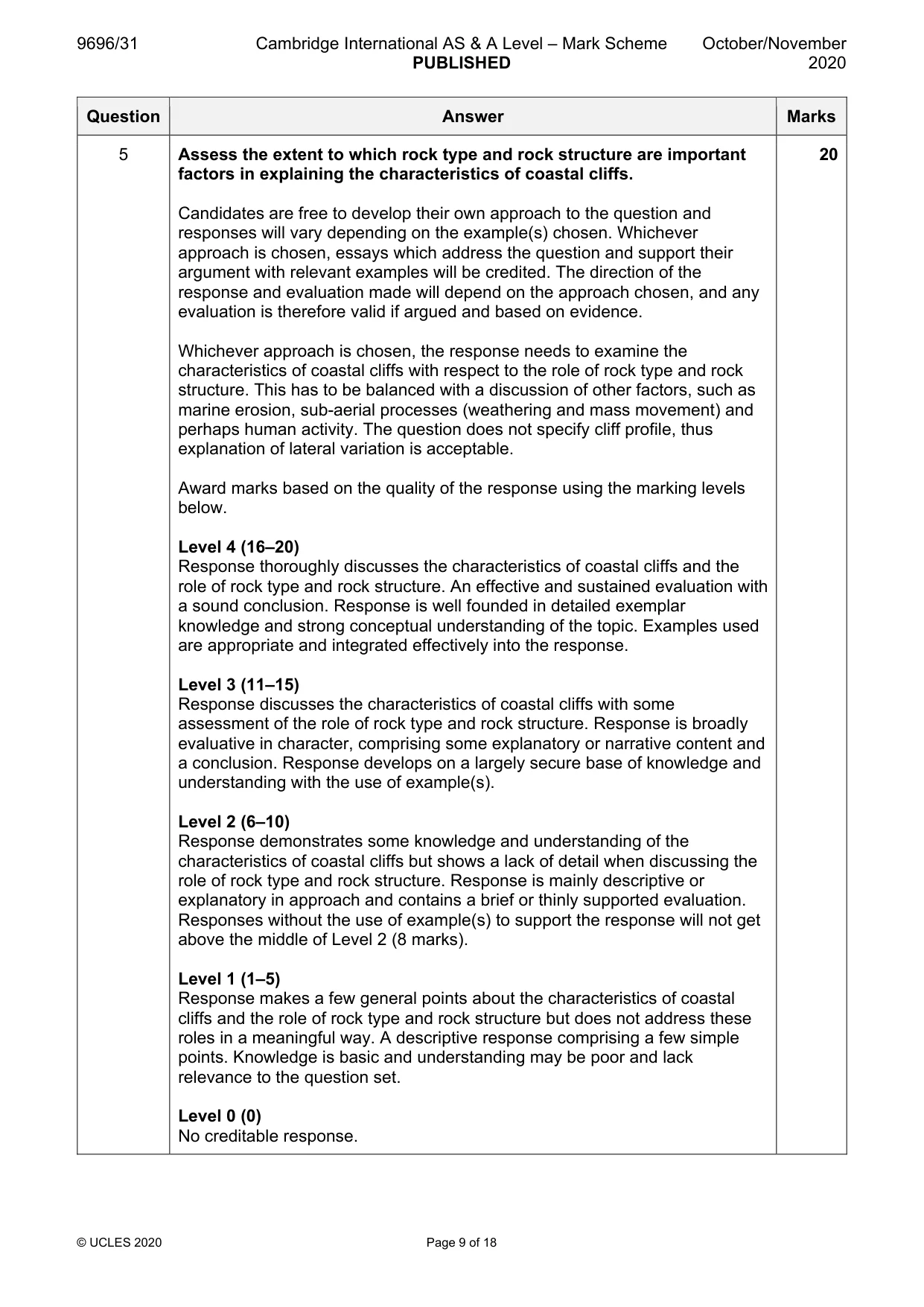
Mark scheme: 5 Assess the extent to which rock type and rock structure are important 20 factors in explaining the characteristics of coastal cliffs. Candidates are free to develop their own approach to the question and responses will vary depending on the example(s) chosen. Whichever approach is chosen, essays which address the question and support their argument with relevant examples will be credited. The direction of the response and evaluation made will depend on the approach chosen, and any evaluation is therefore valid if argued and based on evidence. Whichever approach is chosen, the response needs to examine the characteristics of coastal cliffs with respect to the role of rock type and rock structure. This has to be balanced with a discussion of other factors, such as marine erosion, sub-aerial processes (weathering and mass movement) and perhaps human activity. The question does not specify cliff profile, thus explanation of lateral variation is acceptable. Award marks based on the quality of the response using the marking levels below. Level 4 (16–20) Response thoroughly discusses the characteristics of coastal cliffs and the role of rock type and rock structure. An effective and sustained evaluation with a sound conclusion. Response is well founded in detailed exemplar knowledge and strong conceptual understanding of the topic. Examples used are appropriate and integrated effectively into the response. Level 3 (11–15) Response discusses the characteristics of coastal cliffs with some assessment of the role of rock type and rock structure. Response is broadly evaluative in character, comprising some explanatory or narrative content and a conclusion. Response develops on a largely secure base of knowledge and understanding with the use of example(s). Level 2 (6–10) Response demonstrates some knowledge and understanding of the characteristics of coastal cliffs but shows a lack of detail when discussing the role of rock type and rock structure. Response is mainly descriptive or explanatory in approach and contains a brief or thinly supported evaluation. Responses without the use of example(s) to support the response will not get above the middle of Level 2 (8 marks). Level 1 (1–5) Response makes a few general points about the characteristics of coastal cliffs and the role of rock type and rock structure but does not address these roles in a meaningful way. A descriptive response comprising a few simple points. Knowledge is basic and understanding may be poor and lack relevance to the question set. Level 0 (0) No creditable response.
Q6 · ‘The successful management of a stretch of coastline is helped by an understanding of the…
6 ‘The successful management of a stretch of coastline is helped by an understanding of the operation of sediment cells.’ With the aid of one or more examples, how far do you agree? [20] Hazardous environments If answering this option, answer Question 7 and either Question 8 or Question 9.
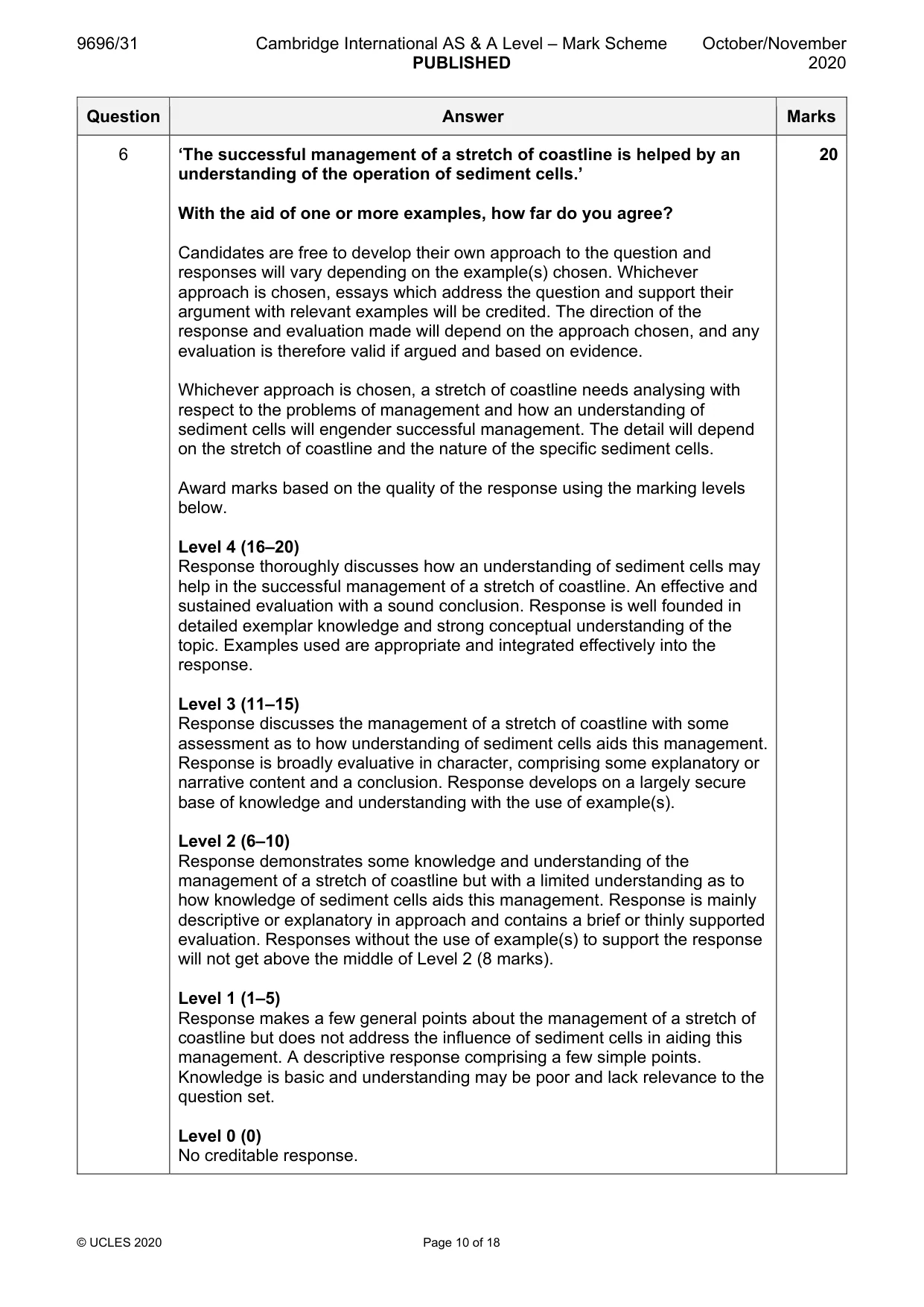
Mark scheme: 6 ‘The successful management of a stretch of coastline is helped by an 20 understanding of the operation of sediment cells.’ With the aid of one or more examples, how far do you agree? Candidates are free to develop their own approach to the question and responses will vary depending on the example(s) chosen. Whichever approach is chosen, essays which address the question and support their argument with relevant examples will be credited. The direction of the response and evaluation made will depend on the approach chosen, and any evaluation is therefore valid if argued and based on evidence. Whichever approach is chosen, a stretch of coastline needs analysing with respect to the problems of management and how an understanding of sediment cells will engender successful management. The detail will depend on the stretch of coastline and the nature of the specific sediment cells. Award marks based on the quality of the response using the marking levels below. Level 4 (16–20) Response thoroughly discusses how an understanding of sediment cells may help in the successful management of a stretch of coastline. An effective and sustained evaluation with a sound conclusion. Response is well founded in detailed exemplar knowledge and strong conceptual understanding of the topic. Examples used are appropriate and integrated effectively into the response. Level 3 (11–15) Response discusses the management of a stretch of coastline with some assessment as to how understanding of sediment cells aids this management. Response is broadly evaluative in character, comprising some explanatory or narrative content and a conclusion. Response develops on a largely secure base of knowledge and understanding with the use of example(s). Level 2 (6–10) Response demonstrates some knowledge and understanding of the management of a stretch of coastline but with a limited understanding as to how knowledge of sediment cells aids this management. Response is mainly descriptive or explanatory in approach and contains a brief or thinly supported evaluation. Responses without the use of example(s) to support the response will not get above the middle of Level 2 (8 marks). Level 1 (1–5) Response makes a few general points about the management of a stretch of coastline but does not address the influence of sediment cells in aiding this management. A descriptive response comprising a few simple points. Knowledge is basic and understanding may be poor and lack relevance to the question set. Level 0 (0) No creditable response. Hazardous environments If answering this option, answer Question 7 and either Question 8 or Question 9.
Q7 · Warning times and hazard durations of hurricanes, earthquakes and volcanoes
7 Fig. 7.1 shows warning times and hazard durations of hurricanes, earthquakes and volcanoes. (a) Contrast the warning times and hazard durations shown in Fig. 7.1. [3] (b) Explain the variations in the warning times and hazard durations shown in Fig. 7.1. [7]
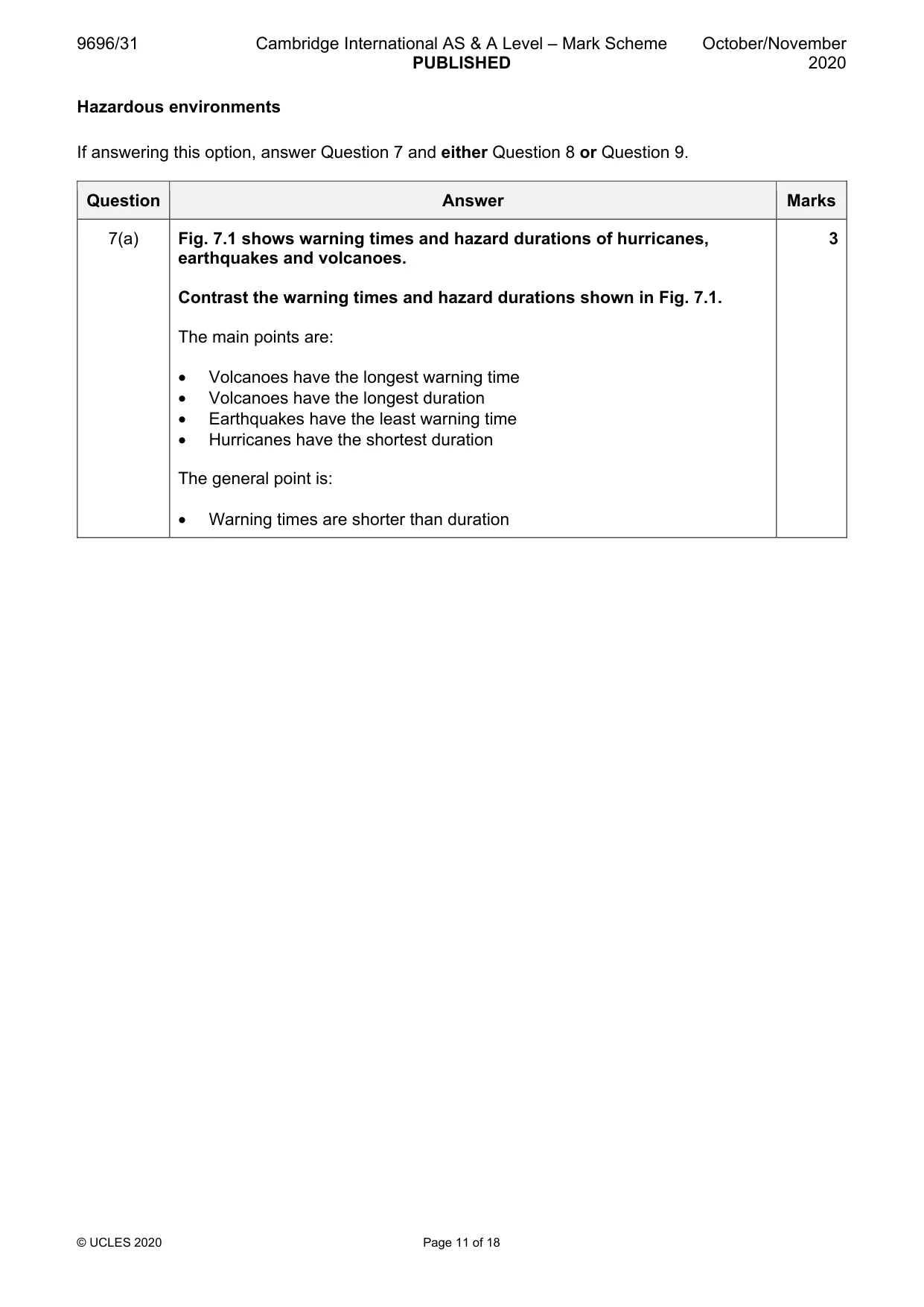
Mark scheme: 7(a) Fig. 7.1 shows warning times and hazard durations of hurricanes, 3 earthquakes and volcanoes. Contrast the warning times and hazard durations shown in Fig. 7.1. The main points are: • Volcanoes have the longest warning time • Volcanoes have the longest duration • Earthquakes have the least warning time • Hurricanes have the shortest duration The general point is: • Warning times are shorter than duration 7(b) Explain the variations in the warning times and hazard durations shown 7 in Fig. 7.1. Explanation will be in terms of an understanding of precursors to the hazard and the length of time those hazards affect a specific area. • Earthquakes generally give little warning, apart from seismic fore shocks, but may continue with aftershocks and secondary hazards after the main event. • Hurricanes can be observed forming offshore and moving towards the coast and decrease in strength quite rapidly on reaching land. • Volcanoes can show warning signs, such as bulging, gas given off, minor seismic activity, many weeks before the eruption and have a tendency to keep on erupting for a long time with secondary hazards. Award marks based on the quality of explanation and breadth of the response using the marking levels below. Level 3 (6–7) Response offers a thorough discussion of the nature of the hazards to explain the differences in warning times and length of duration. Response is well founded in detailed knowledge and strong conceptual understanding of the topic. Any examples used are appropriate and integrated effectively into the response. Level 2 (3–5) Response offers some explanation of the different warning times and length of duration but in a limited manner. Response develops on a largely secure base of knowledge and understanding. Examples may lack detail or development. Level 1 (1–2) Response comprises one or two basic points about the hazards but explanation is insecure. Knowledge is basic and understanding may be inaccurate. Examples are in name only or lacking entirely. Level 0 (0) No creditable response.
Q8 · ‘The type of eruption is the most important factor influencing the hazards from…
8 ‘The type of eruption is the most important factor influencing the hazards from volcanoes.’ With the aid of examples, how far do you agree? [20]
Mark scheme: 8 ‘The type of eruption is the most important factor influencing the 20 hazards from volcanoes.’ With the aid of examples, how far do you agree? Candidates are free to develop their own approach to the question and responses will vary depending on the example(s) chosen. Whichever approach is chosen, essays which address the question and support their argument with relevant examples will be credited. The direction of the response and evaluation made will depend on the approach chosen, and any evaluation is therefore valid if argued and based on evidence. Whichever approach is chosen, the basic distinction between explosive (acidic, andesitic, rhyolitic) and effusive (basic, basaltic) volcanic eruptions needs discussion. Explosive eruptions with a variety of products such as pyroclastic flows, ash fall, and/or volcanic bombs are more hazardous. Effusive eruptions, such as those on Hawaii and Mt Etna, mostly produce lava flows which are less hazardous. There needs to be analysis of different types and their eruption products and hazards. The question states ‘the most important factor’, thus other factors, such as frequency and intensity of the eruption, length of time of the eruption and local environment, both physical and human, could be discussed. Award marks based on the quality of the response using the marking levels below. Level 4 (16–20) Response thoroughly discusses the types of volcanic eruptions and their associated hazards. An effective and sustained evaluation with a sound conclusion. Response is well founded in detailed exemplar knowledge and strong conceptual understanding of the topic. Examples used are appropriate and integrated effectively into the response. Level 3 (11–15) Response discusses eruption types with some assessment of their hazardous effects as well as the effects of other factors. Response is broadly evaluative in character, comprising some explanatory or narrative content and a conclusion. Response develops on a largely secure base of knowledge and understanding with the use of example(s). Level 2 (6–10) Response demonstrates some knowledge and understanding of the types of volcanic eruptions but shows a lack of development with respect to their hazardous effects. Response is mainly descriptive or explanatory in approach and contains a brief or thinly supported evaluation. Responses without the use of example(s) to support the response will not get above the middle of Level 2 (8 marks). 8 Level 1 (1–5) Response makes a few general points about the type of volcanic eruptions but does not address their hazardous effects in a meaningful way. A descriptive response comprising a few simple points. Knowledge is basic and understanding may be poor and lack relevance to the question set. Level 0 (0) No creditable response.
Q9 · Using a case study, assess the extent to which a hazardous environment can be sustainably…
9 Using a case study, assess the extent to which a hazardous environment can be sustainably managed. [20] Hot arid and semi-arid environments If answering this option, answer Question 10 and either Question 11 or Question 12.
Mark scheme: 9 Using a case study, assess the extent to which a hazardous 20 environment can be sustainably managed. Candidates are free to develop their own approach to the question and responses will vary depending on the example(s) chosen. Whichever approach is chosen, essays which address the question and support their argument with relevant examples will be credited. The direction of the response and evaluation made will depend on the approach chosen, and any evaluation is therefore valid if argued and based on evidence. Whichever hazardous environment is chosen, the problems of sustainable management need to be discussed and then possible solutions to these problems assessed. These will vary with the nature of the hazardous environment and its location. Award marks based on the quality of the response using the marking levels below. Level 4 (16–20) Response thoroughly discusses the extent to which the chosen hazardous environment can be sustainably managed. An effective and sustained evaluation with a sound conclusion. Response is well founded in detailed exemplar knowledge and strong conceptual understanding of the topic. Examples used are appropriate and integrated effectively into the response. Level 3 (11–15) Response discusses the nature of the chosen hazardous environment with some assessment of the extent to which it can be sustainably managed. Response is broadly evaluative in character, comprising some explanatory or narrative content and a conclusion. Response develops on a largely secure base of knowledge and understanding with the use of example(s). Level 2 (6–10) Response demonstrates some knowledge and understanding of the chosen hazardous environment but shows a lack of development. Response is mainly descriptive or explanatory in approach and contains a brief or thinly supported evaluation. Responses without the use of example(s) to support the response will not get above the middle of Level 2 (8 marks). Level 1 (1–5) Response makes a few general points about the chosen hazardous environment but does not assess the extent to which it can be sustainably managed. A descriptive response comprising a few simple points. Knowledge is basic and understanding may be poor and lack relevance to the question set. Level 0 (0) No creditable response. Hot arid and semi-arid environments If answering this option, answer Question 10 and either Question 11 or Question 12.
Q10 · A photograph which shows a hot arid environment in California, USA
10 Fig. 10.1 is a photograph which shows a hot arid environment in California, USA. (a) Describe the main features of the environment shown in Fig. 10.1. [4] (b) Suggest how temperature has influenced the features you described in (a). [6]
Mark scheme: 10(a) Fig. 10.1 is a photograph which shows a hot arid environment in 4 California, USA. Describe the main features of the environment shown in Fig. 10.1. The main descriptive points could be: • The soils and rocks are of a reddish/light colour • The large boulder is rounded/smooth • Several smaller boulders located at the base of the large boulder • The large boulder has vertical/horizontal joints/cracks • There is patchy vegetation • The vegetation is mostly clumps of grass/low bushes/tree Four points for 4 marks. 10(b) Suggest how temperature has influenced the features you described 6 in (a). Temperature in terms of thermal fracture and exfoliation (insolation weathering) could have been influential in producing the rock characteristics described. Evaporation and salt weathering may also have occurred. The scant vegetation and its nature are also, partly, the result of temperature. Award marks based on the quality of explanation and breadth of the response using the marking levels below. Level 3 (5–6) Response offers a thorough discussion of the role of temperature in influencing the features described. Response is well founded in detailed knowledge and strong conceptual understanding of the topic. Any examples used are appropriate and integrated effectively into the response. Level 2 (3–4) Response offers some explanation of the role of temperature in influencing the features described but in a limited manner. Response develops on a largely secure base of knowledge and understanding. Examples may lack detail or development. Level 1 (1–2) Response comprises one or two descriptive points about the role of temperature in influencing the features described but with an insecure explanation. Knowledge is basic and understanding may be inaccurate. Examples are in name only or lacking entirely. Level 0 (0) No creditable response.
Q11 · ‘Soil degradation in semi-arid environments is the result of human factors.’ With the aid…
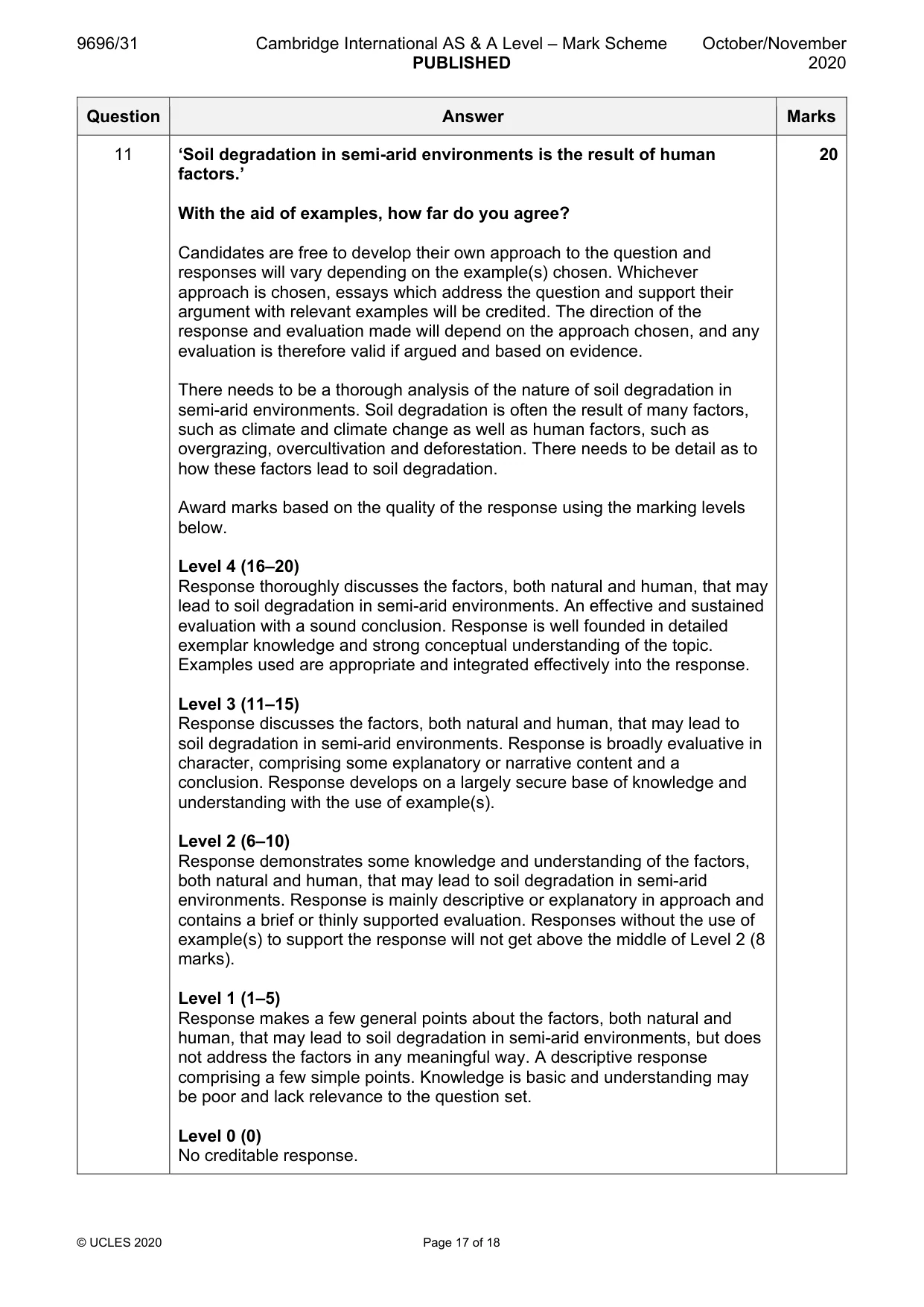
11 ‘Soil degradation in semi-arid environments is the result of human factors.’ With the aid of examples, how far do you agree? [20]
Mark scheme: 11 ‘Soil degradation in semi-arid environments is the result of human 20 factors.’ With the aid of examples, how far do you agree? Candidates are free to develop their own approach to the question and responses will vary depending on the example(s) chosen. Whichever approach is chosen, essays which address the question and support their argument with relevant examples will be credited. The direction of the response and evaluation made will depend on the approach chosen, and any evaluation is therefore valid if argued and based on evidence. There needs to be a thorough analysis of the nature of soil degradation in semi-arid environments. Soil degradation is often the result of many factors, such as climate and climate change as well as human factors, such as overgrazing, overcultivation and deforestation. There needs to be detail as to how these factors lead to soil degradation. Award marks based on the quality of the response using the marking levels below. Level 4 (16–20) Response thoroughly discusses the factors, both natural and human, that may lead to soil degradation in semi-arid environments. An effective and sustained evaluation with a sound conclusion. Response is well founded in detailed exemplar knowledge and strong conceptual understanding of the topic. Examples used are appropriate and integrated effectively into the response. Level 3 (11–15) Response discusses the factors, both natural and human, that may lead to soil degradation in semi-arid environments. Response is broadly evaluative in character, comprising some explanatory or narrative content and a conclusion. Response develops on a largely secure base of knowledge and understanding with the use of example(s). Level 2 (6–10) Response demonstrates some knowledge and understanding of the factors, both natural and human, that may lead to soil degradation in semi-arid environments. Response is mainly descriptive or explanatory in approach and contains a brief or thinly supported evaluation. Responses without the use of example(s) to support the response will not get above the middle of Level 2 (8 marks). Level 1 (1–5) Response makes a few general points about the factors, both natural and human, that may lead to soil degradation in semi-arid environments, but does not address the factors in any meaningful way. A descriptive response comprising a few simple points. Knowledge is basic and understanding may be poor and lack relevance to the question set. Level 0 (0) No creditable response.
Q12 · Assess the extent to which the global distribution of hot arid environments is the result…
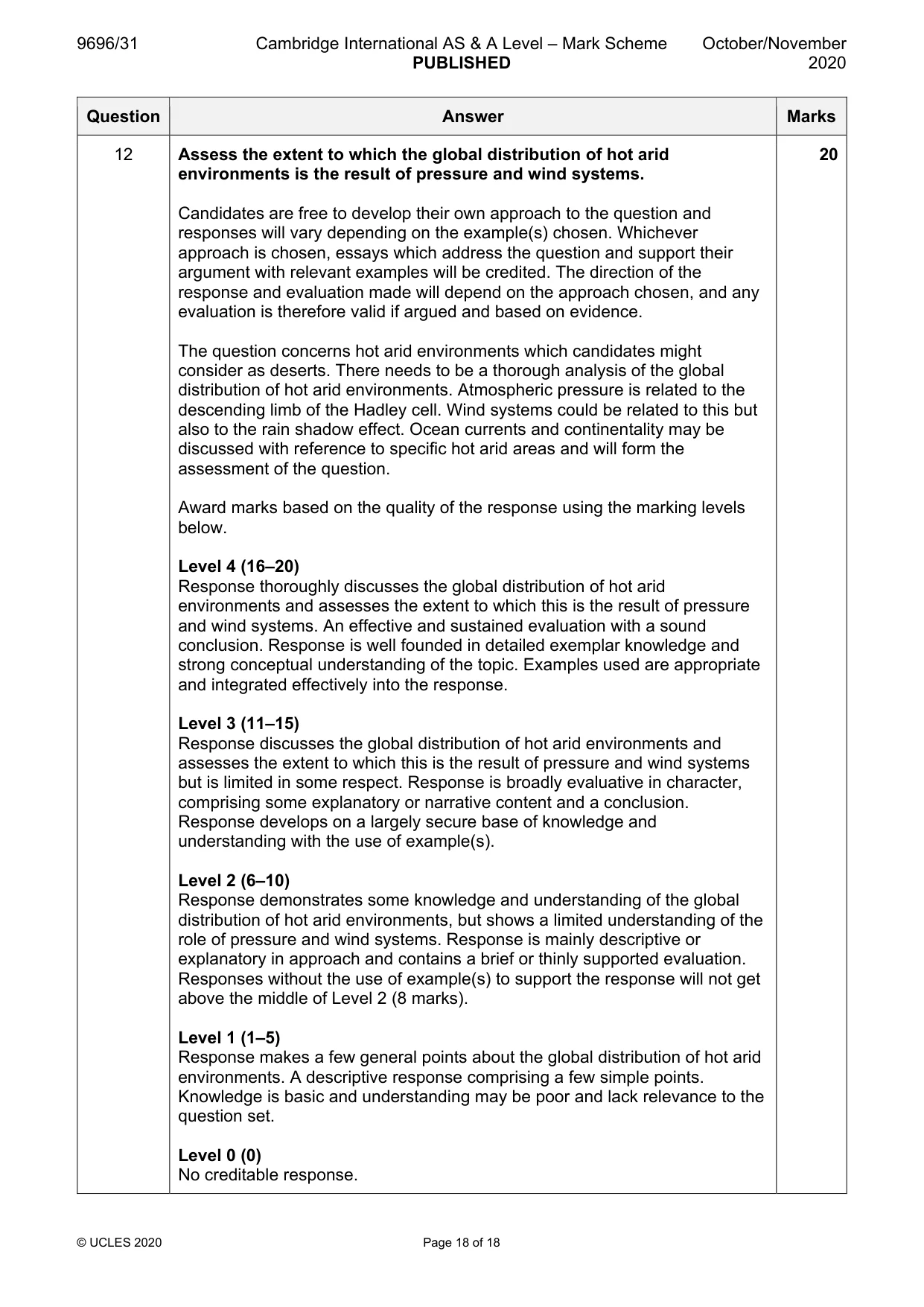
12 Assess the extent to which the global distribution of hot arid environments is the result of pressure and wind systems. [20]
Mark scheme: 12 Assess the extent to which the global distribution of hot arid 20 environments is the result of pressure and wind systems. Candidates are free to develop their own approach to the question and responses will vary depending on the example(s) chosen. Whichever approach is chosen, essays which address the question and support their argument with relevant examples will be credited. The direction of the response and evaluation made will depend on the approach chosen, and any evaluation is therefore valid if argued and based on evidence. The question concerns hot arid environments which candidates might consider as deserts. There needs to be a thorough analysis of the global distribution of hot arid environments. Atmospheric pressure is related to the descending limb of the Hadley cell. Wind systems could be related to this but also to the rain shadow effect. Ocean currents and continentality may be discussed with reference to specific hot arid areas and will form the assessment of the question. Award marks based on the quality of the response using the marking levels below. Level 4 (16–20) Response thoroughly discusses the global distribution of hot arid environments and assesses the extent to which this is the result of pressure and wind systems. An effective and sustained evaluation with a sound conclusion. Response is well founded in detailed exemplar knowledge and strong conceptual understanding of the topic. Examples used are appropriate and integrated effectively into the response. Level 3 (11–15) Response discusses the global distribution of hot arid environments and assesses the extent to which this is the result of pressure and wind systems but is limited in some respect. Response is broadly evaluative in character, comprising some explanatory or narrative content and a conclusion. Response develops on a largely secure base of knowledge and understanding with the use of example(s). Level 2 (6–10) Response demonstrates some knowledge and understanding of the global distribution of hot arid environments, but shows a limited understanding of the role of pressure and wind systems. Response is mainly descriptive or explanatory in approach and contains a brief or thinly supported evaluation. Responses without the use of example(s) to support the response will not get above the middle of Level 2 (8 marks). Level 1 (1–5) Response makes a few general points about the global distribution of hot arid environments. A descriptive response comprising a few simple points. Knowledge is basic and understanding may be poor and lack relevance to the question set. Level 0 (0) No creditable response.
What was in this paper
The subtopics covered by these 12 questions, and how many questions each got. Open one in a new tab to see every Cambridge question on it.
2Characteristics and formation of coastal landforms1Coastal processes1Hot arid and semi-arid climates1Humid tropical (rainforest) ecosystems and seasonally humid tropical (savanna) ecosystems1Landforms of hot arid and semi-arid environments1Sustainable management in hazardous environments1Sustainable management of coasts1Sustainable management of hot arid and semi-arid environments1Sustainable management of tropical environments1Tropical climates1What you needed in this session
Cambridge’s own grade thresholds for 2020 Oct/Nov, Paper 3 · Variant 1. A higher threshold means an easier paper — the bar moves with how the cohort did.