Cambridge A Level Geography 9696 — 2020 Oct/Nov Paper 3 · Variant 2
9696/32/O/N/20 · 12 questions · 60 marks · ≈68 min
The question paper and its mark scheme, free to read here and free to download. This is Cambridge’s own paper, exactly as it was sat.
Question paper4 pages

Mark scheme18 pages
Answers below. Sit the paper first if you are practising.



Questions as text
Q1 · A cross-section which shows some effects of the weathering of granite in a tropical…
1 Fig. 1.1 is a cross-section which shows some effects of the weathering of granite in a tropical environment. (a) Use Fig. 1.1 to describe the effects of weathering. [4] (b) Explain the effects of weathering you described in (a). [6]
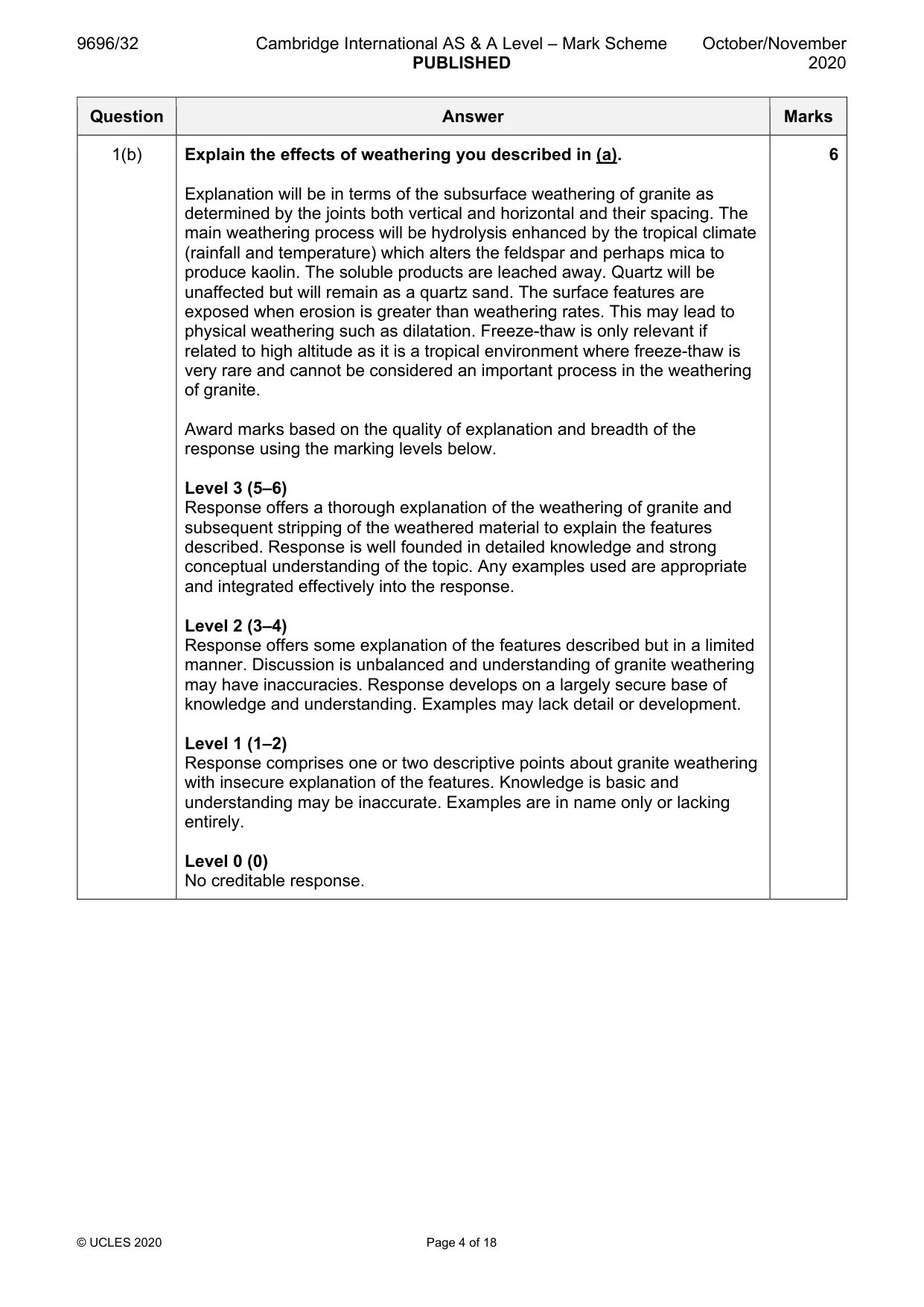
Mark scheme: Question Answer Marks 1(a) Fig. 1.1 is a cross-section which shows some effects of the weathering 4 of granite in a tropical environment. Use Fig. 1.1 to describe the effects of weathering. The features that could be described are: • Rounded core stones • Enlargement of horizontal and vertical joints • Increasing size of core stones with depth • Boulders on the outcrop • Relevant description of talus/scree • Vertical extent of weathered material • Other relevant effects The emphasis is on description and not just a listing. Any four for 4 marks. 1(b) Explain the effects of weathering you described in (a). 6 Explanation will be in terms of the subsurface weathering of granite as determined by the joints both vertical and horizontal and their spacing. The main weathering process will be hydrolysis enhanced by the tropical climate (rainfall and temperature) which alters the feldspar and perhaps mica to produce kaolin. The soluble products are leached away. Quartz will be unaffected but will remain as a quartz sand. The surface features are exposed when erosion is greater than weathering rates. This may lead to physical weathering such as dilatation. Freeze-thaw is only relevant if related to high altitude as it is a tropical environment where freeze-thaw is very rare and cannot be considered an important process in the weathering of granite. Award marks based on the quality of explanation and breadth of the response using the marking levels below. Level 3 (5–6) Response offers a thorough explanation of the weathering of granite and subsequent stripping of the weathered material to explain the features described. Response is well founded in detailed knowledge and strong conceptual understanding of the topic. Any examples used are appropriate and integrated effectively into the response. Level 2 (3–4) Response offers some explanation of the features described but in a limited manner. Discussion is unbalanced and understanding of granite weathering may have inaccuracies. Response develops on a largely secure base of knowledge and understanding. Examples may lack detail or development. Level 1 (1–2) Response comprises one or two descriptive points about granite weathering with insecure explanation of the features. Knowledge is basic and understanding may be inaccurate. Examples are in name only or lacking entirely. Level 0 (0) No creditable response.
Q2 · To what extent are the plant communities of seasonally humid tropical (savanna)…
2 To what extent are the plant communities of seasonally humid tropical (savanna) ecosystems climax communities? [20]
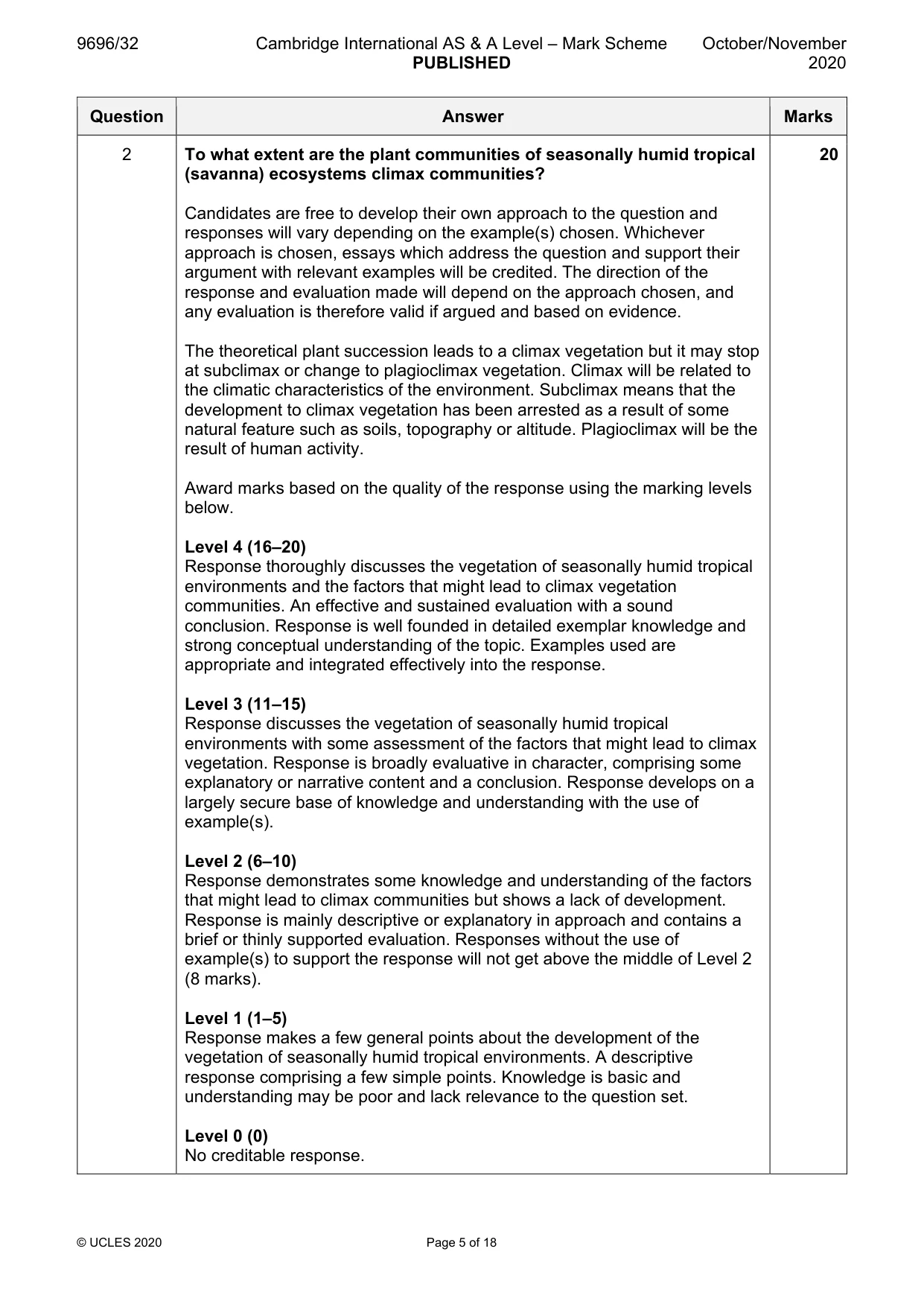
Mark scheme: 2 To what extent are the plant communities of seasonally humid tropical 20 (savanna) ecosystems climax communities? Candidates are free to develop their own approach to the question and responses will vary depending on the example(s) chosen. Whichever approach is chosen, essays which address the question and support their argument with relevant examples will be credited. The direction of the response and evaluation made will depend on the approach chosen, and any evaluation is therefore valid if argued and based on evidence. The theoretical plant succession leads to a climax vegetation but it may stop at subclimax or change to plagioclimax vegetation. Climax will be related to the climatic characteristics of the environment. Subclimax means that the development to climax vegetation has been arrested as a result of some natural feature such as soils, topography or altitude. Plagioclimax will be the result of human activity. Award marks based on the quality of the response using the marking levels below. Level 4 (16–20) Response thoroughly discusses the vegetation of seasonally humid tropical environments and the factors that might lead to climax vegetation communities. An effective and sustained evaluation with a sound conclusion. Response is well founded in detailed exemplar knowledge and strong conceptual understanding of the topic. Examples used are appropriate and integrated effectively into the response. Level 3 (11–15) Response discusses the vegetation of seasonally humid tropical environments with some assessment of the factors that might lead to climax vegetation. Response is broadly evaluative in character, comprising some explanatory or narrative content and a conclusion. Response develops on a largely secure base of knowledge and understanding with the use of example(s). Level 2 (6–10) Response demonstrates some knowledge and understanding of the factors that might lead to climax communities but shows a lack of development. Response is mainly descriptive or explanatory in approach and contains a brief or thinly supported evaluation. Responses without the use of example(s) to support the response will not get above the middle of Level 2 (8 marks). Level 1 (1–5) Response makes a few general points about the development of the vegetation of seasonally humid tropical environments. A descriptive response comprising a few simple points. Knowledge is basic and understanding may be poor and lack relevance to the question set. Level 0 (0) No creditable response.
Q3 · Assess the role of monsoons in the global distribution and climatic characteristics of…
3 Assess the role of monsoons in the global distribution and climatic characteristics of tropical environments. [20] Coastal environments If answering this option, answer Question 4 and either Question 5 or Question 6.
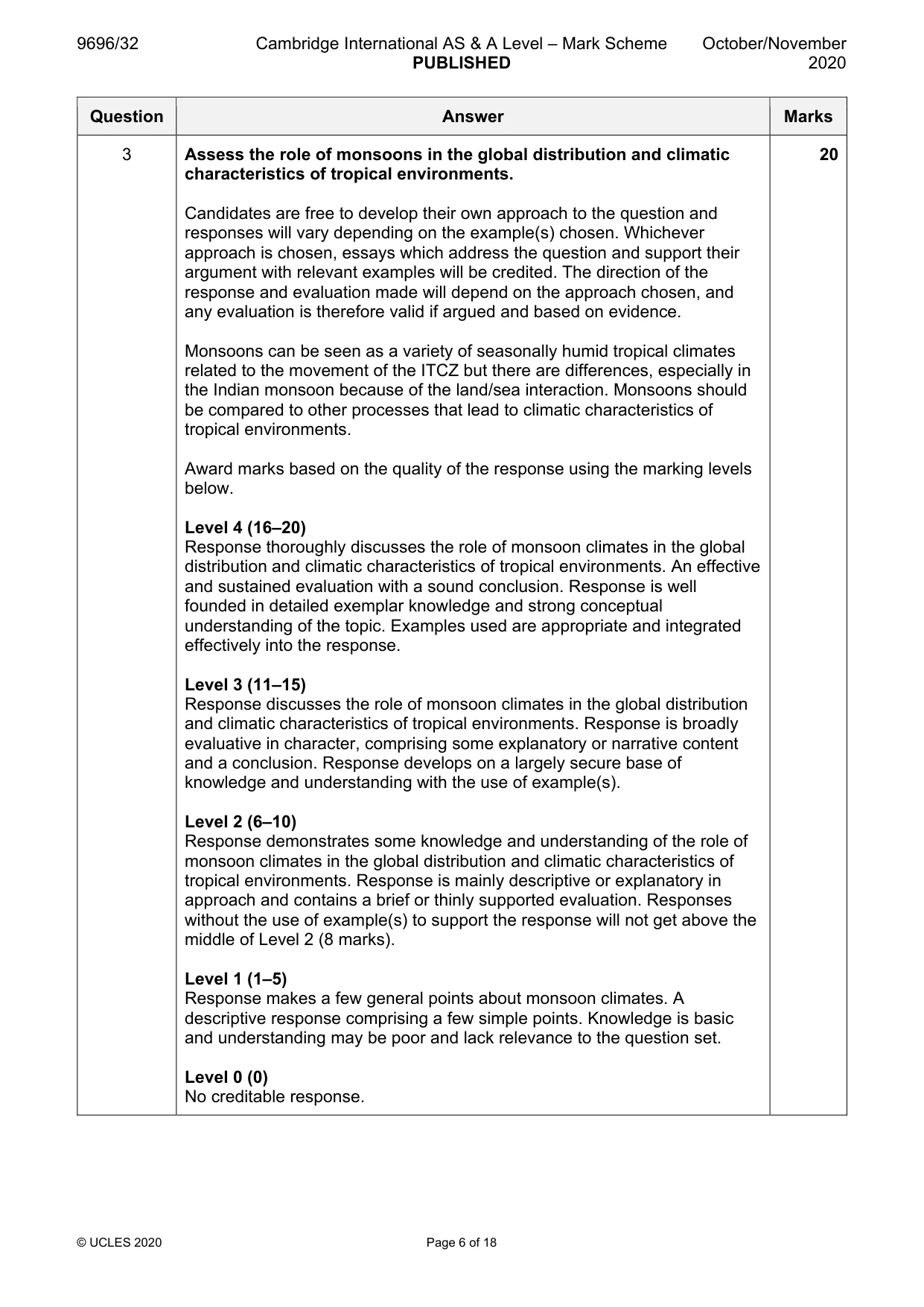
Mark scheme: 3 Assess the role of monsoons in the global distribution and climatic 20 characteristics of tropical environments. Candidates are free to develop their own approach to the question and responses will vary depending on the example(s) chosen. Whichever approach is chosen, essays which address the question and support their argument with relevant examples will be credited. The direction of the response and evaluation made will depend on the approach chosen, and any evaluation is therefore valid if argued and based on evidence. Monsoons can be seen as a variety of seasonally humid tropical climates related to the movement of the ITCZ but there are differences, especially in the Indian monsoon because of the land/sea interaction. Monsoons should be compared to other processes that lead to climatic characteristics of tropical environments. Award marks based on the quality of the response using the marking levels below. Level 4 (16–20) Response thoroughly discusses the role of monsoon climates in the global distribution and climatic characteristics of tropical environments. An effective and sustained evaluation with a sound conclusion. Response is well founded in detailed exemplar knowledge and strong conceptual understanding of the topic. Examples used are appropriate and integrated effectively into the response. Level 3 (11–15) Response discusses the role of monsoon climates in the global distribution and climatic characteristics of tropical environments. Response is broadly evaluative in character, comprising some explanatory or narrative content and a conclusion. Response develops on a largely secure base of knowledge and understanding with the use of example(s). Level 2 (6–10) Response demonstrates some knowledge and understanding of the role of monsoon climates in the global distribution and climatic characteristics of tropical environments. Response is mainly descriptive or explanatory in approach and contains a brief or thinly supported evaluation. Responses without the use of example(s) to support the response will not get above the middle of Level 2 (8 marks). Level 1 (1–5) Response makes a few general points about monsoon climates. A descriptive response comprising a few simple points. Knowledge is basic and understanding may be poor and lack relevance to the question set. Level 0 (0) No creditable response. Coastal environments If answering this option, answer Question 4 and either Question 5 or Question 6.
Q4 · Hard engineering solutions to coastal erosion in north Norfolk, UK
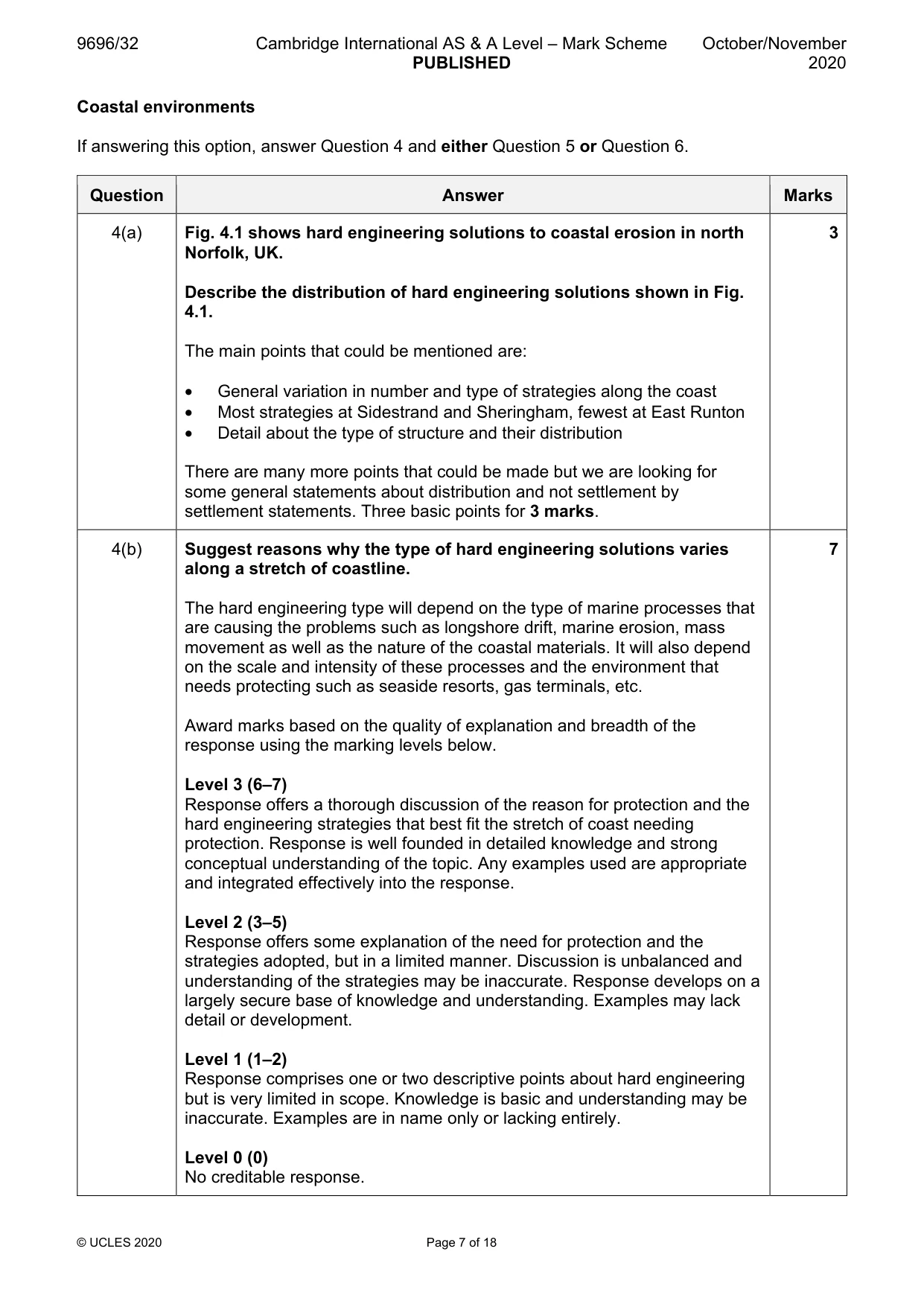
4 Fig. 4.1 shows hard engineering solutions to coastal erosion in north Norfolk, UK. (a) Describe the distribution of hard engineering solutions shown in Fig. 4.1. [3] (b) Suggest reasons why the type of hard engineering solutions varies along a stretch of coastline. [7]
Mark scheme: 4(a) Fig. 4.1 shows hard engineering solutions to coastal erosion in north 3 Norfolk, UK. Describe the distribution of hard engineering solutions shown in Fig. 4.1. The main points that could be mentioned are: • General variation in number and type of strategies along the coast • Most strategies at Sidestrand and Sheringham, fewest at East Runton • Detail about the type of structure and their distribution There are many more points that could be made but we are looking for some general statements about distribution and not settlement by settlement statements. Three basic points for 3 marks. 4(b) Suggest reasons why the type of hard engineering solutions varies 7 along a stretch of coastline. The hard engineering type will depend on the type of marine processes that are causing the problems such as longshore drift, marine erosion, mass movement as well as the nature of the coastal materials. It will also depend on the scale and intensity of these processes and the environment that needs protecting such as seaside resorts, gas terminals, etc. Award marks based on the quality of explanation and breadth of the response using the marking levels below. Level 3 (6–7) Response offers a thorough discussion of the reason for protection and the hard engineering strategies that best fit the stretch of coast needing protection. Response is well founded in detailed knowledge and strong conceptual understanding of the topic. Any examples used are appropriate and integrated effectively into the response. Level 2 (3–5) Response offers some explanation of the need for protection and the strategies adopted, but in a limited manner. Discussion is unbalanced and understanding of the strategies may be inaccurate. Response develops on a largely secure base of knowledge and understanding. Examples may lack detail or development. Level 1 (1–2) Response comprises one or two descriptive points about hard engineering but is very limited in scope. Knowledge is basic and understanding may be inaccurate. Examples are in name only or lacking entirely. Level 0 (0) No creditable response.
Q5 · Assess the role of wave characteristics in explaining the form and development of the…
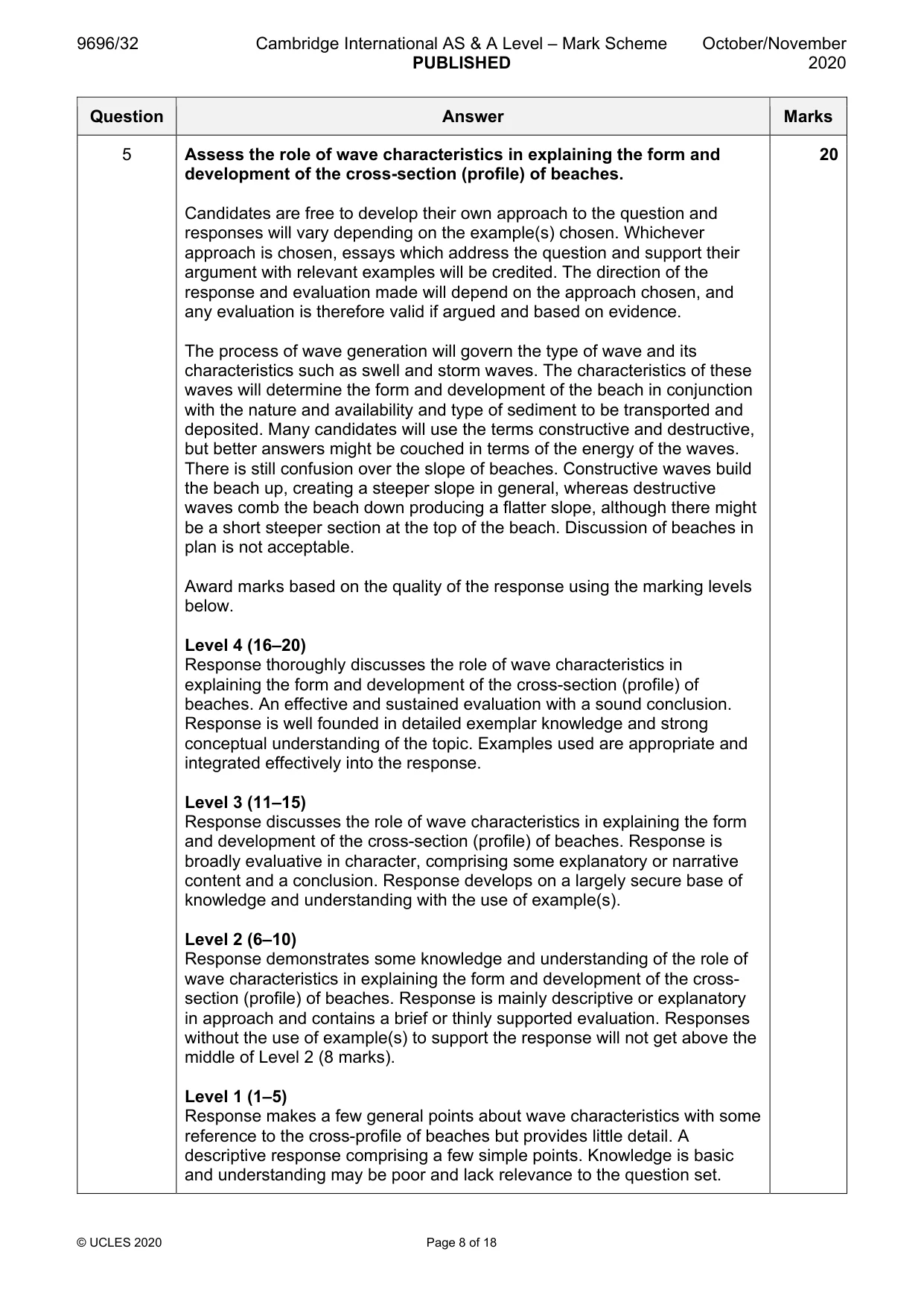
5 Assess the role of wave characteristics in explaining the form and development of the cross- section (profile) of beaches. [20]
Mark scheme: 5 Assess the role of wave characteristics in explaining the form and 20 development of the cross-section (profile) of beaches. Candidates are free to develop their own approach to the question and responses will vary depending on the example(s) chosen. Whichever approach is chosen, essays which address the question and support their argument with relevant examples will be credited. The direction of the response and evaluation made will depend on the approach chosen, and any evaluation is therefore valid if argued and based on evidence. The process of wave generation will govern the type of wave and its characteristics such as swell and storm waves. The characteristics of these waves will determine the form and development of the beach in conjunction with the nature and availability and type of sediment to be transported and deposited. Many candidates will use the terms constructive and destructive, but better answers might be couched in terms of the energy of the waves. There is still confusion over the slope of beaches. Constructive waves build the beach up, creating a steeper slope in general, whereas destructive waves comb the beach down producing a flatter slope, although there might be a short steeper section at the top of the beach. Discussion of beaches in plan is not acceptable. Award marks based on the quality of the response using the marking levels below. Level 4 (16–20) Response thoroughly discusses the role of wave characteristics in explaining the form and development of the cross-section (profile) of beaches. An effective and sustained evaluation with a sound conclusion. Response is well founded in detailed exemplar knowledge and strong conceptual understanding of the topic. Examples used are appropriate and integrated effectively into the response. Level 3 (11–15) Response discusses the role of wave characteristics in explaining the form and development of the cross-section (profile) of beaches. Response is broadly evaluative in character, comprising some explanatory or narrative content and a conclusion. Response develops on a largely secure base of knowledge and understanding with the use of example(s). Level 2 (6–10) Response demonstrates some knowledge and understanding of the role of wave characteristics in explaining the form and development of the cross- section (profile) of beaches. Response is mainly descriptive or explanatory in approach and contains a brief or thinly supported evaluation. Responses without the use of example(s) to support the response will not get above the middle of Level 2 (8 marks). Level 1 (1–5) Response makes a few general points about wave characteristics with some reference to the cross-profile of beaches but provides little detail. A descriptive response comprising a few simple points. Knowledge is basic and understanding may be poor and lack relevance to the question set. 5 Level 0 (0) No creditable response.
Q6 · ‘Global warming is the greatest threat to coral reefs.’ With the aid of examples, how far…
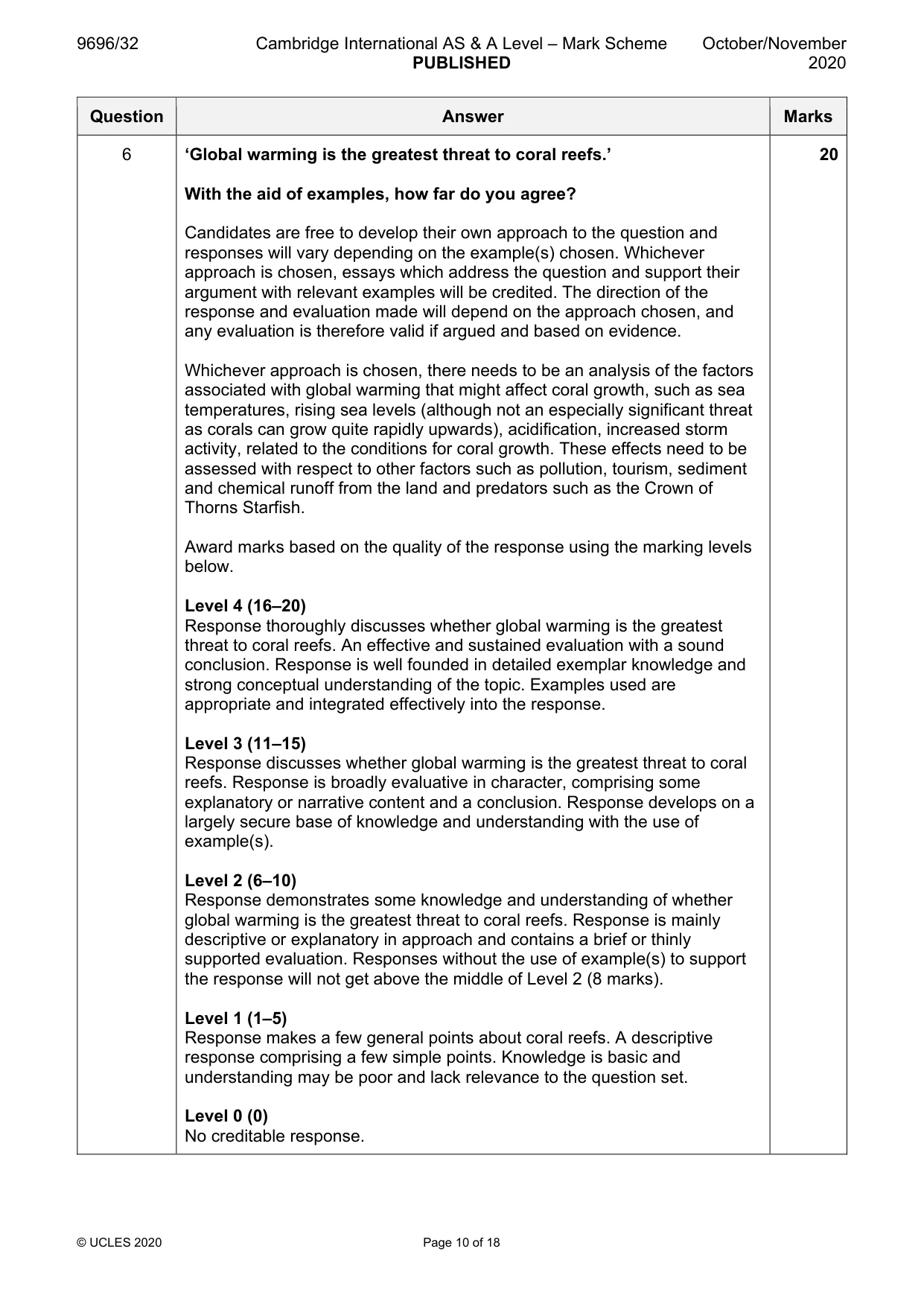
6 ‘Global warming is the greatest threat to coral reefs.’ With the aid of examples, how far do you agree? [20] Hazardous environments If answering this option, answer Question 7 and either Question 8 or Question 9.
Mark scheme: 6 ‘Global warming is the greatest threat to coral reefs.’ 20 With the aid of examples, how far do you agree? Candidates are free to develop their own approach to the question and responses will vary depending on the example(s) chosen. Whichever approach is chosen, essays which address the question and support their argument with relevant examples will be credited. The direction of the response and evaluation made will depend on the approach chosen, and any evaluation is therefore valid if argued and based on evidence. Whichever approach is chosen, there needs to be an analysis of the factors associated with global warming that might affect coral growth, such as sea temperatures, rising sea levels (although not an especially significant threat as corals can grow quite rapidly upwards), acidification, increased storm activity, related to the conditions for coral growth. These effects need to be assessed with respect to other factors such as pollution, tourism, sediment and chemical runoff from the land and predators such as the Crown of Thorns Starfish. Award marks based on the quality of the response using the marking levels below. Level 4 (16–20) Response thoroughly discusses whether global warming is the greatest threat to coral reefs. An effective and sustained evaluation with a sound conclusion. Response is well founded in detailed exemplar knowledge and strong conceptual understanding of the topic. Examples used are appropriate and integrated effectively into the response. Level 3 (11–15) Response discusses whether global warming is the greatest threat to coral reefs. Response is broadly evaluative in character, comprising some explanatory or narrative content and a conclusion. Response develops on a largely secure base of knowledge and understanding with the use of example(s). Level 2 (6–10) Response demonstrates some knowledge and understanding of whether global warming is the greatest threat to coral reefs. Response is mainly descriptive or explanatory in approach and contains a brief or thinly supported evaluation. Responses without the use of example(s) to support the response will not get above the middle of Level 2 (8 marks). Level 1 (1–5) Response makes a few general points about coral reefs. A descriptive response comprising a few simple points. Knowledge is basic and understanding may be poor and lack relevance to the question set. Level 0 (0) No creditable response. Hazardous environments If answering this option, answer Question 7 and either Question 8 or Question 9.
Q7 · The global distribution of deaths from rainfall-triggered mass movement events, 2007–17
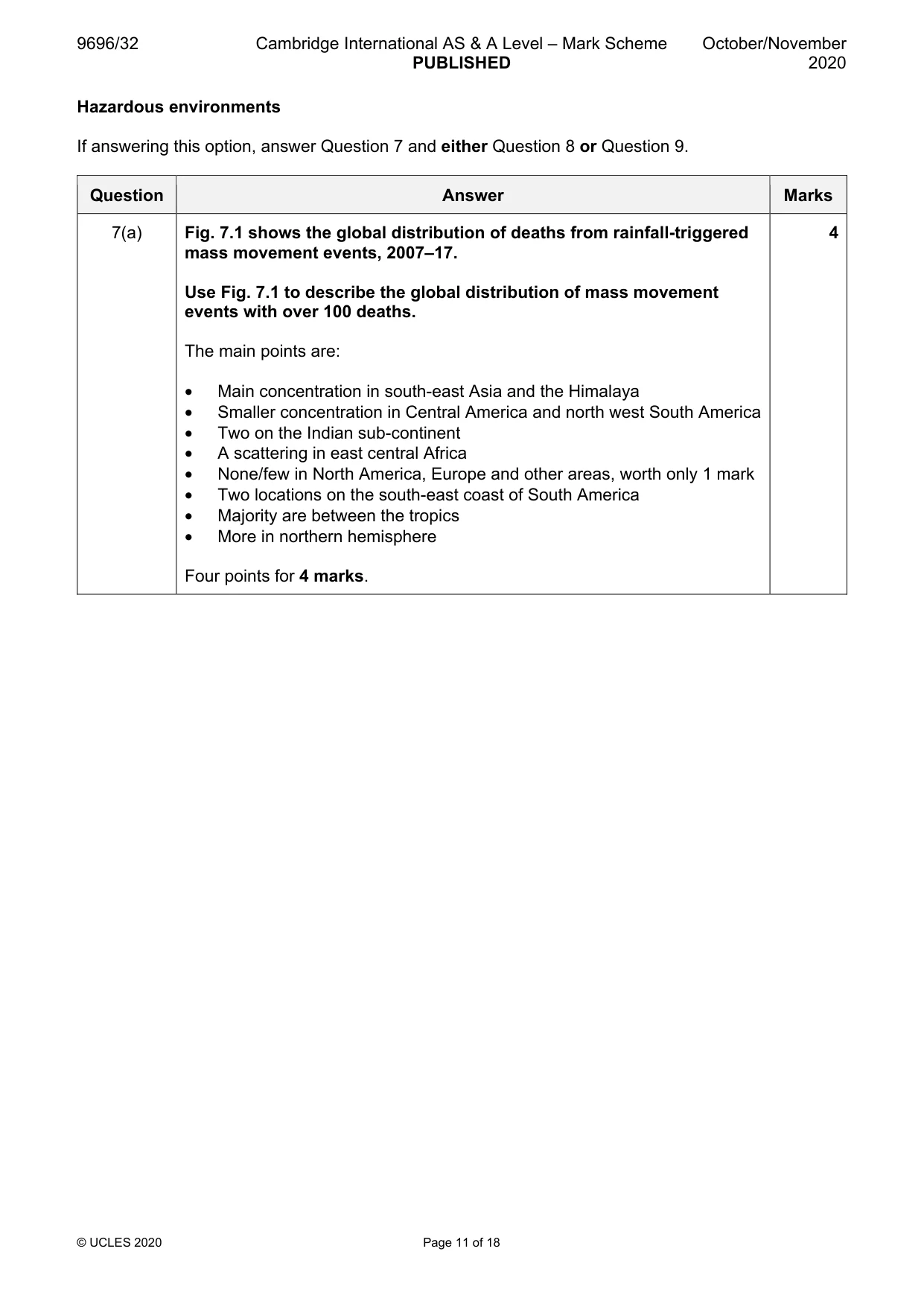
7 Fig. 7.1 shows the global distribution of deaths from rainfall-triggered mass movement events, 2007–17. (a) Use Fig. 7.1 to describe the global distribution of mass movement events with over 100 deaths. [4] (b) Explain two reasons why the number of deaths from mass movement events varies. [6]
Mark scheme: 7(a) Fig. 7.1 shows the global distribution of deaths from rainfall-triggered 4 mass movement events, 2007–17. Use Fig. 7.1 to describe the global distribution of mass movement events with over 100 deaths. The main points are: • Main concentration in south-east Asia and the Himalaya • Smaller concentration in Central America and north west South America • Two on the Indian sub-continent • A scattering in east central Africa • None/few in North America, Europe and other areas, worth only 1 mark • Two locations on the south-east coast of South America • Majority are between the tropics • More in northern hemisphere Four points for 4 marks. 7(b) Explain two reasons why the number of deaths from mass movement 6 events varies. Number of deaths might be related to a variety of factors such as type of mass movement, scale of the mass movement, relation to tectonic activity. These factors might also be related to slope angle, rock type and precipitation amounts and intensity. Location with respect to settlement and areas of high population density, time of day, lack of slope management are also relevant points. Award marks based on the quality of explanation and breadth of the response using the marking levels below. Level 3 (5–6) Response offers a thorough discussion of mass movement and offers two reasons why the number of deaths from mass movement events varies. Response is well founded in detailed knowledge and strong conceptual understanding of the topic. Any examples used are appropriate and integrated effectively into the response. Level 2 (3–4) Response offers some discussion of mass movement and two possible reasons for deaths from mass movement events, but in a limited manner. Discussion is unbalanced with respect to the two reasons and understanding of mass movement may be inaccurate. Response develops on a largely secure base of knowledge and understanding. Examples may lack detail or development. Level 1 (1–2) Response comprises one or two descriptive points about mass movement and possible reasons for fatalities but explanation is insecure. Knowledge is basic and understanding may be inaccurate. Examples are in name only or lacking entirely. Level 0 (0) No creditable response.
Q8 · ‘Earthquakes are more difficult to predict, but easier to prepare for, than volcanic…
8 ‘Earthquakes are more difficult to predict, but easier to prepare for, than volcanic eruptions.’ How far do you agree with this view? [20]
Mark scheme: 8 ‘Earthquakes are more difficult to predict, but easier to prepare for, 20 than volcanic eruptions.’ How far do you agree with this view? Candidates are free to develop their own approach to the question and responses will vary depending on the example(s) chosen. Whichever approach is chosen, essays which address the question and support their argument with relevant examples will be credited. The direction of the response and evaluation made will depend on the approach chosen, and any evaluation is therefore valid if argued and based on evidence. There are two components to the question. Thus preparation as well as prediction needs discussing. Preparation should be linked to the ease or otherwise of prediction and a sensible assessment produced. Award marks based on the quality of the response using the marking levels below. Level 4 (16–20) Response thoroughly discusses whether earthquakes are more difficult to predict, but easier to prepare for, than volcanic eruptions. An effective and sustained evaluation with a sound conclusion. Response is well founded in detailed exemplar knowledge and strong conceptual understanding of the topic. Examples used are appropriate and integrated effectively into the response. Level 3 (11–15) Response discusses the prediction and preparation of earthquakes and volcanic eruptions with some assessment of the question. Response is broadly evaluative in character, comprising some explanatory or narrative content and a conclusion. Response develops on a largely secure base of knowledge and understanding with the use of example(s). Level 2 (6–10) Response demonstrates some knowledge and understanding of earthquakes and volcanoes but shows a lack of development. Response is mainly descriptive or explanatory in approach and contains a brief or thinly supported evaluation. Responses without the use of example(s) to support the response will not get above the middle of Level 2 (8 marks). Level 1 (1–5) Response makes a few general points about earthquakes and volcanoes. A descriptive response comprising a few simple points. Knowledge is basic and understanding may be poor and lack relevance to the question set. Level 0 (0) No creditable response.
Q9 · Assess the extent to which high winds are the most significant hazard of small-scale…
9 Assess the extent to which high winds are the most significant hazard of small-scale atmospheric disturbances (tornadoes). [20] Hot arid and semi-arid environments If answering this option, answer Question 10 and either Question 11 or Question 12.
Mark scheme: 9 Assess the extent to which high winds are the most significant hazard 20 of small-scale atmospheric disturbances (tornadoes). Candidates are free to develop their own approach to the question and responses will vary depending on the example(s) chosen. Whichever approach is chosen, essays which address the question and support their argument with relevant examples will be credited. The direction of the response and evaluation made will depend on the approach chosen, and any evaluation is therefore valid if argued and based on evidence. Whichever approach is chosen, the nature of small-scale atmospheric disturbances (tornadoes) and their characteristics need discussion. The main hazards from such disturbances are high winds, torrential rainfall and possibly severe hailstorms and pressure difference. It is generally agreed that most fatalities occur from high winds, but the relative effect might vary with location and strength of the tornado. Award marks based on the quality of the response using the marking levels below. Level 4 (16–20) Response thoroughly discusses the extent to which high winds are the most significant hazard of small-scale atmospheric disturbances. An effective and sustained evaluation with a sound conclusion. Response is well founded in detailed exemplar knowledge and strong conceptual understanding of the topic. Examples used are appropriate and integrated effectively into the response. Level 3 (11–15) Response discusses the extent to which high winds are the most significant hazard of small-scale atmospheric disturbances (tornadoes). Response is broadly evaluative in character, comprising some explanatory or narrative content and a conclusion. Response develops on a largely secure base of knowledge and understanding with the use of example(s). Level 2 (6–10) Response demonstrates some knowledge and understanding of the hazards associated with small-scale atmospheric disturbances (tornadoes) but shows a lack of development. Response is mainly descriptive or explanatory in approach and contains a brief or thinly supported evaluation. Responses without the use of example(s) to support the response will not get above the middle of Level 2 (8 marks). Level 1 (1–5) Response makes a few general points about the hazards associated with small-scale atmospheric disturbances (tornadoes). A descriptive response comprising a few simple points. Knowledge is basic and understanding may be poor and lack relevance to the question set. Level 0 (0) No creditable response. Hot arid and semi-arid environments If answering this option, answer Question 10 and either Question 11 or Question 12.
Q10 · A photograph which shows a desertified landscape in a semi-arid environment
10 Fig. 10.1 is a photograph which shows a desertified landscape in a semi-arid environment. (a) Describe the features of the landscape shown in Fig. 10.1. [4] (b) Explain how one physical factor and one human factor lead to the desertification of a semi- arid environment. [6]
Mark scheme: 10(a) Fig. 10.1 is a photograph which shows a desertified landscape in a 4 semi-arid environment. Describe the features of the landscape shown in Fig. 10.1. The main points are: • Very sparse vegetation on the hillock • Vegetation is small grass tussocks and stunted bushes • Very sandy bare soils • Thin vegetation on the plain in the background • Description of features as dunes is relevant Three main points with the extra mark for detail. 10(b) Explain how one physical factor and one human factor lead to the 6 desertification of a semi-arid environment. Desertification in semi-arid environments is normally the result of a combination of physical and human factors. Physical factors usually include climate change with increasing aridity and perhaps changes in wind speed and direction. Human factors relate to overpopulation with land degradation a result of deforestation, overgrazing and overcultivation. There needs to be discussion of one physical and one human factor. Award marks based on the quality of explanation and breadth of the response using the marking levels below. Level 3 (5–6) Response offers a thorough explanation of desertification and discusses one physical and one human factor that can lead to the development of desertification in a semi-arid environment. Response is well founded in detailed knowledge and strong conceptual understanding of the topic. Any examples used are appropriate and integrated effectively into the response. Level 2 (3–4) Response offers some explanation of desertification, and one physical and one human factor that lead to its development in a semi-arid environment but in a limited manner. Response develops on a largely secure base of knowledge and understanding. Examples may lack detail or development. Level 1 (1–2) Response comprises one or two descriptive points about desertification in a semi-arid environment and a physical and a human factor that can lead to its development. Knowledge is basic and understanding may be inaccurate. Examples are in name only or lacking entirely. Level 0 (0) No creditable response.
Q11 · Discuss the view that thermal fracture is the most important weathering process in hot…
11 Discuss the view that thermal fracture is the most important weathering process in hot arid and semi-arid environments. [20]
Mark scheme: 11 Discuss the view that thermal fracture is the most important 20 weathering process in hot arid and semi-arid environments. Candidates are free to develop their own approach to the question and responses will vary depending on the example(s) chosen. Whichever approach is chosen, essays which address the question and support their argument with relevant examples will be credited. The direction of the response and evaluation made will depend on the approach chosen, and any evaluation is therefore valid if argued and based on evidence. Whichever approach is chosen, there needs to be a discussion of thermal fracture with respect to other possible weathering processes in hot arid and semi-arid environments. The assessment will need to relate the climatic features of arid and semi-arid areas in relation to those processes. Answers might contrast weathering processes between arid and semi-arid environments because of their differing climatic characteristics. Award marks based on the quality of the response using the marking levels below. Level 4 (16–20) Response thoroughly discusses the view that thermal fracture is the most important weathering process in hot arid and semi-arid environments. An effective and sustained evaluation with a sound conclusion. Response is well founded in detailed exemplar knowledge and strong conceptual understanding of the topic. Examples used are appropriate and integrated effectively into the response. Level 3 (11–15) Response discusses the view that thermal fracture is the most important weathering process in hot arid and semi-arid environments. Response is broadly evaluative in character, comprising some explanatory or narrative content and a conclusion. Response develops on a largely secure base of knowledge and understanding with the use of example(s). Level 2 (6–10) Response demonstrates some knowledge and understanding of the weathering processes but shows a lack of development. Response is mainly descriptive or explanatory in approach and contains a brief or thinly supported evaluation. Responses without the use of example(s) to support the response will not get above the middle of Level 2 (8 marks). Level 1 (1–5) Response makes a few general points about weathering processes. A descriptive response comprising a few simple points. Knowledge is basic and understanding may be poor and lack relevance to the question set. Level 0 (0) No creditable response.
Q12 · ‘The sustainable management of either a hot arid or semi-arid environment is difficult…
12 ‘The sustainable management of either a hot arid or semi-arid environment is difficult mainly because of the fragility of the vegetation.’ With reference to a case study, how far do you agree? [20]
Mark scheme: 12 ‘The sustainable management of either a hot arid or semi-arid 20 environment is difficult mainly because of the fragility of the vegetation.’ With reference to a case study, how far do you agree? Candidates are free to develop their own approach to the question and responses will vary depending on the example(s) chosen. Whichever approach is chosen, essays which address the question and support their argument with relevant examples will be credited. The direction of the response and evaluation made will depend on the approach chosen, and any evaluation is therefore valid if argued and based on evidence. Soils are generally lacking in structure which makes for fragile vegetation. Drought and high temperatures make the vegetation susceptible to wilting and become easily eroded by strong winds and erosion. The fragility of vegetation is only one factor in making sustainable management difficult. Other factors need discussing such as human action and climatic characteristics of the chosen environment. Award marks based on the quality of the response using the marking levels below. Level 4 (16–20) Response thoroughly discusses the view that the sustainable management of either a hot arid or semi-arid environment is difficult mainly because of the fragility of vegetation. An effective and sustained evaluation with a sound conclusion. Response is well founded in detailed exemplar knowledge and strong conceptual understanding of the topic. Examples used are appropriate and integrated effectively into the response. Level 3 (11–15) Response discusses the view that the sustainable management of either a hot arid or semi-arid environment is difficult mainly because of the fragility of vegetation. Response is broadly evaluative in character, comprising some explanatory or narrative content and a conclusion. Response develops on a largely secure base of knowledge and understanding with the use of example(s). Level 2 (6–10) Response demonstrates some knowledge and understanding of the fragility of the vegetation of the chosen environment but shows a lack of evaluation of other factors which make sustainable management difficult. Response is mainly descriptive or explanatory in approach and contains a brief or thinly supported evaluation. Responses without the use of example(s) to support the response will not get above the middle of Level 2 (8 marks). Level 1 (1–5) Response makes a few general points about the fragility of the vegetation of the chosen environment but does not address the question with respect to other factors that make sustainable management difficult. A descriptive response comprising a few simple points. Knowledge is basic and understanding may be poor and lack relevance to the question set. 12 Level 0 (0) No creditable response.
What was in this paper
The subtopics covered by these 12 questions, and how many questions each got. Open one in a new tab to see every Cambridge question on it.
2Characteristics and formation of coastal landforms1Coral reefs1Hazards resulting from atmospheric disturbances1Hazards resulting from mass movements1Humid tropical (rainforest) ecosystems and seasonally humid tropical (savanna) ecosystems1Landforms of hot arid and semi-arid environments1Sustainable management in hazardous environments1Sustainable management of coasts1Tropical climates1Weathering1What you needed in this session
Cambridge’s own grade thresholds for 2020 Oct/Nov, Paper 3 · Variant 2. A higher threshold means an easier paper — the bar moves with how the cohort did.