Cambridge A Level Geography 9696 — 2019 Oct/Nov Paper 4 · Variant 2
9696/42/O/N/19 · 11 questions · 60 marks · ≈68 min
The question paper and its mark scheme, free to read here and free to download. This is Cambridge’s own paper, exactly as it was sat.
Question paper4 pages



Mark scheme25 pages
Answers below. Sit the paper first if you are practising.



Questions as text
Q1 · Production of machinery for cement plants in India, an MIC in Asia, in 2016
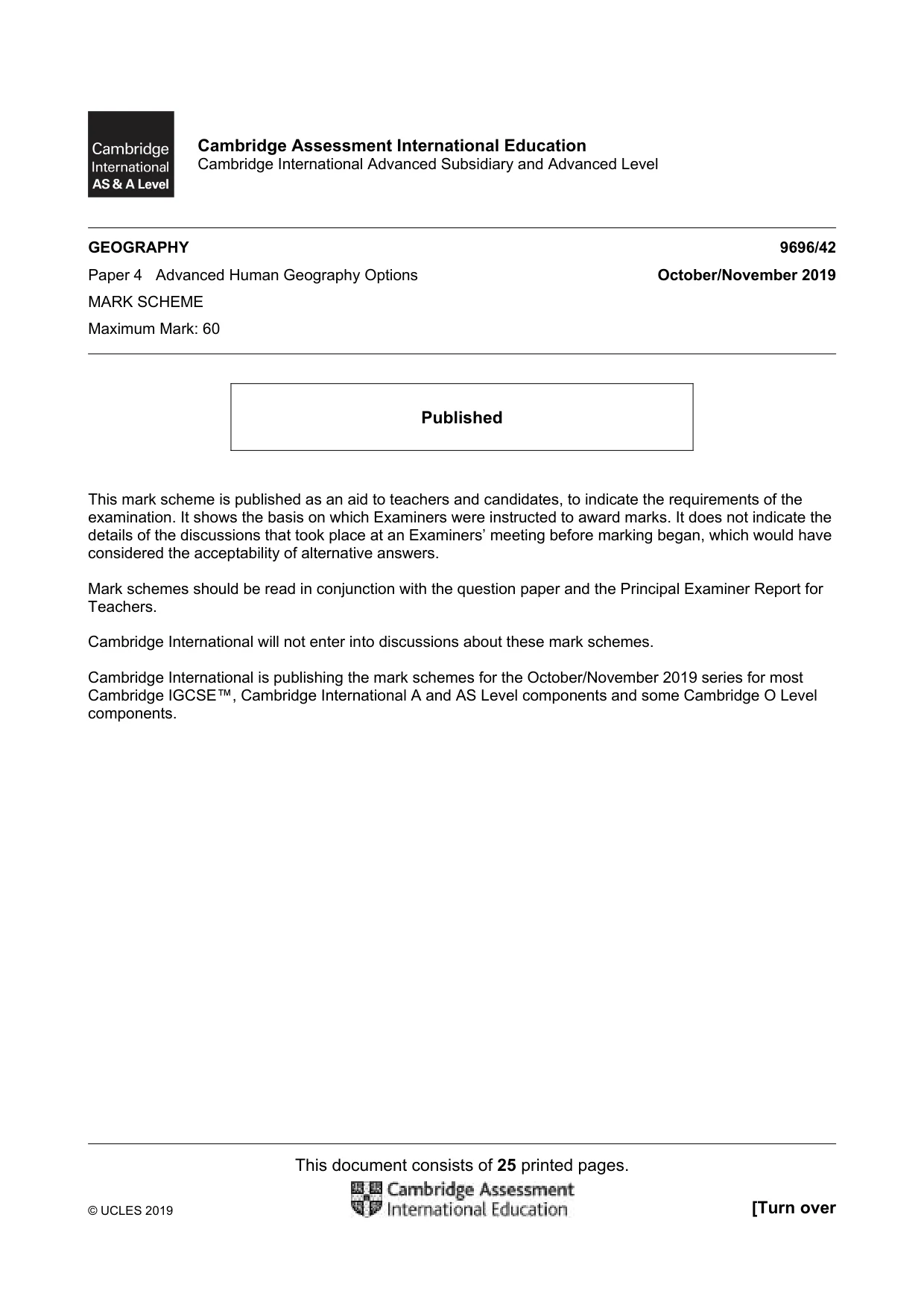
1 Fig. 1.1 shows production of machinery for cement plants in India, an MIC in Asia, in 2016. Cement is used in building construction and to make concrete. (a) Describe the distribution of production shown in Fig. 1.1. [4] (b) Explain how producing heavy, bulky, low value products, such as cement and concrete, affects industrial location. [6]
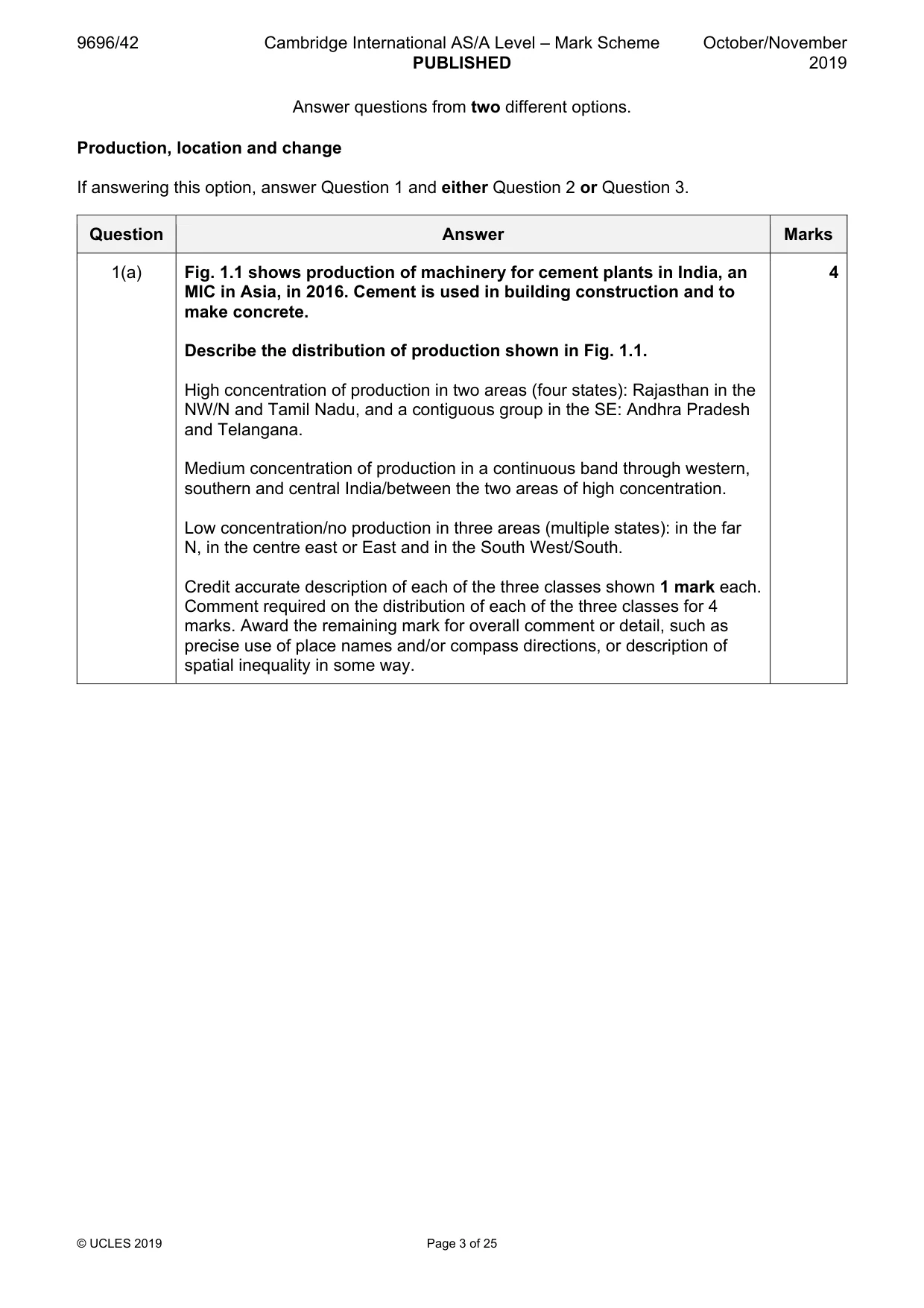
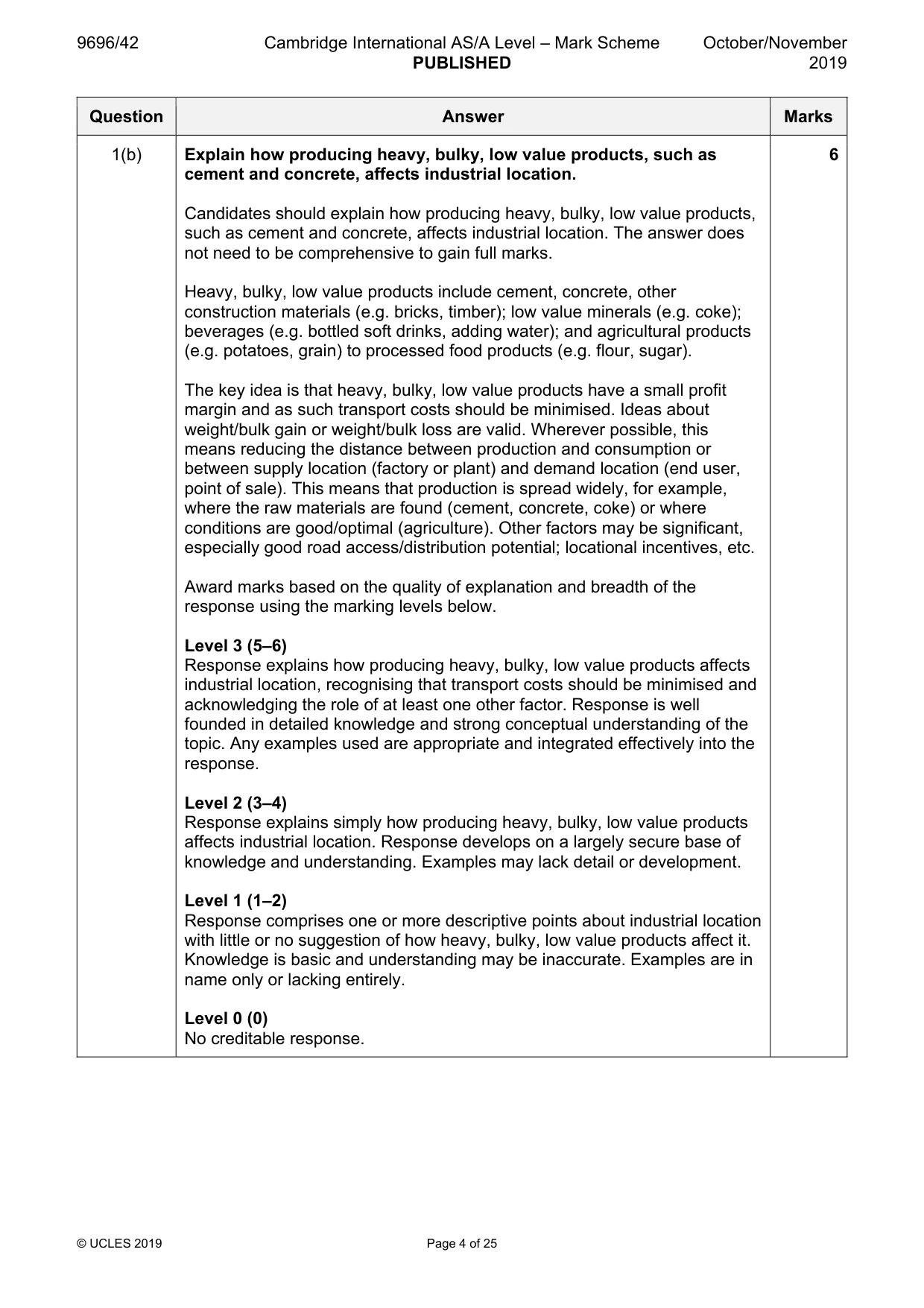
Mark scheme: Question Answer Marks 1(a) Fig. 1.1 shows production of machinery for cement plants in India, an 4 MIC in Asia, in 2016. Cement is used in building construction and to make concrete. Describe the distribution of production shown in Fig. 1.1. High concentration of production in two areas (four states): Rajasthan in the NW/N and Tamil Nadu, and a contiguous group in the SE: Andhra Pradesh and Telangana. Medium concentration of production in a continuous band through western, southern and central India/between the two areas of high concentration. Low concentration/no production in three areas (multiple states): in the far N, in the centre east or East and in the South West/South. Credit accurate description of each of the three classes shown 1 mark each. Comment required on the distribution of each of the three classes for 4 marks. Award the remaining mark for overall comment or detail, such as precise use of place names and/or compass directions, or description of spatial inequality in some way. 1(b) Explain how producing heavy, bulky, low value products, such as 6 cement and concrete, affects industrial location. Candidates should explain how producing heavy, bulky, low value products, such as cement and concrete, affects industrial location. The answer does not need to be comprehensive to gain full marks. Heavy, bulky, low value products include cement, concrete, other construction materials (e.g. bricks, timber); low value minerals (e.g. coke); beverages (e.g. bottled soft drinks, adding water); and agricultural products (e.g. potatoes, grain) to processed food products (e.g. flour, sugar). The key idea is that heavy, bulky, low value products have a small profit margin and as such transport costs should be minimised. Ideas about weight/bulk gain or weight/bulk loss are valid. Wherever possible, this means reducing the distance between production and consumption or between supply location (factory or plant) and demand location (end user, point of sale). This means that production is spread widely, for example, where the raw materials are found (cement, concrete, coke) or where conditions are good/optimal (agriculture). Other factors may be significant, especially good road access/distribution potential; locational incentives, etc. Award marks based on the quality of explanation and breadth of the response using the marking levels below. Level 3 (5–6) Response explains how producing heavy, bulky, low value products affects industrial location, recognising that transport costs should be minimised and acknowledging the role of at least one other factor. Response is well founded in detailed knowledge and strong conceptual understanding of the topic. Any examples used are appropriate and integrated effectively into the response. Level 2 (3–4) Response explains simply how producing heavy, bulky, low value products affects industrial location. Response develops on a largely secure base of knowledge and understanding. Examples may lack detail or development. Level 1 (1–2) Response comprises one or more descriptive points about industrial location with little or no suggestion of how heavy, bulky, low value products affect it. Knowledge is basic and understanding may be inaccurate. Examples are in name only or lacking entirely. Level 0 (0) No creditable response.
Q2 · Evaluate different ways to increase the productivity of one agricultural system you have…
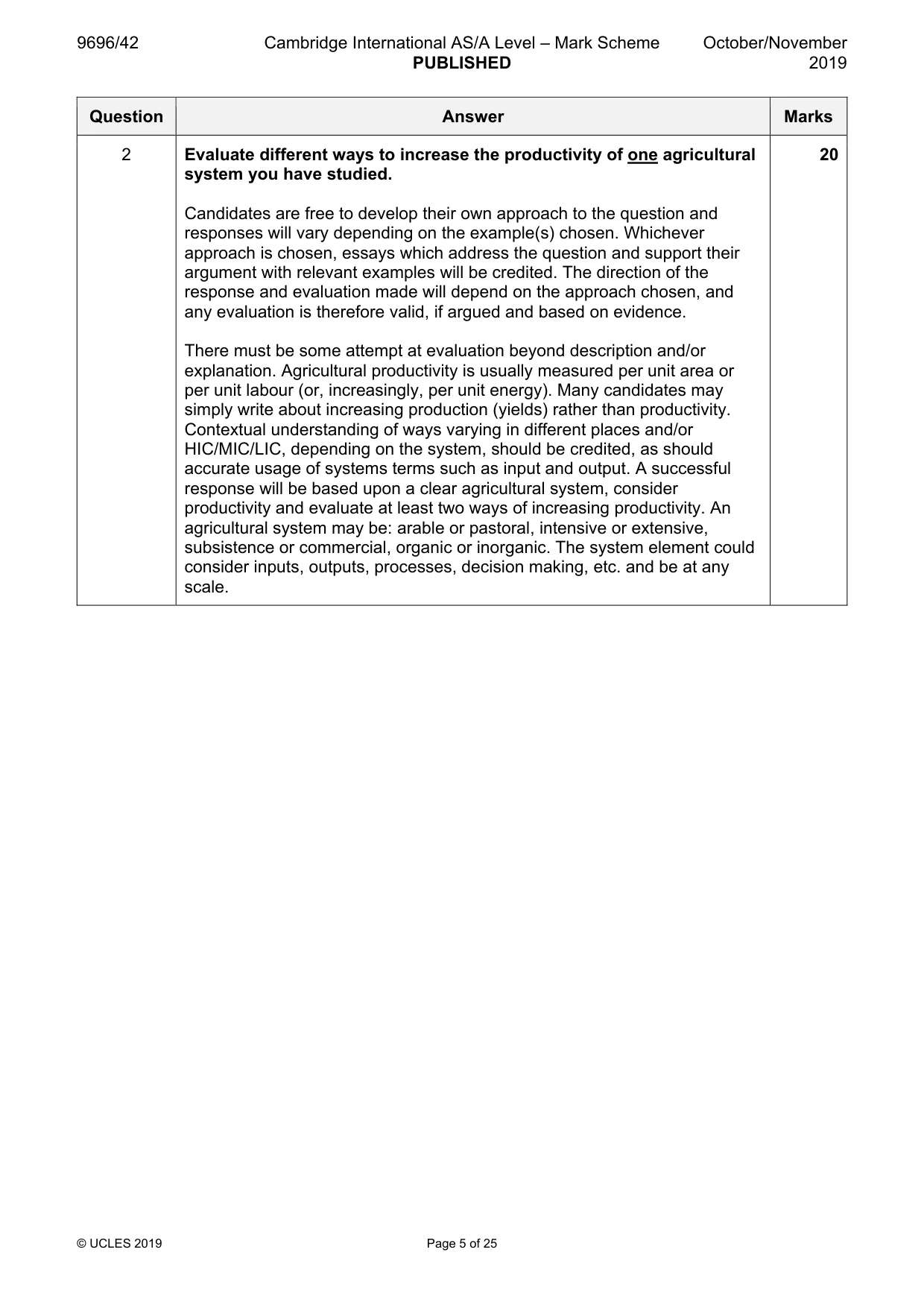
2 Evaluate different ways to increase the productivity of one agricultural system you have studied. [20]
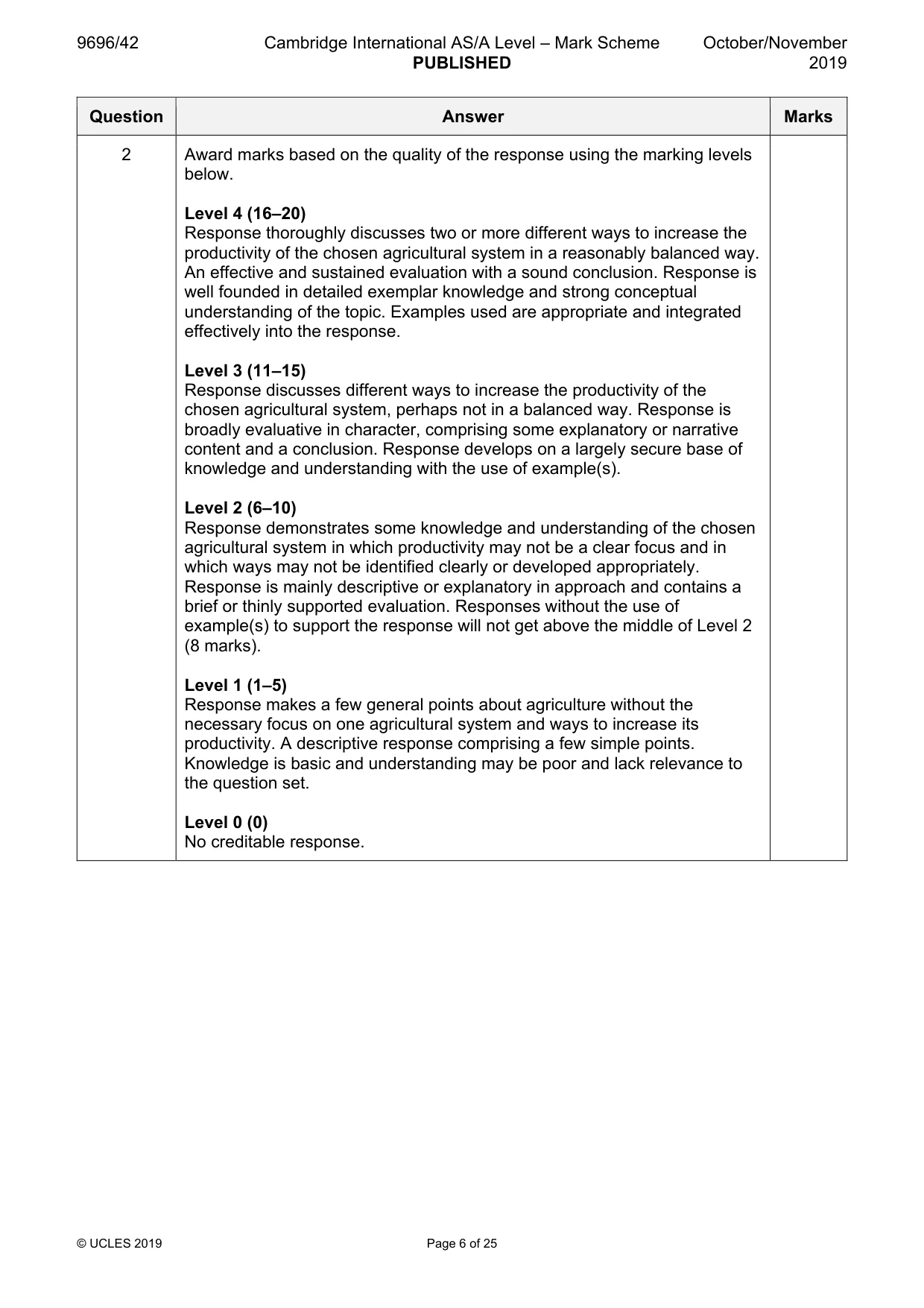
Mark scheme: 2 Evaluate different ways to increase the productivity of one agricultural 20 system you have studied. Candidates are free to develop their own approach to the question and responses will vary depending on the example(s) chosen. Whichever approach is chosen, essays which address the question and support their argument with relevant examples will be credited. The direction of the response and evaluation made will depend on the approach chosen, and any evaluation is therefore valid, if argued and based on evidence. There must be some attempt at evaluation beyond description and/or explanation. Agricultural productivity is usually measured per unit area or per unit labour (or, increasingly, per unit energy). Many candidates may simply write about increasing production (yields) rather than productivity. Contextual understanding of ways varying in different places and/or HIC/MIC/LIC, depending on the system, should be credited, as should accurate usage of systems terms such as input and output. A successful response will be based upon a clear agricultural system, consider productivity and evaluate at least two ways of increasing productivity. An agricultural system may be: arable or pastoral, intensive or extensive, subsistence or commercial, organic or inorganic. The system element could consider inputs, outputs, processes, decision making, etc. and be at any scale. 2 Award marks based on the quality of the response using the marking levels below. Level 4 (16–20) Response thoroughly discusses two or more different ways to increase the productivity of the chosen agricultural system in a reasonably balanced way. An effective and sustained evaluation with a sound conclusion. Response is well founded in detailed exemplar knowledge and strong conceptual understanding of the topic. Examples used are appropriate and integrated effectively into the response. Level 3 (11–15) Response discusses different ways to increase the productivity of the chosen agricultural system, perhaps not in a balanced way. Response is broadly evaluative in character, comprising some explanatory or narrative content and a conclusion. Response develops on a largely secure base of knowledge and understanding with the use of example(s). Level 2 (6–10) Response demonstrates some knowledge and understanding of the chosen agricultural system in which productivity may not be a clear focus and in which ways may not be identified clearly or developed appropriately. Response is mainly descriptive or explanatory in approach and contains a brief or thinly supported evaluation. Responses without the use of example(s) to support the response will not get above the middle of Level 2 (8 marks). Level 1 (1–5) Response makes a few general points about agriculture without the necessary focus on one agricultural system and ways to increase its productivity. A descriptive response comprising a few simple points. Knowledge is basic and understanding may be poor and lack relevance to the question set. Level 0 (0) No creditable response.
Q3 · ‘The industrial policy for manufacturing was ambitious in its aims but limited in its…
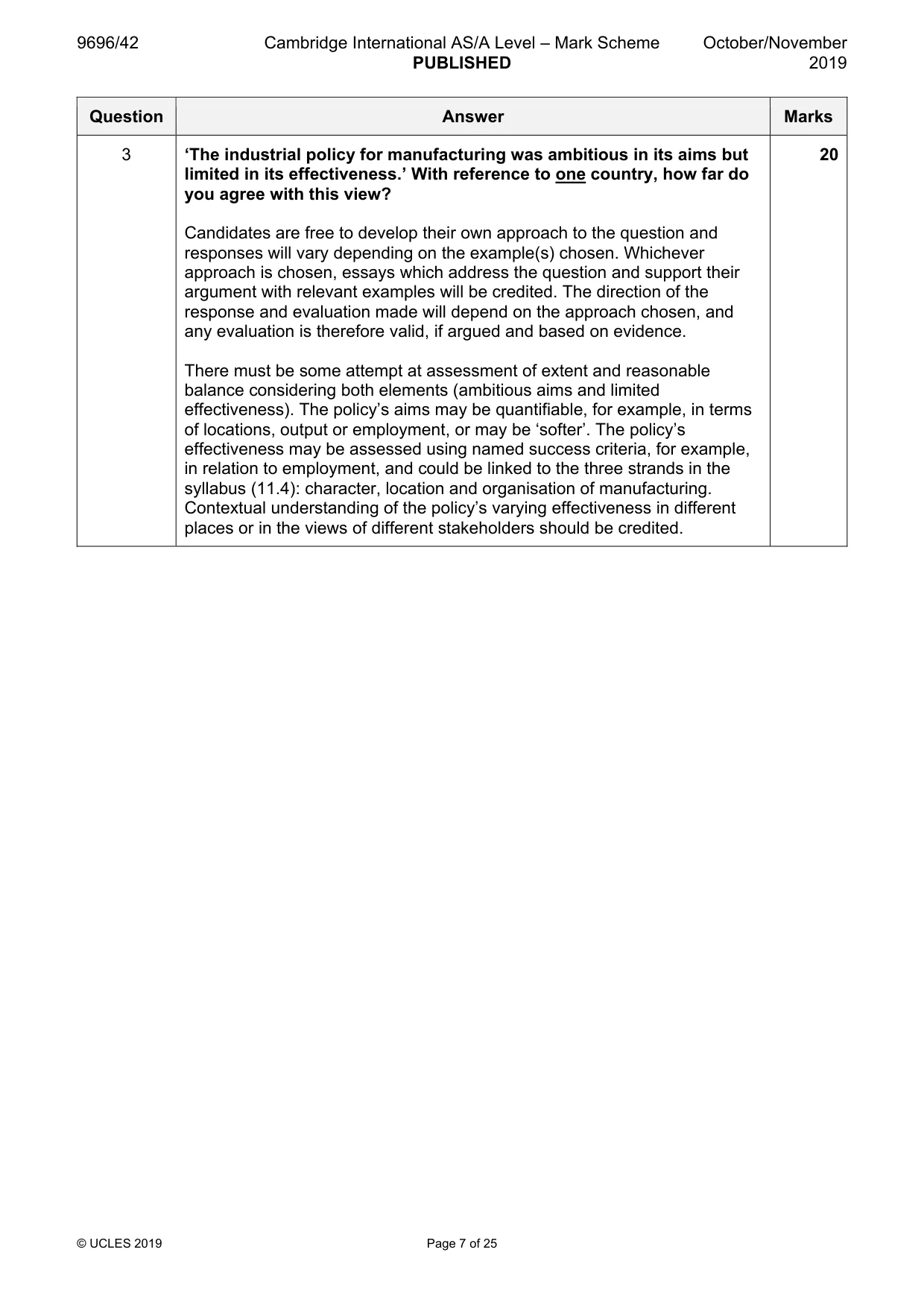
3 ‘The industrial policy for manufacturing was ambitious in its aims but limited in its effectiveness.’ With reference to one country, how far do you agree with this view? [20] Environmental management If answering this option, answer Question 4 and either Question 5 or Question 6.
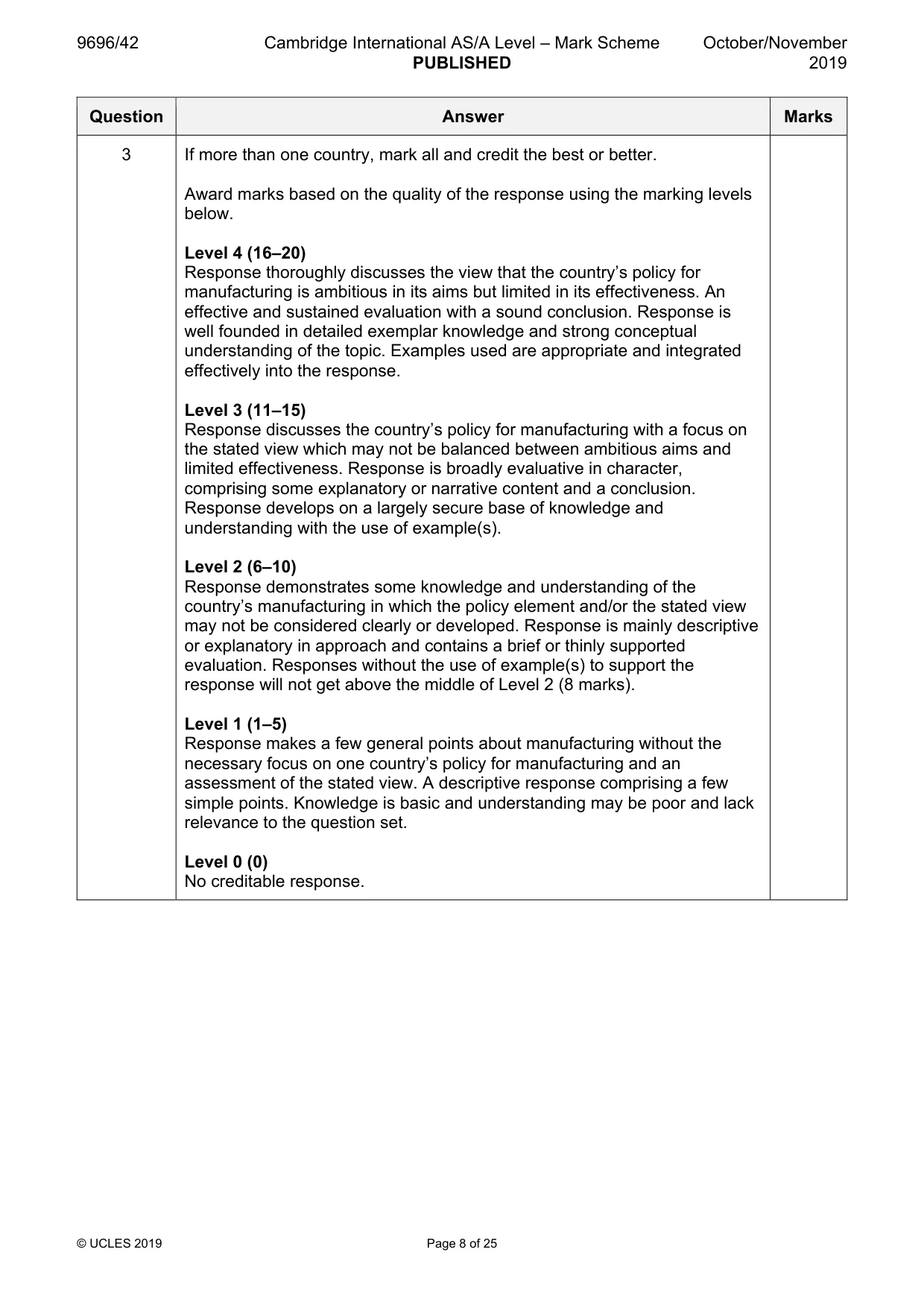
Mark scheme: 3 ‘The industrial policy for manufacturing was ambitious in its aims but 20 limited in its effectiveness.’ With reference to one country, how far do you agree with this view? Candidates are free to develop their own approach to the question and responses will vary depending on the example(s) chosen. Whichever approach is chosen, essays which address the question and support their argument with relevant examples will be credited. The direction of the response and evaluation made will depend on the approach chosen, and any evaluation is therefore valid, if argued and based on evidence. There must be some attempt at assessment of extent and reasonable balance considering both elements (ambitious aims and limited effectiveness). The policy’s aims may be quantifiable, for example, in terms of locations, output or employment, or may be ‘softer’. The policy’s effectiveness may be assessed using named success criteria, for example, in relation to employment, and could be linked to the three strands in the syllabus (11.4): character, location and organisation of manufacturing. Contextual understanding of the policy’s varying effectiveness in different places or in the views of different stakeholders should be credited. 3 If more than one country, mark all and credit the best or better. Award marks based on the quality of the response using the marking levels below. Level 4 (16–20) Response thoroughly discusses the view that the country’s policy for manufacturing is ambitious in its aims but limited in its effectiveness. An effective and sustained evaluation with a sound conclusion. Response is well founded in detailed exemplar knowledge and strong conceptual understanding of the topic. Examples used are appropriate and integrated effectively into the response. Level 3 (11–15) Response discusses the country’s policy for manufacturing with a focus on the stated view which may not be balanced between ambitious aims and limited effectiveness. Response is broadly evaluative in character, comprising some explanatory or narrative content and a conclusion. Response develops on a largely secure base of knowledge and understanding with the use of example(s). Level 2 (6–10) Response demonstrates some knowledge and understanding of the country’s manufacturing in which the policy element and/or the stated view may not be considered clearly or developed. Response is mainly descriptive or explanatory in approach and contains a brief or thinly supported evaluation. Responses without the use of example(s) to support the response will not get above the middle of Level 2 (8 marks). Level 1 (1–5) Response makes a few general points about manufacturing without the necessary focus on one country’s policy for manufacturing and an assessment of the stated view. A descriptive response comprising a few simple points. Knowledge is basic and understanding may be poor and lack relevance to the question set. Level 0 (0) No creditable response. Environmental management If answering this option, answer Question 4 and either Question 5 or Question 6.
Q4 · Electricity generating capacity in Europe, by fuel type, in 2013 and predicted for 2030
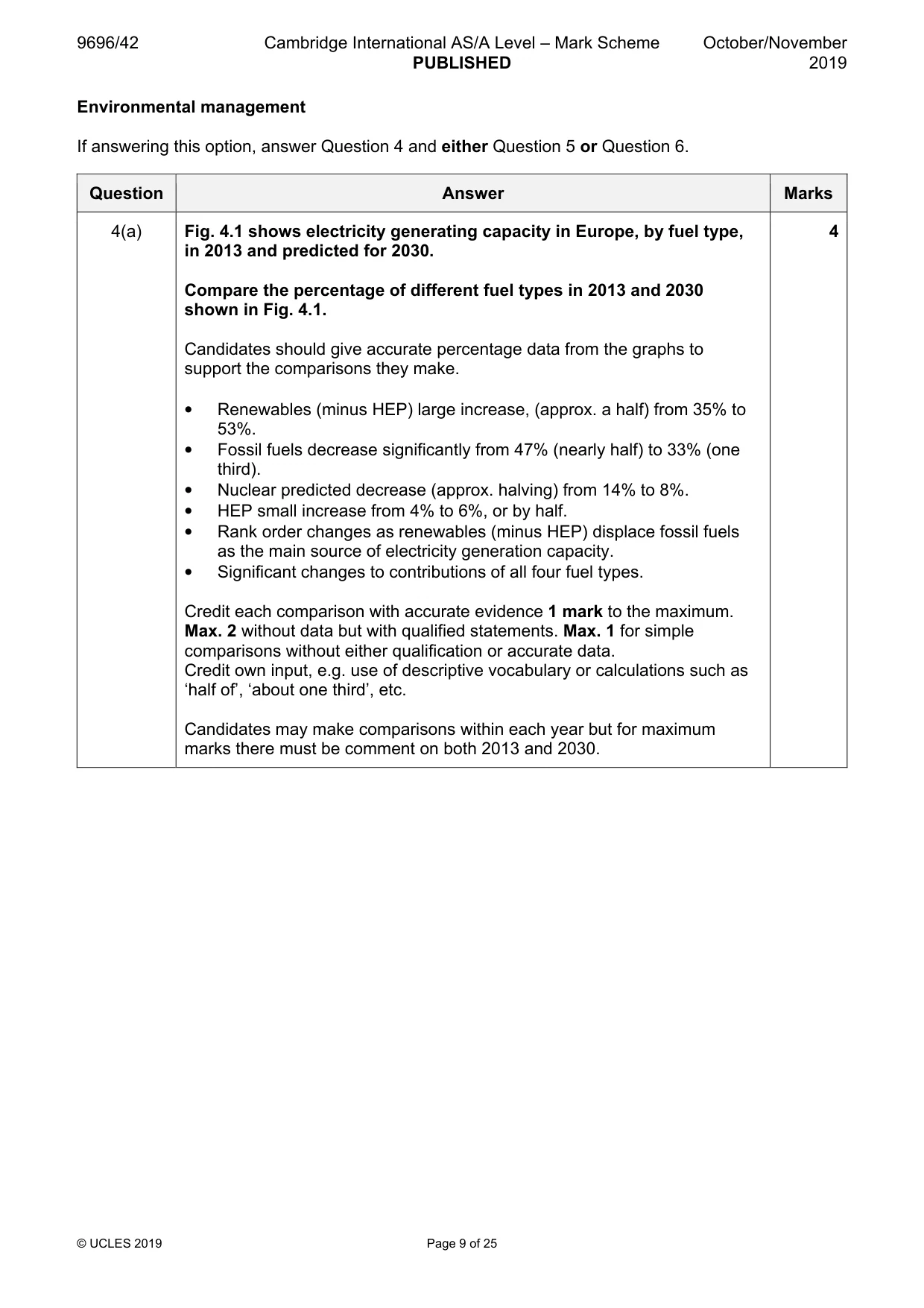
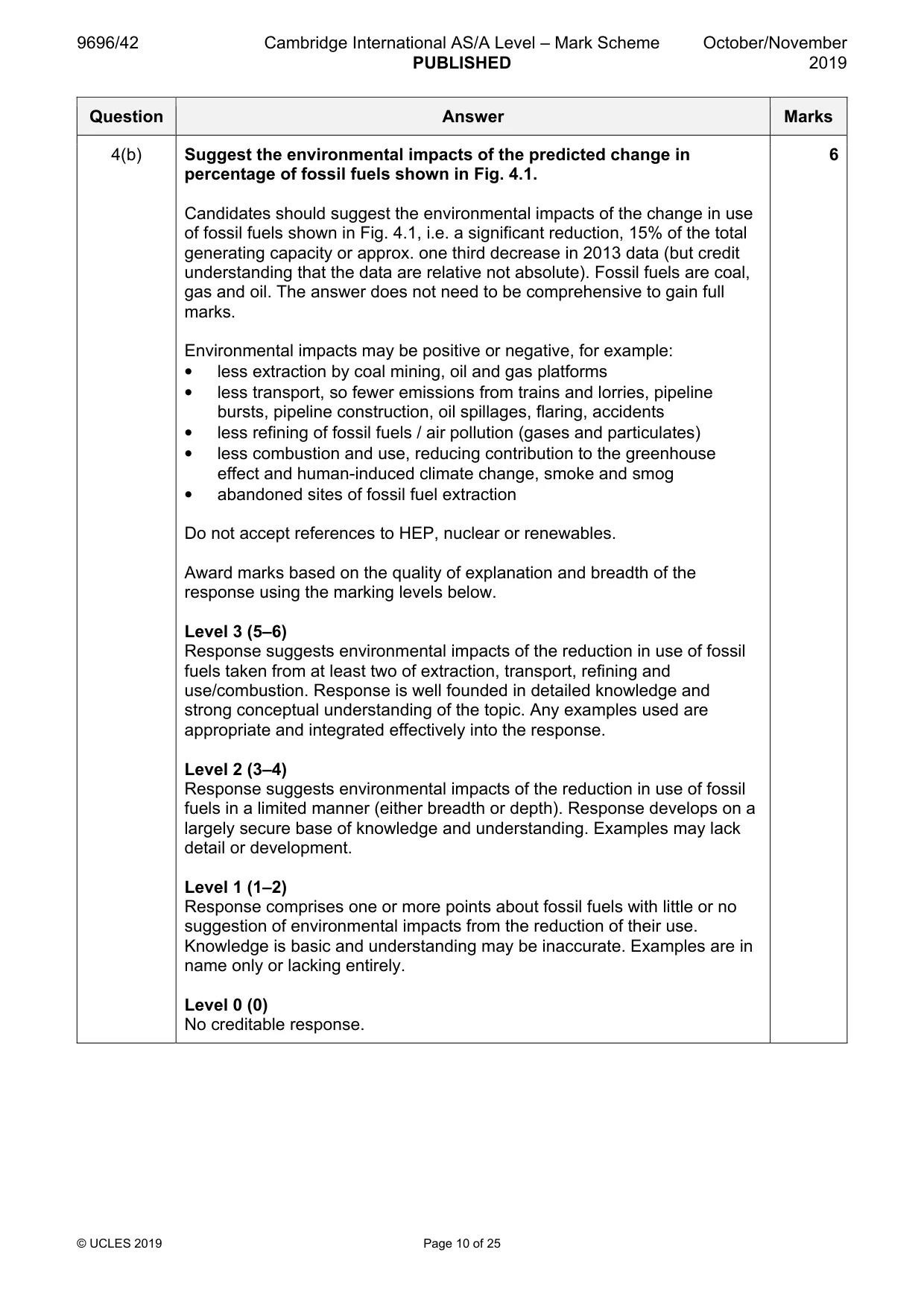
4 Fig. 4.1 shows electricity generating capacity in Europe, by fuel type, in 2013 and predicted for 2030. (a) Compare the percentage of different fuel types in 2013 and 2030 shown in Fig. 4.1. [4] (b) Suggest the environmental impacts of the predicted change in percentage of fossil fuels shown in Fig. 4.1. [6]
Mark scheme: 4(a) Fig. 4.1 shows electricity generating capacity in Europe, by fuel type, 4 in 2013 and predicted for 2030. Compare the percentage of different fuel types in 2013 and 2030 shown in Fig. 4.1. Candidates should give accurate percentage data from the graphs to support the comparisons they make. • Renewables (minus HEP) large increase, (approx. a half) from 35% to 53%. • Fossil fuels decrease significantly from 47% (nearly half) to 33% (one third). • Nuclear predicted decrease (approx. halving) from 14% to 8%. • HEP small increase from 4% to 6%, or by half. • Rank order changes as renewables (minus HEP) displace fossil fuels as the main source of electricity generation capacity. • Significant changes to contributions of all four fuel types. Credit each comparison with accurate evidence 1 mark to the maximum. Max. 2 without data but with qualified statements. Max. 1 for simple comparisons without either qualification or accurate data. Credit own input, e.g. use of descriptive vocabulary or calculations such as ‘half of’, ‘about one third’, etc. Candidates may make comparisons within each year but for maximum marks there must be comment on both 2013 and 2030. 4(b) Suggest the environmental impacts of the predicted change in 6 percentage of fossil fuels shown in Fig. 4.1. Candidates should suggest the environmental impacts of the change in use of fossil fuels shown in Fig. 4.1, i.e. a significant reduction, 15% of the total generating capacity or approx. one third decrease in 2013 data (but credit understanding that the data are relative not absolute). Fossil fuels are coal, gas and oil. The answer does not need to be comprehensive to gain full marks. Environmental impacts may be positive or negative, for example: • less extraction by coal mining, oil and gas platforms • less transport, so fewer emissions from trains and lorries, pipeline bursts, pipeline construction, oil spillages, flaring, accidents • less refining of fossil fuels / air pollution (gases and particulates) • less combustion and use, reducing contribution to the greenhouse effect and human-induced climate change, smoke and smog • abandoned sites of fossil fuel extraction Do not accept references to HEP, nuclear or renewables. Award marks based on the quality of explanation and breadth of the response using the marking levels below. Level 3 (5–6) Response suggests environmental impacts of the reduction in use of fossil fuels taken from at least two of extraction, transport, refining and use/combustion. Response is well founded in detailed knowledge and strong conceptual understanding of the topic. Any examples used are appropriate and integrated effectively into the response. Level 2 (3–4) Response suggests environmental impacts of the reduction in use of fossil fuels in a limited manner (either breadth or depth). Response develops on a largely secure base of knowledge and understanding. Examples may lack detail or development. Level 1 (1–2) Response comprises one or more points about fossil fuels with little or no suggestion of environmental impacts from the reduction of their use. Knowledge is basic and understanding may be inaccurate. Examples are in name only or lacking entirely. Level 0 (0) No creditable response.
Q5 · ‘People have different views about the scheme’s success.’ How far is this statement true…
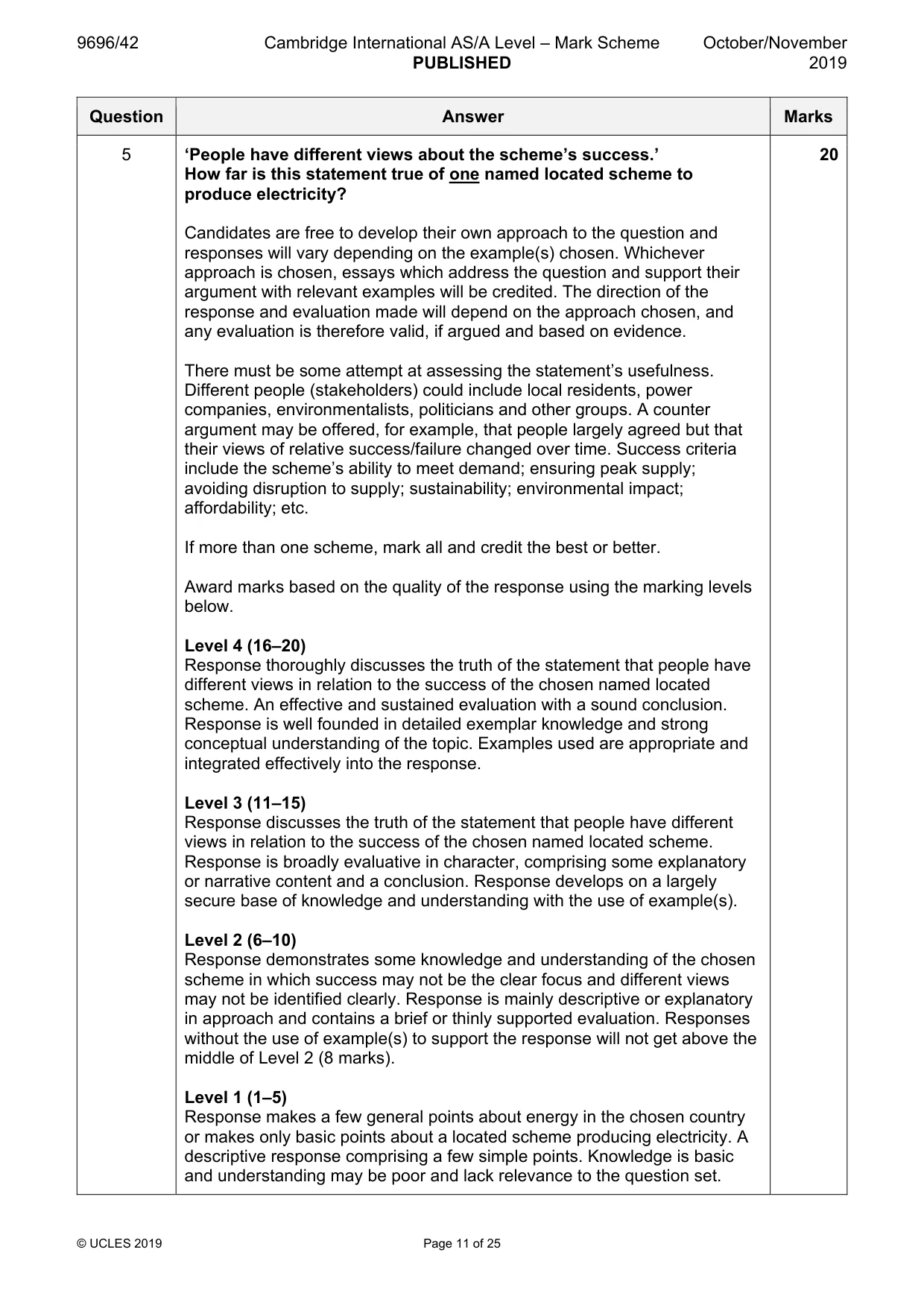
5 ‘People have different views about the scheme’s success.’ How far is this statement true of one named located scheme to produce electricity? [20]
Mark scheme: 5 ‘People have different views about the scheme’s success.’ 20 How far is this statement true of one named located scheme to produce electricity? Candidates are free to develop their own approach to the question and responses will vary depending on the example(s) chosen. Whichever approach is chosen, essays which address the question and support their argument with relevant examples will be credited. The direction of the response and evaluation made will depend on the approach chosen, and any evaluation is therefore valid, if argued and based on evidence. There must be some attempt at assessing the statement’s usefulness. Different people (stakeholders) could include local residents, power companies, environmentalists, politicians and other groups. A counter argument may be offered, for example, that people largely agreed but that their views of relative success/failure changed over time. Success criteria include the scheme’s ability to meet demand; ensuring peak supply; avoiding disruption to supply; sustainability; environmental impact; affordability; etc. If more than one scheme, mark all and credit the best or better. Award marks based on the quality of the response using the marking levels below. Level 4 (16–20) Response thoroughly discusses the truth of the statement that people have different views in relation to the success of the chosen named located scheme. An effective and sustained evaluation with a sound conclusion. Response is well founded in detailed exemplar knowledge and strong conceptual understanding of the topic. Examples used are appropriate and integrated effectively into the response. Level 3 (11–15) Response discusses the truth of the statement that people have different views in relation to the success of the chosen named located scheme. Response is broadly evaluative in character, comprising some explanatory or narrative content and a conclusion. Response develops on a largely secure base of knowledge and understanding with the use of example(s). Level 2 (6–10) Response demonstrates some knowledge and understanding of the chosen scheme in which success may not be the clear focus and different views may not be identified clearly. Response is mainly descriptive or explanatory in approach and contains a brief or thinly supported evaluation. Responses without the use of example(s) to support the response will not get above the middle of Level 2 (8 marks). Level 1 (1–5) Response makes a few general points about energy in the chosen country or makes only basic points about a located scheme producing electricity. A descriptive response comprising a few simple points. Knowledge is basic and understanding may be poor and lack relevance to the question set. 5 Level 0 (0) No creditable response.
Q6 · With reference to one or more examples, evaluate why issues of water quality can be…
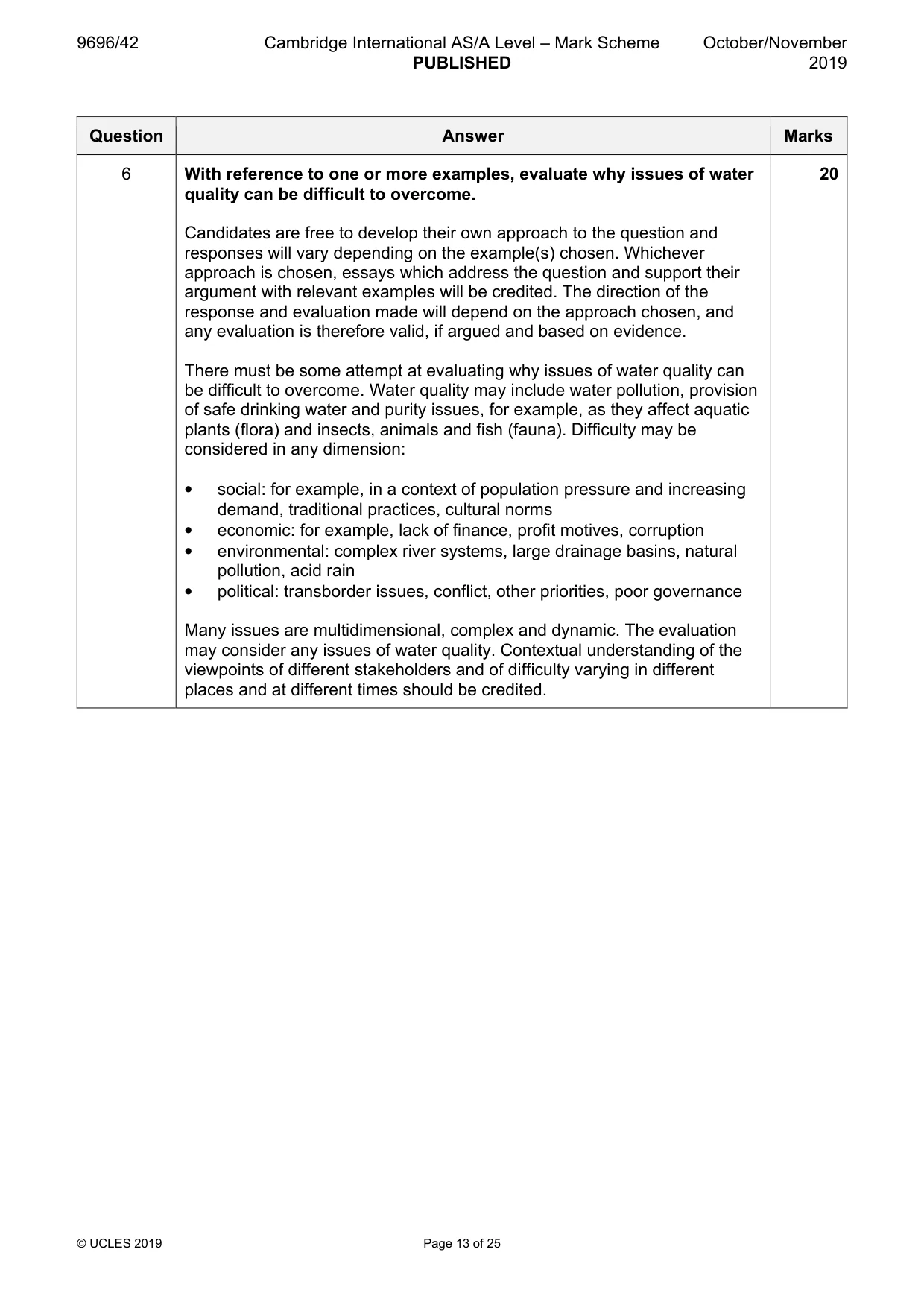
6 With reference to one or more examples, evaluate why issues of water quality can be difficult to overcome. [20] Global interdependence If answering this option, answer Question 7 and either Question 8 or Question 9.
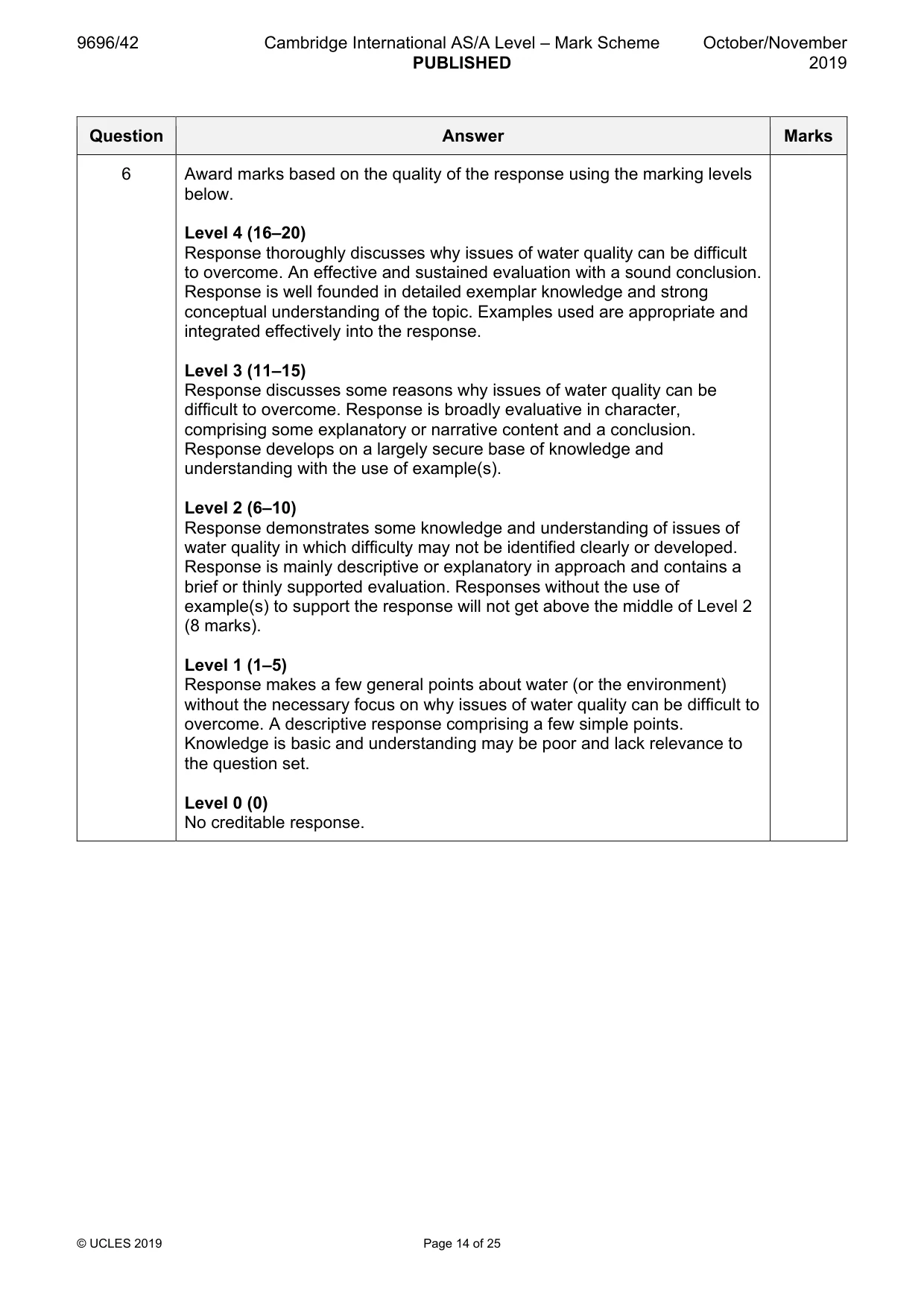
Mark scheme: 6 With reference to one or more examples, evaluate why issues of water 20 quality can be difficult to overcome. Candidates are free to develop their own approach to the question and responses will vary depending on the example(s) chosen. Whichever approach is chosen, essays which address the question and support their argument with relevant examples will be credited. The direction of the response and evaluation made will depend on the approach chosen, and any evaluation is therefore valid, if argued and based on evidence. There must be some attempt at evaluating why issues of water quality can be difficult to overcome. Water quality may include water pollution, provision of safe drinking water and purity issues, for example, as they affect aquatic plants (flora) and insects, animals and fish (fauna). Difficulty may be considered in any dimension: • social: for example, in a context of population pressure and increasing demand, traditional practices, cultural norms • economic: for example, lack of finance, profit motives, corruption • environmental: complex river systems, large drainage basins, natural pollution, acid rain • political: transborder issues, conflict, other priorities, poor governance Many issues are multidimensional, complex and dynamic. The evaluation may consider any issues of water quality. Contextual understanding of the viewpoints of different stakeholders and of difficulty varying in different places and at different times should be credited. Question Answer Marks 6 Award marks based on the quality of the response using the marking levels below. Level 4 (16–20) Response thoroughly discusses why issues of water quality can be difficult to overcome. An effective and sustained evaluation with a sound conclusion. Response is well founded in detailed exemplar knowledge and strong conceptual understanding of the topic. Examples used are appropriate and integrated effectively into the response. Level 3 (11–15) Response discusses some reasons why issues of water quality can be difficult to overcome. Response is broadly evaluative in character, comprising some explanatory or narrative content and a conclusion. Response develops on a largely secure base of knowledge and understanding with the use of example(s). Level 2 (6–10) Response demonstrates some knowledge and understanding of issues of water quality in which difficulty may not be identified clearly or developed. Response is mainly descriptive or explanatory in approach and contains a brief or thinly supported evaluation. Responses without the use of example(s) to support the response will not get above the middle of Level 2 (8 marks). Level 1 (1–5) Response makes a few general points about water (or the environment) without the necessary focus on why issues of water quality can be difficult to overcome. A descriptive response comprising a few simple points. Knowledge is basic and understanding may be poor and lack relevance to the question set. Level 0 (0) No creditable response. Global interdependence If answering this option, answer Question 7 and either Question 8 or Question 9.
Q7 · A photograph which shows children selling jewellery to a tourist at a beach resort in an…
7 Fig. 7.1 is a photograph which shows children selling jewellery to a tourist at a beach resort in an MIC in Asia. (a) Suggest the impacts on local society of the tourism activity shown in Fig. 7.1. [4] (b) Explain the ways that the environment shown in Fig. 7.1 may be at risk of being degraded by mass tourism. [6]
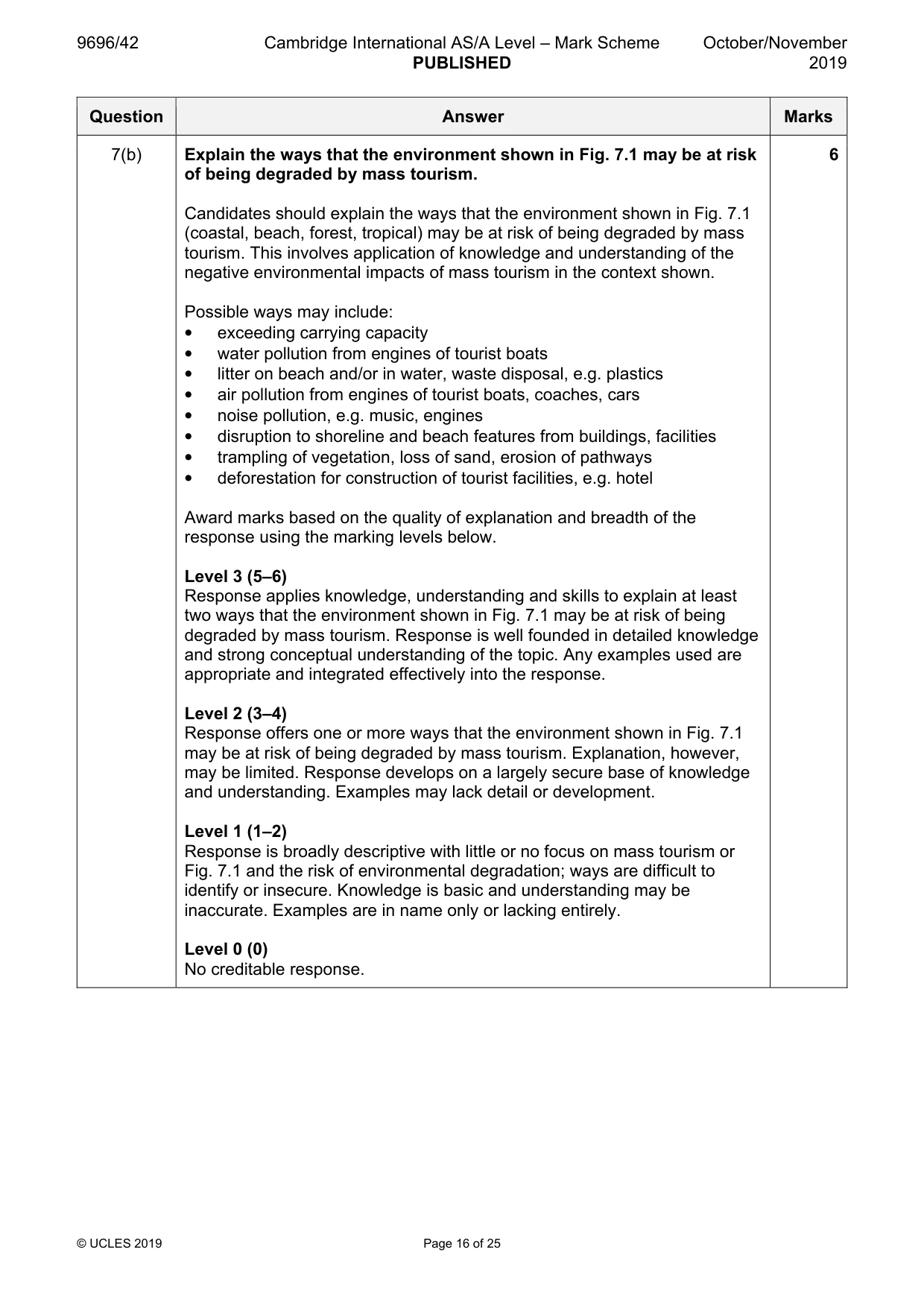
Mark scheme: 7(a) Fig. 7.1 is a photograph which shows children selling jewellery to a 4 tourist at a beach resort in an MIC in Asia. Suggest the impacts on local society of the tourism activity shown in Fig. 7.1. Candidates should suggest the impacts on local society of children (child hawkers) trying to sell tourists, in this case from an HIC, jewellery. This involves skills in photographic interpretation and the application of knowledge and understanding of tourism’s impacts in this specific context. Suggested impacts on local society may include: (mainly) positive • work in craft production • improved family life from earnings, e.g. diet, living conditions, health • language acquisition • worldview, opening up horizons (mainly) negative • children not attending school limits development, literacy and skills • possible conflicts and rivalries between children/child hawkers • loss of culture/change of culture and values to ‘Western’ ones Credit other valid suggestions. Candidates do not need to make comprehensive suggestions of impacts on society for full marks. Reward responses which demonstrate clear understanding of the photograph and of tourism. For a simple valid impact on local society 1 mark, for a detailed or developed impact on society 2 marks to the maximum. Do not credit economic or environmental impacts unless they are made relevant and applied to local society. 7(b) Explain the ways that the environment shown in Fig. 7.1 may be at risk 6 of being degraded by mass tourism. Candidates should explain the ways that the environment shown in Fig. 7.1 (coastal, beach, forest, tropical) may be at risk of being degraded by mass tourism. This involves application of knowledge and understanding of the negative environmental impacts of mass tourism in the context shown. Possible ways may include: • exceeding carrying capacity • water pollution from engines of tourist boats • litter on beach and/or in water, waste disposal, e.g. plastics • air pollution from engines of tourist boats, coaches, cars • noise pollution, e.g. music, engines • disruption to shoreline and beach features from buildings, facilities • trampling of vegetation, loss of sand, erosion of pathways • deforestation for construction of tourist facilities, e.g. hotel Award marks based on the quality of explanation and breadth of the response using the marking levels below. Level 3 (5–6) Response applies knowledge, understanding and skills to explain at least two ways that the environment shown in Fig. 7.1 may be at risk of being degraded by mass tourism. Response is well founded in detailed knowledge and strong conceptual understanding of the topic. Any examples used are appropriate and integrated effectively into the response. Level 2 (3–4) Response offers one or more ways that the environment shown in Fig. 7.1 may be at risk of being degraded by mass tourism. Explanation, however, may be limited. Response develops on a largely secure base of knowledge and understanding. Examples may lack detail or development. Level 1 (1–2) Response is broadly descriptive with little or no focus on mass tourism or Fig. 7.1 and the risk of environmental degradation; ways are difficult to identify or insecure. Knowledge is basic and understanding may be inaccurate. Examples are in name only or lacking entirely. Level 0 (0) No creditable response.
Q8 · Assess the effects of changes in the global market on the trade of exporting countries
8 Assess the effects of changes in the global market on the trade of exporting countries. [20]
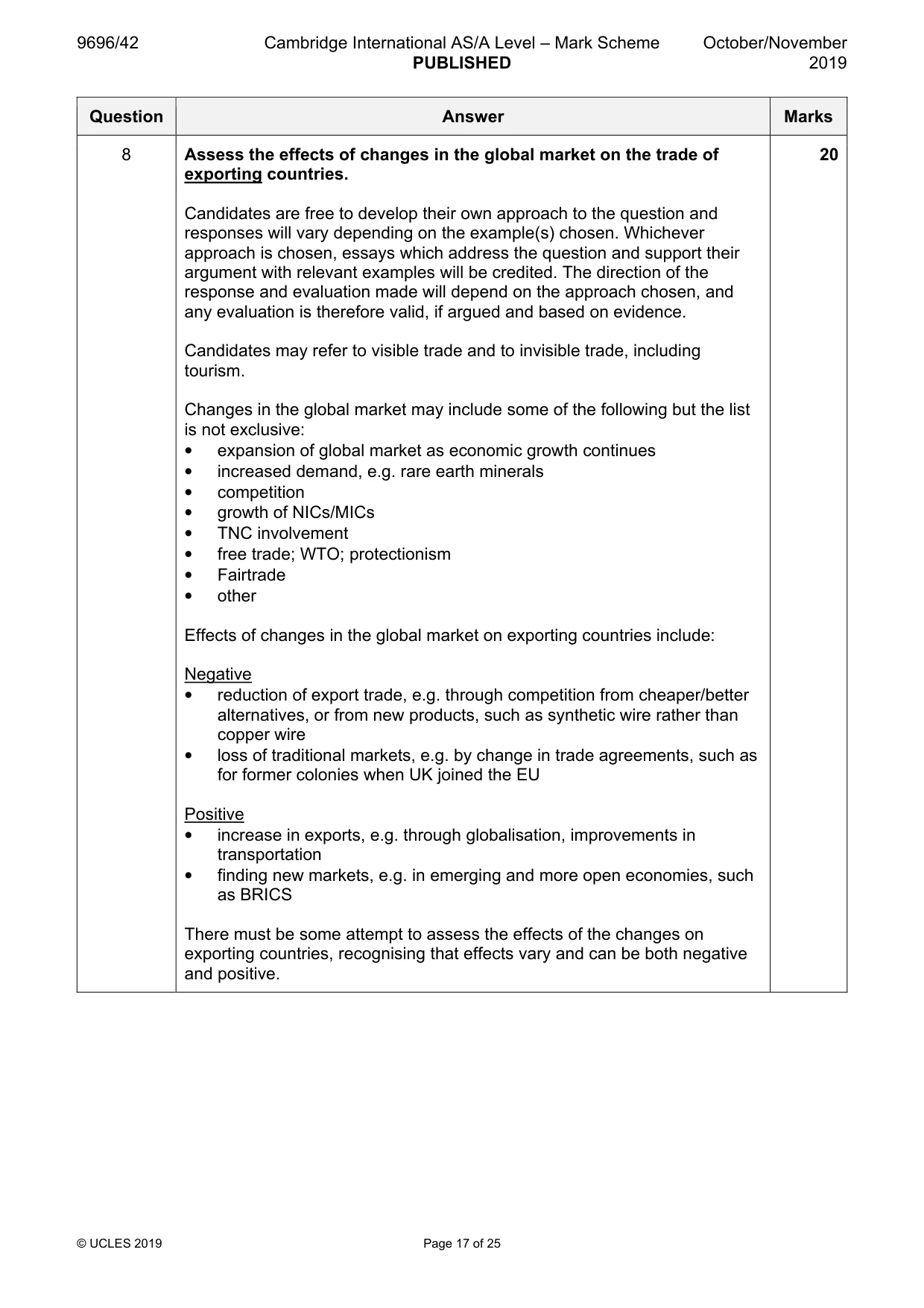
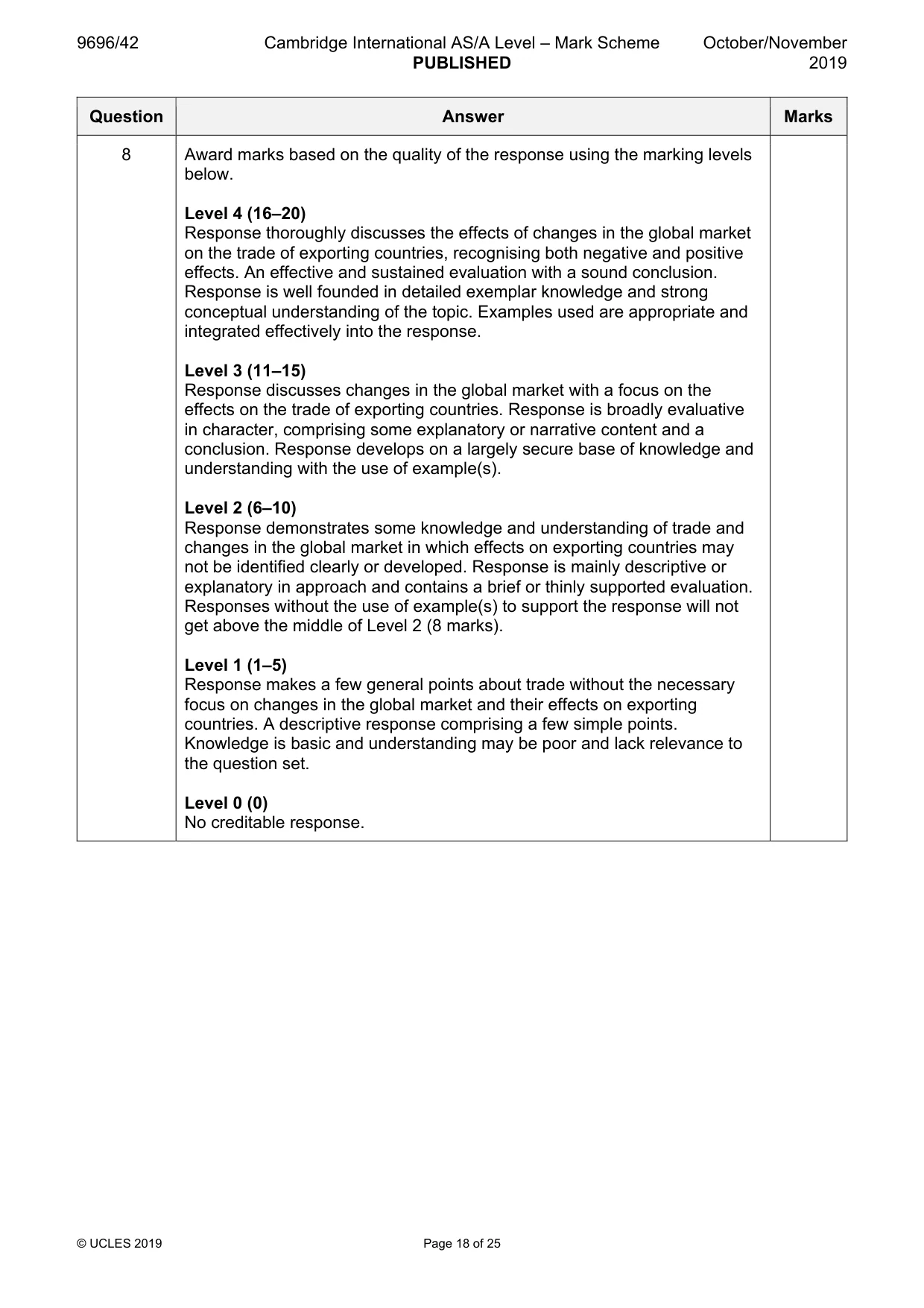
Mark scheme: 8 Assess the effects of changes in the global market on the trade of 20 exporting countries. Candidates are free to develop their own approach to the question and responses will vary depending on the example(s) chosen. Whichever approach is chosen, essays which address the question and support their argument with relevant examples will be credited. The direction of the response and evaluation made will depend on the approach chosen, and any evaluation is therefore valid, if argued and based on evidence. Candidates may refer to visible trade and to invisible trade, including tourism. Changes in the global market may include some of the following but the list is not exclusive: • expansion of global market as economic growth continues • increased demand, e.g. rare earth minerals • competition • growth of NICs/MICs • TNC involvement • free trade; WTO; protectionism • Fairtrade • other Effects of changes in the global market on exporting countries include: Negative • reduction of export trade, e.g. through competition from cheaper/better alternatives, or from new products, such as synthetic wire rather than copper wire • loss of traditional markets, e.g. by change in trade agreements, such as for former colonies when UK joined the EU Positive • increase in exports, e.g. through globalisation, improvements in transportation • finding new markets, e.g. in emerging and more open economies, such as BRICS There must be some attempt to assess the effects of the changes on exporting countries, recognising that effects vary and can be both negative and positive. 8 Award marks based on the quality of the response using the marking levels below. Level 4 (16–20) Response thoroughly discusses the effects of changes in the global market on the trade of exporting countries, recognising both negative and positive effects. An effective and sustained evaluation with a sound conclusion. Response is well founded in detailed exemplar knowledge and strong conceptual understanding of the topic. Examples used are appropriate and integrated effectively into the response. Level 3 (11–15) Response discusses changes in the global market with a focus on the effects on the trade of exporting countries. Response is broadly evaluative in character, comprising some explanatory or narrative content and a conclusion. Response develops on a largely secure base of knowledge and understanding with the use of example(s). Level 2 (6–10) Response demonstrates some knowledge and understanding of trade and changes in the global market in which effects on exporting countries may not be identified clearly or developed. Response is mainly descriptive or explanatory in approach and contains a brief or thinly supported evaluation. Responses without the use of example(s) to support the response will not get above the middle of Level 2 (8 marks). Level 1 (1–5) Response makes a few general points about trade without the necessary focus on changes in the global market and their effects on exporting countries. A descriptive response comprising a few simple points. Knowledge is basic and understanding may be poor and lack relevance to the question set. Level 0 (0) No creditable response.
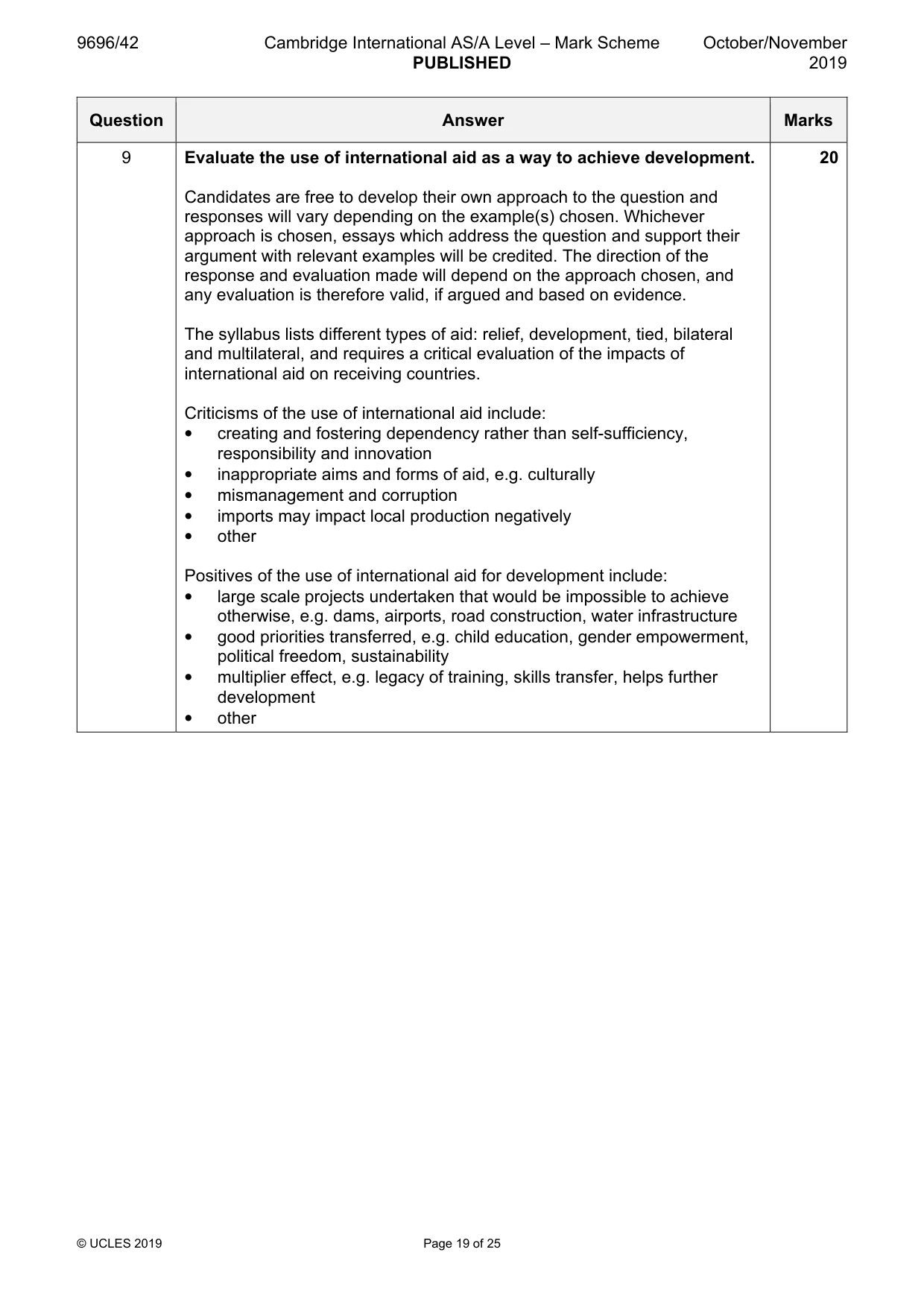
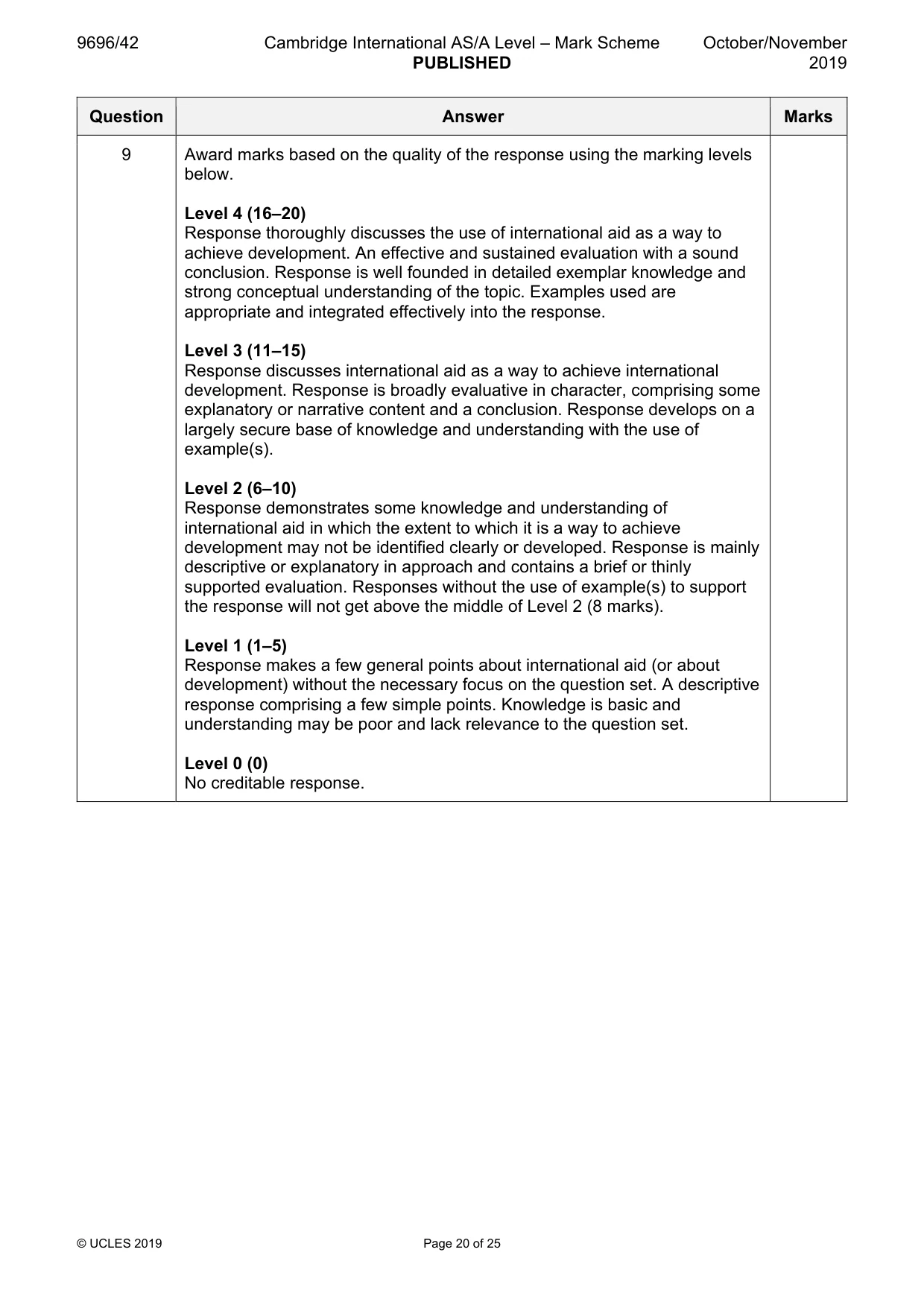
Q9 · Evaluate the use of international aid as a way to achieve development
9 Evaluate the use of international aid as a way to achieve development. [20] Economic transition If answering this option, answer Question 10 and either Question 11 or Question 12.
Mark scheme: 9 Evaluate the use of international aid as a way to achieve development. 20 Candidates are free to develop their own approach to the question and responses will vary depending on the example(s) chosen. Whichever approach is chosen, essays which address the question and support their argument with relevant examples will be credited. The direction of the response and evaluation made will depend on the approach chosen, and any evaluation is therefore valid, if argued and based on evidence. The syllabus lists different types of aid: relief, development, tied, bilateral and multilateral, and requires a critical evaluation of the impacts of international aid on receiving countries. Criticisms of the use of international aid include: • creating and fostering dependency rather than self-sufficiency, responsibility and innovation • inappropriate aims and forms of aid, e.g. culturally • mismanagement and corruption • imports may impact local production negatively • other Positives of the use of international aid for development include: • large scale projects undertaken that would be impossible to achieve otherwise, e.g. dams, airports, road construction, water infrastructure • good priorities transferred, e.g. child education, gender empowerment, political freedom, sustainability • multiplier effect, e.g. legacy of training, skills transfer, helps further development • other 9 Award marks based on the quality of the response using the marking levels below. Level 4 (16–20) Response thoroughly discusses the use of international aid as a way to achieve development. An effective and sustained evaluation with a sound conclusion. Response is well founded in detailed exemplar knowledge and strong conceptual understanding of the topic. Examples used are appropriate and integrated effectively into the response. Level 3 (11–15) Response discusses international aid as a way to achieve international development. Response is broadly evaluative in character, comprising some explanatory or narrative content and a conclusion. Response develops on a largely secure base of knowledge and understanding with the use of example(s). Level 2 (6–10) Response demonstrates some knowledge and understanding of international aid in which the extent to which it is a way to achieve development may not be identified clearly or developed. Response is mainly descriptive or explanatory in approach and contains a brief or thinly supported evaluation. Responses without the use of example(s) to support the response will not get above the middle of Level 2 (8 marks). Level 1 (1–5) Response makes a few general points about international aid (or about development) without the necessary focus on the question set. A descriptive response comprising a few simple points. Knowledge is basic and understanding may be poor and lack relevance to the question set. Level 0 (0) No creditable response. Economic transition If answering this option, answer Question 10 and either Question 11 or Question 12.
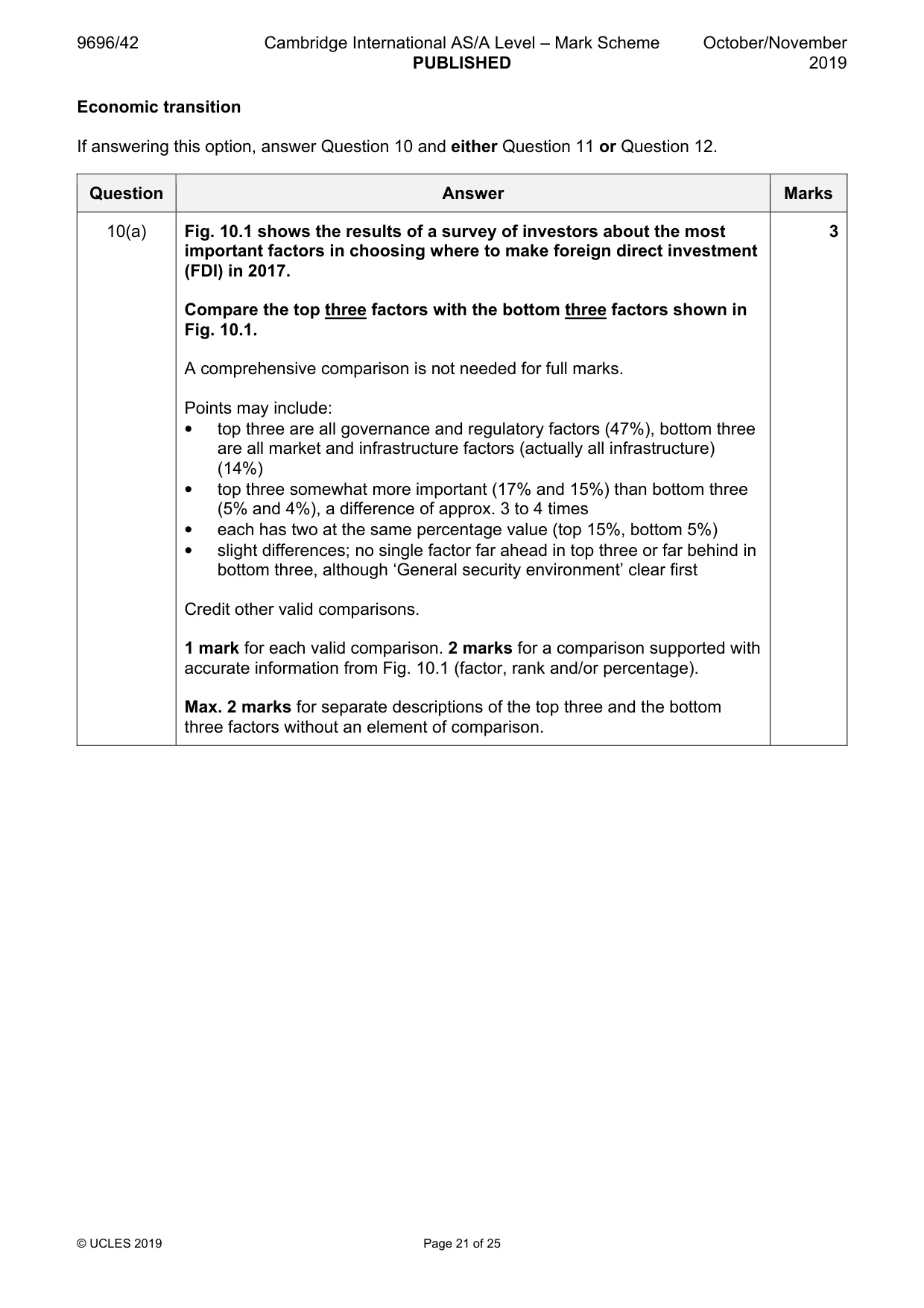
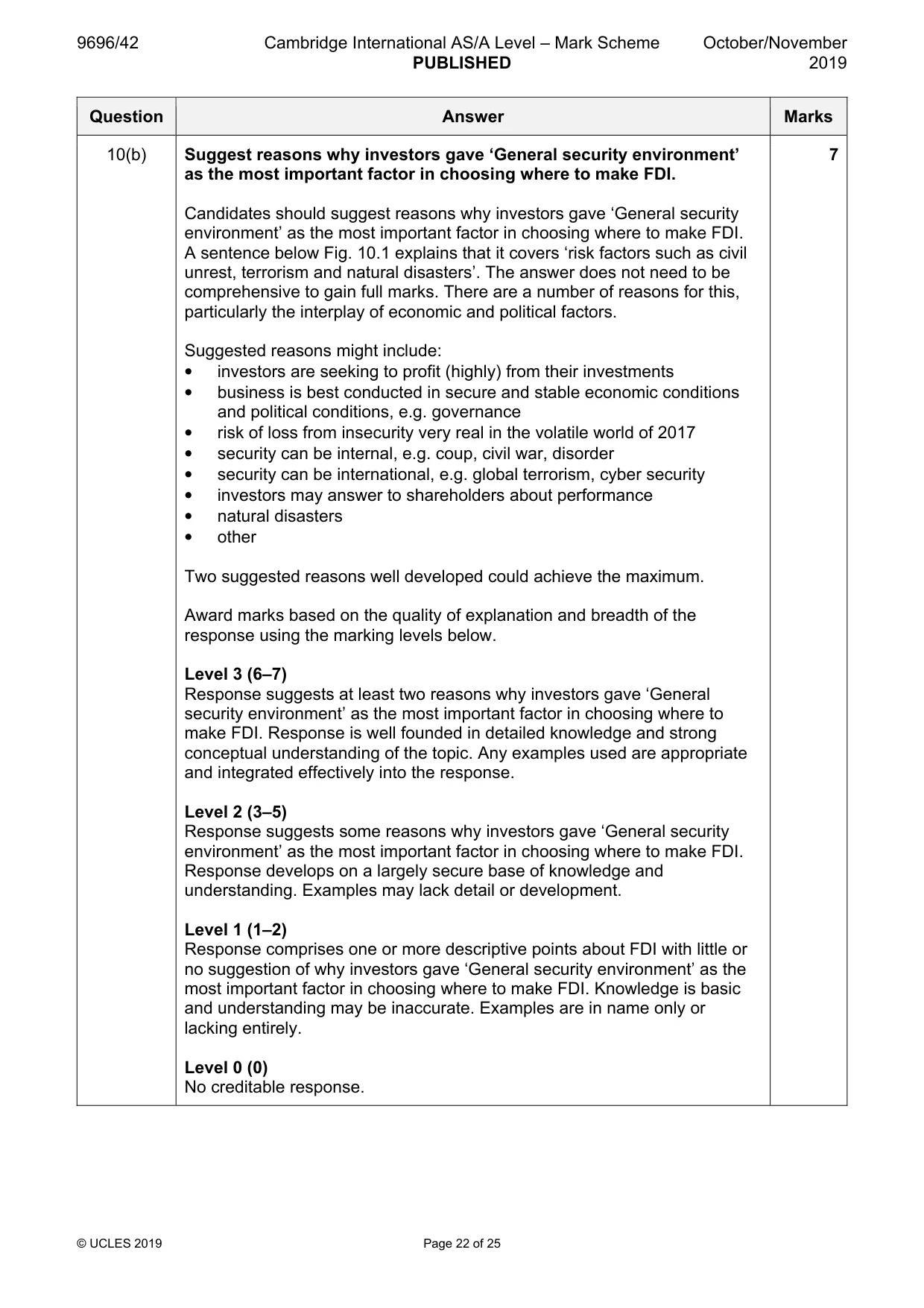
Q10 · The results of a survey of investors about the most important factors in choosing where…
10 Fig. 10.1 shows the results of a survey of investors about the most important factors in choosing where to make foreign direct investment (FDI) in 2017. (a) Compare the top three factors with the bottom three factors shown in Fig. 10.1. [3] (b) Suggest reasons why investors gave ‘General security environment’ as the most important factor in choosing where to make FDI. [7]
Mark scheme: 10(a) Fig. 10.1 shows the results of a survey of investors about the most 3 important factors in choosing where to make foreign direct investment (FDI) in 2017. Compare the top three factors with the bottom three factors shown in Fig. 10.1. A comprehensive comparison is not needed for full marks. Points may include: • top three are all governance and regulatory factors (47%), bottom three are all market and infrastructure factors (actually all infrastructure) (14%) • top three somewhat more important (17% and 15%) than bottom three (5% and 4%), a difference of approx. 3 to 4 times • each has two at the same percentage value (top 15%, bottom 5%) • slight differences; no single factor far ahead in top three or far behind in bottom three, although ‘General security environment’ clear first Credit other valid comparisons. 1 mark for each valid comparison. 2 marks for a comparison supported with accurate information from Fig. 10.1 (factor, rank and/or percentage). Max. 2 marks for separate descriptions of the top three and the bottom three factors without an element of comparison. 10(b) Suggest reasons why investors gave ‘General security environment’ 7 as the most important factor in choosing where to make FDI. Candidates should suggest reasons why investors gave ‘General security environment’ as the most important factor in choosing where to make FDI. A sentence below Fig. 10.1 explains that it covers ‘risk factors such as civil unrest, terrorism and natural disasters’. The answer does not need to be comprehensive to gain full marks. There are a number of reasons for this, particularly the interplay of economic and political factors. Suggested reasons might include: • investors are seeking to profit (highly) from their investments • business is best conducted in secure and stable economic conditions and political conditions, e.g. governance • risk of loss from insecurity very real in the volatile world of 2017 • security can be internal, e.g. coup, civil war, disorder • security can be international, e.g. global terrorism, cyber security • investors may answer to shareholders about performance • natural disasters • other Two suggested reasons well developed could achieve the maximum. Award marks based on the quality of explanation and breadth of the response using the marking levels below. Level 3 (6–7) Response suggests at least two reasons why investors gave ‘General security environment’ as the most important factor in choosing where to make FDI. Response is well founded in detailed knowledge and strong conceptual understanding of the topic. Any examples used are appropriate and integrated effectively into the response. Level 2 (3–5) Response suggests some reasons why investors gave ‘General security environment’ as the most important factor in choosing where to make FDI. Response develops on a largely secure base of knowledge and understanding. Examples may lack detail or development. Level 1 (1–2) Response comprises one or more descriptive points about FDI with little or no suggestion of why investors gave ‘General security environment’ as the most important factor in choosing where to make FDI. Knowledge is basic and understanding may be inaccurate. Examples are in name only or lacking entirely. Level 0 (0) No creditable response.
Q11 · ‘The best way of measuring inequality is the human development index (HDI).’ How far do…
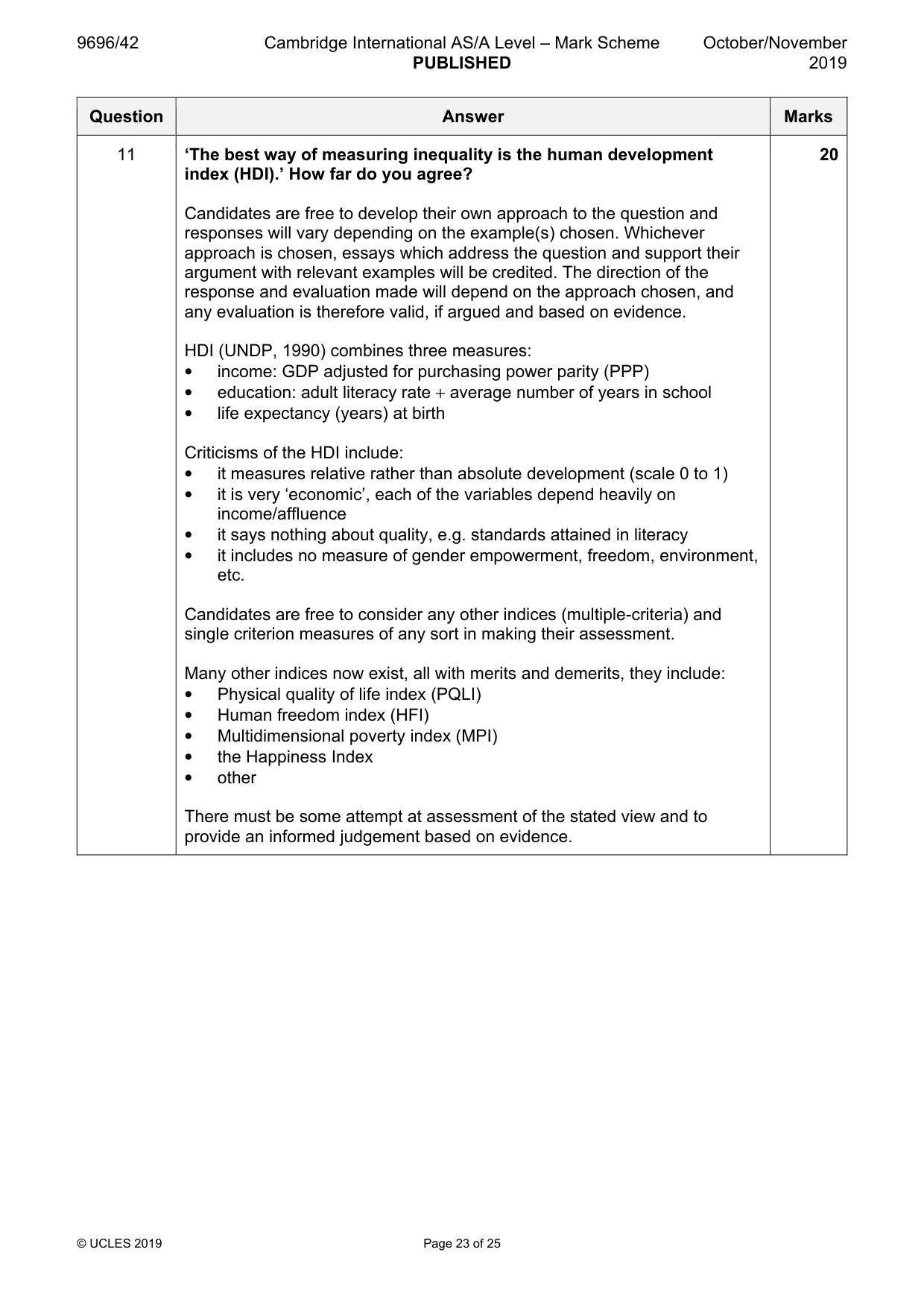
11 ‘The best way of measuring inequality is the human development index (HDI).’ How far do you agree? [20]
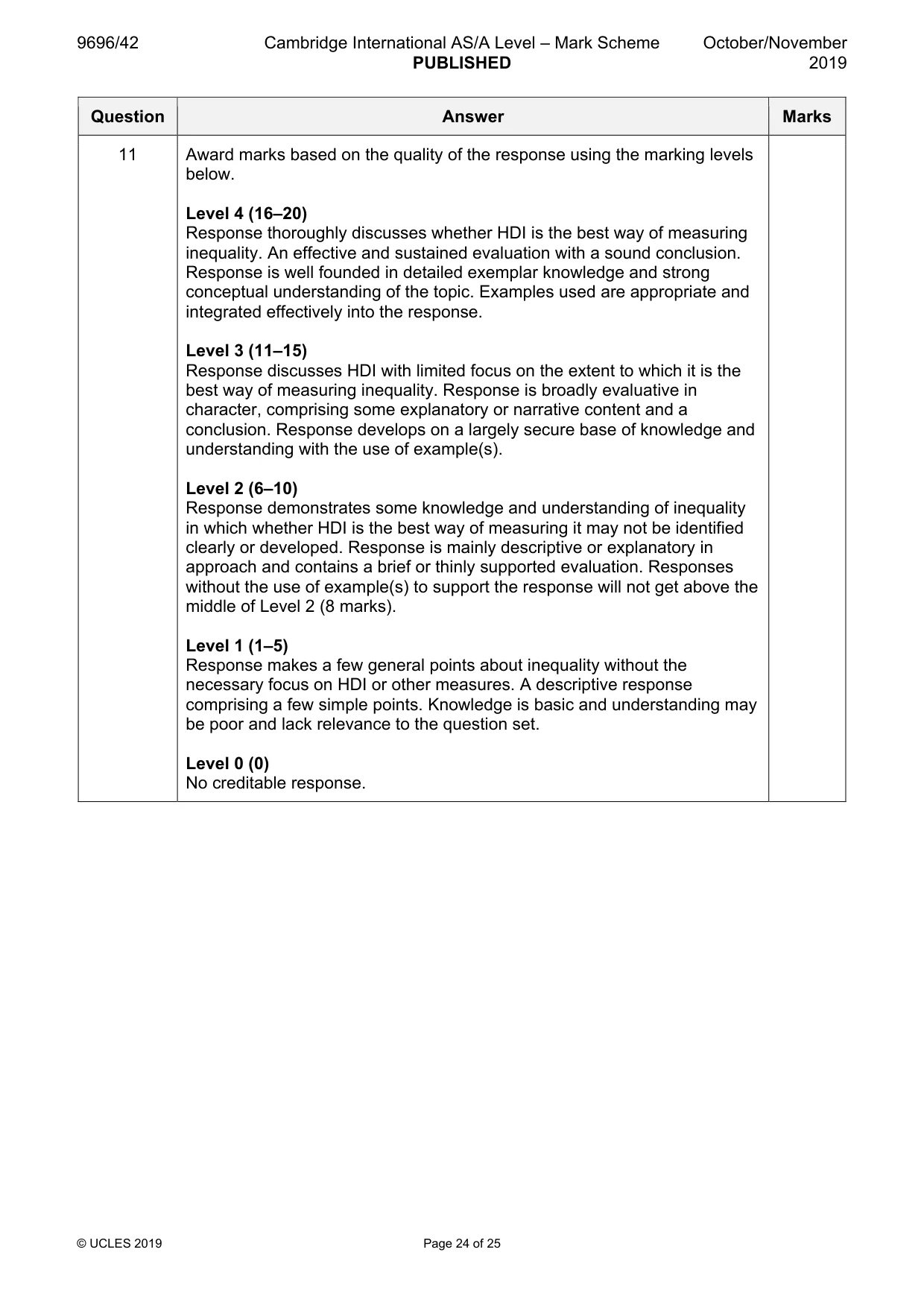
Mark scheme: 11 ‘The best way of measuring inequality is the human development 20 index (HDI).’ How far do you agree? Candidates are free to develop their own approach to the question and responses will vary depending on the example(s) chosen. Whichever approach is chosen, essays which address the question and support their argument with relevant examples will be credited. The direction of the response and evaluation made will depend on the approach chosen, and any evaluation is therefore valid, if argued and based on evidence. HDI (UNDP, 1990) combines three measures: • income: GDP adjusted for purchasing power parity (PPP) • education: adult literacy rate + average number of years in school • life expectancy (years) at birth Criticisms of the HDI include: • it measures relative rather than absolute development (scale 0 to 1) • it is very ‘economic’, each of the variables depend heavily on income/affluence • it says nothing about quality, e.g. standards attained in literacy • it includes no measure of gender empowerment, freedom, environment, etc. Candidates are free to consider any other indices (multiple-criteria) and single criterion measures of any sort in making their assessment. Many other indices now exist, all with merits and demerits, they include: • Physical quality of life index (PQLI) • Human freedom index (HFI) • Multidimensional poverty index (MPI) • the Happiness Index • other There must be some attempt at assessment of the stated view and to provide an informed judgement based on evidence. 11 Award marks based on the quality of the response using the marking levels below. Level 4 (16–20) Response thoroughly discusses whether HDI is the best way of measuring inequality. An effective and sustained evaluation with a sound conclusion. Response is well founded in detailed exemplar knowledge and strong conceptual understanding of the topic. Examples used are appropriate and integrated effectively into the response. Level 3 (11–15) Response discusses HDI with limited focus on the extent to which it is the best way of measuring inequality. Response is broadly evaluative in character, comprising some explanatory or narrative content and a conclusion. Response develops on a largely secure base of knowledge and understanding with the use of example(s). Level 2 (6–10) Response demonstrates some knowledge and understanding of inequality in which whether HDI is the best way of measuring it may not be identified clearly or developed. Response is mainly descriptive or explanatory in approach and contains a brief or thinly supported evaluation. Responses without the use of example(s) to support the response will not get above the middle of Level 2 (8 marks). Level 1 (1–5) Response makes a few general points about inequality without the necessary focus on HDI or other measures. A descriptive response comprising a few simple points. Knowledge is basic and understanding may be poor and lack relevance to the question set. Level 0 (0) No creditable response.
What was in this paper
The subtopics covered by these 11 questions, and how many questions each got. Open one in a new tab to see every Cambridge question on it.
1International debt and international aid1Manufacturing and related service industry1National development1The globalisation of economic activity1The human impact1The management of a tourist destination1The management of agricultural change1The management of change in manufacturing industry1The management of energy supply1Trade flows and trading patterns1What you needed in this session
Cambridge’s own grade thresholds for 2019 Oct/Nov, Paper 4 · Variant 2. A higher threshold means an easier paper — the bar moves with how the cohort did.