Cambridge A Level Geography 9696 — 2016 Oct/Nov Paper 3 · Variant 2
9696/32/O/N/16 · 50 marks · ≈56 min
The question paper and its mark scheme, free to read here and free to download. This is Cambridge’s own paper, exactly as it was sat.
Question paper4 pages

Mark scheme13 pages
Answers below. Sit the paper first if you are practising.

Paper as text
Question paper, page 1
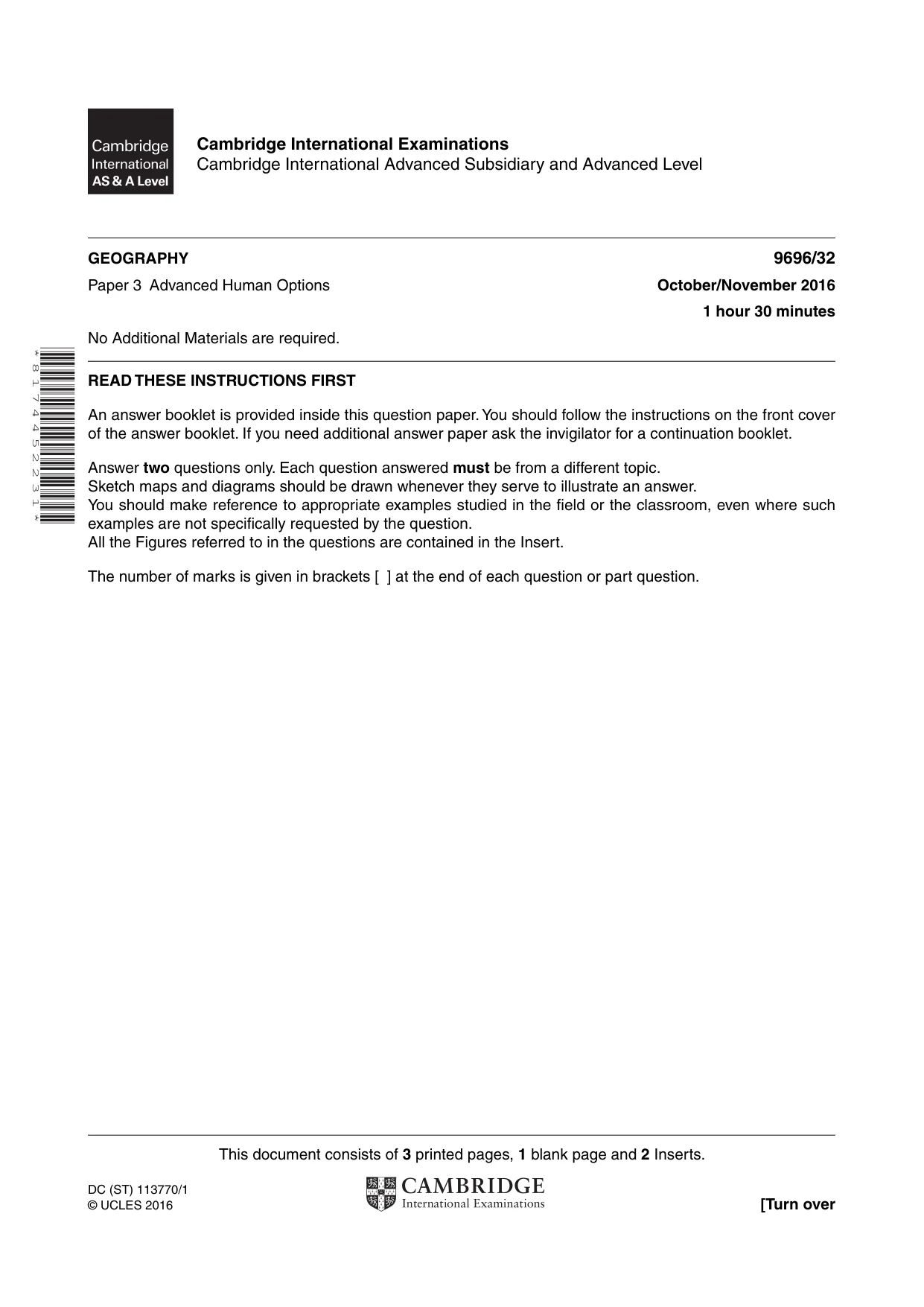
This document consists of 3 printed pages, 1 blank page and 2 Inserts. DC (ST) 113770/1 © UCLES 2016 [Turn over Cambridge International Examinations Cambridge International Advanced Subsidiary and Advanced Level * 8 1 7 4 4 5 2 2 3 1 * GEOGRAPHY 9696/32 Paper 3 Advanced Human Options October/November 2016 1 hour 30 minutes No Additional Materials are required. READ THESE INSTRUCTIONS FIRST An answer booklet is provided inside this question paper. You should follow the instructions on the front cover of the answer booklet. If you need additional answer paper ask the invigilator for a continuation booklet. Answer two questions only. Each question answered must be from a different topic. Sketch maps and diagrams should be drawn whenever they serve to illustrate an answer. You should make reference to appropriate examples studied in the field or the classroom, even where such examples are not specifically requested by the question. All the Figures referred to in the questions are contained in the Insert. The number of marks is given in brackets [ ] at the end of each question or part question.
Question paper, page 2
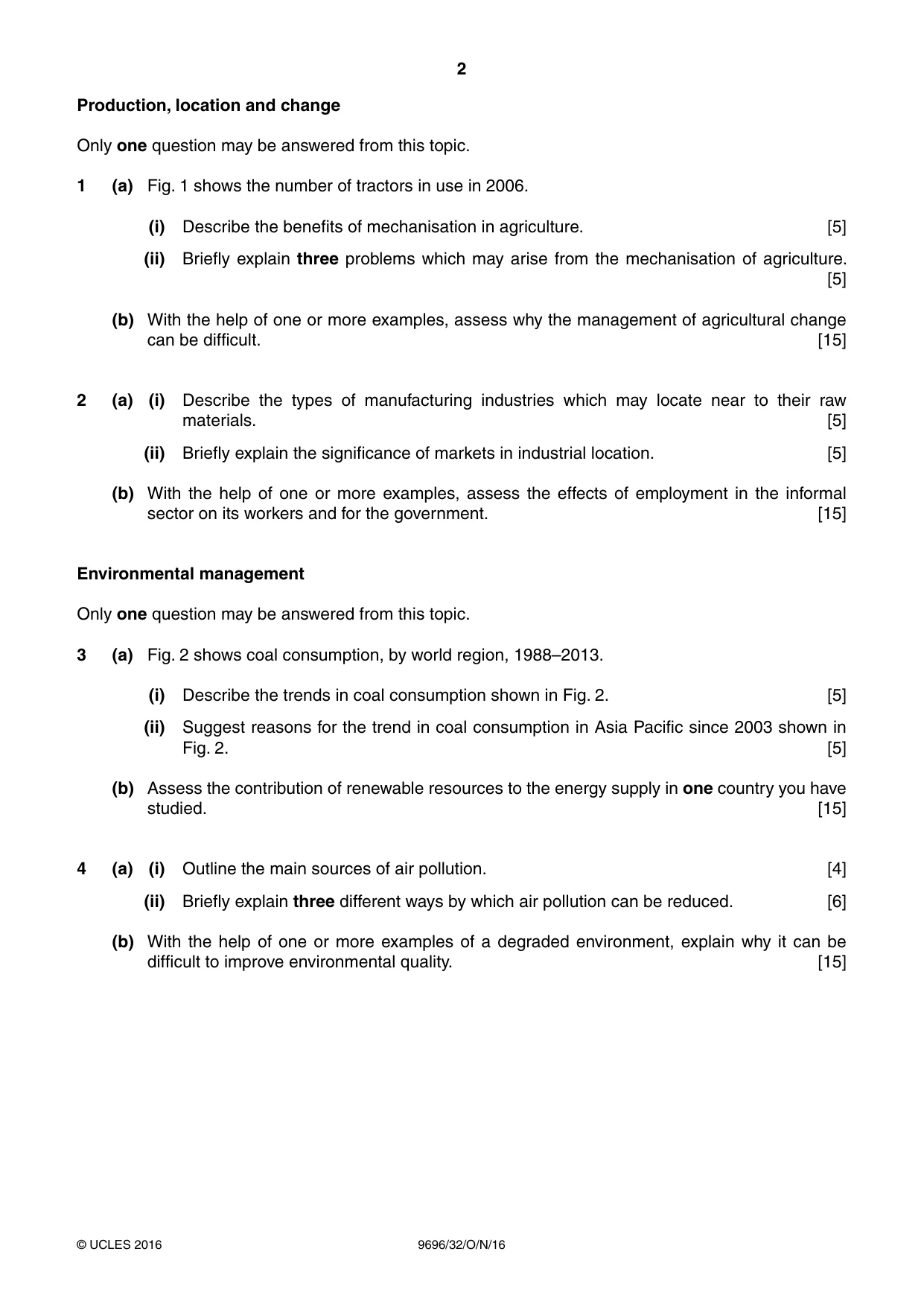
2 9696/32/O/N/16 © UCLES 2016 Production, location and change Only one question may be answered from this topic. 1 (a) Fig. 1 shows the number of tractors in use in 2006. (i) Describe the benefits of mechanisation in agriculture. [5] (ii) Briefly explain three problems which may arise from the mechanisation of agriculture. [5] (b) With the help of one or more examples, assess why the management of agricultural change can be difficult. [15] 2 (a) (i) Describe the types of manufacturing industries which may locate near to their raw materials. [5] (ii) Briefly explain the significance of markets in industrial location. [5] (b) With the help of one or more examples, assess the effects of employment in the informal sector on its workers and for the government. [15] Environmental management Only one question may be answered from this topic. 3 (a) Fig. 2 shows coal consumption, by world region, 1988–2013. (i) Describe the trends in coal consumption shown in Fig. 2. [5] (ii) Suggest reasons for the trend in coal consumption in Asia Pacific since 2003 shown in Fig. 2. [5] (b) Assess the contribution of renewable resources to the energy supply in one country you have studied. [15] 4 (a) (i) Outline the main sources of air pollution. [4] (ii) Briefly explain three different ways by which air pollution can be reduced. [6] (b) With the help of one or more examples of a degraded environment, explain why it can be difficult to improve environmental quality. [15]
Question paper, page 3
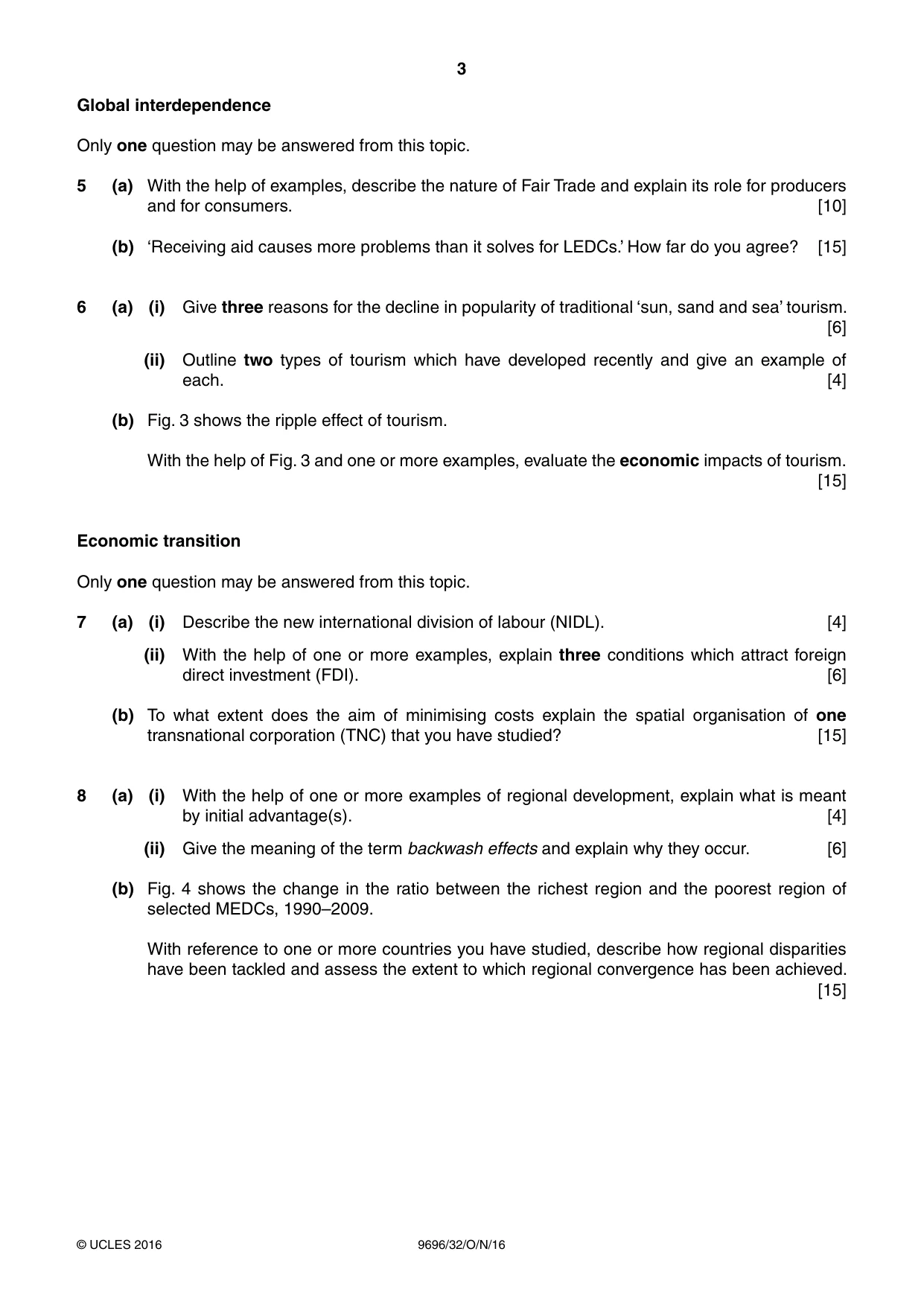
3 9696/32/O/N/16 © UCLES 2016 Global interdependence Only one question may be answered from this topic. 5 (a) With the help of examples, describe the nature of Fair Trade and explain its role for producers and for consumers. [10] (b) ‘Receiving aid causes more problems than it solves for LEDCs.’ How far do you agree? [15] 6 (a) (i) Give three reasons for the decline in popularity of traditional ‘sun, sand and sea’ tourism. [6] (ii) Outline two types of tourism which have developed recently and give an example of each. [4] (b) Fig. 3 shows the ripple effect of tourism. With the help of Fig. 3 and one or more examples, evaluate the economic impacts of tourism. [15] Economic transition Only one question may be answered from this topic. 7 (a) (i) Describe the new international division of labour (NIDL). [4] (ii) With the help of one or more examples, explain three conditions which attract foreign direct investment (FDI). [6] (b) To what extent does the aim of minimising costs explain the spatial organisation of one transnational corporation (TNC) that you have studied? [15] 8 (a) (i) With the help of one or more examples of regional development, explain what is meant by initial advantage(s). [4] (ii) Give the meaning of the term backwash effects and explain why they occur. [6] (b) Fig. 4 shows the change in the ratio between the richest region and the poorest region of selected MEDCs, 1990–2009. With reference to one or more countries you have studied, describe how regional disparities have been tackled and assess the extent to which regional convergence has been achieved. [15]
Question paper, page 4
4 9696/32/O/N/16 © UCLES 2016 BLANK PAGE Permission to reproduce items where third-party owned material protected by copyright is included has been sought and cleared where possible. Every reasonable effort has been made by the publisher (UCLES) to trace copyright holders, but if any items requiring clearance have unwittingly been included, the publisher will be pleased to make amends at the earliest possible opportunity. To avoid the issue of disclosure of answer-related information to candidates, all copyright acknowledgements are reproduced online in the Cambridge International Examinations Copyright Acknowledgements Booklet. This is produced for each series of examinations and is freely available to download at www.cie.org.uk after the live examination series. Cambridge International Examinations is part of the Cambridge Assessment Group. Cambridge Assessment is the brand name of University of Cambridge Local Examinations Syndicate (UCLES), which is itself a department of the University of Cambridge.
Mark scheme, page 1
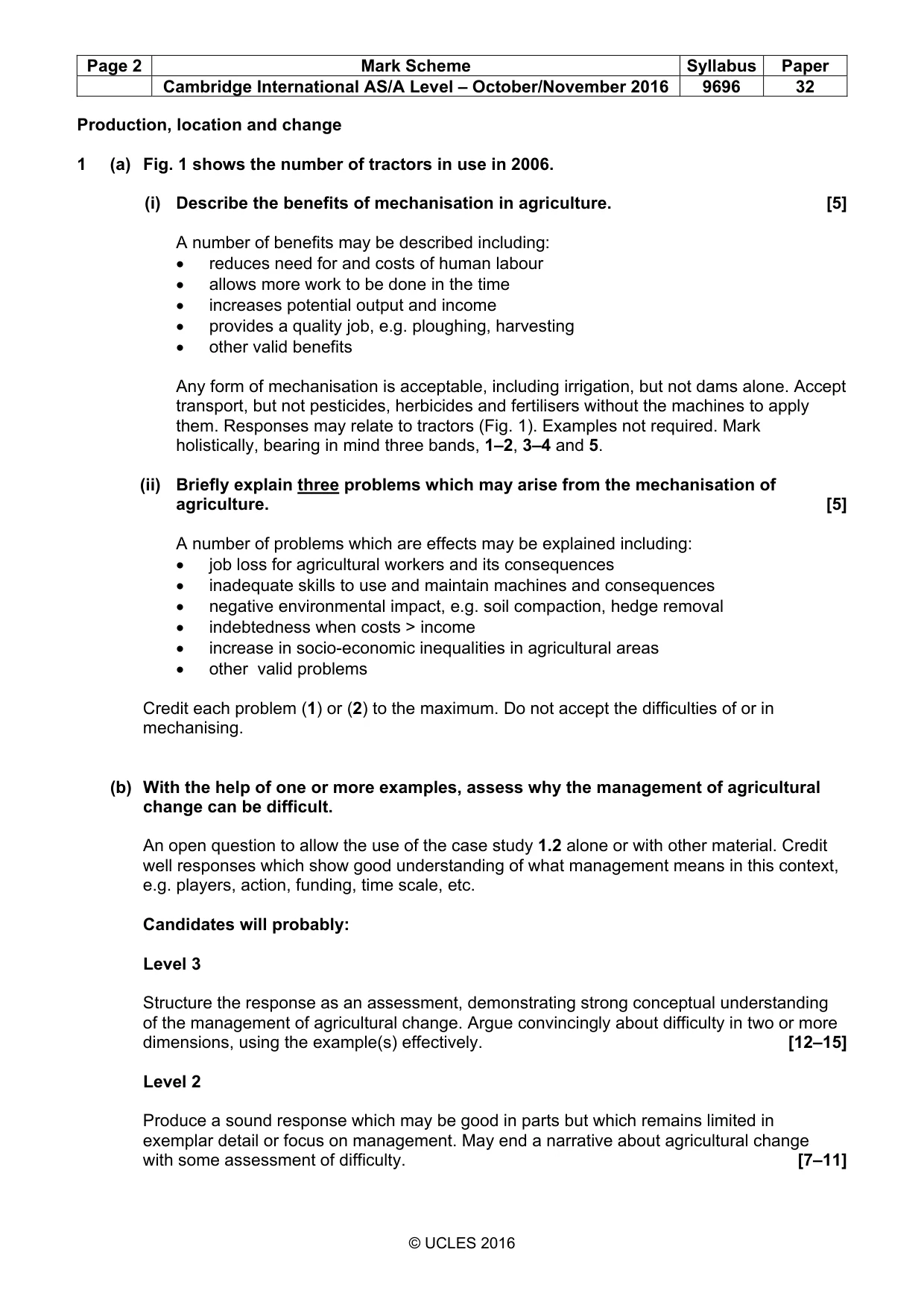
® IGCSE is the registered trademark of Cambridge International Examinations. This document consists of 13 printed pages. © UCLES 2016 [Turn over Cambridge International Examinations Cambridge International Advanced Subsidiary and Advanced Level GEOGRAPHY 9696/32 Paper 3 Advanced Human Options October/November 2016 MARK SCHEME Maximum Mark: 50 Published This mark scheme is published as an aid to teachers and candidates, to indicate the requirements of the examination. It shows the basis on which Examiners were instructed to award marks. It does not indicate the details of the discussions that took place at an Examiners’ meeting before marking began, which would have considered the acceptability of alternative answers. Mark schemes should be read in conjunction with the question paper and the Principal Examiner Report for Teachers. Cambridge will not enter into discussions about these mark schemes. Cambridge is publishing the mark schemes for the October/November 2016 series for most Cambridge IGCSE®, Cambridge International A and AS Level components and some Cambridge O Level components.
Mark scheme, page 2
Page 2 Mark Scheme Syllabus Paper Cambridge International AS/A Level – October/November 2016 9696 32 © UCLES 2016 Production, location and change 1 (a) Fig. 1 shows the number of tractors in use in 2006. (i) Describe the benefits of mechanisation in agriculture. [5] A number of benefits may be described including: • reduces need for and costs of human labour • allows more work to be done in the time • increases potential output and income • provides a quality job, e.g. ploughing, harvesting • other valid benefits Any form of mechanisation is acceptable, including irrigation, but not dams alone. Accept transport, but not pesticides, herbicides and fertilisers without the machines to apply them. Responses may relate to tractors (Fig. 1). Examples not required. Mark holistically, bearing in mind three bands, 1–2, 3–4 and 5. (ii) Briefly explain three problems which may arise from the mechanisation of agriculture. [5] A number of problems which are effects may be explained including: • job loss for agricultural workers and its consequences • inadequate skills to use and maintain machines and consequences • negative environmental impact, e.g. soil compaction, hedge removal • indebtedness when costs > income • increase in socio-economic inequalities in agricultural areas • other valid problems Credit each problem (1) or (2) to the maximum. Do not accept the difficulties of or in mechanising. (b) With the help of one or more examples, assess why the management of agricultural change can be difficult. An open question to allow the use of the case study 1.2 alone or with other material. Credit well responses which show good understanding of what management means in this context, e.g. players, action, funding, time scale, etc. Candidates will probably: Level 3 Structure the response as an assessment, demonstrating strong conceptual understanding of the management of agricultural change. Argue convincingly about difficulty in two or more dimensions, using the example(s) effectively. [12–15] Level 2 Produce a sound response which may be good in parts but which remains limited in exemplar detail or focus on management. May end a narrative about agricultural change with some assessment of difficulty. [7–11]
Mark scheme, page 3
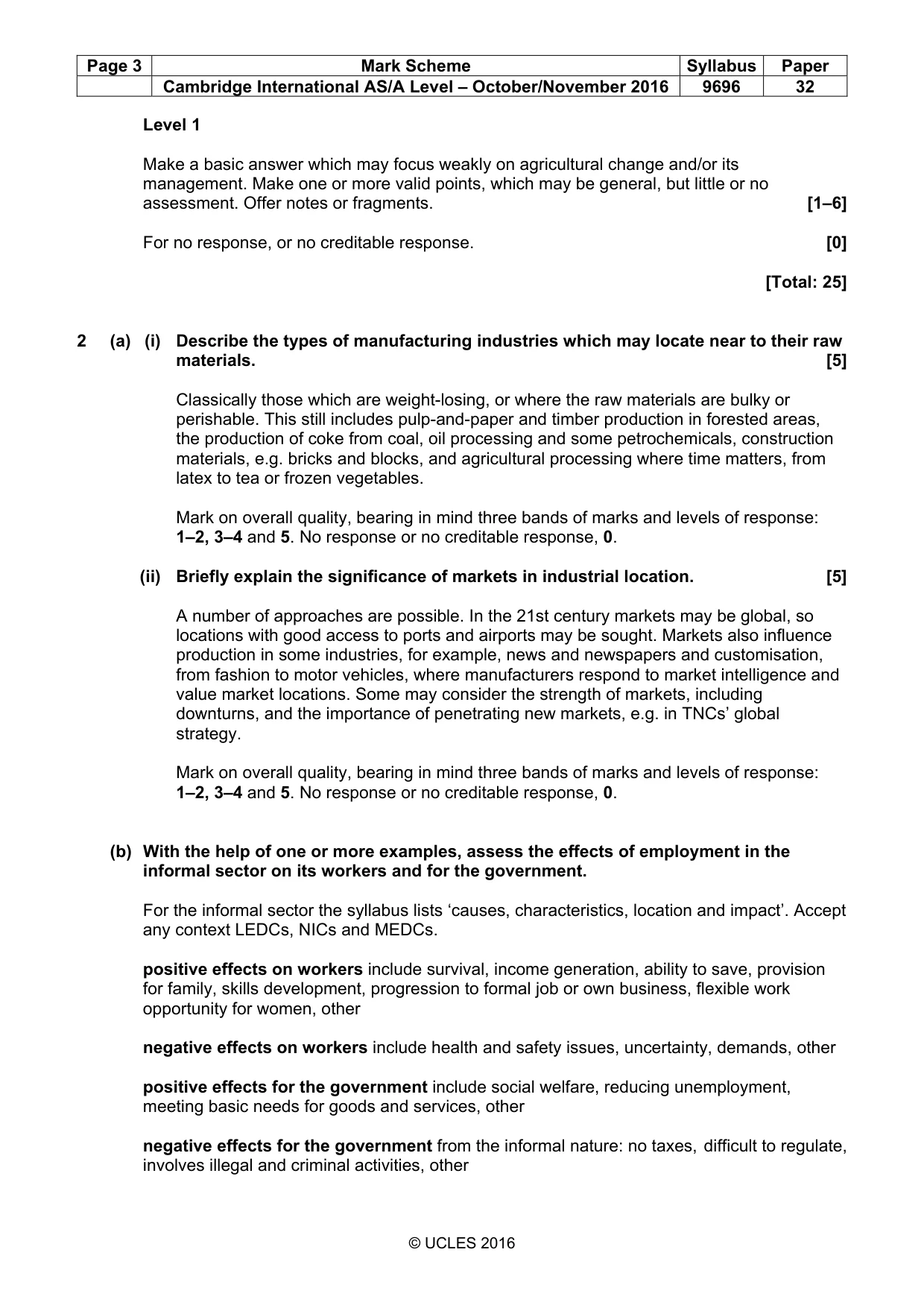
Page 3 Mark Scheme Syllabus Paper Cambridge International AS/A Level – October/November 2016 9696 32 © UCLES 2016 Level 1 Make a basic answer which may focus weakly on agricultural change and/or its management. Make one or more valid points, which may be general, but little or no assessment. Offer notes or fragments. [1–6] For no response, or no creditable response. [0] [Total: 25] 2 (a) (i) Describe the types of manufacturing industries which may locate near to their raw materials. [5] Classically those which are weight-losing, or where the raw materials are bulky or perishable. This still includes pulp-and-paper and timber production in forested areas, the production of coke from coal, oil processing and some petrochemicals, construction materials, e.g. bricks and blocks, and agricultural processing where time matters, from latex to tea or frozen vegetables. Mark on overall quality, bearing in mind three bands of marks and levels of response: 1–2, 3–4 and 5. No response or no creditable response, 0. (ii) Briefly explain the significance of markets in industrial location. [5] A number of approaches are possible. In the 21st century markets may be global, so locations with good access to ports and airports may be sought. Markets also influence production in some industries, for example, news and newspapers and customisation, from fashion to motor vehicles, where manufacturers respond to market intelligence and value market locations. Some may consider the strength of markets, including downturns, and the importance of penetrating new markets, e.g. in TNCs’ global strategy. Mark on overall quality, bearing in mind three bands of marks and levels of response: 1–2, 3–4 and 5. No response or no creditable response, 0. (b) With the help of one or more examples, assess the effects of employment in the informal sector on its workers and for the government. For the informal sector the syllabus lists ‘causes, characteristics, location and impact’. Accept any context LEDCs, NICs and MEDCs. positive effects on workers include survival, income generation, ability to save, provision for family, skills development, progression to formal job or own business, flexible work opportunity for women, other negative effects on workers include health and safety issues, uncertainty, demands, other positive effects for the government include social welfare, reducing unemployment, meeting basic needs for goods and services, other negative effects for the government from the informal nature: no taxes, difficult to regulate, involves illegal and criminal activities, other
Mark scheme, page 4
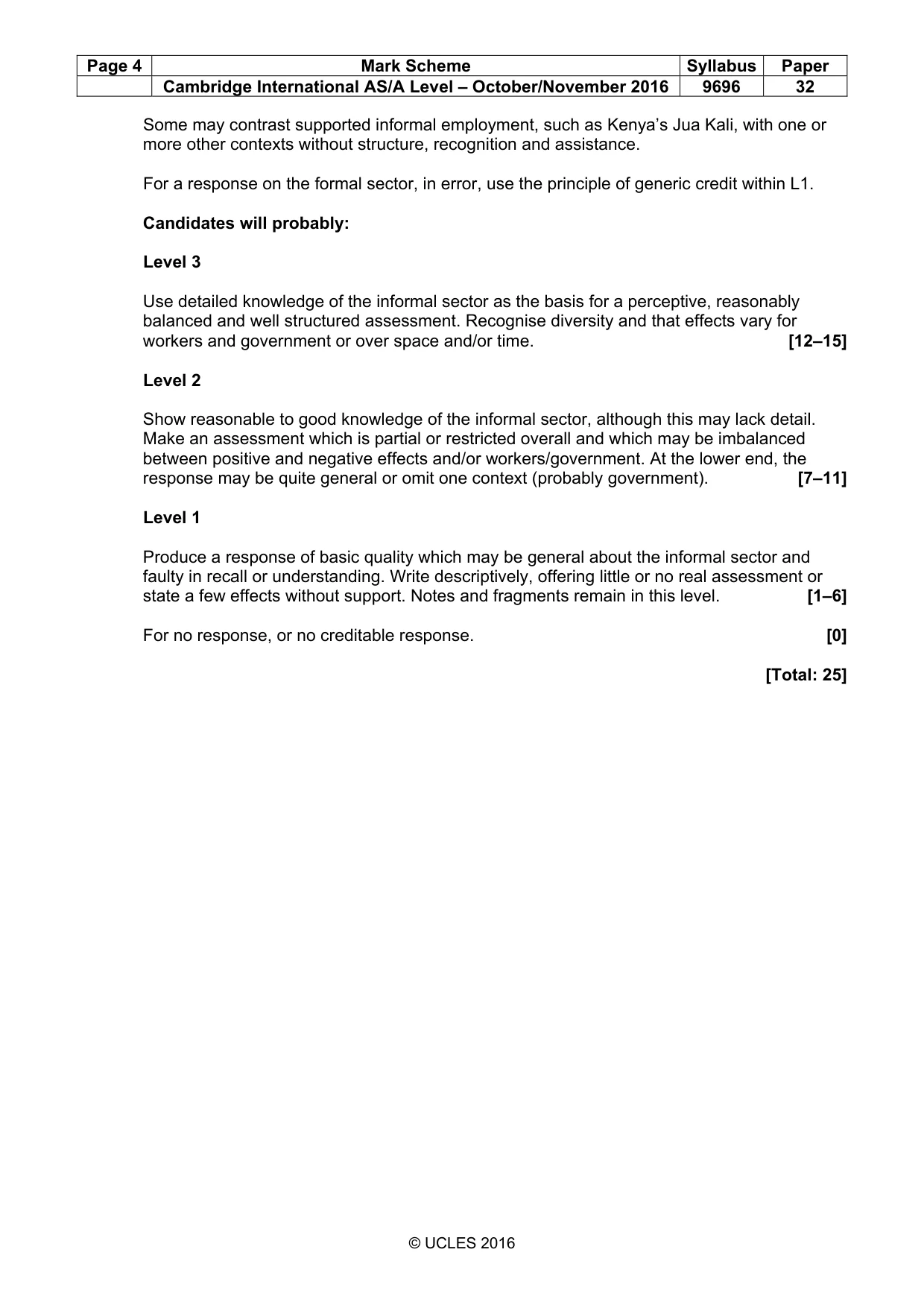
Page 4 Mark Scheme Syllabus Paper Cambridge International AS/A Level – October/November 2016 9696 32 © UCLES 2016 Some may contrast supported informal employment, such as Kenya’s Jua Kali, with one or more other contexts without structure, recognition and assistance. For a response on the formal sector, in error, use the principle of generic credit within L1. Candidates will probably: Level 3 Use detailed knowledge of the informal sector as the basis for a perceptive, reasonably balanced and well structured assessment. Recognise diversity and that effects vary for workers and government or over space and/or time. [12–15] Level 2 Show reasonable to good knowledge of the informal sector, although this may lack detail. Make an assessment which is partial or restricted overall and which may be imbalanced between positive and negative effects and/or workers/government. At the lower end, the response may be quite general or omit one context (probably government). [7–11] Level 1 Produce a response of basic quality which may be general about the informal sector and faulty in recall or understanding. Write descriptively, offering little or no real assessment or state a few effects without support. Notes and fragments remain in this level. [1–6] For no response, or no creditable response. [0] [Total: 25]
Mark scheme, page 5
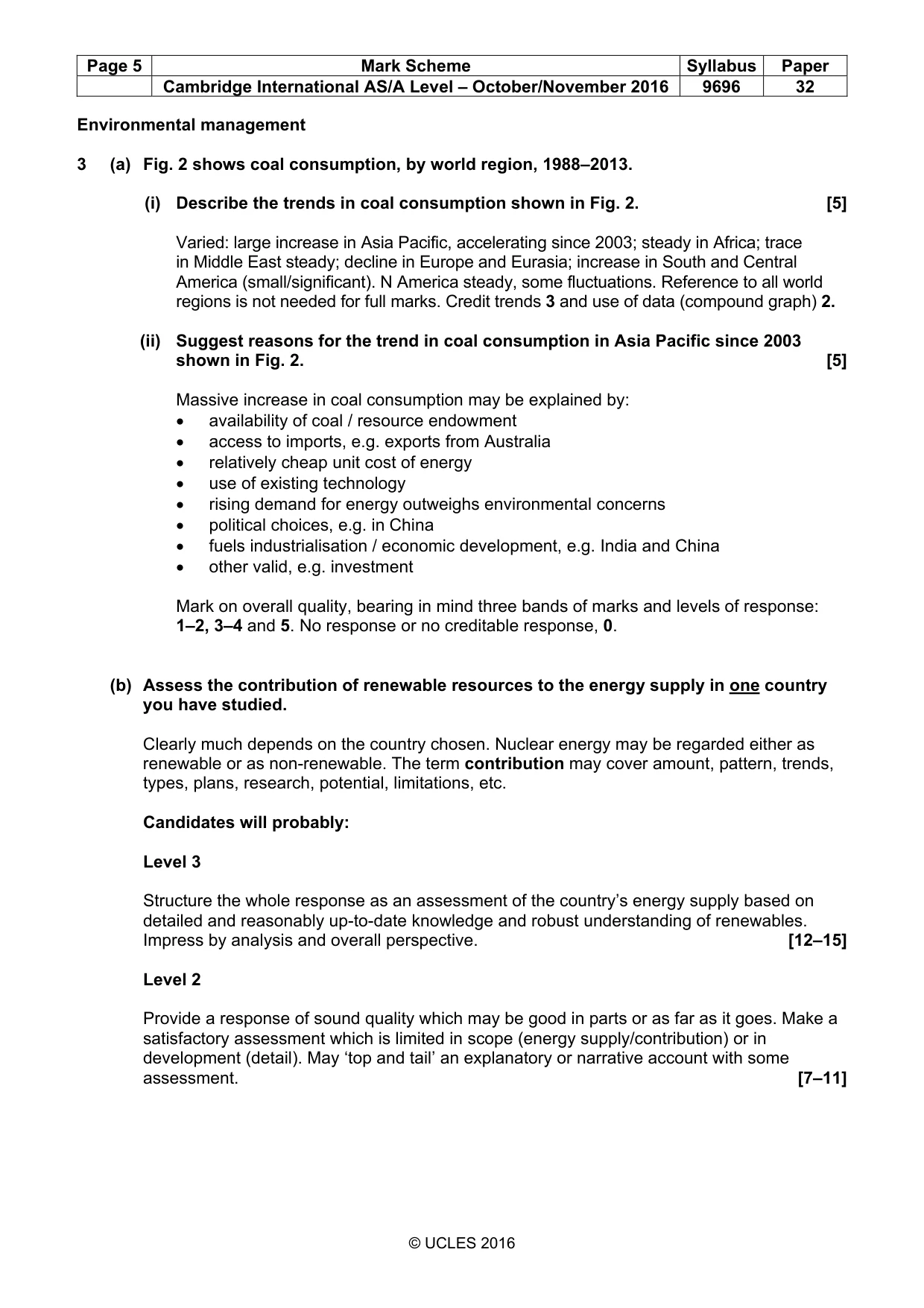
Page 5 Mark Scheme Syllabus Paper Cambridge International AS/A Level – October/November 2016 9696 32 © UCLES 2016 Environmental management 3 (a) Fig. 2 shows coal consumption, by world region, 1988–2013. (i) Describe the trends in coal consumption shown in Fig. 2. [5] Varied: large increase in Asia Pacific, accelerating since 2003; steady in Africa; trace in Middle East steady; decline in Europe and Eurasia; increase in South and Central America (small/significant). N America steady, some fluctuations. Reference to all world regions is not needed for full marks. Credit trends 3 and use of data (compound graph) 2. (ii) Suggest reasons for the trend in coal consumption in Asia Pacific since 2003 shown in Fig. 2. [5] Massive increase in coal consumption may be explained by: • availability of coal / resource endowment • access to imports, e.g. exports from Australia • relatively cheap unit cost of energy • use of existing technology • rising demand for energy outweighs environmental concerns • political choices, e.g. in China • fuels industrialisation / economic development, e.g. India and China • other valid, e.g. investment Mark on overall quality, bearing in mind three bands of marks and levels of response: 1–2, 3–4 and 5. No response or no creditable response, 0. (b) Assess the contribution of renewable resources to the energy supply in one country you have studied. Clearly much depends on the country chosen. Nuclear energy may be regarded either as renewable or as non-renewable. The term contribution may cover amount, pattern, trends, types, plans, research, potential, limitations, etc. Candidates will probably: Level 3 Structure the whole response as an assessment of the country’s energy supply based on detailed and reasonably up-to-date knowledge and robust understanding of renewables. Impress by analysis and overall perspective. [12–15] Level 2 Provide a response of sound quality which may be good in parts or as far as it goes. Make a satisfactory assessment which is limited in scope (energy supply/contribution) or in development (detail). May ‘top and tail’ an explanatory or narrative account with some assessment. [7–11]
Mark scheme, page 6
Page 6 Mark Scheme Syllabus Paper Cambridge International AS/A Level – October/November 2016 9696 32 © UCLES 2016 Level 1 Struggle to deal with the topic through lack of knowledge or of skills in application, so that the focus of the response is not that of the question. Make one or more basic points about energy supply, which may be faulty, with little or no assessment of renewables. Offer notes or fragments. [1–6] For no response, or no creditable response. [0] [Total: 25] 4 (a) (i) Outline the main sources of air pollution. [4] These may be approached by sector (manufacturing, transport, domestic, etc.) or by activity such as the combustion of fossil fuels in industry and motor vehicles, emissions from manufacturing, use of fuelwood, etc. Accept dust storms, volcanoes and veld fires which may be significant locally. Mark holistically looking for scope and some precision, using the mark bands 1, 2–3 and 4. (ii) Briefly explain three different ways by which air pollution can be reduced. [6] Any ways are acceptable, such as: • improved technology, e.g. ‘clean coal’ • higher quality vehicle fuels, e.g. unleaded petrol • removing older vehicles from the roads • banning vehicles from urban centres • shift from use of fossil fuels to renewable sources • rural electrification reducing use of fuelwood • afforestation • other valid ways Credit each way 2 to the maximum. (b) With the help of one or more examples of a degraded environment, explain why it can be difficult to improve environmental quality. Any degraded environment(s) may be chosen. The explanation here is itself an assessment because of the link to difficulty. Approaches are likely to be multidimensional (economic, social/cultural, political, physical) and better responses will probably demonstrate that factors are complex and interactive, making links between them. Some may refer to scale (spatial scale, timescale) and to the involvement and conflicting interests of different stakeholders.
Mark scheme, page 7
Page 7 Mark Scheme Syllabus Paper Cambridge International AS/A Level – October/November 2016 9696 32 © UCLES 2016 Candidates will probably: Level 3 Produce a high quality explanation of difficulty, well founded in detailed knowledge of one or more degraded environments. Impress by overall perspective and clear identification of the multidimensional nature of the constraints, challenges and/or problems. [12–15] Level 2 Develop a response of sound quality which is good in parts, but which remains limited in perspective or environmental detail and/or the explanation of difficulty developed. At the lower end may consider the topic quite broadly. [7–11] Level 1 Make one or more basic observations about environmental quality. Respond quite generally or descriptively, with little or no explanation of difficulty. Fragmentary and note-form responses remain in this level. [1–6] For no response, or no creditable response. [0] [Total: 25]
Mark scheme, page 8
Page 8 Mark Scheme Syllabus Paper Cambridge International AS/A Level – October/November 2016 9696 32 © UCLES 2016 Global interdependence 5 (a) With the help of examples, describe the nature of Fair Trade and explain its role for producers and for consumers. [10] Fair Trade is a small but growing element of trade, involving a small number of key products such as cotton, coffee, tea, some fruit, vegetables and flowers. It is largely about certified ethical production in LEDCs and consumers in MEDCs. For producers, Fair Trade may include: • better trading conditions, e.g. removing middlemen • a better financial outcome, e.g. price, percentage received • empowerment, securing rights • developing knowledge and skills to improve lives For consumers, as well as ethical satisfaction Fair Trade includes campaigning for change; challenging conventional trading practices; raising people’s awareness of fair trade issues; product certification and Fairtrade labelling. Reference to both producers and consumers is needed, but balance is not. Mark on overall quality, bearing in mind three levels of response and mark bands 1–4, 5–7 and 8–10. For a response without examples, max. 6. For unfair / fair / free trade, generic credit max. 4. No response or no creditable response, 0. (b) ‘Receiving aid causes more problems than it solves for LEDCs.’ How far do you agree? A response based on the analysis of different types of aid is likely. For example, relief aid may solve immediate problems, whilst tied aid is generally viewed as problematic, and development aid may lead to aid dependency which is a major problem in some of the poorest countries. Candidates are free to use the examples they have to establish any position by evidence-based argument. Some may suggest elements of good practice by aid donors. Candidates will probably: Level 3 Provide an impressive assessment, distinguished by its command of the topic. While not making a comprehensive response, convince by the overall perspective on aid, use of examples as evidence and skills in assessment. [12–15] Level 2 Develop a satisfactory answer which may be good in parts. Show some sound knowledge and understanding of aid and related problems. Make a response that remains partial or limited in one or more ways: overall perspective, exemplar detail or assessment. For a response about one LEDC, max. 10. [7–11]
Mark scheme, page 9
Page 9 Mark Scheme Syllabus Paper Cambridge International AS/A Level – October/November 2016 9696 32 © UCLES 2016 Level 1 Make a few basic points which may be more descriptive or explanatory of aid than an assessment. Write generally or in name only, maybe without reflecting the question set. Offer a fragmentary or note-form response. [1–6] For no response, or no creditable response. [0] [Total: 25] 6 (a) (i) Give three reasons for the decline in popularity of traditional ‘sun, sand and sea’ tourism. [6] Possible reasons may include: • boredom with traditional holidays / search for new experience • promotion and advertising of alternatives • changes in fashion • deterioration of facilities and coastal environments • concern for responsible / sustainable tourism • other valid reasons Credit three reasons: a simple reason (1) and a developed reason (2). (ii) Outline two types of tourism which have developed recently and give an example of each. [4] Marking experience suggests responses may include adventure tourism, wilderness tourism, heritage tourism, business tourism, niche tourism. Accept ecotourism and cruises which, although not new, have recently experienced substantial reformulation and explosive growth. Credit each type (2) (type + example). (b) Fig. 3 shows the ripple effect of tourism. With the help of Fig. 3 and one or more examples, evaluate the economic impacts of tourism. While explicitly economic, content may be applied to society and environment, e.g. through wages to wellbeing and standard of living, or in terms of repairs to and maintenance of the location, etc. The ripple effect spreads money from tourism progressively into the local economy. Evaluation may be in terms of cost/benefit, positive and negative, local and national scales, individuals and businesses, etc. Credit well accounts that recognise diversity and that some groups of people and/or places are impacted more than others. Accept any examples. Candidates will probably: Level 3 Structure the whole response as an evaluation, identifying a variety of economic impacts, using Fig. 3 effectively. Impress by conceptual content, analysis, and the integration of detailed evidence from the chosen example(s). [12–15]
Mark scheme, page 10
Page 10 Mark Scheme Syllabus Paper Cambridge International AS/A Level – October/November 2016 9696 32 © UCLES 2016 Level 2 Provide a response of sound to good quality which is satisfactory as far as it goes but which could be developed further in detail, scope or in the evaluation made. Make some use of Fig. 3, which, at the lower end, may be in name only (‘the multiplier effect’). [7–11] Level 1 Make one or more simple points about the economic impacts of tourism. Write generally or use an example in name only. Offer little or no effective evaluation, or use simple language such as ‘good’ and ‘bad’. Refer to Fig. 3 in name only, or not at all. Offer notes or fragments. [1–6] For no response, or no creditable response. [0] [Total: 25]
Mark scheme, page 11
Page 11 Mark Scheme Syllabus Paper Cambridge International AS/A Level – October/November 2016 9696 32 © UCLES 2016 Economic transition 7 (a) (i) Describe the new international division of labour (NIDL). [4] At its simplest and most generalised it is the spatial organisation of different functions (i.e. division) to make best economic use of labour. It leads to highly skilled jobs, e.g. HQ, R&D, being done in MEDCs; and production jobs in LEDCs and NICs. For full marks, more than manufacture/assembly function is needed. Mark on overall quality. For no response or no creditable response, 0. (ii) With the help of one or more examples, explain three conditions which attract foreign direct investment (FDI). [6] A number of conditions may be seen, including: • good governance • political stability • economic stability, e.g. stable currency • government incentives, e.g. tax, infrastructure • an educated workforce • presence of raw materials • other valid conditions Credit three conditions: a developed condition (2) and a simple condition (1). For a well developed response without the example(s), max. 4. (b) To what extent does the aim of minimising costs explain the spatial organisation of one transnational corporation (TNC) that you have studied? In most cases, anticipate a ‘to some extent’ response, given that TNCs have other aims, such as profit maximisation, market penetration, proximity to customers and being globally competitive (which is about more than cost saving). Costs may be of production, transport or other functions such as promotion and R&D. Candidates will probably: Level 3 Provide an effective assessment of the place of cost minimisation, showing detailed knowledge of the chosen TNC. Demonstrate strong conceptual understanding of the TNC’s spatial organisation and operation and of the global economy. Structure the response well. [12–15] Level 2 Produce a sound response, which lacks full development, but which may be good in places. Take a broad but shallow approach to the chosen TNC, or a restricted one, short on detail, understanding of its spatial organisation and operation and/or assessment. At the lower end, may ‘tell the story’ of the TNC with limited assessment. [7–11]
Mark scheme, page 12
Page 12 Mark Scheme Syllabus Paper Cambridge International AS/A Level – October/November 2016 9696 32 © UCLES 2016 Level 1 Make a descriptive response about the TNC rather than an evaluative one or offer a simple, unsupported view about extent. Write quite generally or in name only, with a weak focus on cost minimisation. Note-form and fragmentary responses remain in this level. [1–6] For no response, or no creditable response. [0] [Total: 25] 8 (a) (i) With the help of one or more examples of regional development, explain what is meant by initial advantage(s). [4] In the process of cumulative causation (Myrdal, 1957), the advantage(s) for a region which, once taken, promote development, growth and further benefits. Each makes that place more attractive to early development than elsewhere. Classically initial advantages are understood to be a resource (mineral, agricultural) or a locational advantage, such as a natural harbour. For a sound answer without the example(s), max. 2. (ii) Give the meaning of the term backwash effects and explain why they occur. [6] Also part of Myrdal’s theory, backwash effects describe how the core’s demands drain the periphery of resources (raw materials), labour (by out-migration) and wealth (capital). These flows occur as cumulative causation takes hold strongly in the emergent core area, so encouraging this spatial concentration of the three elements there at the expense of other areas. Mark on overall quality, bearing in mind three bands of marks and levels of response: 1–2, 3–4 and 5–6. No response or no creditable response, 0. (b) Fig. 4 shows the change in the ratio between the richest region and the poorest region of selected MEDCs, 1990–2009. With reference to one or more countries you have studied, describe how regional disparities have been tackled and assess the extent to which regional convergence has been achieved. Fig. 4 is a general stimulus resource. Classically regional divergence occurs before convergence, both ‘naturally’ as lagging regions catch up and as a result of government intervention. Candidates will probably: Level 3 Provide a perceptive description of what was done, and an effective assessment, showing detailed knowledge of the chosen example(s). Demonstrate strong conceptual understanding of disparities and of convergence. Structure the response well. [12–15]
Mark scheme, page 13
Page 13 Mark Scheme Syllabus Paper Cambridge International AS/A Level – October/November 2016 9696 32 © UCLES 2016 Level 2 Produce a sound response, which lacks full development but which may be good in places. Take a broad but shallow approach to the chosen example(s) or a rather restricted one, limited in scope or detail, conceptual understanding and/or assessment. [7–11] Level 1 Make a descriptive response about tackling disparities with little or no assessment of convergence. May struggle to select and apply learned material with a weak focus on the question set. Note-form and fragmentary responses remain in this level. [1–6] For no response, or no creditable response. [0] [Total: 25]
What you needed in this session
Cambridge’s own grade thresholds for 2016 Oct/Nov, Paper 3 · Variant 2. A higher threshold means an easier paper — the bar moves with how the cohort did.