Cambridge A Level Geography 9696 — 2016 Oct/Nov Paper 3 · Variant 3
9696/33/O/N/16 · 50 marks · ≈56 min
The question paper and its mark scheme, free to read here and free to download. This is Cambridge’s own paper, exactly as it was sat.
Question paper4 pages

Mark scheme13 pages
Answers below. Sit the paper first if you are practising.


Paper as text
Question paper, page 1
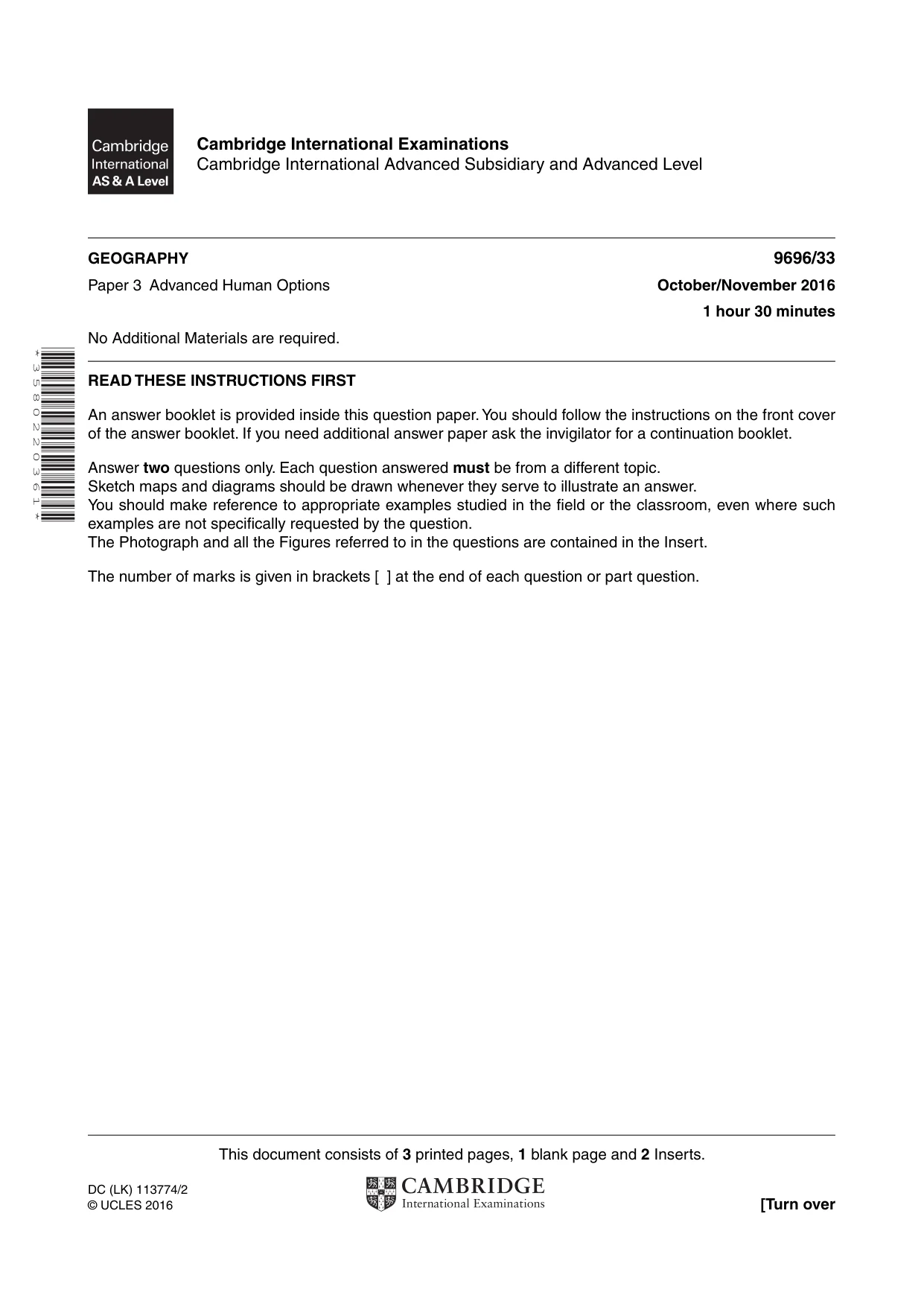
This document consists of 3 printed pages, 1 blank page and 2 Inserts. DC (LK) 113774/2 © UCLES 2016 [Turn over Cambridge International Examinations Cambridge International Advanced Subsidiary and Advanced Level * 3 5 8 0 2 2 0 3 6 1 * GEOGRAPHY 9696/33 Paper 3 Advanced Human Options October/November 2016 1 hour 30 minutes No Additional Materials are required. READ THESE INSTRUCTIONS FIRST An answer booklet is provided inside this question paper. You should follow the instructions on the front cover of the answer booklet. If you need additional answer paper ask the invigilator for a continuation booklet. Answer two questions only. Each question answered must be from a different topic. Sketch maps and diagrams should be drawn whenever they serve to illustrate an answer. You should make reference to appropriate examples studied in the field or the classroom, even where such examples are not specifically requested by the question. The Photograph and all the Figures referred to in the questions are contained in the Insert. The number of marks is given in brackets [ ] at the end of each question or part question.
Question paper, page 2
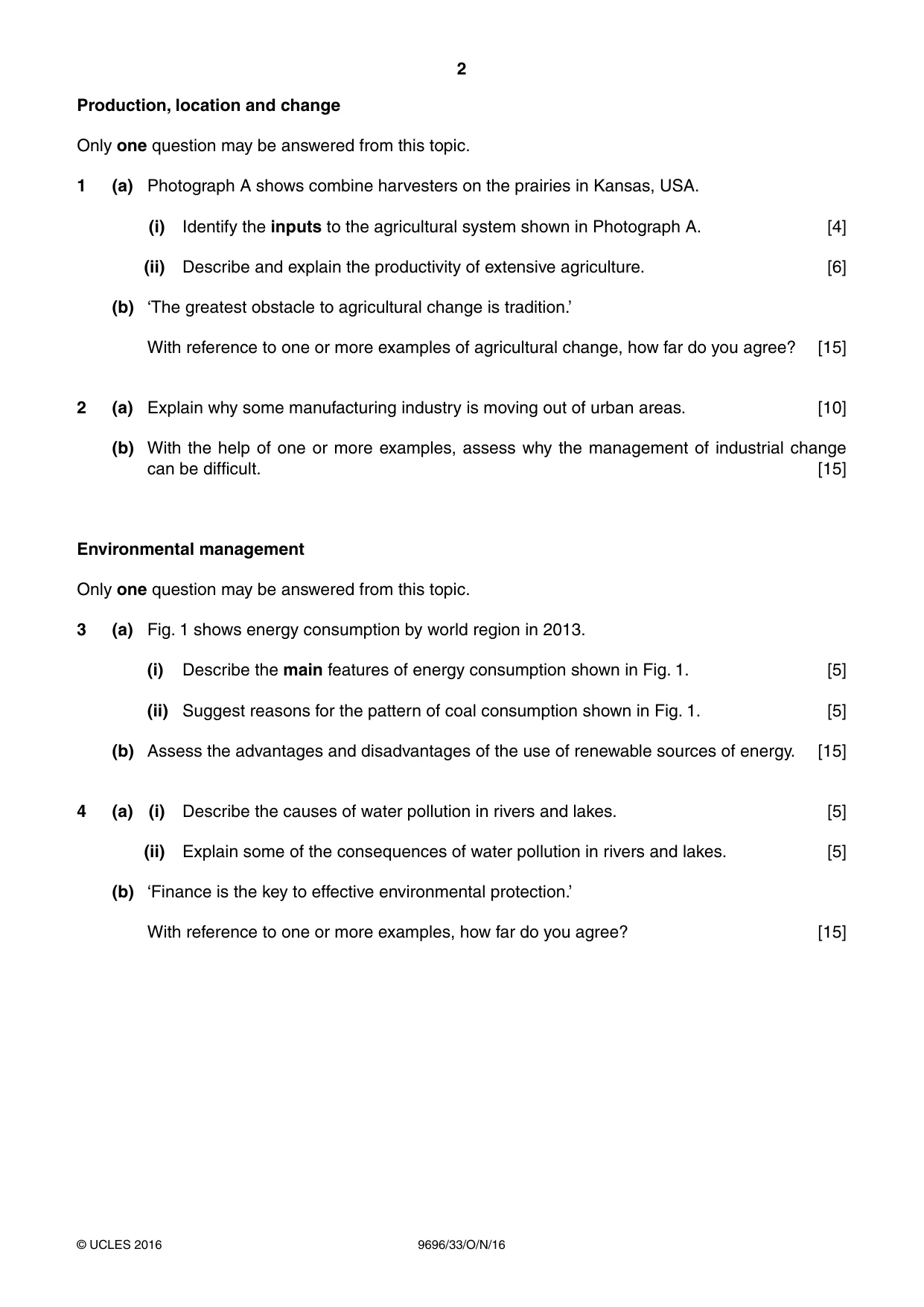
2 9696/33/O/N/16 © UCLES 2016 Production, location and change Only one question may be answered from this topic. 1 (a) Photograph A shows combine harvesters on the prairies in Kansas, USA. (i) Identify the inputs to the agricultural system shown in Photograph A. [4] (ii) Describe and explain the productivity of extensive agriculture. [6] (b) ‘The greatest obstacle to agricultural change is tradition.’ With reference to one or more examples of agricultural change, how far do you agree? [15] 2 (a) Explain why some manufacturing industry is moving out of urban areas. [10] (b) With the help of one or more examples, assess why the management of industrial change can be difficult. [15] Environmental management Only one question may be answered from this topic. 3 (a) Fig. 1 shows energy consumption by world region in 2013. (i) Describe the main features of energy consumption shown in Fig. 1. [5] (ii) Suggest reasons for the pattern of coal consumption shown in Fig. 1. [5] (b) Assess the advantages and disadvantages of the use of renewable sources of energy. [15] 4 (a) (i) Describe the causes of water pollution in rivers and lakes. [5] (ii) Explain some of the consequences of water pollution in rivers and lakes. [5] (b) ‘Finance is the key to effective environmental protection.’ With reference to one or more examples, how far do you agree? [15]
Question paper, page 3
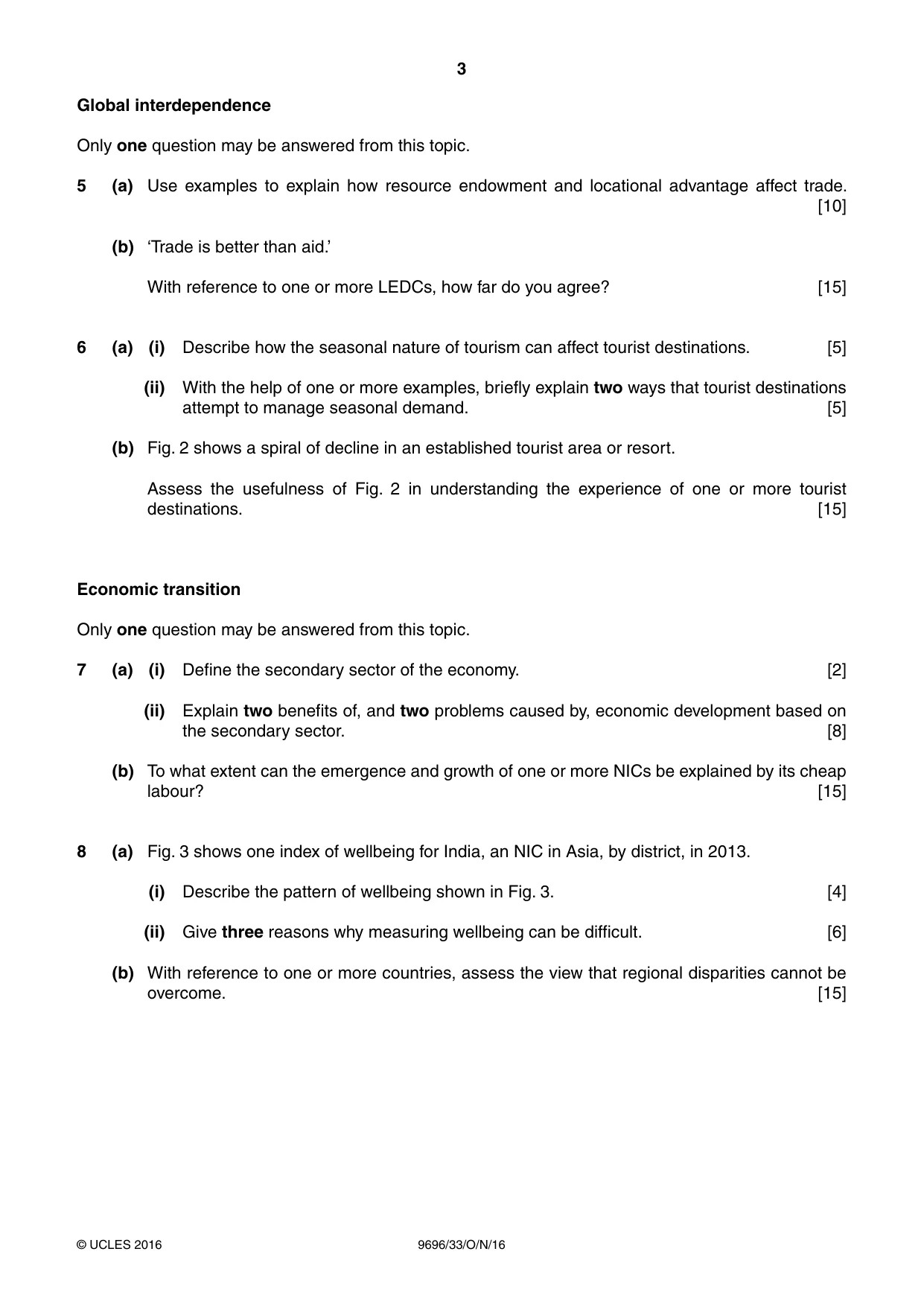
3 9696/33/O/N/16 © UCLES 2016 Global interdependence Only one question may be answered from this topic. 5 (a) Use examples to explain how resource endowment and locational advantage affect trade. [10] (b) ‘Trade is better than aid.’ With reference to one or more LEDCs, how far do you agree? [15] 6 (a) (i) Describe how the seasonal nature of tourism can affect tourist destinations. [5] (ii) With the help of one or more examples, briefly explain two ways that tourist destinations attempt to manage seasonal demand. [5] (b) Fig. 2 shows a spiral of decline in an established tourist area or resort. Assess the usefulness of Fig. 2 in understanding the experience of one or more tourist destinations. [15] Economic transition Only one question may be answered from this topic. 7 (a) (i) Define the secondary sector of the economy. [2] (ii) Explain two benefits of, and two problems caused by, economic development based on the secondary sector. [8] (b) To what extent can the emergence and growth of one or more NICs be explained by its cheap labour? [15] 8 (a) Fig. 3 shows one index of wellbeing for India, an NIC in Asia, by district, in 2013. (i) Describe the pattern of wellbeing shown in Fig. 3. [4] (ii) Give three reasons why measuring wellbeing can be difficult. [6] (b) With reference to one or more countries, assess the view that regional disparities cannot be overcome. [15]
Question paper, page 4
4 9696/33/O/N/16 © UCLES 2016 BLANK PAGE Permission to reproduce items where third-party owned material protected by copyright is included has been sought and cleared where possible. Every reasonable effort has been made by the publisher (UCLES) to trace copyright holders, but if any items requiring clearance have unwittingly been included, the publisher will be pleased to make amends at the earliest possible opportunity. To avoid the issue of disclosure of answer-related information to candidates, all copyright acknowledgements are reproduced online in the Cambridge International Examinations Copyright Acknowledgements Booklet. This is produced for each series of examinations and is freely available to download at www.cie.org.uk after the live examination series. Cambridge International Examinations is part of the Cambridge Assessment Group. Cambridge Assessment is the brand name of University of Cambridge Local Examinations Syndicate (UCLES), which is itself a department of the University of Cambridge.
Mark scheme, page 1
® IGCSE is the registered trademark of Cambridge International Examinations. This document consists of 13 printed pages. © UCLES 2016 [Turn over Cambridge International Examinations Cambridge International Advanced Subsidiary and Advanced Level GEOGRAPHY 9696/33 Paper 3 Advanced Human Options October/November 2016 MARK SCHEME Maximum Mark: 50 Published This mark scheme is published as an aid to teachers and candidates, to indicate the requirements of the examination. It shows the basis on which Examiners were instructed to award marks. It does not indicate the details of the discussions that took place at an Examiners’ meeting before marking began, which would have considered the acceptability of alternative answers. Mark schemes should be read in conjunction with the question paper and the Principal Examiner Report for Teachers. Cambridge will not enter into discussions about these mark schemes. Cambridge is publishing the mark schemes for the October/November 2016 series for most Cambridge IGCSE®, Cambridge International A and AS Level components and some Cambridge O Level components.
Mark scheme, page 2
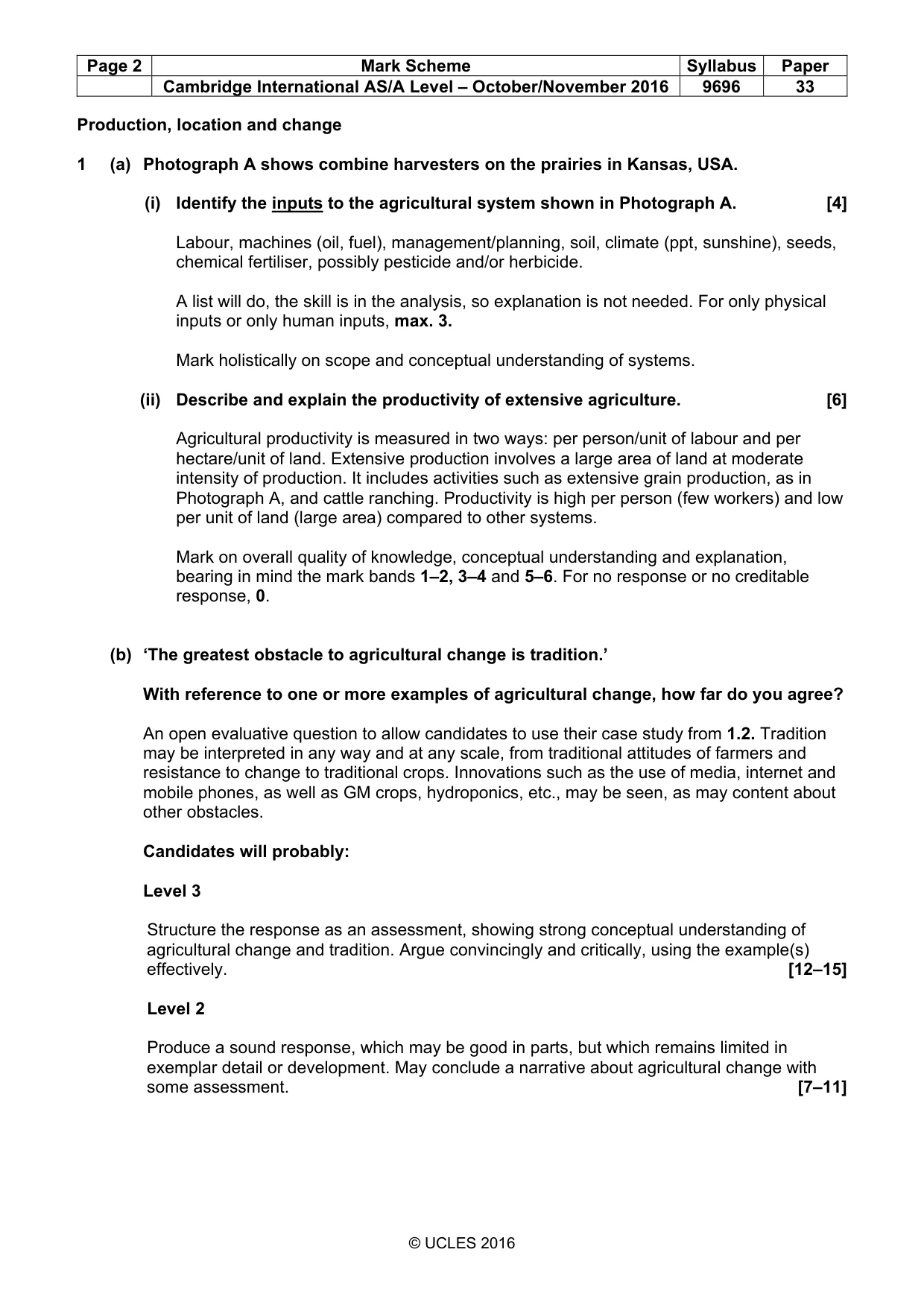
Page 2 Mark Scheme Syllabus Paper Cambridge International AS/A Level – October/November 2016 9696 33 © UCLES 2016 Production, location and change 1 (a) Photograph A shows combine harvesters on the prairies in Kansas, USA. (i) Identify the inputs to the agricultural system shown in Photograph A. [4] Labour, machines (oil, fuel), management/planning, soil, climate (ppt, sunshine), seeds, chemical fertiliser, possibly pesticide and/or herbicide. A list will do, the skill is in the analysis, so explanation is not needed. For only physical inputs or only human inputs, max. 3. Mark holistically on scope and conceptual understanding of systems. (ii) Describe and explain the productivity of extensive agriculture. [6] Agricultural productivity is measured in two ways: per person/unit of labour and per hectare/unit of land. Extensive production involves a large area of land at moderate intensity of production. It includes activities such as extensive grain production, as in Photograph A, and cattle ranching. Productivity is high per person (few workers) and low per unit of land (large area) compared to other systems. Mark on overall quality of knowledge, conceptual understanding and explanation, bearing in mind the mark bands 1–2, 3–4 and 5–6. For no response or no creditable response, 0. (b) ‘The greatest obstacle to agricultural change is tradition.’ With reference to one or more examples of agricultural change, how far do you agree? An open evaluative question to allow candidates to use their case study from 1.2. Tradition may be interpreted in any way and at any scale, from traditional attitudes of farmers and resistance to change to traditional crops. Innovations such as the use of media, internet and mobile phones, as well as GM crops, hydroponics, etc., may be seen, as may content about other obstacles. Candidates will probably: Level 3 Structure the response as an assessment, showing strong conceptual understanding of agricultural change and tradition. Argue convincingly and critically, using the example(s) effectively. [12–15] Level 2 Produce a sound response, which may be good in parts, but which remains limited in exemplar detail or development. May conclude a narrative about agricultural change with some assessment. [7–11]
Mark scheme, page 3
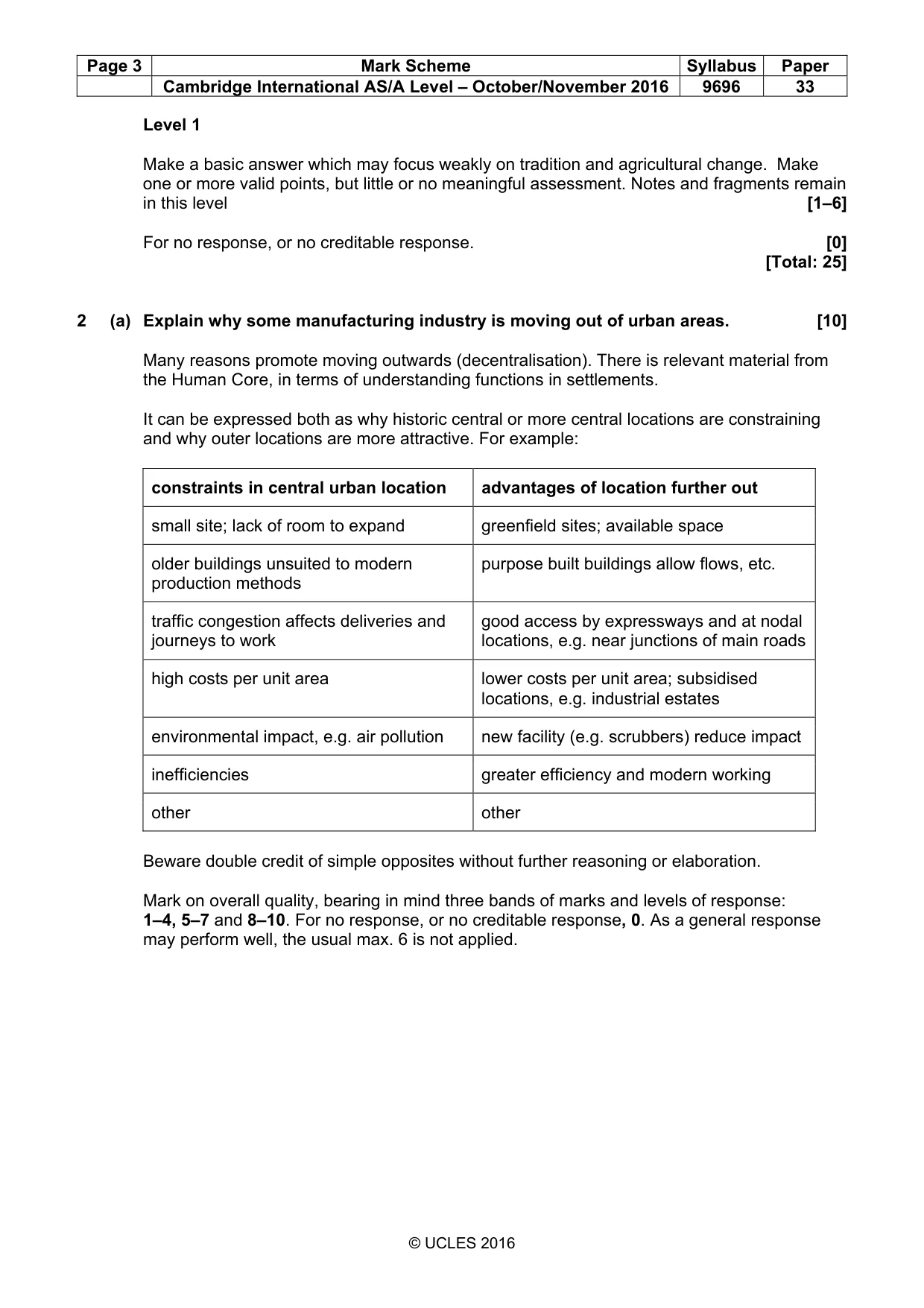
Page 3 Mark Scheme Syllabus Paper Cambridge International AS/A Level – October/November 2016 9696 33 © UCLES 2016 Level 1 Make a basic answer which may focus weakly on tradition and agricultural change. Make one or more valid points, but little or no meaningful assessment. Notes and fragments remain in this level [1–6] For no response, or no creditable response. [0] [Total: 25] 2 (a) Explain why some manufacturing industry is moving out of urban areas. [10] Many reasons promote moving outwards (decentralisation). There is relevant material from the Human Core, in terms of understanding functions in settlements. It can be expressed both as why historic central or more central locations are constraining and why outer locations are more attractive. For example: constraints in central urban location advantages of location further out small site; lack of room to expand greenfield sites; available space older buildings unsuited to modern production methods purpose built buildings allow flows, etc. traffic congestion affects deliveries and journeys to work good access by expressways and at nodal locations, e.g. near junctions of main roads high costs per unit area lower costs per unit area; subsidised locations, e.g. industrial estates environmental impact, e.g. air pollution new facility (e.g. scrubbers) reduce impact inefficiencies greater efficiency and modern working other other Beware double credit of simple opposites without further reasoning or elaboration. Mark on overall quality, bearing in mind three bands of marks and levels of response: 1–4, 5–7 and 8–10. For no response, or no creditable response, 0. As a general response may perform well, the usual max. 6 is not applied.
Mark scheme, page 4
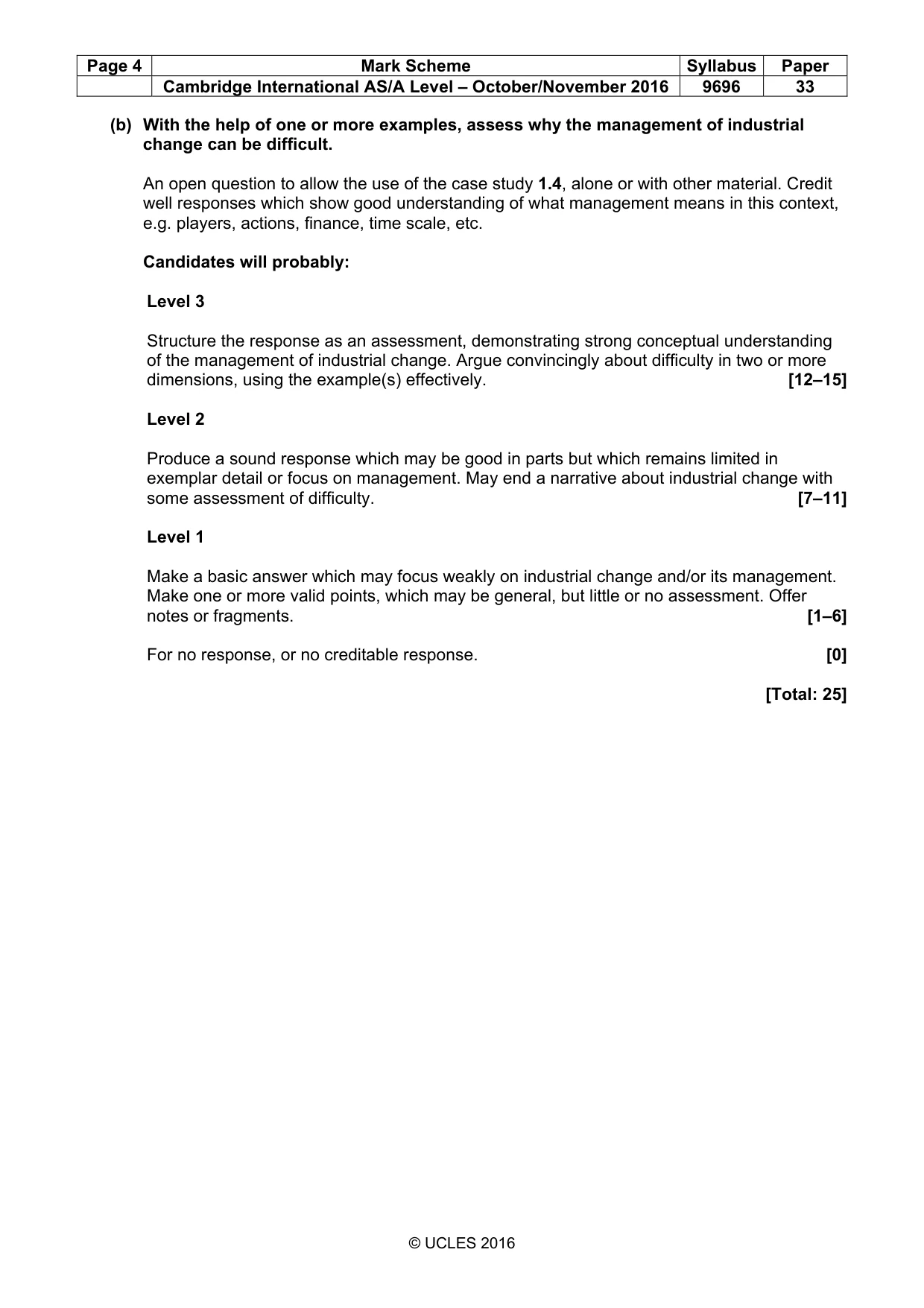
Page 4 Mark Scheme Syllabus Paper Cambridge International AS/A Level – October/November 2016 9696 33 © UCLES 2016 (b) With the help of one or more examples, assess why the management of industrial change can be difficult. An open question to allow the use of the case study 1.4, alone or with other material. Credit well responses which show good understanding of what management means in this context, e.g. players, actions, finance, time scale, etc. Candidates will probably: Level 3 Structure the response as an assessment, demonstrating strong conceptual understanding of the management of industrial change. Argue convincingly about difficulty in two or more dimensions, using the example(s) effectively. [12–15] Level 2 Produce a sound response which may be good in parts but which remains limited in exemplar detail or focus on management. May end a narrative about industrial change with some assessment of difficulty. [7–11] Level 1 Make a basic answer which may focus weakly on industrial change and/or its management. Make one or more valid points, which may be general, but little or no assessment. Offer notes or fragments. [1–6] For no response, or no creditable response. [0] [Total: 25]
Mark scheme, page 5
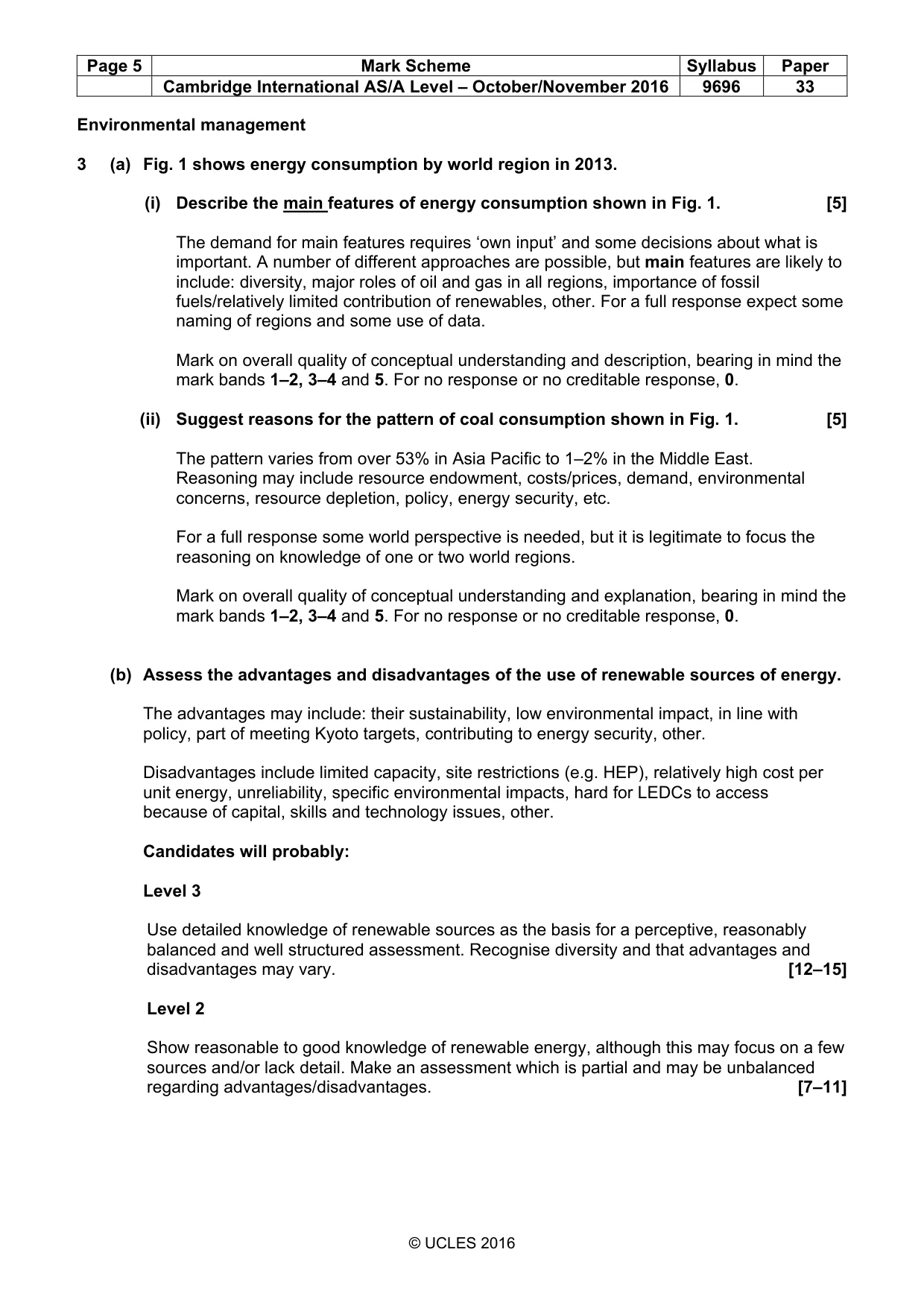
Page 5 Mark Scheme Syllabus Paper Cambridge International AS/A Level – October/November 2016 9696 33 © UCLES 2016 Environmental management 3 (a) Fig. 1 shows energy consumption by world region in 2013. (i) Describe the main features of energy consumption shown in Fig. 1. [5] The demand for main features requires ‘own input’ and some decisions about what is important. A number of different approaches are possible, but main features are likely to include: diversity, major roles of oil and gas in all regions, importance of fossil fuels/relatively limited contribution of renewables, other. For a full response expect some naming of regions and some use of data. Mark on overall quality of conceptual understanding and description, bearing in mind the mark bands 1–2, 3–4 and 5. For no response or no creditable response, 0. (ii) Suggest reasons for the pattern of coal consumption shown in Fig. 1. [5] The pattern varies from over 53% in Asia Pacific to 1–2% in the Middle East. Reasoning may include resource endowment, costs/prices, demand, environmental concerns, resource depletion, policy, energy security, etc. For a full response some world perspective is needed, but it is legitimate to focus the reasoning on knowledge of one or two world regions. Mark on overall quality of conceptual understanding and explanation, bearing in mind the mark bands 1–2, 3–4 and 5. For no response or no creditable response, 0. (b) Assess the advantages and disadvantages of the use of renewable sources of energy. The advantages may include: their sustainability, low environmental impact, in line with policy, part of meeting Kyoto targets, contributing to energy security, other. Disadvantages include limited capacity, site restrictions (e.g. HEP), relatively high cost per unit energy, unreliability, specific environmental impacts, hard for LEDCs to access because of capital, skills and technology issues, other. Candidates will probably: Level 3 Use detailed knowledge of renewable sources as the basis for a perceptive, reasonably balanced and well structured assessment. Recognise diversity and that advantages and disadvantages may vary. [12–15] Level 2 Show reasonable to good knowledge of renewable energy, although this may focus on a few sources and/or lack detail. Make an assessment which is partial and may be unbalanced regarding advantages/disadvantages. [7–11]
Mark scheme, page 6
Page 6 Mark Scheme Syllabus Paper Cambridge International AS/A Level – October/November 2016 9696 33 © UCLES 2016 Level 1 Produce a response of basic quality which may be general about renewable energy and faulty in recall or understanding. Write descriptively, offering little or no real assessment or state advantage/disadvantage without support. Notes and fragments remain in this level. [1–6] For no response, or no creditable response. [0] [Total: 25] 4 (a) (i) Describe the causes of water pollution in rivers and lakes. [5] Freshwater pollution (not marine). Causes may be approached by activity, such as industrial effluents or leached chemical fertilisers, or conceptually, such as poor management, weak law enforcement, accidents, hydrological cycle, lack of education, etc. For a full response some overall perspective is needed but it is legitimate to focus the reasoning on knowledge of one or two examples. Mark on overall quality of description, bearing in mind the mark bands 1–2, 3–4 and 5. For no response or no creditable response, 0. (ii) Explain some of the consequences of water pollution in rivers and lakes. [5] Consequences may be in any dimension, for example: • social illness from use of untreated water, birth defects • economic costs of water treatment • environmental impact on ecosystem/food chain, e.g. eutrophication/blocked drains causing flooding • political protests, law-making A full response consists of two or more consequences developed (and maybe illustrated or supported by an example). Mark on overall quality of explanation, bearing in mind the mark bands 1–2, 3–4 and 5. For no response or no creditable response, 0. (b) ‘Finance is the key to effective environmental protection.’ With reference to one or more examples, how far do you agree? Any environment(s) may be chosen, not restricted to water as in (a). The statement invites assessment both of finance and of other factors, such as governance, cooperation, etc., and therefore any position is acceptable if argued and evidenced. Finance may be for workers, equipment, education, media, etc.
Mark scheme, page 7
Page 7 Mark Scheme Syllabus Paper Cambridge International AS/A Level – October/November 2016 9696 33 © UCLES 2016 Candidates will probably: Level 3 Produce a high quality assessment of the role of finance and other factors in effective environmental protection, well founded in detailed knowledge of the example(s). Impress by overall perspective, organising the response well. [12–15] Level 2 Develop a response of sound quality which is good in parts, but which remains limited in perspective or environmental detail and/or the assessment of finance developed. At the lower end may consider the topic quite broadly. [7–11] Level 1 Make one or more basic observations about environmental protection. Respond quite generally or descriptively, with little or no meaningful assessment. Give a fragmentary or note-form response. [1–6] For no response, or no creditable response. [0] [Total: 25]
Mark scheme, page 8
Page 8 Mark Scheme Syllabus Paper Cambridge International AS/A Level – October/November 2016 9696 33 © UCLES 2016 Global interdependence 5 (a) Use examples to explain how resource endowment and locational advantage affect trade. [10] resource endowment is likely to be considered with reference to mineral resources, such as oil. Accept agricultural potential and human resources. May consider examples such as Namibia’s mineral wealth or Japan and Singapore’s lack of physical resources. Discovery of mineral resources or the effect of substitutes on trade, e.g. for copper, may be seen. locational advantage is the role of strategic situation, for example, in relation to the world’s shipping lanes or access to major markets such as the US or China. Compare relative locational disadvantage to overcome, e.g. for landlocked countries and remote islands. May consider changes in transport technology and relative costs. For either resource endowment only or locational advantage only, max.6. Mark on overall quality, bearing in mind three bands of marks and levels of response: 1–4, 5–7 and 8–10. For no response, or no creditable response, 0. (b) ‘Trade is better than aid.’ With reference to one or more LEDCs, how far do you agree? The advantages and disadvantages of both trade and aid may be explored as the basis for the assessment. Any position may be taken, if based on argument, and that argument on evidence. It is likely that both will be seen to have a place. Any agreement with the statement may be limited by acknowledging the role of aid in certain prescribed circumstances, e.g. relief aid following a disaster, or development aid for specific needs which could not be otherwise funded. Candidates will probably: Level 3 Provide an impressive assessment of both trade and aid. Whilst not making a comprehensive response, convince by overall perspective, use of examples as evidence and judgement(s) made. [12–15] Level 2 Develop a satisfactory answer which may be good in parts. Show some sound knowledge and understanding of both trade and aid. Make a response that is partial or limited in one or more ways: overall perspective, exemplar detail or assessment. [7–11] Level 1 Make a few basic, general, points which may be more descriptive or explanatory of trade and aid than evaluative, or which include a view without support. Offer notes or a fragmentary response. [1–6] For no response, or no creditable response, 0. [Total: 25]
Mark scheme, page 9
Page 9 Mark Scheme Syllabus Paper Cambridge International AS/A Level – October/November 2016 9696 33 © UCLES 2016 6 (a) (i) Describe how the seasonal nature of tourism can affect tourist destinations. [5] A number of effects may be described, including at peak times/high season: • all beds taken / some bookings refused • at, or beyond, carrying capacity (physical, psychological, etc.) • stress and conflict for tourists and local people • congestion • other valid effects and ‘out of season’: • hotels low occupancy or temporarily closed • unemployment and underemployment of workers • low revenue • some shops closed and services unavailable • opportunity to do repairs, etc. • other valid effects For only high season or only low season, max. 3. Mark on overall quality, bearing in mind the mark bands 1–2, 3–4 and 5. For no response or no creditable response, 0. (ii) With the help of one or more examples, briefly explain two ways that tourist destinations attempt to manage seasonal demand. [5] A number of ways are used, such as conference trade, business tourism, special theme or event-based holidays, special deals, and advertising in other parts of the world which have different holiday patterns and periods. It is something which has been done with some success in Mediterranean resorts, e.g. ‘Winter Sun’, and in New Zealand’s resorts. Credit 2 and 3 or 3 and 2; for a response without the example(s), max. 3. (b) Fig. 2 shows a spiral of decline in an established tourist area or resort. Assess the usefulness of Fig. 2 in understanding the experience of one or more tourist destinations. A change from the life cycle model, this focuses on decline and articulates one set of reasons and processes. Assessment of usefulness may cover what it does not say, such as other circumstances which trigger decline; consider other paths, such as ecotourism or destinations at an earlier stage; or may introduce other models which are as, or more, useful, such as those of Butler, Plog or Doxey. Candidates will probably: Level 3 Structure the whole response as an evaluation, identifying elements of usefulness and of the model’s limitations. Impress by conceptual content, critical appreciation and use of detailed evidence from the chosen examples. [12–15]
Mark scheme, page 10
Page 10 Mark Scheme Syllabus Paper Cambridge International AS/A Level – October/November 2016 9696 33 © UCLES 2016 Level 2 Provide a response of sound to good quality which is satisfactory as far as it goes but which could be developed further in detail, scope or in the evaluation of usefulness made. [7–11] Level 1 Make one or more simple points about the development of tourism. Write generally and descriptively, offering little or no effective evaluation. May ‘tell the story’ of one or more tourist destinations without application. Offer notes or fragments. [1–6] For no response, or no creditable response. [0] [Total: 25]
Mark scheme, page 11
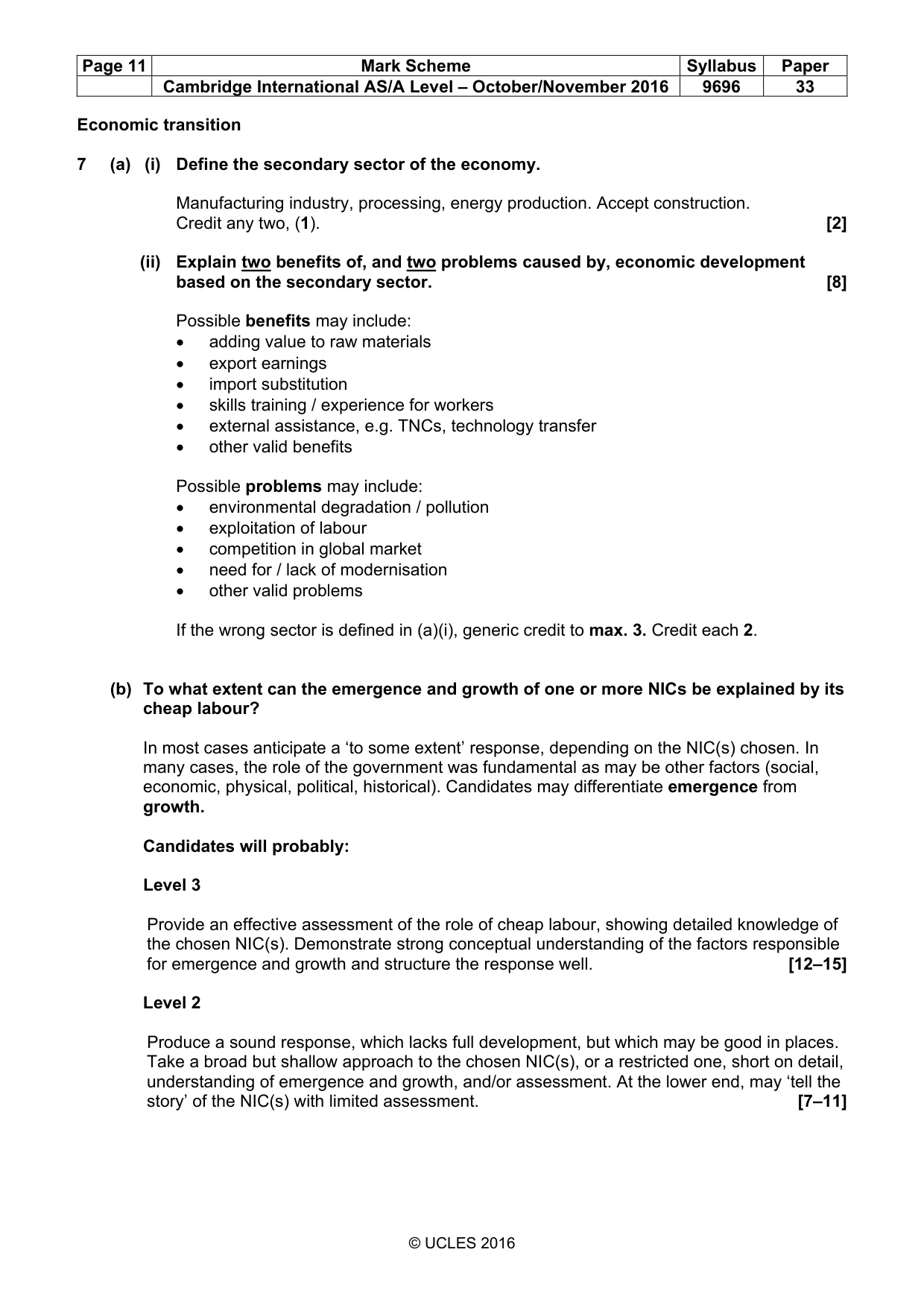
Page 11 Mark Scheme Syllabus Paper Cambridge International AS/A Level – October/November 2016 9696 33 © UCLES 2016 Economic transition 7 (a) (i) Define the secondary sector of the economy. Manufacturing industry, processing, energy production. Accept construction. Credit any two, (1). [2] (ii) Explain two benefits of, and two problems caused by, economic development based on the secondary sector. [8] Possible benefits may include: • adding value to raw materials • export earnings • import substitution • skills training / experience for workers • external assistance, e.g. TNCs, technology transfer • other valid benefits Possible problems may include: • environmental degradation / pollution • exploitation of labour • competition in global market • need for / lack of modernisation • other valid problems If the wrong sector is defined in (a)(i), generic credit to max. 3. Credit each 2. (b) To what extent can the emergence and growth of one or more NICs be explained by its cheap labour? In most cases anticipate a ‘to some extent’ response, depending on the NIC(s) chosen. In many cases, the role of the government was fundamental as may be other factors (social, economic, physical, political, historical). Candidates may differentiate emergence from growth. Candidates will probably: Level 3 Provide an effective assessment of the role of cheap labour, showing detailed knowledge of the chosen NIC(s). Demonstrate strong conceptual understanding of the factors responsible for emergence and growth and structure the response well. [12–15] Level 2 Produce a sound response, which lacks full development, but which may be good in places. Take a broad but shallow approach to the chosen NIC(s), or a restricted one, short on detail, understanding of emergence and growth, and/or assessment. At the lower end, may ‘tell the story’ of the NIC(s) with limited assessment. [7–11]
Mark scheme, page 12
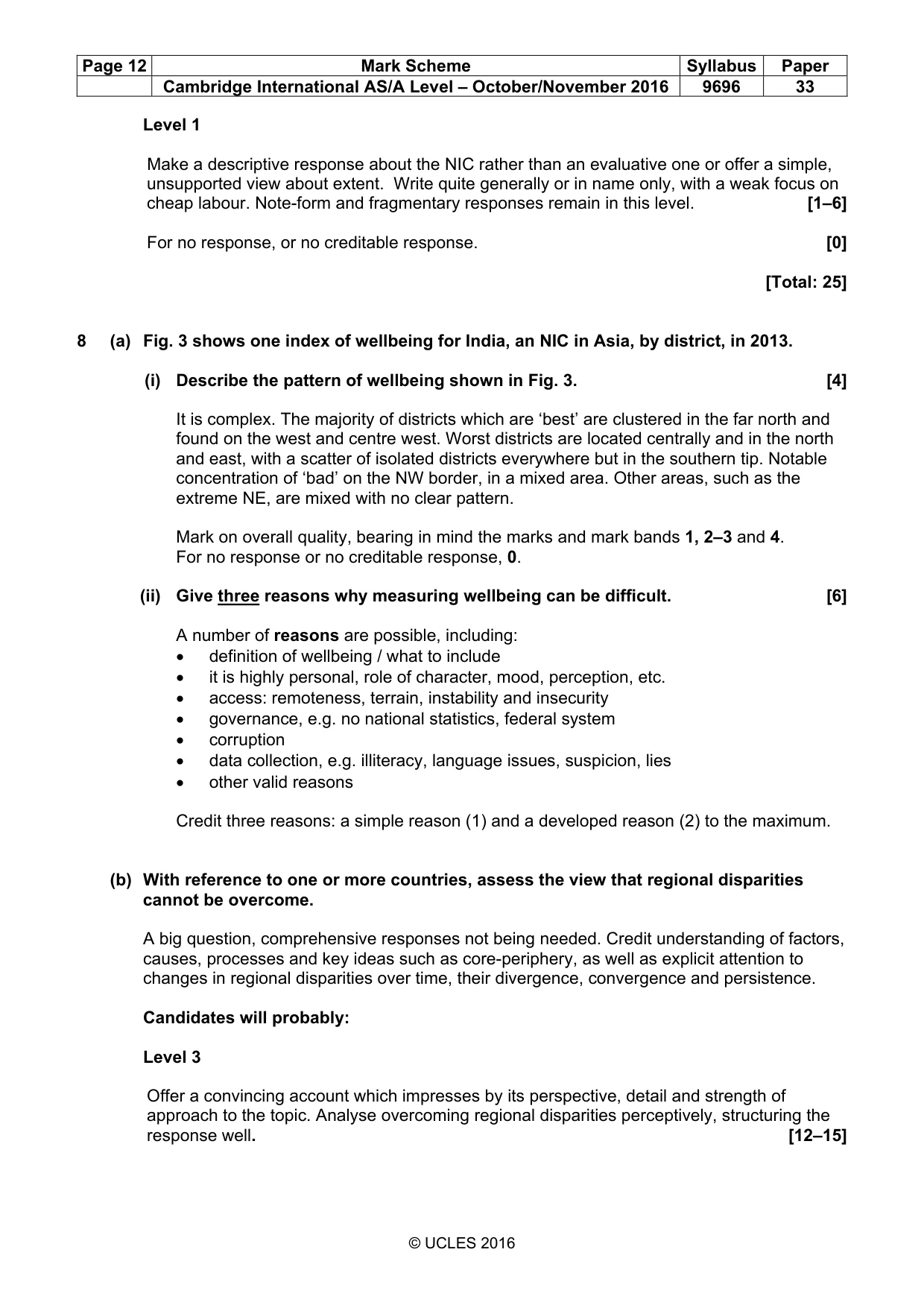
Page 12 Mark Scheme Syllabus Paper Cambridge International AS/A Level – October/November 2016 9696 33 © UCLES 2016 Level 1 Make a descriptive response about the NIC rather than an evaluative one or offer a simple, unsupported view about extent. Write quite generally or in name only, with a weak focus on cheap labour. Note-form and fragmentary responses remain in this level. [1–6] For no response, or no creditable response. [0] [Total: 25] 8 (a) Fig. 3 shows one index of wellbeing for India, an NIC in Asia, by district, in 2013. (i) Describe the pattern of wellbeing shown in Fig. 3. [4] It is complex. The majority of districts which are ‘best’ are clustered in the far north and found on the west and centre west. Worst districts are located centrally and in the north and east, with a scatter of isolated districts everywhere but in the southern tip. Notable concentration of ‘bad’ on the NW border, in a mixed area. Other areas, such as the extreme NE, are mixed with no clear pattern. Mark on overall quality, bearing in mind the marks and mark bands 1, 2–3 and 4. For no response or no creditable response, 0. (ii) Give three reasons why measuring wellbeing can be difficult. [6] A number of reasons are possible, including: • definition of wellbeing / what to include • it is highly personal, role of character, mood, perception, etc. • access: remoteness, terrain, instability and insecurity • governance, e.g. no national statistics, federal system • corruption • data collection, e.g. illiteracy, language issues, suspicion, lies • other valid reasons Credit three reasons: a simple reason (1) and a developed reason (2) to the maximum. (b) With reference to one or more countries, assess the view that regional disparities cannot be overcome. A big question, comprehensive responses not being needed. Credit understanding of factors, causes, processes and key ideas such as core-periphery, as well as explicit attention to changes in regional disparities over time, their divergence, convergence and persistence. Candidates will probably: Level 3 Offer a convincing account which impresses by its perspective, detail and strength of approach to the topic. Analyse overcoming regional disparities perceptively, structuring the response well. [12–15]
Mark scheme, page 13
Page 13 Mark Scheme Syllabus Paper Cambridge International AS/A Level – October/November 2016 9696 33 © UCLES 2016 Level 2 Provide a response of sound quality overall, which may be good in parts, but which remains limited in detail, overall understanding of overcoming regional disparities, or in the analysis made. [7–11] Level 1 Make one or more simple observations about regional disparities. Struggle to select and apply learned material to the idea of whether they can be overcome. Answer generally and/or descriptively, offering little or no analysis. [1–6] For no response, or no creditable response. [0] [Total: 25]
What you needed in this session
Cambridge’s own grade thresholds for 2016 Oct/Nov, Paper 3 · Variant 3. A higher threshold means an easier paper — the bar moves with how the cohort did.