Cambridge A Level General Paper (AS Level only) 8004 — 2018 May/June Paper 1 · Variant 3
8004/13/M/J/18 · 100 marks · ≈113 min
The question paper and its mark scheme, free to read here and free to download. This is Cambridge’s own paper, exactly as it was sat.
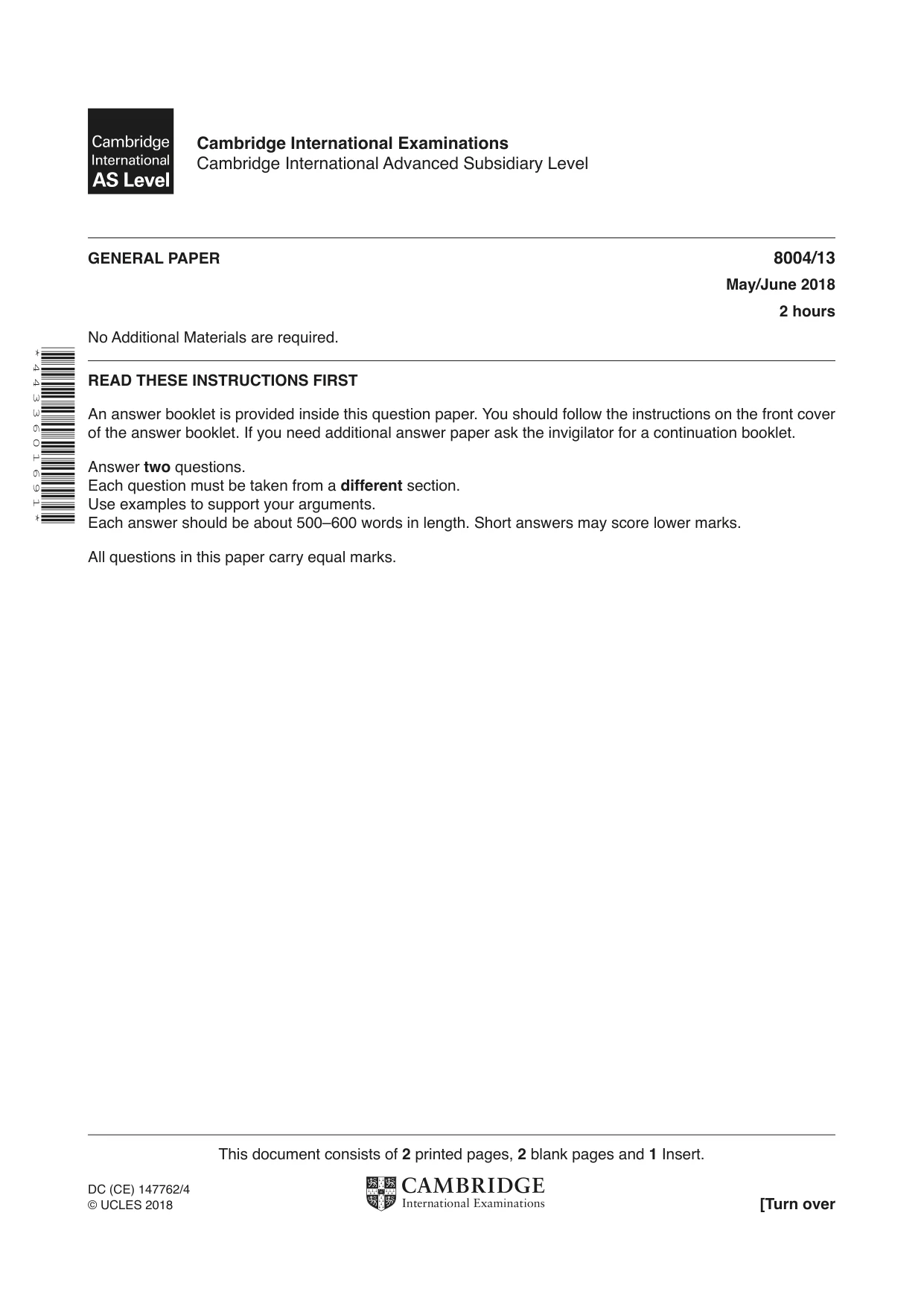
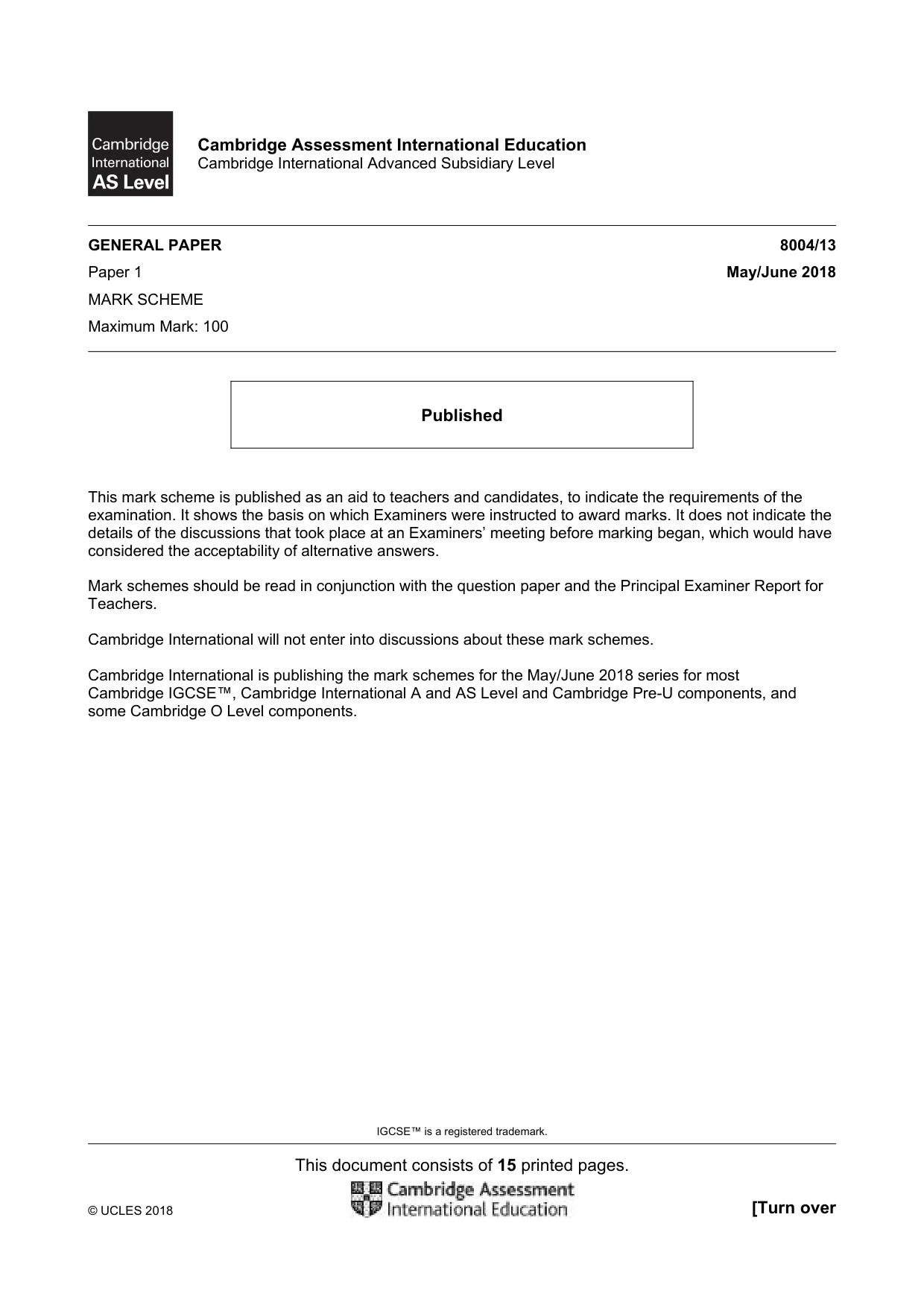
Question paper4 pages

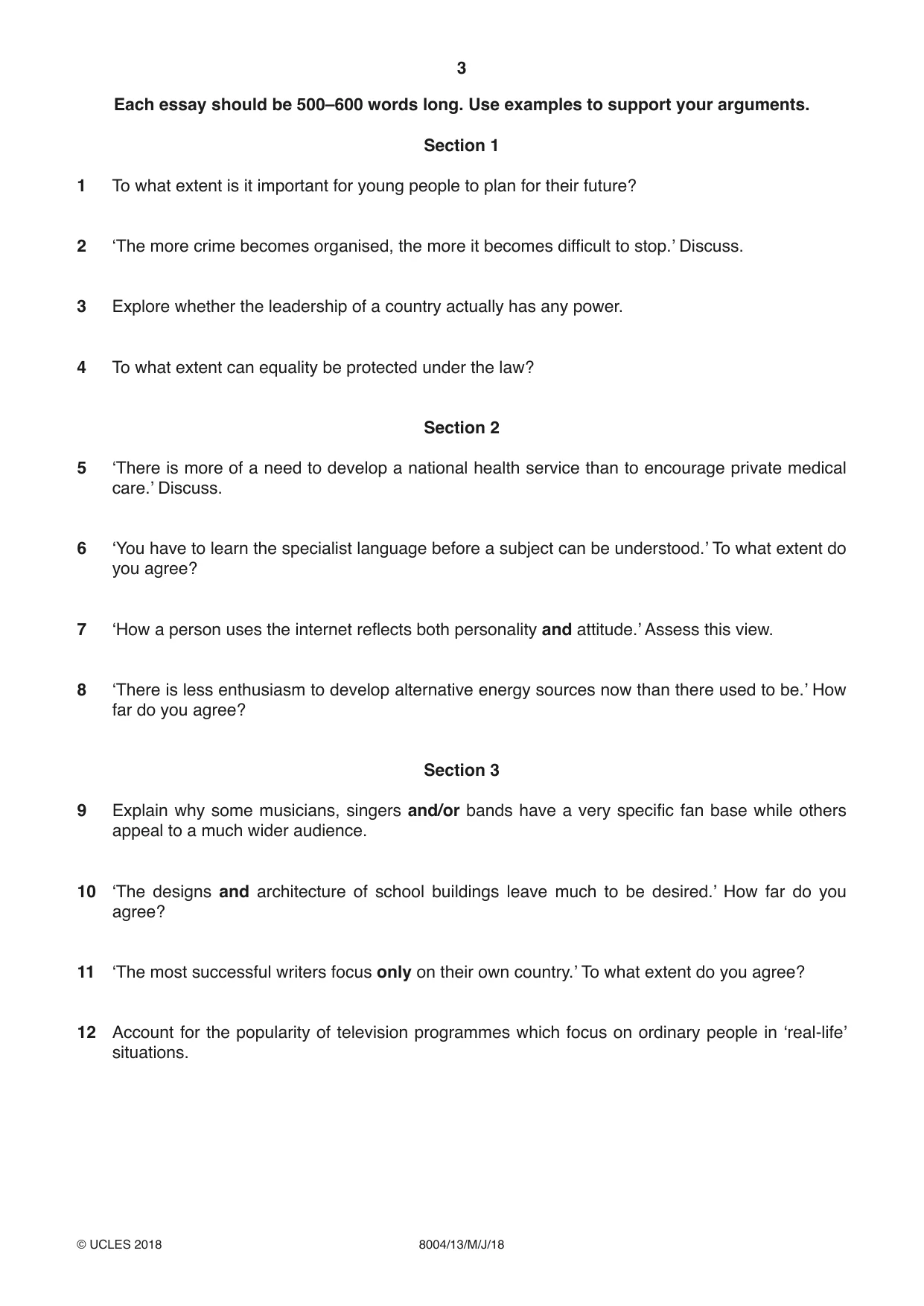

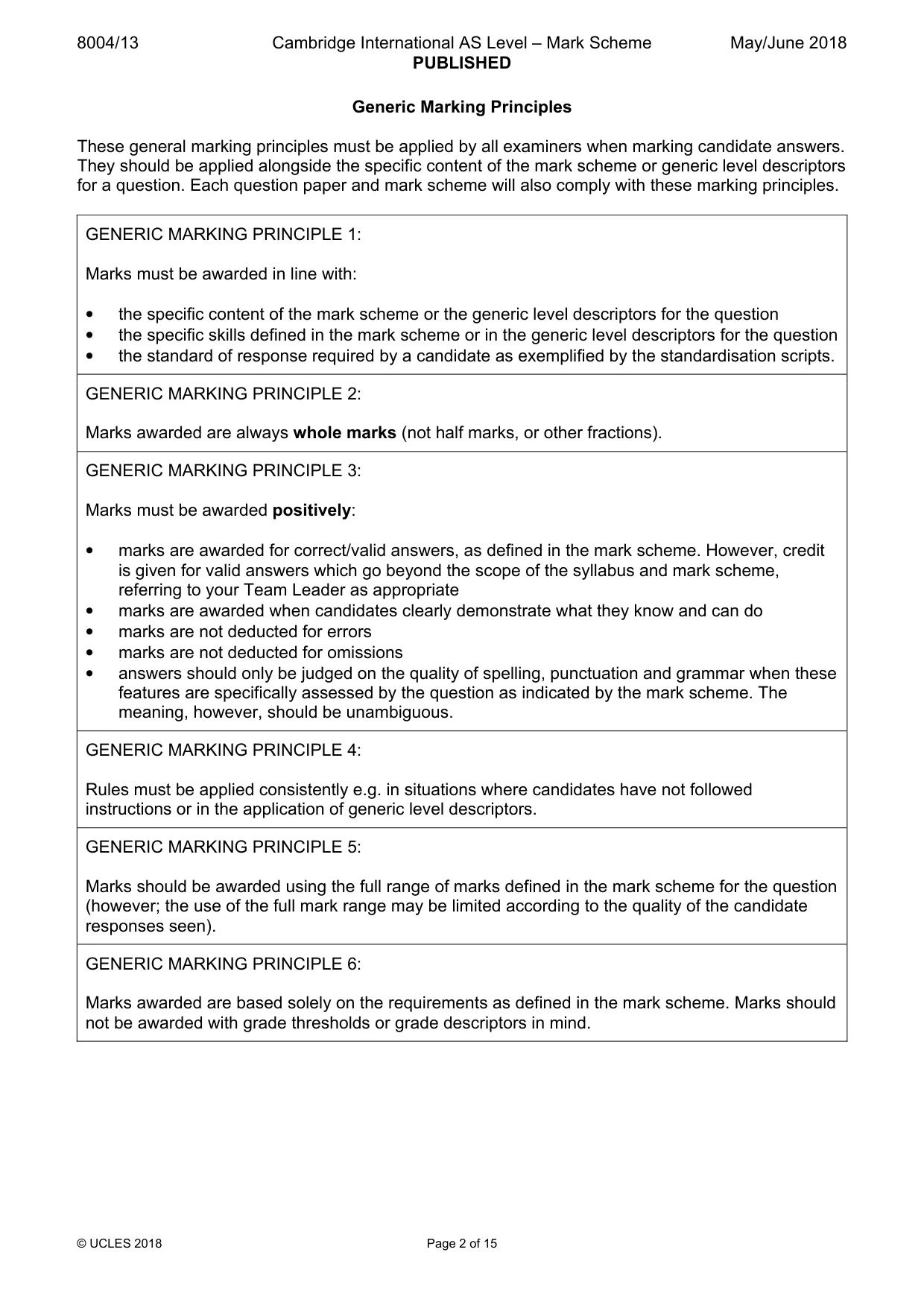
Mark scheme15 pages
Answers below. Sit the paper first if you are practising.
Paper as text
Question paper, page 1
* 4 4 3 3 6 0 1 6 9 1 * This document consists of 2 printed pages, 2 blank pages and 1 Insert. DC (CE) 147762/4 © UCLES 2018 [Turn over Cambridge International Examinations Cambridge International Advanced Subsidiary Level GENERAL PAPER 8004/13 May/June 2018 2 hours No Additional Materials are required. READ THESE INSTRUCTIONS FIRST An answer booklet is provided inside this question paper. You should follow the instructions on the front cover of the answer booklet. If you need additional answer paper ask the invigilator for a continuation booklet. Answer two questions. Each question must be taken from a different section. Use examples to support your arguments. Each answer should be about 500–600 words in length. Short answers may score lower marks. All questions in this paper carry equal marks.
Question paper, page 2
2 8004/13/M/J/18 © UCLES 2018 BLANK PAGE
Question paper, page 3
3 8004/13/M/J/18 © UCLES 2018 Each essay should be 500–600 words long. Use examples to support your arguments. Section 1 1 To what extent is it important for young people to plan for their future? 2 ‘The more crime becomes organised, the more it becomes difficult to stop.’ Discuss. 3 Explore whether the leadership of a country actually has any power. 4 To what extent can equality be protected under the law? Section 2 5 ‘There is more of a need to develop a national health service than to encourage private medical care.’ Discuss. 6 ‘You have to learn the specialist language before a subject can be understood.’ To what extent do you agree? 7 ‘How a person uses the internet reflects both personality and attitude.’ Assess this view. 8 ‘There is less enthusiasm to develop alternative energy sources now than there used to be.’ How far do you agree? Section 3 9 Explain why some musicians, singers and/or bands have a very specific fan base while others appeal to a much wider audience. 10 ‘The designs and architecture of school buildings leave much to be desired.’ How far do you agree? 11 ‘The most successful writers focus only on their own country.’ To what extent do you agree? 12 Account for the popularity of television programmes which focus on ordinary people in ‘real-life’ situations.
Question paper, page 4
4 8004/13/M/J/18 © UCLES 2018 Permission to reproduce items where third-party owned material protected by copyright is included has been sought and cleared where possible. Every reasonable effort has been made by the publisher (UCLES) to trace copyright holders, but if any items requiring clearance have unwittingly been included, the publisher will be pleased to make amends at the earliest possible opportunity. To avoid the issue of disclosure of answer-related information to candidates, all copyright acknowledgements are reproduced online in the Cambridge International Examinations Copyright Acknowledgements Booklet. This is produced for each series of examinations and is freely available to download at www.cie.org.uk after the live examination series. Cambridge International Examinations is part of the Cambridge Assessment Group. Cambridge Assessment is the brand name of University of Cambridge Local Examinations Syndicate (UCLES), which is itself a department of the University of Cambridge. BLANK PAGE
Mark scheme, page 1
IGCSE™ is a registered trademark. This document consists of 15 printed pages. © UCLES 2018 [Turn over Cambridge Assessment International Education Cambridge International Advanced Subsidiary Level GENERAL PAPER 8004/13 Paper 1 May/June 2018 MARK SCHEME Maximum Mark: 100 Published This mark scheme is published as an aid to teachers and candidates, to indicate the requirements of the examination. It shows the basis on which Examiners were instructed to award marks. It does not indicate the details of the discussions that took place at an Examiners’ meeting before marking began, which would have considered the acceptability of alternative answers. Mark schemes should be read in conjunction with the question paper and the Principal Examiner Report for Teachers. Cambridge International will not enter into discussions about these mark schemes. Cambridge International is publishing the mark schemes for the May/June 2018 series for most Cambridge IGCSE™, Cambridge International A and AS Level and Cambridge Pre-U components, and some Cambridge O Level components.
Mark scheme, page 2
8004/13 Cambridge International AS Level – Mark Scheme PUBLISHED May/June 2018 © UCLES 2018 Page 2 of 15 Generic Marking Principles These general marking principles must be applied by all examiners when marking candidate answers. They should be applied alongside the specific content of the mark scheme or generic level descriptors for a question. Each question paper and mark scheme will also comply with these marking principles. GENERIC MARKING PRINCIPLE 1: Marks must be awarded in line with: • the specific content of the mark scheme or the generic level descriptors for the question • the specific skills defined in the mark scheme or in the generic level descriptors for the question • the standard of response required by a candidate as exemplified by the standardisation scripts. GENERIC MARKING PRINCIPLE 2: Marks awarded are always whole marks (not half marks, or other fractions). GENERIC MARKING PRINCIPLE 3: Marks must be awarded positively: • marks are awarded for correct/valid answers, as defined in the mark scheme. However, credit is given for valid answers which go beyond the scope of the syllabus and mark scheme, referring to your Team Leader as appropriate • marks are awarded when candidates clearly demonstrate what they know and can do • marks are not deducted for errors • marks are not deducted for omissions • answers should only be judged on the quality of spelling, punctuation and grammar when these features are specifically assessed by the question as indicated by the mark scheme. The meaning, however, should be unambiguous. GENERIC MARKING PRINCIPLE 4: Rules must be applied consistently e.g. in situations where candidates have not followed instructions or in the application of generic level descriptors. GENERIC MARKING PRINCIPLE 5: Marks should be awarded using the full range of marks defined in the mark scheme for the question (however; the use of the full mark range may be limited according to the quality of the candidate responses seen). GENERIC MARKING PRINCIPLE 6: Marks awarded are based solely on the requirements as defined in the mark scheme. Marks should not be awarded with grade thresholds or grade descriptors in mind.
Mark scheme, page 3
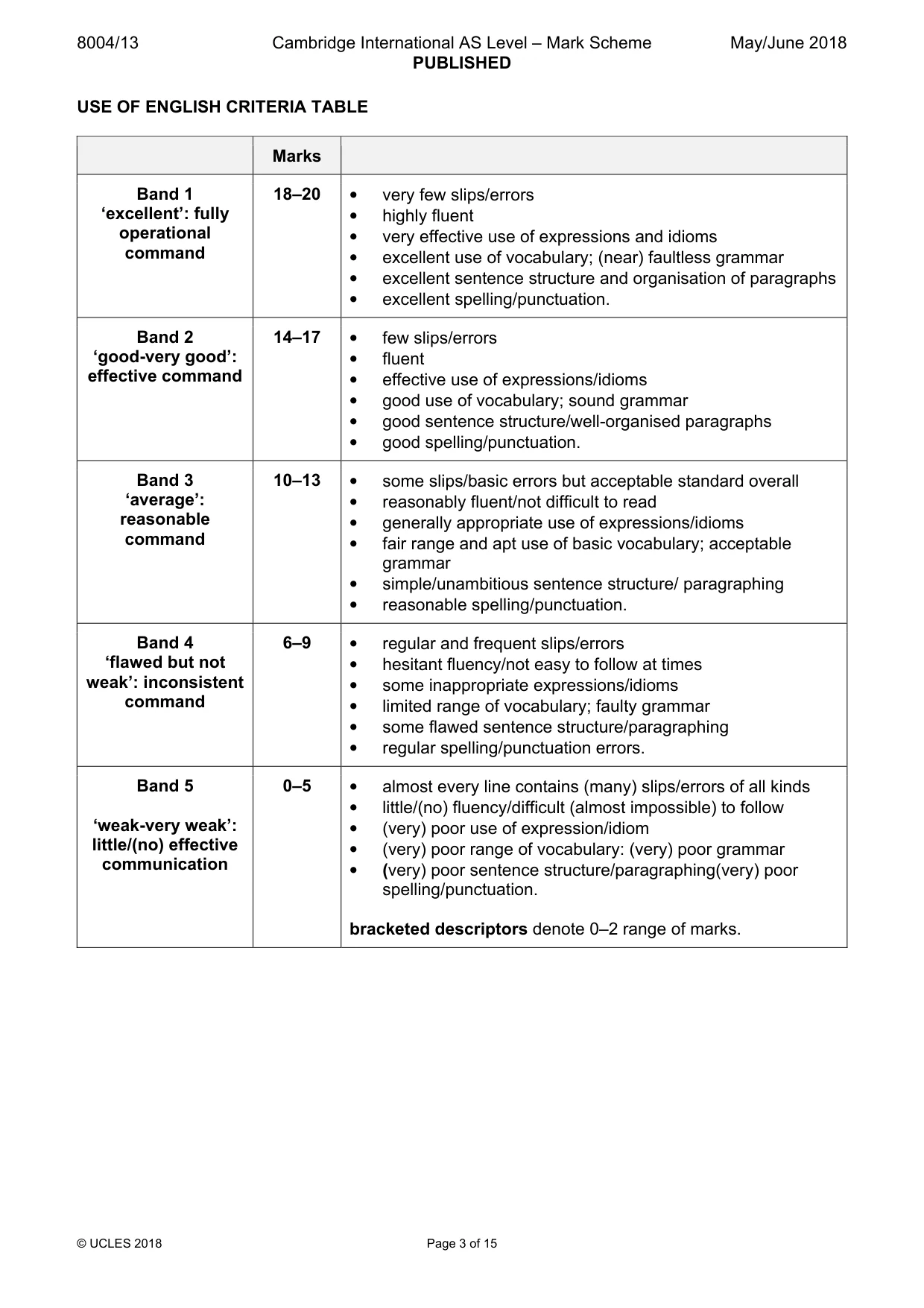
8004/13 Cambridge International AS Level – Mark Scheme PUBLISHED May/June 2018 © UCLES 2018 Page 3 of 15 USE OF ENGLISH CRITERIA TABLE Marks Band 1 ‘excellent’: fully operational command 18–20 • very few slips/errors • highly fluent • very effective use of expressions and idioms • excellent use of vocabulary; (near) faultless grammar • excellent sentence structure and organisation of paragraphs • excellent spelling/punctuation. Band 2 ‘good-very good’: effective command 14–17 • few slips/errors • fluent • effective use of expressions/idioms • good use of vocabulary; sound grammar • good sentence structure/well-organised paragraphs • good spelling/punctuation. Band 3 ‘average’: reasonable command 10–13 • some slips/basic errors but acceptable standard overall • reasonably fluent/not difficult to read • generally appropriate use of expressions/idioms • fair range and apt use of basic vocabulary; acceptable grammar • simple/unambitious sentence structure/ paragraphing • reasonable spelling/punctuation. Band 4 ‘flawed but not weak’: inconsistent command 6–9 • regular and frequent slips/errors • hesitant fluency/not easy to follow at times • some inappropriate expressions/idioms • limited range of vocabulary; faulty grammar • some flawed sentence structure/paragraphing • regular spelling/punctuation errors. Band 5 ‘weak-very weak’: little/(no) effective communication 0–5 • almost every line contains (many) slips/errors of all kinds • little/(no) fluency/difficult (almost impossible) to follow • (very) poor use of expression/idiom • (very) poor range of vocabulary: (very) poor grammar • (very) poor sentence structure/paragraphing(very) poor spelling/punctuation. bracketed descriptors denote 0–2 range of marks.
Mark scheme, page 4
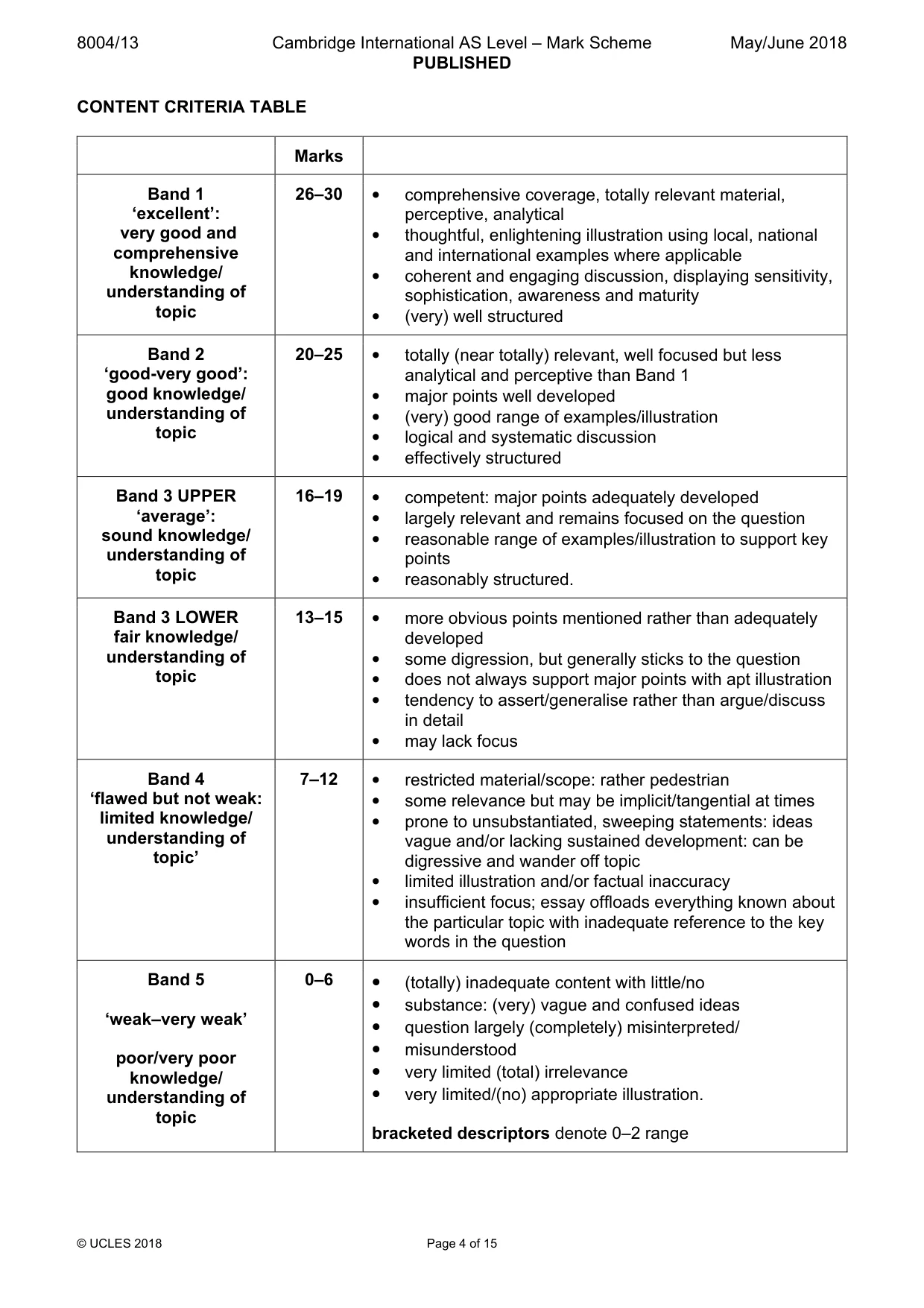
8004/13 Cambridge International AS Level – Mark Scheme PUBLISHED May/June 2018 © UCLES 2018 Page 4 of 15 CONTENT CRITERIA TABLE Marks Band 1 ‘excellent’: very good and comprehensive knowledge/ understanding of topic 26–30 • comprehensive coverage, totally relevant material, perceptive, analytical • thoughtful, enlightening illustration using local, national and international examples where applicable • coherent and engaging discussion, displaying sensitivity, sophistication, awareness and maturity • (very) well structured Band 2 ‘good-very good’: good knowledge/ understanding of topic 20–25 • totally (near totally) relevant, well focused but less analytical and perceptive than Band 1 • major points well developed • (very) good range of examples/illustration • logical and systematic discussion • effectively structured Band 3 UPPER ‘average’: sound knowledge/ understanding of topic 16–19 • competent: major points adequately developed • largely relevant and remains focused on the question • reasonable range of examples/illustration to support key points • reasonably structured. Band 3 LOWER fair knowledge/ understanding of topic 13–15 • more obvious points mentioned rather than adequately developed • some digression, but generally sticks to the question • does not always support major points with apt illustration • tendency to assert/generalise rather than argue/discuss in detail • may lack focus Band 4 ‘flawed but not weak: limited knowledge/ understanding of topic’ 7–12 • restricted material/scope: rather pedestrian • some relevance but may be implicit/tangential at times • prone to unsubstantiated, sweeping statements: ideas vague and/or lacking sustained development: can be digressive and wander off topic • limited illustration and/or factual inaccuracy • insufficient focus; essay offloads everything known about the particular topic with inadequate reference to the key words in the question Band 5 ‘weak–very weak’ poor/very poor knowledge/ understanding of topic 0–6 • (totally) inadequate content with little/no • substance: (very) vague and confused ideas • question largely (completely) misinterpreted/ • misunderstood • very limited (total) irrelevance • very limited/(no) appropriate illustration. bracketed descriptors denote 0–2 range
Mark scheme, page 5
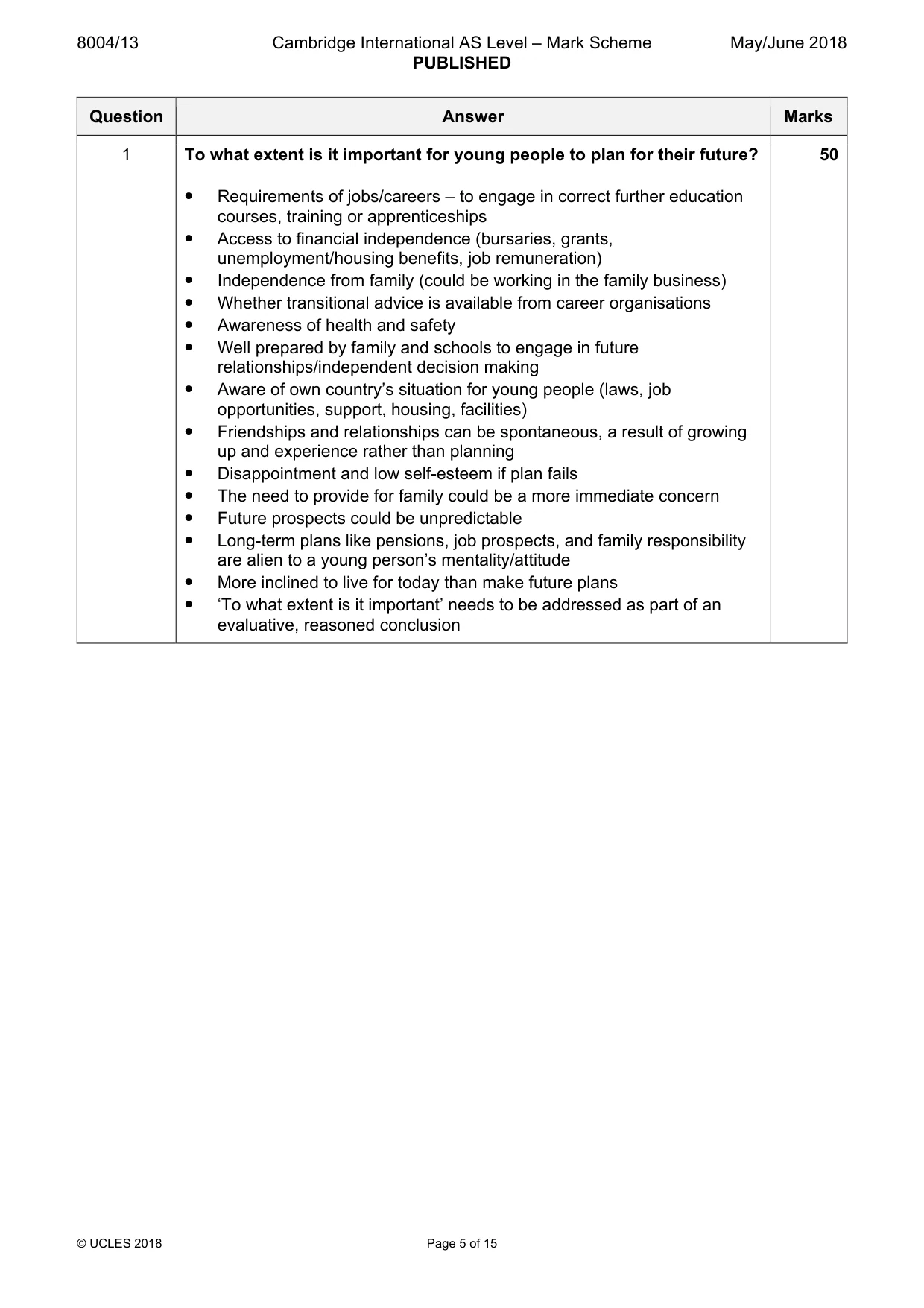
8004/13 Cambridge International AS Level – Mark Scheme PUBLISHED May/June 2018 © UCLES 2018 Page 5 of 15 Question Answer Marks 1 To what extent is it important for young people to plan for their future? • Requirements of jobs/careers – to engage in correct further education courses, training or apprenticeships • Access to financial independence (bursaries, grants, unemployment/housing benefits, job remuneration) • Independence from family (could be working in the family business) • Whether transitional advice is available from career organisations • Awareness of health and safety • Well prepared by family and schools to engage in future relationships/independent decision making • Aware of own country’s situation for young people (laws, job opportunities, support, housing, facilities) • Friendships and relationships can be spontaneous, a result of growing up and experience rather than planning • Disappointment and low self-esteem if plan fails • The need to provide for family could be a more immediate concern • Future prospects could be unpredictable • Long-term plans like pensions, job prospects, and family responsibility are alien to a young person’s mentality/attitude • More inclined to live for today than make future plans • ‘To what extent is it important’ needs to be addressed as part of an evaluative, reasoned conclusion 50
Mark scheme, page 6
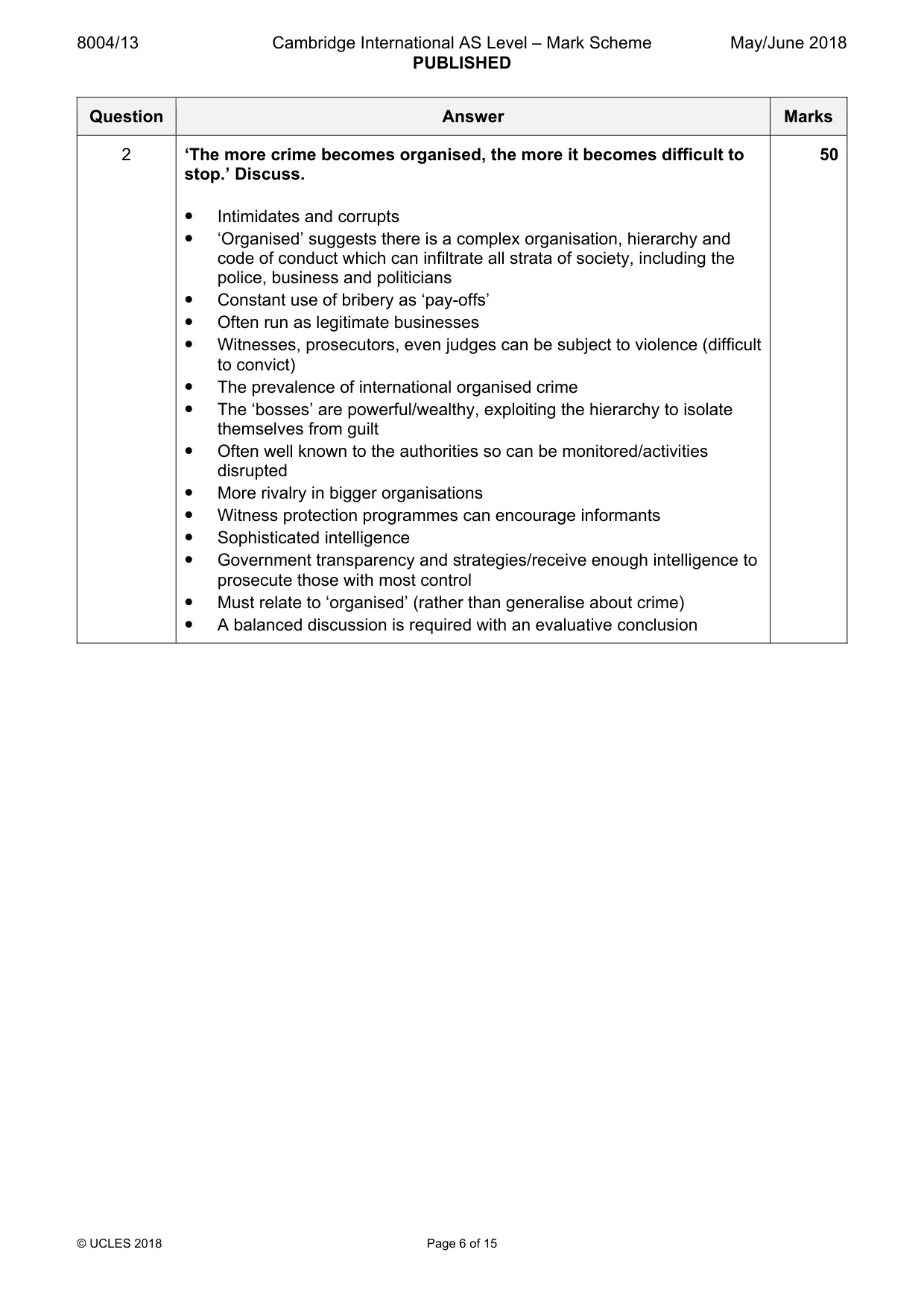
8004/13 Cambridge International AS Level – Mark Scheme PUBLISHED May/June 2018 © UCLES 2018 Page 6 of 15 Question Answer Marks 2 ‘The more crime becomes organised, the more it becomes difficult to stop.’ Discuss. • Intimidates and corrupts • ‘Organised’ suggests there is a complex organisation, hierarchy and code of conduct which can infiltrate all strata of society, including the police, business and politicians • Constant use of bribery as ‘pay-offs’ • Often run as legitimate businesses • Witnesses, prosecutors, even judges can be subject to violence (difficult to convict) • The prevalence of international organised crime • The ‘bosses’ are powerful/wealthy, exploiting the hierarchy to isolate themselves from guilt • Often well known to the authorities so can be monitored/activities disrupted • More rivalry in bigger organisations • Witness protection programmes can encourage informants • Sophisticated intelligence • Government transparency and strategies/receive enough intelligence to prosecute those with most control • Must relate to ‘organised’ (rather than generalise about crime) • A balanced discussion is required with an evaluative conclusion 50
Mark scheme, page 7
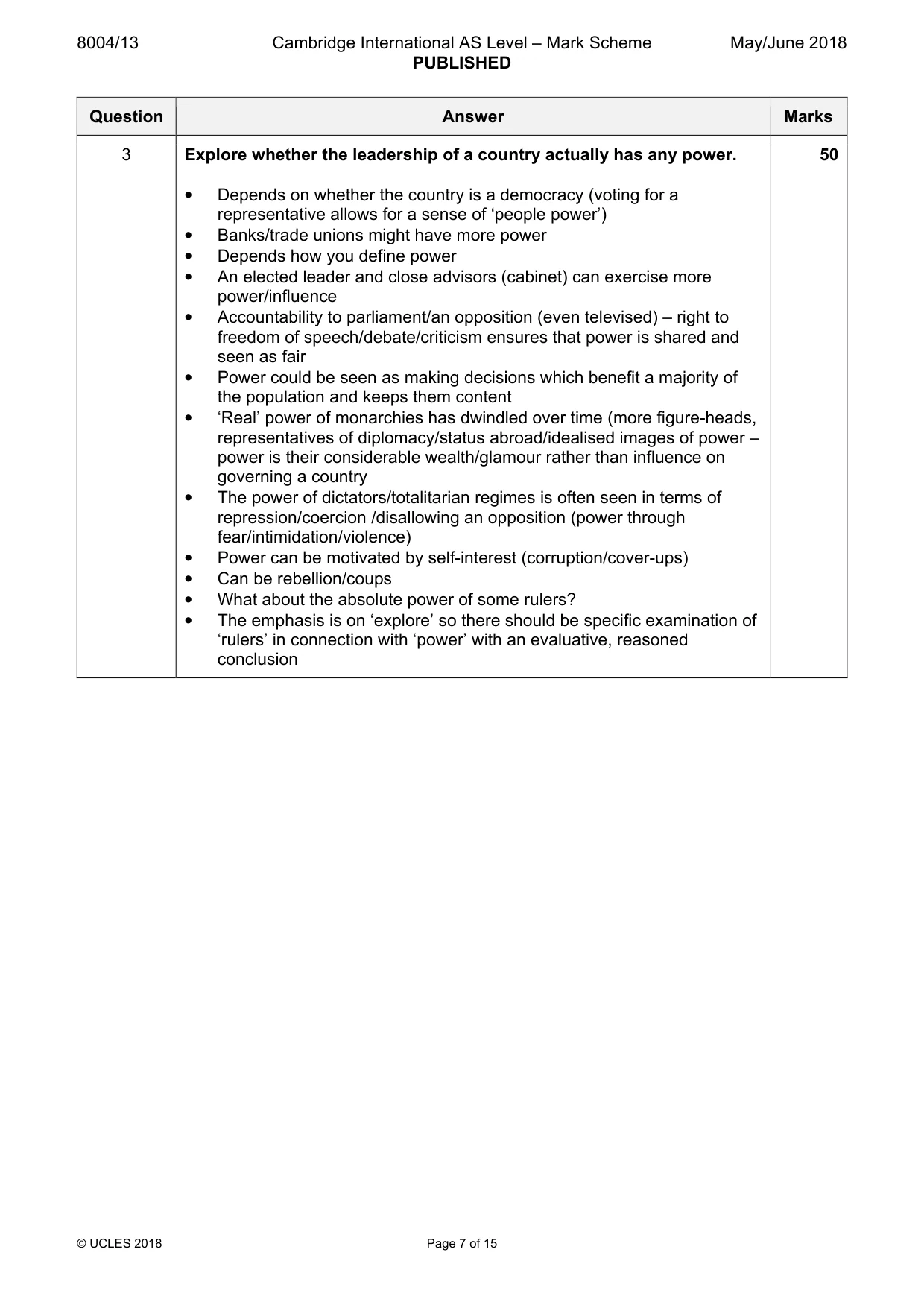
8004/13 Cambridge International AS Level – Mark Scheme PUBLISHED May/June 2018 © UCLES 2018 Page 7 of 15 Question Answer Marks 3 Explore whether the leadership of a country actually has any power. • Depends on whether the country is a democracy (voting for a representative allows for a sense of ‘people power’) • Banks/trade unions might have more power • Depends how you define power • An elected leader and close advisors (cabinet) can exercise more power/influence • Accountability to parliament/an opposition (even televised) – right to freedom of speech/debate/criticism ensures that power is shared and seen as fair • Power could be seen as making decisions which benefit a majority of the population and keeps them content • ‘Real’ power of monarchies has dwindled over time (more figure-heads, representatives of diplomacy/status abroad/idealised images of power – power is their considerable wealth/glamour rather than influence on governing a country • The power of dictators/totalitarian regimes is often seen in terms of repression/coercion /disallowing an opposition (power through fear/intimidation/violence) • Power can be motivated by self-interest (corruption/cover-ups) • Can be rebellion/coups • What about the absolute power of some rulers? • The emphasis is on ‘explore’ so there should be specific examination of ‘rulers’ in connection with ‘power’ with an evaluative, reasoned conclusion 50
Mark scheme, page 8
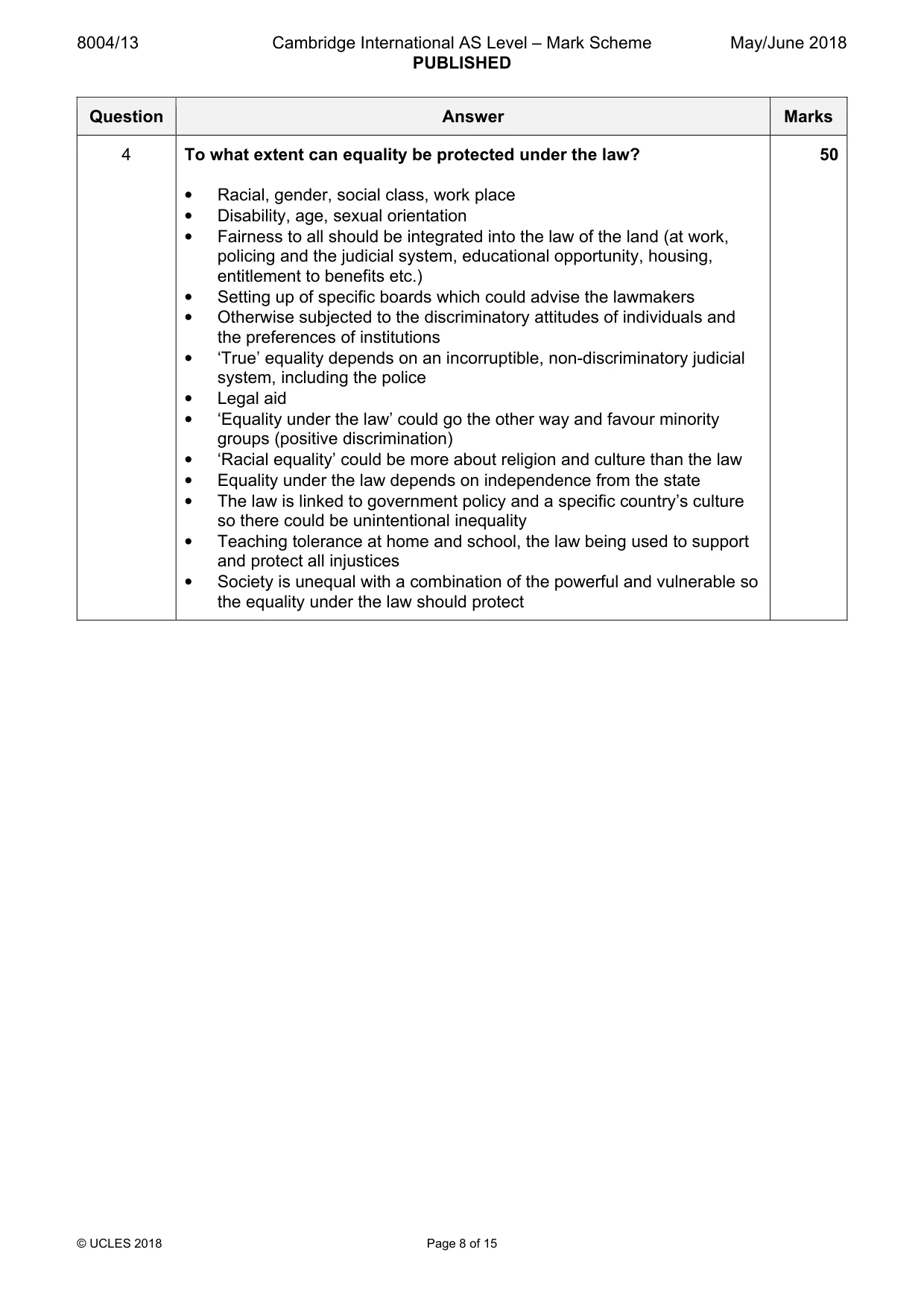
8004/13 Cambridge International AS Level – Mark Scheme PUBLISHED May/June 2018 © UCLES 2018 Page 8 of 15 Question Answer Marks 4 To what extent can equality be protected under the law? • Racial, gender, social class, work place • Disability, age, sexual orientation • Fairness to all should be integrated into the law of the land (at work, policing and the judicial system, educational opportunity, housing, entitlement to benefits etc.) • Setting up of specific boards which could advise the lawmakers • Otherwise subjected to the discriminatory attitudes of individuals and the preferences of institutions • ‘True’ equality depends on an incorruptible, non-discriminatory judicial system, including the police • Legal aid • ‘Equality under the law’ could go the other way and favour minority groups (positive discrimination) • ‘Racial equality’ could be more about religion and culture than the law • Equality under the law depends on independence from the state • The law is linked to government policy and a specific country’s culture so there could be unintentional inequality • Teaching tolerance at home and school, the law being used to support and protect all injustices • Society is unequal with a combination of the powerful and vulnerable so the equality under the law should protect 50
Mark scheme, page 9
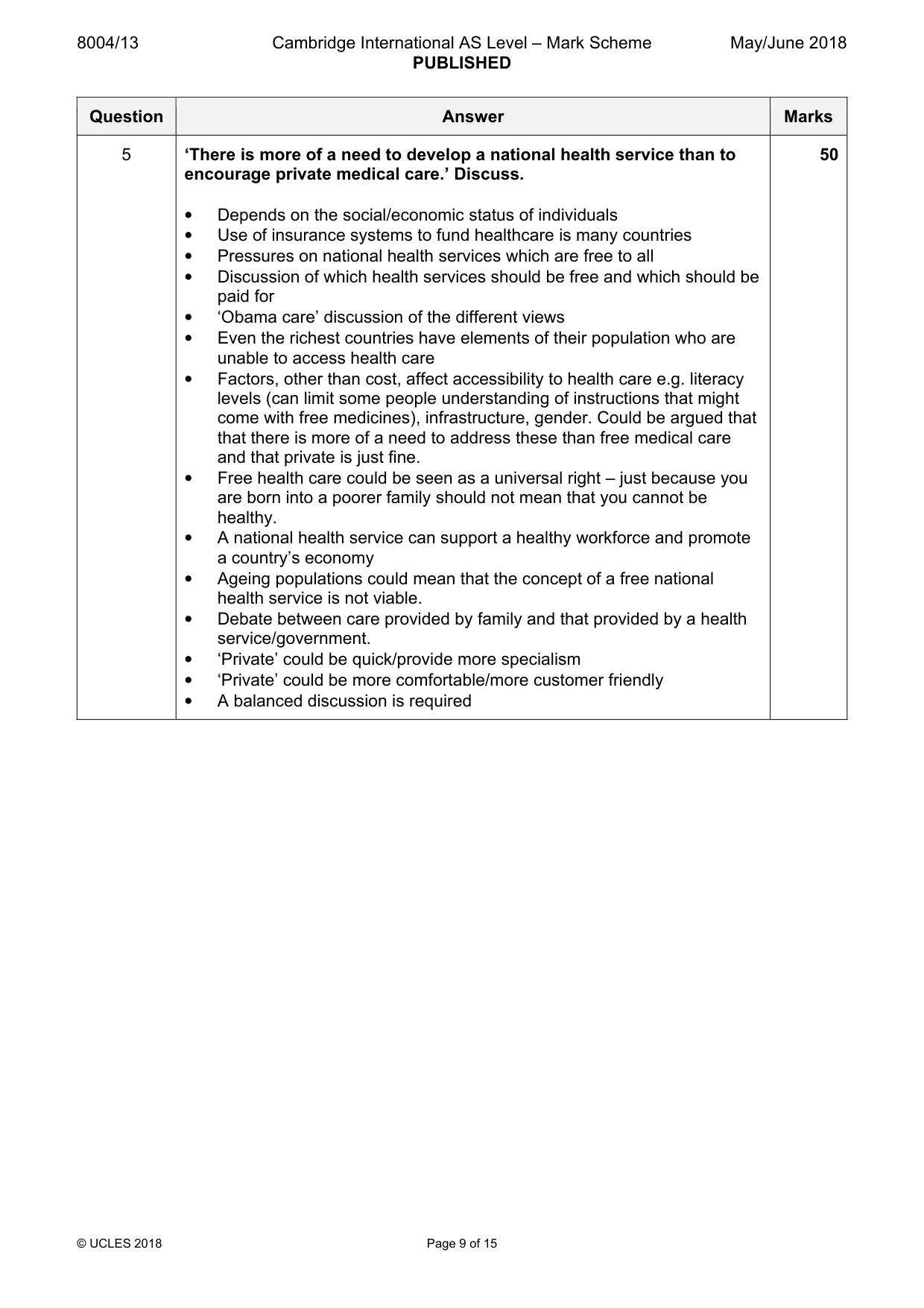
8004/13 Cambridge International AS Level – Mark Scheme PUBLISHED May/June 2018 © UCLES 2018 Page 9 of 15 Question Answer Marks 5 ‘There is more of a need to develop a national health service than to encourage private medical care.’ Discuss. • Depends on the social/economic status of individuals • Use of insurance systems to fund healthcare is many countries • Pressures on national health services which are free to all • Discussion of which health services should be free and which should be paid for • ‘Obama care’ discussion of the different views • Even the richest countries have elements of their population who are unable to access health care • Factors, other than cost, affect accessibility to health care e.g. literacy levels (can limit some people understanding of instructions that might come with free medicines), infrastructure, gender. Could be argued that that there is more of a need to address these than free medical care and that private is just fine. • Free health care could be seen as a universal right – just because you are born into a poorer family should not mean that you cannot be healthy. • A national health service can support a healthy workforce and promote a country’s economy • Ageing populations could mean that the concept of a free national health service is not viable. • Debate between care provided by family and that provided by a health service/government. • ‘Private’ could be quick/provide more specialism • ‘Private’ could be more comfortable/more customer friendly • A balanced discussion is required 50
Mark scheme, page 10
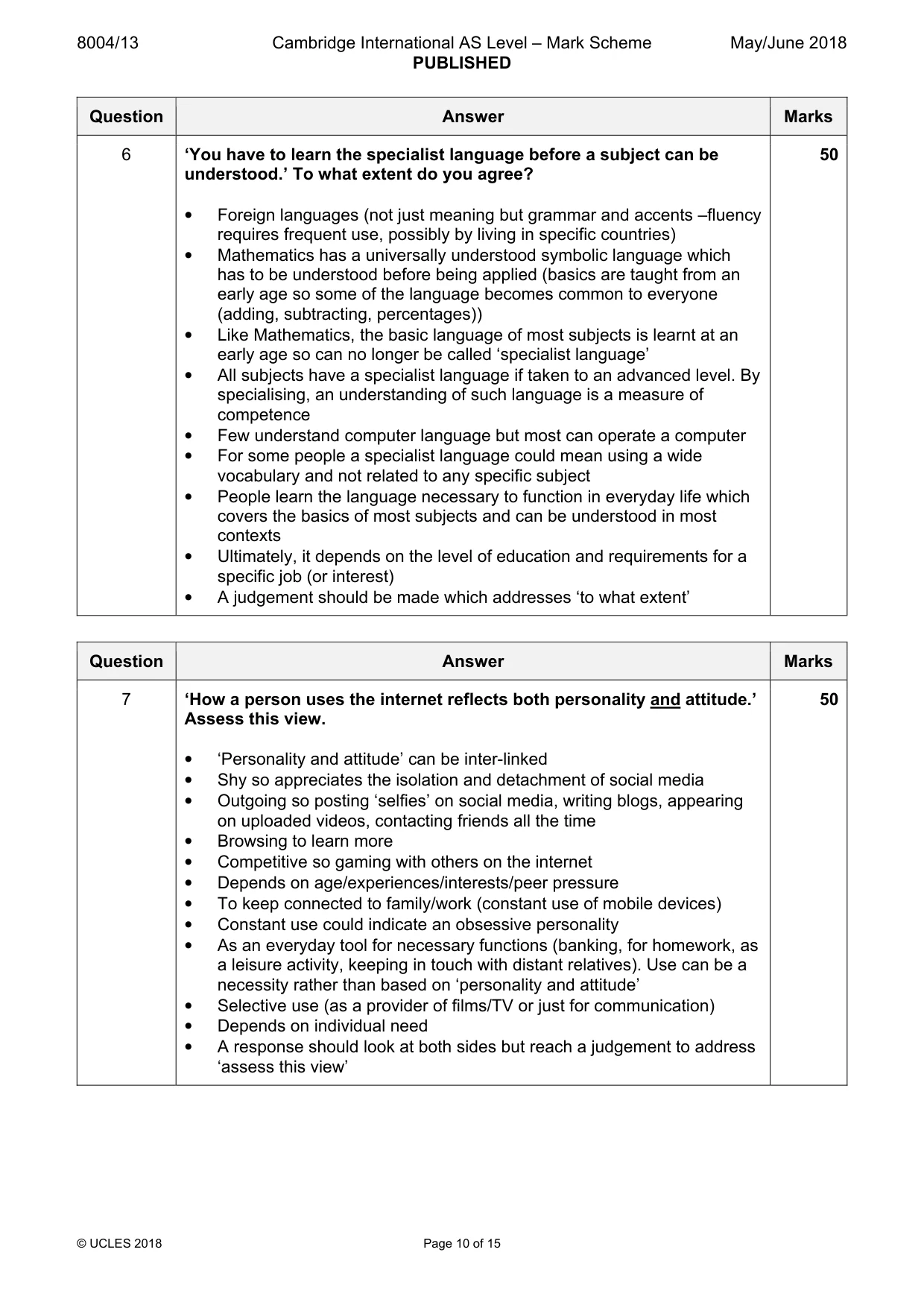
8004/13 Cambridge International AS Level – Mark Scheme PUBLISHED May/June 2018 © UCLES 2018 Page 10 of 15 Question Answer Marks 6 ‘You have to learn the specialist language before a subject can be understood.’ To what extent do you agree? • Foreign languages (not just meaning but grammar and accents –fluency requires frequent use, possibly by living in specific countries) • Mathematics has a universally understood symbolic language which has to be understood before being applied (basics are taught from an early age so some of the language becomes common to everyone (adding, subtracting, percentages)) • Like Mathematics, the basic language of most subjects is learnt at an early age so can no longer be called ‘specialist language’ • All subjects have a specialist language if taken to an advanced level. By specialising, an understanding of such language is a measure of competence • Few understand computer language but most can operate a computer • For some people a specialist language could mean using a wide vocabulary and not related to any specific subject • People learn the language necessary to function in everyday life which covers the basics of most subjects and can be understood in most contexts • Ultimately, it depends on the level of education and requirements for a specific job (or interest) • A judgement should be made which addresses ‘to what extent’ 50 Question Answer Marks 7 ‘How a person uses the internet reflects both personality and attitude.’ Assess this view. • ‘Personality and attitude’ can be inter-linked • Shy so appreciates the isolation and detachment of social media • Outgoing so posting ‘selfies’ on social media, writing blogs, appearing on uploaded videos, contacting friends all the time • Browsing to learn more • Competitive so gaming with others on the internet • Depends on age/experiences/interests/peer pressure • To keep connected to family/work (constant use of mobile devices) • Constant use could indicate an obsessive personality • As an everyday tool for necessary functions (banking, for homework, as a leisure activity, keeping in touch with distant relatives). Use can be a necessity rather than based on ‘personality and attitude’ • Selective use (as a provider of films/TV or just for communication) • Depends on individual need • A response should look at both sides but reach a judgement to address ‘assess this view’ 50
Mark scheme, page 11
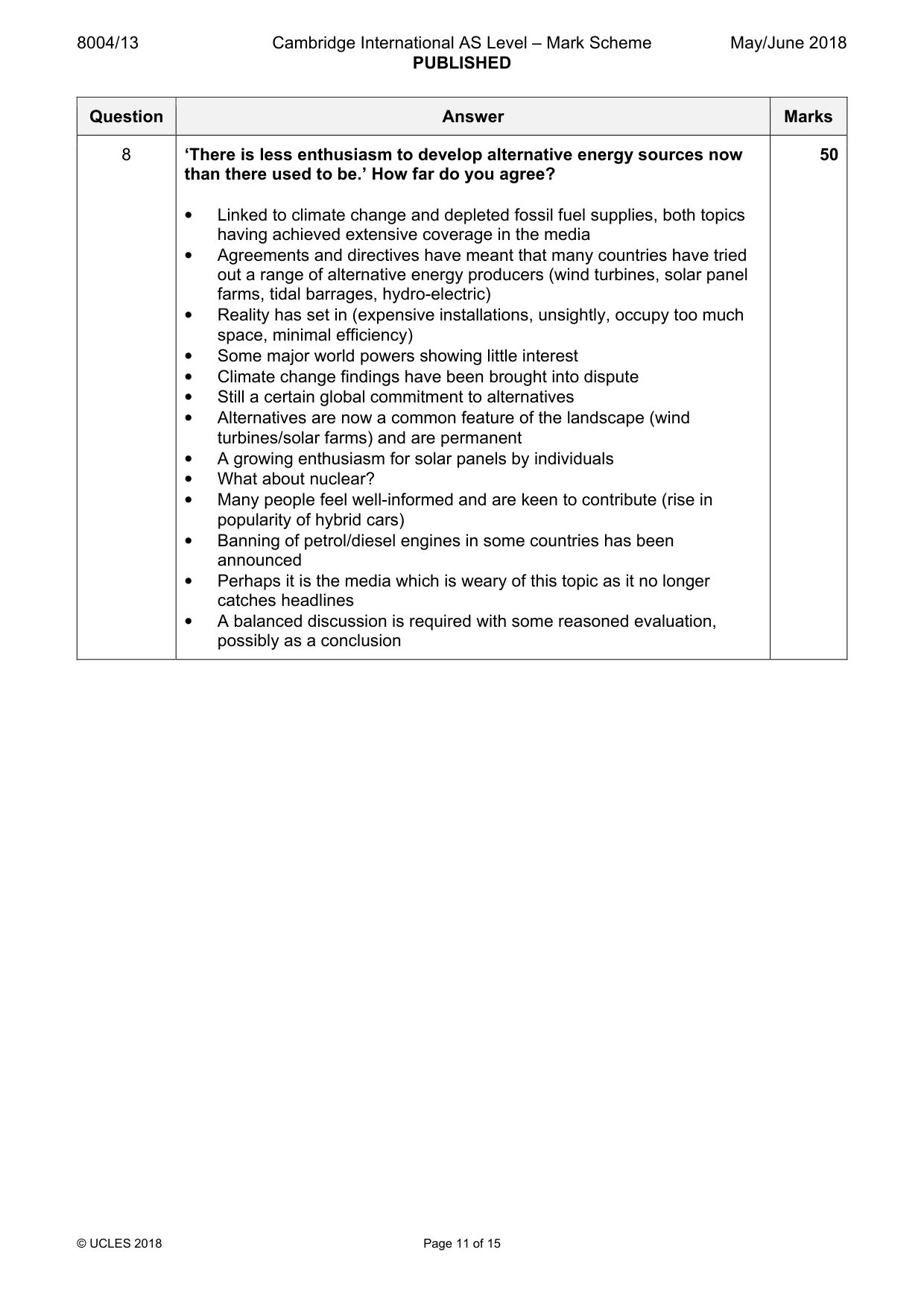
8004/13 Cambridge International AS Level – Mark Scheme PUBLISHED May/June 2018 © UCLES 2018 Page 11 of 15 Question Answer Marks 8 ‘There is less enthusiasm to develop alternative energy sources now than there used to be.’ How far do you agree? • Linked to climate change and depleted fossil fuel supplies, both topics having achieved extensive coverage in the media • Agreements and directives have meant that many countries have tried out a range of alternative energy producers (wind turbines, solar panel farms, tidal barrages, hydro-electric) • Reality has set in (expensive installations, unsightly, occupy too much space, minimal efficiency) • Some major world powers showing little interest • Climate change findings have been brought into dispute • Still a certain global commitment to alternatives • Alternatives are now a common feature of the landscape (wind turbines/solar farms) and are permanent • A growing enthusiasm for solar panels by individuals • What about nuclear? • Many people feel well-informed and are keen to contribute (rise in popularity of hybrid cars) • Banning of petrol/diesel engines in some countries has been announced • Perhaps it is the media which is weary of this topic as it no longer catches headlines • A balanced discussion is required with some reasoned evaluation, possibly as a conclusion 50
Mark scheme, page 12
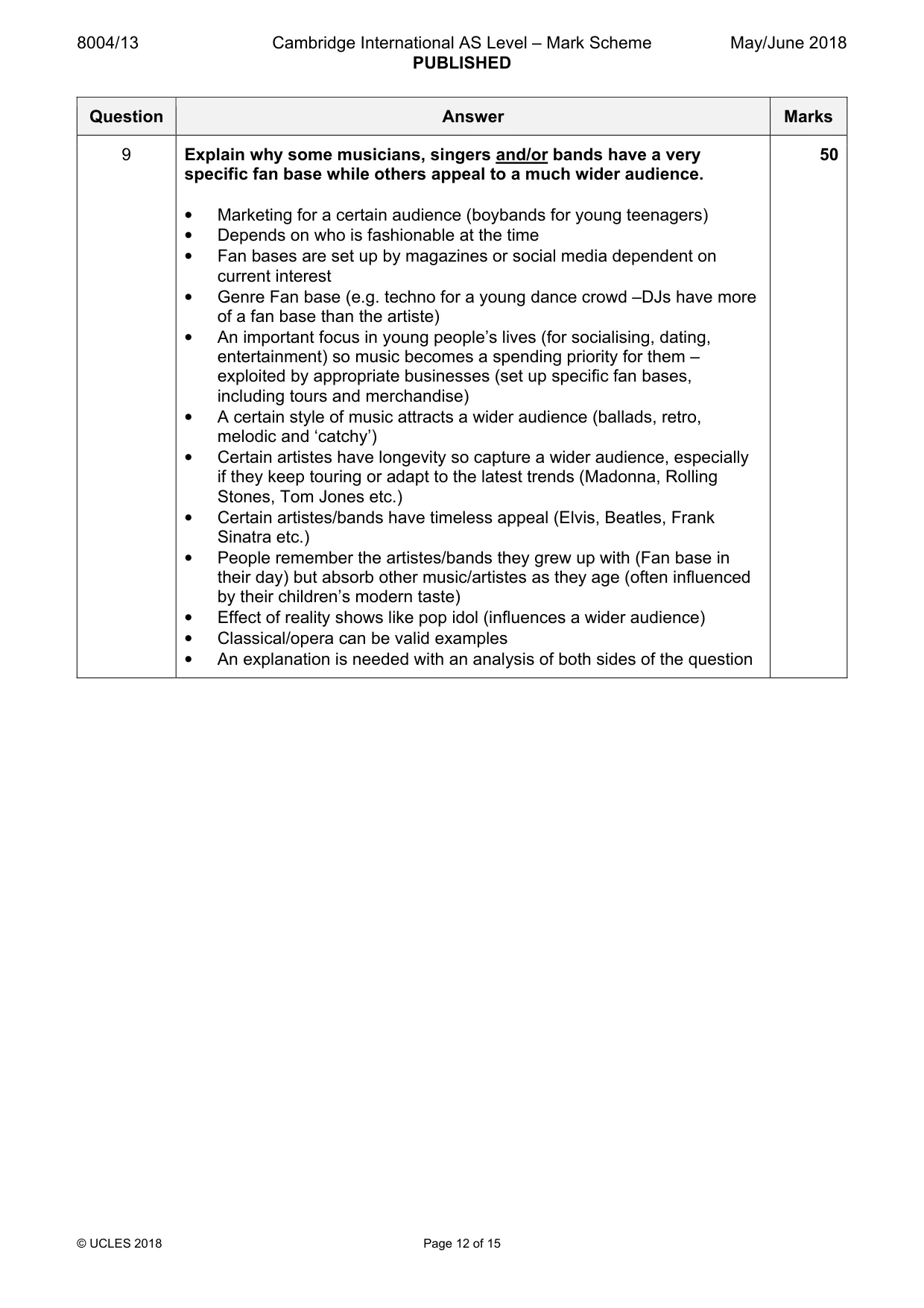
8004/13 Cambridge International AS Level – Mark Scheme PUBLISHED May/June 2018 © UCLES 2018 Page 12 of 15 Question Answer Marks 9 Explain why some musicians, singers and/or bands have a very specific fan base while others appeal to a much wider audience. • Marketing for a certain audience (boybands for young teenagers) • Depends on who is fashionable at the time • Fan bases are set up by magazines or social media dependent on current interest • Genre Fan base (e.g. techno for a young dance crowd –DJs have more of a fan base than the artiste) • An important focus in young people’s lives (for socialising, dating, entertainment) so music becomes a spending priority for them – exploited by appropriate businesses (set up specific fan bases, including tours and merchandise) • A certain style of music attracts a wider audience (ballads, retro, melodic and ‘catchy’) • Certain artistes have longevity so capture a wider audience, especially if they keep touring or adapt to the latest trends (Madonna, Rolling Stones, Tom Jones etc.) • Certain artistes/bands have timeless appeal (Elvis, Beatles, Frank Sinatra etc.) • People remember the artistes/bands they grew up with (Fan base in their day) but absorb other music/artistes as they age (often influenced by their children’s modern taste) • Effect of reality shows like pop idol (influences a wider audience) • Classical/opera can be valid examples • An explanation is needed with an analysis of both sides of the question 50
Mark scheme, page 13
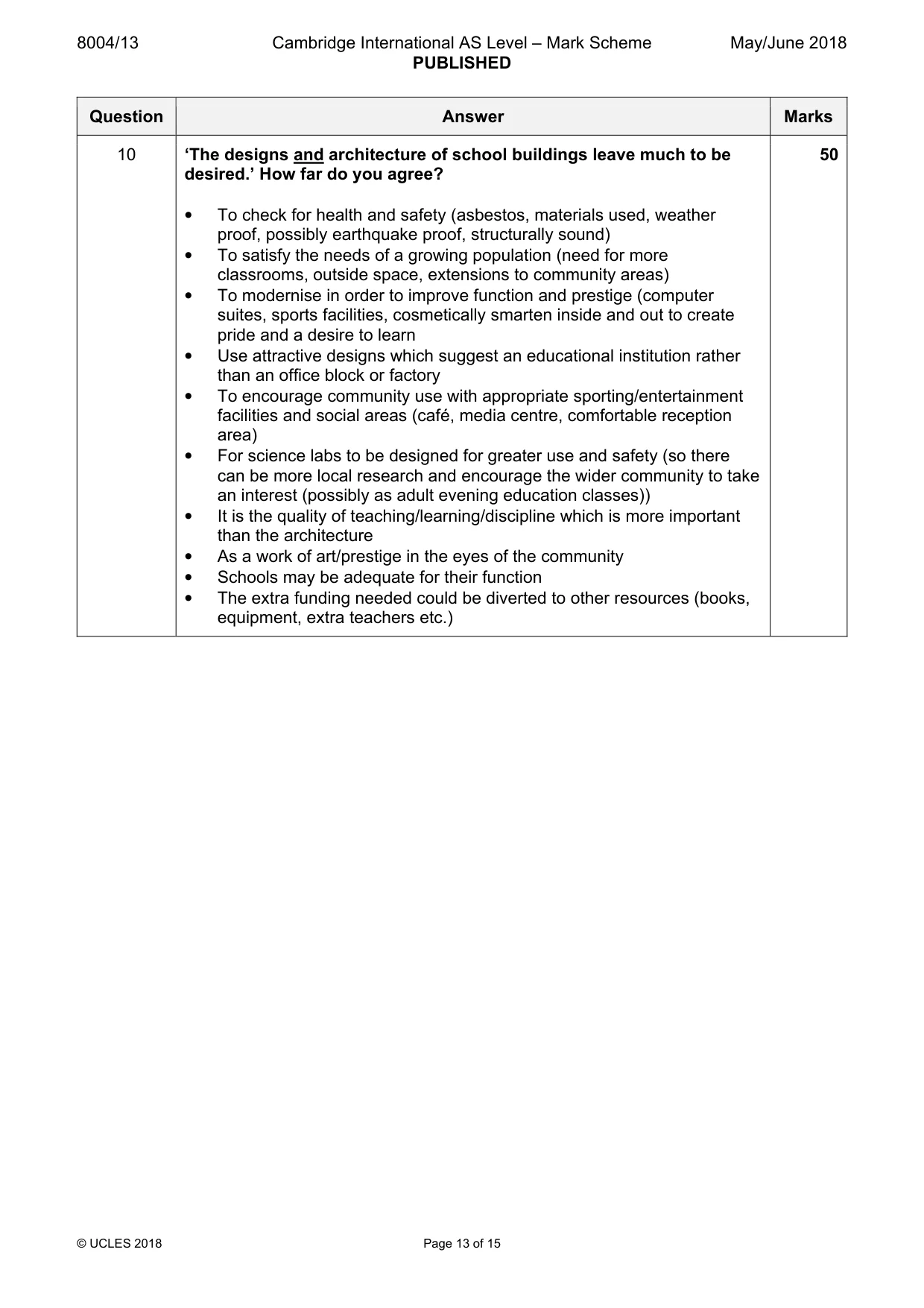
8004/13 Cambridge International AS Level – Mark Scheme PUBLISHED May/June 2018 © UCLES 2018 Page 13 of 15 Question Answer Marks 10 ‘The designs and architecture of school buildings leave much to be desired.’ How far do you agree? • To check for health and safety (asbestos, materials used, weather proof, possibly earthquake proof, structurally sound) • To satisfy the needs of a growing population (need for more classrooms, outside space, extensions to community areas) • To modernise in order to improve function and prestige (computer suites, sports facilities, cosmetically smarten inside and out to create pride and a desire to learn • Use attractive designs which suggest an educational institution rather than an office block or factory • To encourage community use with appropriate sporting/entertainment facilities and social areas (café, media centre, comfortable reception area) • For science labs to be designed for greater use and safety (so there can be more local research and encourage the wider community to take an interest (possibly as adult evening education classes)) • It is the quality of teaching/learning/discipline which is more important than the architecture • As a work of art/prestige in the eyes of the community • Schools may be adequate for their function • The extra funding needed could be diverted to other resources (books, equipment, extra teachers etc.) 50
Mark scheme, page 14
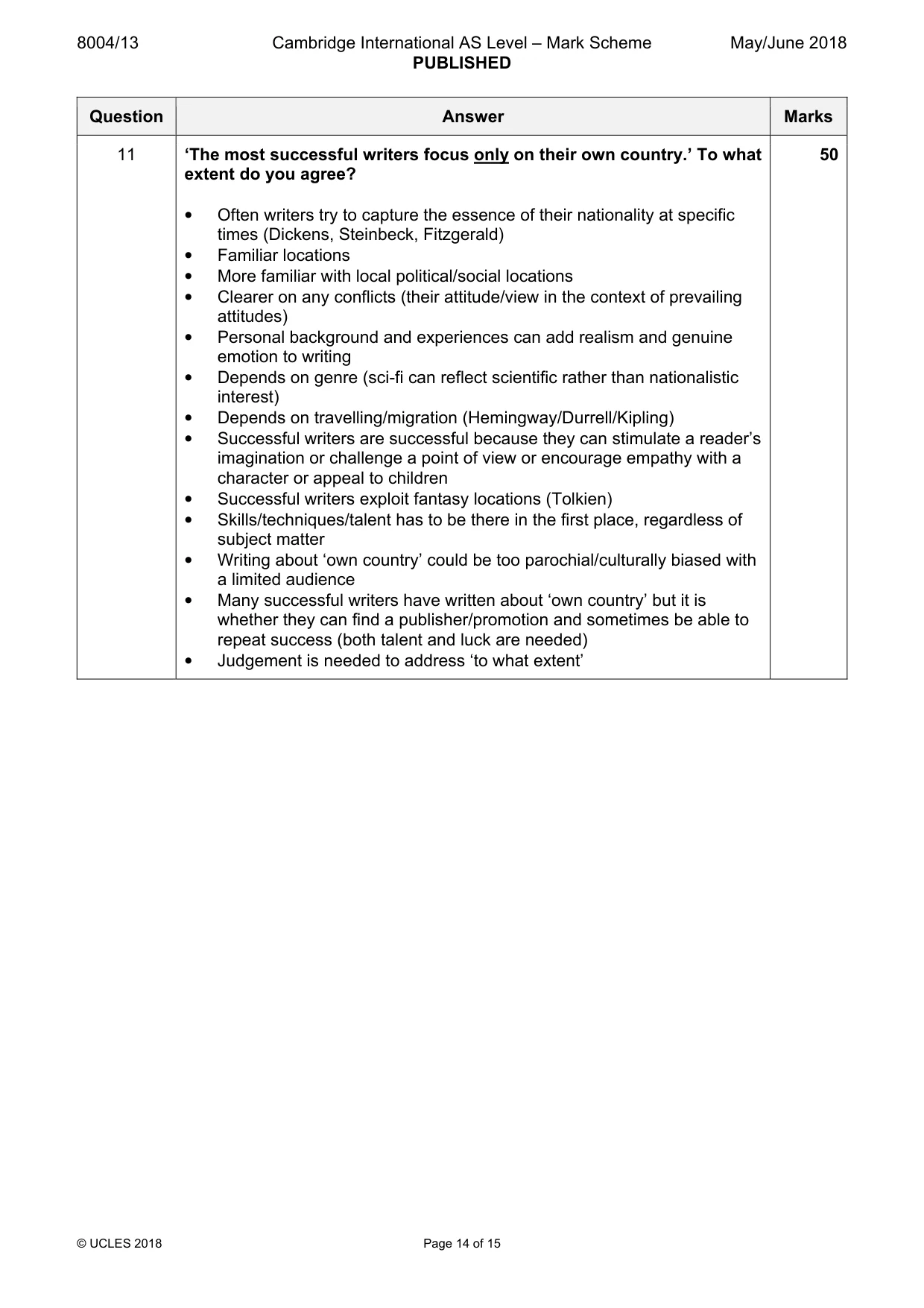
8004/13 Cambridge International AS Level – Mark Scheme PUBLISHED May/June 2018 © UCLES 2018 Page 14 of 15 Question Answer Marks 11 ‘The most successful writers focus only on their own country.’ To what extent do you agree? • Often writers try to capture the essence of their nationality at specific times (Dickens, Steinbeck, Fitzgerald) • Familiar locations • More familiar with local political/social locations • Clearer on any conflicts (their attitude/view in the context of prevailing attitudes) • Personal background and experiences can add realism and genuine emotion to writing • Depends on genre (sci-fi can reflect scientific rather than nationalistic interest) • Depends on travelling/migration (Hemingway/Durrell/Kipling) • Successful writers are successful because they can stimulate a reader’s imagination or challenge a point of view or encourage empathy with a character or appeal to children • Successful writers exploit fantasy locations (Tolkien) • Skills/techniques/talent has to be there in the first place, regardless of subject matter • Writing about ‘own country’ could be too parochial/culturally biased with a limited audience • Many successful writers have written about ‘own country’ but it is whether they can find a publisher/promotion and sometimes be able to repeat success (both talent and luck are needed) • Judgement is needed to address ‘to what extent’ 50
Mark scheme, page 15
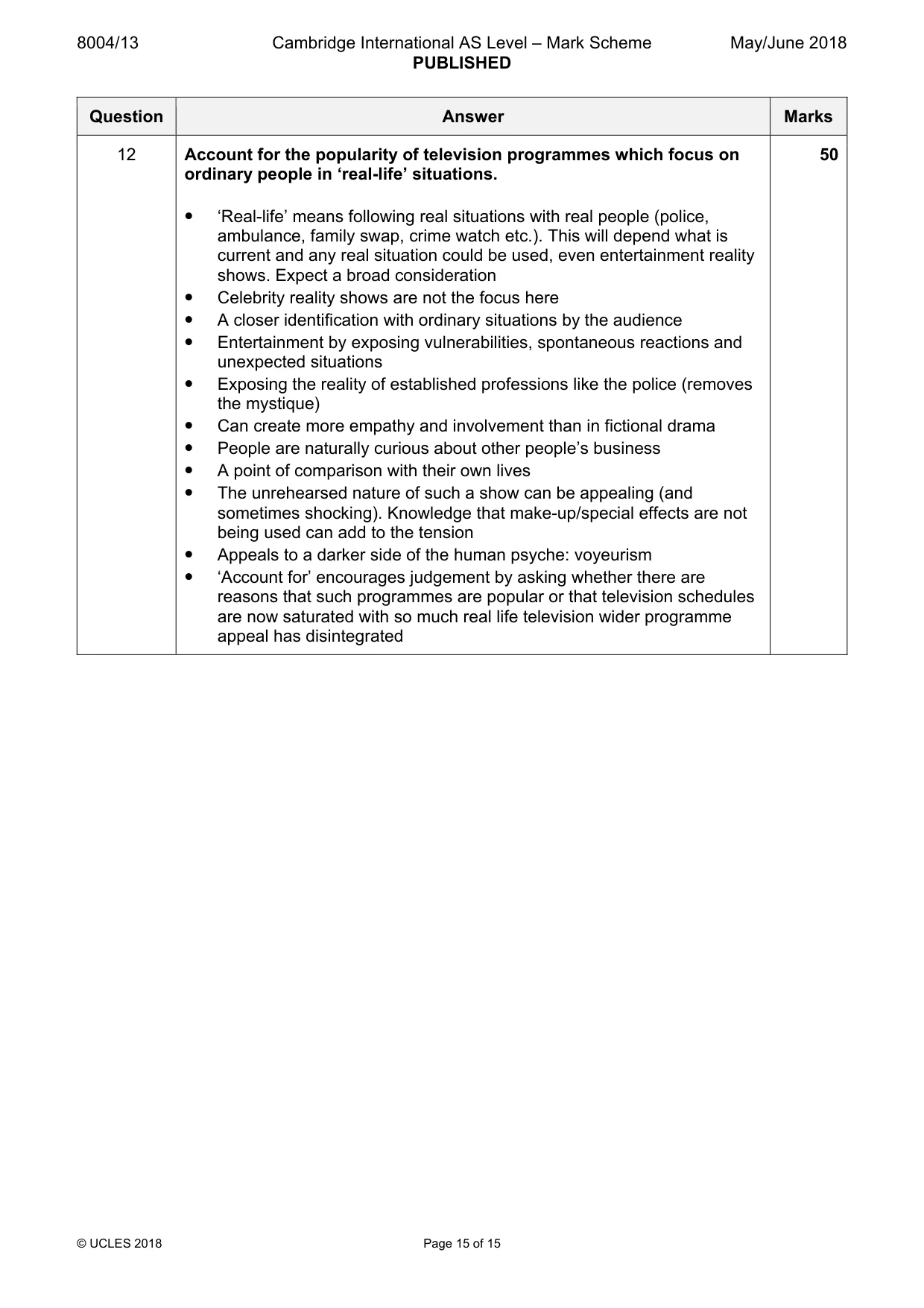
8004/13 Cambridge International AS Level – Mark Scheme PUBLISHED May/June 2018 © UCLES 2018 Page 15 of 15 Question Answer Marks 12 Account for the popularity of television programmes which focus on ordinary people in ‘real-life’ situations. • ‘Real-life’ means following real situations with real people (police, ambulance, family swap, crime watch etc.). This will depend what is current and any real situation could be used, even entertainment reality shows. Expect a broad consideration • Celebrity reality shows are not the focus here • A closer identification with ordinary situations by the audience • Entertainment by exposing vulnerabilities, spontaneous reactions and unexpected situations • Exposing the reality of established professions like the police (removes the mystique) • Can create more empathy and involvement than in fictional drama • People are naturally curious about other people’s business • A point of comparison with their own lives • The unrehearsed nature of such a show can be appealing (and sometimes shocking). Knowledge that make-up/special effects are not being used can add to the tension • Appeals to a darker side of the human psyche: voyeurism • ‘Account for’ encourages judgement by asking whether there are reasons that such programmes are popular or that television schedules are now saturated with so much real life television wider programme appeal has disintegrated 50
What you needed in this session
Cambridge’s own grade thresholds for 2018 May/June, Paper 1 · Variant 3. A higher threshold means an easier paper — the bar moves with how the cohort did.