Cambridge A Level General Paper (AS Level only) 8004 — 2018 May/June Paper 1 · Variant 1
8004/11/M/J/18 · 100 marks · ≈113 min
The question paper and its mark scheme, free to read here and free to download. This is Cambridge’s own paper, exactly as it was sat.
Question paper4 pages

Mark scheme11 pages
Answers below. Sit the paper first if you are practising.
Paper as text
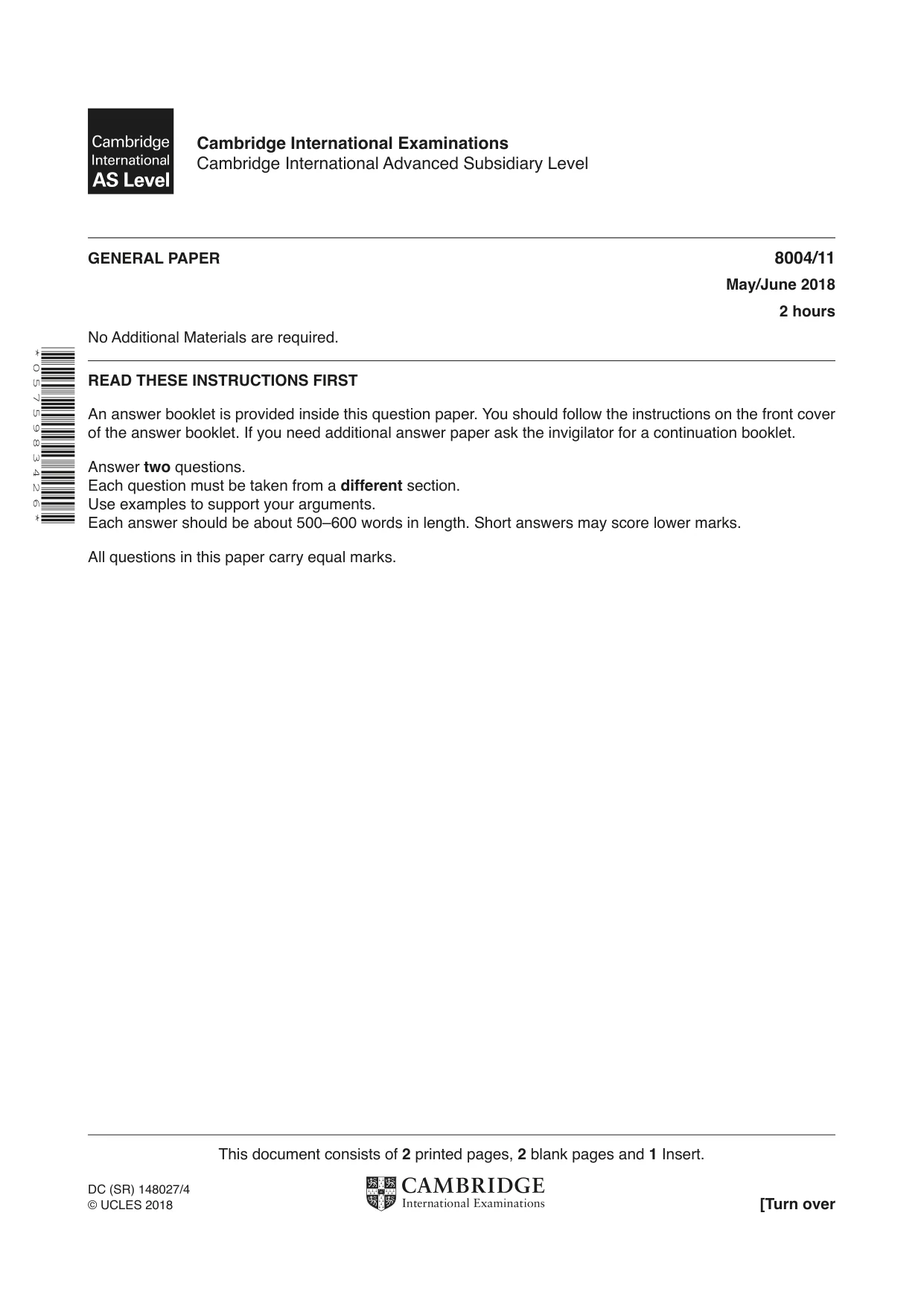
Question paper, page 1
* 0 5 7 5 9 8 3 4 2 6 * This document consists of 2 printed pages, 2 blank pages and 1 Insert. DC (SR) 148027/4 © UCLES 2018 [Turn over Cambridge International Examinations Cambridge International Advanced Subsidiary Level GENERAL PAPER 8004/11 May/June 2018 2 hours No Additional Materials are required. READ THESE INSTRUCTIONS FIRST An answer booklet is provided inside this question paper. You should follow the instructions on the front cover of the answer booklet. If you need additional answer paper ask the invigilator for a continuation booklet. Answer two questions. Each question must be taken from a different section. Use examples to support your arguments. Each answer should be about 500–600 words in length. Short answers may score lower marks. All questions in this paper carry equal marks.
Question paper, page 2
2 8004/11/M/J/18 © UCLES 2018 BLANK PAGE
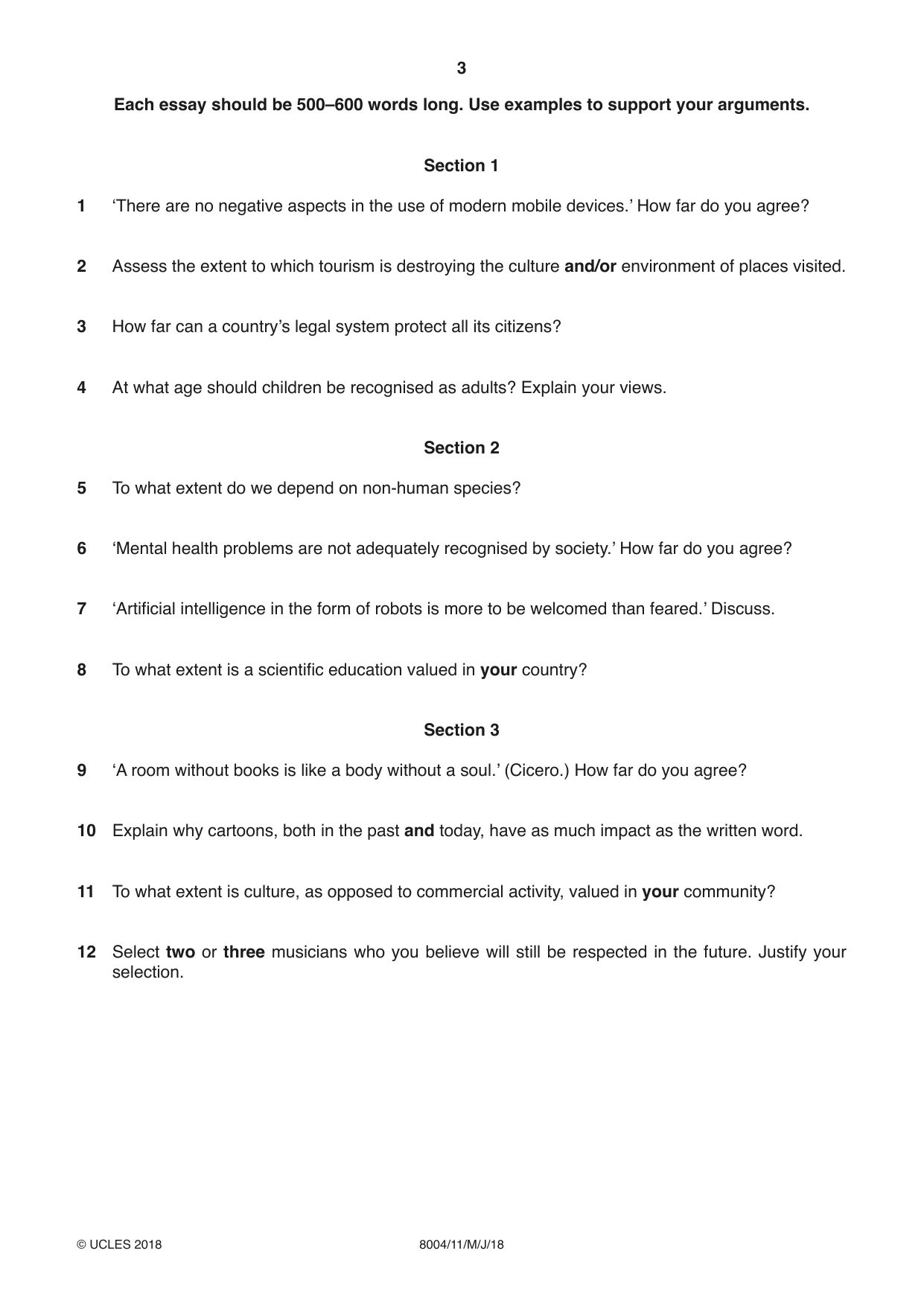
Question paper, page 3
3 8004/11/M/J/18 © UCLES 2018 Each essay should be 500–600 words long. Use examples to support your arguments. Section 1 1 ‘There are no negative aspects in the use of modern mobile devices.’ How far do you agree? 2 Assess the extent to which tourism is destroying the culture and/or environment of places visited. 3 How far can a country’s legal system protect all its citizens? 4 At what age should children be recognised as adults? Explain your views. Section 2 5 To what extent do we depend on non-human species? 6 ‘Mental health problems are not adequately recognised by society.’ How far do you agree? 7 ‘Artificial intelligence in the form of robots is more to be welcomed than feared.’ Discuss. 8 To what extent is a scientific education valued in your country? Section 3 9 ‘A room without books is like a body without a soul.’ (Cicero.) How far do you agree? 10 Explain why cartoons, both in the past and today, have as much impact as the written word. 11 To what extent is culture, as opposed to commercial activity, valued in your community? 12 Select two or three musicians who you believe will still be respected in the future. Justify your selection.
Question paper, page 4
4 8004/11/M/J/18 © UCLES 2018 BLANK PAGE Permission to reproduce items where third-party owned material protected by copyright is included has been sought and cleared where possible. Every reasonable effort has been made by the publisher (UCLES) to trace copyright holders, but if any items requiring clearance have unwittingly been included, the publisher will be pleased to make amends at the earliest possible opportunity. To avoid the issue of disclosure of answer-related information to candidates, all copyright acknowledgements are reproduced online in the Cambridge International Examinations Copyright Acknowledgements Booklet. This is produced for each series of examinations and is freely available to download at www.cie.org.uk after the live examination series. Cambridge International Examinations is part of the Cambridge Assessment Group. Cambridge Assessment is the brand name of University of Cambridge Local Examinations Syndicate (UCLES), which is itself a department of the University of Cambridge.
Mark scheme, page 1
IGCSE™ is a registered trademark. This document consists of 11 printed pages. © UCLES 2018 [Turn over Cambridge Assessment International Education Cambridge International Advanced Subsidiary Level GENERAL PAPER 8004/11 Paper 1 May/June 2018 MARK SCHEME Maximum Mark: 100 Published This mark scheme is published as an aid to teachers and candidates, to indicate the requirements of the examination. It shows the basis on which Examiners were instructed to award marks. It does not indicate the details of the discussions that took place at an Examiners’ meeting before marking began, which would have considered the acceptability of alternative answers. Mark schemes should be read in conjunction with the question paper and the Principal Examiner Report for Teachers. Cambridge International will not enter into discussions about these mark schemes. Cambridge International is publishing the mark schemes for the May/June 2018 series for most Cambridge IGCSE™, Cambridge International A and AS Level and Cambridge Pre-U components, and some Cambridge O Level components.
Mark scheme, page 2
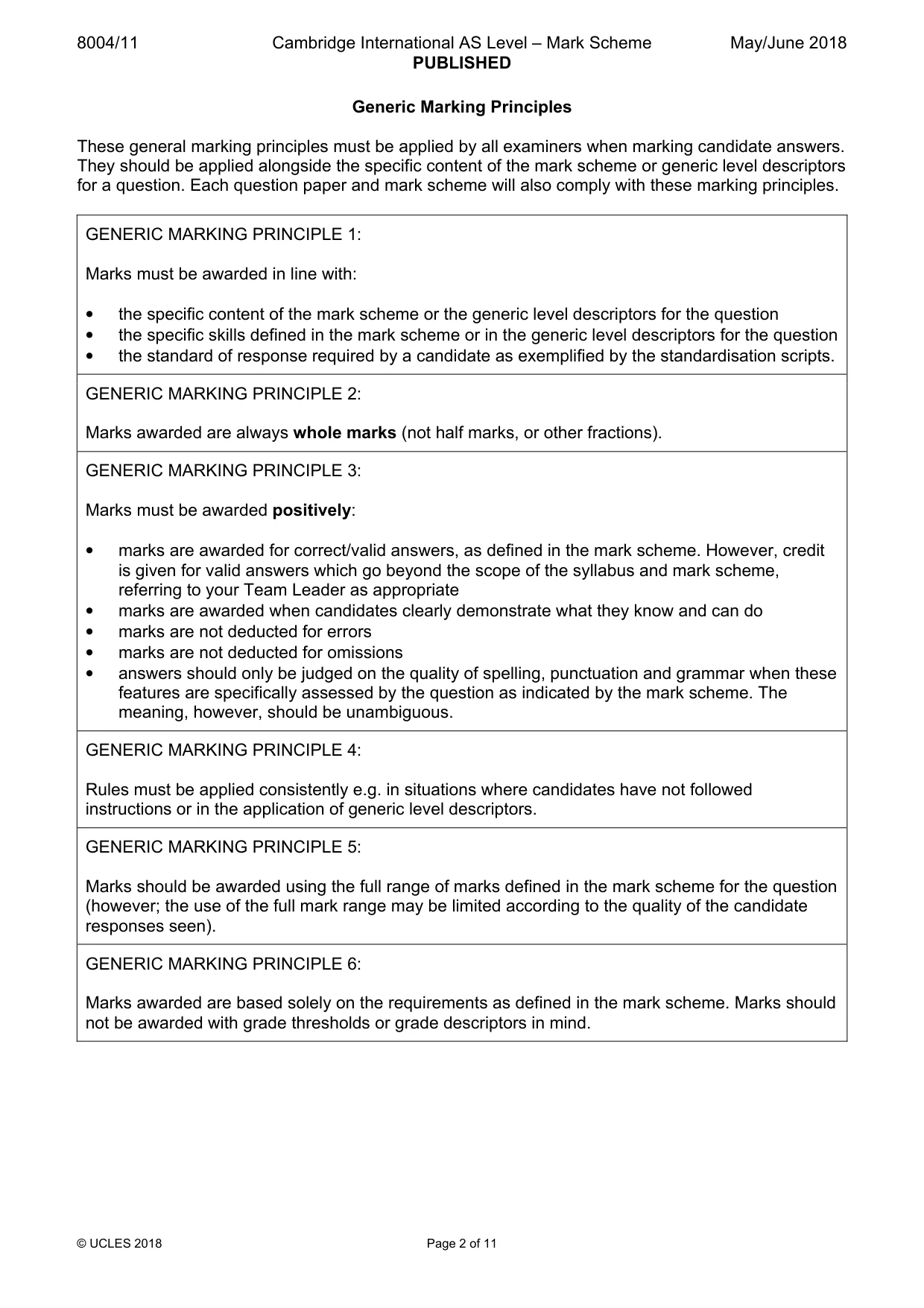
8004/11 Cambridge International AS Level – Mark Scheme PUBLISHED May/June 2018 © UCLES 2018 Page 2 of 11 Generic Marking Principles These general marking principles must be applied by all examiners when marking candidate answers. They should be applied alongside the specific content of the mark scheme or generic level descriptors for a question. Each question paper and mark scheme will also comply with these marking principles. GENERIC MARKING PRINCIPLE 1: Marks must be awarded in line with: • the specific content of the mark scheme or the generic level descriptors for the question • the specific skills defined in the mark scheme or in the generic level descriptors for the question • the standard of response required by a candidate as exemplified by the standardisation scripts. GENERIC MARKING PRINCIPLE 2: Marks awarded are always whole marks (not half marks, or other fractions). GENERIC MARKING PRINCIPLE 3: Marks must be awarded positively: • marks are awarded for correct/valid answers, as defined in the mark scheme. However, credit is given for valid answers which go beyond the scope of the syllabus and mark scheme, referring to your Team Leader as appropriate • marks are awarded when candidates clearly demonstrate what they know and can do • marks are not deducted for errors • marks are not deducted for omissions • answers should only be judged on the quality of spelling, punctuation and grammar when these features are specifically assessed by the question as indicated by the mark scheme. The meaning, however, should be unambiguous. GENERIC MARKING PRINCIPLE 4: Rules must be applied consistently e.g. in situations where candidates have not followed instructions or in the application of generic level descriptors. GENERIC MARKING PRINCIPLE 5: Marks should be awarded using the full range of marks defined in the mark scheme for the question (however; the use of the full mark range may be limited according to the quality of the candidate responses seen). GENERIC MARKING PRINCIPLE 6: Marks awarded are based solely on the requirements as defined in the mark scheme. Marks should not be awarded with grade thresholds or grade descriptors in mind.
Mark scheme, page 3
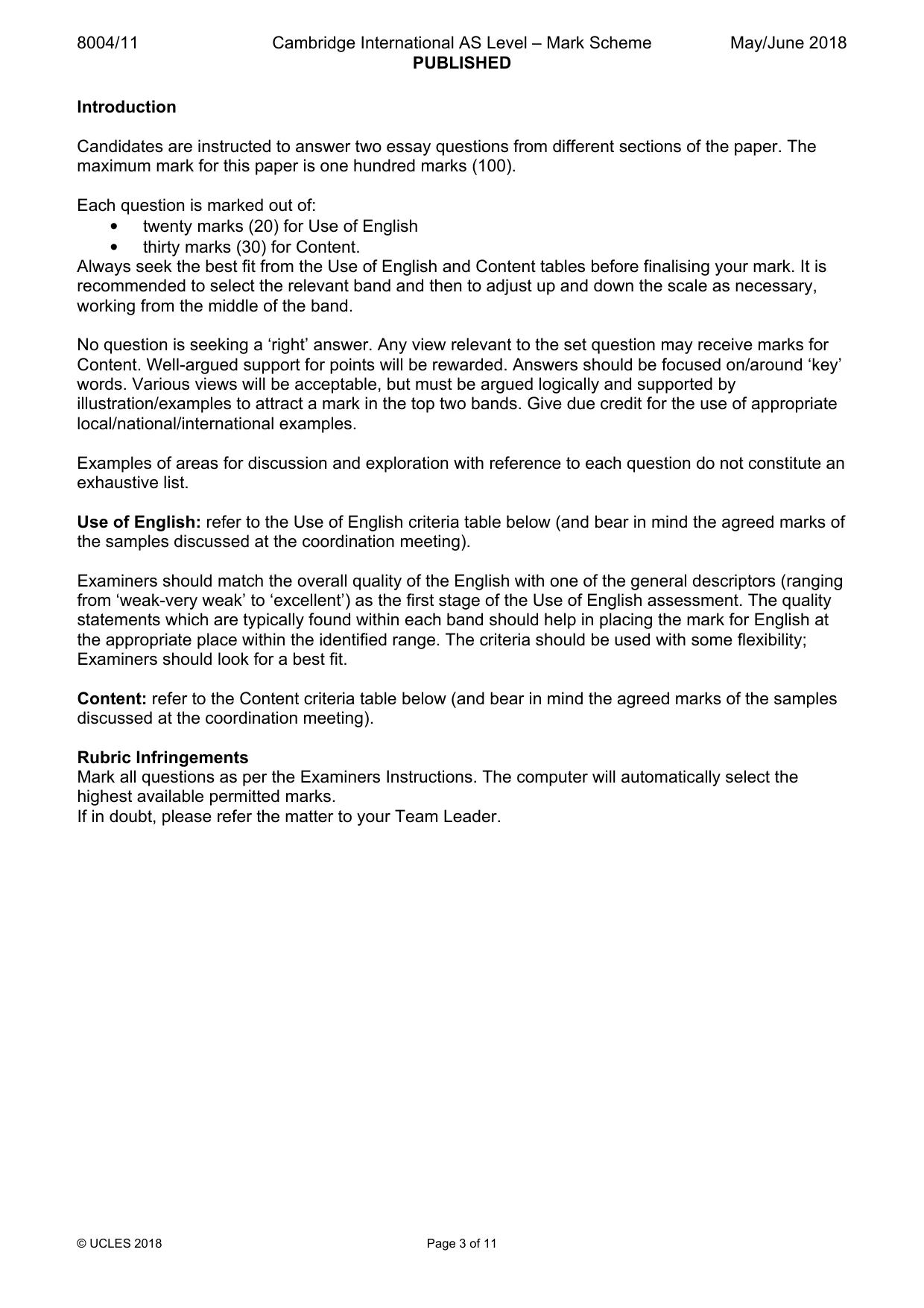
8004/11 Cambridge International AS Level – Mark Scheme PUBLISHED May/June 2018 © UCLES 2018 Page 3 of 11 Introduction Candidates are instructed to answer two essay questions from different sections of the paper. The maximum mark for this paper is one hundred marks (100). Each question is marked out of: • twenty marks (20) for Use of English • thirty marks (30) for Content. Always seek the best fit from the Use of English and Content tables before finalising your mark. It is recommended to select the relevant band and then to adjust up and down the scale as necessary, working from the middle of the band. No question is seeking a ‘right’ answer. Any view relevant to the set question may receive marks for Content. Well-argued support for points will be rewarded. Answers should be focused on/around ‘key’ words. Various views will be acceptable, but must be argued logically and supported by illustration/examples to attract a mark in the top two bands. Give due credit for the use of appropriate local/national/international examples. Examples of areas for discussion and exploration with reference to each question do not constitute an exhaustive list. Use of English: refer to the Use of English criteria table below (and bear in mind the agreed marks of the samples discussed at the coordination meeting). Examiners should match the overall quality of the English with one of the general descriptors (ranging from ‘weak-very weak’ to ‘excellent’) as the first stage of the Use of English assessment. The quality statements which are typically found within each band should help in placing the mark for English at the appropriate place within the identified range. The criteria should be used with some flexibility; Examiners should look for a best fit. Content: refer to the Content criteria table below (and bear in mind the agreed marks of the samples discussed at the coordination meeting). Rubric Infringements Mark all questions as per the Examiners Instructions. The computer will automatically select the highest available permitted marks. If in doubt, please refer the matter to your Team Leader.
Mark scheme, page 4
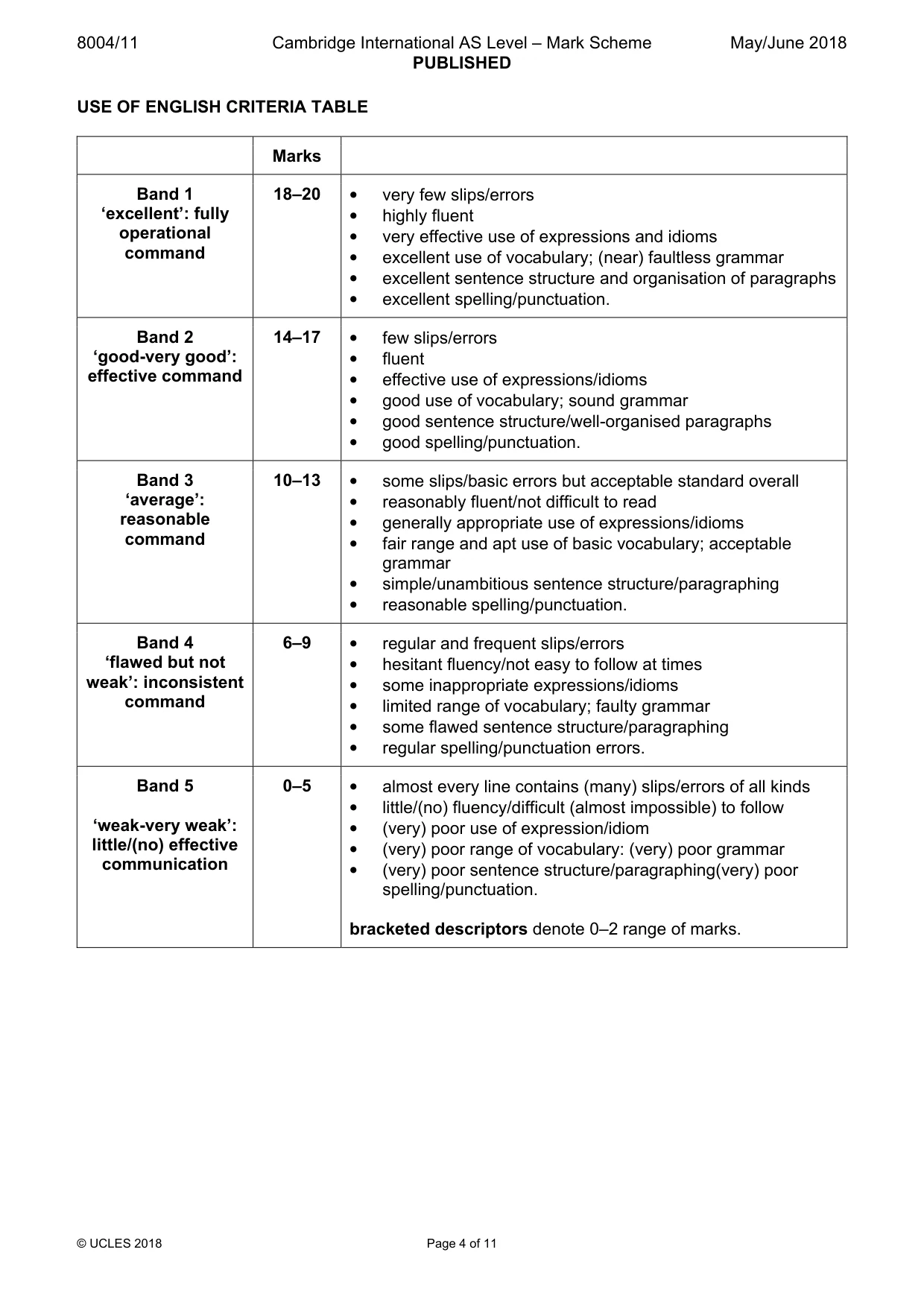
8004/11 Cambridge International AS Level – Mark Scheme PUBLISHED May/June 2018 © UCLES 2018 Page 4 of 11 USE OF ENGLISH CRITERIA TABLE Marks Band 1 ‘excellent’: fully operational command 18–20 • very few slips/errors • highly fluent • very effective use of expressions and idioms • excellent use of vocabulary; (near) faultless grammar • excellent sentence structure and organisation of paragraphs • excellent spelling/punctuation. Band 2 ‘good-very good’: effective command 14–17 • few slips/errors • fluent • effective use of expressions/idioms • good use of vocabulary; sound grammar • good sentence structure/well-organised paragraphs • good spelling/punctuation. Band 3 ‘average’: reasonable command 10–13 • some slips/basic errors but acceptable standard overall • reasonably fluent/not difficult to read • generally appropriate use of expressions/idioms • fair range and apt use of basic vocabulary; acceptable grammar • simple/unambitious sentence structure/paragraphing • reasonable spelling/punctuation. Band 4 ‘flawed but not weak’: inconsistent command 6–9 • regular and frequent slips/errors • hesitant fluency/not easy to follow at times • some inappropriate expressions/idioms • limited range of vocabulary; faulty grammar • some flawed sentence structure/paragraphing • regular spelling/punctuation errors. Band 5 ‘weak-very weak’: little/(no) effective communication 0–5 • almost every line contains (many) slips/errors of all kinds • little/(no) fluency/difficult (almost impossible) to follow • (very) poor use of expression/idiom • (very) poor range of vocabulary: (very) poor grammar • (very) poor sentence structure/paragraphing(very) poor spelling/punctuation. bracketed descriptors denote 0–2 range of marks.
Mark scheme, page 5
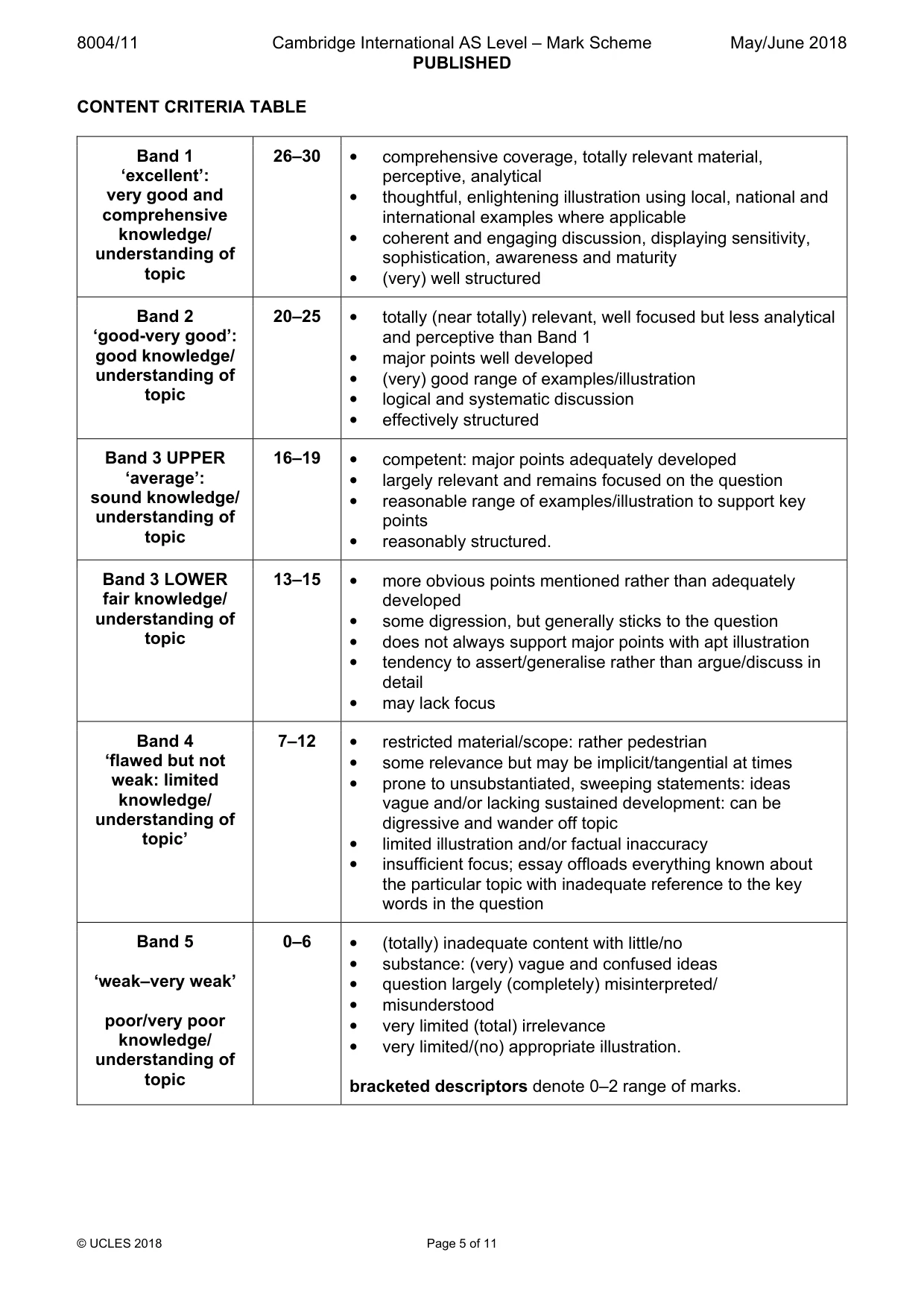
8004/11 Cambridge International AS Level – Mark Scheme PUBLISHED May/June 2018 © UCLES 2018 Page 5 of 11 CONTENT CRITERIA TABLE Band 1 ‘excellent’: very good and comprehensive knowledge/ understanding of topic 26–30 • comprehensive coverage, totally relevant material, perceptive, analytical • thoughtful, enlightening illustration using local, national and international examples where applicable • coherent and engaging discussion, displaying sensitivity, sophistication, awareness and maturity • (very) well structured Band 2 ‘good-very good’: good knowledge/ understanding of topic 20–25 • totally (near totally) relevant, well focused but less analytical and perceptive than Band 1 • major points well developed • (very) good range of examples/illustration • logical and systematic discussion • effectively structured Band 3 UPPER ‘average’: sound knowledge/ understanding of topic 16–19 • competent: major points adequately developed • largely relevant and remains focused on the question • reasonable range of examples/illustration to support key points • reasonably structured. Band 3 LOWER fair knowledge/ understanding of topic 13–15 • more obvious points mentioned rather than adequately developed • some digression, but generally sticks to the question • does not always support major points with apt illustration • tendency to assert/generalise rather than argue/discuss in detail • may lack focus Band 4 ‘flawed but not weak: limited knowledge/ understanding of topic’ 7–12 • restricted material/scope: rather pedestrian • some relevance but may be implicit/tangential at times • prone to unsubstantiated, sweeping statements: ideas vague and/or lacking sustained development: can be digressive and wander off topic • limited illustration and/or factual inaccuracy • insufficient focus; essay offloads everything known about the particular topic with inadequate reference to the key words in the question Band 5 ‘weak–very weak’ poor/very poor knowledge/ understanding of topic 0–6 • (totally) inadequate content with little/no • substance: (very) vague and confused ideas • question largely (completely) misinterpreted/ • misunderstood • very limited (total) irrelevance • very limited/(no) appropriate illustration. bracketed descriptors denote 0–2 range of marks.
Mark scheme, page 6
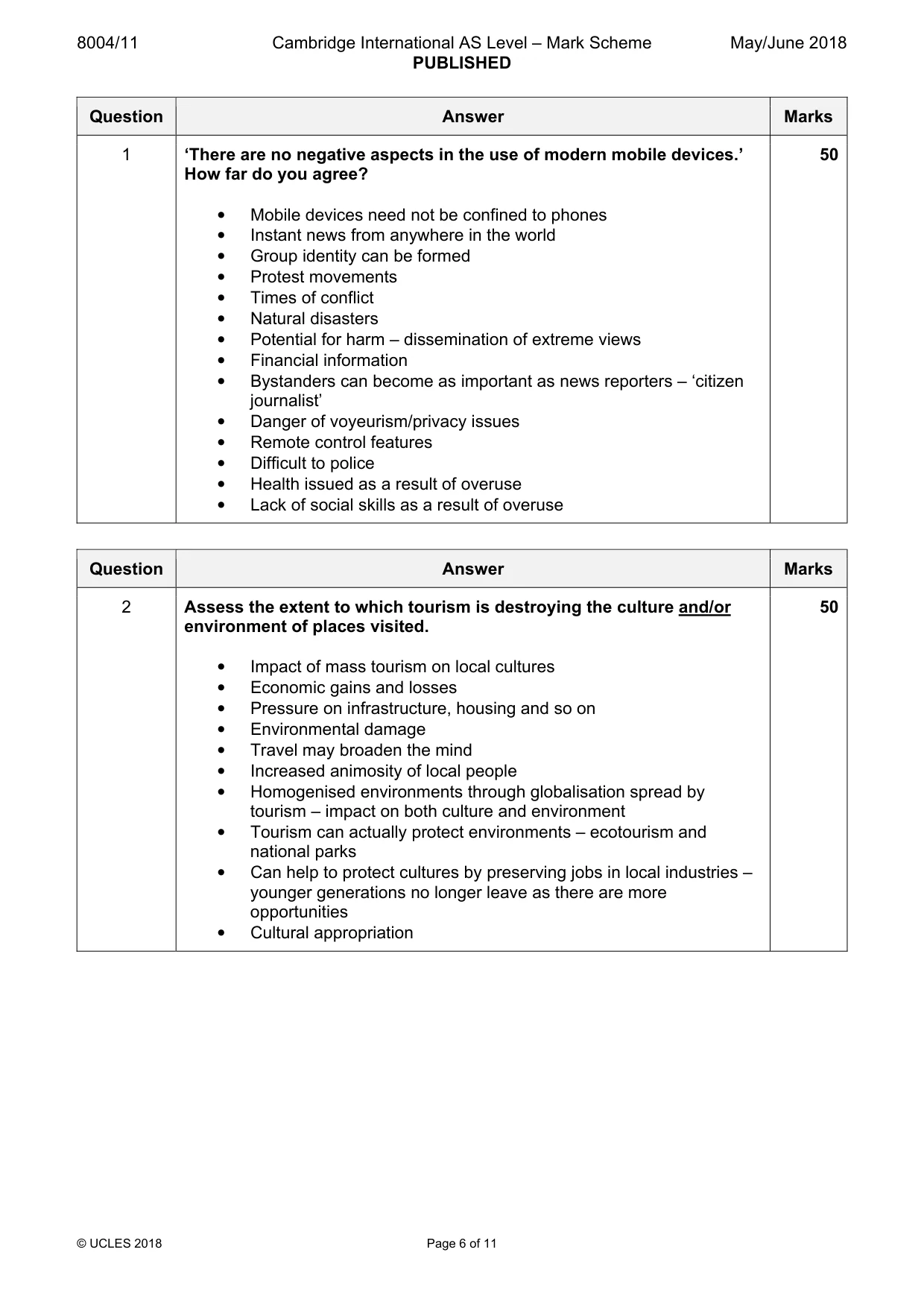
8004/11 Cambridge International AS Level – Mark Scheme PUBLISHED May/June 2018 © UCLES 2018 Page 6 of 11 Question Answer Marks 1 ‘There are no negative aspects in the use of modern mobile devices.’ How far do you agree? • Mobile devices need not be confined to phones • Instant news from anywhere in the world • Group identity can be formed • Protest movements • Times of conflict • Natural disasters • Potential for harm – dissemination of extreme views • Financial information • Bystanders can become as important as news reporters – ‘citizen journalist’ • Danger of voyeurism/privacy issues • Remote control features • Difficult to police • Health issued as a result of overuse • Lack of social skills as a result of overuse 50 Question Answer Marks 2 Assess the extent to which tourism is destroying the culture and/or environment of places visited. • Impact of mass tourism on local cultures • Economic gains and losses • Pressure on infrastructure, housing and so on • Environmental damage • Travel may broaden the mind • Increased animosity of local people • Homogenised environments through globalisation spread by tourism – impact on both culture and environment • Tourism can actually protect environments – ecotourism and national parks • Can help to protect cultures by preserving jobs in local industries – younger generations no longer leave as there are more opportunities • Cultural appropriation 50
Mark scheme, page 7
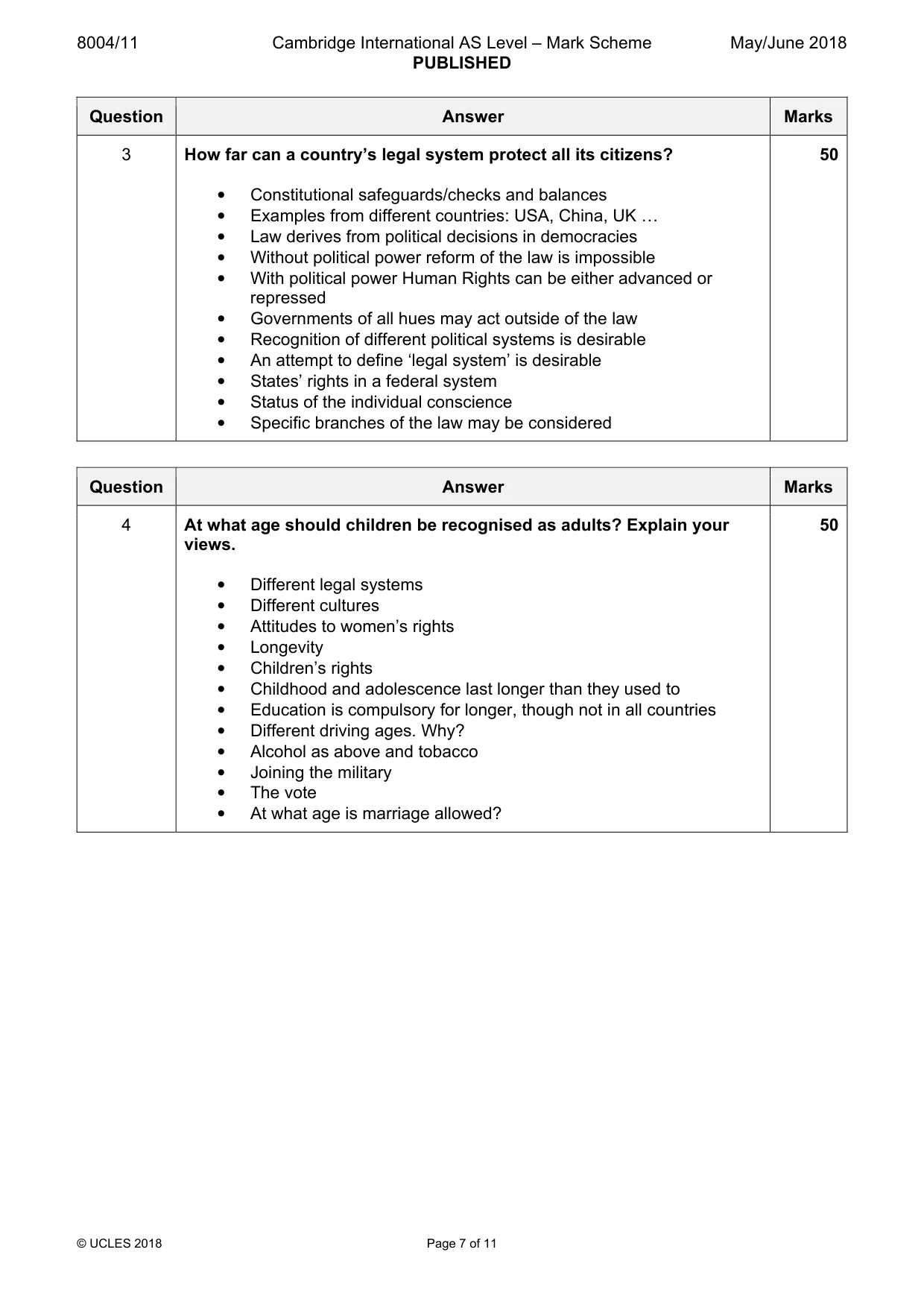
8004/11 Cambridge International AS Level – Mark Scheme PUBLISHED May/June 2018 © UCLES 2018 Page 7 of 11 Question Answer Marks 3 How far can a country’s legal system protect all its citizens? • Constitutional safeguards/checks and balances • Examples from different countries: USA, China, UK « • Law derives from political decisions in democracies • Without political power reform of the law is impossible • With political power Human Rights can be either advanced or repressed • Governments of all hues may act outside of the law • Recognition of different political systems is desirable • An attempt to define ‘legal system’ is desirable • States’ rights in a federal system • Status of the individual conscience • Specific branches of the law may be considered 50 Question Answer Marks 4 At what age should children be recognised as adults? Explain your views. • Different legal systems • Different cultures • Attitudes to women’s rights • Longevity • Children’s rights • Childhood and adolescence last longer than they used to • Education is compulsory for longer, though not in all countries • Different driving ages. Why? • Alcohol as above and tobacco • Joining the military • The vote • At what age is marriage allowed? 50
Mark scheme, page 8
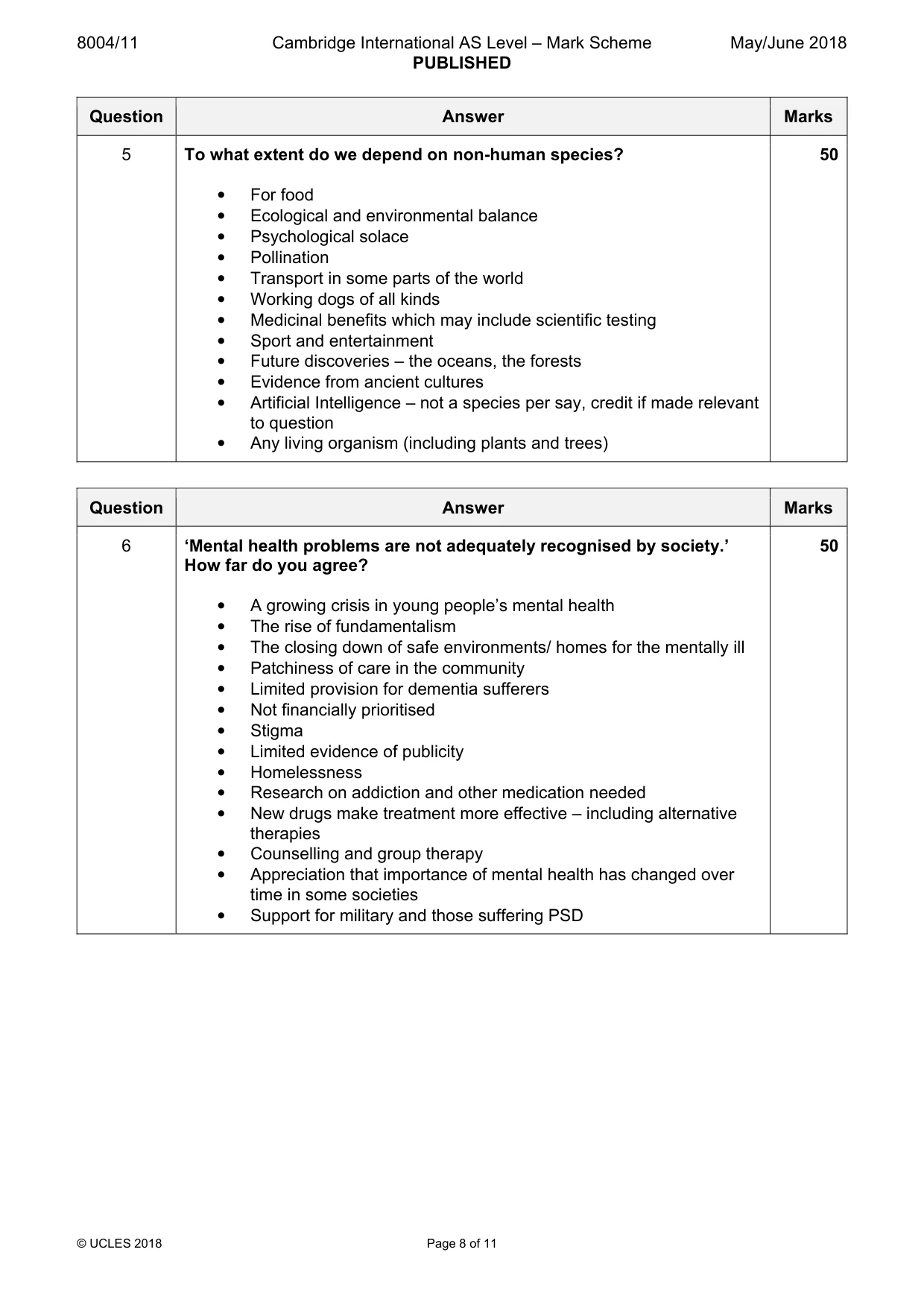
8004/11 Cambridge International AS Level – Mark Scheme PUBLISHED May/June 2018 © UCLES 2018 Page 8 of 11 Question Answer Marks 5 To what extent do we depend on non-human species? • For food • Ecological and environmental balance • Psychological solace • Pollination • Transport in some parts of the world • Working dogs of all kinds • Medicinal benefits which may include scientific testing • Sport and entertainment • Future discoveries – the oceans, the forests • Evidence from ancient cultures • Artificial Intelligence – not a species per say, credit if made relevant to question • Any living organism (including plants and trees) 50 Question Answer Marks 6 ‘Mental health problems are not adequately recognised by society.’ How far do you agree? • A growing crisis in young people’s mental health • The rise of fundamentalism • The closing down of safe environments/ homes for the mentally ill • Patchiness of care in the community • Limited provision for dementia sufferers • Not financially prioritised • Stigma • Limited evidence of publicity • Homelessness • Research on addiction and other medication needed • New drugs make treatment more effective – including alternative therapies • Counselling and group therapy • Appreciation that importance of mental health has changed over time in some societies • Support for military and those suffering PSD 50
Mark scheme, page 9
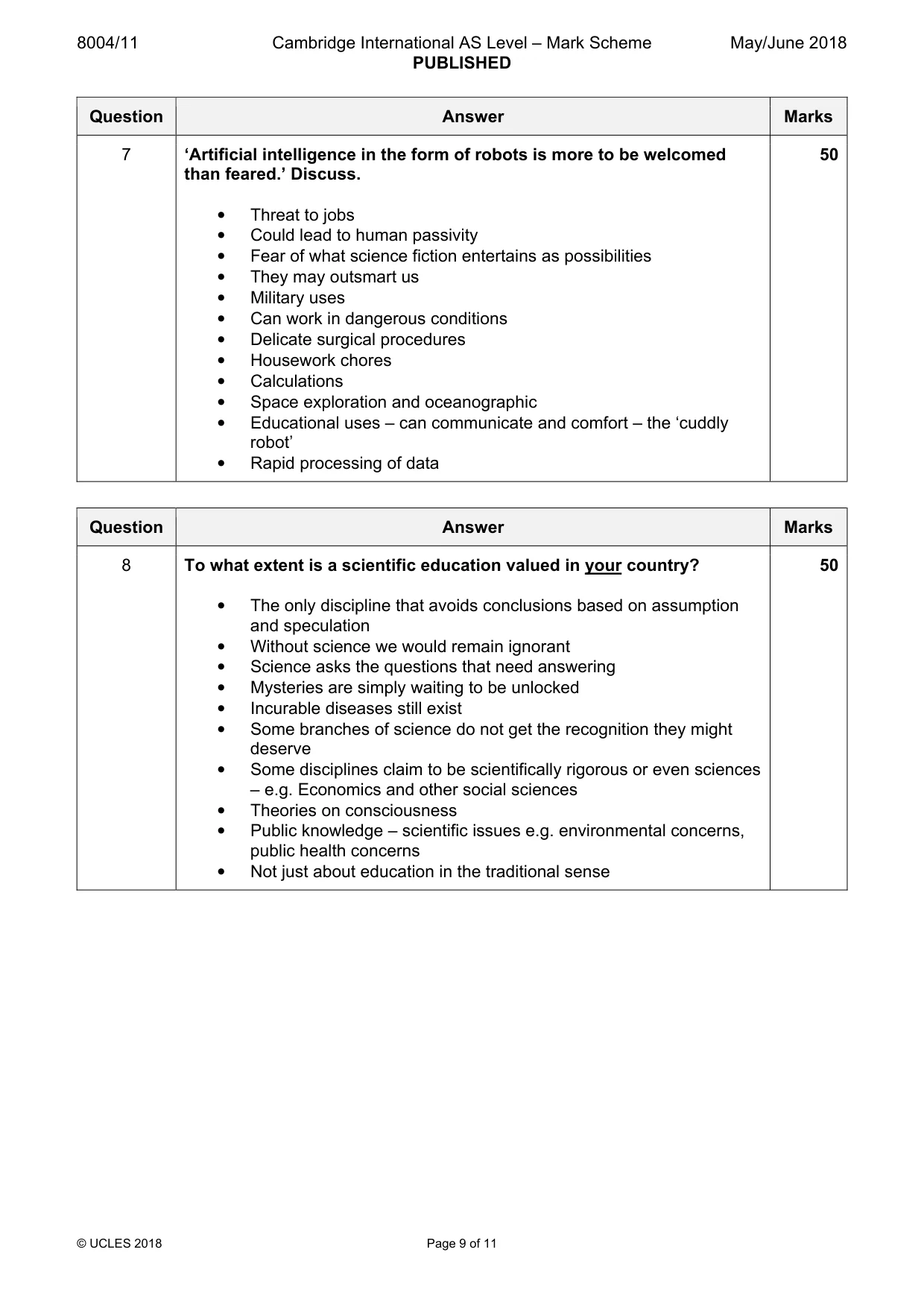
8004/11 Cambridge International AS Level – Mark Scheme PUBLISHED May/June 2018 © UCLES 2018 Page 9 of 11 Question Answer Marks 7 ‘Artificial intelligence in the form of robots is more to be welcomed than feared.’ Discuss. • Threat to jobs • Could lead to human passivity • Fear of what science fiction entertains as possibilities • They may outsmart us • Military uses • Can work in dangerous conditions • Delicate surgical procedures • Housework chores • Calculations • Space exploration and oceanographic • Educational uses – can communicate and comfort – the ‘cuddly robot’ • Rapid processing of data 50 Question Answer Marks 8 To what extent is a scientific education valued in your country? • The only discipline that avoids conclusions based on assumption and speculation • Without science we would remain ignorant • Science asks the questions that need answering • Mysteries are simply waiting to be unlocked • Incurable diseases still exist • Some branches of science do not get the recognition they might deserve • Some disciplines claim to be scientifically rigorous or even sciences – e.g. Economics and other social sciences • Theories on consciousness • Public knowledge – scientific issues e.g. environmental concerns, public health concerns • Not just about education in the traditional sense 50
Mark scheme, page 10
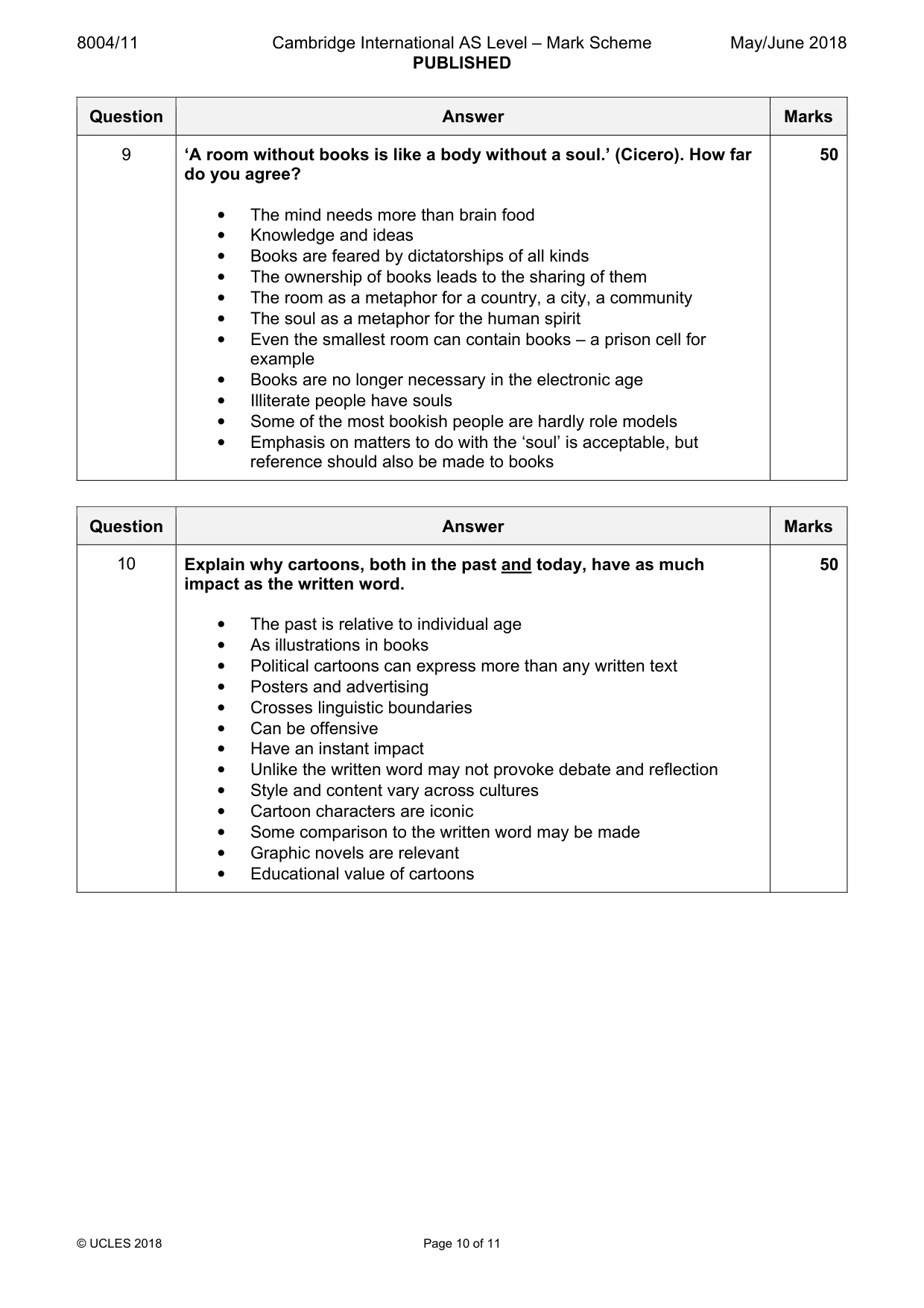
8004/11 Cambridge International AS Level – Mark Scheme PUBLISHED May/June 2018 © UCLES 2018 Page 10 of 11 Question Answer Marks 9 ‘A room without books is like a body without a soul.’ (Cicero). How far do you agree? • The mind needs more than brain food • Knowledge and ideas • Books are feared by dictatorships of all kinds • The ownership of books leads to the sharing of them • The room as a metaphor for a country, a city, a community • The soul as a metaphor for the human spirit • Even the smallest room can contain books – a prison cell for example • Books are no longer necessary in the electronic age • Illiterate people have souls • Some of the most bookish people are hardly role models • Emphasis on matters to do with the ‘soul’ is acceptable, but reference should also be made to books 50 Question Answer Marks 10 Explain why cartoons, both in the past and today, have as much impact as the written word. • The past is relative to individual age • As illustrations in books • Political cartoons can express more than any written text • Posters and advertising • Crosses linguistic boundaries • Can be offensive • Have an instant impact • Unlike the written word may not provoke debate and reflection • Style and content vary across cultures • Cartoon characters are iconic • Some comparison to the written word may be made • Graphic novels are relevant • Educational value of cartoons 50
Mark scheme, page 11
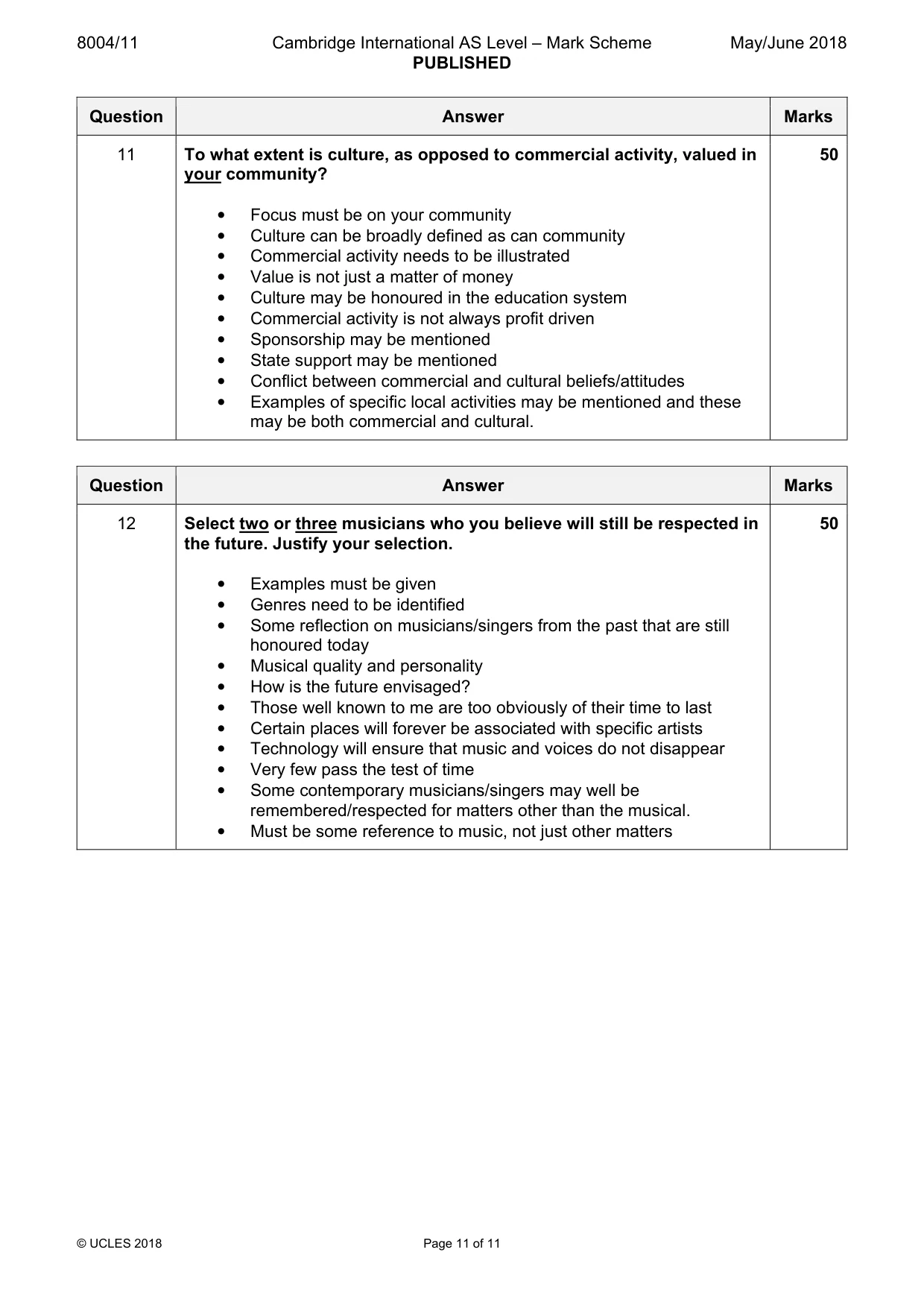
8004/11 Cambridge International AS Level – Mark Scheme PUBLISHED May/June 2018 © UCLES 2018 Page 11 of 11 Question Answer Marks 11 To what extent is culture, as opposed to commercial activity, valued in your community? • Focus must be on your community • Culture can be broadly defined as can community • Commercial activity needs to be illustrated • Value is not just a matter of money • Culture may be honoured in the education system • Commercial activity is not always profit driven • Sponsorship may be mentioned • State support may be mentioned • Conflict between commercial and cultural beliefs/attitudes • Examples of specific local activities may be mentioned and these may be both commercial and cultural. 50 Question Answer Marks 12 Select two or three musicians who you believe will still be respected in the future. Justify your selection. • Examples must be given • Genres need to be identified • Some reflection on musicians/singers from the past that are still honoured today • Musical quality and personality • How is the future envisaged? • Those well known to me are too obviously of their time to last • Certain places will forever be associated with specific artists • Technology will ensure that music and voices do not disappear • Very few pass the test of time • Some contemporary musicians/singers may well be remembered/respected for matters other than the musical. • Must be some reference to music, not just other matters 50
What you needed in this session
Cambridge’s own grade thresholds for 2018 May/June, Paper 1 · Variant 1. A higher threshold means an easier paper — the bar moves with how the cohort did.