Cambridge A Level General Paper (AS Level only) 8004 — 2017 Oct/Nov Paper 1 · Variant 3
8004/13/O/N/17 · 100 marks · ≈113 min
The question paper and its mark scheme, free to read here and free to download. This is Cambridge’s own paper, exactly as it was sat.
Question paper4 pages
Mark scheme8 pages
Answers below. Sit the paper first if you are practising.
Paper as text
Question paper, page 1
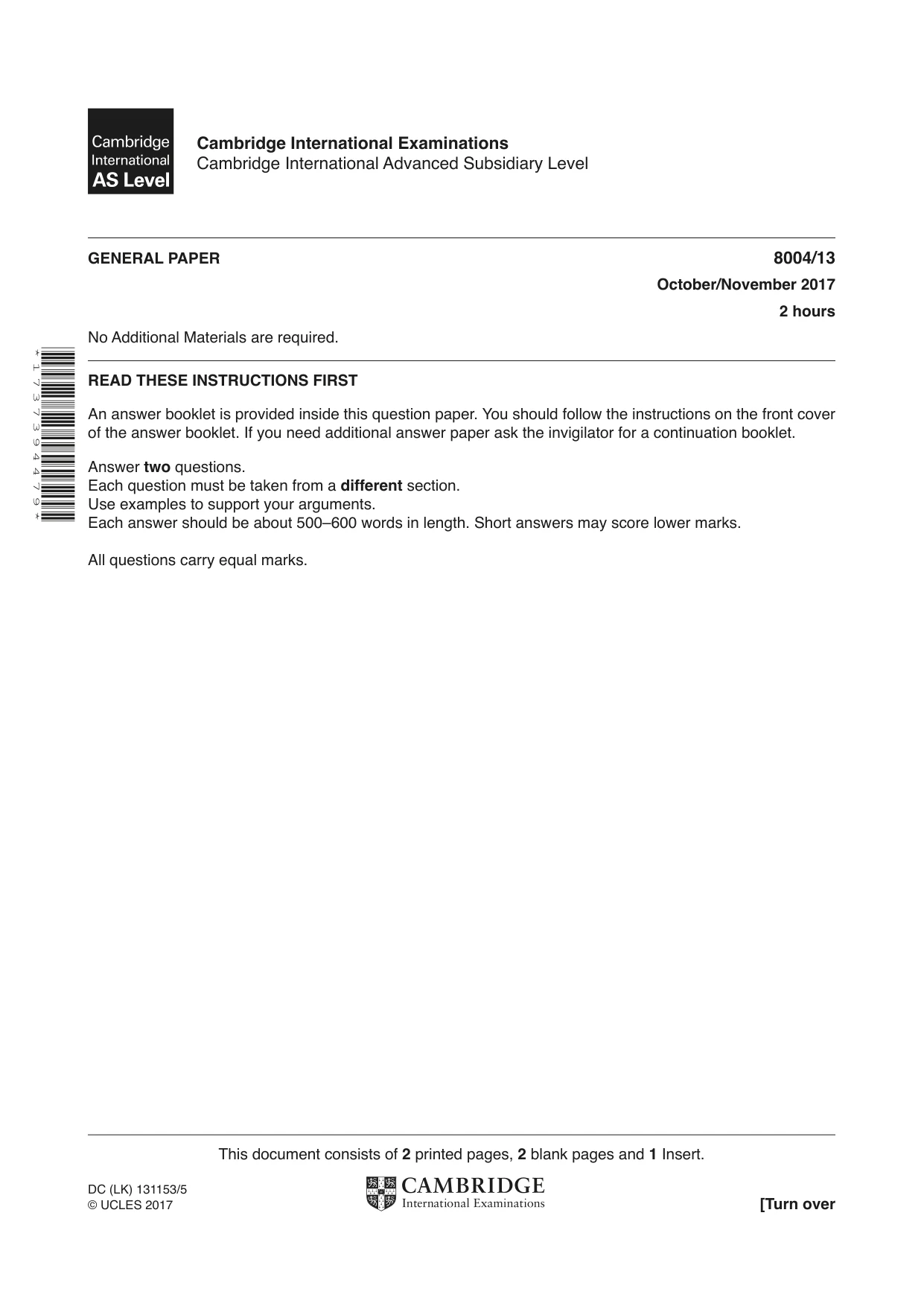
This document consists of 2 printed pages, 2 blank pages and 1 Insert. DC (LK) 131153/5 © UCLES 2017 [Turn over Cambridge International Examinations Cambridge International Advanced Subsidiary Level * 1 7 3 7 3 9 4 4 7 9 * GENERAL PAPER 8004/13 October/November 2017 2 hours No Additional Materials are required. READ THESE INSTRUCTIONS FIRST An answer booklet is provided inside this question paper. You should follow the instructions on the front cover of the answer booklet. If you need additional answer paper ask the invigilator for a continuation booklet. Answer two questions. Each question must be taken from a different section. Use examples to support your arguments. Each answer should be about 500–600 words in length. Short answers may score lower marks. All questions carry equal marks.
Question paper, page 2
2 8004/13/O/N/17 © UCLES 2017 BLANK PAGE
Question paper, page 3
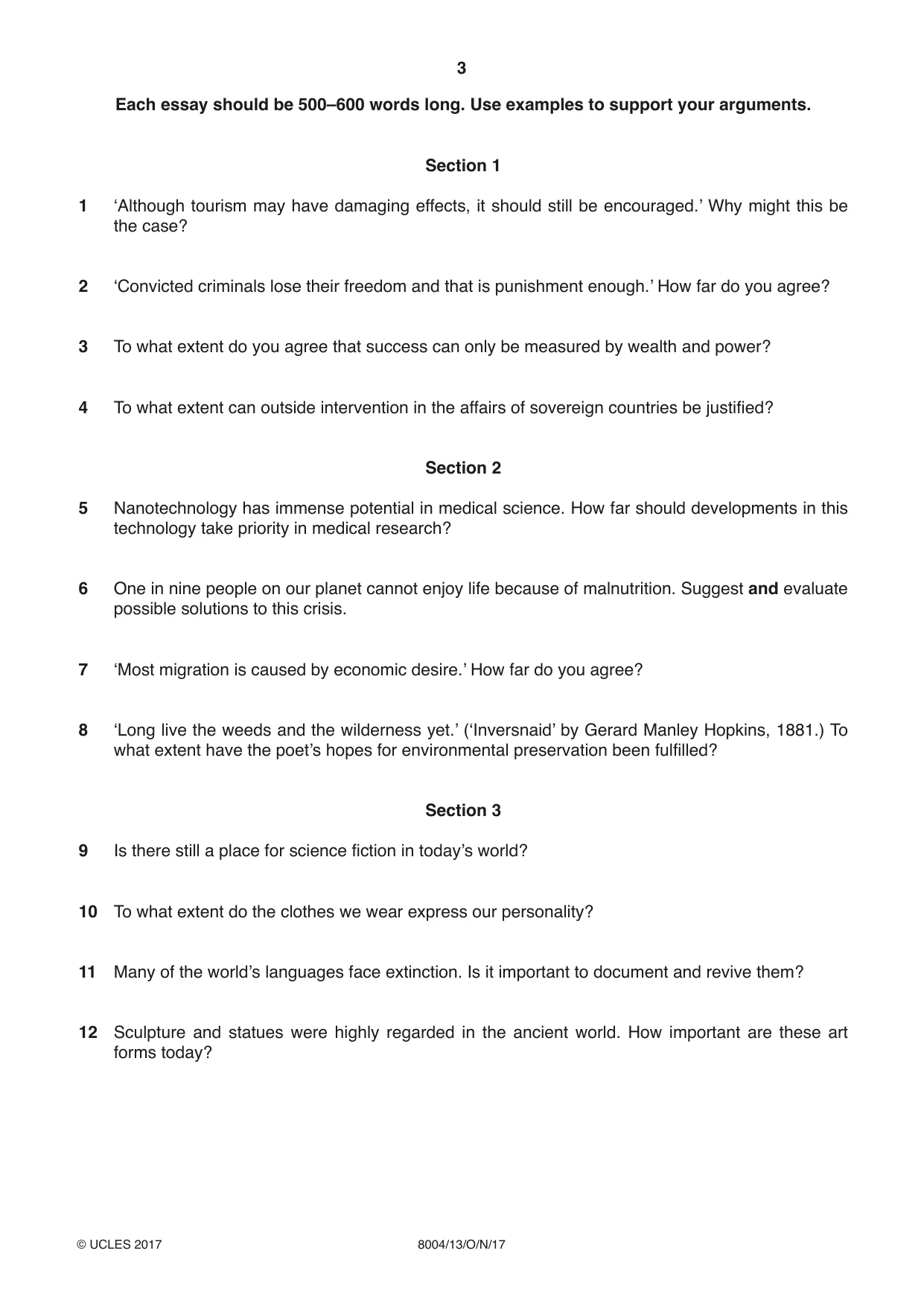
3 8004/13/O/N/17 © UCLES 2017 Each essay should be 500–600 words long. Use examples to support your arguments. Section 1 1 ‘Although tourism may have damaging effects, it should still be encouraged.’ Why might this be the case? 2 ‘Convicted criminals lose their freedom and that is punishment enough.’ How far do you agree? 3 To what extent do you agree that success can only be measured by wealth and power? 4 To what extent can outside intervention in the affairs of sovereign countries be justified? Section 2 5 Nanotechnology has immense potential in medical science. How far should developments in this technology take priority in medical research? 6 One in nine people on our planet cannot enjoy life because of malnutrition. Suggest and evaluate possible solutions to this crisis. 7 ‘Most migration is caused by economic desire.’ How far do you agree? 8 ‘Long live the weeds and the wilderness yet.’ (‘Inversnaid’ by Gerard Manley Hopkins, 1881.) To what extent have the poet’s hopes for environmental preservation been fulfilled? Section 3 9 Is there still a place for science fiction in today’s world? 10 To what extent do the clothes we wear express our personality? 11 Many of the world’s languages face extinction. Is it important to document and revive them? 12 Sculpture and statues were highly regarded in the ancient world. How important are these art forms today?
Question paper, page 4
4 8004/13/O/N/17 © UCLES 2017 Permission to reproduce items where third-party owned material protected by copyright is included has been sought and cleared where possible. Every reasonable effort has been made by the publisher (UCLES) to trace copyright holders, but if any items requiring clearance have unwittingly been included, the publisher will be pleased to make amends at the earliest possible opportunity. To avoid the issue of disclosure of answer-related information to candidates, all copyright acknowledgements are reproduced online in the Cambridge International Examinations Copyright Acknowledgements Booklet. This is produced for each series of examinations and is freely available to download at www.cie.org.uk after the live examination series. Cambridge International Examinations is part of the Cambridge Assessment Group. Cambridge Assessment is the brand name of University of Cambridge Local Examinations Syndicate (UCLES), which is itself a department of the University of Cambridge. BLANK PAGE
Mark scheme, page 1
® IGCSE is a registered trademark. This document consists of 8 printed pages. © UCLES 2017 [Turn over Cambridge Assessment International Education Cambridge International Advanced Subsidiary Level GENERAL PAPER 8004/13 Paper 1 October/November 2017 MARK SCHEME Maximum Mark: 100 Published This mark scheme is published as an aid to teachers and candidates, to indicate the requirements of the examination. It shows the basis on which Examiners were instructed to award marks. It does not indicate the details of the discussions that took place at an Examiners’ meeting before marking began, which would have considered the acceptability of alternative answers. Mark schemes should be read in conjunction with the question paper and the Principal Examiner Report for Teachers. Cambridge International will not enter into discussions about these mark schemes. Cambridge International is publishing the mark schemes for the October/November 2017 series for most Cambridge IGCSE®, Cambridge International A and AS Level components and some Cambridge O Level components.
Mark scheme, page 2
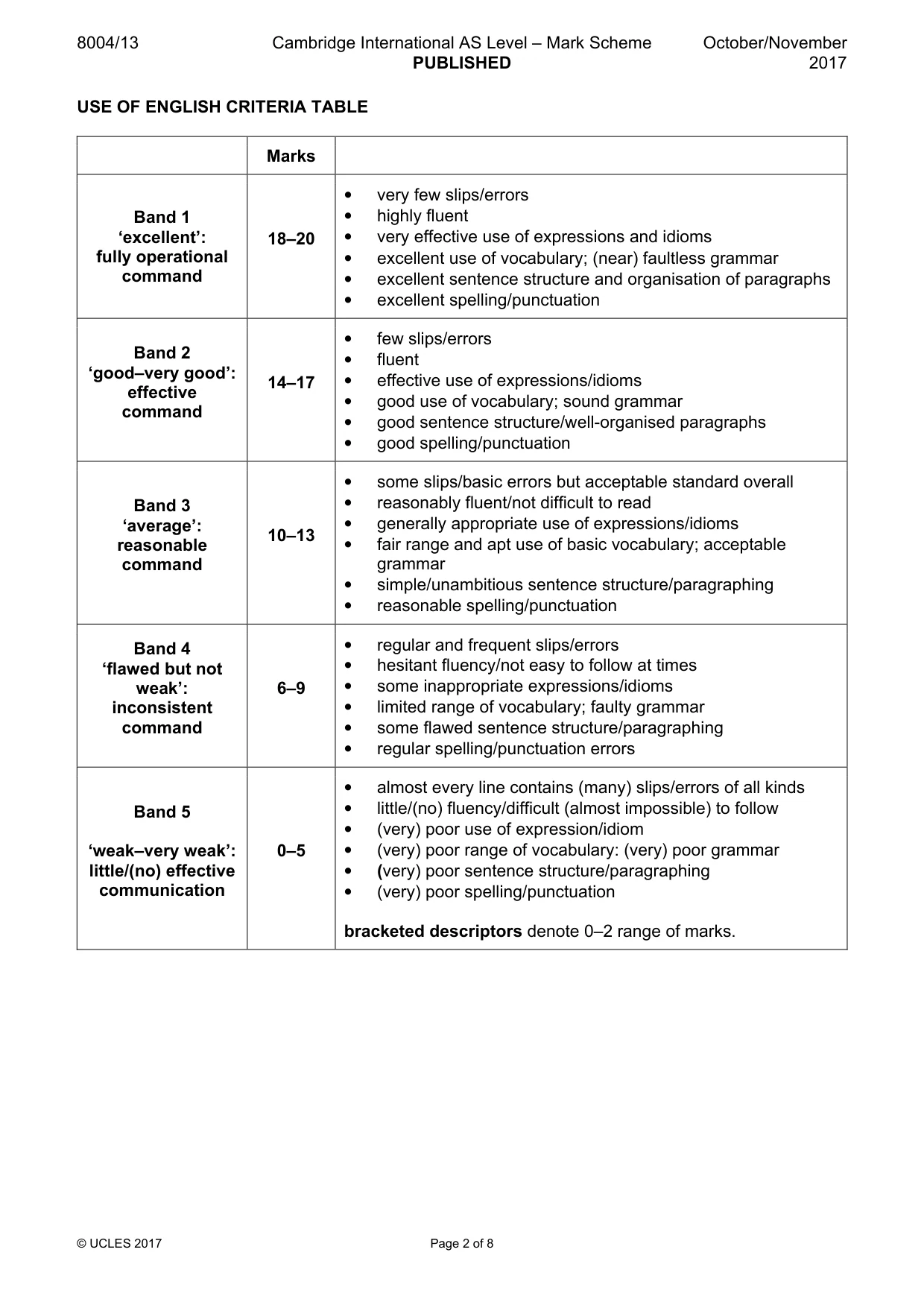
8004/13 Cambridge International AS Level – Mark Scheme PUBLISHED October/November 2017 © UCLES 2017 Page 2 of 8 USE OF ENGLISH CRITERIA TABLE Marks Band 1 ‘excellent’: fully operational command 18–20 • very few slips/errors • highly fluent • very effective use of expressions and idioms • excellent use of vocabulary; (near) faultless grammar • excellent sentence structure and organisation of paragraphs • excellent spelling/punctuation Band 2 ‘good–very good’: effective command 14–17 • few slips/errors • fluent • effective use of expressions/idioms • good use of vocabulary; sound grammar • good sentence structure/well-organised paragraphs • good spelling/punctuation Band 3 ‘average’: reasonable command 10–13 • some slips/basic errors but acceptable standard overall • reasonably fluent/not difficult to read • generally appropriate use of expressions/idioms • fair range and apt use of basic vocabulary; acceptable grammar • simple/unambitious sentence structure/paragraphing • reasonable spelling/punctuation Band 4 ‘flawed but not weak’: inconsistent command 6–9 • regular and frequent slips/errors • hesitant fluency/not easy to follow at times • some inappropriate expressions/idioms • limited range of vocabulary; faulty grammar • some flawed sentence structure/paragraphing • regular spelling/punctuation errors Band 5 ‘weak–very weak’: little/(no) effective communication 0–5 • almost every line contains (many) slips/errors of all kinds • little/(no) fluency/difficult (almost impossible) to follow • (very) poor use of expression/idiom • (very) poor range of vocabulary: (very) poor grammar • (very) poor sentence structure/paragraphing • (very) poor spelling/punctuation bracketed descriptors denote 0–2 range of marks.
Mark scheme, page 3
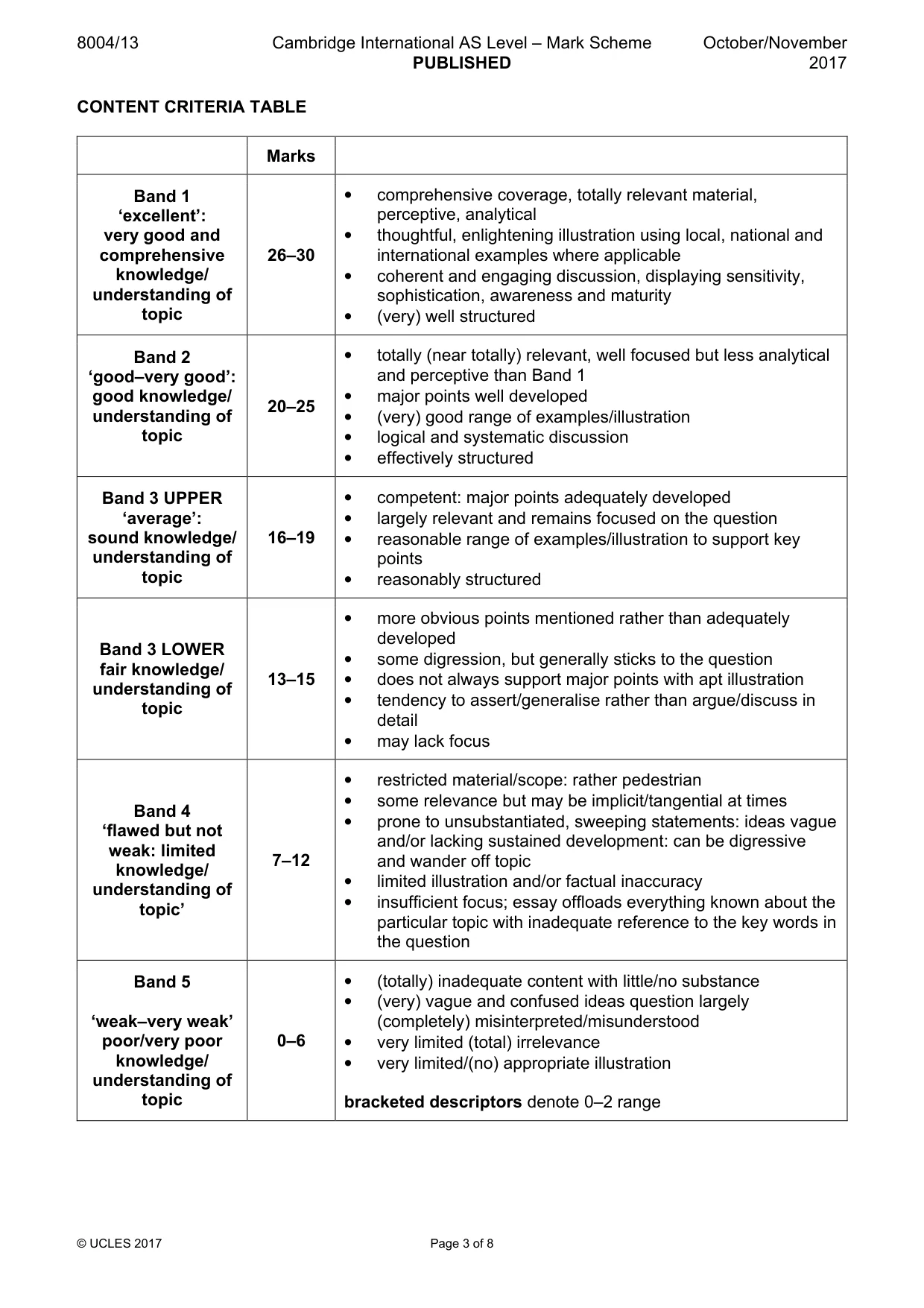
8004/13 Cambridge International AS Level – Mark Scheme PUBLISHED October/November 2017 © UCLES 2017 Page 3 of 8 CONTENT CRITERIA TABLE Marks Band 1 ‘excellent’: very good and comprehensive knowledge/ understanding of topic 26–30 • comprehensive coverage, totally relevant material, perceptive, analytical • thoughtful, enlightening illustration using local, national and international examples where applicable • coherent and engaging discussion, displaying sensitivity, sophistication, awareness and maturity • (very) well structured Band 2 ‘good–very good’: good knowledge/ understanding of topic 20–25 • totally (near totally) relevant, well focused but less analytical and perceptive than Band 1 • major points well developed • (very) good range of examples/illustration • logical and systematic discussion • effectively structured Band 3 UPPER ‘average’: sound knowledge/ understanding of topic 16–19 • competent: major points adequately developed • largely relevant and remains focused on the question • reasonable range of examples/illustration to support key points • reasonably structured Band 3 LOWER fair knowledge/ understanding of topic 13–15 • more obvious points mentioned rather than adequately developed • some digression, but generally sticks to the question • does not always support major points with apt illustration • tendency to assert/generalise rather than argue/discuss in detail • may lack focus Band 4 ‘flawed but not weak: limited knowledge/ understanding of topic’ 7–12 • restricted material/scope: rather pedestrian • some relevance but may be implicit/tangential at times • prone to unsubstantiated, sweeping statements: ideas vague and/or lacking sustained development: can be digressive and wander off topic • limited illustration and/or factual inaccuracy • insufficient focus; essay offloads everything known about the particular topic with inadequate reference to the key words in the question Band 5 ‘weak–very weak’ poor/very poor knowledge/ understanding of topic 0–6 • (totally) inadequate content with little/no substance • (very) vague and confused ideas question largely (completely) misinterpreted/misunderstood • very limited (total) irrelevance • very limited/(no) appropriate illustration bracketed descriptors denote 0–2 range
Mark scheme, page 4
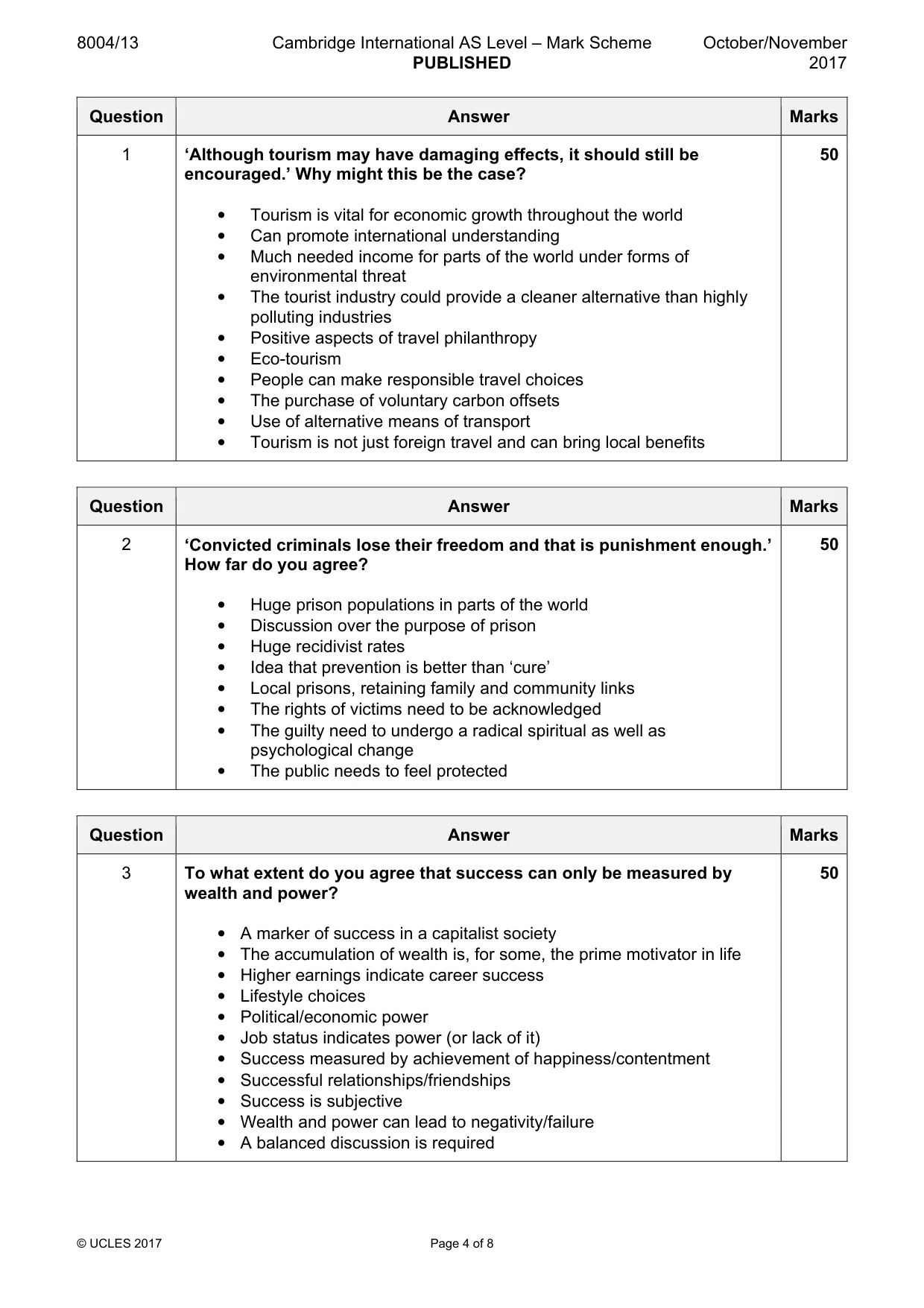
8004/13 Cambridge International AS Level – Mark Scheme PUBLISHED October/November 2017 © UCLES 2017 Page 4 of 8 Question Answer Marks 1 ‘Although tourism may have damaging effects, it should still be encouraged.’ Why might this be the case? • Tourism is vital for economic growth throughout the world • Can promote international understanding • Much needed income for parts of the world under forms of environmental threat • The tourist industry could provide a cleaner alternative than highly polluting industries • Positive aspects of travel philanthropy • Eco-tourism • People can make responsible travel choices • The purchase of voluntary carbon offsets • Use of alternative means of transport • Tourism is not just foreign travel and can bring local benefits 50 Question Answer Marks 2 ‘Convicted criminals lose their freedom and that is punishment enough.’ How far do you agree? • Huge prison populations in parts of the world • Discussion over the purpose of prison • Huge recidivist rates • Idea that prevention is better than ‘cure’ • Local prisons, retaining family and community links • The rights of victims need to be acknowledged • The guilty need to undergo a radical spiritual as well as psychological change • The public needs to feel protected 50 Question Answer Marks 3 To what extent do you agree that success can only be measured by wealth and power? • A marker of success in a capitalist society • The accumulation of wealth is, for some, the prime motivator in life • Higher earnings indicate career success • Lifestyle choices • Political/economic power • Job status indicates power (or lack of it) • Success measured by achievement of happiness/contentment • Successful relationships/friendships • Success is subjective • Wealth and power can lead to negativity/failure • A balanced discussion is required 50
Mark scheme, page 5
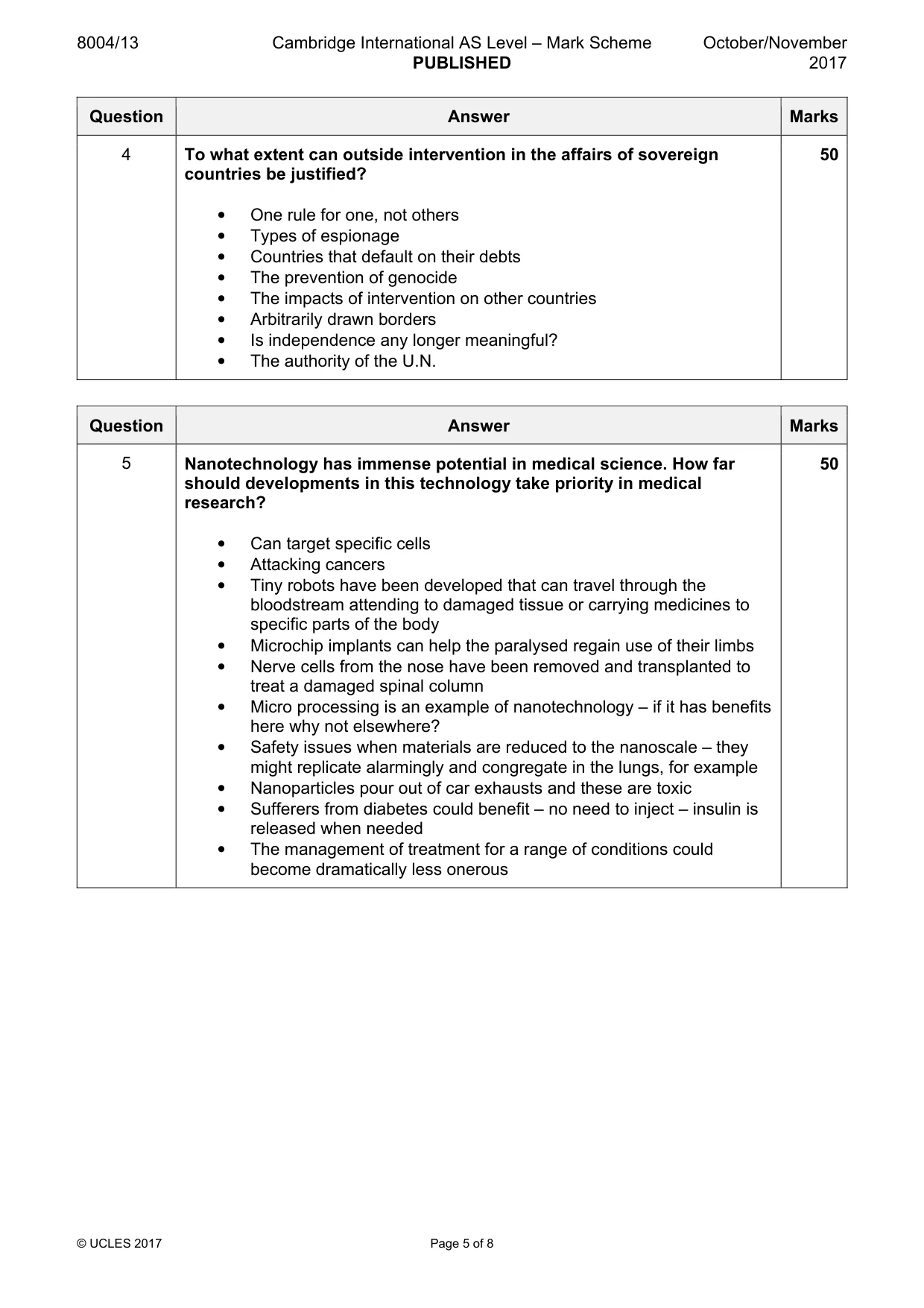
8004/13 Cambridge International AS Level – Mark Scheme PUBLISHED October/November 2017 © UCLES 2017 Page 5 of 8 Question Answer Marks 4 To what extent can outside intervention in the affairs of sovereign countries be justified? • One rule for one, not others • Types of espionage • Countries that default on their debts • The prevention of genocide • The impacts of intervention on other countries • Arbitrarily drawn borders • Is independence any longer meaningful? • The authority of the U.N. 50 Question Answer Marks 5 Nanotechnology has immense potential in medical science. How far should developments in this technology take priority in medical research? • Can target specific cells • Attacking cancers • Tiny robots have been developed that can travel through the bloodstream attending to damaged tissue or carrying medicines to specific parts of the body • Microchip implants can help the paralysed regain use of their limbs • Nerve cells from the nose have been removed and transplanted to treat a damaged spinal column • Micro processing is an example of nanotechnology – if it has benefits here why not elsewhere? • Safety issues when materials are reduced to the nanoscale – they might replicate alarmingly and congregate in the lungs, for example • Nanoparticles pour out of car exhausts and these are toxic • Sufferers from diabetes could benefit – no need to inject – insulin is released when needed • The management of treatment for a range of conditions could become dramatically less onerous 50
Mark scheme, page 6
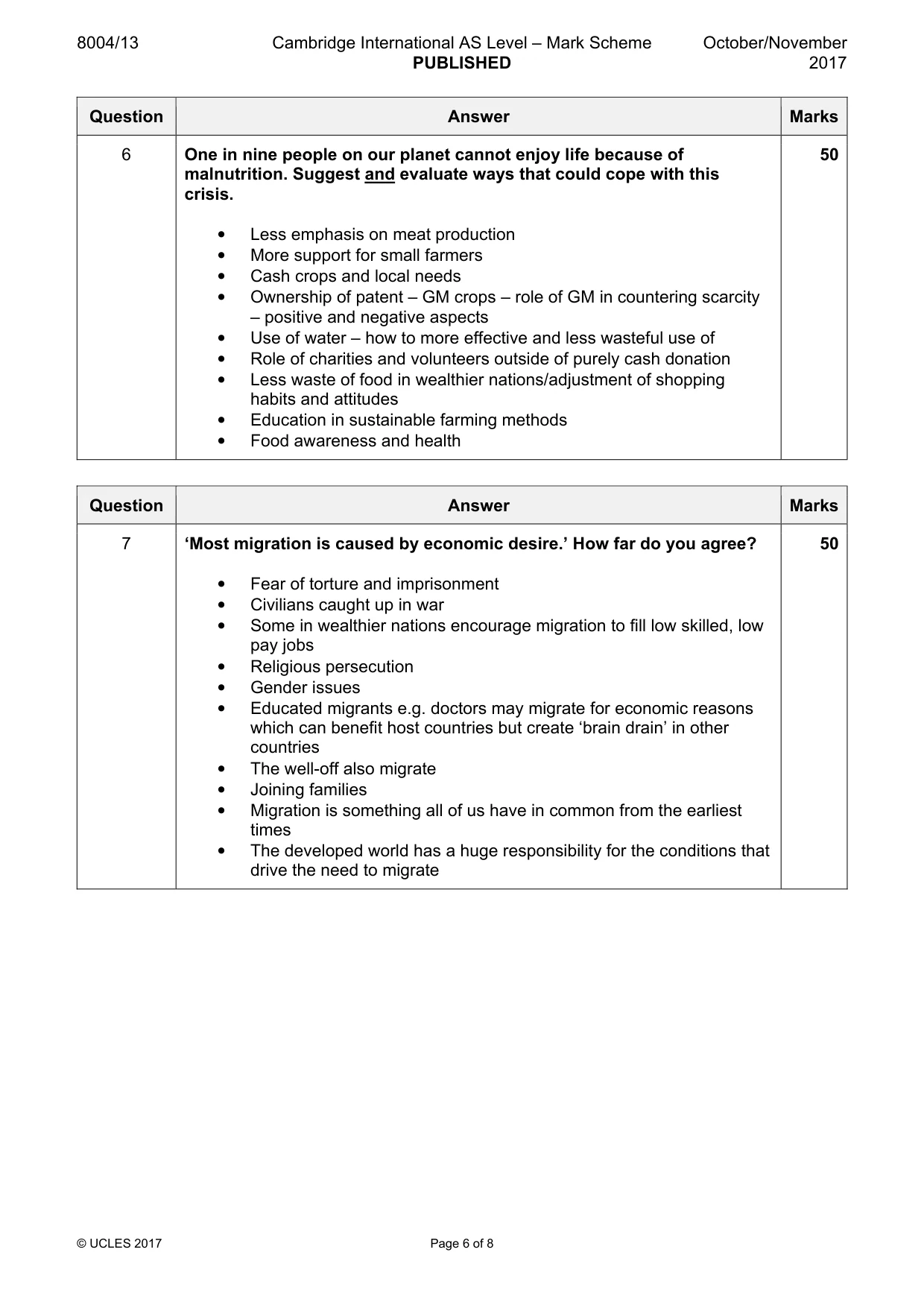
8004/13 Cambridge International AS Level – Mark Scheme PUBLISHED October/November 2017 © UCLES 2017 Page 6 of 8 Question Answer Marks 6 One in nine people on our planet cannot enjoy life because of malnutrition. Suggest and evaluate ways that could cope with this crisis. • Less emphasis on meat production • More support for small farmers • Cash crops and local needs • Ownership of patent – GM crops – role of GM in countering scarcity – positive and negative aspects • Use of water – how to more effective and less wasteful use of • Role of charities and volunteers outside of purely cash donation • Less waste of food in wealthier nations/adjustment of shopping habits and attitudes • Education in sustainable farming methods • Food awareness and health 50 Question Answer Marks 7 ‘Most migration is caused by economic desire.’ How far do you agree? • Fear of torture and imprisonment • Civilians caught up in war • Some in wealthier nations encourage migration to fill low skilled, low pay jobs • Religious persecution • Gender issues • Educated migrants e.g. doctors may migrate for economic reasons which can benefit host countries but create ‘brain drain’ in other countries • The well-off also migrate • Joining families • Migration is something all of us have in common from the earliest times • The developed world has a huge responsibility for the conditions that drive the need to migrate 50
Mark scheme, page 7
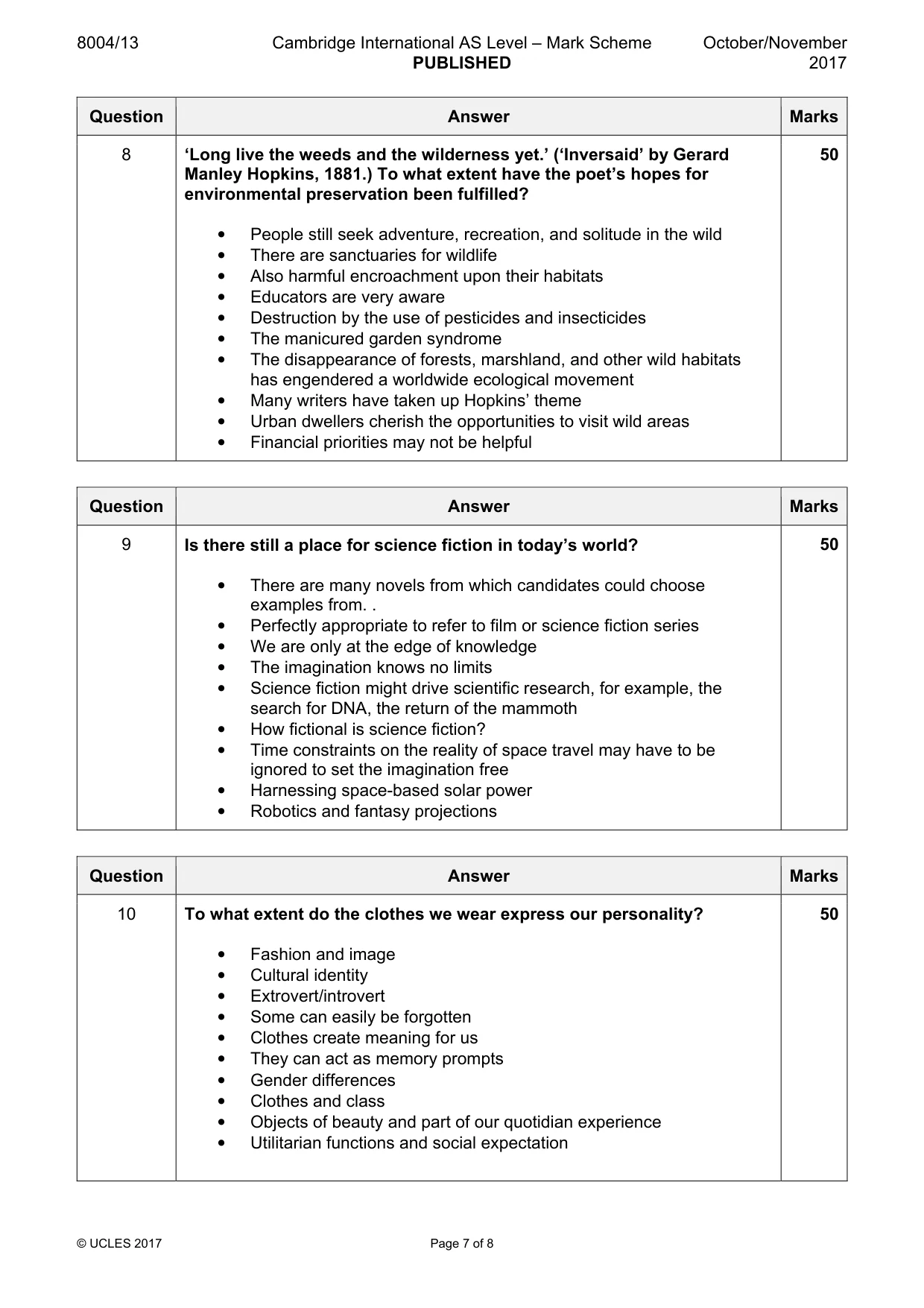
8004/13 Cambridge International AS Level – Mark Scheme PUBLISHED October/November 2017 © UCLES 2017 Page 7 of 8 Question Answer Marks 8 ‘Long live the weeds and the wilderness yet.’ (‘Inversaid’ by Gerard Manley Hopkins, 1881.) To what extent have the poet’s hopes for environmental preservation been fulfilled? • People still seek adventure, recreation, and solitude in the wild • There are sanctuaries for wildlife • Also harmful encroachment upon their habitats • Educators are very aware • Destruction by the use of pesticides and insecticides • The manicured garden syndrome • The disappearance of forests, marshland, and other wild habitats has engendered a worldwide ecological movement • Many writers have taken up Hopkins’ theme • Urban dwellers cherish the opportunities to visit wild areas • Financial priorities may not be helpful 50 Question Answer Marks 9 Is there still a place for science fiction in today’s world? • There are many novels from which candidates could choose examples from. . • Perfectly appropriate to refer to film or science fiction series • We are only at the edge of knowledge • The imagination knows no limits • Science fiction might drive scientific research, for example, the search for DNA, the return of the mammoth • How fictional is science fiction? • Time constraints on the reality of space travel may have to be ignored to set the imagination free • Harnessing space-based solar power • Robotics and fantasy projections 50 Question Answer Marks 10 To what extent do the clothes we wear express our personality? • Fashion and image • Cultural identity • Extrovert/introvert • Some can easily be forgotten • Clothes create meaning for us • They can act as memory prompts • Gender differences • Clothes and class • Objects of beauty and part of our quotidian experience • Utilitarian functions and social expectation 50
Mark scheme, page 8
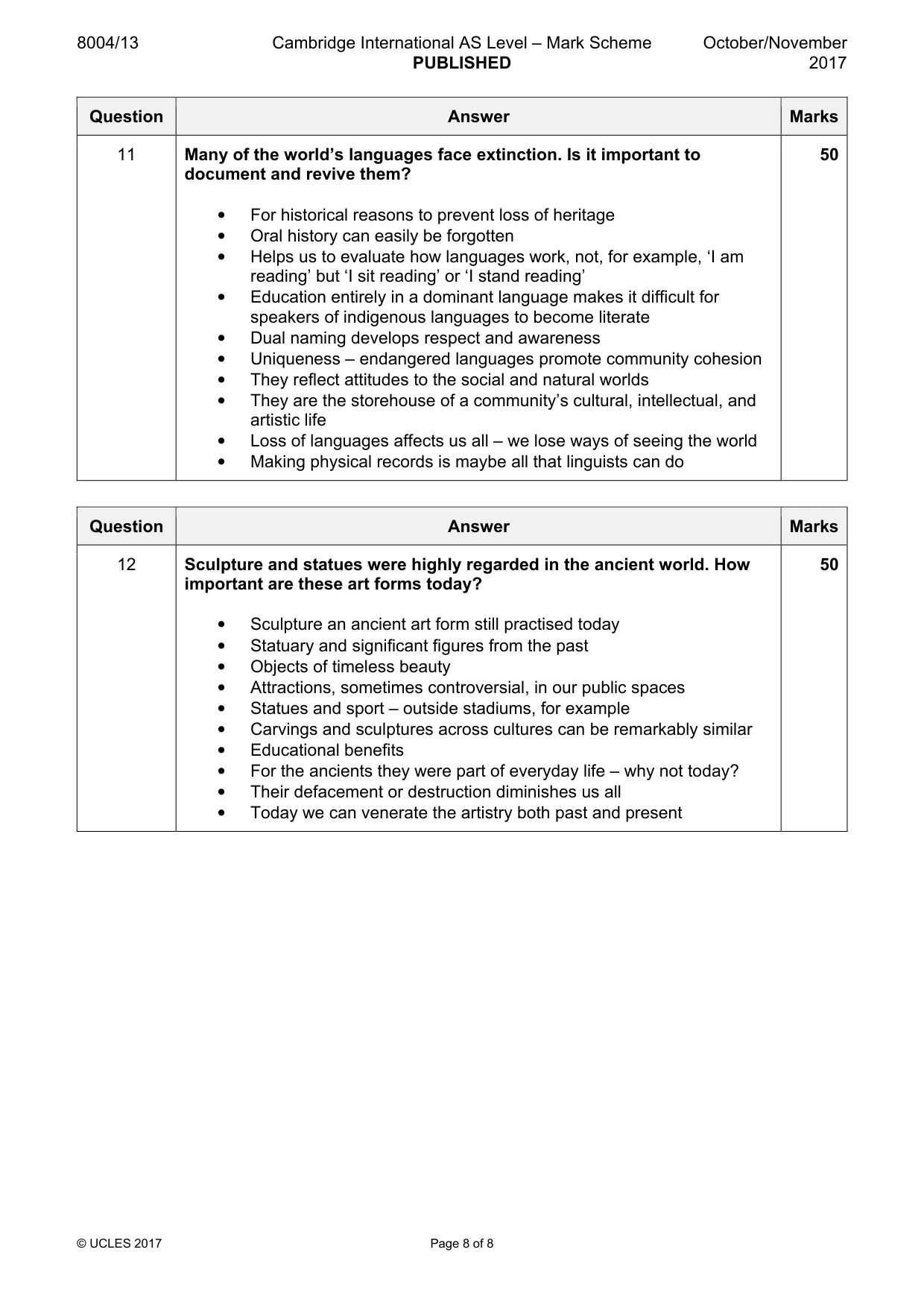
8004/13 Cambridge International AS Level – Mark Scheme PUBLISHED October/November 2017 © UCLES 2017 Page 8 of 8 Question Answer Marks 11 Many of the world’s languages face extinction. Is it important to document and revive them? • For historical reasons to prevent loss of heritage • Oral history can easily be forgotten • Helps us to evaluate how languages work, not, for example, ‘I am reading’ but ‘I sit reading’ or ‘I stand reading’ • Education entirely in a dominant language makes it difficult for speakers of indigenous languages to become literate • Dual naming develops respect and awareness • Uniqueness – endangered languages promote community cohesion • They reflect attitudes to the social and natural worlds • They are the storehouse of a community’s cultural, intellectual, and artistic life • Loss of languages affects us all – we lose ways of seeing the world • Making physical records is maybe all that linguists can do 50 Question Answer Marks 12 Sculpture and statues were highly regarded in the ancient world. How important are these art forms today? • Sculpture an ancient art form still practised today • Statuary and significant figures from the past • Objects of timeless beauty • Attractions, sometimes controversial, in our public spaces • Statues and sport – outside stadiums, for example • Carvings and sculptures across cultures can be remarkably similar • Educational benefits • For the ancients they were part of everyday life – why not today? • Their defacement or destruction diminishes us all • Today we can venerate the artistry both past and present 50
What you needed in this session
Cambridge’s own grade thresholds for 2017 Oct/Nov, Paper 1 · Variant 3. A higher threshold means an easier paper — the bar moves with how the cohort did.