Cambridge A Level General Paper (AS Level only) 8004 — 2016 Oct/Nov Paper 1 · Variant 3
8004/13/O/N/16 · 100 marks · ≈113 min
The question paper and its mark scheme, free to read here and free to download. This is Cambridge’s own paper, exactly as it was sat.
Question paper4 pages


Mark scheme10 pages
Answers below. Sit the paper first if you are practising.
Paper as text
Question paper, page 1
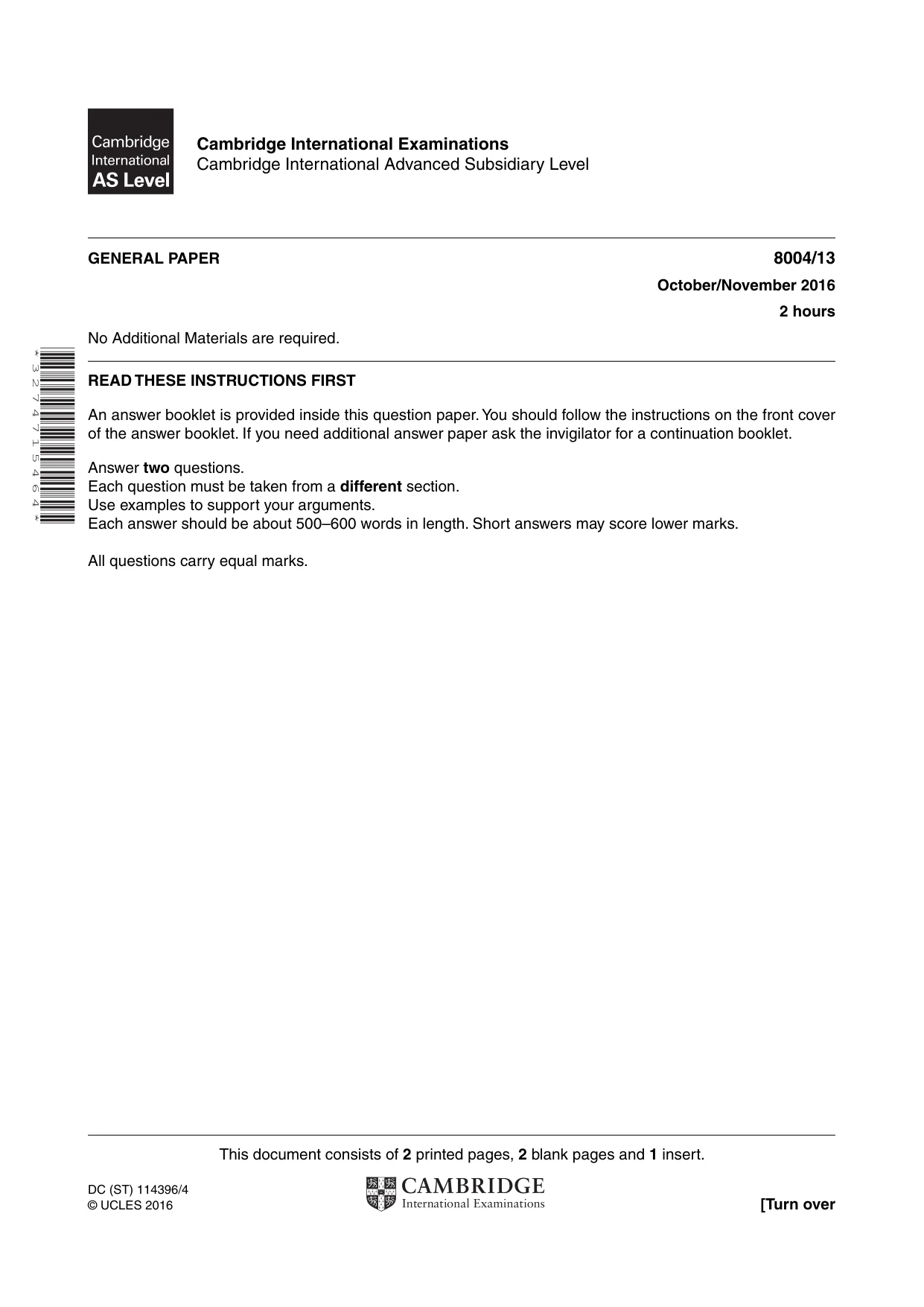
This document consists of 2 printed pages, 2 blank pages and 1 insert. DC (ST) 114396/4 © UCLES 2016 [Turn over Cambridge International Examinations Cambridge International Advanced Subsidiary Level * 3 2 7 4 7 1 5 4 6 4 * GENERAL PAPER 8004/13 October/November 2016 2 hours No Additional Materials are required. READ THESE INSTRUCTIONS FIRST An answer booklet is provided inside this question paper. You should follow the instructions on the front cover of the answer booklet. If you need additional answer paper ask the invigilator for a continuation booklet. Answer two questions. Each question must be taken from a different section. Use examples to support your arguments. Each answer should be about 500–600 words in length. Short answers may score lower marks. All questions carry equal marks.
Question paper, page 2
2 8004/13/O/N/16 © UCLES 2016 BLANK PAGE
Question paper, page 3
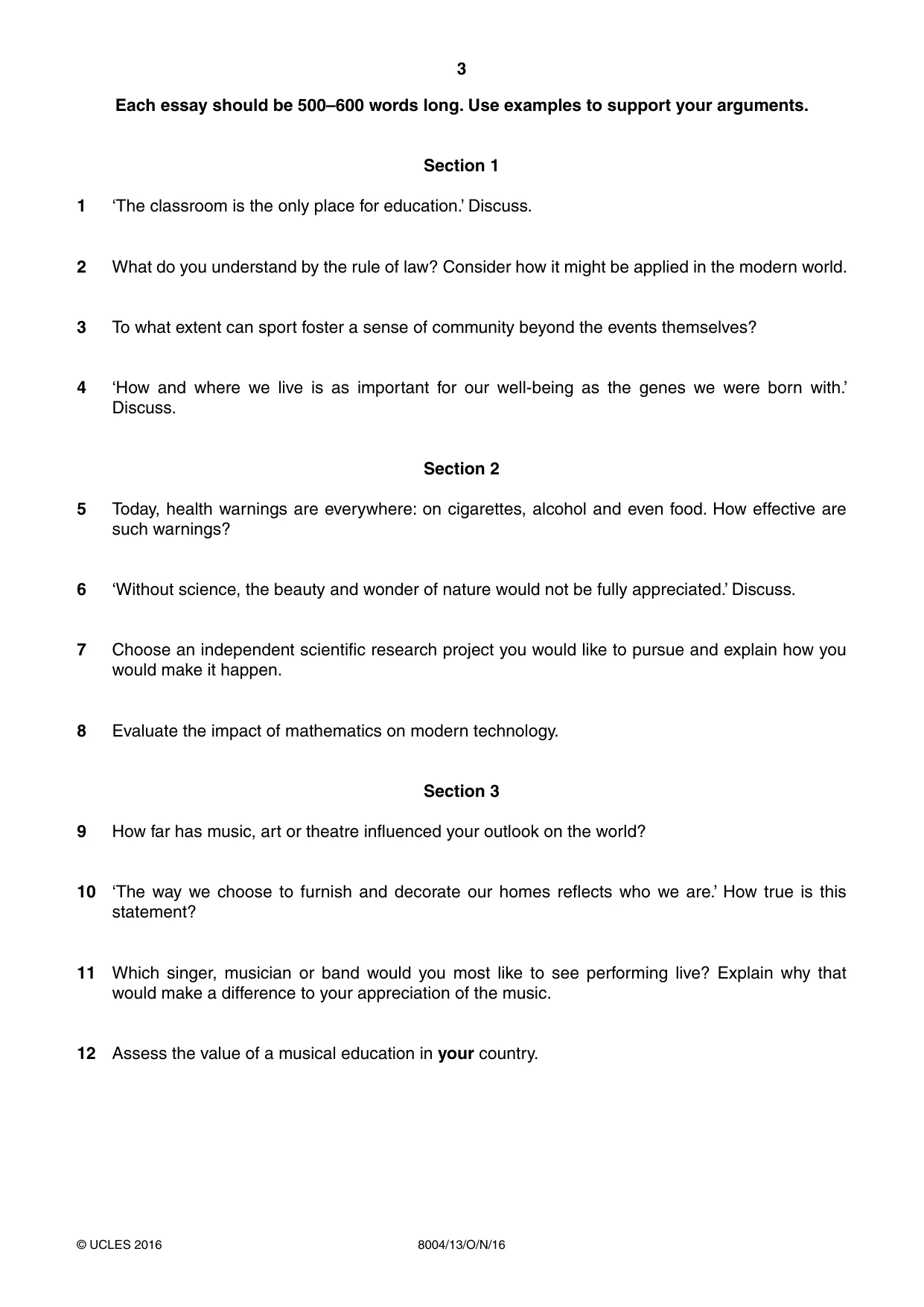
3 8004/13/O/N/16 © UCLES 2016 Each essay should be 500–600 words long. Use examples to support your arguments. Section 1 1 ‘The classroom is the only place for education.’ Discuss. 2 What do you understand by the rule of law? Consider how it might be applied in the modern world. 3 To what extent can sport foster a sense of community beyond the events themselves? 4 ‘How and where we live is as important for our well-being as the genes we were born with.’ Discuss. Section 2 5 Today, health warnings are everywhere: on cigarettes, alcohol and even food. How effective are such warnings? 6 ‘Without science, the beauty and wonder of nature would not be fully appreciated.’ Discuss. 7 Choose an independent scientific research project you would like to pursue and explain how you would make it happen. 8 Evaluate the impact of mathematics on modern technology. Section 3 9 How far has music, art or theatre influenced your outlook on the world? 10 ‘The way we choose to furnish and decorate our homes reflects who we are.’ How true is this statement? 11 Which singer, musician or band would you most like to see performing live? Explain why that would make a difference to your appreciation of the music. 12 Assess the value of a musical education in your country.
Question paper, page 4
4 8004/13/O/N/16 © UCLES 2016 BLANK PAGE Permission to reproduce items where third-party owned material protected by copyright is included has been sought and cleared where possible. Every reasonable effort has been made by the publisher (UCLES) to trace copyright holders, but if any items requiring clearance have unwittingly been included, the publisher will be pleased to make amends at the earliest possible opportunity. To avoid the issue of disclosure of answer-related information to candidates, all copyright acknowledgements are reproduced online in the Cambridge International Examinations Copyright Acknowledgements Booklet. This is produced for each series of examinations and is freely available to download at www.cie.org.uk after the live examination series. Cambridge International Examinations is part of the Cambridge Assessment Group. Cambridge Assessment is the brand name of University of Cambridge Local Examinations Syndicate (UCLES), which is itself a department of the University of Cambridge.
Mark scheme, page 1
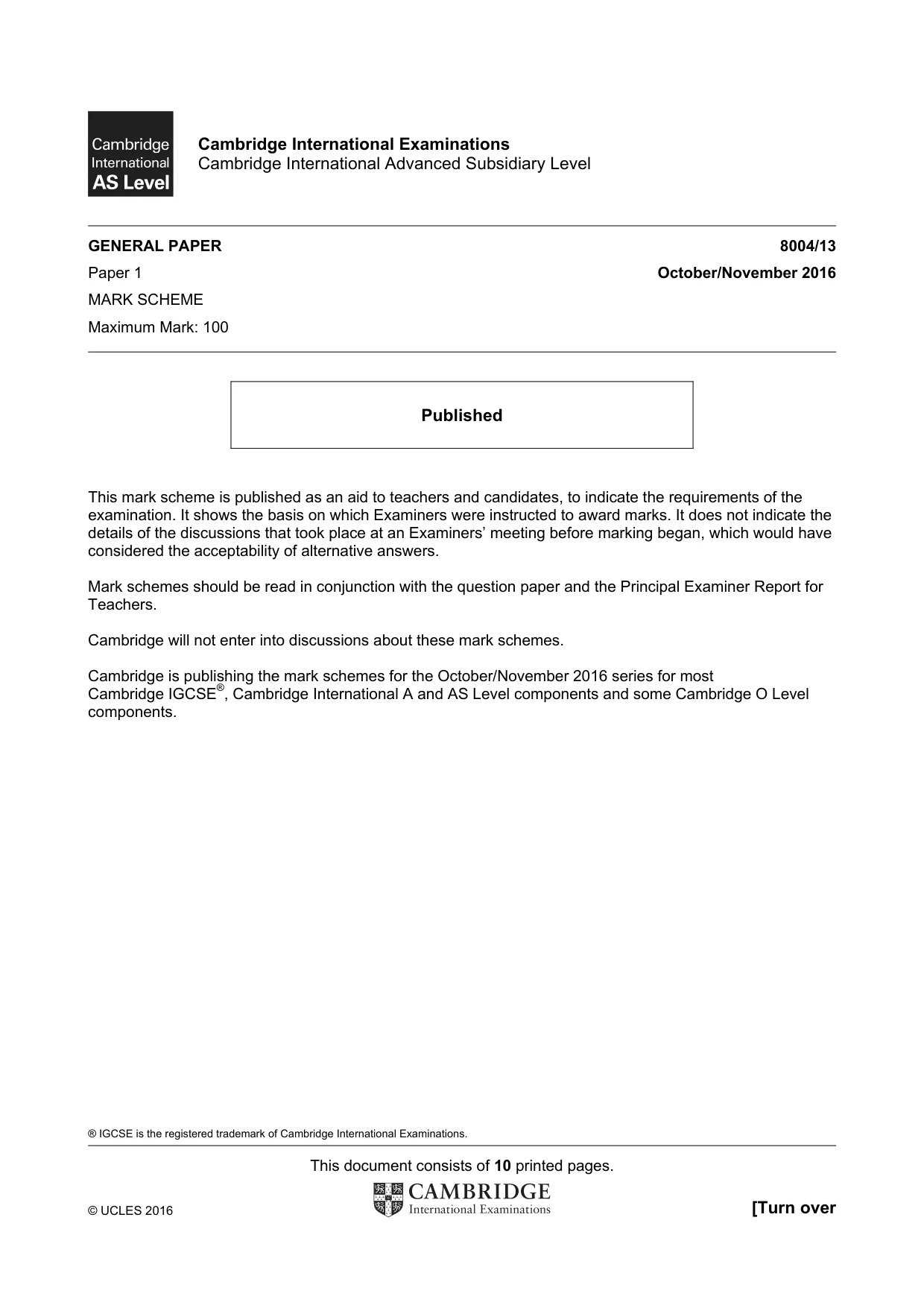
® IGCSE is the registered trademark of Cambridge International Examinations. This document consists of 10 printed pages. © UCLES 2016 [Turn over Cambridge International Examinations Cambridge International Advanced Subsidiary Level GENERAL PAPER 8004/13 Paper 1 October/November 2016 MARK SCHEME Maximum Mark: 100 Published This mark scheme is published as an aid to teachers and candidates, to indicate the requirements of the examination. It shows the basis on which Examiners were instructed to award marks. It does not indicate the details of the discussions that took place at an Examiners’ meeting before marking began, which would have considered the acceptability of alternative answers. Mark schemes should be read in conjunction with the question paper and the Principal Examiner Report for Teachers. Cambridge will not enter into discussions about these mark schemes. Cambridge is publishing the mark schemes for the October/November 2016 series for most Cambridge IGCSE®, Cambridge International A and AS Level components and some Cambridge O Level components.
Mark scheme, page 2
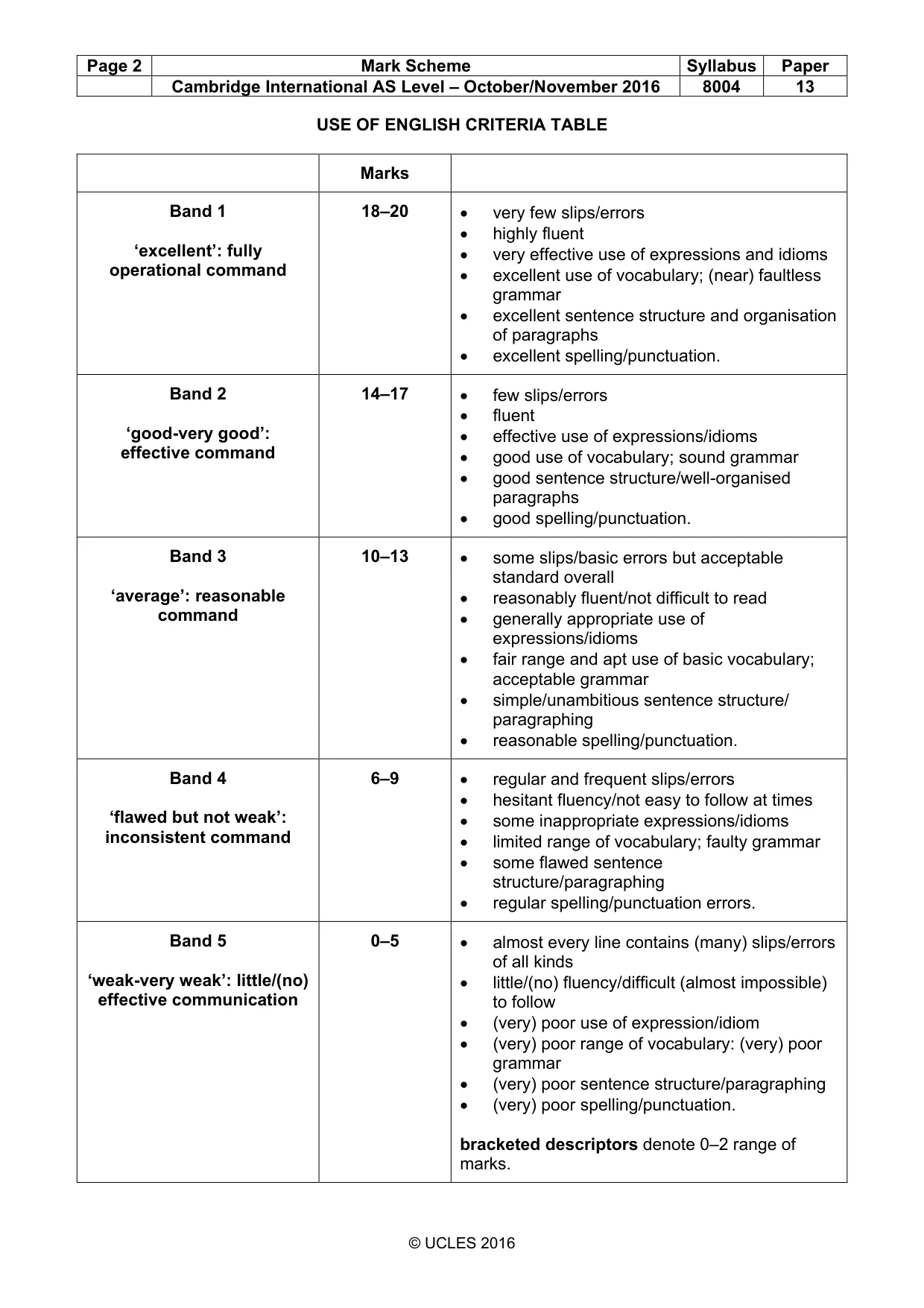
Page 2 Mark Scheme Syllabus Paper Cambridge International AS Level – October/November 2016 8004 13 © UCLES 2016 USE OF ENGLISH CRITERIA TABLE Marks Band 1 ‘excellent’: fully operational command 18–20 • very few slips/errors • highly fluent • very effective use of expressions and idioms • excellent use of vocabulary; (near) faultless grammar • excellent sentence structure and organisation of paragraphs • excellent spelling/punctuation. Band 2 ‘good-very good’: effective command 14–17 • few slips/errors • fluent • effective use of expressions/idioms • good use of vocabulary; sound grammar • good sentence structure/well-organised paragraphs • good spelling/punctuation. Band 3 ‘average’: reasonable command 10–13 • some slips/basic errors but acceptable standard overall • reasonably fluent/not difficult to read • generally appropriate use of expressions/idioms • fair range and apt use of basic vocabulary; acceptable grammar • simple/unambitious sentence structure/ paragraphing • reasonable spelling/punctuation. Band 4 ‘flawed but not weak’: inconsistent command 6–9 • regular and frequent slips/errors • hesitant fluency/not easy to follow at times • some inappropriate expressions/idioms • limited range of vocabulary; faulty grammar • some flawed sentence structure/paragraphing • regular spelling/punctuation errors. Band 5 ‘weak-very weak’: little/(no) effective communication 0–5 • almost every line contains (many) slips/errors of all kinds • little/(no) fluency/difficult (almost impossible) to follow • (very) poor use of expression/idiom • (very) poor range of vocabulary: (very) poor grammar • (very) poor sentence structure/paragraphing • (very) poor spelling/punctuation. bracketed descriptors denote 0–2 range of marks.
Mark scheme, page 3
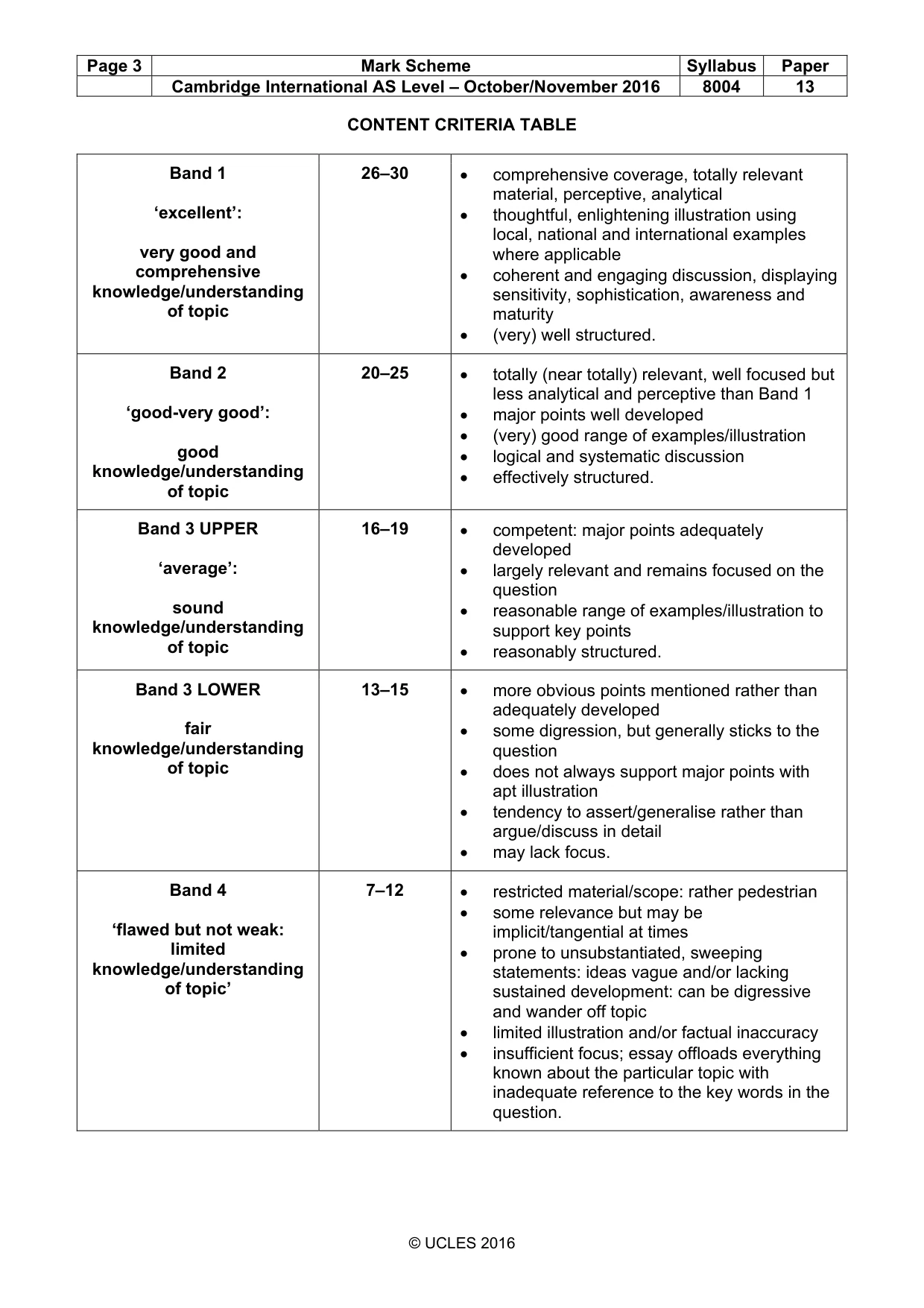
Page 3 Mark Scheme Syllabus Paper Cambridge International AS Level – October/November 2016 8004 13 © UCLES 2016 CONTENT CRITERIA TABLE Band 1 ‘excellent’: very good and comprehensive knowledge/understanding of topic 26–30 • comprehensive coverage, totally relevant material, perceptive, analytical • thoughtful, enlightening illustration using local, national and international examples where applicable • coherent and engaging discussion, displaying sensitivity, sophistication, awareness and maturity • (very) well structured. Band 2 ‘good-very good’: good knowledge/understanding of topic 20–25 • totally (near totally) relevant, well focused but less analytical and perceptive than Band 1 • major points well developed • (very) good range of examples/illustration • logical and systematic discussion • effectively structured. Band 3 UPPER ‘average’: sound knowledge/understanding of topic 16–19 • competent: major points adequately developed • largely relevant and remains focused on the question • reasonable range of examples/illustration to support key points • reasonably structured. Band 3 LOWER fair knowledge/understanding of topic 13–15 • more obvious points mentioned rather than adequately developed • some digression, but generally sticks to the question • does not always support major points with apt illustration • tendency to assert/generalise rather than argue/discuss in detail • may lack focus. Band 4 ‘flawed but not weak: limited knowledge/understanding of topic’ 7–12 • restricted material/scope: rather pedestrian • some relevance but may be implicit/tangential at times • prone to unsubstantiated, sweeping statements: ideas vague and/or lacking sustained development: can be digressive and wander off topic • limited illustration and/or factual inaccuracy • insufficient focus; essay offloads everything known about the particular topic with inadequate reference to the key words in the question.
Mark scheme, page 4
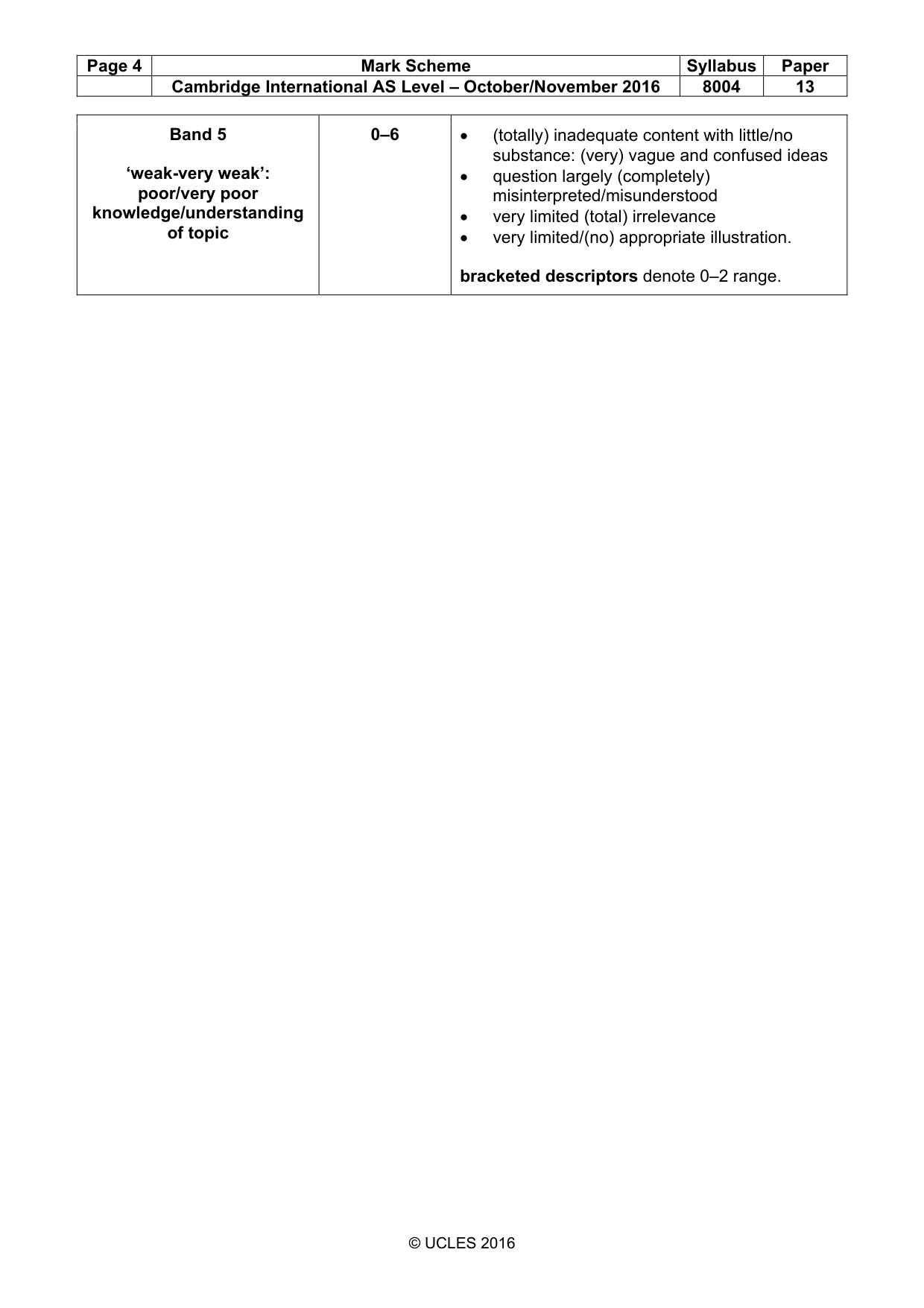
Page 4 Mark Scheme Syllabus Paper Cambridge International AS Level – October/November 2016 8004 13 © UCLES 2016 Band 5 ‘weak-very weak’: poor/very poor knowledge/understanding of topic 0–6 • (totally) inadequate content with little/no substance: (very) vague and confused ideas • question largely (completely) misinterpreted/misunderstood • very limited (total) irrelevance • very limited/(no) appropriate illustration. bracketed descriptors denote 0–2 range.
Mark scheme, page 5
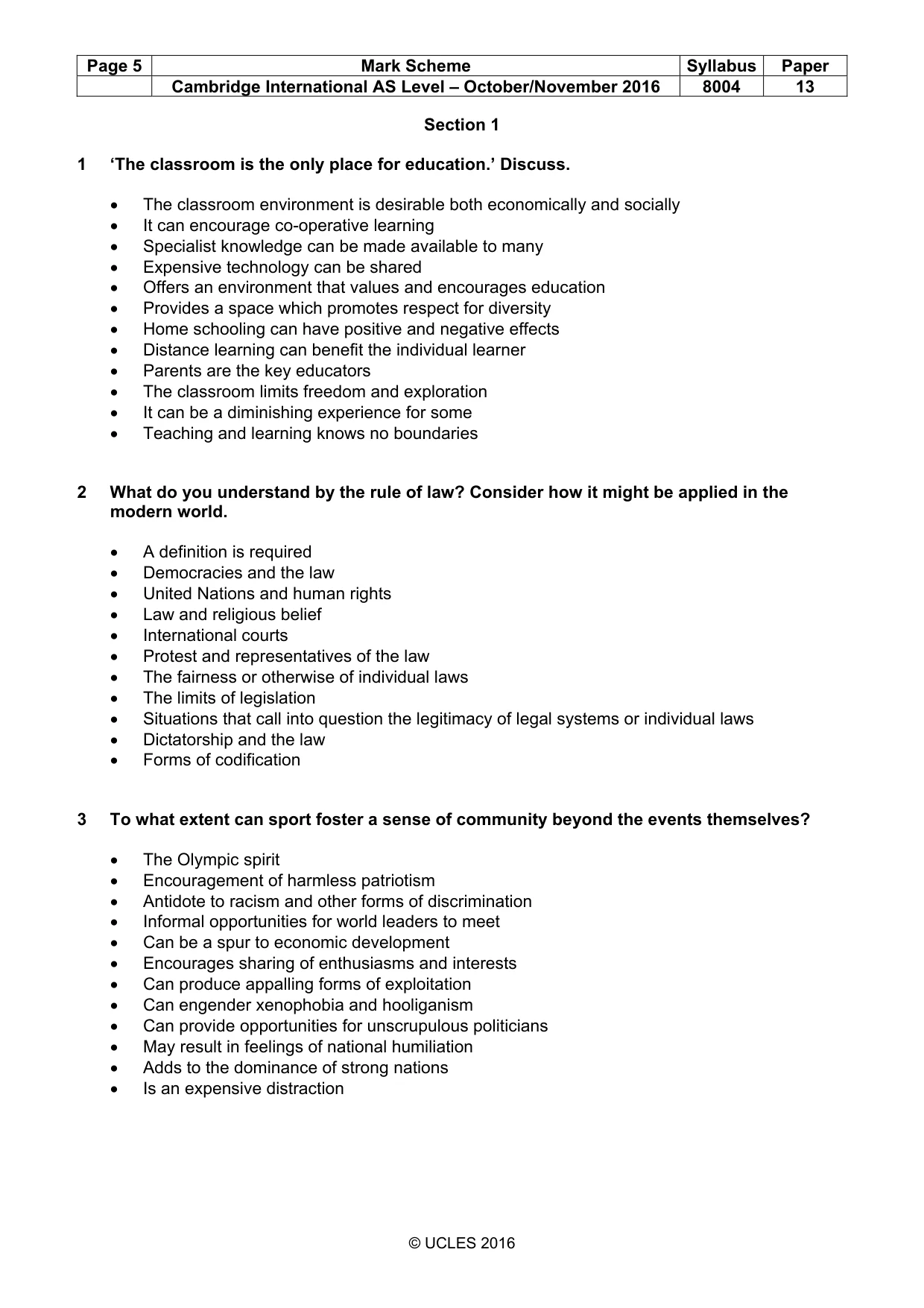
Page 5 Mark Scheme Syllabus Paper Cambridge International AS Level – October/November 2016 8004 13 © UCLES 2016 Section 1 1 ‘The classroom is the only place for education.’ Discuss. • The classroom environment is desirable both economically and socially • It can encourage co-operative learning • Specialist knowledge can be made available to many • Expensive technology can be shared • Offers an environment that values and encourages education • Provides a space which promotes respect for diversity • Home schooling can have positive and negative effects • Distance learning can benefit the individual learner • Parents are the key educators • The classroom limits freedom and exploration • It can be a diminishing experience for some • Teaching and learning knows no boundaries 2 What do you understand by the rule of law? Consider how it might be applied in the modern world. • A definition is required • Democracies and the law • United Nations and human rights • Law and religious belief • International courts • Protest and representatives of the law • The fairness or otherwise of individual laws • The limits of legislation • Situations that call into question the legitimacy of legal systems or individual laws • Dictatorship and the law • Forms of codification 3 To what extent can sport foster a sense of community beyond the events themselves? • The Olympic spirit • Encouragement of harmless patriotism • Antidote to racism and other forms of discrimination • Informal opportunities for world leaders to meet • Can be a spur to economic development • Encourages sharing of enthusiasms and interests • Can produce appalling forms of exploitation • Can engender xenophobia and hooliganism • Can provide opportunities for unscrupulous politicians • May result in feelings of national humiliation • Adds to the dominance of strong nations • Is an expensive distraction
Mark scheme, page 6
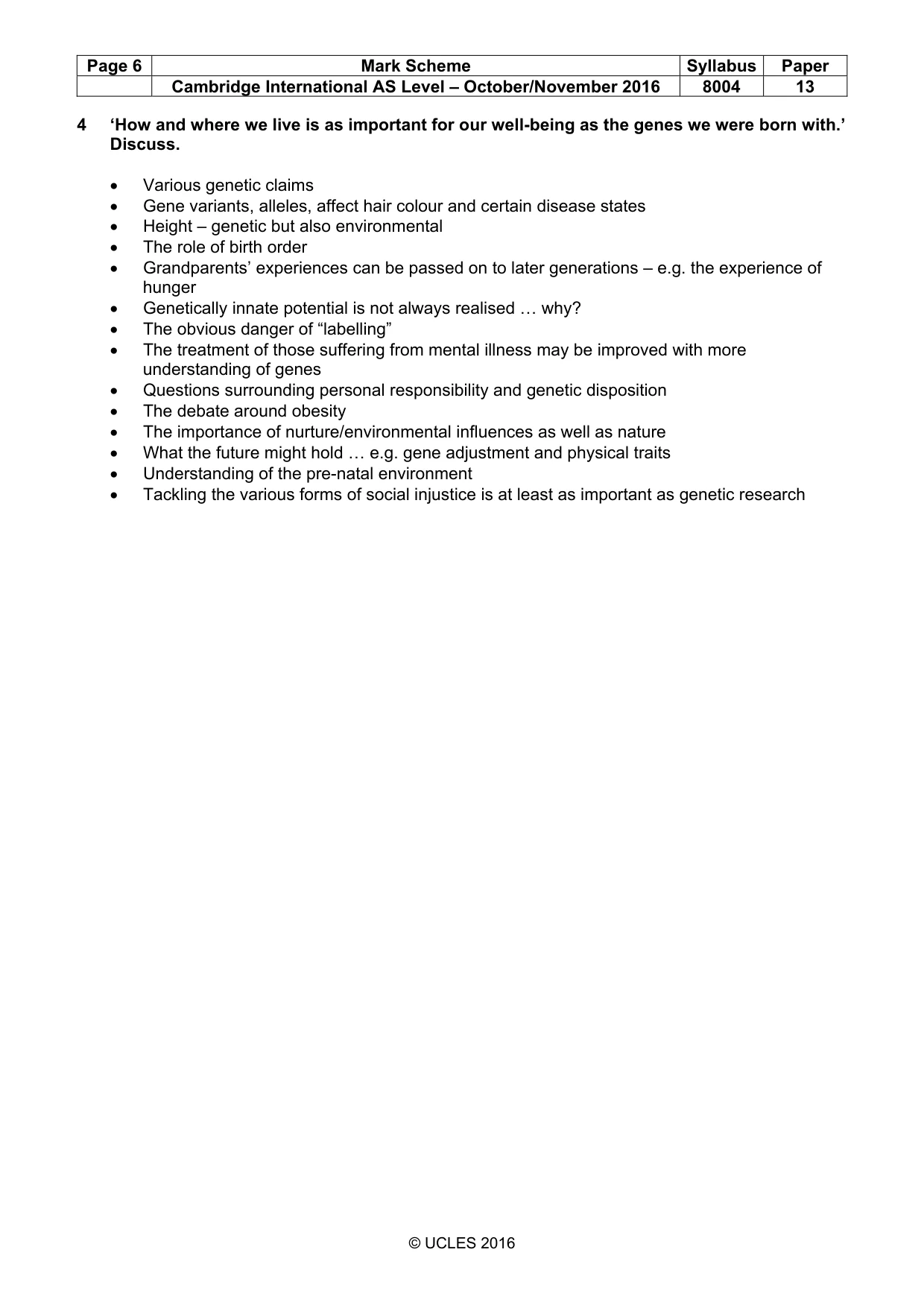
Page 6 Mark Scheme Syllabus Paper Cambridge International AS Level – October/November 2016 8004 13 © UCLES 2016 4 ‘How and where we live is as important for our well-being as the genes we were born with.’ Discuss. • Various genetic claims • Gene variants, alleles, affect hair colour and certain disease states • Height – genetic but also environmental • The role of birth order • Grandparents’ experiences can be passed on to later generations – e.g. the experience of hunger • Genetically innate potential is not always realised … why? • The obvious danger of “labelling” • The treatment of those suffering from mental illness may be improved with more understanding of genes • Questions surrounding personal responsibility and genetic disposition • The debate around obesity • The importance of nurture/environmental influences as well as nature • What the future might hold … e.g. gene adjustment and physical traits • Understanding of the pre-natal environment • Tackling the various forms of social injustice is at least as important as genetic research
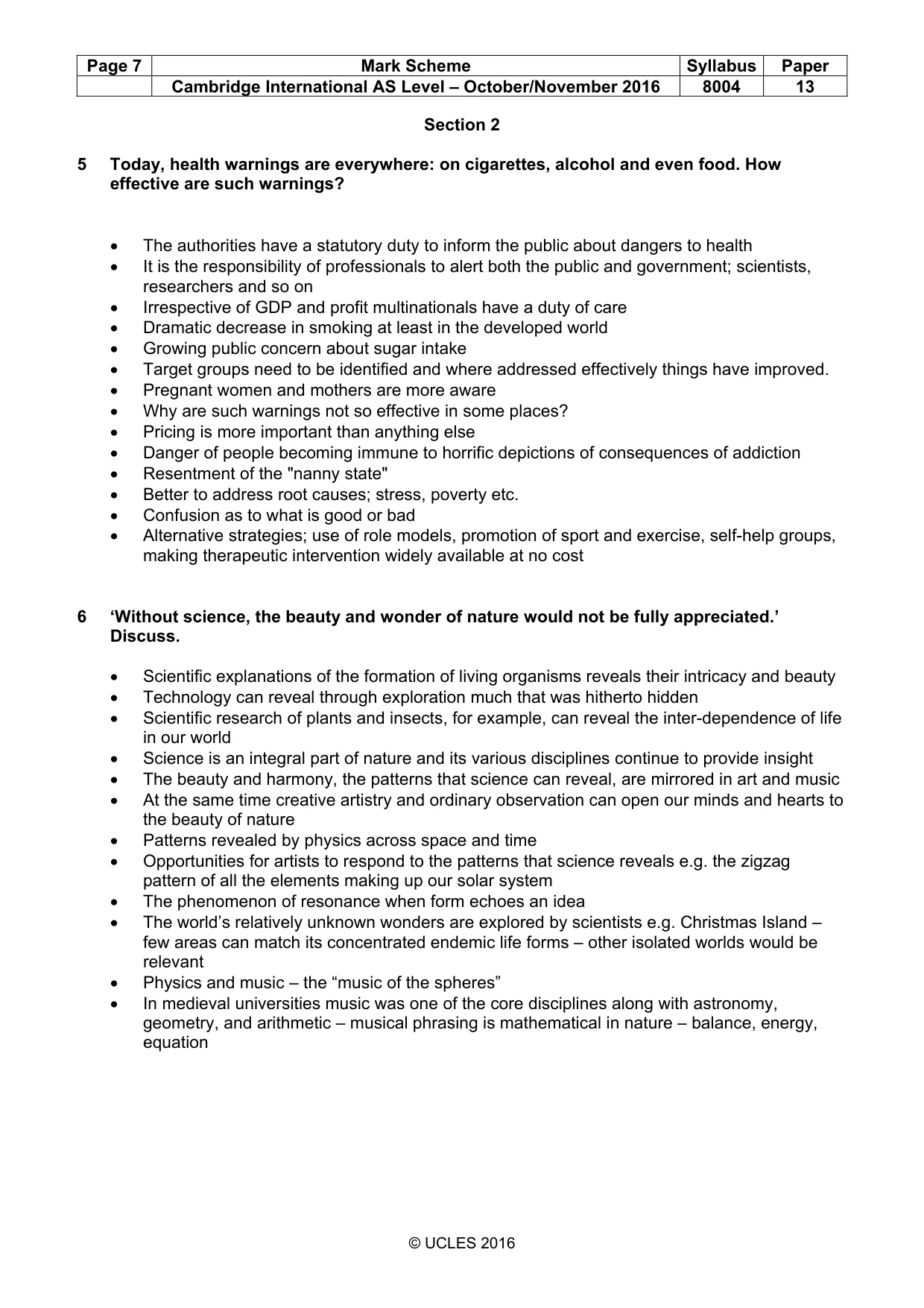
Mark scheme, page 7
Page 7 Mark Scheme Syllabus Paper Cambridge International AS Level – October/November 2016 8004 13 © UCLES 2016 Section 2 5 Today, health warnings are everywhere: on cigarettes, alcohol and even food. How effective are such warnings? • The authorities have a statutory duty to inform the public about dangers to health • It is the responsibility of professionals to alert both the public and government; scientists, researchers and so on • Irrespective of GDP and profit multinationals have a duty of care • Dramatic decrease in smoking at least in the developed world • Growing public concern about sugar intake • Target groups need to be identified and where addressed effectively things have improved. • Pregnant women and mothers are more aware • Why are such warnings not so effective in some places? • Pricing is more important than anything else • Danger of people becoming immune to horrific depictions of consequences of addiction • Resentment of the "nanny state" • Better to address root causes; stress, poverty etc. • Confusion as to what is good or bad • Alternative strategies; use of role models, promotion of sport and exercise, self-help groups, making therapeutic intervention widely available at no cost 6 ‘Without science, the beauty and wonder of nature would not be fully appreciated.’ Discuss. • Scientific explanations of the formation of living organisms reveals their intricacy and beauty • Technology can reveal through exploration much that was hitherto hidden • Scientific research of plants and insects, for example, can reveal the inter-dependence of life in our world • Science is an integral part of nature and its various disciplines continue to provide insight • The beauty and harmony, the patterns that science can reveal, are mirrored in art and music • At the same time creative artistry and ordinary observation can open our minds and hearts to the beauty of nature • Patterns revealed by physics across space and time • Opportunities for artists to respond to the patterns that science reveals e.g. the zigzag pattern of all the elements making up our solar system • The phenomenon of resonance when form echoes an idea • The world’s relatively unknown wonders are explored by scientists e.g. Christmas Island – few areas can match its concentrated endemic life forms – other isolated worlds would be relevant • Physics and music – the “music of the spheres” • In medieval universities music was one of the core disciplines along with astronomy, geometry, and arithmetic – musical phrasing is mathematical in nature – balance, energy, equation
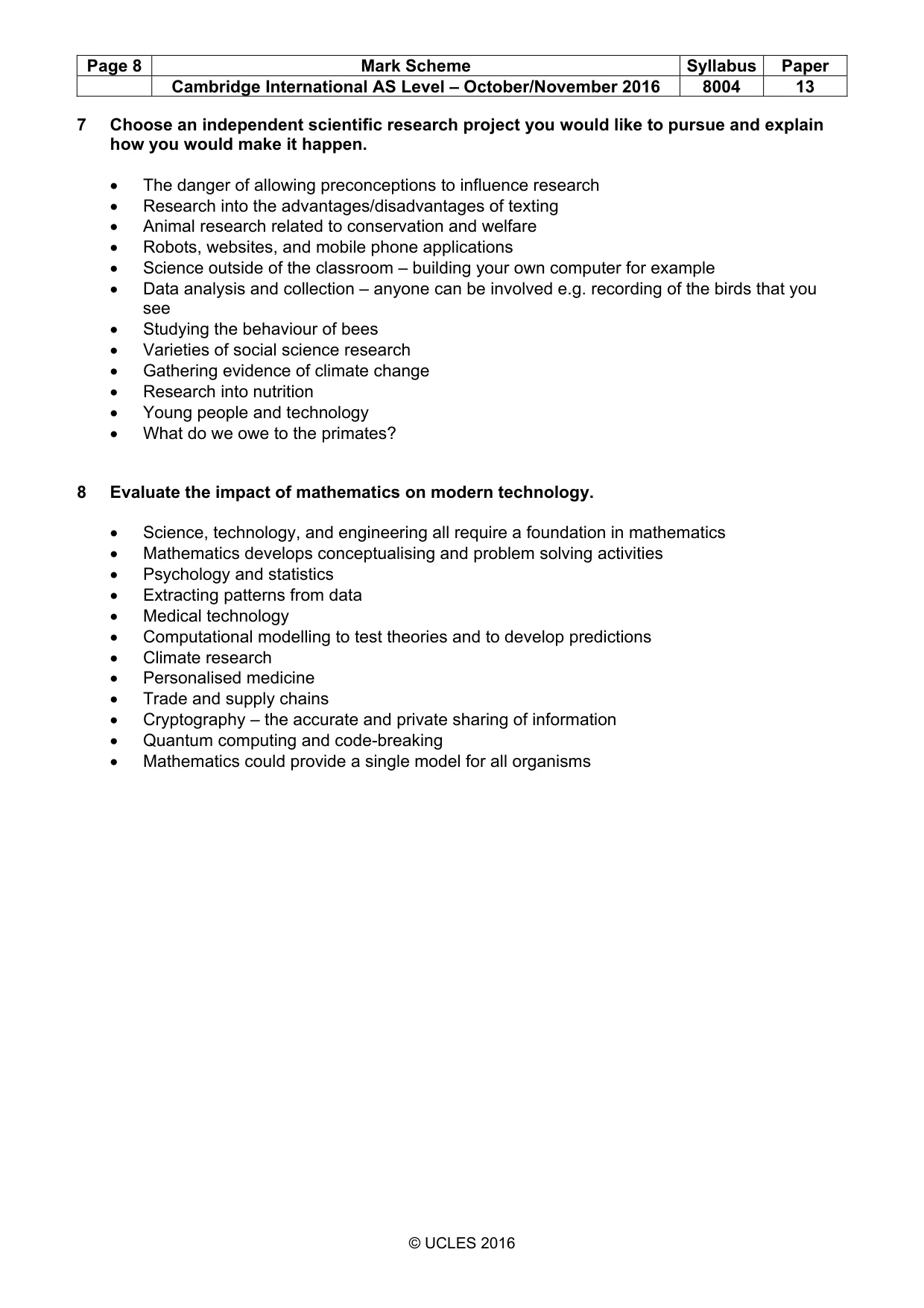
Mark scheme, page 8
Page 8 Mark Scheme Syllabus Paper Cambridge International AS Level – October/November 2016 8004 13 © UCLES 2016 7 Choose an independent scientific research project you would like to pursue and explain how you would make it happen. • The danger of allowing preconceptions to influence research • Research into the advantages/disadvantages of texting • Animal research related to conservation and welfare • Robots, websites, and mobile phone applications • Science outside of the classroom – building your own computer for example • Data analysis and collection – anyone can be involved e.g. recording of the birds that you see • Studying the behaviour of bees • Varieties of social science research • Gathering evidence of climate change • Research into nutrition • Young people and technology • What do we owe to the primates? 8 Evaluate the impact of mathematics on modern technology. • Science, technology, and engineering all require a foundation in mathematics • Mathematics develops conceptualising and problem solving activities • Psychology and statistics • Extracting patterns from data • Medical technology • Computational modelling to test theories and to develop predictions • Climate research • Personalised medicine • Trade and supply chains • Cryptography – the accurate and private sharing of information • Quantum computing and code-breaking • Mathematics could provide a single model for all organisms
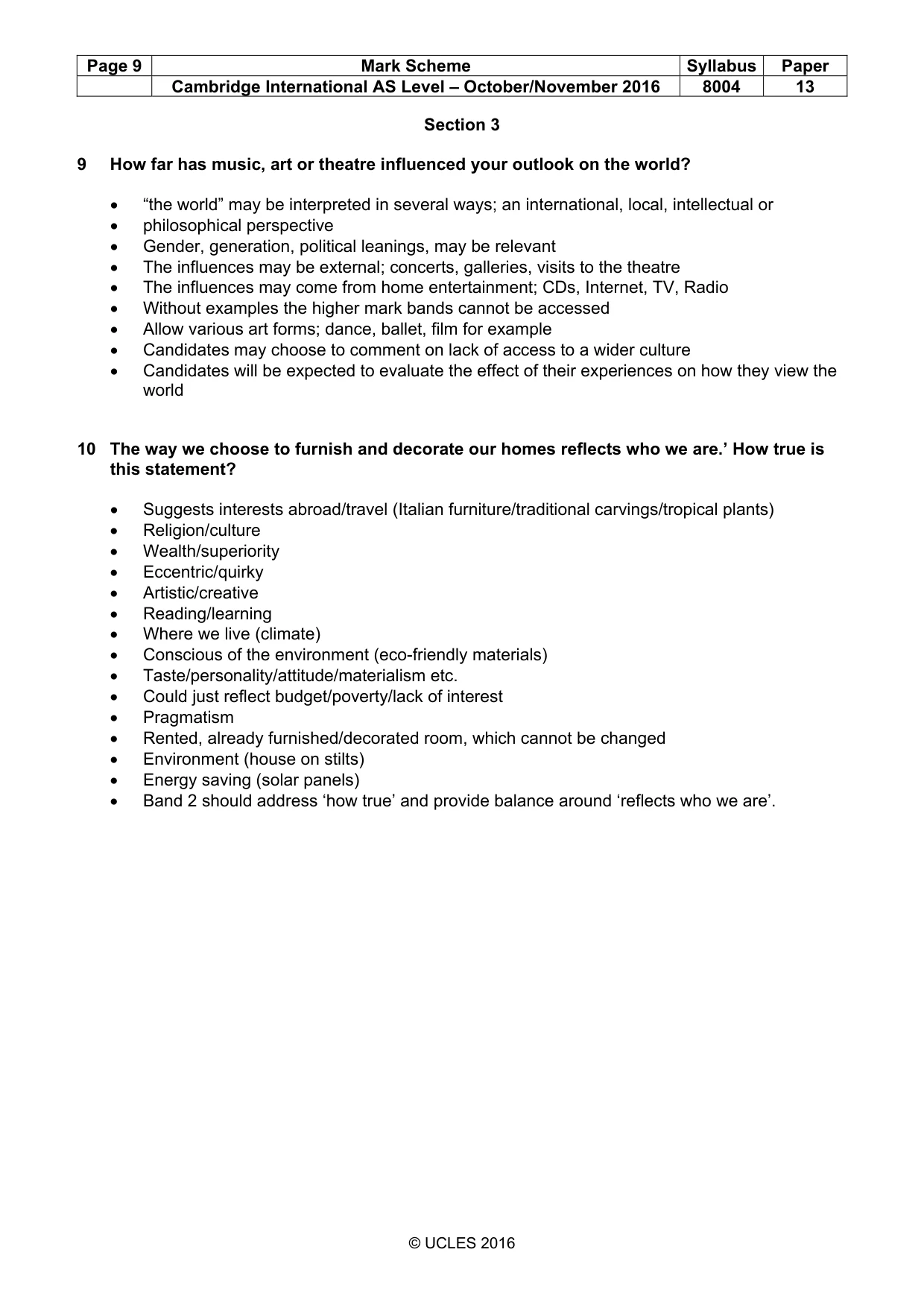
Mark scheme, page 9
Page 9 Mark Scheme Syllabus Paper Cambridge International AS Level – October/November 2016 8004 13 © UCLES 2016 Section 3 9 How far has music, art or theatre influenced your outlook on the world? • “the world” may be interpreted in several ways; an international, local, intellectual or • philosophical perspective • Gender, generation, political leanings, may be relevant • The influences may be external; concerts, galleries, visits to the theatre • The influences may come from home entertainment; CDs, Internet, TV, Radio • Without examples the higher mark bands cannot be accessed • Allow various art forms; dance, ballet, film for example • Candidates may choose to comment on lack of access to a wider culture • Candidates will be expected to evaluate the effect of their experiences on how they view the world 10 The way we choose to furnish and decorate our homes reflects who we are.’ How true is this statement? • Suggests interests abroad/travel (Italian furniture/traditional carvings/tropical plants) • Religion/culture • Wealth/superiority • Eccentric/quirky • Artistic/creative • Reading/learning • Where we live (climate) • Conscious of the environment (eco-friendly materials) • Taste/personality/attitude/materialism etc. • Could just reflect budget/poverty/lack of interest • Pragmatism • Rented, already furnished/decorated room, which cannot be changed • Environment (house on stilts) • Energy saving (solar panels) • Band 2 should address ‘how true’ and provide balance around ‘reflects who we are’.
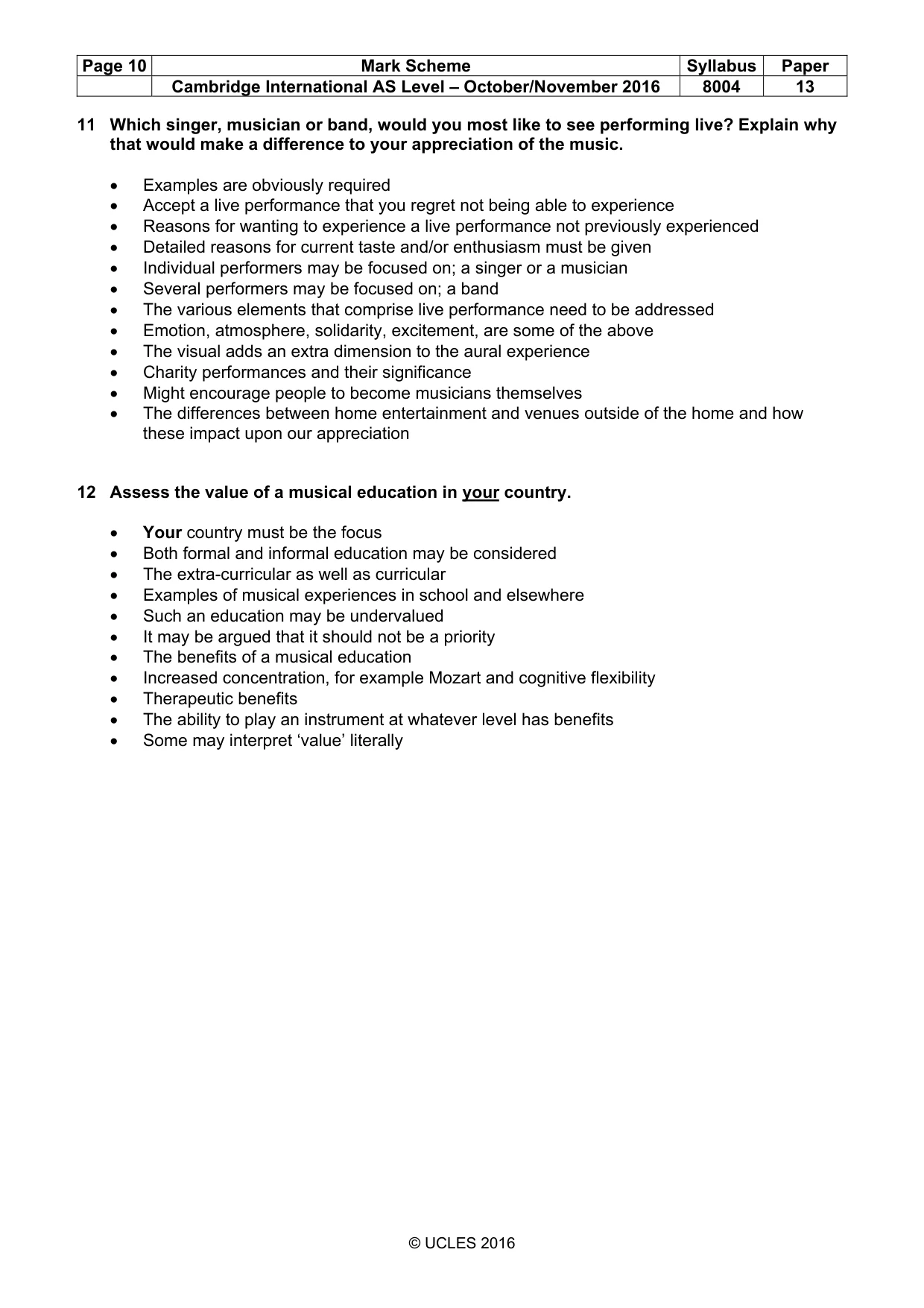
Mark scheme, page 10
Page 10 Mark Scheme Syllabus Paper Cambridge International AS Level – October/November 2016 8004 13 © UCLES 2016 11 Which singer, musician or band, would you most like to see performing live? Explain why that would make a difference to your appreciation of the music. • Examples are obviously required • Accept a live performance that you regret not being able to experience • Reasons for wanting to experience a live performance not previously experienced • Detailed reasons for current taste and/or enthusiasm must be given • Individual performers may be focused on; a singer or a musician • Several performers may be focused on; a band • The various elements that comprise live performance need to be addressed • Emotion, atmosphere, solidarity, excitement, are some of the above • The visual adds an extra dimension to the aural experience • Charity performances and their significance • Might encourage people to become musicians themselves • The differences between home entertainment and venues outside of the home and how these impact upon our appreciation 12 Assess the value of a musical education in your country. • Your country must be the focus • Both formal and informal education may be considered • The extra-curricular as well as curricular • Examples of musical experiences in school and elsewhere • Such an education may be undervalued • It may be argued that it should not be a priority • The benefits of a musical education • Increased concentration, for example Mozart and cognitive flexibility • Therapeutic benefits • The ability to play an instrument at whatever level has benefits • Some may interpret ‘value’ literally
What you needed in this session
Cambridge’s own grade thresholds for 2016 Oct/Nov, Paper 1 · Variant 3. A higher threshold means an easier paper — the bar moves with how the cohort did.