Cambridge A Level General Paper (AS Level only) 8004 — 2016 May/June Paper 1 · Variant 3
8004/13/M/J/16 · 100 marks · ≈113 min
The question paper and its mark scheme, free to read here and free to download. This is Cambridge’s own paper, exactly as it was sat.
Question paper4 pages

Mark scheme8 pages
Answers below. Sit the paper first if you are practising.
Paper as text
Question paper, page 1
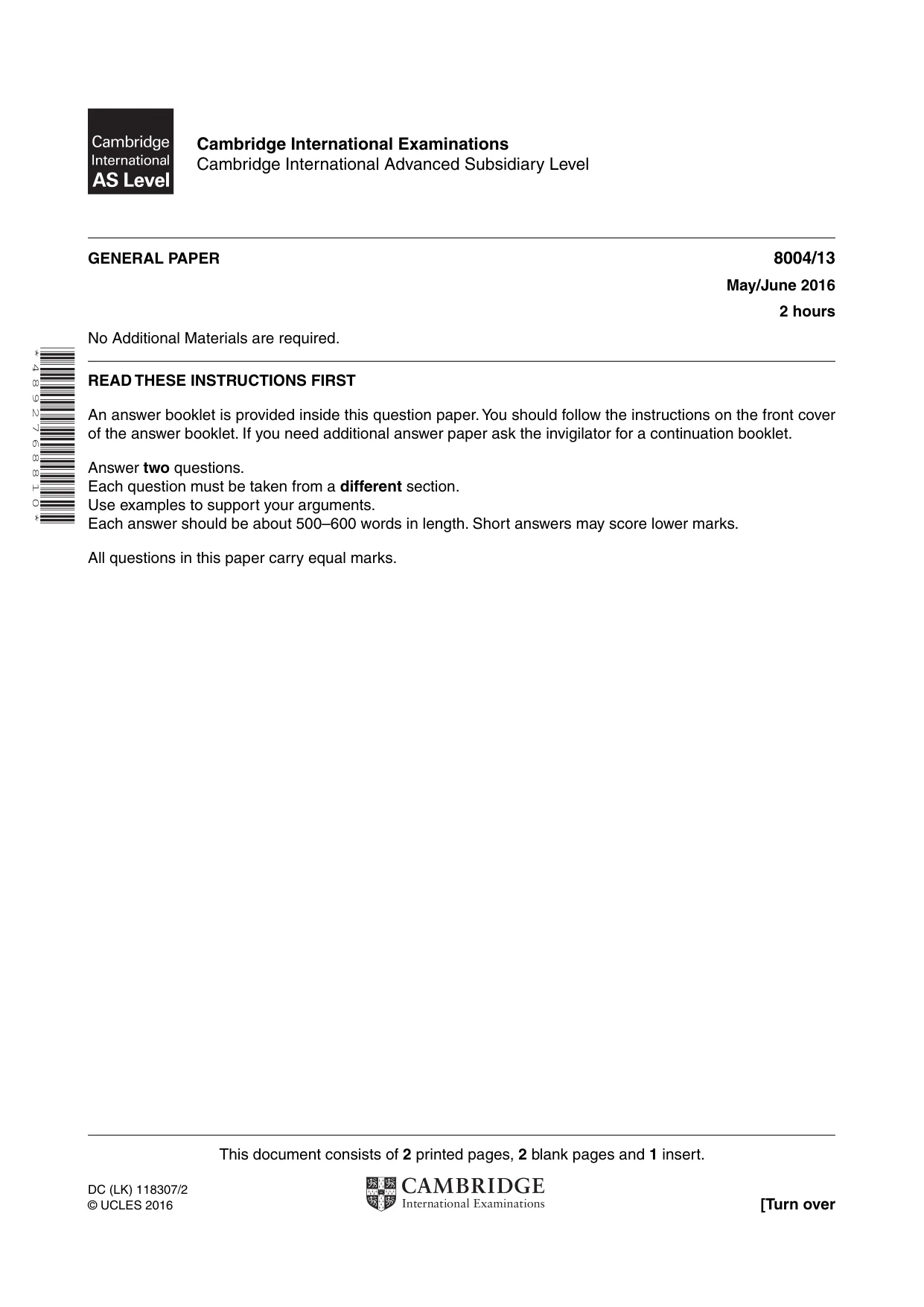
This document consists of 2 printed pages, 2 blank pages and 1 insert. DC (LK) 118307/2 © UCLES 2016 [Turn over Cambridge International Examinations Cambridge International Advanced Subsidiary Level * 4 8 9 2 7 6 8 8 1 0 * GENERAL PAPER 8004/13 May/June 2016 2 hours No Additional Materials are required. READ THESE INSTRUCTIONS FIRST An answer booklet is provided inside this question paper. You should follow the instructions on the front cover of the answer booklet. If you need additional answer paper ask the invigilator for a continuation booklet. Answer two questions. Each question must be taken from a different section. Use examples to support your arguments. Each answer should be about 500–600 words in length. Short answers may score lower marks. All questions in this paper carry equal marks.
Question paper, page 2
2 8004/13/M/J/16 © UCLES 2016 BLANK PAGE
Question paper, page 3
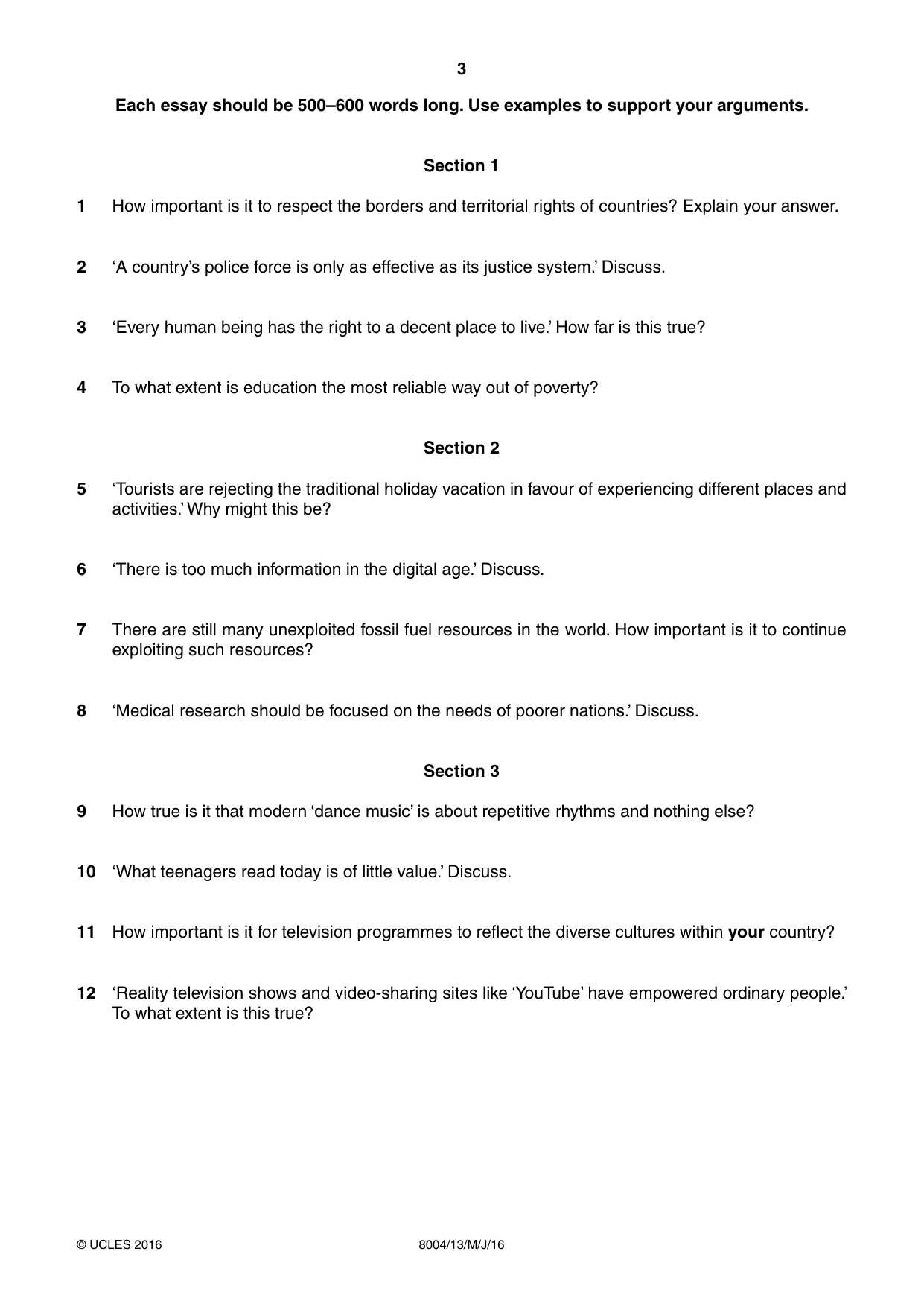
3 8004/13/M/J/16 © UCLES 2016 Each essay should be 500–600 words long. Use examples to support your arguments. Section 1 1 How important is it to respect the borders and territorial rights of countries? Explain your answer. 2 ‘A country’s police force is only as effective as its justice system.’ Discuss. 3 ‘Every human being has the right to a decent place to live.’ How far is this true? 4 To what extent is education the most reliable way out of poverty? Section 2 5 ‘Tourists are rejecting the traditional holiday vacation in favour of experiencing different places and activities.’ Why might this be? 6 ‘There is too much information in the digital age.’ Discuss. 7 There are still many unexploited fossil fuel resources in the world. How important is it to continue exploiting such resources? 8 ‘Medical research should be focused on the needs of poorer nations.’ Discuss. Section 3 9 How true is it that modern ‘dance music’ is about repetitive rhythms and nothing else? 10 ‘What teenagers read today is of little value.’ Discuss. 11 How important is it for television programmes to reflect the diverse cultures within your country? 12 ‘Reality television shows and video-sharing sites like ‘YouTube’ have empowered ordinary people.’ To what extent is this true?
Question paper, page 4
4 8004/13/M/J/16 © UCLES 2016 BLANK PAGE Permission to reproduce items where third-party owned material protected by copyright is included has been sought and cleared where possible. Every reasonable effort has been made by the publisher (UCLES) to trace copyright holders, but if any items requiring clearance have unwittingly been included, the publisher will be pleased to make amends at the earliest possible opportunity. To avoid the issue of disclosure of answer-related information to candidates, all copyright acknowledgements are reproduced online in the Cambridge International Examinations Copyright Acknowledgements Booklet. This is produced for each series of examinations and is freely available to download at www.cie.org.uk after the live examination series. Cambridge International Examinations is part of the Cambridge Assessment Group. Cambridge Assessment is the brand name of University of Cambridge Local Examinations Syndicate (UCLES), which is itself a department of the University of Cambridge.
Mark scheme, page 1
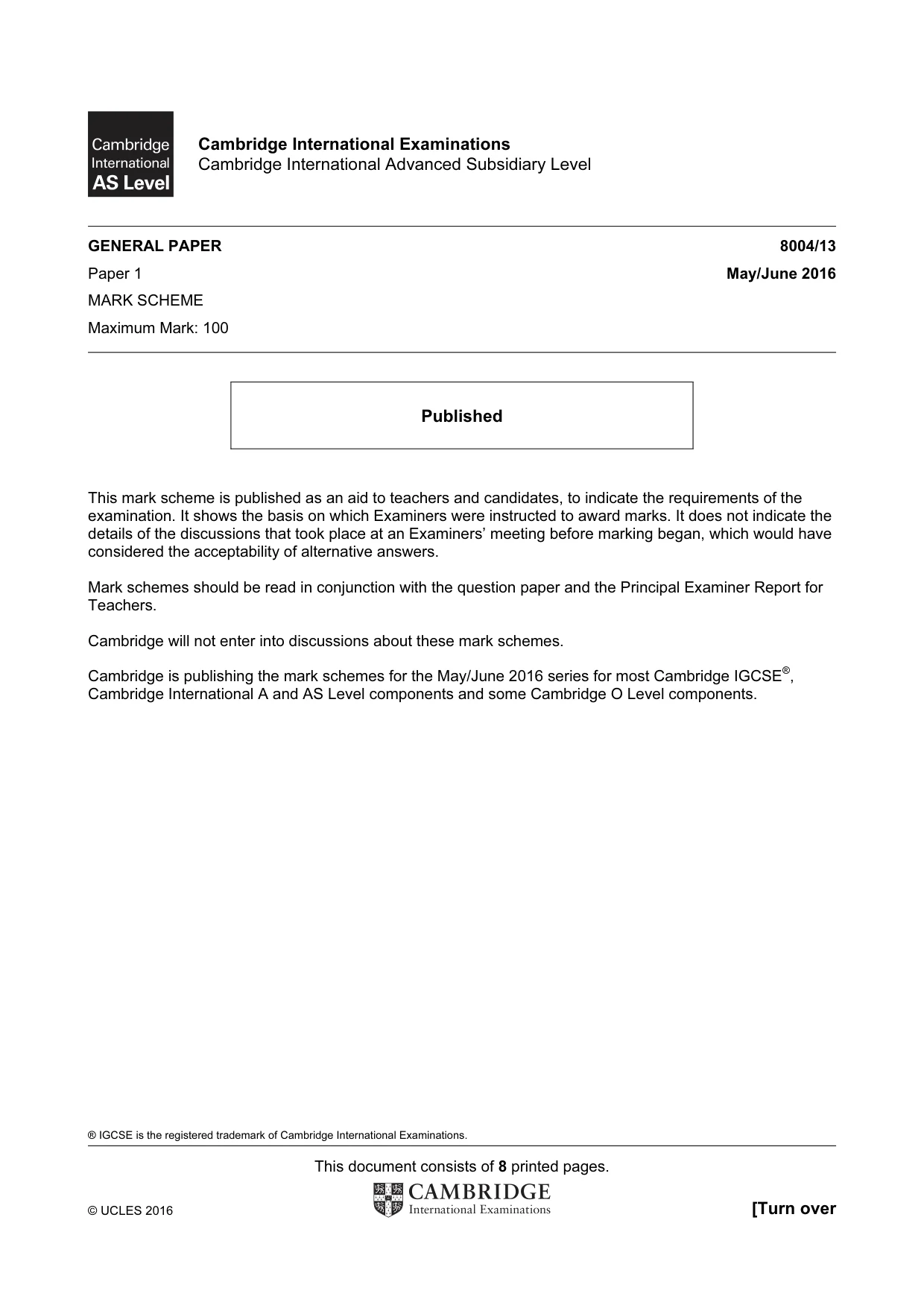
® IGCSE is the registered trademark of Cambridge International Examinations. This document consists of 8 printed pages. © UCLES 2016 [Turn over Cambridge International Examinations Cambridge International Advanced Subsidiary Level GENERAL PAPER 8004/13 Paper 1 May/June 2016 MARK SCHEME Maximum Mark: 100 Published This mark scheme is published as an aid to teachers and candidates, to indicate the requirements of the examination. It shows the basis on which Examiners were instructed to award marks. It does not indicate the details of the discussions that took place at an Examiners’ meeting before marking began, which would have considered the acceptability of alternative answers. Mark schemes should be read in conjunction with the question paper and the Principal Examiner Report for Teachers. Cambridge will not enter into discussions about these mark schemes. Cambridge is publishing the mark schemes for the May/June 2016 series for most Cambridge IGCSE®, Cambridge International A and AS Level components and some Cambridge O Level components.
Mark scheme, page 2
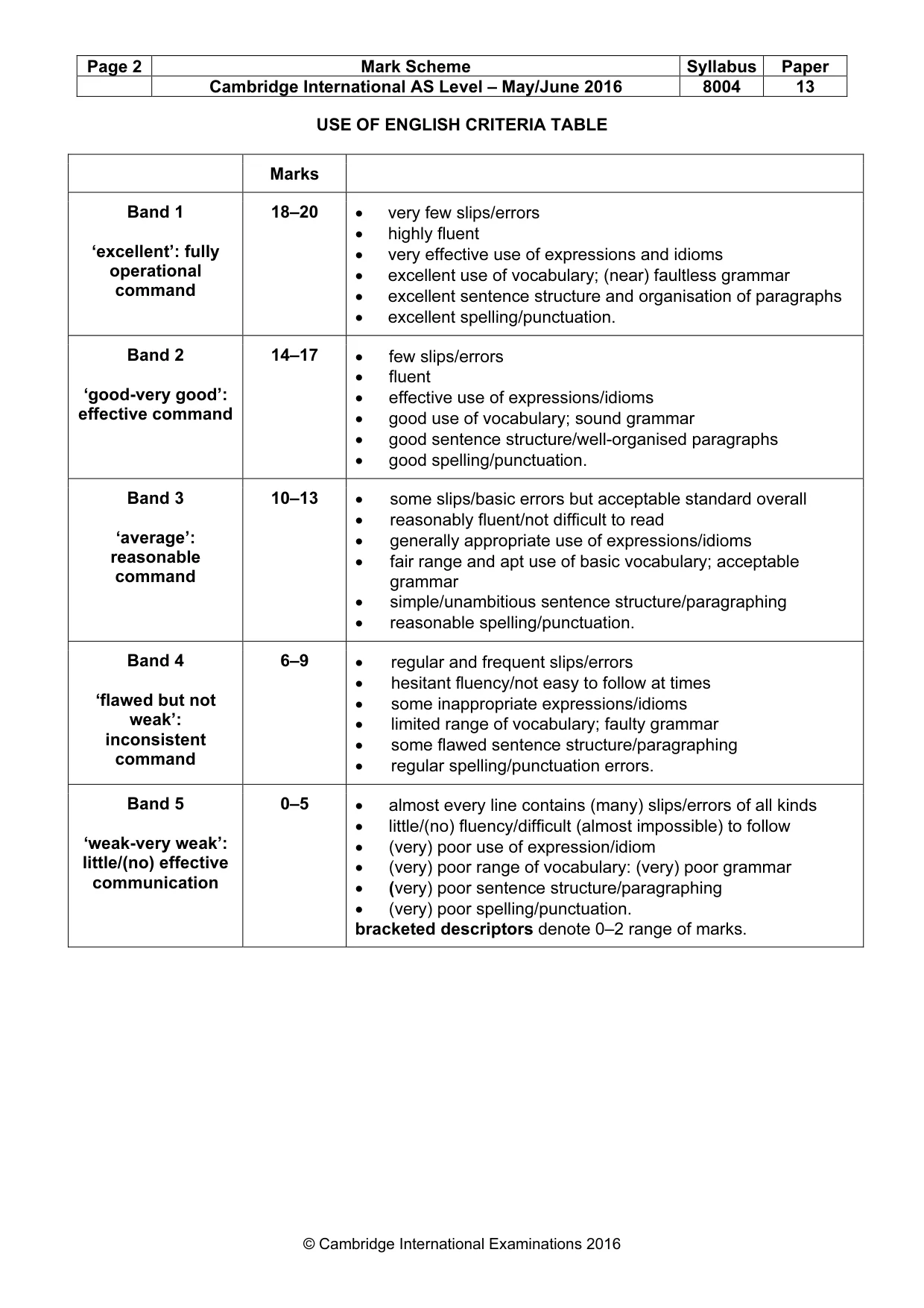
Page 2 Mark Scheme Syllabus Paper Cambridge International AS Level – May/June 2016 8004 13 © Cambridge International Examinations 2016 USE OF ENGLISH CRITERIA TABLE Marks Band 1 ‘excellent’: fully operational command 18–20 • very few slips/errors • highly fluent • very effective use of expressions and idioms • excellent use of vocabulary; (near) faultless grammar • excellent sentence structure and organisation of paragraphs • excellent spelling/punctuation. Band 2 ‘good-very good’: effective command 14–17 • few slips/errors • fluent • effective use of expressions/idioms • good use of vocabulary; sound grammar • good sentence structure/well-organised paragraphs • good spelling/punctuation. Band 3 ‘average’: reasonable command 10–13 • some slips/basic errors but acceptable standard overall • reasonably fluent/not difficult to read • generally appropriate use of expressions/idioms • fair range and apt use of basic vocabulary; acceptable grammar • simple/unambitious sentence structure/paragraphing • reasonable spelling/punctuation. Band 4 ‘flawed but not weak’: inconsistent command 6–9 • regular and frequent slips/errors • hesitant fluency/not easy to follow at times • some inappropriate expressions/idioms • limited range of vocabulary; faulty grammar • some flawed sentence structure/paragraphing • regular spelling/punctuation errors. Band 5 ‘weak-very weak’: little/(no) effective communication 0–5 • almost every line contains (many) slips/errors of all kinds • little/(no) fluency/difficult (almost impossible) to follow • (very) poor use of expression/idiom • (very) poor range of vocabulary: (very) poor grammar • (very) poor sentence structure/paragraphing • (very) poor spelling/punctuation. bracketed descriptors denote 0–2 range of marks.
Mark scheme, page 3
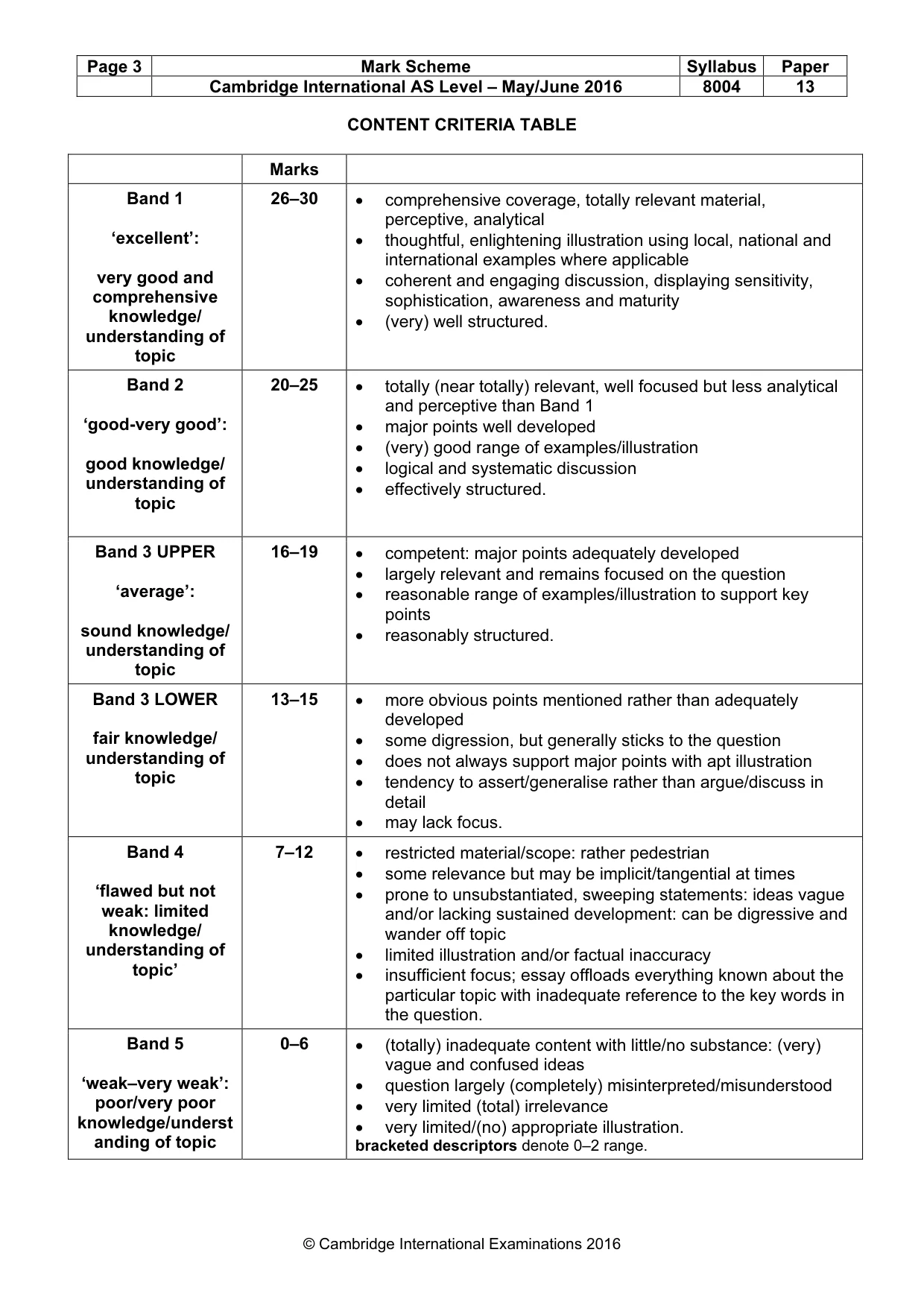
Page 3 Mark Scheme Syllabus Paper Cambridge International AS Level – May/June 2016 8004 13 © Cambridge International Examinations 2016 CONTENT CRITERIA TABLE Marks Band 1 ‘excellent’: very good and comprehensive knowledge/ understanding of topic 26–30 • comprehensive coverage, totally relevant material, perceptive, analytical • thoughtful, enlightening illustration using local, national and international examples where applicable • coherent and engaging discussion, displaying sensitivity, sophistication, awareness and maturity • (very) well structured. Band 2 ‘good-very good’: good knowledge/ understanding of topic 20–25 • totally (near totally) relevant, well focused but less analytical and perceptive than Band 1 • major points well developed • (very) good range of examples/illustration • logical and systematic discussion • effectively structured. Band 3 UPPER ‘average’: sound knowledge/ understanding of topic 16–19 • competent: major points adequately developed • largely relevant and remains focused on the question • reasonable range of examples/illustration to support key points • reasonably structured. Band 3 LOWER fair knowledge/ understanding of topic 13–15 • more obvious points mentioned rather than adequately developed • some digression, but generally sticks to the question • does not always support major points with apt illustration • tendency to assert/generalise rather than argue/discuss in detail • may lack focus. Band 4 ‘flawed but not weak: limited knowledge/ understanding of topic’ 7–12 • restricted material/scope: rather pedestrian • some relevance but may be implicit/tangential at times • prone to unsubstantiated, sweeping statements: ideas vague and/or lacking sustained development: can be digressive and wander off topic • limited illustration and/or factual inaccuracy • insufficient focus; essay offloads everything known about the particular topic with inadequate reference to the key words in the question. Band 5 ‘weak–very weak’: poor/very poor knowledge/underst anding of topic 0–6 • (totally) inadequate content with little/no substance: (very) vague and confused ideas • question largely (completely) misinterpreted/misunderstood • very limited (total) irrelevance • very limited/(no) appropriate illustration. bracketed descriptors denote 0–2 range.
Mark scheme, page 4
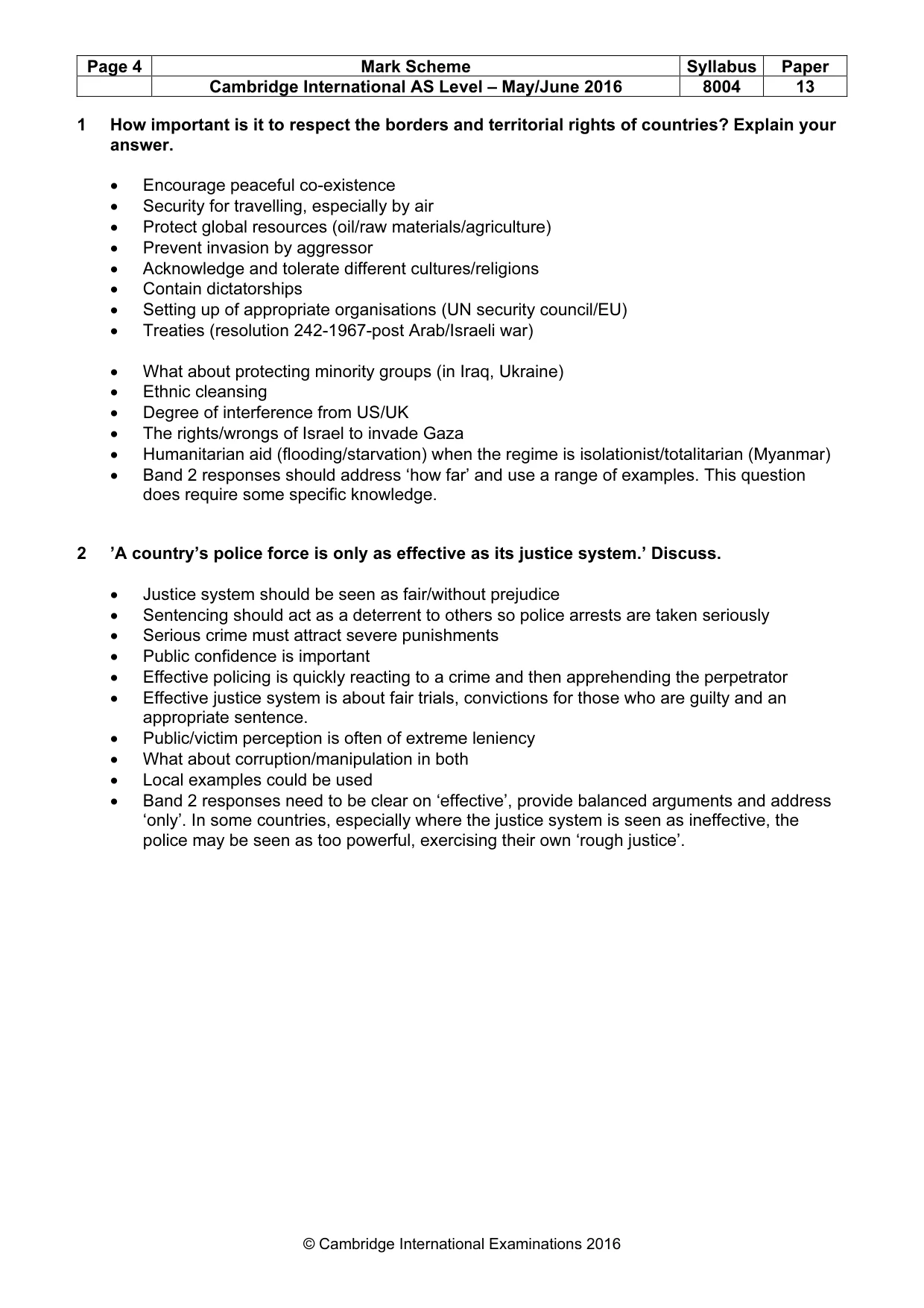
Page 4 Mark Scheme Syllabus Paper Cambridge International AS Level – May/June 2016 8004 13 © Cambridge International Examinations 2016 1 How important is it to respect the borders and territorial rights of countries? Explain your answer. • Encourage peaceful co-existence • Security for travelling, especially by air • Protect global resources (oil/raw materials/agriculture) • Prevent invasion by aggressor • Acknowledge and tolerate different cultures/religions • Contain dictatorships • Setting up of appropriate organisations (UN security council/EU) • Treaties (resolution 242-1967-post Arab/Israeli war) • What about protecting minority groups (in Iraq, Ukraine) • Ethnic cleansing • Degree of interference from US/UK • The rights/wrongs of Israel to invade Gaza • Humanitarian aid (flooding/starvation) when the regime is isolationist/totalitarian (Myanmar) • Band 2 responses should address ‘how far’ and use a range of examples. This question does require some specific knowledge. 2 ’A country’s police force is only as effective as its justice system.’ Discuss. • Justice system should be seen as fair/without prejudice • Sentencing should act as a deterrent to others so police arrests are taken seriously • Serious crime must attract severe punishments • Public confidence is important • Effective policing is quickly reacting to a crime and then apprehending the perpetrator • Effective justice system is about fair trials, convictions for those who are guilty and an appropriate sentence. • Public/victim perception is often of extreme leniency • What about corruption/manipulation in both • Local examples could be used • Band 2 responses need to be clear on ‘effective’, provide balanced arguments and address ‘only’. In some countries, especially where the justice system is seen as ineffective, the police may be seen as too powerful, exercising their own ‘rough justice’.
Mark scheme, page 5
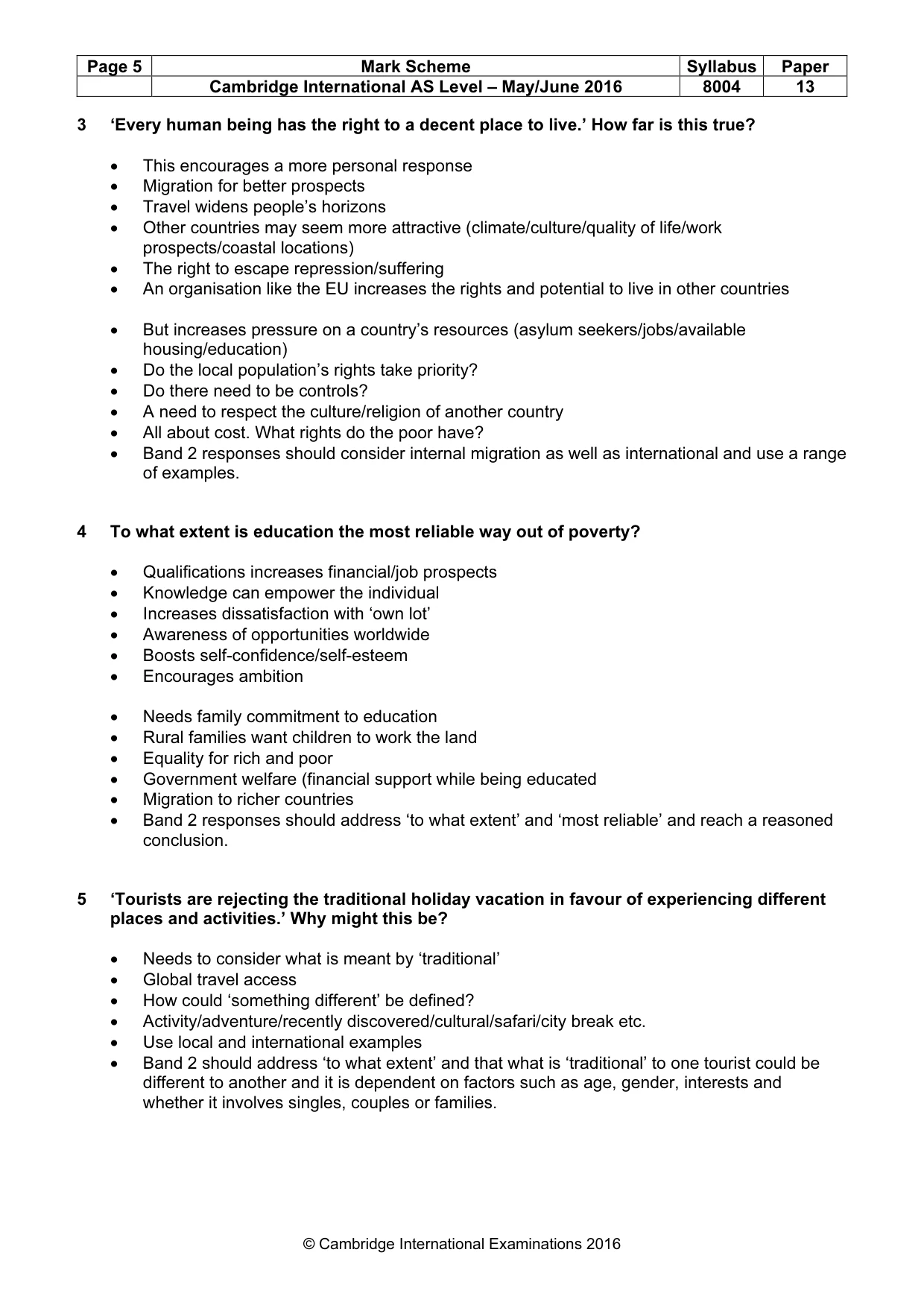
Page 5 Mark Scheme Syllabus Paper Cambridge International AS Level – May/June 2016 8004 13 © Cambridge International Examinations 2016 3 ‘Every human being has the right to a decent place to live.’ How far is this true? • This encourages a more personal response • Migration for better prospects • Travel widens people’s horizons • Other countries may seem more attractive (climate/culture/quality of life/work prospects/coastal locations) • The right to escape repression/suffering • An organisation like the EU increases the rights and potential to live in other countries • But increases pressure on a country’s resources (asylum seekers/jobs/available housing/education) • Do the local population’s rights take priority? • Do there need to be controls? • A need to respect the culture/religion of another country • All about cost. What rights do the poor have? • Band 2 responses should consider internal migration as well as international and use a range of examples. 4 To what extent is education the most reliable way out of poverty? • Qualifications increases financial/job prospects • Knowledge can empower the individual • Increases dissatisfaction with ‘own lot’ • Awareness of opportunities worldwide • Boosts self-confidence/self-esteem • Encourages ambition • Needs family commitment to education • Rural families want children to work the land • Equality for rich and poor • Government welfare (financial support while being educated • Migration to richer countries • Band 2 responses should address ‘to what extent’ and ‘most reliable’ and reach a reasoned conclusion. 5 ‘Tourists are rejecting the traditional holiday vacation in favour of experiencing different places and activities.’ Why might this be? • Needs to consider what is meant by ‘traditional’ • Global travel access • How could ‘something different’ be defined? • Activity/adventure/recently discovered/cultural/safari/city break etc. • Use local and international examples • Band 2 should address ‘to what extent’ and that what is ‘traditional’ to one tourist could be different to another and it is dependent on factors such as age, gender, interests and whether it involves singles, couples or families.
Mark scheme, page 6
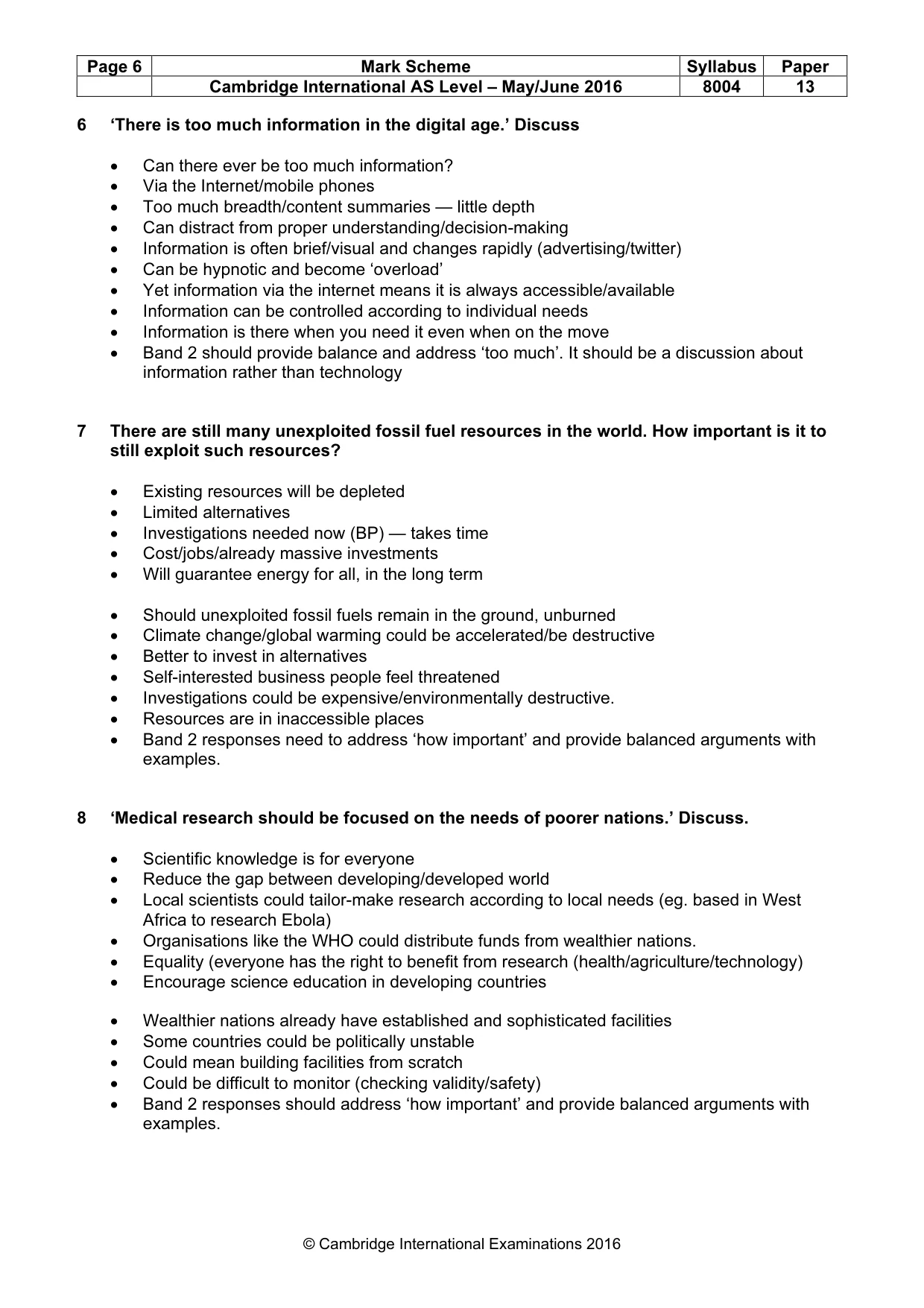
Page 6 Mark Scheme Syllabus Paper Cambridge International AS Level – May/June 2016 8004 13 © Cambridge International Examinations 2016 6 ‘There is too much information in the digital age.’ Discuss • Can there ever be too much information? • Via the Internet/mobile phones • Too much breadth/content summaries — little depth • Can distract from proper understanding/decision-making • Information is often brief/visual and changes rapidly (advertising/twitter) • Can be hypnotic and become ‘overload’ • Yet information via the internet means it is always accessible/available • Information can be controlled according to individual needs • Information is there when you need it even when on the move • Band 2 should provide balance and address ‘too much’. It should be a discussion about information rather than technology 7 There are still many unexploited fossil fuel resources in the world. How important is it to still exploit such resources? • Existing resources will be depleted • Limited alternatives • Investigations needed now (BP) — takes time • Cost/jobs/already massive investments • Will guarantee energy for all, in the long term • Should unexploited fossil fuels remain in the ground, unburned • Climate change/global warming could be accelerated/be destructive • Better to invest in alternatives • Self-interested business people feel threatened • Investigations could be expensive/environmentally destructive. • Resources are in inaccessible places • Band 2 responses need to address ‘how important’ and provide balanced arguments with examples. 8 ‘Medical research should be focused on the needs of poorer nations.’ Discuss. • Scientific knowledge is for everyone • Reduce the gap between developing/developed world • Local scientists could tailor-make research according to local needs (eg. based in West Africa to research Ebola) • Organisations like the WHO could distribute funds from wealthier nations. • Equality (everyone has the right to benefit from research (health/agriculture/technology) • Encourage science education in developing countries • Wealthier nations already have established and sophisticated facilities • Some countries could be politically unstable • Could mean building facilities from scratch • Could be difficult to monitor (checking validity/safety) • Band 2 responses should address ‘how important’ and provide balanced arguments with examples.
Mark scheme, page 7
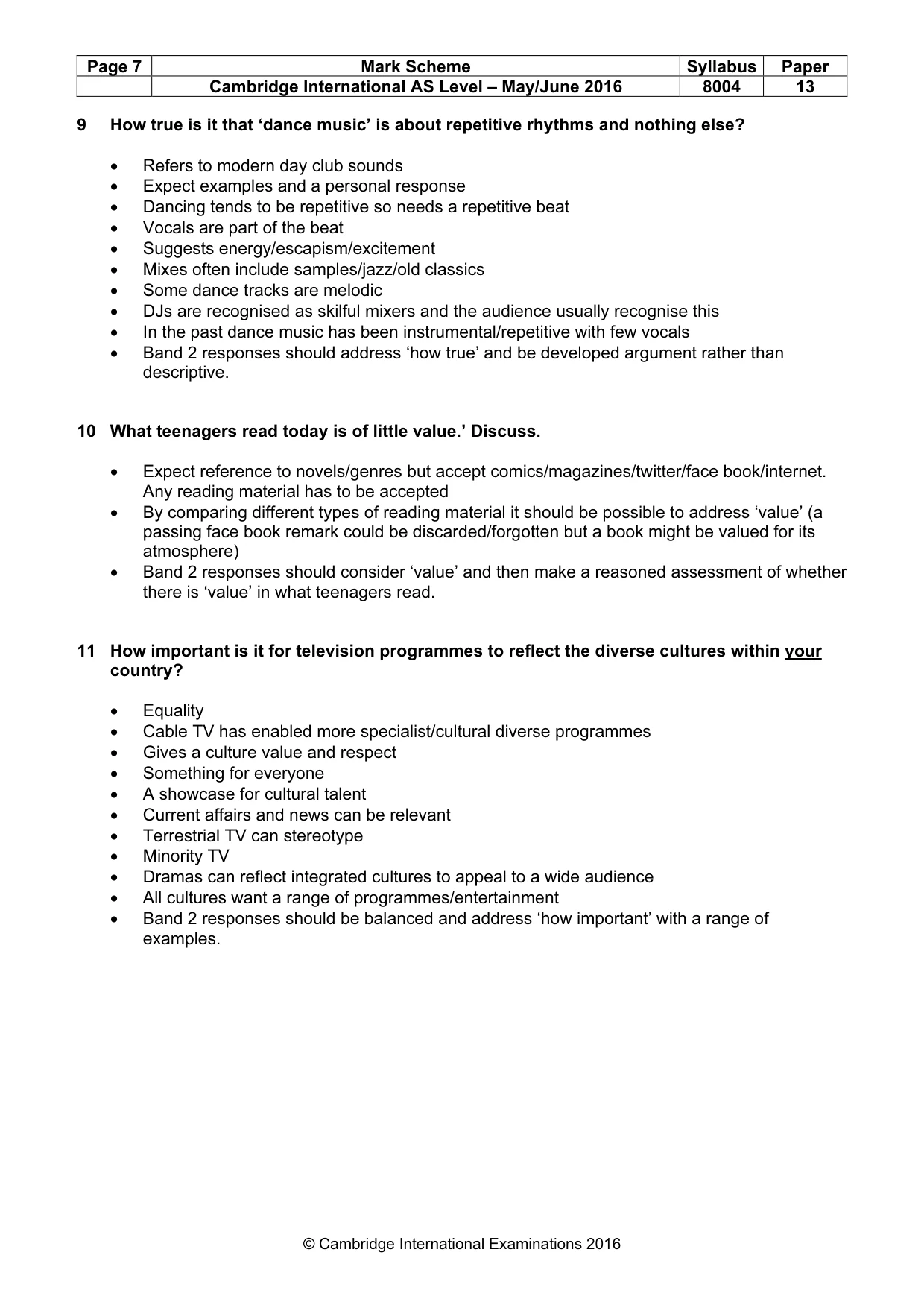
Page 7 Mark Scheme Syllabus Paper Cambridge International AS Level – May/June 2016 8004 13 © Cambridge International Examinations 2016 9 How true is it that ‘dance music’ is about repetitive rhythms and nothing else? • Refers to modern day club sounds • Expect examples and a personal response • Dancing tends to be repetitive so needs a repetitive beat • Vocals are part of the beat • Suggests energy/escapism/excitement • Mixes often include samples/jazz/old classics • Some dance tracks are melodic • DJs are recognised as skilful mixers and the audience usually recognise this • In the past dance music has been instrumental/repetitive with few vocals • Band 2 responses should address ‘how true’ and be developed argument rather than descriptive. 10 What teenagers read today is of little value.’ Discuss. • Expect reference to novels/genres but accept comics/magazines/twitter/face book/internet. Any reading material has to be accepted • By comparing different types of reading material it should be possible to address ‘value’ (a passing face book remark could be discarded/forgotten but a book might be valued for its atmosphere) • Band 2 responses should consider ‘value’ and then make a reasoned assessment of whether there is ‘value’ in what teenagers read. 11 How important is it for television programmes to reflect the diverse cultures within your country? • Equality • Cable TV has enabled more specialist/cultural diverse programmes • Gives a culture value and respect • Something for everyone • A showcase for cultural talent • Current affairs and news can be relevant • Terrestrial TV can stereotype • Minority TV • Dramas can reflect integrated cultures to appeal to a wide audience • All cultures want a range of programmes/entertainment • Band 2 responses should be balanced and address ‘how important’ with a range of examples.
Mark scheme, page 8
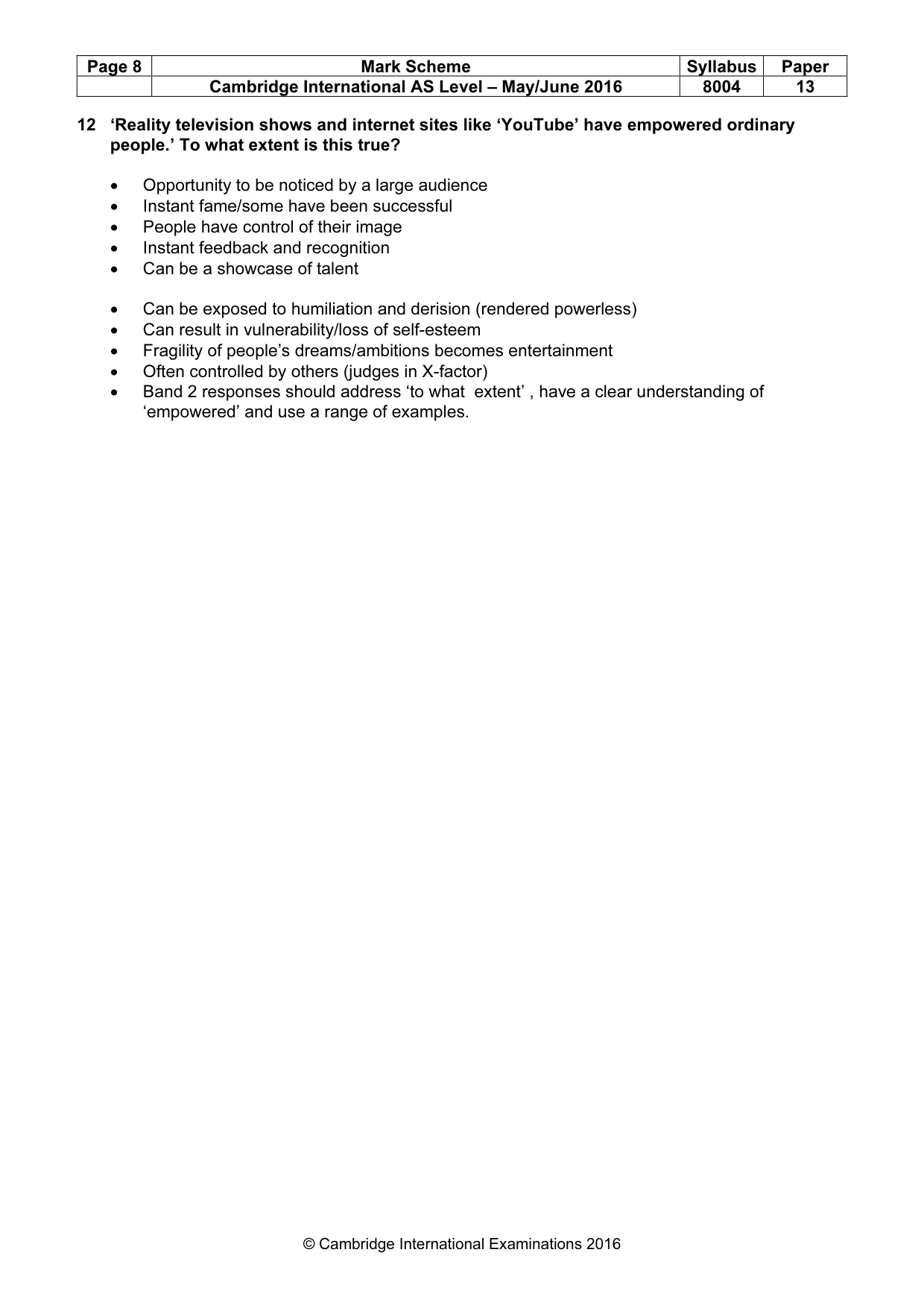
Page 8 Mark Scheme Syllabus Paper Cambridge International AS Level – May/June 2016 8004 13 © Cambridge International Examinations 2016 12 ‘Reality television shows and internet sites like ‘YouTube’ have empowered ordinary people.’ To what extent is this true? • Opportunity to be noticed by a large audience • Instant fame/some have been successful • People have control of their image • Instant feedback and recognition • Can be a showcase of talent • Can be exposed to humiliation and derision (rendered powerless) • Can result in vulnerability/loss of self-esteem • Fragility of people’s dreams/ambitions becomes entertainment • Often controlled by others (judges in X-factor) • Band 2 responses should address ‘to what extent’ , have a clear understanding of ‘empowered’ and use a range of examples.
What you needed in this session
Cambridge’s own grade thresholds for 2016 May/June, Paper 1 · Variant 3. A higher threshold means an easier paper — the bar moves with how the cohort did.