Cambridge A Level General Paper (AS Level only) 8004 — 2018 May/June Paper 1 · Variant 2
8004/12/M/J/18 · 100 marks · ≈113 min
The question paper and its mark scheme, free to read here and free to download. This is Cambridge’s own paper, exactly as it was sat.
Question paper4 pages


Mark scheme11 pages
Answers below. Sit the paper first if you are practising.
Paper as text
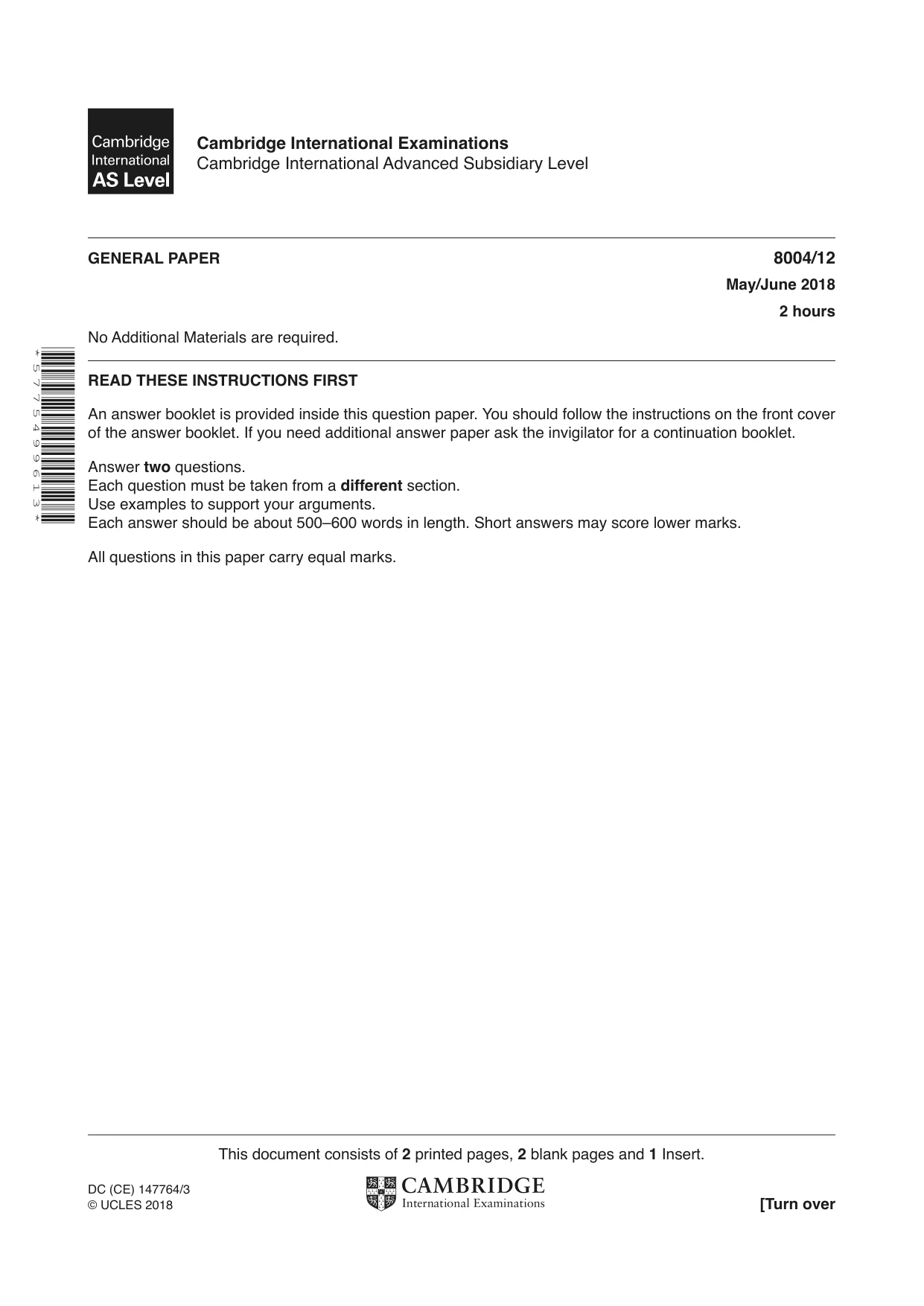
Question paper, page 1
* 5 7 7 5 4 9 9 6 1 3 * This document consists of 2 printed pages, 2 blank pages and 1 Insert. DC (CE) 147764/3 © UCLES 2018 [Turn over Cambridge International Examinations Cambridge International Advanced Subsidiary Level GENERAL PAPER 8004/12 May/June 2018 2 hours No Additional Materials are required. READ THESE INSTRUCTIONS FIRST An answer booklet is provided inside this question paper. You should follow the instructions on the front cover of the answer booklet. If you need additional answer paper ask the invigilator for a continuation booklet. Answer two questions. Each question must be taken from a different section. Use examples to support your arguments. Each answer should be about 500–600 words in length. Short answers may score lower marks. All questions in this paper carry equal marks.
Question paper, page 2
2 8004/12/M/J/18 © UCLES 2018 BLANK PAGE
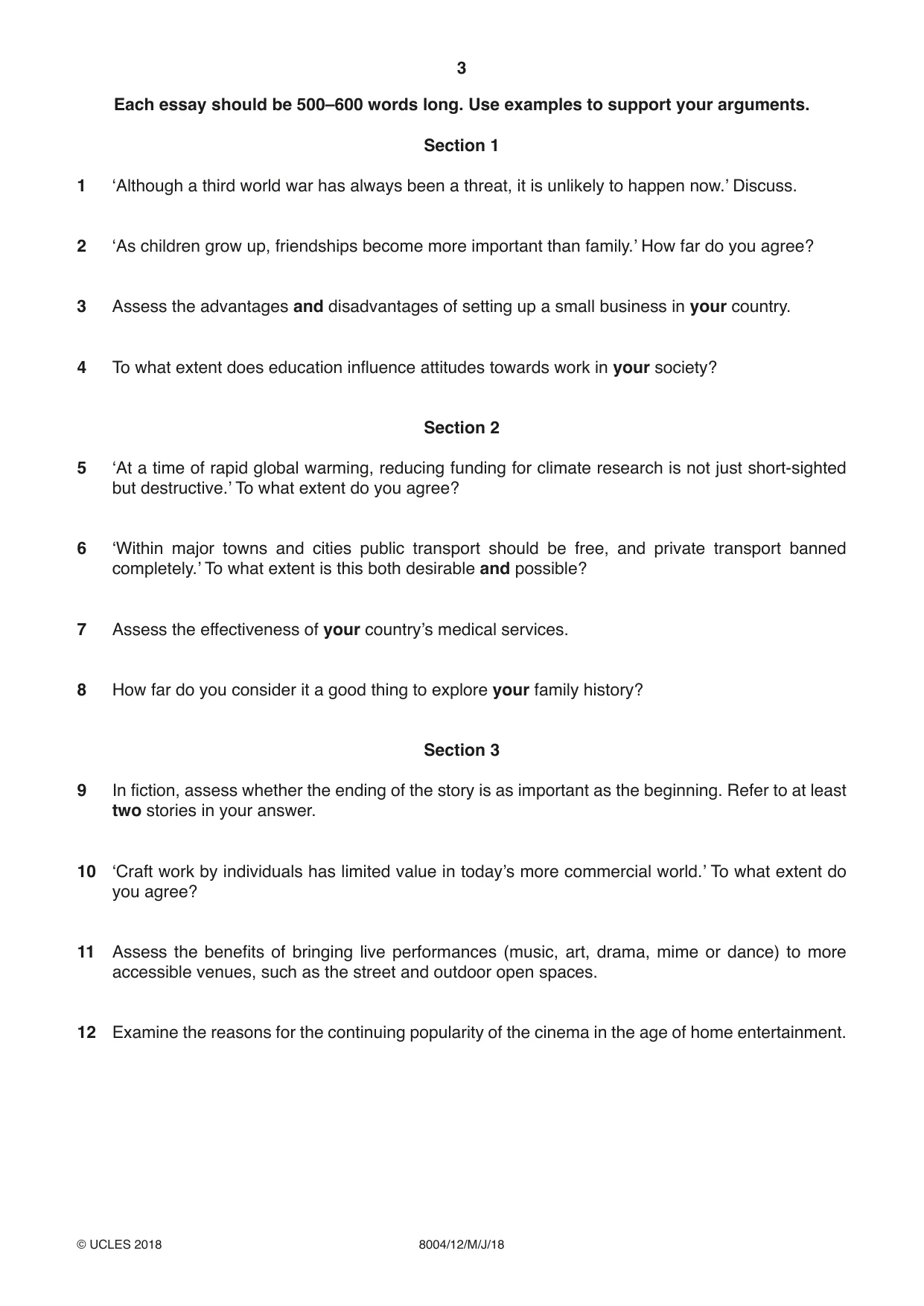
Question paper, page 3
3 8004/12/M/J/18 © UCLES 2018 Each essay should be 500–600 words long. Use examples to support your arguments. Section 1 1 ‘Although a third world war has always been a threat, it is unlikely to happen now.’ Discuss. 2 ‘As children grow up, friendships become more important than family.’ How far do you agree? 3 Assess the advantages and disadvantages of setting up a small business in your country. 4 To what extent does education influence attitudes towards work in your society? Section 2 5 ‘At a time of rapid global warming, reducing funding for climate research is not just short-sighted but destructive.’ To what extent do you agree? 6 ‘Within major towns and cities public transport should be free, and private transport banned completely.’ To what extent is this both desirable and possible? 7 Assess the effectiveness of your country’s medical services. 8 How far do you consider it a good thing to explore your family history? Section 3 9 In fiction, assess whether the ending of the story is as important as the beginning. Refer to at least two stories in your answer. 10 ‘Craft work by individuals has limited value in today’s more commercial world.’ To what extent do you agree? 11 Assess the benefits of bringing live performances (music, art, drama, mime or dance) to more accessible venues, such as the street and outdoor open spaces. 12 Examine the reasons for the continuing popularity of the cinema in the age of home entertainment.
Question paper, page 4
4 8004/12/M/J/18 © UCLES 2018 Permission to reproduce items where third-party owned material protected by copyright is included has been sought and cleared where possible. Every reasonable effort has been made by the publisher (UCLES) to trace copyright holders, but if any items requiring clearance have unwittingly been included, the publisher will be pleased to make amends at the earliest possible opportunity. To avoid the issue of disclosure of answer-related information to candidates, all copyright acknowledgements are reproduced online in the Cambridge International Examinations Copyright Acknowledgements Booklet. This is produced for each series of examinations and is freely available to download at www.cie.org.uk after the live examination series. Cambridge International Examinations is part of the Cambridge Assessment Group. Cambridge Assessment is the brand name of University of Cambridge Local Examinations Syndicate (UCLES), which is itself a department of the University of Cambridge. BLANK PAGE
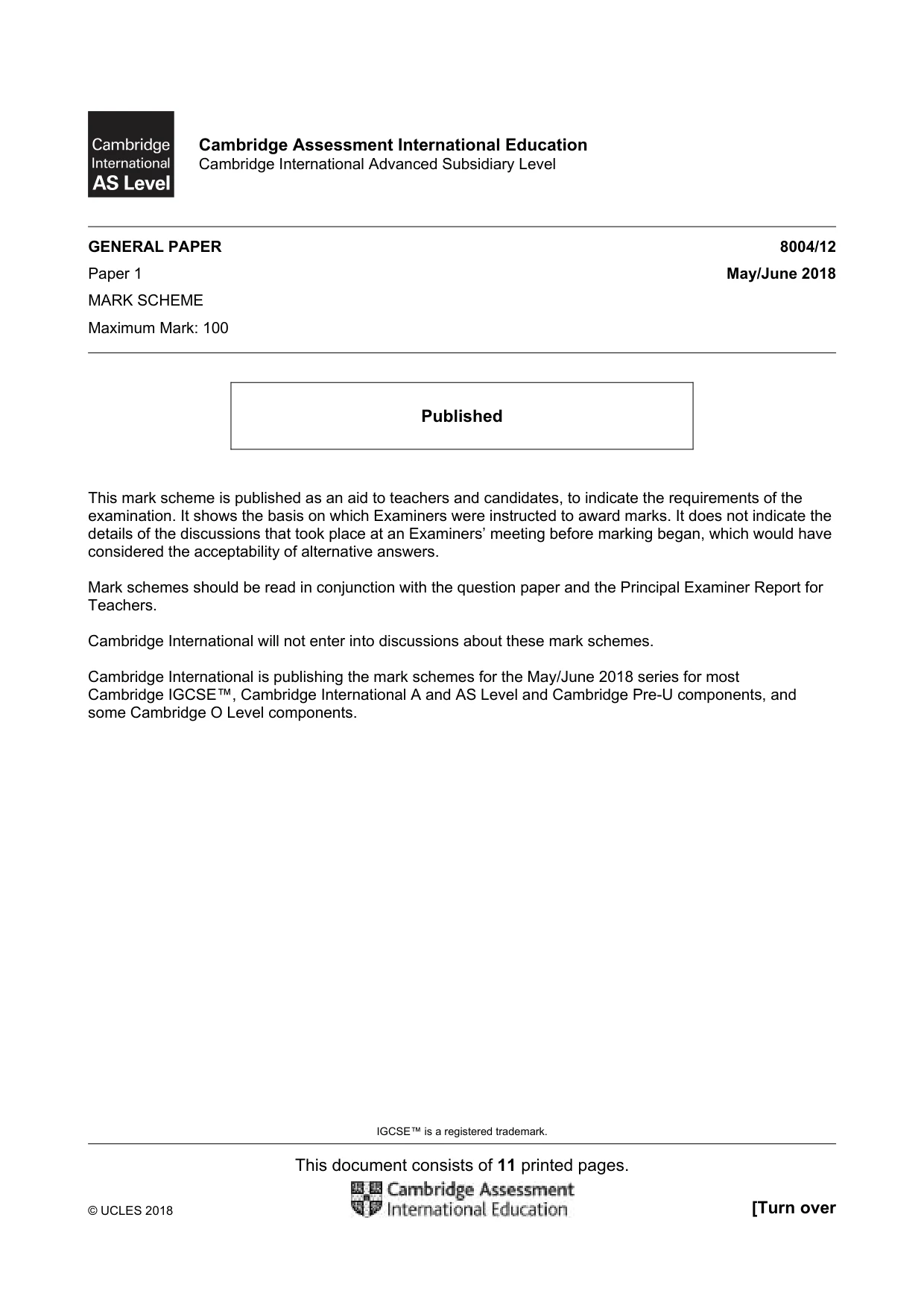
Mark scheme, page 1
IGCSE™ is a registered trademark. This document consists of 11 printed pages. © UCLES 2018 [Turn over Cambridge Assessment International Education Cambridge International Advanced Subsidiary Level GENERAL PAPER 8004/12 Paper 1 May/June 2018 MARK SCHEME Maximum Mark: 100 Published This mark scheme is published as an aid to teachers and candidates, to indicate the requirements of the examination. It shows the basis on which Examiners were instructed to award marks. It does not indicate the details of the discussions that took place at an Examiners’ meeting before marking began, which would have considered the acceptability of alternative answers. Mark schemes should be read in conjunction with the question paper and the Principal Examiner Report for Teachers. Cambridge International will not enter into discussions about these mark schemes. Cambridge International is publishing the mark schemes for the May/June 2018 series for most Cambridge IGCSE™, Cambridge International A and AS Level and Cambridge Pre-U components, and some Cambridge O Level components.
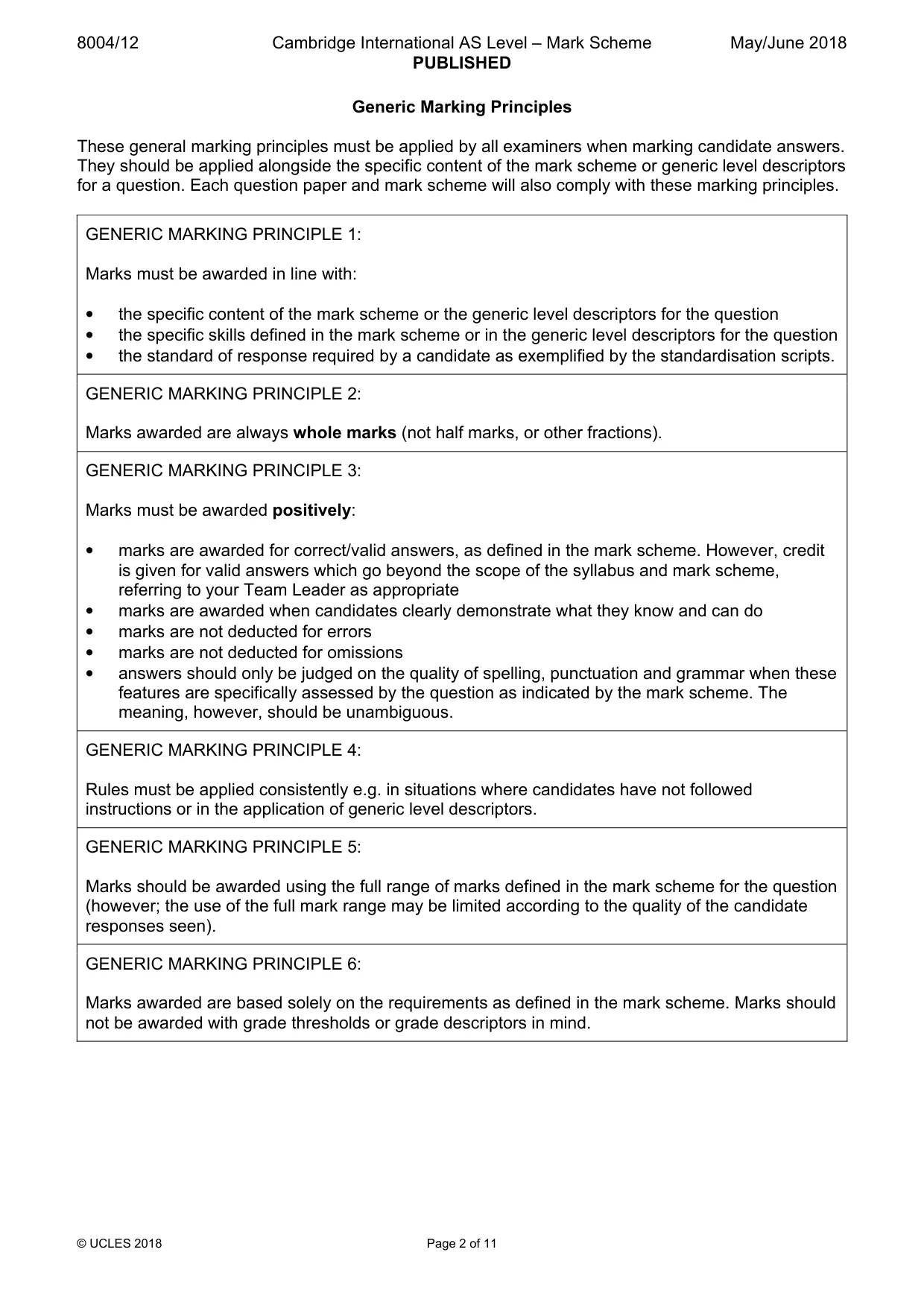
Mark scheme, page 2
8004/12 Cambridge International AS Level – Mark Scheme PUBLISHED May/June 2018 © UCLES 2018 Page 2 of 11 Generic Marking Principles These general marking principles must be applied by all examiners when marking candidate answers. They should be applied alongside the specific content of the mark scheme or generic level descriptors for a question. Each question paper and mark scheme will also comply with these marking principles. GENERIC MARKING PRINCIPLE 1: Marks must be awarded in line with: • the specific content of the mark scheme or the generic level descriptors for the question • the specific skills defined in the mark scheme or in the generic level descriptors for the question • the standard of response required by a candidate as exemplified by the standardisation scripts. GENERIC MARKING PRINCIPLE 2: Marks awarded are always whole marks (not half marks, or other fractions). GENERIC MARKING PRINCIPLE 3: Marks must be awarded positively: • marks are awarded for correct/valid answers, as defined in the mark scheme. However, credit is given for valid answers which go beyond the scope of the syllabus and mark scheme, referring to your Team Leader as appropriate • marks are awarded when candidates clearly demonstrate what they know and can do • marks are not deducted for errors • marks are not deducted for omissions • answers should only be judged on the quality of spelling, punctuation and grammar when these features are specifically assessed by the question as indicated by the mark scheme. The meaning, however, should be unambiguous. GENERIC MARKING PRINCIPLE 4: Rules must be applied consistently e.g. in situations where candidates have not followed instructions or in the application of generic level descriptors. GENERIC MARKING PRINCIPLE 5: Marks should be awarded using the full range of marks defined in the mark scheme for the question (however; the use of the full mark range may be limited according to the quality of the candidate responses seen). GENERIC MARKING PRINCIPLE 6: Marks awarded are based solely on the requirements as defined in the mark scheme. Marks should not be awarded with grade thresholds or grade descriptors in mind.
Mark scheme, page 3
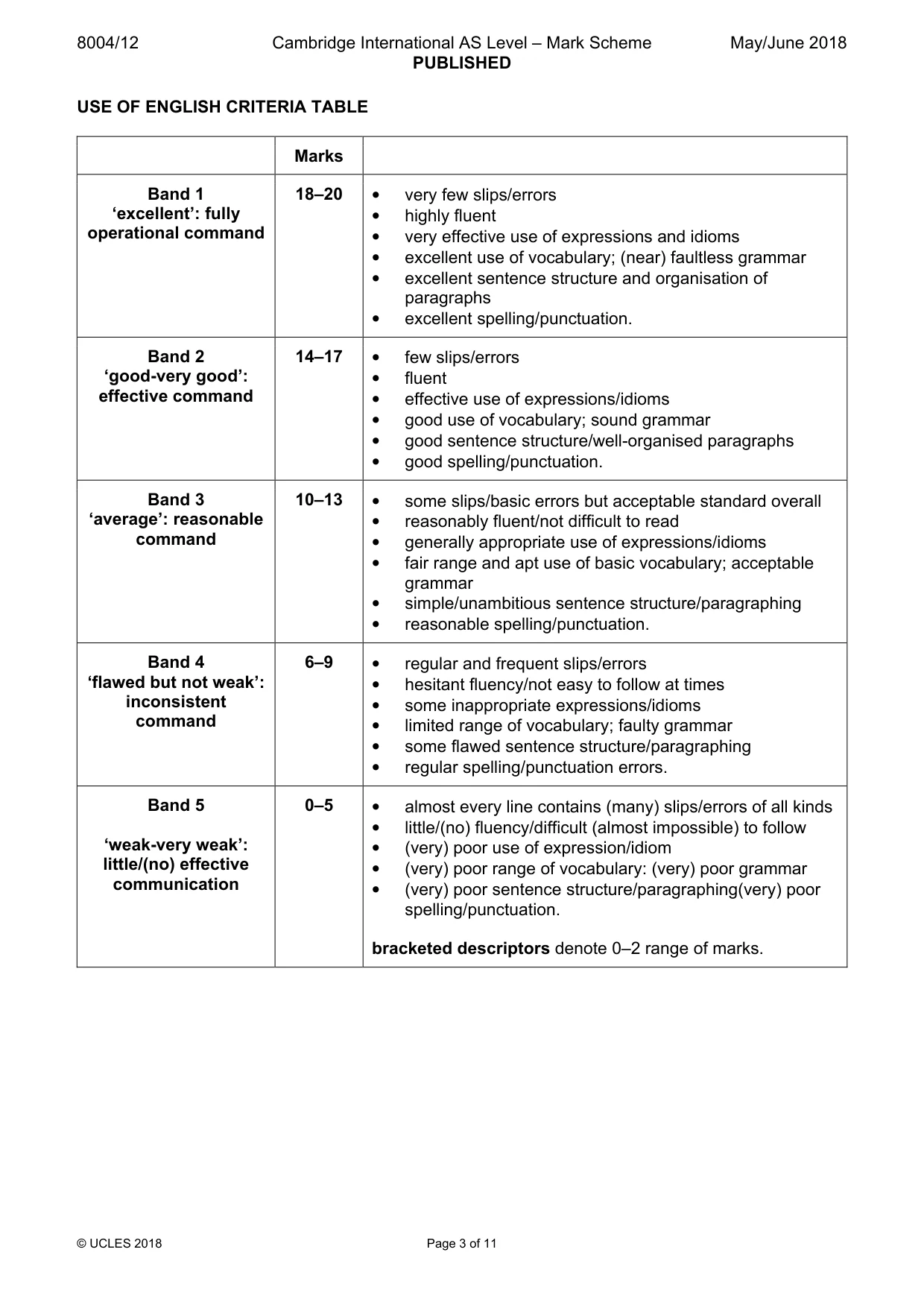
8004/12 Cambridge International AS Level – Mark Scheme PUBLISHED May/June 2018 © UCLES 2018 Page 3 of 11 USE OF ENGLISH CRITERIA TABLE Marks Band 1 ‘excellent’: fully operational command 18–20 • very few slips/errors • highly fluent • very effective use of expressions and idioms • excellent use of vocabulary; (near) faultless grammar • excellent sentence structure and organisation of paragraphs • excellent spelling/punctuation. Band 2 ‘good-very good’: effective command 14–17 • few slips/errors • fluent • effective use of expressions/idioms • good use of vocabulary; sound grammar • good sentence structure/well-organised paragraphs • good spelling/punctuation. Band 3 ‘average’: reasonable command 10–13 • some slips/basic errors but acceptable standard overall • reasonably fluent/not difficult to read • generally appropriate use of expressions/idioms • fair range and apt use of basic vocabulary; acceptable grammar • simple/unambitious sentence structure/paragraphing • reasonable spelling/punctuation. Band 4 ‘flawed but not weak’: inconsistent command 6–9 • regular and frequent slips/errors • hesitant fluency/not easy to follow at times • some inappropriate expressions/idioms • limited range of vocabulary; faulty grammar • some flawed sentence structure/paragraphing • regular spelling/punctuation errors. Band 5 ‘weak-very weak’: little/(no) effective communication 0–5 • almost every line contains (many) slips/errors of all kinds • little/(no) fluency/difficult (almost impossible) to follow • (very) poor use of expression/idiom • (very) poor range of vocabulary: (very) poor grammar • (very) poor sentence structure/paragraphing(very) poor spelling/punctuation. bracketed descriptors denote 0–2 range of marks.
Mark scheme, page 4
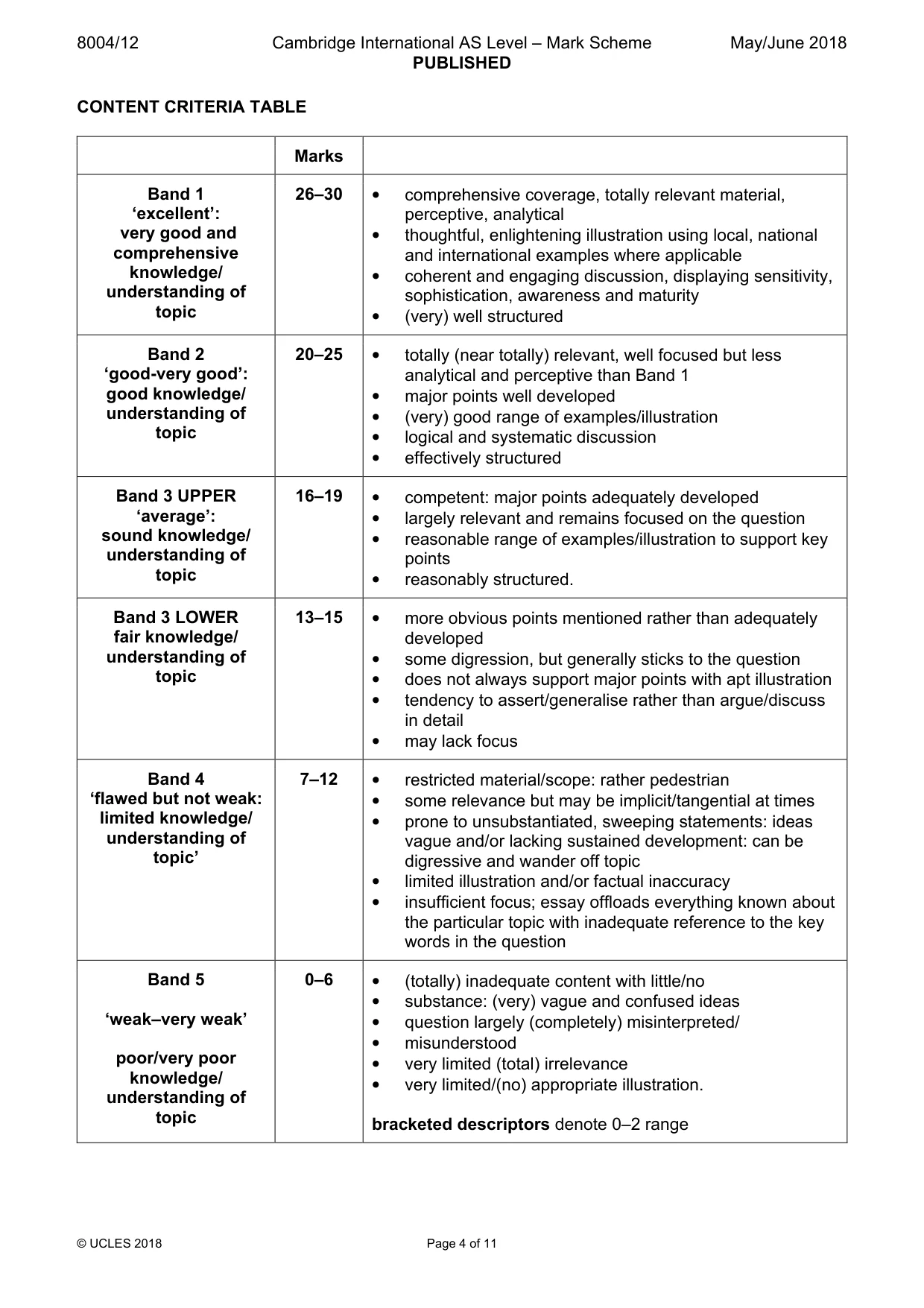
8004/12 Cambridge International AS Level – Mark Scheme PUBLISHED May/June 2018 © UCLES 2018 Page 4 of 11 CONTENT CRITERIA TABLE Marks Band 1 ‘excellent’: very good and comprehensive knowledge/ understanding of topic 26–30 • comprehensive coverage, totally relevant material, perceptive, analytical • thoughtful, enlightening illustration using local, national and international examples where applicable • coherent and engaging discussion, displaying sensitivity, sophistication, awareness and maturity • (very) well structured Band 2 ‘good-very good’: good knowledge/ understanding of topic 20–25 • totally (near totally) relevant, well focused but less analytical and perceptive than Band 1 • major points well developed • (very) good range of examples/illustration • logical and systematic discussion • effectively structured Band 3 UPPER ‘average’: sound knowledge/ understanding of topic 16–19 • competent: major points adequately developed • largely relevant and remains focused on the question • reasonable range of examples/illustration to support key points • reasonably structured. Band 3 LOWER fair knowledge/ understanding of topic 13–15 • more obvious points mentioned rather than adequately developed • some digression, but generally sticks to the question • does not always support major points with apt illustration • tendency to assert/generalise rather than argue/discuss in detail • may lack focus Band 4 ‘flawed but not weak: limited knowledge/ understanding of topic’ 7–12 • restricted material/scope: rather pedestrian • some relevance but may be implicit/tangential at times • prone to unsubstantiated, sweeping statements: ideas vague and/or lacking sustained development: can be digressive and wander off topic • limited illustration and/or factual inaccuracy • insufficient focus; essay offloads everything known about the particular topic with inadequate reference to the key words in the question Band 5 ‘weak–very weak’ poor/very poor knowledge/ understanding of topic 0–6 • (totally) inadequate content with little/no • substance: (very) vague and confused ideas • question largely (completely) misinterpreted/ • misunderstood • very limited (total) irrelevance • very limited/(no) appropriate illustration. bracketed descriptors denote 0–2 range
Mark scheme, page 5
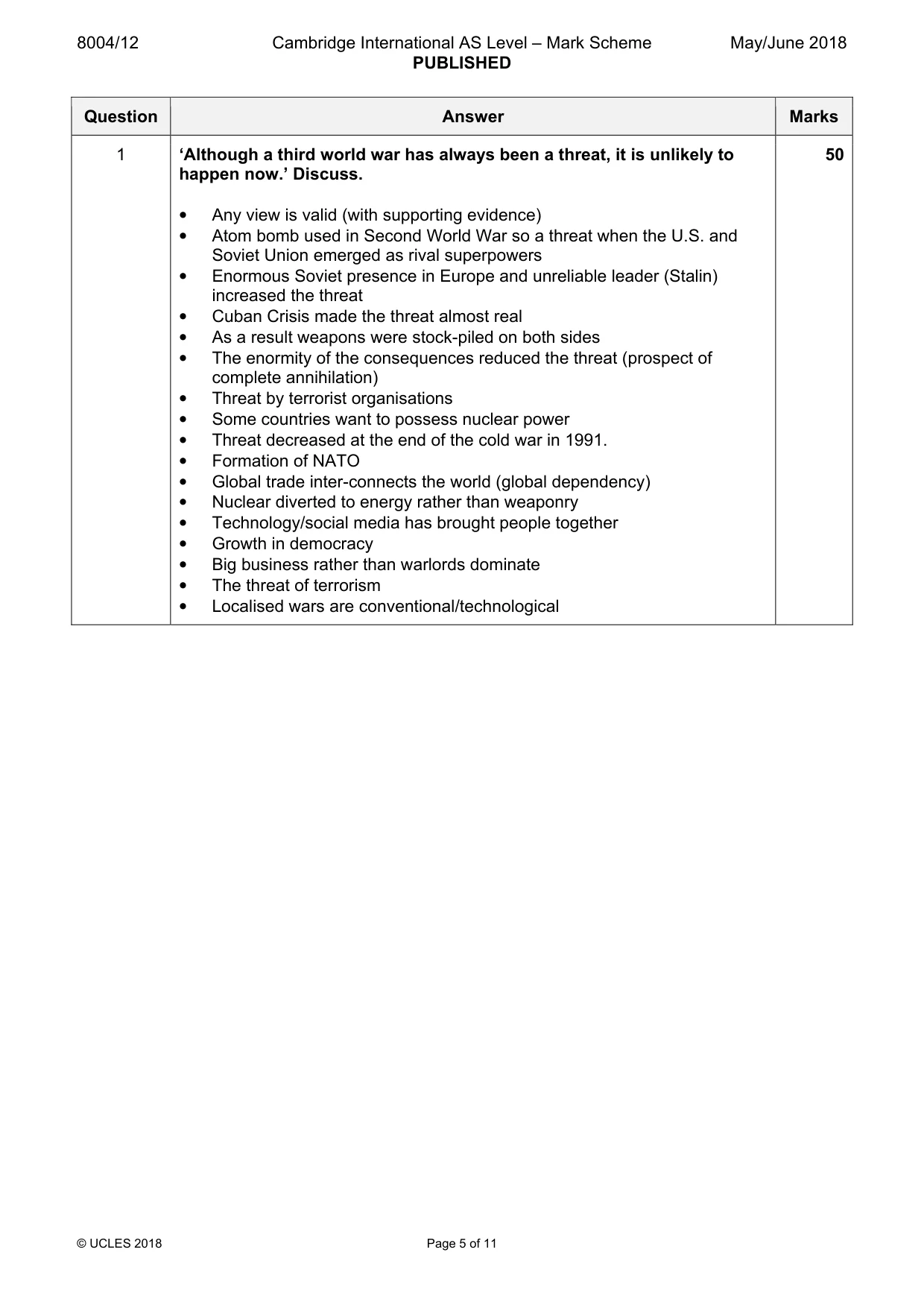
8004/12 Cambridge International AS Level – Mark Scheme PUBLISHED May/June 2018 © UCLES 2018 Page 5 of 11 Question Answer Marks 1 ‘Although a third world war has always been a threat, it is unlikely to happen now.’ Discuss. • Any view is valid (with supporting evidence) • Atom bomb used in Second World War so a threat when the U.S. and Soviet Union emerged as rival superpowers • Enormous Soviet presence in Europe and unreliable leader (Stalin) increased the threat • Cuban Crisis made the threat almost real • As a result weapons were stock-piled on both sides • The enormity of the consequences reduced the threat (prospect of complete annihilation) • Threat by terrorist organisations • Some countries want to possess nuclear power • Threat decreased at the end of the cold war in 1991. • Formation of NATO • Global trade inter-connects the world (global dependency) • Nuclear diverted to energy rather than weaponry • Technology/social media has brought people together • Growth in democracy • Big business rather than warlords dominate • The threat of terrorism • Localised wars are conventional/technological 50
Mark scheme, page 6
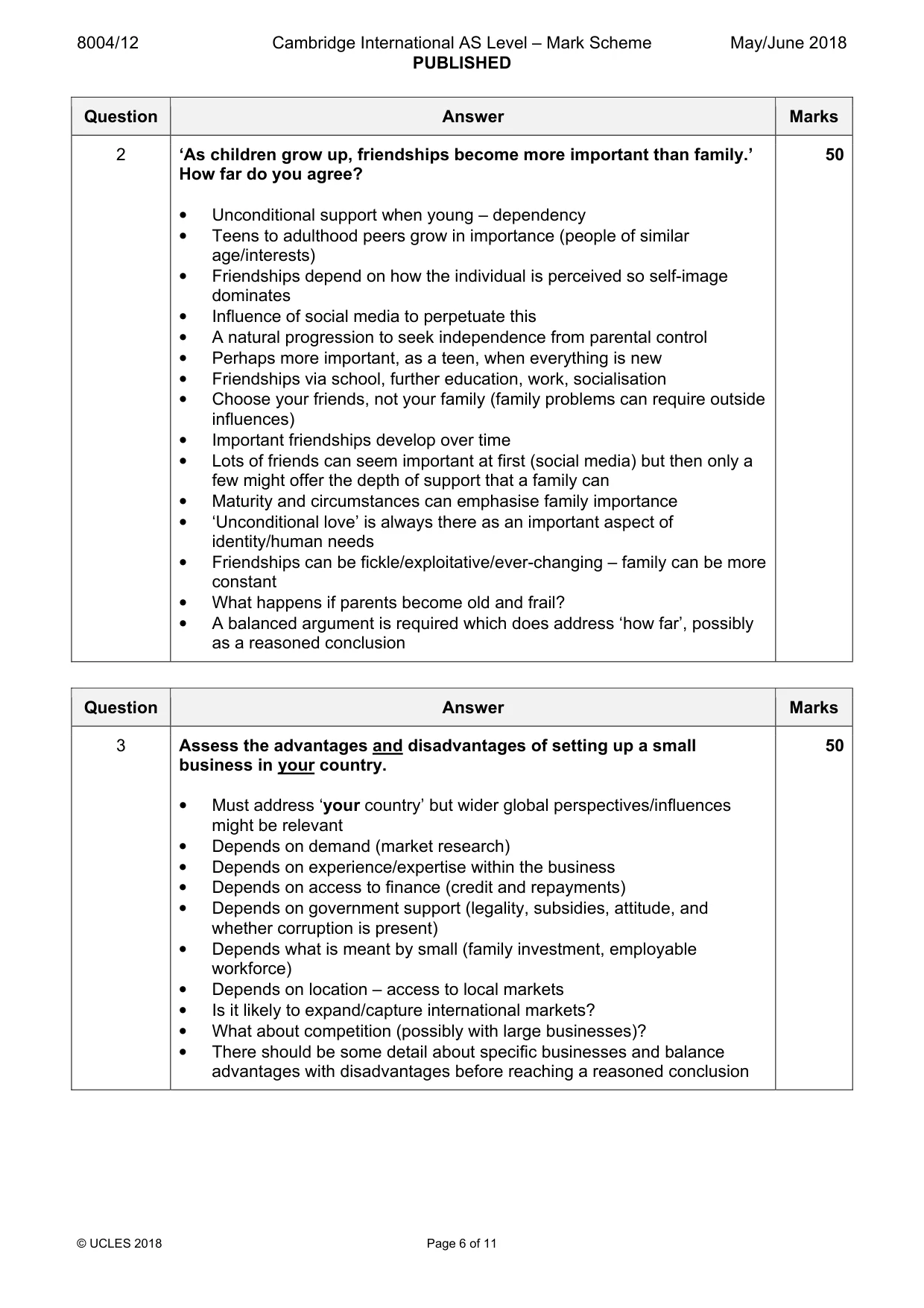
8004/12 Cambridge International AS Level – Mark Scheme PUBLISHED May/June 2018 © UCLES 2018 Page 6 of 11 Question Answer Marks 2 ‘As children grow up, friendships become more important than family.’ How far do you agree? • Unconditional support when young – dependency • Teens to adulthood peers grow in importance (people of similar age/interests) • Friendships depend on how the individual is perceived so self-image dominates • Influence of social media to perpetuate this • A natural progression to seek independence from parental control • Perhaps more important, as a teen, when everything is new • Friendships via school, further education, work, socialisation • Choose your friends, not your family (family problems can require outside influences) • Important friendships develop over time • Lots of friends can seem important at first (social media) but then only a few might offer the depth of support that a family can • Maturity and circumstances can emphasise family importance • ‘Unconditional love’ is always there as an important aspect of identity/human needs • Friendships can be fickle/exploitative/ever-changing – family can be more constant • What happens if parents become old and frail? • A balanced argument is required which does address ‘how far’, possibly as a reasoned conclusion 50 Question Answer Marks 3 Assess the advantages and disadvantages of setting up a small business in your country. • Must address ‘your country’ but wider global perspectives/influences might be relevant • Depends on demand (market research) • Depends on experience/expertise within the business • Depends on access to finance (credit and repayments) • Depends on government support (legality, subsidies, attitude, and whether corruption is present) • Depends what is meant by small (family investment, employable workforce) • Depends on location – access to local markets • Is it likely to expand/capture international markets? • What about competition (possibly with large businesses)? • There should be some detail about specific businesses and balance advantages with disadvantages before reaching a reasoned conclusion 50
Mark scheme, page 7
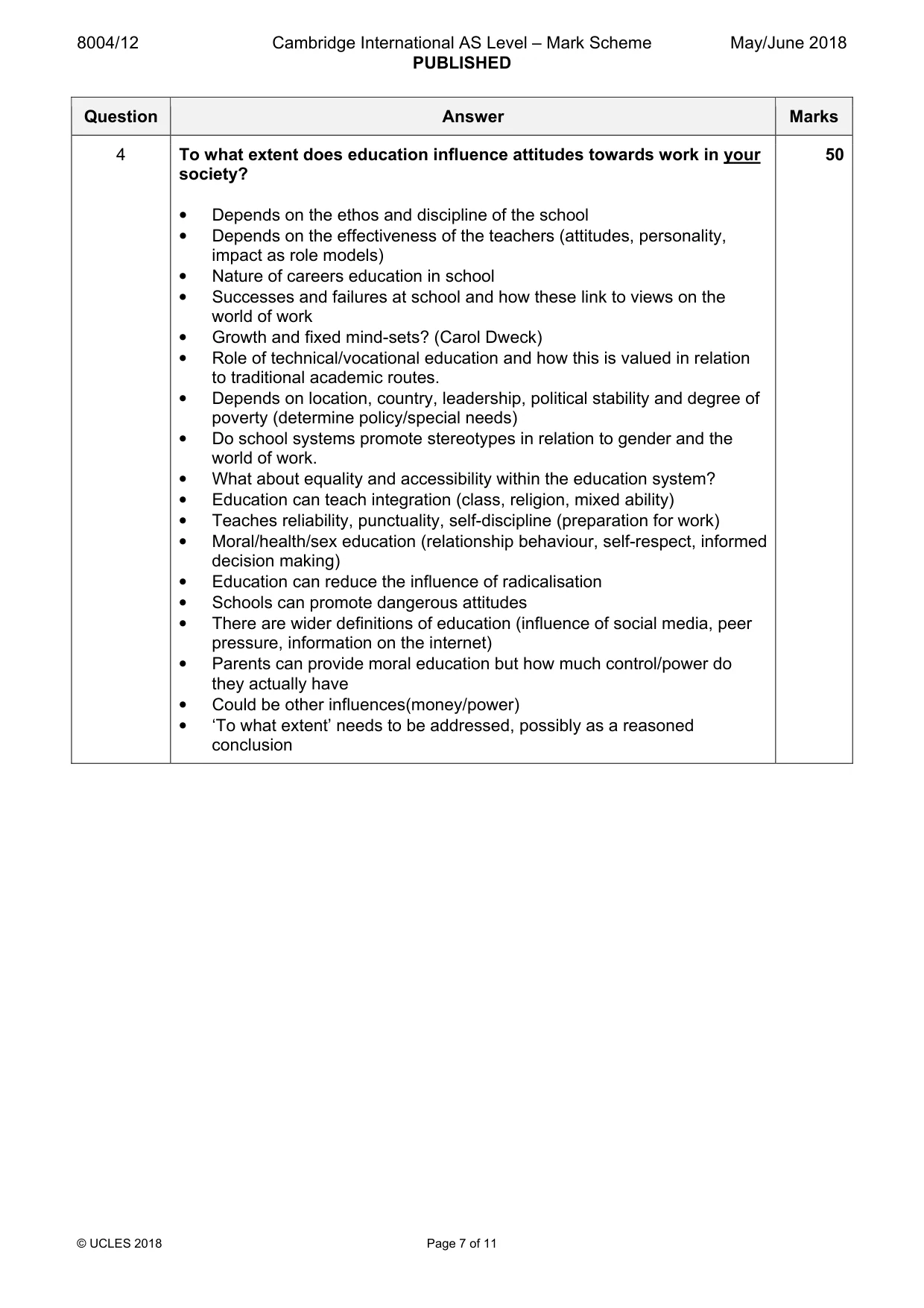
8004/12 Cambridge International AS Level – Mark Scheme PUBLISHED May/June 2018 © UCLES 2018 Page 7 of 11 Question Answer Marks 4 To what extent does education influence attitudes towards work in your society? • Depends on the ethos and discipline of the school • Depends on the effectiveness of the teachers (attitudes, personality, impact as role models) • Nature of careers education in school • Successes and failures at school and how these link to views on the world of work • Growth and fixed mind-sets? (Carol Dweck) • Role of technical/vocational education and how this is valued in relation to traditional academic routes. • Depends on location, country, leadership, political stability and degree of poverty (determine policy/special needs) • Do school systems promote stereotypes in relation to gender and the world of work. • What about equality and accessibility within the education system? • Education can teach integration (class, religion, mixed ability) • Teaches reliability, punctuality, self-discipline (preparation for work) • Moral/health/sex education (relationship behaviour, self-respect, informed decision making) • Education can reduce the influence of radicalisation • Schools can promote dangerous attitudes • There are wider definitions of education (influence of social media, peer pressure, information on the internet) • Parents can provide moral education but how much control/power do they actually have • Could be other influences(money/power) • ‘To what extent’ needs to be addressed, possibly as a reasoned conclusion 50
Mark scheme, page 8
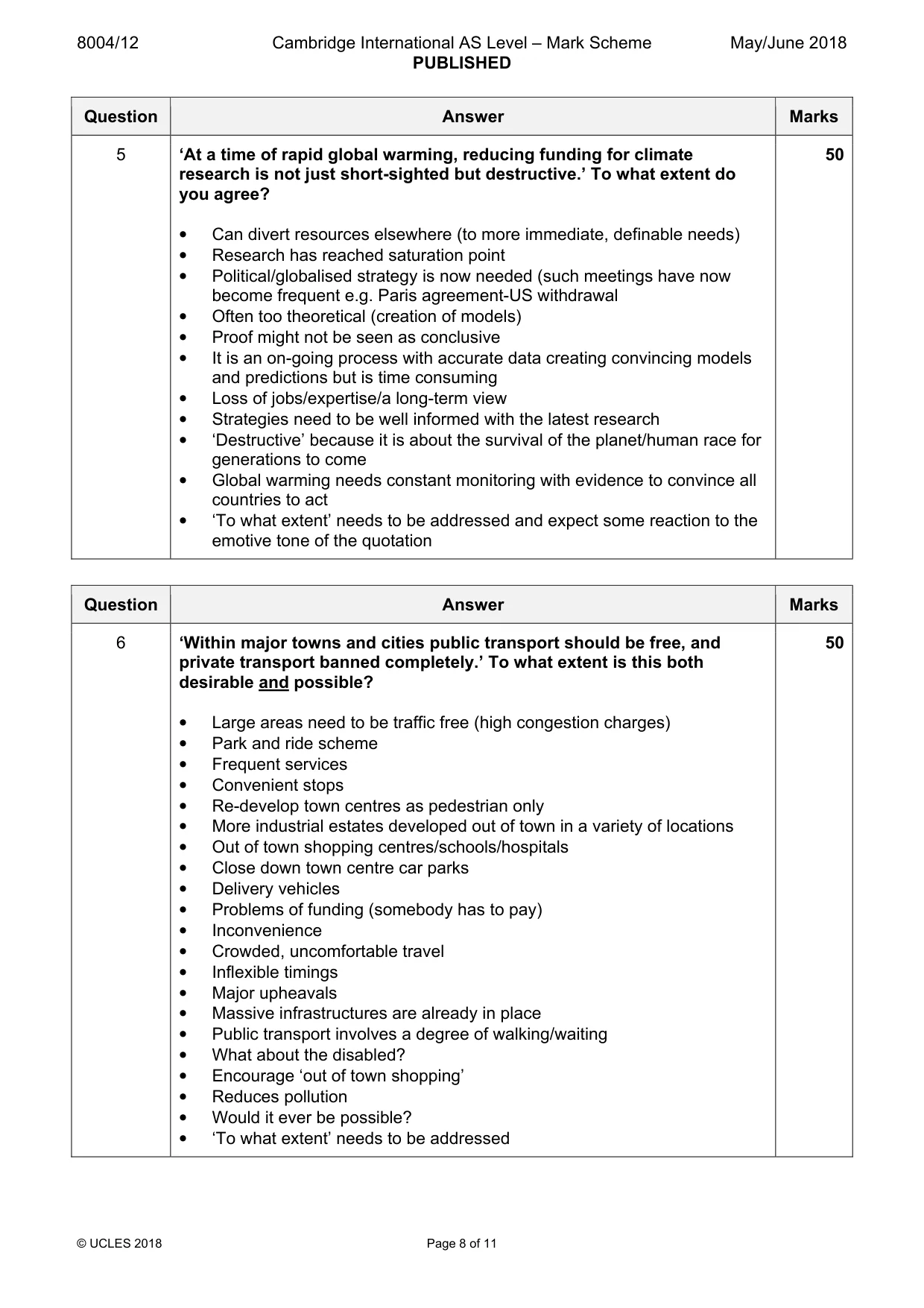
8004/12 Cambridge International AS Level – Mark Scheme PUBLISHED May/June 2018 © UCLES 2018 Page 8 of 11 Question Answer Marks 5 ‘At a time of rapid global warming, reducing funding for climate research is not just short-sighted but destructive.’ To what extent do you agree? • Can divert resources elsewhere (to more immediate, definable needs) • Research has reached saturation point • Political/globalised strategy is now needed (such meetings have now become frequent e.g. Paris agreement-US withdrawal • Often too theoretical (creation of models) • Proof might not be seen as conclusive • It is an on-going process with accurate data creating convincing models and predictions but is time consuming • Loss of jobs/expertise/a long-term view • Strategies need to be well informed with the latest research • ‘Destructive’ because it is about the survival of the planet/human race for generations to come • Global warming needs constant monitoring with evidence to convince all countries to act • ‘To what extent’ needs to be addressed and expect some reaction to the emotive tone of the quotation 50 Question Answer Marks 6 ‘Within major towns and cities public transport should be free, and private transport banned completely.’ To what extent is this both desirable and possible? • Large areas need to be traffic free (high congestion charges) • Park and ride scheme • Frequent services • Convenient stops • Re-develop town centres as pedestrian only • More industrial estates developed out of town in a variety of locations • Out of town shopping centres/schools/hospitals • Close down town centre car parks • Delivery vehicles • Problems of funding (somebody has to pay) • Inconvenience • Crowded, uncomfortable travel • Inflexible timings • Major upheavals • Massive infrastructures are already in place • Public transport involves a degree of walking/waiting • What about the disabled? • Encourage ‘out of town shopping’ • Reduces pollution • Would it ever be possible? • ‘To what extent’ needs to be addressed 50
Mark scheme, page 9
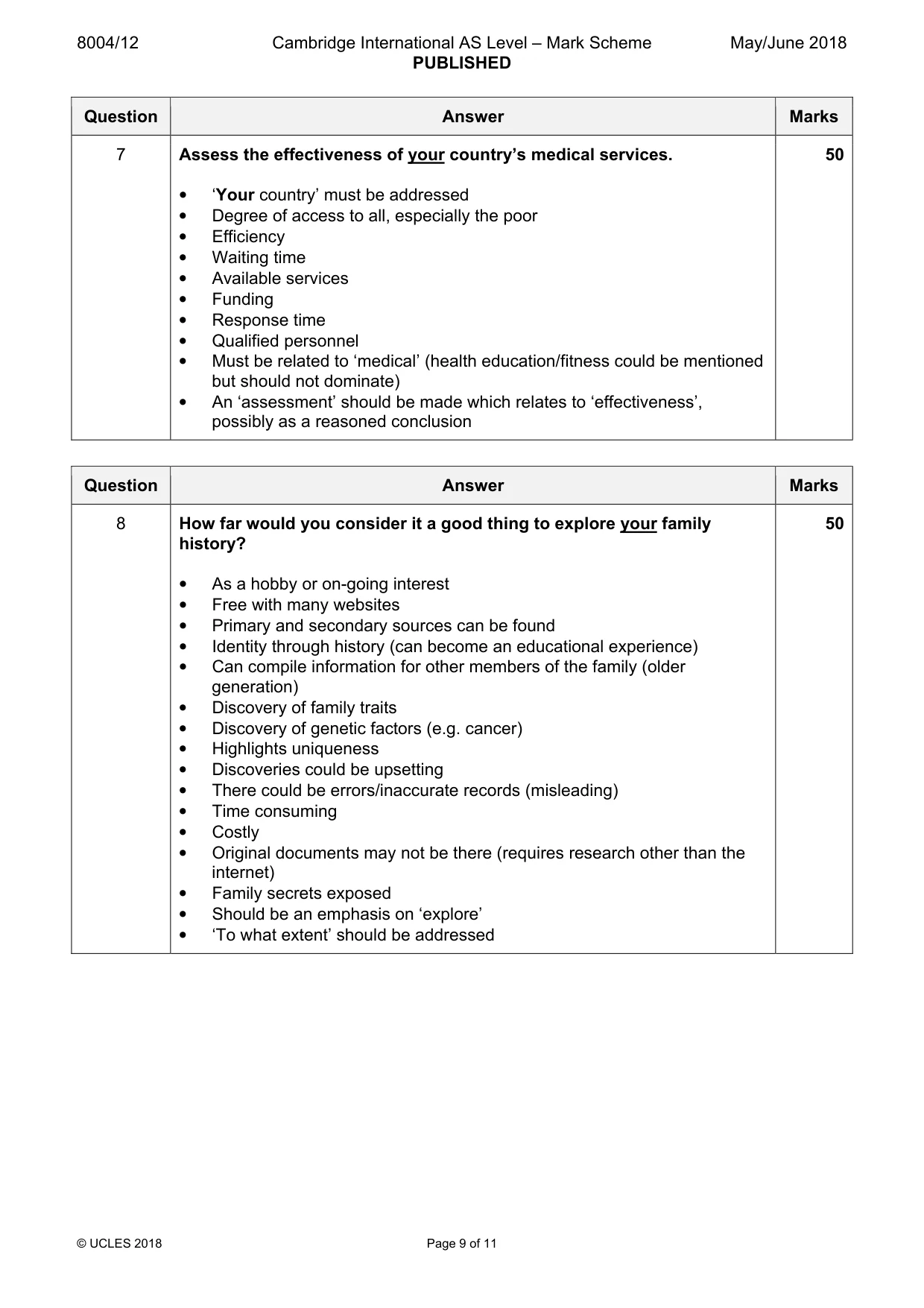
8004/12 Cambridge International AS Level – Mark Scheme PUBLISHED May/June 2018 © UCLES 2018 Page 9 of 11 Question Answer Marks 7 Assess the effectiveness of your country’s medical services. • ‘Your country’ must be addressed • Degree of access to all, especially the poor • Efficiency • Waiting time • Available services • Funding • Response time • Qualified personnel • Must be related to ‘medical’ (health education/fitness could be mentioned but should not dominate) • An ‘assessment’ should be made which relates to ‘effectiveness’, possibly as a reasoned conclusion 50 Question Answer Marks 8 How far would you consider it a good thing to explore your family history? • As a hobby or on-going interest • Free with many websites • Primary and secondary sources can be found • Identity through history (can become an educational experience) • Can compile information for other members of the family (older generation) • Discovery of family traits • Discovery of genetic factors (e.g. cancer) • Highlights uniqueness • Discoveries could be upsetting • There could be errors/inaccurate records (misleading) • Time consuming • Costly • Original documents may not be there (requires research other than the internet) • Family secrets exposed • Should be an emphasis on ‘explore’ • ‘To what extent’ should be addressed 50
Mark scheme, page 10
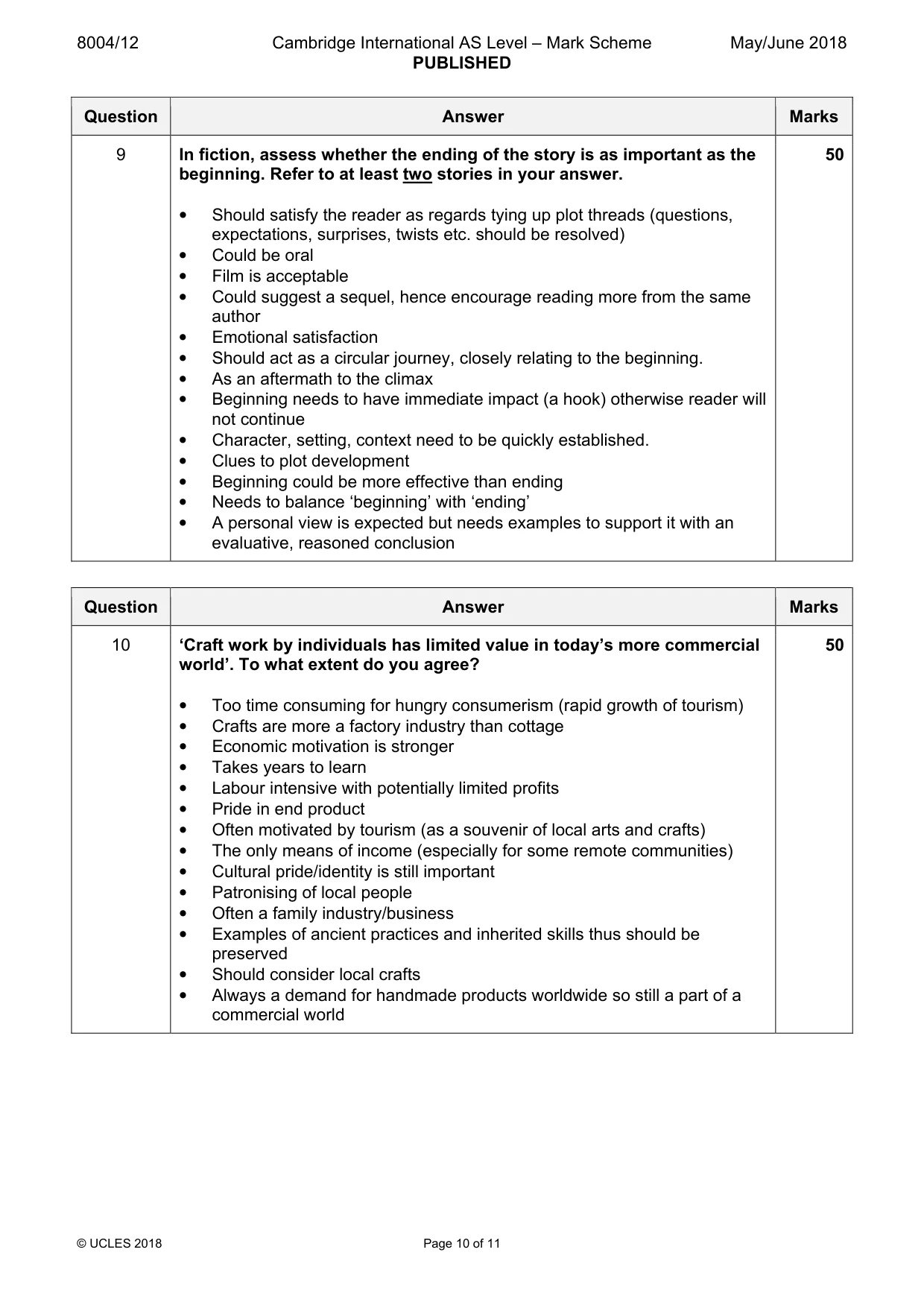
8004/12 Cambridge International AS Level – Mark Scheme PUBLISHED May/June 2018 © UCLES 2018 Page 10 of 11 Question Answer Marks 9 In fiction, assess whether the ending of the story is as important as the beginning. Refer to at least two stories in your answer. • Should satisfy the reader as regards tying up plot threads (questions, expectations, surprises, twists etc. should be resolved) • Could be oral • Film is acceptable • Could suggest a sequel, hence encourage reading more from the same author • Emotional satisfaction • Should act as a circular journey, closely relating to the beginning. • As an aftermath to the climax • Beginning needs to have immediate impact (a hook) otherwise reader will not continue • Character, setting, context need to be quickly established. • Clues to plot development • Beginning could be more effective than ending • Needs to balance ‘beginning’ with ‘ending’ • A personal view is expected but needs examples to support it with an evaluative, reasoned conclusion 50 Question Answer Marks 10 ‘Craft work by individuals has limited value in today’s more commercial world’. To what extent do you agree? • Too time consuming for hungry consumerism (rapid growth of tourism) • Crafts are more a factory industry than cottage • Economic motivation is stronger • Takes years to learn • Labour intensive with potentially limited profits • Pride in end product • Often motivated by tourism (as a souvenir of local arts and crafts) • The only means of income (especially for some remote communities) • Cultural pride/identity is still important • Patronising of local people • Often a family industry/business • Examples of ancient practices and inherited skills thus should be preserved • Should consider local crafts • Always a demand for handmade products worldwide so still a part of a commercial world 50
Mark scheme, page 11
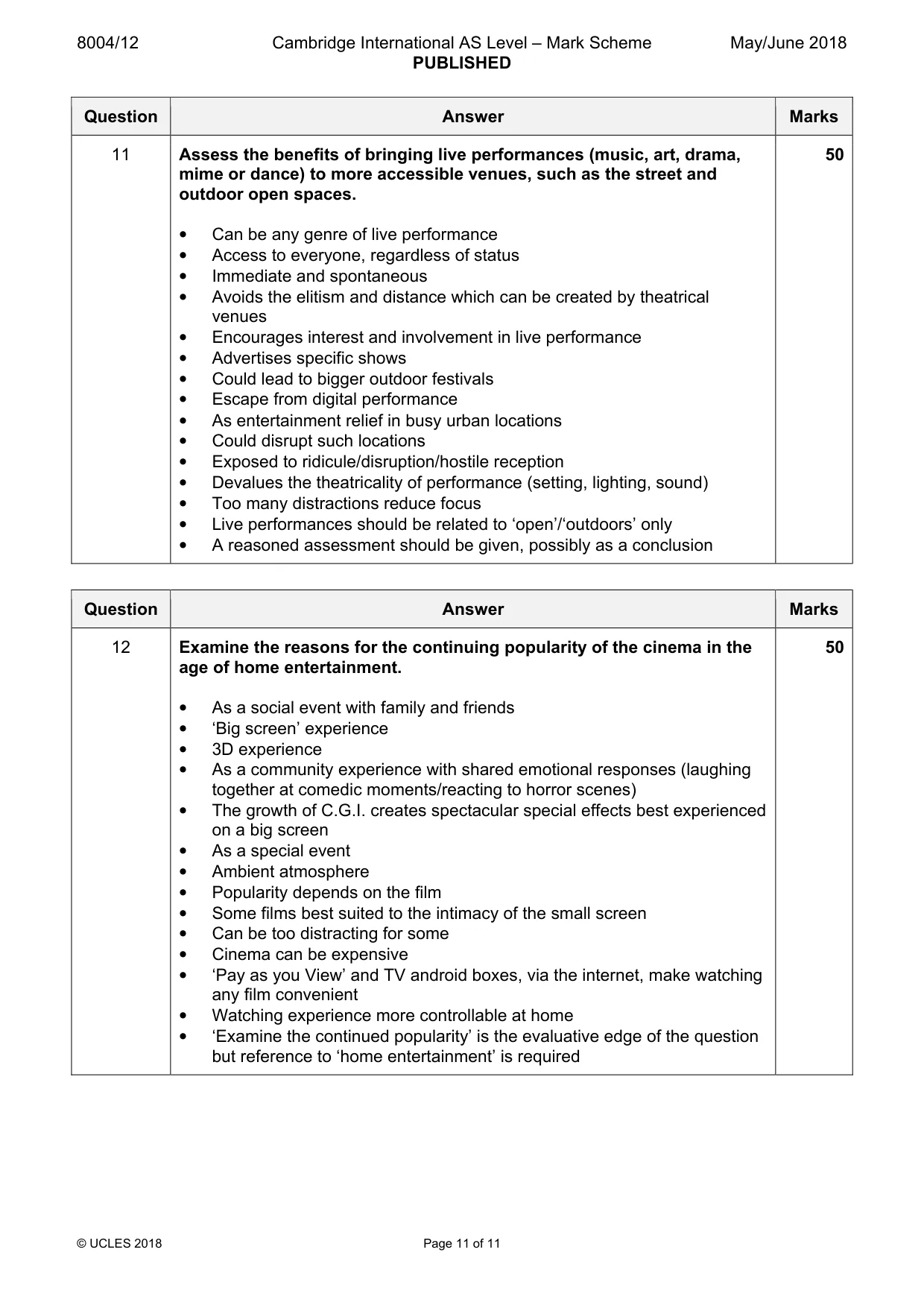
8004/12 Cambridge International AS Level – Mark Scheme PUBLISHED May/June 2018 © UCLES 2018 Page 11 of 11 Question Answer Marks 11 Assess the benefits of bringing live performances (music, art, drama, mime or dance) to more accessible venues, such as the street and outdoor open spaces. • Can be any genre of live performance • Access to everyone, regardless of status • Immediate and spontaneous • Avoids the elitism and distance which can be created by theatrical venues • Encourages interest and involvement in live performance • Advertises specific shows • Could lead to bigger outdoor festivals • Escape from digital performance • As entertainment relief in busy urban locations • Could disrupt such locations • Exposed to ridicule/disruption/hostile reception • Devalues the theatricality of performance (setting, lighting, sound) • Too many distractions reduce focus • Live performances should be related to ‘open’/‘outdoors’ only • A reasoned assessment should be given, possibly as a conclusion 50 Question Answer Marks 12 Examine the reasons for the continuing popularity of the cinema in the age of home entertainment. • As a social event with family and friends • ‘Big screen’ experience • 3D experience • As a community experience with shared emotional responses (laughing together at comedic moments/reacting to horror scenes) • The growth of C.G.I. creates spectacular special effects best experienced on a big screen • As a special event • Ambient atmosphere • Popularity depends on the film • Some films best suited to the intimacy of the small screen • Can be too distracting for some • Cinema can be expensive • ‘Pay as you View’ and TV android boxes, via the internet, make watching any film convenient • Watching experience more controllable at home • ‘Examine the continued popularity’ is the evaluative edge of the question but reference to ‘home entertainment’ is required 50
What you needed in this session
Cambridge’s own grade thresholds for 2018 May/June, Paper 1 · Variant 2. A higher threshold means an easier paper — the bar moves with how the cohort did.