Cambridge A Level General Paper (AS Level only) 8004 — 2017 May/June Paper 1 · Variant 3
8004/13/M/J/17 · 100 marks · ≈113 min
The question paper and its mark scheme, free to read here and free to download. This is Cambridge’s own paper, exactly as it was sat.
Question paper4 pages

Mark scheme9 pages
Answers below. Sit the paper first if you are practising.
Paper as text
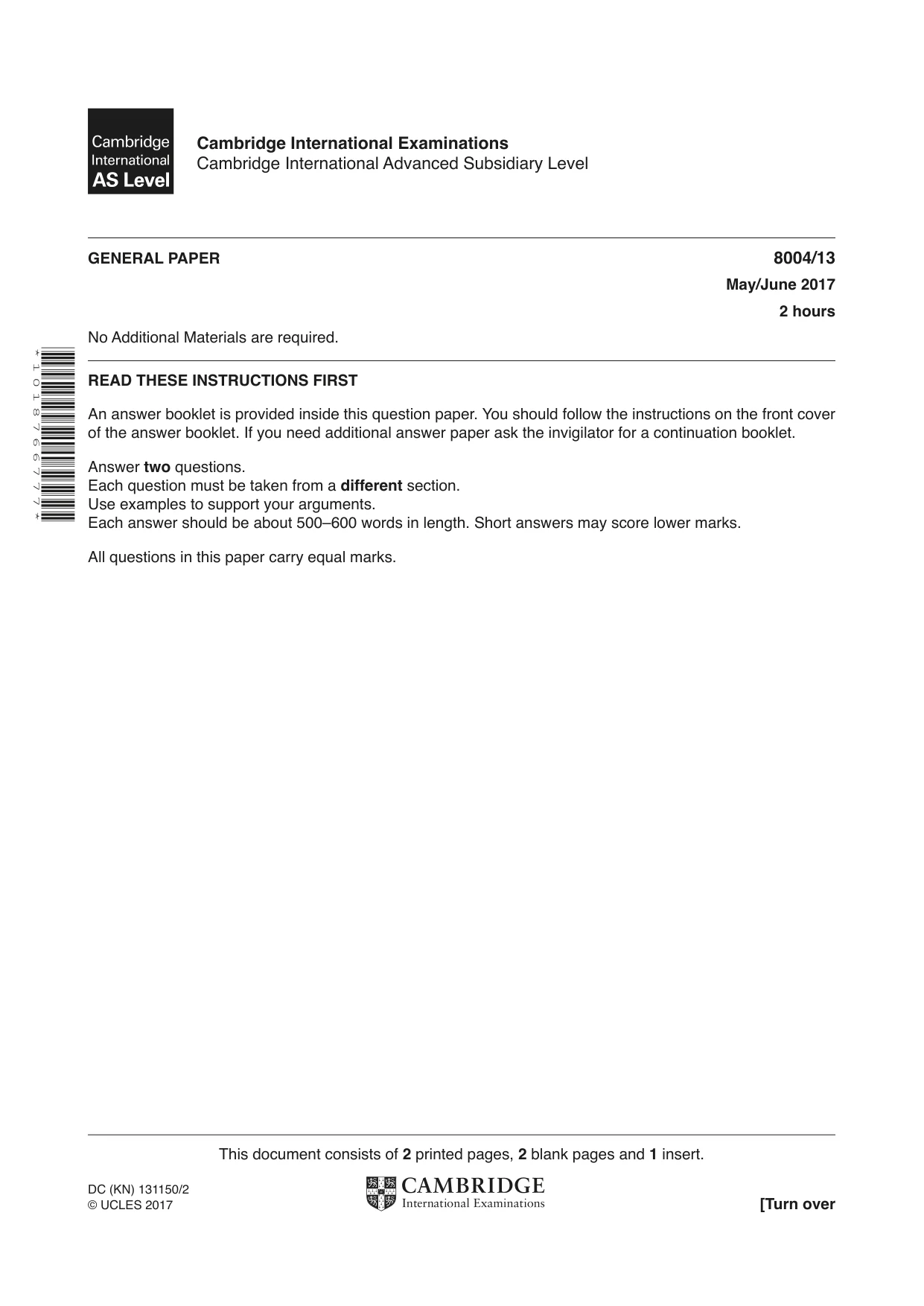
Question paper, page 1
This document consists of 2 printed pages, 2 blank pages and 1 insert. DC (KN) 131150/2 © UCLES 2017 [Turn over Cambridge International Examinations Cambridge International Advanced Subsidiary Level * 1 0 1 8 7 6 6 7 7 7 * GENERAL PAPER 8004/13 May/June 2017 2 hours No Additional Materials are required. READ THESE INSTRUCTIONS FIRST An answer booklet is provided inside this question paper. You should follow the instructions on the front cover of the answer booklet. If you need additional answer paper ask the invigilator for a continuation booklet. Answer two questions. Each question must be taken from a different section. Use examples to support your arguments. Each answer should be about 500–600 words in length. Short answers may score lower marks. All questions in this paper carry equal marks.
Question paper, page 2
2 8004/13/M/J/17 © UCLES 2017 BLANK PAGE
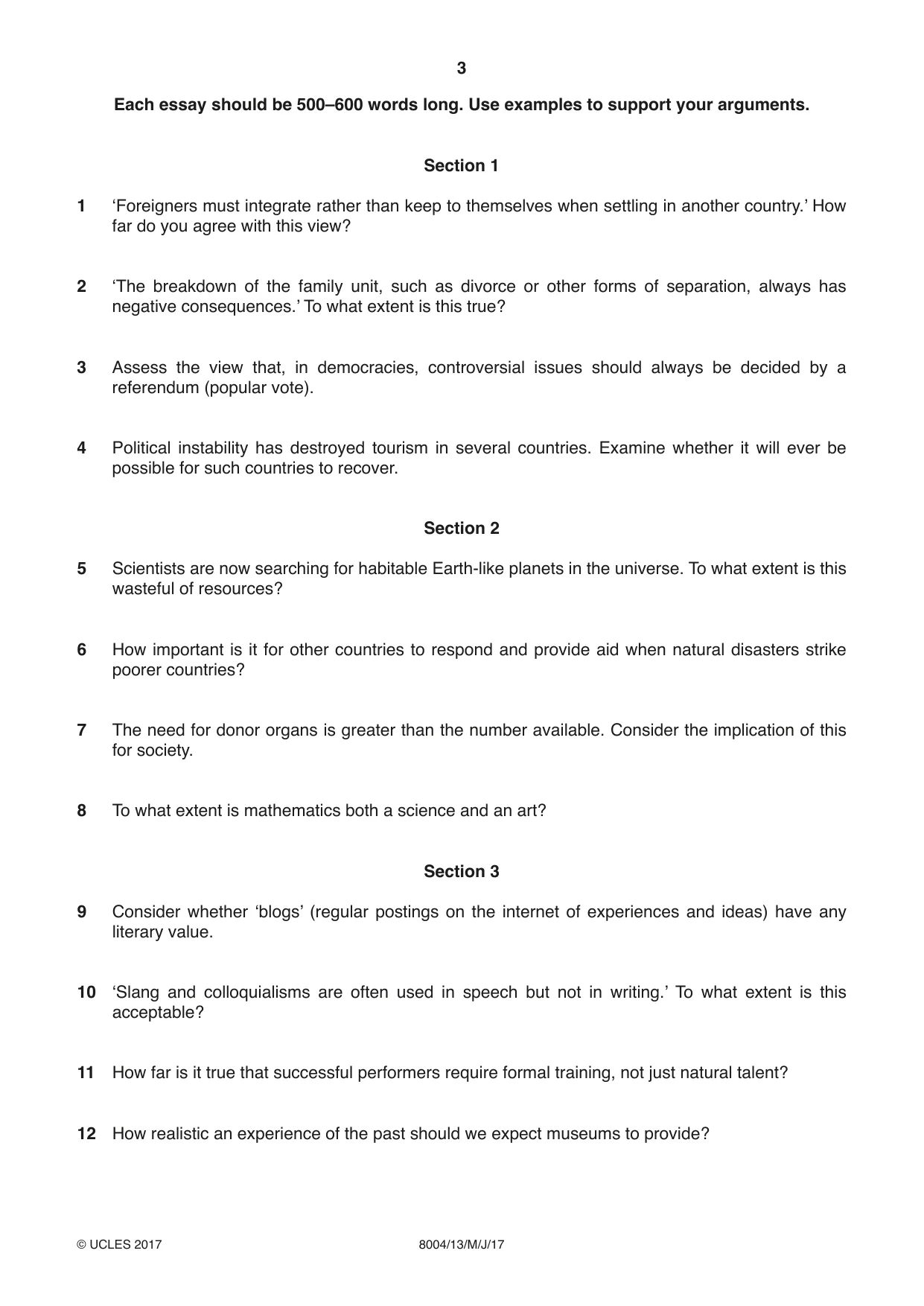
Question paper, page 3
3 8004/13/M/J/17 © UCLES 2017 Each essay should be 500–600 words long. Use examples to support your arguments. Section 1 1 ‘Foreigners must integrate rather than keep to themselves when settling in another country.’ How far do you agree with this view? 2 ‘The breakdown of the family unit, such as divorce or other forms of separation, always has negative consequences.’ To what extent is this true? 3 Assess the view that, in democracies, controversial issues should always be decided by a referendum (popular vote). 4 Political instability has destroyed tourism in several countries. Examine whether it will ever be possible for such countries to recover. Section 2 5 Scientists are now searching for habitable Earth-like planets in the universe. To what extent is this wasteful of resources? 6 How important is it for other countries to respond and provide aid when natural disasters strike poorer countries? 7 The need for donor organs is greater than the number available. Consider the implication of this for society. 8 To what extent is mathematics both a science and an art? Section 3 9 Consider whether ‘blogs’ (regular postings on the internet of experiences and ideas) have any literary value. 10 ‘Slang and colloquialisms are often used in speech but not in writing.’ To what extent is this acceptable? 11 How far is it true that successful performers require formal training, not just natural talent? 12 How realistic an experience of the past should we expect museums to provide?
Question paper, page 4
4 8004/13/M/J/17 © UCLES 2017 BLANK PAGE Permission to reproduce items where third-party owned material protected by copyright is included has been sought and cleared where possible. Every reasonable effort has been made by the publisher (UCLES) to trace copyright holders, but if any items requiring clearance have unwittingly been included, the publisher will be pleased to make amends at the earliest possible opportunity. To avoid the issue of disclosure of answer-related information to candidates, all copyright acknowledgements are reproduced online in the Cambridge International Examinations Copyright Acknowledgements Booklet. This is produced for each series of examinations and is freely available to download at www.cie.org.uk after the live examination series. Cambridge International Examinations is part of the Cambridge Assessment Group. Cambridge Assessment is the brand name of University of Cambridge Local Examinations Syndicate (UCLES), which is itself a department of the University of Cambridge.
Mark scheme, page 1
® IGCSE is a registered trademark. This document consists of 9 printed pages. © UCLES 2017 [Turn over Cambridge International Examinations Cambridge International Advanced Subsidiary Level GENERAL PAPER 8004/13 Paper 1 May/June 2017 MARK SCHEME Maximum Mark: 100 Published This mark scheme is published as an aid to teachers and candidates, to indicate the requirements of the examination. It shows the basis on which Examiners were instructed to award marks. It does not indicate the details of the discussions that took place at an Examiners’ meeting before marking began, which would have considered the acceptability of alternative answers. Mark schemes should be read in conjunction with the question paper and the Principal Examiner Report for Teachers. Cambridge will not enter into discussions about these mark schemes. Cambridge is publishing the mark schemes for the May/June 2017 series for most Cambridge IGCSE®, Cambridge International A and AS Level and Cambridge Pre-U components, and some Cambridge O Level components.
Mark scheme, page 2
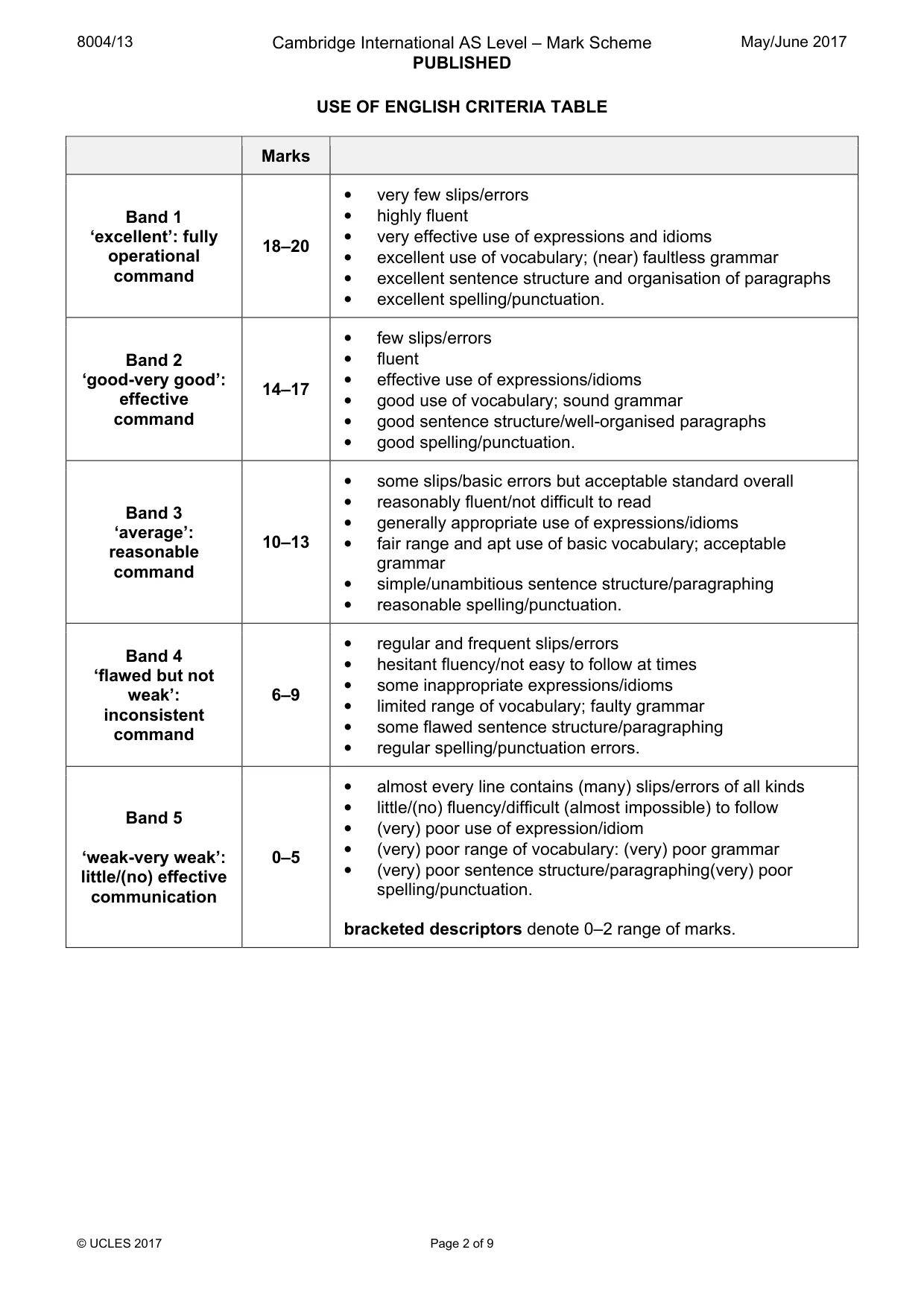
8004/13 Cambridge International AS Level – Mark Scheme PUBLISHED May/June 2017 © UCLES 2017 Page 2 of 9 USE OF ENGLISH CRITERIA TABLE Marks Band 1 ‘excellent’: fully operational command 18–20 • very few slips/errors • highly fluent • very effective use of expressions and idioms • excellent use of vocabulary; (near) faultless grammar • excellent sentence structure and organisation of paragraphs • excellent spelling/punctuation. Band 2 ‘good-very good’: effective command 14–17 • few slips/errors • fluent • effective use of expressions/idioms • good use of vocabulary; sound grammar • good sentence structure/well-organised paragraphs • good spelling/punctuation. Band 3 ‘average’: reasonable command 10–13 • some slips/basic errors but acceptable standard overall • reasonably fluent/not difficult to read • generally appropriate use of expressions/idioms • fair range and apt use of basic vocabulary; acceptable grammar • simple/unambitious sentence structure/paragraphing • reasonable spelling/punctuation. Band 4 ‘flawed but not weak’: inconsistent command 6–9 • regular and frequent slips/errors • hesitant fluency/not easy to follow at times • some inappropriate expressions/idioms • limited range of vocabulary; faulty grammar • some flawed sentence structure/paragraphing • regular spelling/punctuation errors. Band 5 ‘weak-very weak’: little/(no) effective communication 0–5 • almost every line contains (many) slips/errors of all kinds • little/(no) fluency/difficult (almost impossible) to follow • (very) poor use of expression/idiom • (very) poor range of vocabulary: (very) poor grammar • (very) poor sentence structure/paragraphing(very) poor spelling/punctuation. bracketed descriptors denote 0–2 range of marks.
Mark scheme, page 3
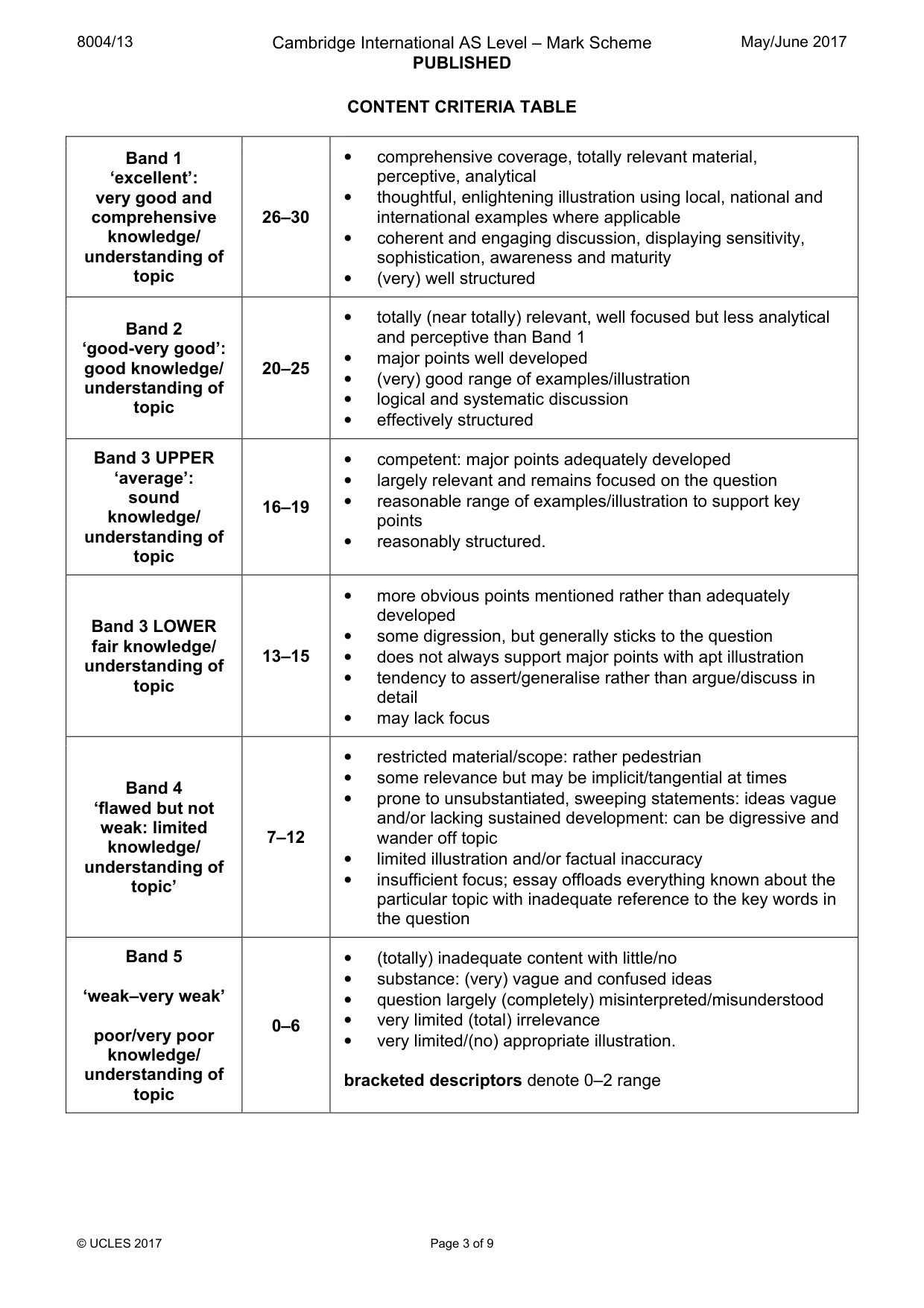
8004/13 Cambridge International AS Level – Mark Scheme PUBLISHED May/June 2017 © UCLES 2017 Page 3 of 9 CONTENT CRITERIA TABLE Band 1 ‘excellent’: very good and comprehensive knowledge/ understanding of topic 26–30 • comprehensive coverage, totally relevant material, perceptive, analytical • thoughtful, enlightening illustration using local, national and international examples where applicable • coherent and engaging discussion, displaying sensitivity, sophistication, awareness and maturity • (very) well structured Band 2 ‘good-very good’: good knowledge/ understanding of topic 20–25 • totally (near totally) relevant, well focused but less analytical and perceptive than Band 1 • major points well developed • (very) good range of examples/illustration • logical and systematic discussion • effectively structured Band 3 UPPER ‘average’: sound knowledge/ understanding of topic 16–19 • competent: major points adequately developed • largely relevant and remains focused on the question • reasonable range of examples/illustration to support key points • reasonably structured. Band 3 LOWER fair knowledge/ understanding of topic 13–15 • more obvious points mentioned rather than adequately developed • some digression, but generally sticks to the question • does not always support major points with apt illustration • tendency to assert/generalise rather than argue/discuss in detail • may lack focus Band 4 ‘flawed but not weak: limited knowledge/ understanding of topic’ 7–12 • restricted material/scope: rather pedestrian • some relevance but may be implicit/tangential at times • prone to unsubstantiated, sweeping statements: ideas vague and/or lacking sustained development: can be digressive and wander off topic • limited illustration and/or factual inaccuracy • insufficient focus; essay offloads everything known about the particular topic with inadequate reference to the key words in the question Band 5 ‘weak–very weak’ poor/very poor knowledge/ understanding of topic 0–6 • (totally) inadequate content with little/no • substance: (very) vague and confused ideas • question largely (completely) misinterpreted/misunderstood • very limited (total) irrelevance • very limited/(no) appropriate illustration. bracketed descriptors denote 0–2 range
Mark scheme, page 4
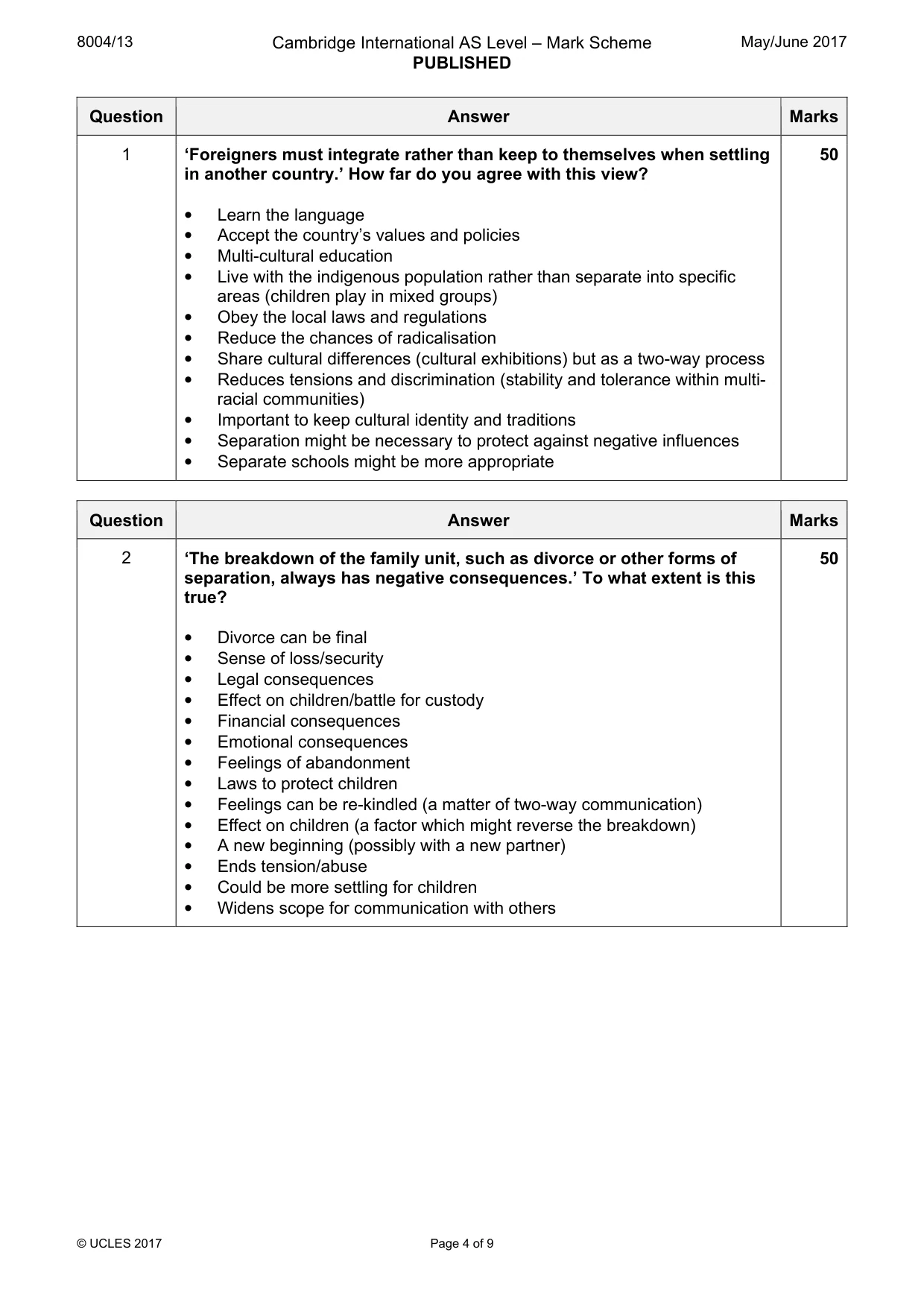
8004/13 Cambridge International AS Level – Mark Scheme PUBLISHED May/June 2017 © UCLES 2017 Page 4 of 9 Question Answer Marks 1 ‘Foreigners must integrate rather than keep to themselves when settling in another country.’ How far do you agree with this view? • Learn the language • Accept the country’s values and policies • Multi-cultural education • Live with the indigenous population rather than separate into specific areas (children play in mixed groups) • Obey the local laws and regulations • Reduce the chances of radicalisation • Share cultural differences (cultural exhibitions) but as a two-way process • Reduces tensions and discrimination (stability and tolerance within multi- racial communities) • Important to keep cultural identity and traditions • Separation might be necessary to protect against negative influences • Separate schools might be more appropriate 50 Question Answer Marks 2 ‘The breakdown of the family unit, such as divorce or other forms of separation, always has negative consequences.’ To what extent is this true? • Divorce can be final • Sense of loss/security • Legal consequences • Effect on children/battle for custody • Financial consequences • Emotional consequences • Feelings of abandonment • Laws to protect children • Feelings can be re-kindled (a matter of two-way communication) • Effect on children (a factor which might reverse the breakdown) • A new beginning (possibly with a new partner) • Ends tension/abuse • Could be more settling for children • Widens scope for communication with others 50
Mark scheme, page 5
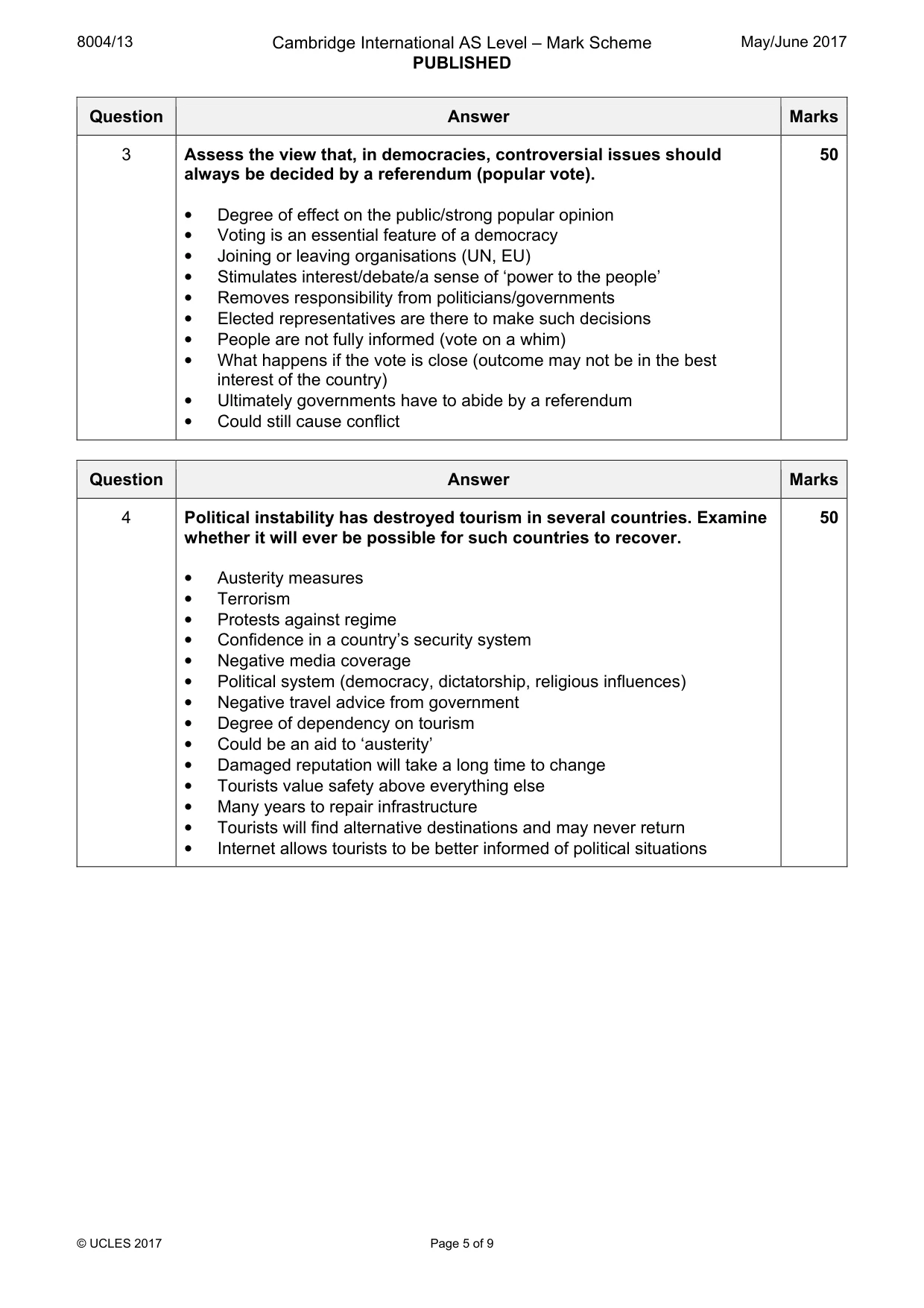
8004/13 Cambridge International AS Level – Mark Scheme PUBLISHED May/June 2017 © UCLES 2017 Page 5 of 9 Question Answer Marks 3 Assess the view that, in democracies, controversial issues should always be decided by a referendum (popular vote). • Degree of effect on the public/strong popular opinion • Voting is an essential feature of a democracy • Joining or leaving organisations (UN, EU) • Stimulates interest/debate/a sense of ‘power to the people’ • Removes responsibility from politicians/governments • Elected representatives are there to make such decisions • People are not fully informed (vote on a whim) • What happens if the vote is close (outcome may not be in the best interest of the country) • Ultimately governments have to abide by a referendum • Could still cause conflict 50 Question Answer Marks 4 Political instability has destroyed tourism in several countries. Examine whether it will ever be possible for such countries to recover. • Austerity measures • Terrorism • Protests against regime • Confidence in a country’s security system • Negative media coverage • Political system (democracy, dictatorship, religious influences) • Negative travel advice from government • Degree of dependency on tourism • Could be an aid to ‘austerity’ • Damaged reputation will take a long time to change • Tourists value safety above everything else • Many years to repair infrastructure • Tourists will find alternative destinations and may never return • Internet allows tourists to be better informed of political situations 50
Mark scheme, page 6
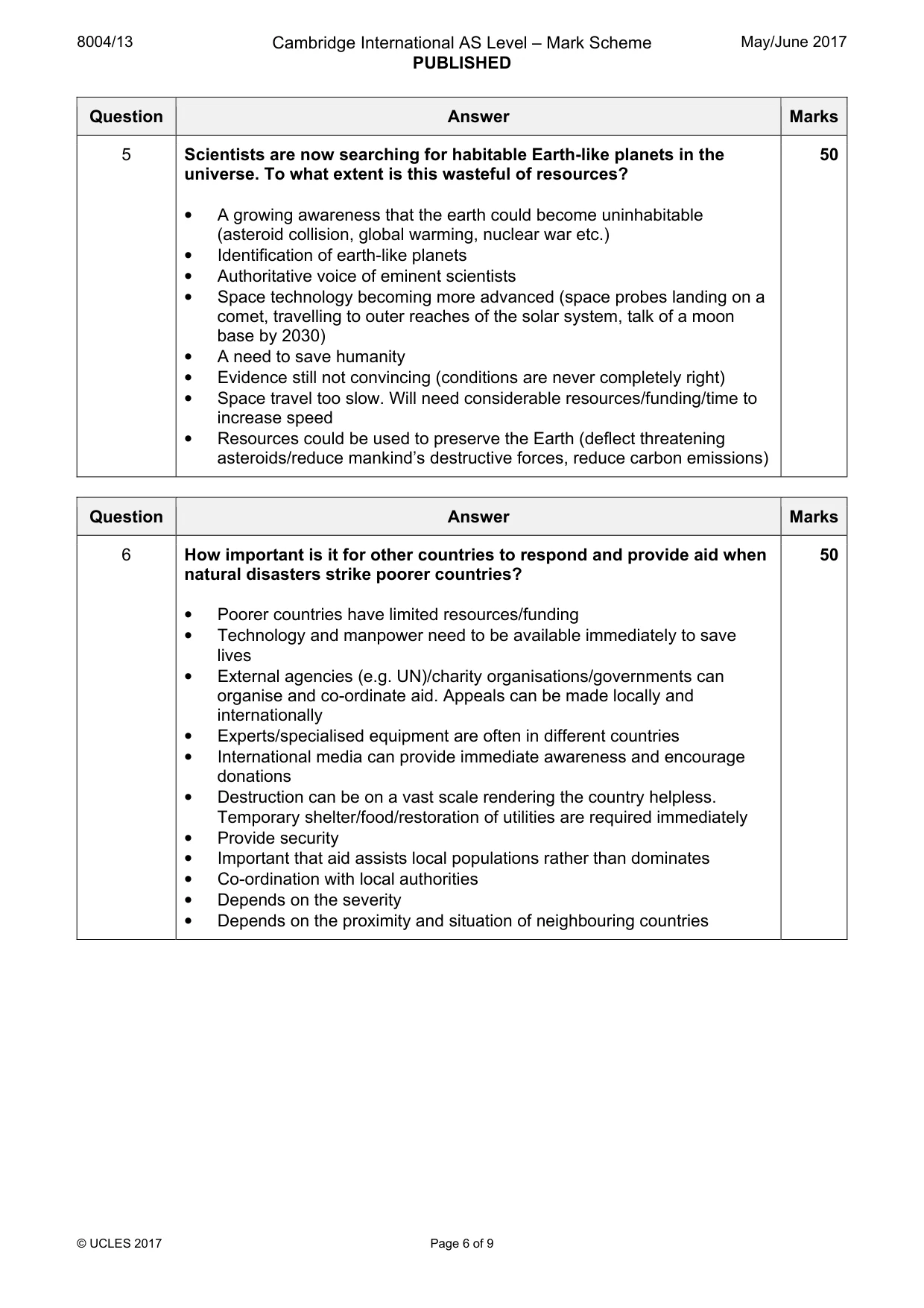
8004/13 Cambridge International AS Level – Mark Scheme PUBLISHED May/June 2017 © UCLES 2017 Page 6 of 9 Question Answer Marks 5 Scientists are now searching for habitable Earth-like planets in the universe. To what extent is this wasteful of resources? • A growing awareness that the earth could become uninhabitable (asteroid collision, global warming, nuclear war etc.) • Identification of earth-like planets • Authoritative voice of eminent scientists • Space technology becoming more advanced (space probes landing on a comet, travelling to outer reaches of the solar system, talk of a moon base by 2030) • A need to save humanity • Evidence still not convincing (conditions are never completely right) • Space travel too slow. Will need considerable resources/funding/time to increase speed • Resources could be used to preserve the Earth (deflect threatening asteroids/reduce mankind’s destructive forces, reduce carbon emissions) 50 Question Answer Marks 6 How important is it for other countries to respond and provide aid when natural disasters strike poorer countries? • Poorer countries have limited resources/funding • Technology and manpower need to be available immediately to save lives • External agencies (e.g. UN)/charity organisations/governments can organise and co-ordinate aid. Appeals can be made locally and internationally • Experts/specialised equipment are often in different countries • International media can provide immediate awareness and encourage donations • Destruction can be on a vast scale rendering the country helpless. Temporary shelter/food/restoration of utilities are required immediately • Provide security • Important that aid assists local populations rather than dominates • Co-ordination with local authorities • Depends on the severity • Depends on the proximity and situation of neighbouring countries 50
Mark scheme, page 7
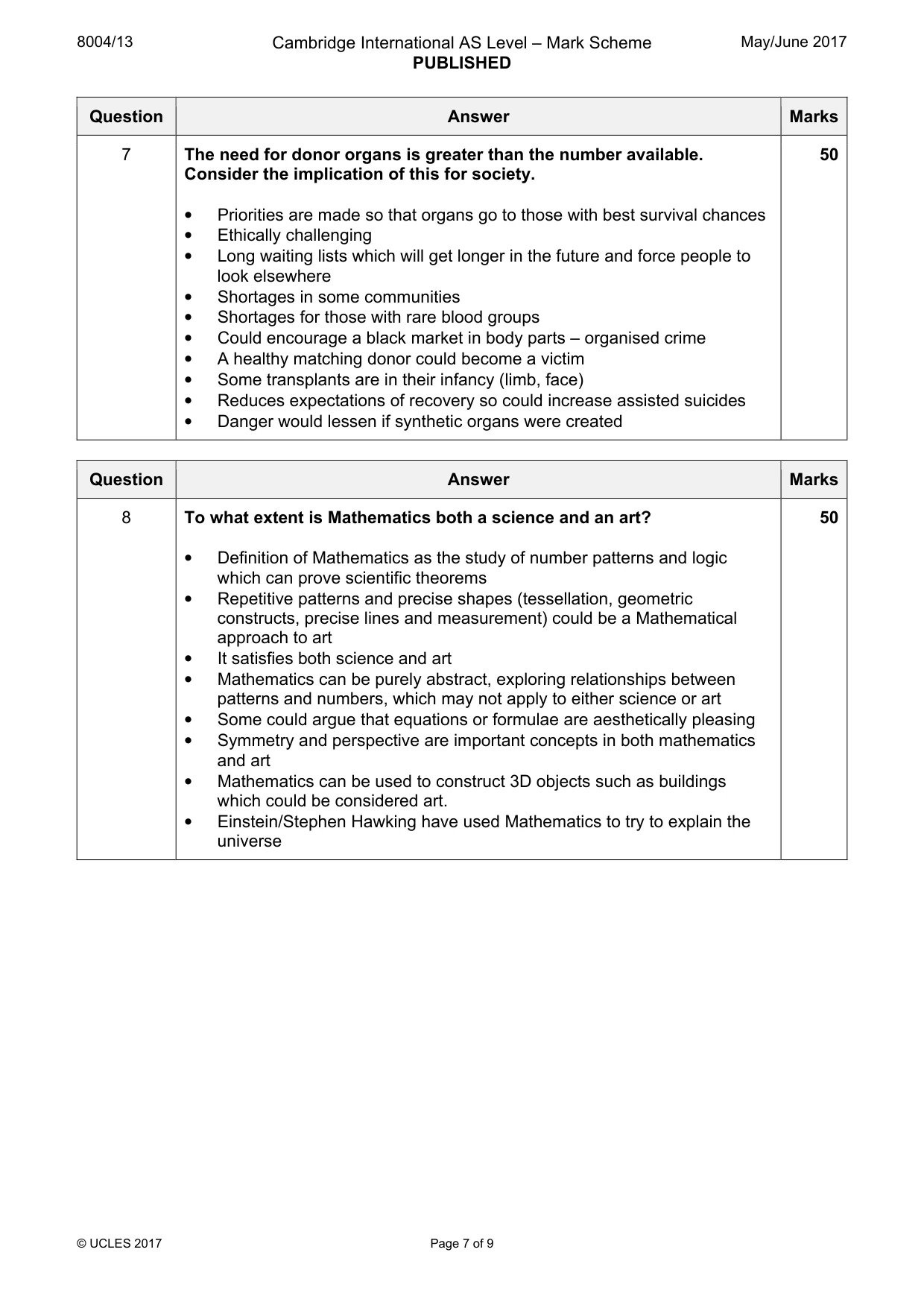
8004/13 Cambridge International AS Level – Mark Scheme PUBLISHED May/June 2017 © UCLES 2017 Page 7 of 9 Question Answer Marks 7 The need for donor organs is greater than the number available. Consider the implication of this for society. • Priorities are made so that organs go to those with best survival chances • Ethically challenging • Long waiting lists which will get longer in the future and force people to look elsewhere • Shortages in some communities • Shortages for those with rare blood groups • Could encourage a black market in body parts – organised crime • A healthy matching donor could become a victim • Some transplants are in their infancy (limb, face) • Reduces expectations of recovery so could increase assisted suicides • Danger would lessen if synthetic organs were created 50 Question Answer Marks 8 To what extent is Mathematics both a science and an art? • Definition of Mathematics as the study of number patterns and logic which can prove scientific theorems • Repetitive patterns and precise shapes (tessellation, geometric constructs, precise lines and measurement) could be a Mathematical approach to art • It satisfies both science and art • Mathematics can be purely abstract, exploring relationships between patterns and numbers, which may not apply to either science or art • Some could argue that equations or formulae are aesthetically pleasing • Symmetry and perspective are important concepts in both mathematics and art • Mathematics can be used to construct 3D objects such as buildings which could be considered art. • Einstein/Stephen Hawking have used Mathematics to try to explain the universe 50
Mark scheme, page 8
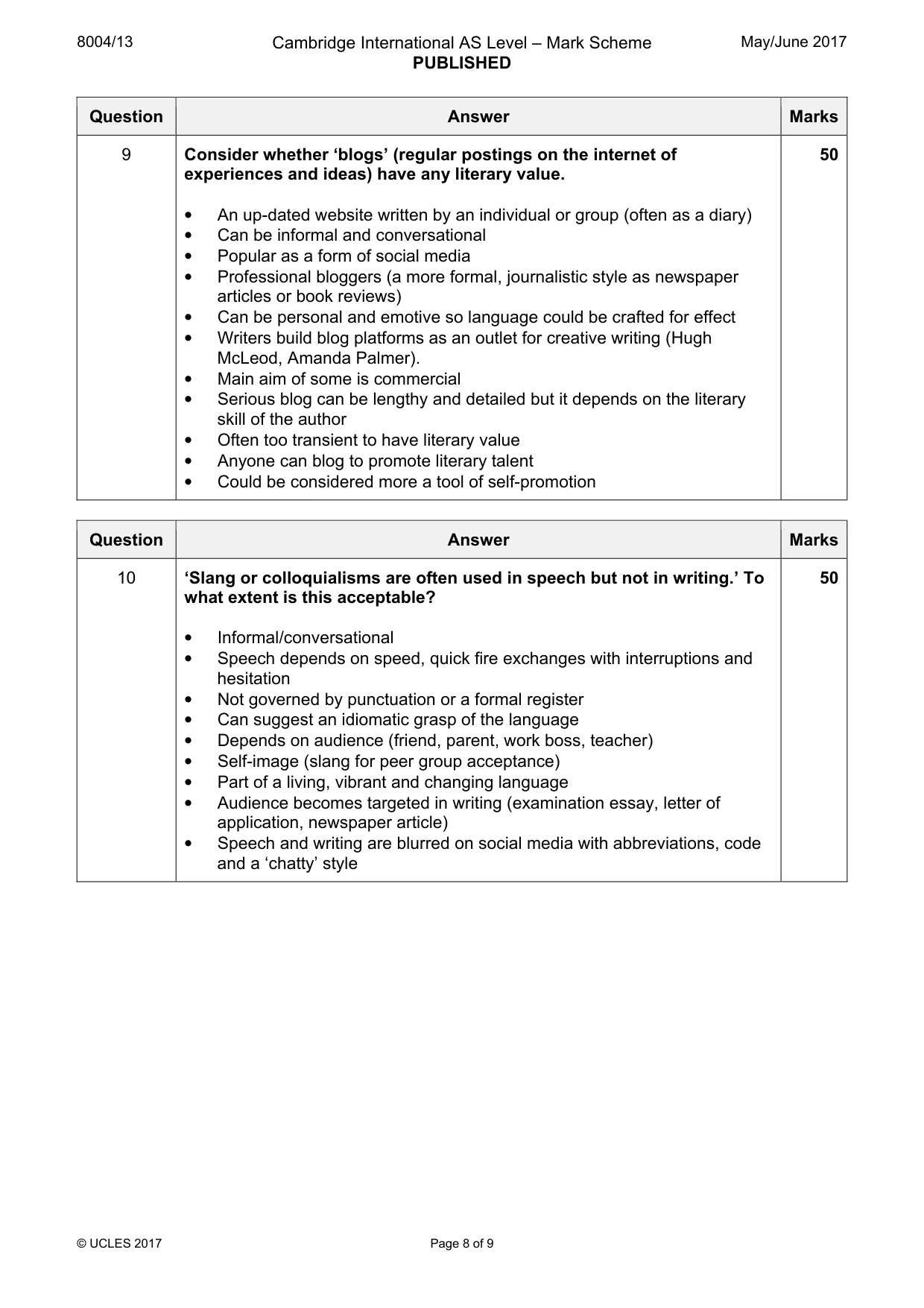
8004/13 Cambridge International AS Level – Mark Scheme PUBLISHED May/June 2017 © UCLES 2017 Page 8 of 9 Question Answer Marks 9 Consider whether ‘blogs’ (regular postings on the internet of experiences and ideas) have any literary value. • An up-dated website written by an individual or group (often as a diary) • Can be informal and conversational • Popular as a form of social media • Professional bloggers (a more formal, journalistic style as newspaper articles or book reviews) • Can be personal and emotive so language could be crafted for effect • Writers build blog platforms as an outlet for creative writing (Hugh McLeod, Amanda Palmer). • Main aim of some is commercial • Serious blog can be lengthy and detailed but it depends on the literary skill of the author • Often too transient to have literary value • Anyone can blog to promote literary talent • Could be considered more a tool of self-promotion 50 Question Answer Marks 10 ‘Slang or colloquialisms are often used in speech but not in writing.’ To what extent is this acceptable? • Informal/conversational • Speech depends on speed, quick fire exchanges with interruptions and hesitation • Not governed by punctuation or a formal register • Can suggest an idiomatic grasp of the language • Depends on audience (friend, parent, work boss, teacher) • Self-image (slang for peer group acceptance) • Part of a living, vibrant and changing language • Audience becomes targeted in writing (examination essay, letter of application, newspaper article) • Speech and writing are blurred on social media with abbreviations, code and a ‘chatty’ style 50
Mark scheme, page 9
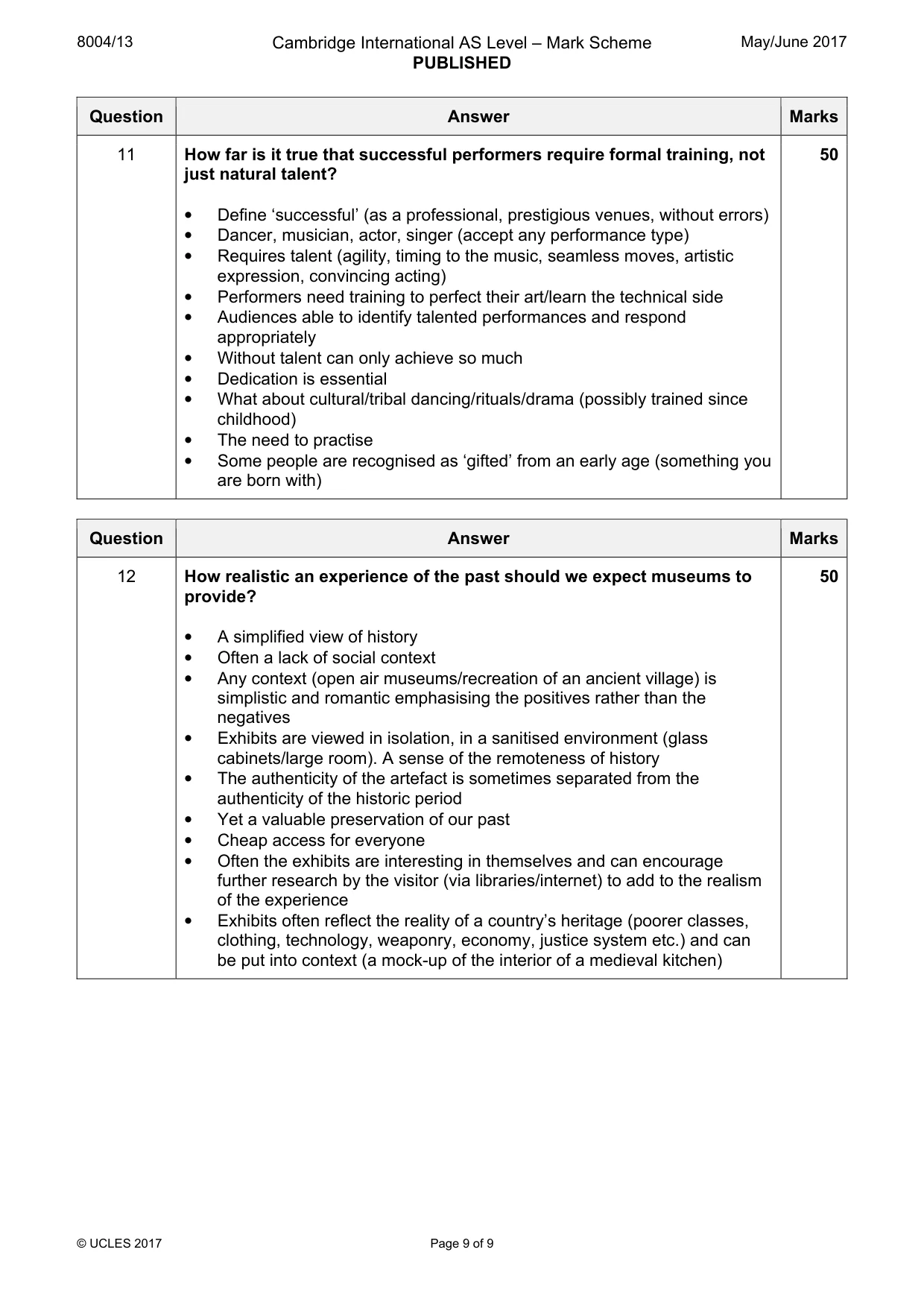
8004/13 Cambridge International AS Level – Mark Scheme PUBLISHED May/June 2017 © UCLES 2017 Page 9 of 9 Question Answer Marks 11 How far is it true that successful performers require formal training, not just natural talent? • Define ‘successful’ (as a professional, prestigious venues, without errors) • Dancer, musician, actor, singer (accept any performance type) • Requires talent (agility, timing to the music, seamless moves, artistic expression, convincing acting) • Performers need training to perfect their art/learn the technical side • Audiences able to identify talented performances and respond appropriately • Without talent can only achieve so much • Dedication is essential • What about cultural/tribal dancing/rituals/drama (possibly trained since childhood) • The need to practise • Some people are recognised as ‘gifted’ from an early age (something you are born with) 50 Question Answer Marks 12 How realistic an experience of the past should we expect museums to provide? • A simplified view of history • Often a lack of social context • Any context (open air museums/recreation of an ancient village) is simplistic and romantic emphasising the positives rather than the negatives • Exhibits are viewed in isolation, in a sanitised environment (glass cabinets/large room). A sense of the remoteness of history • The authenticity of the artefact is sometimes separated from the authenticity of the historic period • Yet a valuable preservation of our past • Cheap access for everyone • Often the exhibits are interesting in themselves and can encourage further research by the visitor (via libraries/internet) to add to the realism of the experience • Exhibits often reflect the reality of a country’s heritage (poorer classes, clothing, technology, weaponry, economy, justice system etc.) and can be put into context (a mock-up of the interior of a medieval kitchen) 50
What you needed in this session
Cambridge’s own grade thresholds for 2017 May/June, Paper 1 · Variant 3. A higher threshold means an easier paper — the bar moves with how the cohort did.