Cambridge A Level General Paper (AS Level only) 8004 — 2015 May/June Paper 1 · Variant 3
8004/13/M/J/15 · 100 marks · ≈113 min
The question paper and its mark scheme, free to read here and free to download. This is Cambridge’s own paper, exactly as it was sat.
Question paper4 pages

Mark scheme7 pages
Answers below. Sit the paper first if you are practising.
Paper as text
Question paper, page 1
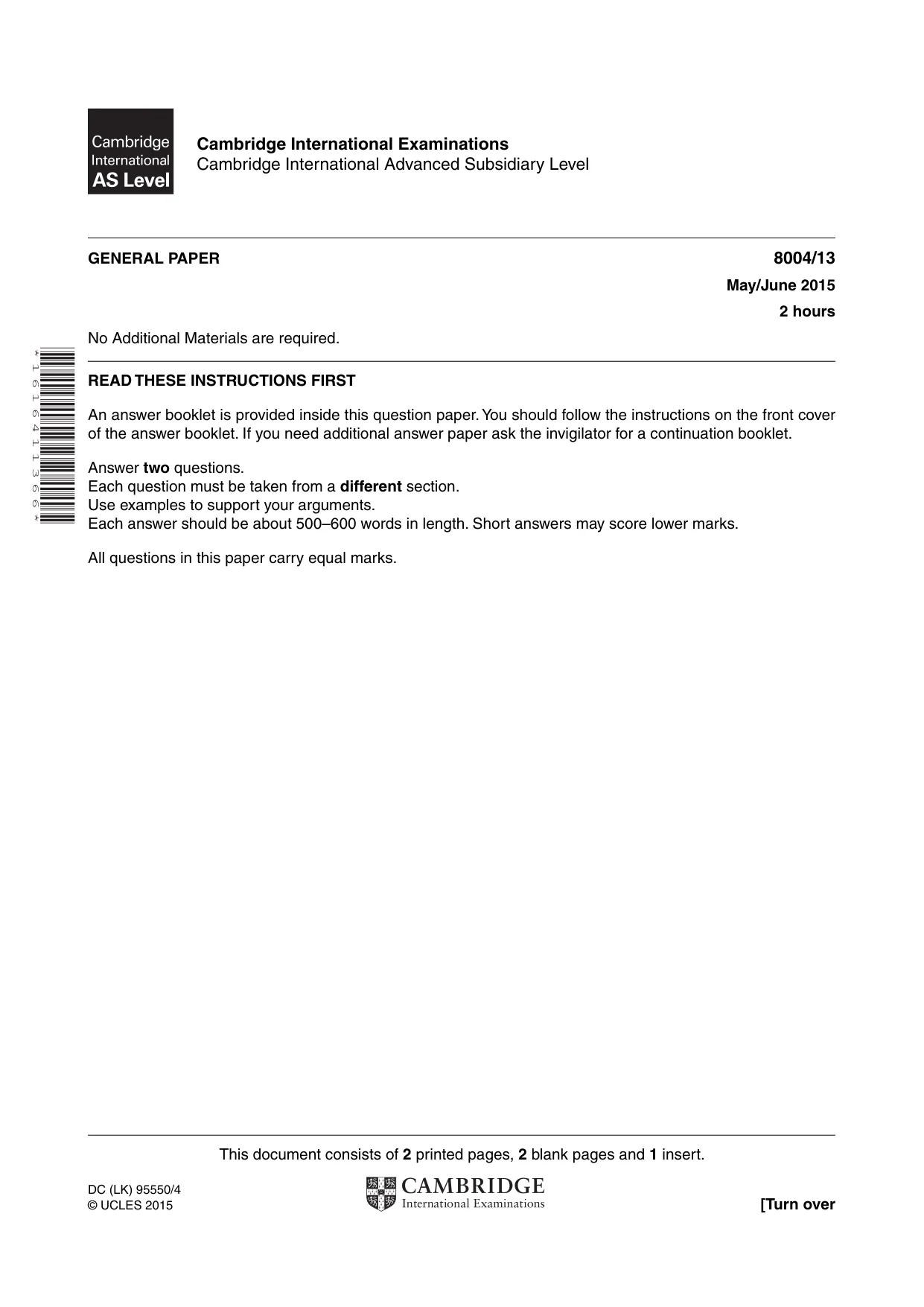
This document consists of 2 printed pages, 2 blank pages and 1 insert. DC (LK) 95550/4 © UCLES 2015 [Turn over * 1 6 1 6 4 1 1 3 6 6 * GENERAL PAPER 8004/13 May/June 2015 2 hours No Additional Materials are required. READ THESE INSTRUCTIONS FIRST An answer booklet is provided inside this question paper. You should follow the instructions on the front cover of the answer booklet. If you need additional answer paper ask the invigilator for a continuation booklet. Answer two questions. Each question must be taken from a different section. Use examples to support your arguments. Each answer should be about 500–600 words in length. Short answers may score lower marks. All questions in this paper carry equal marks. Cambridge International Examinations Cambridge International Advanced Subsidiary Level
Question paper, page 2
2 8004/13/M/J/15 © UCLES 2015 BLANK PAGE
Question paper, page 3
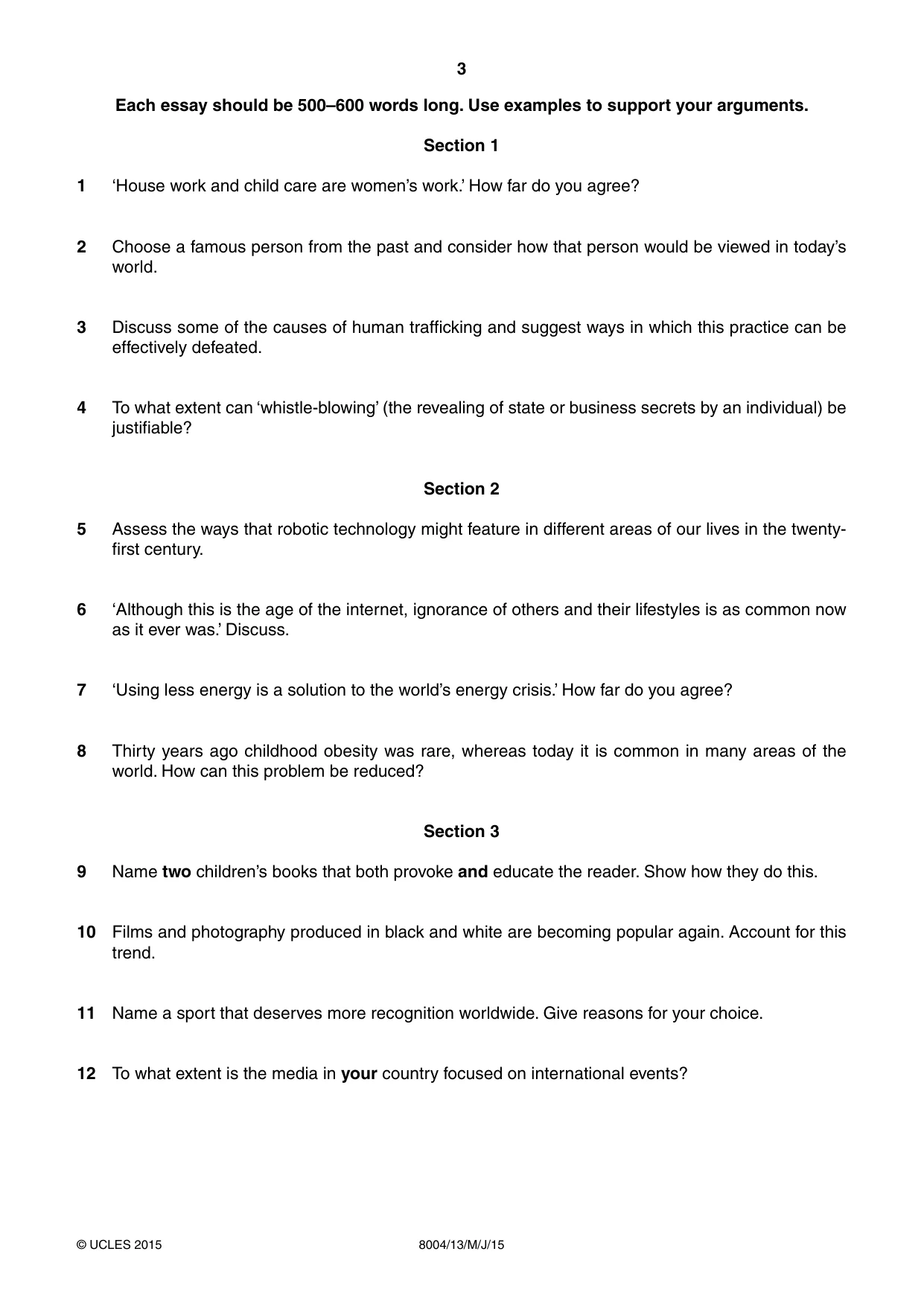
3 8004/13/M/J/15 © UCLES 2015 Each essay should be 500–600 words long. Use examples to support your arguments. Section 1 1 ‘House work and child care are women’s work.’ How far do you agree? 2 Choose a famous person from the past and consider how that person would be viewed in today’s world. 3 Discuss some of the causes of human trafficking and suggest ways in which this practice can be effectively defeated. 4 To what extent can ‘whistle-blowing’ (the revealing of state or business secrets by an individual) be justifiable? Section 2 5 Assess the ways that robotic technology might feature in different areas of our lives in the twenty- first century. 6 ‘Although this is the age of the internet, ignorance of others and their lifestyles is as common now as it ever was.’ Discuss. 7 ‘Using less energy is a solution to the world’s energy crisis.’ How far do you agree? 8 Thirty years ago childhood obesity was rare, whereas today it is common in many areas of the world. How can this problem be reduced? Section 3 9 Name two children’s books that both provoke and educate the reader. Show how they do this. 10 Films and photography produced in black and white are becoming popular again. Account for this trend. 11 Name a sport that deserves more recognition worldwide. Give reasons for your choice. 12 To what extent is the media in your country focused on international events?
Question paper, page 4
4 8004/13/M/J/15 © UCLES 2015 BLANK PAGE Permission to reproduce items where third-party owned material protected by copyright is included has been sought and cleared where possible. Every reasonable effort has been made by the publisher (UCLES) to trace copyright holders, but if any items requiring clearance have unwittingly been included, the publisher will be pleased to make amends at the earliest possible opportunity. To avoid the issue of disclosure of answer-related information to candidates, all copyright acknowledgements are reproduced online in the Cambridge International Examinations Copyright Acknowledgements Booklet. This is produced for each series of examinations and is freely available to download at www.cie.org.uk after the live examination series. Cambridge International Examinations is part of the Cambridge Assessment Group. Cambridge Assessment is the brand name of University of Cambridge Local Examinations Syndicate (UCLES), which is itself a department of the University of Cambridge.
Mark scheme, page 1
® IGCSE is the registered trademark of Cambridge International Examinations. CAMBRIDGE INTERNATIONAL EXAMINATIONS Cambridge International Advanced Subsidiary Level MARK SCHEME for the May/June 2015 series 8004 GENERAL PAPER 8004/13 Paper 1 maximum raw mark 100 This mark scheme is published as an aid to teachers and candidates, to indicate the requirements of the examination. It shows the basis on which Examiners were instructed to award marks. It does not indicate the details of the discussions that took place at an Examiners’ meeting before marking began, which would have considered the acceptability of alternative answers. Mark schemes should be read in conjunction with the question paper and the Principal Examiner Report for Teachers. Cambridge will not enter into discussions about these mark schemes. Cambridge is publishing the mark schemes for the May/June 2015 series for most Cambridge IGCSE®, Cambridge International A and AS Level components and some Cambridge O Level components.
Mark scheme, page 2
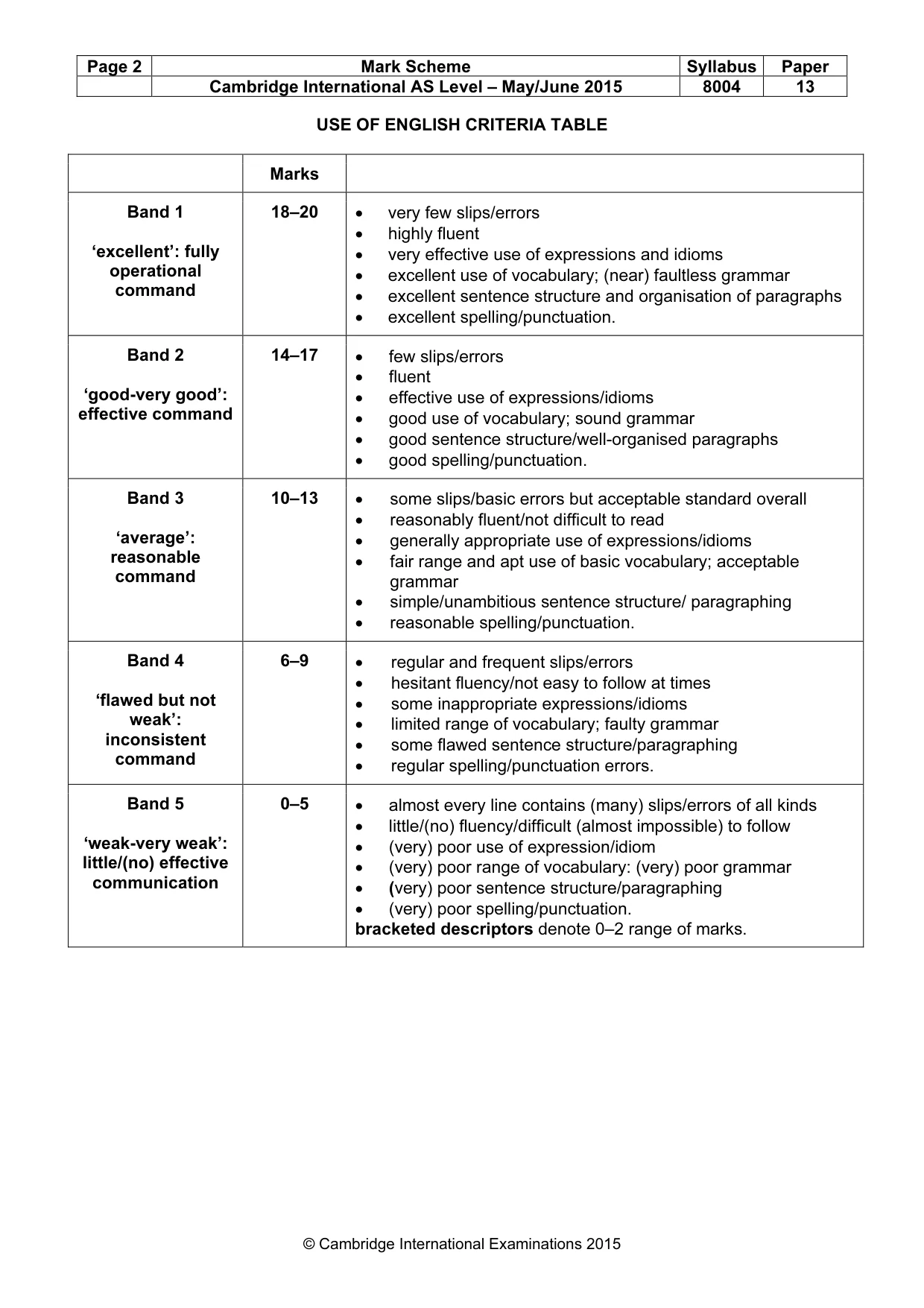
Page 2 Mark Scheme Syllabus Paper Cambridge International AS Level – May/June 2015 8004 13 © Cambridge International Examinations 2015 USE OF ENGLISH CRITERIA TABLE Marks Band 1 ‘excellent’: fully operational command 18–20 • very few slips/errors • highly fluent • very effective use of expressions and idioms • excellent use of vocabulary; (near) faultless grammar • excellent sentence structure and organisation of paragraphs • excellent spelling/punctuation. Band 2 ‘good-very good’: effective command 14–17 • few slips/errors • fluent • effective use of expressions/idioms • good use of vocabulary; sound grammar • good sentence structure/well-organised paragraphs • good spelling/punctuation. Band 3 ‘average’: reasonable command 10–13 • some slips/basic errors but acceptable standard overall • reasonably fluent/not difficult to read • generally appropriate use of expressions/idioms • fair range and apt use of basic vocabulary; acceptable grammar • simple/unambitious sentence structure/ paragraphing • reasonable spelling/punctuation. Band 4 ‘flawed but not weak’: inconsistent command 6–9 • regular and frequent slips/errors • hesitant fluency/not easy to follow at times • some inappropriate expressions/idioms • limited range of vocabulary; faulty grammar • some flawed sentence structure/paragraphing • regular spelling/punctuation errors. Band 5 ‘weak-very weak’: little/(no) effective communication 0–5 • almost every line contains (many) slips/errors of all kinds • little/(no) fluency/difficult (almost impossible) to follow • (very) poor use of expression/idiom • (very) poor range of vocabulary: (very) poor grammar • (very) poor sentence structure/paragraphing • (very) poor spelling/punctuation. bracketed descriptors denote 0–2 range of marks.
Mark scheme, page 3
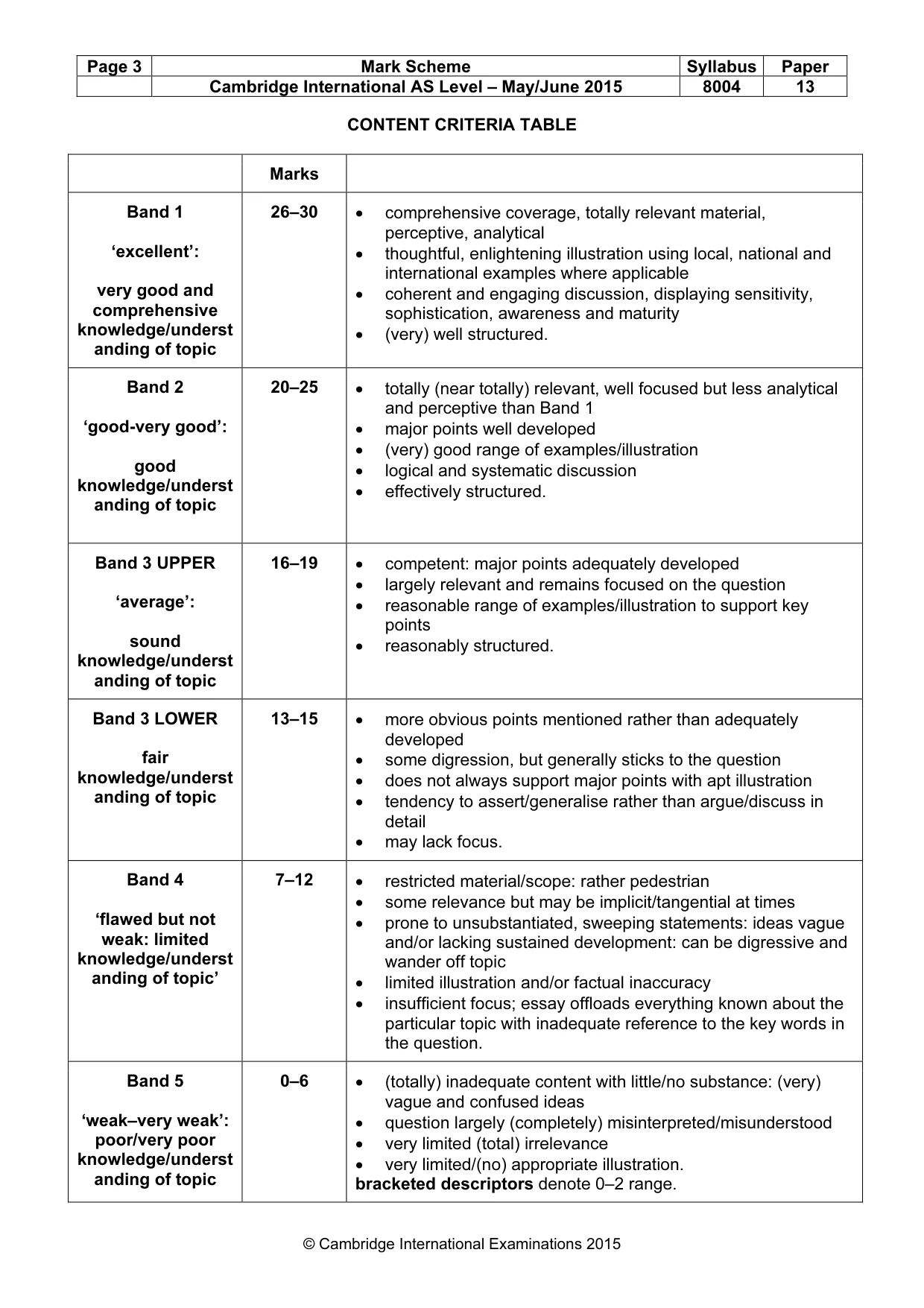
Page 3 Mark Scheme Syllabus Paper Cambridge International AS Level – May/June 2015 8004 13 © Cambridge International Examinations 2015 CONTENT CRITERIA TABLE Marks Band 1 ‘excellent’: very good and comprehensive knowledge/underst anding of topic 26–30 • comprehensive coverage, totally relevant material, perceptive, analytical • thoughtful, enlightening illustration using local, national and international examples where applicable • coherent and engaging discussion, displaying sensitivity, sophistication, awareness and maturity • (very) well structured. Band 2 ‘good-very good’: good knowledge/underst anding of topic 20–25 • totally (near totally) relevant, well focused but less analytical and perceptive than Band 1 • major points well developed • (very) good range of examples/illustration • logical and systematic discussion • effectively structured. Band 3 UPPER ‘average’: sound knowledge/underst anding of topic 16–19 • competent: major points adequately developed • largely relevant and remains focused on the question • reasonable range of examples/illustration to support key points • reasonably structured. Band 3 LOWER fair knowledge/underst anding of topic 13–15 • more obvious points mentioned rather than adequately developed • some digression, but generally sticks to the question • does not always support major points with apt illustration • tendency to assert/generalise rather than argue/discuss in detail • may lack focus. Band 4 ‘flawed but not weak: limited knowledge/underst anding of topic’ 7–12 • restricted material/scope: rather pedestrian • some relevance but may be implicit/tangential at times • prone to unsubstantiated, sweeping statements: ideas vague and/or lacking sustained development: can be digressive and wander off topic • limited illustration and/or factual inaccuracy • insufficient focus; essay offloads everything known about the particular topic with inadequate reference to the key words in the question. Band 5 ‘weak–very weak’: poor/very poor knowledge/underst anding of topic 0–6 • (totally) inadequate content with little/no substance: (very) vague and confused ideas • question largely (completely) misinterpreted/misunderstood • very limited (total) irrelevance • very limited/(no) appropriate illustration. bracketed descriptors denote 0–2 range.
Mark scheme, page 4
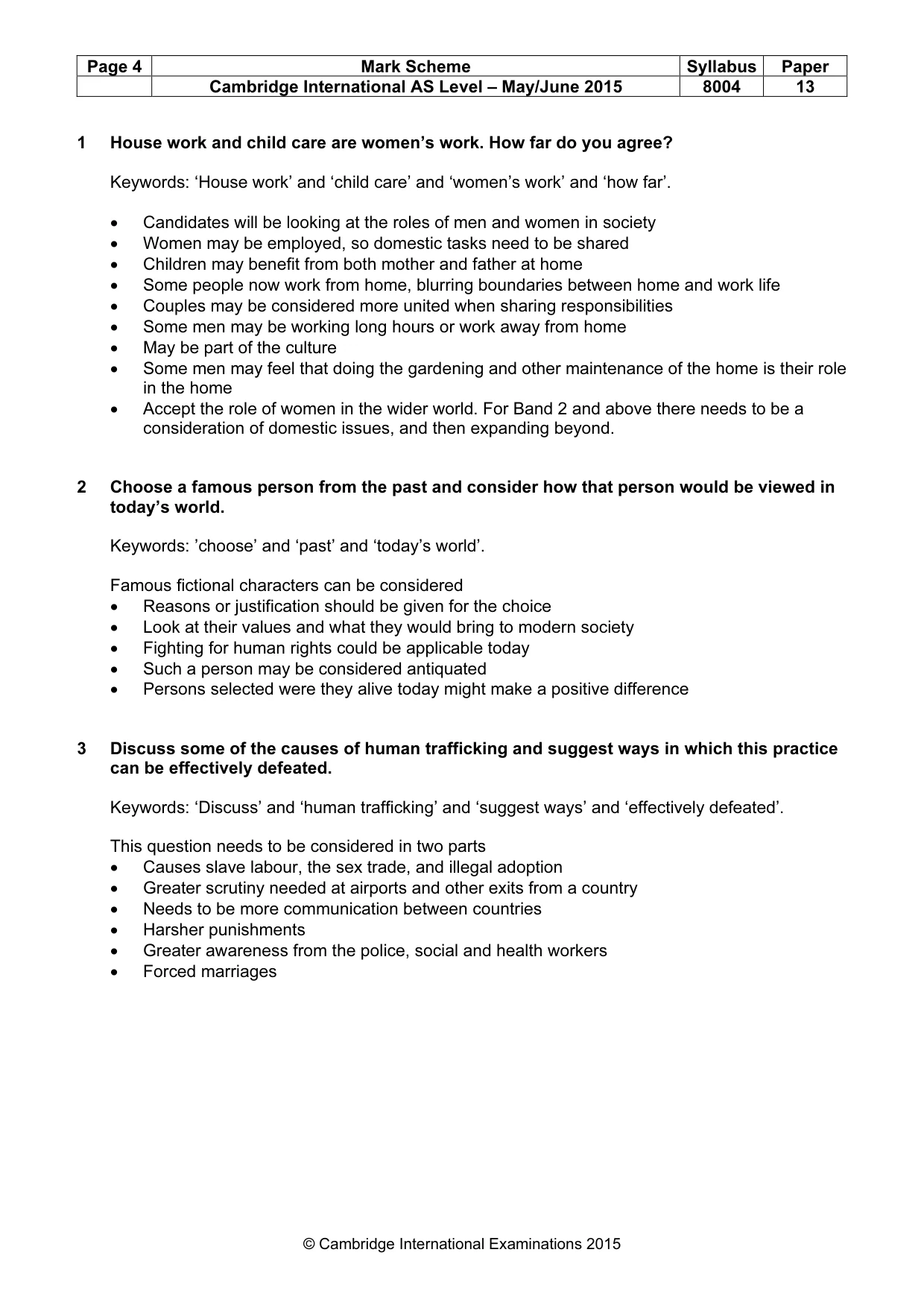
Page 4 Mark Scheme Syllabus Paper Cambridge International AS Level – May/June 2015 8004 13 © Cambridge International Examinations 2015 1 House work and child care are women’s work. How far do you agree? Keywords: ‘House work’ and ‘child care’ and ‘women’s work’ and ‘how far’. • Candidates will be looking at the roles of men and women in society • Women may be employed, so domestic tasks need to be shared • Children may benefit from both mother and father at home • Some people now work from home, blurring boundaries between home and work life • Couples may be considered more united when sharing responsibilities • Some men may be working long hours or work away from home • May be part of the culture • Some men may feel that doing the gardening and other maintenance of the home is their role in the home • Accept the role of women in the wider world. For Band 2 and above there needs to be a consideration of domestic issues, and then expanding beyond. 2 Choose a famous person from the past and consider how that person would be viewed in today’s world. Keywords: ’choose’ and ‘past’ and ‘today’s world’. Famous fictional characters can be considered • Reasons or justification should be given for the choice • Look at their values and what they would bring to modern society • Fighting for human rights could be applicable today • Such a person may be considered antiquated • Persons selected were they alive today might make a positive difference 3 Discuss some of the causes of human trafficking and suggest ways in which this practice can be effectively defeated. Keywords: ‘Discuss’ and ‘human trafficking’ and ‘suggest ways’ and ‘effectively defeated’. This question needs to be considered in two parts • Causes slave labour, the sex trade, and illegal adoption • Greater scrutiny needed at airports and other exits from a country • Needs to be more communication between countries • Harsher punishments • Greater awareness from the police, social and health workers • Forced marriages
Mark scheme, page 5
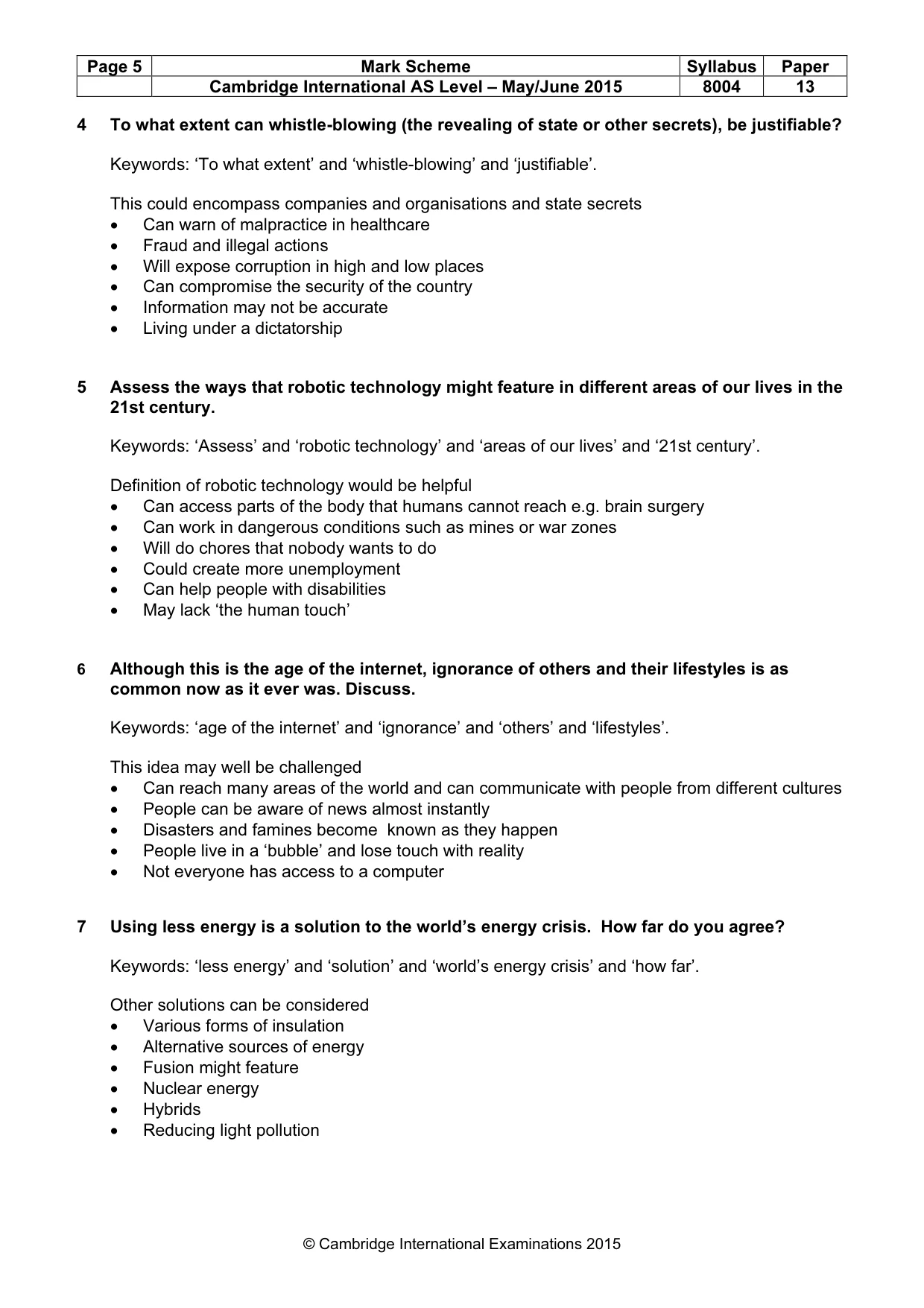
Page 5 Mark Scheme Syllabus Paper Cambridge International AS Level – May/June 2015 8004 13 © Cambridge International Examinations 2015 4 To what extent can whistle-blowing (the revealing of state or other secrets), be justifiable? Keywords: ‘To what extent’ and ‘whistle-blowing’ and ‘justifiable’. This could encompass companies and organisations and state secrets • Can warn of malpractice in healthcare • Fraud and illegal actions • Will expose corruption in high and low places • Can compromise the security of the country • Information may not be accurate • Living under a dictatorship 5 Assess the ways that robotic technology might feature in different areas of our lives in the 21st century. Keywords: ‘Assess’ and ‘robotic technology’ and ‘areas of our lives’ and ‘21st century’. Definition of robotic technology would be helpful • Can access parts of the body that humans cannot reach e.g. brain surgery • Can work in dangerous conditions such as mines or war zones • Will do chores that nobody wants to do • Could create more unemployment • Can help people with disabilities • May lack ‘the human touch’ 6 Although this is the age of the internet, ignorance of others and their lifestyles is as common now as it ever was. Discuss. Keywords: ‘age of the internet’ and ‘ignorance’ and ‘others’ and ‘lifestyles’. This idea may well be challenged • Can reach many areas of the world and can communicate with people from different cultures • People can be aware of news almost instantly • Disasters and famines become known as they happen • People live in a ‘bubble’ and lose touch with reality • Not everyone has access to a computer 7 Using less energy is a solution to the world’s energy crisis. How far do you agree? Keywords: ‘less energy’ and ‘solution’ and ‘world’s energy crisis’ and ‘how far’. Other solutions can be considered • Various forms of insulation • Alternative sources of energy • Fusion might feature • Nuclear energy • Hybrids • Reducing light pollution
Mark scheme, page 6
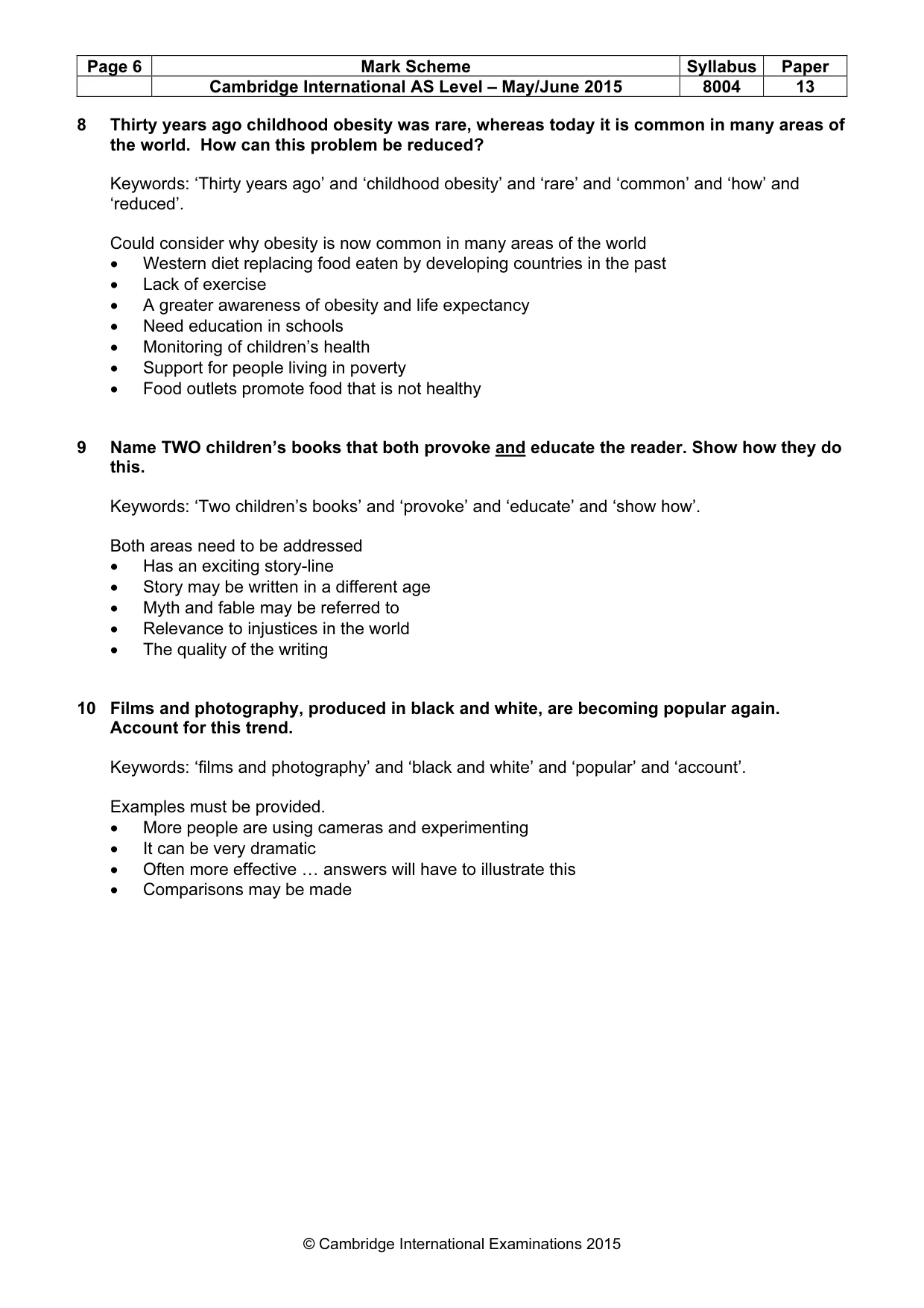
Page 6 Mark Scheme Syllabus Paper Cambridge International AS Level – May/June 2015 8004 13 © Cambridge International Examinations 2015 8 Thirty years ago childhood obesity was rare, whereas today it is common in many areas of the world. How can this problem be reduced? Keywords: ‘Thirty years ago’ and ‘childhood obesity’ and ‘rare’ and ‘common’ and ‘how’ and ‘reduced’. Could consider why obesity is now common in many areas of the world • Western diet replacing food eaten by developing countries in the past • Lack of exercise • A greater awareness of obesity and life expectancy • Need education in schools • Monitoring of children’s health • Support for people living in poverty • Food outlets promote food that is not healthy 9 Name TWO children’s books that both provoke and educate the reader. Show how they do this. Keywords: ‘Two children’s books’ and ‘provoke’ and ‘educate’ and ‘show how’. Both areas need to be addressed • Has an exciting story-line • Story may be written in a different age • Myth and fable may be referred to • Relevance to injustices in the world • The quality of the writing 10 Films and photography, produced in black and white, are becoming popular again. Account for this trend. Keywords: ‘films and photography’ and ‘black and white’ and ‘popular’ and ‘account’. Examples must be provided. • More people are using cameras and experimenting • It can be very dramatic • Often more effective … answers will have to illustrate this • Comparisons may be made
Mark scheme, page 7
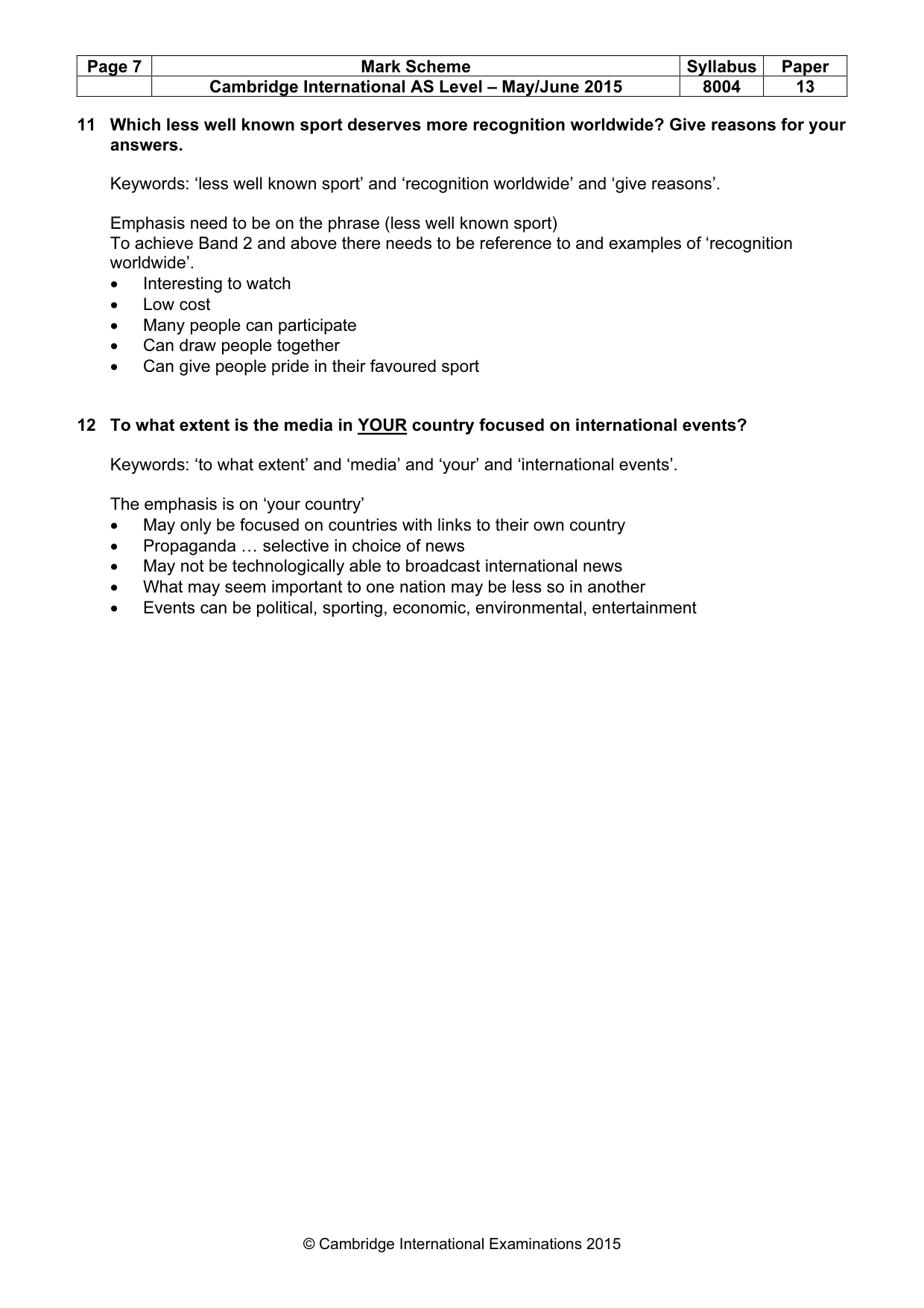
Page 7 Mark Scheme Syllabus Paper Cambridge International AS Level – May/June 2015 8004 13 © Cambridge International Examinations 2015 11 Which less well known sport deserves more recognition worldwide? Give reasons for your answers. Keywords: ‘less well known sport’ and ‘recognition worldwide’ and ‘give reasons’. Emphasis need to be on the phrase (less well known sport) To achieve Band 2 and above there needs to be reference to and examples of ‘recognition worldwide’. • Interesting to watch • Low cost • Many people can participate • Can draw people together • Can give people pride in their favoured sport 12 To what extent is the media in YOUR country focused on international events? Keywords: ‘to what extent’ and ‘media’ and ‘your’ and ‘international events’. The emphasis is on ‘your country’ • May only be focused on countries with links to their own country • Propaganda … selective in choice of news • May not be technologically able to broadcast international news • What may seem important to one nation may be less so in another • Events can be political, sporting, economic, environmental, entertainment
What you needed in this session
Cambridge’s own grade thresholds for 2015 May/June, Paper 1 · Variant 3. A higher threshold means an easier paper — the bar moves with how the cohort did.