Cambridge A Level General Paper (AS Level only) 8004 — 2017 May/June Paper 1 · Variant 1
8004/11/M/J/17 · 100 marks · ≈113 min
The question paper and its mark scheme, free to read here and free to download. This is Cambridge’s own paper, exactly as it was sat.
Question paper4 pages


Mark scheme9 pages
Answers below. Sit the paper first if you are practising.
Paper as text
Question paper, page 1
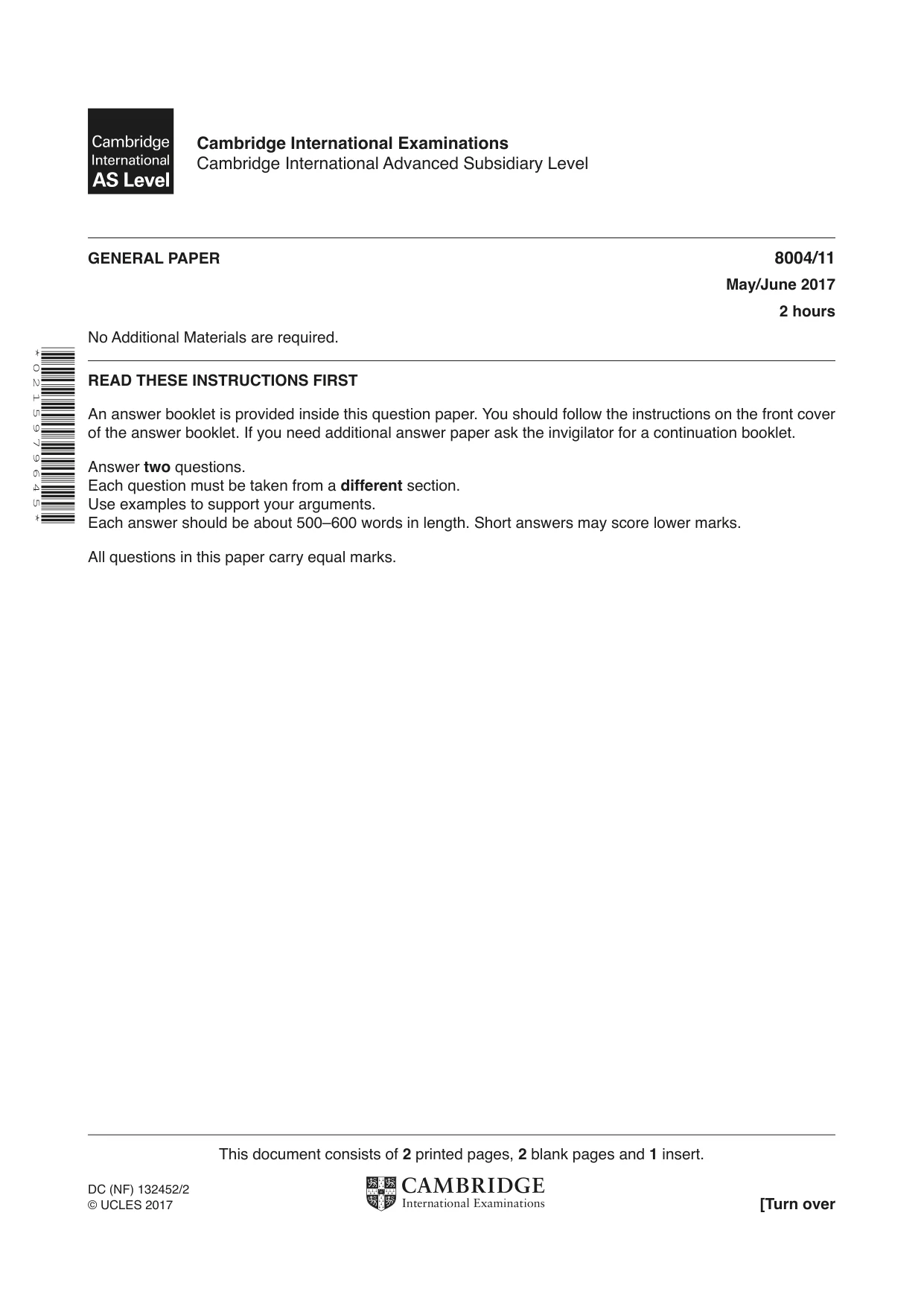
This document consists of 2 printed pages, 2 blank pages and 1 insert. DC (NF) 132452/2 © UCLES 2017 [Turn over Cambridge International Examinations Cambridge International Advanced Subsidiary Level * 0 2 1 5 9 7 9 6 4 5 * GENERAL PAPER 8004/11 May/June 2017 2 hours No Additional Materials are required. READ THESE INSTRUCTIONS FIRST An answer booklet is provided inside this question paper. You should follow the instructions on the front cover of the answer booklet. If you need additional answer paper ask the invigilator for a continuation booklet. Answer two questions. Each question must be taken from a different section. Use examples to support your arguments. Each answer should be about 500–600 words in length. Short answers may score lower marks. All questions in this paper carry equal marks.
Question paper, page 2
2 8004/11/M/J/17 © UCLES 2017 BLANK PAGE
Question paper, page 3
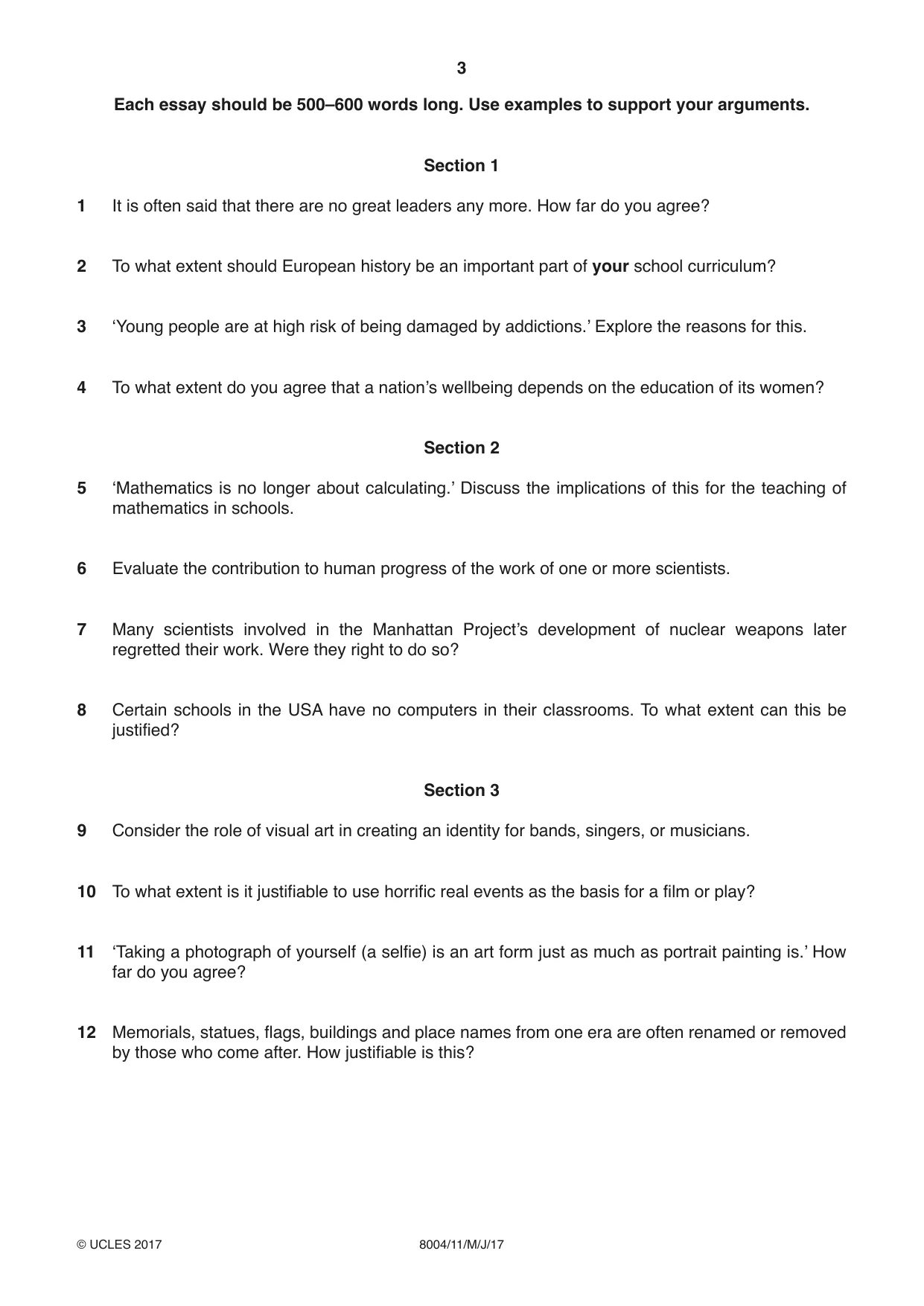
3 8004/11/M/J/17 © UCLES 2017 Each essay should be 500–600 words long. Use examples to support your arguments. Section 1 1 It is often said that there are no great leaders any more. How far do you agree? 2 To what extent should European history be an important part of your school curriculum? 3 ‘Young people are at high risk of being damaged by addictions.’ Explore the reasons for this. 4 To what extent do you agree that a nation’s wellbeing depends on the education of its women? Section 2 5 ‘Mathematics is no longer about calculating.’ Discuss the implications of this for the teaching of mathematics in schools. 6 Evaluate the contribution to human progress of the work of one or more scientists. 7 Many scientists involved in the Manhattan Project’s development of nuclear weapons later regretted their work. Were they right to do so? 8 Certain schools in the USA have no computers in their classrooms. To what extent can this be justified? Section 3 9 Consider the role of visual art in creating an identity for bands, singers, or musicians. 10 To what extent is it justifiable to use horrific real events as the basis for a film or play? 11 ‘Taking a photograph of yourself (a selfie) is an art form just as much as portrait painting is.’ How far do you agree? 12 Memorials, statues, flags, buildings and place names from one era are often renamed or removed by those who come after. How justifiable is this?
Question paper, page 4
4 8004/11/M/J/17 © UCLES 2017 BLANK PAGE Permission to reproduce items where third-party owned material protected by copyright is included has been sought and cleared where possible. Every reasonable effort has been made by the publisher (UCLES) to trace copyright holders, but if any items requiring clearance have unwittingly been included, the publisher will be pleased to make amends at the earliest possible opportunity. To avoid the issue of disclosure of answer-related information to candidates, all copyright acknowledgements are reproduced online in the Cambridge International Examinations Copyright Acknowledgements Booklet. This is produced for each series of examinations and is freely available to download at www.cie.org.uk after the live examination series. Cambridge International Examinations is part of the Cambridge Assessment Group. Cambridge Assessment is the brand name of University of Cambridge Local Examinations Syndicate (UCLES), which is itself a department of the University of Cambridge.
Mark scheme, page 1
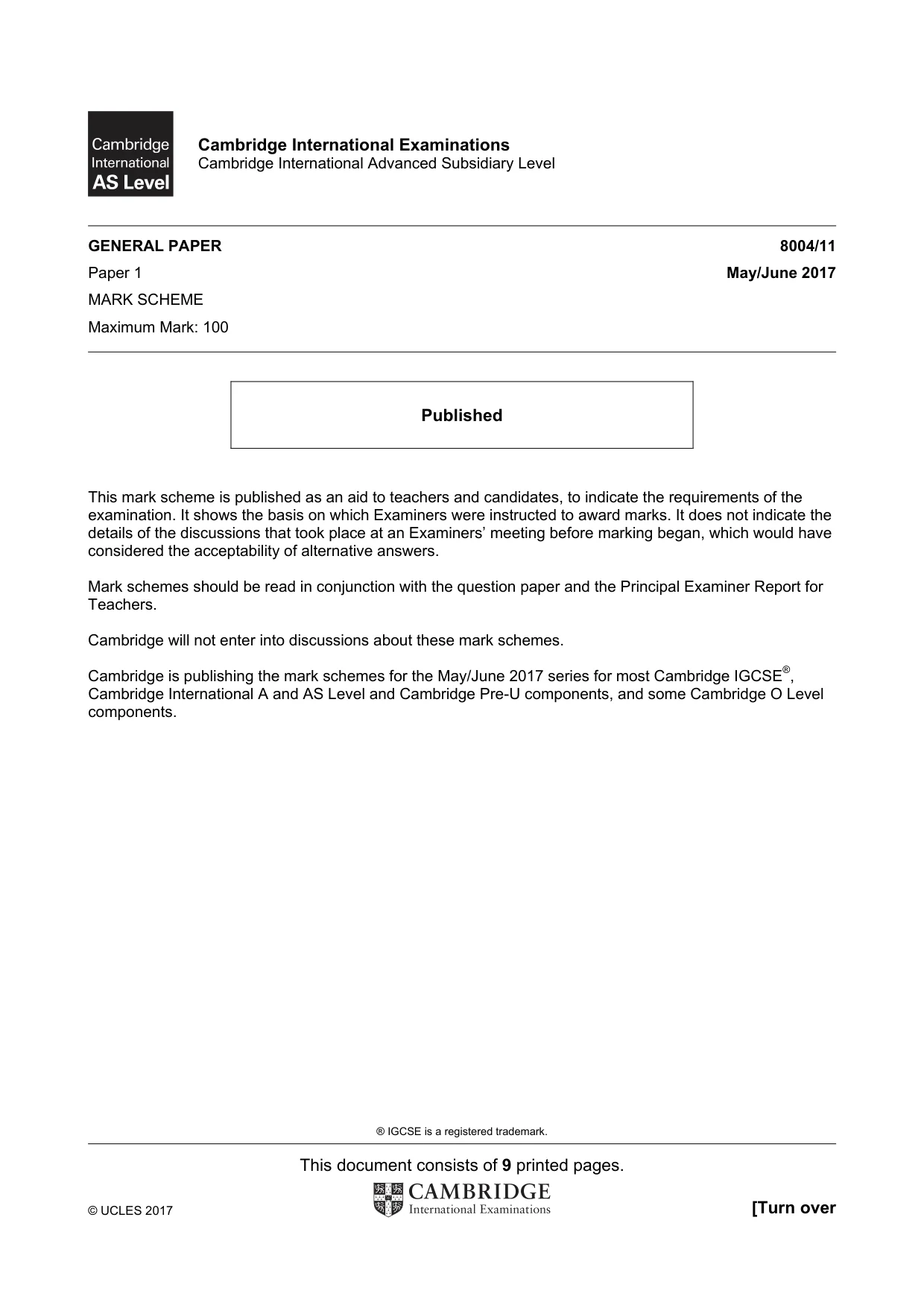
® IGCSE is a registered trademark. This document consists of 9 printed pages. © UCLES 2017 [Turn over Cambridge International Examinations Cambridge International Advanced Subsidiary Level GENERAL PAPER 8004/11 Paper 1 May/June 2017 MARK SCHEME Maximum Mark: 100 Published This mark scheme is published as an aid to teachers and candidates, to indicate the requirements of the examination. It shows the basis on which Examiners were instructed to award marks. It does not indicate the details of the discussions that took place at an Examiners’ meeting before marking began, which would have considered the acceptability of alternative answers. Mark schemes should be read in conjunction with the question paper and the Principal Examiner Report for Teachers. Cambridge will not enter into discussions about these mark schemes. Cambridge is publishing the mark schemes for the May/June 2017 series for most Cambridge IGCSE®, Cambridge International A and AS Level and Cambridge Pre-U components, and some Cambridge O Level components.
Mark scheme, page 2
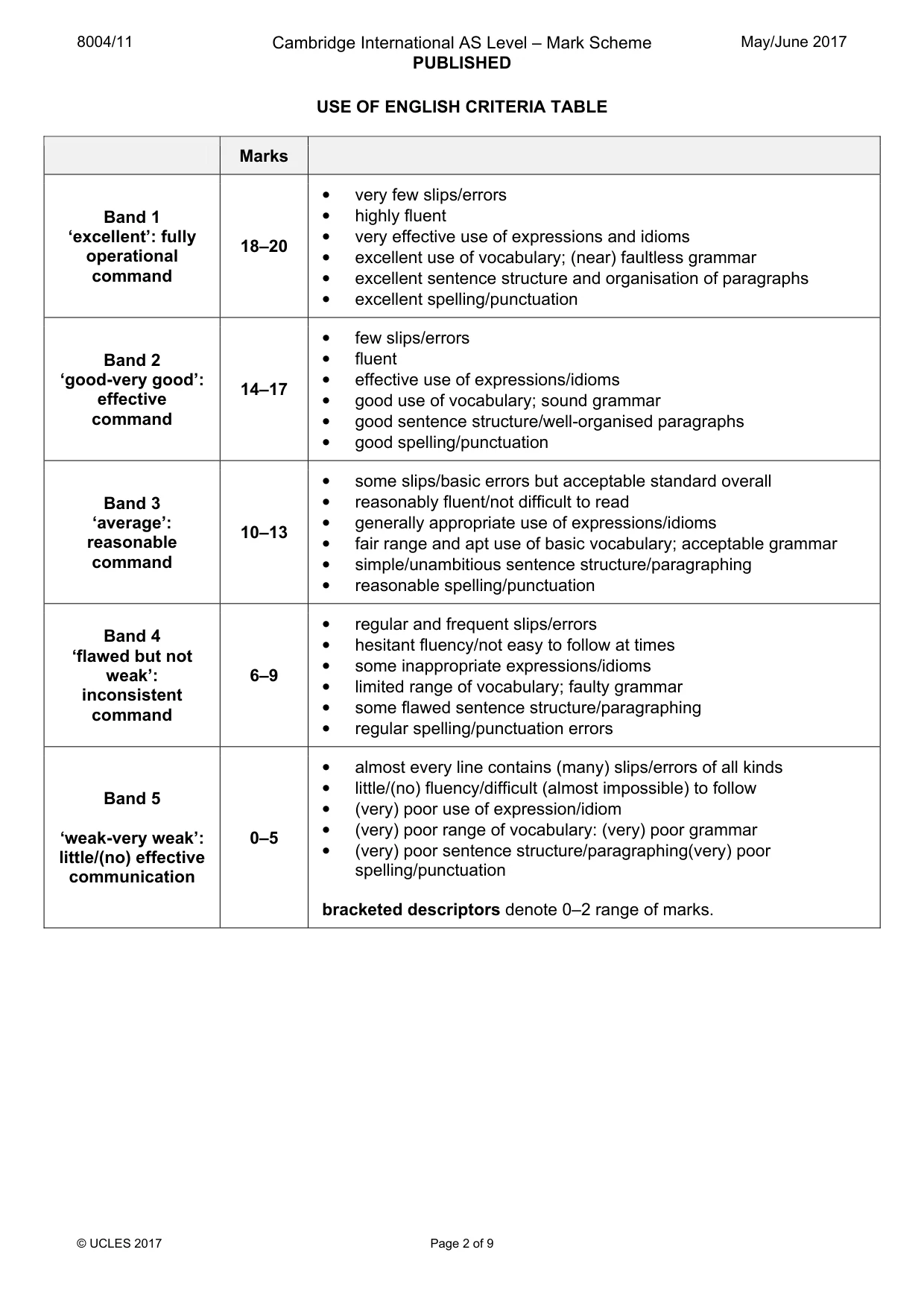
8004/11 Cambridge International AS Level – Mark Scheme PUBLISHED May/June 2017 © UCLES 2017 Page 2 of 9 USE OF ENGLISH CRITERIA TABLE Marks Band 1 ‘excellent’: fully operational command 18–20 • very few slips/errors • highly fluent • very effective use of expressions and idioms • excellent use of vocabulary; (near) faultless grammar • excellent sentence structure and organisation of paragraphs • excellent spelling/punctuation Band 2 ‘good-very good’: effective command 14–17 • few slips/errors • fluent • effective use of expressions/idioms • good use of vocabulary; sound grammar • good sentence structure/well-organised paragraphs • good spelling/punctuation Band 3 ‘average’: reasonable command 10–13 • some slips/basic errors but acceptable standard overall • reasonably fluent/not difficult to read • generally appropriate use of expressions/idioms • fair range and apt use of basic vocabulary; acceptable grammar • simple/unambitious sentence structure/paragraphing • reasonable spelling/punctuation Band 4 ‘flawed but not weak’: inconsistent command 6–9 • regular and frequent slips/errors • hesitant fluency/not easy to follow at times • some inappropriate expressions/idioms • limited range of vocabulary; faulty grammar • some flawed sentence structure/paragraphing • regular spelling/punctuation errors Band 5 ‘weak-very weak’: little/(no) effective communication 0–5 • almost every line contains (many) slips/errors of all kinds • little/(no) fluency/difficult (almost impossible) to follow • (very) poor use of expression/idiom • (very) poor range of vocabulary: (very) poor grammar • (very) poor sentence structure/paragraphing(very) poor spelling/punctuation bracketed descriptors denote 0–2 range of marks.
Mark scheme, page 3
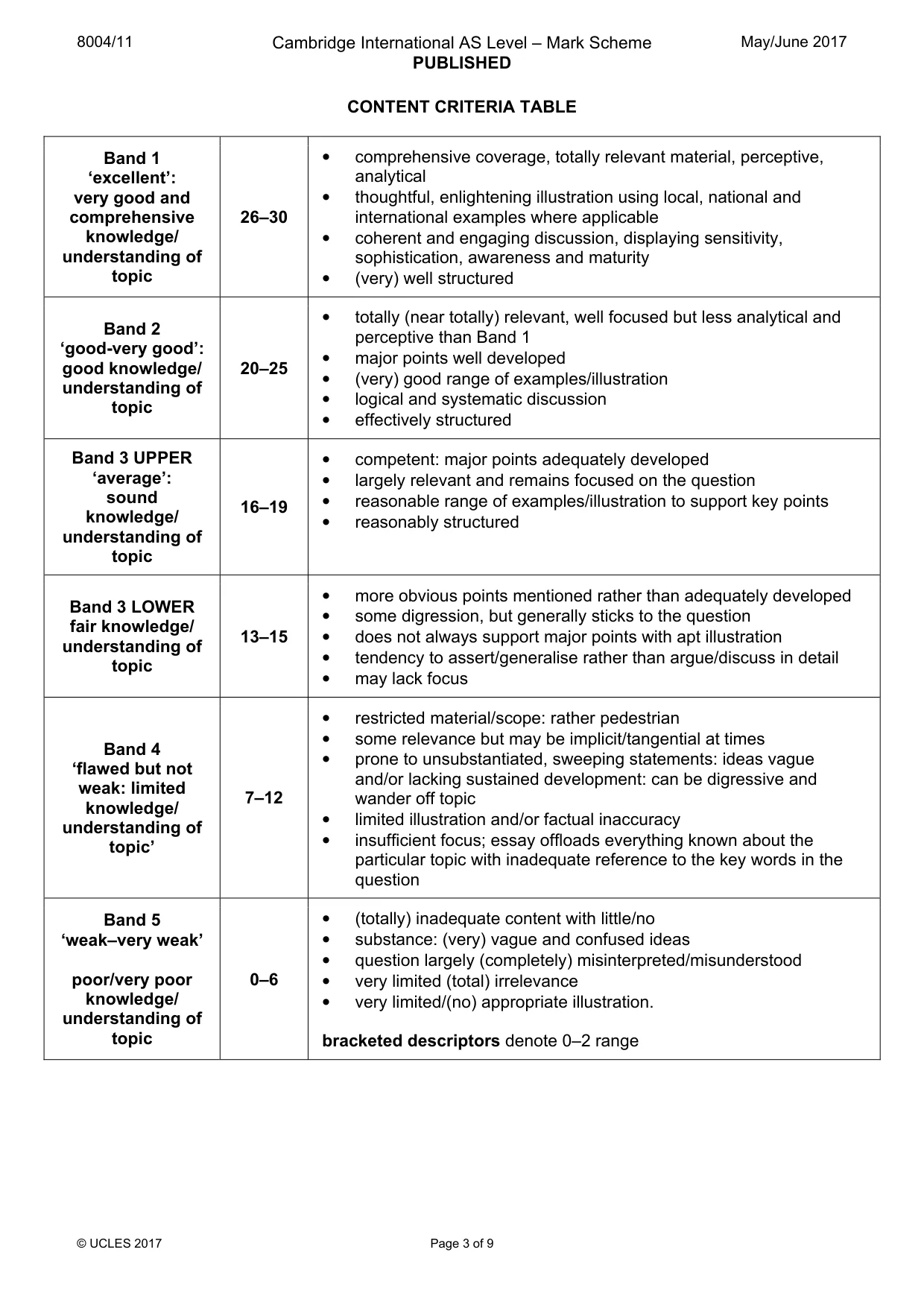
8004/11 Cambridge International AS Level – Mark Scheme PUBLISHED May/June 2017 © UCLES 2017 Page 3 of 9 CONTENT CRITERIA TABLE Band 1 ‘excellent’: very good and comprehensive knowledge/ understanding of topic 26–30 • comprehensive coverage, totally relevant material, perceptive, analytical • thoughtful, enlightening illustration using local, national and international examples where applicable • coherent and engaging discussion, displaying sensitivity, sophistication, awareness and maturity • (very) well structured Band 2 ‘good-very good’: good knowledge/ understanding of topic 20–25 • totally (near totally) relevant, well focused but less analytical and perceptive than Band 1 • major points well developed • (very) good range of examples/illustration • logical and systematic discussion • effectively structured Band 3 UPPER ‘average’: sound knowledge/ understanding of topic 16–19 • competent: major points adequately developed • largely relevant and remains focused on the question • reasonable range of examples/illustration to support key points • reasonably structured Band 3 LOWER fair knowledge/ understanding of topic 13–15 • more obvious points mentioned rather than adequately developed • some digression, but generally sticks to the question • does not always support major points with apt illustration • tendency to assert/generalise rather than argue/discuss in detail • may lack focus Band 4 ‘flawed but not weak: limited knowledge/ understanding of topic’ 7–12 • restricted material/scope: rather pedestrian • some relevance but may be implicit/tangential at times • prone to unsubstantiated, sweeping statements: ideas vague and/or lacking sustained development: can be digressive and wander off topic • limited illustration and/or factual inaccuracy • insufficient focus; essay offloads everything known about the particular topic with inadequate reference to the key words in the question Band 5 ‘weak–very weak’ poor/very poor knowledge/ understanding of topic 0–6 • (totally) inadequate content with little/no • substance: (very) vague and confused ideas • question largely (completely) misinterpreted/misunderstood • very limited (total) irrelevance • very limited/(no) appropriate illustration. bracketed descriptors denote 0–2 range
Mark scheme, page 4
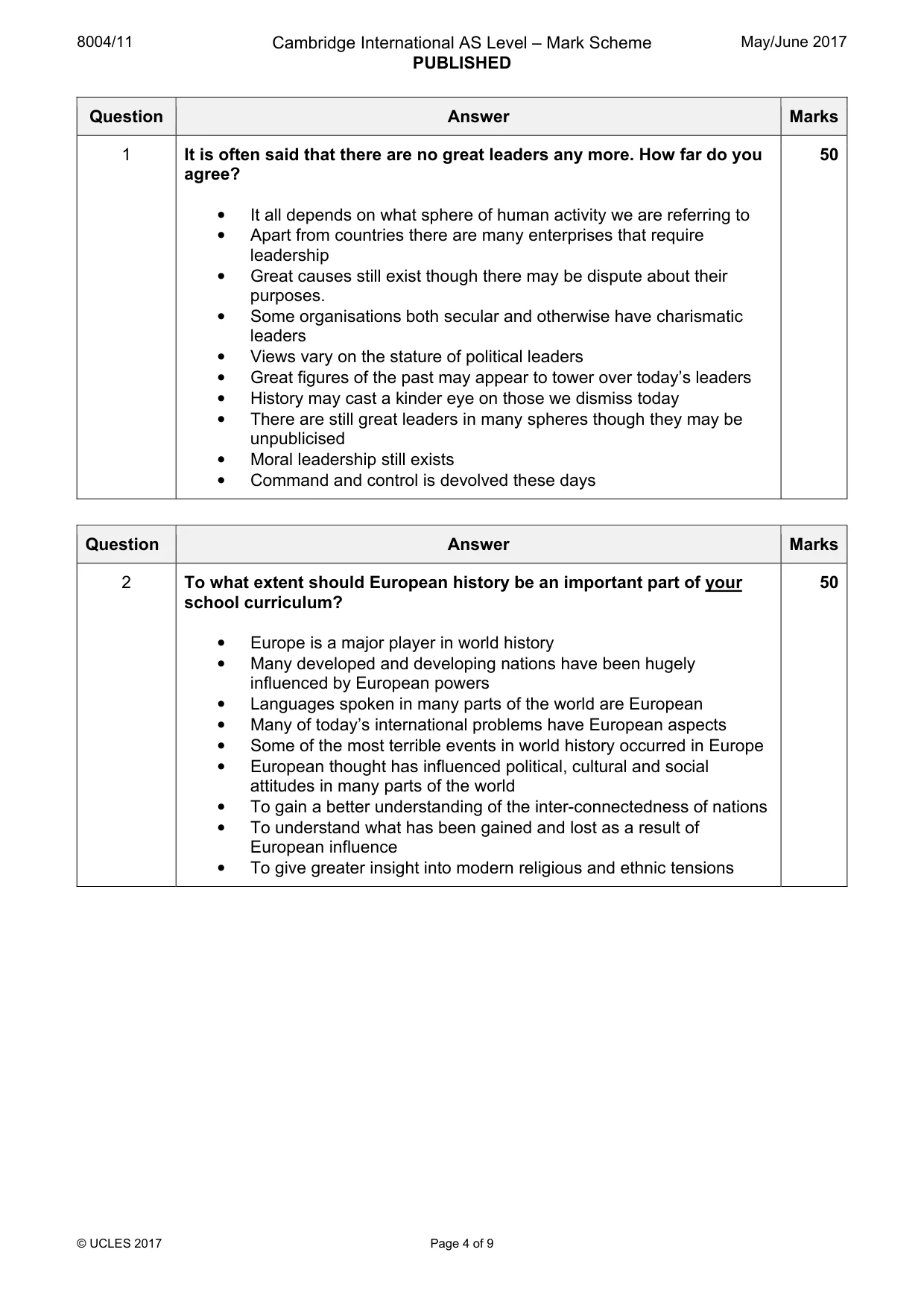
8004/11 Cambridge International AS Level – Mark Scheme PUBLISHED May/June 2017 © UCLES 2017 Page 4 of 9 Question Answer Marks 1 It is often said that there are no great leaders any more. How far do you agree? • It all depends on what sphere of human activity we are referring to • Apart from countries there are many enterprises that require leadership • Great causes still exist though there may be dispute about their purposes. • Some organisations both secular and otherwise have charismatic leaders • Views vary on the stature of political leaders • Great figures of the past may appear to tower over today’s leaders • History may cast a kinder eye on those we dismiss today • There are still great leaders in many spheres though they may be unpublicised • Moral leadership still exists • Command and control is devolved these days 50 Question Answer Marks 2 To what extent should European history be an important part of your school curriculum? • Europe is a major player in world history • Many developed and developing nations have been hugely influenced by European powers • Languages spoken in many parts of the world are European • Many of today’s international problems have European aspects • Some of the most terrible events in world history occurred in Europe • European thought has influenced political, cultural and social attitudes in many parts of the world • To gain a better understanding of the inter-connectedness of nations • To understand what has been gained and lost as a result of European influence • To give greater insight into modern religious and ethnic tensions 50
Mark scheme, page 5
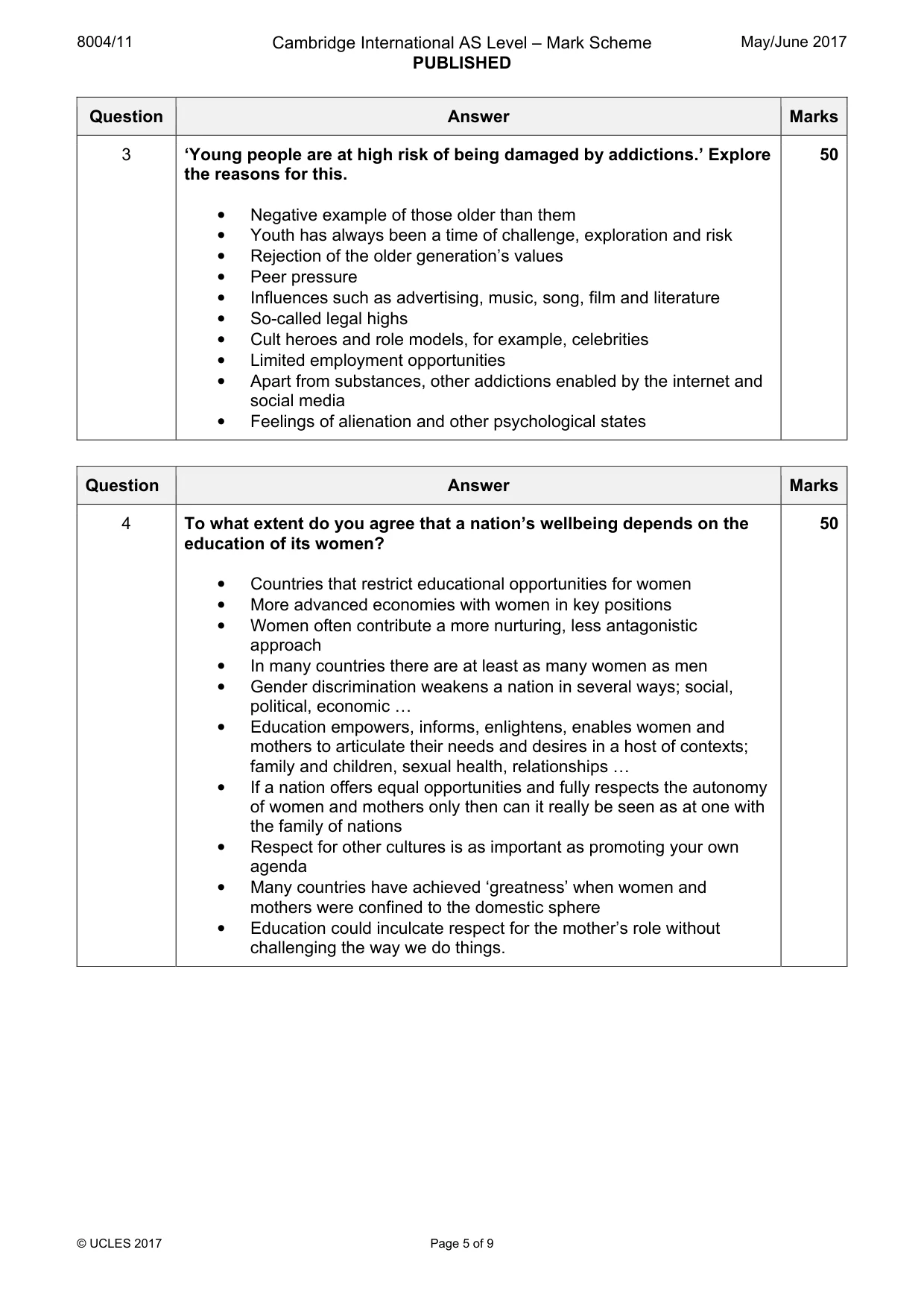
8004/11 Cambridge International AS Level – Mark Scheme PUBLISHED May/June 2017 © UCLES 2017 Page 5 of 9 Question Answer Marks 3 ‘Young people are at high risk of being damaged by addictions.’ Explore the reasons for this. • Negative example of those older than them • Youth has always been a time of challenge, exploration and risk • Rejection of the older generation’s values • Peer pressure • Influences such as advertising, music, song, film and literature • So-called legal highs • Cult heroes and role models, for example, celebrities • Limited employment opportunities • Apart from substances, other addictions enabled by the internet and social media • Feelings of alienation and other psychological states 50 Question Answer Marks 4 To what extent do you agree that a nation’s wellbeing depends on the education of its women? • Countries that restrict educational opportunities for women • More advanced economies with women in key positions • Women often contribute a more nurturing, less antagonistic approach • In many countries there are at least as many women as men • Gender discrimination weakens a nation in several ways; social, political, economic « • Education empowers, informs, enlightens, enables women and mothers to articulate their needs and desires in a host of contexts; family and children, sexual health, relationships « • If a nation offers equal opportunities and fully respects the autonomy of women and mothers only then can it really be seen as at one with the family of nations • Respect for other cultures is as important as promoting your own agenda • Many countries have achieved ‘greatness’ when women and mothers were confined to the domestic sphere • Education could inculcate respect for the mother’s role without challenging the way we do things. 50
Mark scheme, page 6
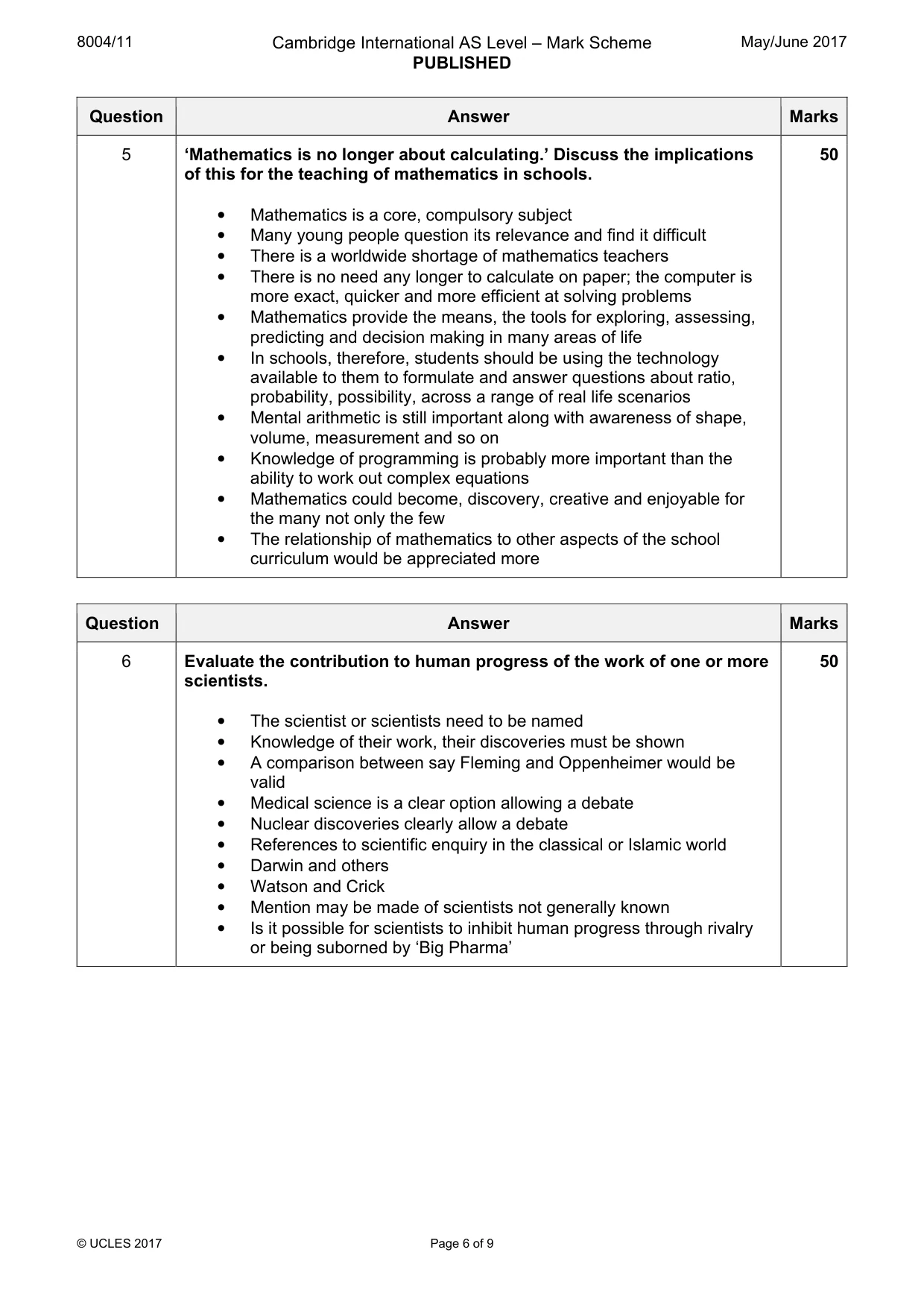
8004/11 Cambridge International AS Level – Mark Scheme PUBLISHED May/June 2017 © UCLES 2017 Page 6 of 9 Question Answer Marks 5 ‘Mathematics is no longer about calculating.’ Discuss the implications of this for the teaching of mathematics in schools. • Mathematics is a core, compulsory subject • Many young people question its relevance and find it difficult • There is a worldwide shortage of mathematics teachers • There is no need any longer to calculate on paper; the computer is more exact, quicker and more efficient at solving problems • Mathematics provide the means, the tools for exploring, assessing, predicting and decision making in many areas of life • In schools, therefore, students should be using the technology available to them to formulate and answer questions about ratio, probability, possibility, across a range of real life scenarios • Mental arithmetic is still important along with awareness of shape, volume, measurement and so on • Knowledge of programming is probably more important than the ability to work out complex equations • Mathematics could become, discovery, creative and enjoyable for the many not only the few • The relationship of mathematics to other aspects of the school curriculum would be appreciated more 50 Question Answer Marks 6 Evaluate the contribution to human progress of the work of one or more scientists. • The scientist or scientists need to be named • Knowledge of their work, their discoveries must be shown • A comparison between say Fleming and Oppenheimer would be valid • Medical science is a clear option allowing a debate • Nuclear discoveries clearly allow a debate • References to scientific enquiry in the classical or Islamic world • Darwin and others • Watson and Crick • Mention may be made of scientists not generally known • Is it possible for scientists to inhibit human progress through rivalry or being suborned by ‘Big Pharma’ 50
Mark scheme, page 7
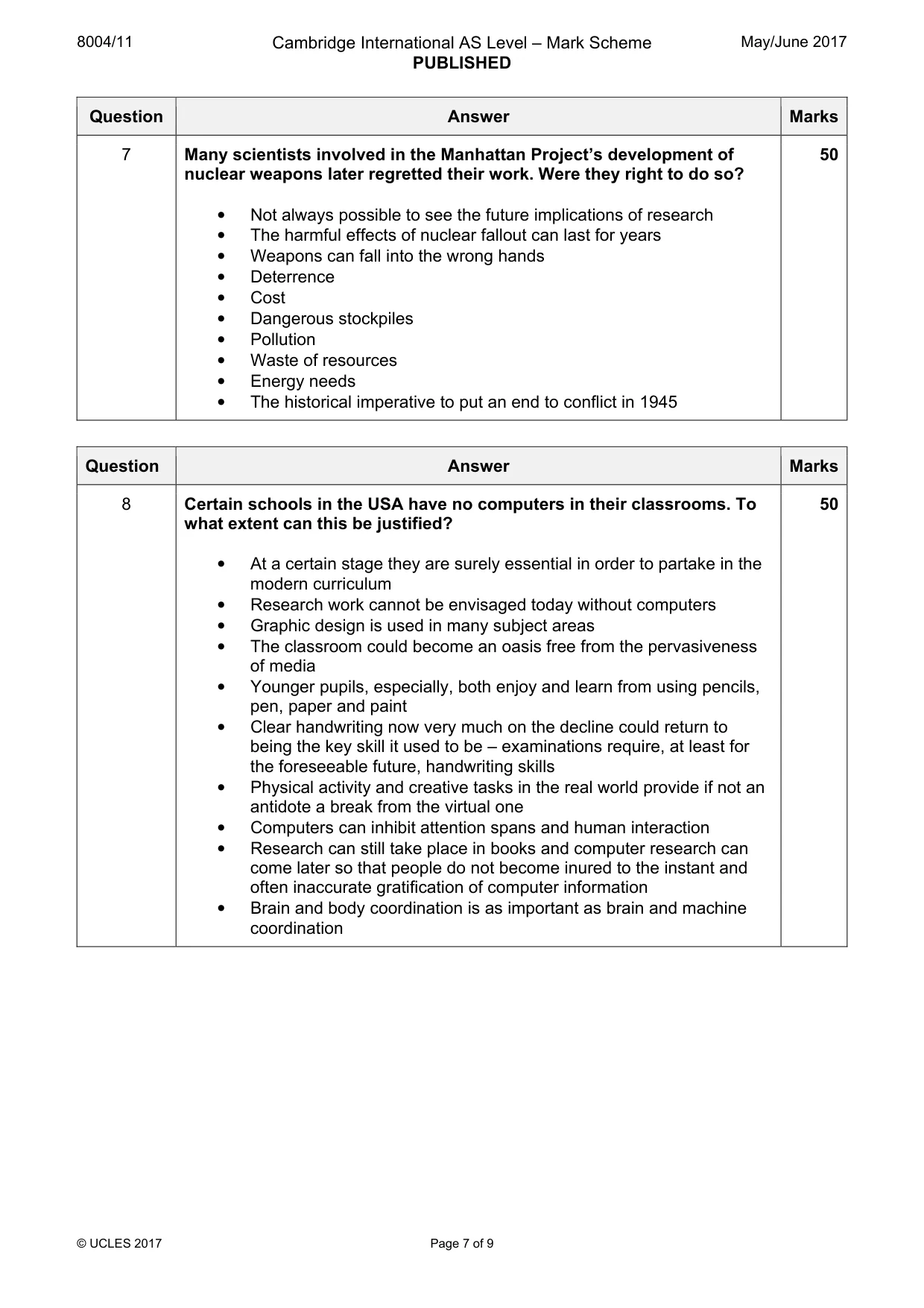
8004/11 Cambridge International AS Level – Mark Scheme PUBLISHED May/June 2017 © UCLES 2017 Page 7 of 9 Question Answer Marks 7 Many scientists involved in the Manhattan Project’s development of nuclear weapons later regretted their work. Were they right to do so? • Not always possible to see the future implications of research • The harmful effects of nuclear fallout can last for years • Weapons can fall into the wrong hands • Deterrence • Cost • Dangerous stockpiles • Pollution • Waste of resources • Energy needs • The historical imperative to put an end to conflict in 1945 50 Question Answer Marks 8 Certain schools in the USA have no computers in their classrooms. To what extent can this be justified? • At a certain stage they are surely essential in order to partake in the modern curriculum • Research work cannot be envisaged today without computers • Graphic design is used in many subject areas • The classroom could become an oasis free from the pervasiveness of media • Younger pupils, especially, both enjoy and learn from using pencils, pen, paper and paint • Clear handwriting now very much on the decline could return to being the key skill it used to be – examinations require, at least for the foreseeable future, handwriting skills • Physical activity and creative tasks in the real world provide if not an antidote a break from the virtual one • Computers can inhibit attention spans and human interaction • Research can still take place in books and computer research can come later so that people do not become inured to the instant and often inaccurate gratification of computer information • Brain and body coordination is as important as brain and machine coordination 50
Mark scheme, page 8
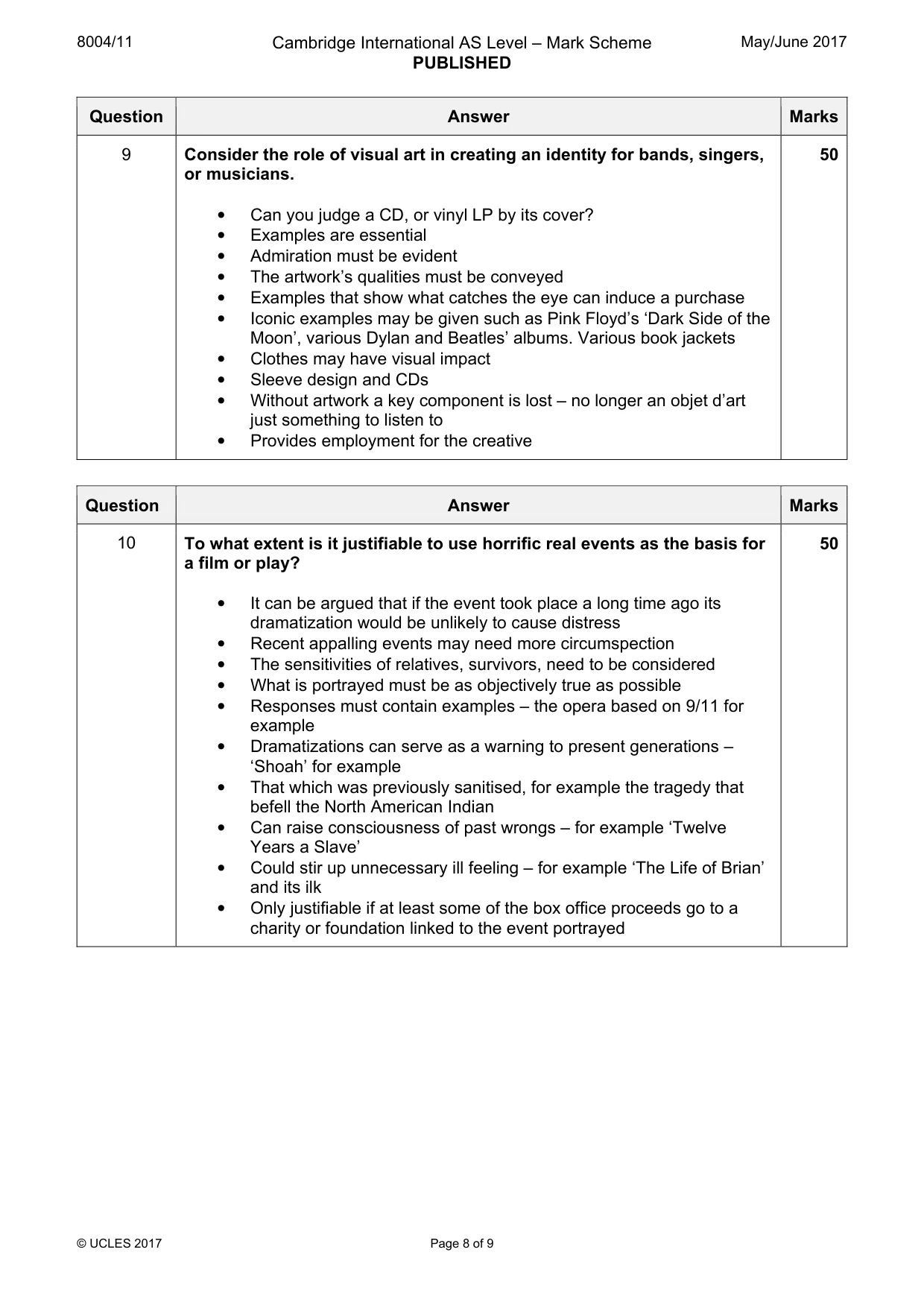
8004/11 Cambridge International AS Level – Mark Scheme PUBLISHED May/June 2017 © UCLES 2017 Page 8 of 9 Question Answer Marks 9 Consider the role of visual art in creating an identity for bands, singers, or musicians. • Can you judge a CD, or vinyl LP by its cover? • Examples are essential • Admiration must be evident • The artwork’s qualities must be conveyed • Examples that show what catches the eye can induce a purchase • Iconic examples may be given such as Pink Floyd’s ‘Dark Side of the Moon’, various Dylan and Beatles’ albums. Various book jackets • Clothes may have visual impact • Sleeve design and CDs • Without artwork a key component is lost – no longer an objet d’art just something to listen to • Provides employment for the creative 50 Question Answer Marks 10 To what extent is it justifiable to use horrific real events as the basis for a film or play? • It can be argued that if the event took place a long time ago its dramatization would be unlikely to cause distress • Recent appalling events may need more circumspection • The sensitivities of relatives, survivors, need to be considered • What is portrayed must be as objectively true as possible • Responses must contain examples – the opera based on 9/11 for example • Dramatizations can serve as a warning to present generations – ‘Shoah’ for example • That which was previously sanitised, for example the tragedy that befell the North American Indian • Can raise consciousness of past wrongs – for example ‘Twelve Years a Slave’ • Could stir up unnecessary ill feeling – for example ‘The Life of Brian’ and its ilk • Only justifiable if at least some of the box office proceeds go to a charity or foundation linked to the event portrayed 50
Mark scheme, page 9
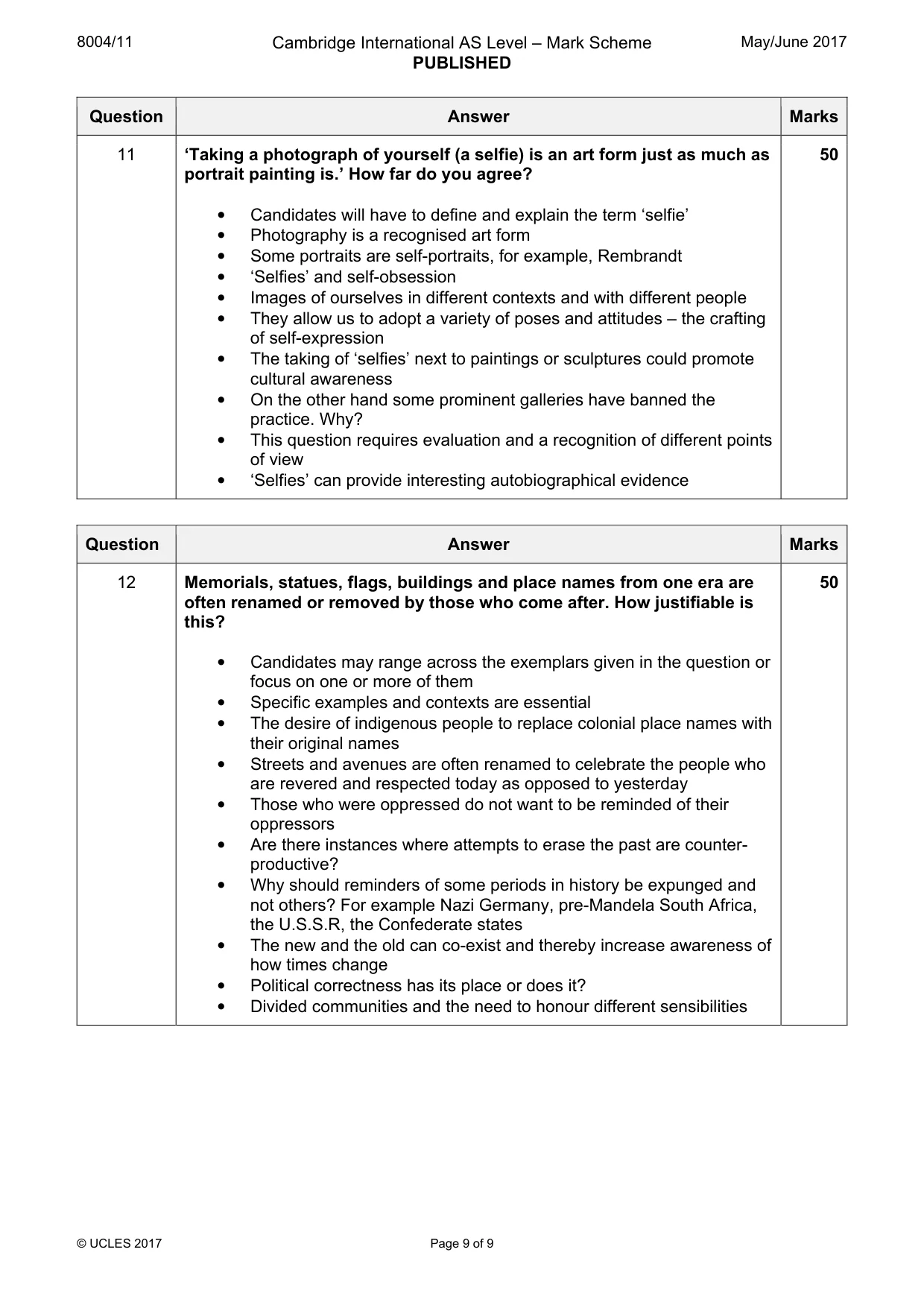
8004/11 Cambridge International AS Level – Mark Scheme PUBLISHED May/June 2017 © UCLES 2017 Page 9 of 9 Question Answer Marks 11 ‘Taking a photograph of yourself (a selfie) is an art form just as much as portrait painting is.’ How far do you agree? • Candidates will have to define and explain the term ‘selfie’ • Photography is a recognised art form • Some portraits are self-portraits, for example, Rembrandt • ‘Selfies’ and self-obsession • Images of ourselves in different contexts and with different people • They allow us to adopt a variety of poses and attitudes – the crafting of self-expression • The taking of ‘selfies’ next to paintings or sculptures could promote cultural awareness • On the other hand some prominent galleries have banned the practice. Why? • This question requires evaluation and a recognition of different points of view • ‘Selfies’ can provide interesting autobiographical evidence 50 Question Answer Marks 12 Memorials, statues, flags, buildings and place names from one era are often renamed or removed by those who come after. How justifiable is this? • Candidates may range across the exemplars given in the question or focus on one or more of them • Specific examples and contexts are essential • The desire of indigenous people to replace colonial place names with their original names • Streets and avenues are often renamed to celebrate the people who are revered and respected today as opposed to yesterday • Those who were oppressed do not want to be reminded of their oppressors • Are there instances where attempts to erase the past are counter- productive? • Why should reminders of some periods in history be expunged and not others? For example Nazi Germany, pre-Mandela South Africa, the U.S.S.R, the Confederate states • The new and the old can co-exist and thereby increase awareness of how times change • Political correctness has its place or does it? • Divided communities and the need to honour different sensibilities 50
What you needed in this session
Cambridge’s own grade thresholds for 2017 May/June, Paper 1 · Variant 1. A higher threshold means an easier paper — the bar moves with how the cohort did.