Cambridge A Level General Paper (AS Level only) 8004 — 2017 May/June Paper 1 · Variant 2
8004/12/M/J/17 · 100 marks · ≈113 min
The question paper and its mark scheme, free to read here and free to download. This is Cambridge’s own paper, exactly as it was sat.
Question paper4 pages
Mark scheme9 pages
Answers below. Sit the paper first if you are practising.
Paper as text
Question paper, page 1
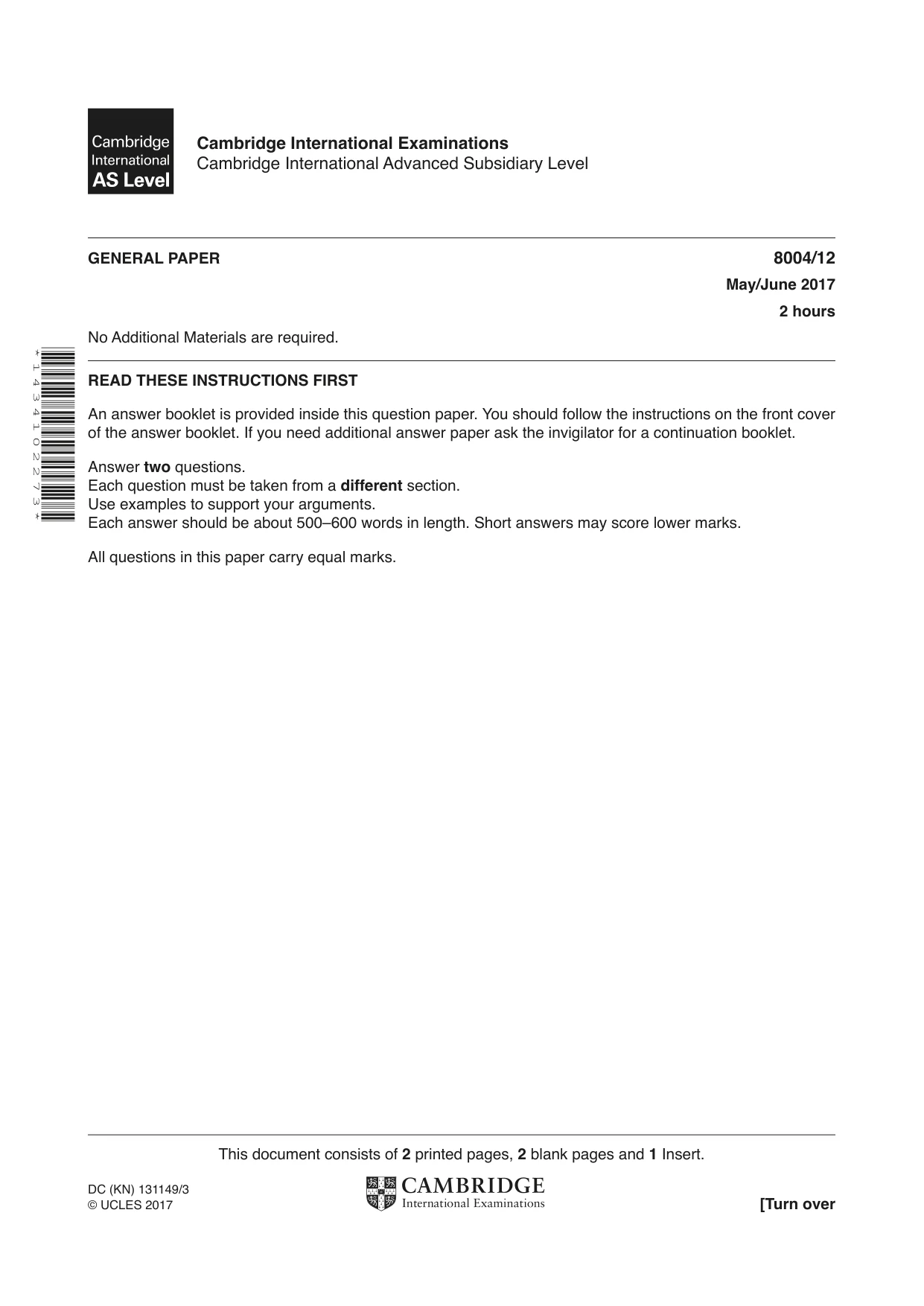
This document consists of 2 printed pages, 2 blank pages and 1 Insert. DC (KN) 131149/3 © UCLES 2017 [Turn over Cambridge International Examinations Cambridge International Advanced Subsidiary Level * 1 4 3 4 1 0 2 2 7 3 * GENERAL PAPER 8004/12 May/June 2017 2 hours No Additional Materials are required. READ THESE INSTRUCTIONS FIRST An answer booklet is provided inside this question paper. You should follow the instructions on the front cover of the answer booklet. If you need additional answer paper ask the invigilator for a continuation booklet. Answer two questions. Each question must be taken from a different section. Use examples to support your arguments. Each answer should be about 500–600 words in length. Short answers may score lower marks. All questions in this paper carry equal marks.
Question paper, page 2
2 8004/12/M/J/17 © UCLES 2017 BLANK PAGE
Question paper, page 3
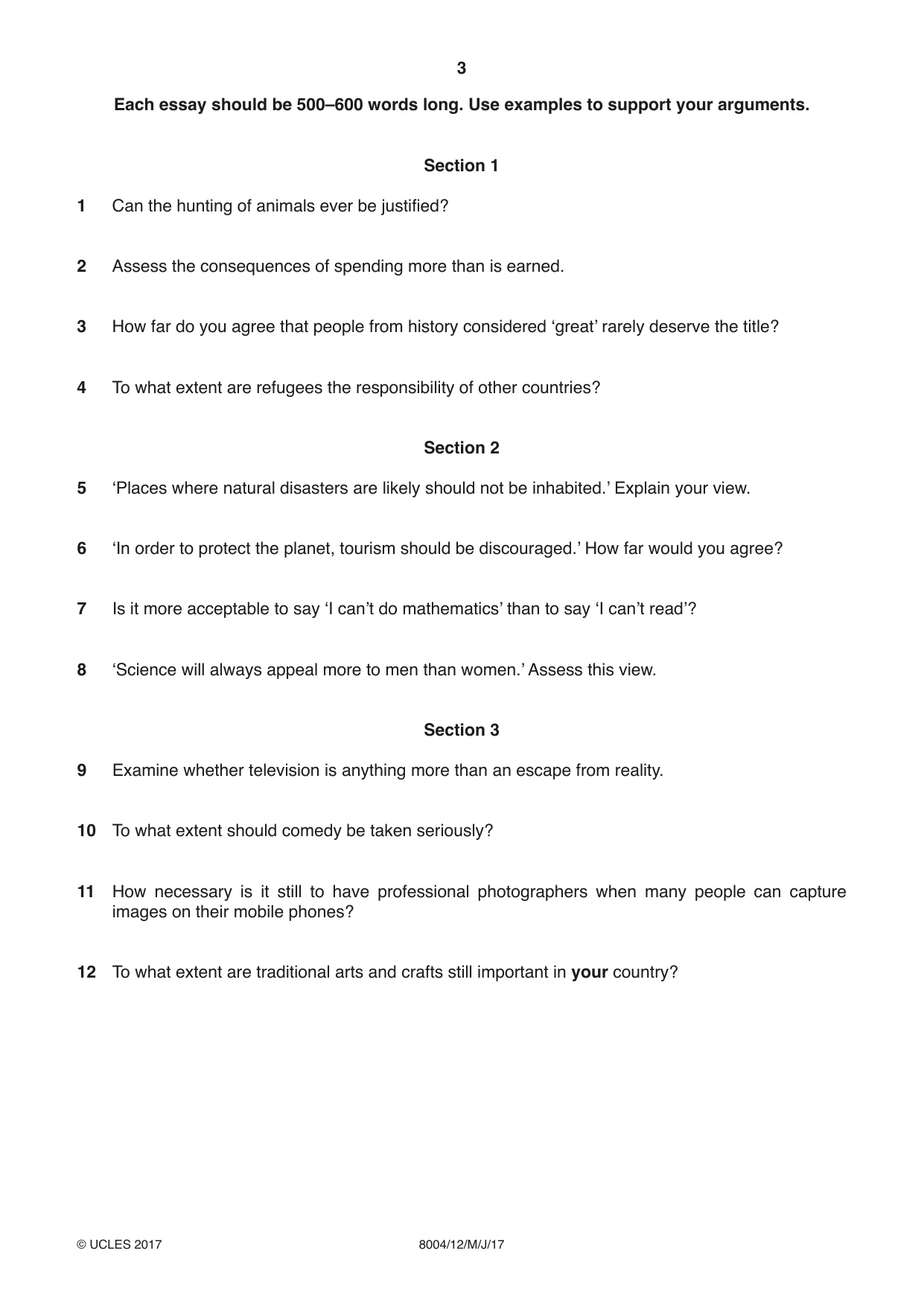
3 8004/12/M/J/17 © UCLES 2017 Each essay should be 500–600 words long. Use examples to support your arguments. Section 1 1 Can the hunting of animals ever be justified? 2 Assess the consequences of spending more than is earned. 3 How far do you agree that people from history considered ‘great’ rarely deserve the title? 4 To what extent are refugees the responsibility of other countries? Section 2 5 ‘Places where natural disasters are likely should not be inhabited.’ Explain your view. 6 ‘In order to protect the planet, tourism should be discouraged.’ How far would you agree? 7 Is it more acceptable to say ‘I can’t do mathematics’ than to say ‘I can’t read’? 8 ‘Science will always appeal more to men than women.’ Assess this view. Section 3 9 Examine whether television is anything more than an escape from reality. 10 To what extent should comedy be taken seriously? 11 How necessary is it still to have professional photographers when many people can capture images on their mobile phones? 12 To what extent are traditional arts and crafts still important in your country?
Question paper, page 4
4 8004/12/M/J/17 © UCLES 2017 BLANK PAGE Permission to reproduce items where third-party owned material protected by copyright is included has been sought and cleared where possible. Every reasonable effort has been made by the publisher (UCLES) to trace copyright holders, but if any items requiring clearance have unwittingly been included, the publisher will be pleased to make amends at the earliest possible opportunity. To avoid the issue of disclosure of answer-related information to candidates, all copyright acknowledgements are reproduced online in the Cambridge International Examinations Copyright Acknowledgements Booklet. This is produced for each series of examinations and is freely available to download at www.cie.org.uk after the live examination series. Cambridge International Examinations is part of the Cambridge Assessment Group. Cambridge Assessment is the brand name of University of Cambridge Local Examinations Syndicate (UCLES), which is itself a department of the University of Cambridge.
Mark scheme, page 1
® IGCSE is a registered trademark. This document consists of 9 printed pages. © UCLES 2017 [Turn over Cambridge International Examinations Cambridge International Advanced Subsidiary Level GENERAL PAPER 8004/12 Paper 1 May/June 2017 MARK SCHEME Maximum Mark: 100 Published This mark scheme is published as an aid to teachers and candidates, to indicate the requirements of the examination. It shows the basis on which Examiners were instructed to award marks. It does not indicate the details of the discussions that took place at an Examiners’ meeting before marking began, which would have considered the acceptability of alternative answers. Mark schemes should be read in conjunction with the question paper and the Principal Examiner Report for Teachers. Cambridge will not enter into discussions about these mark schemes. Cambridge is publishing the mark schemes for the May/June 2017 series for most Cambridge IGCSE®, Cambridge International A and AS Level and Cambridge Pre-U components, and some Cambridge O Level components.
Mark scheme, page 2
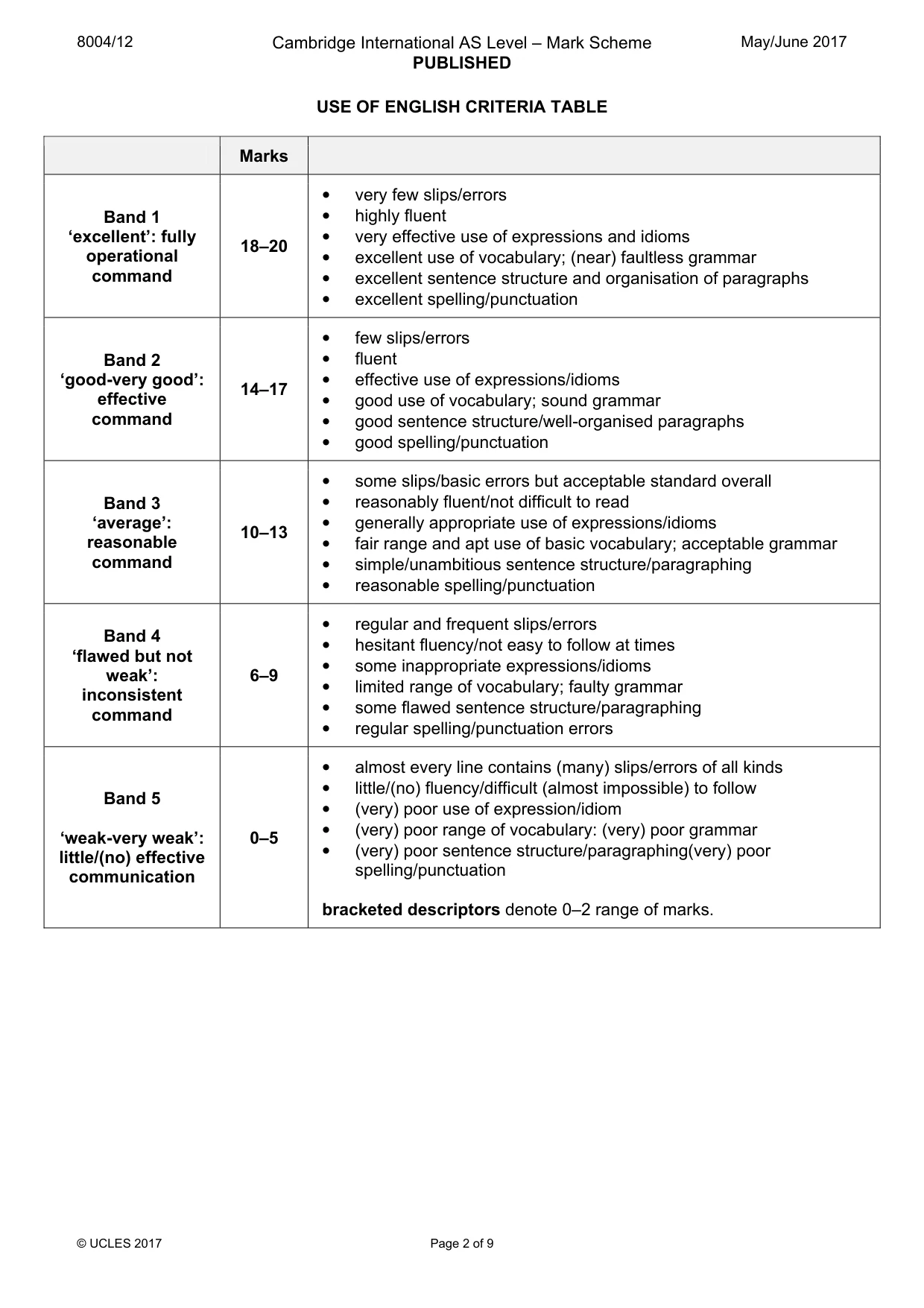
8004/12 Cambridge International AS Level – Mark Scheme PUBLISHED May/June 2017 © UCLES 2017 Page 2 of 9 USE OF ENGLISH CRITERIA TABLE Marks Band 1 ‘excellent’: fully operational command 18–20 • very few slips/errors • highly fluent • very effective use of expressions and idioms • excellent use of vocabulary; (near) faultless grammar • excellent sentence structure and organisation of paragraphs • excellent spelling/punctuation Band 2 ‘good-very good’: effective command 14–17 • few slips/errors • fluent • effective use of expressions/idioms • good use of vocabulary; sound grammar • good sentence structure/well-organised paragraphs • good spelling/punctuation Band 3 ‘average’: reasonable command 10–13 • some slips/basic errors but acceptable standard overall • reasonably fluent/not difficult to read • generally appropriate use of expressions/idioms • fair range and apt use of basic vocabulary; acceptable grammar • simple/unambitious sentence structure/paragraphing • reasonable spelling/punctuation Band 4 ‘flawed but not weak’: inconsistent command 6–9 • regular and frequent slips/errors • hesitant fluency/not easy to follow at times • some inappropriate expressions/idioms • limited range of vocabulary; faulty grammar • some flawed sentence structure/paragraphing • regular spelling/punctuation errors Band 5 ‘weak-very weak’: little/(no) effective communication 0–5 • almost every line contains (many) slips/errors of all kinds • little/(no) fluency/difficult (almost impossible) to follow • (very) poor use of expression/idiom • (very) poor range of vocabulary: (very) poor grammar • (very) poor sentence structure/paragraphing(very) poor spelling/punctuation bracketed descriptors denote 0–2 range of marks.
Mark scheme, page 3
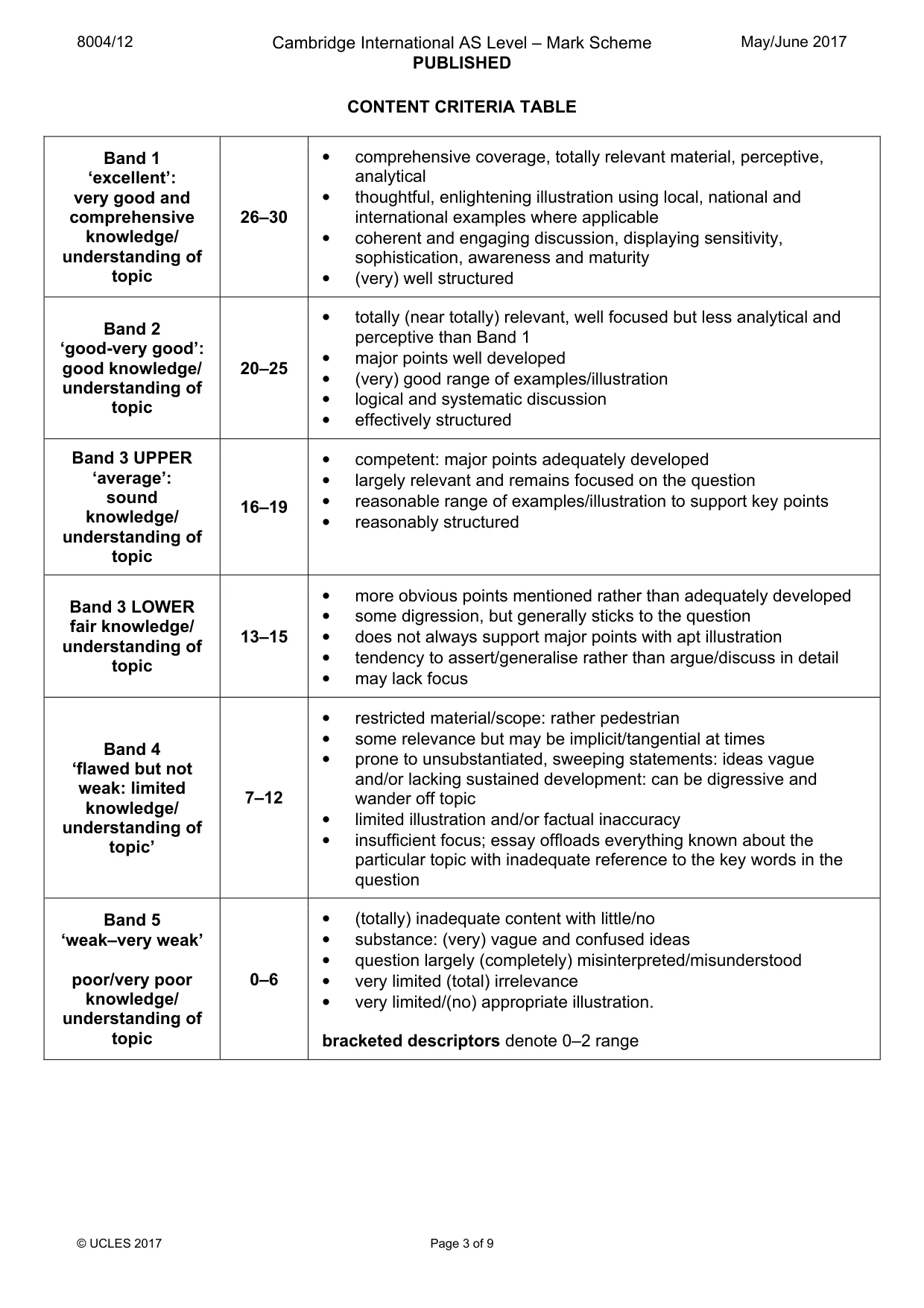
8004/12 Cambridge International AS Level – Mark Scheme PUBLISHED May/June 2017 © UCLES 2017 Page 3 of 9 CONTENT CRITERIA TABLE Band 1 ‘excellent’: very good and comprehensive knowledge/ understanding of topic 26–30 • comprehensive coverage, totally relevant material, perceptive, analytical • thoughtful, enlightening illustration using local, national and international examples where applicable • coherent and engaging discussion, displaying sensitivity, sophistication, awareness and maturity • (very) well structured Band 2 ‘good-very good’: good knowledge/ understanding of topic 20–25 • totally (near totally) relevant, well focused but less analytical and perceptive than Band 1 • major points well developed • (very) good range of examples/illustration • logical and systematic discussion • effectively structured Band 3 UPPER ‘average’: sound knowledge/ understanding of topic 16–19 • competent: major points adequately developed • largely relevant and remains focused on the question • reasonable range of examples/illustration to support key points • reasonably structured Band 3 LOWER fair knowledge/ understanding of topic 13–15 • more obvious points mentioned rather than adequately developed • some digression, but generally sticks to the question • does not always support major points with apt illustration • tendency to assert/generalise rather than argue/discuss in detail • may lack focus Band 4 ‘flawed but not weak: limited knowledge/ understanding of topic’ 7–12 • restricted material/scope: rather pedestrian • some relevance but may be implicit/tangential at times • prone to unsubstantiated, sweeping statements: ideas vague and/or lacking sustained development: can be digressive and wander off topic • limited illustration and/or factual inaccuracy • insufficient focus; essay offloads everything known about the particular topic with inadequate reference to the key words in the question Band 5 ‘weak–very weak’ poor/very poor knowledge/ understanding of topic 0–6 • (totally) inadequate content with little/no • substance: (very) vague and confused ideas • question largely (completely) misinterpreted/misunderstood • very limited (total) irrelevance • very limited/(no) appropriate illustration. bracketed descriptors denote 0–2 range
Mark scheme, page 4
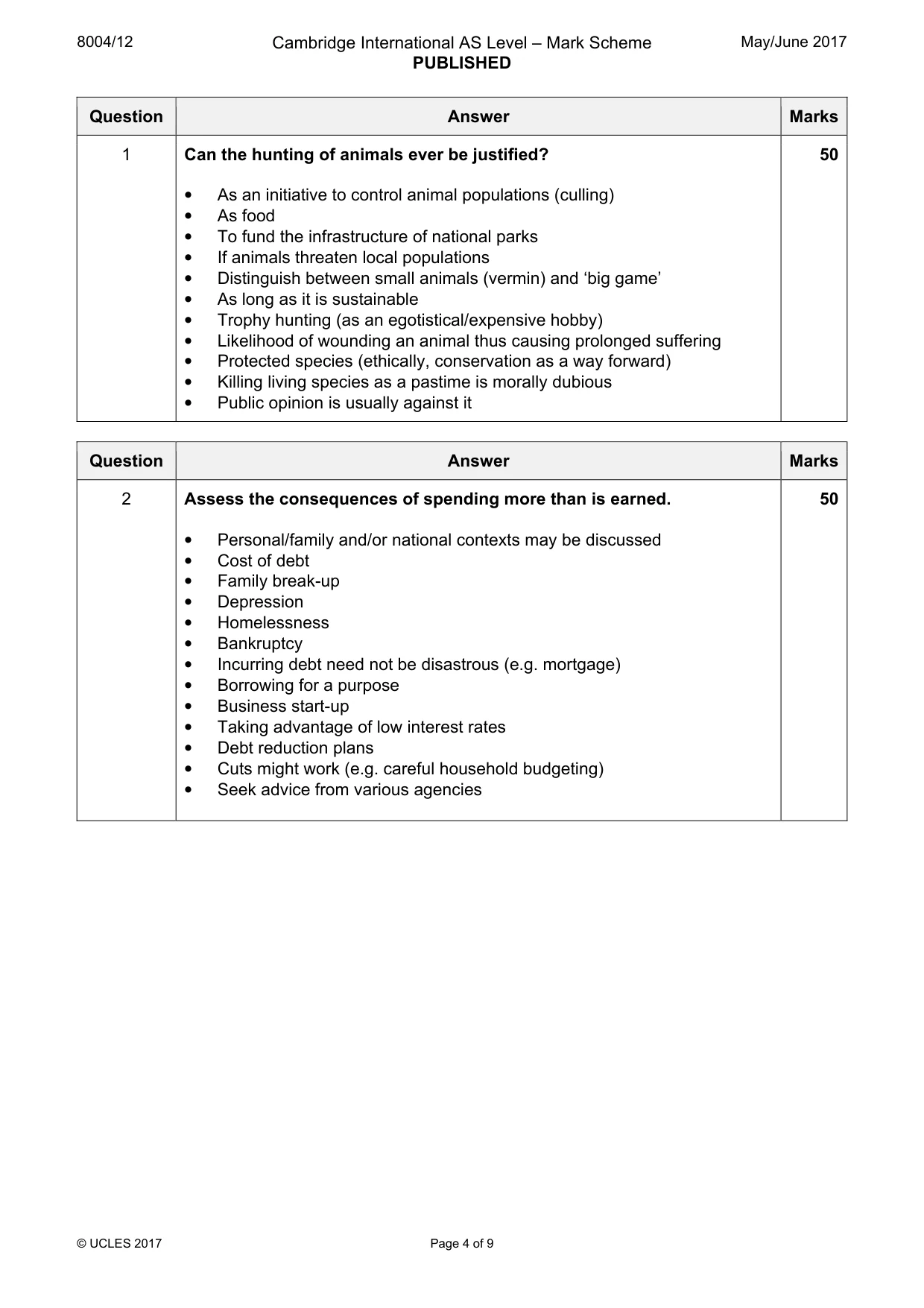
8004/12 Cambridge International AS Level – Mark Scheme PUBLISHED May/June 2017 © UCLES 2017 Page 4 of 9 Question Answer Marks 1 Can the hunting of animals ever be justified? • As an initiative to control animal populations (culling) • As food • To fund the infrastructure of national parks • If animals threaten local populations • Distinguish between small animals (vermin) and ‘big game’ • As long as it is sustainable • Trophy hunting (as an egotistical/expensive hobby) • Likelihood of wounding an animal thus causing prolonged suffering • Protected species (ethically, conservation as a way forward) • Killing living species as a pastime is morally dubious • Public opinion is usually against it 50 Question Answer Marks 2 Assess the consequences of spending more than is earned. • Personal/family and/or national contexts may be discussed • Cost of debt • Family break-up • Depression • Homelessness • Bankruptcy • Incurring debt need not be disastrous (e.g. mortgage) • Borrowing for a purpose • Business start-up • Taking advantage of low interest rates • Debt reduction plans • Cuts might work (e.g. careful household budgeting) • Seek advice from various agencies 50
Mark scheme, page 5
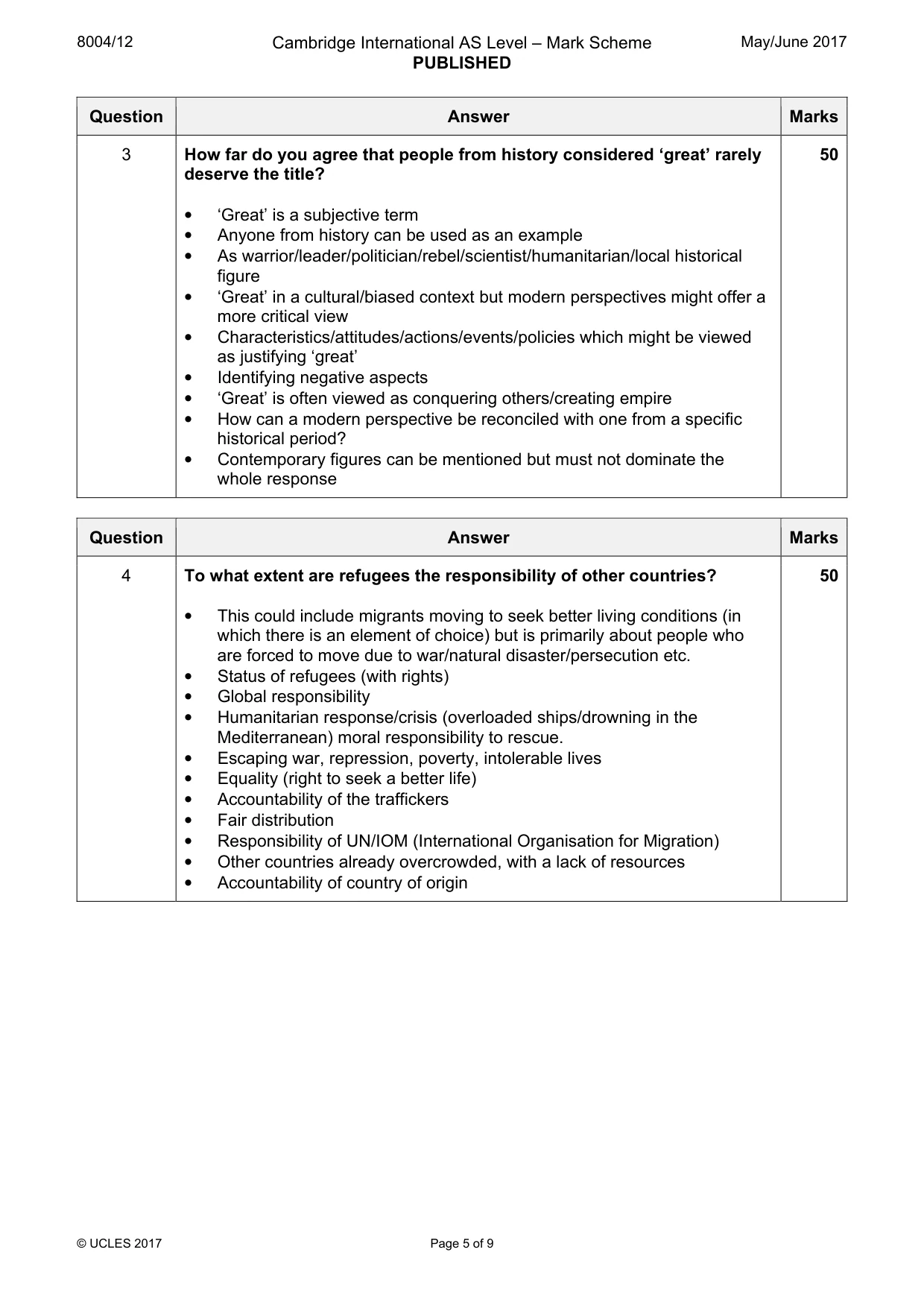
8004/12 Cambridge International AS Level – Mark Scheme PUBLISHED May/June 2017 © UCLES 2017 Page 5 of 9 Question Answer Marks 3 How far do you agree that people from history considered ‘great’ rarely deserve the title? • ‘Great’ is a subjective term • Anyone from history can be used as an example • As warrior/leader/politician/rebel/scientist/humanitarian/local historical figure • ‘Great’ in a cultural/biased context but modern perspectives might offer a more critical view • Characteristics/attitudes/actions/events/policies which might be viewed as justifying ‘great’ • Identifying negative aspects • ‘Great’ is often viewed as conquering others/creating empire • How can a modern perspective be reconciled with one from a specific historical period? • Contemporary figures can be mentioned but must not dominate the whole response 50 Question Answer Marks 4 To what extent are refugees the responsibility of other countries? • This could include migrants moving to seek better living conditions (in which there is an element of choice) but is primarily about people who are forced to move due to war/natural disaster/persecution etc. • Status of refugees (with rights) • Global responsibility • Humanitarian response/crisis (overloaded ships/drowning in the Mediterranean) moral responsibility to rescue. • Escaping war, repression, poverty, intolerable lives • Equality (right to seek a better life) • Accountability of the traffickers • Fair distribution • Responsibility of UN/IOM (International Organisation for Migration) • Other countries already overcrowded, with a lack of resources • Accountability of country of origin 50
Mark scheme, page 6
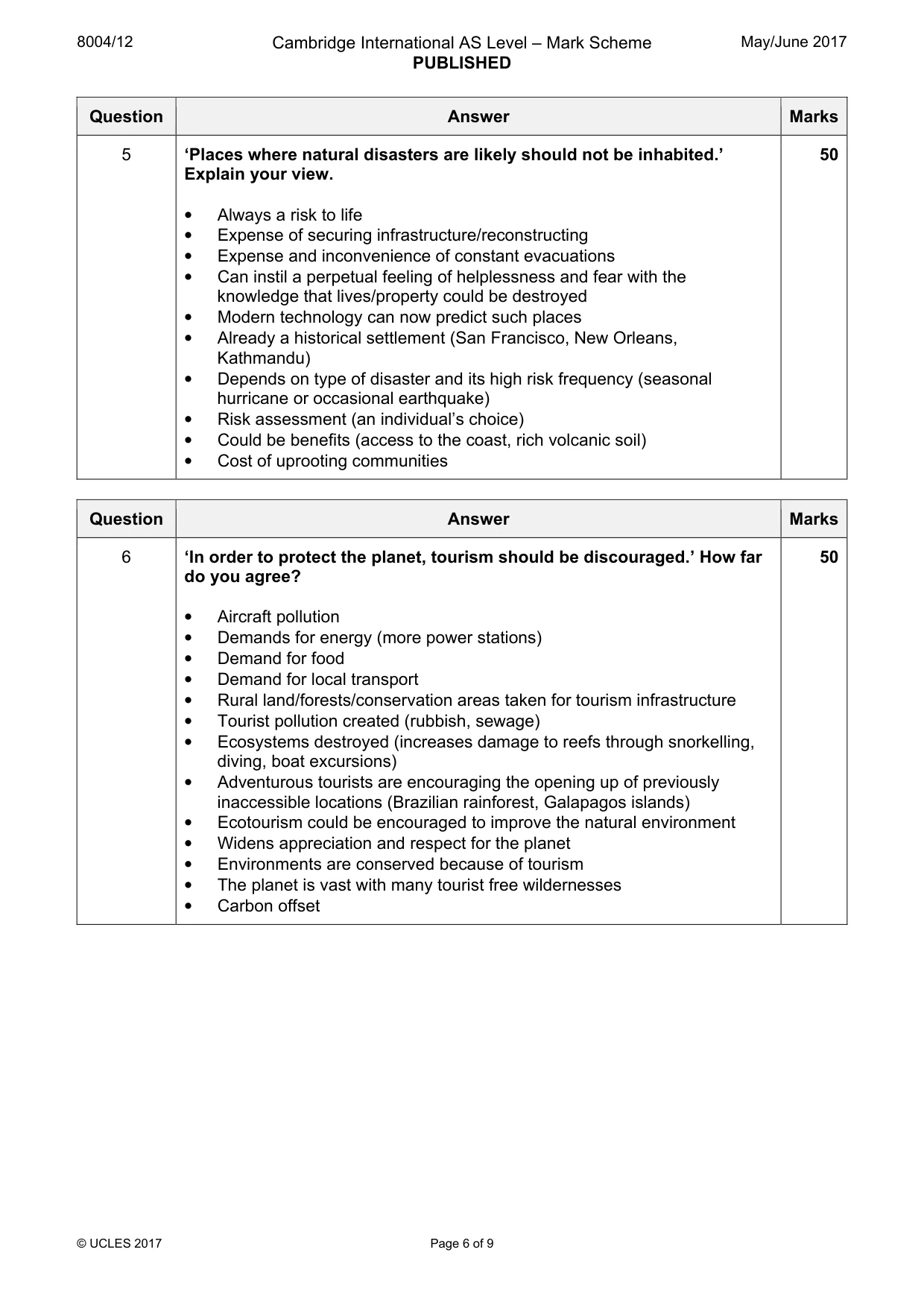
8004/12 Cambridge International AS Level – Mark Scheme PUBLISHED May/June 2017 © UCLES 2017 Page 6 of 9 Question Answer Marks 5 ‘Places where natural disasters are likely should not be inhabited.’ Explain your view. • Always a risk to life • Expense of securing infrastructure/reconstructing • Expense and inconvenience of constant evacuations • Can instil a perpetual feeling of helplessness and fear with the knowledge that lives/property could be destroyed • Modern technology can now predict such places • Already a historical settlement (San Francisco, New Orleans, Kathmandu) • Depends on type of disaster and its high risk frequency (seasonal hurricane or occasional earthquake) • Risk assessment (an individual’s choice) • Could be benefits (access to the coast, rich volcanic soil) • Cost of uprooting communities 50 Question Answer Marks 6 ‘In order to protect the planet, tourism should be discouraged.’ How far do you agree? • Aircraft pollution • Demands for energy (more power stations) • Demand for food • Demand for local transport • Rural land/forests/conservation areas taken for tourism infrastructure • Tourist pollution created (rubbish, sewage) • Ecosystems destroyed (increases damage to reefs through snorkelling, diving, boat excursions) • Adventurous tourists are encouraging the opening up of previously inaccessible locations (Brazilian rainforest, Galapagos islands) • Ecotourism could be encouraged to improve the natural environment • Widens appreciation and respect for the planet • Environments are conserved because of tourism • The planet is vast with many tourist free wildernesses • Carbon offset 50
Mark scheme, page 7
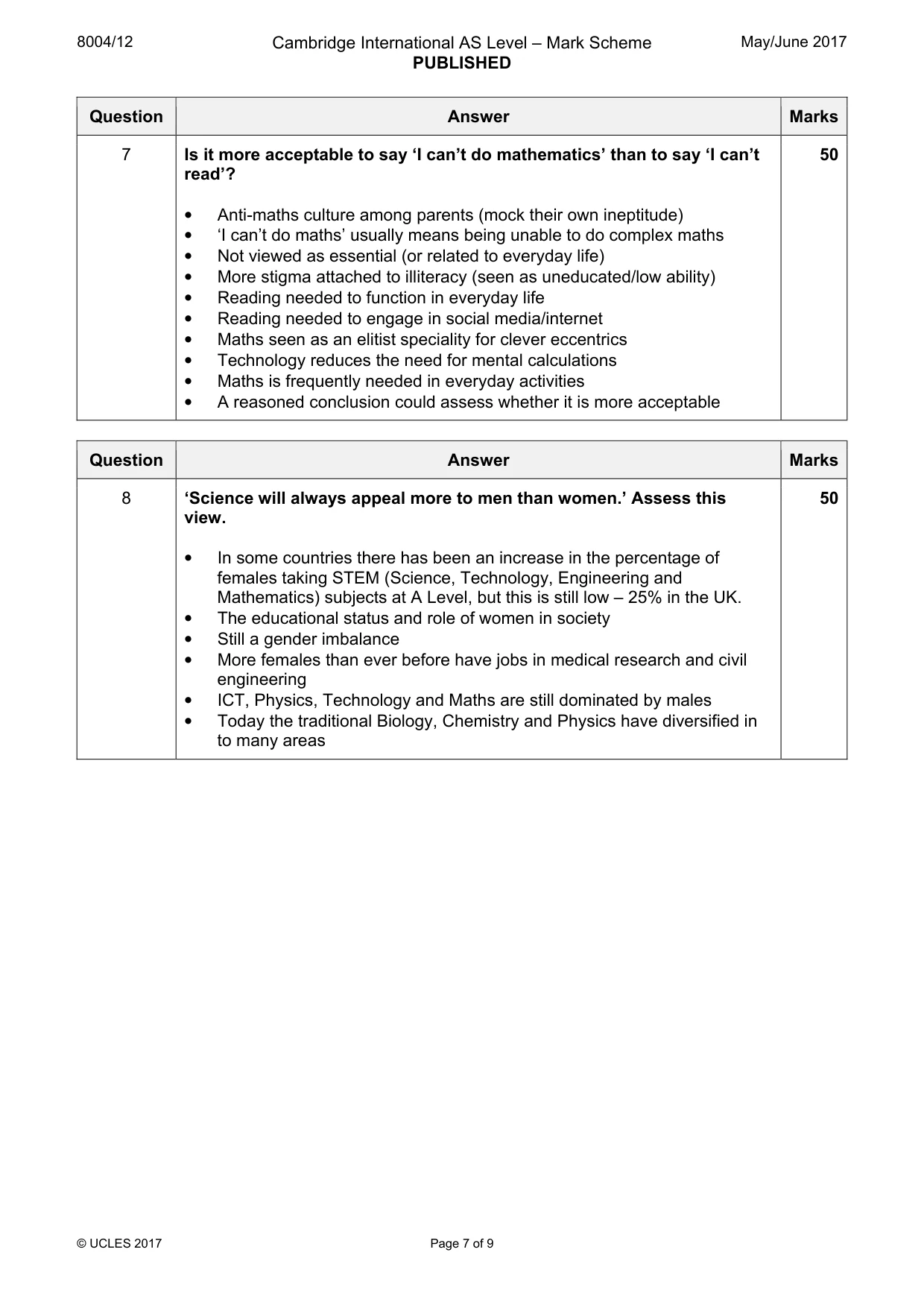
8004/12 Cambridge International AS Level – Mark Scheme PUBLISHED May/June 2017 © UCLES 2017 Page 7 of 9 Question Answer Marks 7 Is it more acceptable to say ‘I can’t do mathematics’ than to say ‘I can’t read’? • Anti-maths culture among parents (mock their own ineptitude) • ‘I can’t do maths’ usually means being unable to do complex maths • Not viewed as essential (or related to everyday life) • More stigma attached to illiteracy (seen as uneducated/low ability) • Reading needed to function in everyday life • Reading needed to engage in social media/internet • Maths seen as an elitist speciality for clever eccentrics • Technology reduces the need for mental calculations • Maths is frequently needed in everyday activities • A reasoned conclusion could assess whether it is more acceptable 50 Question Answer Marks 8 ‘Science will always appeal more to men than women.’ Assess this view. • In some countries there has been an increase in the percentage of females taking STEM (Science, Technology, Engineering and Mathematics) subjects at A Level, but this is still low – 25% in the UK. • The educational status and role of women in society • Still a gender imbalance • More females than ever before have jobs in medical research and civil engineering • ICT, Physics, Technology and Maths are still dominated by males • Today the traditional Biology, Chemistry and Physics have diversified in to many areas 50
Mark scheme, page 8
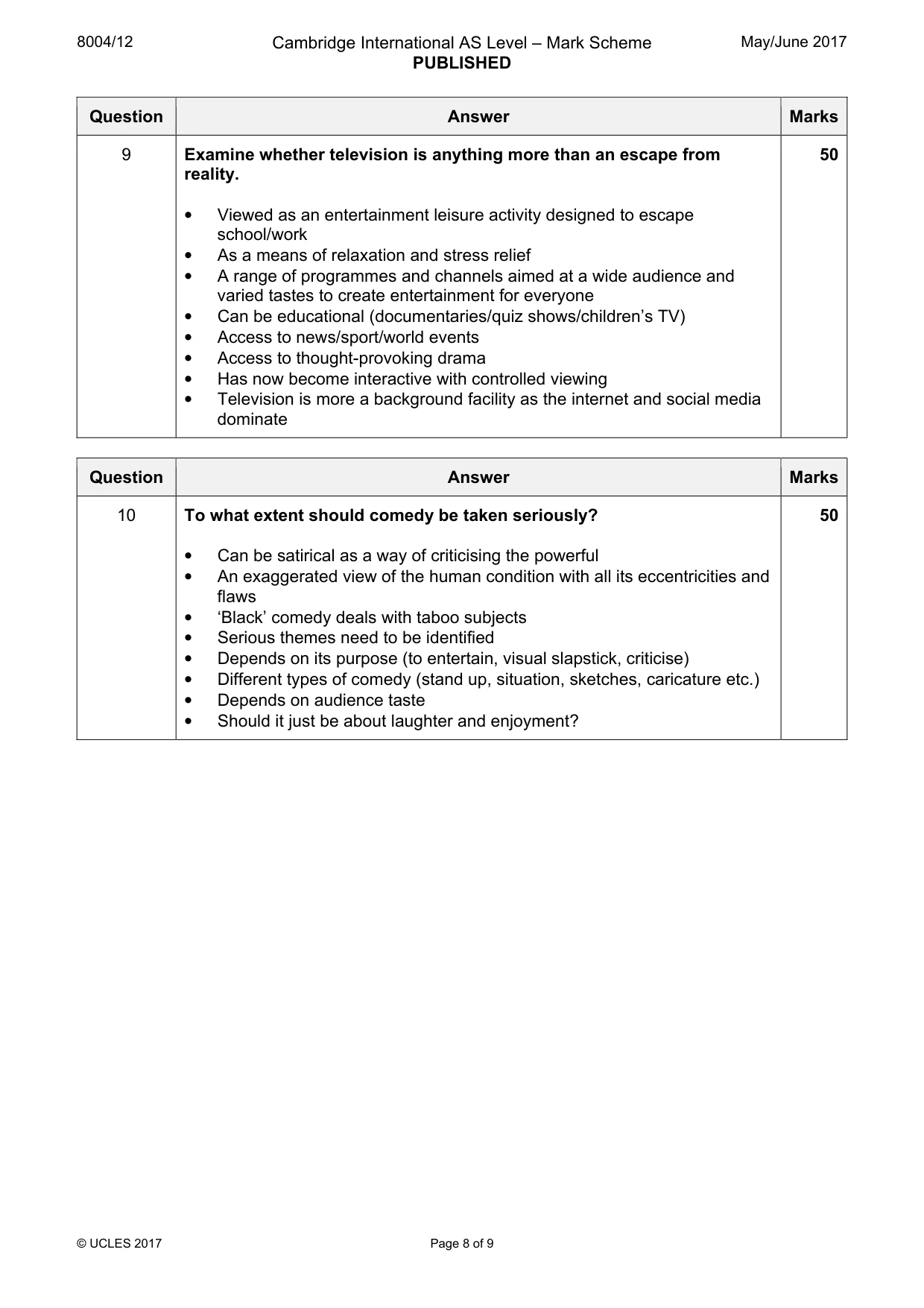
8004/12 Cambridge International AS Level – Mark Scheme PUBLISHED May/June 2017 © UCLES 2017 Page 8 of 9 Question Answer Marks 9 Examine whether television is anything more than an escape from reality. • Viewed as an entertainment leisure activity designed to escape school/work • As a means of relaxation and stress relief • A range of programmes and channels aimed at a wide audience and varied tastes to create entertainment for everyone • Can be educational (documentaries/quiz shows/children’s TV) • Access to news/sport/world events • Access to thought-provoking drama • Has now become interactive with controlled viewing • Television is more a background facility as the internet and social media dominate 50 Question Answer Marks 10 To what extent should comedy be taken seriously? • Can be satirical as a way of criticising the powerful • An exaggerated view of the human condition with all its eccentricities and flaws • ‘Black’ comedy deals with taboo subjects • Serious themes need to be identified • Depends on its purpose (to entertain, visual slapstick, criticise) • Different types of comedy (stand up, situation, sketches, caricature etc.) • Depends on audience taste • Should it just be about laughter and enjoyment? 50
Mark scheme, page 9
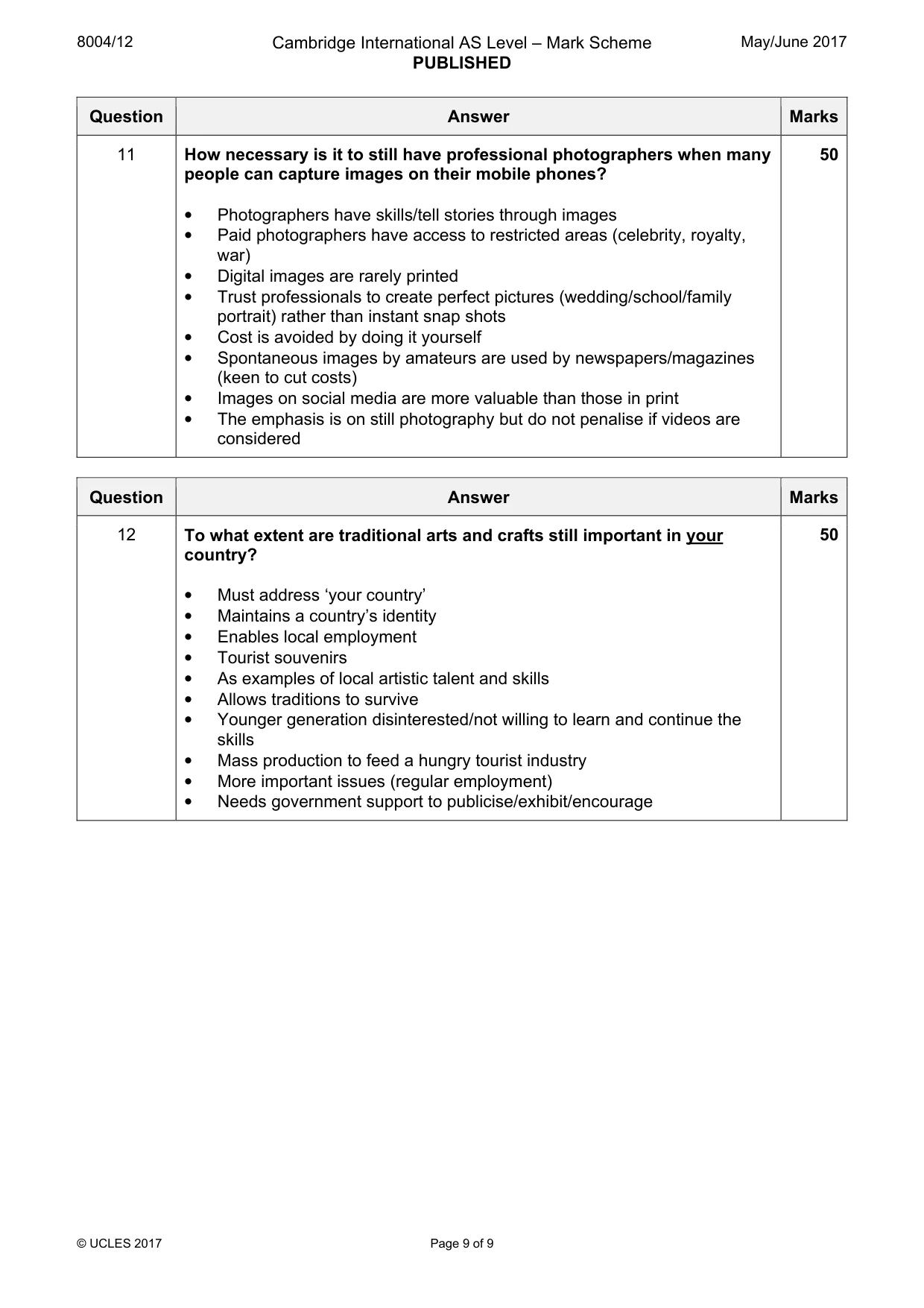
8004/12 Cambridge International AS Level – Mark Scheme PUBLISHED May/June 2017 © UCLES 2017 Page 9 of 9 Question Answer Marks 11 How necessary is it to still have professional photographers when many people can capture images on their mobile phones? • Photographers have skills/tell stories through images • Paid photographers have access to restricted areas (celebrity, royalty, war) • Digital images are rarely printed • Trust professionals to create perfect pictures (wedding/school/family portrait) rather than instant snap shots • Cost is avoided by doing it yourself • Spontaneous images by amateurs are used by newspapers/magazines (keen to cut costs) • Images on social media are more valuable than those in print • The emphasis is on still photography but do not penalise if videos are considered 50 Question Answer Marks 12 To what extent are traditional arts and crafts still important in your country? • Must address ‘your country’ • Maintains a country’s identity • Enables local employment • Tourist souvenirs • As examples of local artistic talent and skills • Allows traditions to survive • Younger generation disinterested/not willing to learn and continue the skills • Mass production to feed a hungry tourist industry • More important issues (regular employment) • Needs government support to publicise/exhibit/encourage 50
What you needed in this session
Cambridge’s own grade thresholds for 2017 May/June, Paper 1 · Variant 2. A higher threshold means an easier paper — the bar moves with how the cohort did.