Cambridge A Level General Paper (AS Level only) 8004 — 2016 May/June Paper 1 · Variant 2
8004/12/M/J/16 · 100 marks · ≈113 min
The question paper and its mark scheme, free to read here and free to download. This is Cambridge’s own paper, exactly as it was sat.
Question paper4 pages

Mark scheme8 pages
Answers below. Sit the paper first if you are practising.
Paper as text
Question paper, page 1
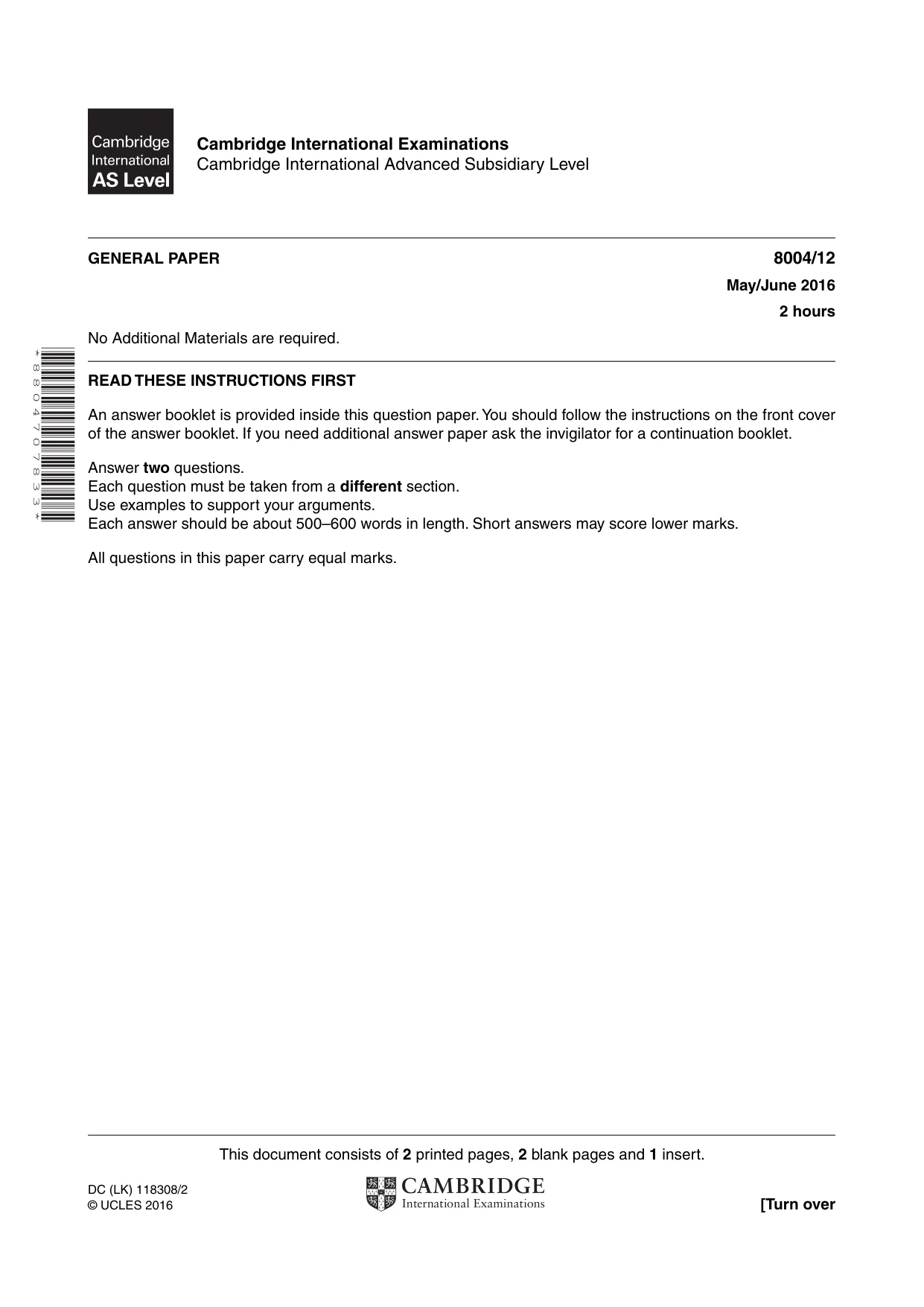
This document consists of 2 printed pages, 2 blank pages and 1 insert. DC (LK) 118308/2 © UCLES 2016 [Turn over Cambridge International Examinations Cambridge International Advanced Subsidiary Level * 8 8 0 4 7 0 7 8 3 3 * GENERAL PAPER 8004/12 May/June 2016 2 hours No Additional Materials are required. READ THESE INSTRUCTIONS FIRST An answer booklet is provided inside this question paper. You should follow the instructions on the front cover of the answer booklet. If you need additional answer paper ask the invigilator for a continuation booklet. Answer two questions. Each question must be taken from a different section. Use examples to support your arguments. Each answer should be about 500–600 words in length. Short answers may score lower marks. All questions in this paper carry equal marks.
Question paper, page 2
2 8004/12/M/J/16 © UCLES 2016 BLANK PAGE
Question paper, page 3
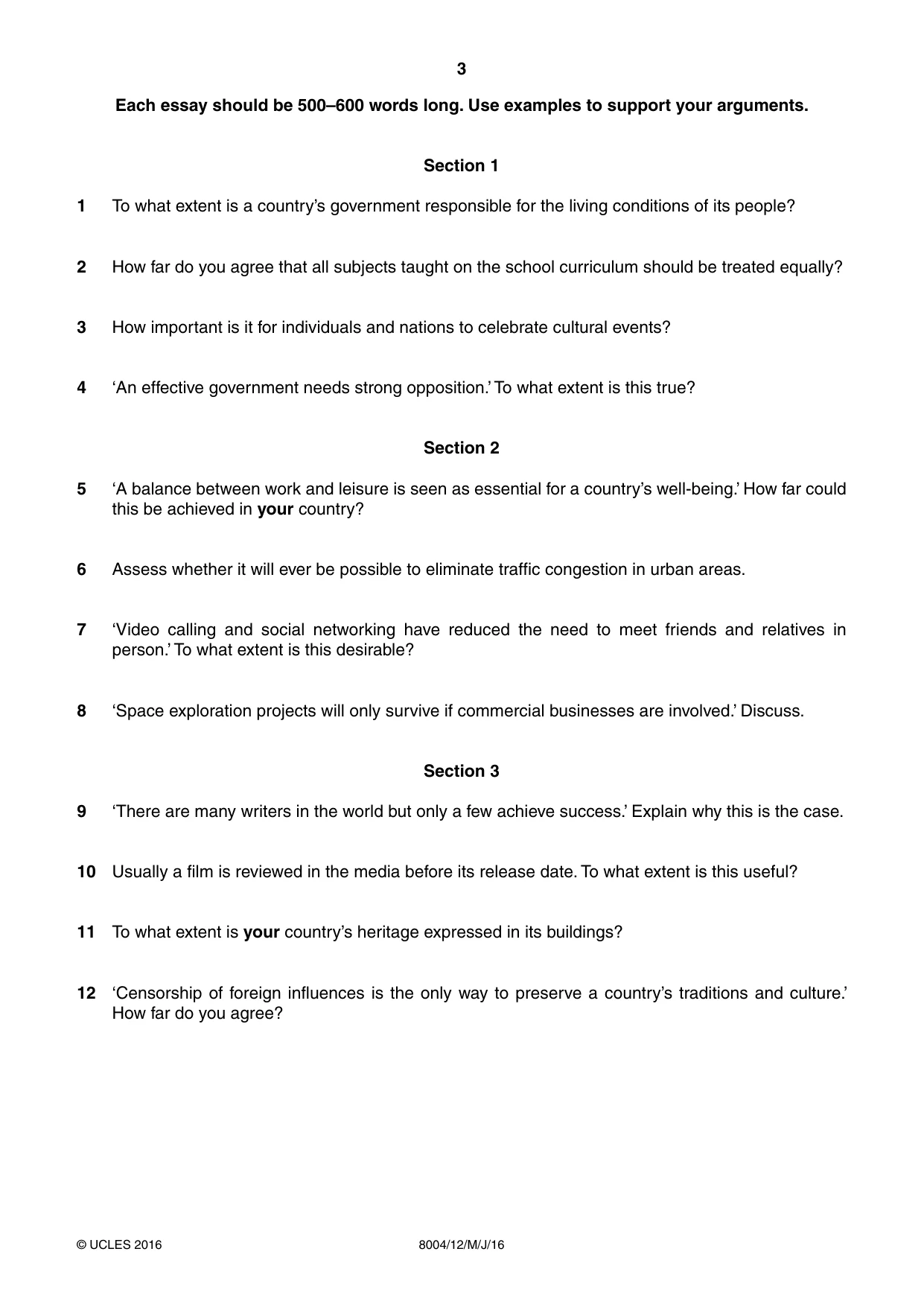
3 8004/12/M/J/16 © UCLES 2016 Each essay should be 500–600 words long. Use examples to support your arguments. Section 1 1 To what extent is a country’s government responsible for the living conditions of its people? 2 How far do you agree that all subjects taught on the school curriculum should be treated equally? 3 How important is it for individuals and nations to celebrate cultural events? 4 ‘An effective government needs strong opposition.’ To what extent is this true? Section 2 5 ‘A balance between work and leisure is seen as essential for a country’s well-being.’ How far could this be achieved in your country? 6 Assess whether it will ever be possible to eliminate traffic congestion in urban areas. 7 ‘Video calling and social networking have reduced the need to meet friends and relatives in person.’ To what extent is this desirable? 8 ‘Space exploration projects will only survive if commercial businesses are involved.’ Discuss. Section 3 9 ‘There are many writers in the world but only a few achieve success.’ Explain why this is the case. 10 Usually a film is reviewed in the media before its release date. To what extent is this useful? 11 To what extent is your country’s heritage expressed in its buildings? 12 ‘Censorship of foreign influences is the only way to preserve a country’s traditions and culture.’ How far do you agree?
Question paper, page 4
4 8004/12/M/J/16 © UCLES 2016 BLANK PAGE Permission to reproduce items where third-party owned material protected by copyright is included has been sought and cleared where possible. Every reasonable effort has been made by the publisher (UCLES) to trace copyright holders, but if any items requiring clearance have unwittingly been included, the publisher will be pleased to make amends at the earliest possible opportunity. To avoid the issue of disclosure of answer-related information to candidates, all copyright acknowledgements are reproduced online in the Cambridge International Examinations Copyright Acknowledgements Booklet. This is produced for each series of examinations and is freely available to download at www.cie.org.uk after the live examination series. Cambridge International Examinations is part of the Cambridge Assessment Group. Cambridge Assessment is the brand name of University of Cambridge Local Examinations Syndicate (UCLES), which is itself a department of the University of Cambridge.
Mark scheme, page 1
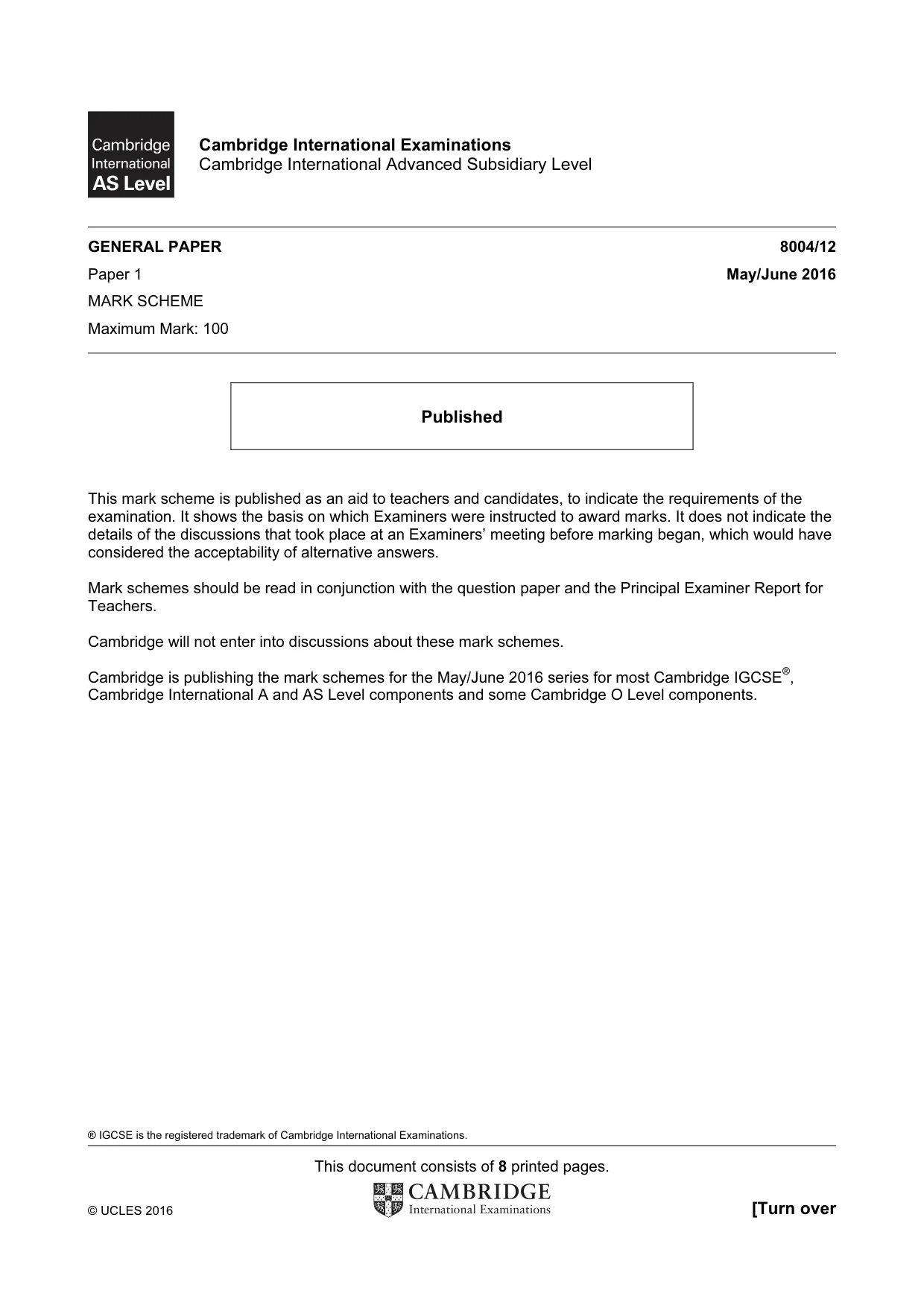
® IGCSE is the registered trademark of Cambridge International Examinations. This document consists of 8 printed pages. © UCLES 2016 [Turn over Cambridge International Examinations Cambridge International Advanced Subsidiary Level GENERAL PAPER 8004/12 Paper 1 May/June 2016 MARK SCHEME Maximum Mark: 100 Published This mark scheme is published as an aid to teachers and candidates, to indicate the requirements of the examination. It shows the basis on which Examiners were instructed to award marks. It does not indicate the details of the discussions that took place at an Examiners’ meeting before marking began, which would have considered the acceptability of alternative answers. Mark schemes should be read in conjunction with the question paper and the Principal Examiner Report for Teachers. Cambridge will not enter into discussions about these mark schemes. Cambridge is publishing the mark schemes for the May/June 2016 series for most Cambridge IGCSE®, Cambridge International A and AS Level components and some Cambridge O Level components.
Mark scheme, page 2
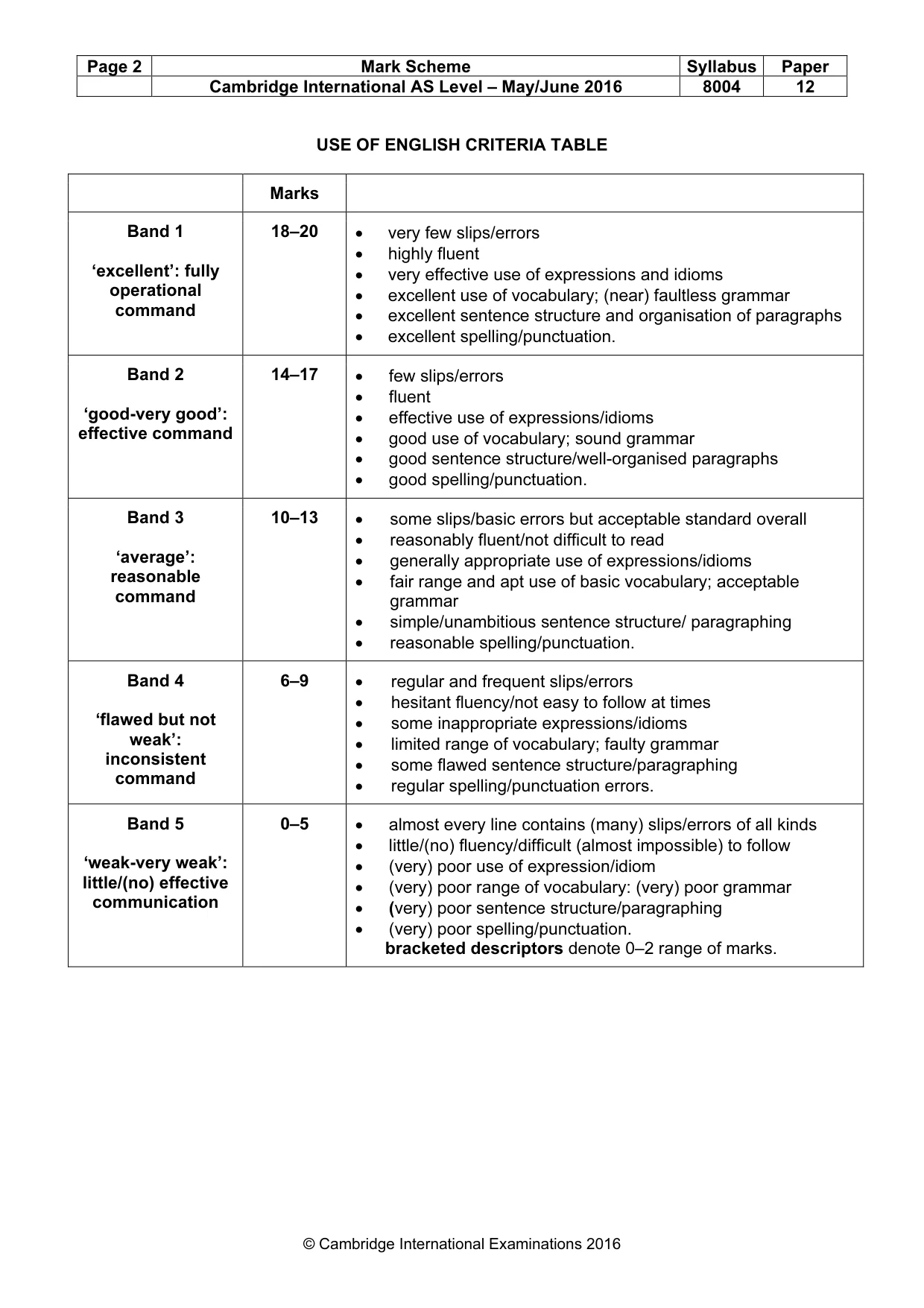
Page 2 Mark Scheme Syllabus Paper Cambridge International AS Level – May/June 2016 8004 12 © Cambridge International Examinations 2016 USE OF ENGLISH CRITERIA TABLE Marks Band 1 ‘excellent’: fully operational command 18–20 • very few slips/errors • highly fluent • very effective use of expressions and idioms • excellent use of vocabulary; (near) faultless grammar • excellent sentence structure and organisation of paragraphs • excellent spelling/punctuation. Band 2 ‘good-very good’: effective command 14–17 • few slips/errors • fluent • effective use of expressions/idioms • good use of vocabulary; sound grammar • good sentence structure/well-organised paragraphs • good spelling/punctuation. Band 3 ‘average’: reasonable command 10–13 • some slips/basic errors but acceptable standard overall • reasonably fluent/not difficult to read • generally appropriate use of expressions/idioms • fair range and apt use of basic vocabulary; acceptable grammar • simple/unambitious sentence structure/ paragraphing • reasonable spelling/punctuation. Band 4 ‘flawed but not weak’: inconsistent command 6–9 • regular and frequent slips/errors • hesitant fluency/not easy to follow at times • some inappropriate expressions/idioms • limited range of vocabulary; faulty grammar • some flawed sentence structure/paragraphing • regular spelling/punctuation errors. Band 5 ‘weak-very weak’: little/(no) effective communication 0–5 • almost every line contains (many) slips/errors of all kinds • little/(no) fluency/difficult (almost impossible) to follow • (very) poor use of expression/idiom • (very) poor range of vocabulary: (very) poor grammar • (very) poor sentence structure/paragraphing • (very) poor spelling/punctuation. bracketed descriptors denote 0–2 range of marks.
Mark scheme, page 3
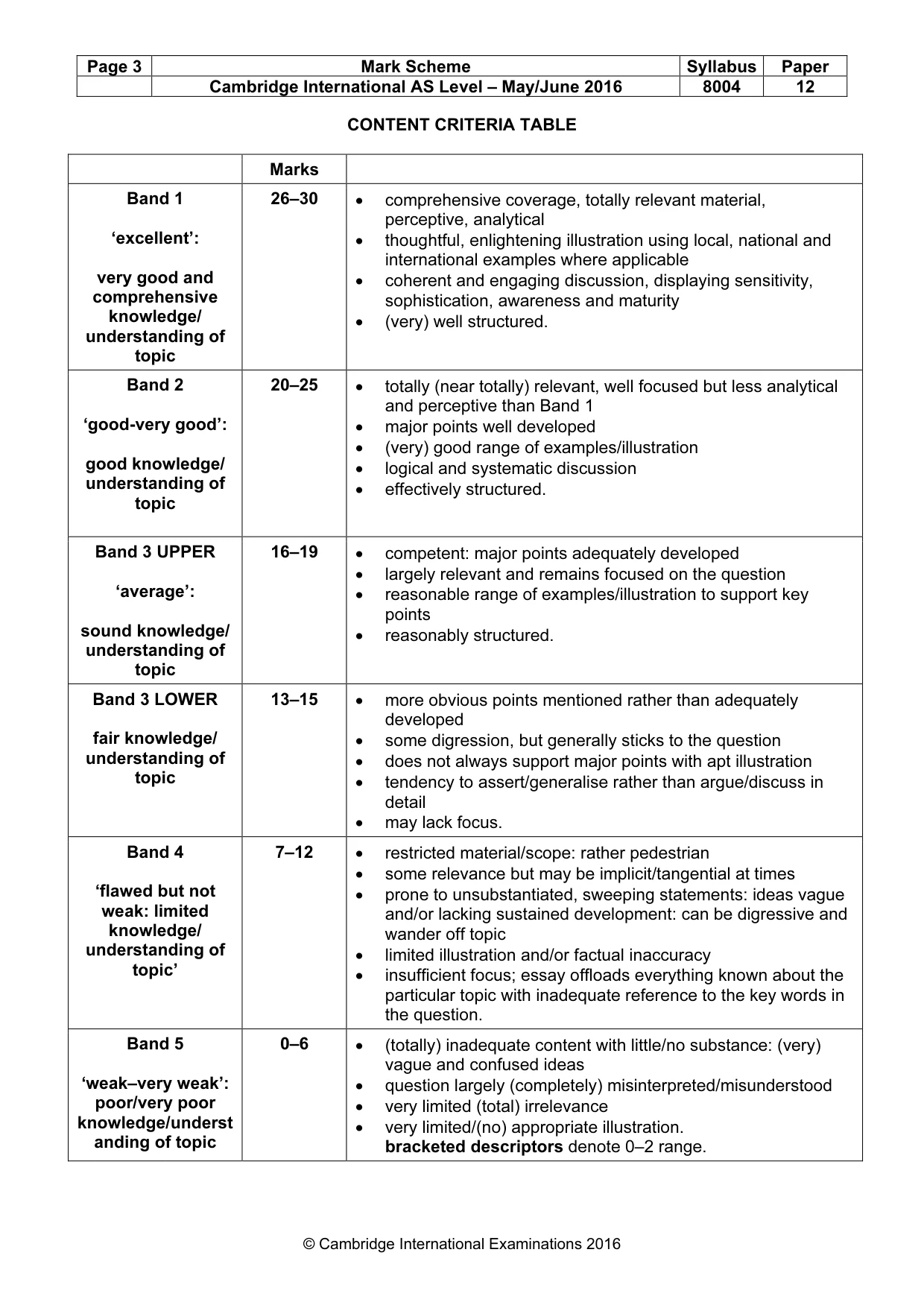
Page 3 Mark Scheme Syllabus Paper Cambridge International AS Level – May/June 2016 8004 12 © Cambridge International Examinations 2016 CONTENT CRITERIA TABLE Marks Band 1 ‘excellent’: very good and comprehensive knowledge/ understanding of topic 26–30 • comprehensive coverage, totally relevant material, perceptive, analytical • thoughtful, enlightening illustration using local, national and international examples where applicable • coherent and engaging discussion, displaying sensitivity, sophistication, awareness and maturity • (very) well structured. Band 2 ‘good-very good’: good knowledge/ understanding of topic 20–25 • totally (near totally) relevant, well focused but less analytical and perceptive than Band 1 • major points well developed • (very) good range of examples/illustration • logical and systematic discussion • effectively structured. Band 3 UPPER ‘average’: sound knowledge/ understanding of topic 16–19 • competent: major points adequately developed • largely relevant and remains focused on the question • reasonable range of examples/illustration to support key points • reasonably structured. Band 3 LOWER fair knowledge/ understanding of topic 13–15 • more obvious points mentioned rather than adequately developed • some digression, but generally sticks to the question • does not always support major points with apt illustration • tendency to assert/generalise rather than argue/discuss in detail • may lack focus. Band 4 ‘flawed but not weak: limited knowledge/ understanding of topic’ 7–12 • restricted material/scope: rather pedestrian • some relevance but may be implicit/tangential at times • prone to unsubstantiated, sweeping statements: ideas vague and/or lacking sustained development: can be digressive and wander off topic • limited illustration and/or factual inaccuracy • insufficient focus; essay offloads everything known about the particular topic with inadequate reference to the key words in the question. Band 5 ‘weak–very weak’: poor/very poor knowledge/underst anding of topic 0–6 • (totally) inadequate content with little/no substance: (very) vague and confused ideas • question largely (completely) misinterpreted/misunderstood • very limited (total) irrelevance • very limited/(no) appropriate illustration. bracketed descriptors denote 0–2 range.
Mark scheme, page 4
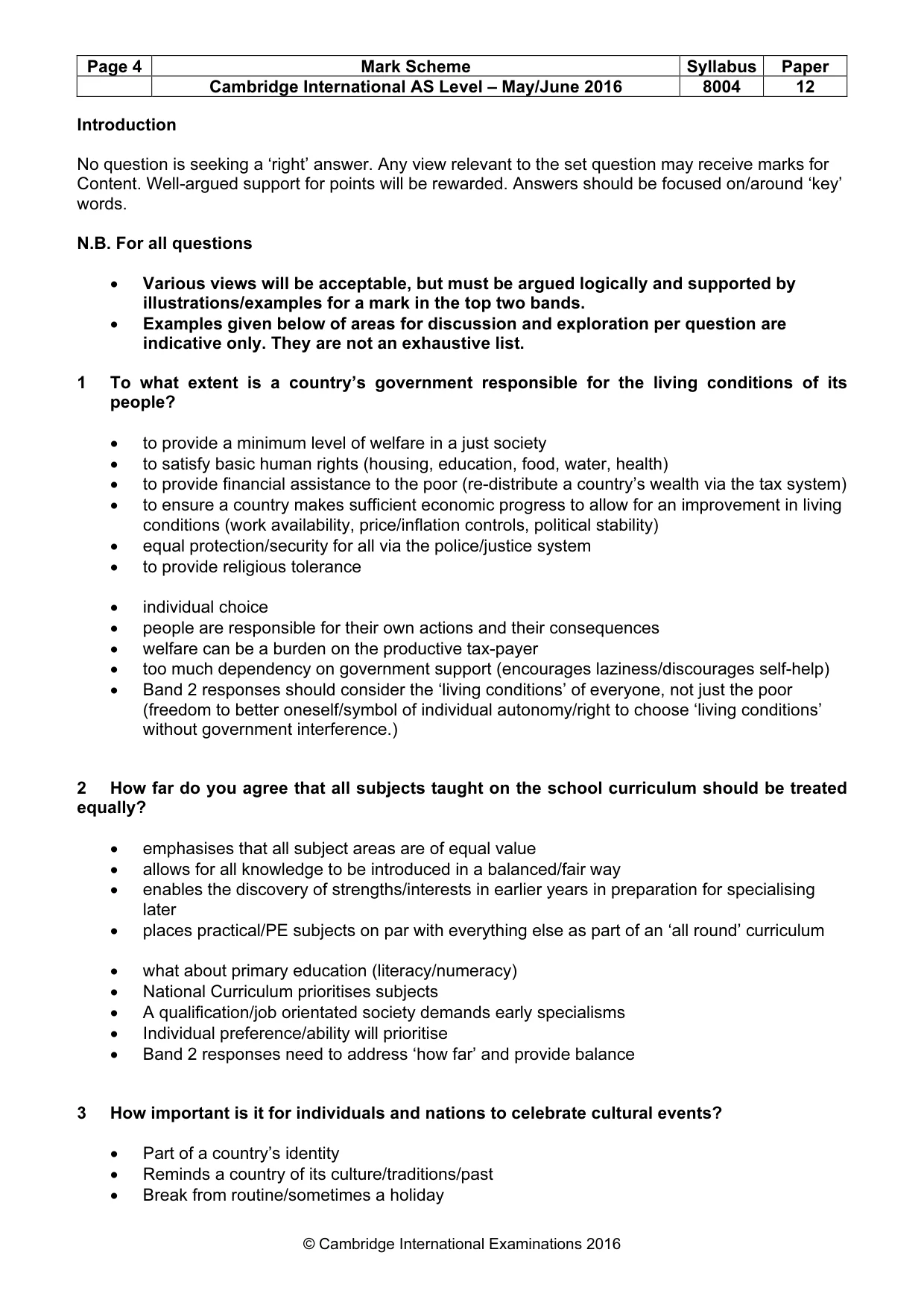
Page 4 Mark Scheme Syllabus Paper Cambridge International AS Level – May/June 2016 8004 12 © Cambridge International Examinations 2016 Introduction No question is seeking a ‘right’ answer. Any view relevant to the set question may receive marks for Content. Well-argued support for points will be rewarded. Answers should be focused on/around ‘key’ words. N.B. For all questions • Various views will be acceptable, but must be argued logically and supported by illustrations/examples for a mark in the top two bands. • Examples given below of areas for discussion and exploration per question are indicative only. They are not an exhaustive list. 1 To what extent is a country’s government responsible for the living conditions of its people? • to provide a minimum level of welfare in a just society • to satisfy basic human rights (housing, education, food, water, health) • to provide financial assistance to the poor (re-distribute a country’s wealth via the tax system) • to ensure a country makes sufficient economic progress to allow for an improvement in living conditions (work availability, price/inflation controls, political stability) • equal protection/security for all via the police/justice system • to provide religious tolerance • individual choice • people are responsible for their own actions and their consequences • welfare can be a burden on the productive tax-payer • too much dependency on government support (encourages laziness/discourages self-help) • Band 2 responses should consider the ‘living conditions’ of everyone, not just the poor (freedom to better oneself/symbol of individual autonomy/right to choose ‘living conditions’ without government interference.) 2 How far do you agree that all subjects taught on the school curriculum should be treated equally? • emphasises that all subject areas are of equal value • allows for all knowledge to be introduced in a balanced/fair way • enables the discovery of strengths/interests in earlier years in preparation for specialising later • places practical/PE subjects on par with everything else as part of an ‘all round’ curriculum • what about primary education (literacy/numeracy) • National Curriculum prioritises subjects • A qualification/job orientated society demands early specialisms • Individual preference/ability will prioritise • Band 2 responses need to address ‘how far’ and provide balance 3 How important is it for individuals and nations to celebrate cultural events? • Part of a country’s identity • Reminds a country of its culture/traditions/past • Break from routine/sometimes a holiday
Mark scheme, page 5
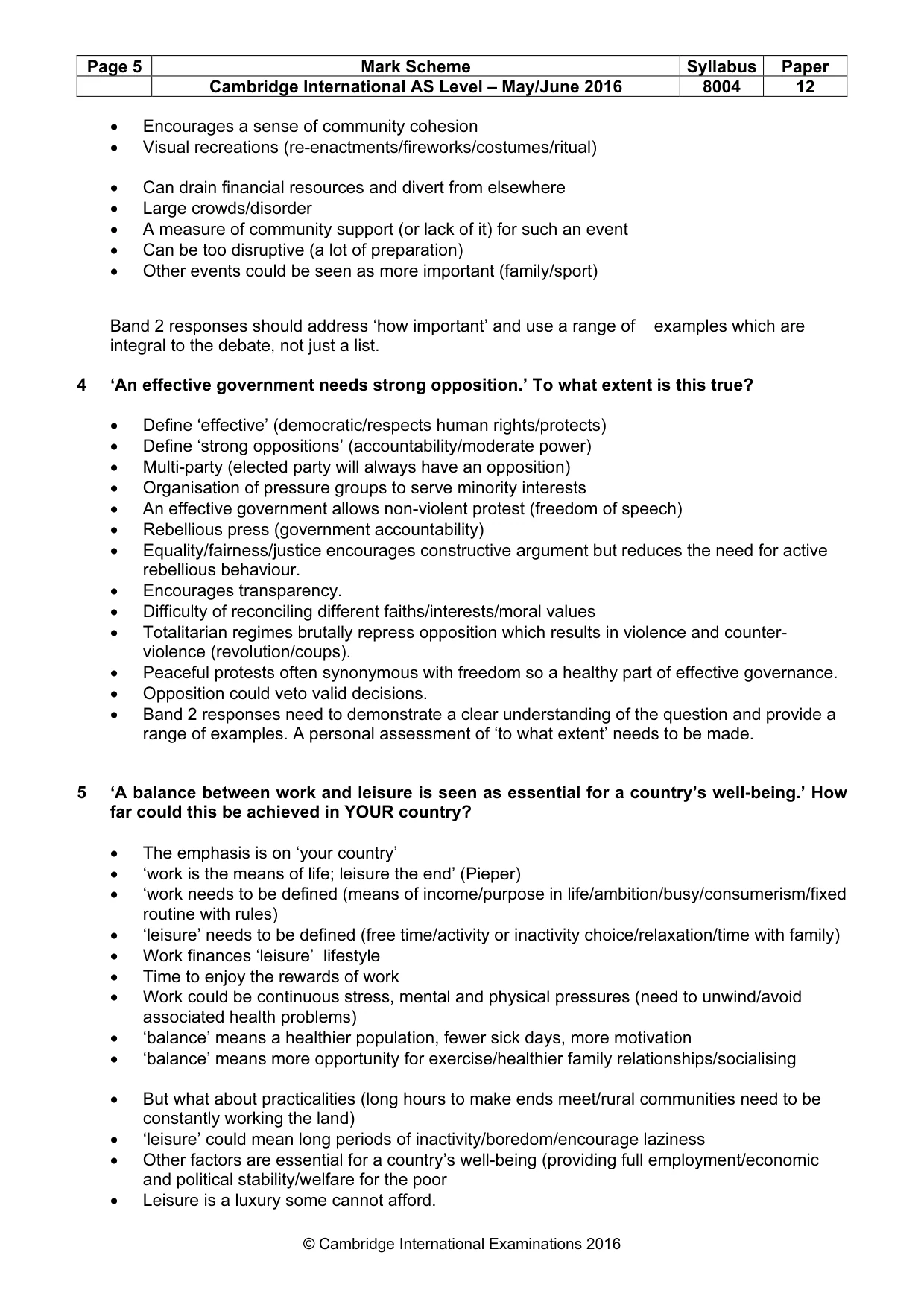
Page 5 Mark Scheme Syllabus Paper Cambridge International AS Level – May/June 2016 8004 12 © Cambridge International Examinations 2016 • Encourages a sense of community cohesion • Visual recreations (re-enactments/fireworks/costumes/ritual) • Can drain financial resources and divert from elsewhere • Large crowds/disorder • A measure of community support (or lack of it) for such an event • Can be too disruptive (a lot of preparation) • Other events could be seen as more important (family/sport) Band 2 responses should address ‘how important’ and use a range of examples which are integral to the debate, not just a list. 4 ‘An effective government needs strong opposition.’ To what extent is this true? • Define ‘effective’ (democratic/respects human rights/protects) • Define ‘strong oppositions’ (accountability/moderate power) • Multi-party (elected party will always have an opposition) • Organisation of pressure groups to serve minority interests • An effective government allows non-violent protest (freedom of speech) • Rebellious press (government accountability) • Equality/fairness/justice encourages constructive argument but reduces the need for active rebellious behaviour. • Encourages transparency. • Difficulty of reconciling different faiths/interests/moral values • Totalitarian regimes brutally repress opposition which results in violence and counter- violence (revolution/coups). • Peaceful protests often synonymous with freedom so a healthy part of effective governance. • Opposition could veto valid decisions. • Band 2 responses need to demonstrate a clear understanding of the question and provide a range of examples. A personal assessment of ‘to what extent’ needs to be made. 5 ‘A balance between work and leisure is seen as essential for a country’s well-being.’ How far could this be achieved in YOUR country? • The emphasis is on ‘your country’ • ‘work is the means of life; leisure the end’ (Pieper) • ‘work needs to be defined (means of income/purpose in life/ambition/busy/consumerism/fixed routine with rules) • ‘leisure’ needs to be defined (free time/activity or inactivity choice/relaxation/time with family) • Work finances ‘leisure’ lifestyle • Time to enjoy the rewards of work • Work could be continuous stress, mental and physical pressures (need to unwind/avoid associated health problems) • ‘balance’ means a healthier population, fewer sick days, more motivation • ‘balance’ means more opportunity for exercise/healthier family relationships/socialising • But what about practicalities (long hours to make ends meet/rural communities need to be constantly working the land) • ‘leisure’ could mean long periods of inactivity/boredom/encourage laziness • Other factors are essential for a country’s well-being (providing full employment/economic and political stability/welfare for the poor • Leisure is a luxury some cannot afford.
Mark scheme, page 6
Page 6 Mark Scheme Syllabus Paper Cambridge International AS Level – May/June 2016 8004 12 © Cambridge International Examinations 2016 • Band 2 responses will address ‘achievement’ and provide a range of examples from ‘your country’. 6 Assess whether it will ever be possible to eliminate traffic congestion in urban areas. • Cycling/cycle paths – problems of safety/topography • Only public transport allowed in city centres • Monorail (cost/massive infrastructure) • Trams • Underground • Car sharing • Urban areas with all the above are still congested • Commuters-rail • Band 2 responses need to address ‘assess whether possible’. 7 ‘Video calling and social networking have reduced the need to meet friends and relatives in person.’ To what extent is this desirable? • Makes distance no object • ‘skype’ is visual so it is as if friends/relatives are in the same room • Any documents/photographs can be shared instantly • Avoids complicated arrangements • At everyone’s convenience • Safe (avoids late night return journeys) • Can link up with different locations at the same time. • Reduces physical intimacy to ‘chat’ or a ‘movie’ • Limited emotional involvement (if upset cannot hug- could lead to distress) • Visits can be occasions/events/socialising/activities such as family meals • Computer communication can be inconvenient/come to abrupt conclusions • Band 2 responses need to address ‘to what extent’ and provide balanced arguments, not just lists. 8 ‘Space exploration projects will only survive if commercial businesses are involved.’ Discuss. • Decline in funding for NASA projects • Commercial businesses launching satellites • Supplying cargo for the International Space Station • Space tourism (no interest from NASA)-Space X/Virgin Galactica • Businesses tied to commercial ventures • NASA tied to the government (Defence Department) • Could be unlimited funding • Mineral explorations on the moon (pharmaceutical companies) • Government loses control • Motivated by self-interest/profit (could jeopardise safety) • A long-term investment (high risk) • Could cater for the wealthy elite
Mark scheme, page 7
Page 7 Mark Scheme Syllabus Paper Cambridge International AS Level – May/June 2016 8004 12 © Cambridge International Examinations 2016 • Band 2 responses need to consider ‘only’ and provide balance. Perhaps there needs to be an element of co-operation between a number of parties if it is to survive. 9 ‘There are many writers in the world but only a few achieve success.’ Explain why this might be the case. • It is a skill few have although most people have the skills for basic writing • Time consuming • Needs determination and perseverance • Easily give up (cannot cope with rejection) • Need to be widely read/seek inspiration • Unclear of genre • Difficulty of being original/capturing the public imagination • Consistently self-critical • Success can be in terms of ‘a lucky break’, financial or pride of publishing something • Examples are essential and Band 2 responses will develop arguments around the definition of ‘success’ and ‘explain why’ possibly with reference to genre/style and cover a range (poetry/novels/drama/short stories/articles). 10 Usually a film is reviewed in the media before its release date. To what extent is this useful? • Publicises the film • Enables informed choices of which films to see • Identifies genre/plot devices/setting/character/casting/direction • A credible critic offers opinions/recommendations which are valued • Important for its success or failure • A question of taste/personal value judgement • Too powerful/influential - can ruin a film • Trailers can be more useful • Associated with ‘high-brow’ newspapers/magazines • Critics can be too opinionated and provide little content information • Examples are essential • Band 2 responses should address ‘to what extent’ and provide a balanced argument. 11 To what extent is YOUR country’s heritage expressed in its buildings? • Traditional/historic • Religious symbolism • Cultural significance • Progress • Signature buildings connects minorities • Commercial function • Urbane (demolish ancient buildings) • Globalisation • ‘To what extent’ needs to be addressed to create balance
Mark scheme, page 8
Page 8 Mark Scheme Syllabus Paper Cambridge International AS Level – May/June 2016 8004 12 © Cambridge International Examinations 2016 12 ‘Censorship of foreign influences is the only way to preserve a country’s traditions and culture.’ How far do you agree? • Examples are needed (taken from the arts, religion, music, language, costume, dance, film etc.) • Censor modern interpretations which could dilute/corrupt/change • Censor western influences • Rural communities isolate themselves from urban areas • Community events/holiday celebrations only commemorate traditions • Establishment of fundamentalist groups as governments to censor/enforce • Can hinder a country’s progress • Traditions and culture reflect different times so are diverse • Censorship suggests intolerance/repression • Travel/tourism enables enrichment/sharing/education of varied cultures • Band 2 responses should provide a balanced argument with a range of examples and address ‘how far’.
What you needed in this session
Cambridge’s own grade thresholds for 2016 May/June, Paper 1 · Variant 2. A higher threshold means an easier paper — the bar moves with how the cohort did.