Cambridge A Level General Paper (AS Level only) 8004 — 2016 May/June Paper 1 · Variant 1
8004/11/M/J/16 · 100 marks · ≈113 min
The question paper and its mark scheme, free to read here and free to download. This is Cambridge’s own paper, exactly as it was sat.
Question paper4 pages

Mark scheme10 pages
Answers below. Sit the paper first if you are practising.
Paper as text
Question paper, page 1
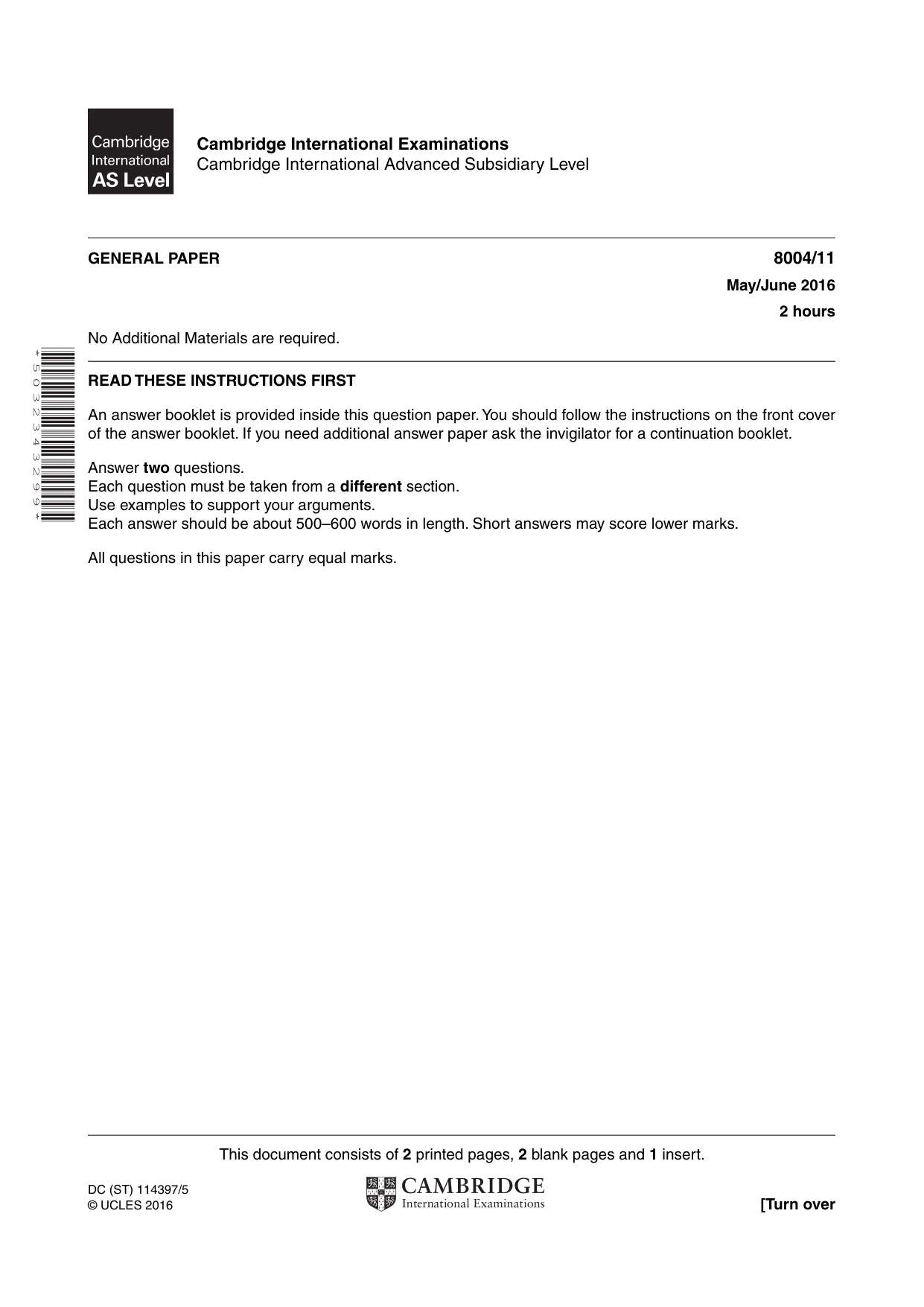
This document consists of 2 printed pages, 2 blank pages and 1 insert. DC (ST) 114397/5 © UCLES 2016 [Turn over Cambridge International Examinations Cambridge International Advanced Subsidiary Level * 5 0 3 2 3 4 3 2 9 9 * GENERAL PAPER 8004/11 May/June 2016 2 hours No Additional Materials are required. READ THESE INSTRUCTIONS FIRST An answer booklet is provided inside this question paper. You should follow the instructions on the front cover of the answer booklet. If you need additional answer paper ask the invigilator for a continuation booklet. Answer two questions. Each question must be taken from a different section. Use examples to support your arguments. Each answer should be about 500–600 words in length. Short answers may score lower marks. All questions in this paper carry equal marks.
Question paper, page 2
2 8004/11/M/J/16 © UCLES 2016 BLANK PAGE
Question paper, page 3
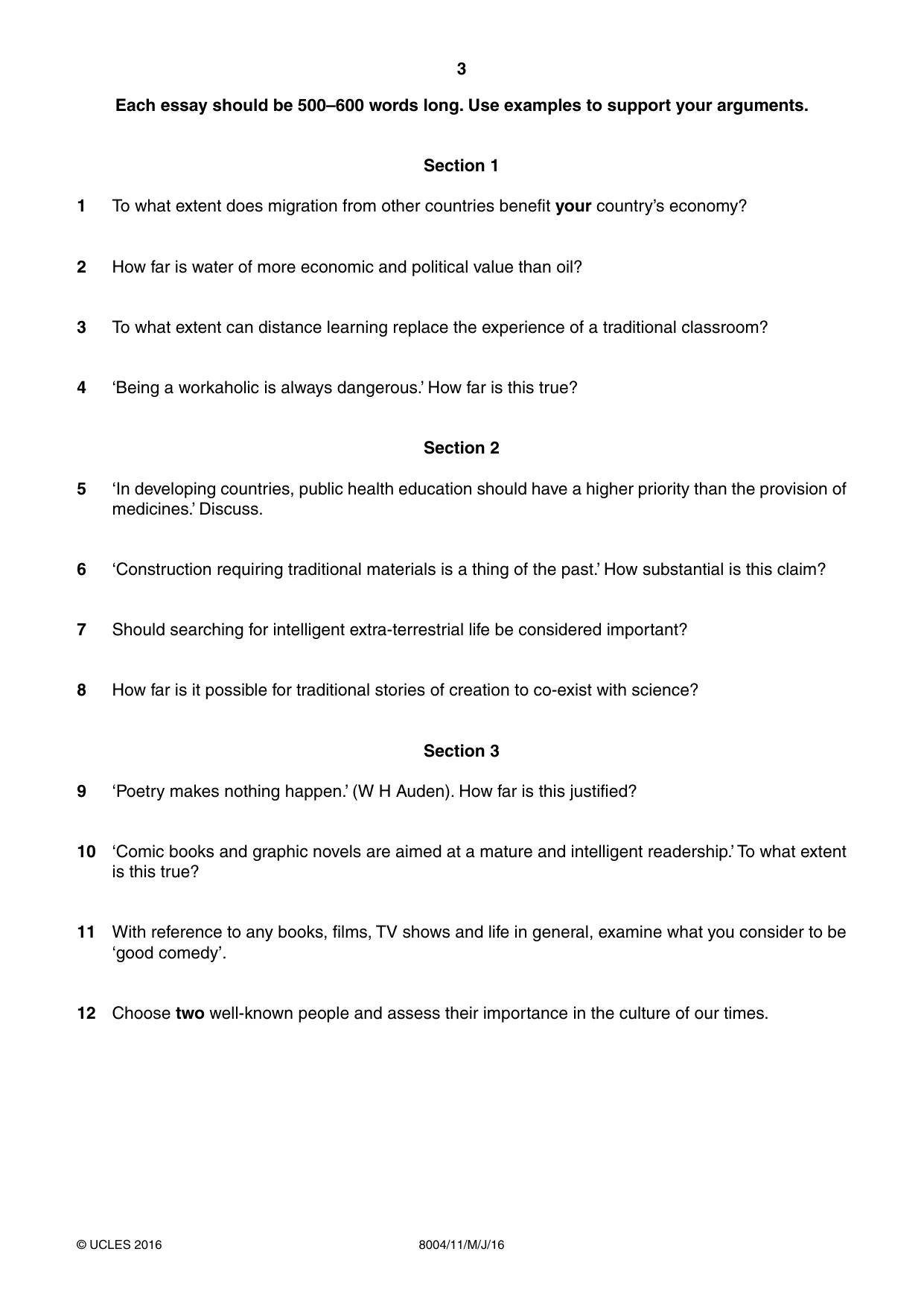
3 8004/11/M/J/16 © UCLES 2016 Each essay should be 500–600 words long. Use examples to support your arguments. Section 1 1 To what extent does migration from other countries benefit your country’s economy? 2 How far is water of more economic and political value than oil? 3 To what extent can distance learning replace the experience of a traditional classroom? 4 ‘Being a workaholic is always dangerous.’ How far is this true? Section 2 5 ‘In developing countries, public health education should have a higher priority than the provision of medicines.’ Discuss. 6 ‘Construction requiring traditional materials is a thing of the past.’ How substantial is this claim? 7 Should searching for intelligent extra-terrestrial life be considered important? 8 How far is it possible for traditional stories of creation to co-exist with science? Section 3 9 ‘Poetry makes nothing happen.’ (W H Auden). How far is this justified? 10 ‘Comic books and graphic novels are aimed at a mature and intelligent readership.’ To what extent is this true? 11 With reference to any books, films, TV shows and life in general, examine what you consider to be ‘good comedy’. 12 Choose two well-known people and assess their importance in the culture of our times.
Question paper, page 4
4 8004/11/M/J/16 © UCLES 2016 BLANK PAGE Permission to reproduce items where third-party owned material protected by copyright is included has been sought and cleared where possible. Every reasonable effort has been made by the publisher (UCLES) to trace copyright holders, but if any items requiring clearance have unwittingly been included, the publisher will be pleased to make amends at the earliest possible opportunity. To avoid the issue of disclosure of answer-related information to candidates, all copyright acknowledgements are reproduced online in the Cambridge International Examinations Copyright Acknowledgements Booklet. This is produced for each series of examinations and is freely available to download at www.cie.org.uk after the live examination series. Cambridge International Examinations is part of the Cambridge Assessment Group. Cambridge Assessment is the brand name of University of Cambridge Local Examinations Syndicate (UCLES), which is itself a department of the University of Cambridge.
Mark scheme, page 1
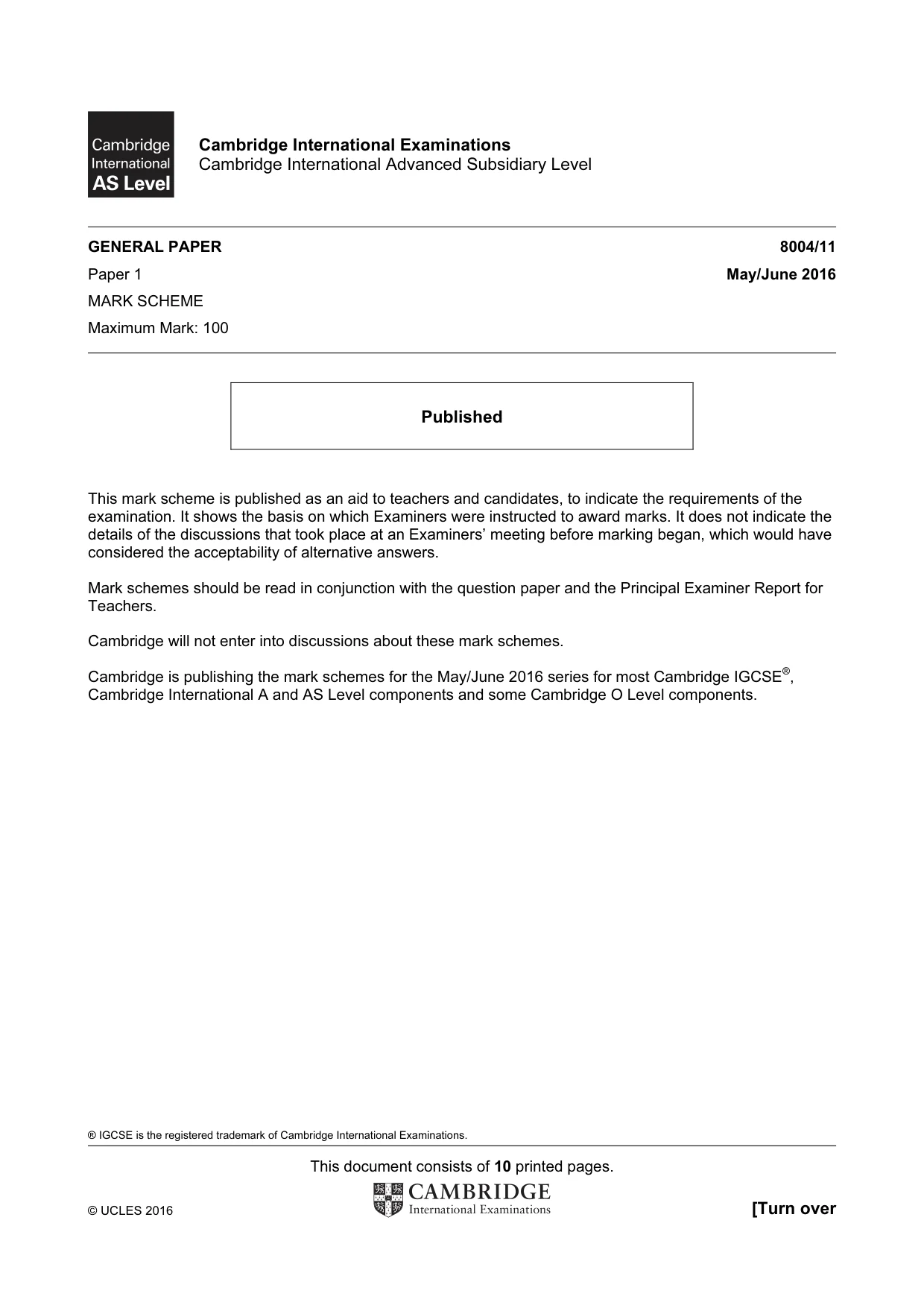
® IGCSE is the registered trademark of Cambridge International Examinations. This document consists of 10 printed pages. © UCLES 2016 [Turn over Cambridge International Examinations Cambridge International Advanced Subsidiary Level GENERAL PAPER 8004/11 Paper 1 May/June 2016 MARK SCHEME Maximum Mark: 100 Published This mark scheme is published as an aid to teachers and candidates, to indicate the requirements of the examination. It shows the basis on which Examiners were instructed to award marks. It does not indicate the details of the discussions that took place at an Examiners’ meeting before marking began, which would have considered the acceptability of alternative answers. Mark schemes should be read in conjunction with the question paper and the Principal Examiner Report for Teachers. Cambridge will not enter into discussions about these mark schemes. Cambridge is publishing the mark schemes for the May/June 2016 series for most Cambridge IGCSE®, Cambridge International A and AS Level components and some Cambridge O Level components.
Mark scheme, page 2
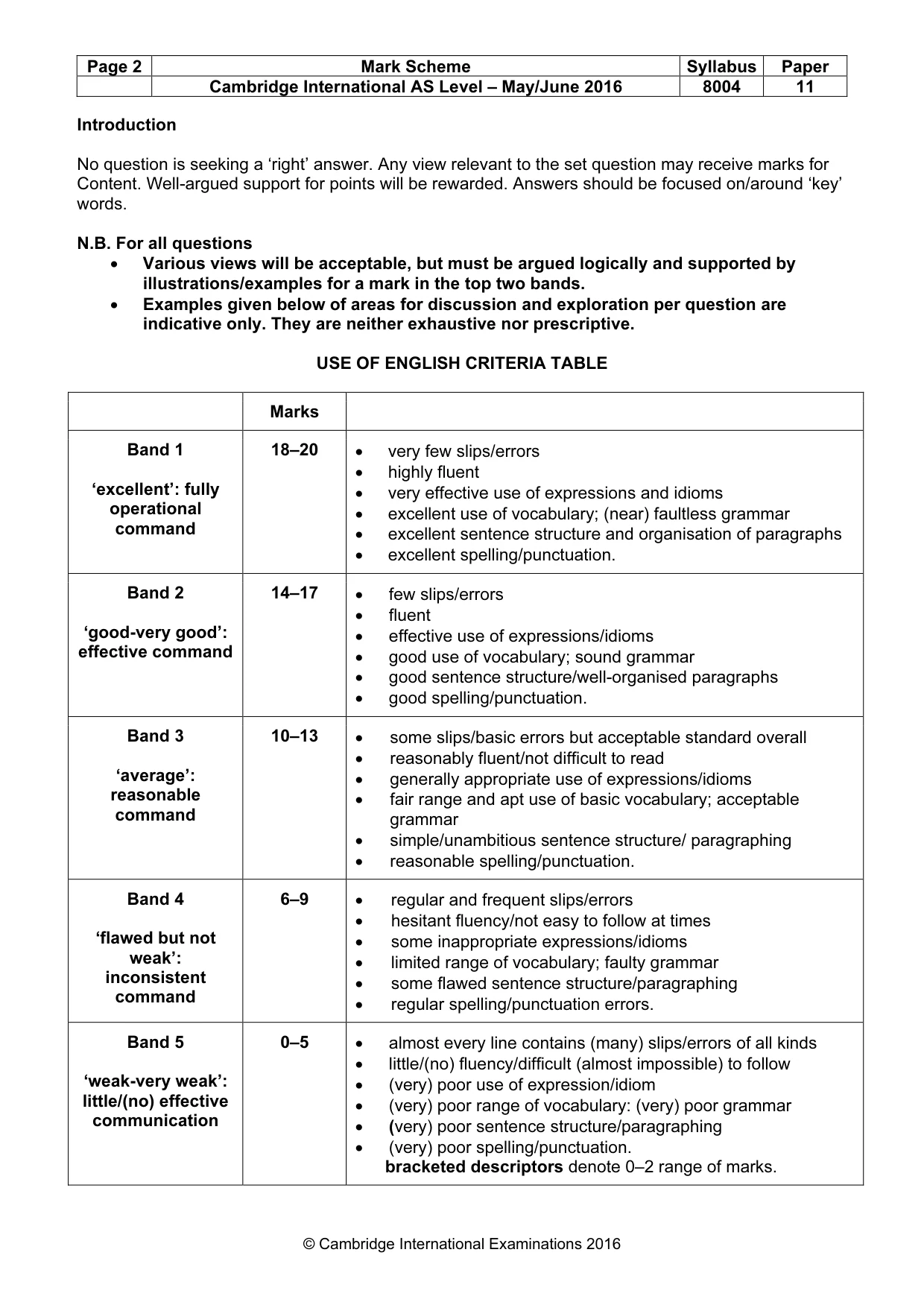
Page 2 Mark Scheme Syllabus Paper Cambridge International AS Level – May/June 2016 8004 11 © Cambridge International Examinations 2016 Introduction No question is seeking a ‘right’ answer. Any view relevant to the set question may receive marks for Content. Well-argued support for points will be rewarded. Answers should be focused on/around ‘key’ words. N.B. For all questions • Various views will be acceptable, but must be argued logically and supported by illustrations/examples for a mark in the top two bands. • Examples given below of areas for discussion and exploration per question are indicative only. They are neither exhaustive nor prescriptive. USE OF ENGLISH CRITERIA TABLE Marks Band 1 ‘excellent’: fully operational command 18–20 • very few slips/errors • highly fluent • very effective use of expressions and idioms • excellent use of vocabulary; (near) faultless grammar • excellent sentence structure and organisation of paragraphs • excellent spelling/punctuation. Band 2 ‘good-very good’: effective command 14–17 • few slips/errors • fluent • effective use of expressions/idioms • good use of vocabulary; sound grammar • good sentence structure/well-organised paragraphs • good spelling/punctuation. Band 3 ‘average’: reasonable command 10–13 • some slips/basic errors but acceptable standard overall • reasonably fluent/not difficult to read • generally appropriate use of expressions/idioms • fair range and apt use of basic vocabulary; acceptable grammar • simple/unambitious sentence structure/ paragraphing • reasonable spelling/punctuation. Band 4 ‘flawed but not weak’: inconsistent command 6–9 • regular and frequent slips/errors • hesitant fluency/not easy to follow at times • some inappropriate expressions/idioms • limited range of vocabulary; faulty grammar • some flawed sentence structure/paragraphing • regular spelling/punctuation errors. Band 5 ‘weak-very weak’: little/(no) effective communication 0–5 • almost every line contains (many) slips/errors of all kinds • little/(no) fluency/difficult (almost impossible) to follow • (very) poor use of expression/idiom • (very) poor range of vocabulary: (very) poor grammar • (very) poor sentence structure/paragraphing • (very) poor spelling/punctuation. bracketed descriptors denote 0–2 range of marks.
Mark scheme, page 3
Page 3 Mark Scheme Syllabus Paper Cambridge International AS Level – May/June 2016 8004 11 © Cambridge International Examinations 2016
Mark scheme, page 4
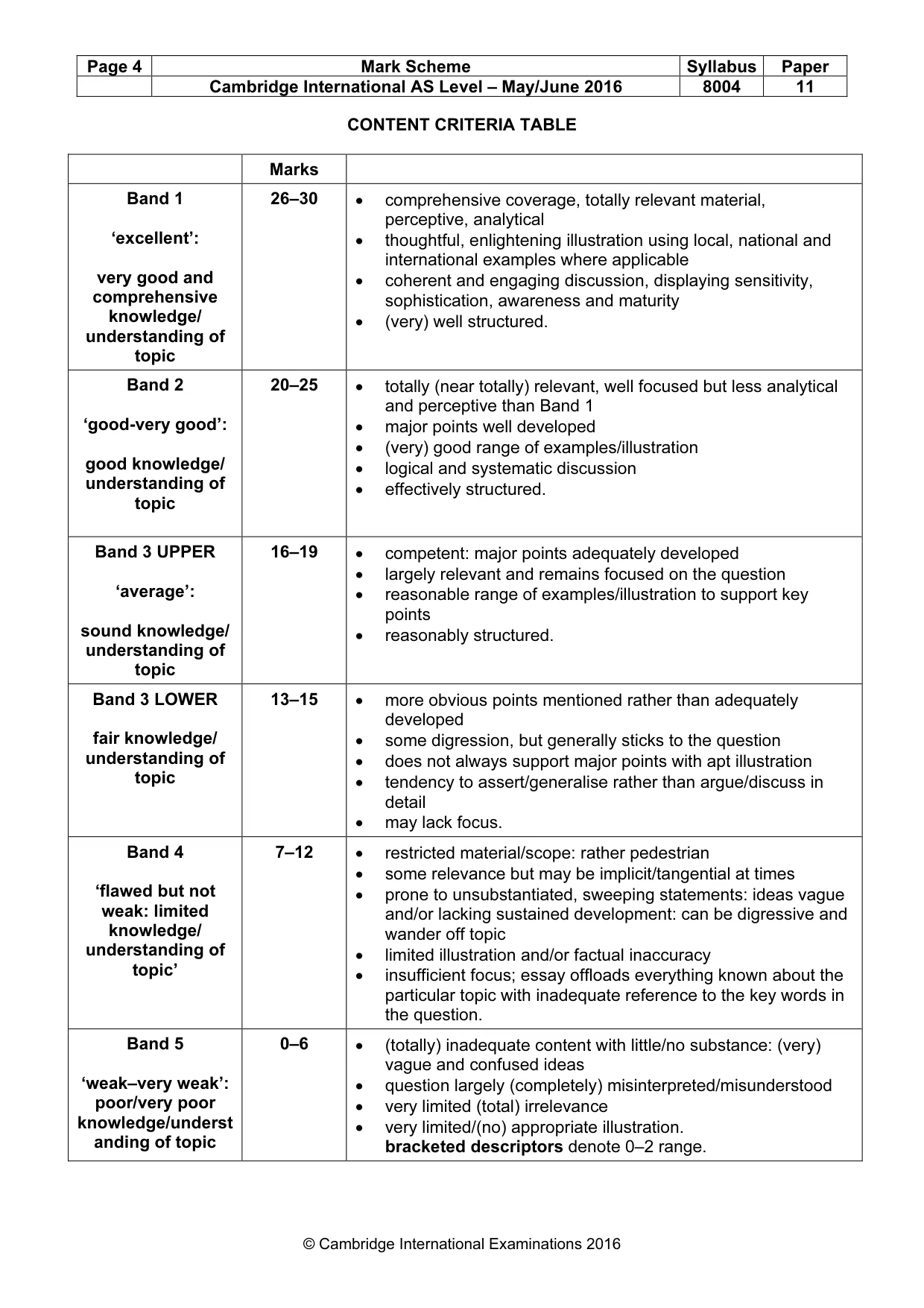
Page 4 Mark Scheme Syllabus Paper Cambridge International AS Level – May/June 2016 8004 11 © Cambridge International Examinations 2016 CONTENT CRITERIA TABLE Marks Band 1 ‘excellent’: very good and comprehensive knowledge/ understanding of topic 26–30 • comprehensive coverage, totally relevant material, perceptive, analytical • thoughtful, enlightening illustration using local, national and international examples where applicable • coherent and engaging discussion, displaying sensitivity, sophistication, awareness and maturity • (very) well structured. Band 2 ‘good-very good’: good knowledge/ understanding of topic 20–25 • totally (near totally) relevant, well focused but less analytical and perceptive than Band 1 • major points well developed • (very) good range of examples/illustration • logical and systematic discussion • effectively structured. Band 3 UPPER ‘average’: sound knowledge/ understanding of topic 16–19 • competent: major points adequately developed • largely relevant and remains focused on the question • reasonable range of examples/illustration to support key points • reasonably structured. Band 3 LOWER fair knowledge/ understanding of topic 13–15 • more obvious points mentioned rather than adequately developed • some digression, but generally sticks to the question • does not always support major points with apt illustration • tendency to assert/generalise rather than argue/discuss in detail • may lack focus. Band 4 ‘flawed but not weak: limited knowledge/ understanding of topic’ 7–12 • restricted material/scope: rather pedestrian • some relevance but may be implicit/tangential at times • prone to unsubstantiated, sweeping statements: ideas vague and/or lacking sustained development: can be digressive and wander off topic • limited illustration and/or factual inaccuracy • insufficient focus; essay offloads everything known about the particular topic with inadequate reference to the key words in the question. Band 5 ‘weak–very weak’: poor/very poor knowledge/underst anding of topic 0–6 • (totally) inadequate content with little/no substance: (very) vague and confused ideas • question largely (completely) misinterpreted/misunderstood • very limited (total) irrelevance • very limited/(no) appropriate illustration. bracketed descriptors denote 0–2 range.
Mark scheme, page 5
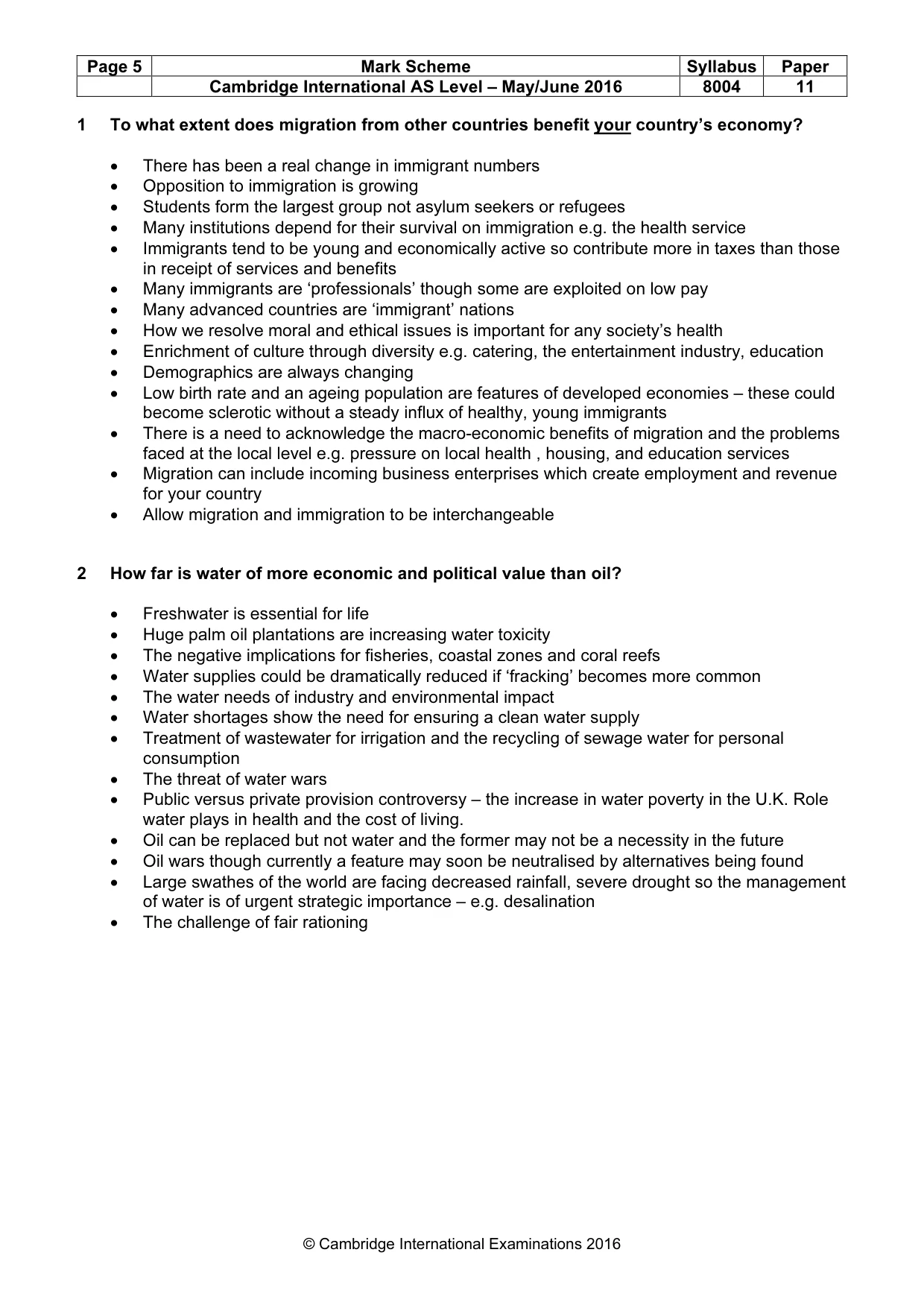
Page 5 Mark Scheme Syllabus Paper Cambridge International AS Level – May/June 2016 8004 11 © Cambridge International Examinations 2016 1 To what extent does migration from other countries benefit your country’s economy? • There has been a real change in immigrant numbers • Opposition to immigration is growing • Students form the largest group not asylum seekers or refugees • Many institutions depend for their survival on immigration e.g. the health service • Immigrants tend to be young and economically active so contribute more in taxes than those in receipt of services and benefits • Many immigrants are ‘professionals’ though some are exploited on low pay • Many advanced countries are ‘immigrant’ nations • How we resolve moral and ethical issues is important for any society’s health • Enrichment of culture through diversity e.g. catering, the entertainment industry, education • Demographics are always changing • Low birth rate and an ageing population are features of developed economies – these could become sclerotic without a steady influx of healthy, young immigrants • There is a need to acknowledge the macro-economic benefits of migration and the problems faced at the local level e.g. pressure on local health , housing, and education services • Migration can include incoming business enterprises which create employment and revenue for your country • Allow migration and immigration to be interchangeable 2 How far is water of more economic and political value than oil? • Freshwater is essential for life • Huge palm oil plantations are increasing water toxicity • The negative implications for fisheries, coastal zones and coral reefs • Water supplies could be dramatically reduced if ‘fracking’ becomes more common • The water needs of industry and environmental impact • Water shortages show the need for ensuring a clean water supply • Treatment of wastewater for irrigation and the recycling of sewage water for personal consumption • The threat of water wars • Public versus private provision controversy – the increase in water poverty in the U.K. Role water plays in health and the cost of living. • Oil can be replaced but not water and the former may not be a necessity in the future • Oil wars though currently a feature may soon be neutralised by alternatives being found • Large swathes of the world are facing decreased rainfall, severe drought so the management of water is of urgent strategic importance – e.g. desalination • The challenge of fair rationing
Mark scheme, page 6
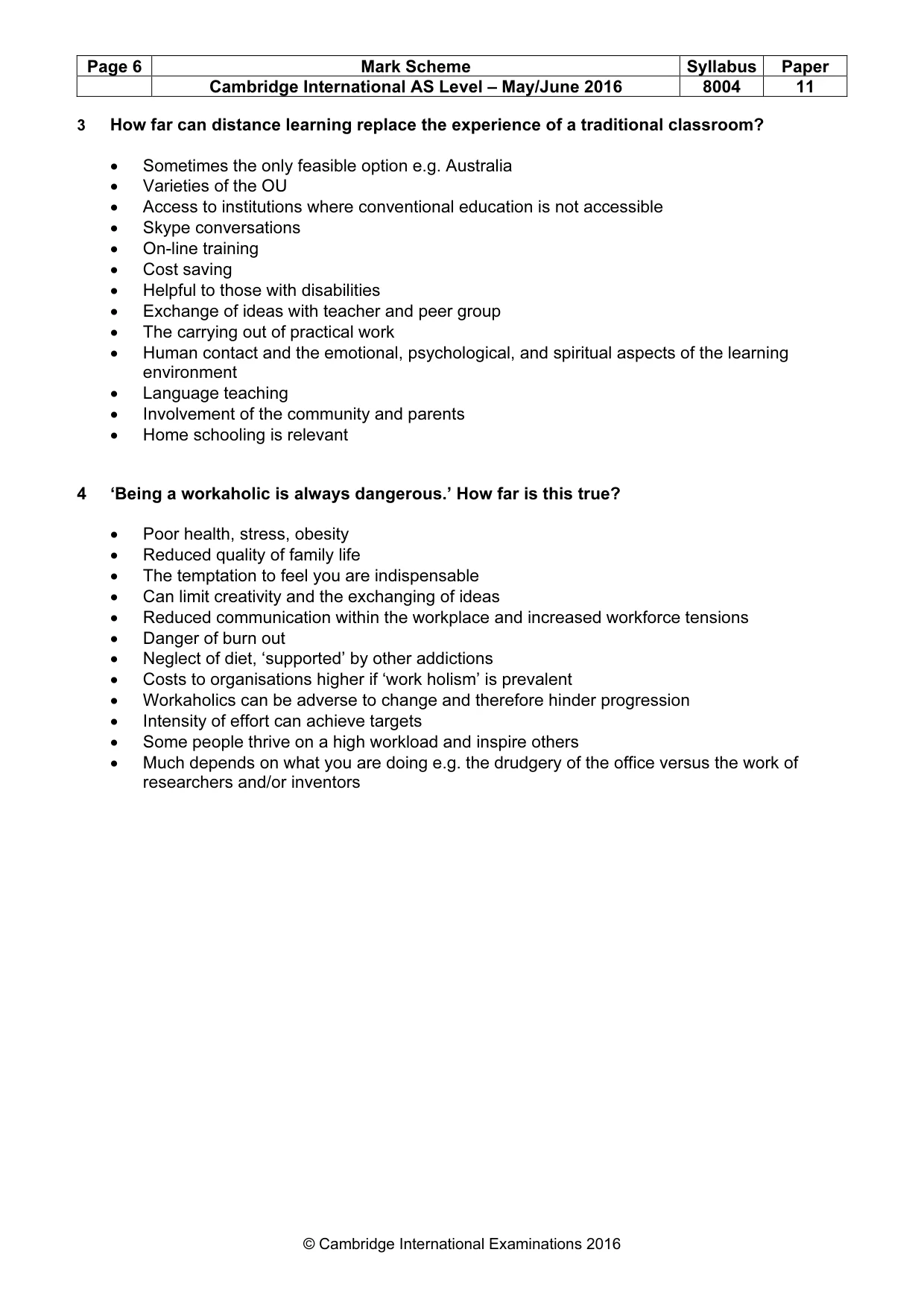
Page 6 Mark Scheme Syllabus Paper Cambridge International AS Level – May/June 2016 8004 11 © Cambridge International Examinations 2016 3 How far can distance learning replace the experience of a traditional classroom? • Sometimes the only feasible option e.g. Australia • Varieties of the OU • Access to institutions where conventional education is not accessible • Skype conversations • On-line training • Cost saving • Helpful to those with disabilities • Exchange of ideas with teacher and peer group • The carrying out of practical work • Human contact and the emotional, psychological, and spiritual aspects of the learning environment • Language teaching • Involvement of the community and parents • Home schooling is relevant 4 ‘Being a workaholic is always dangerous.’ How far is this true? • Poor health, stress, obesity • Reduced quality of family life • The temptation to feel you are indispensable • Can limit creativity and the exchanging of ideas • Reduced communication within the workplace and increased workforce tensions • Danger of burn out • Neglect of diet, ‘supported’ by other addictions • Costs to organisations higher if ‘work holism’ is prevalent • Workaholics can be adverse to change and therefore hinder progression • Intensity of effort can achieve targets • Some people thrive on a high workload and inspire others • Much depends on what you are doing e.g. the drudgery of the office versus the work of researchers and/or inventors
Mark scheme, page 7
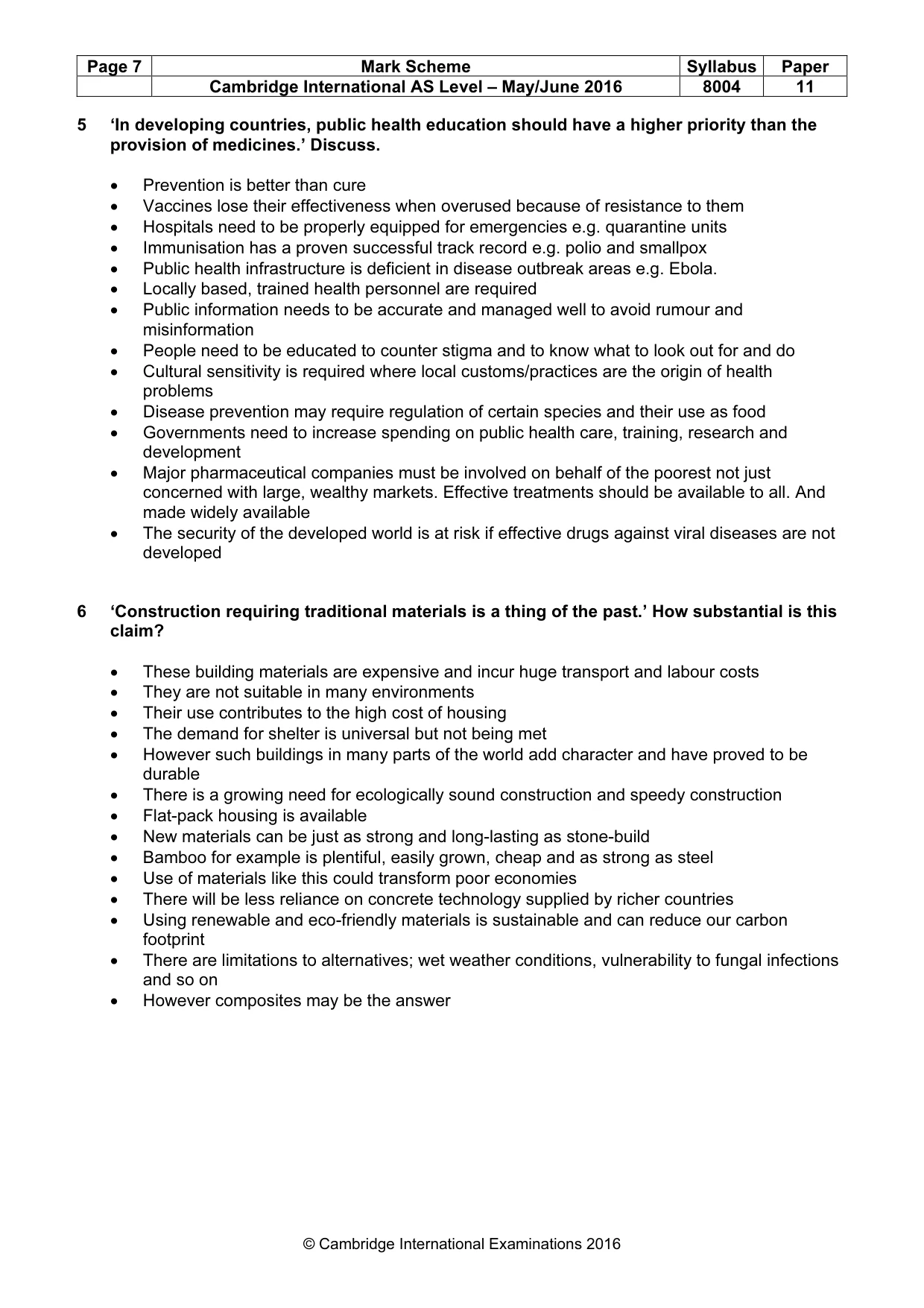
Page 7 Mark Scheme Syllabus Paper Cambridge International AS Level – May/June 2016 8004 11 © Cambridge International Examinations 2016 5 ‘In developing countries, public health education should have a higher priority than the provision of medicines.’ Discuss. • Prevention is better than cure • Vaccines lose their effectiveness when overused because of resistance to them • Hospitals need to be properly equipped for emergencies e.g. quarantine units • Immunisation has a proven successful track record e.g. polio and smallpox • Public health infrastructure is deficient in disease outbreak areas e.g. Ebola. • Locally based, trained health personnel are required • Public information needs to be accurate and managed well to avoid rumour and misinformation • People need to be educated to counter stigma and to know what to look out for and do • Cultural sensitivity is required where local customs/practices are the origin of health problems • Disease prevention may require regulation of certain species and their use as food • Governments need to increase spending on public health care, training, research and development • Major pharmaceutical companies must be involved on behalf of the poorest not just concerned with large, wealthy markets. Effective treatments should be available to all. And made widely available • The security of the developed world is at risk if effective drugs against viral diseases are not developed 6 ‘Construction requiring traditional materials is a thing of the past.’ How substantial is this claim? • These building materials are expensive and incur huge transport and labour costs • They are not suitable in many environments • Their use contributes to the high cost of housing • The demand for shelter is universal but not being met • However such buildings in many parts of the world add character and have proved to be durable • There is a growing need for ecologically sound construction and speedy construction • Flat-pack housing is available • New materials can be just as strong and long-lasting as stone-build • Bamboo for example is plentiful, easily grown, cheap and as strong as steel • Use of materials like this could transform poor economies • There will be less reliance on concrete technology supplied by richer countries • Using renewable and eco-friendly materials is sustainable and can reduce our carbon footprint • There are limitations to alternatives; wet weather conditions, vulnerability to fungal infections and so on • However composites may be the answer
Mark scheme, page 8
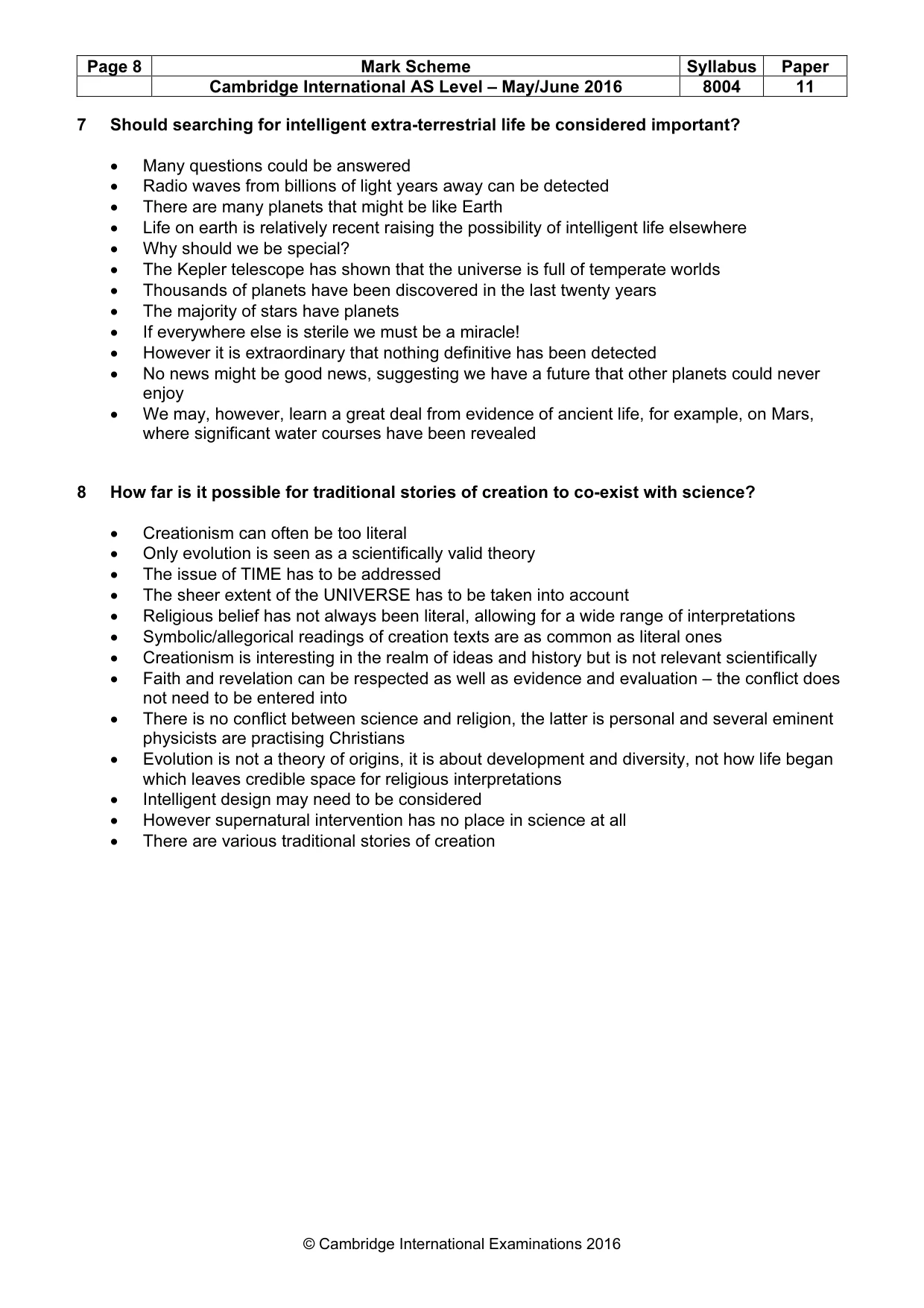
Page 8 Mark Scheme Syllabus Paper Cambridge International AS Level – May/June 2016 8004 11 © Cambridge International Examinations 2016 7 Should searching for intelligent extra-terrestrial life be considered important? • Many questions could be answered • Radio waves from billions of light years away can be detected • There are many planets that might be like Earth • Life on earth is relatively recent raising the possibility of intelligent life elsewhere • Why should we be special? • The Kepler telescope has shown that the universe is full of temperate worlds • Thousands of planets have been discovered in the last twenty years • The majority of stars have planets • If everywhere else is sterile we must be a miracle! • However it is extraordinary that nothing definitive has been detected • No news might be good news, suggesting we have a future that other planets could never enjoy • We may, however, learn a great deal from evidence of ancient life, for example, on Mars, where significant water courses have been revealed 8 How far is it possible for traditional stories of creation to co-exist with science? • Creationism can often be too literal • Only evolution is seen as a scientifically valid theory • The issue of TIME has to be addressed • The sheer extent of the UNIVERSE has to be taken into account • Religious belief has not always been literal, allowing for a wide range of interpretations • Symbolic/allegorical readings of creation texts are as common as literal ones • Creationism is interesting in the realm of ideas and history but is not relevant scientifically • Faith and revelation can be respected as well as evidence and evaluation – the conflict does not need to be entered into • There is no conflict between science and religion, the latter is personal and several eminent physicists are practising Christians • Evolution is not a theory of origins, it is about development and diversity, not how life began which leaves credible space for religious interpretations • Intelligent design may need to be considered • However supernatural intervention has no place in science at all • There are various traditional stories of creation
Mark scheme, page 9
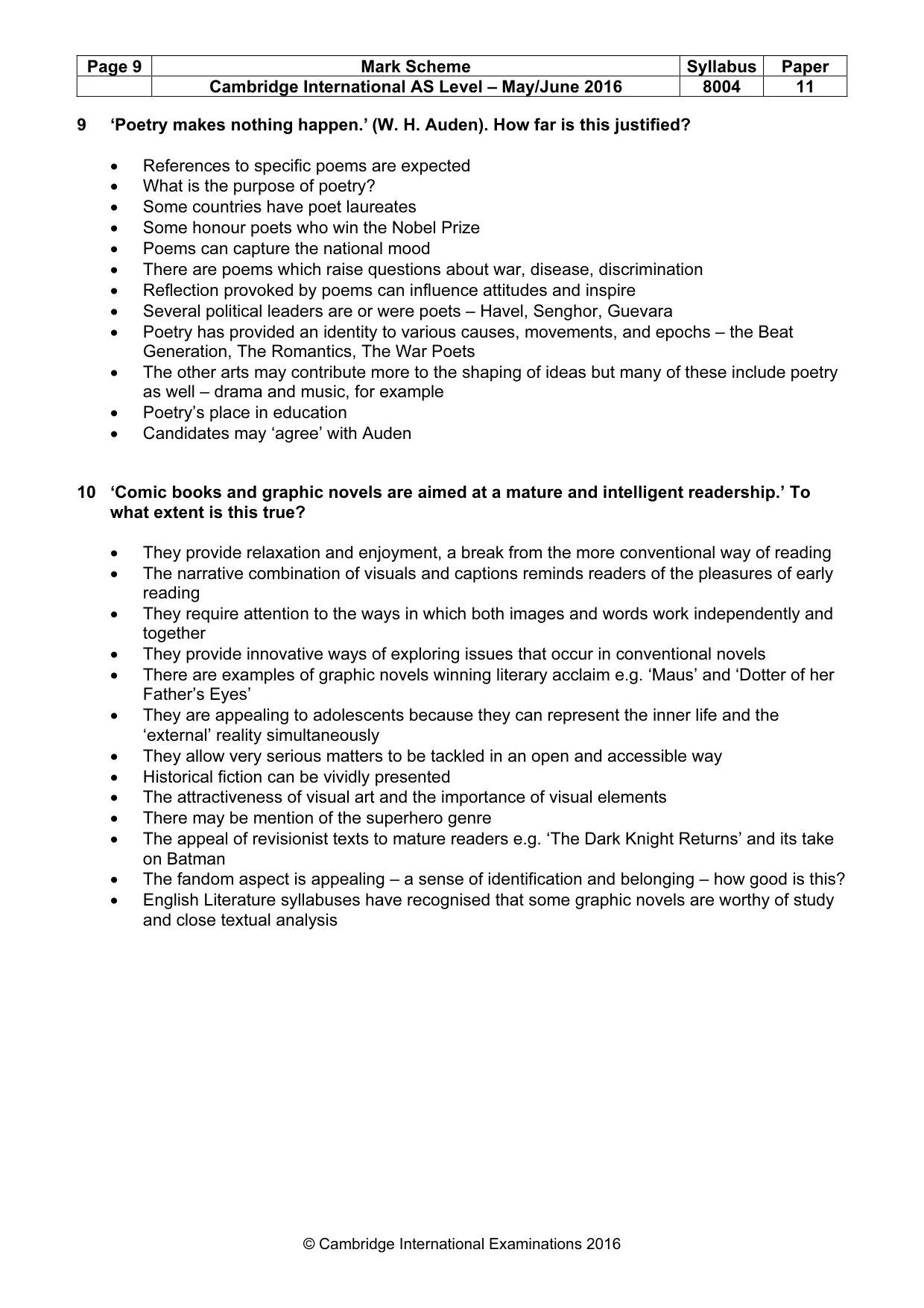
Page 9 Mark Scheme Syllabus Paper Cambridge International AS Level – May/June 2016 8004 11 © Cambridge International Examinations 2016 9 ‘Poetry makes nothing happen.’ (W. H. Auden). How far is this justified? • References to specific poems are expected • What is the purpose of poetry? • Some countries have poet laureates • Some honour poets who win the Nobel Prize • Poems can capture the national mood • There are poems which raise questions about war, disease, discrimination • Reflection provoked by poems can influence attitudes and inspire • Several political leaders are or were poets – Havel, Senghor, Guevara • Poetry has provided an identity to various causes, movements, and epochs – the Beat Generation, The Romantics, The War Poets • The other arts may contribute more to the shaping of ideas but many of these include poetry as well – drama and music, for example • Poetry’s place in education • Candidates may ‘agree’ with Auden 10 ‘Comic books and graphic novels are aimed at a mature and intelligent readership.’ To what extent is this true? • They provide relaxation and enjoyment, a break from the more conventional way of reading • The narrative combination of visuals and captions reminds readers of the pleasures of early reading • They require attention to the ways in which both images and words work independently and together • They provide innovative ways of exploring issues that occur in conventional novels • There are examples of graphic novels winning literary acclaim e.g. ‘Maus’ and ‘Dotter of her Father’s Eyes’ • They are appealing to adolescents because they can represent the inner life and the ‘external’ reality simultaneously • They allow very serious matters to be tackled in an open and accessible way • Historical fiction can be vividly presented • The attractiveness of visual art and the importance of visual elements • There may be mention of the superhero genre • The appeal of revisionist texts to mature readers e.g. ‘The Dark Knight Returns’ and its take on Batman • The fandom aspect is appealing – a sense of identification and belonging – how good is this? • English Literature syllabuses have recognised that some graphic novels are worthy of study and close textual analysis
Mark scheme, page 10
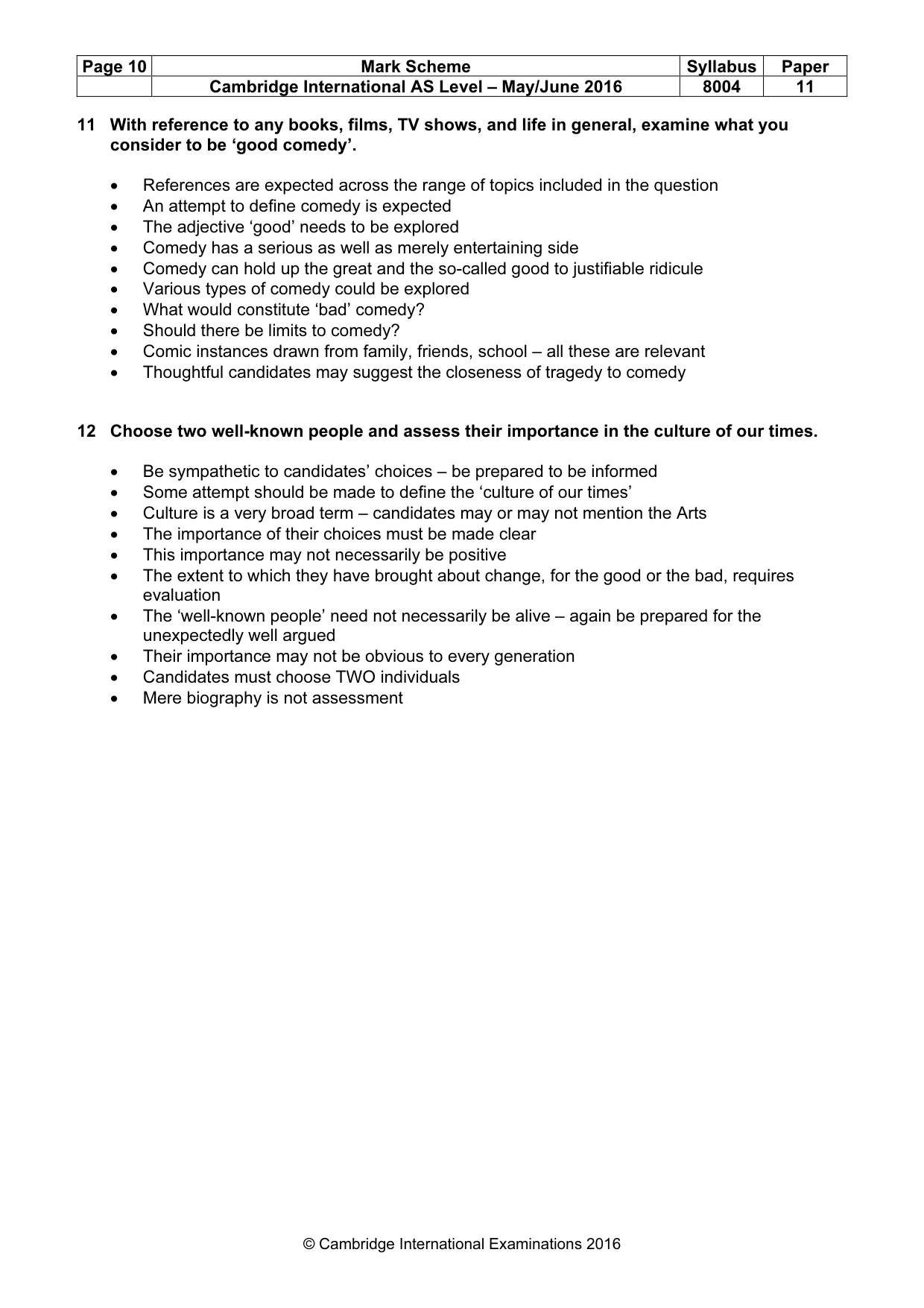
Page 10 Mark Scheme Syllabus Paper Cambridge International AS Level – May/June 2016 8004 11 © Cambridge International Examinations 2016 11 With reference to any books, films, TV shows, and life in general, examine what you consider to be ‘good comedy’. • References are expected across the range of topics included in the question • An attempt to define comedy is expected • The adjective ‘good’ needs to be explored • Comedy has a serious as well as merely entertaining side • Comedy can hold up the great and the so-called good to justifiable ridicule • Various types of comedy could be explored • What would constitute ‘bad’ comedy? • Should there be limits to comedy? • Comic instances drawn from family, friends, school – all these are relevant • Thoughtful candidates may suggest the closeness of tragedy to comedy 12 Choose two well-known people and assess their importance in the culture of our times. • Be sympathetic to candidates’ choices – be prepared to be informed • Some attempt should be made to define the ‘culture of our times’ • Culture is a very broad term – candidates may or may not mention the Arts • The importance of their choices must be made clear • This importance may not necessarily be positive • The extent to which they have brought about change, for the good or the bad, requires evaluation • The ‘well-known people’ need not necessarily be alive – again be prepared for the unexpectedly well argued • Their importance may not be obvious to every generation • Candidates must choose TWO individuals • Mere biography is not assessment
What you needed in this session
Cambridge’s own grade thresholds for 2016 May/June, Paper 1 · Variant 1. A higher threshold means an easier paper — the bar moves with how the cohort did.