Cambridge A Level General Paper (AS Level only) 8004 — 2015 May/June Paper 1 · Variant 1
8004/11/M/J/15 · 100 marks · ≈113 min
The question paper and its mark scheme, free to read here and free to download. This is Cambridge’s own paper, exactly as it was sat.
Question paper4 pages
Mark scheme8 pages
Answers below. Sit the paper first if you are practising.
Paper as text
Question paper, page 1
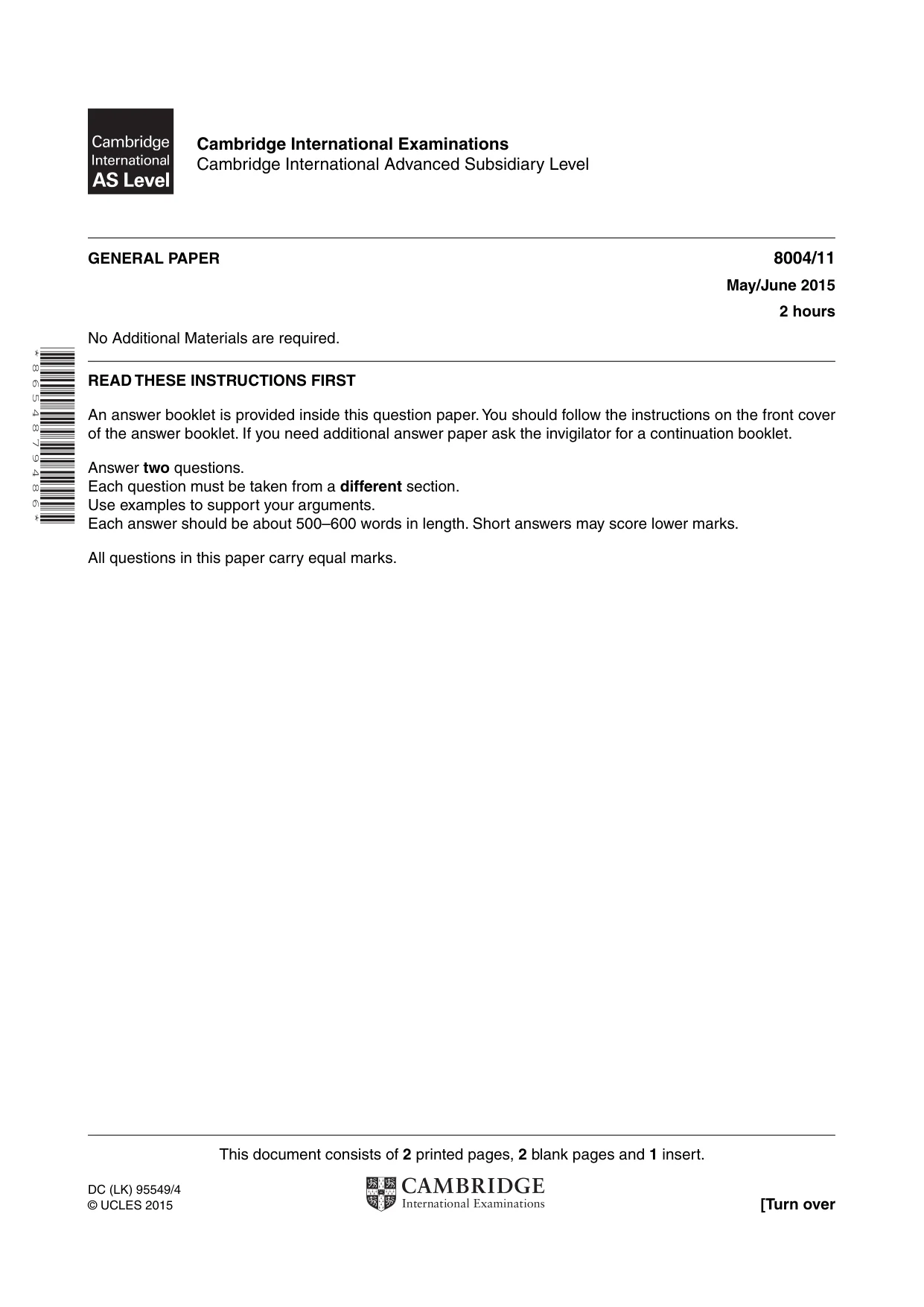
This document consists of 2 printed pages, 2 blank pages and 1 insert. DC (LK) 95549/4 © UCLES 2015 [Turn over * 8 6 5 4 8 7 9 4 8 6 * GENERAL PAPER 8004/11 May/June 2015 2 hours No Additional Materials are required. READ THESE INSTRUCTIONS FIRST An answer booklet is provided inside this question paper. You should follow the instructions on the front cover of the answer booklet. If you need additional answer paper ask the invigilator for a continuation booklet. Answer two questions. Each question must be taken from a different section. Use examples to support your arguments. Each answer should be about 500–600 words in length. Short answers may score lower marks. All questions in this paper carry equal marks. Cambridge International Examinations Cambridge International Advanced Subsidiary Level
Question paper, page 2
2 8004/11/M/J/15 © UCLES 2015 BLANK PAGE
Question paper, page 3
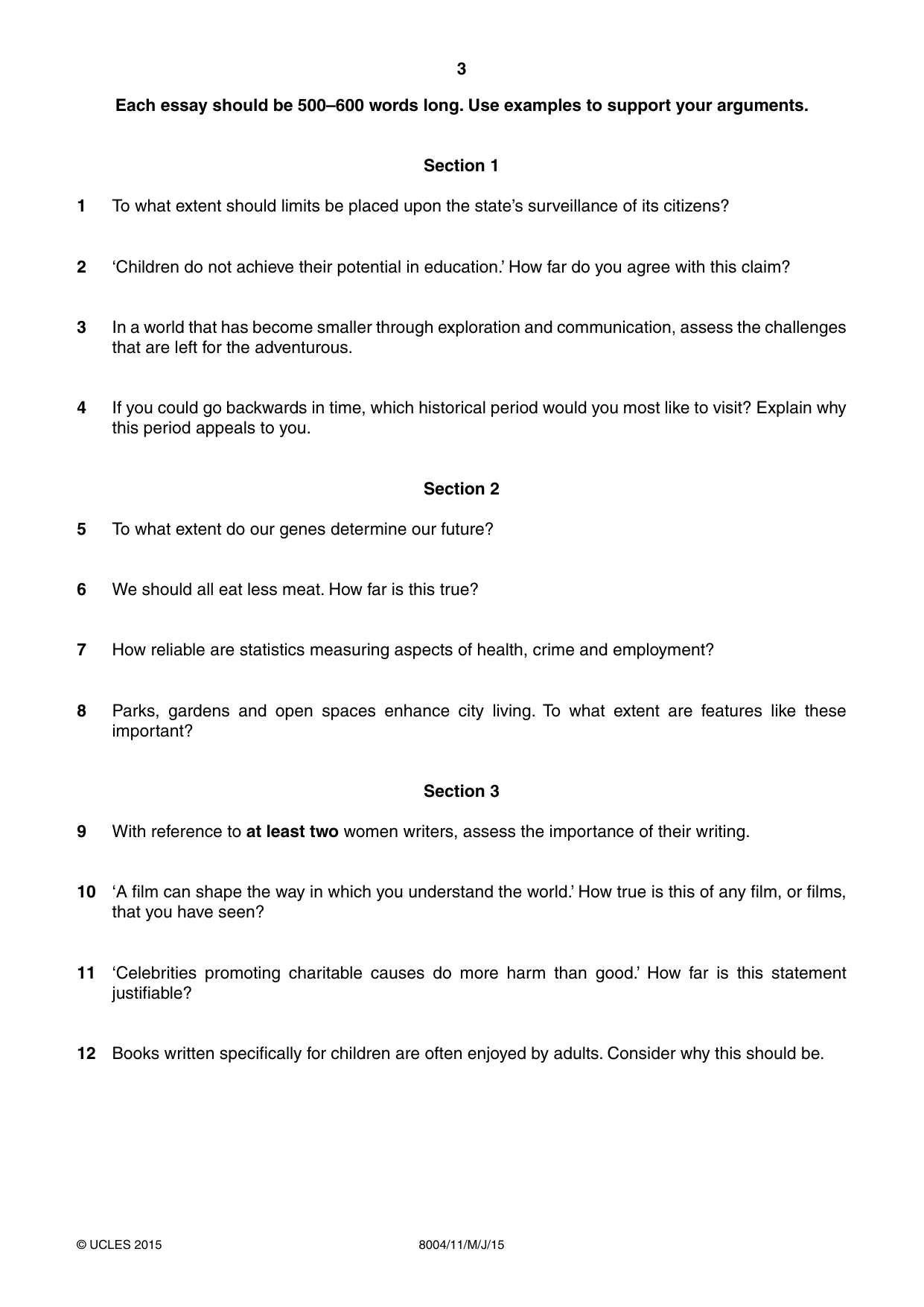
3 8004/11/M/J/15 © UCLES 2015 Each essay should be 500–600 words long. Use examples to support your arguments. Section 1 1 To what extent should limits be placed upon the state’s surveillance of its citizens? 2 ‘Children do not achieve their potential in education.’ How far do you agree with this claim? 3 In a world that has become smaller through exploration and communication, assess the challenges that are left for the adventurous. 4 If you could go backwards in time, which historical period would you most like to visit? Explain why this period appeals to you. Section 2 5 To what extent do our genes determine our future? 6 We should all eat less meat. How far is this true? 7 How reliable are statistics measuring aspects of health, crime and employment? 8 Parks, gardens and open spaces enhance city living. To what extent are features like these important? Section 3 9 With reference to at least two women writers, assess the importance of their writing. 10 ‘A film can shape the way in which you understand the world.’ How true is this of any film, or films, that you have seen? 11 ‘Celebrities promoting charitable causes do more harm than good.’ How far is this statement justifiable? 12 Books written specifically for children are often enjoyed by adults. Consider why this should be.
Question paper, page 4
4 8004/11/M/J/15 © UCLES 2015 BLANK PAGE Permission to reproduce items where third-party owned material protected by copyright is included has been sought and cleared where possible. Every reasonable effort has been made by the publisher (UCLES) to trace copyright holders, but if any items requiring clearance have unwittingly been included, the publisher will be pleased to make amends at the earliest possible opportunity. To avoid the issue of disclosure of answer-related information to candidates, all copyright acknowledgements are reproduced online in the Cambridge International Examinations Copyright Acknowledgements Booklet. This is produced for each series of examinations and is freely available to download at www.cie.org.uk after the live examination series. Cambridge International Examinations is part of the Cambridge Assessment Group. Cambridge Assessment is the brand name of University of Cambridge Local Examinations Syndicate (UCLES), which is itself a department of the University of Cambridge.
Mark scheme, page 1
® IGCSE is the registered trademark of Cambridge International Examinations. CAMBRIDGE INTERNATIONAL EXAMINATIONS Cambridge International Advanced Subsidiary Level MARK SCHEME for the May/June 2015 series 8004 GENERAL PAPER 8004/11 Paper 1 maximum raw mark 100 This mark scheme is published as an aid to teachers and candidates, to indicate the requirements of the examination. It shows the basis on which Examiners were instructed to award marks. It does not indicate the details of the discussions that took place at an Examiners’ meeting before marking began, which would have considered the acceptability of alternative answers. Mark schemes should be read in conjunction with the question paper and the Principal Examiner Report for Teachers. Cambridge will not enter into discussions about these mark schemes. Cambridge is publishing the mark schemes for the May/June 2015 series for most Cambridge IGCSE®, Cambridge International A and AS Level components and some Cambridge O Level components.
Mark scheme, page 2
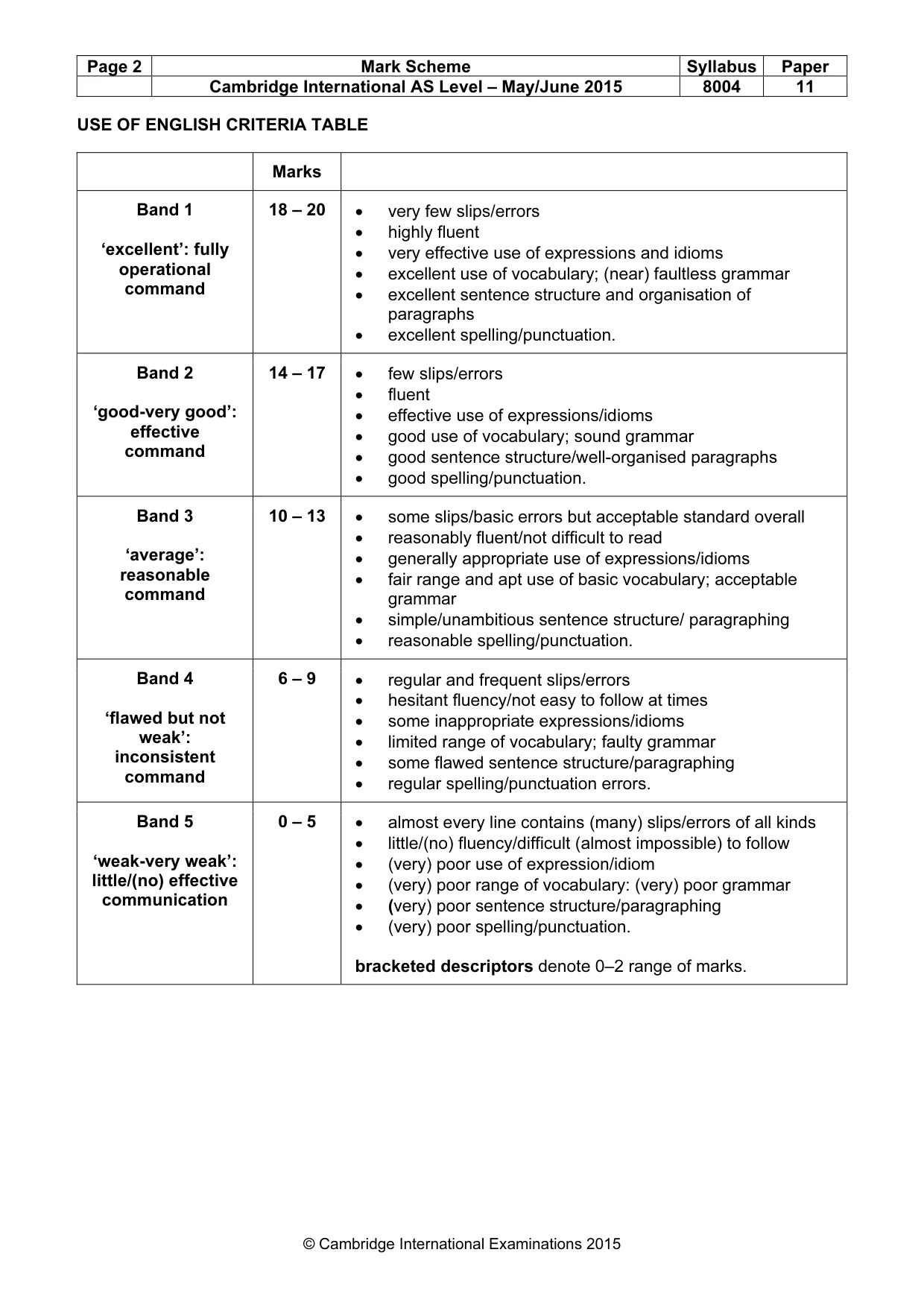
Page 2 Mark Scheme Syllabus Paper Cambridge International AS Level – May/June 2015 8004 11 © Cambridge International Examinations 2015 USE OF ENGLISH CRITERIA TABLE Marks Band 1 ‘excellent’: fully operational command 18 – 20 • very few slips/errors • highly fluent • very effective use of expressions and idioms • excellent use of vocabulary; (near) faultless grammar • excellent sentence structure and organisation of paragraphs • excellent spelling/punctuation. Band 2 ‘good-very good’: effective command 14 – 17 • few slips/errors • fluent • effective use of expressions/idioms • good use of vocabulary; sound grammar • good sentence structure/well-organised paragraphs • good spelling/punctuation. Band 3 ‘average’: reasonable command 10 – 13 • some slips/basic errors but acceptable standard overall • reasonably fluent/not difficult to read • generally appropriate use of expressions/idioms • fair range and apt use of basic vocabulary; acceptable grammar • simple/unambitious sentence structure/ paragraphing • reasonable spelling/punctuation. Band 4 ‘flawed but not weak’: inconsistent command 6 – 9 • regular and frequent slips/errors • hesitant fluency/not easy to follow at times • some inappropriate expressions/idioms • limited range of vocabulary; faulty grammar • some flawed sentence structure/paragraphing • regular spelling/punctuation errors. Band 5 ‘weak-very weak’: little/(no) effective communication 0 – 5 • almost every line contains (many) slips/errors of all kinds • little/(no) fluency/difficult (almost impossible) to follow • (very) poor use of expression/idiom • (very) poor range of vocabulary: (very) poor grammar • (very) poor sentence structure/paragraphing • (very) poor spelling/punctuation. bracketed descriptors denote 0–2 range of marks.
Mark scheme, page 3
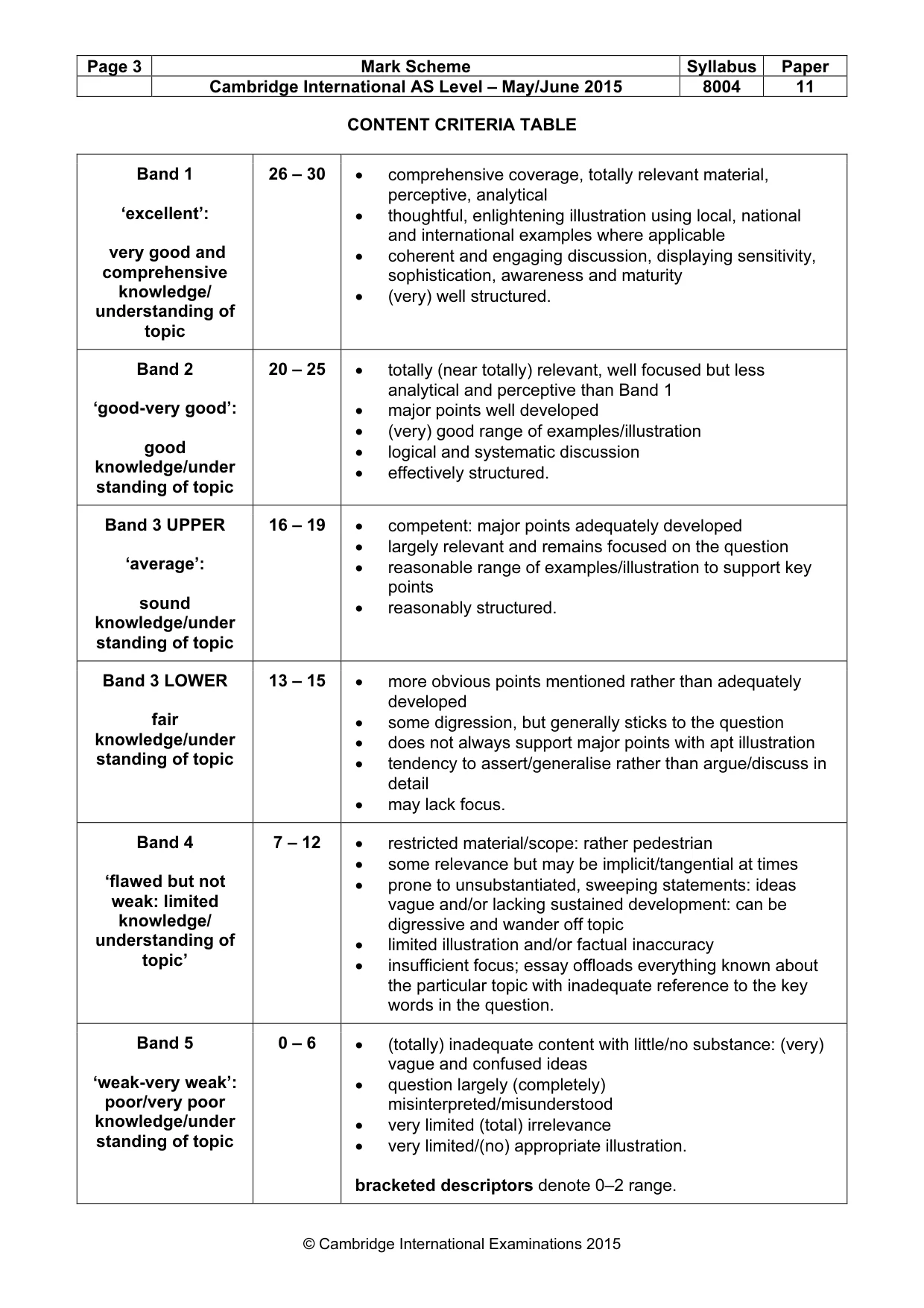
Page 3 Mark Scheme Syllabus Paper Cambridge International AS Level – May/June 2015 8004 11 © Cambridge International Examinations 2015 CONTENT CRITERIA TABLE Band 1 ‘excellent’: very good and comprehensive knowledge/ understanding of topic 26 – 30 • comprehensive coverage, totally relevant material, perceptive, analytical • thoughtful, enlightening illustration using local, national and international examples where applicable • coherent and engaging discussion, displaying sensitivity, sophistication, awareness and maturity • (very) well structured. Band 2 ‘good-very good’: good knowledge/under standing of topic 20 – 25 • totally (near totally) relevant, well focused but less analytical and perceptive than Band 1 • major points well developed • (very) good range of examples/illustration • logical and systematic discussion • effectively structured. Band 3 UPPER ‘average’: sound knowledge/under standing of topic 16 – 19 • competent: major points adequately developed • largely relevant and remains focused on the question • reasonable range of examples/illustration to support key points • reasonably structured. Band 3 LOWER fair knowledge/under standing of topic 13 – 15 • more obvious points mentioned rather than adequately developed • some digression, but generally sticks to the question • does not always support major points with apt illustration • tendency to assert/generalise rather than argue/discuss in detail • may lack focus. Band 4 ‘flawed but not weak: limited knowledge/ understanding of topic’ 7 – 12 • restricted material/scope: rather pedestrian • some relevance but may be implicit/tangential at times • prone to unsubstantiated, sweeping statements: ideas vague and/or lacking sustained development: can be digressive and wander off topic • limited illustration and/or factual inaccuracy • insufficient focus; essay offloads everything known about the particular topic with inadequate reference to the key words in the question. Band 5 ‘weak-very weak’: poor/very poor knowledge/under standing of topic 0 – 6 • (totally) inadequate content with little/no substance: (very) vague and confused ideas • question largely (completely) misinterpreted/misunderstood • very limited (total) irrelevance • very limited/(no) appropriate illustration. bracketed descriptors denote 0–2 range.
Mark scheme, page 4
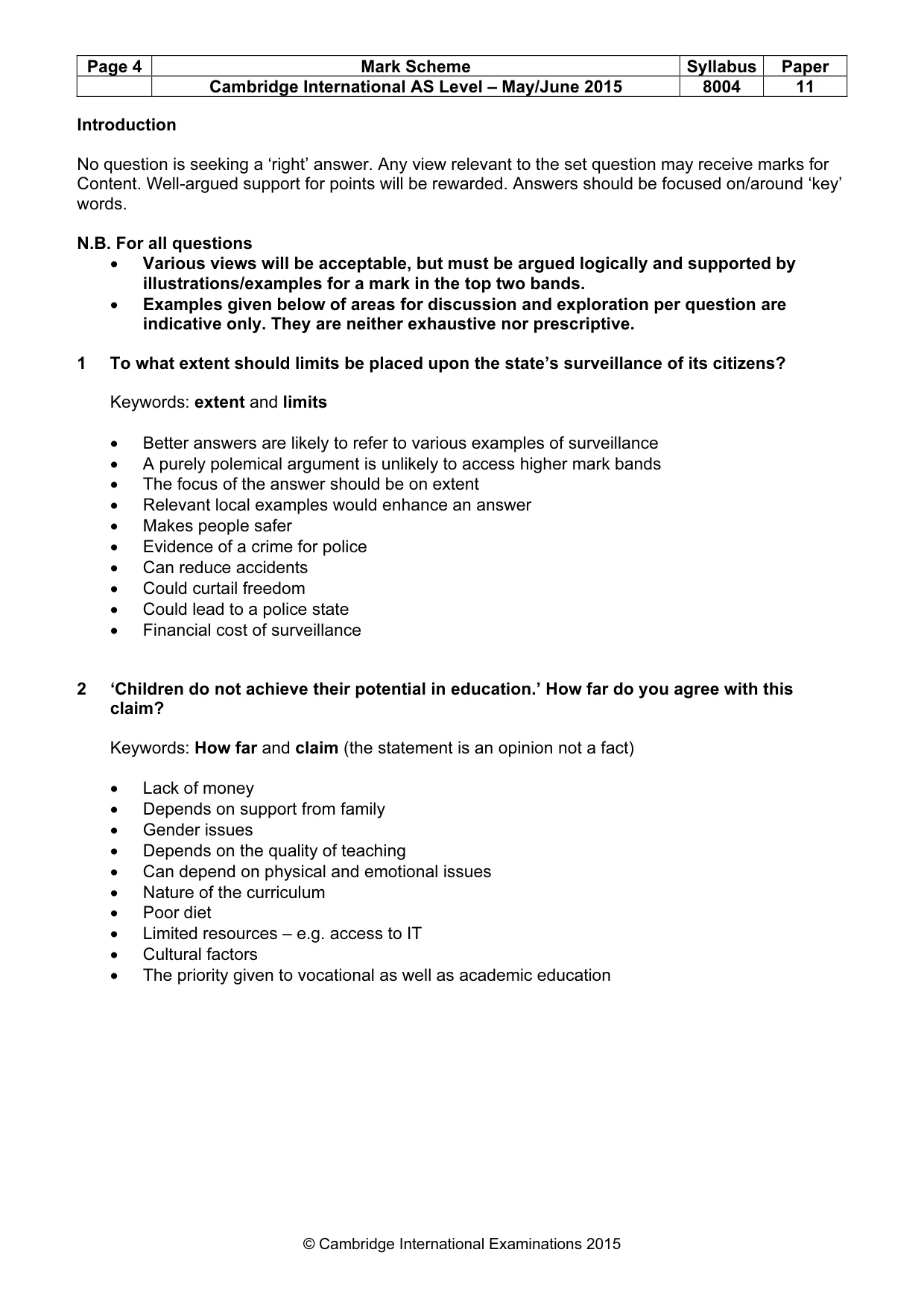
Page 4 Mark Scheme Syllabus Paper Cambridge International AS Level – May/June 2015 8004 11 © Cambridge International Examinations 2015 Introduction No question is seeking a ‘right’ answer. Any view relevant to the set question may receive marks for Content. Well-argued support for points will be rewarded. Answers should be focused on/around ‘key’ words. N.B. For all questions • Various views will be acceptable, but must be argued logically and supported by illustrations/examples for a mark in the top two bands. • Examples given below of areas for discussion and exploration per question are indicative only. They are neither exhaustive nor prescriptive. 1 To what extent should limits be placed upon the state’s surveillance of its citizens? Keywords: extent and limits • Better answers are likely to refer to various examples of surveillance • A purely polemical argument is unlikely to access higher mark bands • The focus of the answer should be on extent • Relevant local examples would enhance an answer • Makes people safer • Evidence of a crime for police • Can reduce accidents • Could curtail freedom • Could lead to a police state • Financial cost of surveillance 2 ‘Children do not achieve their potential in education.’ How far do you agree with this claim? Keywords: How far and claim (the statement is an opinion not a fact) • Lack of money • Depends on support from family • Gender issues • Depends on the quality of teaching • Can depend on physical and emotional issues • Nature of the curriculum • Poor diet • Limited resources – e.g. access to IT • Cultural factors • The priority given to vocational as well as academic education
Mark scheme, page 5
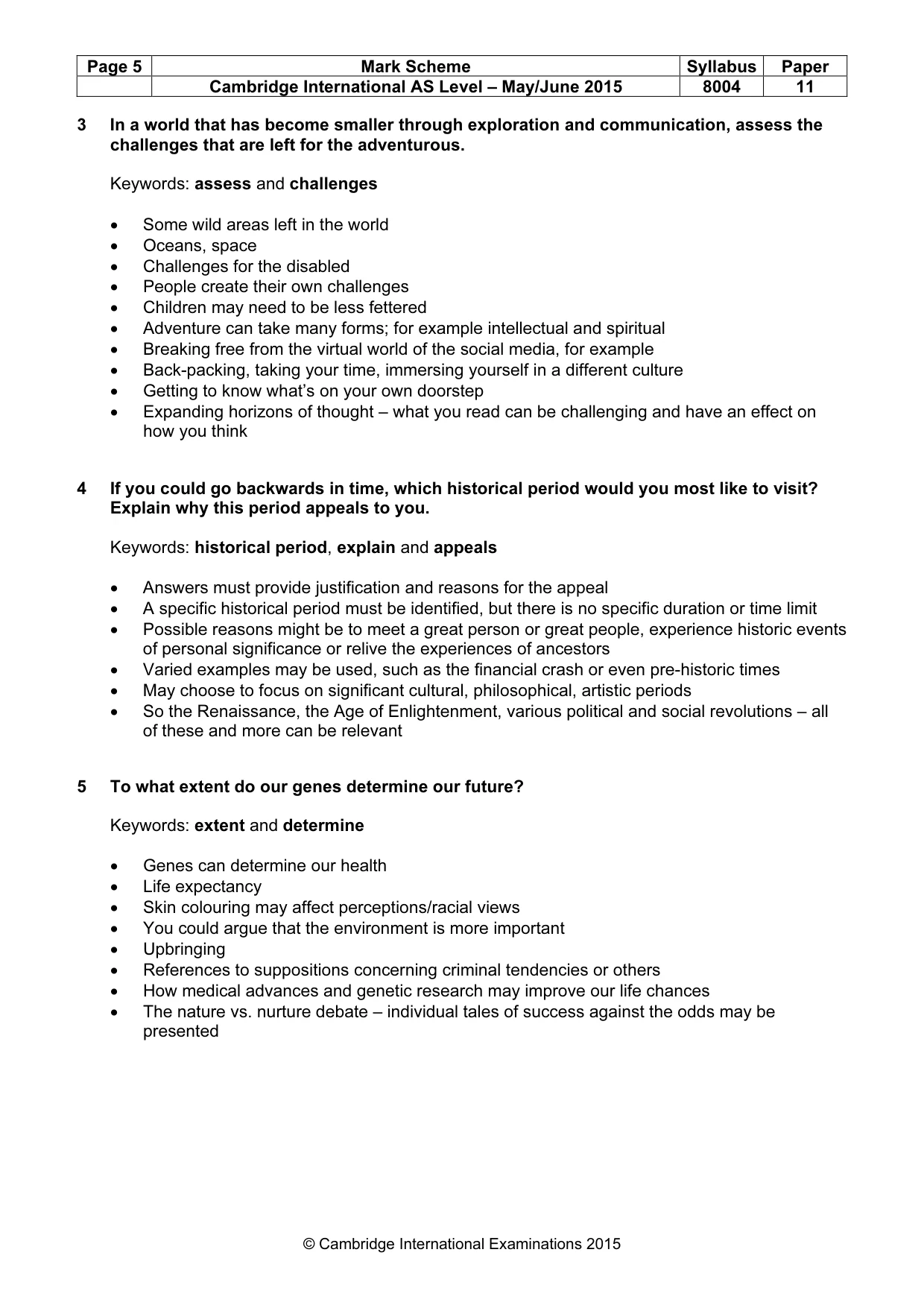
Page 5 Mark Scheme Syllabus Paper Cambridge International AS Level – May/June 2015 8004 11 © Cambridge International Examinations 2015 3 In a world that has become smaller through exploration and communication, assess the challenges that are left for the adventurous. Keywords: assess and challenges • Some wild areas left in the world • Oceans, space • Challenges for the disabled • People create their own challenges • Children may need to be less fettered • Adventure can take many forms; for example intellectual and spiritual • Breaking free from the virtual world of the social media, for example • Back-packing, taking your time, immersing yourself in a different culture • Getting to know what’s on your own doorstep • Expanding horizons of thought – what you read can be challenging and have an effect on how you think 4 If you could go backwards in time, which historical period would you most like to visit? Explain why this period appeals to you. Keywords: historical period, explain and appeals • Answers must provide justification and reasons for the appeal • A specific historical period must be identified, but there is no specific duration or time limit • Possible reasons might be to meet a great person or great people, experience historic events of personal significance or relive the experiences of ancestors • Varied examples may be used, such as the financial crash or even pre-historic times • May choose to focus on significant cultural, philosophical, artistic periods • So the Renaissance, the Age of Enlightenment, various political and social revolutions – all of these and more can be relevant 5 To what extent do our genes determine our future? Keywords: extent and determine • Genes can determine our health • Life expectancy • Skin colouring may affect perceptions/racial views • You could argue that the environment is more important • Upbringing • References to suppositions concerning criminal tendencies or others • How medical advances and genetic research may improve our life chances • The nature vs. nurture debate – individual tales of success against the odds may be presented
Mark scheme, page 6
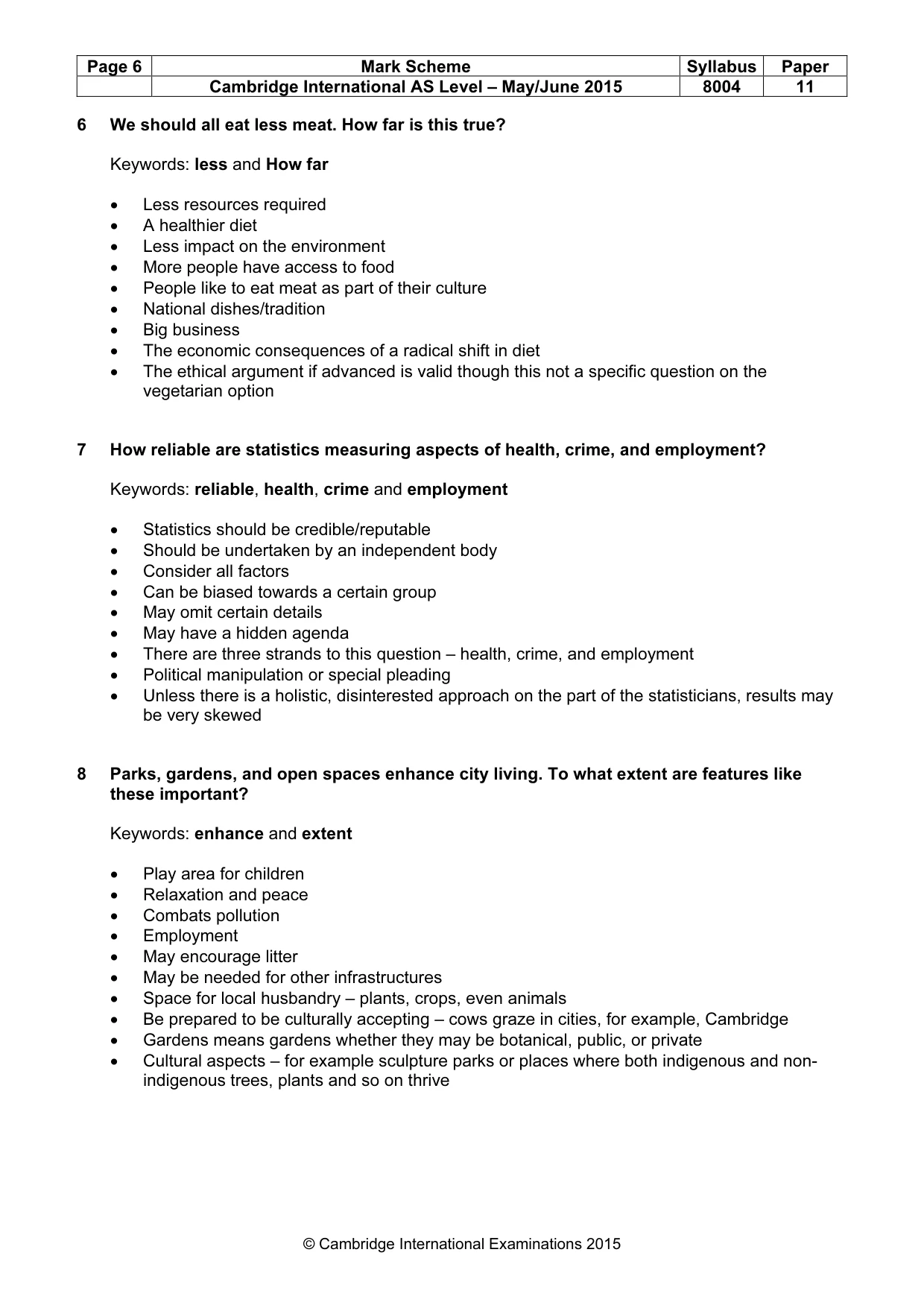
Page 6 Mark Scheme Syllabus Paper Cambridge International AS Level – May/June 2015 8004 11 © Cambridge International Examinations 2015 6 We should all eat less meat. How far is this true? Keywords: less and How far • Less resources required • A healthier diet • Less impact on the environment • More people have access to food • People like to eat meat as part of their culture • National dishes/tradition • Big business • The economic consequences of a radical shift in diet • The ethical argument if advanced is valid though this not a specific question on the vegetarian option 7 How reliable are statistics measuring aspects of health, crime, and employment? Keywords: reliable, health, crime and employment • Statistics should be credible/reputable • Should be undertaken by an independent body • Consider all factors • Can be biased towards a certain group • May omit certain details • May have a hidden agenda • There are three strands to this question – health, crime, and employment • Political manipulation or special pleading • Unless there is a holistic, disinterested approach on the part of the statisticians, results may be very skewed 8 Parks, gardens, and open spaces enhance city living. To what extent are features like these important? Keywords: enhance and extent • Play area for children • Relaxation and peace • Combats pollution • Employment • May encourage litter • May be needed for other infrastructures • Space for local husbandry – plants, crops, even animals • Be prepared to be culturally accepting – cows graze in cities, for example, Cambridge • Gardens means gardens whether they may be botanical, public, or private • Cultural aspects – for example sculpture parks or places where both indigenous and non- indigenous trees, plants and so on thrive
Mark scheme, page 7
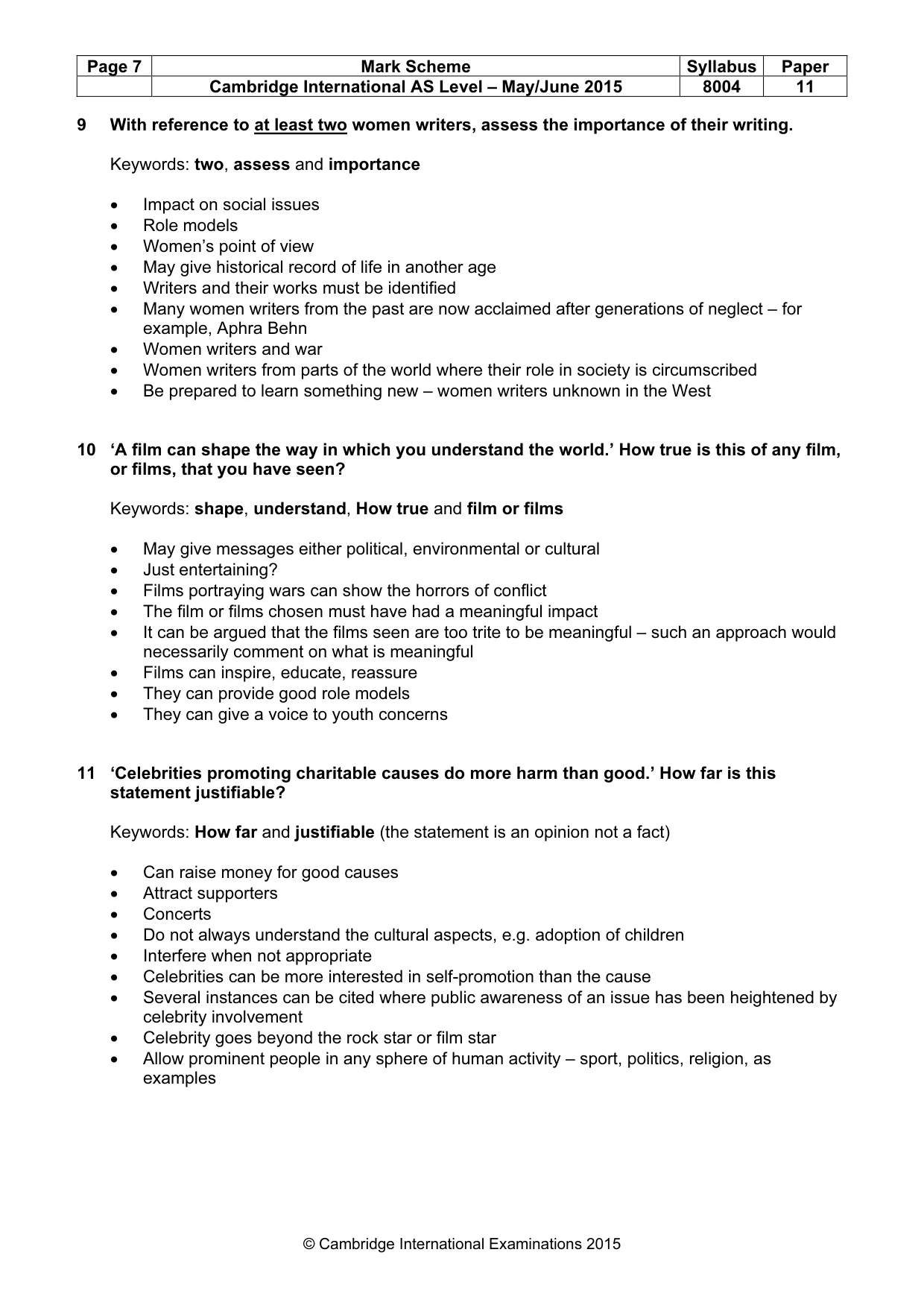
Page 7 Mark Scheme Syllabus Paper Cambridge International AS Level – May/June 2015 8004 11 © Cambridge International Examinations 2015 9 With reference to at least two women writers, assess the importance of their writing. Keywords: two, assess and importance • Impact on social issues • Role models • Women’s point of view • May give historical record of life in another age • Writers and their works must be identified • Many women writers from the past are now acclaimed after generations of neglect – for example, Aphra Behn • Women writers and war • Women writers from parts of the world where their role in society is circumscribed • Be prepared to learn something new – women writers unknown in the West 10 ‘A film can shape the way in which you understand the world.’ How true is this of any film, or films, that you have seen? Keywords: shape, understand, How true and film or films • May give messages either political, environmental or cultural • Just entertaining? • Films portraying wars can show the horrors of conflict • The film or films chosen must have had a meaningful impact • It can be argued that the films seen are too trite to be meaningful – such an approach would necessarily comment on what is meaningful • Films can inspire, educate, reassure • They can provide good role models • They can give a voice to youth concerns 11 ‘Celebrities promoting charitable causes do more harm than good.’ How far is this statement justifiable? Keywords: How far and justifiable (the statement is an opinion not a fact) • Can raise money for good causes • Attract supporters • Concerts • Do not always understand the cultural aspects, e.g. adoption of children • Interfere when not appropriate • Celebrities can be more interested in self-promotion than the cause • Several instances can be cited where public awareness of an issue has been heightened by celebrity involvement • Celebrity goes beyond the rock star or film star • Allow prominent people in any sphere of human activity – sport, politics, religion, as examples
Mark scheme, page 8
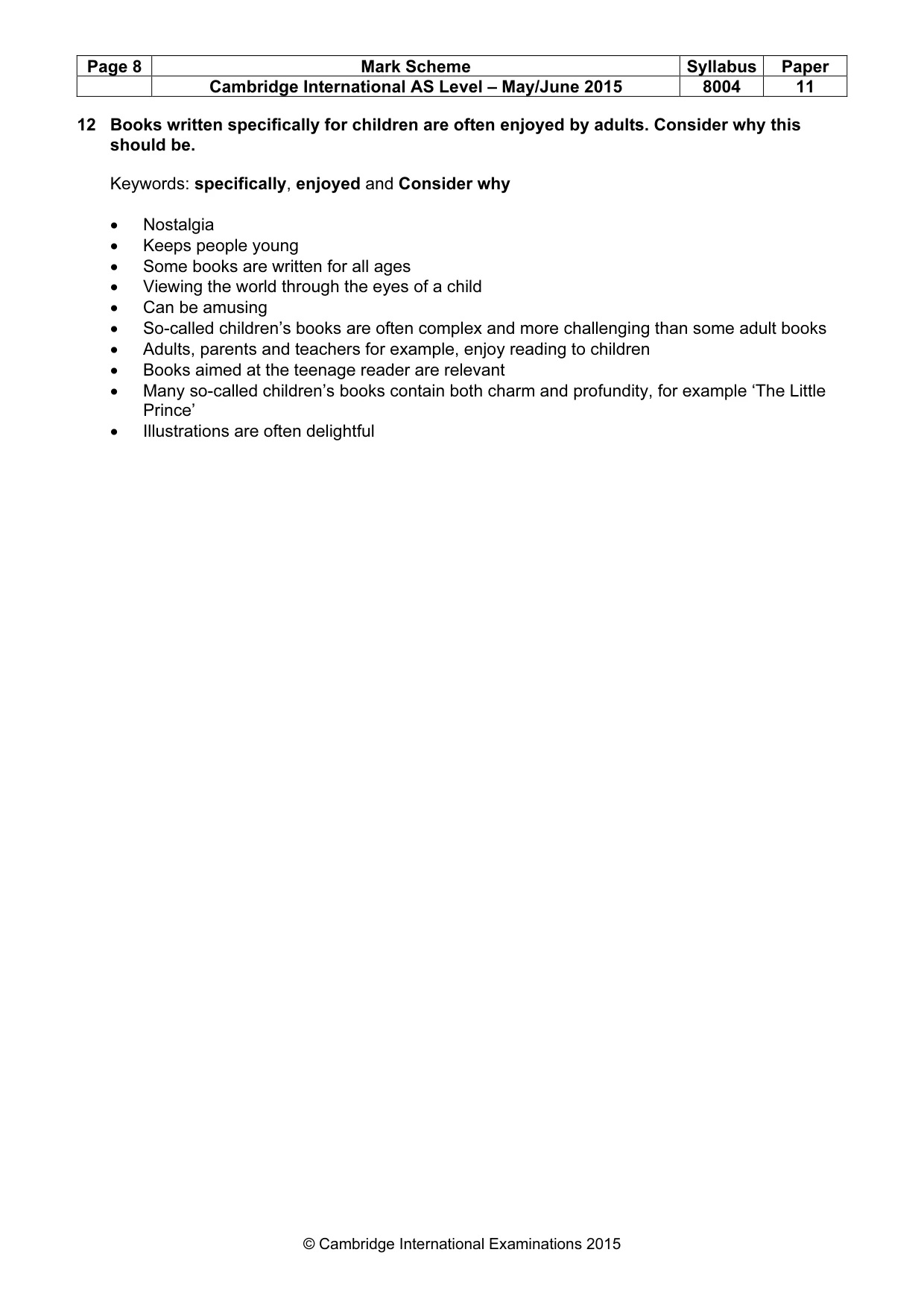
Page 8 Mark Scheme Syllabus Paper Cambridge International AS Level – May/June 2015 8004 11 © Cambridge International Examinations 2015 12 Books written specifically for children are often enjoyed by adults. Consider why this should be. Keywords: specifically, enjoyed and Consider why • Nostalgia • Keeps people young • Some books are written for all ages • Viewing the world through the eyes of a child • Can be amusing • So-called children’s books are often complex and more challenging than some adult books • Adults, parents and teachers for example, enjoy reading to children • Books aimed at the teenage reader are relevant • Many so-called children’s books contain both charm and profundity, for example ‘The Little Prince’ • Illustrations are often delightful
What you needed in this session
Cambridge’s own grade thresholds for 2015 May/June, Paper 1 · Variant 1. A higher threshold means an easier paper — the bar moves with how the cohort did.