Cambridge A Level General Paper (AS Level only) 8004 — 2015 May/June Paper 1 · Variant 2
8004/12/M/J/15 · 100 marks · ≈113 min
The question paper and its mark scheme, free to read here and free to download. This is Cambridge’s own paper, exactly as it was sat.
Question paper4 pages

Mark scheme8 pages
Answers below. Sit the paper first if you are practising.
Paper as text
Question paper, page 1
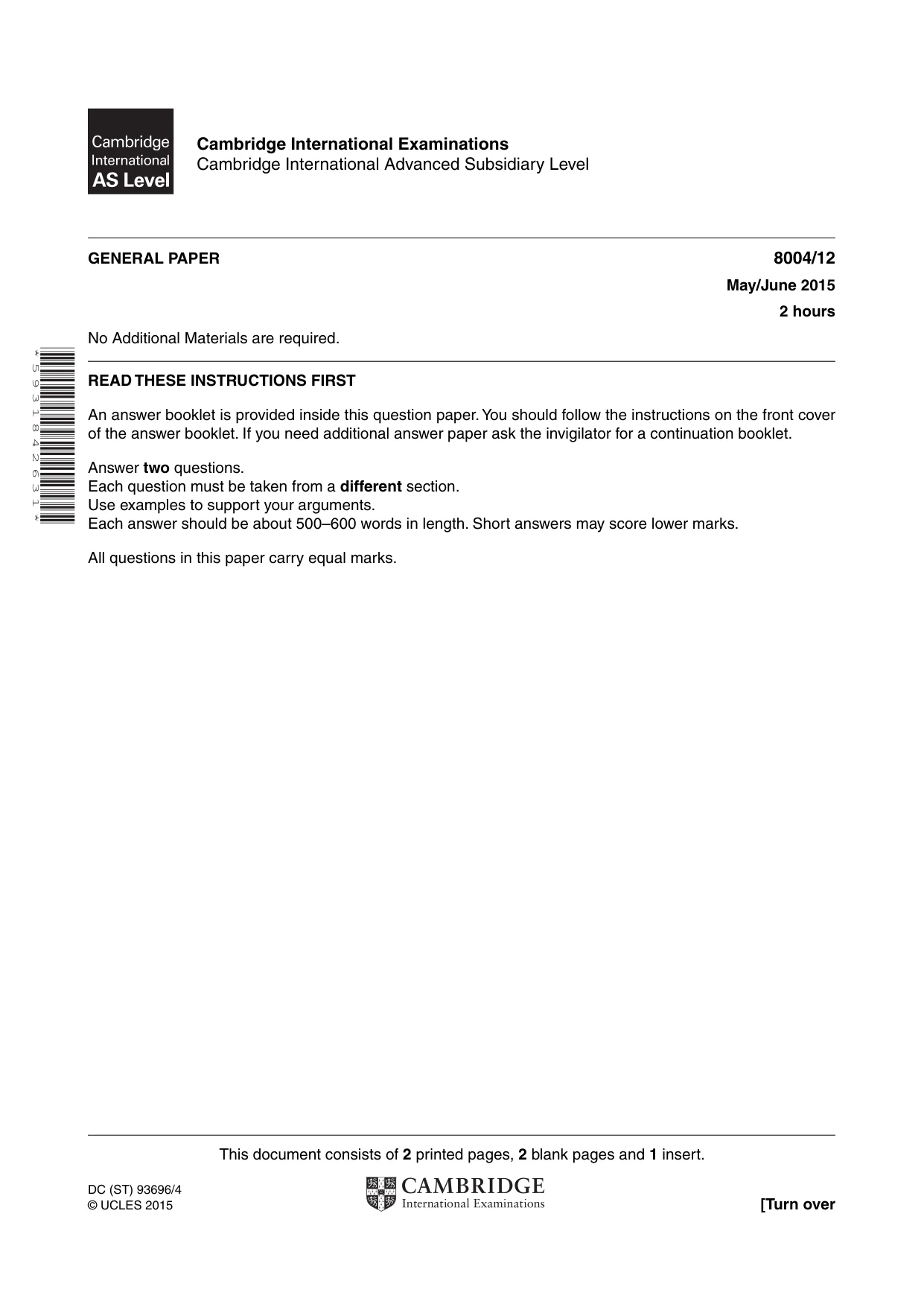
This document consists of 2 printed pages, 2 blank pages and 1 insert. DC (ST) 93696/4 © UCLES 2015 [Turn over Cambridge International Examinations Cambridge International Advanced Subsidiary Level * 5 9 3 1 8 4 2 6 3 1 * GENERAL PAPER 8004/12 May/June 2015 2 hours No Additional Materials are required. READ THESE INSTRUCTIONS FIRST An answer booklet is provided inside this question paper. You should follow the instructions on the front cover of the answer booklet. If you need additional answer paper ask the invigilator for a continuation booklet. Answer two questions. Each question must be taken from a different section. Use examples to support your arguments. Each answer should be about 500–600 words in length. Short answers may score lower marks. All questions in this paper carry equal marks.
Question paper, page 2
2 8004/12/M/J/15 © UCLES 2015 BLANK PAGE
Question paper, page 3
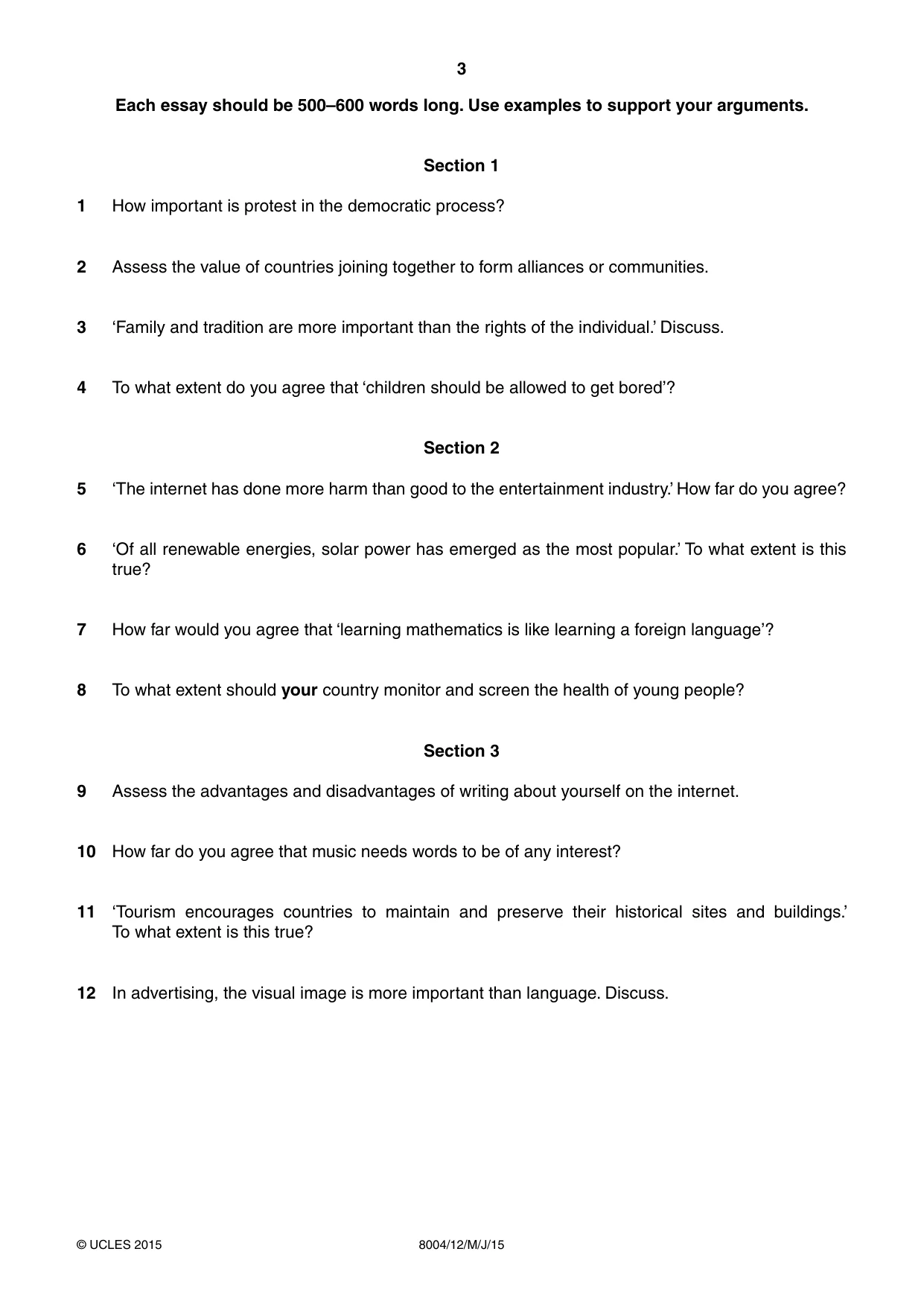
3 8004/12/M/J/15 © UCLES 2015 Each essay should be 500–600 words long. Use examples to support your arguments. Section 1 1 How important is protest in the democratic process? 2 Assess the value of countries joining together to form alliances or communities. 3 ‘Family and tradition are more important than the rights of the individual.’ Discuss. 4 To what extent do you agree that ‘children should be allowed to get bored’? Section 2 5 ‘The internet has done more harm than good to the entertainment industry.’ How far do you agree? 6 ‘Of all renewable energies, solar power has emerged as the most popular.’ To what extent is this true? 7 How far would you agree that ‘learning mathematics is like learning a foreign language’? 8 To what extent should your country monitor and screen the health of young people? Section 3 9 Assess the advantages and disadvantages of writing about yourself on the internet. 10 How far do you agree that music needs words to be of any interest? 11 ‘Tourism encourages countries to maintain and preserve their historical sites and buildings.’ To what extent is this true? 12 In advertising, the visual image is more important than language. Discuss.
Question paper, page 4
4 8004/12/M/J/15 © UCLES 2015 BLANK PAGE Permission to reproduce items where third-party owned material protected by copyright is included has been sought and cleared where possible. Every reasonable effort has been made by the publisher (UCLES) to trace copyright holders, but if any items requiring clearance have unwittingly been included, the publisher will be pleased to make amends at the earliest possible opportunity. To avoid the issue of disclosure of answer-related information to candidates, all copyright acknowledgements are reproduced online in the Cambridge International Examinations Copyright Acknowledgements Booklet. This is produced for each series of examinations and is freely available to download at www.cie.org.uk after the live examination series. Cambridge International Examinations is part of the Cambridge Assessment Group. Cambridge Assessment is the brand name of University of Cambridge Local Examinations Syndicate (UCLES), which is itself a department of the University of Cambridge.
Mark scheme, page 1
® IGCSE is the registered trademark of Cambridge International Examinations. CAMBRIDGE INTERNATIONAL EXAMINATIONS Cambridge International Advanced Subsidiary Level MARK SCHEME for the May/June 2015 series 8004 GENERAL PAPER 8004/12 Paper 1, maximum raw mark 100 This mark scheme is published as an aid to teachers and candidates, to indicate the requirements of the examination. It shows the basis on which Examiners were instructed to award marks. It does not indicate the details of the discussions that took place at an Examiners’ meeting before marking began, which would have considered the acceptability of alternative answers. Mark schemes should be read in conjunction with the question paper and the Principal Examiner Report for Teachers. Cambridge will not enter into discussions about these mark schemes. Cambridge is publishing the mark schemes for the May/June 2015 series for most Cambridge IGCSE®, Cambridge International A and AS Level components and some Cambridge O Level components.
Mark scheme, page 2
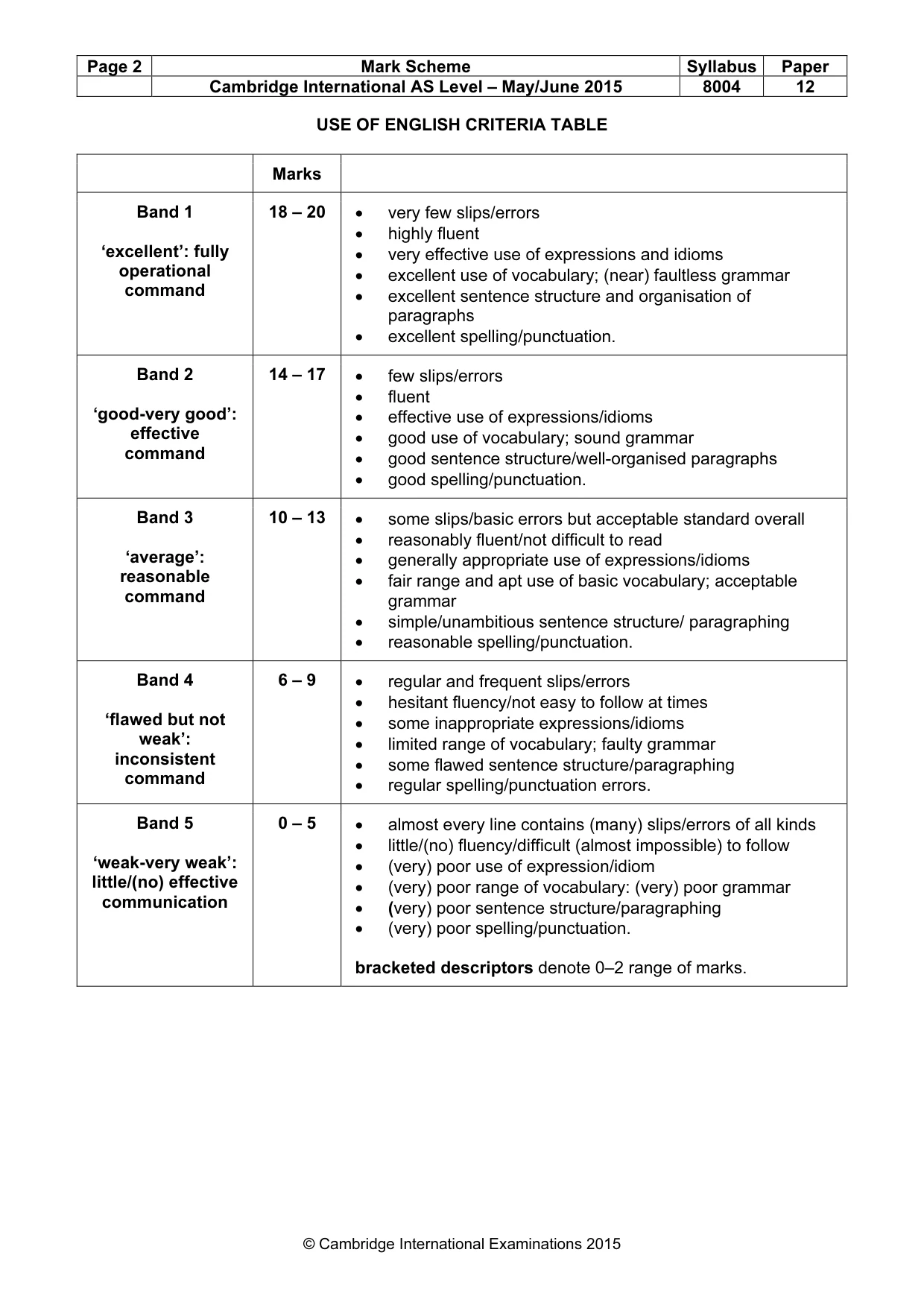
Page 2 Mark Scheme Syllabus Paper Cambridge International AS Level – May/June 2015 8004 12 © Cambridge International Examinations 2015 USE OF ENGLISH CRITERIA TABLE Marks Band 1 ‘excellent’: fully operational command 18 – 20 • very few slips/errors • highly fluent • very effective use of expressions and idioms • excellent use of vocabulary; (near) faultless grammar • excellent sentence structure and organisation of paragraphs • excellent spelling/punctuation. Band 2 ‘good-very good’: effective command 14 – 17 • few slips/errors • fluent • effective use of expressions/idioms • good use of vocabulary; sound grammar • good sentence structure/well-organised paragraphs • good spelling/punctuation. Band 3 ‘average’: reasonable command 10 – 13 • some slips/basic errors but acceptable standard overall • reasonably fluent/not difficult to read • generally appropriate use of expressions/idioms • fair range and apt use of basic vocabulary; acceptable grammar • simple/unambitious sentence structure/ paragraphing • reasonable spelling/punctuation. Band 4 ‘flawed but not weak’: inconsistent command 6 – 9 • regular and frequent slips/errors • hesitant fluency/not easy to follow at times • some inappropriate expressions/idioms • limited range of vocabulary; faulty grammar • some flawed sentence structure/paragraphing • regular spelling/punctuation errors. Band 5 ‘weak-very weak’: little/(no) effective communication 0 – 5 • almost every line contains (many) slips/errors of all kinds • little/(no) fluency/difficult (almost impossible) to follow • (very) poor use of expression/idiom • (very) poor range of vocabulary: (very) poor grammar • (very) poor sentence structure/paragraphing • (very) poor spelling/punctuation. bracketed descriptors denote 0–2 range of marks.
Mark scheme, page 3
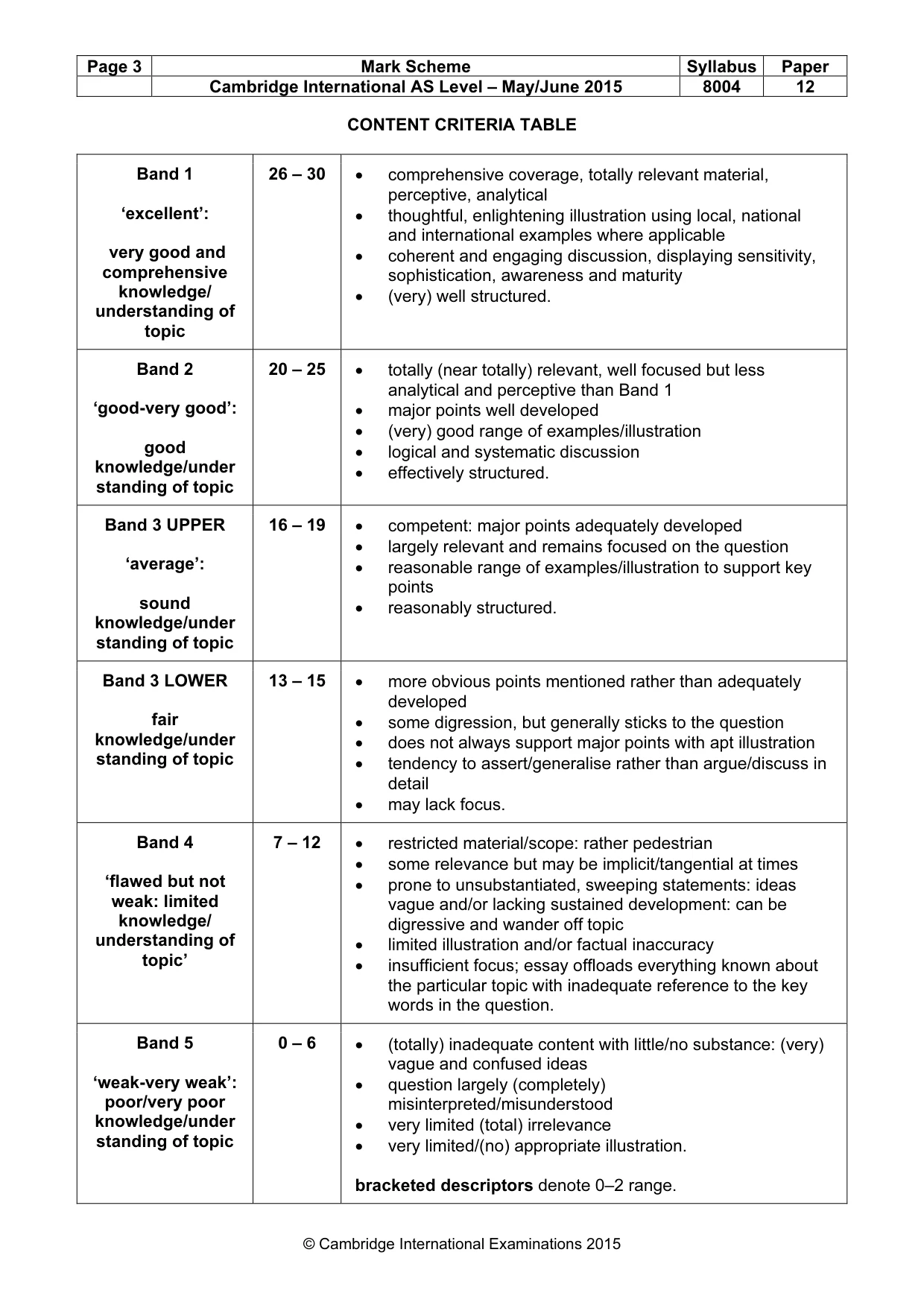
Page 3 Mark Scheme Syllabus Paper Cambridge International AS Level – May/June 2015 8004 12 © Cambridge International Examinations 2015 CONTENT CRITERIA TABLE Band 1 ‘excellent’: very good and comprehensive knowledge/ understanding of topic 26 – 30 • comprehensive coverage, totally relevant material, perceptive, analytical • thoughtful, enlightening illustration using local, national and international examples where applicable • coherent and engaging discussion, displaying sensitivity, sophistication, awareness and maturity • (very) well structured. Band 2 ‘good-very good’: good knowledge/under standing of topic 20 – 25 • totally (near totally) relevant, well focused but less analytical and perceptive than Band 1 • major points well developed • (very) good range of examples/illustration • logical and systematic discussion • effectively structured. Band 3 UPPER ‘average’: sound knowledge/under standing of topic 16 – 19 • competent: major points adequately developed • largely relevant and remains focused on the question • reasonable range of examples/illustration to support key points • reasonably structured. Band 3 LOWER fair knowledge/under standing of topic 13 – 15 • more obvious points mentioned rather than adequately developed • some digression, but generally sticks to the question • does not always support major points with apt illustration • tendency to assert/generalise rather than argue/discuss in detail • may lack focus. Band 4 ‘flawed but not weak: limited knowledge/ understanding of topic’ 7 – 12 • restricted material/scope: rather pedestrian • some relevance but may be implicit/tangential at times • prone to unsubstantiated, sweeping statements: ideas vague and/or lacking sustained development: can be digressive and wander off topic • limited illustration and/or factual inaccuracy • insufficient focus; essay offloads everything known about the particular topic with inadequate reference to the key words in the question. Band 5 ‘weak-very weak’: poor/very poor knowledge/under standing of topic 0 – 6 • (totally) inadequate content with little/no substance: (very) vague and confused ideas • question largely (completely) misinterpreted/misunderstood • very limited (total) irrelevance • very limited/(no) appropriate illustration. bracketed descriptors denote 0–2 range.
Mark scheme, page 4
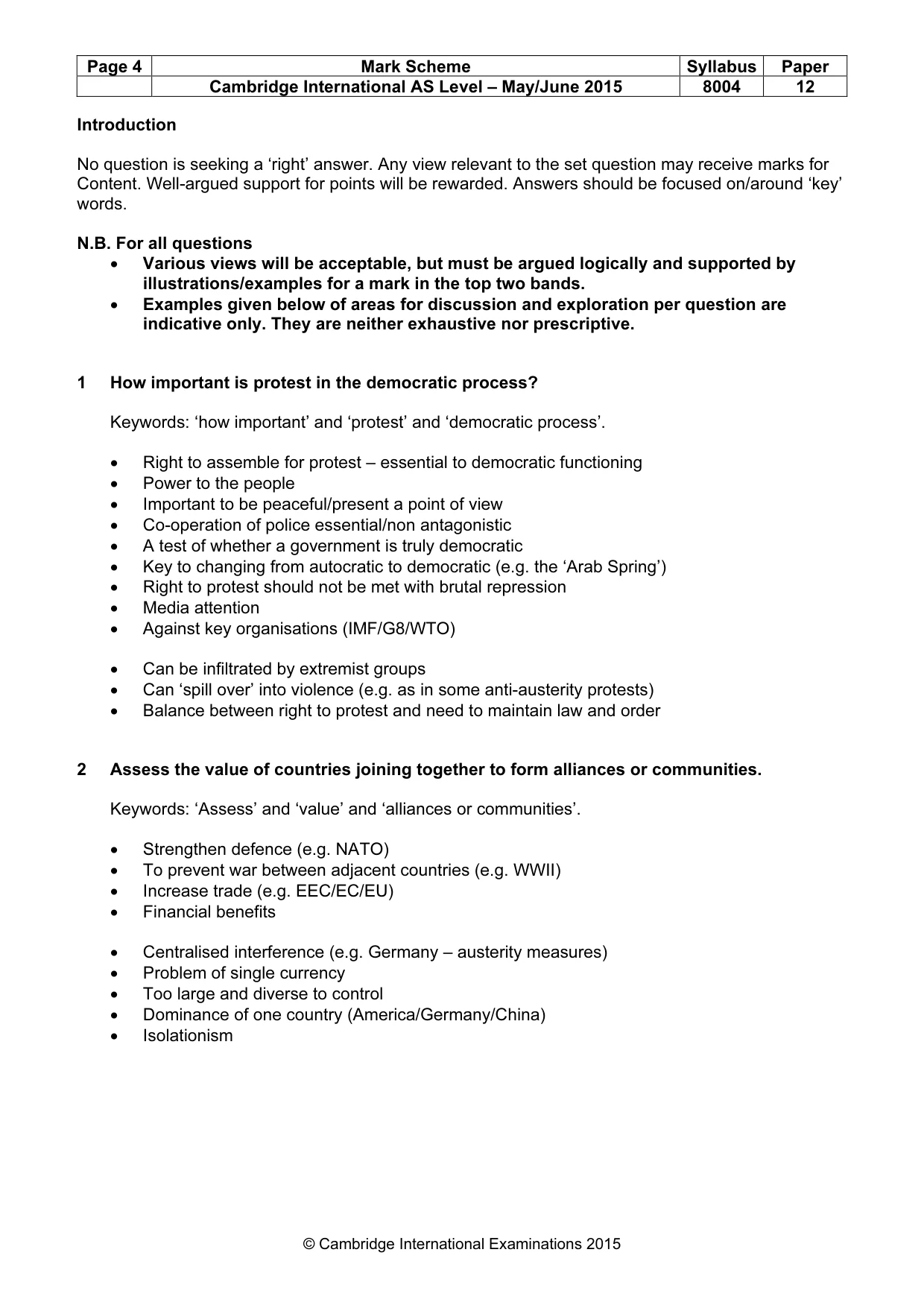
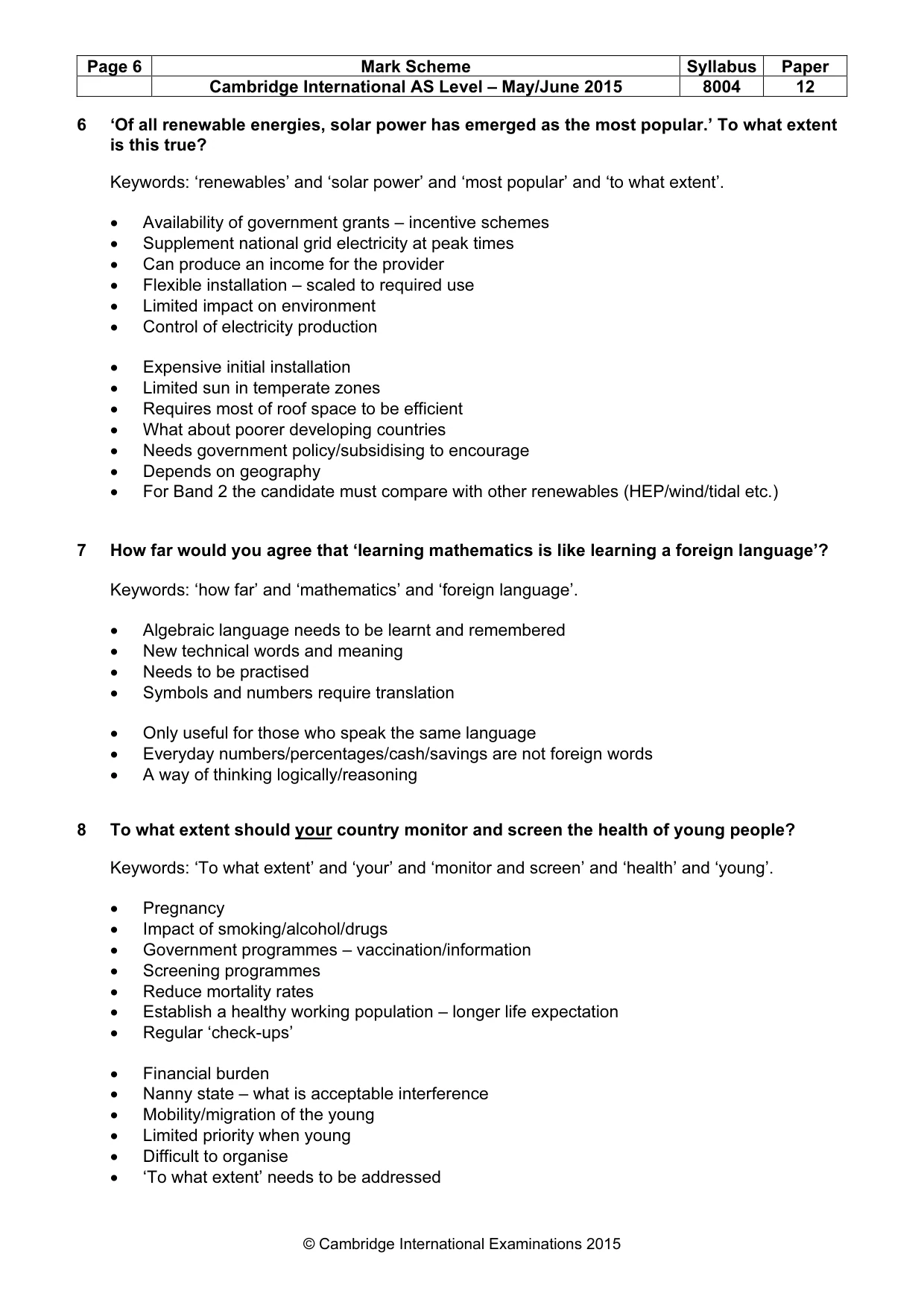
Page 4 Mark Scheme Syllabus Paper Cambridge International AS Level – May/June 2015 8004 12 © Cambridge International Examinations 2015 Introduction No question is seeking a ‘right’ answer. Any view relevant to the set question may receive marks for Content. Well-argued support for points will be rewarded. Answers should be focused on/around ‘key’ words. N.B. For all questions • Various views will be acceptable, but must be argued logically and supported by illustrations/examples for a mark in the top two bands. • Examples given below of areas for discussion and exploration per question are indicative only. They are neither exhaustive nor prescriptive. 1 How important is protest in the democratic process? Keywords: ‘how important’ and ‘protest’ and ‘democratic process’. • Right to assemble for protest – essential to democratic functioning • Power to the people • Important to be peaceful/present a point of view • Co-operation of police essential/non antagonistic • A test of whether a government is truly democratic • Key to changing from autocratic to democratic (e.g. the ‘Arab Spring’) • Right to protest should not be met with brutal repression • Media attention • Against key organisations (IMF/G8/WTO) • Can be infiltrated by extremist groups • Can ‘spill over’ into violence (e.g. as in some anti-austerity protests) • Balance between right to protest and need to maintain law and order 2 Assess the value of countries joining together to form alliances or communities. Keywords: ‘Assess’ and ‘value’ and ‘alliances or communities’. • Strengthen defence (e.g. NATO) • To prevent war between adjacent countries (e.g. WWII) • Increase trade (e.g. EEC/EC/EU) • Financial benefits • Centralised interference (e.g. Germany – austerity measures) • Problem of single currency • Too large and diverse to control • Dominance of one country (America/Germany/China) • Isolationism
Mark scheme, page 5
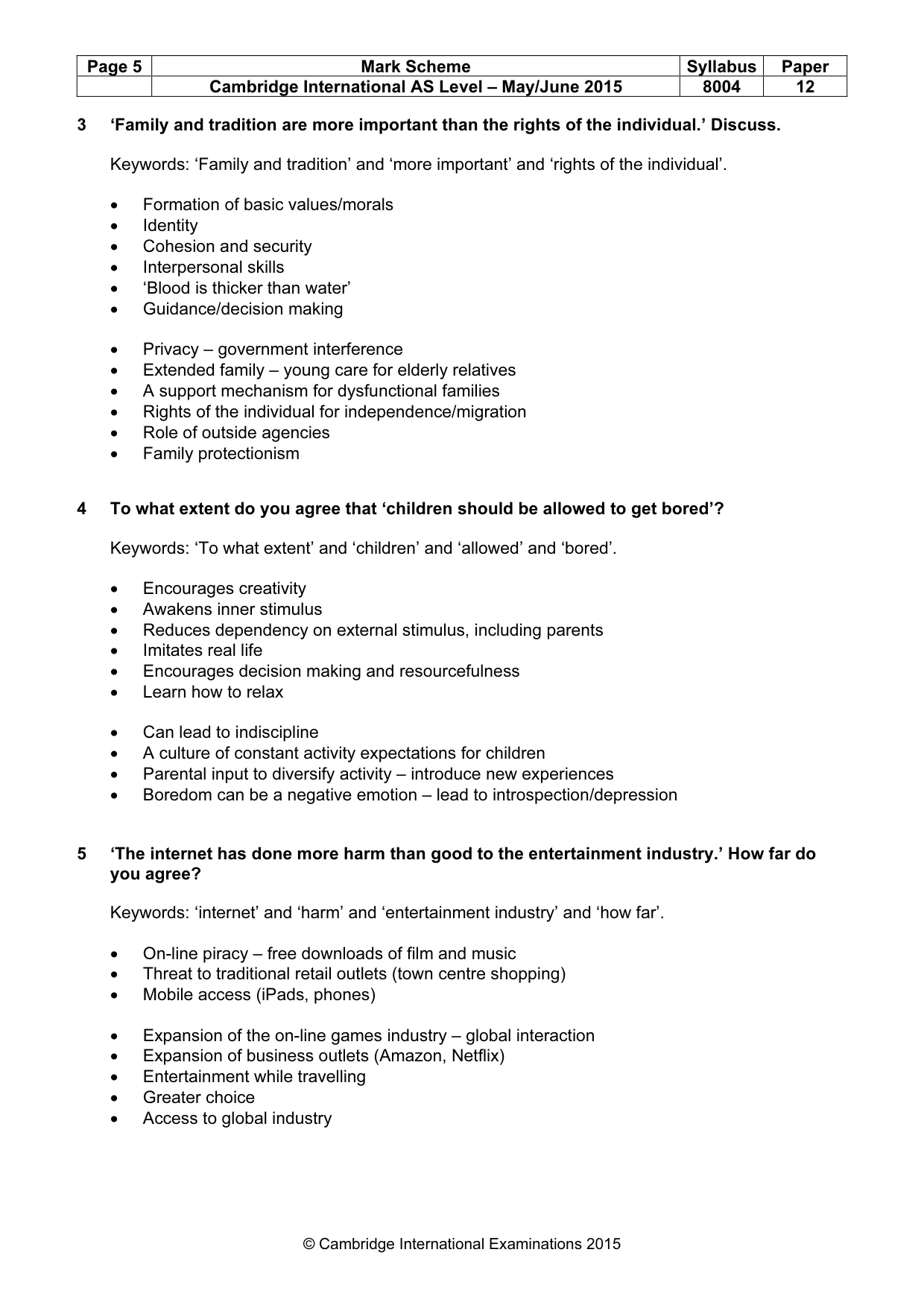
Page 5 Mark Scheme Syllabus Paper Cambridge International AS Level – May/June 2015 8004 12 © Cambridge International Examinations 2015 3 ‘Family and tradition are more important than the rights of the individual.’ Discuss. Keywords: ‘Family and tradition’ and ‘more important’ and ‘rights of the individual’. • Formation of basic values/morals • Identity • Cohesion and security • Interpersonal skills • ‘Blood is thicker than water’ • Guidance/decision making • Privacy – government interference • Extended family – young care for elderly relatives • A support mechanism for dysfunctional families • Rights of the individual for independence/migration • Role of outside agencies • Family protectionism 4 To what extent do you agree that ‘children should be allowed to get bored’? Keywords: ‘To what extent’ and ‘children’ and ‘allowed’ and ‘bored’. • Encourages creativity • Awakens inner stimulus • Reduces dependency on external stimulus, including parents • Imitates real life • Encourages decision making and resourcefulness • Learn how to relax • Can lead to indiscipline • A culture of constant activity expectations for children • Parental input to diversify activity – introduce new experiences • Boredom can be a negative emotion – lead to introspection/depression 5 ‘The internet has done more harm than good to the entertainment industry.’ How far do you agree? Keywords: ‘internet’ and ‘harm’ and ‘entertainment industry’ and ‘how far’. • On-line piracy – free downloads of film and music • Threat to traditional retail outlets (town centre shopping) • Mobile access (iPads, phones) • Expansion of the on-line games industry – global interaction • Expansion of business outlets (Amazon, Netflix) • Entertainment while travelling • Greater choice • Access to global industry
Mark scheme, page 6
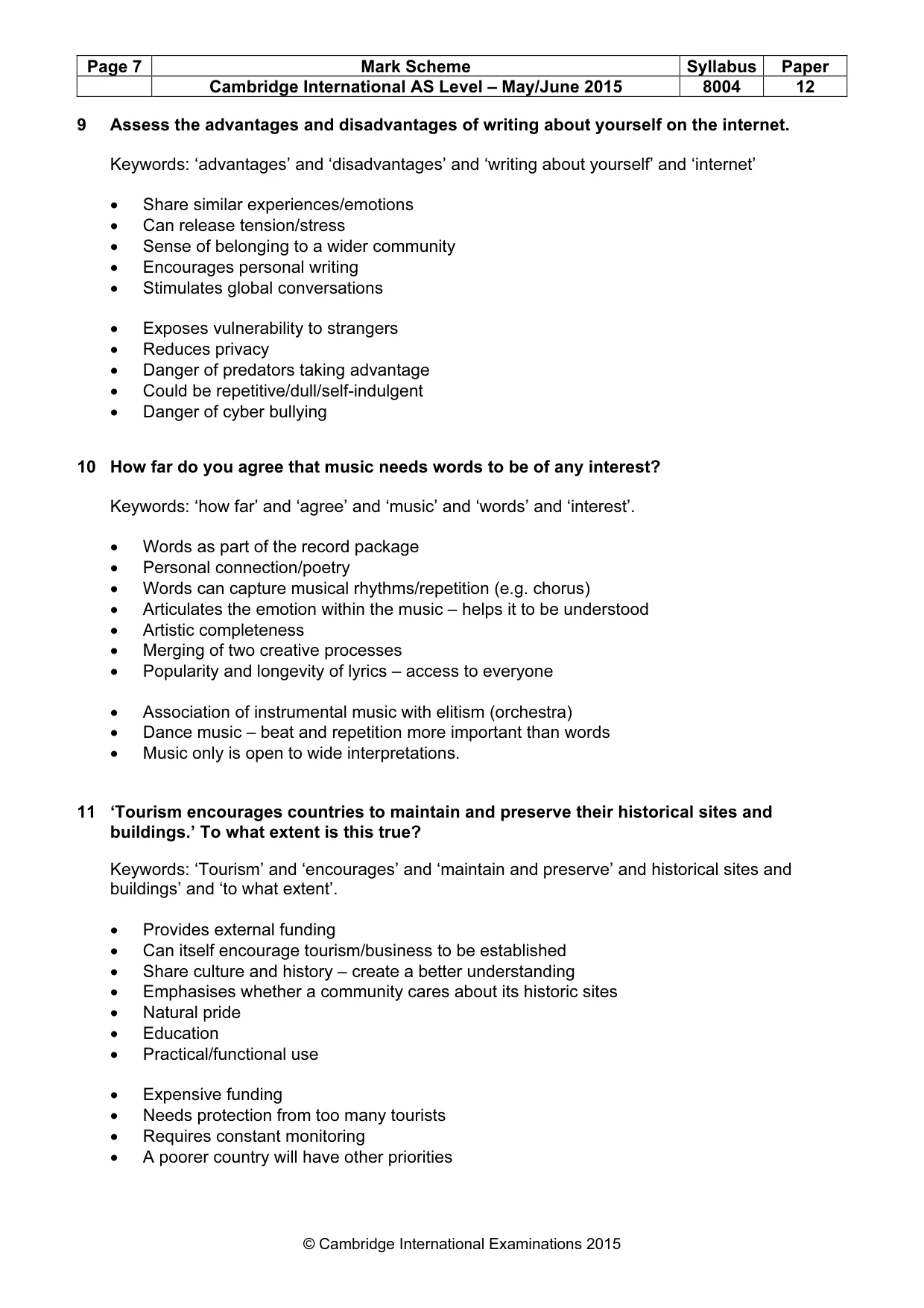
Page 6 Mark Scheme Syllabus Paper Cambridge International AS Level – May/June 2015 8004 12 © Cambridge International Examinations 2015 6 ‘Of all renewable energies, solar power has emerged as the most popular.’ To what extent is this true? Keywords: ‘renewables’ and ‘solar power’ and ‘most popular’ and ‘to what extent’. • Availability of government grants – incentive schemes • Supplement national grid electricity at peak times • Can produce an income for the provider • Flexible installation – scaled to required use • Limited impact on environment • Control of electricity production • Expensive initial installation • Limited sun in temperate zones • Requires most of roof space to be efficient • What about poorer developing countries • Needs government policy/subsidising to encourage • Depends on geography • For Band 2 the candidate must compare with other renewables (HEP/wind/tidal etc.) 7 How far would you agree that ‘learning mathematics is like learning a foreign language’? Keywords: ‘how far’ and ‘mathematics’ and ‘foreign language’. • Algebraic language needs to be learnt and remembered • New technical words and meaning • Needs to be practised • Symbols and numbers require translation • Only useful for those who speak the same language • Everyday numbers/percentages/cash/savings are not foreign words • A way of thinking logically/reasoning 8 To what extent should your country monitor and screen the health of young people? Keywords: ‘To what extent’ and ‘your’ and ‘monitor and screen’ and ‘health’ and ‘young’. • Pregnancy • Impact of smoking/alcohol/drugs • Government programmes – vaccination/information • Screening programmes • Reduce mortality rates • Establish a healthy working population – longer life expectation • Regular ‘check-ups’ • Financial burden • Nanny state – what is acceptable interference • Mobility/migration of the young • Limited priority when young • Difficult to organise • ‘To what extent’ needs to be addressed
Mark scheme, page 7
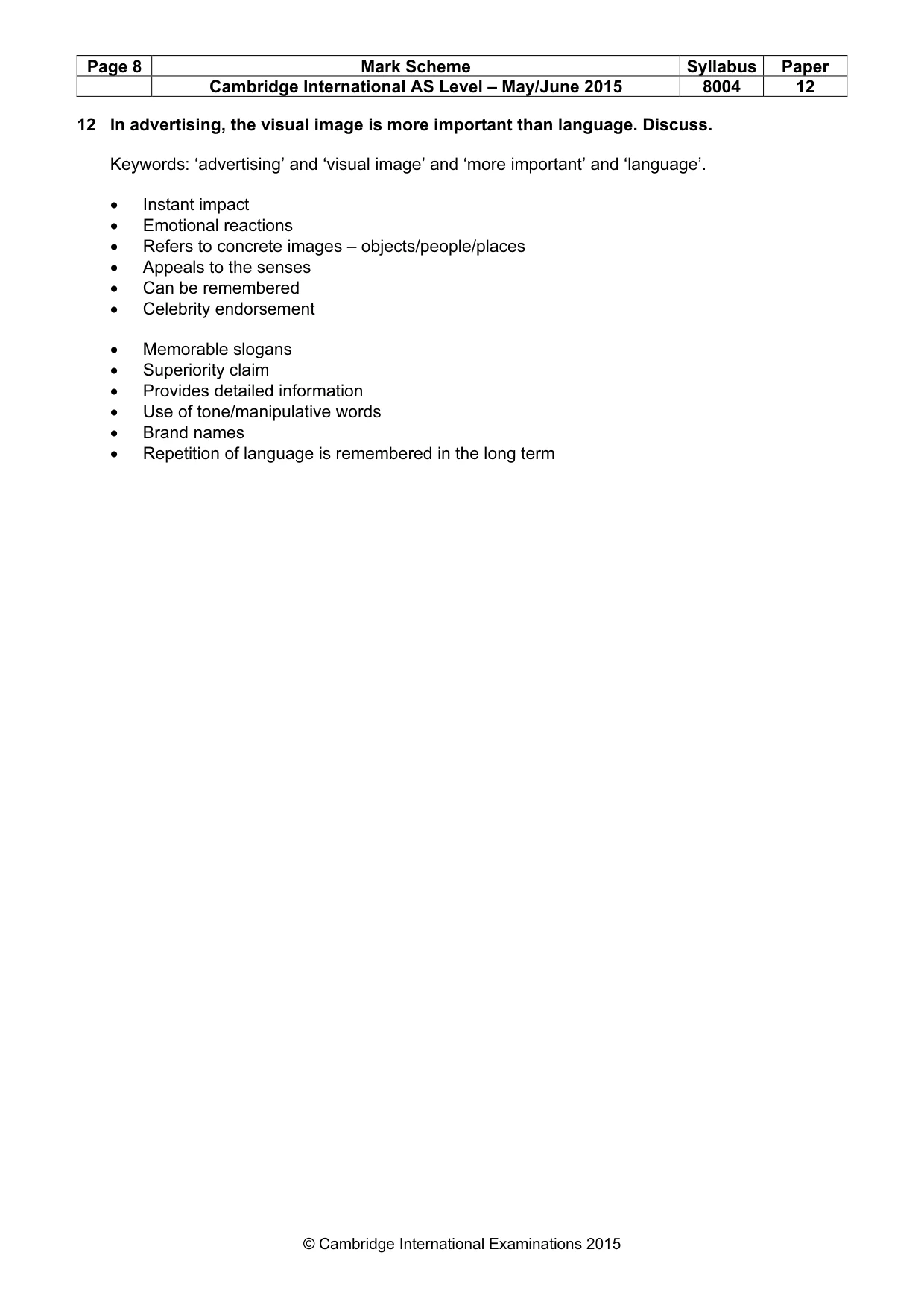
Page 7 Mark Scheme Syllabus Paper Cambridge International AS Level – May/June 2015 8004 12 © Cambridge International Examinations 2015 9 Assess the advantages and disadvantages of writing about yourself on the internet. Keywords: ‘advantages’ and ‘disadvantages’ and ‘writing about yourself’ and ‘internet’ • Share similar experiences/emotions • Can release tension/stress • Sense of belonging to a wider community • Encourages personal writing • Stimulates global conversations • Exposes vulnerability to strangers • Reduces privacy • Danger of predators taking advantage • Could be repetitive/dull/self-indulgent • Danger of cyber bullying 10 How far do you agree that music needs words to be of any interest? Keywords: ‘how far’ and ‘agree’ and ‘music’ and ‘words’ and ‘interest’. • Words as part of the record package • Personal connection/poetry • Words can capture musical rhythms/repetition (e.g. chorus) • Articulates the emotion within the music – helps it to be understood • Artistic completeness • Merging of two creative processes • Popularity and longevity of lyrics – access to everyone • Association of instrumental music with elitism (orchestra) • Dance music – beat and repetition more important than words • Music only is open to wide interpretations. 11 ‘Tourism encourages countries to maintain and preserve their historical sites and buildings.’ To what extent is this true? Keywords: ‘Tourism’ and ‘encourages’ and ‘maintain and preserve’ and historical sites and buildings’ and ‘to what extent’. • Provides external funding • Can itself encourage tourism/business to be established • Share culture and history – create a better understanding • Emphasises whether a community cares about its historic sites • Natural pride • Education • Practical/functional use • Expensive funding • Needs protection from too many tourists • Requires constant monitoring • A poorer country will have other priorities
Mark scheme, page 8
Page 8 Mark Scheme Syllabus Paper Cambridge International AS Level – May/June 2015 8004 12 © Cambridge International Examinations 2015 12 In advertising, the visual image is more important than language. Discuss. Keywords: ‘advertising’ and ‘visual image’ and ‘more important’ and ‘language’. • Instant impact • Emotional reactions • Refers to concrete images – objects/people/places • Appeals to the senses • Can be remembered • Celebrity endorsement • Memorable slogans • Superiority claim • Provides detailed information • Use of tone/manipulative words • Brand names • Repetition of language is remembered in the long term
What you needed in this session
Cambridge’s own grade thresholds for 2015 May/June, Paper 1 · Variant 2. A higher threshold means an easier paper — the bar moves with how the cohort did.