Cambridge A Level General Paper (AS Level only) 8004 — 2014 Oct/Nov Paper 1 · Variant 3
8004/13/O/N/14 · 100 marks · ≈113 min
The question paper and its mark scheme, free to read here and free to download. This is Cambridge’s own paper, exactly as it was sat.
Question paper4 pages

Mark scheme8 pages
Answers below. Sit the paper first if you are practising.
Paper as text
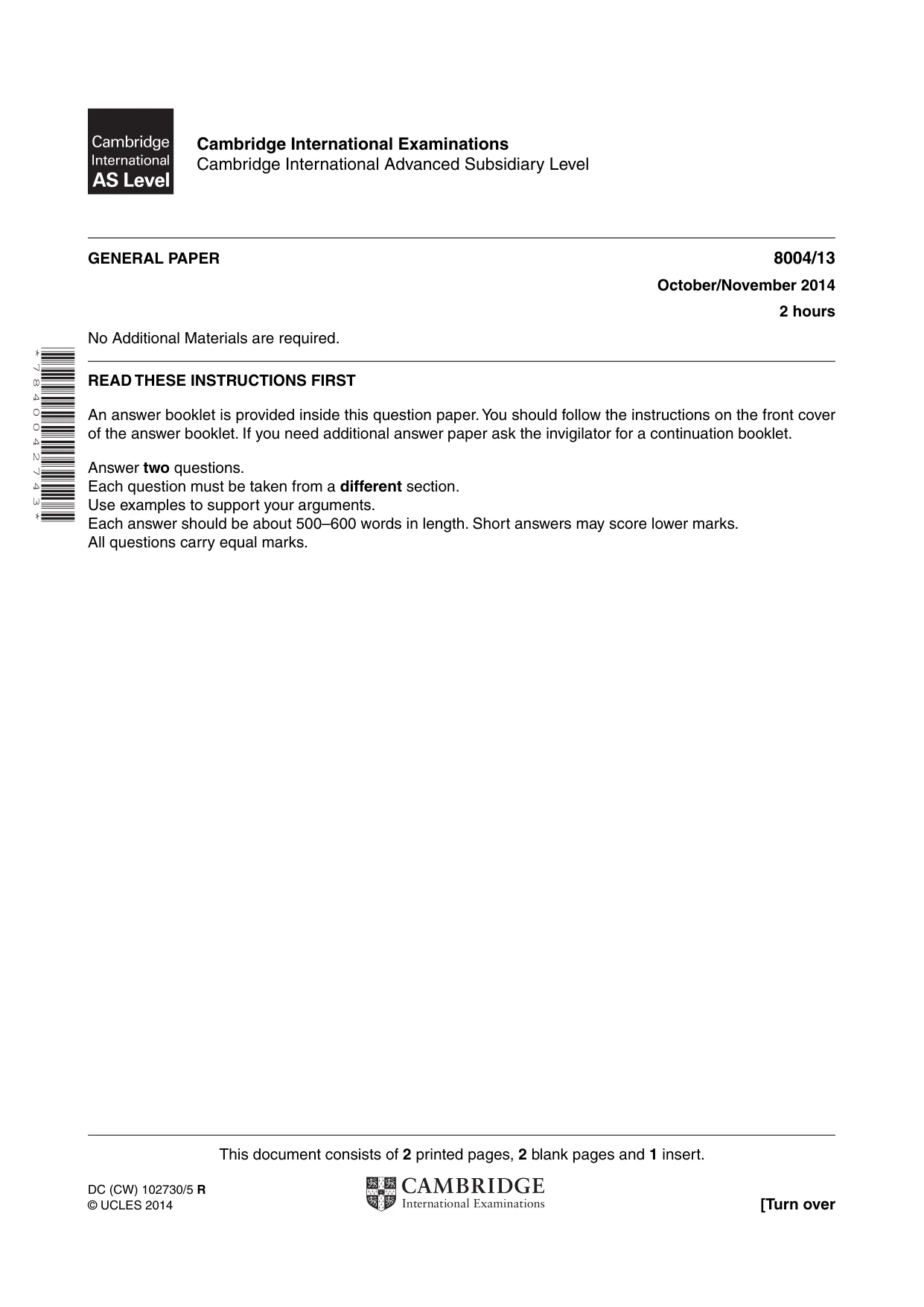
Question paper, page 1
This document consists of 2 printed pages, 2 blank pages and 1 insert. DC (CW) 102730/5 R © UCLES 2014 [Turn over Cambridge International Examinations Cambridge International Advanced Subsidiary Level * 7 8 4 0 0 4 2 7 4 3 * GENERAL PAPER 8004/13 October/November 2014 2 hours No Additional Materials are required. READ THESE INSTRUCTIONS FIRST An answer booklet is provided inside this question paper. You should follow the instructions on the front cover of the answer booklet. If you need additional answer paper ask the invigilator for a continuation booklet. Answer two questions. Each question must be taken from a different section. Use examples to support your arguments. Each answer should be about 500–600 words in length. Short answers may score lower marks. All questions carry equal marks.
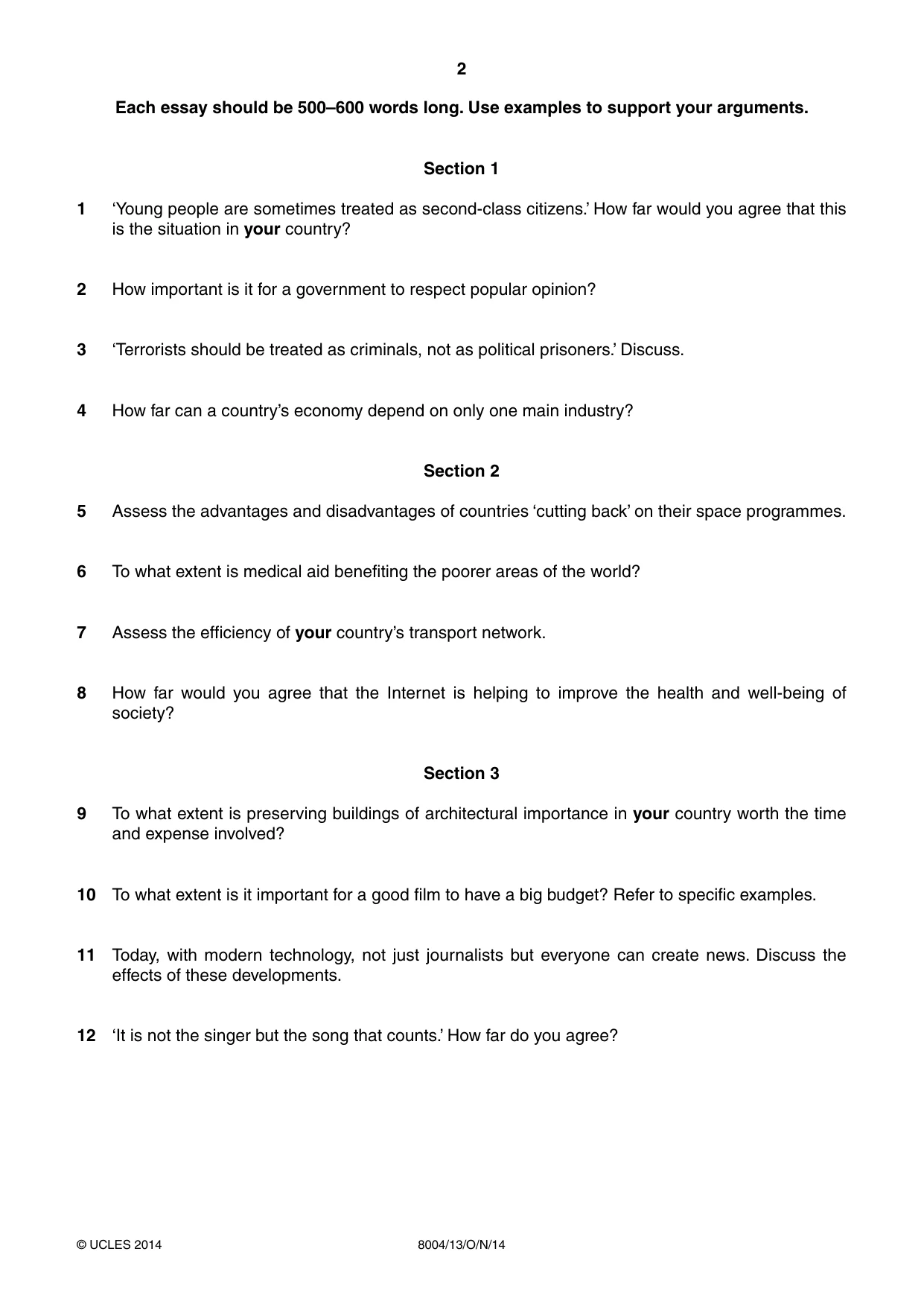
Question paper, page 2
2 8004/13/O/N/14 © UCLES 2014 Each essay should be 500–600 words long. Use examples to support your arguments. Section 1 1 ‘Young people are sometimes treated as second-class citizens.’ How far would you agree that this is the situation in your country? 2 How important is it for a government to respect popular opinion? 3 ‘Terrorists should be treated as criminals, not as political prisoners.’ Discuss. 4 How far can a country’s economy depend on only one main industry? Section 2 5 Assess the advantages and disadvantages of countries ‘cutting back’ on their space programmes. 6 To what extent is medical aid benefiting the poorer areas of the world? 7 Assess the efficiency of your country’s transport network. 8 How far would you agree that the Internet is helping to improve the health and well-being of society? Section 3 9 To what extent is preserving buildings of architectural importance in your country worth the time and expense involved? 10 To what extent is it important for a good film to have a big budget? Refer to specific examples. 11 Today, with modern technology, not just journalists but everyone can create news. Discuss the effects of these developments. 12 ‘It is not the singer but the song that counts.’ How far do you agree?
Question paper, page 3
3 8004/13/O/N/14 © UCLES 2014 BLANK PAGE
Question paper, page 4
4 8004/13/O/N/14 © UCLES 2014 BLANK PAGE Permission to reproduce items where third-party owned material protected by copyright is included has been sought and cleared where possible. Every reasonable effort has been made by the publisher (UCLES) to trace copyright holders, but if any items requiring clearance have unwittingly been included, the publisher will be pleased to make amends at the earliest possible opportunity. Cambridge International Examinations is part of the Cambridge Assessment Group. Cambridge Assessment is the brand name of University of Cambridge Local Examinations Syndicate (UCLES), which is itself a department of the University of Cambridge.
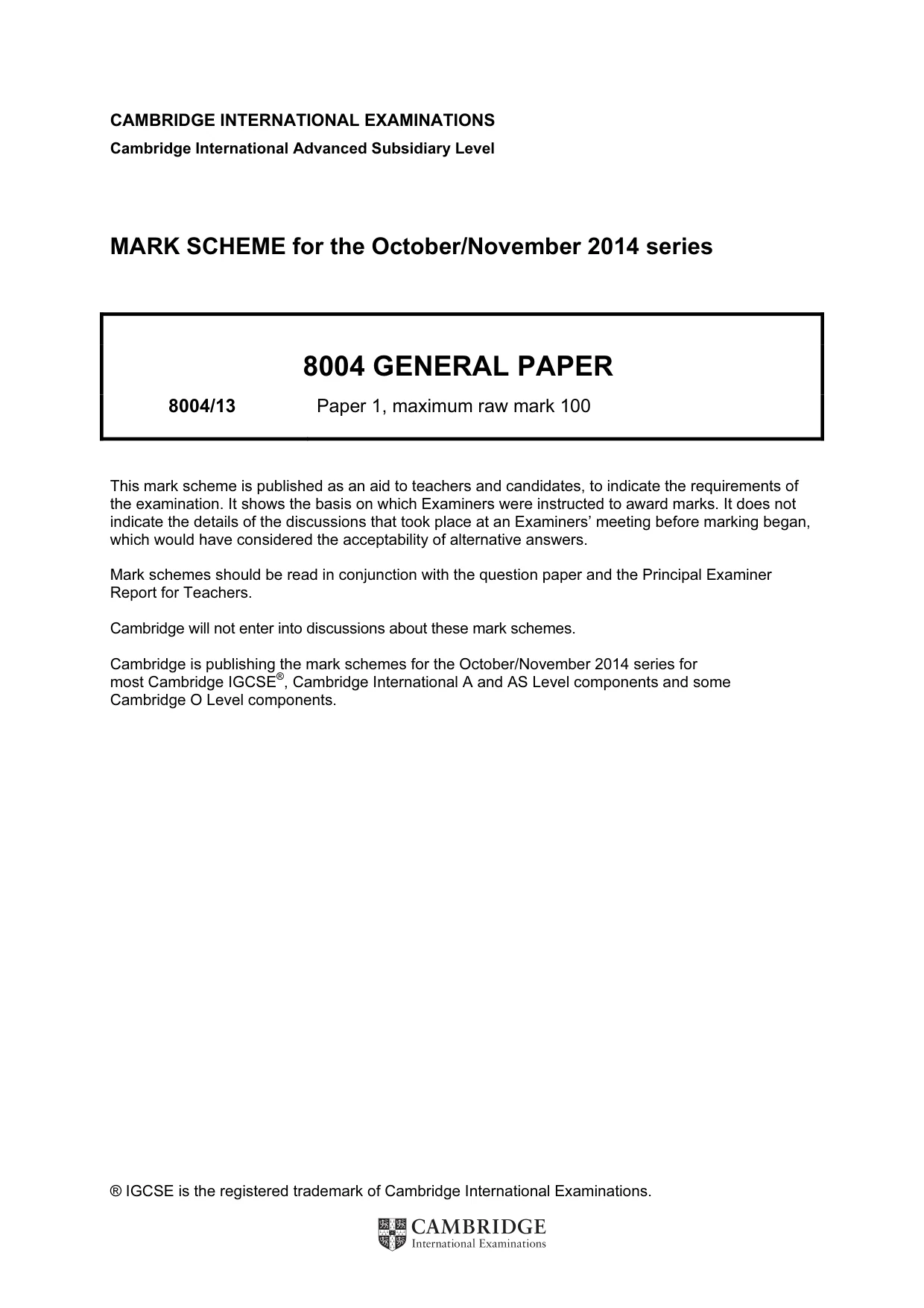
Mark scheme, page 1
® IGCSE is the registered trademark of Cambridge International Examinations. CAMBRIDGE INTERNATIONAL EXAMINATIONS Cambridge International Advanced Subsidiary Level MARK SCHEME for the October/November 2014 series 8004 GENERAL PAPER 8004/13 Paper 1, maximum raw mark 100 This mark scheme is published as an aid to teachers and candidates, to indicate the requirements of the examination. It shows the basis on which Examiners were instructed to award marks. It does not indicate the details of the discussions that took place at an Examiners’ meeting before marking began, which would have considered the acceptability of alternative answers. Mark schemes should be read in conjunction with the question paper and the Principal Examiner Report for Teachers. Cambridge will not enter into discussions about these mark schemes. Cambridge is publishing the mark schemes for the October/November 2014 series for most Cambridge IGCSE®, Cambridge International A and AS Level components and some Cambridge O Level components.
Mark scheme, page 2
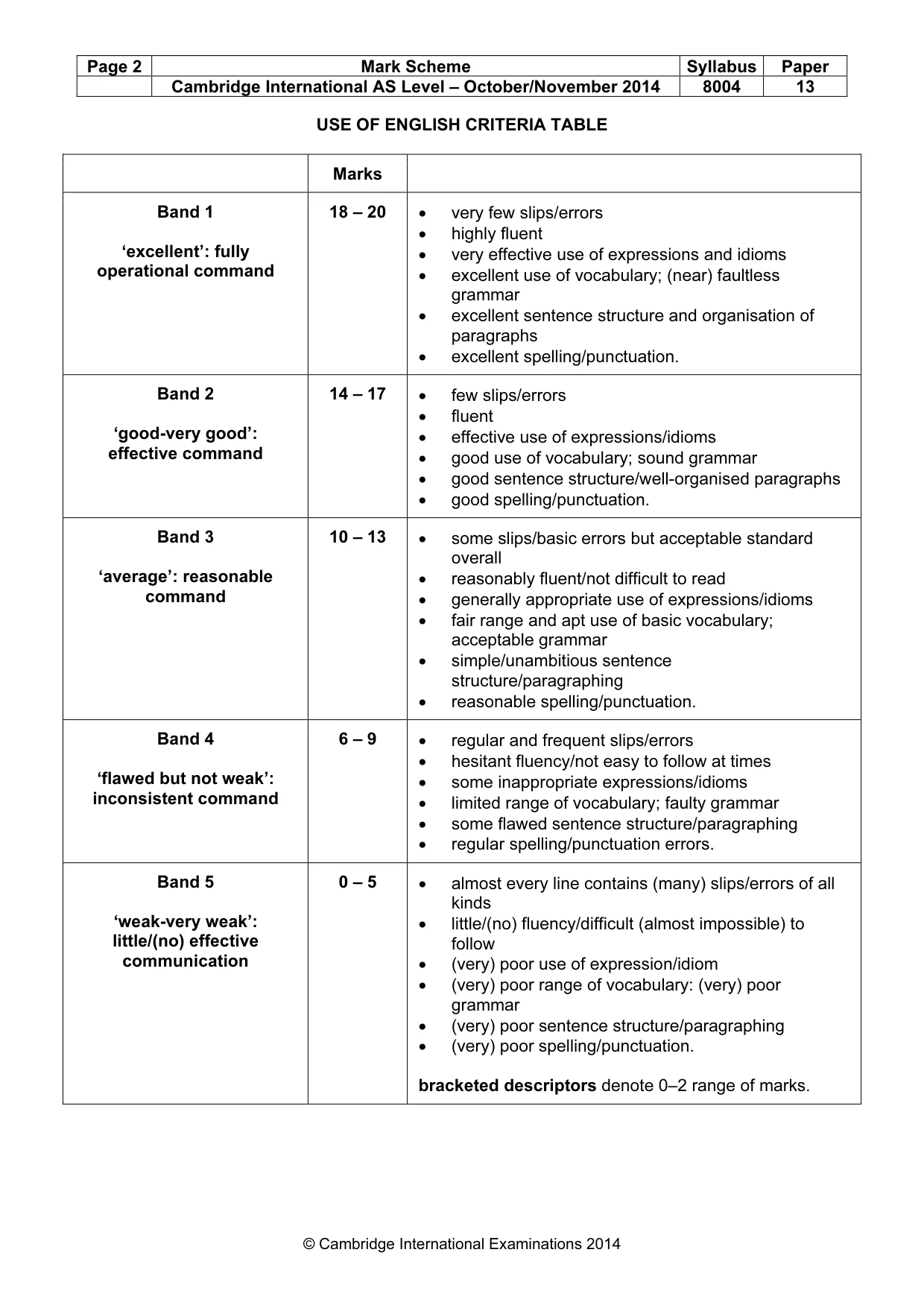
Page 2 Mark Scheme Syllabus Paper Cambridge International AS Level – October/November 2014 8004 13 © Cambridge International Examinations 2014 USE OF ENGLISH CRITERIA TABLE Marks Band 1 ‘excellent’: fully operational command 18 – 20 • very few slips/errors • highly fluent • very effective use of expressions and idioms • excellent use of vocabulary; (near) faultless grammar • excellent sentence structure and organisation of paragraphs • excellent spelling/punctuation. Band 2 ‘good-very good’: effective command 14 – 17 • few slips/errors • fluent • effective use of expressions/idioms • good use of vocabulary; sound grammar • good sentence structure/well-organised paragraphs • good spelling/punctuation. Band 3 ‘average’: reasonable command 10 – 13 • some slips/basic errors but acceptable standard overall • reasonably fluent/not difficult to read • generally appropriate use of expressions/idioms • fair range and apt use of basic vocabulary; acceptable grammar • simple/unambitious sentence structure/paragraphing • reasonable spelling/punctuation. Band 4 ‘flawed but not weak’: inconsistent command 6 – 9 • regular and frequent slips/errors • hesitant fluency/not easy to follow at times • some inappropriate expressions/idioms • limited range of vocabulary; faulty grammar • some flawed sentence structure/paragraphing • regular spelling/punctuation errors. Band 5 ‘weak-very weak’: little/(no) effective communication 0 – 5 • almost every line contains (many) slips/errors of all kinds • little/(no) fluency/difficult (almost impossible) to follow • (very) poor use of expression/idiom • (very) poor range of vocabulary: (very) poor grammar • (very) poor sentence structure/paragraphing • (very) poor spelling/punctuation. bracketed descriptors denote 0–2 range of marks.
Mark scheme, page 3
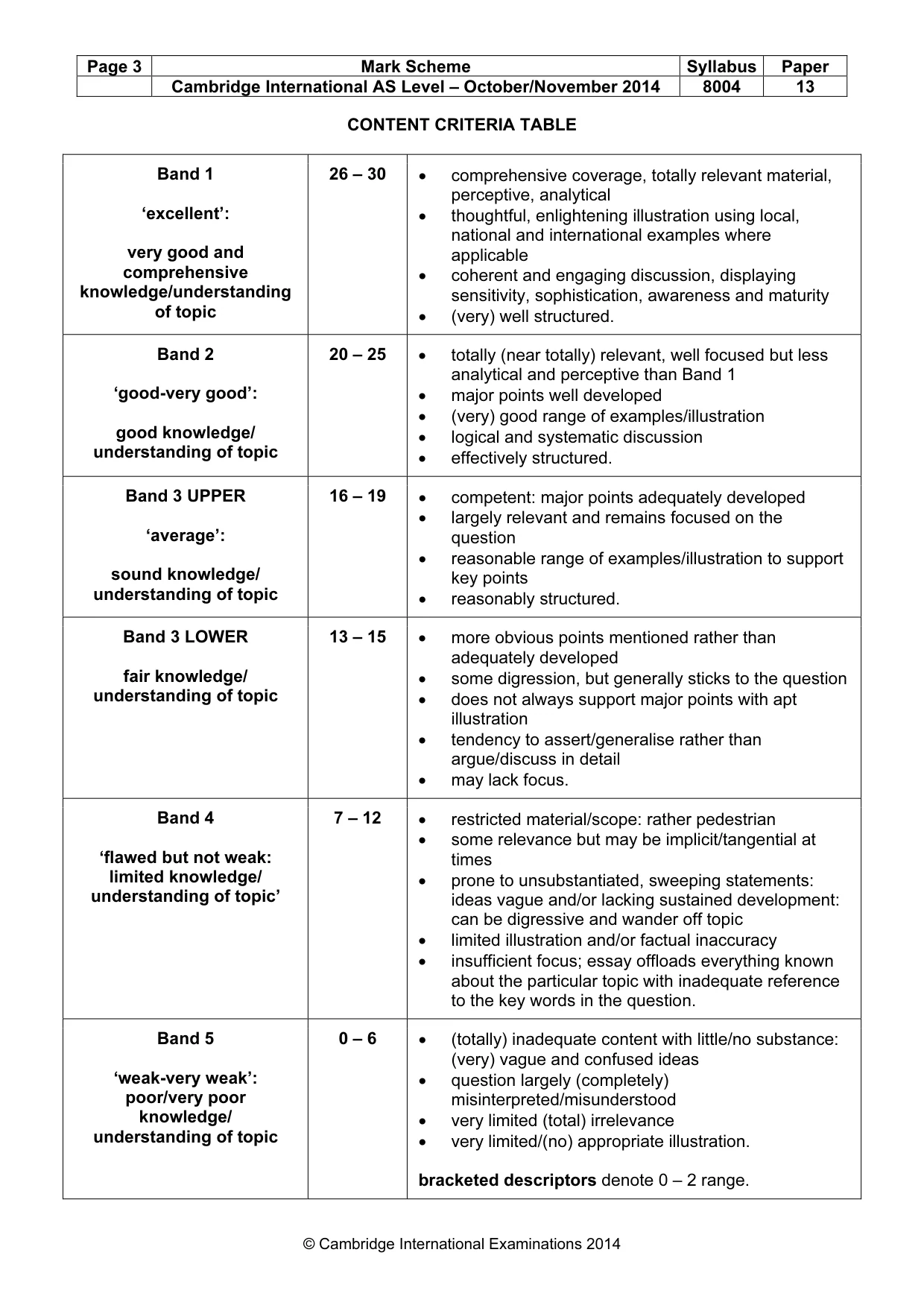
Page 3 Mark Scheme Syllabus Paper Cambridge International AS Level – October/November 2014 8004 13 © Cambridge International Examinations 2014 CONTENT CRITERIA TABLE Band 1 ‘excellent’: very good and comprehensive knowledge/understanding of topic 26 – 30 • comprehensive coverage, totally relevant material, perceptive, analytical • thoughtful, enlightening illustration using local, national and international examples where applicable • coherent and engaging discussion, displaying sensitivity, sophistication, awareness and maturity • (very) well structured. Band 2 ‘good-very good’: good knowledge/ understanding of topic 20 – 25 • totally (near totally) relevant, well focused but less analytical and perceptive than Band 1 • major points well developed • (very) good range of examples/illustration • logical and systematic discussion • effectively structured. Band 3 UPPER ‘average’: sound knowledge/ understanding of topic 16 – 19 • competent: major points adequately developed • largely relevant and remains focused on the question • reasonable range of examples/illustration to support key points • reasonably structured. Band 3 LOWER fair knowledge/ understanding of topic 13 – 15 • more obvious points mentioned rather than adequately developed • some digression, but generally sticks to the question • does not always support major points with apt illustration • tendency to assert/generalise rather than argue/discuss in detail • may lack focus. Band 4 ‘flawed but not weak: limited knowledge/ understanding of topic’ 7 – 12 • restricted material/scope: rather pedestrian • some relevance but may be implicit/tangential at times • prone to unsubstantiated, sweeping statements: ideas vague and/or lacking sustained development: can be digressive and wander off topic • limited illustration and/or factual inaccuracy • insufficient focus; essay offloads everything known about the particular topic with inadequate reference to the key words in the question. Band 5 ‘weak-very weak’: poor/very poor knowledge/ understanding of topic 0 – 6 • (totally) inadequate content with little/no substance: (very) vague and confused ideas • question largely (completely) misinterpreted/misunderstood • very limited (total) irrelevance • very limited/(no) appropriate illustration. bracketed descriptors denote 0 – 2 range.
Mark scheme, page 4
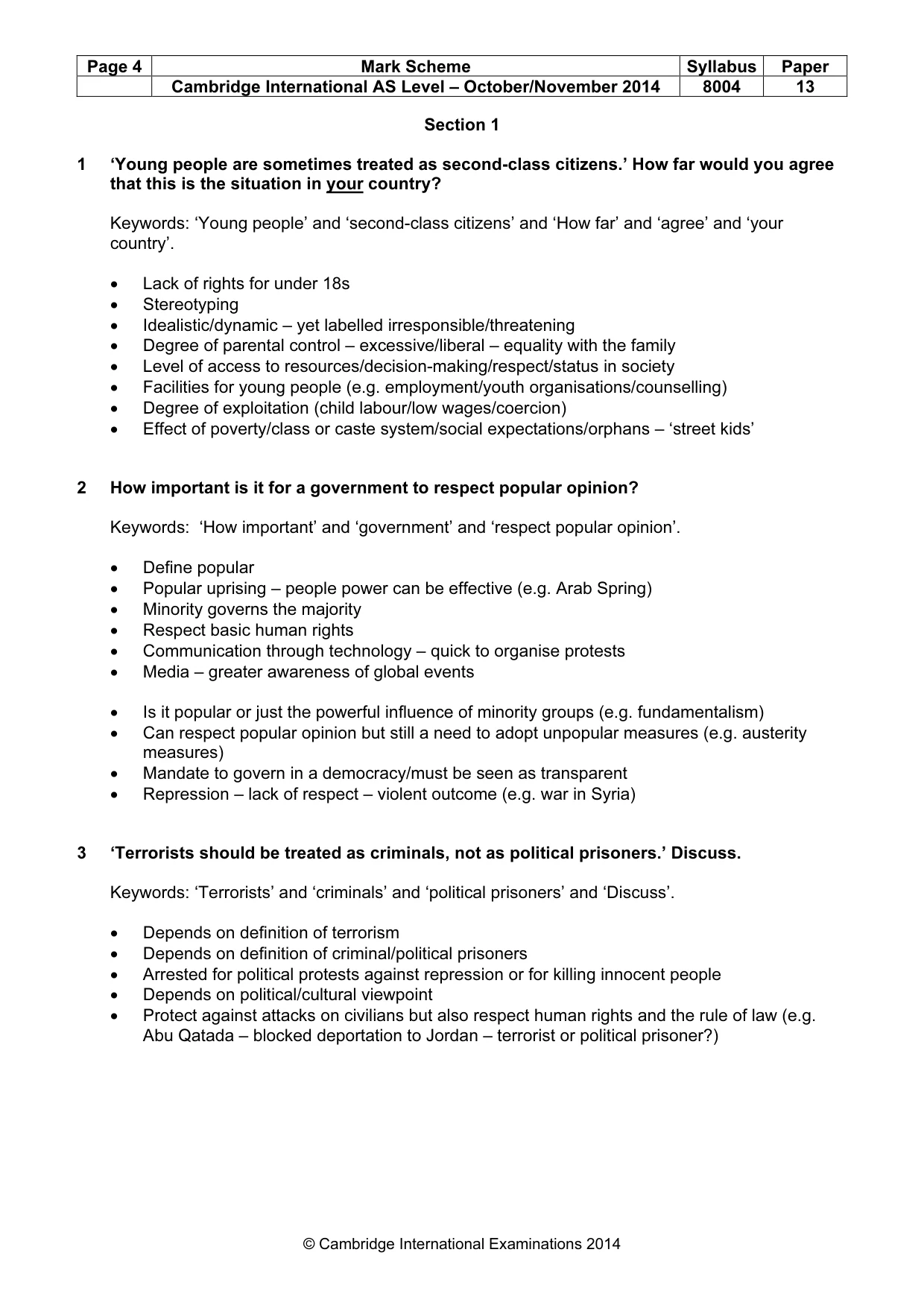
Page 4 Mark Scheme Syllabus Paper Cambridge International AS Level – October/November 2014 8004 13 © Cambridge International Examinations 2014 Section 1 1 ‘Young people are sometimes treated as second-class citizens.’ How far would you agree that this is the situation in your country? Keywords: ‘Young people’ and ‘second-class citizens’ and ‘How far’ and ‘agree’ and ‘your country’. • Lack of rights for under 18s • Stereotyping • Idealistic/dynamic – yet labelled irresponsible/threatening • Degree of parental control – excessive/liberal – equality with the family • Level of access to resources/decision-making/respect/status in society • Facilities for young people (e.g. employment/youth organisations/counselling) • Degree of exploitation (child labour/low wages/coercion) • Effect of poverty/class or caste system/social expectations/orphans – ‘street kids’ 2 How important is it for a government to respect popular opinion? Keywords: ‘How important’ and ‘government’ and ‘respect popular opinion’. • Define popular • Popular uprising – people power can be effective (e.g. Arab Spring) • Minority governs the majority • Respect basic human rights • Communication through technology – quick to organise protests • Media – greater awareness of global events • Is it popular or just the powerful influence of minority groups (e.g. fundamentalism) • Can respect popular opinion but still a need to adopt unpopular measures (e.g. austerity measures) • Mandate to govern in a democracy/must be seen as transparent • Repression – lack of respect – violent outcome (e.g. war in Syria) 3 ‘Terrorists should be treated as criminals, not as political prisoners.’ Discuss. Keywords: ‘Terrorists’ and ‘criminals’ and ‘political prisoners’ and ‘Discuss’. • Depends on definition of terrorism • Depends on definition of criminal/political prisoners • Arrested for political protests against repression or for killing innocent people • Depends on political/cultural viewpoint • Protect against attacks on civilians but also respect human rights and the rule of law (e.g. Abu Qatada – blocked deportation to Jordan – terrorist or political prisoner?)
Mark scheme, page 5
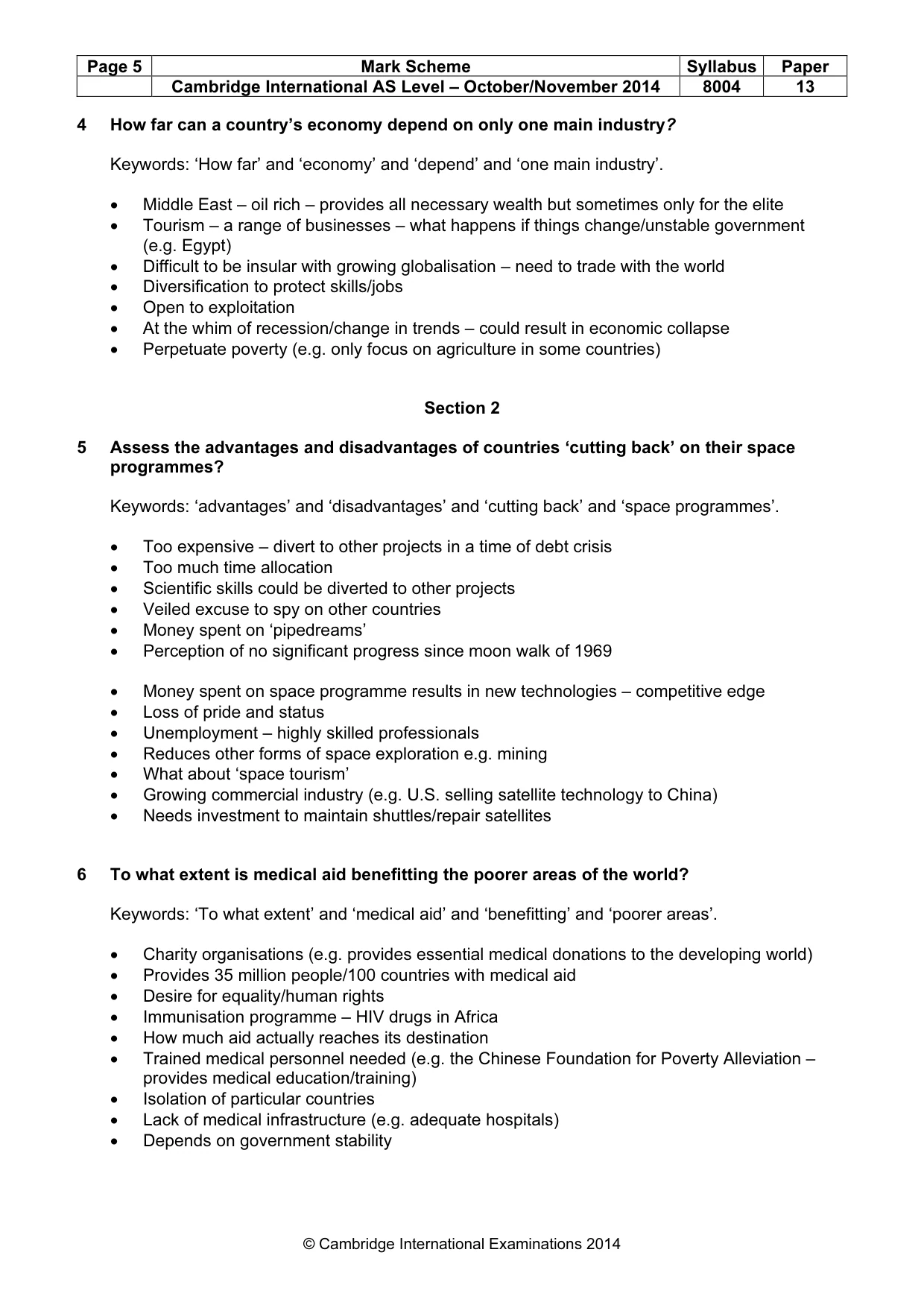
Page 5 Mark Scheme Syllabus Paper Cambridge International AS Level – October/November 2014 8004 13 © Cambridge International Examinations 2014 4 How far can a country’s economy depend on only one main industry? Keywords: ‘How far’ and ‘economy’ and ‘depend’ and ‘one main industry’. • Middle East – oil rich – provides all necessary wealth but sometimes only for the elite • Tourism – a range of businesses – what happens if things change/unstable government (e.g. Egypt) • Difficult to be insular with growing globalisation – need to trade with the world • Diversification to protect skills/jobs • Open to exploitation • At the whim of recession/change in trends – could result in economic collapse • Perpetuate poverty (e.g. only focus on agriculture in some countries) Section 2 5 Assess the advantages and disadvantages of countries ‘cutting back’ on their space programmes? Keywords: ‘advantages’ and ‘disadvantages’ and ‘cutting back’ and ‘space programmes’. • Too expensive – divert to other projects in a time of debt crisis • Too much time allocation • Scientific skills could be diverted to other projects • Veiled excuse to spy on other countries • Money spent on ‘pipedreams’ • Perception of no significant progress since moon walk of 1969 • Money spent on space programme results in new technologies – competitive edge • Loss of pride and status • Unemployment – highly skilled professionals • Reduces other forms of space exploration e.g. mining • What about ‘space tourism’ • Growing commercial industry (e.g. U.S. selling satellite technology to China) • Needs investment to maintain shuttles/repair satellites 6 To what extent is medical aid benefitting the poorer areas of the world? Keywords: ‘To what extent’ and ‘medical aid’ and ‘benefitting’ and ‘poorer areas’. • Charity organisations (e.g. provides essential medical donations to the developing world) • Provides 35 million people/100 countries with medical aid • Desire for equality/human rights • Immunisation programme – HIV drugs in Africa • How much aid actually reaches its destination • Trained medical personnel needed (e.g. the Chinese Foundation for Poverty Alleviation – provides medical education/training) • Isolation of particular countries • Lack of medical infrastructure (e.g. adequate hospitals) • Depends on government stability
Mark scheme, page 6
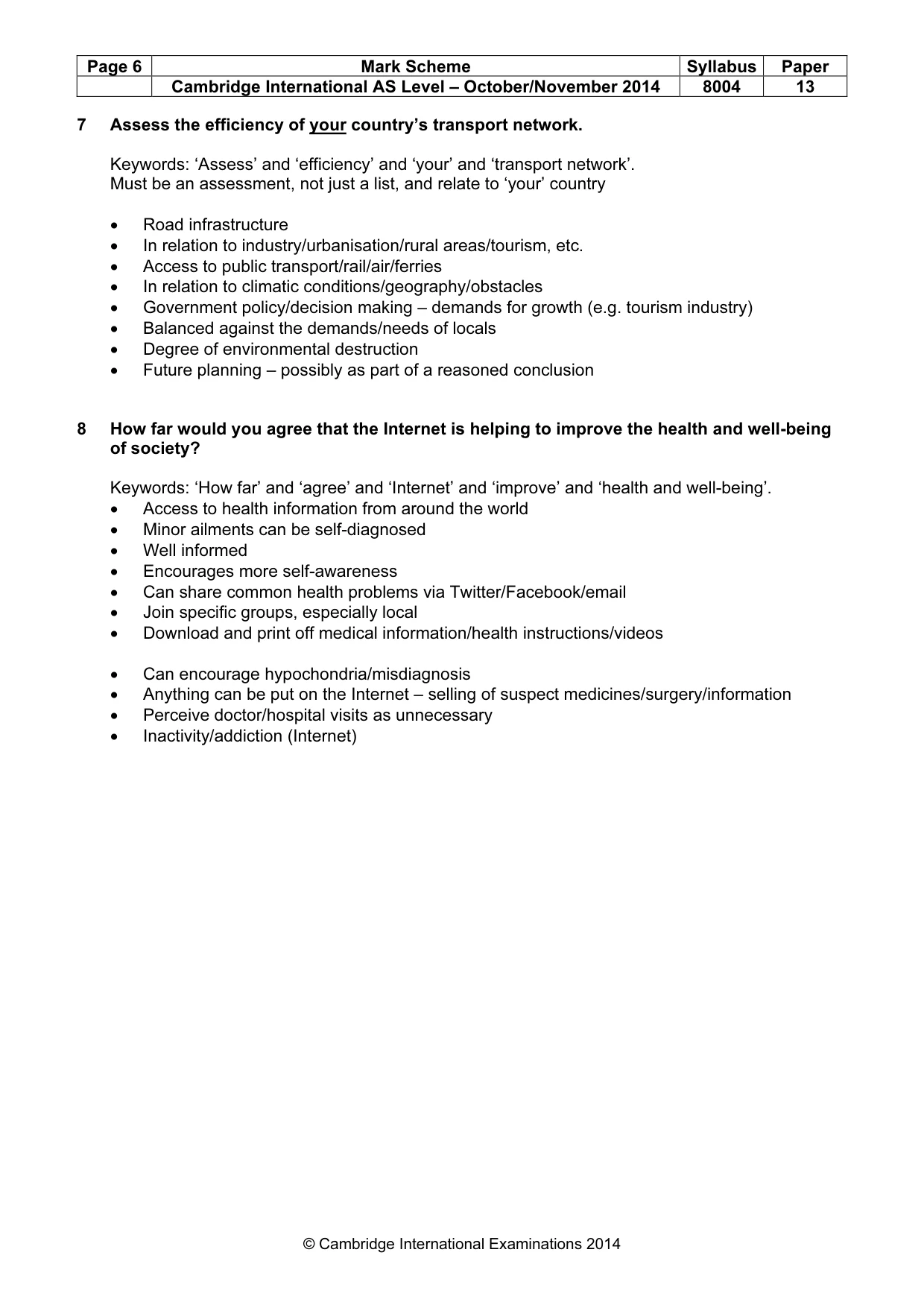
Page 6 Mark Scheme Syllabus Paper Cambridge International AS Level – October/November 2014 8004 13 © Cambridge International Examinations 2014 7 Assess the efficiency of your country’s transport network. Keywords: ‘Assess’ and ‘efficiency’ and ‘your’ and ‘transport network’. Must be an assessment, not just a list, and relate to ‘your’ country • Road infrastructure • In relation to industry/urbanisation/rural areas/tourism, etc. • Access to public transport/rail/air/ferries • In relation to climatic conditions/geography/obstacles • Government policy/decision making – demands for growth (e.g. tourism industry) • Balanced against the demands/needs of locals • Degree of environmental destruction • Future planning – possibly as part of a reasoned conclusion 8 How far would you agree that the Internet is helping to improve the health and well-being of society? Keywords: ‘How far’ and ‘agree’ and ‘Internet’ and ‘improve’ and ‘health and well-being’. • Access to health information from around the world • Minor ailments can be self-diagnosed • Well informed • Encourages more self-awareness • Can share common health problems via Twitter/Facebook/email • Join specific groups, especially local • Download and print off medical information/health instructions/videos • Can encourage hypochondria/misdiagnosis • Anything can be put on the Internet – selling of suspect medicines/surgery/information • Perceive doctor/hospital visits as unnecessary • Inactivity/addiction (Internet)
Mark scheme, page 7
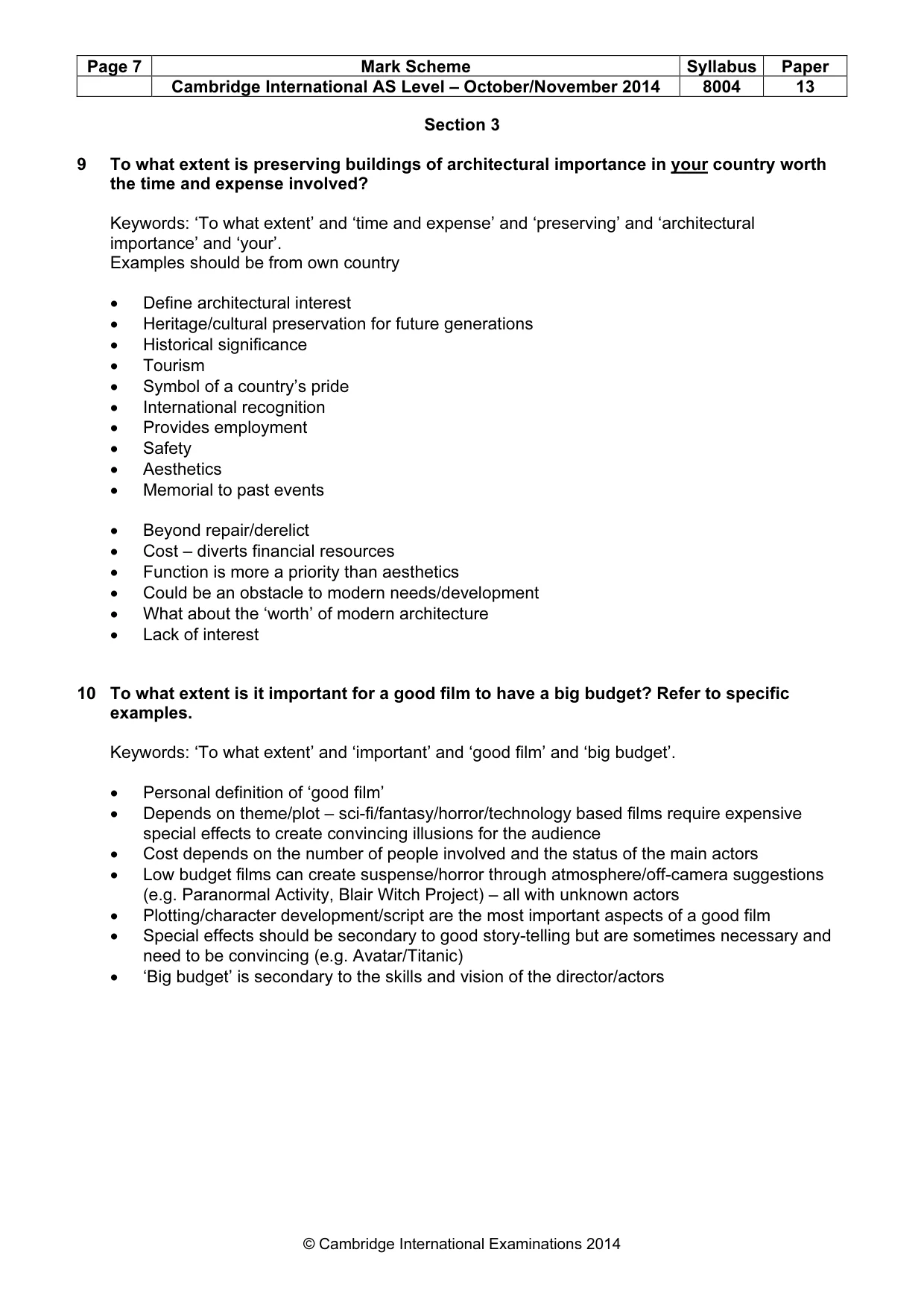
Page 7 Mark Scheme Syllabus Paper Cambridge International AS Level – October/November 2014 8004 13 © Cambridge International Examinations 2014 Section 3 9 To what extent is preserving buildings of architectural importance in your country worth the time and expense involved? Keywords: ‘To what extent’ and ‘time and expense’ and ‘preserving’ and ‘architectural importance’ and ‘your’. Examples should be from own country • Define architectural interest • Heritage/cultural preservation for future generations • Historical significance • Tourism • Symbol of a country’s pride • International recognition • Provides employment • Safety • Aesthetics • Memorial to past events • Beyond repair/derelict • Cost – diverts financial resources • Function is more a priority than aesthetics • Could be an obstacle to modern needs/development • What about the ‘worth’ of modern architecture • Lack of interest 10 To what extent is it important for a good film to have a big budget? Refer to specific examples. Keywords: ‘To what extent’ and ‘important’ and ‘good film’ and ‘big budget’. • Personal definition of ‘good film’ • Depends on theme/plot – sci-fi/fantasy/horror/technology based films require expensive special effects to create convincing illusions for the audience • Cost depends on the number of people involved and the status of the main actors • Low budget films can create suspense/horror through atmosphere/off-camera suggestions (e.g. Paranormal Activity, Blair Witch Project) – all with unknown actors • Plotting/character development/script are the most important aspects of a good film • Special effects should be secondary to good story-telling but are sometimes necessary and need to be convincing (e.g. Avatar/Titanic) • ‘Big budget’ is secondary to the skills and vision of the director/actors
Mark scheme, page 8
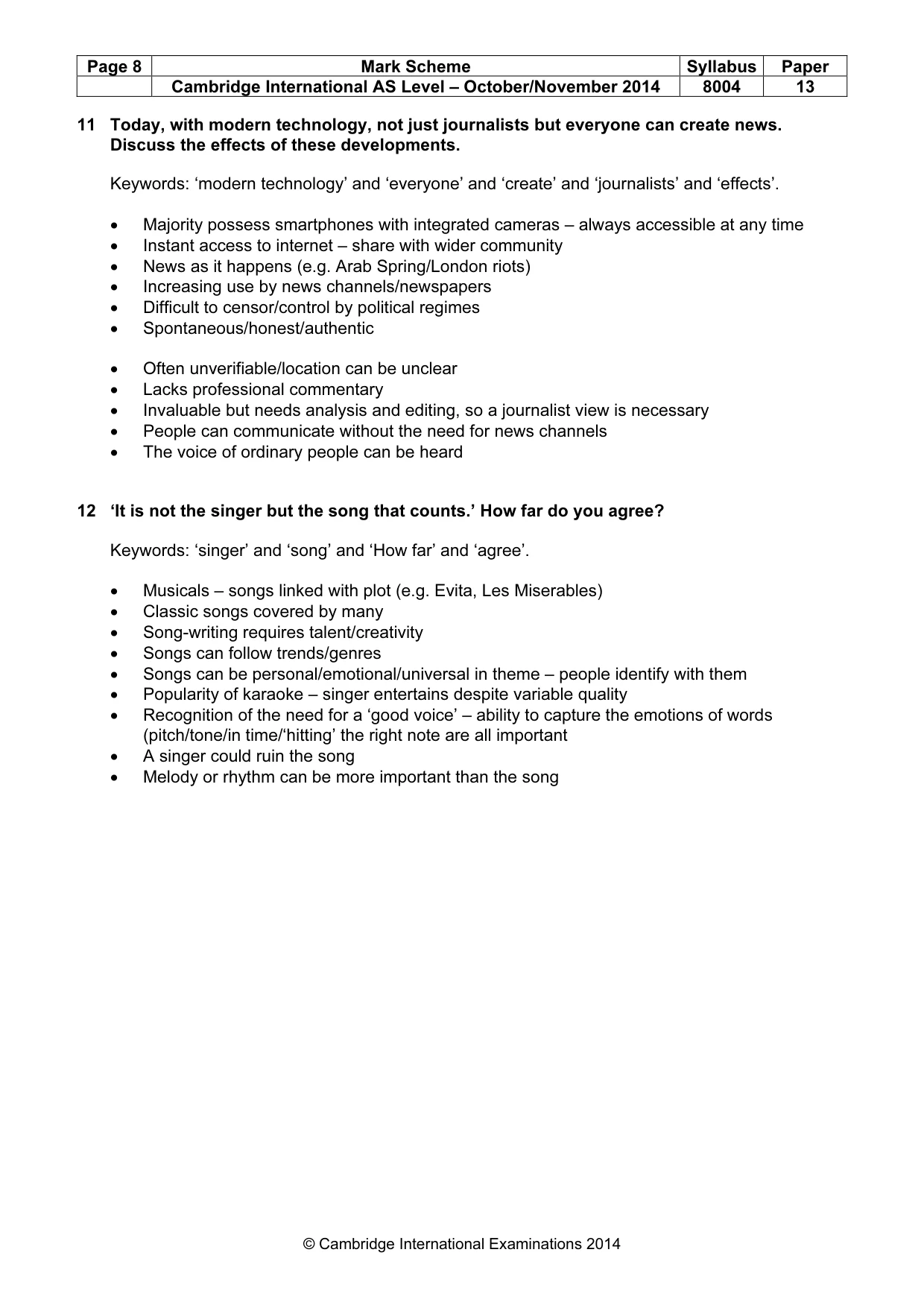
Page 8 Mark Scheme Syllabus Paper Cambridge International AS Level – October/November 2014 8004 13 © Cambridge International Examinations 2014 11 Today, with modern technology, not just journalists but everyone can create news. Discuss the effects of these developments. Keywords: ‘modern technology’ and ‘everyone’ and ‘create’ and ‘journalists’ and ‘effects’. • Majority possess smartphones with integrated cameras – always accessible at any time • Instant access to internet – share with wider community • News as it happens (e.g. Arab Spring/London riots) • Increasing use by news channels/newspapers • Difficult to censor/control by political regimes • Spontaneous/honest/authentic • Often unverifiable/location can be unclear • Lacks professional commentary • Invaluable but needs analysis and editing, so a journalist view is necessary • People can communicate without the need for news channels • The voice of ordinary people can be heard 12 ‘It is not the singer but the song that counts.’ How far do you agree? Keywords: ‘singer’ and ‘song’ and ‘How far’ and ‘agree’. • Musicals – songs linked with plot (e.g. Evita, Les Miserables) • Classic songs covered by many • Song-writing requires talent/creativity • Songs can follow trends/genres • Songs can be personal/emotional/universal in theme – people identify with them • Popularity of karaoke – singer entertains despite variable quality • Recognition of the need for a ‘good voice’ – ability to capture the emotions of words (pitch/tone/in time/‘hitting’ the right note are all important • A singer could ruin the song • Melody or rhythm can be more important than the song
What you needed in this session
Cambridge’s own grade thresholds for 2014 Oct/Nov, Paper 1 · Variant 3. A higher threshold means an easier paper — the bar moves with how the cohort did.