Cambridge A Level General Paper (AS Level only) 8004 — 2014 Oct/Nov Paper 1 · Variant 1
8004/11/O/N/14 · 100 marks · ≈113 min
The question paper and its mark scheme, free to read here and free to download. This is Cambridge’s own paper, exactly as it was sat.
Question paper4 pages

Mark scheme10 pages
Answers below. Sit the paper first if you are practising.
Paper as text
Question paper, page 1
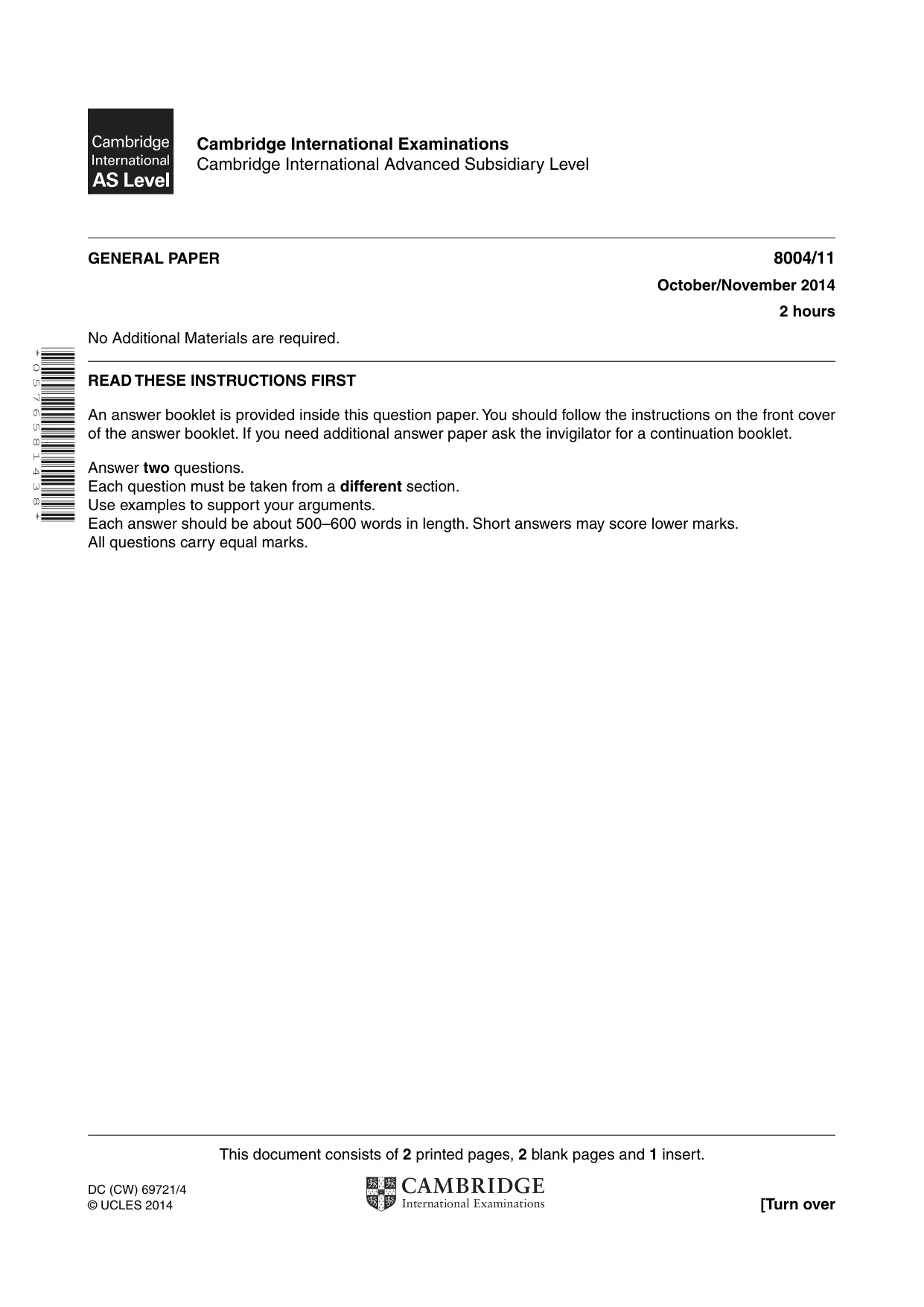
* 0 5 7 6 5 8 1 4 3 8 * This document consists of 2 printed pages, 2 blank pages and 1 insert. DC (CW) 69721/4 © UCLES 2014 [Turn over Cambridge International Examinations Cambridge International Advanced Subsidiary Level GENERAL PAPER 8004/11 October/November 2014 2 hours No Additional Materials are required. READ THESE INSTRUCTIONS FIRST An answer booklet is provided inside this question paper. You should follow the instructions on the front cover of the answer booklet. If you need additional answer paper ask the invigilator for a continuation booklet. Answer two questions. Each question must be taken from a different section. Use examples to support your arguments. Each answer should be about 500–600 words in length. Short answers may score lower marks. All questions carry equal marks.
Question paper, page 2
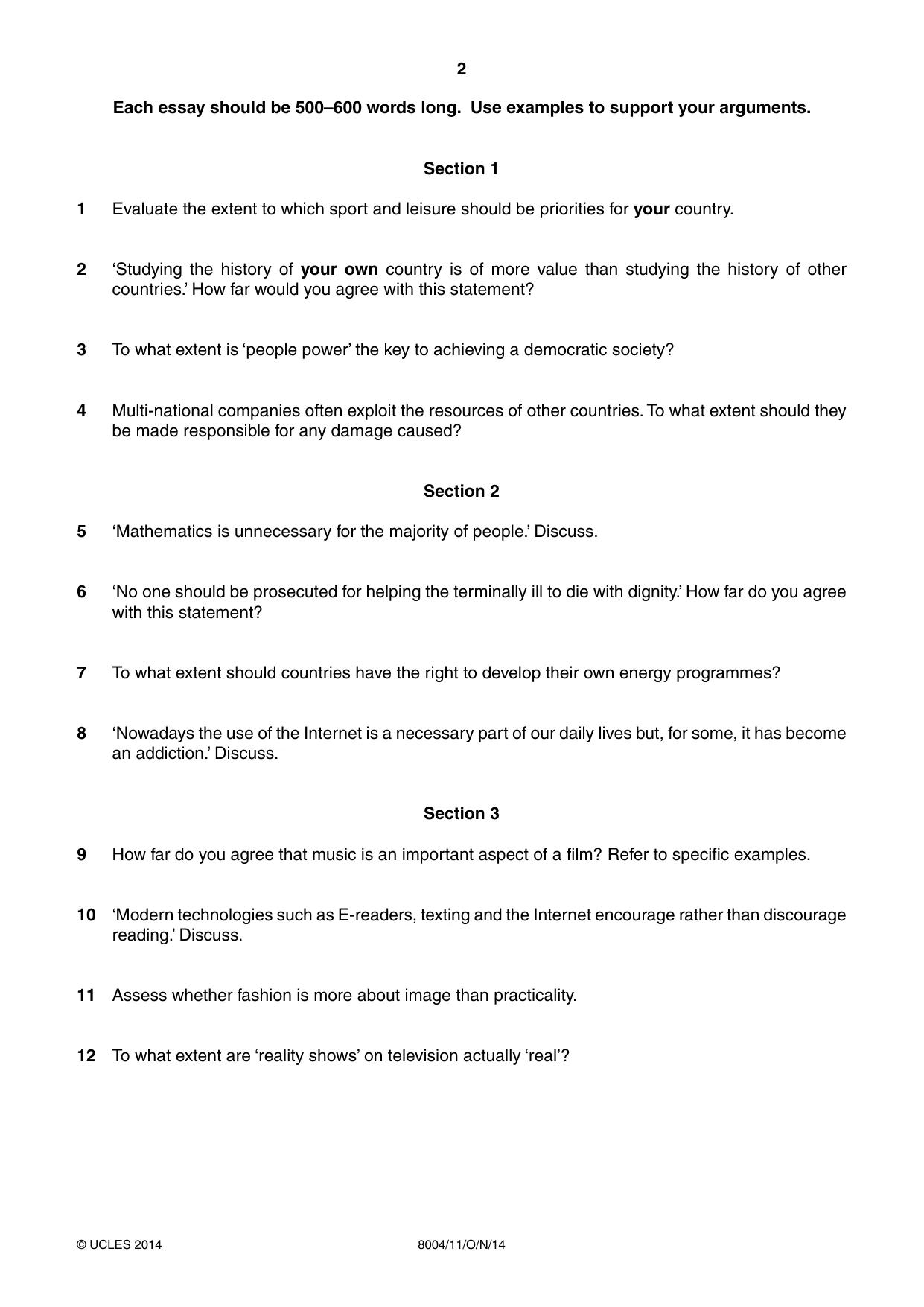
2 8004/11/O/N/14 © UCLES 2014 Each essay should be 500–600 words long. Use examples to support your arguments. Section 1 1 Evaluate the extent to which sport and leisure should be priorities for your country. 2 ‘Studying the history of your own country is of more value than studying the history of other countries.’ How far would you agree with this statement? 3 To what extent is ‘people power’ the key to achieving a democratic society? 4 Multi-national companies often exploit the resources of other countries. To what extent should they be made responsible for any damage caused? Section 2 5 ‘Mathematics is unnecessary for the majority of people.’ Discuss. 6 ‘No one should be prosecuted for helping the terminally ill to die with dignity.’ How far do you agree with this statement? 7 To what extent should countries have the right to develop their own energy programmes? 8 ‘Nowadays the use of the Internet is a necessary part of our daily lives but, for some, it has become an addiction.’ Discuss. Section 3 9 How far do you agree that music is an important aspect of a film? Refer to specific examples. 10 ‘Modern technologies such as E-readers, texting and the Internet encourage rather than discourage reading.’ Discuss. 11 Assess whether fashion is more about image than practicality. 12 To what extent are ‘reality shows’ on television actually ‘real’?
Question paper, page 3
3 8004/11/O/N/14 © UCLES 2014 BLANK PAGE
Question paper, page 4
4 8004/11/O/N/14 © UCLES 2014 BLANK PAGE Permission to reproduce items where third-party owned material protected by copyright is included has been sought and cleared where possible. Every reasonable effort has been made by the publisher (UCLES) to trace copyright holders, but if any items requiring clearance have unwittingly been included, the publisher will be pleased to make amends at the earliest possible opportunity. Cambridge International Examinations is part of the Cambridge Assessment Group. Cambridge Assessment is the brand name of University of Cambridge Local Examinations Syndicate (UCLES), which is itself a department of the University of Cambridge.
Mark scheme, page 1
® IGCSE is the registered trademark of Cambridge International Examinations. CAMBRIDGE INTERNATIONAL EXAMINATIONS Cambridge International Advanced Subsidiary Level MARK SCHEME for the October/November 2014 series 8004 GENERAL PAPER 8004/11 Paper 1, maximum raw mark 100 This mark scheme is published as an aid to teachers and candidates, to indicate the requirements of the examination. It shows the basis on which Examiners were instructed to award marks. It does not indicate the details of the discussions that took place at an Examiners’ meeting before marking began, which would have considered the acceptability of alternative answers. Mark schemes should be read in conjunction with the question paper and the Principal Examiner Report for Teachers. Cambridge will not enter into discussions about these mark schemes. Cambridge is publishing the mark schemes for the October/November 2014 series for most Cambridge IGCSE®, Cambridge International A and AS Level components and some Cambridge O Level components.
Mark scheme, page 2
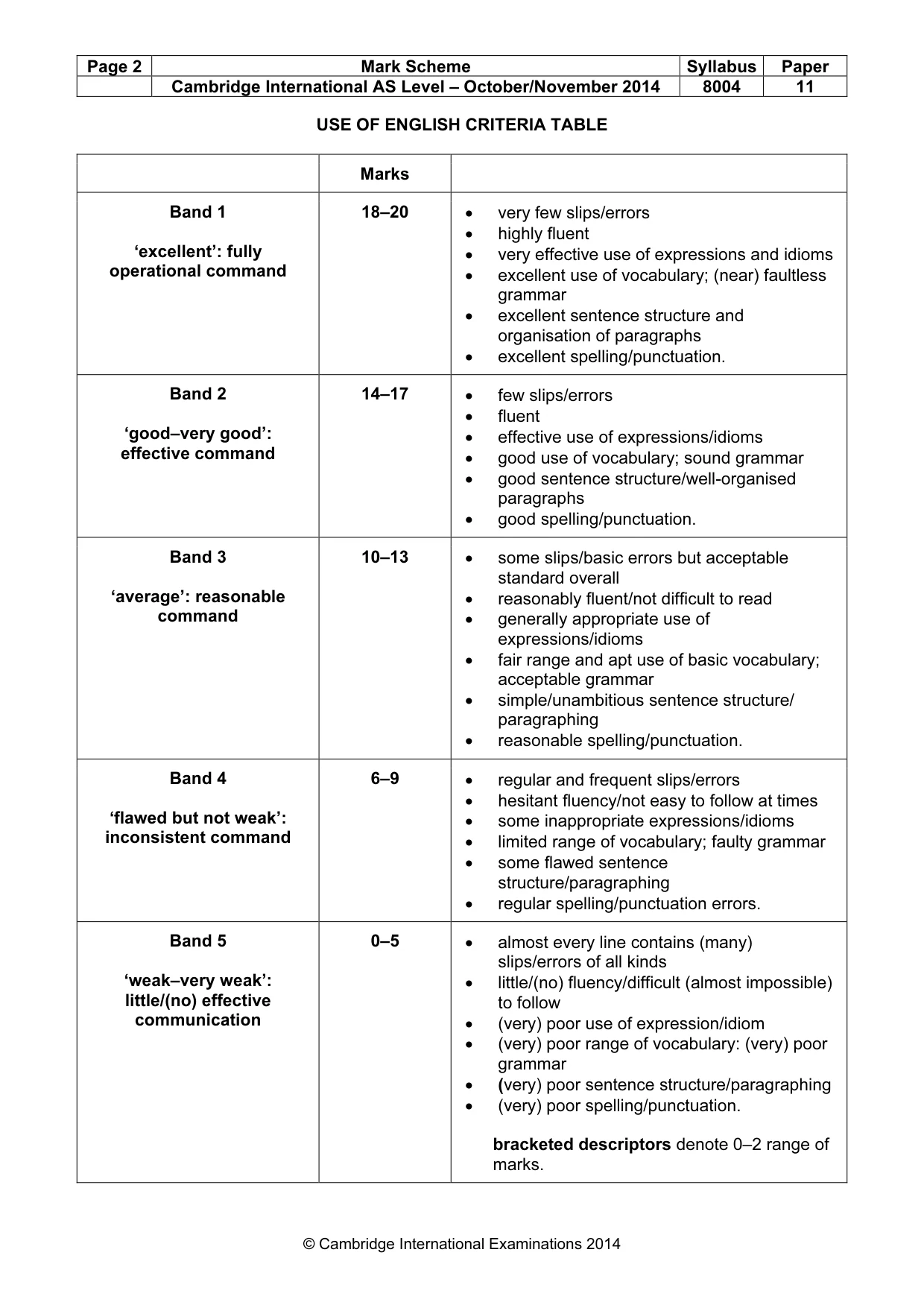
Page 2 Mark Scheme Syllabus Paper Cambridge International AS Level – October/November 2014 8004 11 © Cambridge International Examinations 2014 USE OF ENGLISH CRITERIA TABLE Marks Band 1 ‘excellent’: fully operational command 18–20 • very few slips/errors • highly fluent • very effective use of expressions and idioms • excellent use of vocabulary; (near) faultless grammar • excellent sentence structure and organisation of paragraphs • excellent spelling/punctuation. Band 2 ‘good–very good’: effective command 14–17 • few slips/errors • fluent • effective use of expressions/idioms • good use of vocabulary; sound grammar • good sentence structure/well-organised paragraphs • good spelling/punctuation. Band 3 ‘average’: reasonable command 10–13 • some slips/basic errors but acceptable standard overall • reasonably fluent/not difficult to read • generally appropriate use of expressions/idioms • fair range and apt use of basic vocabulary; acceptable grammar • simple/unambitious sentence structure/ paragraphing • reasonable spelling/punctuation. Band 4 ‘flawed but not weak’: inconsistent command 6–9 • regular and frequent slips/errors • hesitant fluency/not easy to follow at times • some inappropriate expressions/idioms • limited range of vocabulary; faulty grammar • some flawed sentence structure/paragraphing • regular spelling/punctuation errors. Band 5 ‘weak–very weak’: little/(no) effective communication 0–5 • almost every line contains (many) slips/errors of all kinds • little/(no) fluency/difficult (almost impossible) to follow • (very) poor use of expression/idiom • (very) poor range of vocabulary: (very) poor grammar • (very) poor sentence structure/paragraphing • (very) poor spelling/punctuation. bracketed descriptors denote 0–2 range of marks.
Mark scheme, page 3
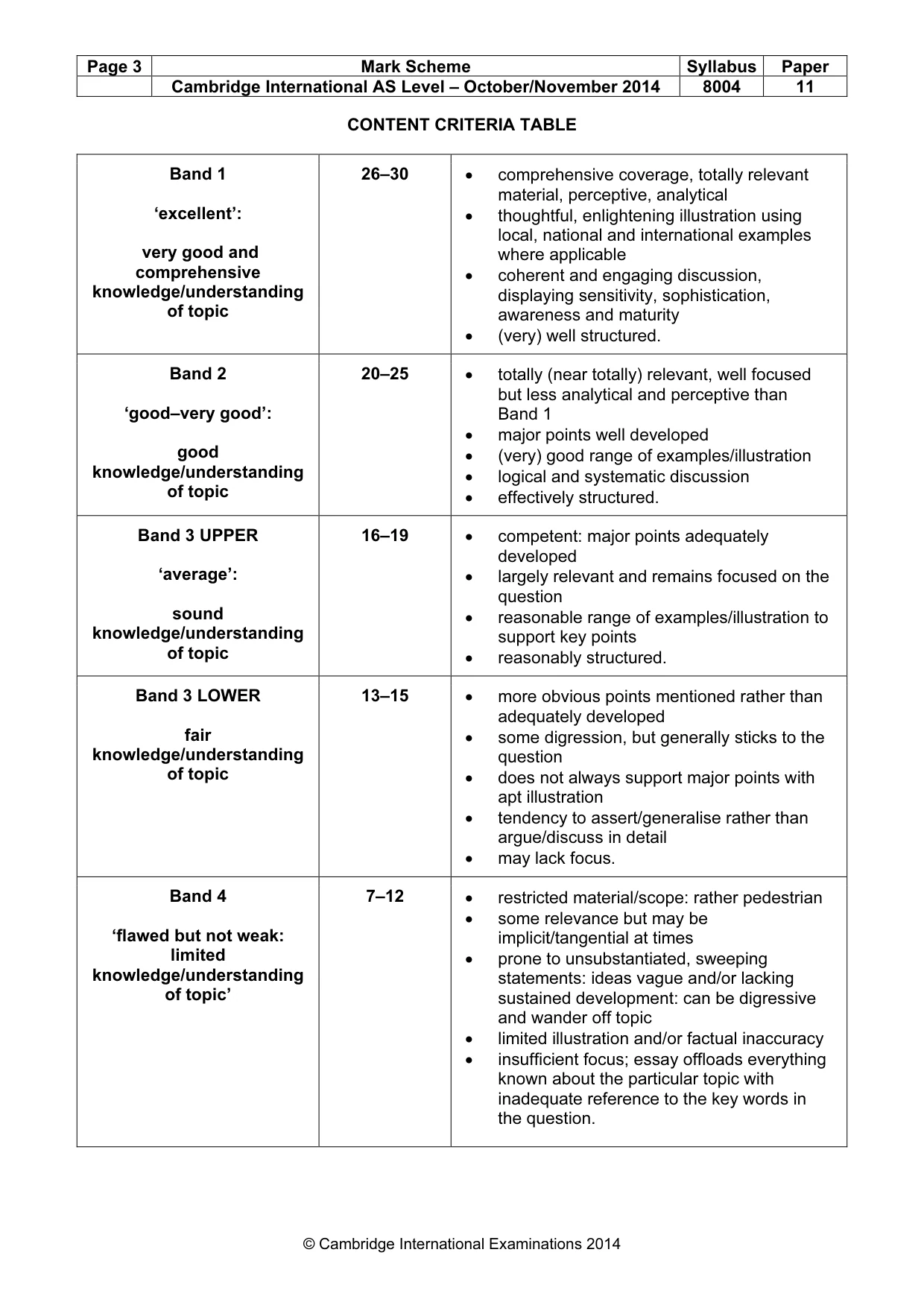
Page 3 Mark Scheme Syllabus Paper Cambridge International AS Level – October/November 2014 8004 11 © Cambridge International Examinations 2014 CONTENT CRITERIA TABLE Band 1 ‘excellent’: very good and comprehensive knowledge/understanding of topic 26–30 • comprehensive coverage, totally relevant material, perceptive, analytical • thoughtful, enlightening illustration using local, national and international examples where applicable • coherent and engaging discussion, displaying sensitivity, sophistication, awareness and maturity • (very) well structured. Band 2 ‘good–very good’: good knowledge/understanding of topic 20–25 • totally (near totally) relevant, well focused but less analytical and perceptive than Band 1 • major points well developed • (very) good range of examples/illustration • logical and systematic discussion • effectively structured. Band 3 UPPER ‘average’: sound knowledge/understanding of topic 16–19 • competent: major points adequately developed • largely relevant and remains focused on the question • reasonable range of examples/illustration to support key points • reasonably structured. Band 3 LOWER fair knowledge/understanding of topic 13–15 • more obvious points mentioned rather than adequately developed • some digression, but generally sticks to the question • does not always support major points with apt illustration • tendency to assert/generalise rather than argue/discuss in detail • may lack focus. Band 4 ‘flawed but not weak: limited knowledge/understanding of topic’ 7–12 • restricted material/scope: rather pedestrian • some relevance but may be implicit/tangential at times • prone to unsubstantiated, sweeping statements: ideas vague and/or lacking sustained development: can be digressive and wander off topic • limited illustration and/or factual inaccuracy • insufficient focus; essay offloads everything known about the particular topic with inadequate reference to the key words in the question.
Mark scheme, page 4
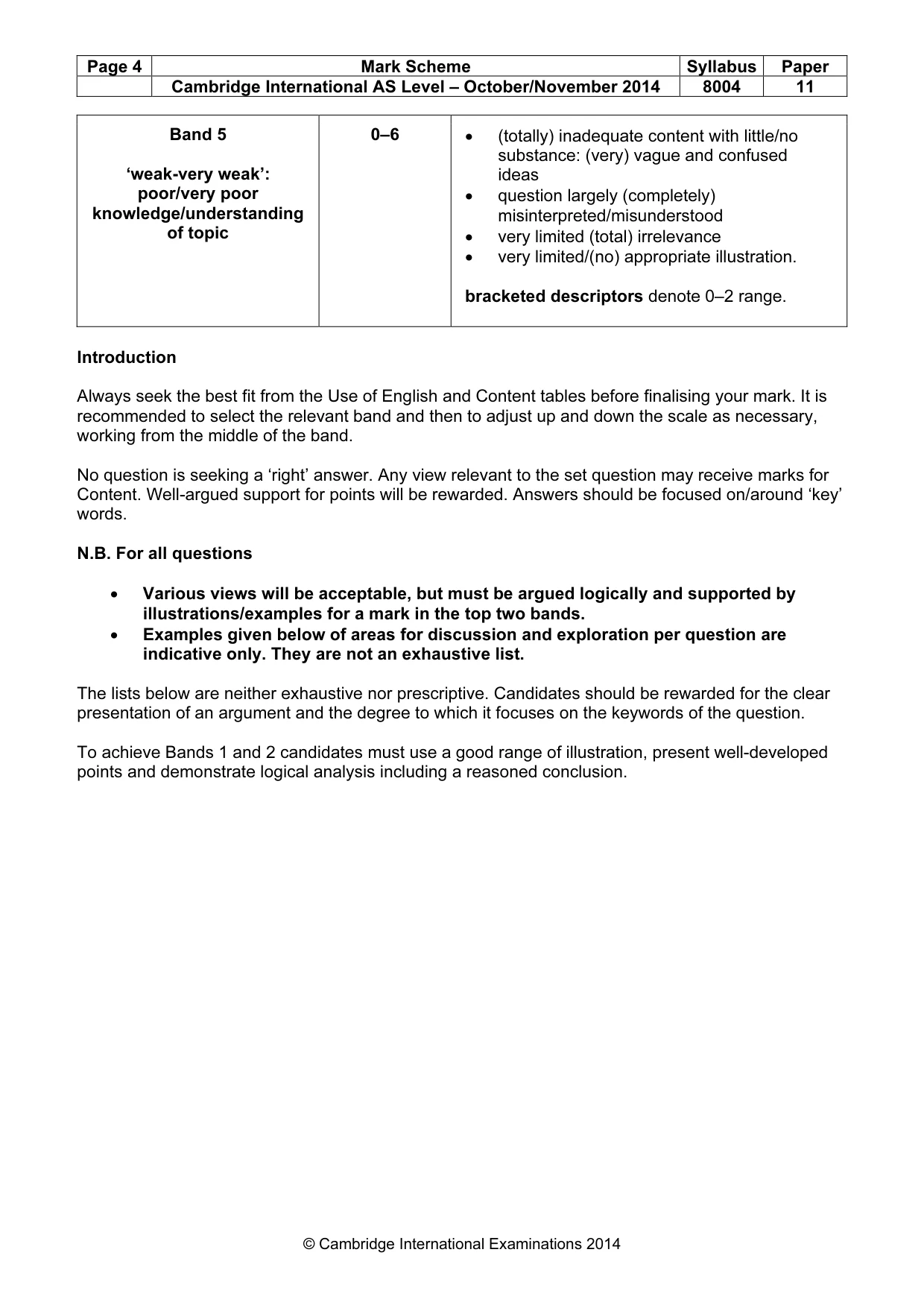
Page 4 Mark Scheme Syllabus Paper Cambridge International AS Level – October/November 2014 8004 11 © Cambridge International Examinations 2014 Band 5 ‘weak-very weak’: poor/very poor knowledge/understanding of topic 0–6 • (totally) inadequate content with little/no substance: (very) vague and confused ideas • question largely (completely) misinterpreted/misunderstood • very limited (total) irrelevance • very limited/(no) appropriate illustration. bracketed descriptors denote 0–2 range. Introduction Always seek the best fit from the Use of English and Content tables before finalising your mark. It is recommended to select the relevant band and then to adjust up and down the scale as necessary, working from the middle of the band. No question is seeking a ‘right’ answer. Any view relevant to the set question may receive marks for Content. Well-argued support for points will be rewarded. Answers should be focused on/around ‘key’ words. N.B. For all questions • Various views will be acceptable, but must be argued logically and supported by illustrations/examples for a mark in the top two bands. • Examples given below of areas for discussion and exploration per question are indicative only. They are not an exhaustive list. The lists below are neither exhaustive nor prescriptive. Candidates should be rewarded for the clear presentation of an argument and the degree to which it focuses on the keywords of the question. To achieve Bands 1 and 2 candidates must use a good range of illustration, present well-developed points and demonstrate logical analysis including a reasoned conclusion.
Mark scheme, page 5
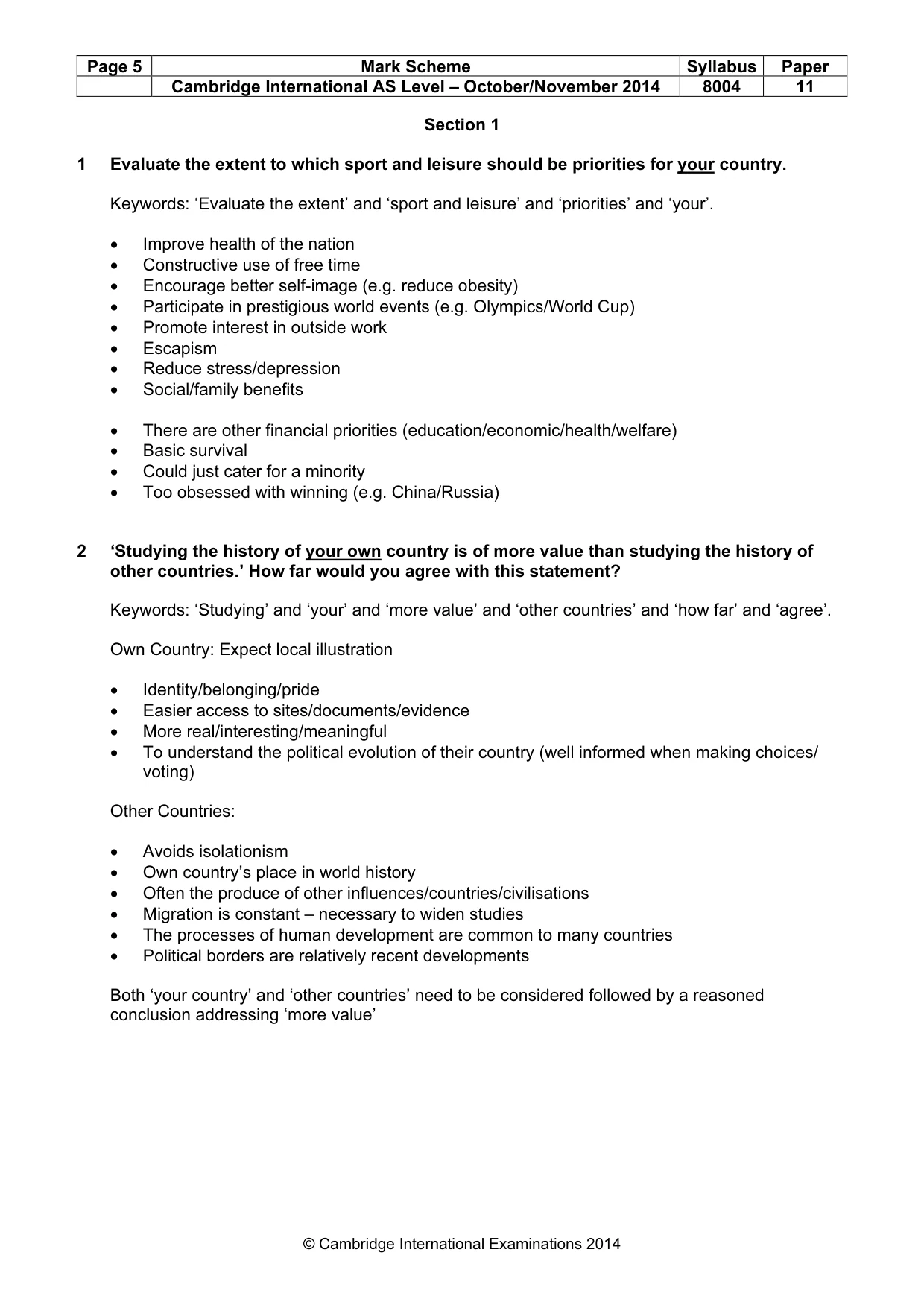
Page 5 Mark Scheme Syllabus Paper Cambridge International AS Level – October/November 2014 8004 11 © Cambridge International Examinations 2014 Section 1 1 Evaluate the extent to which sport and leisure should be priorities for your country. Keywords: ‘Evaluate the extent’ and ‘sport and leisure’ and ‘priorities’ and ‘your’. • Improve health of the nation • Constructive use of free time • Encourage better self-image (e.g. reduce obesity) • Participate in prestigious world events (e.g. Olympics/World Cup) • Promote interest in outside work • Escapism • Reduce stress/depression • Social/family benefits • There are other financial priorities (education/economic/health/welfare) • Basic survival • Could just cater for a minority • Too obsessed with winning (e.g. China/Russia) 2 ‘Studying the history of your own country is of more value than studying the history of other countries.’ How far would you agree with this statement? Keywords: ‘Studying’ and ‘your’ and ‘more value’ and ‘other countries’ and ‘how far’ and ‘agree’. Own Country: Expect local illustration • Identity/belonging/pride • Easier access to sites/documents/evidence • More real/interesting/meaningful • To understand the political evolution of their country (well informed when making choices/ voting) Other Countries: • Avoids isolationism • Own country’s place in world history • Often the produce of other influences/countries/civilisations • Migration is constant – necessary to widen studies • The processes of human development are common to many countries • Political borders are relatively recent developments Both ‘your country’ and ‘other countries’ need to be considered followed by a reasoned conclusion addressing ‘more value’
Mark scheme, page 6
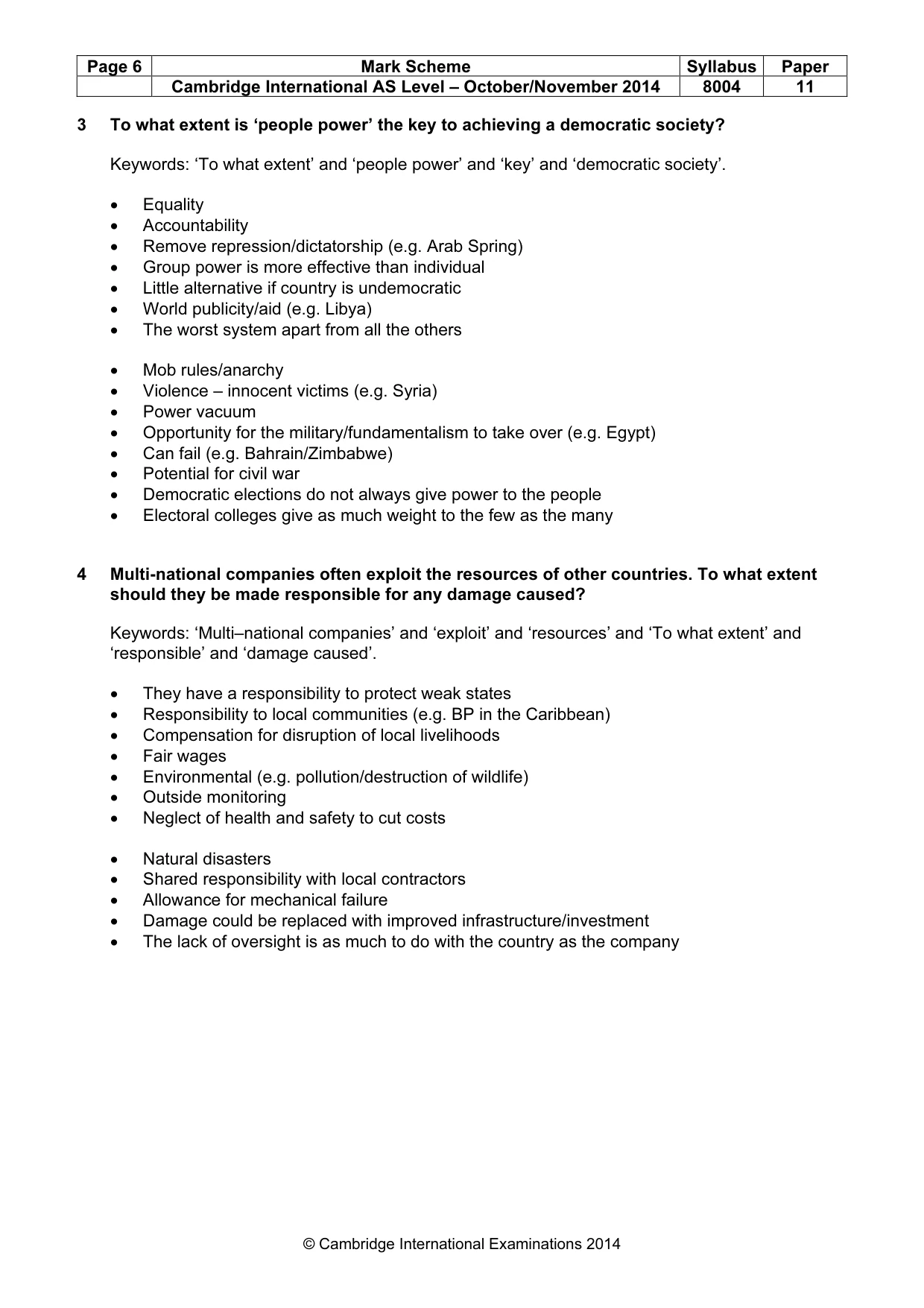
Page 6 Mark Scheme Syllabus Paper Cambridge International AS Level – October/November 2014 8004 11 © Cambridge International Examinations 2014 3 To what extent is ‘people power’ the key to achieving a democratic society? Keywords: ‘To what extent’ and ‘people power’ and ‘key’ and ‘democratic society’. • Equality • Accountability • Remove repression/dictatorship (e.g. Arab Spring) • Group power is more effective than individual • Little alternative if country is undemocratic • World publicity/aid (e.g. Libya) • The worst system apart from all the others • Mob rules/anarchy • Violence – innocent victims (e.g. Syria) • Power vacuum • Opportunity for the military/fundamentalism to take over (e.g. Egypt) • Can fail (e.g. Bahrain/Zimbabwe) • Potential for civil war • Democratic elections do not always give power to the people • Electoral colleges give as much weight to the few as the many 4 Multi-national companies often exploit the resources of other countries. To what extent should they be made responsible for any damage caused? Keywords: ‘Multi–national companies’ and ‘exploit’ and ‘resources’ and ‘To what extent’ and ‘responsible’ and ‘damage caused’. • They have a responsibility to protect weak states • Responsibility to local communities (e.g. BP in the Caribbean) • Compensation for disruption of local livelihoods • Fair wages • Environmental (e.g. pollution/destruction of wildlife) • Outside monitoring • Neglect of health and safety to cut costs • Natural disasters • Shared responsibility with local contractors • Allowance for mechanical failure • Damage could be replaced with improved infrastructure/investment • The lack of oversight is as much to do with the country as the company
Mark scheme, page 7
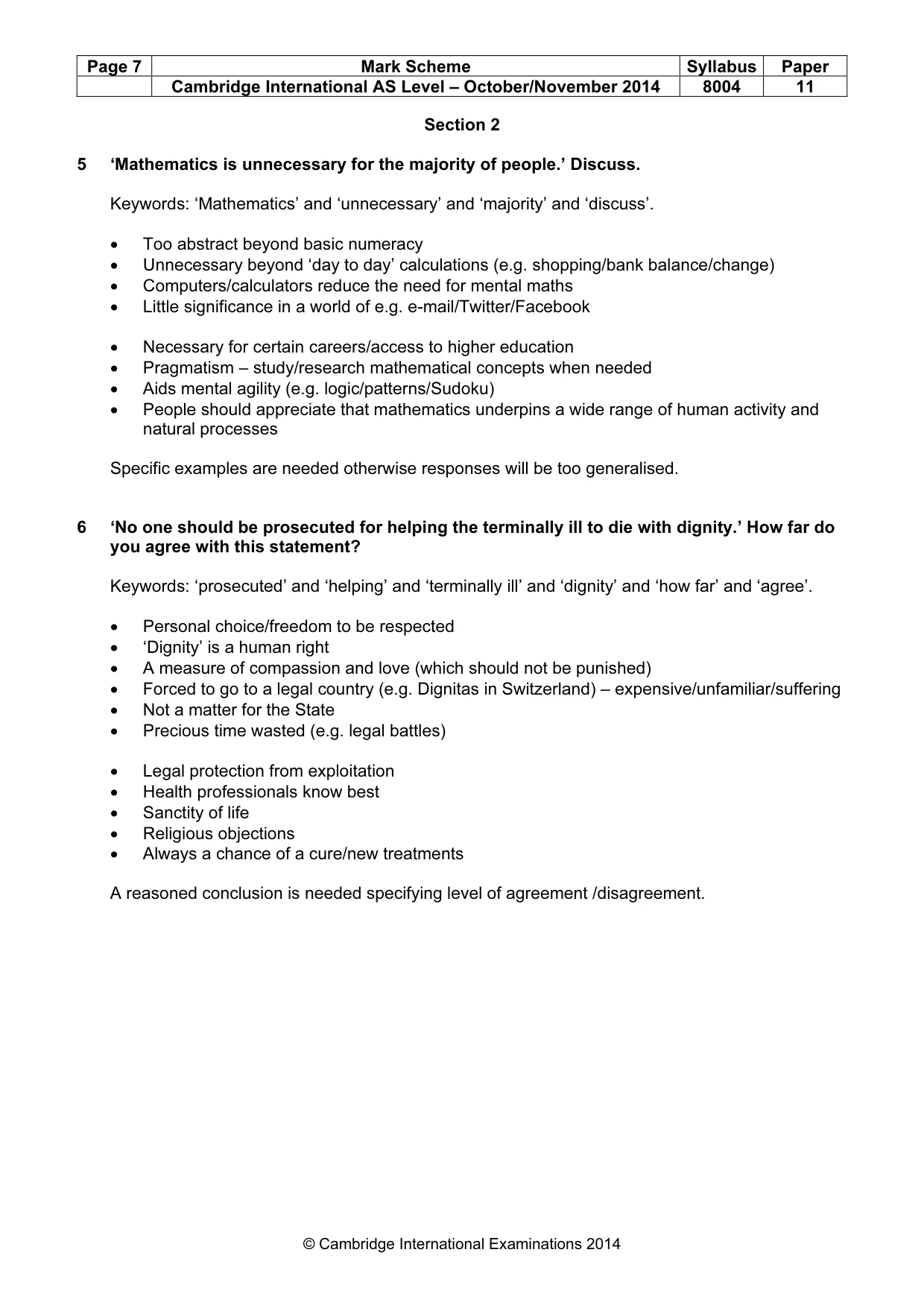
Page 7 Mark Scheme Syllabus Paper Cambridge International AS Level – October/November 2014 8004 11 © Cambridge International Examinations 2014 Section 2 5 ‘Mathematics is unnecessary for the majority of people.’ Discuss. Keywords: ‘Mathematics’ and ‘unnecessary’ and ‘majority’ and ‘discuss’. • Too abstract beyond basic numeracy • Unnecessary beyond ‘day to day’ calculations (e.g. shopping/bank balance/change) • Computers/calculators reduce the need for mental maths • Little significance in a world of e.g. e-mail/Twitter/Facebook • Necessary for certain careers/access to higher education • Pragmatism – study/research mathematical concepts when needed • Aids mental agility (e.g. logic/patterns/Sudoku) • People should appreciate that mathematics underpins a wide range of human activity and natural processes Specific examples are needed otherwise responses will be too generalised. 6 ‘No one should be prosecuted for helping the terminally ill to die with dignity.’ How far do you agree with this statement? Keywords: ‘prosecuted’ and ‘helping’ and ‘terminally ill’ and ‘dignity’ and ‘how far’ and ‘agree’. • Personal choice/freedom to be respected • ‘Dignity’ is a human right • A measure of compassion and love (which should not be punished) • Forced to go to a legal country (e.g. Dignitas in Switzerland) – expensive/unfamiliar/suffering • Not a matter for the State • Precious time wasted (e.g. legal battles) • Legal protection from exploitation • Health professionals know best • Sanctity of life • Religious objections • Always a chance of a cure/new treatments A reasoned conclusion is needed specifying level of agreement /disagreement.
Mark scheme, page 8
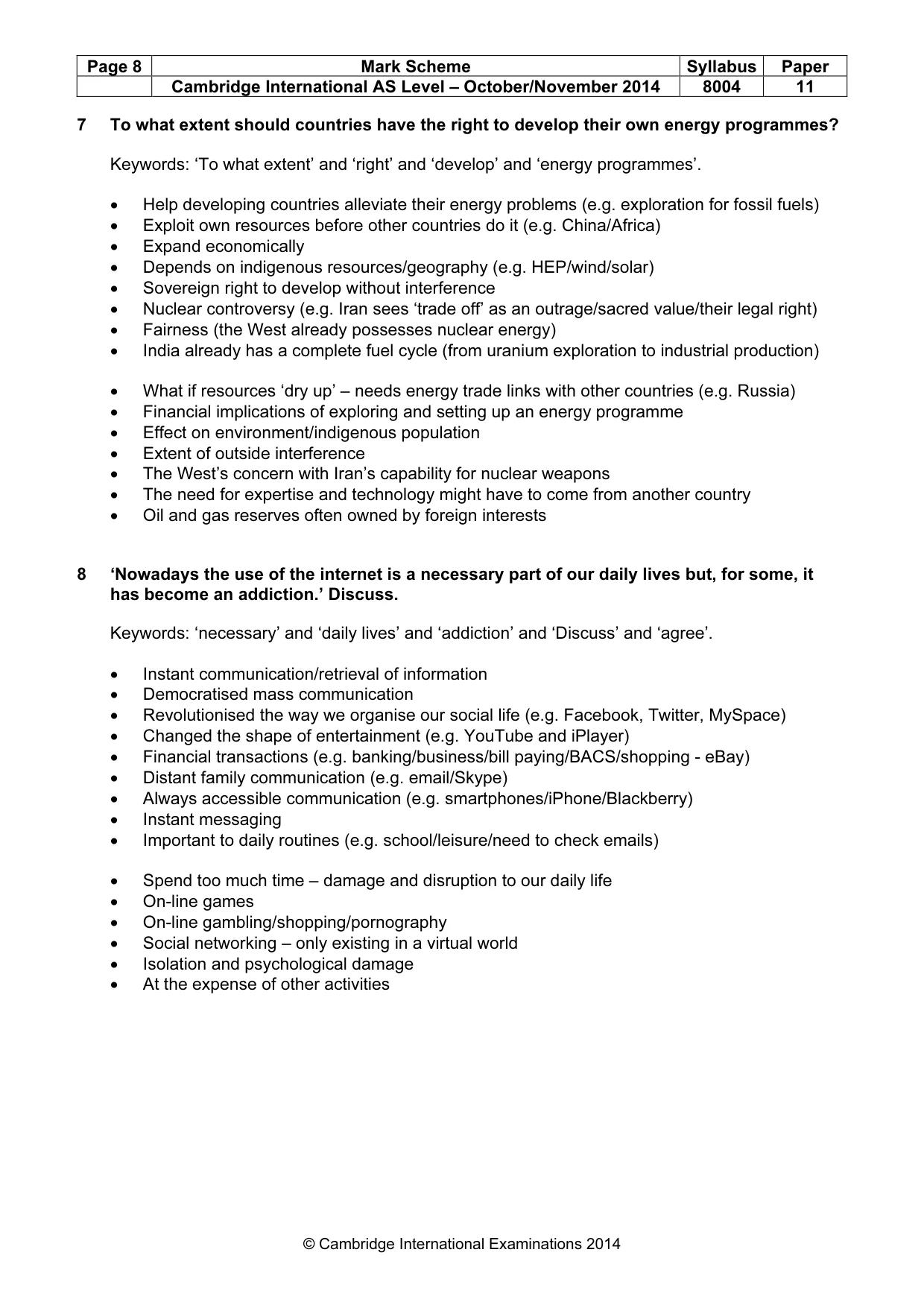
Page 8 Mark Scheme Syllabus Paper Cambridge International AS Level – October/November 2014 8004 11 © Cambridge International Examinations 2014 7 To what extent should countries have the right to develop their own energy programmes? Keywords: ‘To what extent’ and ‘right’ and ‘develop’ and ‘energy programmes’. • Help developing countries alleviate their energy problems (e.g. exploration for fossil fuels) • Exploit own resources before other countries do it (e.g. China/Africa) • Expand economically • Depends on indigenous resources/geography (e.g. HEP/wind/solar) • Sovereign right to develop without interference • Nuclear controversy (e.g. Iran sees ‘trade off’ as an outrage/sacred value/their legal right) • Fairness (the West already possesses nuclear energy) • India already has a complete fuel cycle (from uranium exploration to industrial production) • What if resources ‘dry up’ – needs energy trade links with other countries (e.g. Russia) • Financial implications of exploring and setting up an energy programme • Effect on environment/indigenous population • Extent of outside interference • The West’s concern with Iran’s capability for nuclear weapons • The need for expertise and technology might have to come from another country • Oil and gas reserves often owned by foreign interests 8 ‘Nowadays the use of the internet is a necessary part of our daily lives but, for some, it has become an addiction.’ Discuss. Keywords: ‘necessary’ and ‘daily lives’ and ‘addiction’ and ‘Discuss’ and ‘agree’. • Instant communication/retrieval of information • Democratised mass communication • Revolutionised the way we organise our social life (e.g. Facebook, Twitter, MySpace) • Changed the shape of entertainment (e.g. YouTube and iPlayer) • Financial transactions (e.g. banking/business/bill paying/BACS/shopping - eBay) • Distant family communication (e.g. email/Skype) • Always accessible communication (e.g. smartphones/iPhone/Blackberry) • Instant messaging • Important to daily routines (e.g. school/leisure/need to check emails) • Spend too much time – damage and disruption to our daily life • On-line games • On-line gambling/shopping/pornography • Social networking – only existing in a virtual world • Isolation and psychological damage • At the expense of other activities
Mark scheme, page 9
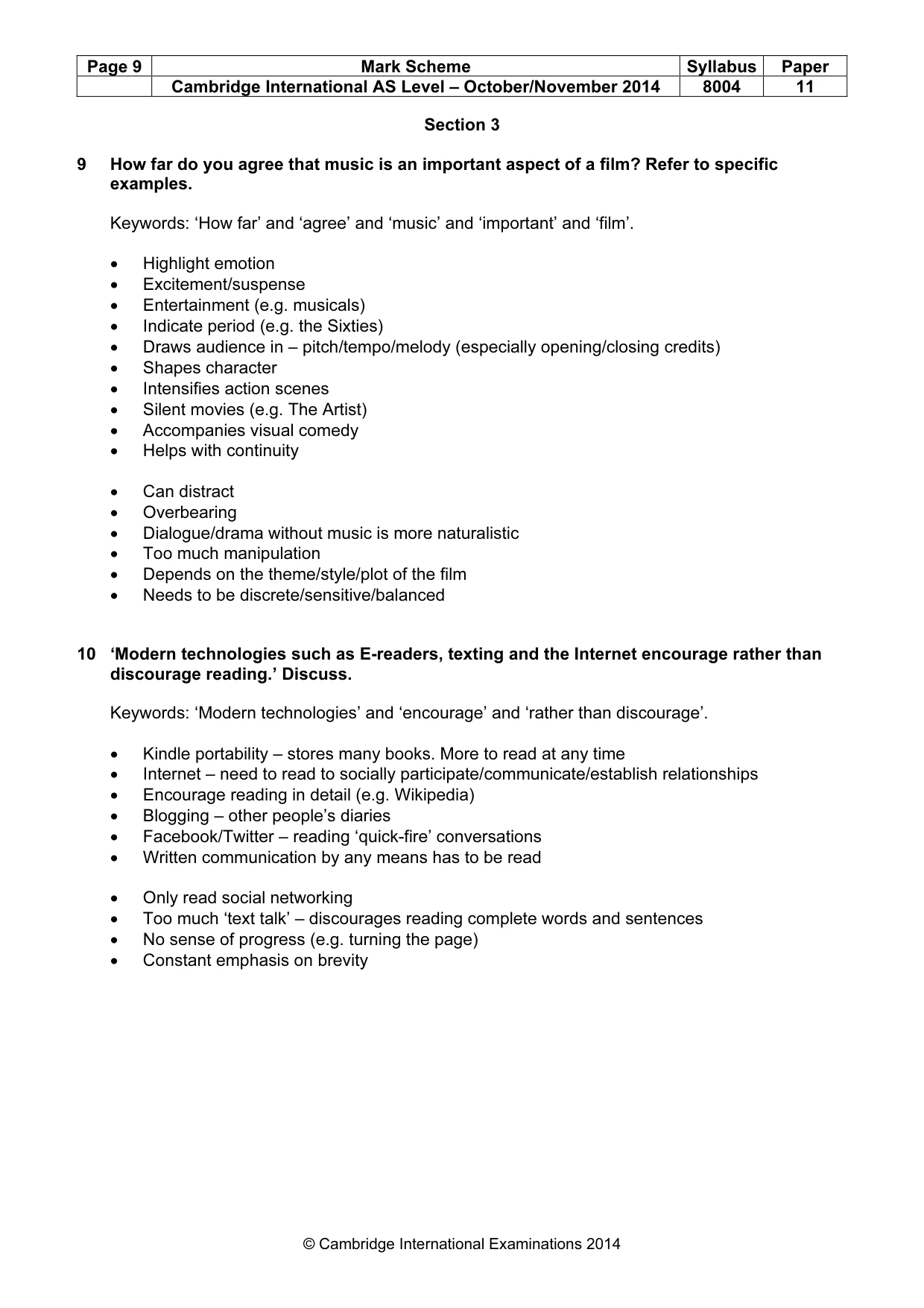
Page 9 Mark Scheme Syllabus Paper Cambridge International AS Level – October/November 2014 8004 11 © Cambridge International Examinations 2014 Section 3 9 How far do you agree that music is an important aspect of a film? Refer to specific examples. Keywords: ‘How far’ and ‘agree’ and ‘music’ and ‘important’ and ‘film’. • Highlight emotion • Excitement/suspense • Entertainment (e.g. musicals) • Indicate period (e.g. the Sixties) • Draws audience in – pitch/tempo/melody (especially opening/closing credits) • Shapes character • Intensifies action scenes • Silent movies (e.g. The Artist) • Accompanies visual comedy • Helps with continuity • Can distract • Overbearing • Dialogue/drama without music is more naturalistic • Too much manipulation • Depends on the theme/style/plot of the film • Needs to be discrete/sensitive/balanced 10 ‘Modern technologies such as E-readers, texting and the Internet encourage rather than discourage reading.’ Discuss. Keywords: ‘Modern technologies’ and ‘encourage’ and ‘rather than discourage’. • Kindle portability – stores many books. More to read at any time • Internet – need to read to socially participate/communicate/establish relationships • Encourage reading in detail (e.g. Wikipedia) • Blogging – other people’s diaries • Facebook/Twitter – reading ‘quick-fire’ conversations • Written communication by any means has to be read • Only read social networking • Too much ‘text talk’ – discourages reading complete words and sentences • No sense of progress (e.g. turning the page) • Constant emphasis on brevity
Mark scheme, page 10
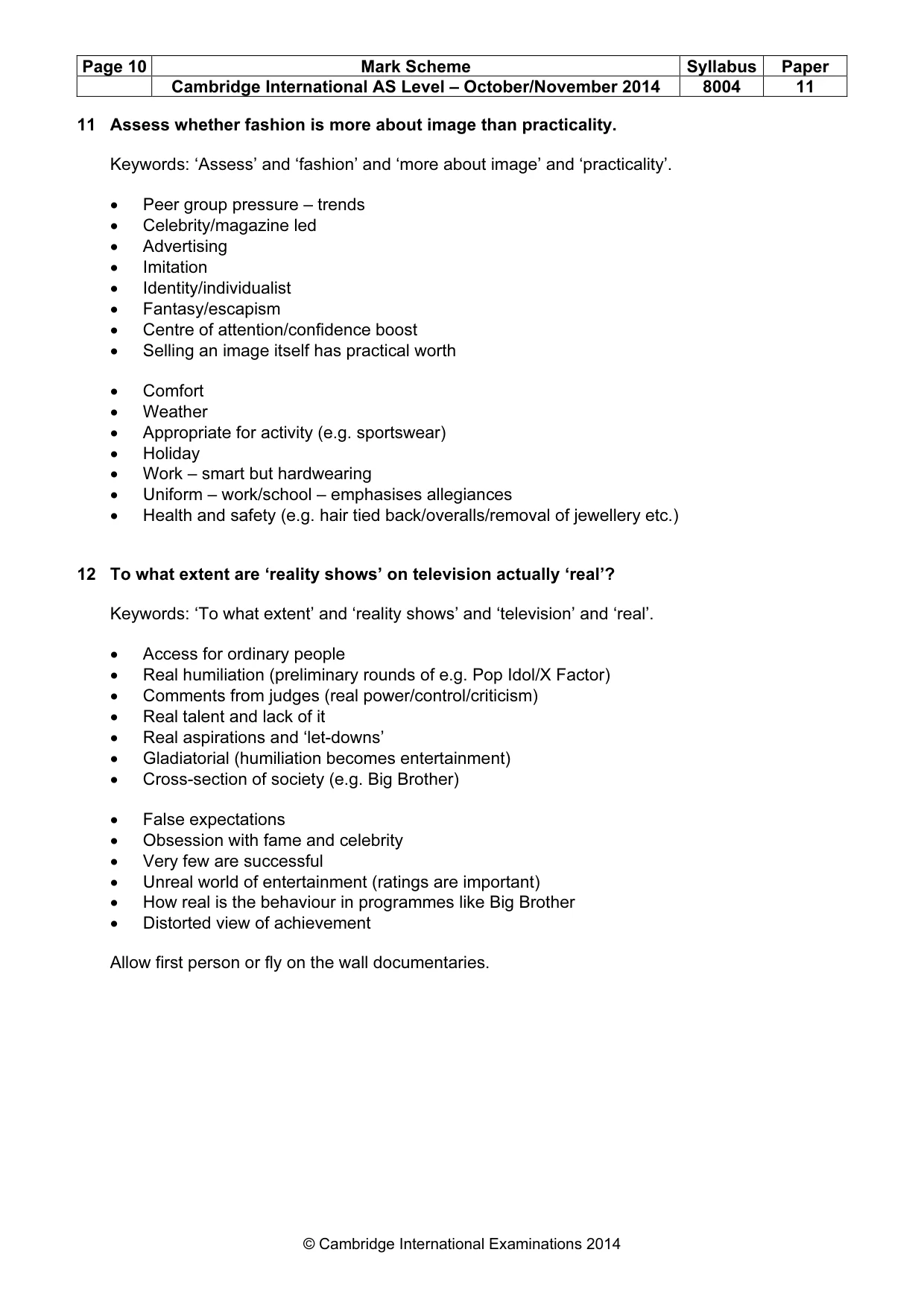
Page 10 Mark Scheme Syllabus Paper Cambridge International AS Level – October/November 2014 8004 11 © Cambridge International Examinations 2014 11 Assess whether fashion is more about image than practicality. Keywords: ‘Assess’ and ‘fashion’ and ‘more about image’ and ‘practicality’. • Peer group pressure – trends • Celebrity/magazine led • Advertising • Imitation • Identity/individualist • Fantasy/escapism • Centre of attention/confidence boost • Selling an image itself has practical worth • Comfort • Weather • Appropriate for activity (e.g. sportswear) • Holiday • Work – smart but hardwearing • Uniform – work/school – emphasises allegiances • Health and safety (e.g. hair tied back/overalls/removal of jewellery etc.) 12 To what extent are ‘reality shows’ on television actually ‘real’? Keywords: ‘To what extent’ and ‘reality shows’ and ‘television’ and ‘real’. • Access for ordinary people • Real humiliation (preliminary rounds of e.g. Pop Idol/X Factor) • Comments from judges (real power/control/criticism) • Real talent and lack of it • Real aspirations and ‘let-downs’ • Gladiatorial (humiliation becomes entertainment) • Cross-section of society (e.g. Big Brother) • False expectations • Obsession with fame and celebrity • Very few are successful • Unreal world of entertainment (ratings are important) • How real is the behaviour in programmes like Big Brother • Distorted view of achievement Allow first person or fly on the wall documentaries.
What you needed in this session
Cambridge’s own grade thresholds for 2014 Oct/Nov, Paper 1 · Variant 1. A higher threshold means an easier paper — the bar moves with how the cohort did.