Cambridge A Level General Paper (AS Level only) 8004 — 2014 Oct/Nov Paper 1 · Variant 2
8004/12/O/N/14 · 100 marks · ≈113 min
The question paper and its mark scheme, free to read here and free to download. This is Cambridge’s own paper, exactly as it was sat.
Question paper4 pages

Mark scheme10 pages
Answers below. Sit the paper first if you are practising.
Paper as text
Question paper, page 1
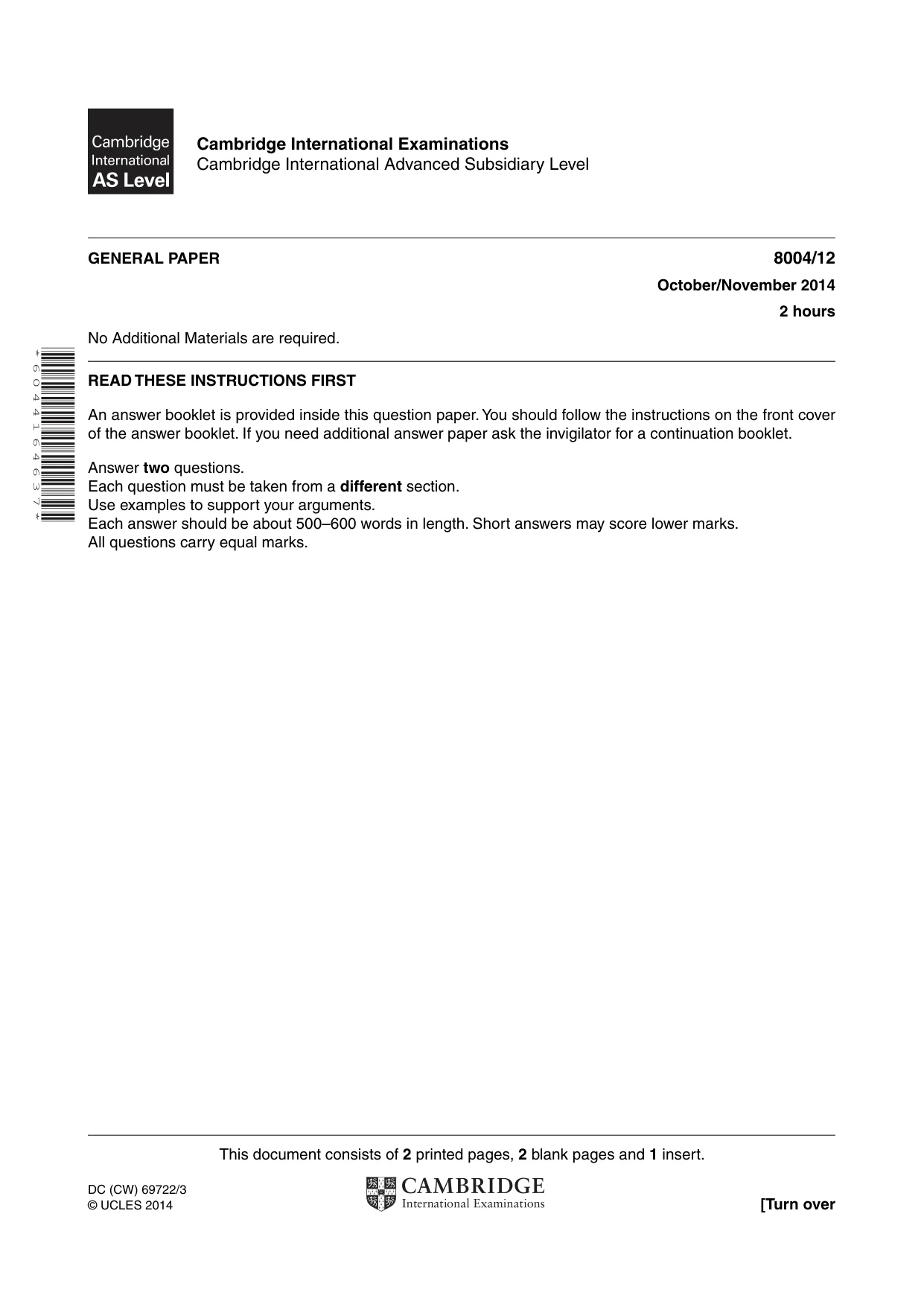
This document consists of 2 printed pages, 2 blank pages and 1 insert. DC (CW) 69722/3 © UCLES 2014 [Turn over Cambridge International Examinations Cambridge International Advanced Subsidiary Level * 6 0 4 4 1 6 4 6 3 7 * GENERAL PAPER 8004/12 October/November 2014 2 hours No Additional Materials are required. READ THESE INSTRUCTIONS FIRST An answer booklet is provided inside this question paper. You should follow the instructions on the front cover of the answer booklet. If you need additional answer paper ask the invigilator for a continuation booklet. Answer two questions. Each question must be taken from a different section. Use examples to support your arguments. Each answer should be about 500–600 words in length. Short answers may score lower marks. All questions carry equal marks.
Question paper, page 2
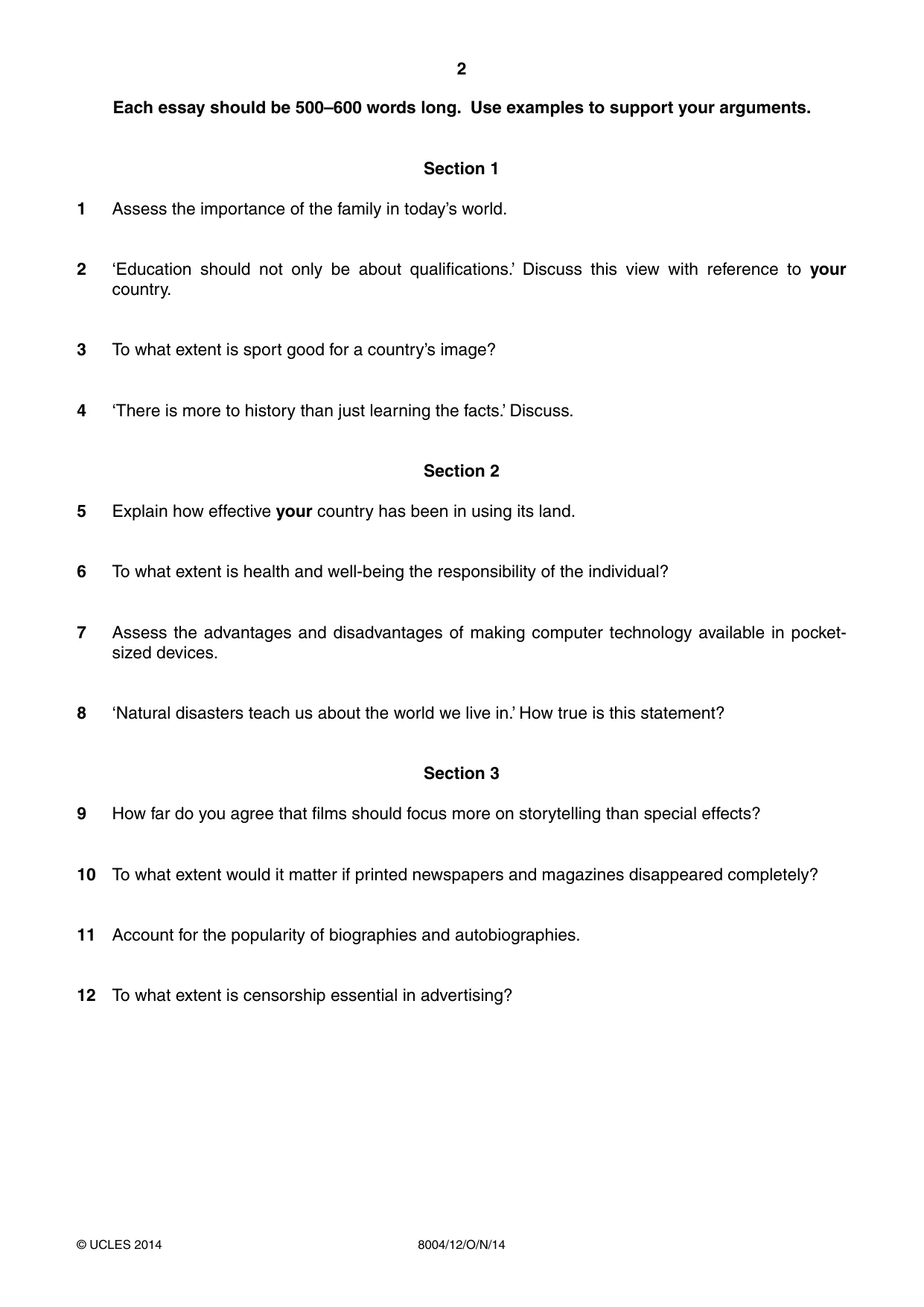
2 8004/12/O/N/14 © UCLES 2014 Each essay should be 500–600 words long. Use examples to support your arguments. Section 1 1 Assess the importance of the family in today’s world. 2 ‘Education should not only be about qualifications.’ Discuss this view with reference to your country. 3 To what extent is sport good for a country’s image? 4 ‘There is more to history than just learning the facts.’ Discuss. Section 2 5 Explain how effective your country has been in using its land. 6 To what extent is health and well-being the responsibility of the individual? 7 Assess the advantages and disadvantages of making computer technology available in pocket- sized devices. 8 ‘Natural disasters teach us about the world we live in.’ How true is this statement? Section 3 9 How far do you agree that films should focus more on storytelling than special effects? 10 To what extent would it matter if printed newspapers and magazines disappeared completely? 11 Account for the popularity of biographies and autobiographies. 12 To what extent is censorship essential in advertising?
Question paper, page 3
3 8004/12/O/N/14 © UCLES 2014 BLANK PAGE
Question paper, page 4
4 8004/12/O/N/14 © UCLES 2014 BLANK PAGE Permission to reproduce items where third-party owned material protected by copyright is included has been sought and cleared where possible. Every reasonable effort has been made by the publisher (UCLES) to trace copyright holders, but if any items requiring clearance have unwittingly been included, the publisher will be pleased to make amends at the earliest possible opportunity. Cambridge International Examinations is part of the Cambridge Assessment Group. Cambridge Assessment is the brand name of University of Cambridge Local Examinations Syndicate (UCLES), which is itself a department of the University of Cambridge.
Mark scheme, page 1
® IGCSE is the registered trademark of Cambridge International Examinations. CAMBRIDGE INTERNATIONAL EXAMINATIONS Cambridge International Advanced Subsidiary Level MARK SCHEME for the October/November 2014 series 8004 GENERAL PAPER 8004/12 Paper 1, maximum raw mark 100 This mark scheme is published as an aid to teachers and candidates, to indicate the requirements of the examination. It shows the basis on which Examiners were instructed to award marks. It does not indicate the details of the discussions that took place at an Examiners’ meeting before marking began, which would have considered the acceptability of alternative answers. Mark schemes should be read in conjunction with the question paper and the Principal Examiner Report for Teachers. Cambridge will not enter into discussions about these mark schemes. Cambridge is publishing the mark schemes for the October/November 2014 series for most Cambridge IGCSE®, Cambridge International A and AS Level components and some Cambridge O Level components.
Mark scheme, page 2
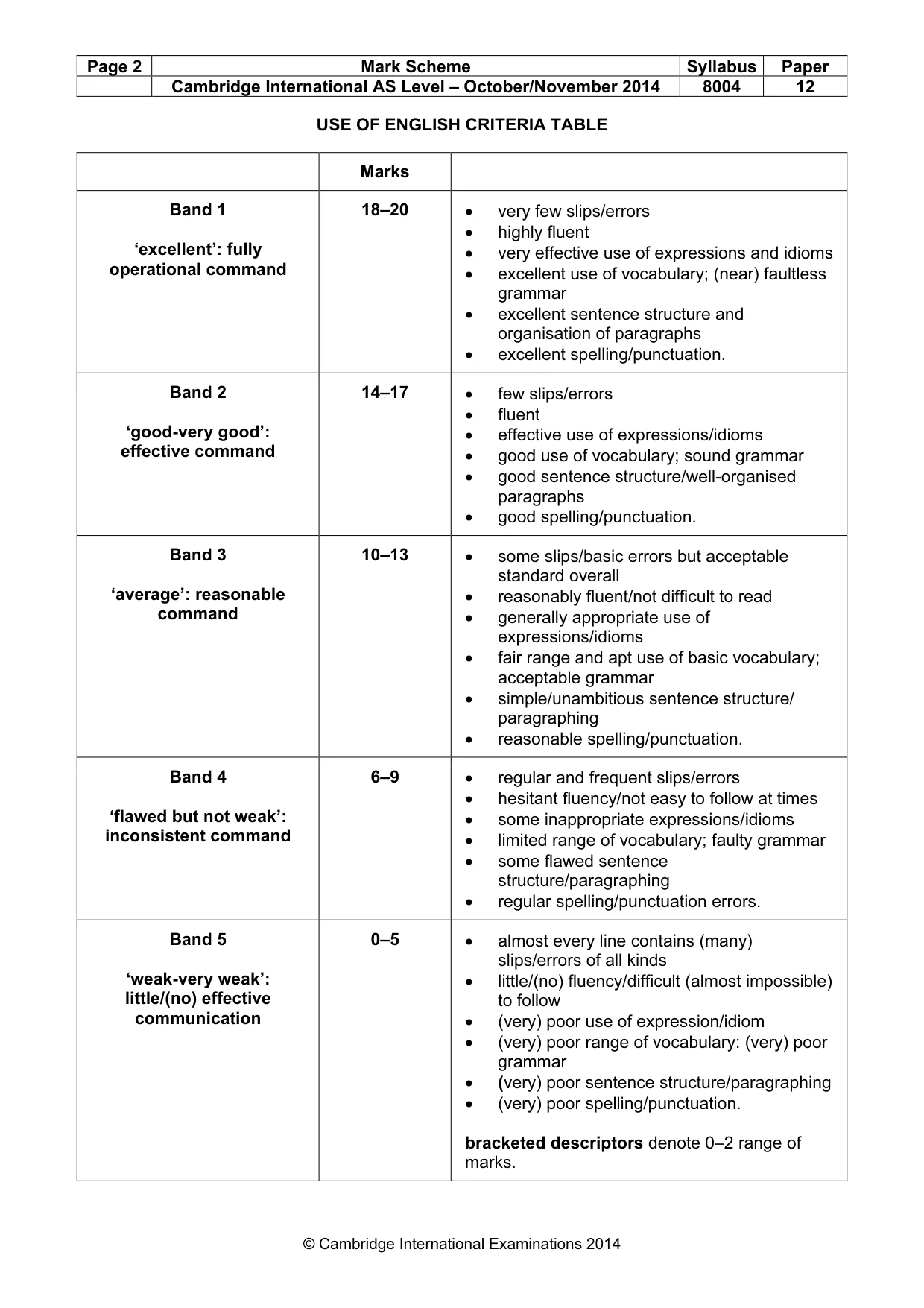
Page 2 Mark Scheme Syllabus Paper Cambridge International AS Level – October/November 2014 8004 12 © Cambridge International Examinations 2014 USE OF ENGLISH CRITERIA TABLE Marks Band 1 ‘excellent’: fully operational command 18–20 • very few slips/errors • highly fluent • very effective use of expressions and idioms • excellent use of vocabulary; (near) faultless grammar • excellent sentence structure and organisation of paragraphs • excellent spelling/punctuation. Band 2 ‘good-very good’: effective command 14–17 • few slips/errors • fluent • effective use of expressions/idioms • good use of vocabulary; sound grammar • good sentence structure/well-organised paragraphs • good spelling/punctuation. Band 3 ‘average’: reasonable command 10–13 • some slips/basic errors but acceptable standard overall • reasonably fluent/not difficult to read • generally appropriate use of expressions/idioms • fair range and apt use of basic vocabulary; acceptable grammar • simple/unambitious sentence structure/ paragraphing • reasonable spelling/punctuation. Band 4 ‘flawed but not weak’: inconsistent command 6–9 • regular and frequent slips/errors • hesitant fluency/not easy to follow at times • some inappropriate expressions/idioms • limited range of vocabulary; faulty grammar • some flawed sentence structure/paragraphing • regular spelling/punctuation errors. Band 5 ‘weak-very weak’: little/(no) effective communication 0–5 • almost every line contains (many) slips/errors of all kinds • little/(no) fluency/difficult (almost impossible) to follow • (very) poor use of expression/idiom • (very) poor range of vocabulary: (very) poor grammar • (very) poor sentence structure/paragraphing • (very) poor spelling/punctuation. bracketed descriptors denote 0–2 range of marks.
Mark scheme, page 3
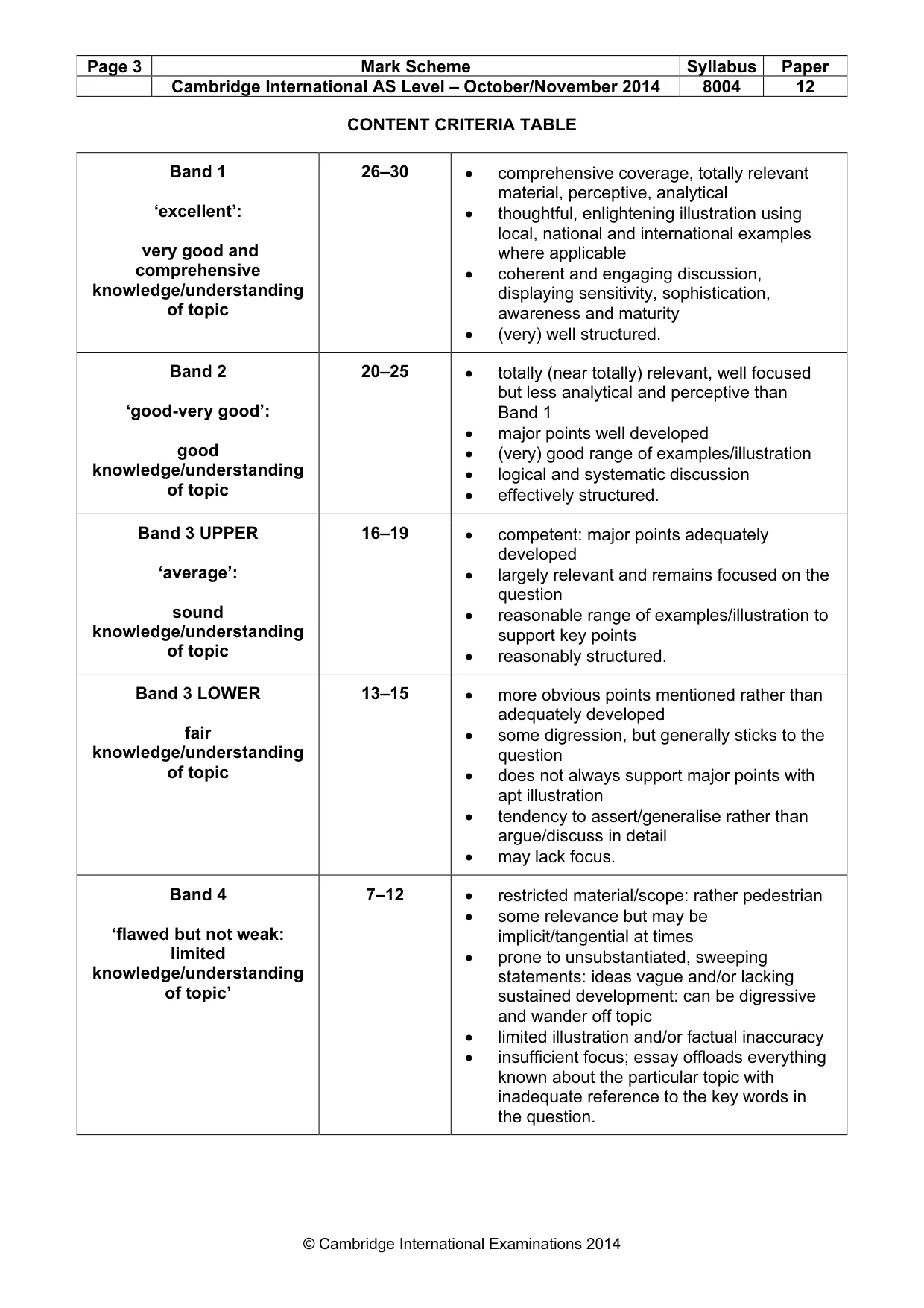
Page 3 Mark Scheme Syllabus Paper Cambridge International AS Level – October/November 2014 8004 12 © Cambridge International Examinations 2014 CONTENT CRITERIA TABLE Band 1 ‘excellent’: very good and comprehensive knowledge/understanding of topic 26–30 • comprehensive coverage, totally relevant material, perceptive, analytical • thoughtful, enlightening illustration using local, national and international examples where applicable • coherent and engaging discussion, displaying sensitivity, sophistication, awareness and maturity • (very) well structured. Band 2 ‘good-very good’: good knowledge/understanding of topic 20–25 • totally (near totally) relevant, well focused but less analytical and perceptive than Band 1 • major points well developed • (very) good range of examples/illustration • logical and systematic discussion • effectively structured. Band 3 UPPER ‘average’: sound knowledge/understanding of topic 16–19 • competent: major points adequately developed • largely relevant and remains focused on the question • reasonable range of examples/illustration to support key points • reasonably structured. Band 3 LOWER fair knowledge/understanding of topic 13–15 • more obvious points mentioned rather than adequately developed • some digression, but generally sticks to the question • does not always support major points with apt illustration • tendency to assert/generalise rather than argue/discuss in detail • may lack focus. Band 4 ‘flawed but not weak: limited knowledge/understanding of topic’ 7–12 • restricted material/scope: rather pedestrian • some relevance but may be implicit/tangential at times • prone to unsubstantiated, sweeping statements: ideas vague and/or lacking sustained development: can be digressive and wander off topic • limited illustration and/or factual inaccuracy • insufficient focus; essay offloads everything known about the particular topic with inadequate reference to the key words in the question.
Mark scheme, page 4
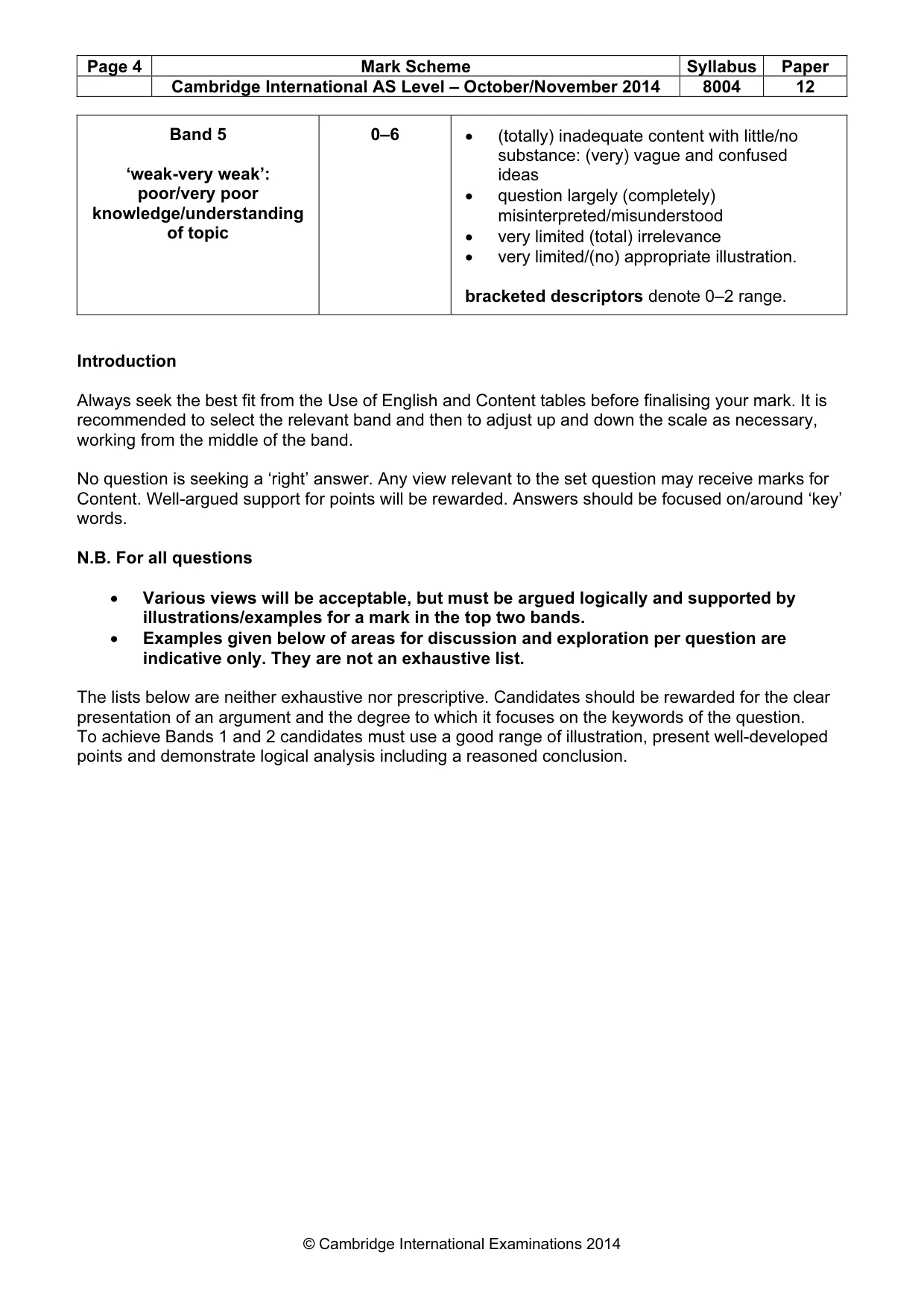
Page 4 Mark Scheme Syllabus Paper Cambridge International AS Level – October/November 2014 8004 12 © Cambridge International Examinations 2014 Band 5 ‘weak-very weak’: poor/very poor knowledge/understanding of topic 0–6 • (totally) inadequate content with little/no substance: (very) vague and confused ideas • question largely (completely) misinterpreted/misunderstood • very limited (total) irrelevance • very limited/(no) appropriate illustration. bracketed descriptors denote 0–2 range. Introduction Always seek the best fit from the Use of English and Content tables before finalising your mark. It is recommended to select the relevant band and then to adjust up and down the scale as necessary, working from the middle of the band. No question is seeking a ‘right’ answer. Any view relevant to the set question may receive marks for Content. Well-argued support for points will be rewarded. Answers should be focused on/around ‘key’ words. N.B. For all questions • Various views will be acceptable, but must be argued logically and supported by illustrations/examples for a mark in the top two bands. • Examples given below of areas for discussion and exploration per question are indicative only. They are not an exhaustive list. The lists below are neither exhaustive nor prescriptive. Candidates should be rewarded for the clear presentation of an argument and the degree to which it focuses on the keywords of the question. To achieve Bands 1 and 2 candidates must use a good range of illustration, present well-developed points and demonstrate logical analysis including a reasoned conclusion.
Mark scheme, page 5
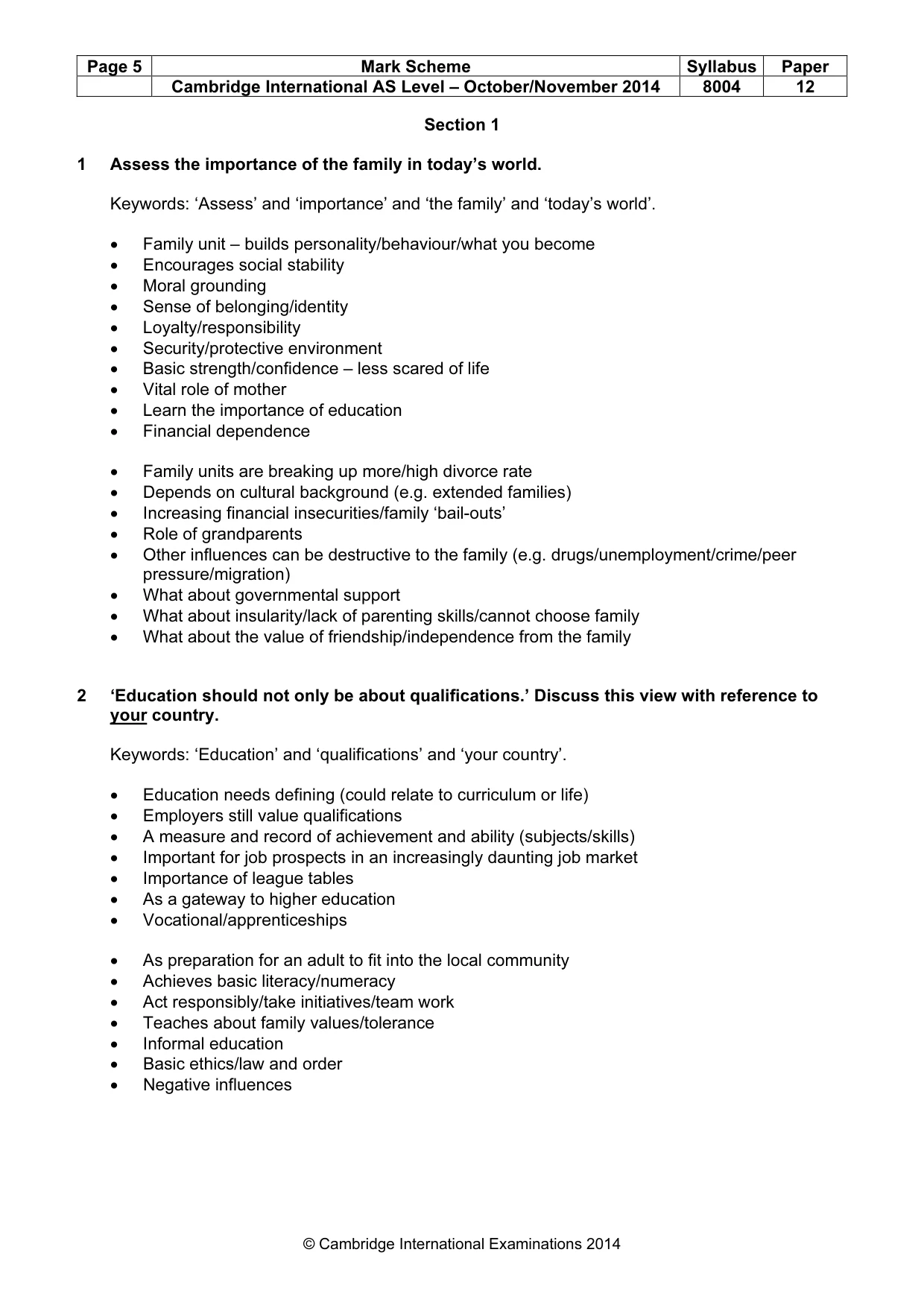
Page 5 Mark Scheme Syllabus Paper Cambridge International AS Level – October/November 2014 8004 12 © Cambridge International Examinations 2014 Section 1 1 Assess the importance of the family in today’s world. Keywords: ‘Assess’ and ‘importance’ and ‘the family’ and ‘today’s world’. • Family unit – builds personality/behaviour/what you become • Encourages social stability • Moral grounding • Sense of belonging/identity • Loyalty/responsibility • Security/protective environment • Basic strength/confidence – less scared of life • Vital role of mother • Learn the importance of education • Financial dependence • Family units are breaking up more/high divorce rate • Depends on cultural background (e.g. extended families) • Increasing financial insecurities/family ‘bail-outs’ • Role of grandparents • Other influences can be destructive to the family (e.g. drugs/unemployment/crime/peer pressure/migration) • What about governmental support • What about insularity/lack of parenting skills/cannot choose family • What about the value of friendship/independence from the family 2 ‘Education should not only be about qualifications.’ Discuss this view with reference to your country. Keywords: ‘Education’ and ‘qualifications’ and ‘your country’. • Education needs defining (could relate to curriculum or life) • Employers still value qualifications • A measure and record of achievement and ability (subjects/skills) • Important for job prospects in an increasingly daunting job market • Importance of league tables • As a gateway to higher education • Vocational/apprenticeships • As preparation for an adult to fit into the local community • Achieves basic literacy/numeracy • Act responsibly/take initiatives/team work • Teaches about family values/tolerance • Informal education • Basic ethics/law and order • Negative influences
Mark scheme, page 6
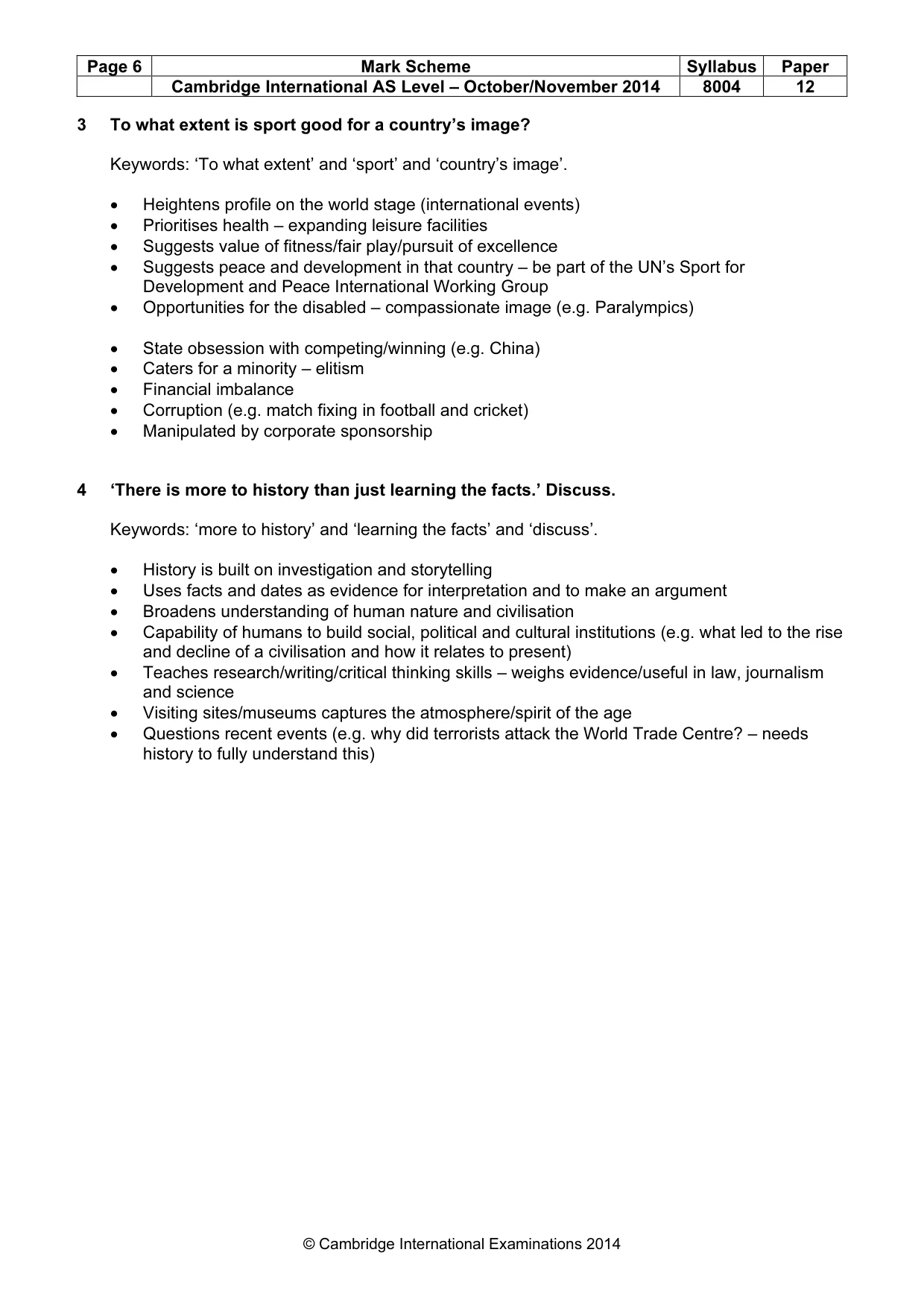
Page 6 Mark Scheme Syllabus Paper Cambridge International AS Level – October/November 2014 8004 12 © Cambridge International Examinations 2014 3 To what extent is sport good for a country’s image? Keywords: ‘To what extent’ and ‘sport’ and ‘country’s image’. • Heightens profile on the world stage (international events) • Prioritises health – expanding leisure facilities • Suggests value of fitness/fair play/pursuit of excellence • Suggests peace and development in that country – be part of the UN’s Sport for Development and Peace International Working Group • Opportunities for the disabled – compassionate image (e.g. Paralympics) • State obsession with competing/winning (e.g. China) • Caters for a minority – elitism • Financial imbalance • Corruption (e.g. match fixing in football and cricket) • Manipulated by corporate sponsorship 4 ‘There is more to history than just learning the facts.’ Discuss. Keywords: ‘more to history’ and ‘learning the facts’ and ‘discuss’. • History is built on investigation and storytelling • Uses facts and dates as evidence for interpretation and to make an argument • Broadens understanding of human nature and civilisation • Capability of humans to build social, political and cultural institutions (e.g. what led to the rise and decline of a civilisation and how it relates to present) • Teaches research/writing/critical thinking skills – weighs evidence/useful in law, journalism and science • Visiting sites/museums captures the atmosphere/spirit of the age • Questions recent events (e.g. why did terrorists attack the World Trade Centre? – needs history to fully understand this)
Mark scheme, page 7
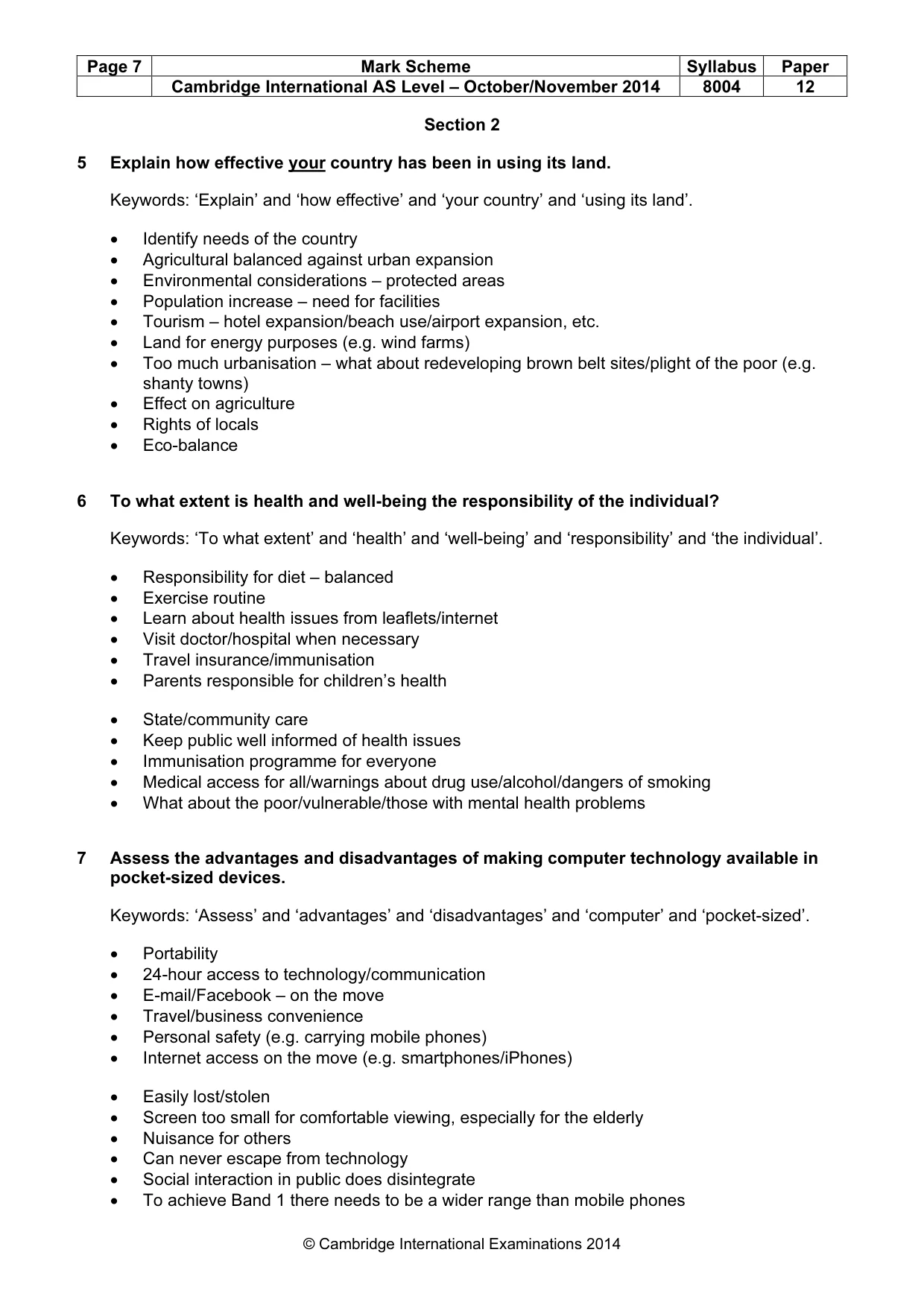
Page 7 Mark Scheme Syllabus Paper Cambridge International AS Level – October/November 2014 8004 12 © Cambridge International Examinations 2014 Section 2 5 Explain how effective your country has been in using its land. Keywords: ‘Explain’ and ‘how effective’ and ‘your country’ and ‘using its land’. • Identify needs of the country • Agricultural balanced against urban expansion • Environmental considerations – protected areas • Population increase – need for facilities • Tourism – hotel expansion/beach use/airport expansion, etc. • Land for energy purposes (e.g. wind farms) • Too much urbanisation – what about redeveloping brown belt sites/plight of the poor (e.g. shanty towns) • Effect on agriculture • Rights of locals • Eco-balance 6 To what extent is health and well-being the responsibility of the individual? Keywords: ‘To what extent’ and ‘health’ and ‘well-being’ and ‘responsibility’ and ‘the individual’. • Responsibility for diet – balanced • Exercise routine • Learn about health issues from leaflets/internet • Visit doctor/hospital when necessary • Travel insurance/immunisation • Parents responsible for children’s health • State/community care • Keep public well informed of health issues • Immunisation programme for everyone • Medical access for all/warnings about drug use/alcohol/dangers of smoking • What about the poor/vulnerable/those with mental health problems 7 Assess the advantages and disadvantages of making computer technology available in pocket-sized devices. Keywords: ‘Assess’ and ‘advantages’ and ‘disadvantages’ and ‘computer’ and ‘pocket-sized’. • Portability • 24-hour access to technology/communication • E-mail/Facebook – on the move • Travel/business convenience • Personal safety (e.g. carrying mobile phones) • Internet access on the move (e.g. smartphones/iPhones) • Easily lost/stolen • Screen too small for comfortable viewing, especially for the elderly • Nuisance for others • Can never escape from technology • Social interaction in public does disintegrate • To achieve Band 1 there needs to be a wider range than mobile phones
Mark scheme, page 8
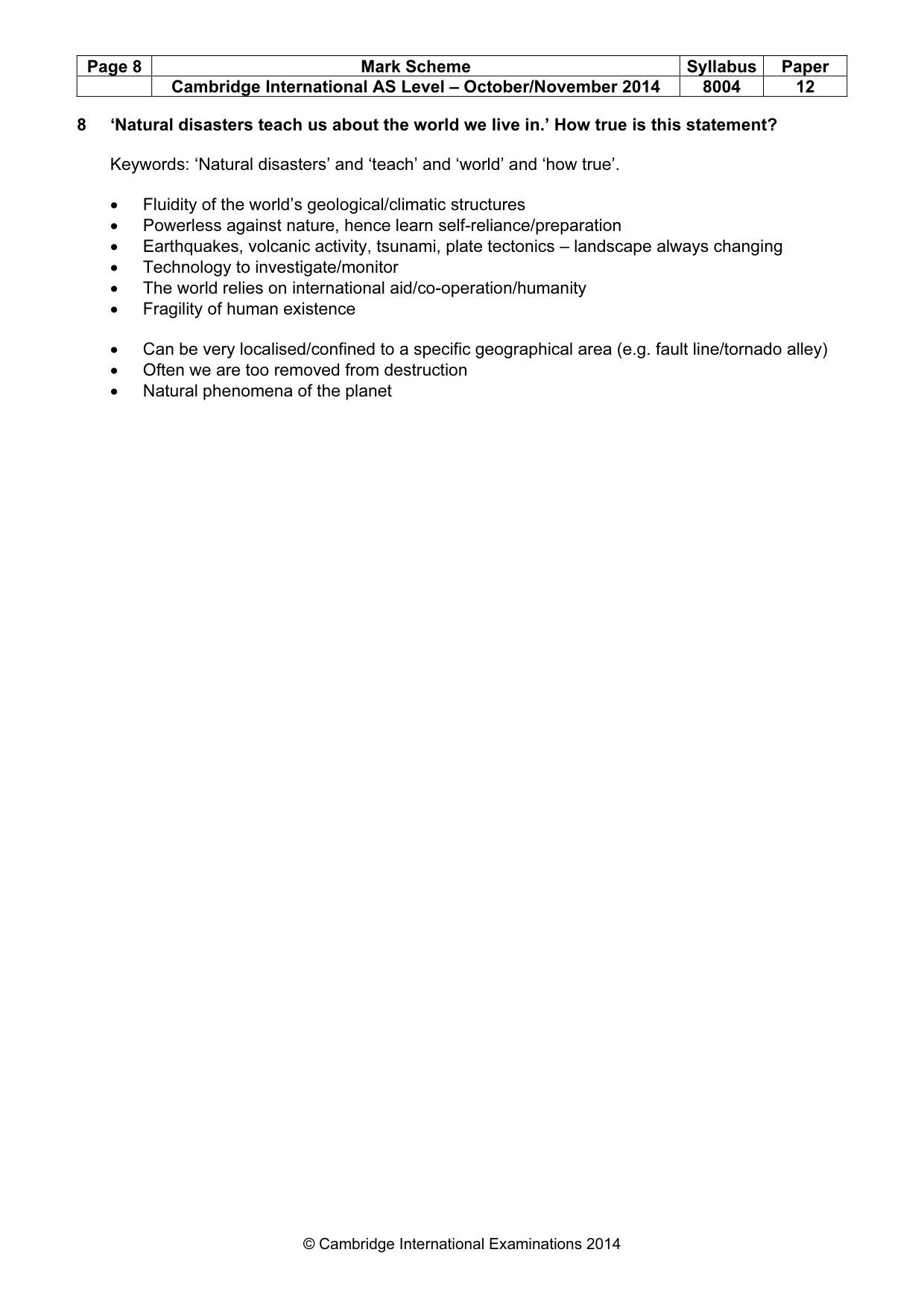
Page 8 Mark Scheme Syllabus Paper Cambridge International AS Level – October/November 2014 8004 12 © Cambridge International Examinations 2014 8 ‘Natural disasters teach us about the world we live in.’ How true is this statement? Keywords: ‘Natural disasters’ and ‘teach’ and ‘world’ and ‘how true’. • Fluidity of the world’s geological/climatic structures • Powerless against nature, hence learn self-reliance/preparation • Earthquakes, volcanic activity, tsunami, plate tectonics – landscape always changing • Technology to investigate/monitor • The world relies on international aid/co-operation/humanity • Fragility of human existence • Can be very localised/confined to a specific geographical area (e.g. fault line/tornado alley) • Often we are too removed from destruction • Natural phenomena of the planet
Mark scheme, page 9
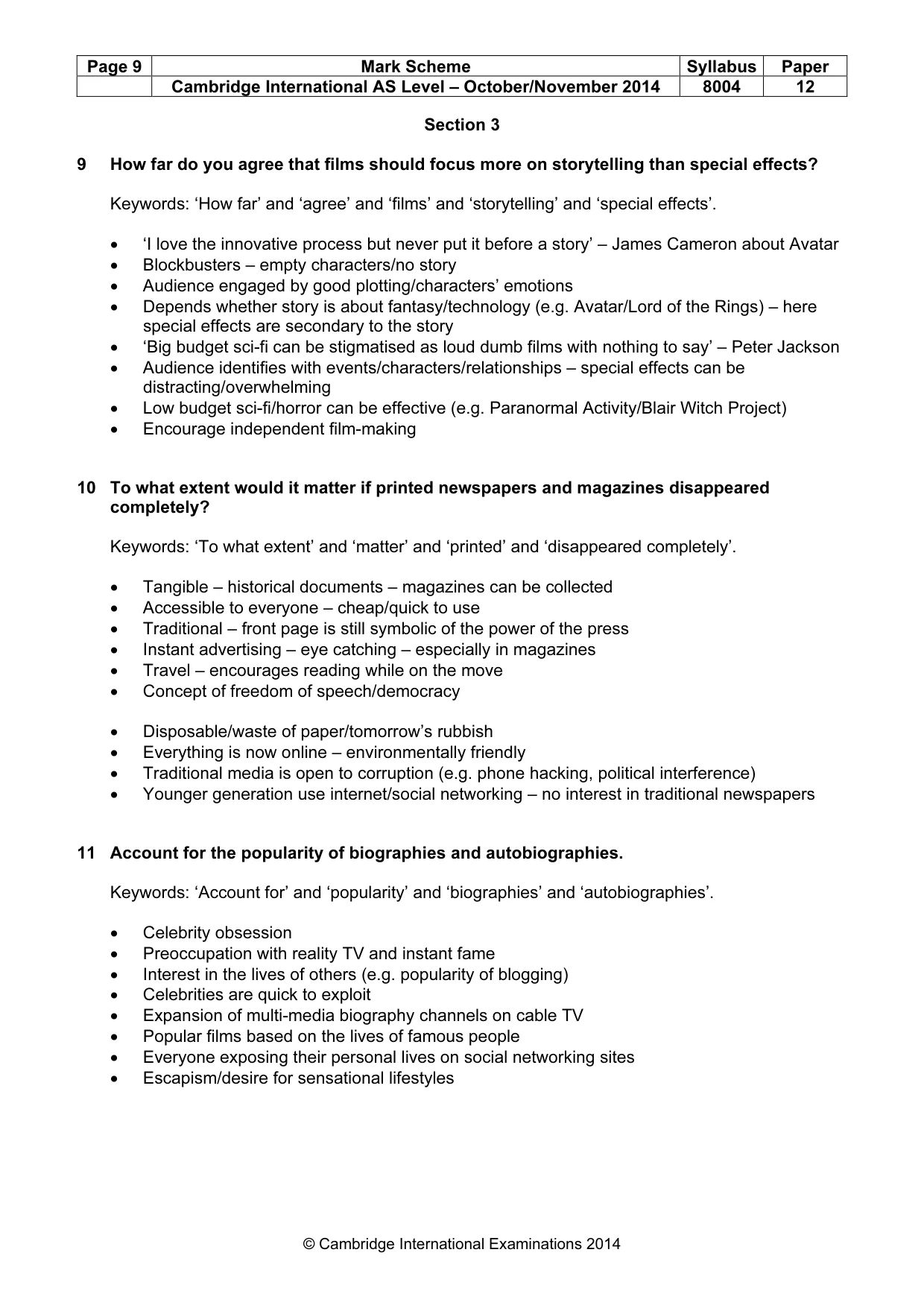
Page 9 Mark Scheme Syllabus Paper Cambridge International AS Level – October/November 2014 8004 12 © Cambridge International Examinations 2014 Section 3 9 How far do you agree that films should focus more on storytelling than special effects? Keywords: ‘How far’ and ‘agree’ and ‘films’ and ‘storytelling’ and ‘special effects’. • ‘I love the innovative process but never put it before a story’ – James Cameron about Avatar • Blockbusters – empty characters/no story • Audience engaged by good plotting/characters’ emotions • Depends whether story is about fantasy/technology (e.g. Avatar/Lord of the Rings) – here special effects are secondary to the story • ‘Big budget sci-fi can be stigmatised as loud dumb films with nothing to say’ – Peter Jackson • Audience identifies with events/characters/relationships – special effects can be distracting/overwhelming • Low budget sci-fi/horror can be effective (e.g. Paranormal Activity/Blair Witch Project) • Encourage independent film-making 10 To what extent would it matter if printed newspapers and magazines disappeared completely? Keywords: ‘To what extent’ and ‘matter’ and ‘printed’ and ‘disappeared completely’. • Tangible – historical documents – magazines can be collected • Accessible to everyone – cheap/quick to use • Traditional – front page is still symbolic of the power of the press • Instant advertising – eye catching – especially in magazines • Travel – encourages reading while on the move • Concept of freedom of speech/democracy • Disposable/waste of paper/tomorrow’s rubbish • Everything is now online – environmentally friendly • Traditional media is open to corruption (e.g. phone hacking, political interference) • Younger generation use internet/social networking – no interest in traditional newspapers 11 Account for the popularity of biographies and autobiographies. Keywords: ‘Account for’ and ‘popularity’ and ‘biographies’ and ‘autobiographies’. • Celebrity obsession • Preoccupation with reality TV and instant fame • Interest in the lives of others (e.g. popularity of blogging) • Celebrities are quick to exploit • Expansion of multi-media biography channels on cable TV • Popular films based on the lives of famous people • Everyone exposing their personal lives on social networking sites • Escapism/desire for sensational lifestyles
Mark scheme, page 10
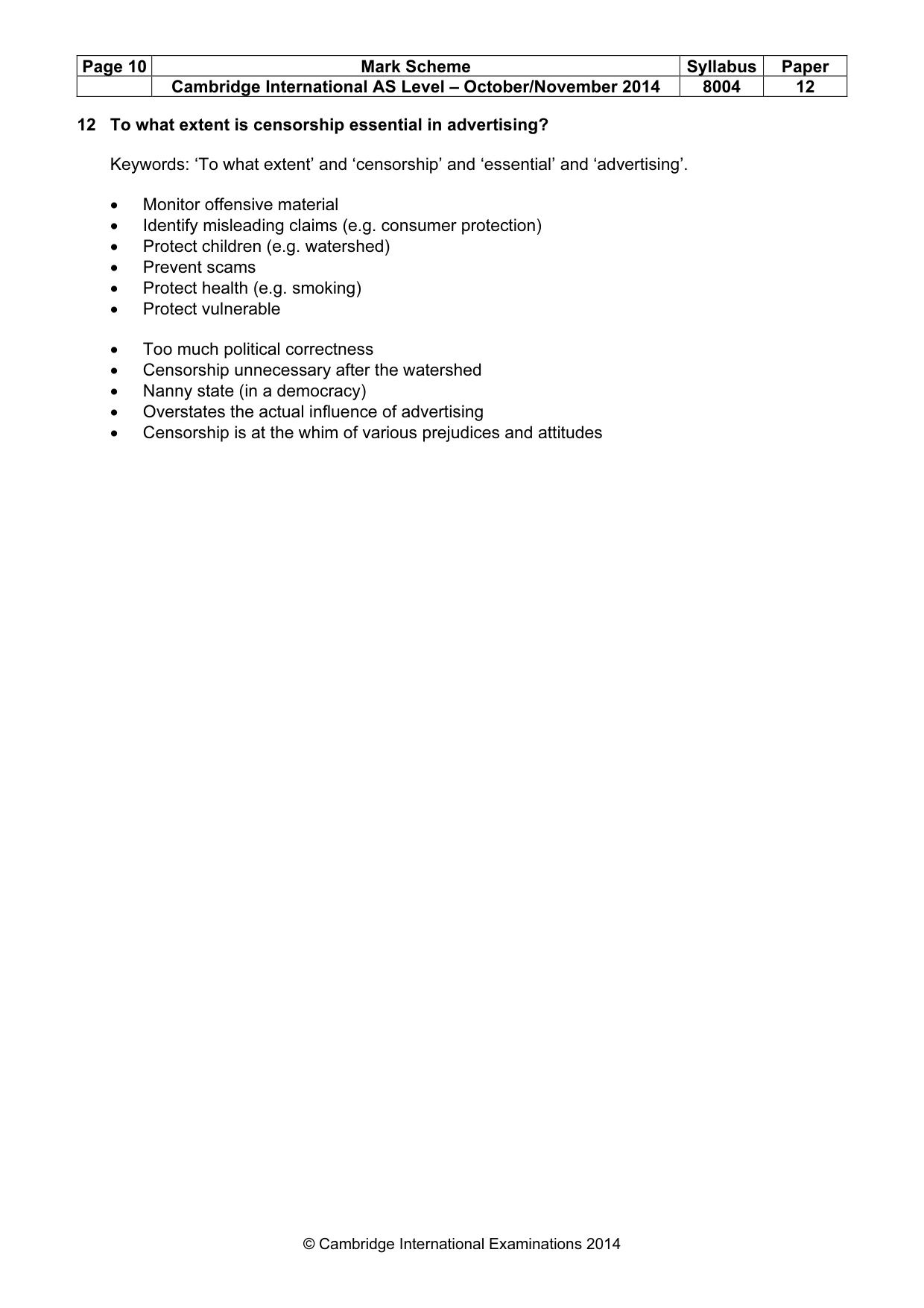
Page 10 Mark Scheme Syllabus Paper Cambridge International AS Level – October/November 2014 8004 12 © Cambridge International Examinations 2014 12 To what extent is censorship essential in advertising? Keywords: ‘To what extent’ and ‘censorship’ and ‘essential’ and ‘advertising’. • Monitor offensive material • Identify misleading claims (e.g. consumer protection) • Protect children (e.g. watershed) • Prevent scams • Protect health (e.g. smoking) • Protect vulnerable • Too much political correctness • Censorship unnecessary after the watershed • Nanny state (in a democracy) • Overstates the actual influence of advertising • Censorship is at the whim of various prejudices and attitudes
What you needed in this session
Cambridge’s own grade thresholds for 2014 Oct/Nov, Paper 1 · Variant 2. A higher threshold means an easier paper — the bar moves with how the cohort did.