Cambridge A Level English - Language AS and A Level (from 2014) 9093 — 2024 May/June Paper 3 · Variant 2
9093/32/M/J/24 · 50 marks · 135 min
The question paper and its mark scheme, free to read here and free to download. This is Cambridge’s own paper, exactly as it was sat.
Question paper8 pages

Mark scheme13 pages
Answers below. Sit the paper first if you are practising.
Paper as text
Question paper, page 1
This document has 8 pages. Any blank pages are indicated. [Turn over Cambridge International AS & A Level ENGLISH LANGUAGE 9093/32 Paper 3 Language Analysis May/June 2024 2 hours 15 minutes You must answer on the enclosed answer booklet. You will need: Answer booklet (enclosed) INSTRUCTIONS ● Answer all questions. ● Follow the instructions on the front cover of the answer booklet. If you need additional answer paper, ask the invigilator for a continuation booklet. ● Dictionaries are not allowed. INFORMATION ● The total mark for this paper is 50. ● The number of marks for each question or part question is shown in brackets [ ]. * 0 5 9 5 6 2 6 0 6 3 * DC (LK/CB) 328419/4 © UCLES 2024
Question paper, page 2
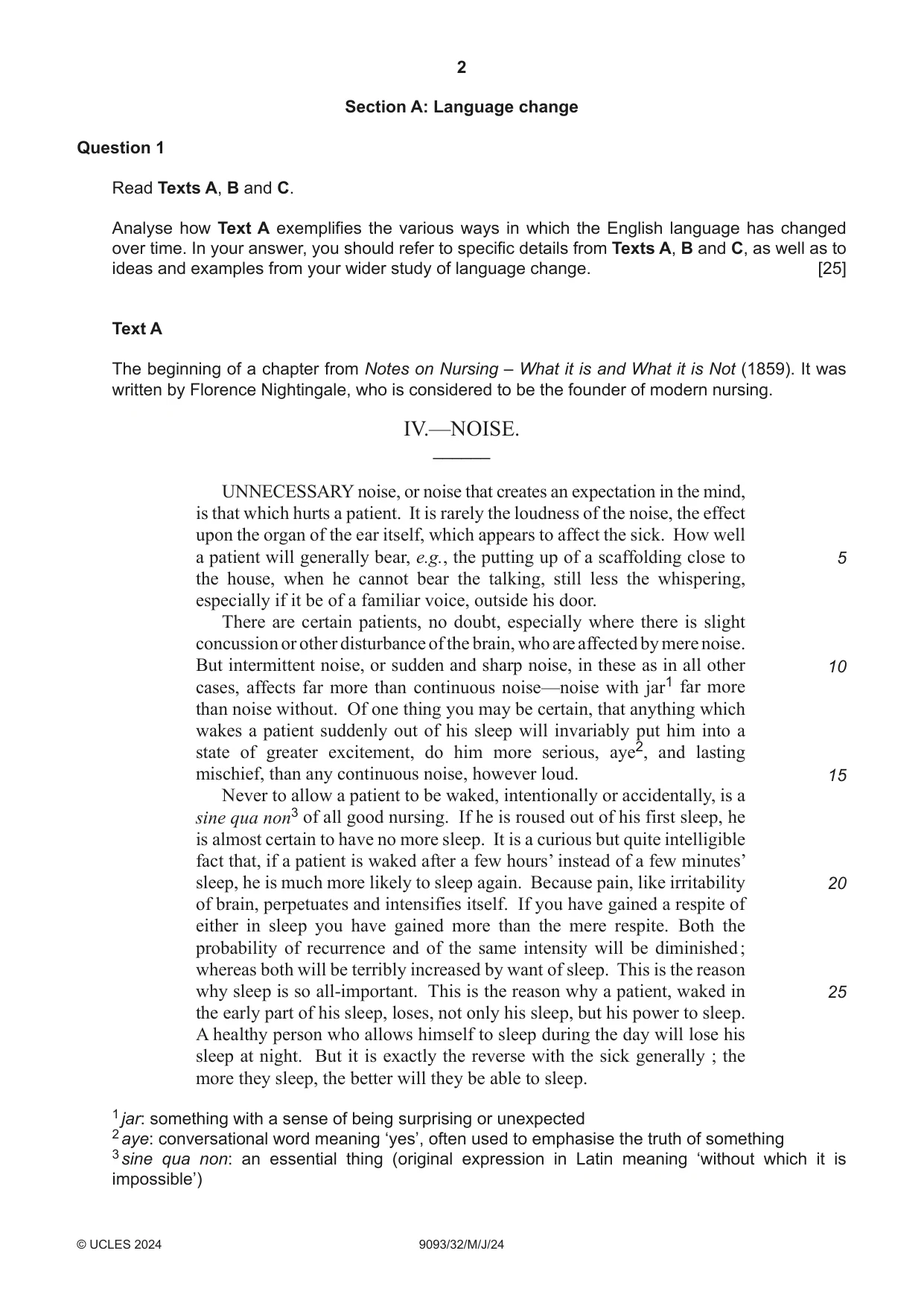
2 9093/32/M/J/24 © UCLES 2024 Section A: Language change Question 1 Read Texts A, B and C. Analyse how Text A exemplifies the various ways in which the English language has changed over time. In your answer, you should refer to specific details from Texts A, B and C, as well as to ideas and examples from your wider study of language change. [25] Text A The beginning of a chapter from Notes on Nursing – What it is and What it is Not (1859). It was written by Florence Nightingale, who is considered to be the founder of modern nursing. IV.—NOISE. ______ UNNECESSARY noise, or noise that creates an expectation in the mind, is that which hurts a patient. It is rarely the loudness of the noise, the effect upon the organ of the ear itself, which appears to affect the sick. How well a patient will generally bear, e.g., the putting up of a scaffolding close to the house, when he cannot bear the talking, still less the whispering, especially if it be of a familiar voice, outside his door. There are certain patients, no doubt, especially where there is slight concussion or other disturbance of the brain, who are affected by mere noise. But intermittent noise, or sudden and sharp noise, in these as in all other cases, affects far more than continuous noise—noise with jar1 far more than noise without. Of one thing you may be certain, that anything which wakes a patient suddenly out of his sleep will invariably put him into a state of greater excitement, do him more serious, aye2, and lasting mischief, than any continuous noise, however loud. Never to allow a patient to be waked, intentionally or accidentally, is a sine qua non3 of all good nursing. If he is roused out of his first sleep, he is almost certain to have no more sleep. It is a curious but quite intelligible fact that, if a patient is waked after a few hours’ instead of a few minutes’ sleep, he is much more likely to sleep again. Because pain, like irritability of brain, perpetuates and intensifies itself. If you have gained a respite of either in sleep you have gained more than the mere respite. Both the probability of recurrence and of the same intensity will be diminished ; whereas both will be terribly increased by want of sleep. This is the reason why sleep is so all-important. This is the reason why a patient, waked in the early part of his sleep, loses, not only his sleep, but his power to sleep. A healthy person who allows himself to sleep during the day will lose his sleep at night. But it is exactly the reverse with the sick generally ; the more they sleep, the better will they be able to sleep. 1 jar: something with a sense of being surprising or unexpected 2 aye: conversational word meaning ‘yes’, often used to emphasise the truth of something 3 sine qua non: an essential thing (original expression in Latin meaning ‘without which it is impossible’) 5 10 15 20 25
Question paper, page 3
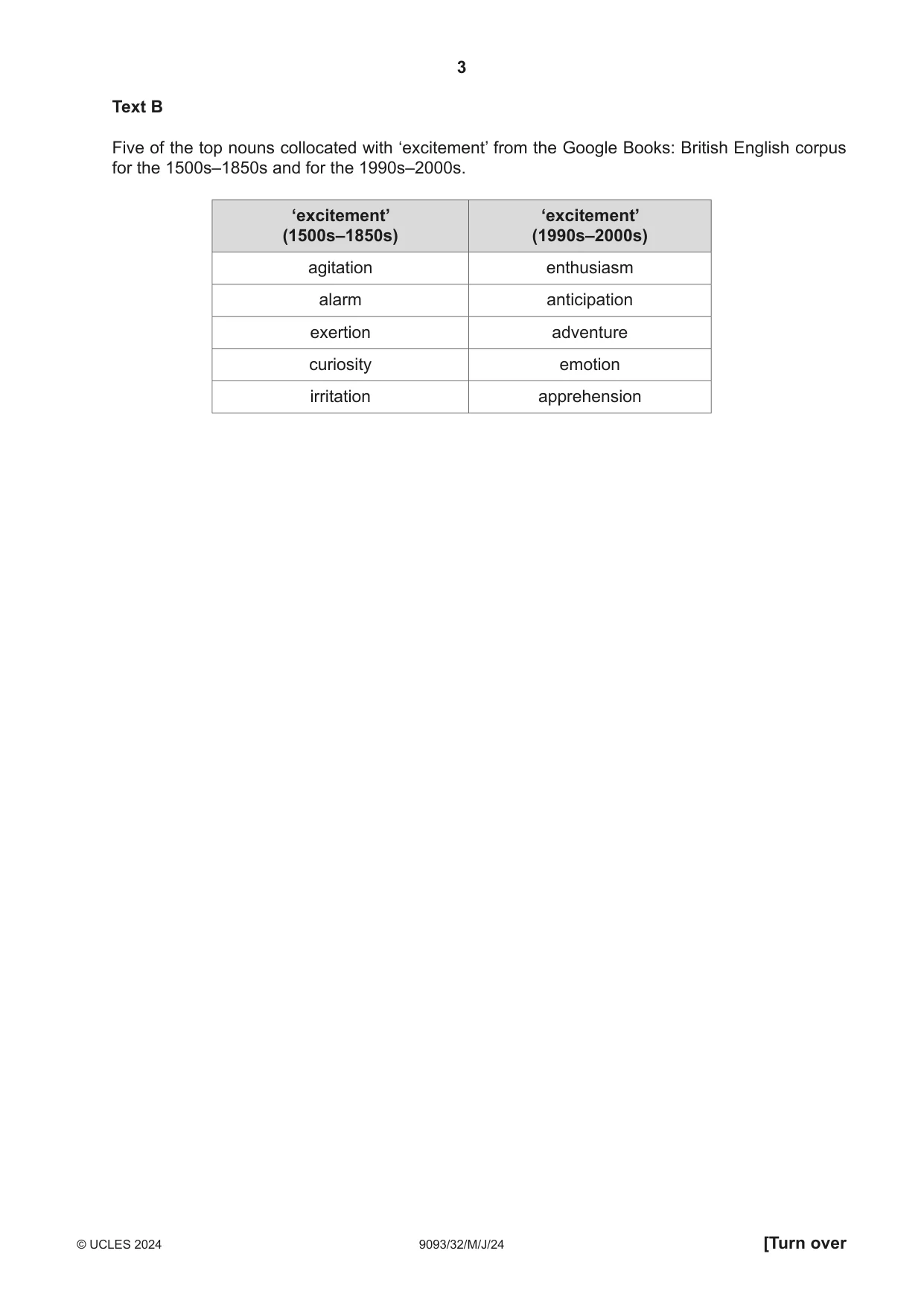
3 9093/32/M/J/24 © UCLES 2024 [Turn over Text B Five of the top nouns collocated with ‘excitement’ from the Google Books: British English corpus for the 1500s–1850s and for the 1990s–2000s. ‘excitement’ (1500s–1850s) ‘excitement’ (1990s–2000s) agitation enthusiasm alarm anticipation exertion adventure curiosity emotion irritation apprehension
Question paper, page 4
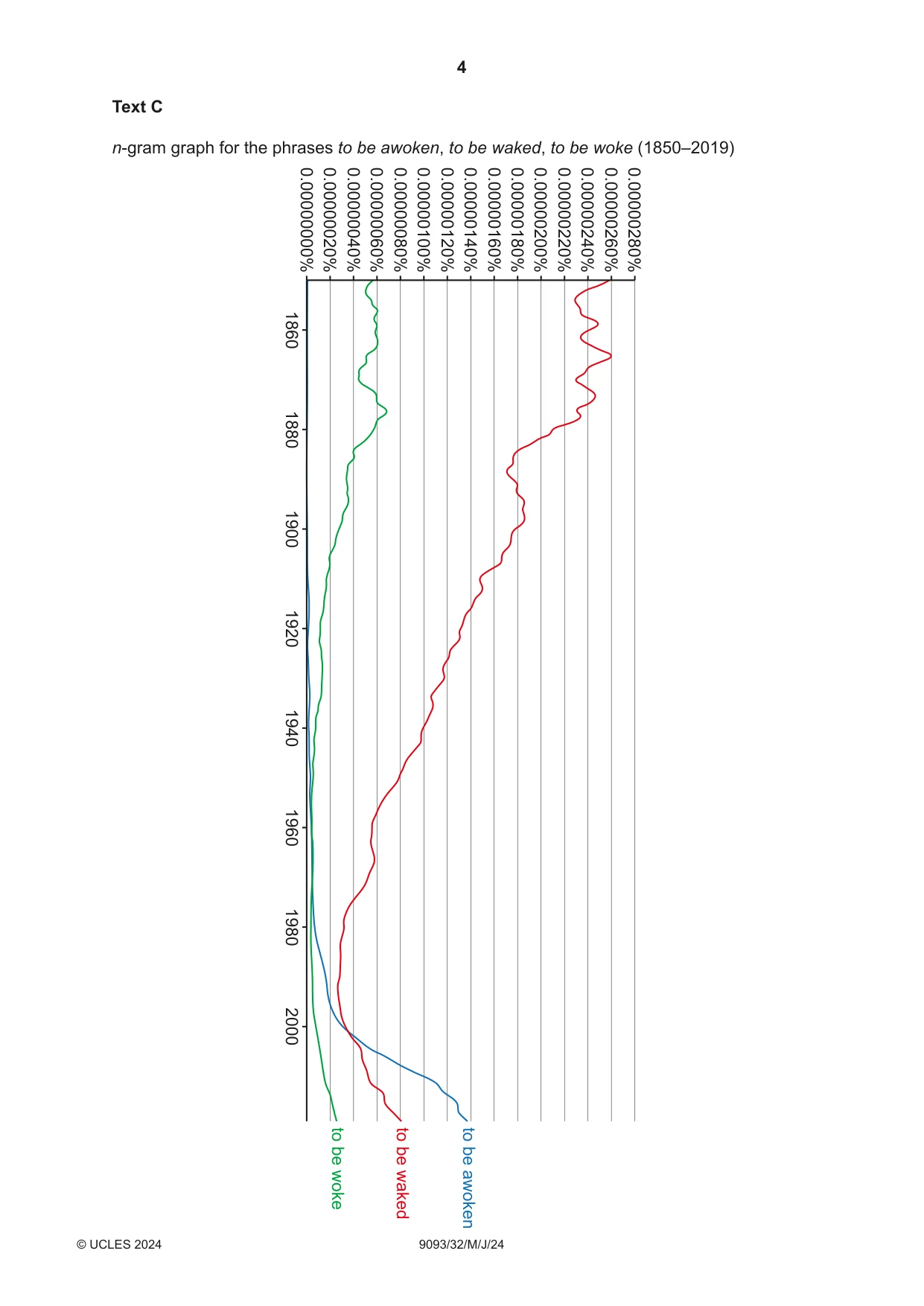
4 9093/32/M/J/24 © UCLES 2024 Text C n-gram graph for the phrases to be awoken, to be waked, to be woke (1850–2019) 1860 0.00000000% 0.00000020% 0.00000040% 0.00000060% 0.00000080% 0.00000100% 0.00000120% 0.00000140% 0.00000160% 0.00000180% 0.00000200% 0.00000220% 0.00000240% 0.00000260% 0.00000280% 1880 1900 1920 1940 1960 1980 2000 to be awoken to be waked to be woke
Question paper, page 5
5 9093/32/M/J/24 © UCLES 2024 [Turn over BLANK PAGE
Question paper, page 6
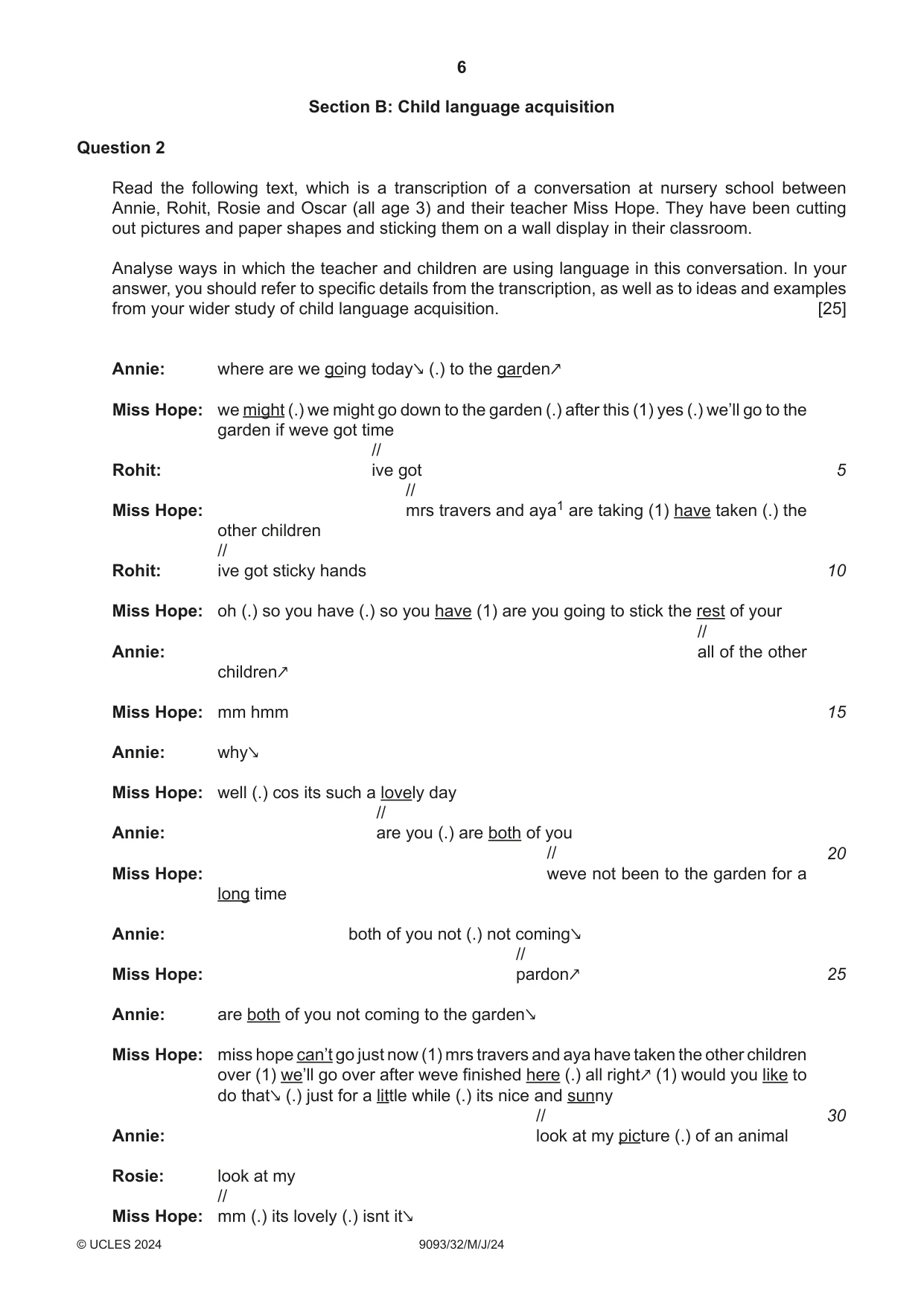
6 9093/32/M/J/24 © UCLES 2024 Section B: Child language acquisition Question 2 Read the following text, which is a transcription of a conversation at nursery school between Annie, Rohit, Rosie and Oscar (all age 3) and their teacher Miss Hope. They have been cutting out pictures and paper shapes and sticking them on a wall display in their classroom. Analyse ways in which the teacher and children are using language in this conversation. In your answer, you should refer to specific details from the transcription, as well as to ideas and examples from your wider study of child language acquisition. [25] Annie: where are we going today↘ (.) to the garden↗ Miss Hope: we might (.) we might go down to the garden (.) after this (1) yes (.) we’ll go to the garden if weve got time // Rohit: ive got // Miss Hope: mrs travers and aya1 are taking (1) have taken (.) the other children // Rohit: ive got sticky hands Miss Hope: oh (.) so you have (.) so you have (1) are you going to stick the rest of your // Annie: all of the other children↗ Miss Hope: mm hmm Annie: why↘ Miss Hope: well (.) cos its such a lovely day // Annie: are you (.) are both of you // Miss Hope: weve not been to the garden for a long time Annie: both of you not (.) not coming↘ // Miss Hope: pardon↗ Annie: are both of you not coming to the garden↘ Miss Hope: miss hope can’t go just now (1) mrs travers and aya have taken the other children over (1) we’ll go over after weve finished here (.) all right↗ (1) would you like to do that↘ (.) just for a little while (.) its nice and sunny // Annie: look at my picture (.) of an animal Rosie: look at my // Miss Hope: mm (.) its lovely (.) isnt it↘ 5 10 15 20 25 30
Question paper, page 7
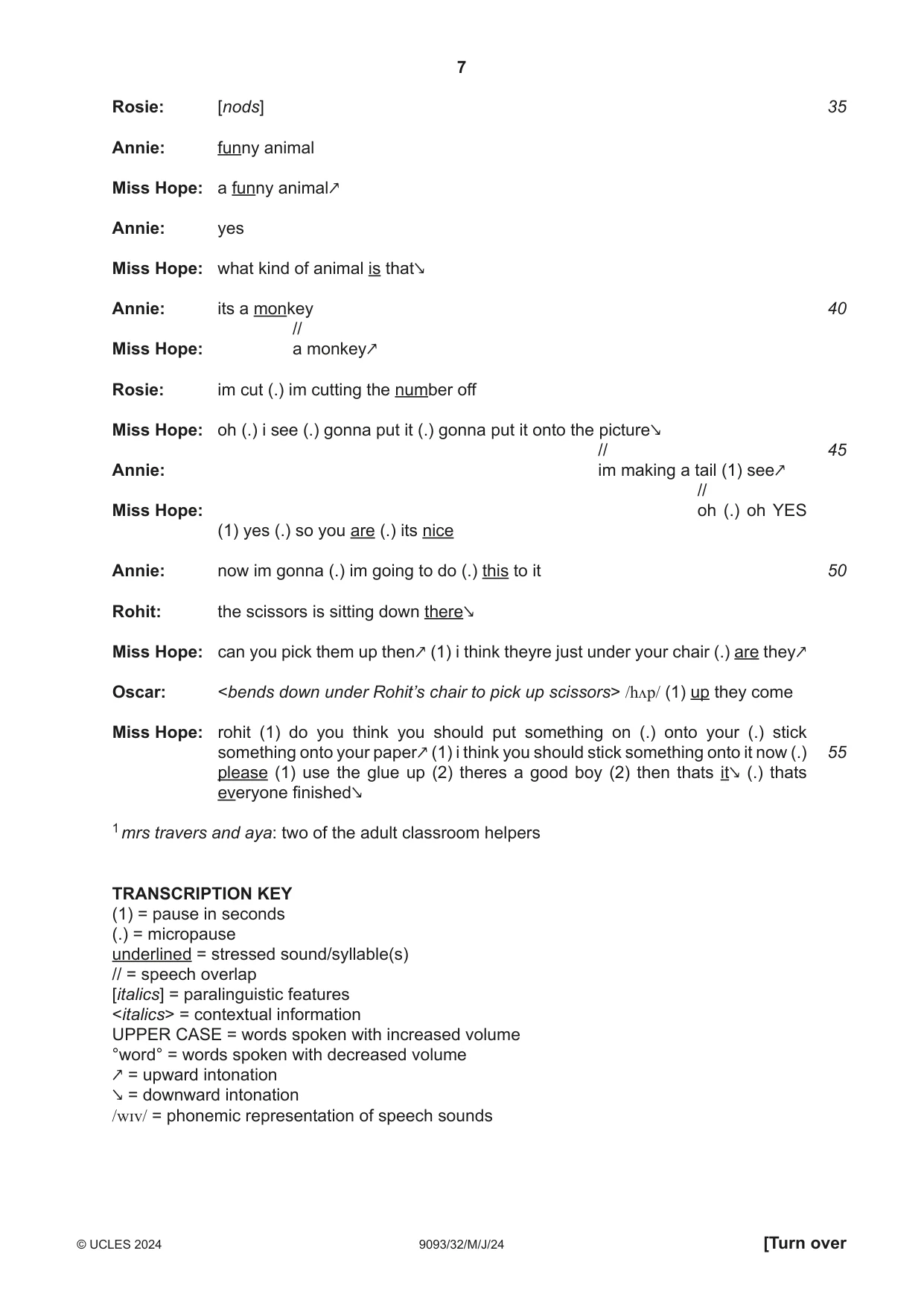
7 9093/32/M/J/24 © UCLES 2024 [Turn over Rosie: [nods] Annie: funny animal Miss Hope: a funny animal↗ Annie: yes Miss Hope: what kind of animal is that↘ Annie: its a monkey // Miss Hope: a monkey↗ Rosie: im cut (.) im cutting the number off Miss Hope: oh (.) i see (.) gonna put it (.) gonna put it onto the picture↘ // Annie: im making a tail (1) see↗ // Miss Hope: oh (.) oh YES (1) yes (.) so you are (.) its nice Annie: now im gonna (.) im going to do (.) this to it Rohit: the scissors is sitting down there↘ Miss Hope: can you pick them up then↗ (1) i think theyre just under your chair (.) are they↗ Oscar: <bends down under Rohit’s chair to pick up scissors> /hʌp/ (1) up they come Miss Hope: rohit (1) do you think you should put something on (.) onto your (.) stick something onto your paper↗ (1) i think you should stick something onto it now (.) please (1) use the glue up (2) theres a good boy (2) then thats it↘ (.) thats everyone finished↘ 1 mrs travers and aya: two of the adult classroom helpers TRANSCRIPTION KEY (1) = pause in seconds (.) = micropause underlined = stressed sound/syllable(s) // = speech overlap [italics] = paralinguistic features <italics> = contextual information UPPER CASE = words spoken with increased volume °word° = words spoken with decreased volume ↗ = upward intonation ↘ = downward intonation /wɪv/ = phonemic representation of speech sounds 35 40 45 50 55
Question paper, page 8
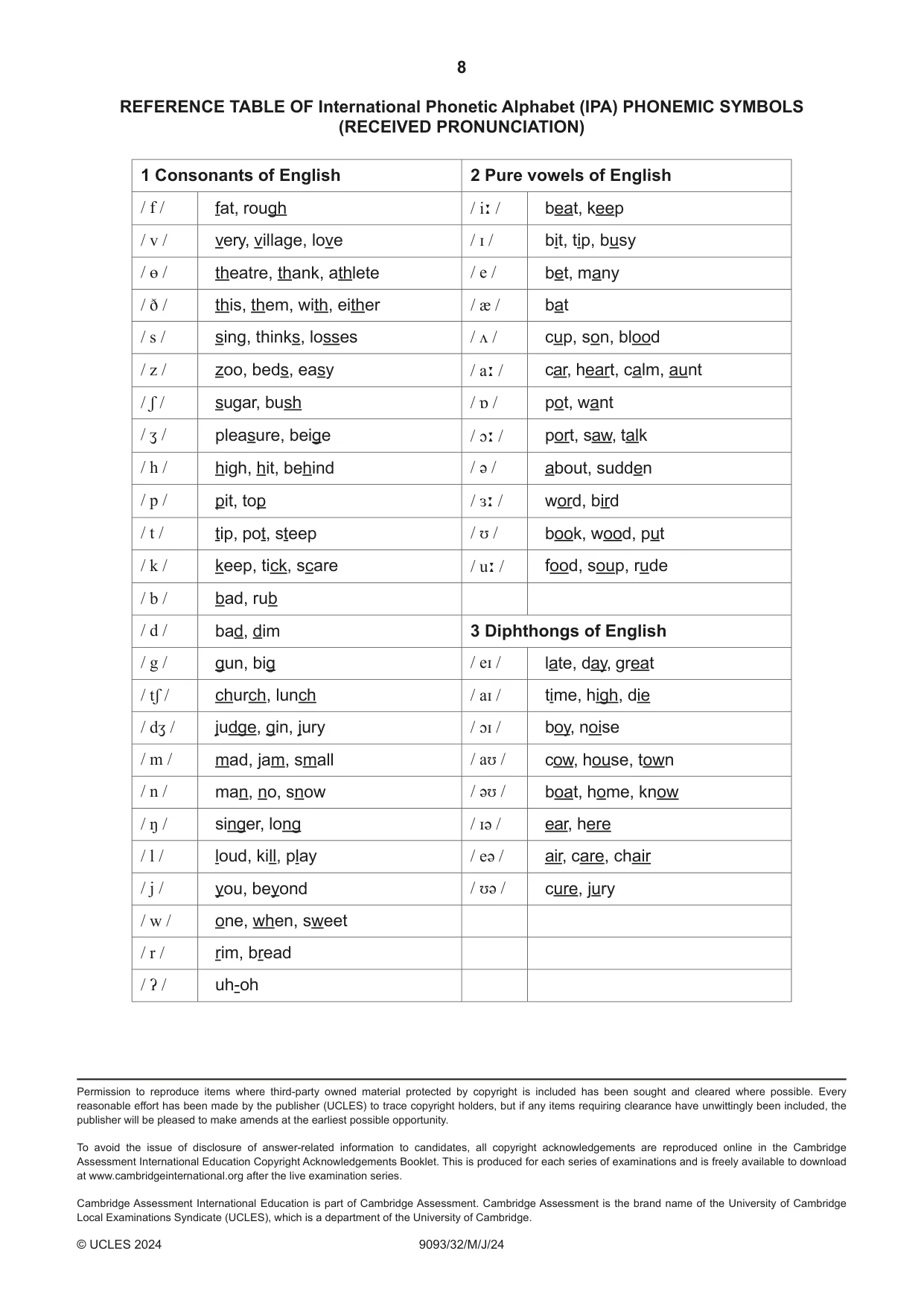
8 9093/32/M/J/24 © UCLES 2024 Permission to reproduce items where third-party owned material protected by copyright is included has been sought and cleared where possible. Every reasonable effort has been made by the publisher (UCLES) to trace copyright holders, but if any items requiring clearance have unwittingly been included, the publisher will be pleased to make amends at the earliest possible opportunity. To avoid the issue of disclosure of answer-related information to candidates, all copyright acknowledgements are reproduced online in the Cambridge Assessment International Education Copyright Acknowledgements Booklet. This is produced for each series of examinations and is freely available to download at www.cambridgeinternational.org after the live examination series. Cambridge Assessment International Education is part of Cambridge Assessment. Cambridge Assessment is the brand name of the University of Cambridge Local Examinations Syndicate (UCLES), which is a department of the University of Cambridge. REFERENCE TABLE OF International Phonetic Alphabet (IPA) PHONEMIC SYMBOLS (RECEIVED PRONUNCIATION) 1 Consonants of English 2 Pure vowels of English / f / fat, rough / iː / beat, keep / v / very, village, love / ɪ / bit, tip, busy / ɵ / theatre, thank, athlete / e / bet, many / ð / this, them, with, either / æ / bat / s / sing, thinks, losses / ʌ / cup, son, blood / z / zoo, beds, easy / aː / car, heart, calm, aunt / ʃ / sugar, bush / ɒ / pot, want / ʒ / pleasure, beige / ɔː / port, saw, talk / h / high, hit, behind / ə / about, sudden / p / pit, top / ɜː / word, bird / t / tip, pot, steep / ʊ / book, wood, put / k / keep, tick, scare / uː / food, soup, rude / b / bad, rub / d / bad, dim 3 Diphthongs of English / g / gun, big / eɪ / late, day, great / tʃ / church, lunch / aɪ / time, high, die / dʒ / judge, gin, jury / ɔɪ / boy, noise / m / mad, jam, small / aʊ / cow, house, town / n / man, no, snow / əʊ / boat, home, know / ŋ / singer, long / ɪə / ear, here / l / loud, kill, play / eə / air, care, chair / j / you, beyond / ʊə / cure, jury / w / one, when, sweet / r / rim, bread / ʔ / uh-oh
Mark scheme, page 1
This document consists of 13 printed pages. © Cambridge University Press & Assessment 2024 [Turn over Cambridge International A Level ENGLISH LANGUAGE 9093/32 Paper 3 Language Analysis May/June 2024 MARK SCHEME Maximum Mark: 50 Published This mark scheme is published as an aid to teachers and candidates, to indicate the requirements of the examination. It shows the basis on which Examiners were instructed to award marks. It does not indicate the details of the discussions that took place at an Examiners’ meeting before marking began, which would have considered the acceptability of alternative answers. Mark schemes should be read in conjunction with the question paper and the Principal Examiner Report for Teachers. Cambridge International will not enter into discussions about these mark schemes. Cambridge International is publishing the mark schemes for the May/June 2024 series for most Cambridge IGCSE, Cambridge International A and AS Level and Cambridge Pre-U components, and some Cambridge O Level components.
Mark scheme, page 2
9093/32 Cambridge International A Level – Mark Scheme PUBLISHED May/June 2024 © Cambridge University Press & Assessment 2024 Page 2 of 13 Generic Marking Principles These general marking principles must be applied by all examiners when marking candidate answers. They should be applied alongside the specific content of the mark scheme or generic level descriptions for a question. Each question paper and mark scheme will also comply with these marking principles. GENERIC MARKING PRINCIPLE 1: Marks must be awarded in line with: the specific content of the mark scheme or the generic level descriptors for the question the specific skills defined in the mark scheme or in the generic level descriptors for the question the standard of response required by a candidate as exemplified by the standardisation scripts. GENERIC MARKING PRINCIPLE 2: Marks awarded are always whole marks (not half marks, or other fractions). GENERIC MARKING PRINCIPLE 3: Marks must be awarded positively: marks are awarded for correct/valid answers, as defined in the mark scheme. However, credit is given for valid answers which go beyond the scope of the syllabus and mark scheme, referring to your Team Leader as appropriate marks are awarded when candidates clearly demonstrate what they know and can do marks are not deducted for errors marks are not deducted for omissions answers should only be judged on the quality of spelling, punctuation and grammar when these features are specifically assessed by the question as indicated by the mark scheme. The meaning, however, should be unambiguous. GENERIC MARKING PRINCIPLE 4: Rules must be applied consistently, e.g. in situations where candidates have not followed instructions or in the application of generic level descriptors.
Mark scheme, page 3
9093/32 Cambridge International A Level – Mark Scheme PUBLISHED May/June 2024 © Cambridge University Press & Assessment 2024 Page 3 of 13 GENERIC MARKING PRINCIPLE 5: Marks should be awarded using the full range of marks defined in the mark scheme for the question (however; the use of the full mark range may be limited according to the quality of the candidate responses seen). GENERIC MARKING PRINCIPLE 6: Marks awarded are based solely on the requirements as defined in the mark scheme. Marks should not be awarded with grade thresholds or grade descriptors in mind.
Mark scheme, page 4
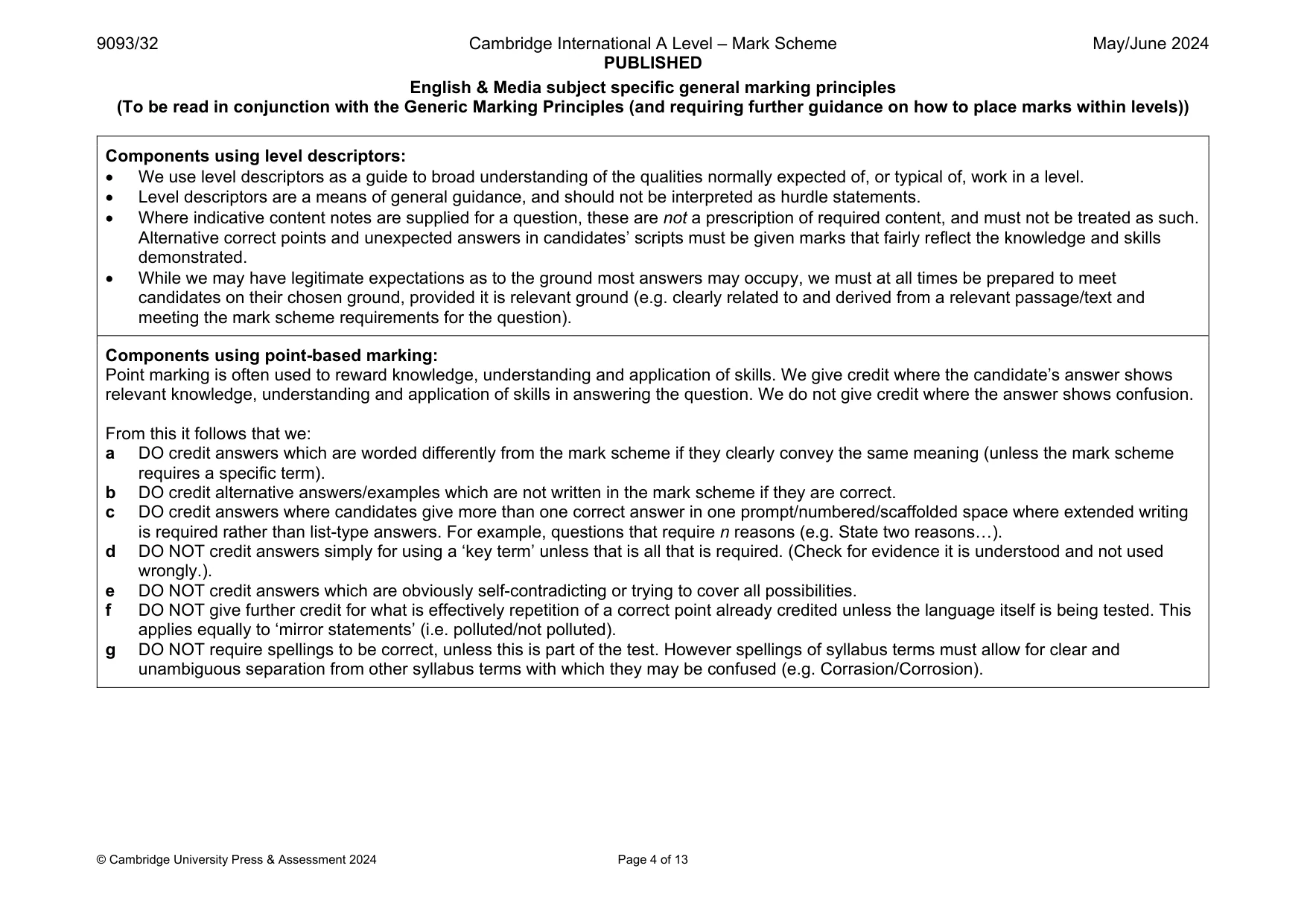
9093/32 Cambridge International A Level – Mark Scheme PUBLISHED May/June 2024 © Cambridge University Press & Assessment 2024 Page 4 of 13 English & Media subject specific general marking principles (To be read in conjunction with the Generic Marking Principles (and requiring further guidance on how to place marks within levels)) Components using level descriptors: We use level descriptors as a guide to broad understanding of the qualities normally expected of, or typical of, work in a level. Level descriptors are a means of general guidance, and should not be interpreted as hurdle statements. Where indicative content notes are supplied for a question, these are not a prescription of required content, and must not be treated as such. Alternative correct points and unexpected answers in candidates’ scripts must be given marks that fairly reflect the knowledge and skills demonstrated. While we may have legitimate expectations as to the ground most answers may occupy, we must at all times be prepared to meet candidates on their chosen ground, provided it is relevant ground (e.g. clearly related to and derived from a relevant passage/text and meeting the mark scheme requirements for the question). Components using point-based marking: Point marking is often used to reward knowledge, understanding and application of skills. We give credit where the candidate’s answer shows relevant knowledge, understanding and application of skills in answering the question. We do not give credit where the answer shows confusion. From this it follows that we: a DO credit answers which are worded differently from the mark scheme if they clearly convey the same meaning (unless the mark scheme requires a specific term). b DO credit alternative answers/examples which are not written in the mark scheme if they are correct. c DO credit answers where candidates give more than one correct answer in one prompt/numbered/scaffolded space where extended writing is required rather than list-type answers. For example, questions that require n reasons (e.g. State two reasons…). d DO NOT credit answers simply for using a ‘key term’ unless that is all that is required. (Check for evidence it is understood and not used wrongly.). e DO NOT credit answers which are obviously self-contradicting or trying to cover all possibilities. f DO NOT give further credit for what is effectively repetition of a correct point already credited unless the language itself is being tested. This applies equally to ‘mirror statements’ (i.e. polluted/not polluted). g DO NOT require spellings to be correct, unless this is part of the test. However spellings of syllabus terms must allow for clear and unambiguous separation from other syllabus terms with which they may be confused (e.g. Corrasion/Corrosion).
Mark scheme, page 5
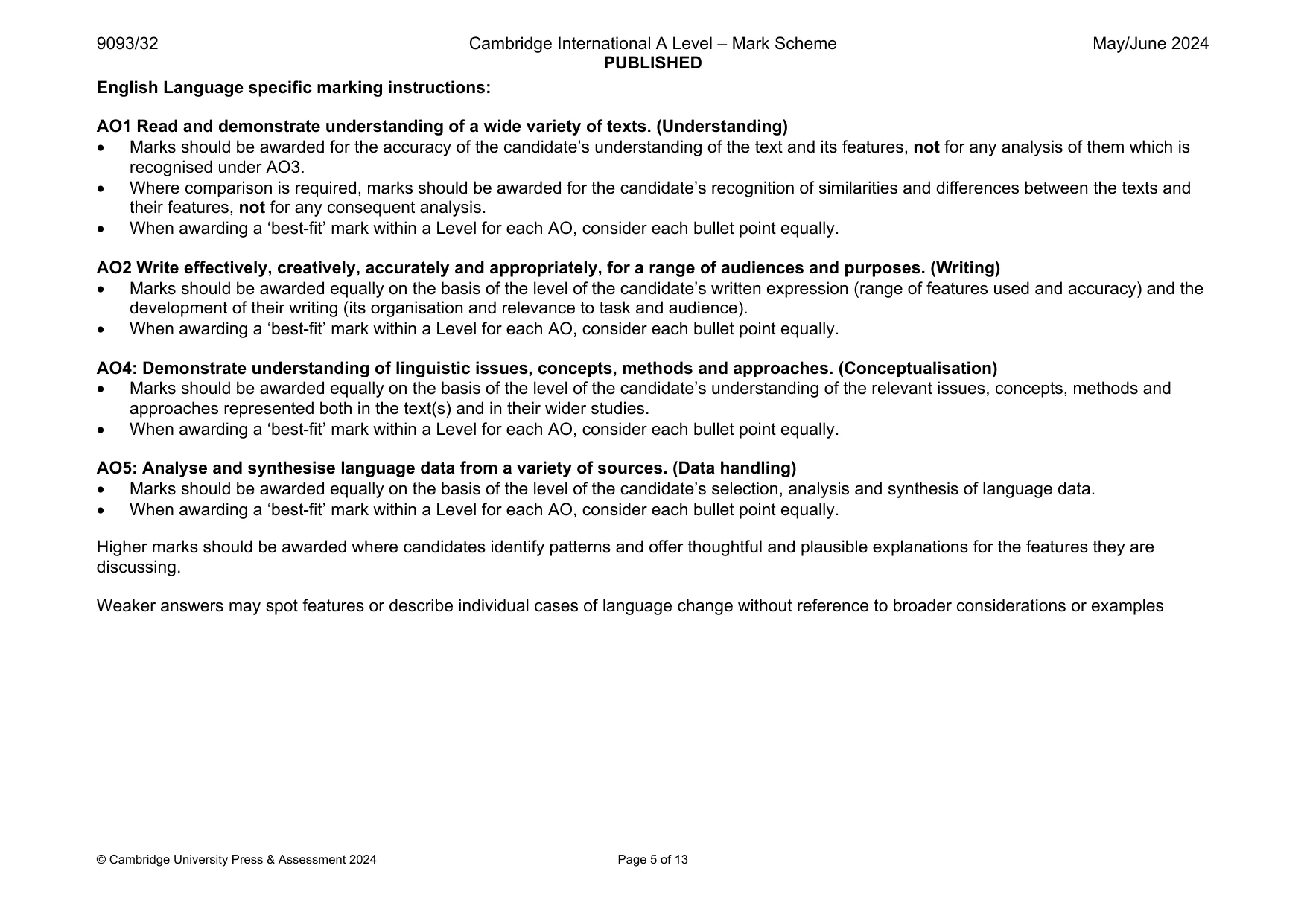
9093/32 Cambridge International A Level – Mark Scheme PUBLISHED May/June 2024 © Cambridge University Press & Assessment 2024 Page 5 of 13 English Language specific marking instructions: AO1 Read and demonstrate understanding of a wide variety of texts. (Understanding) Marks should be awarded for the accuracy of the candidate’s understanding of the text and its features, not for any analysis of them which is recognised under AO3. Where comparison is required, marks should be awarded for the candidate’s recognition of similarities and differences between the texts and their features, not for any consequent analysis. When awarding a ‘best-fit’ mark within a Level for each AO, consider each bullet point equally. AO2 Write effectively, creatively, accurately and appropriately, for a range of audiences and purposes. (Writing) Marks should be awarded equally on the basis of the level of the candidate’s written expression (range of features used and accuracy) and the development of their writing (its organisation and relevance to task and audience). When awarding a ‘best-fit’ mark within a Level for each AO, consider each bullet point equally. AO4: Demonstrate understanding of linguistic issues, concepts, methods and approaches. (Conceptualisation) Marks should be awarded equally on the basis of the level of the candidate’s understanding of the relevant issues, concepts, methods and approaches represented both in the text(s) and in their wider studies. When awarding a ‘best-fit’ mark within a Level for each AO, consider each bullet point equally. AO5: Analyse and synthesise language data from a variety of sources. (Data handling) Marks should be awarded equally on the basis of the level of the candidate’s selection, analysis and synthesis of language data. When awarding a ‘best-fit’ mark within a Level for each AO, consider each bullet point equally. Higher marks should be awarded where candidates identify patterns and offer thoughtful and plausible explanations for the features they are discussing. Weaker answers may spot features or describe individual cases of language change without reference to broader considerations or examples
Mark scheme, page 6
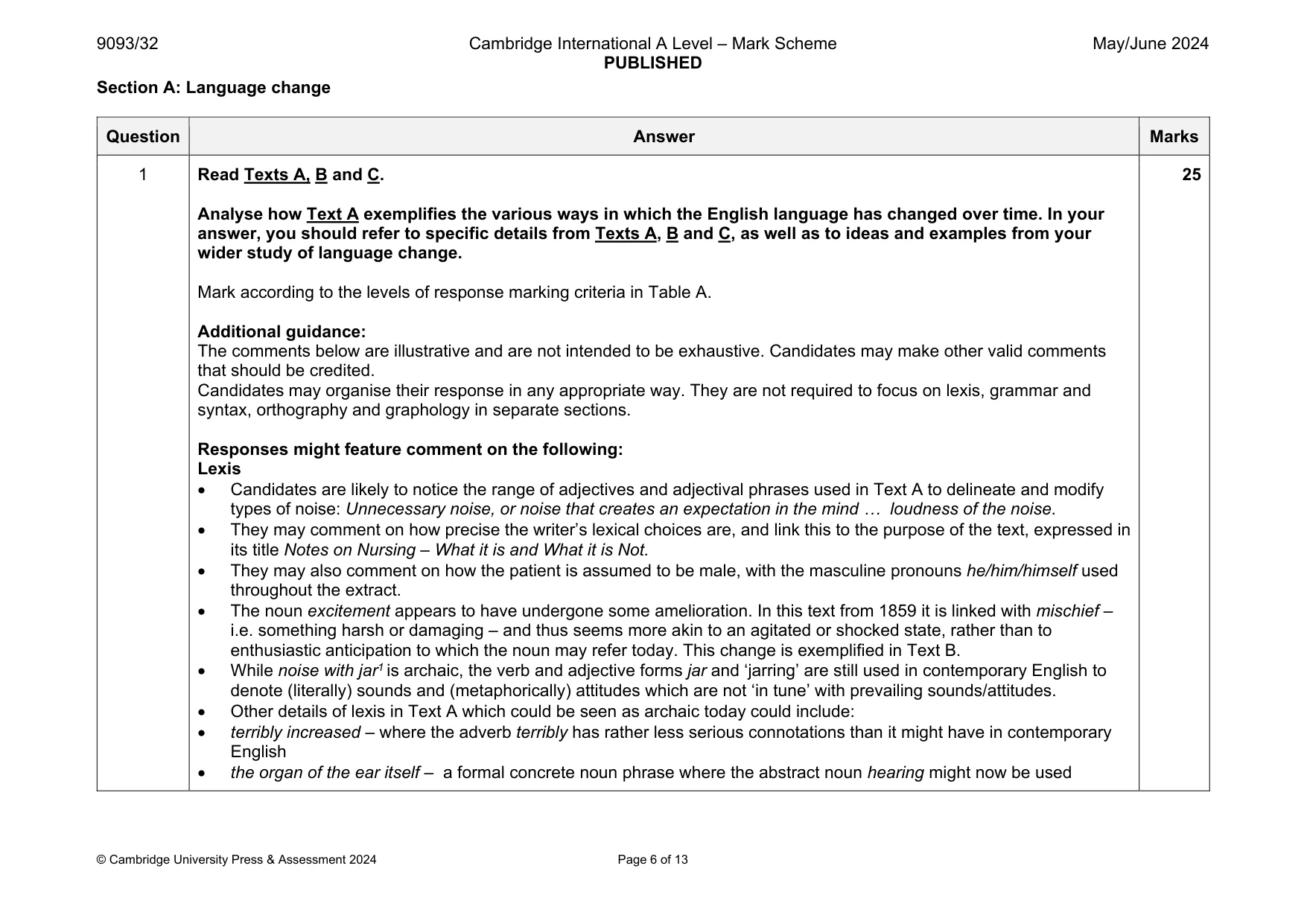
9093/32 Cambridge International A Level – Mark Scheme PUBLISHED May/June 2024 © Cambridge University Press & Assessment 2024 Page 6 of 13 Section A: Language change Question Answer Marks 1 Read Texts A, B and C. Analyse how Text A exemplifies the various ways in which the English language has changed over time. In your answer, you should refer to specific details from Texts A, B and C, as well as to ideas and examples from your wider study of language change. Mark according to the levels of response marking criteria in Table A. Additional guidance: The comments below are illustrative and are not intended to be exhaustive. Candidates may make other valid comments that should be credited. Candidates may organise their response in any appropriate way. They are not required to focus on lexis, grammar and syntax, orthography and graphology in separate sections. Responses might feature comment on the following: Lexis Candidates are likely to notice the range of adjectives and adjectival phrases used in Text A to delineate and modify types of noise: Unnecessary noise, or noise that creates an expectation in the mind … loudness of the noise. They may comment on how precise the writer’s lexical choices are, and link this to the purpose of the text, expressed in its title Notes on Nursing – What it is and What it is Not. They may also comment on how the patient is assumed to be male, with the masculine pronouns he/him/himself used throughout the extract. The noun excitement appears to have undergone some amelioration. In this text from 1859 it is linked with mischief – i.e. something harsh or damaging – and thus seems more akin to an agitated or shocked state, rather than to enthusiastic anticipation to which the noun may refer today. This change is exemplified in Text B. While noise with jar1 is archaic, the verb and adjective forms jar and ‘jarring’ are still used in contemporary English to denote (literally) sounds and (metaphorically) attitudes which are not ‘in tune’ with prevailing sounds/attitudes. Other details of lexis in Text A which could be seen as archaic today could include: terribly increased – where the adverb terribly has rather less serious connotations than it might have in contemporary English the organ of the ear itself – a formal concrete noun phrase where the abstract noun hearing might now be used 25
Mark scheme, page 7
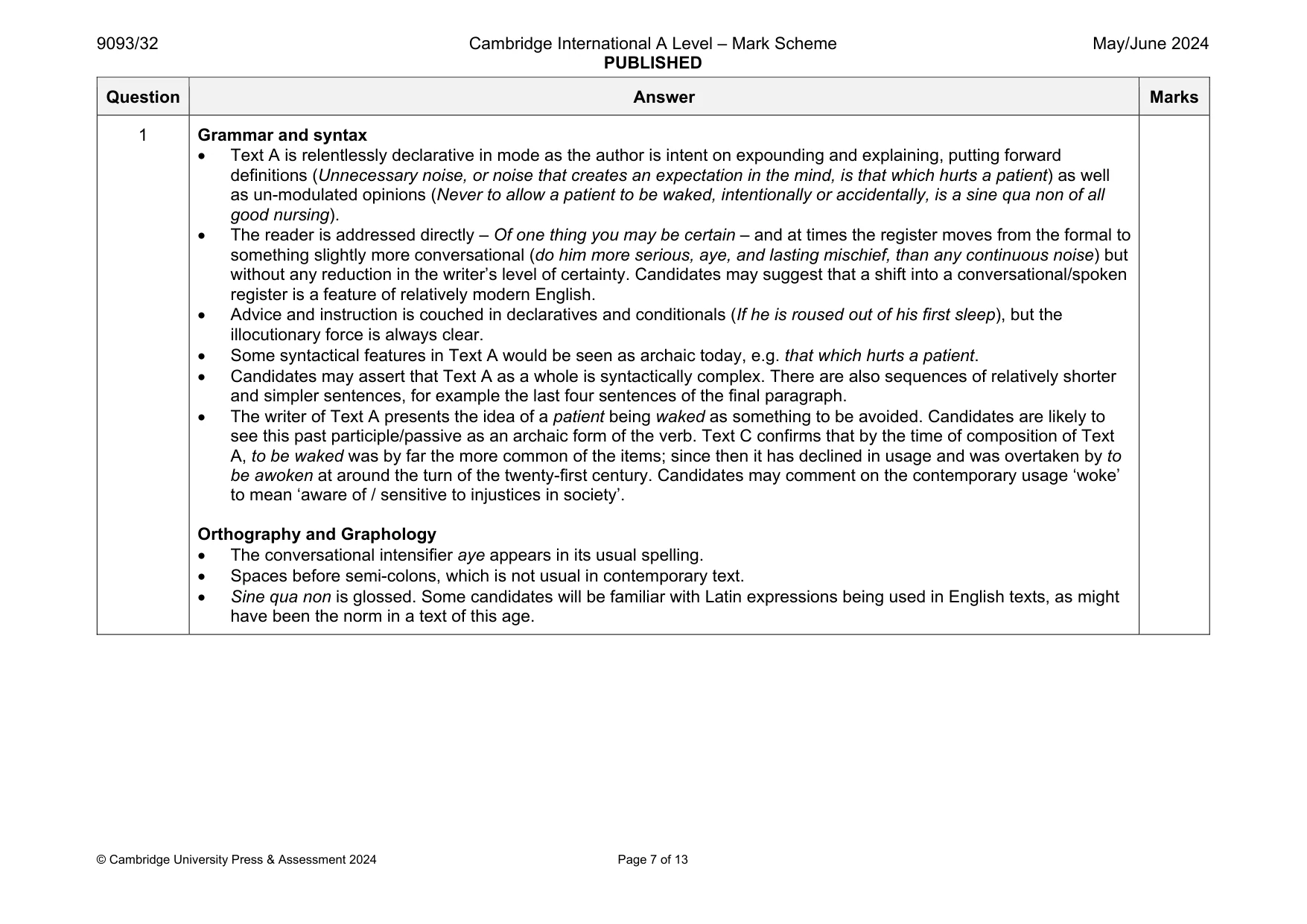
9093/32 Cambridge International A Level – Mark Scheme PUBLISHED May/June 2024 © Cambridge University Press & Assessment 2024 Page 7 of 13 Question Answer Marks 1 Grammar and syntax Text A is relentlessly declarative in mode as the author is intent on expounding and explaining, putting forward definitions (Unnecessary noise, or noise that creates an expectation in the mind, is that which hurts a patient) as well as un-modulated opinions (Never to allow a patient to be waked, intentionally or accidentally, is a sine qua non of all good nursing). The reader is addressed directly – Of one thing you may be certain – and at times the register moves from the formal to something slightly more conversational (do him more serious, aye, and lasting mischief, than any continuous noise) but without any reduction in the writer’s level of certainty. Candidates may suggest that a shift into a conversational/spoken register is a feature of relatively modern English. Advice and instruction is couched in declaratives and conditionals (If he is roused out of his first sleep), but the illocutionary force is always clear. Some syntactical features in Text A would be seen as archaic today, e.g. that which hurts a patient. Candidates may assert that Text A as a whole is syntactically complex. There are also sequences of relatively shorter and simpler sentences, for example the last four sentences of the final paragraph. The writer of Text A presents the idea of a patient being waked as something to be avoided. Candidates are likely to see this past participle/passive as an archaic form of the verb. Text C confirms that by the time of composition of Text A, to be waked was by far the more common of the items; since then it has declined in usage and was overtaken by to be awoken at around the turn of the twenty-first century. Candidates may comment on the contemporary usage ‘woke’ to mean ‘aware of / sensitive to injustices in society’. Orthography and Graphology The conversational intensifier aye appears in its usual spelling. Spaces before semi-colons, which is not usual in contemporary text. Sine qua non is glossed. Some candidates will be familiar with Latin expressions being used in English texts, as might have been the norm in a text of this age.
Mark scheme, page 8
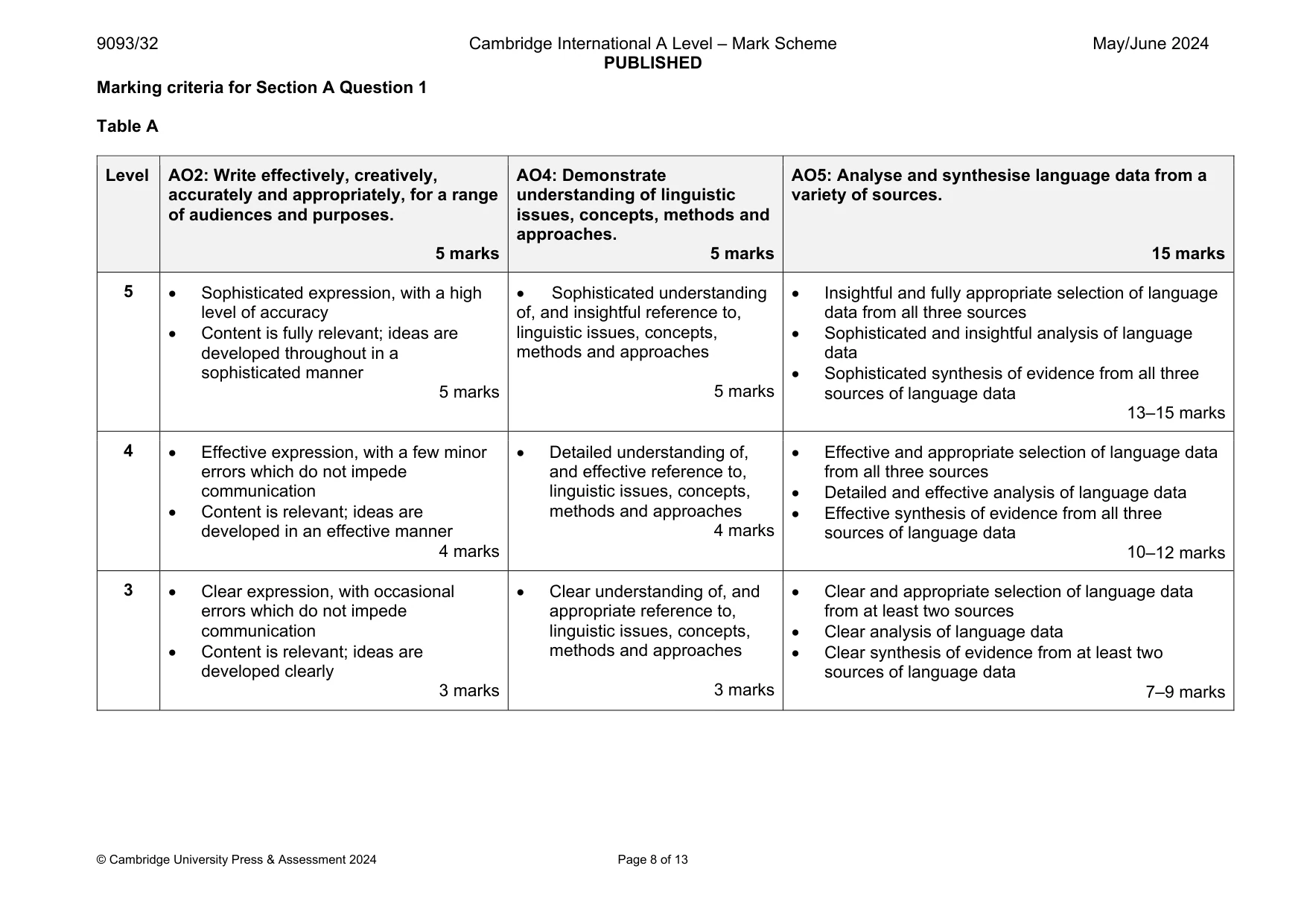
9093/32 Cambridge International A Level – Mark Scheme PUBLISHED May/June 2024 © Cambridge University Press & Assessment 2024 Page 8 of 13 Marking criteria for Section A Question 1 Table A Level AO2: Write effectively, creatively, accurately and appropriately, for a range of audiences and purposes. 5 marks AO4: Demonstrate understanding of linguistic issues, concepts, methods and approaches. 5 marks AO5: Analyse and synthesise language data from a variety of sources. 15 marks 5 Sophisticated expression, with a high level of accuracy Content is fully relevant; ideas are developed throughout in a sophisticated manner 5 marks Sophisticated understanding of, and insightful reference to, linguistic issues, concepts, methods and approaches 5 marks Insightful and fully appropriate selection of language data from all three sources Sophisticated and insightful analysis of language data Sophisticated synthesis of evidence from all three sources of language data 13–15 marks 4 Effective expression, with a few minor errors which do not impede communication Content is relevant; ideas are developed in an effective manner 4 marks Detailed understanding of, and effective reference to, linguistic issues, concepts, methods and approaches 4 marks Effective and appropriate selection of language data from all three sources Detailed and effective analysis of language data Effective synthesis of evidence from all three sources of language data 10–12 marks 3 Clear expression, with occasional errors which do not impede communication Content is relevant; ideas are developed clearly 3 marks Clear understanding of, and appropriate reference to, linguistic issues, concepts, methods and approaches 3 marks Clear and appropriate selection of language data from at least two sources Clear analysis of language data Clear synthesis of evidence from at least two sources of language data 7–9 marks
Mark scheme, page 9
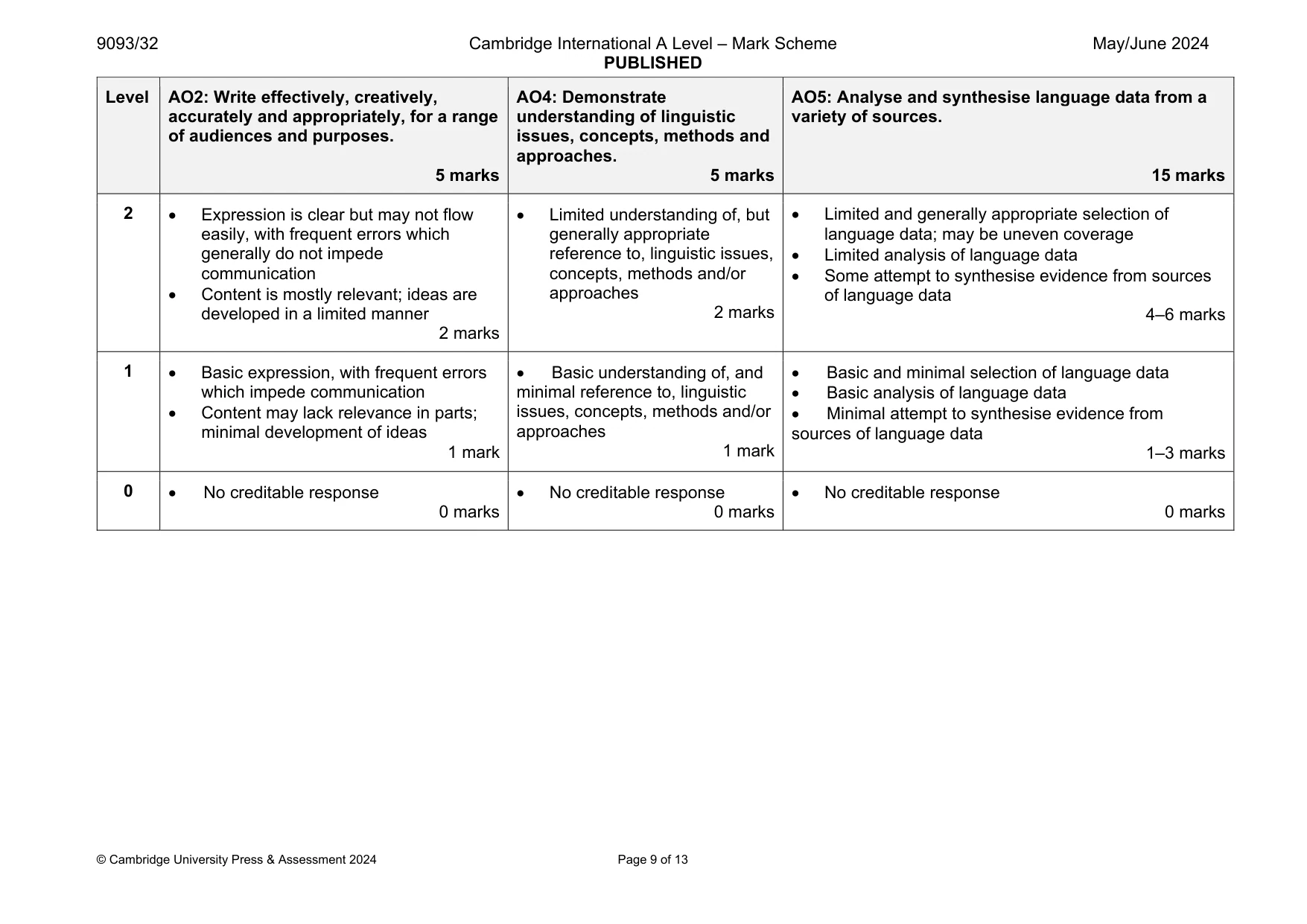
9093/32 Cambridge International A Level – Mark Scheme PUBLISHED May/June 2024 © Cambridge University Press & Assessment 2024 Page 9 of 13 Level AO2: Write effectively, creatively, accurately and appropriately, for a range of audiences and purposes. 5 marks AO4: Demonstrate understanding of linguistic issues, concepts, methods and approaches. 5 marks AO5: Analyse and synthesise language data from a variety of sources. 15 marks 2 Expression is clear but may not flow easily, with frequent errors which generally do not impede communication Content is mostly relevant; ideas are developed in a limited manner 2 marks Limited understanding of, but generally appropriate reference to, linguistic issues, concepts, methods and/or approaches 2 marks Limited and generally appropriate selection of language data; may be uneven coverage Limited analysis of language data Some attempt to synthesise evidence from sources of language data 4–6 marks 1 Basic expression, with frequent errors which impede communication Content may lack relevance in parts; minimal development of ideas 1 mark Basic understanding of, and minimal reference to, linguistic issues, concepts, methods and/or approaches 1 mark Basic and minimal selection of language data Basic analysis of language data Minimal attempt to synthesise evidence from sources of language data 1–3 marks 0 No creditable response 0 marks No creditable response 0 marks No creditable response 0 marks
Mark scheme, page 10
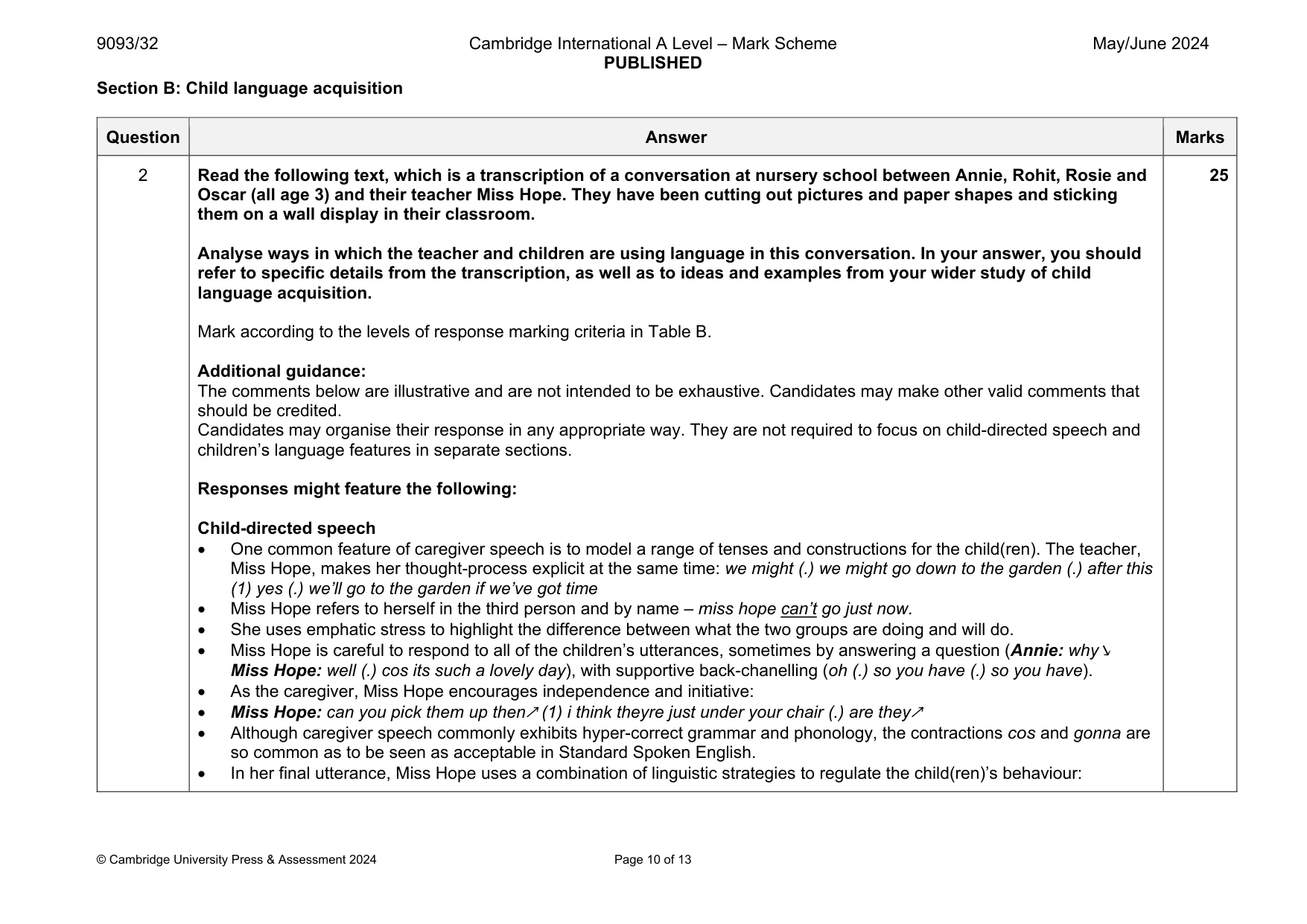
9093/32 Cambridge International A Level – Mark Scheme PUBLISHED May/June 2024 © Cambridge University Press & Assessment 2024 Page 10 of 13 Section B: Child language acquisition Question Answer Marks 2 Read the following text, which is a transcription of a conversation at nursery school between Annie, Rohit, Rosie and Oscar (all age 3) and their teacher Miss Hope. They have been cutting out pictures and paper shapes and sticking them on a wall display in their classroom. Analyse ways in which the teacher and children are using language in this conversation. In your answer, you should refer to specific details from the transcription, as well as to ideas and examples from your wider study of child language acquisition. Mark according to the levels of response marking criteria in Table B. Additional guidance: The comments below are illustrative and are not intended to be exhaustive. Candidates may make other valid comments that should be credited. Candidates may organise their response in any appropriate way. They are not required to focus on child-directed speech and children’s language features in separate sections. Responses might feature the following: Child-directed speech One common feature of caregiver speech is to model a range of tenses and constructions for the child(ren). The teacher, Miss Hope, makes her thought-process explicit at the same time: we might (.) we might go down to the garden (.) after this (1) yes (.) we’ll go to the garden if we’ve got time Miss Hope refers to herself in the third person and by name – miss hope can’t go just now. She uses emphatic stress to highlight the difference between what the two groups are doing and will do. Miss Hope is careful to respond to all of the children’s utterances, sometimes by answering a question (Annie: why↘ Miss Hope: well (.) cos its such a lovely day), with supportive back-chanelling (oh (.) so you have (.) so you have). As the caregiver, Miss Hope encourages independence and initiative: Miss Hope: can you pick them up then↗ (1) i think theyre just under your chair (.) are they↗ Although caregiver speech commonly exhibits hyper-correct grammar and phonology, the contractions cos and gonna are so common as to be seen as acceptable in Standard Spoken English. In her final utterance, Miss Hope uses a combination of linguistic strategies to regulate the child(ren)’s behaviour: 25
Mark scheme, page 11
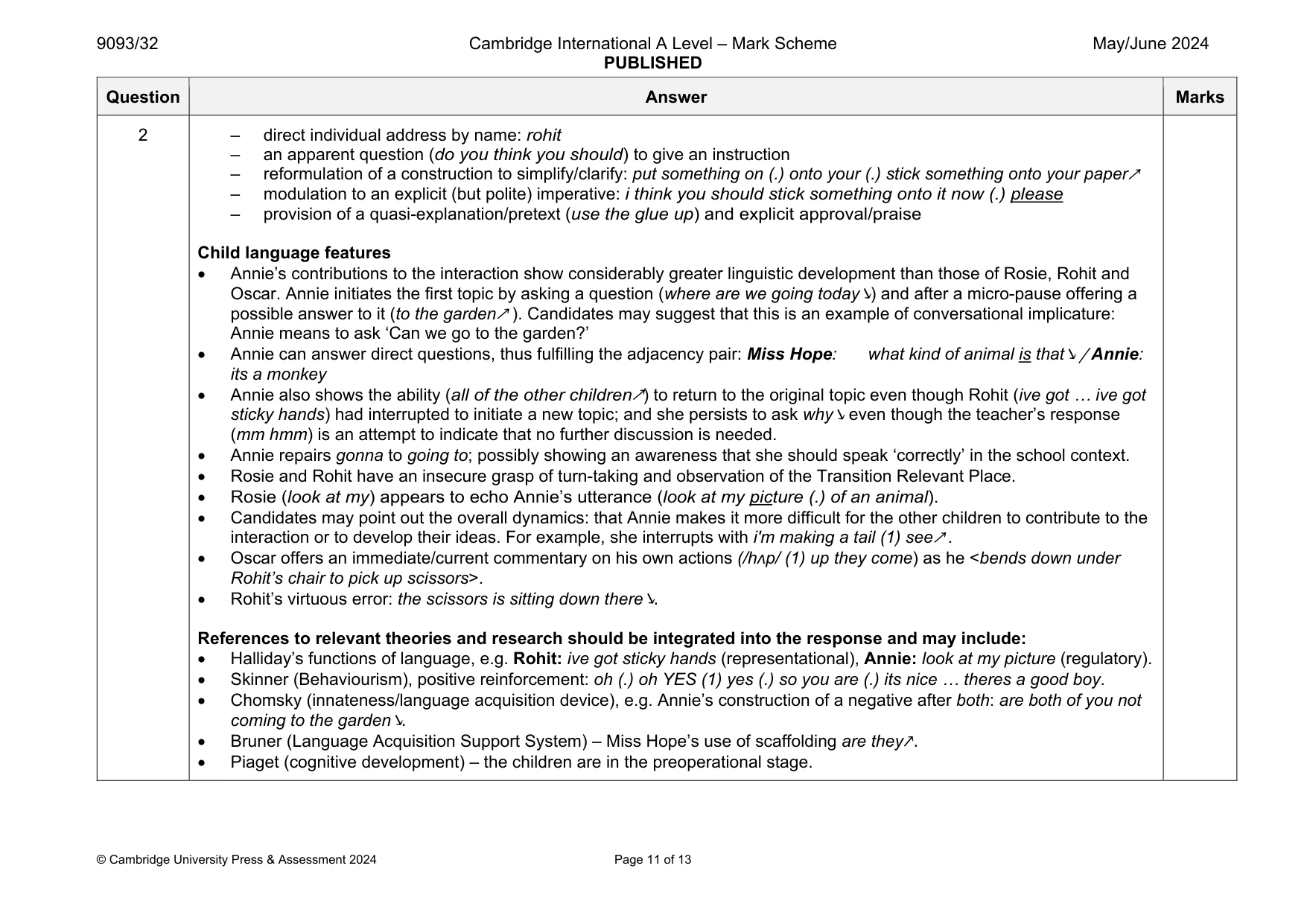
9093/32 Cambridge International A Level – Mark Scheme PUBLISHED May/June 2024 © Cambridge University Press & Assessment 2024 Page 11 of 13 Question Answer Marks 2 – direct individual address by name: rohit – an apparent question (do you think you should) to give an instruction – reformulation of a construction to simplify/clarify: put something on (.) onto your (.) stick something onto your paper↗ – modulation to an explicit (but polite) imperative: i think you should stick something onto it now (.) please – provision of a quasi-explanation/pretext (use the glue up) and explicit approval/praise Child language features Annie’s contributions to the interaction show considerably greater linguistic development than those of Rosie, Rohit and Oscar. Annie initiates the first topic by asking a question (where are we going today↘) and after a micro-pause offering a possible answer to it (to the garden↗ ). Candidates may suggest that this is an example of conversational implicature: Annie means to ask ‘Can we go to the garden?’ Annie can answer direct questions, thus fulfilling the adjacency pair: Miss Hope: what kind of animal is that↘ / Annie: its a monkey Annie also shows the ability (all of the other children↗) to return to the original topic even though Rohit (ive got … ive got sticky hands) had interrupted to initiate a new topic; and she persists to ask why↘ even though the teacher’s response (mm hmm) is an attempt to indicate that no further discussion is needed. Annie repairs gonna to going to; possibly showing an awareness that she should speak ‘correctly’ in the school context. Rosie and Rohit have an insecure grasp of turn-taking and observation of the Transition Relevant Place. Rosie (look at my) appears to echo Annie’s utterance (look at my picture (.) of an animal). Candidates may point out the overall dynamics: that Annie makes it more difficult for the other children to contribute to the interaction or to develop their ideas. For example, she interrupts with i'm making a tail (1) see↗ . Oscar offers an immediate/current commentary on his own actions (/hʌp/ (1) up they come) as he <bends down under Rohit’s chair to pick up scissors>. Rohit’s virtuous error: the scissors is sitting down there↘. References to relevant theories and research should be integrated into the response and may include: Halliday’s functions of language, e.g. Rohit: ive got sticky hands (representational), Annie: look at my picture (regulatory). Skinner (Behaviourism), positive reinforcement: oh (.) oh YES (1) yes (.) so you are (.) its nice … theres a good boy. Chomsky (innateness/language acquisition device), e.g. Annie’s construction of a negative after both: are both of you not coming to the garden↘. Bruner (Language Acquisition Support System) – Miss Hope’s use of scaffolding are they↗. Piaget (cognitive development) – the children are in the preoperational stage.
Mark scheme, page 12
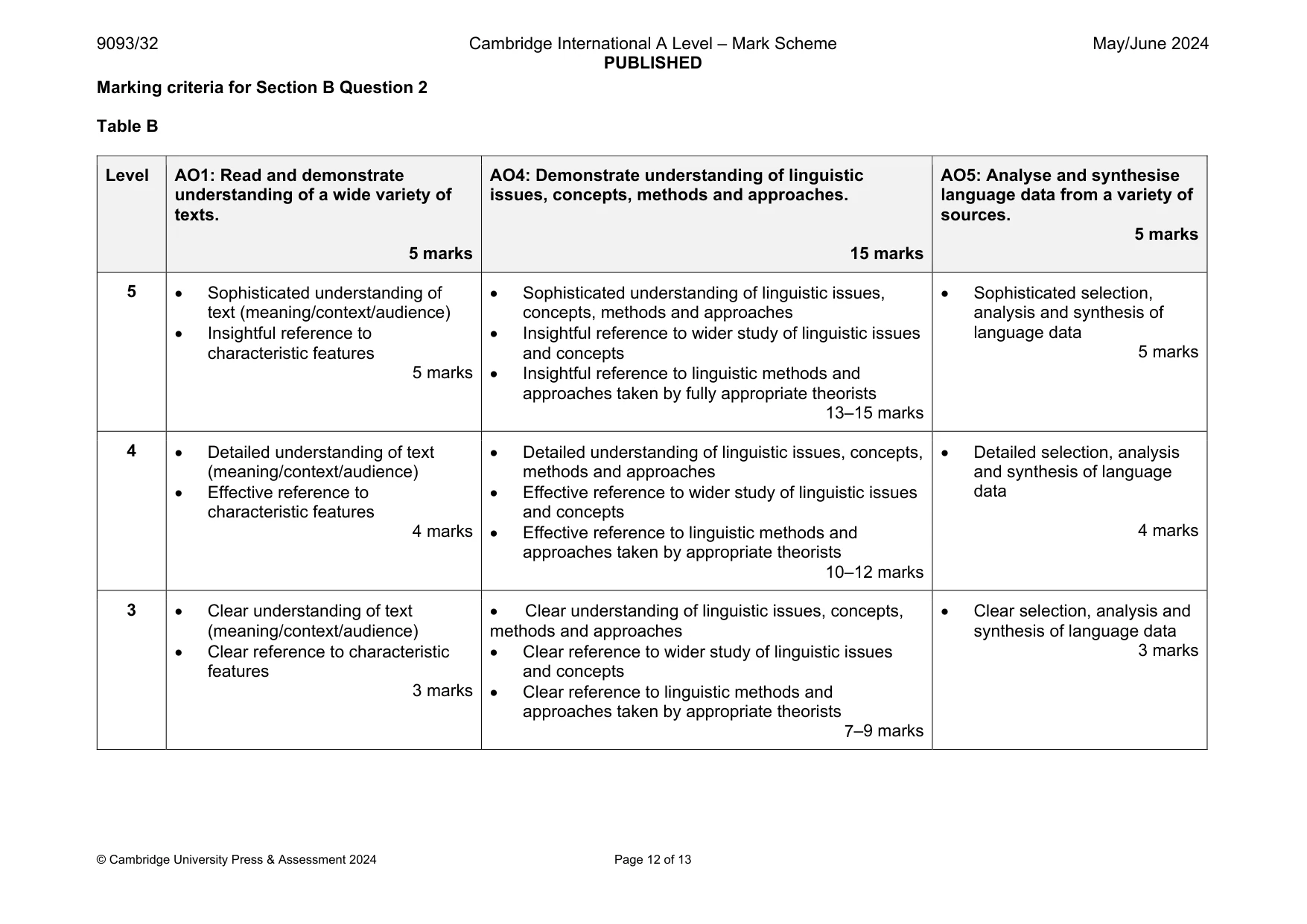
9093/32 Cambridge International A Level – Mark Scheme PUBLISHED May/June 2024 © Cambridge University Press & Assessment 2024 Page 12 of 13 Marking criteria for Section B Question 2 Table B Level AO1: Read and demonstrate understanding of a wide variety of texts. 5 marks AO4: Demonstrate understanding of linguistic issues, concepts, methods and approaches. 15 marks AO5: Analyse and synthesise language data from a variety of sources. 5 marks 5 Sophisticated understanding of text (meaning/context/audience) Insightful reference to characteristic features 5 marks Sophisticated understanding of linguistic issues, concepts, methods and approaches Insightful reference to wider study of linguistic issues and concepts Insightful reference to linguistic methods and approaches taken by fully appropriate theorists 13–15 marks Sophisticated selection, analysis and synthesis of language data 5 marks 4 Detailed understanding of text (meaning/context/audience) Effective reference to characteristic features 4 marks Detailed understanding of linguistic issues, concepts, methods and approaches Effective reference to wider study of linguistic issues and concepts Effective reference to linguistic methods and approaches taken by appropriate theorists 10–12 marks Detailed selection, analysis and synthesis of language data 4 marks 3 Clear understanding of text (meaning/context/audience) Clear reference to characteristic features 3 marks Clear understanding of linguistic issues, concepts, methods and approaches Clear reference to wider study of linguistic issues and concepts Clear reference to linguistic methods and approaches taken by appropriate theorists 7–9 marks Clear selection, analysis and synthesis of language data 3 marks
Mark scheme, page 13
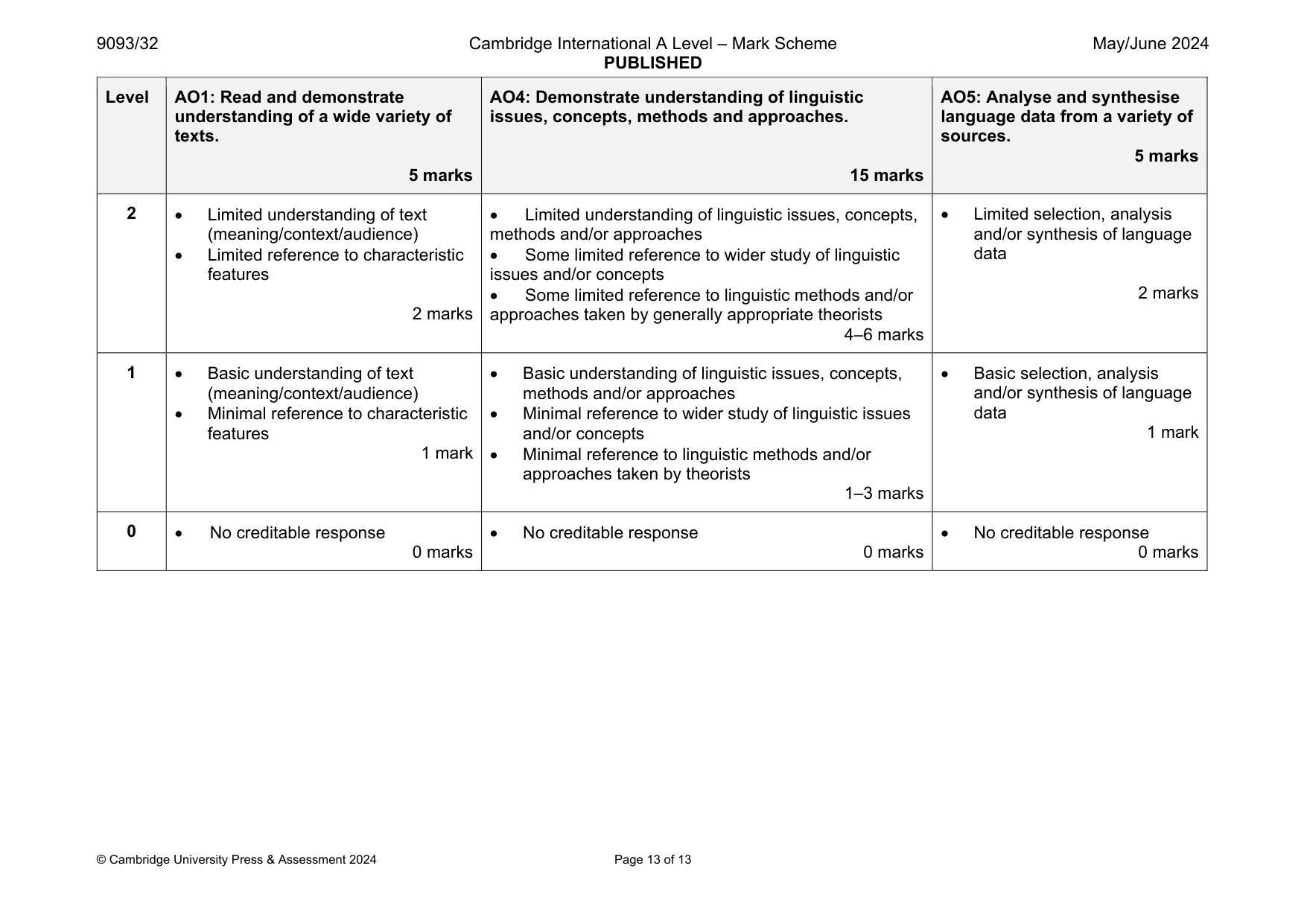
9093/32 Cambridge International A Level – Mark Scheme PUBLISHED May/June 2024 © Cambridge University Press & Assessment 2024 Page 13 of 13 Level AO1: Read and demonstrate understanding of a wide variety of texts. 5 marks AO4: Demonstrate understanding of linguistic issues, concepts, methods and approaches. 15 marks AO5: Analyse and synthesise language data from a variety of sources. 5 marks 2 Limited understanding of text (meaning/context/audience) Limited reference to characteristic features 2 marks Limited understanding of linguistic issues, concepts, methods and/or approaches Some limited reference to wider study of linguistic issues and/or concepts Some limited reference to linguistic methods and/or approaches taken by generally appropriate theorists 4–6 marks Limited selection, analysis and/or synthesis of language data 2 marks 1 Basic understanding of text (meaning/context/audience) Minimal reference to characteristic features 1 mark Basic understanding of linguistic issues, concepts, methods and/or approaches Minimal reference to wider study of linguistic issues and/or concepts Minimal reference to linguistic methods and/or approaches taken by theorists 1–3 marks Basic selection, analysis and/or synthesis of language data 1 mark 0 No creditable response 0 marks No creditable response 0 marks No creditable response 0 marks
What you needed in this session
Cambridge’s own grade thresholds for 2024 May/June, Paper 3 · Variant 2. A higher threshold means an easier paper — the bar moves with how the cohort did.