Cambridge A Level English - Language AS and A Level (from 2014) 9093 — 2025 Feb/March Paper 3 · Variant 2
9093/32/F/M/25 · 50 marks · 135 min
The question paper and its mark scheme, free to read here and free to download. This is Cambridge’s own paper, exactly as it was sat.
Question paper8 pages

Mark scheme13 pages
Answers below. Sit the paper first if you are practising.
Paper as text
Question paper, page 1
This document has 8 pages. Any blank pages are indicated. [Turn over Cambridge International AS & A Level ENGLISH LANGUAGE 9093/32 Paper 3 Language Analysis February/March 2025 2 hours 15 minutes You must answer on the enclosed answer booklet. You will need: Answer booklet (enclosed) INSTRUCTIONS ● Answer all questions. ● Follow the instructions on the front cover of the answer booklet. If you need additional answer paper, ask the invigilator for a continuation booklet. ● Dictionaries are not allowed. INFORMATION ● The total mark for this paper is 50. ● The number of marks for each question or part question is shown in brackets [ ]. * 9 3 5 3 1 6 2 2 4 6 * DC (PQ/CT) 342571/2 © UCLES 2025
Question paper, page 2
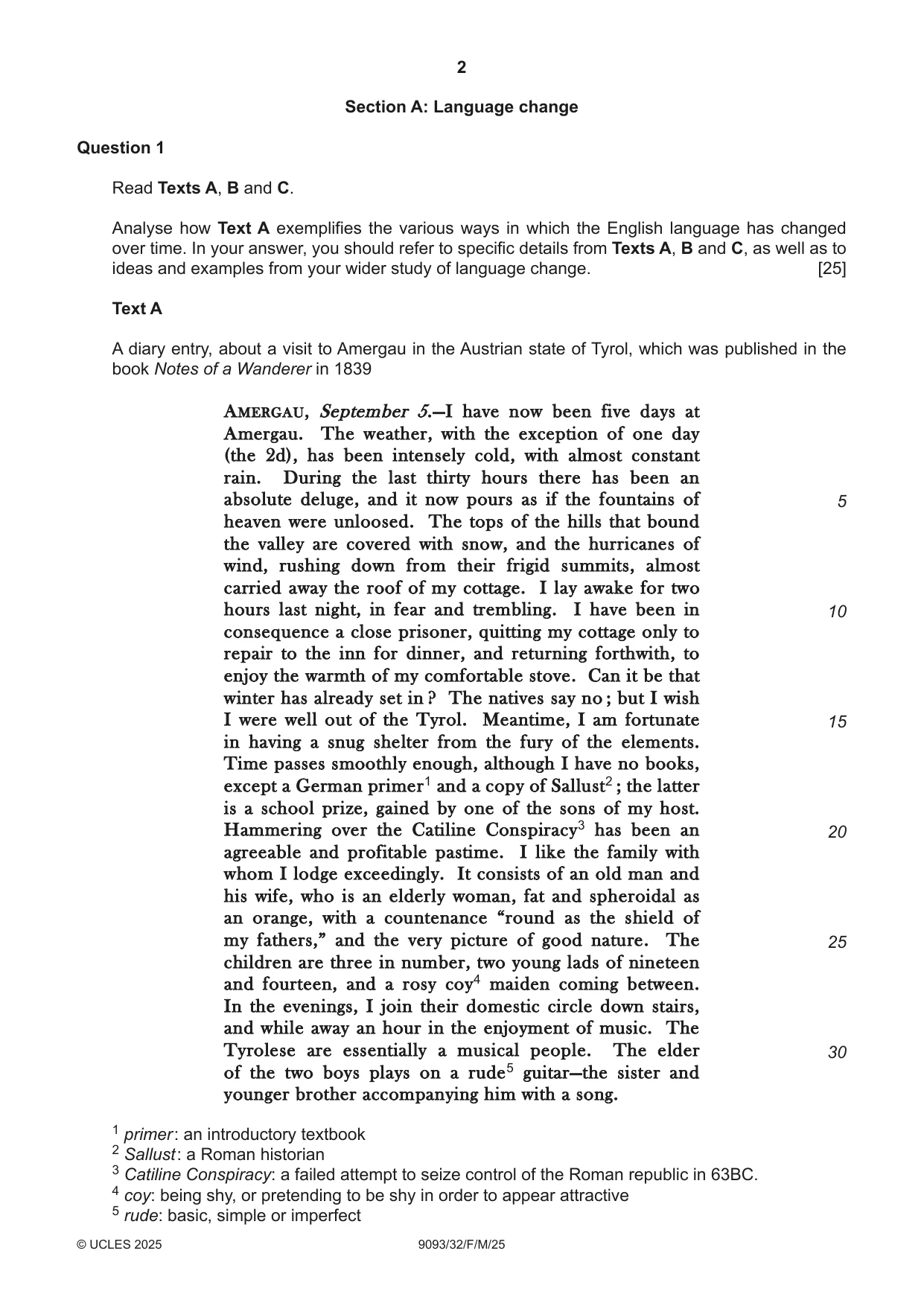
2 9093/32/F/M/25 © UCLES 2025 Section A: Language change Question 1 Read Texts A, B and C. Analyse how Text A exemplifies the various ways in which the English language has changed over time. In your answer, you should refer to specific details from Texts A, B and C, as well as to ideas and examples from your wider study of language change. [25] Text A A diary entry, about a visit to Amergau in the Austrian state of Tyrol, which was published in the book Notes of a Wanderer in 1839 Amergau mergau, , September 5 September 5.—I have now been five days at .—I have now been five days at Amergau. The weather, with the exception of one day Amergau. The weather, with the exception of one day (the 2d), has been intensely cold, with almost constant (the 2d), has been intensely cold, with almost constant rain. During the last thirty hours there has been an rain. During the last thirty hours there has been an absolute deluge, and it now pours as if the fountains of absolute deluge, and it now pours as if the fountains of heaven were unloosed. The tops of the hills that bound heaven were unloosed. The tops of the hills that bound the valley are covered with snow, and the hurricanes of the valley are covered with snow, and the hurricanes of wind, rushing down from their frigid summits, almost wind, rushing down from their frigid summits, almost carried away the roof of my cottage. I lay awake for two carried away the roof of my cottage. I lay awake for two hours last night, in fear and trembling. I have been in hours last night, in fear and trembling. I have been in consequence a close prisoner, quitting my cottage only to consequence a close prisoner, quitting my cottage only to repair to the inn for dinner, and returning forthwith, to repair to the inn for dinner, and returning forthwith, to enjoy the warmth of my comfortable stove. Can it be that enjoy the warmth of my comfortable stove. Can it be that winter has already set in ? The natives say no ; but I wish winter has already set in ? The natives say no ; but I wish I were well out of the Tyrol. Meantime, I am fortunate I were well out of the Tyrol. Meantime, I am fortunate in having a snug shelter from the fury of the elements. in having a snug shelter from the fury of the elements. Time passes smoothly enough, although I have no books, Time passes smoothly enough, although I have no books, except a German primer except a German primer1 and a copy of Sallust and a copy of Sallust2 ; the latter ; the latter is a school prize, gained by one of the sons of my host. is a school prize, gained by one of the sons of my host. Hammering over the Catiline Conspiracy Hammering over the Catiline Conspiracy3 has been an has been an agreeable and profitable pastime. I like the family with agreeable and profitable pastime. I like the family with whom I lodge exceedingly. It consists of an old man and whom I lodge exceedingly. It consists of an old man and his wife, who is an elderly woman, fat and spheroidal as his wife, who is an elderly woman, fat and spheroidal as an orange, with a countenance “round as the shield of an orange, with a countenance “round as the shield of my fathers,” and the very picture of good nature. The my fathers,” and the very picture of good nature. The children are three in number, two young lads of nineteen children are three in number, two young lads of nineteen and fourteen, and a rosy coy and fourteen, and a rosy coy4 maiden coming between. maiden coming between. In the evenings, I join their domestic circle down stairs, In the evenings, I join their domestic circle down stairs, and while away an hour in the enjoyment of music. The and while away an hour in the enjoyment of music. The Tyrolese are essentially a musical people. The elder Tyrolese are essentially a musical people. The elder of the two boys plays on a rude of the two boys plays on a rude5 guitar—the sister and guitar—the sister and younger brother accompanying him with a song. younger brother accompanying him with a song. 5 10 15 20 25 30 1 primer: an introductory textbook 2 Sallust: a Roman historian 3 Catiline Conspiracy: a failed attempt to seize control of the Roman republic in 63BC. 4 coy: being shy, or pretending to be shy in order to appear attractive 5 rude: basic, simple or imperfect
Question paper, page 3
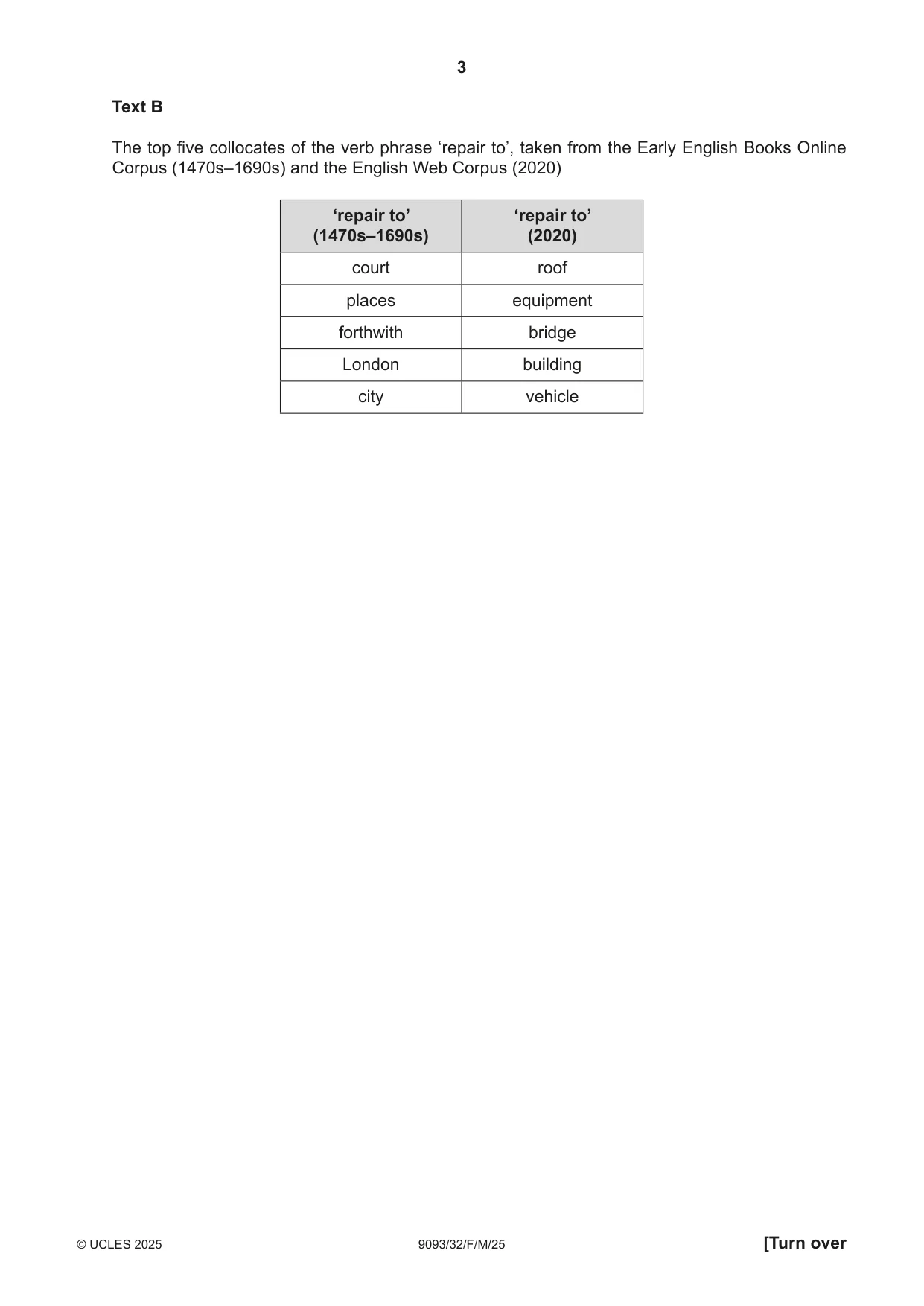
3 9093/32/F/M/25 © UCLES 2025 [Turn over Text B The top five collocates of the verb phrase ‘repair to’, taken from the Early English Books Online Corpus (1470s–1690s) and the English Web Corpus (2020) ‘repair to’ (1470s–1690s) ‘repair to’ (2020) court roof places equipment forthwith bridge London building city vehicle
Question paper, page 4
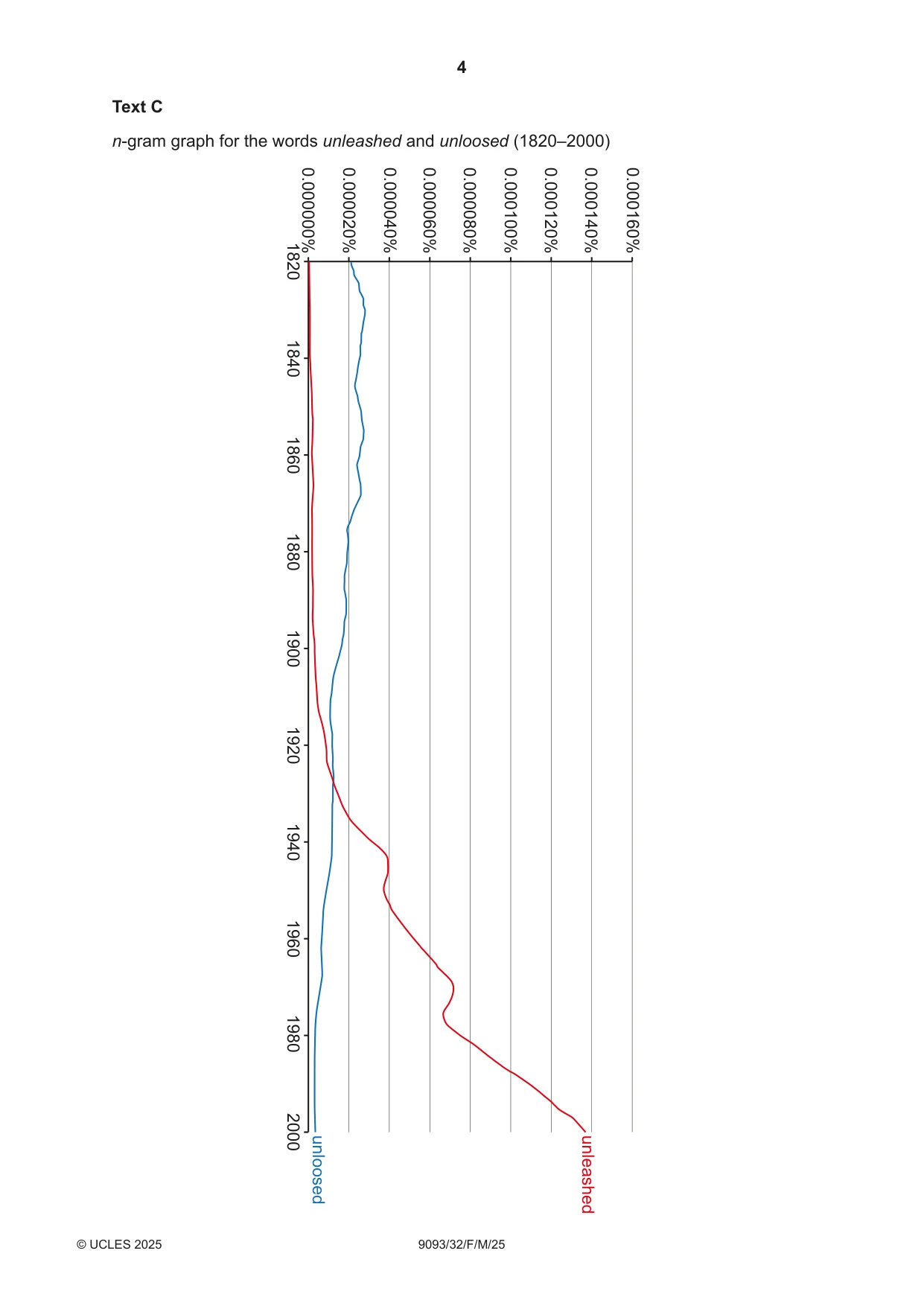
4 9093/32/F/M/25 © UCLES 2025 Text C n-gram graph for the words unleashed and unloosed (1820–2000) 0.000000% 0.000020% 0.000040% 0.000060% 0.000080% 0.000100% 0.000120% 0.000140% 0.000160% 1820 1840 1860 1880 1900 1920 1940 1960 1980 2000 unloosed unleashed
Question paper, page 5
5 9093/32/F/M/25 © UCLES 2025 [Turn over BLANK PAGE
Question paper, page 6
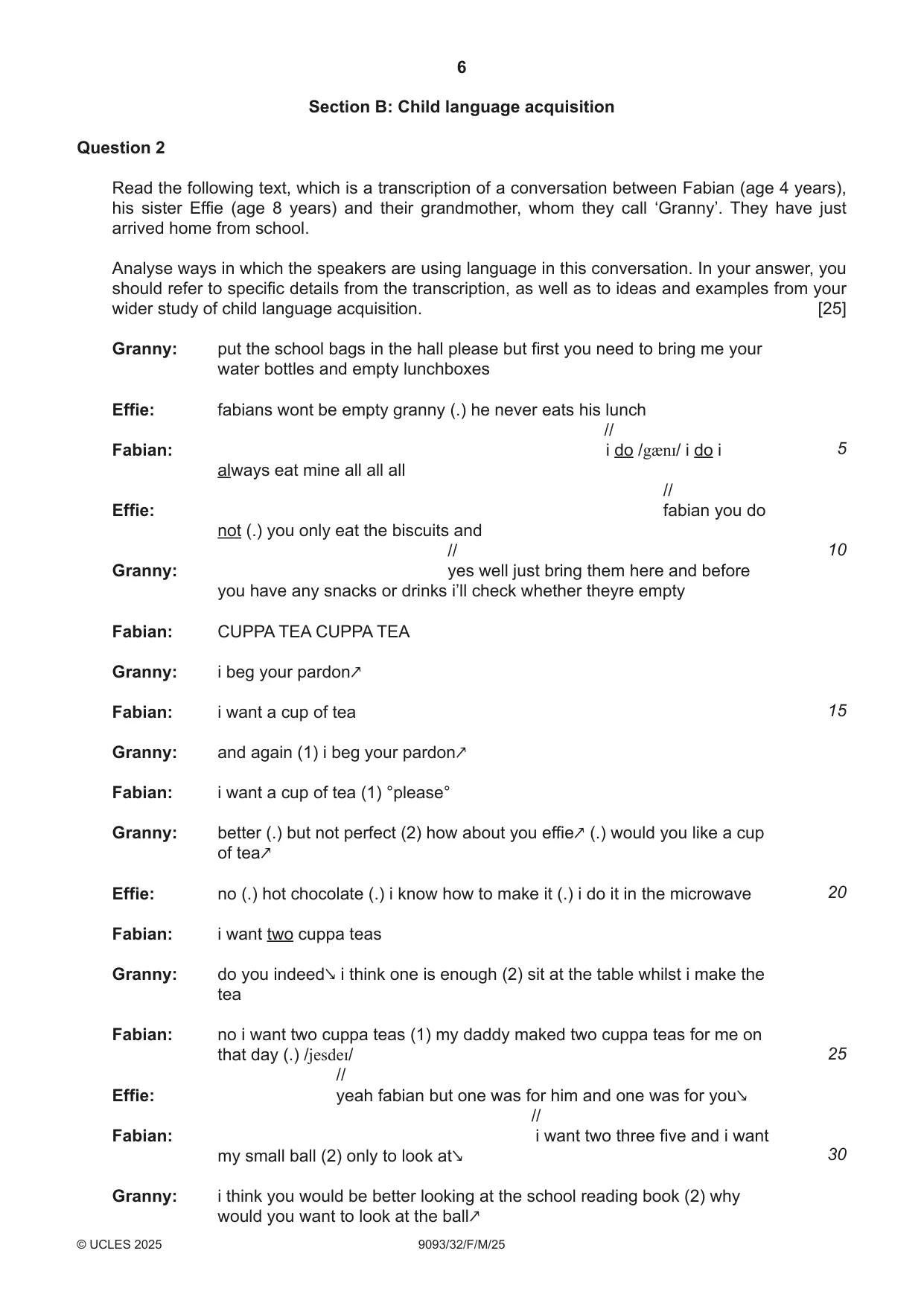
6 9093/32/F/M/25 © UCLES 2025 Section B: Child language acquisition Question 2 Read the following text, which is a transcription of a conversation between Fabian (age 4 years), his sister Effie (age 8 years) and their grandmother, whom they call ‘Granny’. They have just arrived home from school. Analyse ways in which the speakers are using language in this conversation. In your answer, you should refer to specific details from the transcription, as well as to ideas and examples from your wider study of child language acquisition. [25] Granny: put the school bags in the hall please but first you need to bring me your water bottles and empty lunchboxes Effie: fabians wont be empty granny (.) he never eats his lunch // Fabian: i do /gænɪ/ i do i always eat mine all all all // Effie: fabian you do not (.) you only eat the biscuits and // Granny: yes well just bring them here and before you have any snacks or drinks i’ll check whether theyre empty Fabian: CUPPA TEA CUPPA TEA Granny: i beg your pardon↗ Fabian: i want a cup of tea Granny: and again (1) i beg your pardon↗ Fabian: i want a cup of tea (1) °please° Granny: better (.) but not perfect (2) how about you effie↗ (.) would you like a cup of tea↗ Effie: no (.) hot chocolate (.) i know how to make it (.) i do it in the microwave Fabian: i want two cuppa teas Granny: do you indeed↘ i think one is enough (2) sit at the table whilst i make the tea Fabian: no i want two cuppa teas (1) my daddy maked two cuppa teas for me on that day (.) /jesdeɪ/ // Effie: yeah fabian but one was for him and one was for you↘ // Fabian: i want two three five and i want my small ball (2) only to look at↘ Granny: i think you would be better looking at the school reading book (2) why would you want to look at the ball↗ 5 10 15 20 25 30
Question paper, page 7
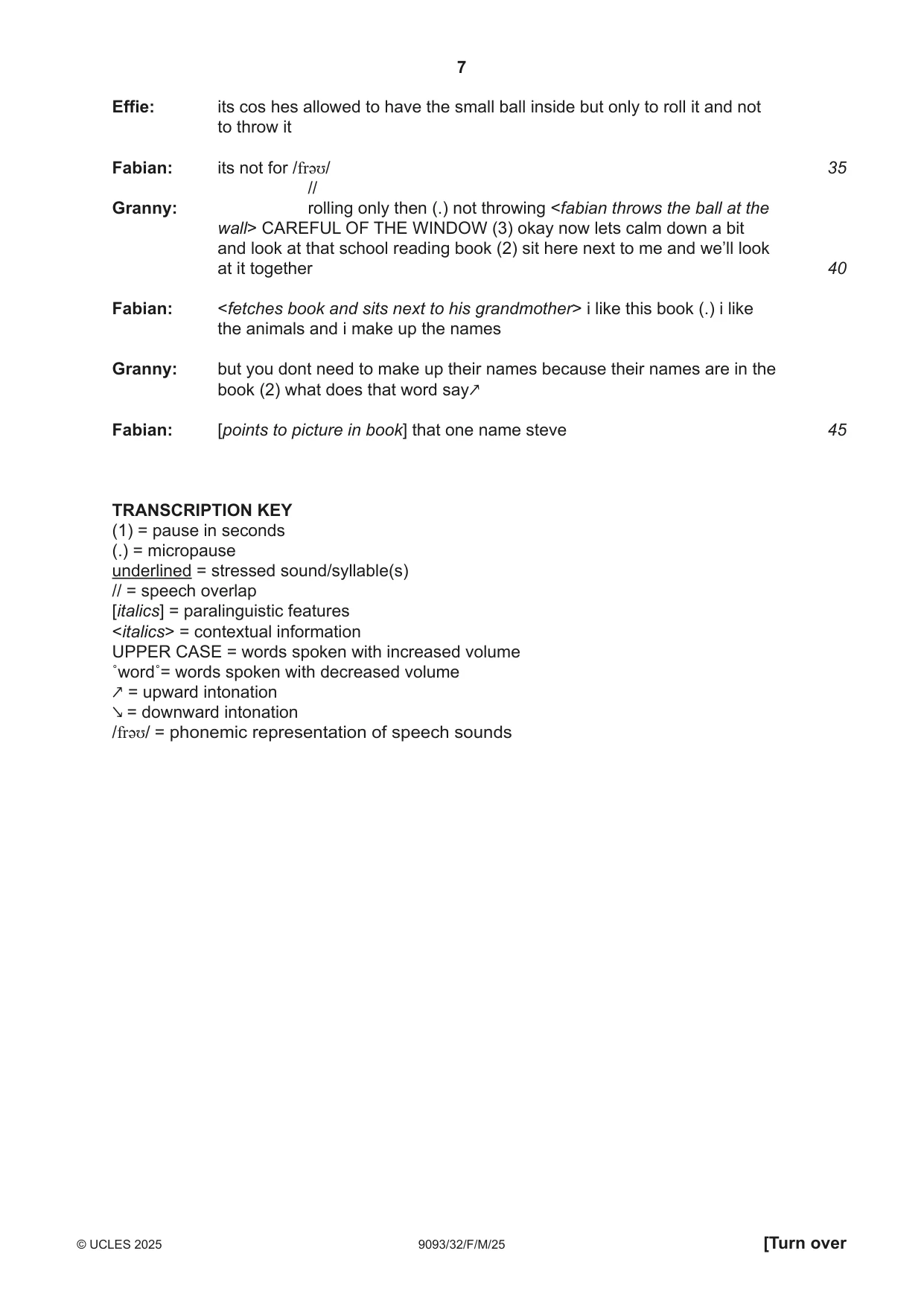
7 9093/32/F/M/25 © UCLES 2025 [Turn over Effie: its cos hes allowed to have the small ball inside but only to roll it and not to throw it Fabian: its not for /frəʊ/ // Granny: rolling only then (.) not throwing <fabian throws the ball at the wall> CAREFUL OF THE WINDOW (3) okay now lets calm down a bit and look at that school reading book (2) sit here next to me and we’ll look at it together Fabian: <fetches book and sits next to his grandmother> i like this book (.) i like the animals and i make up the names Granny: but you dont need to make up their names because their names are in the book (2) what does that word say↗ Fabian: [points to picture in book] that one name steve TRANSCRIPTION KEY (1) = pause in seconds (.) = micropause underlined = stressed sound/syllable(s) // = speech overlap [italics] = paralinguistic features <italics> = contextual information UPPER CASE = words spoken with increased volume ˚word˚= words spoken with decreased volume ↗ = upward intonation ↘ = downward intonation /frəʊ/ = phonemic representation of speech sounds 35 40 45
Question paper, page 8
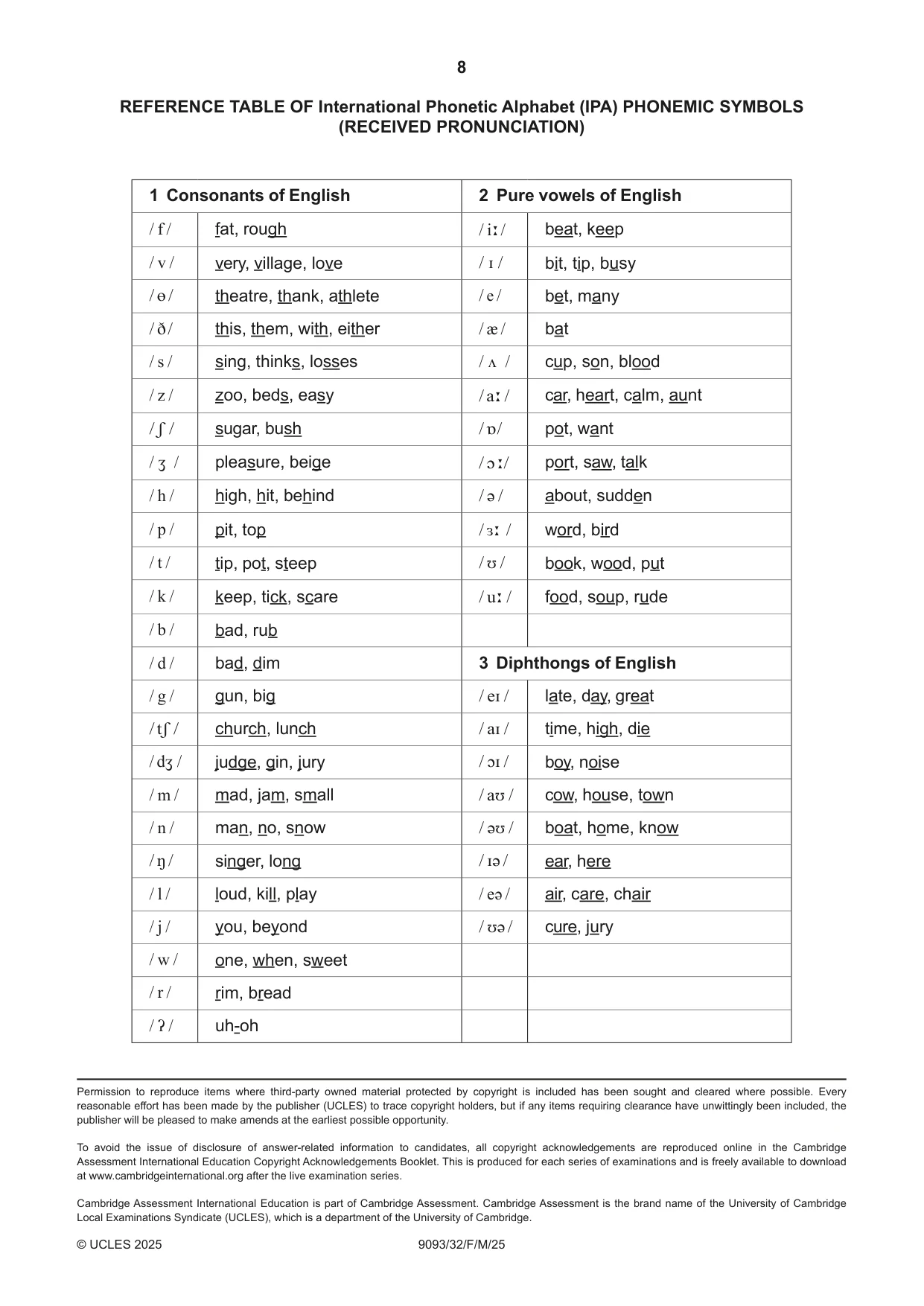
8 9093/32/F/M/25 © UCLES 2025 REFERENCE TABLE OF International Phonetic Alphabet (IPA) PHONEMIC SYMBOLS (RECEIVED PRONUNCIATION) 1 Consonants of English 2 Pure vowels of English / f / fat, rough / iː / beat, keep / v / very, village, love / ɪ / bit, tip, busy / ɵ / theatre, thank, athlete / e / bet, many / ð/ this, them, with, either / æ / bat / s / sing, thinks, losses / ʌ / cup, son, blood / z / zoo, beds, easy / aː / car, heart, calm, aunt / ʃ / sugar, bush / ɒ / pot, want / ʒ / pleasure, beige / ɔː/ port, saw, talk / h / high, hit, behind / ə / about, sudden / p / pit, top / ɜː / word, bird / t / tip, pot, steep / ʊ / book, wood, put / k / keep, tick, scare / uː / food, soup, rude / b / bad, rub / d / bad, dim 3 Diphthongs of English / g / gun, big / eɪ / late, day, great / tʃ / church, lunch / aɪ / time, high, die / dʒ / judge, gin, jury / ɔɪ / boy, noise / m / mad, jam, small / aʊ / cow, house, town / n / man, no, snow / əʊ / boat, home, know / ŋ / singer, long / ɪə / ear, here / l / loud, kill, play / eə / air, care, chair / j / you, beyond / ʊə / cure, jury / w / one, when, sweet / r / rim, bread / ʔ / uh-oh Permission to reproduce items where third-party owned material protected by copyright is included has been sought and cleared where possible. Every reasonable effort has been made by the publisher (UCLES) to trace copyright holders, but if any items requiring clearance have unwittingly been included, the publisher will be pleased to make amends at the earliest possible opportunity. To avoid the issue of disclosure of answer-related information to candidates, all copyright acknowledgements are reproduced online in the Cambridge Assessment International Education Copyright Acknowledgements Booklet. This is produced for each series of examinations and is freely available to download at www.cambridgeinternational.org after the live examination series. Cambridge Assessment International Education is part of Cambridge Assessment. Cambridge Assessment is the brand name of the University of Cambridge Local Examinations Syndicate (UCLES), which is a department of the University of Cambridge.
Mark scheme, page 1
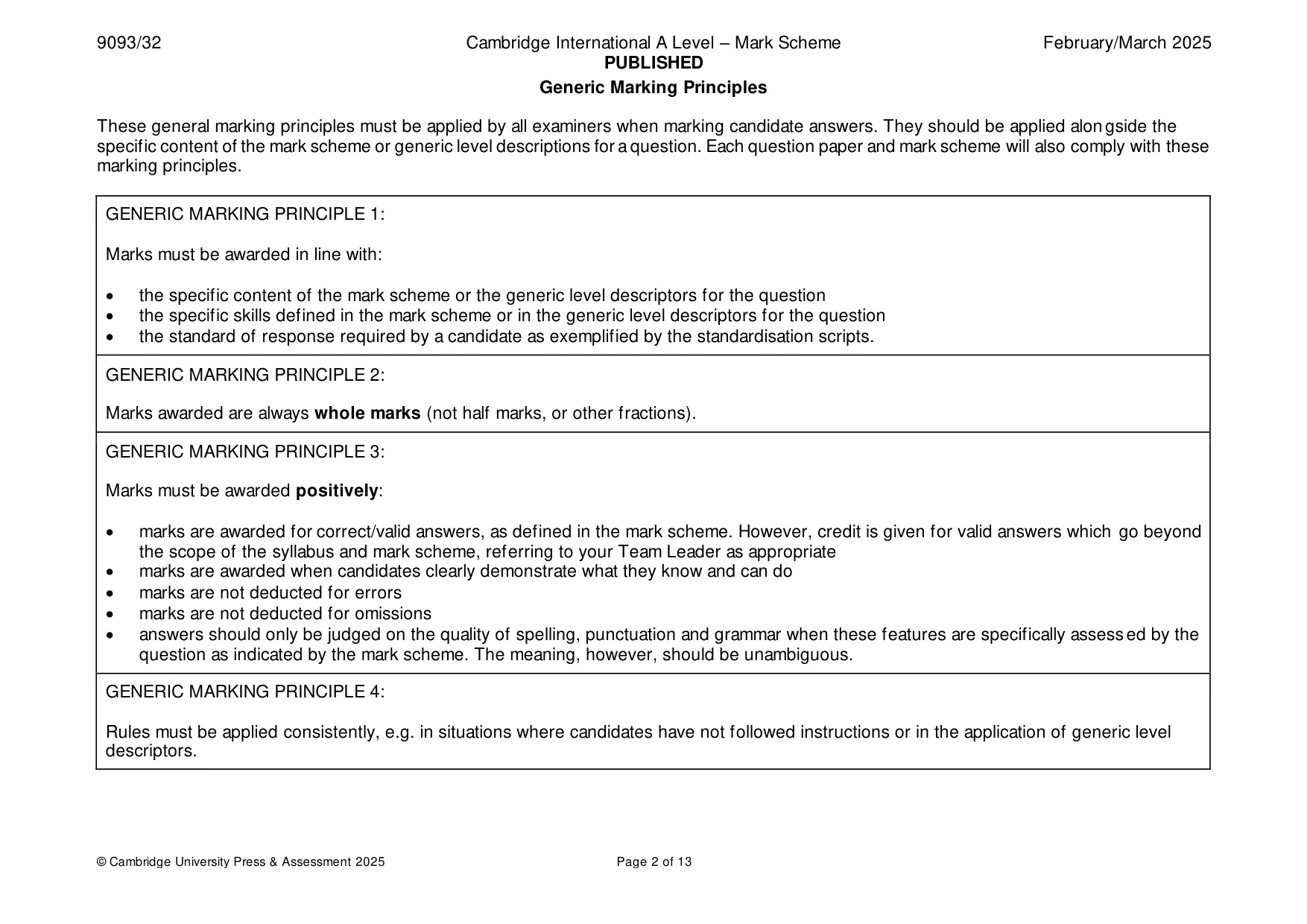
This document consists of 13 printed pages. © Cambridge University Press & Assessment 2025 [Turn over Cambridge International A Level ENGLISH LANGUAGE 9093/32 Paper 3 Language Analysis February/March 2025 MARK SCHEME Maximum Mark: 50 Published This mark scheme is published as an aid to teachers and candidates, to indicate the requirements of the examination. It shows the basis on which Examiners were instructed to award marks. It does not indicate the details of the discussions that took place at an Examiners’ meeting before marking began, which would have considered the acceptability of alternative answers. Mark schemes should be read in conjunction with the question paper and the Principal Examiner Report for Teachers. Cambridge International will not enter into discussions about these mark schemes. Cambridge International is publishing the mark schemes for the February/March 2025 series for most Cambridge IGCSE, Cambridge International A and AS Level components, and some Cambridge O Level components.
Mark scheme, page 2
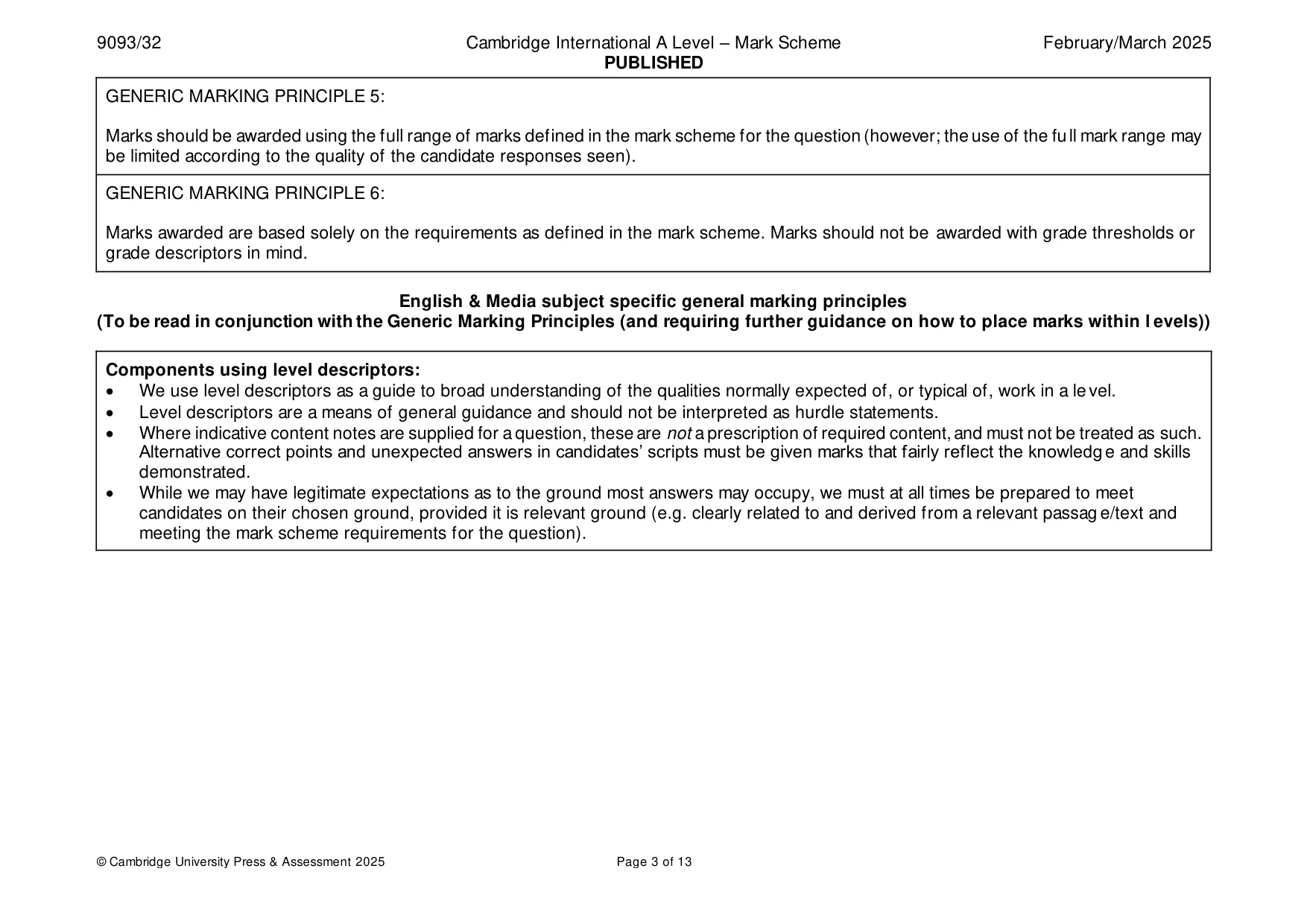
9093/32 Cambridge International A Level – Mark Scheme PUBLISHED February/March 2025 © Cambridge University Press & Assessment 2025 Page 2 of 13 Generic Marking Principles These general marking principles must be applied by all examiners when marking candidate answers. They should be applied alon gside the specific content of the mark scheme or generic level descriptions for a question. Each question paper and mark scheme will also comply with these marking principles. GENERIC MARKING PRINCIPLE 1: Marks must be awarded in line with: • the specific content of the mark scheme or the generic level descriptors for the question • the specific skills defined in the mark scheme or in the generic level descriptors for the question • the standard of response required by a candidate as exemplified by the standardisation scripts. GENERIC MARKING PRINCIPLE 2: Marks awarded are always whole marks (not half marks, or other fractions). GENERIC MARKING PRINCIPLE 3: Marks must be awarded positively: • marks are awarded for correct/valid answers, as defined in the mark scheme. However, credit is given for valid answers which go beyond the scope of the syllabus and mark scheme, referring to your Team Leader as appropriate • marks are awarded when candidates clearly demonstrate what they know and can do • marks are not deducted for errors • marks are not deducted for omissions • answers should only be judged on the quality of spelling, punctuation and grammar when these features are specifically assessed by the question as indicated by the mark scheme. The meaning, however, should be unambiguous. GENERIC MARKING PRINCIPLE 4: Rules must be applied consistently, e.g. in situations where candidates have not followed instructions or in the application of generic level descriptors.
Mark scheme, page 3
9093/32 Cambridge International A Level – Mark Scheme PUBLISHED February/March 2025 © Cambridge University Press & Assessment 2025 Page 3 of 13 GENERIC MARKING PRINCIPLE 5: Marks should be awarded using the full range of marks defined in the mark scheme for the question (however; the use of the full mark range may be limited according to the quality of the candidate responses seen). GENERIC MARKING PRINCIPLE 6: Marks awarded are based solely on the requirements as defined in the mark scheme. Marks should not be awarded with grade thresholds or grade descriptors in mind. English & Media subject specific general marking principles (To be read in conjunction with the Generic Marking Principles (and requiring further guidance on how to place marks within l evels)) Components using level descriptors: • We use level descriptors as a guide to broad understanding of the qualities normally expected of, or typical of, work in a le vel. • Level descriptors are a means of general guidance and should not be interpreted as hurdle statements. • Where indicative content notes are supplied for a question, these are not a prescription of required content, and must not be treated as such. Alternative correct points and unexpected answers in candidates’ scripts must be given marks that fairly reflect the knowledg e and skills demonstrated. • While we may have legitimate expectations as to the ground most answers may occupy, we must at all times be prepared to meet candidates on their chosen ground, provided it is relevant ground (e.g. clearly related to and derived from a relevant passag e/text and meeting the mark scheme requirements for the question).
Mark scheme, page 4
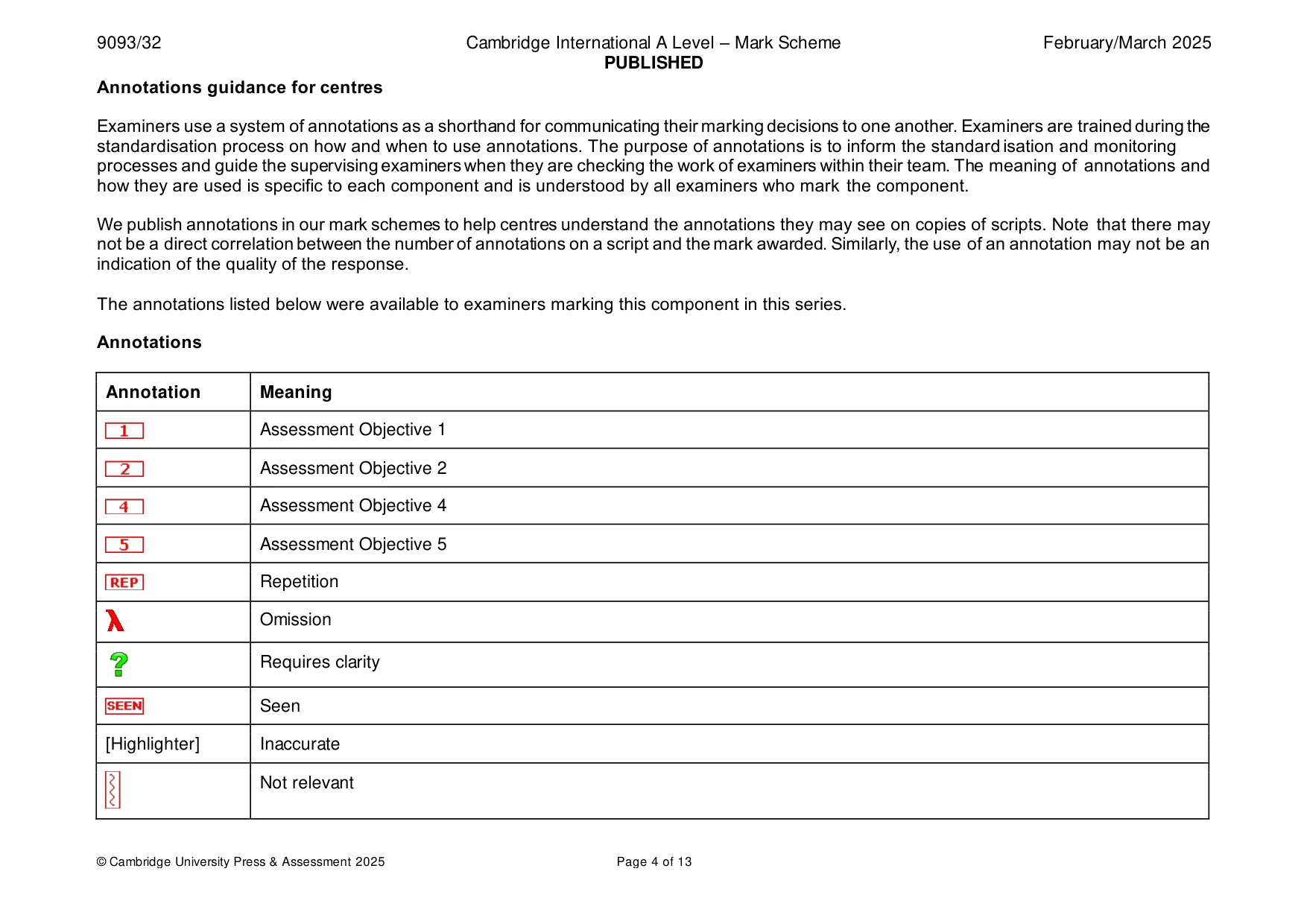
9093/32 Cambridge International A Level – Mark Scheme PUBLISHED February/March 2025 © Cambridge University Press & Assessment 2025 Page 4 of 13 Annotations guidance for centres Examiners use a system of annotations as a shorthand for communicating their marking decisions to one another. Examiners are trained during the standardisation process on how and when to use annotations. The purpose of annotations is to inform the standard isation and monitoring processes and guide the supervising examiners when they are checking the work of examiners within their team. The meaning of annotations and how they are used is specific to each component and is understood by all examiners who mark the component. We publish annotations in our mark schemes to help centres understand the annotations they may see on copies of scripts. Note that there may not be a direct correlation between the number of annotations on a script and the mark awarded. Similarly, the use of an annotation may not be an indication of the quality of the response. The annotations listed below were available to examiners marking this component in this series. Annotations Annotation Meaning Assessment Objective 1 Assessment Objective 2 Assessment Objective 4 Assessment Objective 5 Repetition Omission Requires clarity Seen [Highlighter] Inaccurate Not relevant
Mark scheme, page 5
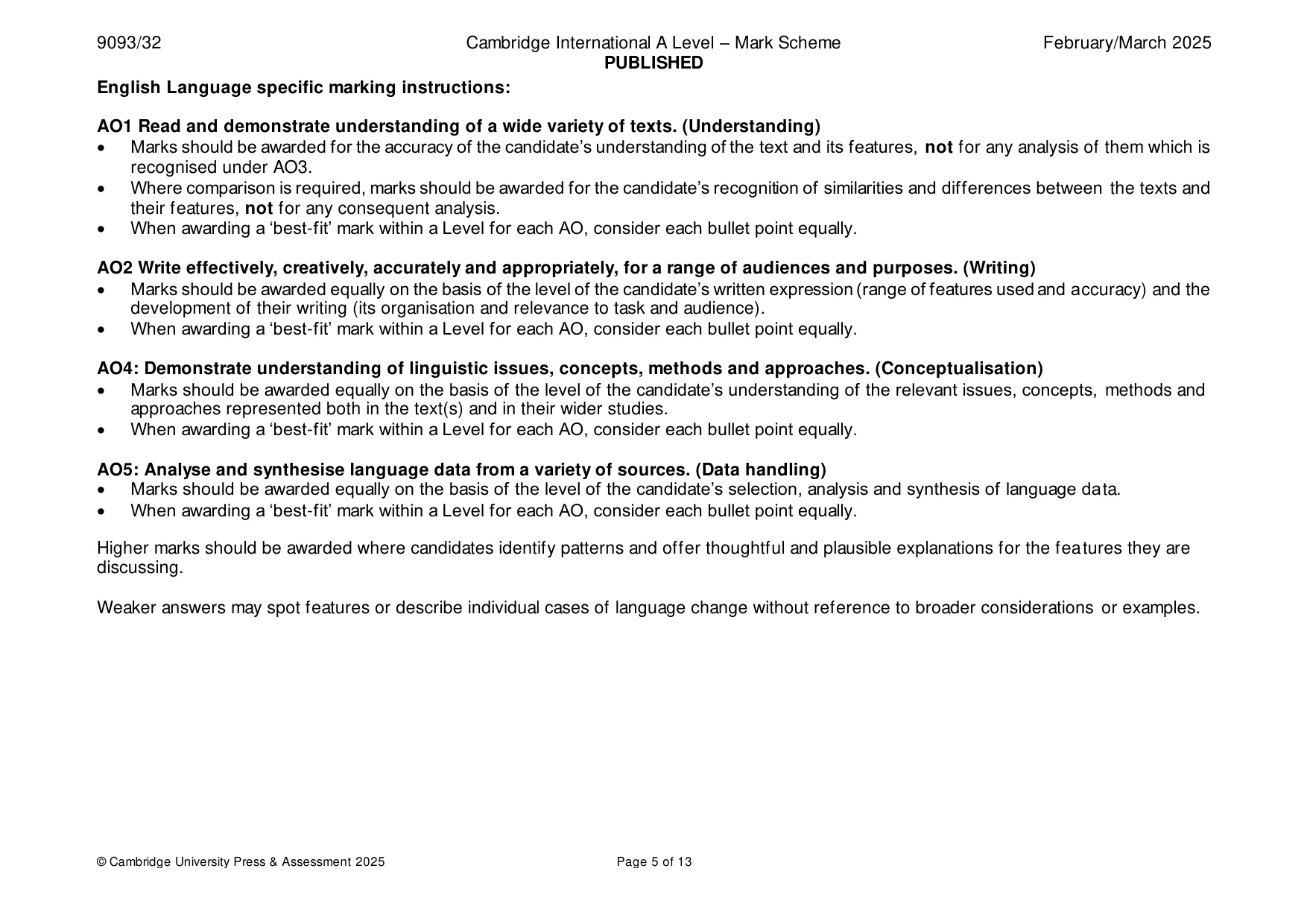
9093/32 Cambridge International A Level – Mark Scheme PUBLISHED February/March 2025 © Cambridge University Press & Assessment 2025 Page 5 of 13 English Language specific marking instructions: AO1 Read and demonstrate understanding of a wide variety of texts. (Understanding) • Marks should be awarded for the accuracy of the candidate’s understanding of the text and its features, not for any analysis of them which is recognised under AO3. • Where comparison is required, marks should be awarded for the candidate’s recognition of similarities and differences between the texts and their features, not for any consequent analysis. • When awarding a ‘best-fit’ mark within a Level for each AO, consider each bullet point equally. AO2 Write effectively, creatively, accurately and appropriately, for a range of audiences and purposes. (Writing) • Marks should be awarded equally on the basis of the level of the candidate’s written expression (range of features used and accuracy) and the development of their writing (its organisation and relevance to task and audience). • When awarding a ‘best-fit’ mark within a Level for each AO, consider each bullet point equally. AO4: Demonstrate understanding of linguistic issues, concepts, methods and approaches. (Conceptualisation) • Marks should be awarded equally on the basis of the level of the candidate’s understanding of the relevant issues, concepts, methods and approaches represented both in the text(s) and in their wider studies. • When awarding a ‘best-fit’ mark within a Level for each AO, consider each bullet point equally. AO5: Analyse and synthesise language data from a variety of sources. (Data handling) • Marks should be awarded equally on the basis of the level of the candidate’s selection, analysis and synthesis of language data. • When awarding a ‘best-fit’ mark within a Level for each AO, consider each bullet point equally. Higher marks should be awarded where candidates identify patterns and offer thoughtful and plausible explanations for the features they are discussing. Weaker answers may spot features or describe individual cases of language change without reference to broader considerations or examples.
Mark scheme, page 6
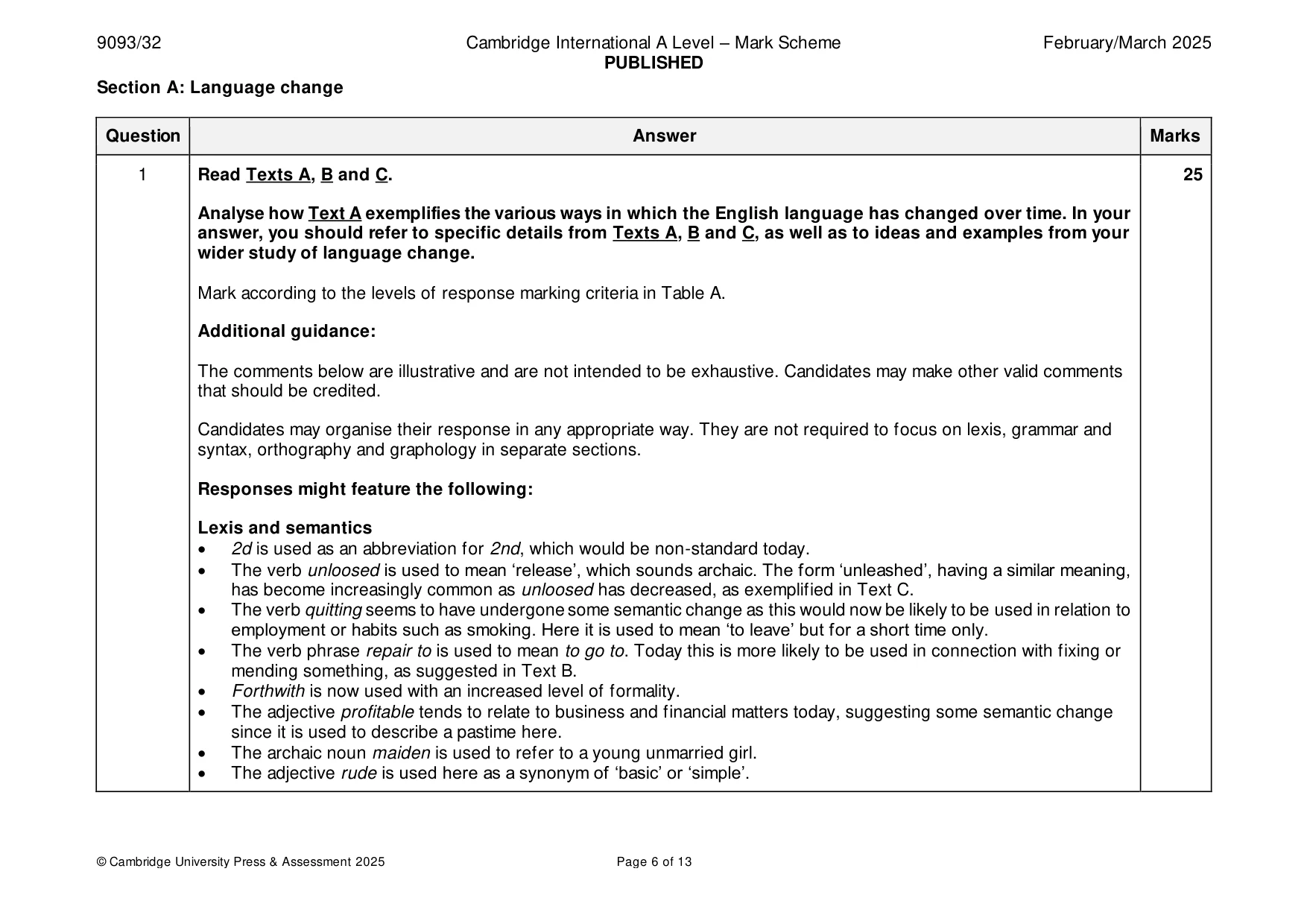
9093/32 Cambridge International A Level – Mark Scheme PUBLISHED February/March 2025 © Cambridge University Press & Assessment 2025 Page 6 of 13 Section A: Language change Question Answer Marks 1 Read Texts A, B and C. Analyse how Text A exemplifies the various ways in which the English language has changed over time. In your answer, you should refer to specific details from Texts A, B and C, as well as to ideas and examples from your wider study of language change. Mark according to the levels of response marking criteria in Table A. Additional guidance: The comments below are illustrative and are not intended to be exhaustive. Candidates may make other valid comments that should be credited. Candidates may organise their response in any appropriate way. They are not required to focus on lexis, grammar and syntax, orthography and graphology in separate sections. Responses might feature the following: Lexis and semantics • 2d is used as an abbreviation for 2nd, which would be non-standard today. • The verb unloosed is used to mean ‘release’, which sounds archaic. The form ‘unleashed’, having a similar meaning, has become increasingly common as unloosed has decreased, as exemplified in Text C. • The verb quitting seems to have undergone some semantic change as this would now be likely to be used in relation to employment or habits such as smoking. Here it is used to mean ‘to leave’ but for a short time only. • The verb phrase repair to is used to mean to go to. Today this is more likely to be used in connection with fixing or mending something, as suggested in Text B. • Forthwith is now used with an increased level of formality. • The adjective profitable tends to relate to business and financial matters today, suggesting some semantic change since it is used to describe a pastime here. • The archaic noun maiden is used to refer to a young unmarried girl. • The adjective rude is used here as a synonym of ‘basic’ or ‘simple’. 25
Mark scheme, page 7
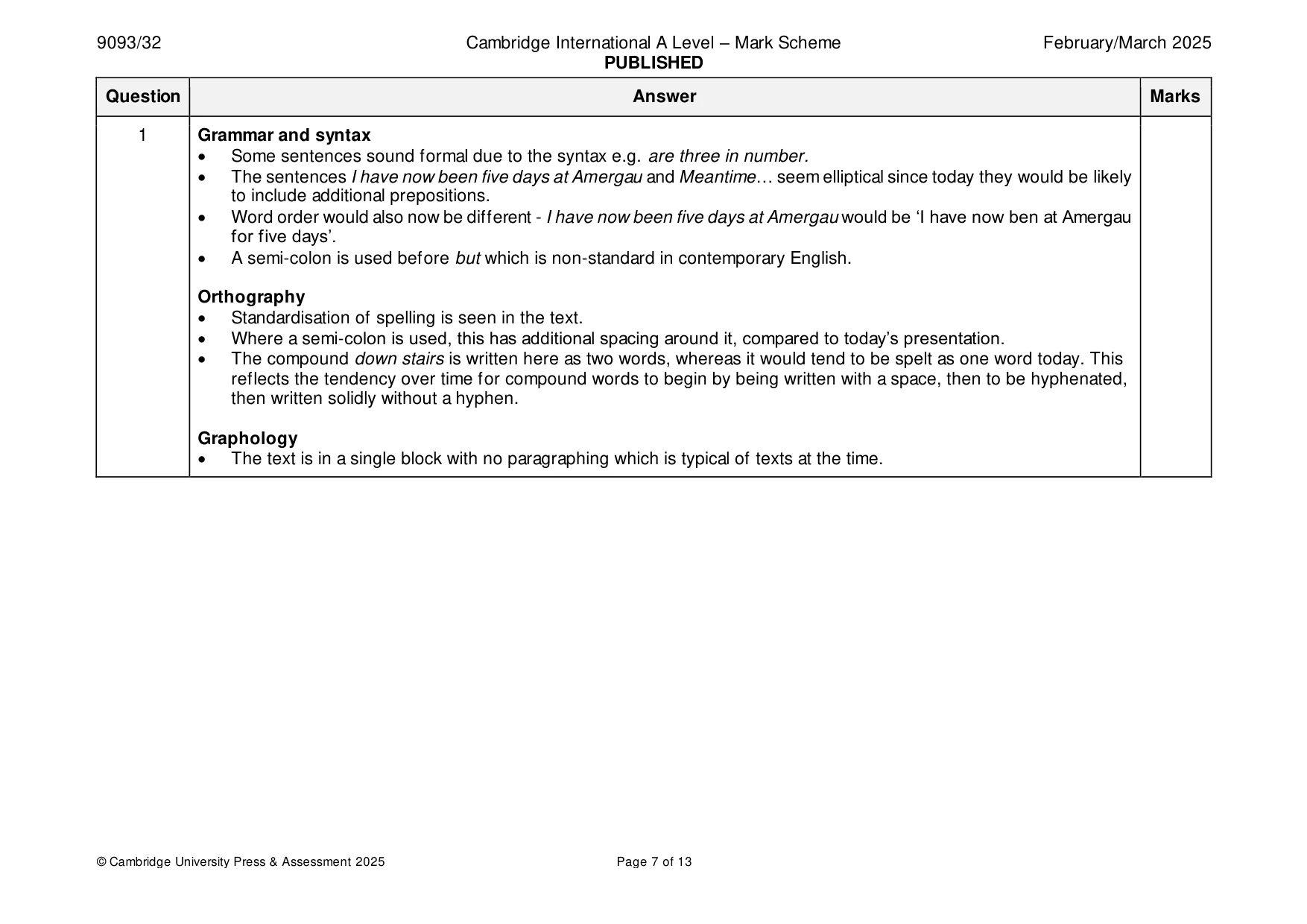
9093/32 Cambridge International A Level – Mark Scheme PUBLISHED February/March 2025 © Cambridge University Press & Assessment 2025 Page 7 of 13 Question Answer Marks 1 Grammar and syntax • Some sentences sound formal due to the syntax e.g. are three in number. • The sentences I have now been five days at Amergau and Meantime… seem elliptical since today they would be likely to include additional prepositions. • Word order would also now be different - I have now been five days at Amergau would be ‘I have now ben at Amergau for five days’. • A semi-colon is used before but which is non-standard in contemporary English. Orthography • Standardisation of spelling is seen in the text. • Where a semi-colon is used, this has additional spacing around it, compared to today’s presentation. • The compound down stairs is written here as two words, whereas it would tend to be spelt as one word today. This reflects the tendency over time for compound words to begin by being written with a space, then to be hyphenated, then written solidly without a hyphen. Graphology • The text is in a single block with no paragraphing which is typical of texts at the time.
Mark scheme, page 8
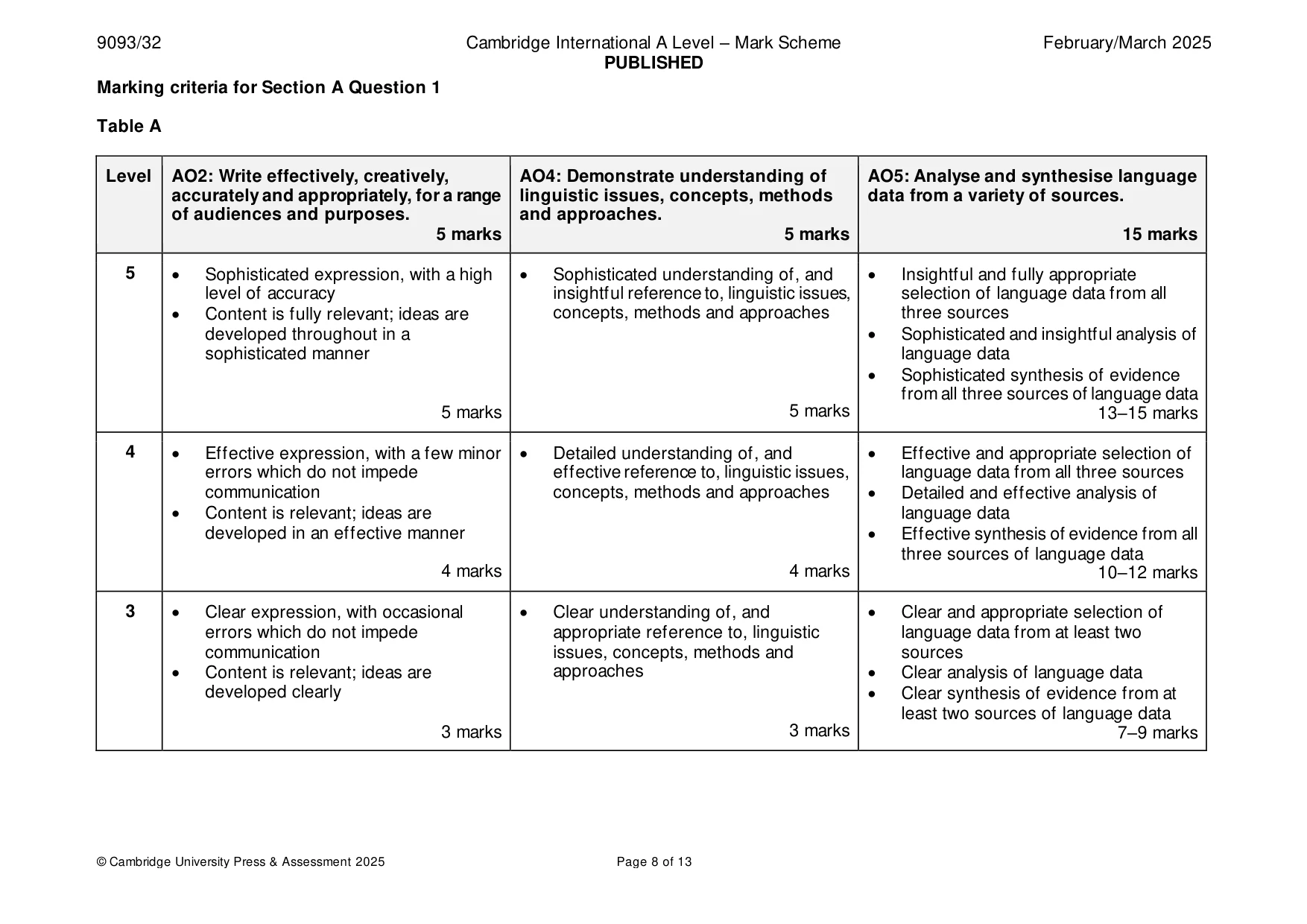
9093/32 Cambridge International A Level – Mark Scheme PUBLISHED February/March 2025 © Cambridge University Press & Assessment 2025 Page 8 of 13 Marking criteria for Section A Question 1 Table A Level AO2: Write effectively, creatively, accurately and appropriately, for a range of audiences and purposes. 5 marks AO4: Demonstrate understanding of linguistic issues, concepts, methods and approaches. 5 marks AO5: Analyse and synthesise language data from a variety of sources. 15 marks 5 • Sophisticated expression, with a high level of accuracy • Content is fully relevant; ideas are developed throughout in a sophisticated manner 5 marks • Sophisticated understanding of, and insightful reference to, linguistic issues, concepts, methods and approaches 5 marks • Insightful and fully appropriate selection of language data from all three sources • Sophisticated and insightful analysis of language data • Sophisticated synthesis of evidence from all three sources of language data 13–15 marks 4 • Effective expression, with a few minor errors which do not impede communication • Content is relevant; ideas are developed in an effective manner 4 marks • Detailed understanding of, and effective reference to, linguistic issues, concepts, methods and approaches 4 marks • Effective and appropriate selection of language data from all three sources • Detailed and effective analysis of language data • Effective synthesis of evidence from all three sources of language data 10–12 marks 3 • Clear expression, with occasional errors which do not impede communication • Content is relevant; ideas are developed clearly 3 marks • Clear understanding of, and appropriate reference to, linguistic issues, concepts, methods and approaches 3 marks • Clear and appropriate selection of language data from at least two sources • Clear analysis of language data • Clear synthesis of evidence from at least two sources of language data 7–9 marks
Mark scheme, page 9
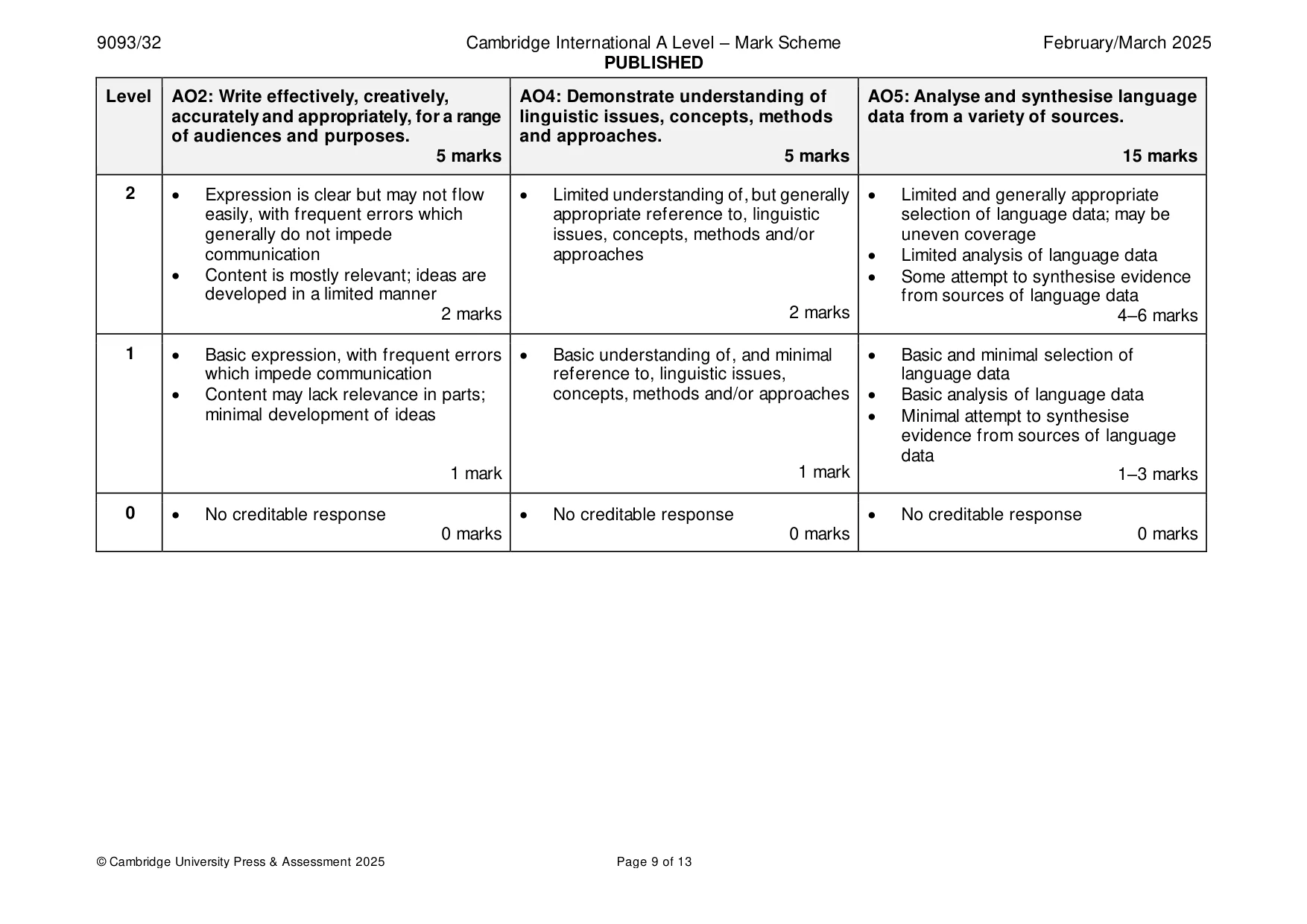
9093/32 Cambridge International A Level – Mark Scheme PUBLISHED February/March 2025 © Cambridge University Press & Assessment 2025 Page 9 of 13 Level AO2: Write effectively, creatively, accurately and appropriately, for a range of audiences and purposes. 5 marks AO4: Demonstrate understanding of linguistic issues, concepts, methods and approaches. 5 marks AO5: Analyse and synthesise language data from a variety of sources. 15 marks 2 • Expression is clear but may not flow easily, with frequent errors which generally do not impede communication • Content is mostly relevant; ideas are developed in a limited manner 2 marks • Limited understanding of, but generally appropriate reference to, linguistic issues, concepts, methods and/or approaches 2 marks • Limited and generally appropriate selection of language data; may be uneven coverage • Limited analysis of language data • Some attempt to synthesise evidence from sources of language data 4–6 marks 1 • Basic expression, with frequent errors which impede communication • Content may lack relevance in parts; minimal development of ideas 1 mark • Basic understanding of, and minimal reference to, linguistic issues, concepts, methods and/or approaches 1 mark • Basic and minimal selection of language data • Basic analysis of language data • Minimal attempt to synthesise evidence from sources of language data 1–3 marks 0 • No creditable response 0 marks • No creditable response 0 marks • No creditable response 0 marks
Mark scheme, page 10
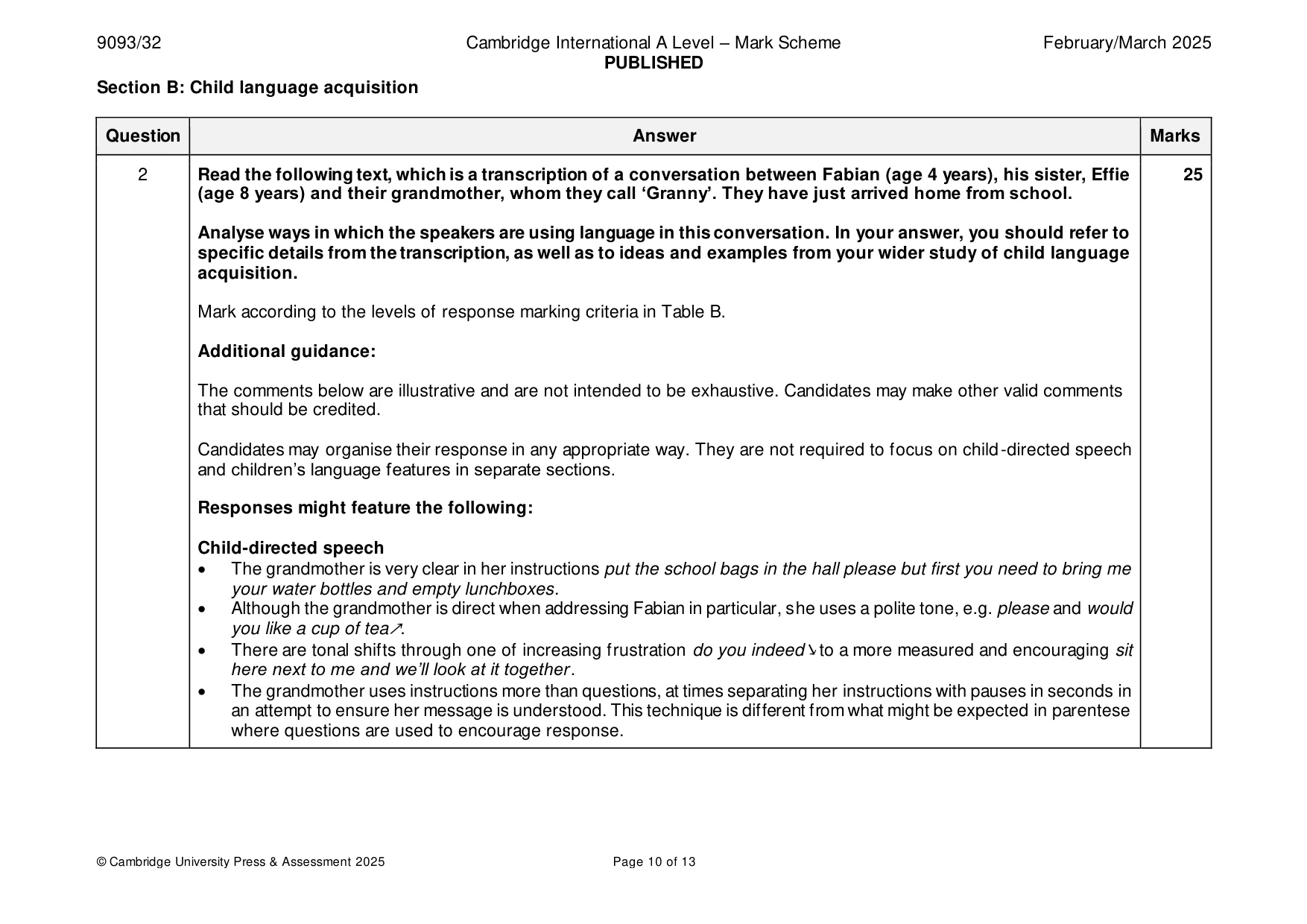
9093/32 Cambridge International A Level – Mark Scheme PUBLISHED February/March 2025 © Cambridge University Press & Assessment 2025 Page 10 of 13 Section B: Child language acquisition Question Answer Marks 2 Read the following text, which is a transcription of a conversation between Fabian (age 4 years), his sister, Effie (age 8 years) and their grandmother, whom they call ‘Granny’. They have just arrived home from school. Analyse ways in which the speakers are using language in this conversation. In your answer, you should refer to specific details from the transcription, as well as to ideas and examples from your wider study of child language acquisition. Mark according to the levels of response marking criteria in Table B. Additional guidance: The comments below are illustrative and are not intended to be exhaustive. Candidates may make other valid comments that should be credited. Candidates may organise their response in any appropriate way. They are not required to focus on child-directed speech and children’s language features in separate sections. Responses might feature the following: Child-directed speech • The grandmother is very clear in her instructions put the school bags in the hall please but first you need to bring me your water bottles and empty lunchboxes. • Although the grandmother is direct when addressing Fabian in particular, she uses a polite tone, e.g. please and would you like a cup of tea↗. • There are tonal shifts through one of increasing frustration do you indeed↘ to a more measured and encouraging sit here next to me and we’ll look at it together. • The grandmother uses instructions more than questions, at times separating her instructions with pauses in seconds in an attempt to ensure her message is understood. This technique is different from what might be expected in parentese where questions are used to encourage response. 25
Mark scheme, page 11
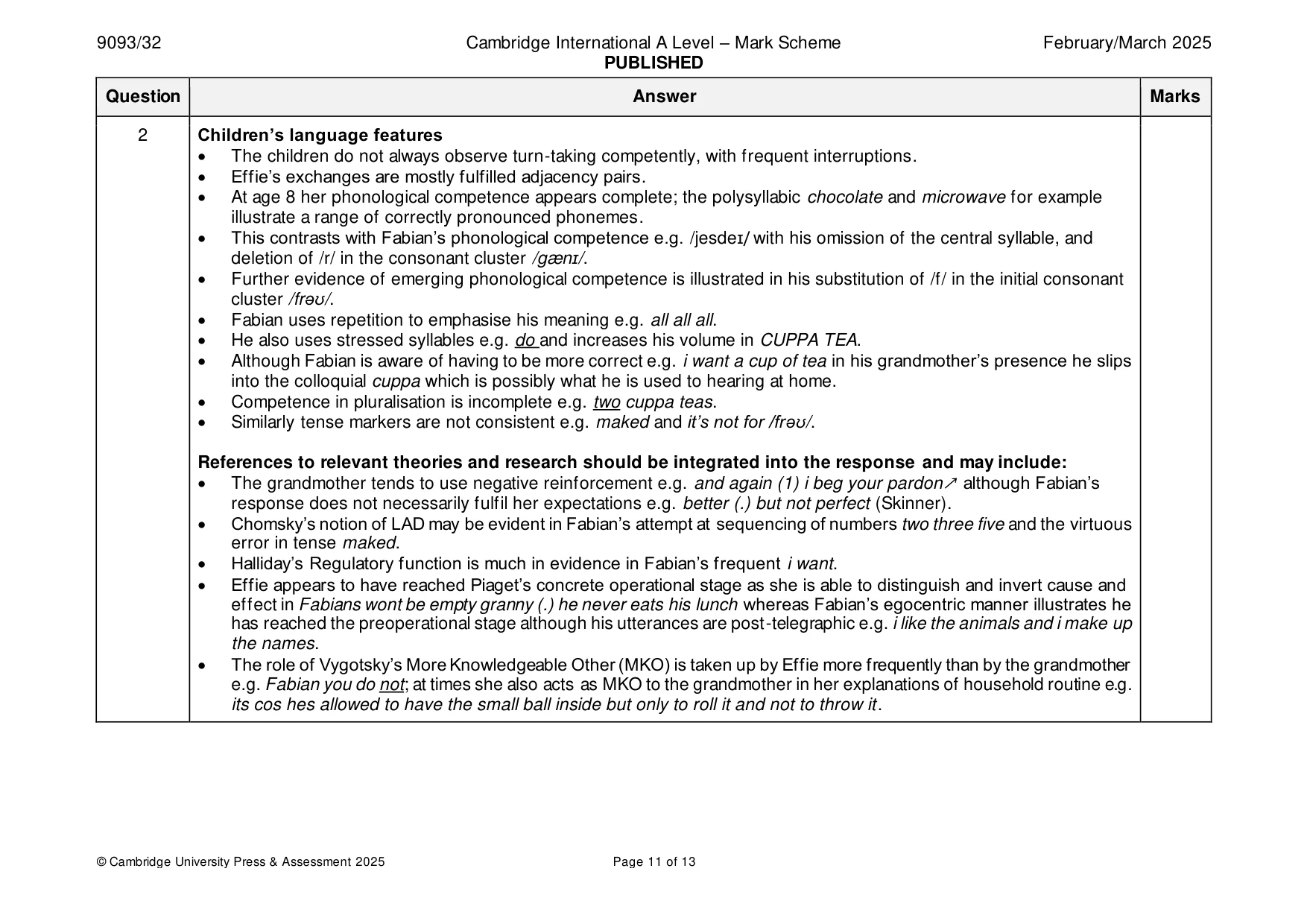
9093/32 Cambridge International A Level – Mark Scheme PUBLISHED February/March 2025 © Cambridge University Press & Assessment 2025 Page 11 of 13 Question Answer Marks 2 Children’s language features • The children do not always observe turn-taking competently, with frequent interruptions. • Effie’s exchanges are mostly fulfilled adjacency pairs. • At age 8 her phonological competence appears complete; the polysyllabic chocolate and microwave for example illustrate a range of correctly pronounced phonemes. • This contrasts with Fabian’s phonological competence e.g. /jesdeɪ/ with his omission of the central syllable, and deletion of /r/ in the consonant cluster /gænɪ/. • Further evidence of emerging phonological competence is illustrated in his substitution of /f/ in the initial consonant cluster /frəʊ/. • Fabian uses repetition to emphasise his meaning e.g. all all all. • He also uses stressed syllables e.g. do and increases his volume in CUPPA TEA. • Although Fabian is aware of having to be more correct e.g. i want a cup of tea in his grandmother’s presence he slips into the colloquial cuppa which is possibly what he is used to hearing at home. • Competence in pluralisation is incomplete e.g. two cuppa teas. • Similarly tense markers are not consistent e.g. maked and it’s not for /frəʊ/. References to relevant theories and research should be integrated into the response and may include: • The grandmother tends to use negative reinforcement e.g. and again (1) i beg your pardon↗ although Fabian’s response does not necessarily fulfil her expectations e.g. better (.) but not perfect (Skinner). • Chomsky’s notion of LAD may be evident in Fabian’s attempt at sequencing of numbers two three five and the virtuous error in tense maked. • Halliday’s Regulatory function is much in evidence in Fabian’s frequent i want. • Effie appears to have reached Piaget’s concrete operational stage as she is able to distinguish and invert cause and effect in Fabians wont be empty granny (.) he never eats his lunch whereas Fabian’s egocentric manner illustrates he has reached the preoperational stage although his utterances are post-telegraphic e.g. i like the animals and i make up the names. • The role of Vygotsky’s More Knowledgeable Other (MKO) is taken up by Effie more frequently than by the grandmother e.g. Fabian you do not; at times she also acts as MKO to the grandmother in her explanations of household routine e.g. its cos hes allowed to have the small ball inside but only to roll it and not to throw it.
Mark scheme, page 12
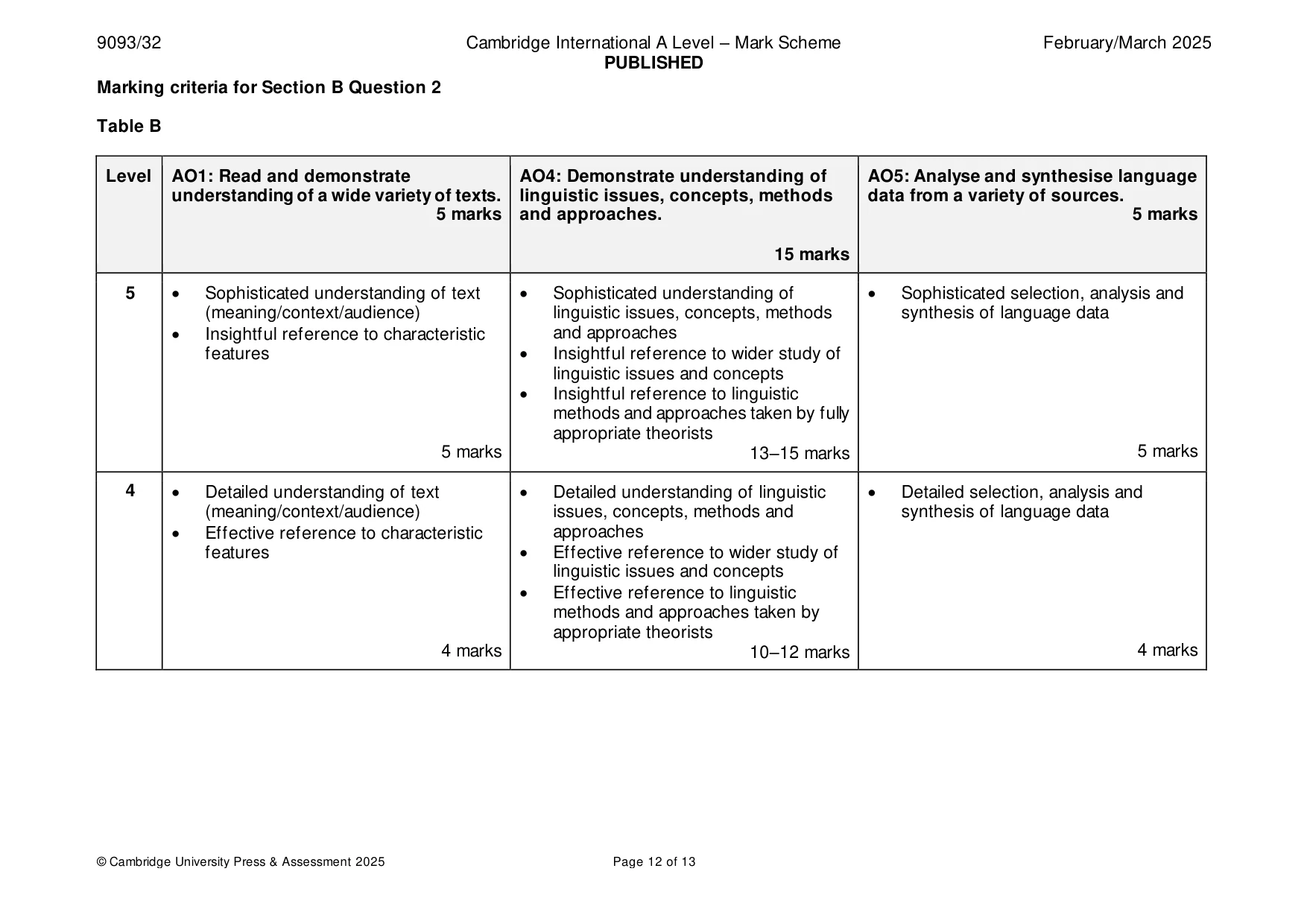
9093/32 Cambridge International A Level – Mark Scheme PUBLISHED February/March 2025 © Cambridge University Press & Assessment 2025 Page 12 of 13 Marking criteria for Section B Question 2 Table B Level AO1: Read and demonstrate understanding of a wide variety of texts. 5 marks AO4: Demonstrate understanding of linguistic issues, concepts, methods and approaches. 15 marks AO5: Analyse and synthesise language data from a variety of sources. 5 marks 5 • Sophisticated understanding of text (meaning/context/audience) • Insightful reference to characteristic features 5 marks • Sophisticated understanding of linguistic issues, concepts, methods and approaches • Insightful reference to wider study of linguistic issues and concepts • Insightful reference to linguistic methods and approaches taken by fully appropriate theorists 13–15 marks • Sophisticated selection, analysis and synthesis of language data 5 marks 4 • Detailed understanding of text (meaning/context/audience) • Effective reference to characteristic features 4 marks • Detailed understanding of linguistic issues, concepts, methods and approaches • Effective reference to wider study of linguistic issues and concepts • Effective reference to linguistic methods and approaches taken by appropriate theorists 10–12 marks • Detailed selection, analysis and synthesis of language data 4 marks
Mark scheme, page 13
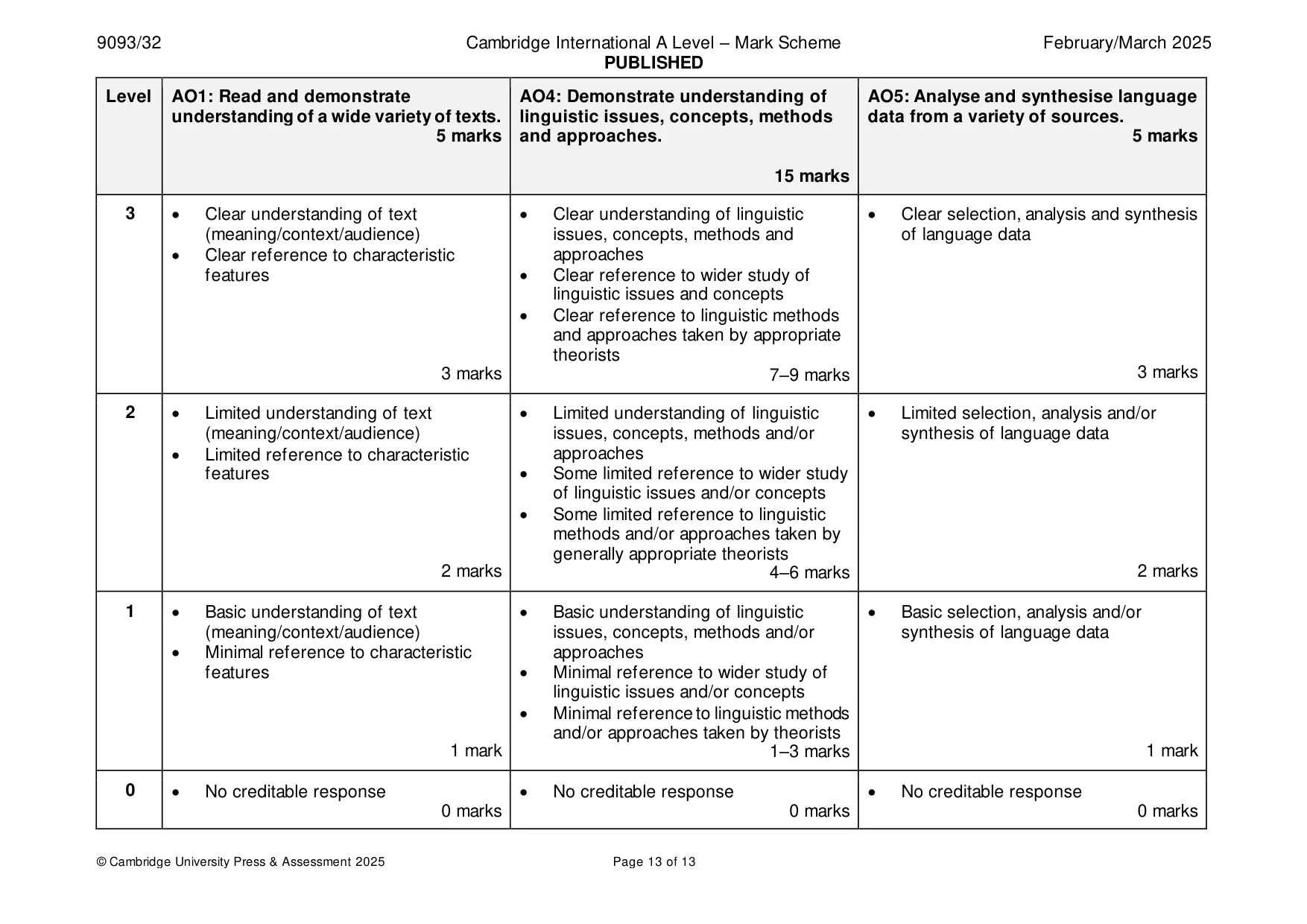
9093/32 Cambridge International A Level – Mark Scheme PUBLISHED February/March 2025 © Cambridge University Press & Assessment 2025 Page 13 of 13 Level AO1: Read and demonstrate understanding of a wide variety of texts. 5 marks AO4: Demonstrate understanding of linguistic issues, concepts, methods and approaches. 15 marks AO5: Analyse and synthesise language data from a variety of sources. 5 marks 3 • Clear understanding of text (meaning/context/audience) • Clear reference to characteristic features 3 marks • Clear understanding of linguistic issues, concepts, methods and approaches • Clear reference to wider study of linguistic issues and concepts • Clear reference to linguistic methods and approaches taken by appropriate theorists 7–9 marks • Clear selection, analysis and synthesis of language data 3 marks 2 • Limited understanding of text (meaning/context/audience) • Limited reference to characteristic features 2 marks • Limited understanding of linguistic issues, concepts, methods and/or approaches • Some limited reference to wider study of linguistic issues and/or concepts • Some limited reference to linguistic methods and/or approaches taken by generally appropriate theorists 4–6 marks • Limited selection, analysis and/or synthesis of language data 2 marks 1 • Basic understanding of text (meaning/context/audience) • Minimal reference to characteristic features 1 mark • Basic understanding of linguistic issues, concepts, methods and/or approaches • Minimal reference to wider study of linguistic issues and/or concepts • Minimal reference to linguistic methods and/or approaches taken by theorists 1–3 marks • Basic selection, analysis and/or synthesis of language data 1 mark 0 • No creditable response 0 marks • No creditable response 0 marks • No creditable response 0 marks
What you needed in this session
Cambridge’s own grade thresholds for 2025 Feb/March, Paper 3 · Variant 2. A higher threshold means an easier paper — the bar moves with how the cohort did.