Cambridge A Level English - Language AS and A Level (from 2014) 9093 — 2024 Feb/March Paper 3 · Variant 2
9093/32/F/M/24 · 50 marks · 135 min
The question paper and its mark scheme, free to read here and free to download. This is Cambridge’s own paper, exactly as it was sat.
Question paper8 pages

Mark scheme13 pages
Answers below. Sit the paper first if you are practising.
Paper as text
Question paper, page 1
This document has 8 pages. Any blank pages are indicated. [Turn over * 1 6 3 9 7 7 9 5 3 5 * Cambridge International AS & A Level ENGLISH LANGUAGE 9093/32 Paper 3 Language Analysis February/March 2024 2 hours 15 minutes You must answer on the enclosed answer booklet. You will need: Answer booklet (enclosed) INSTRUCTIONS ● Answer all questions. ● Follow the instructions on the front cover of the answer booklet. If you need additional answer paper, ask the invigilator for a continuation booklet. ● Dictionaries are not allowed. INFORMATION ● The total mark for this paper is 50. ● The number of marks for each question or part question is shown in brackets [ ]. DC (DE/CB) 328412/3 © UCLES 2024
Question paper, page 2
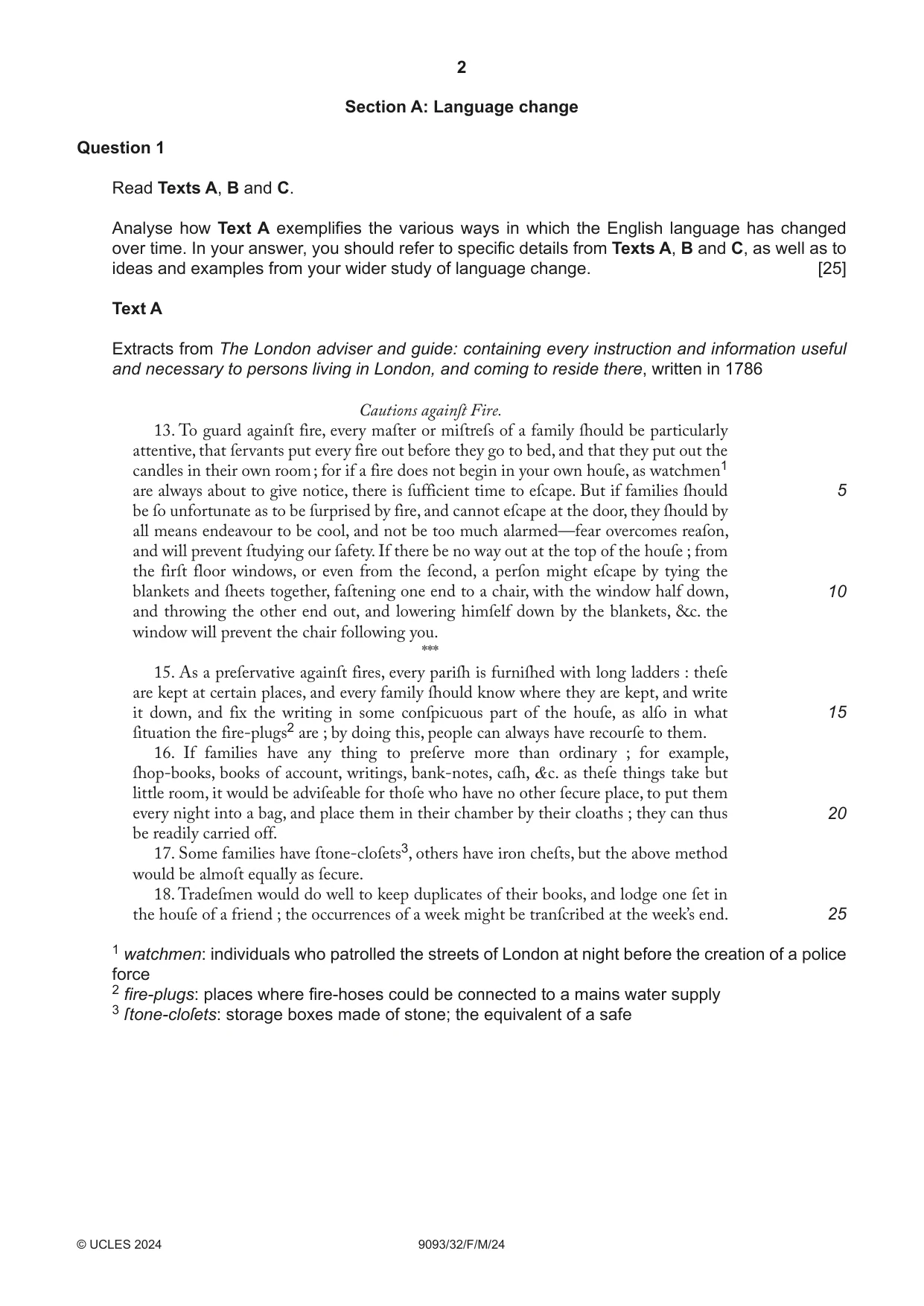
2 9093/32/F/M/24 © UCLES 2024 Section A: Language change Question 1 Read Texts A, B and C. Analyse how Text A exemplifies the various ways in which the English language has changed over time. In your answer, you should refer to specific details from Texts A, B and C, as well as to ideas and examples from your wider study of language change. [25] Text A Extracts from The London adviser and guide: containing every instruction and information useful and necessary to persons living in London, and coming to reside there, written in 1786 Cautions againſt Fire. 13. To guard againſt fire, every maſter or miſtreſs of a family ſhould be particularly attentive, that ſervants put every fire out before they go to bed, and that they put out the candles in their own room ; for if a fire does not begin in your own houſe, as watchmen1 are always about to give notice, there is ſufficient time to eſcape. But if families ſhould be ſo unfortunate as to be ſurprised by fire, and cannot eſcape at the door, they ſhould by all means endeavour to be cool, and not be too much alarmed—fear overcomes reaſon, and will prevent ſtudying our ſafety. If there be no way out at the top of the houſe ; from the firſt floor windows, or even from the ſecond, a perſon might eſcape by tying the blankets and ſheets together, faſtening one end to a chair, with the window half down, and throwing the other end out, and lowering himſelf down by the blankets, &c. the window will prevent the chair following you. *** 15. As a preſervative againſt fires, every pariſh is furniſhed with long ladders : theſe are kept at certain places, and every family ſhould know where they are kept, and write it down, and fix the writing in some conſpicuous part of the houſe, as alſo in what ſituation the fire-plugs2 are ; by doing this, people can always have recourſe to them. 16. If families have any thing to preſerve more than ordinary ; for example, ſhop-books, books of account, writings, bank-notes, caſh, &c. as theſe things take but little room, it would be adviſeable for thoſe who have no other ſecure place, to put them every night into a bag, and place them in their chamber by their cloaths ; they can thus be readily carried off. 17. Some families have ſtone-cloſets3, others have iron cheſts, but the above method would be almoſt equally as ſecure. 18. Tradeſmen would do well to keep duplicates of their books, and lodge one ſet in the houſe of a friend ; the occurrences of a week might be tranſcribed at the week’s end. 1 watchmen: individuals who patrolled the streets of London at night before the creation of a police force 2 fire-plugs: places where fire-hoses could be connected to a mains water supply 3 ſ tone-cloſets: storage boxes made of stone; the equivalent of a safe 5 10 15 20 25
Question paper, page 3
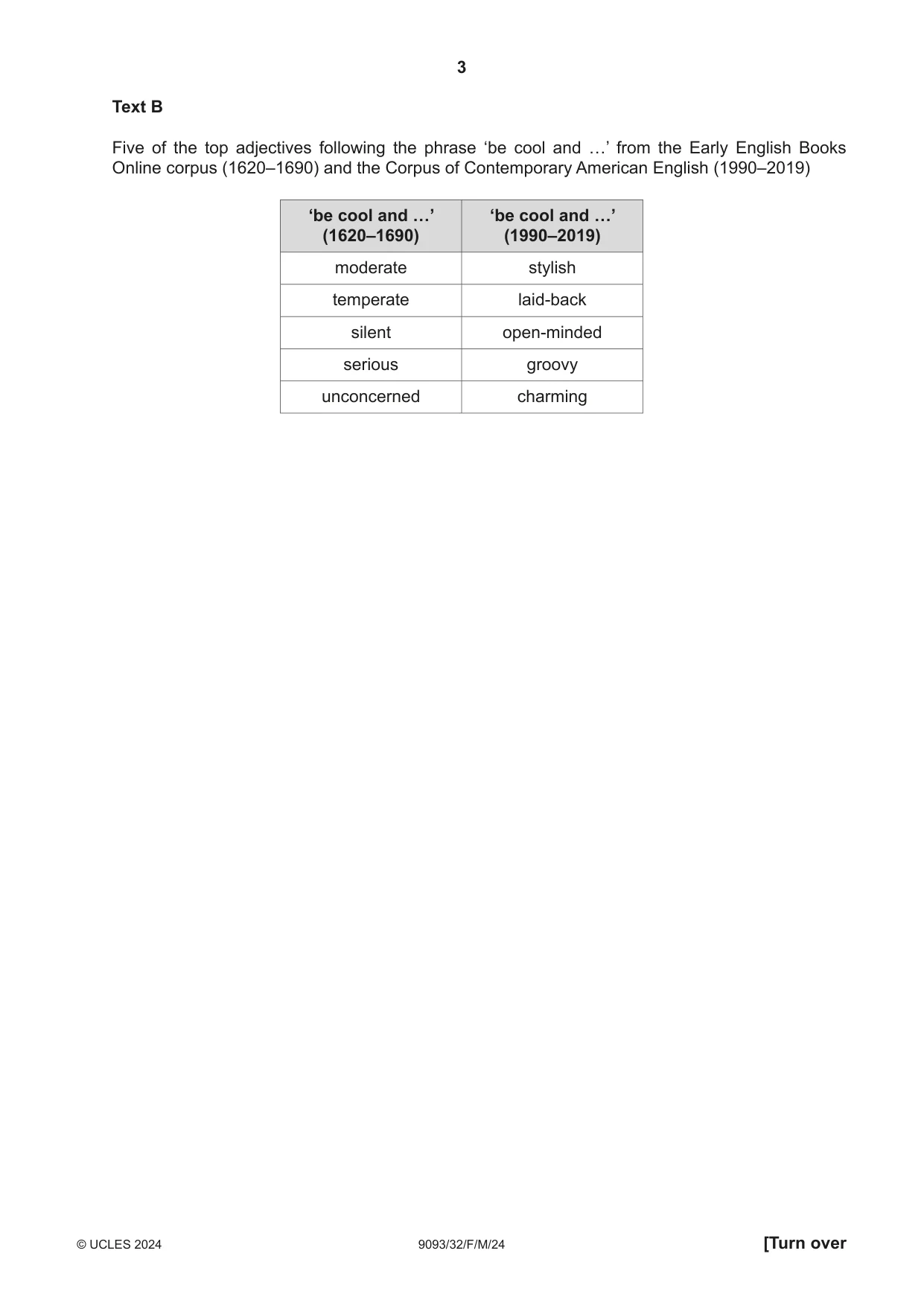
3 9093/32/F/M/24 © UCLES 2024 [Turn over Text B Five of the top adjectives following the phrase ‘be cool and …’ from the Early English Books Online corpus (1620–1690) and the Corpus of Contemporary American English (1990–2019) ‘be cool and …’ (1620–1690) ‘be cool and …’ (1990–2019) moderate stylish temperate laid-back silent open-minded serious groovy unconcerned charming
Question paper, page 4
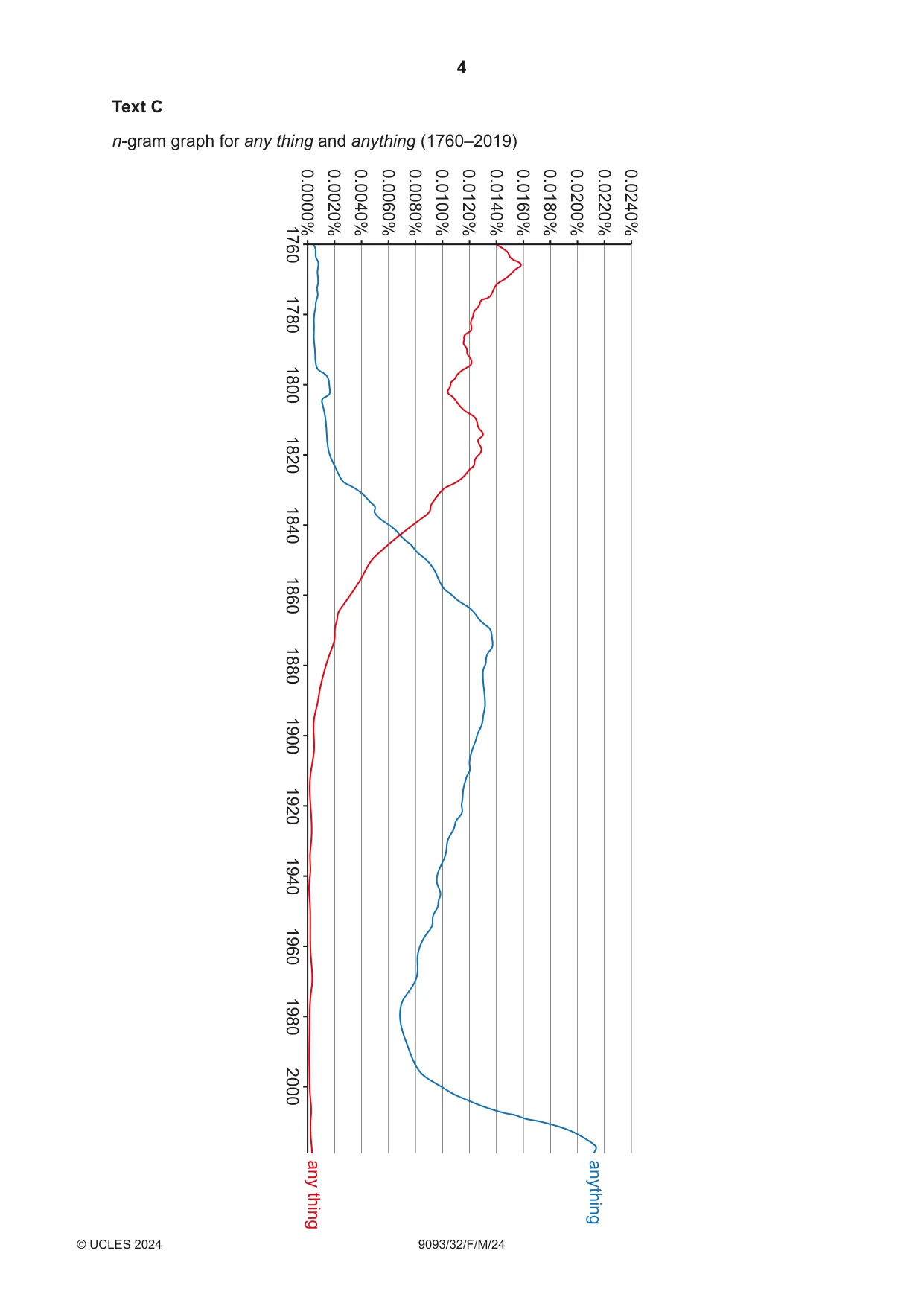
4 9093/32/F/M/24 © UCLES 2024 Text C n-gram graph for any thing and anything (1760–2019) 1760 0.0000% 0.0020% 0.0040% 0.0060% 0.0080% 0.0100% 0.0120% 0.0140% 0.0160% 0.0180% 0.0200% 0.0220% 0.0240% 1780 1800 1820 1840 1860 1880 1900 1920 1940 1960 1980 2000 anything any thing
Question paper, page 5
5 9093/32/F/M/24 © UCLES 2024 [Turn over BLANK PAGE
Question paper, page 6
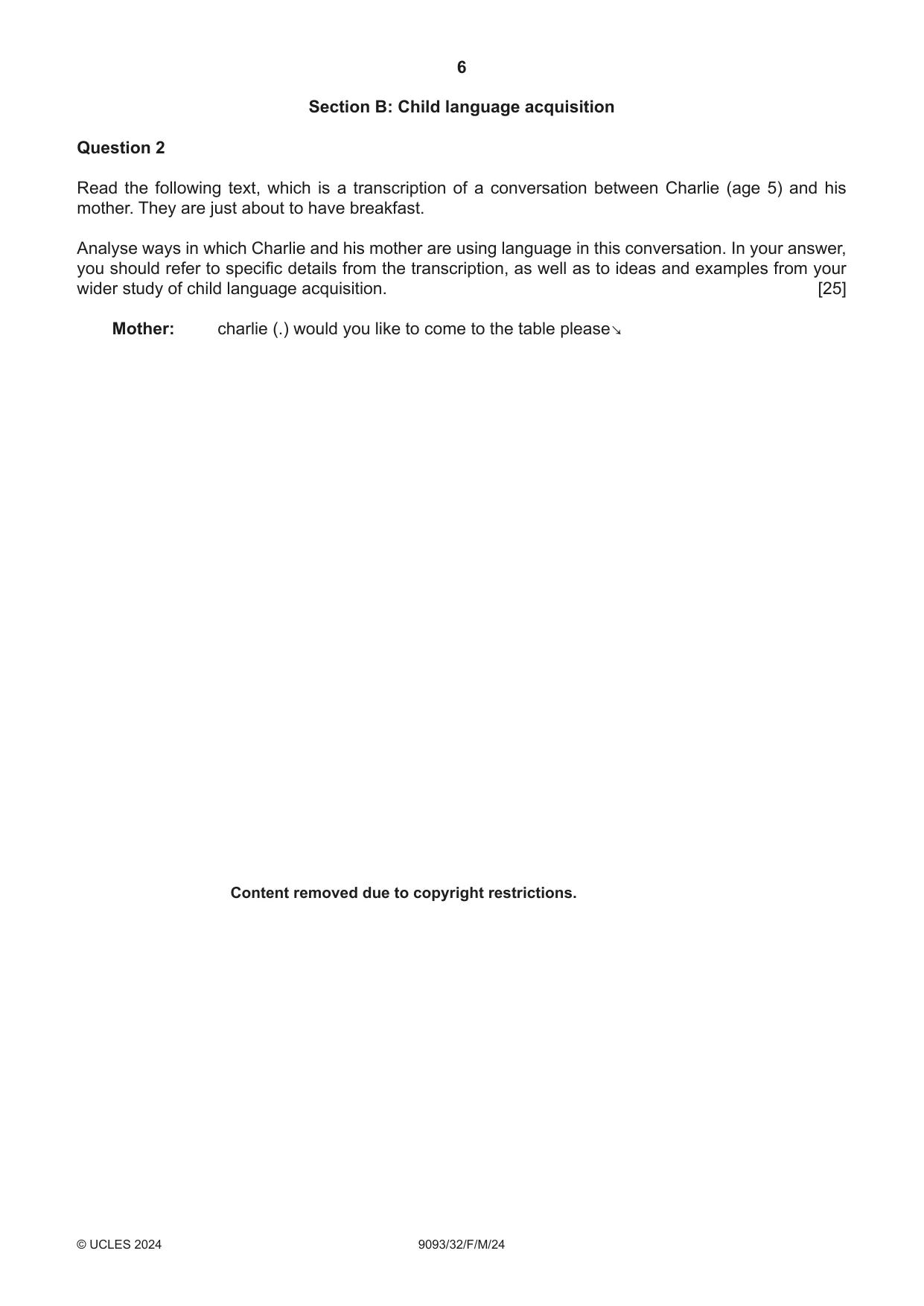
6 9093/32/F/M/24 © UCLES 2024 Section B: Child language acquisition Question 2 Read the following text, which is a transcription of a conversation between Charlie (age 5) and his mother. They are just about to have breakfast. Analyse ways in which Charlie and his mother are using language in this conversation. In your answer, you should refer to specific details from the transcription, as well as to ideas and examples from your wider study of child language acquisition. [25] Mother: charlie (.) would you like to come to the table please ↗ Content removed due to copyright restrictions.
Question paper, page 7
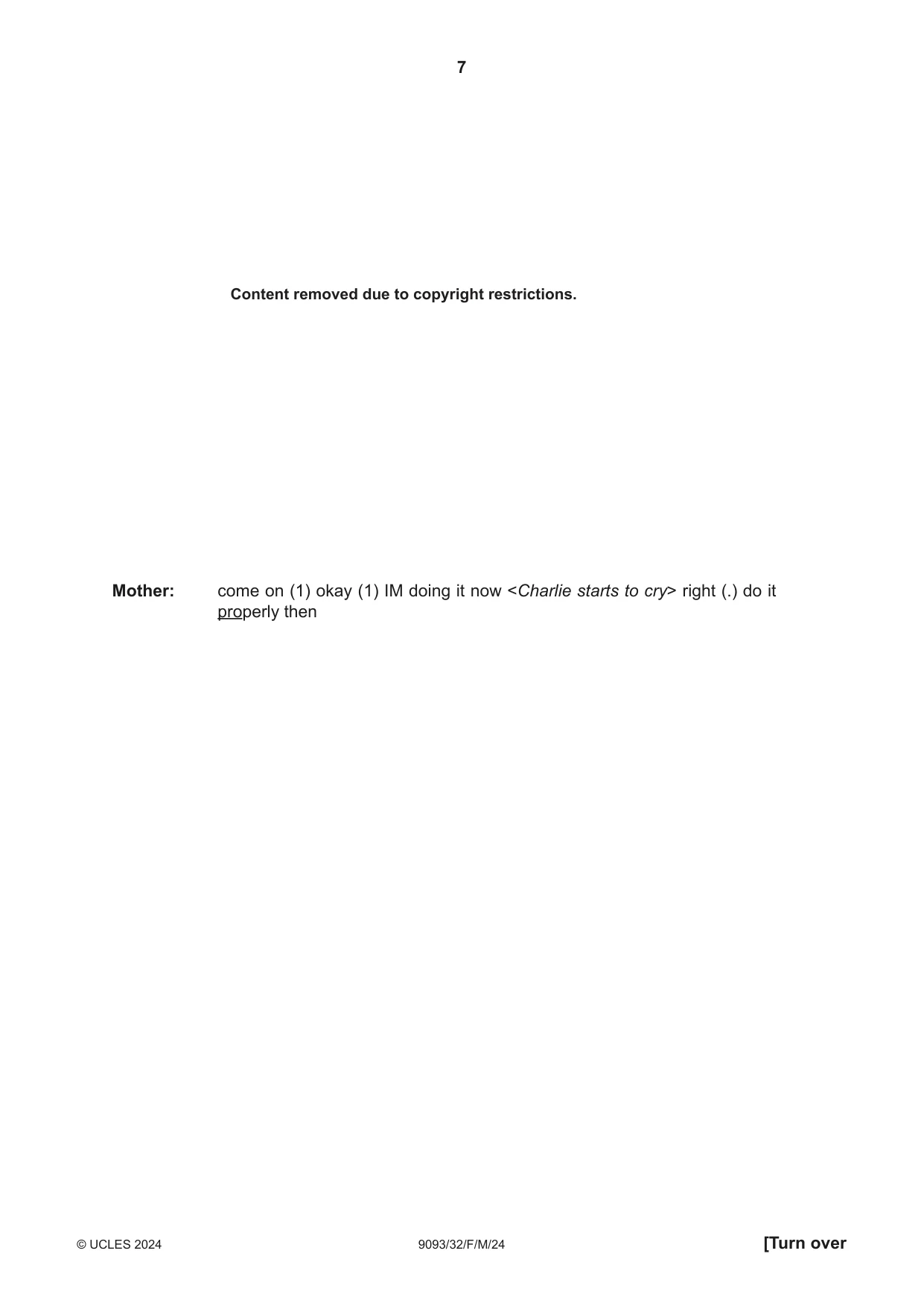
7 9093/32/F/M/24 © UCLES 2024 [Turn over Mother: come on (1) okay (1) IM doing it now <Charlie starts to cry> right (.) do it properly then Content removed due to copyright restrictions.
Question paper, page 8
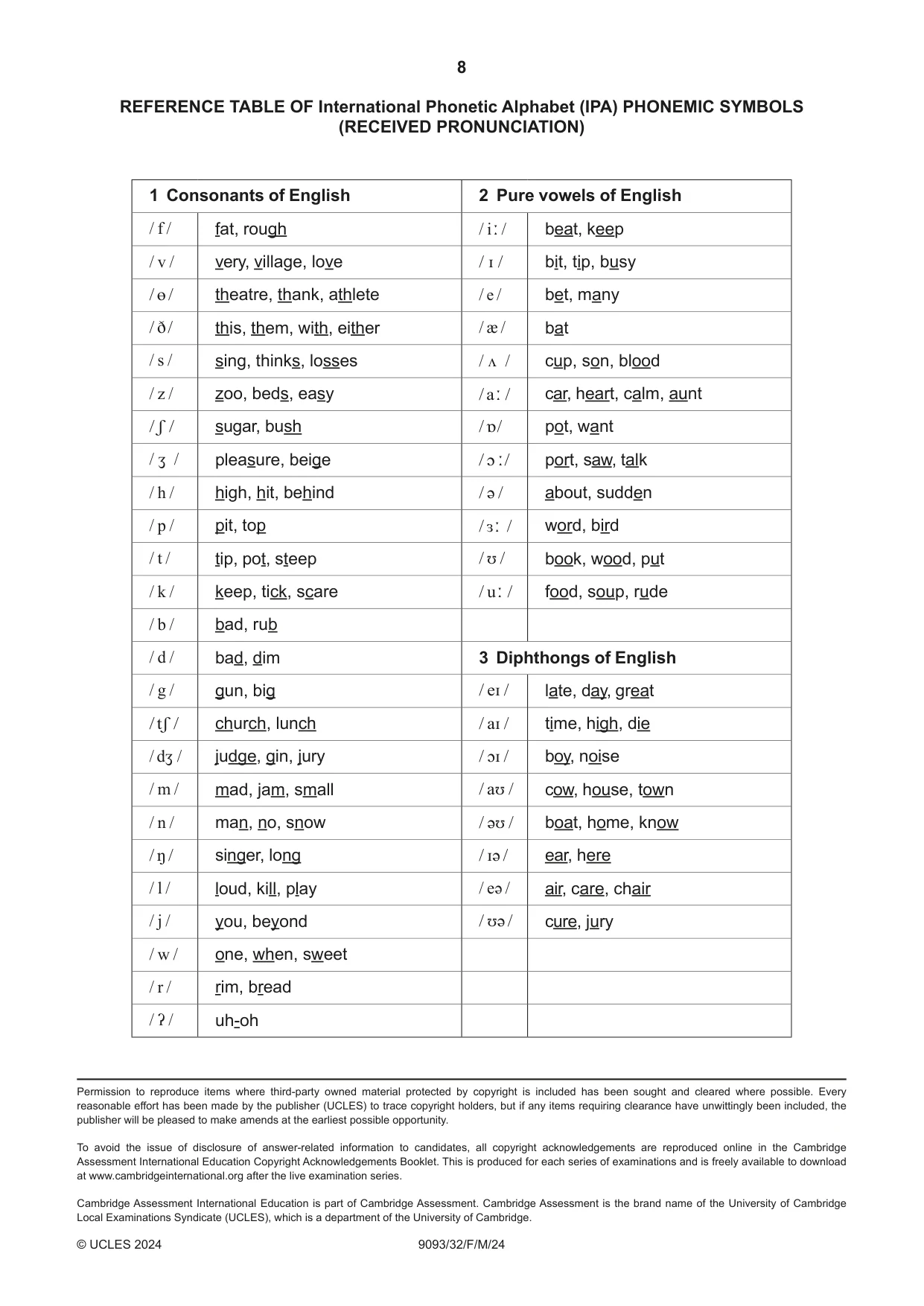
8 9093/32/F/M/24 © UCLES 2024 Permission to reproduce items where third-party owned material protected by copyright is included has been sought and cleared where possible. Every reasonable effort has been made by the publisher (UCLES) to trace copyright holders, but if any items requiring clearance have unwittingly been included, the publisher will be pleased to make amends at the earliest possible opportunity. To avoid the issue of disclosure of answer-related information to candidates, all copyright acknowledgements are reproduced online in the Cambridge Assessment International Education Copyright Acknowledgements Booklet. This is produced for each series of examinations and is freely available to download at www.cambridgeinternational.org after the live examination series. Cambridge Assessment International Education is part of Cambridge Assessment. Cambridge Assessment is the brand name of the University of Cambridge Local Examinations Syndicate (UCLES), which is a department of the University of Cambridge. REFERENCE TABLE OF International Phonetic Alphabet (IPA) PHONEMIC SYMBOLS (RECEIVED PRONUNCIATION) 1 Consonants of English 2 Pure vowels of English / f / fat, rough / i / beat, keep / v / very, village, love / ɪ / bit, tip, busy / ɵ / theatre, thank, athlete / e / bet, many / ð/ this, them, with, either / æ / bat / s / sing, thinks, losses / ʌ / cup, son, blood / z / zoo, beds, easy / a / car, heart, calm, aunt / ʃ / sugar, bush / ɒ / pot, want / ʒ / pleasure, beige / ɔ/ port, saw, talk / h / high, hit, behind / ə / about, sudden / p / pit, top / ɜ / word, bird / t / tip, pot, steep / ʊ / book, wood, put / k / keep, tick, scare / u / food, soup, rude / b / bad, rub / d / bad, dim 3 Diphthongs of English / g / gun, big / eɪ / late, day, great / tʃ / church, lunch / aɪ / time, high, die / dʒ / judge, gin, jury / ɔɪ / boy, noise / m / mad, jam, small / aʊ / cow, house, town / n / man, no, snow / əʊ / boat, home, know / ŋ / singer, long / ɪə / ear, here / l / loud, kill, play / eə / air, care, chair / j / you, beyond / ʊə / cure, jury / w / one, when, sweet / r / rim, bread / ʔ / uh-oh
Mark scheme, page 1
This document consists of 13 printed pages. © Cambridge University Press & Assessment 2024 [Turn over Cambridge International A Level ENGLISH LANGUAGE 9093/32 Paper 3 Language Analysis February/March 2024 MARK SCHEME Maximum Mark: 50 Published This mark scheme is published as an aid to teachers and candidates, to indicate the requirements of the examination. It shows the basis on which Examiners were instructed to award marks. It does not indicate the details of the discussions that took place at an Examiners’ meeting before marking began, which would have considered the acceptability of alternative answers. Mark schemes should be read in conjunction with the question paper and the Principal Examiner Report for Teachers. Cambridge International will not enter into discussions about these mark schemes. Cambridge International is publishing the mark schemes for the February/March 2024 series for most Cambridge IGCSE, Cambridge International A and AS Level components, and some Cambridge O Level components.
Mark scheme, page 2
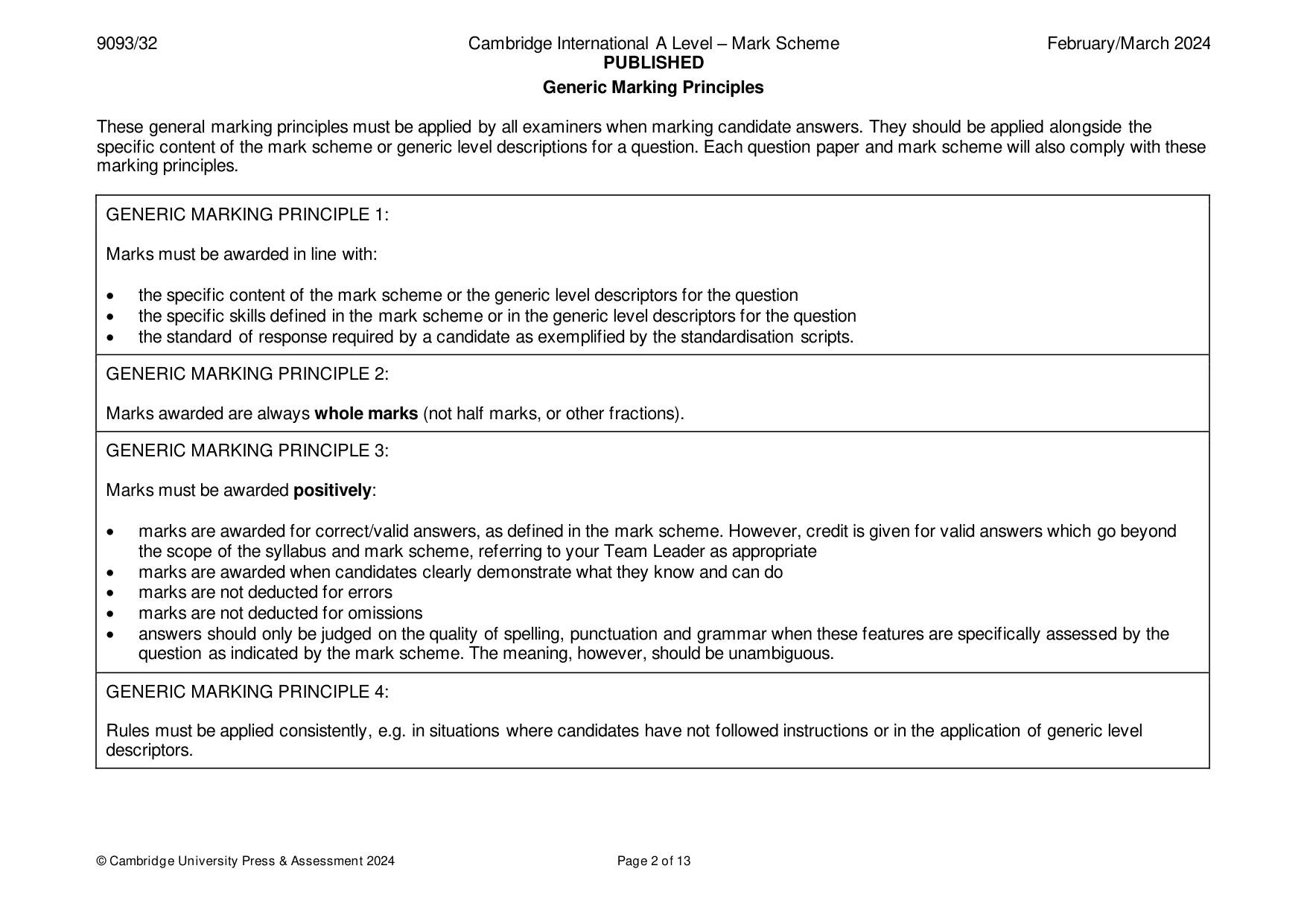
9093/32 Cambridge International A Level – Mark Scheme PUBLISHED February/March 2024 © Cambridge University Press & Assessment 2024 Page 2 of 13 Generic Marking Principles These general marking principles must be applied by all examiners when marking candidate answers. They should be applied alongside the specific content of the mark scheme or generic level descriptions for a question. Each question paper and mark scheme will also comply with these marking principles. GENERIC MARKING PRINCIPLE 1: Marks must be awarded in line with: • the specific content of the mark scheme or the generic level descriptors for the question • the specific skills defined in the mark scheme or in the generic level descriptors for the question • the standard of response required by a candidate as exemplified by the standardisation scripts. GENERIC MARKING PRINCIPLE 2: Marks awarded are always whole marks (not half marks, or other fractions). GENERIC MARKING PRINCIPLE 3: Marks must be awarded positively: • marks are awarded for correct/valid answers, as defined in the mark scheme. However, credit is given for valid answers which go beyond the scope of the syllabus and mark scheme, referring to your Team Leader as appropriate • marks are awarded when candidates clearly demonstrate what they know and can do • marks are not deducted for errors • marks are not deducted for omissions • answers should only be judged on the quality of spelling, punctuation and grammar when these features are specifically assessed by the question as indicated by the mark scheme. The meaning, however, should be unambiguous. GENERIC MARKING PRINCIPLE 4: Rules must be applied consistently, e.g. in situations where candidates have not followed instructions or in the application of generic level descriptors.
Mark scheme, page 3
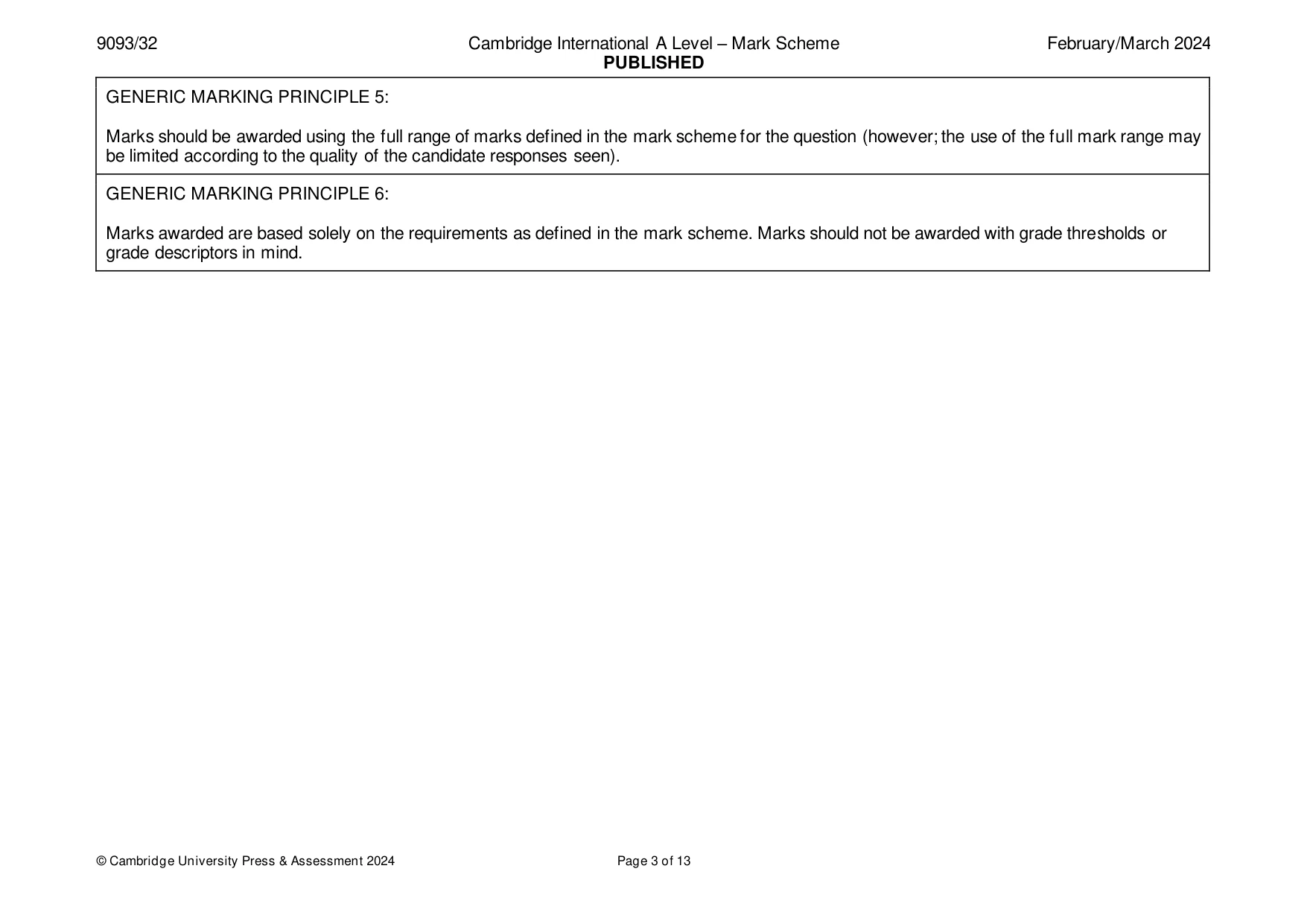
9093/32 Cambridge International A Level – Mark Scheme PUBLISHED February/March 2024 © Cambridge University Press & Assessment 2024 Page 3 of 13 GENERIC MARKING PRINCIPLE 5: Marks should be awarded using the full range of marks defined in the mark scheme for the question (however; the use of the full mark range may be limited according to the quality of the candidate responses seen). GENERIC MARKING PRINCIPLE 6: Marks awarded are based solely on the requirements as defined in the mark scheme. Marks should not be awarded with grade thresholds or grade descriptors in mind.
Mark scheme, page 4
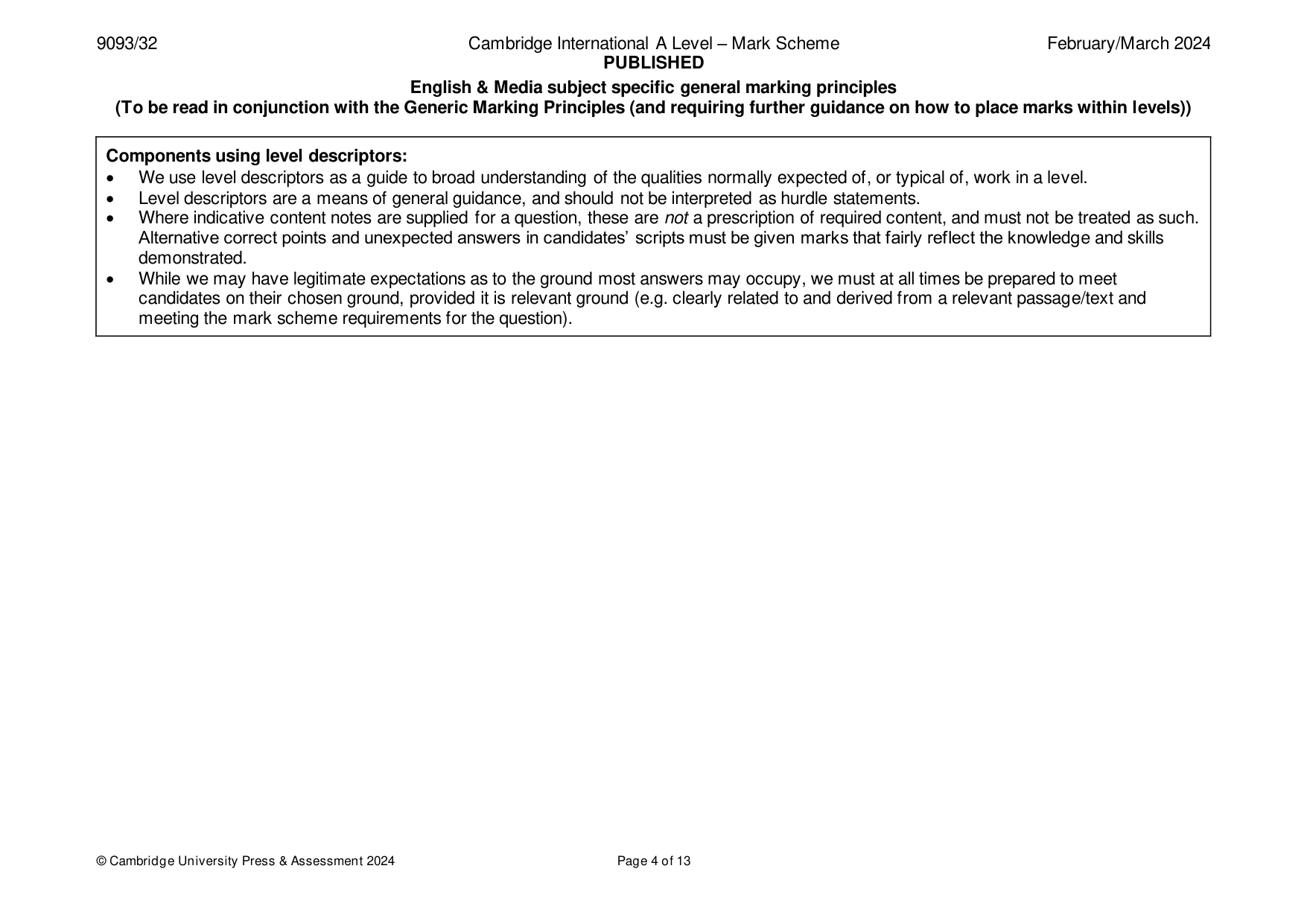
9093/32 Cambridge International A Level – Mark Scheme PUBLISHED February/March 2024 © Cambridge University Press & Assessment 2024 Page 4 of 13 English & Media subject specific general marking principles (To be read in conjunction with the Generic Marking Principles (and requiring further guidance on how to place marks within levels)) Components using level descriptors: • We use level descriptors as a guide to broad understanding of the qualities normally expected of, or typical of, work in a level. • Level descriptors are a means of general guidance, and should not be interpreted as hurdle statements. • Where indicative content notes are supplied for a question, these are not a prescription of required content, and must not be treated as such. Alternative correct points and unexpected answers in candidates’ scripts must be given marks that fairly reflect the knowledge and skills demonstrated. • While we may have legitimate expectations as to the ground most answers may occupy, we must at all times be prepared to meet candidates on their chosen ground, provided it is relevant ground (e.g. clearly related to and derived from a relevant passage/text and meeting the mark scheme requirements for the question).
Mark scheme, page 5
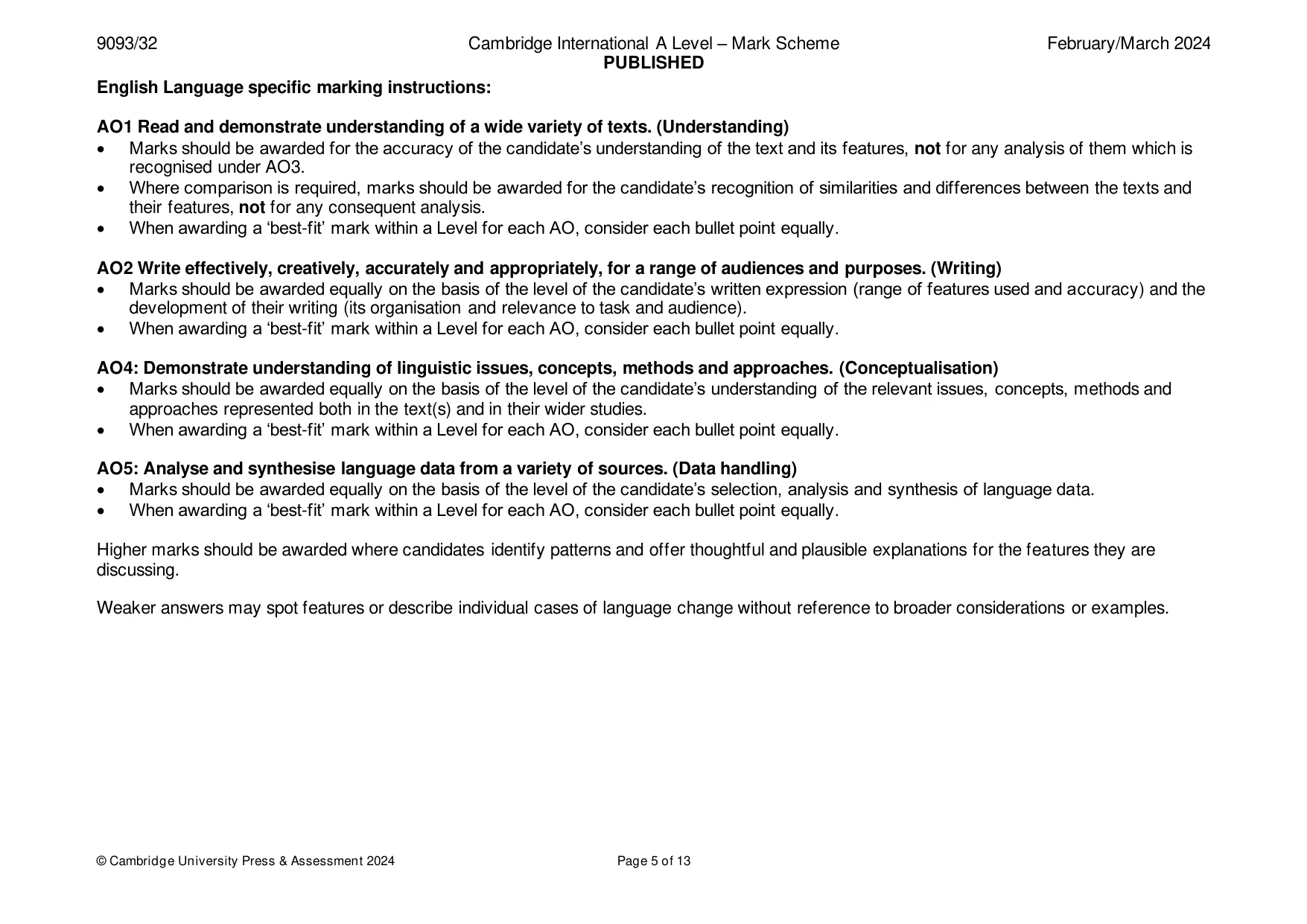
9093/32 Cambridge International A Level – Mark Scheme PUBLISHED February/March 2024 © Cambridge University Press & Assessment 2024 Page 5 of 13 English Language specific marking instructions: AO1 Read and demonstrate understanding of a wide variety of texts. (Understanding) • Marks should be awarded for the accuracy of the candidate’s understanding of the text and its features, not for any analysis of them which is recognised under AO3. • Where comparison is required, marks should be awarded for the candidate’s recognition of similarities and differences between the texts and their features, not for any consequent analysis. • When awarding a ‘best-fit’ mark within a Level for each AO, consider each bullet point equally. AO2 Write effectively, creatively, accurately and appropriately, for a range of audiences and purposes. (Writing) • Marks should be awarded equally on the basis of the level of the candidate’s written expression (range of features used and accuracy) and the development of their writing (its organisation and relevance to task and audience). • When awarding a ‘best-fit’ mark within a Level for each AO, consider each bullet point equally. AO4: Demonstrate understanding of linguistic issues, concepts, methods and approaches. (Conceptualisation) • Marks should be awarded equally on the basis of the level of the candidate’s understanding of the relevant issues, concepts, methods and approaches represented both in the text(s) and in their wider studies. • When awarding a ‘best-fit’ mark within a Level for each AO, consider each bullet point equally. AO5: Analyse and synthesise language data from a variety of sources. (Data handling) • Marks should be awarded equally on the basis of the level of the candidate’s selection, analysis and synthesis of language data. • When awarding a ‘best-fit’ mark within a Level for each AO, consider each bullet point equally. Higher marks should be awarded where candidates identify patterns and offer thoughtful and plausible explanations for the features they are discussing. Weaker answers may spot features or describe individual cases of language change without reference to broader considerations or examples.
Mark scheme, page 6
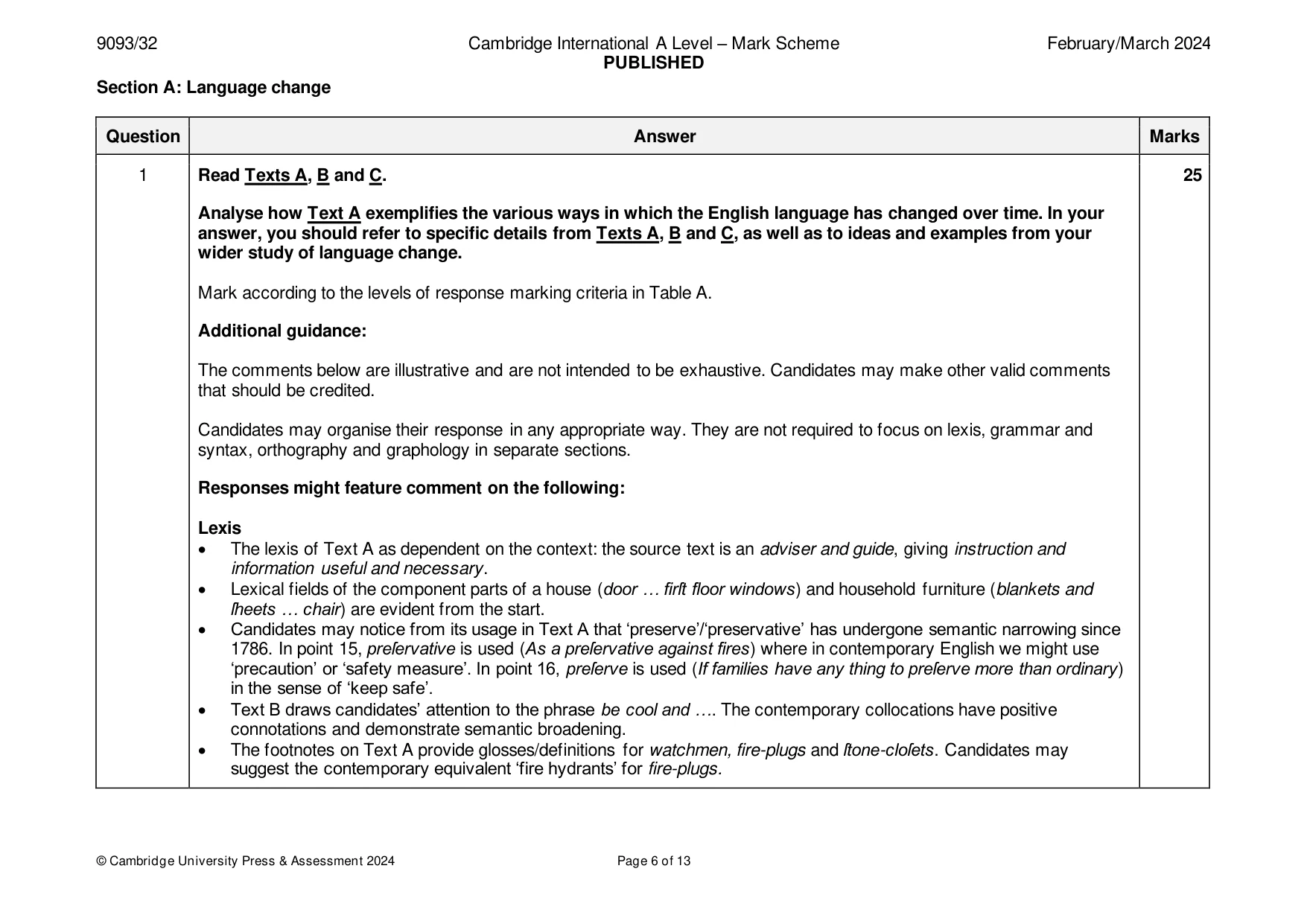
9093/32 Cambridge International A Level – Mark Scheme PUBLISHED February/March 2024 © Cambridge University Press & Assessment 2024 Page 6 of 13 Section A: Language change Question Answer Marks 1 Read Texts A, B and C. Analyse how Text A exemplifies the various ways in which the English language has changed over time. In your answer, you should refer to specific details from Texts A, B and C, as well as to ideas and examples from your wider study of language change. Mark according to the levels of response marking criteria in Table A. Additional guidance: The comments below are illustrative and are not intended to be exhaustive. Candidates may make other valid comments that should be credited. Candidates may organise their response in any appropriate way. They are not required to focus on lexis, grammar and syntax, orthography and graphology in separate sections. Responses might feature comment on the following: Lexis • The lexis of Text A as dependent on the context: the source text is an adviser and guide, giving instruction and information useful and necessary. • Lexical fields of the component parts of a house (door … firſt floor windows) and household furniture (blankets and ſheets … chair) are evident from the start. • Candidates may notice from its usage in Text A that ‘preserve’/‘preservative’ has undergone semantic narrowing since 1786. In point 15, preſervative is used (As a preſervative against fires) where in contemporary English we might use ‘precaution’ or ‘safety measure’. In point 16, preſerve is used (If families have any thing to preſerve more than ordinary) in the sense of ‘keep safe’. • Text B draws candidates’ attention to the phrase be cool and …. The contemporary collocations have positive connotations and demonstrate semantic broadening. • The footnotes on Text A provide glosses/definitions for watchmen, fire-plugs and ſtone-cloſets. Candidates may suggest the contemporary equivalent ‘fire hydrants’ for fire-plugs. 25
Mark scheme, page 7
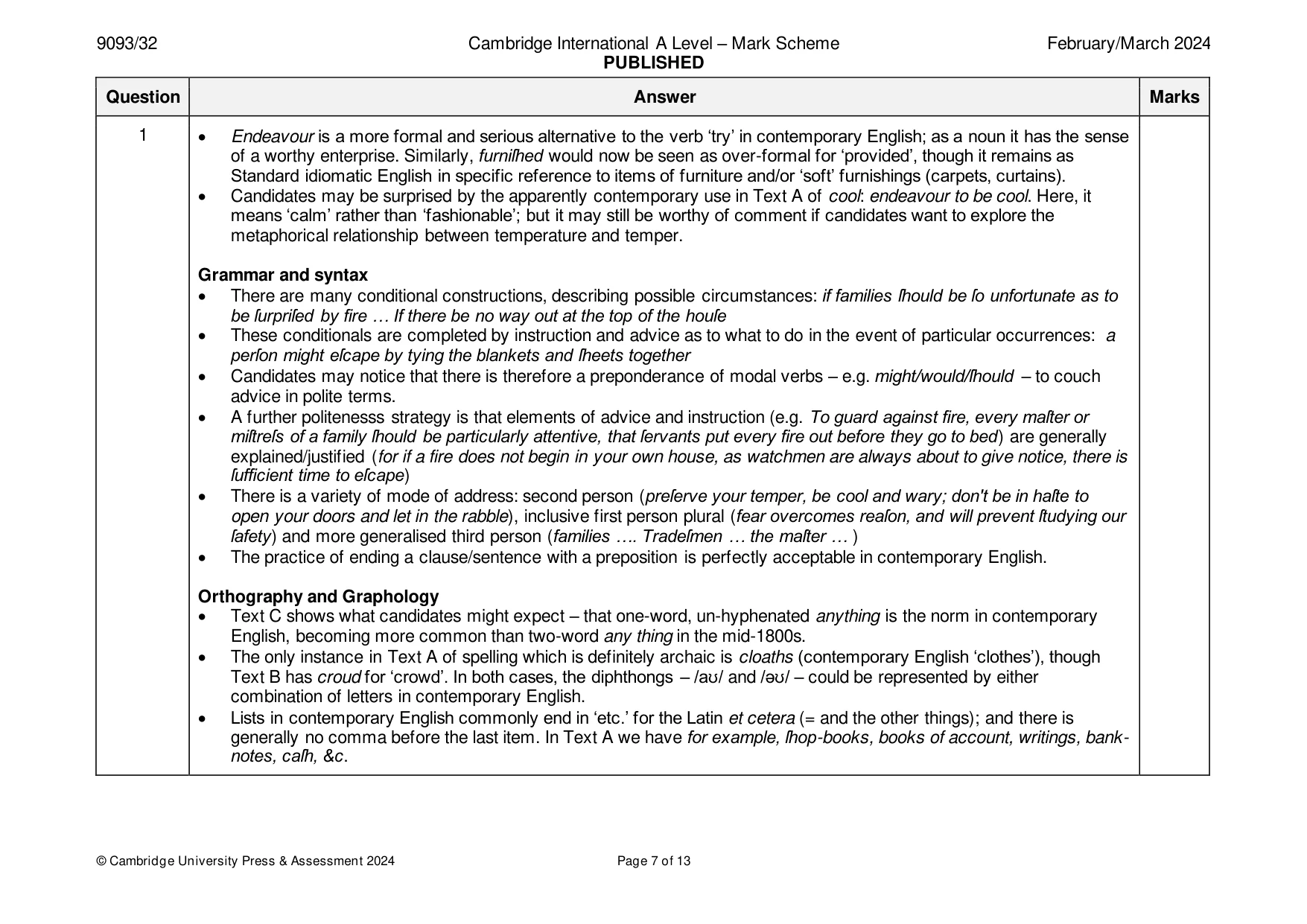
9093/32 Cambridge International A Level – Mark Scheme PUBLISHED February/March 2024 © Cambridge University Press & Assessment 2024 Page 7 of 13 Question Answer Marks 1 • Endeavour is a more formal and serious alternative to the verb ‘try’ in contemporary English; as a noun it has the sense of a worthy enterprise. Similarly, furniſhed would now be seen as over-formal for ‘provided’, though it remains as Standard idiomatic English in specific reference to items of furniture and/or ‘soft’ furnishings (carpets, curtains). • Candidates may be surprised by the apparently contemporary use in Text A of cool: endeavour to be cool. Here, it means ‘calm’ rather than ‘fashionable’; but it may still be worthy of comment if candidates want to explore the metaphorical relationship between temperature and temper. Grammar and syntax • There are many conditional constructions, describing possible circumstances: if families ſhould be ſo unfortunate as to be ſurpriſed by fire … If there be no way out at the top of the houſe • These conditionals are completed by instruction and advice as to what to do in the event of particular occurrences: a perſon might eſcape by tying the blankets and ſheets together • Candidates may notice that there is therefore a preponderance of modal verbs – e.g. might/would/ſhould – to couch advice in polite terms. • A further politenesss strategy is that elements of advice and instruction (e.g. To guard against fire, every maſter or miſtreſs of a family ſhould be particularly attentive, that ſervants put every fire out before they go to bed) are generally explained/justified (for if a fire does not begin in your own house, as watchmen are always about to give notice, there is ſufficient time to eſcape) • There is a variety of mode of address: second person (preſerve your temper, be cool and wary; don't be in haſte to open your doors and let in the rabble), inclusive first person plural (fear overcomes reaſon, and will prevent ſtudying our ſafety) and more generalised third person (families …. Tradeſmen … the maſter … ) • The practice of ending a clause/sentence with a preposition is perfectly acceptable in contemporary English. Orthography and Graphology • Text C shows what candidates might expect – that one-word, un-hyphenated anything is the norm in contemporary English, becoming more common than two-word any thing in the mid-1800s. • The only instance in Text A of spelling which is definitely archaic is cloaths (contemporary English ‘clothes’), though Text B has croud for ‘crowd’. In both cases, the diphthongs – /aʊ/ and /əʊ/ – could be represented by either combination of letters in contemporary English. • Lists in contemporary English commonly end in ‘etc.’ for the Latin et cetera (= and the other things); and there is generally no comma before the last item. In Text A we have for example, ſhop-books, books of account, writings, bank- notes, caſh, &c.
Mark scheme, page 8
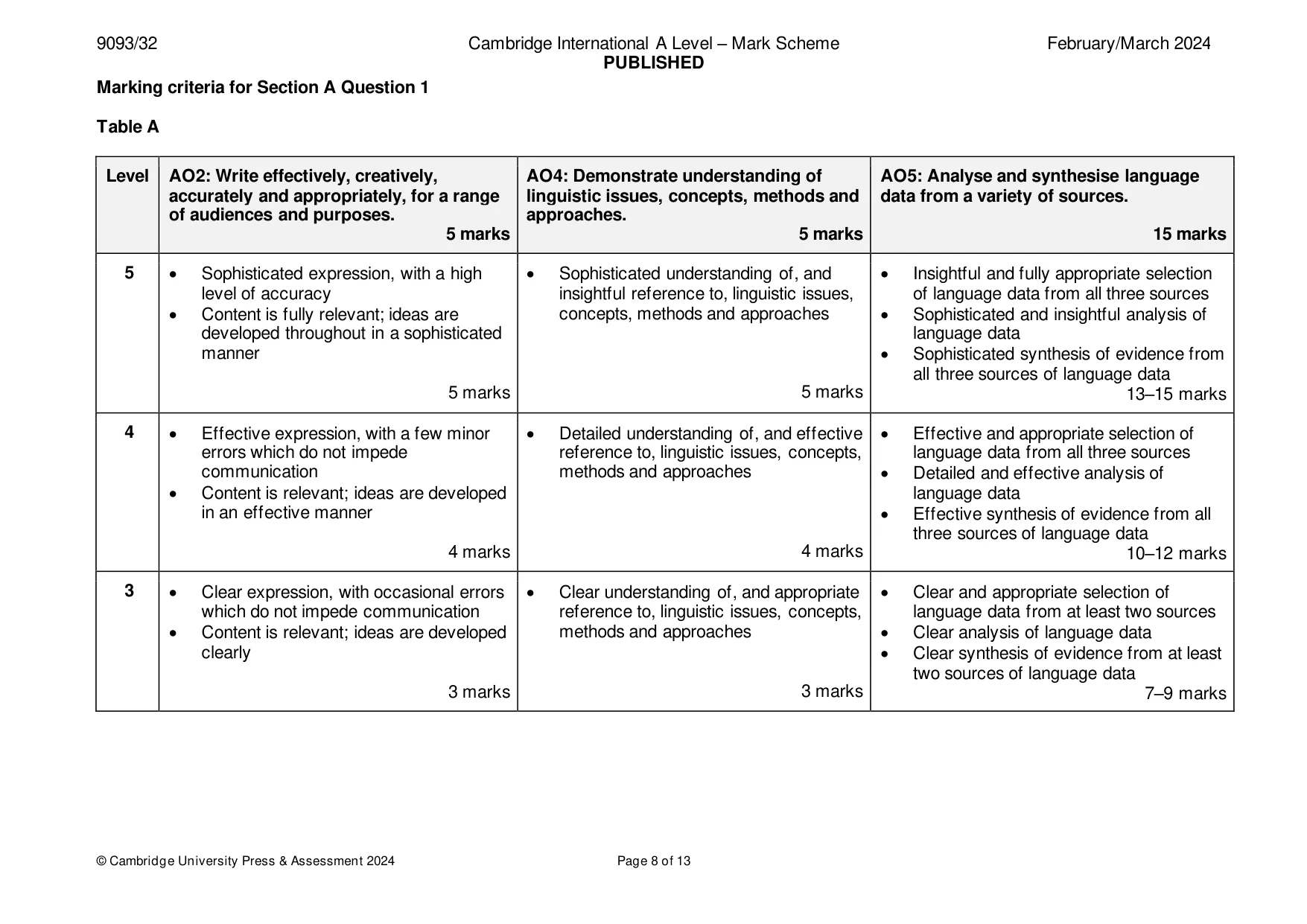
9093/32 Cambridge International A Level – Mark Scheme PUBLISHED February/March 2024 © Cambridge University Press & Assessment 2024 Page 8 of 13 Marking criteria for Section A Question 1 Table A Level AO2: Write effectively, creatively, accurately and appropriately, for a range of audiences and purposes. 5 marks AO4: Demonstrate understanding of linguistic issues, concepts, methods and approaches. 5 marks AO5: Analyse and synthesise language data from a variety of sources. 15 marks 5 • Sophisticated expression, with a high level of accuracy • Content is fully relevant; ideas are developed throughout in a sophisticated manner 5 marks • Sophisticated understanding of, and insightful reference to, linguistic issues, concepts, methods and approaches 5 marks • Insightful and fully appropriate selection of language data from all three sources • Sophisticated and insightful analysis of language data • Sophisticated synthesis of evidence from all three sources of language data 13–15 marks 4 • Effective expression, with a few minor errors which do not impede communication • Content is relevant; ideas are developed in an effective manner 4 marks • Detailed understanding of, and effective reference to, linguistic issues, concepts, methods and approaches 4 marks • Effective and appropriate selection of language data from all three sources • Detailed and effective analysis of language data • Effective synthesis of evidence from all three sources of language data 10–12 marks 3 • Clear expression, with occasional errors which do not impede communication • Content is relevant; ideas are developed clearly 3 marks • Clear understanding of, and appropriate reference to, linguistic issues, concepts, methods and approaches 3 marks • Clear and appropriate selection of language data from at least two sources • Clear analysis of language data • Clear synthesis of evidence from at least two sources of language data 7–9 marks
Mark scheme, page 9
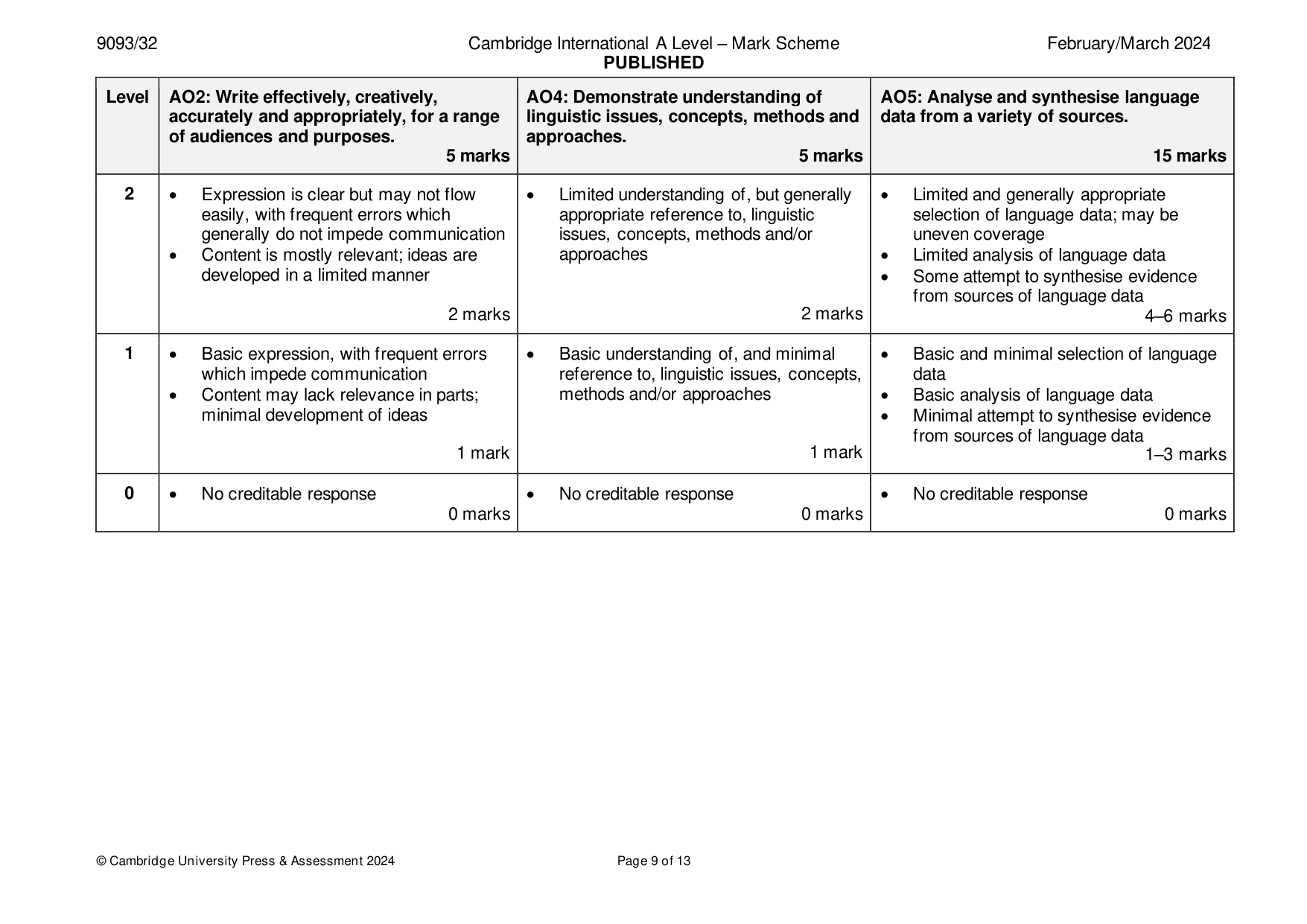
9093/32 Cambridge International A Level – Mark Scheme PUBLISHED February/March 2024 © Cambridge University Press & Assessment 2024 Page 9 of 13 Level AO2: Write effectively, creatively, accurately and appropriately, for a range of audiences and purposes. 5 marks AO4: Demonstrate understanding of linguistic issues, concepts, methods and approaches. 5 marks AO5: Analyse and synthesise language data from a variety of sources. 15 marks 2 • Expression is clear but may not flow easily, with frequent errors which generally do not impede communication • Content is mostly relevant; ideas are developed in a limited manner 2 marks • Limited understanding of, but generally appropriate reference to, linguistic issues, concepts, methods and/or approaches 2 marks • Limited and generally appropriate selection of language data; may be uneven coverage • Limited analysis of language data • Some attempt to synthesise evidence from sources of language data 4–6 marks 1 • Basic expression, with frequent errors which impede communication • Content may lack relevance in parts; minimal development of ideas 1 mark • Basic understanding of, and minimal reference to, linguistic issues, concepts, methods and/or approaches 1 mark • Basic and minimal selection of language data • Basic analysis of language data • Minimal attempt to synthesise evidence from sources of language data 1–3 marks 0 • No creditable response 0 marks • No creditable response 0 marks • No creditable response 0 marks
Mark scheme, page 10
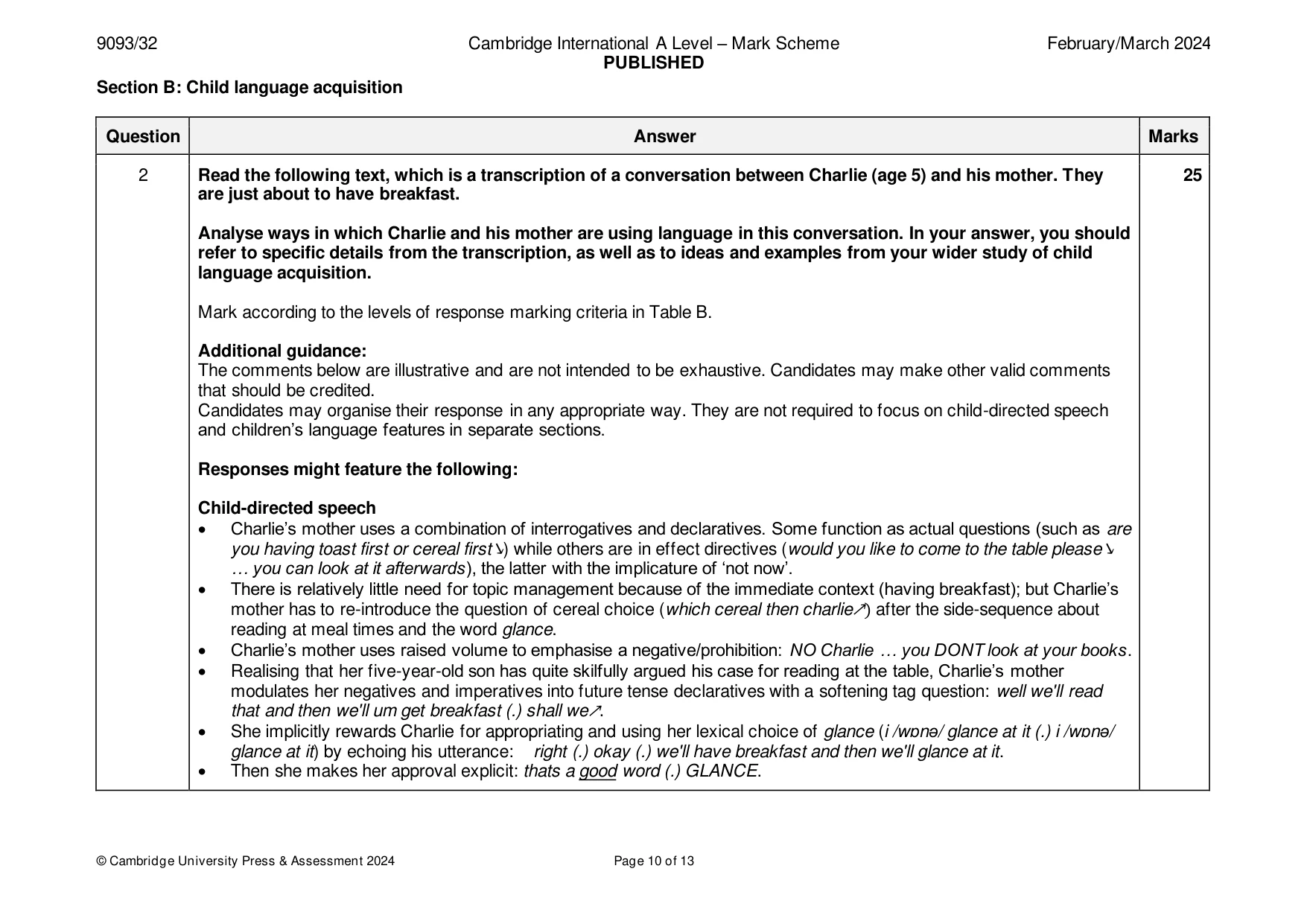
9093/32 Cambridge International A Level – Mark Scheme PUBLISHED February/March 2024 © Cambridge University Press & Assessment 2024 Page 10 of 13 Section B: Child language acquisition Question Answer Marks 2 Read the following text, which is a transcription of a conversation between Charlie (age 5) and his mother. They are just about to have breakfast. Analyse ways in which Charlie and his mother are using language in this conversation. In your answer, you should refer to specific details from the transcription, as well as to ideas and examples from your wider study of child language acquisition. Mark according to the levels of response marking criteria in Table B. Additional guidance: The comments below are illustrative and are not intended to be exhaustive. Candidates may make other valid comments that should be credited. Candidates may organise their response in any appropriate way. They are not required to focus on child-directed speech and children’s language features in separate sections. Responses might feature the following: Child-directed speech • Charlie’s mother uses a combination of interrogatives and declaratives. Some function as actual questions (such as are you having toast first or cereal first↘) while others are in effect directives (would you like to come to the table please↘ … you can look at it afterwards), the latter with the implicature of ‘not now’. • There is relatively little need for topic management because of the immediate context (having breakfast); but Charlie’s mother has to re-introduce the question of cereal choice (which cereal then charlie↗) after the side-sequence about reading at meal times and the word glance. • Charlie’s mother uses raised volume to emphasise a negative/prohibition: NO Charlie … you DONT look at your books. • Realising that her five-year-old son has quite skilfully argued his case for reading at the table, Charlie’s mother modulates her negatives and imperatives into future tense declaratives with a softening tag question: well we'll read that and then we'll um get breakfast (.) shall we↗. • She implicitly rewards Charlie for appropriating and using her lexical choice of glance (i /wɒnə/ glance at it (.) i /wɒnə/ glance at it) by echoing his utterance: right (.) okay (.) we'll have breakfast and then we'll glance at it. • Then she makes her approval explicit: thats a good word (.) GLANCE. 25
Mark scheme, page 11
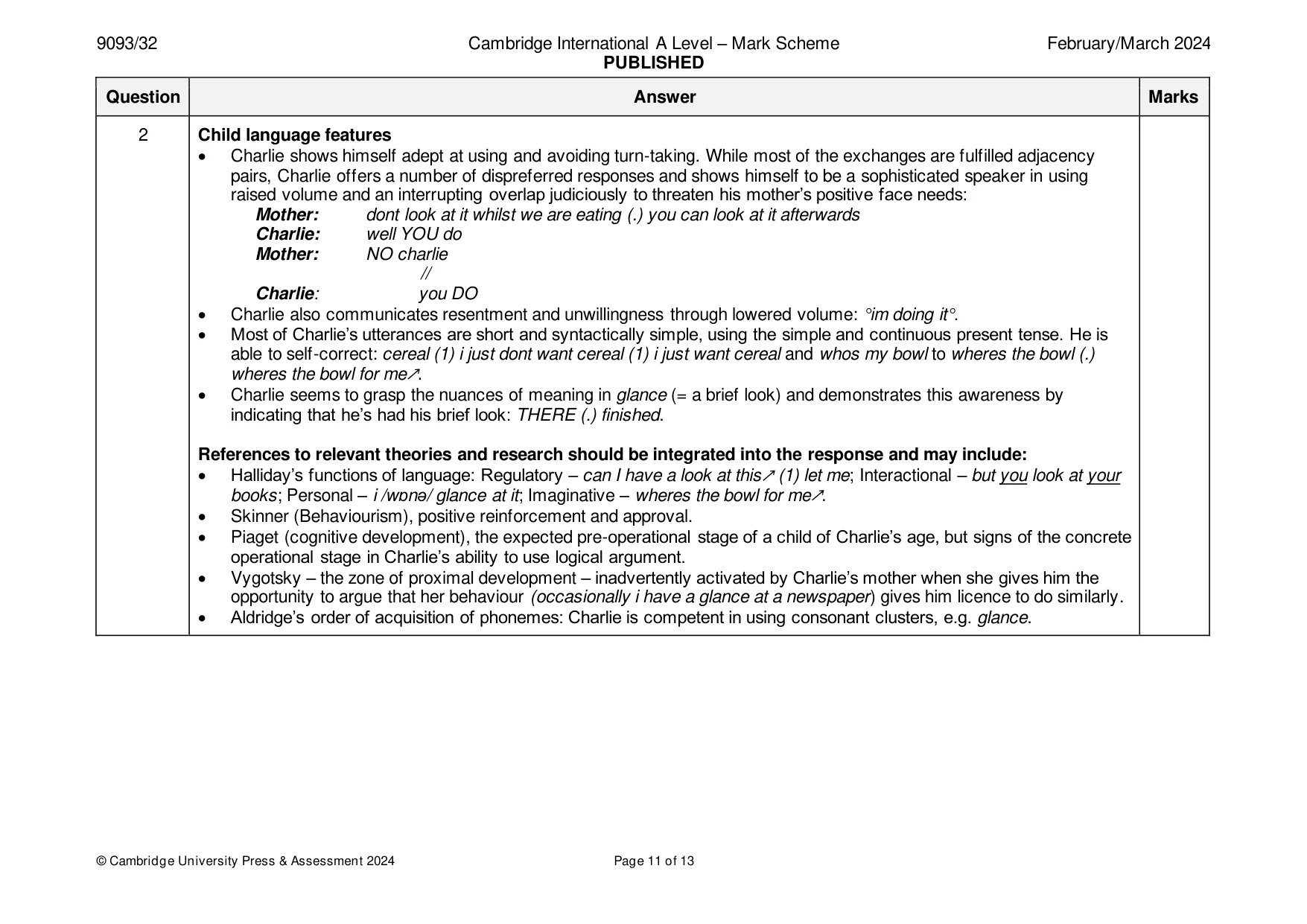
9093/32 Cambridge International A Level – Mark Scheme PUBLISHED February/March 2024 © Cambridge University Press & Assessment 2024 Page 11 of 13 Question Answer Marks 2 Child language features • Charlie shows himself adept at using and avoiding turn-taking. While most of the exchanges are fulfilled adjacency pairs, Charlie offers a number of dispreferred responses and shows himself to be a sophisticated speaker in using raised volume and an interrupting overlap judiciously to threaten his mother’s positive face needs: Mother: dont look at it whilst we are eating (.) you can look at it afterwards Charlie: well YOU do Mother: NO charlie // Charlie: you DO • Charlie also communicates resentment and unwillingness through lowered volume: °im doing it°. • Most of Charlie’s utterances are short and syntactically simple, using the simple and continuous present tense. He is able to self-correct: cereal (1) i just dont want cereal (1) i just want cereal and whos my bowl to wheres the bowl (.) wheres the bowl for me↗. • Charlie seems to grasp the nuances of meaning in glance (= a brief look) and demonstrates this awareness by indicating that he’s had his brief look: THERE (.) finished. References to relevant theories and research should be integrated into the response and may include: • Halliday’s functions of language: Regulatory – can I have a look at this↗ (1) let me; Interactional – but you look at your books; Personal – i /wɒnə/ glance at it; Imaginative – wheres the bowl for me↗. • Skinner (Behaviourism), positive reinforcement and approval. • Piaget (cognitive development), the expected pre-operational stage of a child of Charlie’s age, but signs of the concrete operational stage in Charlie’s ability to use logical argument. • Vygotsky – the zone of proximal development – inadvertently activated by Charlie’s mother when she gives him the opportunity to argue that her behaviour (occasionally i have a glance at a newspaper) gives him licence to do similarly. • Aldridge’s order of acquisition of phonemes: Charlie is competent in using consonant clusters, e.g. glance.
Mark scheme, page 12
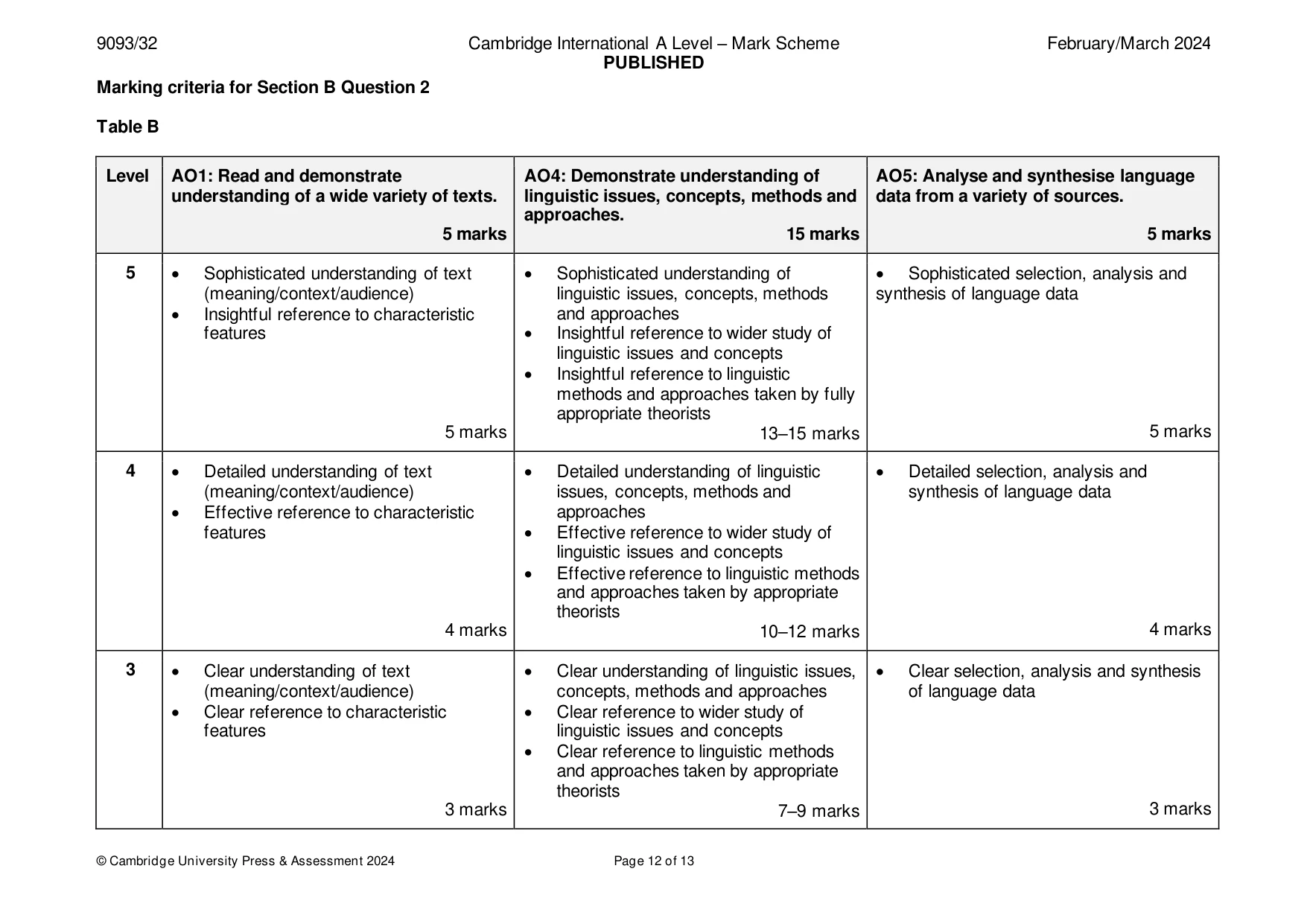
9093/32 Cambridge International A Level – Mark Scheme PUBLISHED February/March 2024 © Cambridge University Press & Assessment 2024 Page 12 of 13 Marking criteria for Section B Question 2 Table B Level AO1: Read and demonstrate understanding of a wide variety of texts. 5 marks AO4: Demonstrate understanding of linguistic issues, concepts, methods and approaches. 15 marks AO5: Analyse and synthesise language data from a variety of sources. 5 marks 5 • Sophisticated understanding of text (meaning/context/audience) • Insightful reference to characteristic features 5 marks • Sophisticated understanding of linguistic issues, concepts, methods and approaches • Insightful reference to wider study of linguistic issues and concepts • Insightful reference to linguistic methods and approaches taken by fully appropriate theorists 13–15 marks • Sophisticated selection, analysis and synthesis of language data 5 marks 4 • Detailed understanding of text (meaning/context/audience) • Effective reference to characteristic features 4 marks • Detailed understanding of linguistic issues, concepts, methods and approaches • Effective reference to wider study of linguistic issues and concepts • Effective reference to linguistic methods and approaches taken by appropriate theorists 10–12 marks • Detailed selection, analysis and synthesis of language data 4 marks 3 • Clear understanding of text (meaning/context/audience) • Clear reference to characteristic features 3 marks • Clear understanding of linguistic issues, concepts, methods and approaches • Clear reference to wider study of linguistic issues and concepts • Clear reference to linguistic methods and approaches taken by appropriate theorists 7–9 marks • Clear selection, analysis and synthesis of language data 3 marks
Mark scheme, page 13
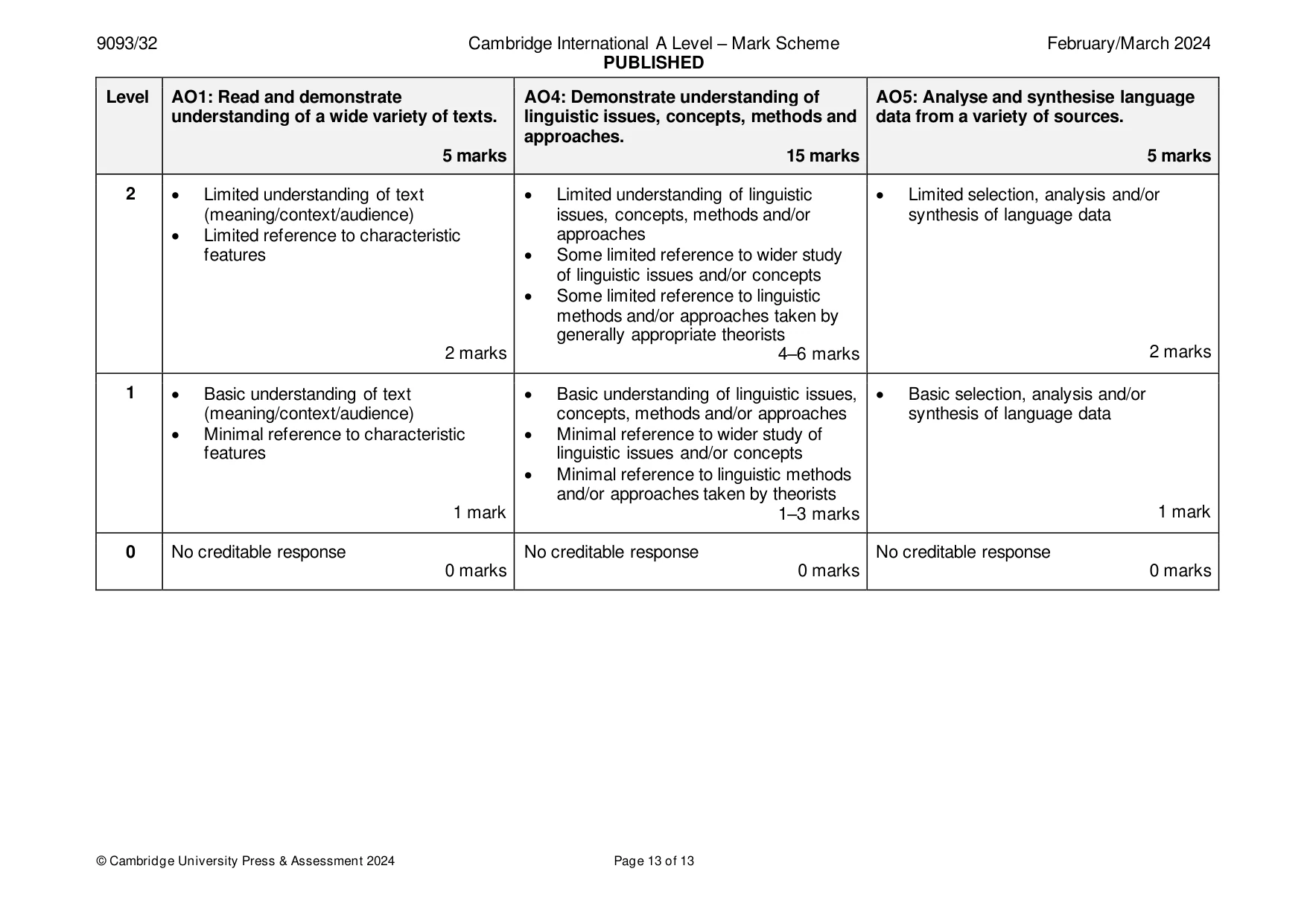
9093/32 Cambridge International A Level – Mark Scheme PUBLISHED February/March 2024 © Cambridge University Press & Assessment 2024 Page 13 of 13 Level AO1: Read and demonstrate understanding of a wide variety of texts. 5 marks AO4: Demonstrate understanding of linguistic issues, concepts, methods and approaches. 15 marks AO5: Analyse and synthesise language data from a variety of sources. 5 marks 2 • Limited understanding of text (meaning/context/audience) • Limited reference to characteristic features 2 marks • Limited understanding of linguistic issues, concepts, methods and/or approaches • Some limited reference to wider study of linguistic issues and/or concepts • Some limited reference to linguistic methods and/or approaches taken by generally appropriate theorists 4–6 marks • Limited selection, analysis and/or synthesis of language data 2 marks 1 • Basic understanding of text (meaning/context/audience) • Minimal reference to characteristic features 1 mark • Basic understanding of linguistic issues, concepts, methods and/or approaches • Minimal reference to wider study of linguistic issues and/or concepts • Minimal reference to linguistic methods and/or approaches taken by theorists 1–3 marks • Basic selection, analysis and/or synthesis of language data 1 mark 0 No creditable response 0 marks No creditable response 0 marks No creditable response 0 marks
What you needed in this session
Cambridge’s own grade thresholds for 2024 Feb/March, Paper 3 · Variant 2. A higher threshold means an easier paper — the bar moves with how the cohort did.