Cambridge A Level English - Language AS and A Level (from 2014) 9093 — 2025 Oct/Nov Paper 3 · Variant 2
9093/32/O/N/25 · 50 marks · 135 min
The question paper and its mark scheme, free to read here and free to download. This is Cambridge’s own paper, exactly as it was sat.
Question paper8 pages
Mark scheme14 pages
Answers below. Sit the paper first if you are practising.
Paper as text
Question paper, page 1
This document has 8 pages. [Turn over Cambridge International AS & A Level ENGLISH LANGUAGE 9093/32 Paper 3 Language Analysis October/November 2025 2 hours 15 minutes You must answer on the enclosed answer booklet. You will need: Answer booklet (enclosed) INSTRUCTIONS ● Answer all questions. ● Follow the instructions on the front cover of the answer booklet. If you need additional answer paper, ask the invigilator for a continuation booklet. ● Dictionaries are not allowed. INFORMATION ● The total mark for this paper is 50. ● The number of marks for each question or part question is shown in brackets [ ]. * 7 4 3 9 1 2 4 0 4 3 * DC (CJ/SG) 356917/2 © UCLES 2025
Question paper, page 2
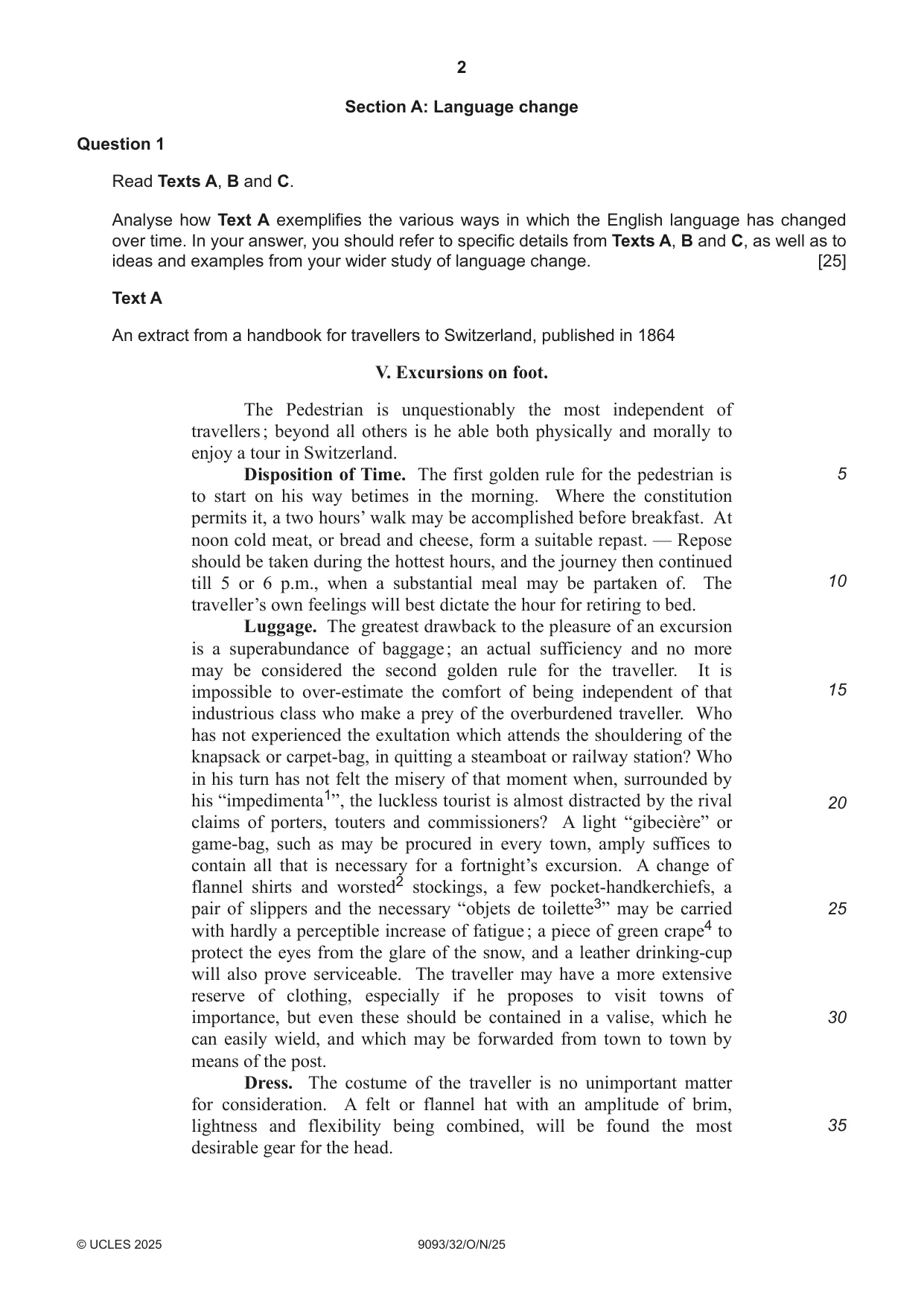
2 9093/32/O/N/25 © UCLES 2025 Section A: Language change Question 1 Read Texts A, B and C. Analyse how Text A exemplifies the various ways in which the English language has changed over time. In your answer, you should refer to specific details from Texts A, B and C, as well as to ideas and examples from your wider study of language change. [25] Text A An extract from a handbook for travellers to Switzerland, published in 1864 V. Excursions on foot. The Pedestrian is unquestionably the most independent of travellers ; beyond all others is he able both physically and morally to enjoy a tour in Switzerland. Disposition of Time. The first golden rule for the pedestrian is to start on his way betimes in the morning. Where the constitution permits it, a two hours’ walk may be accomplished before breakfast. At noon cold meat, or bread and cheese, form a suitable repast. — Repose should be taken during the hottest hours, and the journey then continued till 5 or 6 p.m., when a substantial meal may be partaken of. The traveller’s own feelings will best dictate the hour for retiring to bed. Luggage. The greatest drawback to the pleasure of an excursion is a superabundance of baggage ; an actual sufficiency and no more may be considered the second golden rule for the traveller. It is impossible to over-estimate the comfort of being independent of that industrious class who make a prey of the overburdened traveller. Who has not experienced the exultation which attends the shouldering of the knapsack or carpet-bag, in quitting a steamboat or railway station? Who in his turn has not felt the misery of that moment when, surrounded by his “impedimenta1”, the luckless tourist is almost distracted by the rival claims of porters, touters and commissioners? A light “gibecière” or game-bag, such as may be procured in every town, amply suffices to contain all that is necessary for a fortnight’s excursion. A change of flannel shirts and worsted2 stockings, a few pocket-handkerchiefs, a pair of slippers and the necessary “objets de toilette3” may be carried with hardly a perceptible increase of fatigue ; a piece of green crape4 to protect the eyes from the glare of the snow, and a leather drinking-cup will also prove serviceable. The traveller may have a more extensive reserve of clothing, especially if he proposes to visit towns of importance, but even these should be contained in a valise, which he can easily wield, and which may be forwarded from town to town by means of the post. Dress. The costume of the traveller is no unimportant matter for consideration. A felt or flannel hat with an amplitude of brim, lightness and flexibility being combined, will be found the most desirable gear for the head. 5 10 15 20 25 30 35
Question paper, page 3
3 9093/32/O/N/25 © UCLES 2025 [Turn over 1 impedimenta: Latin word for baggage and equipment carried by an army 2 worsted: made from wool 3 objets de toilette: French phrase for toiletries (items used for personal hygiene) 4 crape: a type of thin material
Question paper, page 4
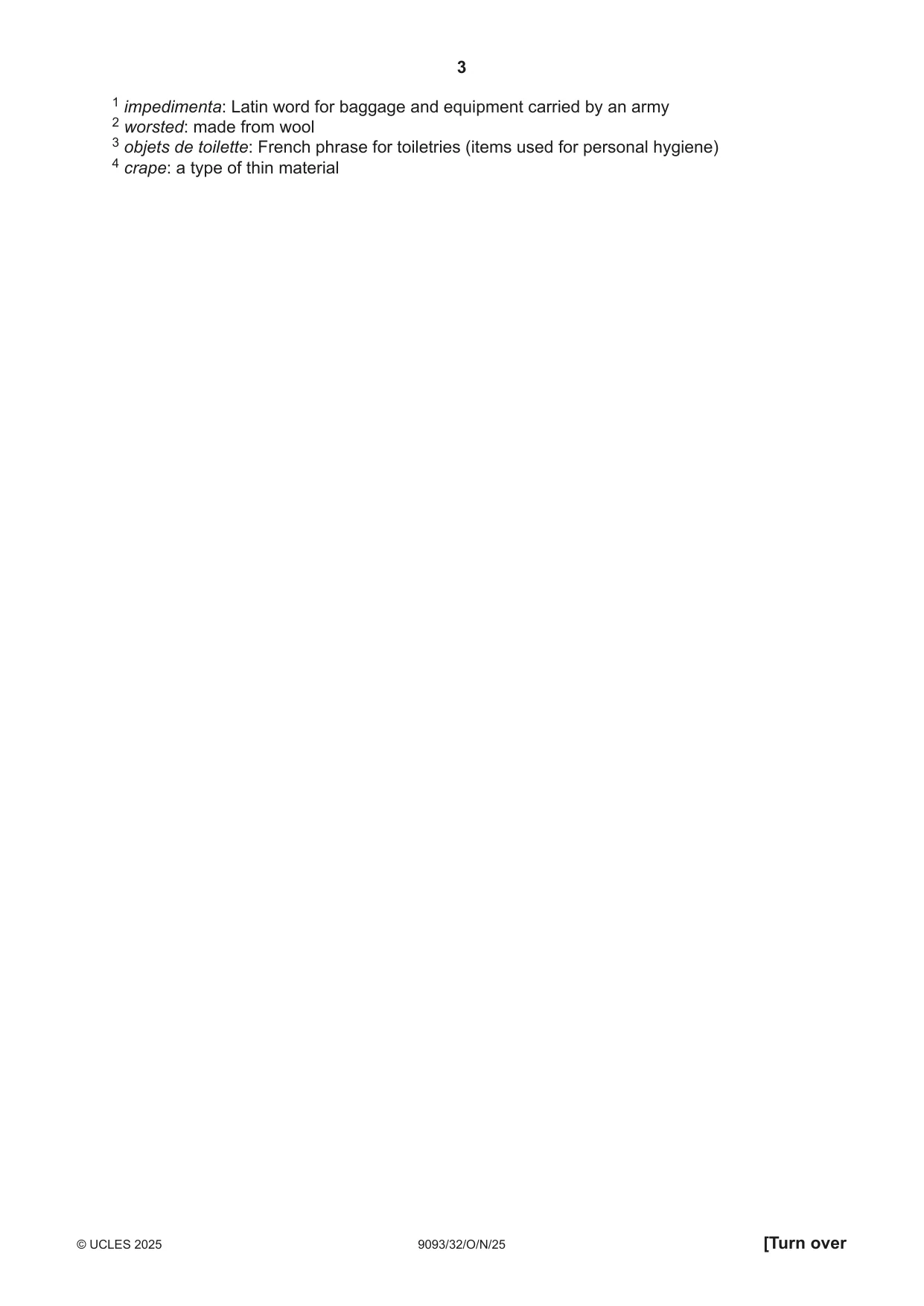
4 9093/32/O/N/25 © UCLES 2025 Text B Five of the top collocates for ‘clothing’ and ‘costume’ from the Google Books corpus (1980s–2000s) ‘clothing’ ‘costume’ industry designer footwear drama equipment jewellery shelter mask bedding scenery
Question paper, page 5
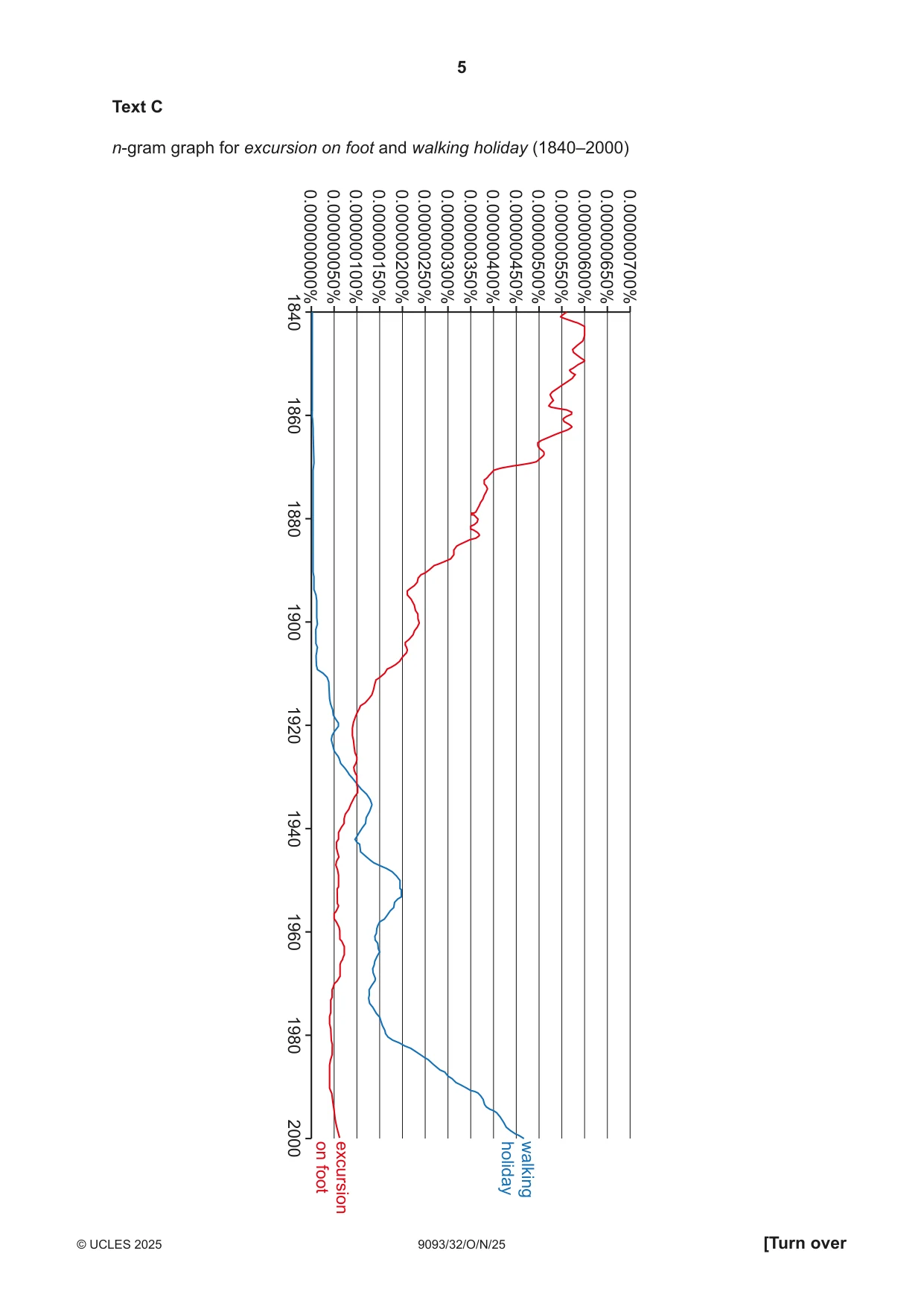
5 9093/32/O/N/25 © UCLES 2025 [Turn over Text C n-gram graph for excursion on foot and walking holiday (1840–2000) 0.000000000% 0.000000050% 0.000000100% 0.000000150% 0.000000200% 0.000000250% 0.000000300% 0.000000350% 0.000000400% 0.000000450% 0.000000500% 0.000000550% 0.000000600% 0.000000650% 0.000000700% 1840 1860 1880 1900 1920 1940 1960 1980 2000 excursion on foot walking holiday
Question paper, page 6
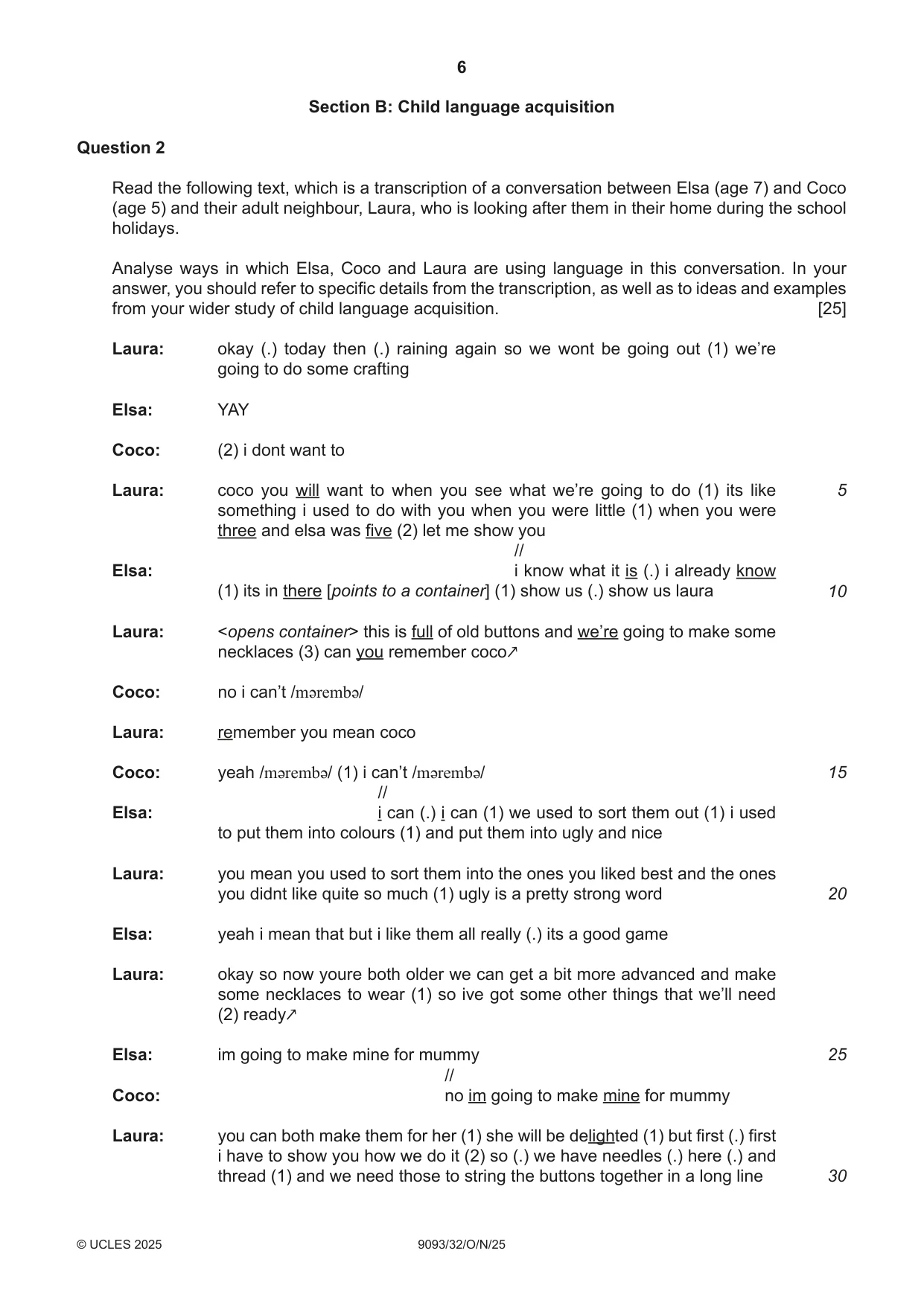
6 9093/32/O/N/25 © UCLES 2025 Section B: Child language acquisition Question 2 Read the following text, which is a transcription of a conversation between Elsa (age 7) and Coco (age 5) and their adult neighbour, Laura, who is looking after them in their home during the school holidays. Analyse ways in which Elsa, Coco and Laura are using language in this conversation. In your answer, you should refer to specific details from the transcription, as well as to ideas and examples from your wider study of child language acquisition. [25] Laura: okay (.) today then (.) raining again so we wont be going out (1) we’re going to do some crafting Elsa: YAY Coco: (2) i dont want to Laura: coco you will want to when you see what we’re going to do (1) its like something i used to do with you when you were little (1) when you were three and elsa was five (2) let me show you // Elsa: i know what it is (.) i already know (1) its in there [points to a container] (1) show us (.) show us laura Laura: <opens container> this is full of old buttons and we’re going to make some necklaces (3) can you remember coco↗ Coco: no i can’t /mərembə/ Laura: remember you mean coco Coco: yeah /mərembə/ (1) i can’t /mərembə/ // Elsa: i can (.) i can (1) we used to sort them out (1) i used to put them into colours (1) and put them into ugly and nice Laura: you mean you used to sort them into the ones you liked best and the ones you didnt like quite so much (1) ugly is a pretty strong word Elsa: yeah i mean that but i like them all really (.) its a good game Laura: okay so now youre both older we can get a bit more advanced and make some necklaces to wear (1) so ive got some other things that we’ll need (2) ready↗ Elsa: im going to make mine for mummy // Coco: no im going to make mine for mummy Laura: you can both make them for her (1) she will be delighted (1) but first (.) first i have to show you how we do it (2) so (.) we have needles (.) here (.) and thread (1) and we need those to string the buttons together in a long line 5 10 15 20 25 30
Question paper, page 7
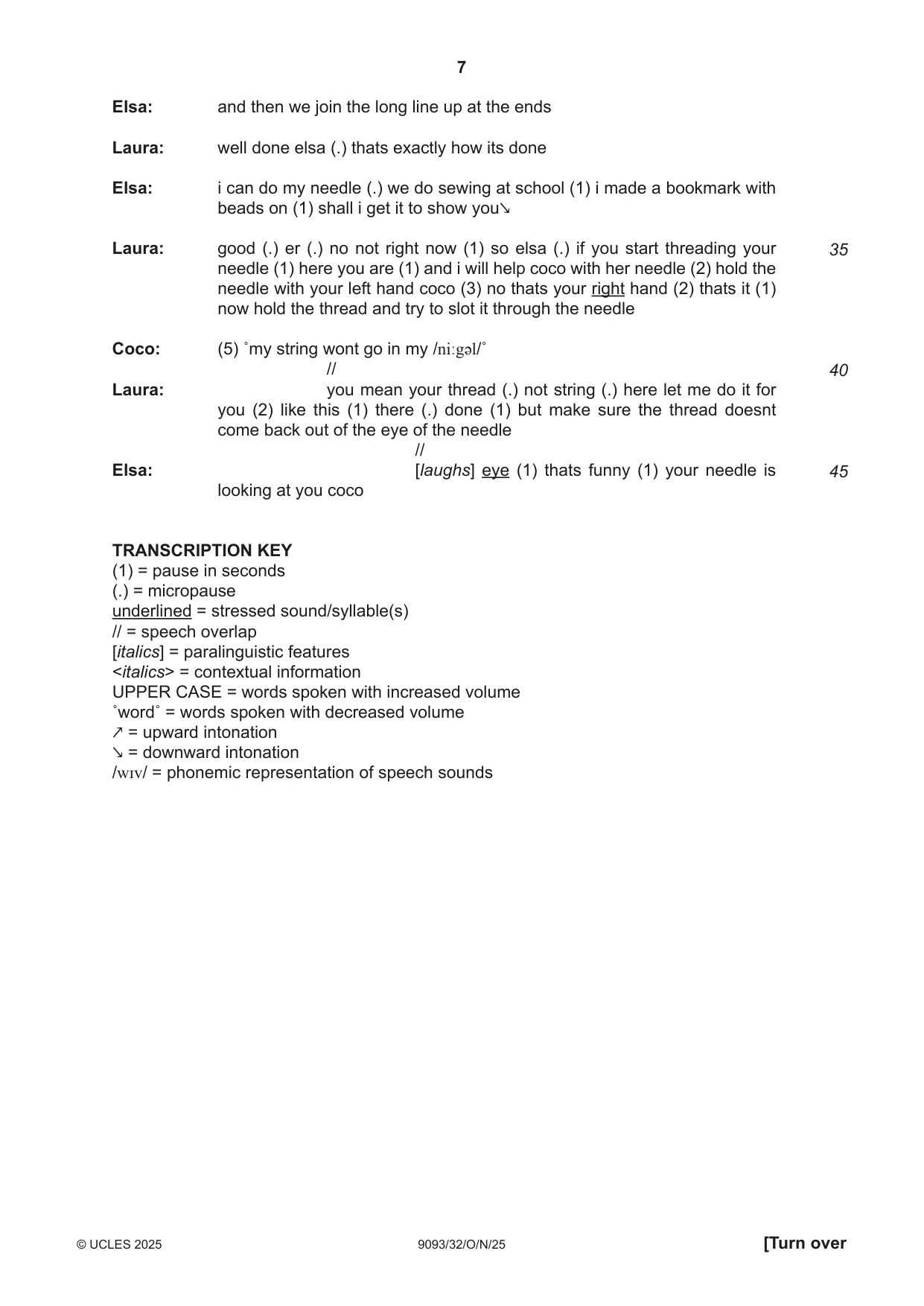
7 9093/32/O/N/25 © UCLES 2025 [Turn over Elsa: and then we join the long line up at the ends Laura: well done elsa (.) thats exactly how its done Elsa: i can do my needle (.) we do sewing at school (1) i made a bookmark with beads on (1) shall i get it to show you↘ Laura: good (.) er (.) no not right now (1) so elsa (.) if you start threading your needle (1) here you are (1) and i will help coco with her needle (2) hold the needle with your left hand coco (3) no thats your right hand (2) thats it (1) now hold the thread and try to slot it through the needle Coco: (5) ˚my string wont go in my /niːgəl/˚ // Laura: you mean your thread (.) not string (.) here let me do it for you (2) like this (1) there (.) done (1) but make sure the thread doesnt come back out of the eye of the needle // Elsa: [laughs] eye (1) thats funny (1) your needle is looking at you coco TRANSCRIPTION KEY (1) = pause in seconds (.) = micropause underlined = stressed sound/syllable(s) // = speech overlap [italics] = paralinguistic features <italics> = contextual information UPPER CASE = words spoken with increased volume ˚word˚ = words spoken with decreased volume ↗ = upward intonation ↘ = downward intonation /wɪv/ = phonemic representation of speech sounds 35 40 45
Question paper, page 8
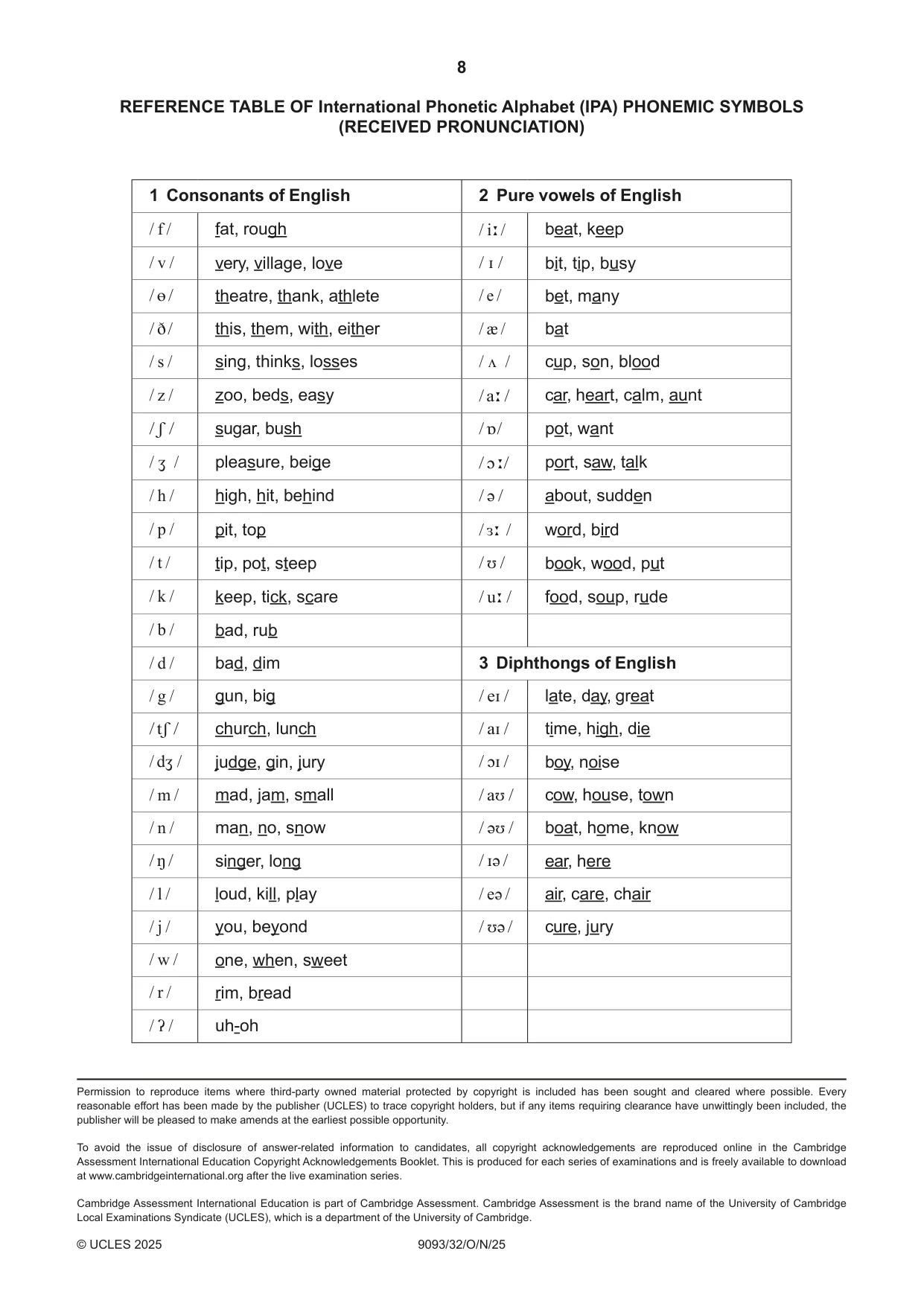
8 9093/32/O/N/25 © UCLES 2025 Permission to reproduce items where third-party owned material protected by copyright is included has been sought and cleared where possible. Every reasonable effort has been made by the publisher (UCLES) to trace copyright holders, but if any items requiring clearance have unwittingly been included, the publisher will be pleased to make amends at the earliest possible opportunity. To avoid the issue of disclosure of answer-related information to candidates, all copyright acknowledgements are reproduced online in the Cambridge Assessment International Education Copyright Acknowledgements Booklet. This is produced for each series of examinations and is freely available to download at www.cambridgeinternational.org after the live examination series. Cambridge Assessment International Education is part of Cambridge Assessment. Cambridge Assessment is the brand name of the University of Cambridge Local Examinations Syndicate (UCLES), which is a department of the University of Cambridge. REFERENCE TABLE OF International Phonetic Alphabet (IPA) PHONEMIC SYMBOLS (RECEIVED PRONUNCIATION) 1 Consonants of English 2 Pure vowels of English / f / fat, rough / iː / beat, keep / v / very, village, love / ɪ / bit, tip, busy / ɵ / theatre, thank, athlete / e / bet, many / ð/ this, them, with, either / æ / bat / s / sing, thinks, losses / ʌ / cup, son, blood / z / zoo, beds, easy / aː / car, heart, calm, aunt / ʃ / sugar, bush / ɒ / pot, want / ʒ / pleasure, beige / ɔː/ port, saw, talk / h / high, hit, behind / ə / about, sudden / p / pit, top / ɜː / word, bird / t / tip, pot, steep / ʊ / book, wood, put / k / keep, tick, scare / uː / food, soup, rude / b / bad, rub / d / bad, dim 3 Diphthongs of English / g / gun, big / eɪ / late, day, great / tʃ / church, lunch / aɪ / time, high, die / dʒ / judge, gin, jury / ɔɪ / boy, noise / m / mad, jam, small / aʊ / cow, house, town / n / man, no, snow / əʊ / boat, home, know / ŋ / singer, long / ɪə / ear, here / l / loud, kill, play / eə / air, care, chair / j / you, beyond / ʊə / cure, jury / w / one, when, sweet / r / rim, bread / ʔ / uh-oh
Mark scheme, page 1
This document consists of 14 printed pages. © Cambridge University Press & Assessment 2025 [Turn over Cambridge International A Level ENGLISH LANGUAGE 9093/32 Paper 3 Language Analysis October/November 2025 MARK SCHEME Maximum Mark: 50 Published This mark scheme is published as an aid to teachers and candidates, to indicate the requirements of the examination. It shows the basis on which Examiners were instructed to award marks. It does not indicate the details of the discussions that took place at an Examiners’ meeting before marking began, which would have considered the acceptability of alternative answers. Mark schemes should be read in conjunction with the question paper and the Principal Examiner Report for Teachers. Cambridge International will not enter into discussions about these mark schemes. Cambridge International is publishing the mark schemes for the October/November 2025 series for most Cambridge IGCSE, Cambridge International A and AS Level components, and some Cambridge O Level components.
Mark scheme, page 2
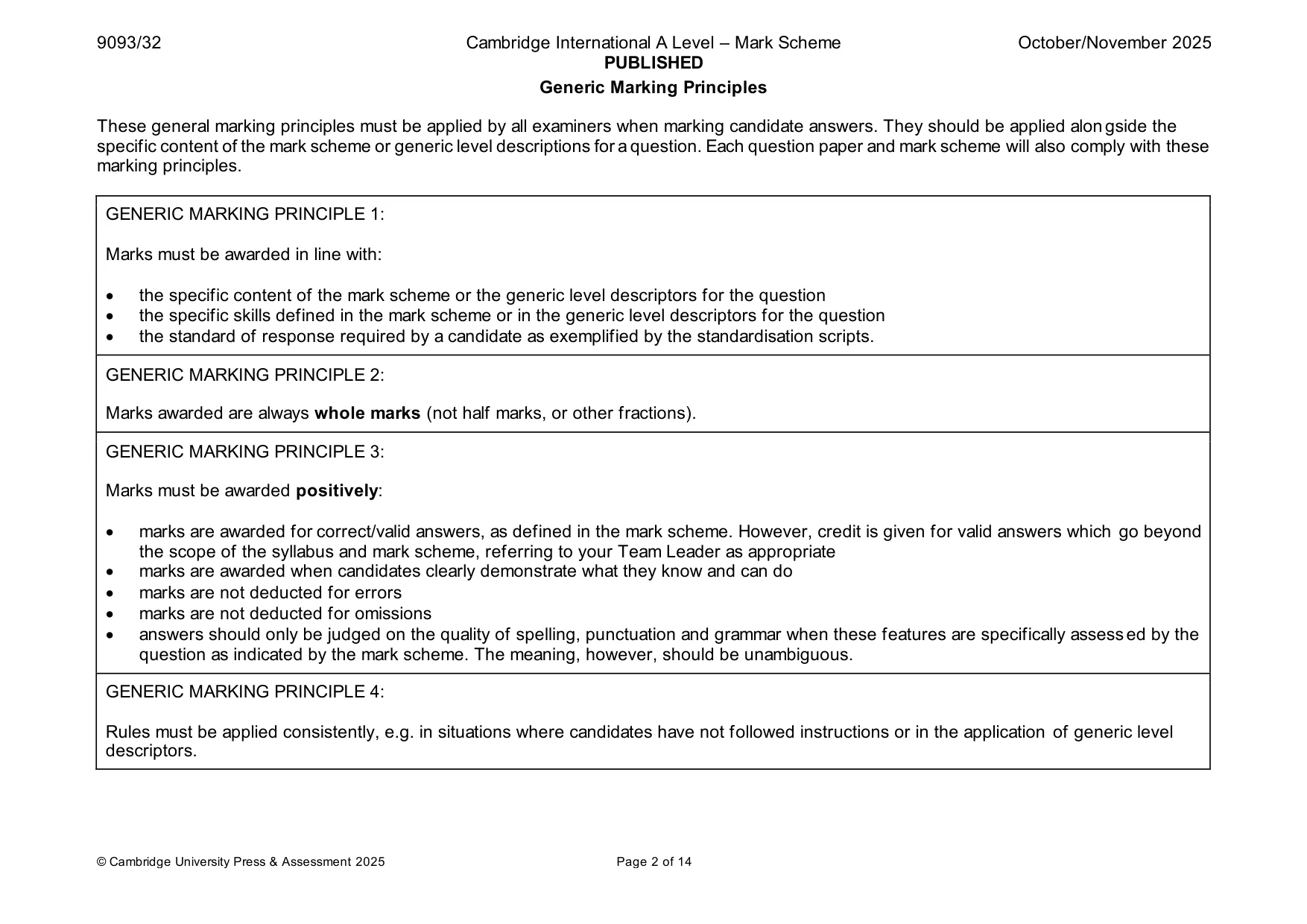
9093/32 Cambridge International A Level – Mark Scheme PUBLISHED October/November 2025 © Cambridge University Press & Assessment 2025 Page 2 of 14 Generic Marking Principles These general marking principles must be applied by all examiners when marking candidate answers. They should be applied alon gside the specific content of the mark scheme or generic level descriptions for a question. Each question paper and mark scheme will also comply with these marking principles. GENERIC MARKING PRINCIPLE 1: Marks must be awarded in line with: • the specific content of the mark scheme or the generic level descriptors for the question • the specific skills defined in the mark scheme or in the generic level descriptors for the question • the standard of response required by a candidate as exemplified by the standardisation scripts. GENERIC MARKING PRINCIPLE 2: Marks awarded are always whole marks (not half marks, or other fractions). GENERIC MARKING PRINCIPLE 3: Marks must be awarded positively: • marks are awarded for correct/valid answers, as defined in the mark scheme. However, credit is given for valid answers which go beyond the scope of the syllabus and mark scheme, referring to your Team Leader as appropriate • marks are awarded when candidates clearly demonstrate what they know and can do • marks are not deducted for errors • marks are not deducted for omissions • answers should only be judged on the quality of spelling, punctuation and grammar when these features are specifically assessed by the question as indicated by the mark scheme. The meaning, however, should be unambiguous. GENERIC MARKING PRINCIPLE 4: Rules must be applied consistently, e.g. in situations where candidates have not followed instructions or in the application of generic level descriptors.
Mark scheme, page 3
9093/32 Cambridge International A Level – Mark Scheme PUBLISHED October/November 2025 © Cambridge University Press & Assessment 2025 Page 3 of 14 GENERIC MARKING PRINCIPLE 5: Marks should be awarded using the full range of marks defined in the mark scheme for the question (however; the use of the full mark range may be limited according to the quality of the candidate responses seen). GENERIC MARKING PRINCIPLE 6: Marks awarded are based solely on the requirements as defined in the mark scheme. Marks should not be awarded with grade thre sholds or grade descriptors in mind.
Mark scheme, page 4
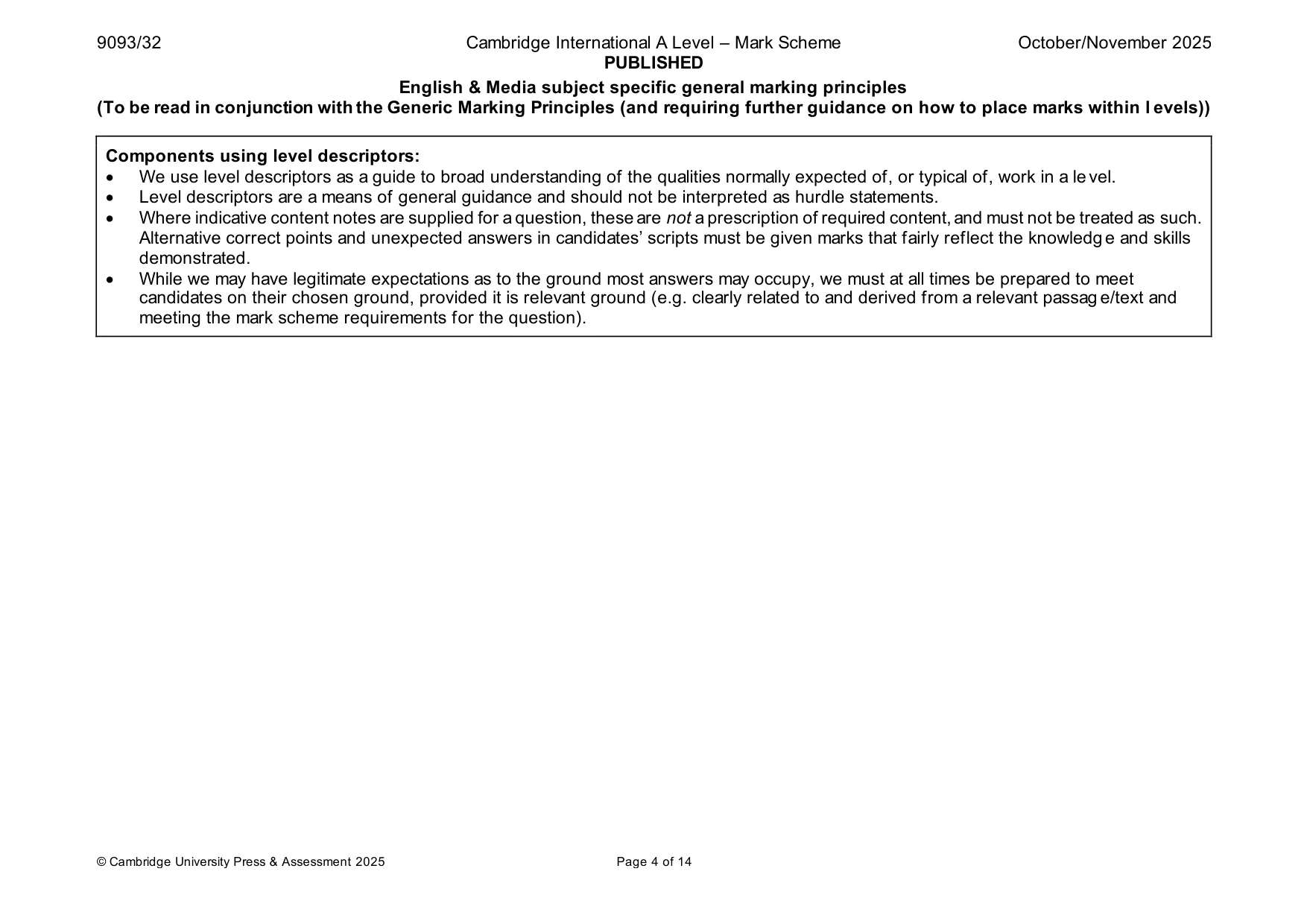
9093/32 Cambridge International A Level – Mark Scheme PUBLISHED October/November 2025 © Cambridge University Press & Assessment 2025 Page 4 of 14 English & Media subject specific general marking principles (To be read in conjunction with the Generic Marking Principles (and requiring further guidance on how to place marks within l evels)) Components using level descriptors: • We use level descriptors as a guide to broad understanding of the qualities normally expected of, or typical of, work in a le vel. • Level descriptors are a means of general guidance and should not be interpreted as hurdle statements. • Where indicative content notes are supplied for a question, these are not a prescription of required content, and must not be treated as such. Alternative correct points and unexpected answers in candidates’ scripts must be given marks that fairly reflect the knowledg e and skills demonstrated. • While we may have legitimate expectations as to the ground most answers may occupy, we must at all times be prepared to meet candidates on their chosen ground, provided it is relevant ground (e.g. clearly related to and derived from a relevant passag e/text and meeting the mark scheme requirements for the question).
Mark scheme, page 5
9093/32 Cambridge International A Level – Mark Scheme PUBLISHED October/November 2025 © Cambridge University Press & Assessment 2025 Page 5 of 14 Annotations guidance for centres Examiners use a system of annotations as a shorthand for communicating their marking decisions to one another. Examiners are trained during the standardisation process on how and when to use annotations. The purpose of annotations is to inform the standard isation and monitoring processes and guide the supervising examiners when they are checking the work of examiners within their team. The meaning of annotations and how they are used is specific to each component and is understood by all examiners who mark the component. We publish annotations in our mark schemes to help centres understand the annotations they may see on copies of scripts. Note that there may not be a direct correlation between the number of annotations on a script and the mark awarded. Similarly, the use of an annotation may not be an indication of the quality of the response. The annotations listed below were available to examiners marking this component in this series. Annotations Annotation Meaning Assessment Objective 1 Assessment Objective 2 Assessment Objective 4 Assessment Objective 5 Repetition Omission Requires clarity Seen [Highlighter] Inaccurate Not relevant
Mark scheme, page 6
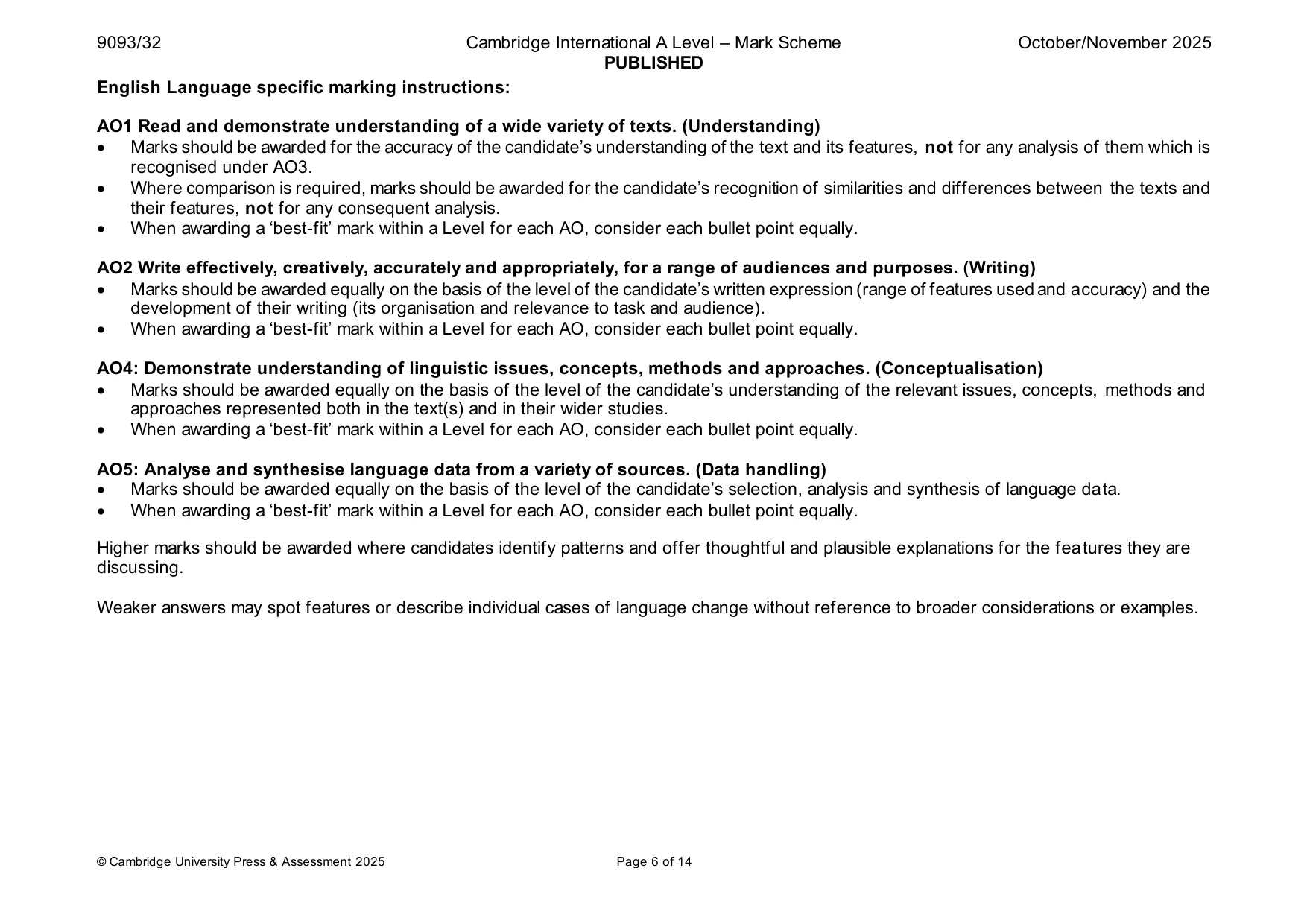
9093/32 Cambridge International A Level – Mark Scheme PUBLISHED October/November 2025 © Cambridge University Press & Assessment 2025 Page 6 of 14 English Language specific marking instructions: AO1 Read and demonstrate understanding of a wide variety of texts. (Understanding) • Marks should be awarded for the accuracy of the candidate’s understanding of the text and its features, not for any analysis of them which is recognised under AO3. • Where comparison is required, marks should be awarded for the candidate’s recognition of similarities and differences between the texts and their features, not for any consequent analysis. • When awarding a ‘best-fit’ mark within a Level for each AO, consider each bullet point equally. AO2 Write effectively, creatively, accurately and appropriately, for a range of audiences and purposes. (Writing) • Marks should be awarded equally on the basis of the level of the candidate’s written expression (range of features used and accuracy) and the development of their writing (its organisation and relevance to task and audience). • When awarding a ‘best-fit’ mark within a Level for each AO, consider each bullet point equally. AO4: Demonstrate understanding of linguistic issues, concepts, methods and approaches. (Conceptualisation) • Marks should be awarded equally on the basis of the level of the candidate’s understanding of the relevant issues, concepts, methods and approaches represented both in the text(s) and in their wider studies. • When awarding a ‘best-fit’ mark within a Level for each AO, consider each bullet point equally. AO5: Analyse and synthesise language data from a variety of sources. (Data handling) • Marks should be awarded equally on the basis of the level of the candidate’s selection, analysis and synthesis of language data. • When awarding a ‘best-fit’ mark within a Level for each AO, consider each bullet point equally. Higher marks should be awarded where candidates identify patterns and offer thoughtful and plausible explanations for the features they are discussing. Weaker answers may spot features or describe individual cases of language change without reference to broader considerations or examples.
Mark scheme, page 7
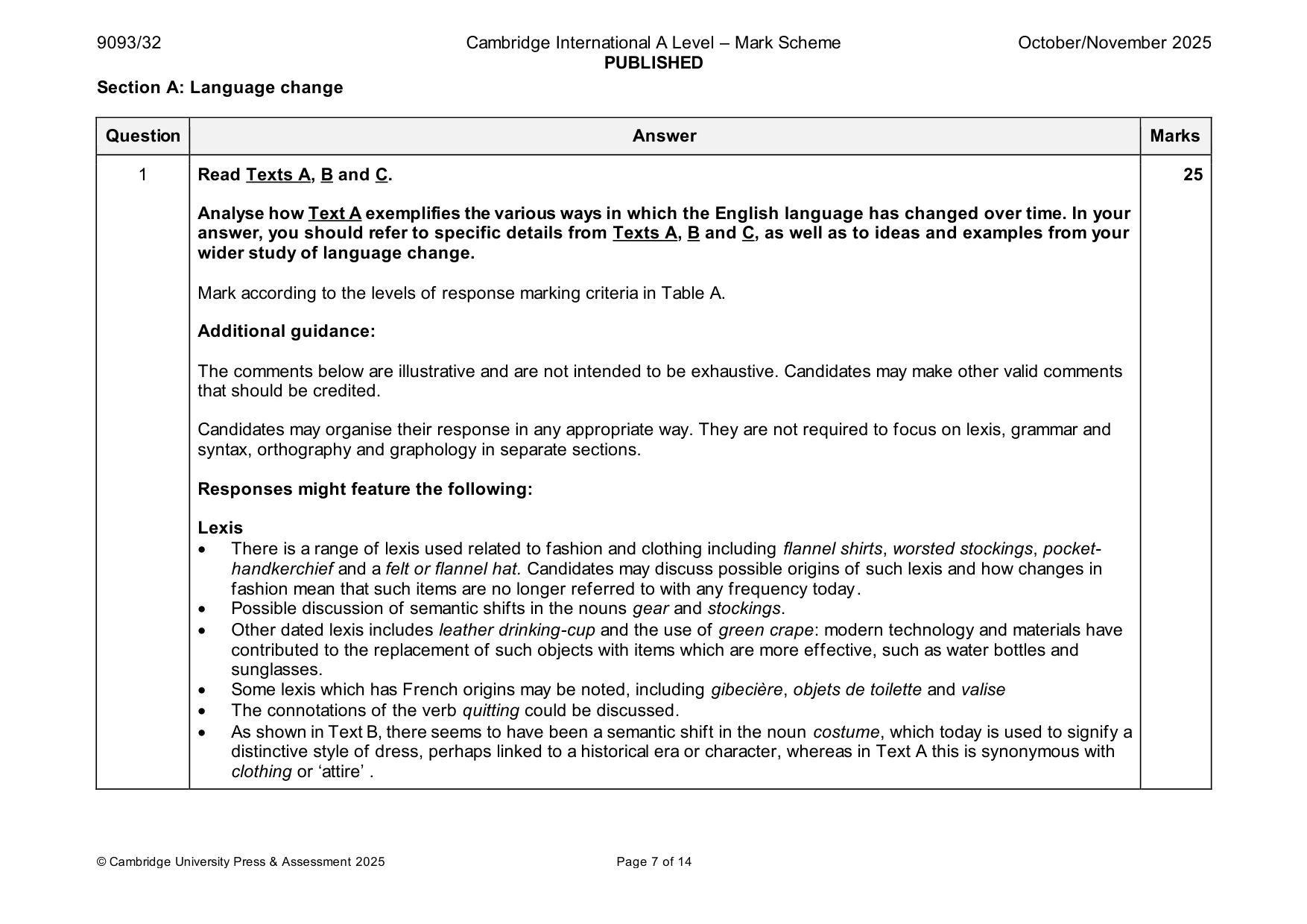
9093/32 Cambridge International A Level – Mark Scheme PUBLISHED October/November 2025 © Cambridge University Press & Assessment 2025 Page 7 of 14 Section A: Language change Question Answer Marks 1 Read Texts A, B and C. Analyse how Text A exemplifies the various ways in which the English language has changed over time. In your answer, you should refer to specific details from Texts A, B and C, as well as to ideas and examples from your wider study of language change. Mark according to the levels of response marking criteria in Table A. Additional guidance: The comments below are illustrative and are not intended to be exhaustive. Candidates may make other valid comments that should be credited. Candidates may organise their response in any appropriate way. They are not required to focus on lexis, grammar and syntax, orthography and graphology in separate sections. Responses might feature the following: Lexis • There is a range of lexis used related to fashion and clothing including flannel shirts, worsted stockings, pocket- handkerchief and a felt or flannel hat. Candidates may discuss possible origins of such lexis and how changes in fashion mean that such items are no longer referred to with any frequency today. • Possible discussion of semantic shifts in the nouns gear and stockings. • Other dated lexis includes leather drinking-cup and the use of green crape: modern technology and materials have contributed to the replacement of such objects with items which are more effective, such as water bottles and sunglasses. • Some lexis which has French origins may be noted, including gibecière, objets de toilette and valise • The connotations of the verb quitting could be discussed. • As shown in Text B, there seems to have been a semantic shift in the noun costume, which today is used to signify a distinctive style of dress, perhaps linked to a historical era or character, whereas in Text A this is synonymous with clothing or ‘attire’ . 25
Mark scheme, page 8
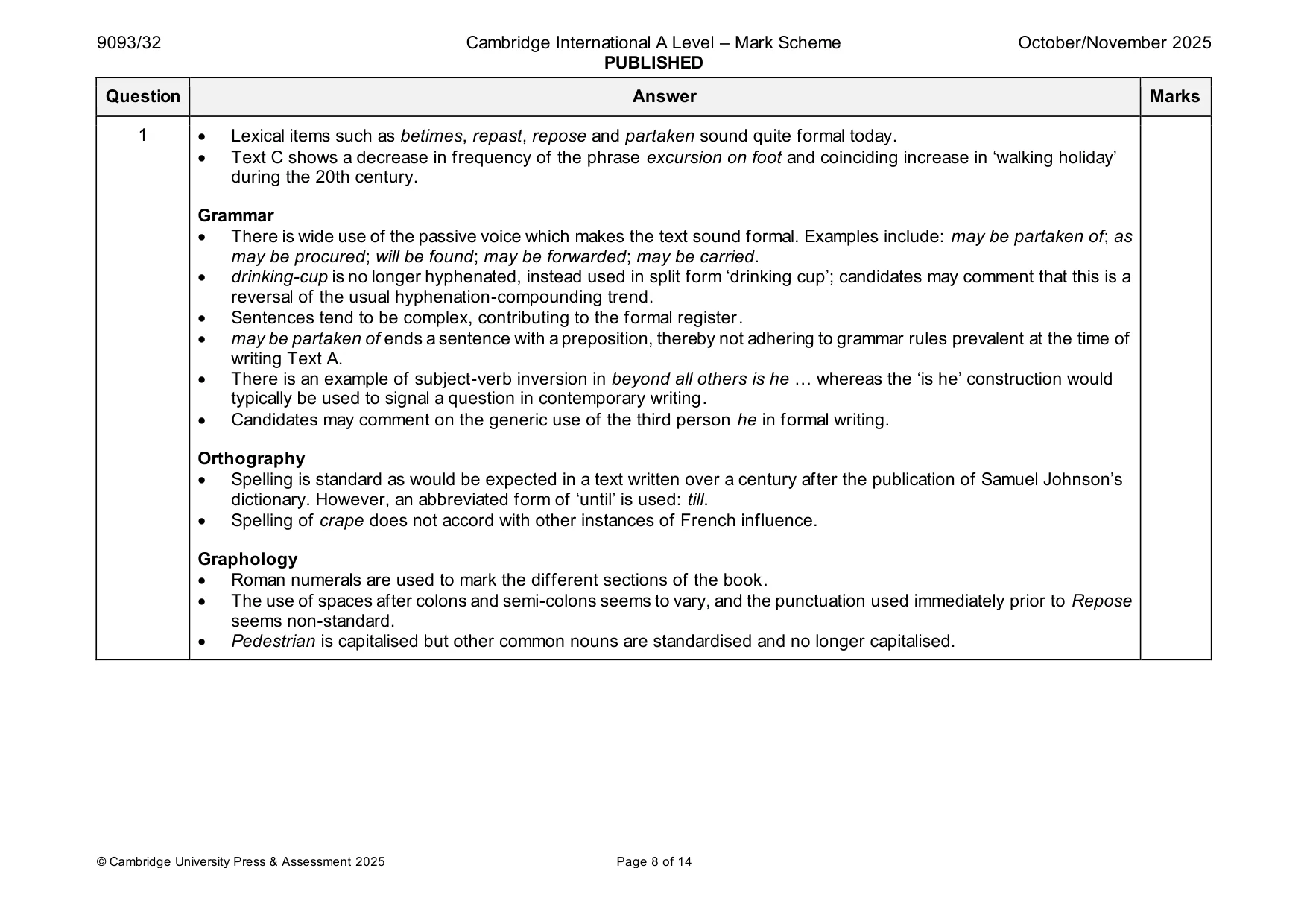
9093/32 Cambridge International A Level – Mark Scheme PUBLISHED October/November 2025 © Cambridge University Press & Assessment 2025 Page 8 of 14 Question Answer Marks 1 • Lexical items such as betimes, repast, repose and partaken sound quite formal today. • Text C shows a decrease in frequency of the phrase excursion on foot and coinciding increase in ‘walking holiday’ during the 20th century. Grammar • There is wide use of the passive voice which makes the text sound formal. Examples include: may be partaken of; as may be procured; will be found; may be forwarded; may be carried. • drinking-cup is no longer hyphenated, instead used in split form ‘drinking cup’; candidates may comment that this is a reversal of the usual hyphenation-compounding trend. • Sentences tend to be complex, contributing to the formal register. • may be partaken of ends a sentence with a preposition, thereby not adhering to grammar rules prevalent at the time of writing Text A. • There is an example of subject-verb inversion in beyond all others is he … whereas the ‘is he’ construction would typically be used to signal a question in contemporary writing. • Candidates may comment on the generic use of the third person he in formal writing. Orthography • Spelling is standard as would be expected in a text written over a century after the publication of Samuel Johnson’s dictionary. However, an abbreviated form of ‘until’ is used: till. • Spelling of crape does not accord with other instances of French influence. Graphology • Roman numerals are used to mark the different sections of the book. • The use of spaces after colons and semi-colons seems to vary, and the punctuation used immediately prior to Repose seems non-standard. • Pedestrian is capitalised but other common nouns are standardised and no longer capitalised.
Mark scheme, page 9
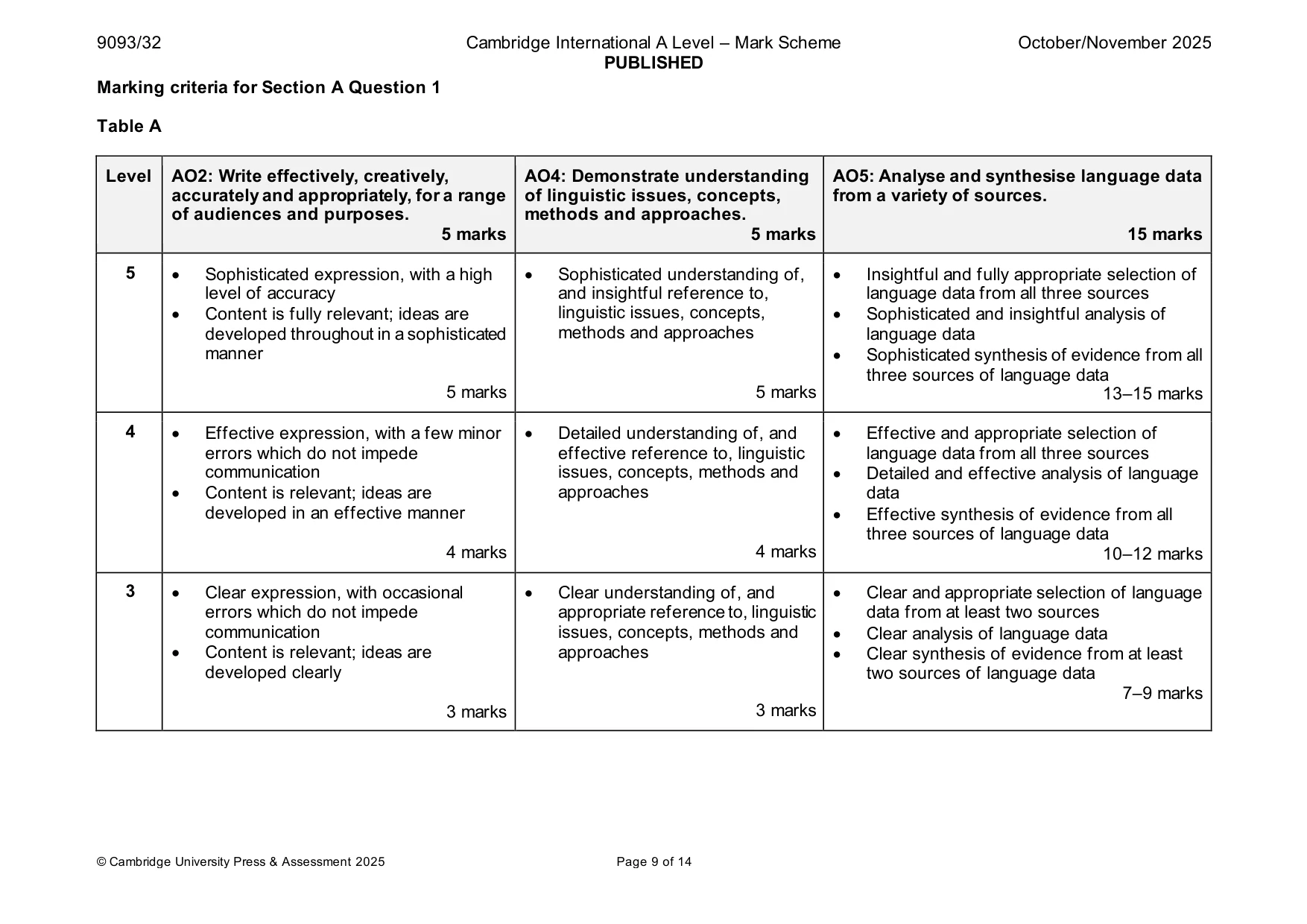
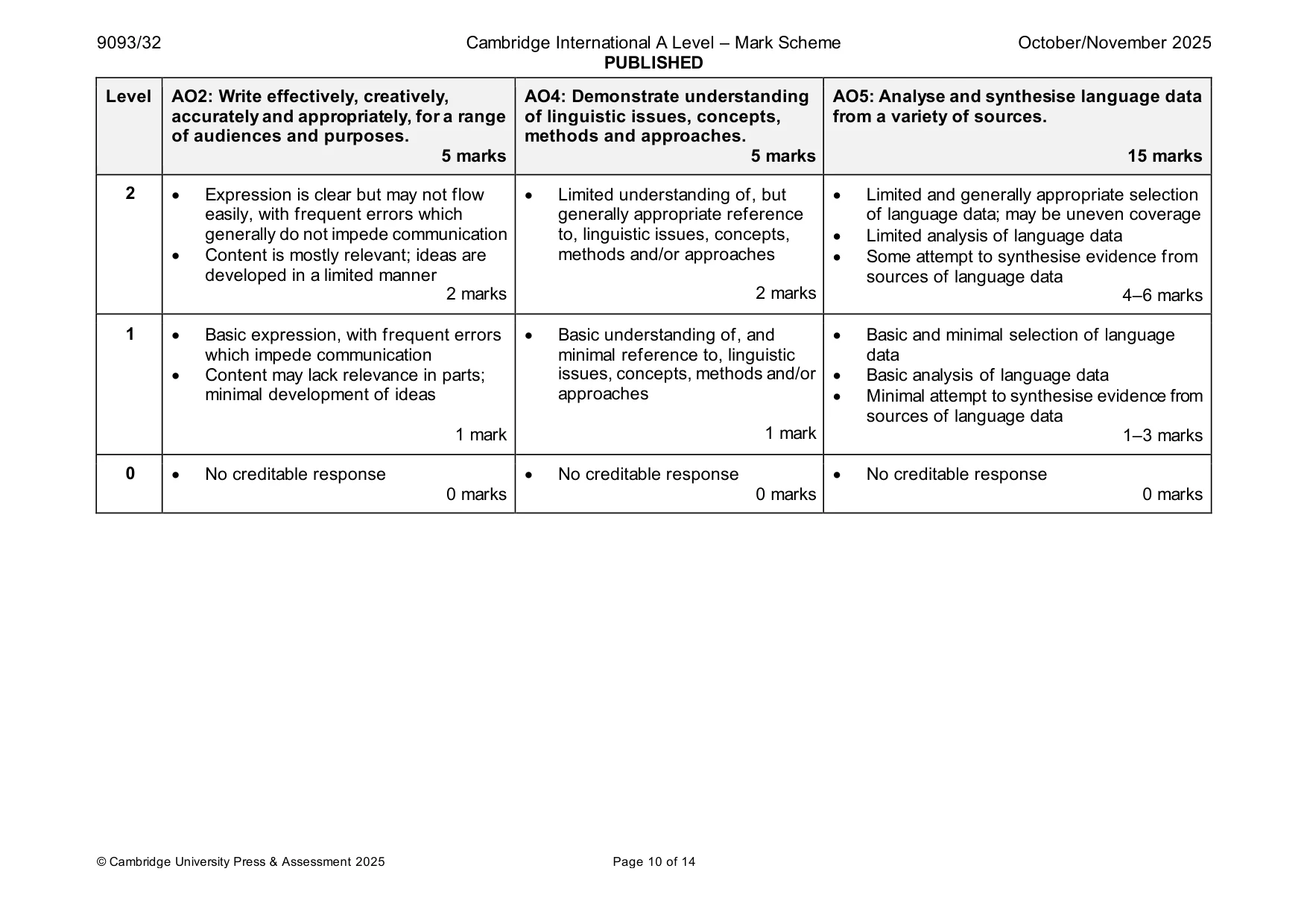
9093/32 Cambridge International A Level – Mark Scheme PUBLISHED October/November 2025 © Cambridge University Press & Assessment 2025 Page 9 of 14 Marking criteria for Section A Question 1 Table A Level AO2: Write effectively, creatively, accurately and appropriately, for a range of audiences and purposes. 5 marks AO4: Demonstrate understanding of linguistic issues, concepts, methods and approaches. 5 marks AO5: Analyse and synthesise language data from a variety of sources. 15 marks 5 • Sophisticated expression, with a high level of accuracy • Content is fully relevant; ideas are developed throughout in a sophisticated manner 5 marks • Sophisticated understanding of, and insightful reference to, linguistic issues, concepts, methods and approaches 5 marks • Insightful and fully appropriate selection of language data from all three sources • Sophisticated and insightful analysis of language data • Sophisticated synthesis of evidence from all three sources of language data 13–15 marks 4 • Effective expression, with a few minor errors which do not impede communication • Content is relevant; ideas are developed in an effective manner 4 marks • Detailed understanding of, and effective reference to, linguistic issues, concepts, methods and approaches 4 marks • Effective and appropriate selection of language data from all three sources • Detailed and effective analysis of language data • Effective synthesis of evidence from all three sources of language data 10–12 marks 3 • Clear expression, with occasional errors which do not impede communication • Content is relevant; ideas are developed clearly 3 marks • Clear understanding of, and appropriate reference to, linguistic issues, concepts, methods and approaches 3 marks • Clear and appropriate selection of language data from at least two sources • Clear analysis of language data • Clear synthesis of evidence from at least two sources of language data 7–9 marks
Mark scheme, page 10
9093/32 Cambridge International A Level – Mark Scheme PUBLISHED October/November 2025 © Cambridge University Press & Assessment 2025 Page 10 of 14 Level AO2: Write effectively, creatively, accurately and appropriately, for a range of audiences and purposes. 5 marks AO4: Demonstrate understanding of linguistic issues, concepts, methods and approaches. 5 marks AO5: Analyse and synthesise language data from a variety of sources. 15 marks 2 • Expression is clear but may not flow easily, with frequent errors which generally do not impede communication • Content is mostly relevant; ideas are developed in a limited manner 2 marks • Limited understanding of, but generally appropriate reference to, linguistic issues, concepts, methods and/or approaches 2 marks • Limited and generally appropriate selection of language data; may be uneven coverage • Limited analysis of language data • Some attempt to synthesise evidence from sources of language data 4–6 marks 1 • Basic expression, with frequent errors which impede communication • Content may lack relevance in parts; minimal development of ideas 1 mark • Basic understanding of, and minimal reference to, linguistic issues, concepts, methods and/or approaches 1 mark • Basic and minimal selection of language data • Basic analysis of language data • Minimal attempt to synthesise evidence from sources of language data 1–3 marks 0 • No creditable response 0 marks • No creditable response 0 marks • No creditable response 0 marks
Mark scheme, page 11
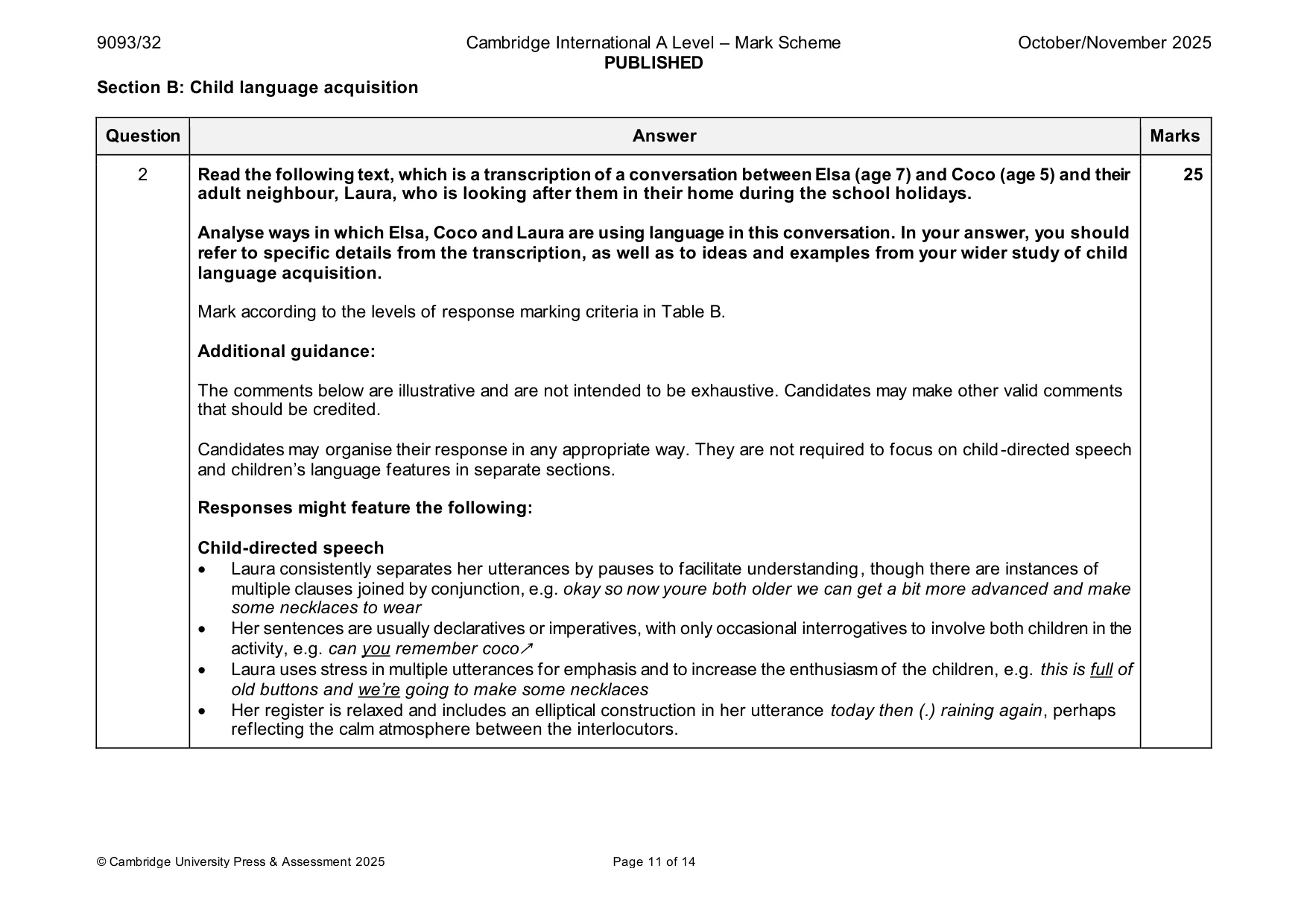
9093/32 Cambridge International A Level – Mark Scheme PUBLISHED October/November 2025 © Cambridge University Press & Assessment 2025 Page 11 of 14 Section B: Child language acquisition Question Answer Marks 2 Read the following text, which is a transcription of a conversation between Elsa (age 7) and Coco (age 5) and their adult neighbour, Laura, who is looking after them in their home during the school holidays. Analyse ways in which Elsa, Coco and Laura are using language in this conversation. In your answer, you should refer to specific details from the transcription, as well as to ideas and examples from your wider study of child language acquisition. Mark according to the levels of response marking criteria in Table B. Additional guidance: The comments below are illustrative and are not intended to be exhaustive. Candidates may make other valid comments that should be credited. Candidates may organise their response in any appropriate way. They are not required to focus on child-directed speech and children’s language features in separate sections. Responses might feature the following: Child-directed speech • Laura consistently separates her utterances by pauses to facilitate understanding, though there are instances of multiple clauses joined by conjunction, e.g. okay so now youre both older we can get a bit more advanced and make some necklaces to wear • Her sentences are usually declaratives or imperatives, with only occasional interrogatives to involve both children in the activity, e.g. can you remember coco↗ • Laura uses stress in multiple utterances for emphasis and to increase the enthusiasm of the children, e.g. this is full of old buttons and we’re going to make some necklaces • Her register is relaxed and includes an elliptical construction in her utterance today then (.) raining again, perhaps reflecting the calm atmosphere between the interlocutors. 25
Mark scheme, page 12
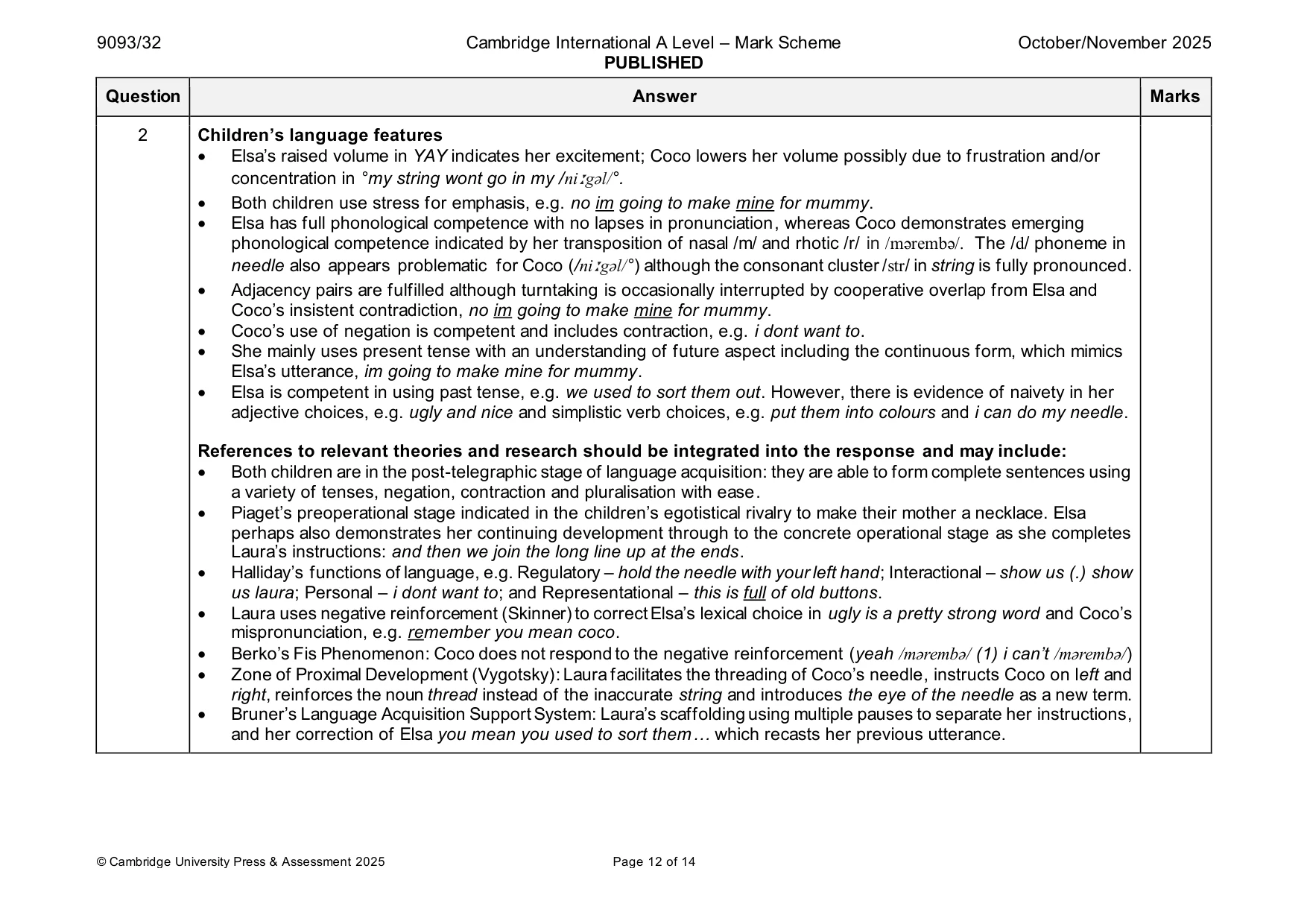
9093/32 Cambridge International A Level – Mark Scheme PUBLISHED October/November 2025 © Cambridge University Press & Assessment 2025 Page 12 of 14 Question Answer Marks 2 Children’s language features • Elsa’s raised volume in YAY indicates her excitement; Coco lowers her volume possibly due to frustration and/or concentration in °my string wont go in my /niːgəl/°. • Both children use stress for emphasis, e.g. no im going to make mine for mummy. • Elsa has full phonological competence with no lapses in pronunciation, whereas Coco demonstrates emerging phonological competence indicated by her transposition of nasal /m/ and rhotic /r/ in /mərembə/. The /d/ phoneme in needle also appears problematic for Coco (/niːgəl/°) although the consonant cluster /str/ in string is fully pronounced. • Adjacency pairs are fulfilled although turntaking is occasionally interrupted by cooperative overlap from Elsa and Coco’s insistent contradiction, no im going to make mine for mummy. • Coco’s use of negation is competent and includes contraction, e.g. i dont want to. • She mainly uses present tense with an understanding of future aspect including the continuous form, which mimics Elsa’s utterance, im going to make mine for mummy. • Elsa is competent in using past tense, e.g. we used to sort them out. However, there is evidence of naivety in her adjective choices, e.g. ugly and nice and simplistic verb choices, e.g. put them into colours and i can do my needle. References to relevant theories and research should be integrated into the response and may include: • Both children are in the post-telegraphic stage of language acquisition: they are able to form complete sentences using a variety of tenses, negation, contraction and pluralisation with ease. • Piaget’s preoperational stage indicated in the children’s egotistical rivalry to make their mother a necklace. Elsa perhaps also demonstrates her continuing development through to the concrete operational stage as she completes Laura’s instructions: and then we join the long line up at the ends. • Halliday’s functions of language, e.g. Regulatory – hold the needle with your left hand; Interactional – show us (.) show us laura; Personal – i dont want to; and Representational – this is full of old buttons. • Laura uses negative reinforcement (Skinner) to correct Elsa’s lexical choice in ugly is a pretty strong word and Coco’s mispronunciation, e.g. remember you mean coco. • Berko’s Fis Phenomenon: Coco does not respond to the negative reinforcement (yeah /mərembə/ (1) i can’t /mərembə/) • Zone of Proximal Development (Vygotsky): Laura facilitates the threading of Coco’s needle, instructs Coco on left and right, reinforces the noun thread instead of the inaccurate string and introduces the eye of the needle as a new term. • Bruner’s Language Acquisition Support System: Laura’s scaffolding using multiple pauses to separate her instructions, and her correction of Elsa you mean you used to sort them… which recasts her previous utterance.
Mark scheme, page 13
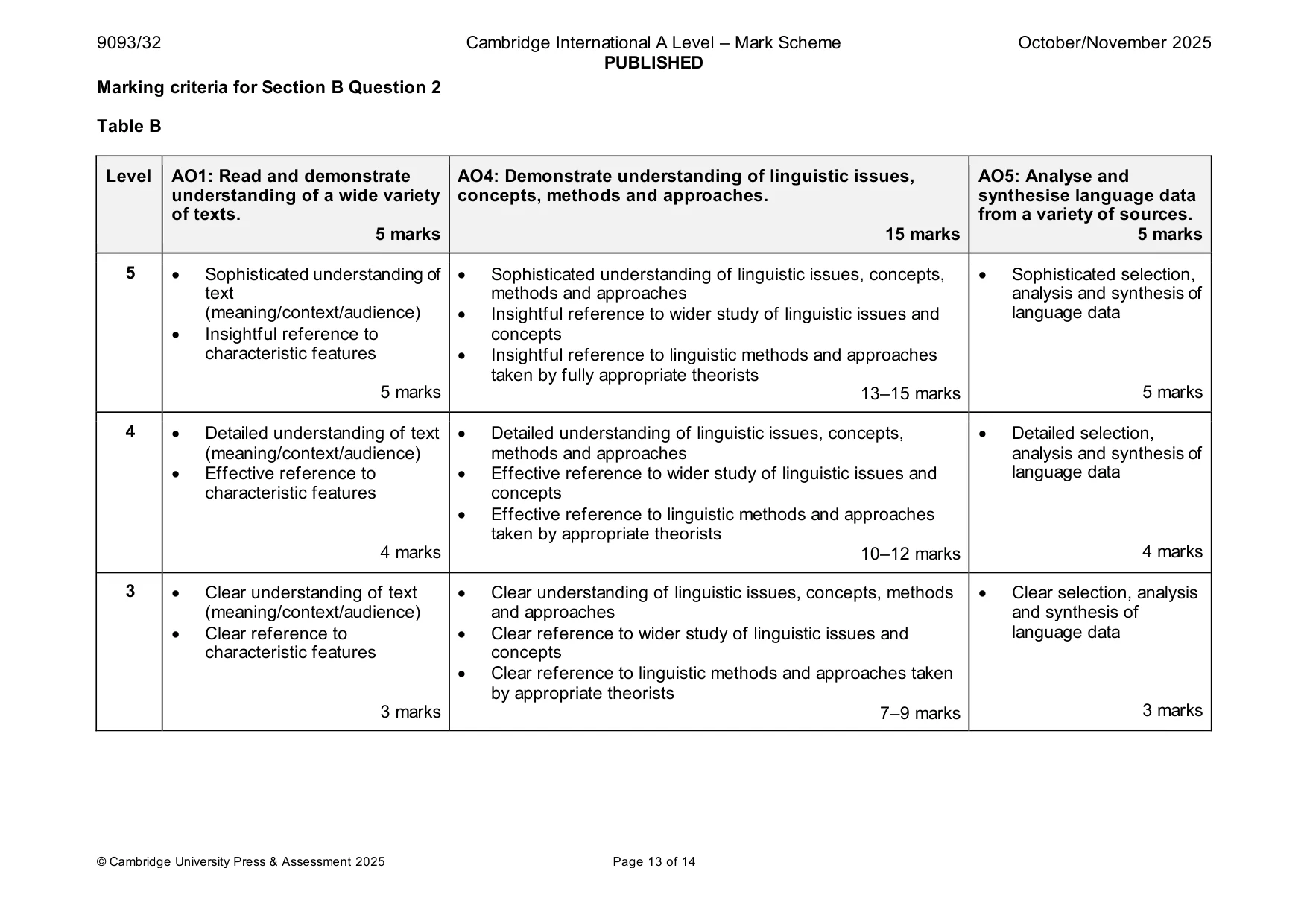
9093/32 Cambridge International A Level – Mark Scheme PUBLISHED October/November 2025 © Cambridge University Press & Assessment 2025 Page 13 of 14 Marking criteria for Section B Question 2 Table B Level AO1: Read and demonstrate understanding of a wide variety of texts. 5 marks AO4: Demonstrate understanding of linguistic issues, concepts, methods and approaches. 15 marks AO5: Analyse and synthesise language data from a variety of sources. 5 marks 5 • Sophisticated understanding of text (meaning/context/audience) • Insightful reference to characteristic features 5 marks • Sophisticated understanding of linguistic issues, concepts, methods and approaches • Insightful reference to wider study of linguistic issues and concepts • Insightful reference to linguistic methods and approaches taken by fully appropriate theorists 13–15 marks • Sophisticated selection, analysis and synthesis of language data 5 marks 4 • Detailed understanding of text (meaning/context/audience) • Effective reference to characteristic features 4 marks • Detailed understanding of linguistic issues, concepts, methods and approaches • Effective reference to wider study of linguistic issues and concepts • Effective reference to linguistic methods and approaches taken by appropriate theorists 10–12 marks • Detailed selection, analysis and synthesis of language data 4 marks 3 • Clear understanding of text (meaning/context/audience) • Clear reference to characteristic features 3 marks • Clear understanding of linguistic issues, concepts, methods and approaches • Clear reference to wider study of linguistic issues and concepts • Clear reference to linguistic methods and approaches taken by appropriate theorists 7–9 marks • Clear selection, analysis and synthesis of language data 3 marks
Mark scheme, page 14
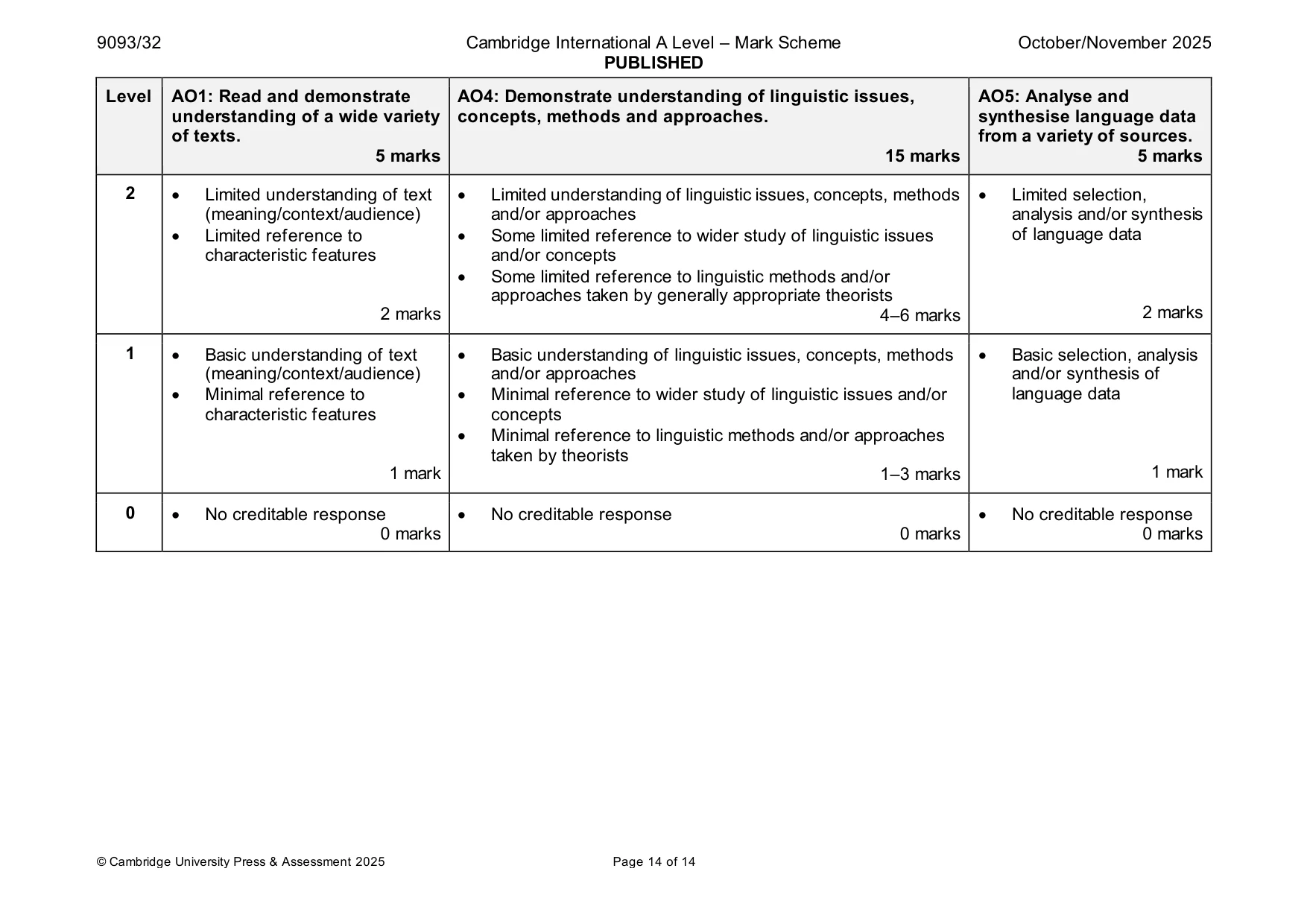
9093/32 Cambridge International A Level – Mark Scheme PUBLISHED October/November 2025 © Cambridge University Press & Assessment 2025 Page 14 of 14 Level AO1: Read and demonstrate understanding of a wide variety of texts. 5 marks AO4: Demonstrate understanding of linguistic issues, concepts, methods and approaches. 15 marks AO5: Analyse and synthesise language data from a variety of sources. 5 marks 2 • Limited understanding of text (meaning/context/audience) • Limited reference to characteristic features 2 marks • Limited understanding of linguistic issues, concepts, methods and/or approaches • Some limited reference to wider study of linguistic issues and/or concepts • Some limited reference to linguistic methods and/or approaches taken by generally appropriate theorists 4–6 marks • Limited selection, analysis and/or synthesis of language data 2 marks 1 • Basic understanding of text (meaning/context/audience) • Minimal reference to characteristic features 1 mark • Basic understanding of linguistic issues, concepts, methods and/or approaches • Minimal reference to wider study of linguistic issues and/or concepts • Minimal reference to linguistic methods and/or approaches taken by theorists 1–3 marks • Basic selection, analysis and/or synthesis of language data 1 mark 0 • No creditable response 0 marks • No creditable response 0 marks • No creditable response 0 marks
What you needed in this session
Cambridge’s own grade thresholds for 2025 Oct/Nov, Paper 3 · Variant 2. A higher threshold means an easier paper — the bar moves with how the cohort did.