Cambridge A Level English - Language AS and A Level (from 2014) 9093 — 2024 Oct/Nov Paper 3 · Variant 2
9093/32/O/N/24 · 50 marks · 135 min
The question paper and its mark scheme, free to read here and free to download. This is Cambridge’s own paper, exactly as it was sat.
Question paper8 pages

Mark scheme13 pages
Answers below. Sit the paper first if you are practising.
Paper as text
Question paper, page 1
This document has 8 pages. Any blank pages are indicated. [Turn over Cambridge International AS & A Level ENGLISH LANGUAGE 9093/32 Paper 3 Language Analysis October/November 2024 2 hours 15 minutes You must answer on the enclosed answer booklet. You will need: Answer booklet (enclosed) INSTRUCTIONS ● Answer all questions. ● Follow the instructions on the front cover of the answer booklet. If you need additional answer paper, ask the invigilator for a continuation booklet. ● Dictionaries are not allowed. INFORMATION ● The total mark for this paper is 50. ● The number of marks for each question or part question is shown in brackets [ ]. * 9 2 1 0 2 7 4 6 4 5 * DC (CJ/JG) 337638/3 © UCLES 2024
Question paper, page 2
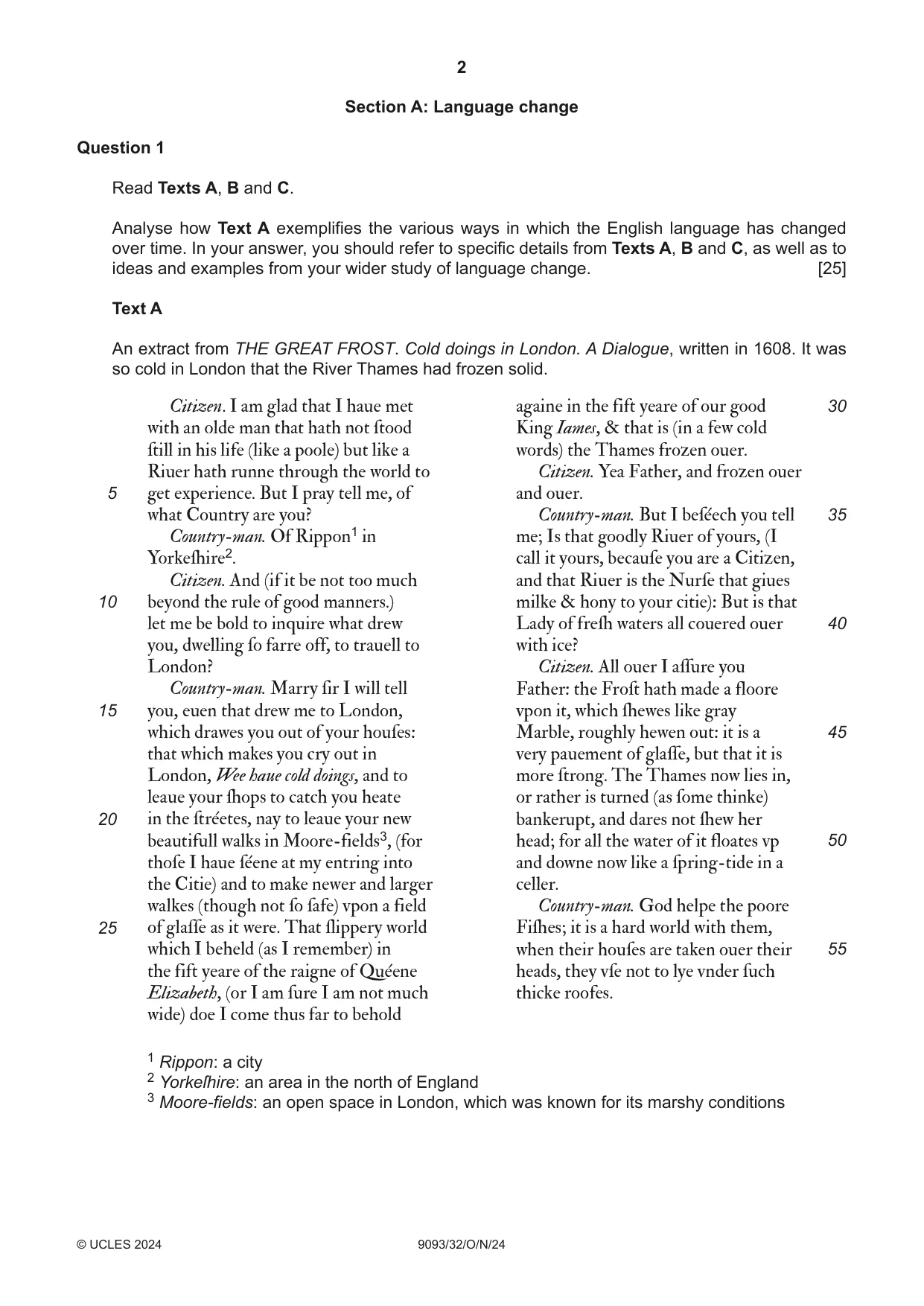
2 9093/32/O/N/24 © UCLES 2024 Section A: Language change Question 1 Read Texts A, B and C. Analyse how Text A exemplifies the various ways in which the English language has changed over time. In your answer, you should refer to specific details from Texts A, B and C, as well as to ideas and examples from your wider study of language change. [25] Text A An extract from THE GREAT FROST. Cold doings in London. A Dialogue, written in 1608. It was so cold in London that the River Thames had frozen solid. Citizen. I am glad that I haue met with an olde man that hath not ſtood ſtill in his life (like a poole) but like a Riuer hath runne through the world to get experience. But I pray tell me, of what Country are you? Country-man. Of Rippon1 in Yorkeſhire2. Citizen. And (if it be not too much beyond the rule of good manners.) let me be bold to inquire what drew you, dwelling ſo farre off, to trauell to London? Country-man. Marry ſir I will tell you, euen that drew me to London, which drawes you out of your houſes: that which makes you cry out in London, Wee haue cold doings, and to leaue your ſhops to catch you heate in the ſtréetes, nay to leaue your new beautifull walks in Moore-fields3, (for thoſe I haue ſéene at my entring into the Citie) and to make newer and larger walkes (though not ſo ſafe) vpon a field of glaſſe as it were. That ſlippery world which I beheld (as I remember) in the fift yeare of the raigne of Quéene Elizabeth, (or I am ſure I am not much wide) doe I come thus far to behold againe in the fift yeare of our good King Iames, & that is (in a few cold words) the Thames frozen ouer. Citizen. Yea Father, and frozen ouer and ouer. Country-man. But I beſéech you tell me; Is that goodly Riuer of yours, (I call it yours, becauſe you are a Citizen, and that Riuer is the Nurſe that giues milke & hony to your citie): But is that Lady of freſh waters all couered ouer with ice? Citizen. All ouer I aſſure you Father: the Froſt hath made a floore vpon it, which ſhewes like gray Marble, roughly hewen out: it is a very pauement of glaſſe, but that it is more ſtrong. The Thames now lies in, or rather is turned (as ſome thinke) bankerupt, and dares not ſhew her head; for all the water of it floates vp and downe now like a ſpring-tide in a celler. Country-man. God helpe the poore Fiſhes; it is a hard world with them, when their houſes are taken ouer their heads, they vſe not to lye vnder ſuch thicke roofes. 1 Rippon: a city 2 Yorkeſhire: an area in the north of England 3 Moore-fields: an open space in London, which was known for its marshy conditions 30 35 40 45 50 55 5 10 15 20 25
Question paper, page 3
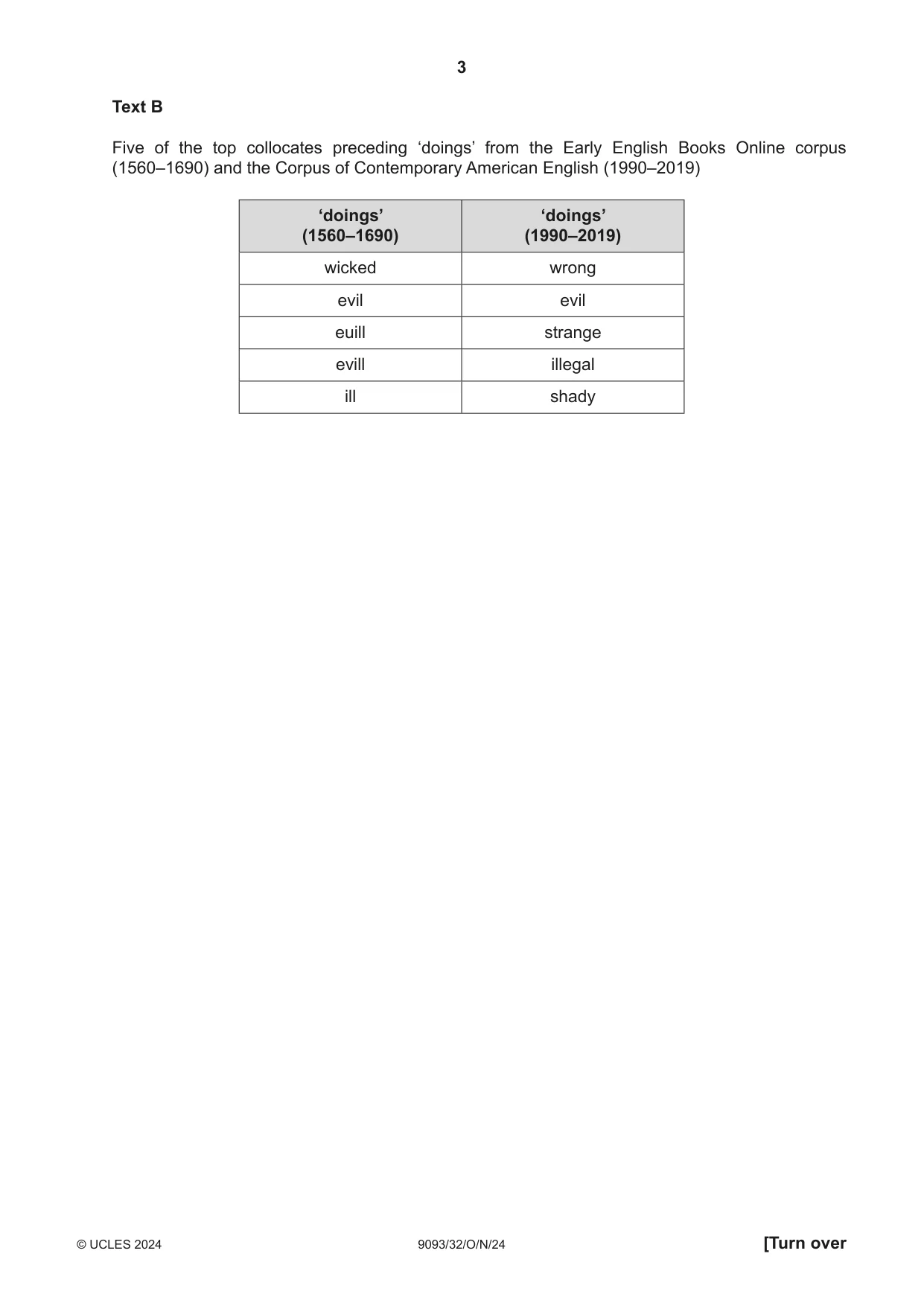
3 9093/32/O/N/24 © UCLES 2024 [Turn over Text B Five of the top collocates preceding ‘doings’ from the Early English Books Online corpus (1560–1690) and the Corpus of Contemporary American English (1990–2019) ‘doings’ (1560–1690) ‘doings’ (1990–2019) wicked wrong evil evil euill strange evill illegal ill shady
Question paper, page 4
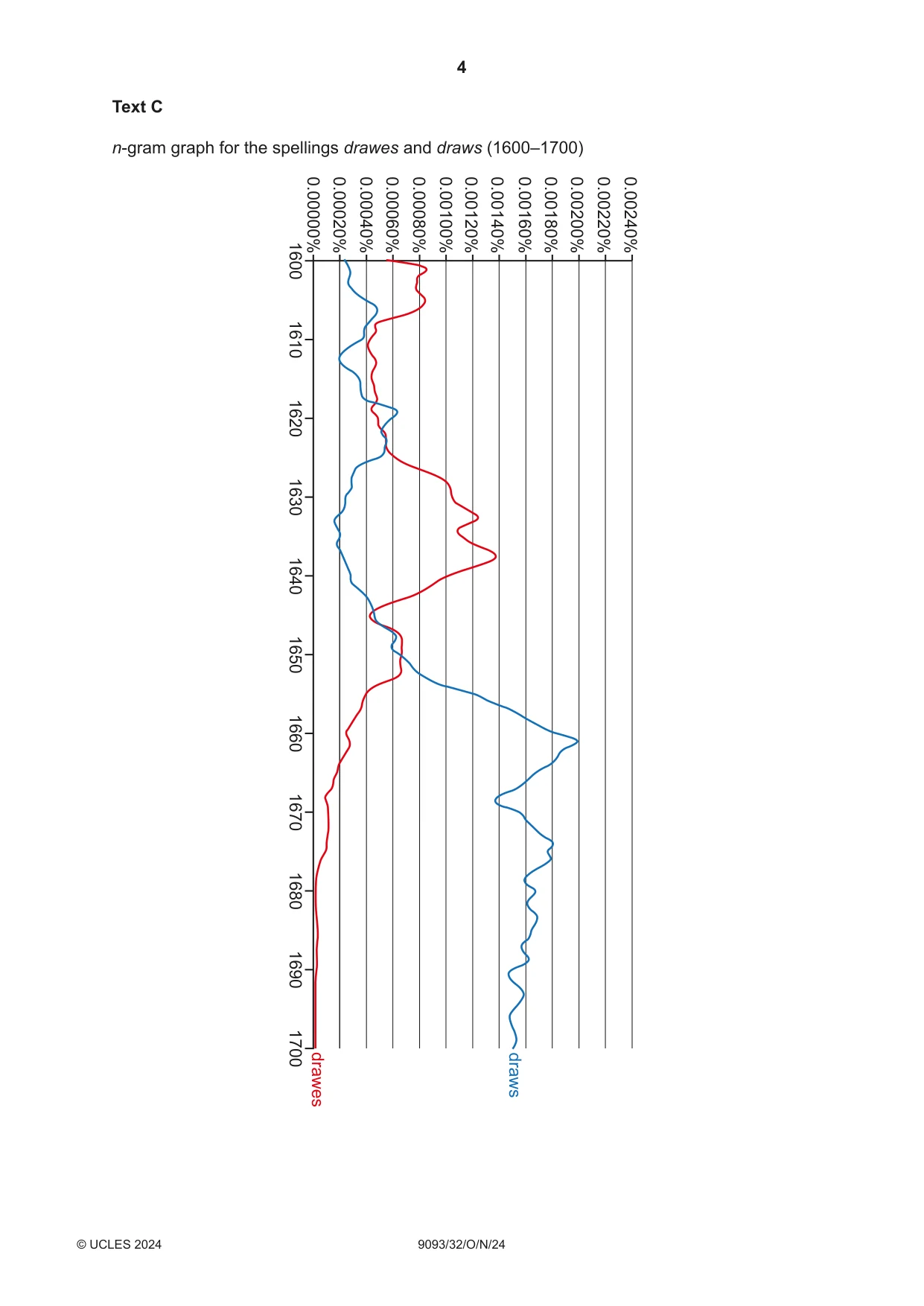
4 9093/32/O/N/24 © UCLES 2024 Text C n-gram graph for the spellings drawes and draws (1600–1700) 0.00000% 0.00040% 0.00080% 0.00120% 0.00160% 0.00200% 0.00240% 1600 1610 1620 1630 1640 1650 1660 1670 1680 1690 1700 0.00020% 0.00060% 0.00100% 0.00140% 0.00180% 0.00220% drawes draws
Question paper, page 5
5 9093/32/O/N/24 © UCLES 2024 [Turn over BLANK PAGE
Question paper, page 6
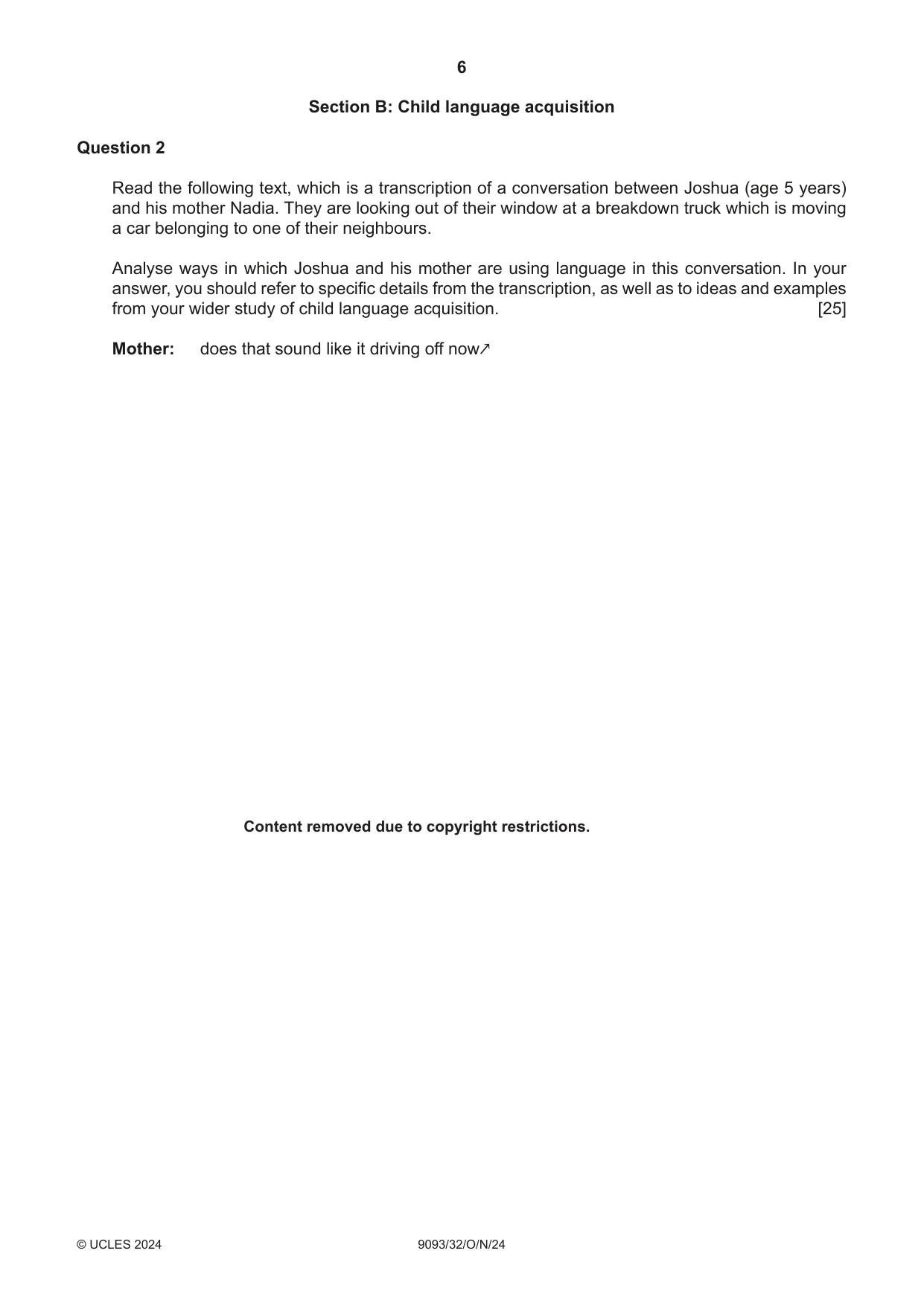
6 9093/32/O/N/24 © UCLES 2024 Section B: Child language acquisition Question 2 Read the following text, which is a transcription of a conversation between Joshua (age 5 years) and his mother Nadia. They are looking out of their window at a breakdown truck which is moving a car belonging to one of their neighbours. Analyse ways in which Joshua and his mother are using language in this conversation. In your answer, you should refer to specific details from the transcription, as well as to ideas and examples from your wider study of child language acquisition. [25] Mother: does that sound like it driving off now↗ Content removed due to copyright restrictions.
Question paper, page 7
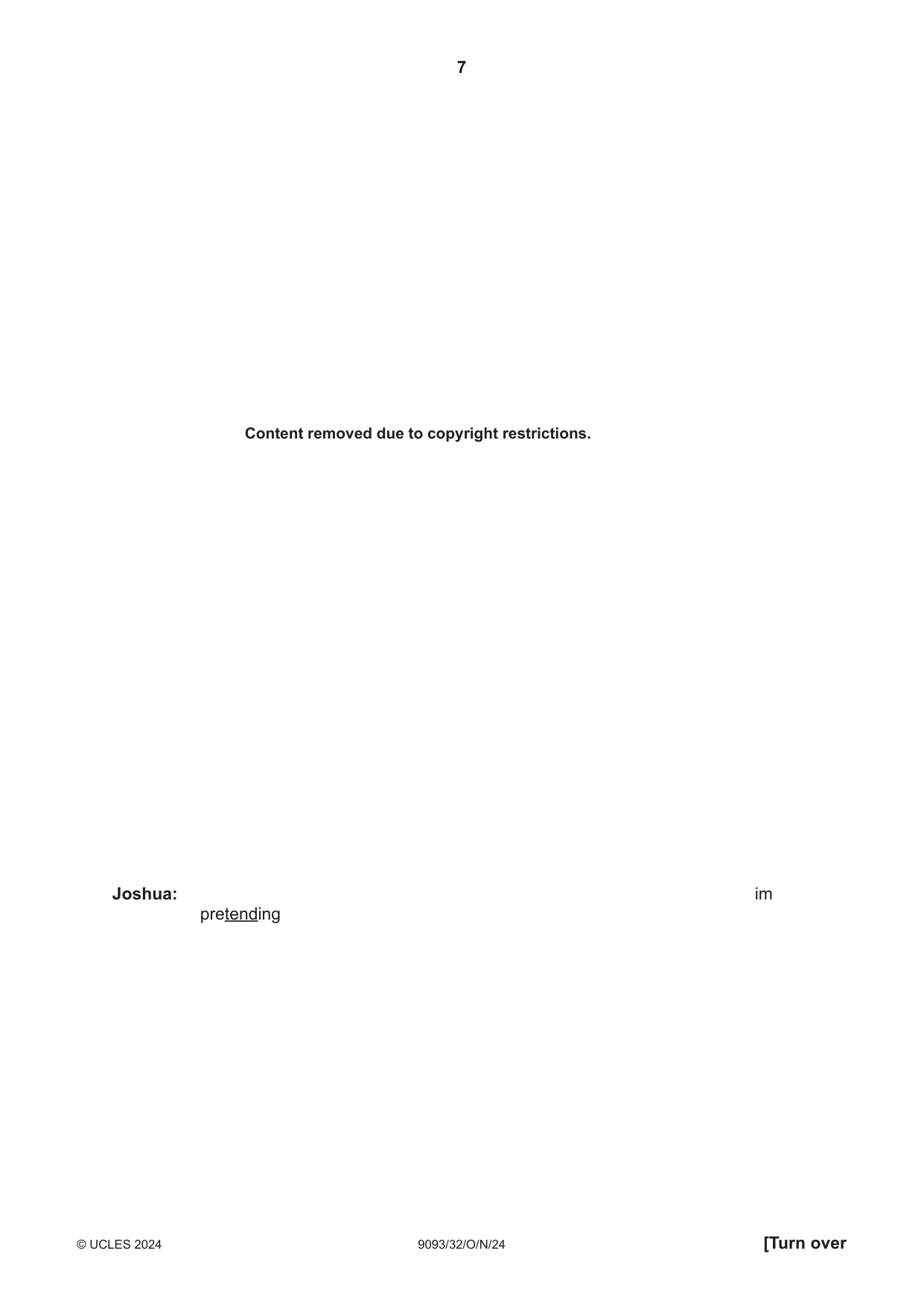
7 9093/32/O/N/24 © UCLES 2024 [Turn over Joshua: im pretending Content removed due to copyright restrictions.
Question paper, page 8
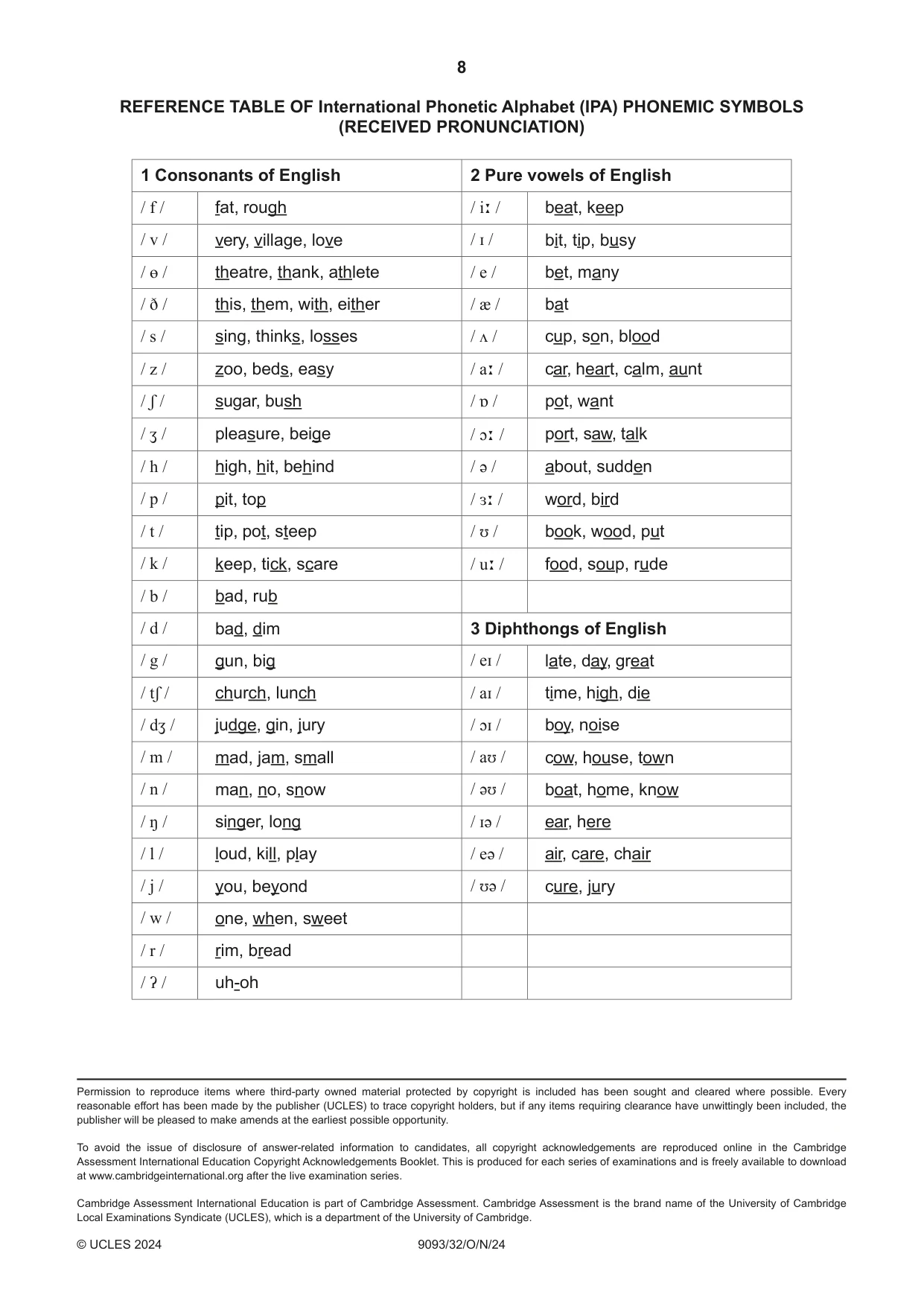
8 9093/32/O/N/24 © UCLES 2024 Permission to reproduce items where third-party owned material protected by copyright is included has been sought and cleared where possible. Every reasonable effort has been made by the publisher (UCLES) to trace copyright holders, but if any items requiring clearance have unwittingly been included, the publisher will be pleased to make amends at the earliest possible opportunity. To avoid the issue of disclosure of answer-related information to candidates, all copyright acknowledgements are reproduced online in the Cambridge Assessment International Education Copyright Acknowledgements Booklet. This is produced for each series of examinations and is freely available to download at www.cambridgeinternational.org after the live examination series. Cambridge Assessment International Education is part of Cambridge Assessment. Cambridge Assessment is the brand name of the University of Cambridge Local Examinations Syndicate (UCLES), which is a department of the University of Cambridge. REFERENCE TABLE OF International Phonetic Alphabet (IPA) PHONEMIC SYMBOLS (RECEIVED PRONUNCIATION) 1 Consonants of English 2 Pure vowels of English / f / fat, rough / iː / beat, keep / v / very, village, love / ɪ / bit, tip, busy / ɵ / theatre, thank, athlete / e / bet, many / ð / this, them, with, either / æ / bat / s / sing, thinks, losses / ʌ / cup, son, blood / z / zoo, beds, easy / aː / car, heart, calm, aunt / ʃ / sugar, bush / ɒ / pot, want / ʒ / pleasure, beige / ɔː / port, saw, talk / h / high, hit, behind / ə / about, sudden / p / pit, top / ɜː / word, bird / t / tip, pot, steep / ʊ / book, wood, put / k / keep, tick, scare / uː / food, soup, rude / b / bad, rub / d / bad, dim 3 Diphthongs of English / g / gun, big / eɪ / late, day, great / tʃ / church, lunch / aɪ / time, high, die / dʒ / judge, gin, jury / ɔɪ / boy, noise / m / mad, jam, small / aʊ / cow, house, town / n / man, no, snow / əʊ / boat, home, know / ŋ / singer, long / ɪə / ear, here / l / loud, kill, play / eə / air, care, chair / j / you, beyond / ʊə / cure, jury / w / one, when, sweet / r / rim, bread / ʔ / uh-oh
Mark scheme, page 1
This document consists of 13 printed pages. © Cambridge University Press & Assessment 2024 [Turn over Cambridge International A Level ENGLISH LANGUAGE 9093/32 Paper 3 Language Analysis October/November 2024 MARK SCHEME Maximum Mark: 50 Published This mark scheme is published as an aid to teachers and candidates, to indicate the requirements of the examination. It shows the basis on which Examiners were instructed to award marks. It does not indicate the details of the discussions that took place at an Examiners’ meeting before marking began, which would have considered the acceptability of alternative answers. Mark schemes should be read in conjunction with the question paper and the Principal Examiner Report for Teachers. Cambridge International will not enter into discussions about these mark schemes. Cambridge International is publishing the mark schemes for the October/November 2024 series for most Cambridge IGCSE, Cambridge International A and AS Level components, and some Cambridge O Level components.
Mark scheme, page 2
9093/32 Cambridge International A Level – Mark Scheme PUBLISHED October/November 2024 © Cambridge University Press & Assessment 2024 Page 2 of 13 Generic Marking Principles These general marking principles must be applied by all examiners when marking candidate answers. They should be applied alongside the specific content of the mark scheme or generic level descriptions for a question. Each question paper and mark scheme will also comply with these marking principles. GENERIC MARKING PRINCIPLE 1: Marks must be awarded in line with: • the specific content of the mark scheme or the generic level descriptors for the question • the specific skills defined in the mark scheme or in the generic level descriptors for the question • the standard of response required by a candidate as exemplified by the standardisation scripts. GENERIC MARKING PRINCIPLE 2: Marks awarded are always whole marks (not half marks, or other fractions). GENERIC MARKING PRINCIPLE 3: Marks must be awarded positively: • marks are awarded for correct/valid answers, as defined in the mark scheme. However, credit is given for valid answers which go beyond the scope of the syllabus and mark scheme, referring to your Team Leader as appropriate • marks are awarded when candidates clearly demonstrate what they know and can do • marks are not deducted for errors • marks are not deducted for omissions • answers should only be judged on the quality of spelling, punctuation and grammar when these features are specifically assessed by the question as indicated by the mark scheme. The meaning, however, should be unambiguous. GENERIC MARKING PRINCIPLE 4: Rules must be applied consistently, e.g. in situations where candidates have not followed instructions or in the application of generic level descriptors.
Mark scheme, page 3
9093/32 Cambridge International A Level – Mark Scheme PUBLISHED October/November 2024 © Cambridge University Press & Assessment 2024 Page 3 of 13 GENERIC MARKING PRINCIPLE 5: Marks should be awarded using the full range of marks defined in the mark scheme for the question (however; the use of the full mark range may be limited according to the quality of the candidate responses seen). GENERIC MARKING PRINCIPLE 6: Marks awarded are based solely on the requirements as defined in the mark scheme. Marks should not be awarded with grade thresholds or grade descriptors in mind.
Mark scheme, page 4
9093/32 Cambridge International A Level – Mark Scheme PUBLISHED October/November 2024 © Cambridge University Press & Assessment 2024 Page 4 of 13 English & Media subject specific general marking principles (To be read in conjunction with the Generic Marking Principles (and requiring further guidance on how to place marks within levels)) Components using level descriptors: • We use level descriptors as a guide to broad understanding of the qualities normally expected of, or typical of, work in a level. • Level descriptors are a means of general guidance, and should not be interpreted as hurdle statements. • Where indicative content notes are supplied for a question, these are not a prescription of required content, and must not be treated as such. Alternative correct points and unexpected answers in candidates’ scripts must be given marks that fairly reflect the knowledge and skills demonstrated. • While we may have legitimate expectations as to the ground most answers may occupy, we must at all times be prepared to meet candidates on their chosen ground, provided it is relevant ground (e.g. clearly related to and derived from a relevant passage/text and meeting the mark scheme requirements for the question).
Mark scheme, page 5
9093/32 Cambridge International A Level – Mark Scheme PUBLISHED October/November 2024 © Cambridge University Press & Assessment 2024 Page 5 of 13 English Language specific marking instructions: AO1 Read and demonstrate understanding of a wide variety of texts. (Understanding) • Marks should be awarded for the accuracy of the candidate’s understanding of the text and its features, not for any analysis of them which is recognised under AO3. • Where comparison is required, marks should be awarded for the candidate’s recognition of similarities and differences between the texts and their features, not for any consequent analysis. • When awarding a ‘best-fit’ mark within a Level for each AO, consider each bullet point equally. AO2 Write effectively, creatively, accurately and appropriately, for a range of audiences and purposes. (Writing) • Marks should be awarded equally on the basis of the level of the candidate’s written expression (range of features used and accuracy) and the development of their writing (its organisation and relevance to task and audience). • When awarding a ‘best-fit’ mark within a Level for each AO, consider each bullet point equally. AO4: Demonstrate understanding of linguistic issues, concepts, methods and approaches. (Conceptualisation) • Marks should be awarded equally on the basis of the level of the candidate’s understanding of the relevant issues, concepts, methods and approaches represented both in the text(s) and in their wider studies. • When awarding a ‘best-fit’ mark within a Level for each AO, consider each bullet point equally. AO5: Analyse and synthesise language data from a variety of sources. (Data handling) • Marks should be awarded equally on the basis of the level of the candidate’s selection, analysis and synthesis of language data. • When awarding a ‘best-fit’ mark within a Level for each AO, consider each bullet point equally. Higher marks should be awarded where candidates identify patterns and offer thoughtful and plausible explanations for the features they are discussing. Weaker answers may spot features or describe individual cases of language change without reference to broader considerations or examples.
Mark scheme, page 6
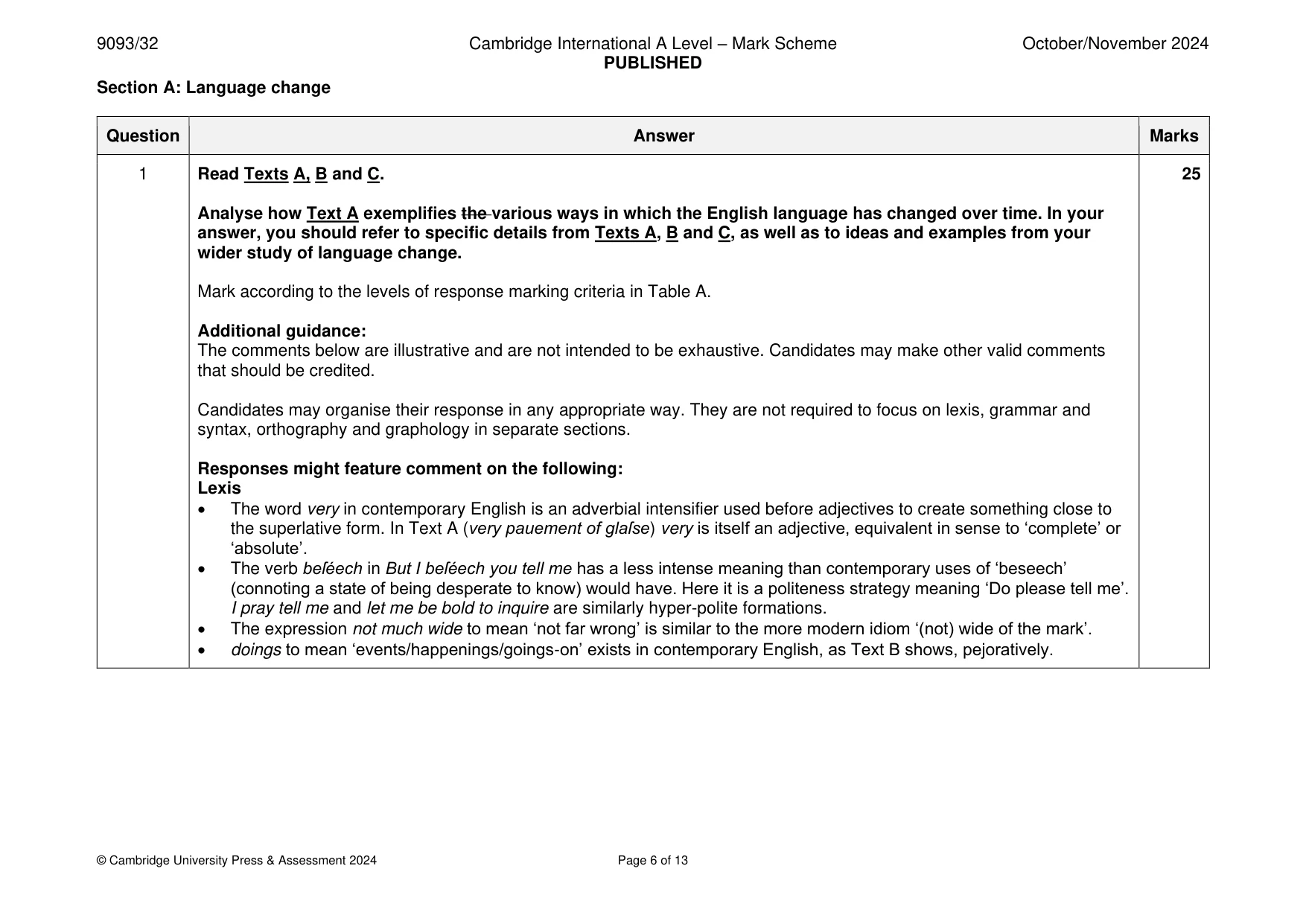
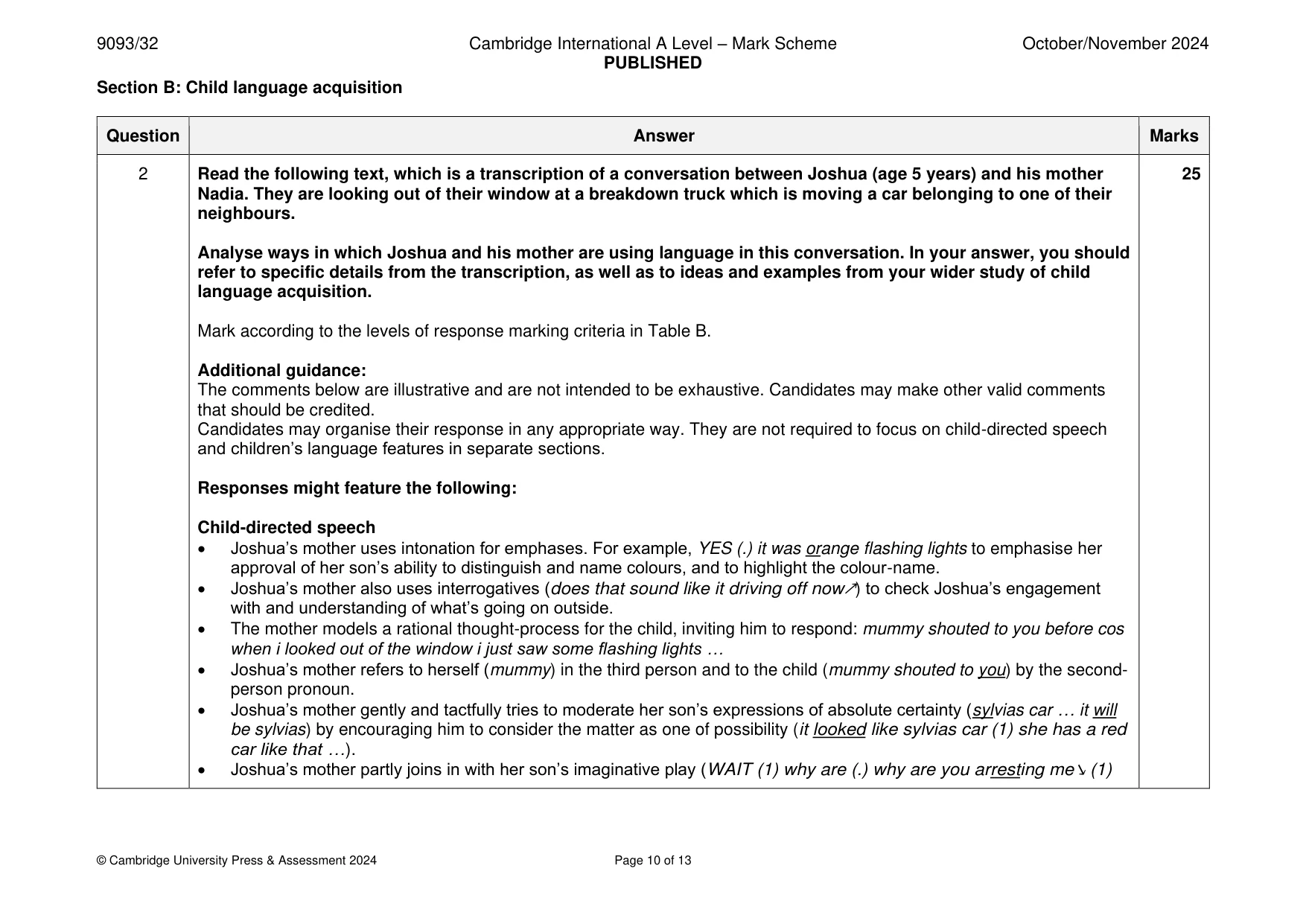
9093/32 Cambridge International A Level – Mark Scheme PUBLISHED October/November 2024 © Cambridge University Press & Assessment 2024 Page 6 of 13 Section A: Language change Question Answer Marks 1 Read Texts A, B and C. Analyse how Text A exemplifies the various ways in which the English language has changed over time. In your answer, you should refer to specific details from Texts A, B and C, as well as to ideas and examples from your wider study of language change. Mark according to the levels of response marking criteria in Table A. Additional guidance: The comments below are illustrative and are not intended to be exhaustive. Candidates may make other valid comments that should be credited. Candidates may organise their response in any appropriate way. They are not required to focus on lexis, grammar and syntax, orthography and graphology in separate sections. Responses might feature comment on the following: Lexis • The word very in contemporary English is an adverbial intensifier used before adjectives to create something close to the superlative form. In Text A (very pauement of glaſse) very is itself an adjective, equivalent in sense to ‘complete’ or ‘absolute’. • The verb beſéech in But I beſéech you tell me has a less intense meaning than contemporary uses of ‘beseech’ (connoting a state of being desperate to know) would have. Here it is a politeness strategy meaning ‘Do please tell me’. I pray tell me and let me be bold to inquire are similarly hyper-polite formations. • The expression not much wide to mean ‘not far wrong’ is similar to the more modern idiom ‘(not) wide of the mark’. • doings to mean ‘events/happenings/goings-on’ exists in contemporary English, as Text B shows, pejoratively. 25
Mark scheme, page 7
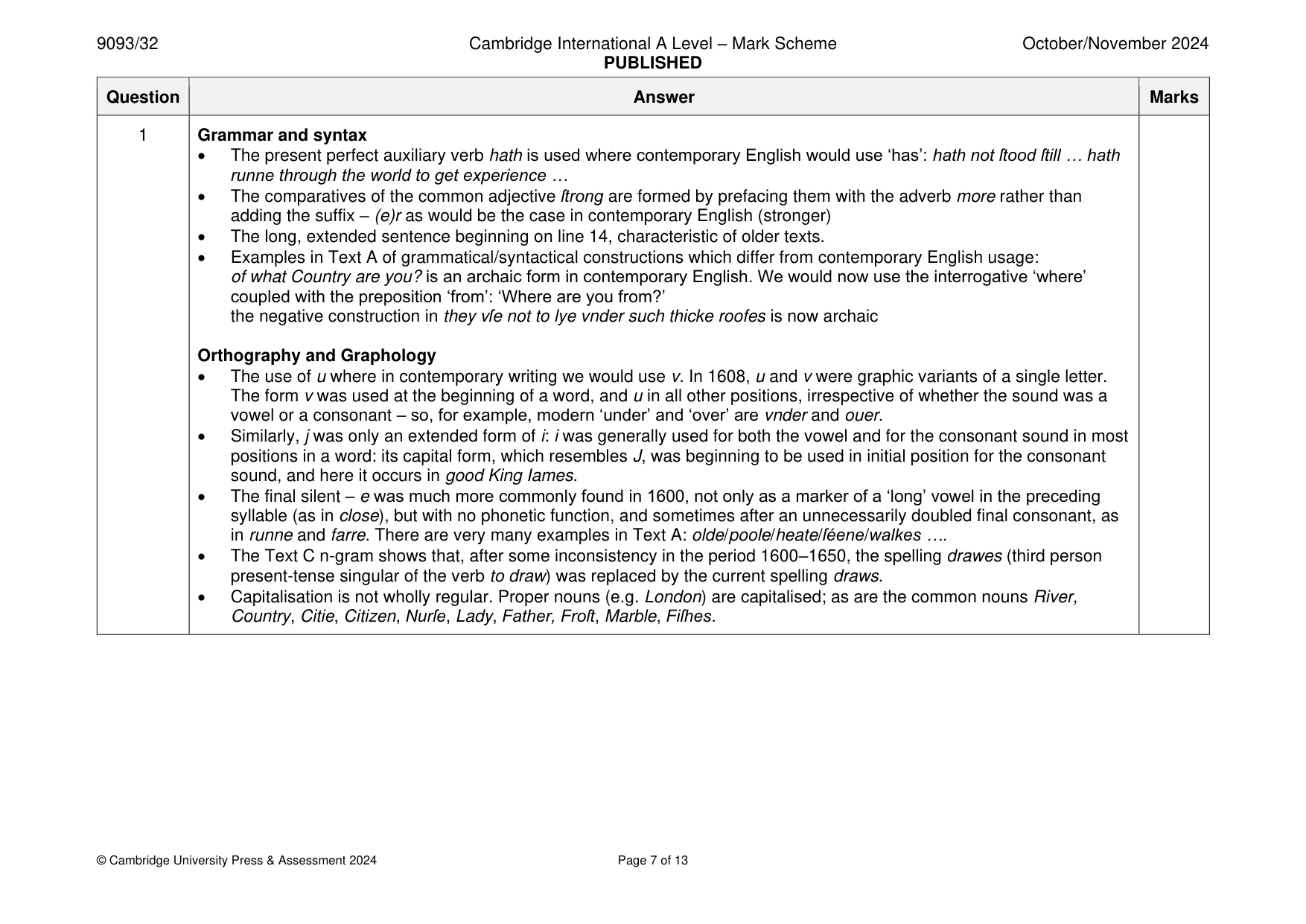
9093/32 Cambridge International A Level – Mark Scheme PUBLISHED October/November 2024 © Cambridge University Press & Assessment 2024 Page 7 of 13 Question Answer Marks 1 Grammar and syntax • The present perfect auxiliary verb hath is used where contemporary English would use ‘has’: hath not ſtood ſtill … hath runne through the world to get experience … • The comparatives of the common adjective ſtrong are formed by prefacing them with the adverb more rather than adding the suffix – (e)r as would be the case in contemporary English (stronger) • The long, extended sentence beginning on line 14, characteristic of older texts. • Examples in Text A of grammatical/syntactical constructions which differ from contemporary English usage: of what Country are you? is an archaic form in contemporary English. We would now use the interrogative ‘where’ coupled with the preposition ‘from’: ‘Where are you from?’ the negative construction in they vſe not to lye vnder such thicke roofes is now archaic Orthography and Graphology • The use of u where in contemporary writing we would use v. In 1608, u and v were graphic variants of a single letter. The form v was used at the beginning of a word, and u in all other positions, irrespective of whether the sound was a vowel or a consonant – so, for example, modern ‘under’ and ‘over’ are vnder and ouer. • Similarly, j was only an extended form of i: i was generally used for both the vowel and for the consonant sound in most positions in a word: its capital form, which resembles J, was beginning to be used in initial position for the consonant sound, and here it occurs in good King Iames. • The final silent – e was much more commonly found in 1600, not only as a marker of a ‘long’ vowel in the preceding syllable (as in close), but with no phonetic function, and sometimes after an unnecessarily doubled final consonant, as in runne and farre. There are very many examples in Text A: olde/poole/heate/ſéene/walkes …. • The Text C n-gram shows that, after some inconsistency in the period 1600–1650, the spelling drawes (third person present-tense singular of the verb to draw) was replaced by the current spelling draws. • Capitalisation is not wholly regular. Proper nouns (e.g. London) are capitalised; as are the common nouns River, Country, Citie, Citizen, Nurſe, Lady, Father, Froſt, Marble, Fiſhes.
Mark scheme, page 8
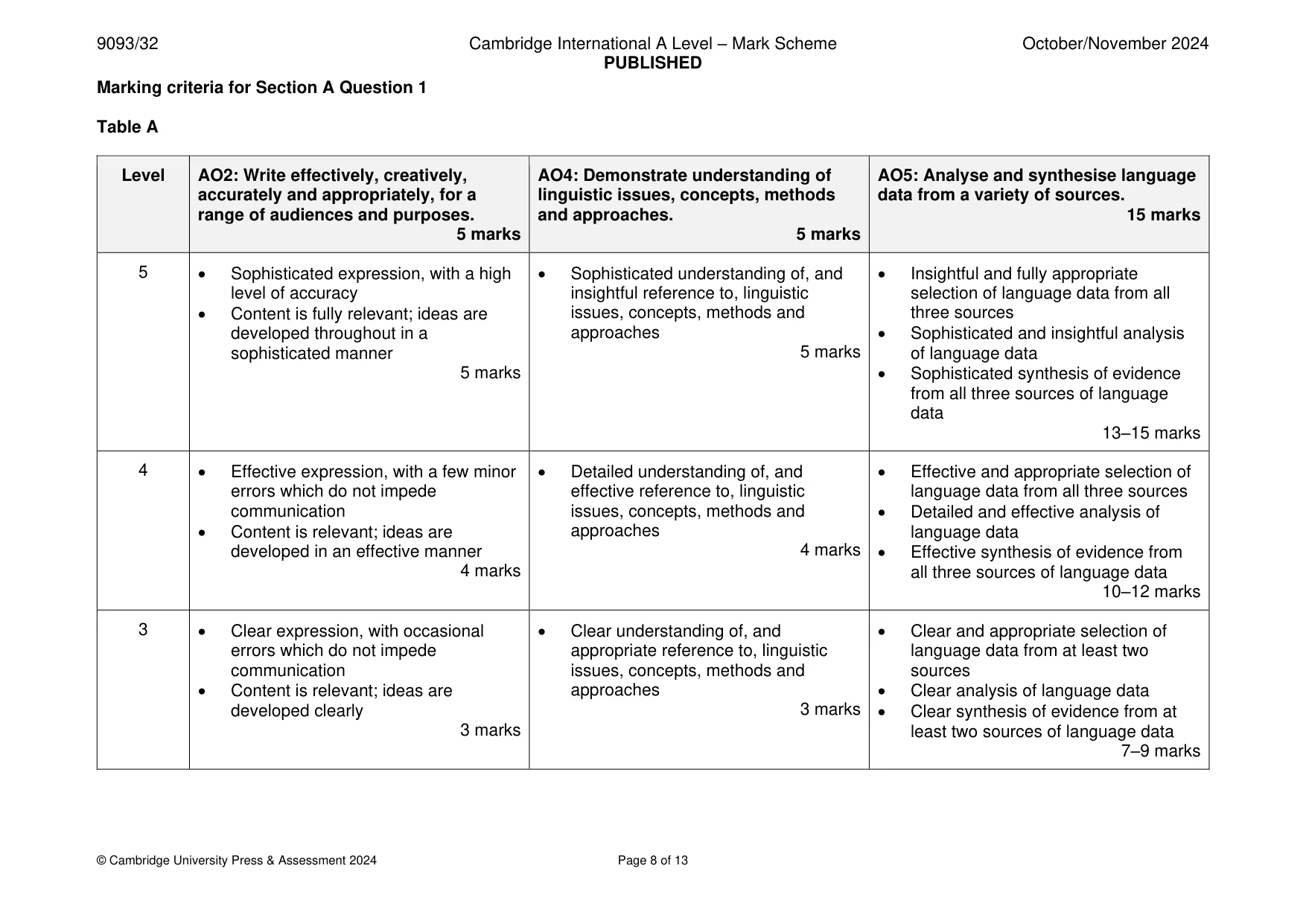
9093/32 Cambridge International A Level – Mark Scheme PUBLISHED October/November 2024 © Cambridge University Press & Assessment 2024 Page 8 of 13 Marking criteria for Section A Question 1 Table A Level AO2: Write effectively, creatively, accurately and appropriately, for a range of audiences and purposes. 5 marks AO4: Demonstrate understanding of linguistic issues, concepts, methods and approaches. 5 marks AO5: Analyse and synthesise language data from a variety of sources. 15 marks 5 • Sophisticated expression, with a high level of accuracy • Content is fully relevant; ideas are developed throughout in a sophisticated manner 5 marks • Sophisticated understanding of, and insightful reference to, linguistic issues, concepts, methods and approaches 5 marks • Insightful and fully appropriate selection of language data from all three sources • Sophisticated and insightful analysis of language data • Sophisticated synthesis of evidence from all three sources of language data 13–15 marks 4 • Effective expression, with a few minor errors which do not impede communication • Content is relevant; ideas are developed in an effective manner 4 marks • Detailed understanding of, and effective reference to, linguistic issues, concepts, methods and approaches 4 marks • Effective and appropriate selection of language data from all three sources • Detailed and effective analysis of language data • Effective synthesis of evidence from all three sources of language data 10–12 marks 3 • Clear expression, with occasional errors which do not impede communication • Content is relevant; ideas are developed clearly 3 marks • Clear understanding of, and appropriate reference to, linguistic issues, concepts, methods and approaches 3 marks • Clear and appropriate selection of language data from at least two sources • Clear analysis of language data • Clear synthesis of evidence from at least two sources of language data 7–9 marks
Mark scheme, page 9
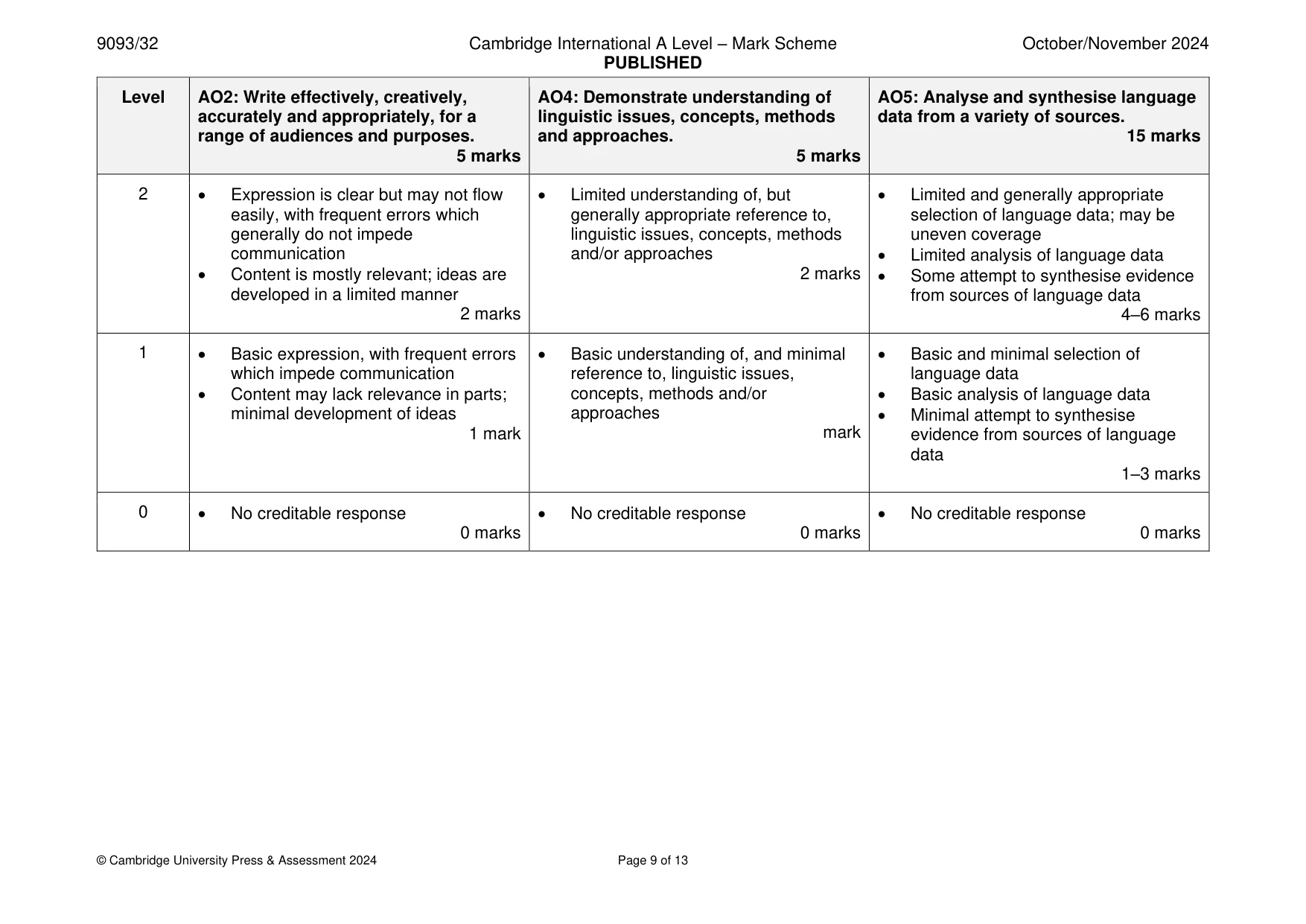
9093/32 Cambridge International A Level – Mark Scheme PUBLISHED October/November 2024 © Cambridge University Press & Assessment 2024 Page 9 of 13 Level AO2: Write effectively, creatively, accurately and appropriately, for a range of audiences and purposes. 5 marks AO4: Demonstrate understanding of linguistic issues, concepts, methods and approaches. 5 marks AO5: Analyse and synthesise language data from a variety of sources. 15 marks 2 • Expression is clear but may not flow easily, with frequent errors which generally do not impede communication • Content is mostly relevant; ideas are developed in a limited manner 2 marks • Limited understanding of, but generally appropriate reference to, linguistic issues, concepts, methods and/or approaches 2 marks • Limited and generally appropriate selection of language data; may be uneven coverage • Limited analysis of language data • Some attempt to synthesise evidence from sources of language data 4–6 marks 1 • Basic expression, with frequent errors which impede communication • Content may lack relevance in parts; minimal development of ideas 1 mark • Basic understanding of, and minimal reference to, linguistic issues, concepts, methods and/or approaches mark • Basic and minimal selection of language data • Basic analysis of language data • Minimal attempt to synthesise evidence from sources of language data 1–3 marks 0 • No creditable response 0 marks • No creditable response 0 marks • No creditable response 0 marks
Mark scheme, page 10
9093/32 Cambridge International A Level – Mark Scheme PUBLISHED October/November 2024 © Cambridge University Press & Assessment 2024 Page 10 of 13 Section B: Child language acquisition Question Answer Marks 2 Read the following text, which is a transcription of a conversation between Joshua (age 5 years) and his mother Nadia. They are looking out of their window at a breakdown truck which is moving a car belonging to one of their neighbours. Analyse ways in which Joshua and his mother are using language in this conversation. In your answer, you should refer to specific details from the transcription, as well as to ideas and examples from your wider study of child language acquisition. Mark according to the levels of response marking criteria in Table B. Additional guidance: The comments below are illustrative and are not intended to be exhaustive. Candidates may make other valid comments that should be credited. Candidates may organise their response in any appropriate way. They are not required to focus on child-directed speech and children’s language features in separate sections. Responses might feature the following: Child-directed speech • Joshua’s mother uses intonation for emphases. For example, YES (.) it was orange flashing lights to emphasise her approval of her son’s ability to distinguish and name colours, and to highlight the colour-name. • Joshua’s mother also uses interrogatives (does that sound like it driving off now↗) to check Joshua’s engagement with and understanding of what’s going on outside. • The mother models a rational thought-process for the child, inviting him to respond: mummy shouted to you before cos when i looked out of the window i just saw some flashing lights … • Joshua’s mother refers to herself (mummy) in the third person and to the child (mummy shouted to you) by the second- person pronoun. • Joshua’s mother gently and tactfully tries to moderate her son’s expressions of absolute certainty (sylvias car … it will be sylvias) by encouraging him to consider the matter as one of possibility (it looked like sylvias car (1) she has a red car like that …). • Joshua’s mother partly joins in with her son’s imaginative play (WAIT (1) why are (.) why are you arresting me↘ (1) 25
Mark scheme, page 11
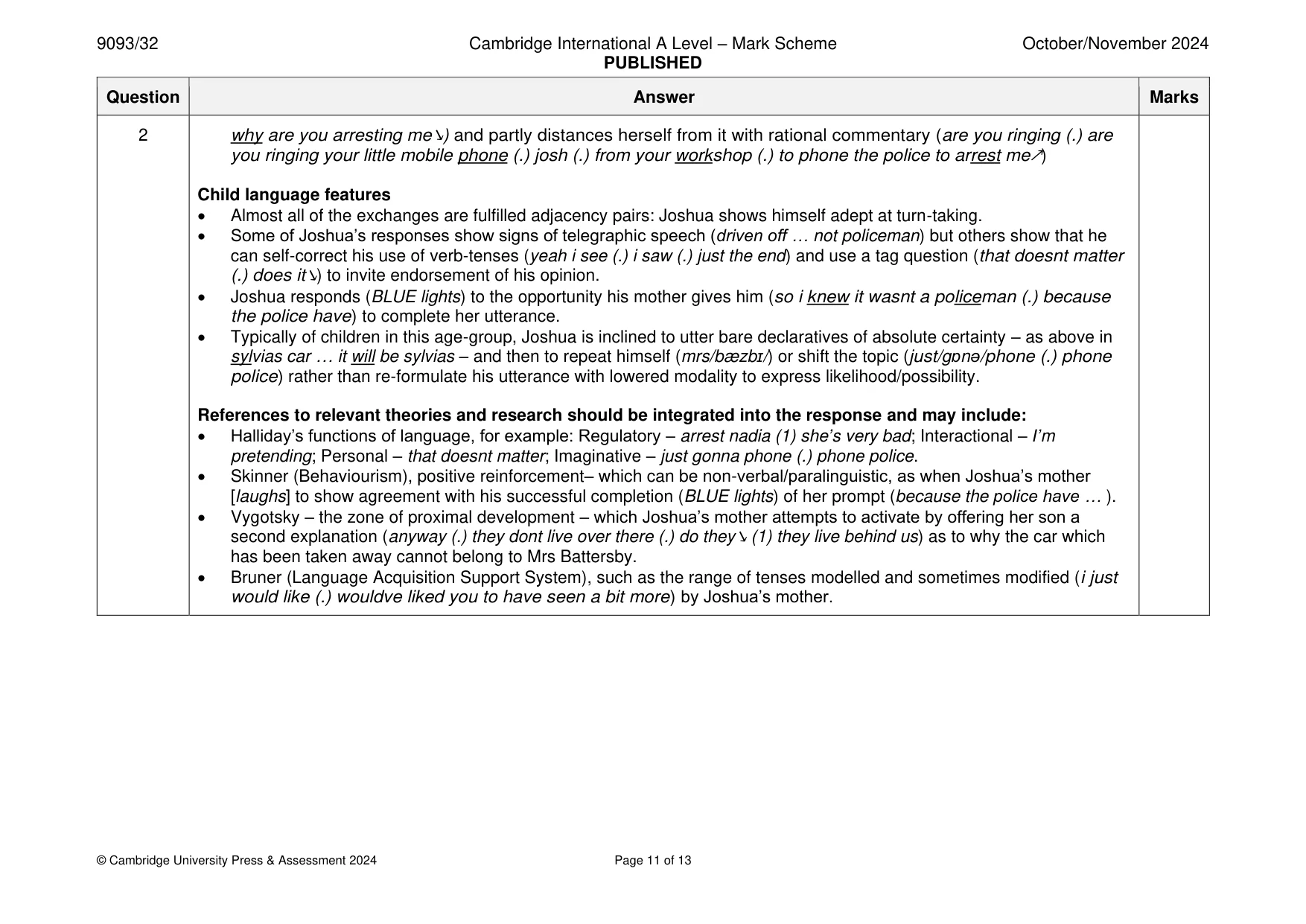
9093/32 Cambridge International A Level – Mark Scheme PUBLISHED October/November 2024 © Cambridge University Press & Assessment 2024 Page 11 of 13 Question Answer Marks 2 why are you arresting me↘) and partly distances herself from it with rational commentary (are you ringing (.) are you ringing your little mobile phone (.) josh (.) from your workshop (.) to phone the police to arrest me↗) Child language features • Almost all of the exchanges are fulfilled adjacency pairs: Joshua shows himself adept at turn-taking. • Some of Joshua’s responses show signs of telegraphic speech (driven off … not policeman) but others show that he can self-correct his use of verb-tenses (yeah i see (.) i saw (.) just the end) and use a tag question (that doesnt matter (.) does it↘) to invite endorsement of his opinion. • Joshua responds (BLUE lights) to the opportunity his mother gives him (so i knew it wasnt a policeman (.) because the police have) to complete her utterance. • Typically of children in this age-group, Joshua is inclined to utter bare declaratives of absolute certainty – as above in sylvias car … it will be sylvias – and then to repeat himself (mrs/bæzbɪ/) or shift the topic (just/gɒnə/phone (.) phone police) rather than re-formulate his utterance with lowered modality to express likelihood/possibility. References to relevant theories and research should be integrated into the response and may include: • Halliday’s functions of language, for example: Regulatory – arrest nadia (1) she’s very bad; Interactional – I’m pretending; Personal – that doesnt matter; Imaginative – just gonna phone (.) phone police. • Skinner (Behaviourism), positive reinforcement– which can be non-verbal/paralinguistic, as when Joshua’s mother [laughs] to show agreement with his successful completion (BLUE lights) of her prompt (because the police have … ). • Vygotsky – the zone of proximal development – which Joshua’s mother attempts to activate by offering her son a second explanation (anyway (.) they dont live over there (.) do they↘ (1) they live behind us) as to why the car which has been taken away cannot belong to Mrs Battersby. • Bruner (Language Acquisition Support System), such as the range of tenses modelled and sometimes modified (i just would like (.) wouldve liked you to have seen a bit more) by Joshua’s mother.
Mark scheme, page 12
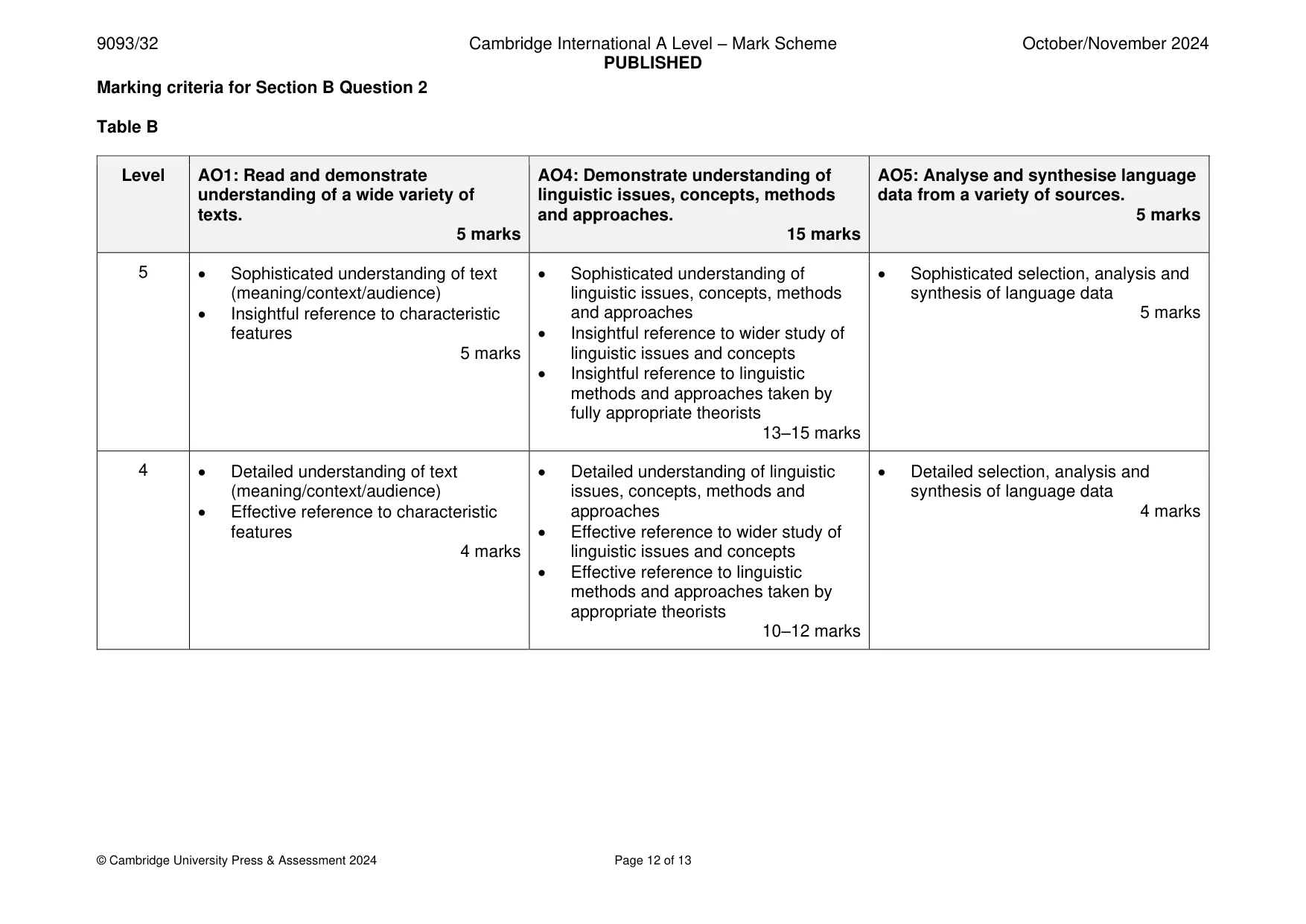
9093/32 Cambridge International A Level – Mark Scheme PUBLISHED October/November 2024 © Cambridge University Press & Assessment 2024 Page 12 of 13 Marking criteria for Section B Question 2 Table B Level AO1: Read and demonstrate understanding of a wide variety of texts. 5 marks AO4: Demonstrate understanding of linguistic issues, concepts, methods and approaches. 15 marks AO5: Analyse and synthesise language data from a variety of sources. 5 marks 5 • Sophisticated understanding of text (meaning/context/audience) • Insightful reference to characteristic features 5 marks • Sophisticated understanding of linguistic issues, concepts, methods and approaches • Insightful reference to wider study of linguistic issues and concepts • Insightful reference to linguistic methods and approaches taken by fully appropriate theorists 13–15 marks • Sophisticated selection, analysis and synthesis of language data 5 marks 4 • Detailed understanding of text (meaning/context/audience) • Effective reference to characteristic features 4 marks • Detailed understanding of linguistic issues, concepts, methods and approaches • Effective reference to wider study of linguistic issues and concepts • Effective reference to linguistic methods and approaches taken by appropriate theorists 10–12 marks • Detailed selection, analysis and synthesis of language data 4 marks
Mark scheme, page 13
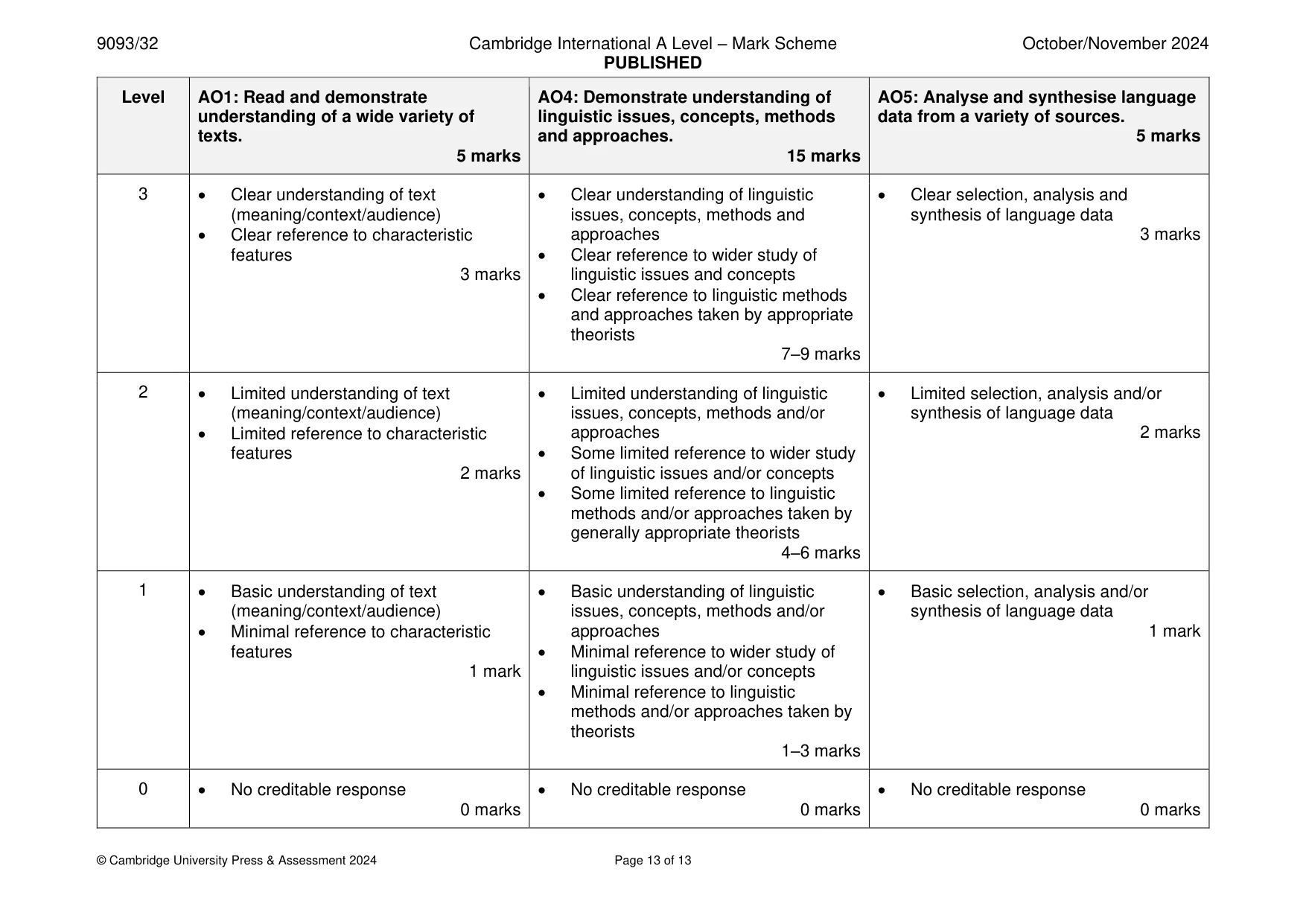
9093/32 Cambridge International A Level – Mark Scheme PUBLISHED October/November 2024 © Cambridge University Press & Assessment 2024 Page 13 of 13 Level AO1: Read and demonstrate understanding of a wide variety of texts. 5 marks AO4: Demonstrate understanding of linguistic issues, concepts, methods and approaches. 15 marks AO5: Analyse and synthesise language data from a variety of sources. 5 marks 3 • Clear understanding of text (meaning/context/audience) • Clear reference to characteristic features 3 marks • Clear understanding of linguistic issues, concepts, methods and approaches • Clear reference to wider study of linguistic issues and concepts • Clear reference to linguistic methods and approaches taken by appropriate theorists 7–9 marks • Clear selection, analysis and synthesis of language data 3 marks 2 • Limited understanding of text (meaning/context/audience) • Limited reference to characteristic features 2 marks • Limited understanding of linguistic issues, concepts, methods and/or approaches • Some limited reference to wider study of linguistic issues and/or concepts • Some limited reference to linguistic methods and/or approaches taken by generally appropriate theorists 4–6 marks • Limited selection, analysis and/or synthesis of language data 2 marks 1 • Basic understanding of text (meaning/context/audience) • Minimal reference to characteristic features 1 mark • Basic understanding of linguistic issues, concepts, methods and/or approaches • Minimal reference to wider study of linguistic issues and/or concepts • Minimal reference to linguistic methods and/or approaches taken by theorists 1–3 marks • Basic selection, analysis and/or synthesis of language data 1 mark 0 • No creditable response 0 marks • No creditable response 0 marks • No creditable response 0 marks
What you needed in this session
Cambridge’s own grade thresholds for 2024 Oct/Nov, Paper 3 · Variant 2. A higher threshold means an easier paper — the bar moves with how the cohort did.