Cambridge A Level English - Language AS and A Level (from 2014) 9093 — 2025 May/June Paper 3 · Variant 2
9093/32/M/J/25 · 50 marks · 135 min
The question paper and its mark scheme, free to read here and free to download. This is Cambridge’s own paper, exactly as it was sat.
Question paper8 pages
Mark scheme14 pages
Answers below. Sit the paper first if you are practising.
Paper as text
Question paper, page 1
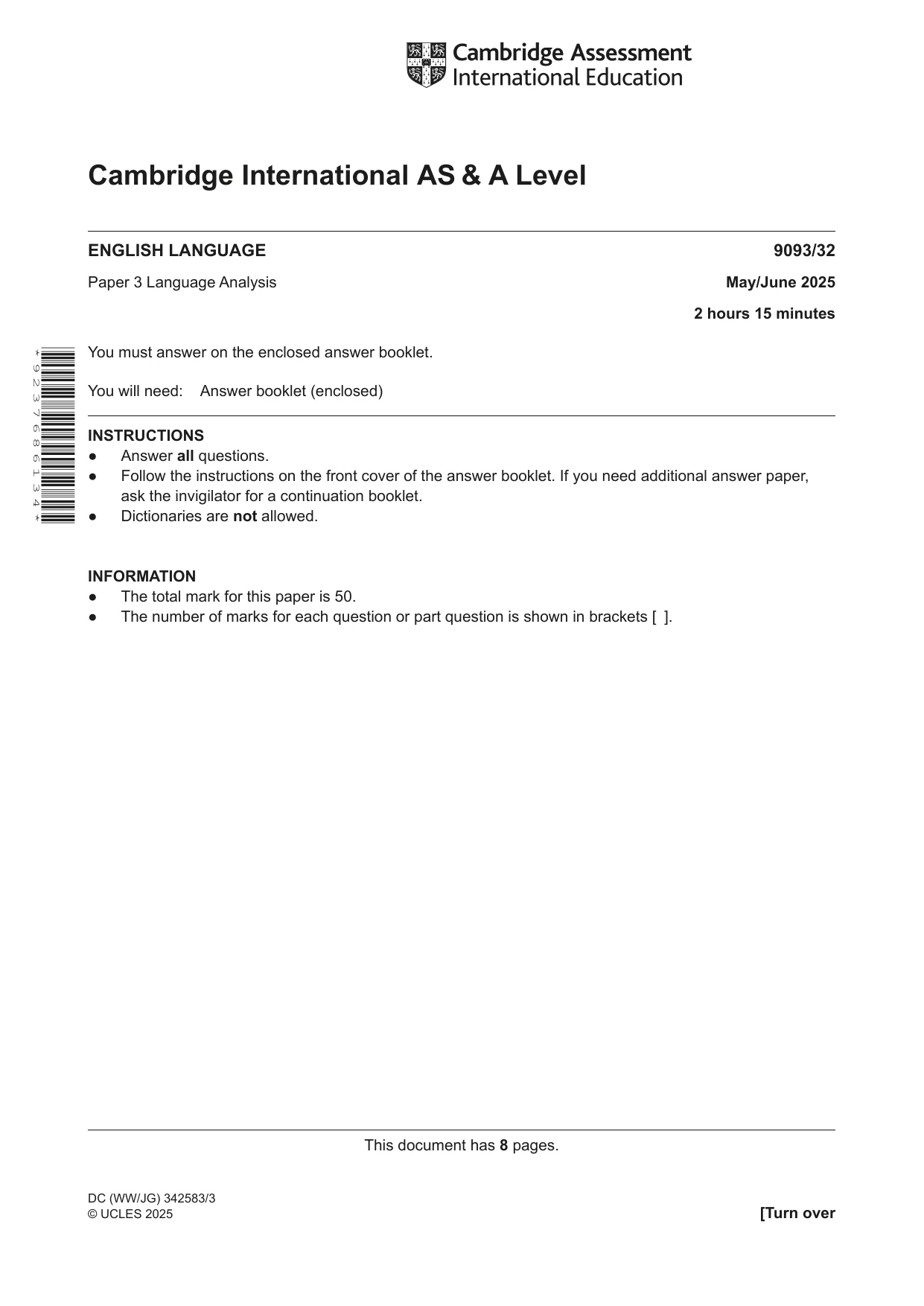
[Turn over Cambridge International AS & A Level DC (WW/JG) 342583/3 © UCLES 2025 This document has 8 pages. * 9 2 3 7 6 8 6 1 3 4 * ENGLISH LANGUAGE 9093/32 Paper 3 Language Analysis May/June 2025 2 hours 15 minutes You must answer on the enclosed answer booklet. You will need: Answer booklet (enclosed) INSTRUCTIONS ● Answer all questions. ● Follow the instructions on the front cover of the answer booklet. If you need additional answer paper, ask the invigilator for a continuation booklet. ● Dictionaries are not allowed. INFORMATION ● The total mark for this paper is 50. ● The number of marks for each question or part question is shown in brackets [ ].
Question paper, page 2
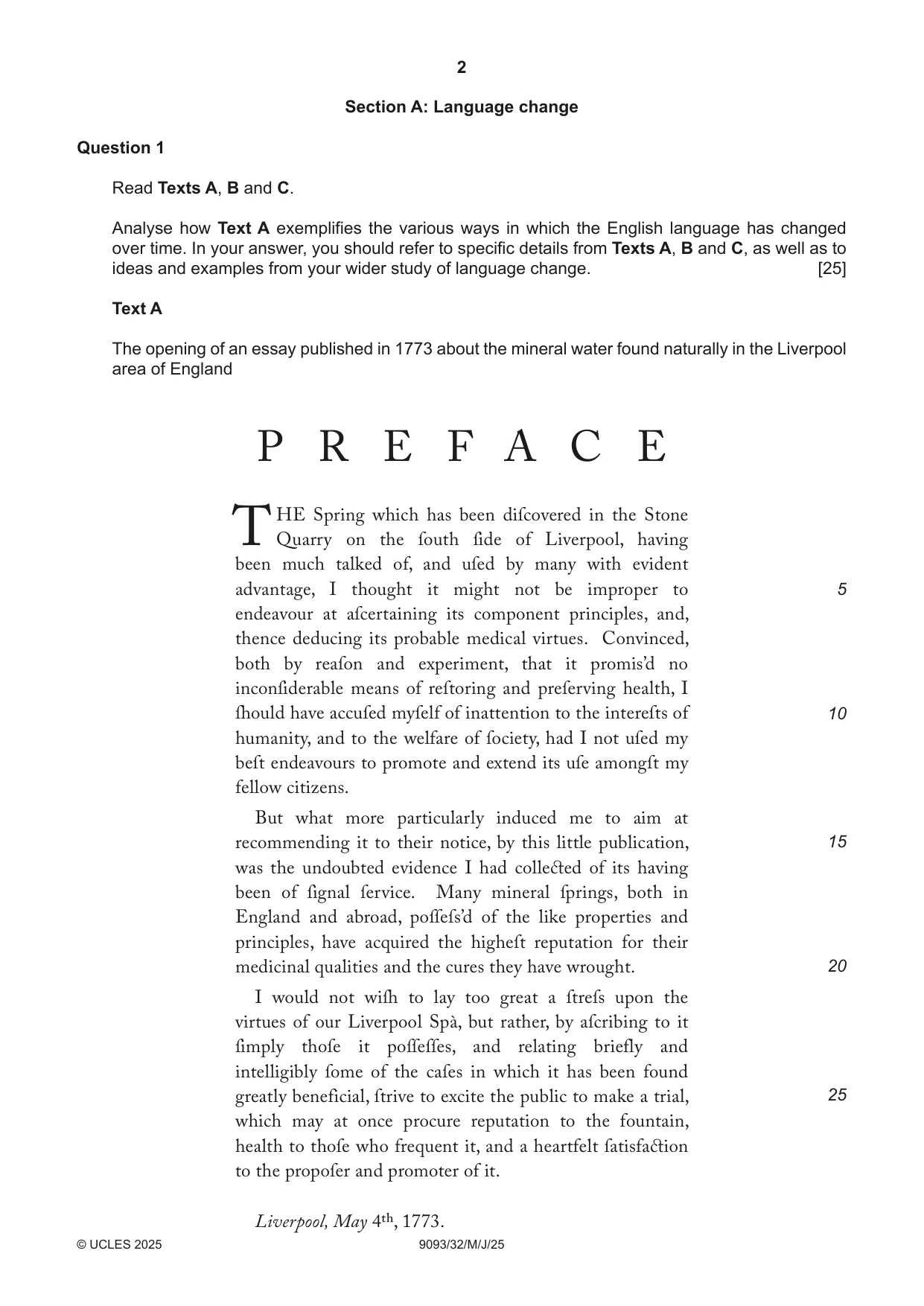
2 9093/32/M/J/25 © UCLES 2025 Section A: Language change Question 1 Read Texts A, B and C. Analyse how Text A exemplifies the various ways in which the English language has changed over time. In your answer, you should refer to specific details from Texts A, B and C, as well as to ideas and examples from your wider study of language change. [25] Text A The opening of an essay published in 1773 about the mineral water found naturally in the Liverpool area of England P R E F A C E HE Spring which has been diſcovered in the Stone Quarry on the ſouth ſide of Liverpool, having been much talked of, and uſed by many with evident advantage, I thought it might not be improper to endeavour at aſcertaining its component principles, and, thence deducing its probable medical virtues. Convinced, both by reaſon and experiment, that it promis’d no inconſiderable means of reſtoring and preſerving health, I ſhould have accuſed myſelf of inattention to the intereſts of humanity, and to the welfare of ſociety, had I not uſed my beſt endeavours to promote and extend its uſe amongſt my fellow citizens. But what more particularly induced me to aim at recommending it to their notice, by this little publication, was the undoubted evidence I had collected of its having been of ſignal ſervice. Many mineral ſprings, both in England and abroad, poſſeſs’d of the like properties and principles, have acquired the higheſt reputation for their medicinal qualities and the cures they have wrought. I would not wiſh to lay too great a ſtreſs upon the virtues of our Liverpool Spà, but rather, by aſcribing to it ſimply thoſe it poſſeſſes, and relating briefly and intelligibly ſome of the caſes in which it has been found greatly beneficial, ſtrive to excite the public to make a trial, which may at once procure reputation to the fountain, health to thoſe who frequent it, and a heartfelt ſatisfaction to the propoſer and promoter of it. Liverpool, May 4th, 1773. T 5 10 15 20 25
Question paper, page 3
3 9093/32/M/J/25 © UCLES 2025 [Turn over E S S A Y O n t h e L i v e r p o o l S PA’ WAT E R § i. Of Mineral Waters in general. E diſtinguiſh by the term of mineral waters, thoſe which are impregnated with ſome mineral principles, and hence are become medicinal. They are properly divided into Saline, Sulphureous, and Metallic. We have found that thoſe which have been termed Spirituous are indebted for that title, to a gas, or fix’d air only, to which they owe their ſparkling, and that agreeable, pungent, acidulous taſte. From this ſame principal they acquire the property they poſſeſs of diſſolving metallic ſubſtances, as will be ſhewn hereafter. W 30 35 40
Question paper, page 4
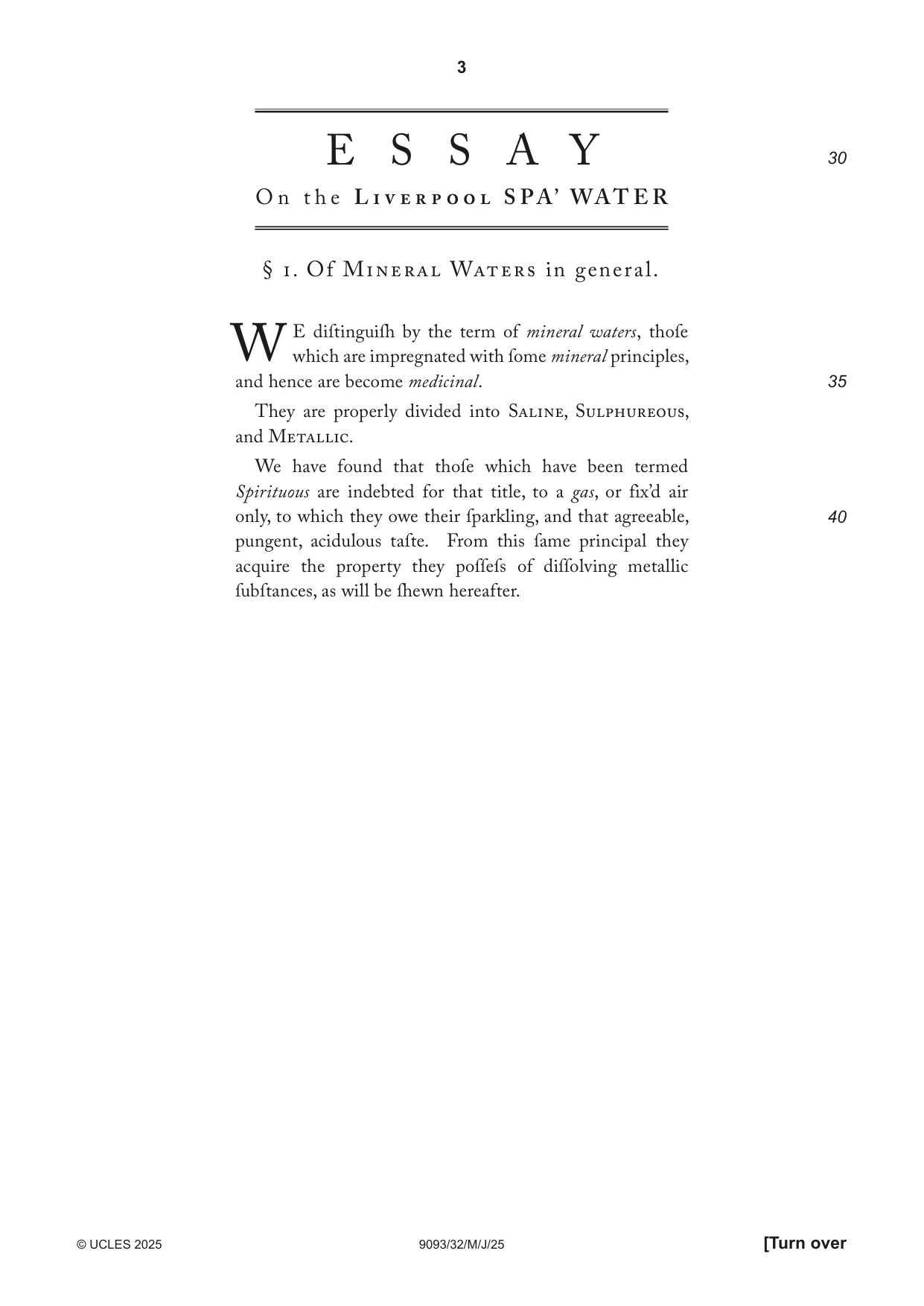
4 9093/32/M/J/25 © UCLES 2025 Text B Five of the top collocates for ‘spa’ from the Early English Books Online Corpus (1650s–1780s) and the Cambridge International Corpus (1980s–1993) ‘spa’ (1650s–1780s) ‘spa’ (1980s–1993) treatments pamper waters whirlpool towns luxury health gym resort salon
Question paper, page 5
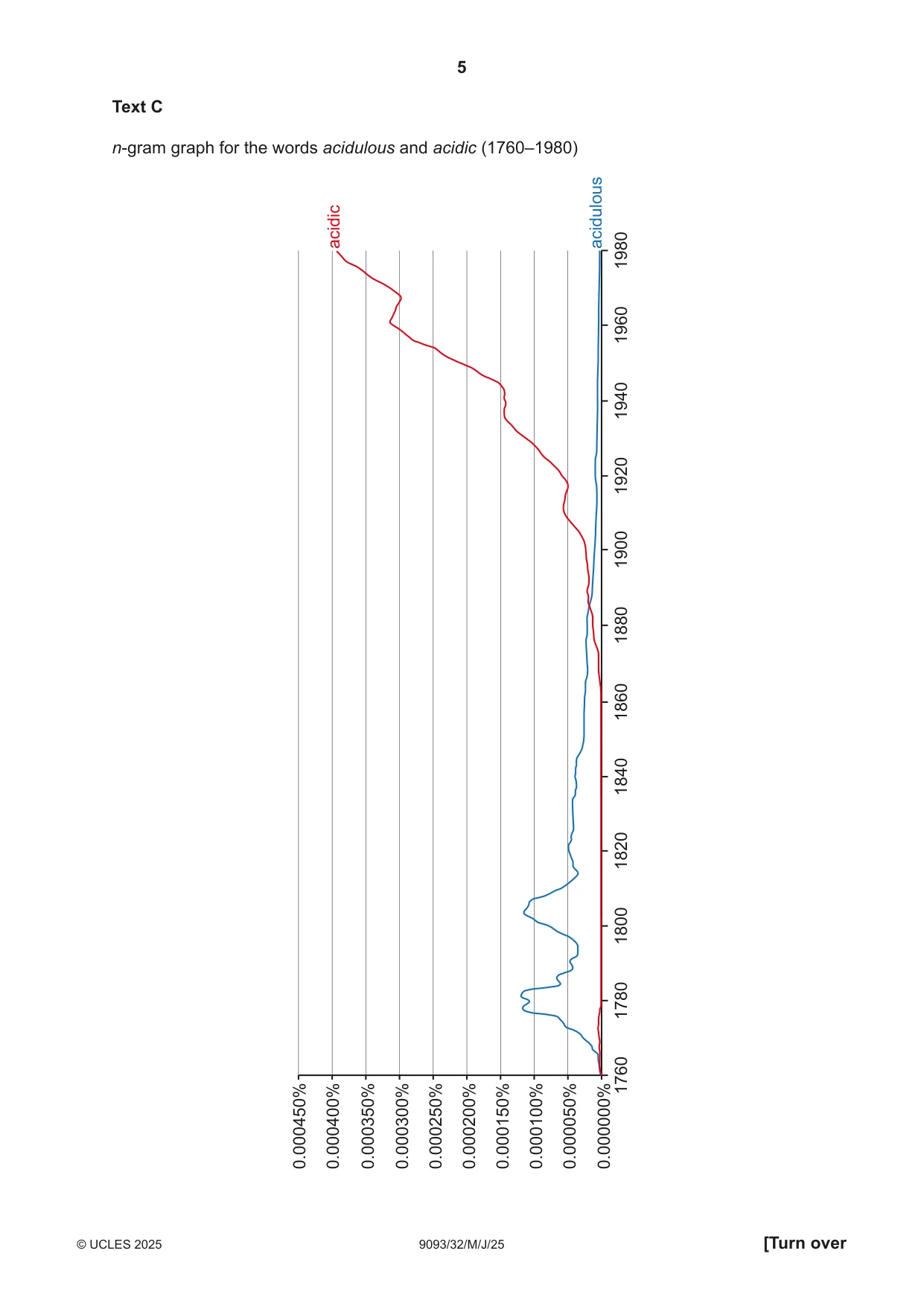
5 9093/32/M/J/25 © UCLES 2025 [Turn over Text C n-gram graph for the words acidulous and acidic (1760–1980) 1780 1760 0.000000% 0.000050% 0.000100% 0.000150% 0.000200% 0.000250% 0.000300% 0.000350% 0.000400% 0.000450% 1800 1820 1840 1860 1880 1900 1920 1940 1960 1980 acidulous acidic
Question paper, page 6
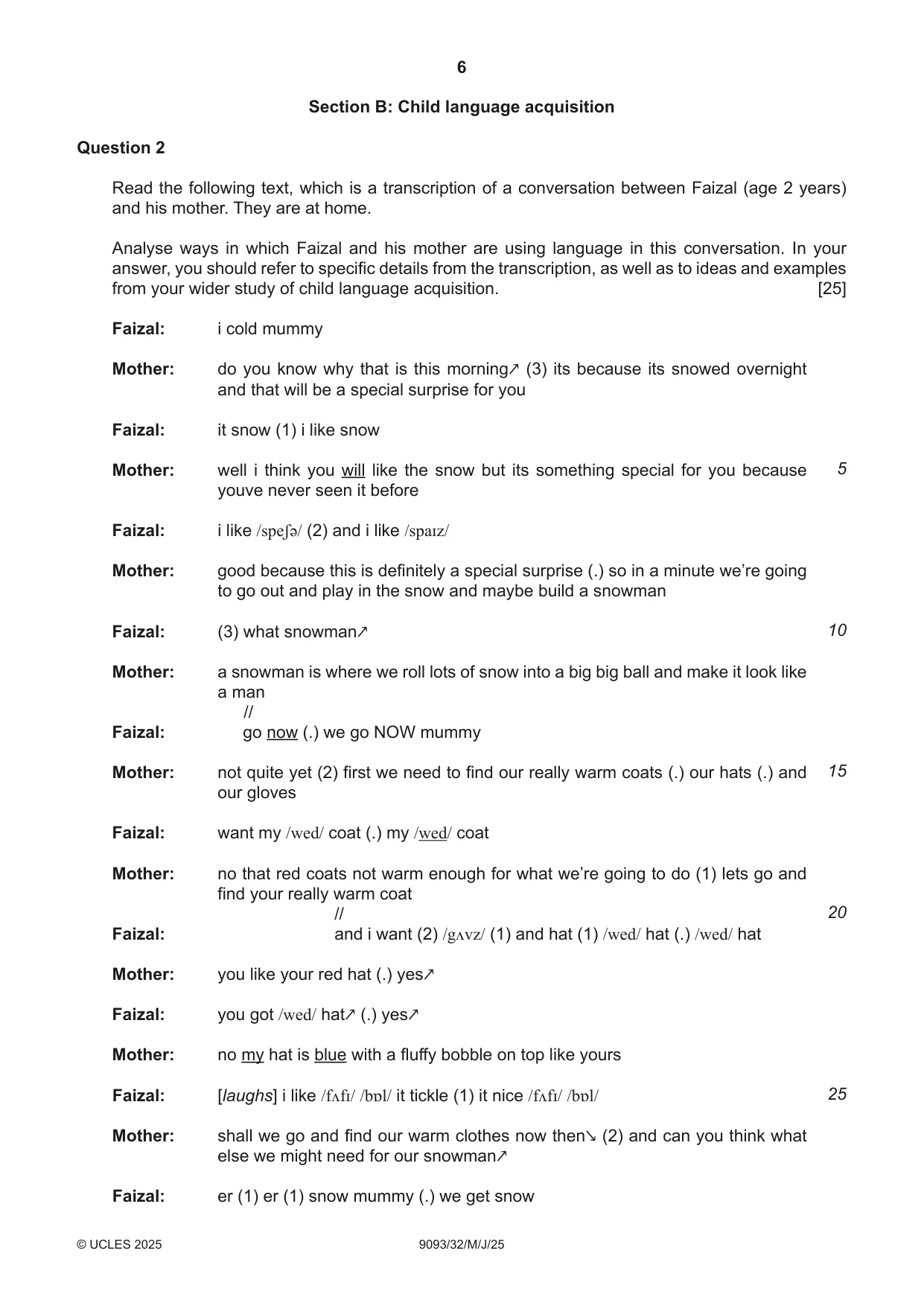
6 9093/32/M/J/25 © UCLES 2025 Section B: Child language acquisition Question 2 Read the following text, which is a transcription of a conversation between Faizal (age 2 years) and his mother. They are at home. Analyse ways in which Faizal and his mother are using language in this conversation. In your answer, you should refer to specific details from the transcription, as well as to ideas and examples from your wider study of child language acquisition. [25] Faizal: i cold mummy Mother: do you know why that is this morning↗ (3) its because its snowed overnight and that will be a special surprise for you Faizal: it snow (1) i like snow Mother: well i think you will like the snow but its something special for you because youve never seen it before Faizal: i like /speʃə/ (2) and i like /spaɪz/ Mother: good because this is definitely a special surprise (.) so in a minute we’re going to go out and play in the snow and maybe build a snowman Faizal: (3) what snowman↗ Mother: a snowman is where we roll lots of snow into a big big ball and make it look like a man // Faizal: go now (.) we go NOW mummy Mother: not quite yet (2) first we need to find our really warm coats (.) our hats (.) and our gloves Faizal: want my /wed/ coat (.) my /wed/ coat Mother: no that red coats not warm enough for what we’re going to do (1) lets go and find your really warm coat // Faizal: and i want (2) /gʌvz/ (1) and hat (1) /wed/ hat (.) /wed/ hat Mother: you like your red hat (.) yes↗ Faizal: you got /wed/ hat↗ (.) yes↗ Mother: no my hat is blue with a fluffy bobble on top like yours Faizal: [laughs] i like /fʌfɪ/ /bɒl/ it tickle (1) it nice /fʌfɪ/ /bɒl/ Mother: shall we go and find our warm clothes now then↘ (2) and can you think what else we might need for our snowman↗ Faizal: er (1) er (1) snow mummy (.) we get snow 5 10 15 20 25
Question paper, page 7
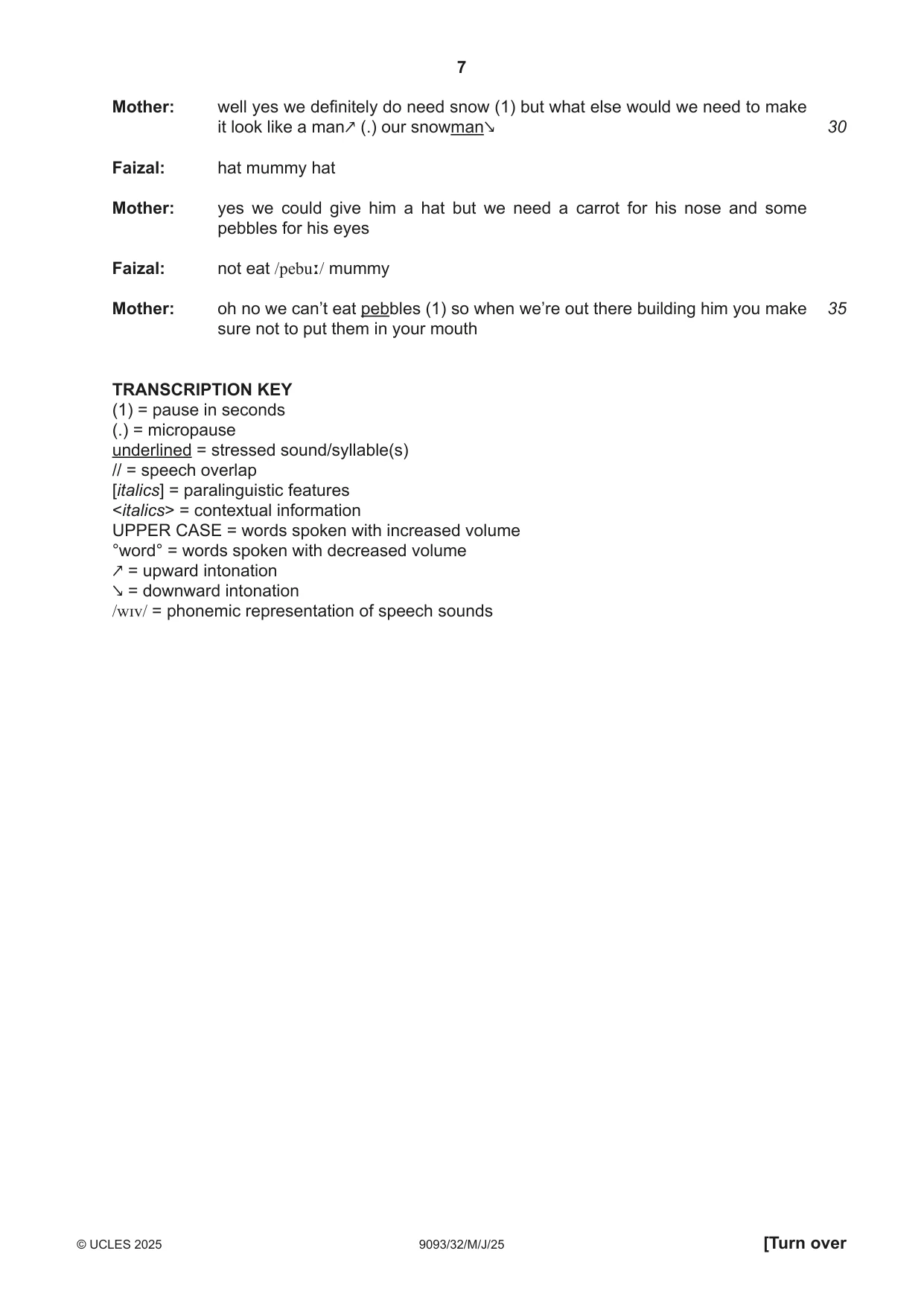
7 9093/32/M/J/25 © UCLES 2025 [Turn over Mother: well yes we definitely do need snow (1) but what else would we need to make it look like a man↗ (.) our snowman↘ Faizal: hat mummy hat Mother: yes we could give him a hat but we need a carrot for his nose and some pebbles for his eyes Faizal: not eat /pebuː/ mummy Mother: oh no we can’t eat pebbles (1) so when we’re out there building him you make sure not to put them in your mouth TRANSCRIPTION KEY (1) = pause in seconds (.) = micropause underlined = stressed sound/syllable(s) // = speech overlap [italics] = paralinguistic features <italics> = contextual information UPPER CASE = words spoken with increased volume °word° = words spoken with decreased volume ↗ = upward intonation ↘ = downward intonation /wɪv/ = phonemic representation of speech sounds 30 35
Question paper, page 8
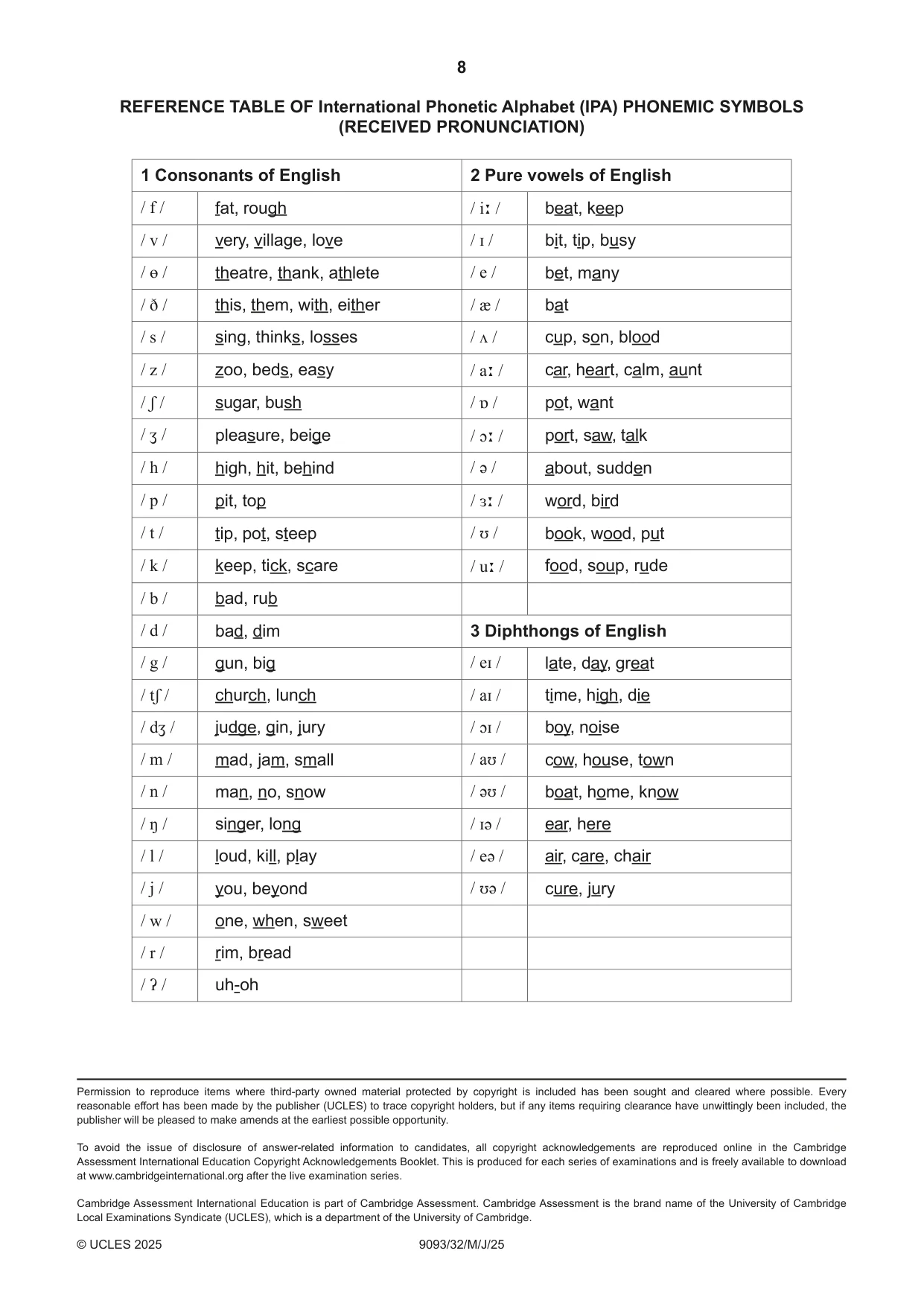
8 9093/32/M/J/25 © UCLES 2025 Permission to reproduce items where third-party owned material protected by copyright is included has been sought and cleared where possible. Every reasonable effort has been made by the publisher (UCLES) to trace copyright holders, but if any items requiring clearance have unwittingly been included, the publisher will be pleased to make amends at the earliest possible opportunity. To avoid the issue of disclosure of answer-related information to candidates, all copyright acknowledgements are reproduced online in the Cambridge Assessment International Education Copyright Acknowledgements Booklet. This is produced for each series of examinations and is freely available to download at www.cambridgeinternational.org after the live examination series. Cambridge Assessment International Education is part of Cambridge Assessment. Cambridge Assessment is the brand name of the University of Cambridge Local Examinations Syndicate (UCLES), which is a department of the University of Cambridge. REFERENCE TABLE OF International Phonetic Alphabet (IPA) PHONEMIC SYMBOLS (RECEIVED PRONUNCIATION) 1 Consonants of English 2 Pure vowels of English / f / fat, rough / iː / beat, keep / v / very, village, love / ɪ / bit, tip, busy / ɵ / theatre, thank, athlete / e / bet, many / ð / this, them, with, either / æ / bat / s / sing, thinks, losses / ʌ / cup, son, blood / z / zoo, beds, easy / aː / car, heart, calm, aunt / ʃ / sugar, bush / ɒ / pot, want / ʒ / pleasure, beige / ɔː / port, saw, talk / h / high, hit, behind / ə / about, sudden / p / pit, top / ɜː / word, bird / t / tip, pot, steep / ʊ / book, wood, put / k / keep, tick, scare / uː / food, soup, rude / b / bad, rub / d / bad, dim 3 Diphthongs of English / g / gun, big / eɪ / late, day, great / tʃ / church, lunch / aɪ / time, high, die / dʒ / judge, gin, jury / ɔɪ / boy, noise / m / mad, jam, small / aʊ / cow, house, town / n / man, no, snow / əʊ / boat, home, know / ŋ / singer, long / ɪə / ear, here / l / loud, kill, play / eə / air, care, chair / j / you, beyond / ʊə / cure, jury / w / one, when, sweet / r / rim, bread / ʔ / uh-oh
Mark scheme, page 1
This document consists of 14 printed pages. © Cambridge University Press & Assessment 2025 [Turn over Cambridge International A Level ENGLISH LANGUAGE 9093/32 Paper 3 Language Analysis May/June 2025 MARK SCHEME Maximum Mark: 50 Published This mark scheme is published as an aid to teachers and candidates, to indicate the requirements of the examination. It shows the basis on which Examiners were instructed to award marks. It does not indicate the details of the discussions that took place at an Examiners’ meeting before marking began, which would have considered the acceptability of alternative answers. Mark schemes should be read in conjunction with the question paper and the Principal Examiner Report for Teachers. Cambridge International will not enter into discussions about these mark schemes. Cambridge International is publishing the mark schemes for the May/June 2025 series for most Cambridge IGCSE, Cambridge International A and AS Level components, and some Cambridge O Level components.
Mark scheme, page 2
9093/32 Cambridge International A Level – Mark Scheme PUBLISHED May/June 2025 © Cambridge University Press & Assessment 2025 Page 2 of 14 Generic Marking Principles These general marking principles must be applied by all examiners when marking candidate answers. They should be applied alongside the specific content of the mark scheme or generic level descriptions for a question. Each question paper and mark scheme will also comply with these marking principles. GENERIC MARKING PRINCIPLE 1: Marks must be awarded in line with: • the specific content of the mark scheme or the generic level descriptors for the question • the specific skills defined in the mark scheme or in the generic level descriptors for the question • the standard of response required by a candidate as exemplified by the standardisation scripts. GENERIC MARKING PRINCIPLE 2: Marks awarded are always whole marks (not half marks, or other fractions). GENERIC MARKING PRINCIPLE 3: Marks must be awarded positively: • marks are awarded for correct/valid answers, as defined in the mark scheme. However, credit is given for valid answers which go beyond the scope of the syllabus and mark scheme, referring to your Team Leader as appropriate • marks are awarded when candidates clearly demonstrate what they know and can do • marks are not deducted for errors • marks are not deducted for omissions • answers should only be judged on the quality of spelling, punctuation and grammar when these features are specifically assessed by the question as indicated by the mark scheme. The meaning, however, should be unambiguous. GENERIC MARKING PRINCIPLE 4: Rules must be applied consistently, e.g. in situations where candidates have not followed instructions or in the application of generic level descriptors.
Mark scheme, page 3
9093/32 Cambridge International A Level – Mark Scheme PUBLISHED May/June 2025 © Cambridge University Press & Assessment 2025 Page 3 of 14 GENERIC MARKING PRINCIPLE 5: Marks should be awarded using the full range of marks defined in the mark scheme for the question (however; the use of the full mark range may be limited according to the quality of the candidate responses seen). GENERIC MARKING PRINCIPLE 6: Marks awarded are based solely on the requirements as defined in the mark scheme. Marks should not be awarded with grade thresholds or grade descriptors in mind.
Mark scheme, page 4
9093/32 Cambridge International A Level – Mark Scheme PUBLISHED May/June 2025 © Cambridge University Press & Assessment 2025 Page 4 of 14 English & Media subject specific general marking principles (To be read in conjunction with the Generic Marking Principles (and requiring further guidance on how to place marks within levels)) Components using level descriptors: • We use level descriptors as a guide to broad understanding of the qualities normally expected of, or typical of, work in a level. • Level descriptors are a means of general guidance and should not be interpreted as hurdle statements. • Where indicative content notes are supplied for a question, these are not a prescription of required content, and must not be treated as such. Alternative correct points and unexpected answers in candidates’ scripts must be given marks that fairly reflect the knowledge and skills demonstrated. • While we may have legitimate expectations as to the ground most answers may occupy, we must at all times be prepared to meet candidates on their chosen ground, provided it is relevant ground (e.g. clearly related to and derived from a relevant passage/text and meeting the mark scheme requirements for the question).
Mark scheme, page 5
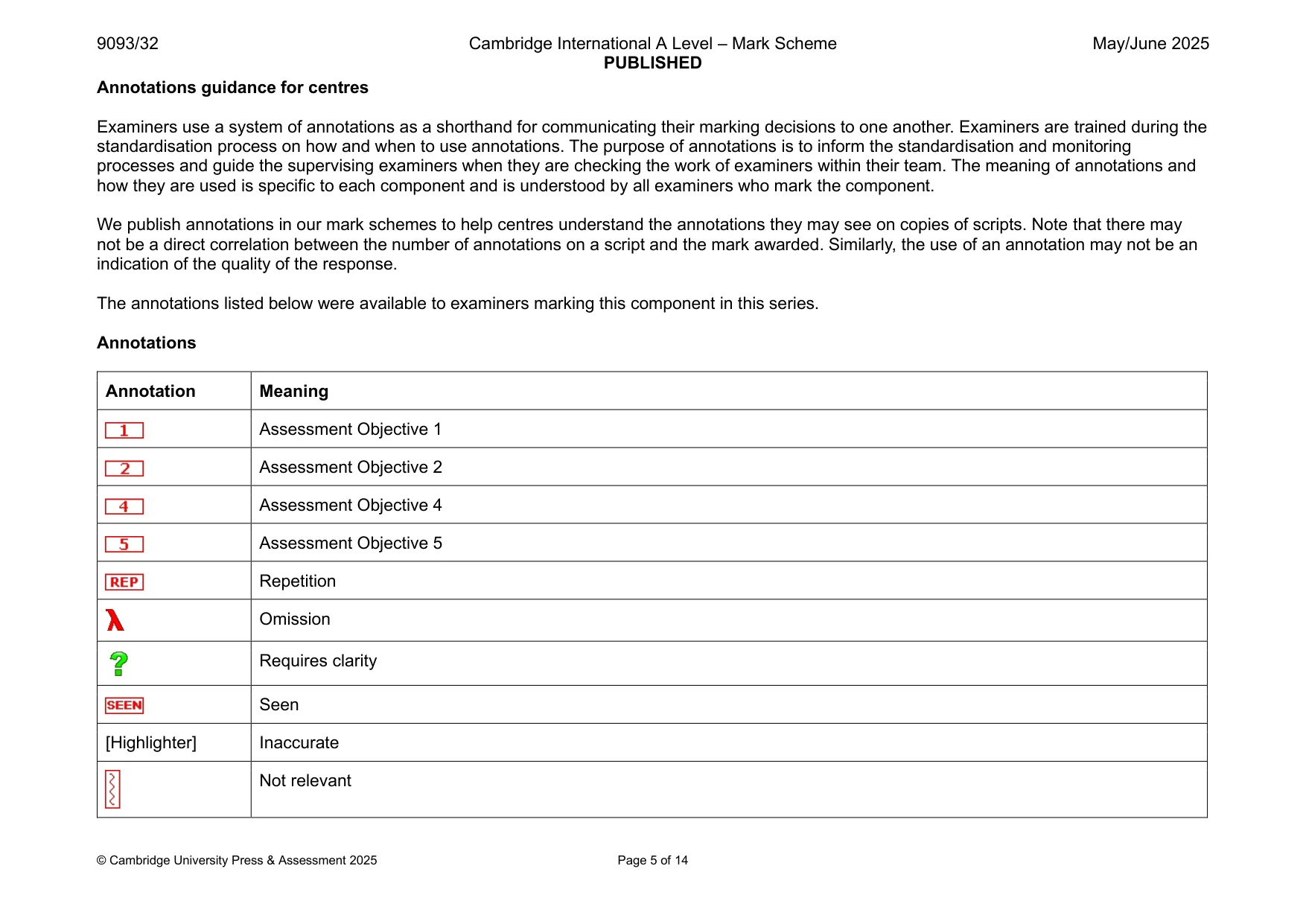
9093/32 Cambridge International A Level – Mark Scheme PUBLISHED May/June 2025 © Cambridge University Press & Assessment 2025 Page 5 of 14 Annotations guidance for centres Examiners use a system of annotations as a shorthand for communicating their marking decisions to one another. Examiners are trained during the standardisation process on how and when to use annotations. The purpose of annotations is to inform the standardisation and monitoring processes and guide the supervising examiners when they are checking the work of examiners within their team. The meaning of annotations and how they are used is specific to each component and is understood by all examiners who mark the component. We publish annotations in our mark schemes to help centres understand the annotations they may see on copies of scripts. Note that there may not be a direct correlation between the number of annotations on a script and the mark awarded. Similarly, the use of an annotation may not be an indication of the quality of the response. The annotations listed below were available to examiners marking this component in this series. Annotations Annotation Meaning Assessment Objective 1 Assessment Objective 2 Assessment Objective 4 Assessment Objective 5 Repetition Omission Requires clarity Seen [Highlighter] Inaccurate Not relevant
Mark scheme, page 6
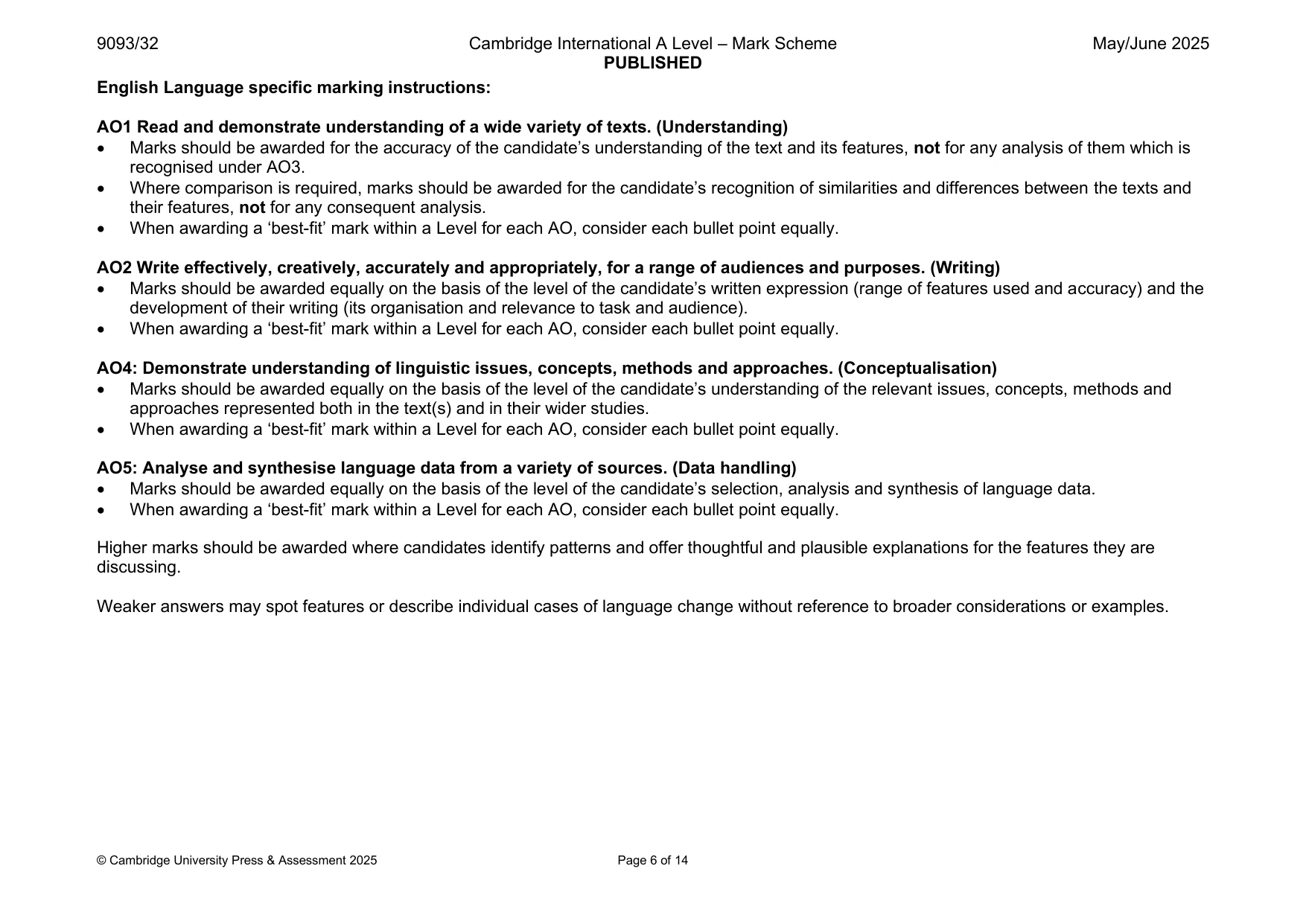
9093/32 Cambridge International A Level – Mark Scheme PUBLISHED May/June 2025 © Cambridge University Press & Assessment 2025 Page 6 of 14 English Language specific marking instructions: AO1 Read and demonstrate understanding of a wide variety of texts. (Understanding) • Marks should be awarded for the accuracy of the candidate’s understanding of the text and its features, not for any analysis of them which is recognised under AO3. • Where comparison is required, marks should be awarded for the candidate’s recognition of similarities and differences between the texts and their features, not for any consequent analysis. • When awarding a ‘best-fit’ mark within a Level for each AO, consider each bullet point equally. AO2 Write effectively, creatively, accurately and appropriately, for a range of audiences and purposes. (Writing) • Marks should be awarded equally on the basis of the level of the candidate’s written expression (range of features used and accuracy) and the development of their writing (its organisation and relevance to task and audience). • When awarding a ‘best-fit’ mark within a Level for each AO, consider each bullet point equally. AO4: Demonstrate understanding of linguistic issues, concepts, methods and approaches. (Conceptualisation) • Marks should be awarded equally on the basis of the level of the candidate’s understanding of the relevant issues, concepts, methods and approaches represented both in the text(s) and in their wider studies. • When awarding a ‘best-fit’ mark within a Level for each AO, consider each bullet point equally. AO5: Analyse and synthesise language data from a variety of sources. (Data handling) • Marks should be awarded equally on the basis of the level of the candidate’s selection, analysis and synthesis of language data. • When awarding a ‘best-fit’ mark within a Level for each AO, consider each bullet point equally. Higher marks should be awarded where candidates identify patterns and offer thoughtful and plausible explanations for the features they are discussing. Weaker answers may spot features or describe individual cases of language change without reference to broader considerations or examples.
Mark scheme, page 7
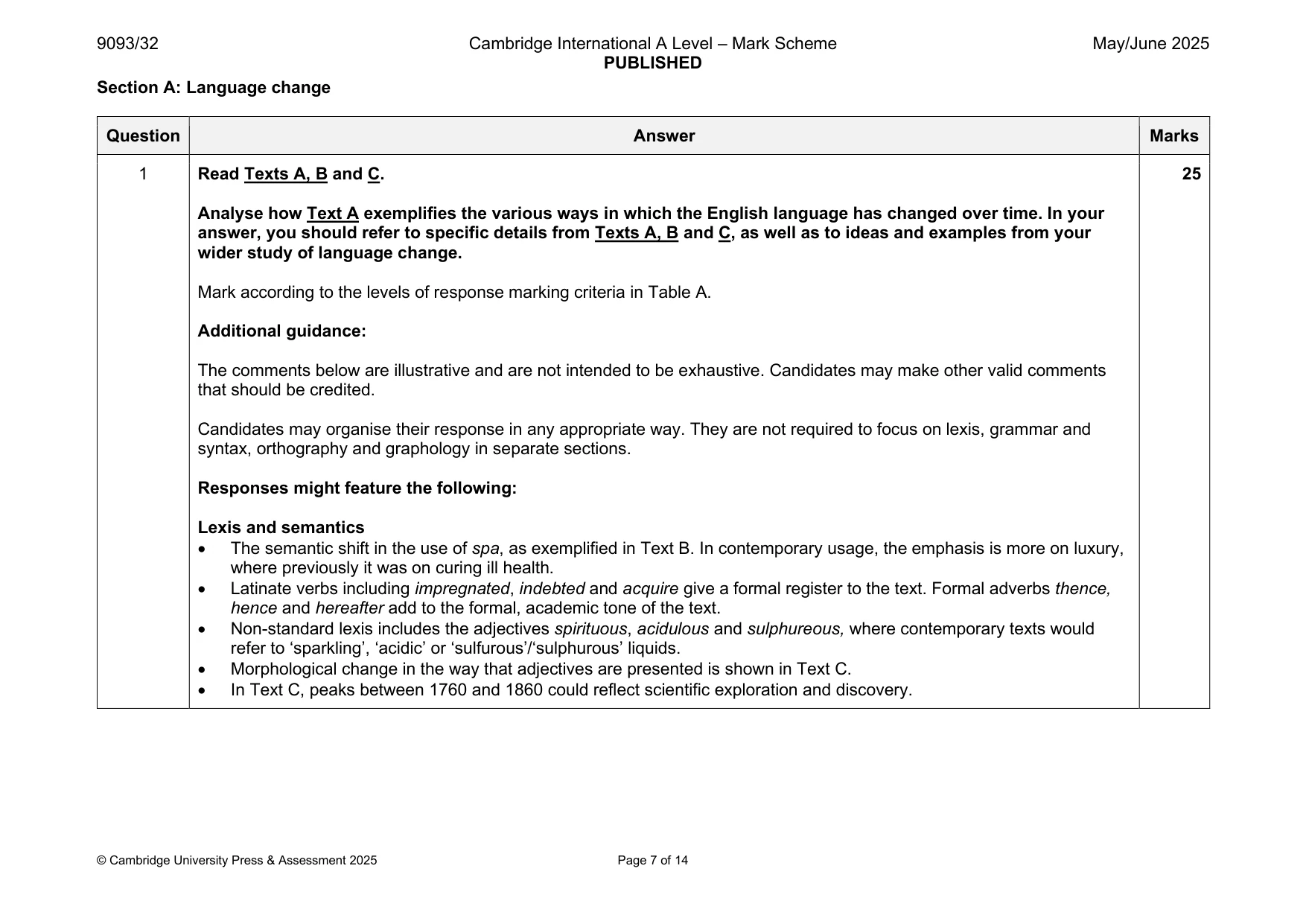
9093/32 Cambridge International A Level – Mark Scheme PUBLISHED May/June 2025 © Cambridge University Press & Assessment 2025 Page 7 of 14 Section A: Language change Question Answer Marks 1 Read Texts A, B and C. Analyse how Text A exemplifies the various ways in which the English language has changed over time. In your answer, you should refer to specific details from Texts A, B and C, as well as to ideas and examples from your wider study of language change. Mark according to the levels of response marking criteria in Table A. Additional guidance: The comments below are illustrative and are not intended to be exhaustive. Candidates may make other valid comments that should be credited. Candidates may organise their response in any appropriate way. They are not required to focus on lexis, grammar and syntax, orthography and graphology in separate sections. Responses might feature the following: Lexis and semantics • The semantic shift in the use of spa, as exemplified in Text B. In contemporary usage, the emphasis is more on luxury, where previously it was on curing ill health. • Latinate verbs including impregnated, indebted and acquire give a formal register to the text. Formal adverbs thence, hence and hereafter add to the formal, academic tone of the text. • Non-standard lexis includes the adjectives spirituous, acidulous and sulphureous, where contemporary texts would refer to ‘sparkling’, ‘acidic’ or ‘sulfurous’/‘sulphurous’ liquids. • Morphological change in the way that adjectives are presented is shown in Text C. • In Text C, peaks between 1760 and 1860 could reflect scientific exploration and discovery. 25
Mark scheme, page 8
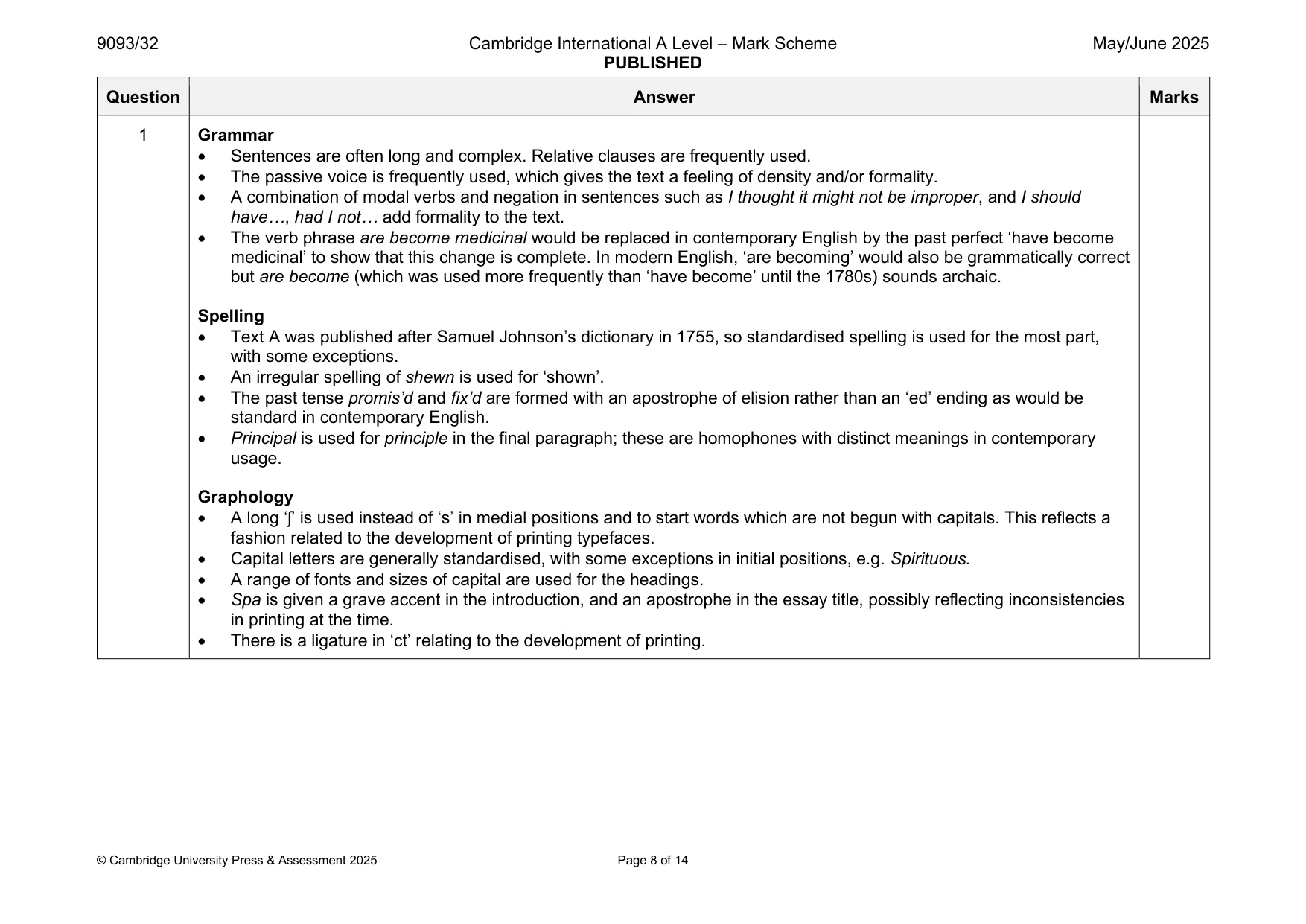
9093/32 Cambridge International A Level – Mark Scheme PUBLISHED May/June 2025 © Cambridge University Press & Assessment 2025 Page 8 of 14 Question Answer Marks 1 Grammar • Sentences are often long and complex. Relative clauses are frequently used. • The passive voice is frequently used, which gives the text a feeling of density and/or formality. • A combination of modal verbs and negation in sentences such as I thought it might not be improper, and I should have…, had I not… add formality to the text. • The verb phrase are become medicinal would be replaced in contemporary English by the past perfect ‘have become medicinal’ to show that this change is complete. In modern English, ‘are becoming’ would also be grammatically correct but are become (which was used more frequently than ‘have become’ until the 1780s) sounds archaic. Spelling • Text A was published after Samuel Johnson’s dictionary in 1755, so standardised spelling is used for the most part, with some exceptions. • An irregular spelling of shewn is used for ‘shown’. • The past tense promis’d and fix’d are formed with an apostrophe of elision rather than an ‘ed’ ending as would be standard in contemporary English. • Principal is used for principle in the final paragraph; these are homophones with distinct meanings in contemporary usage. Graphology • A long ‘ʃ’ is used instead of ‘s’ in medial positions and to start words which are not begun with capitals. This reflects a fashion related to the development of printing typefaces. • Capital letters are generally standardised, with some exceptions in initial positions, e.g. Spirituous. • A range of fonts and sizes of capital are used for the headings. • Spa is given a grave accent in the introduction, and an apostrophe in the essay title, possibly reflecting inconsistencies in printing at the time. • There is a ligature in ‘ct’ relating to the development of printing.
Mark scheme, page 9
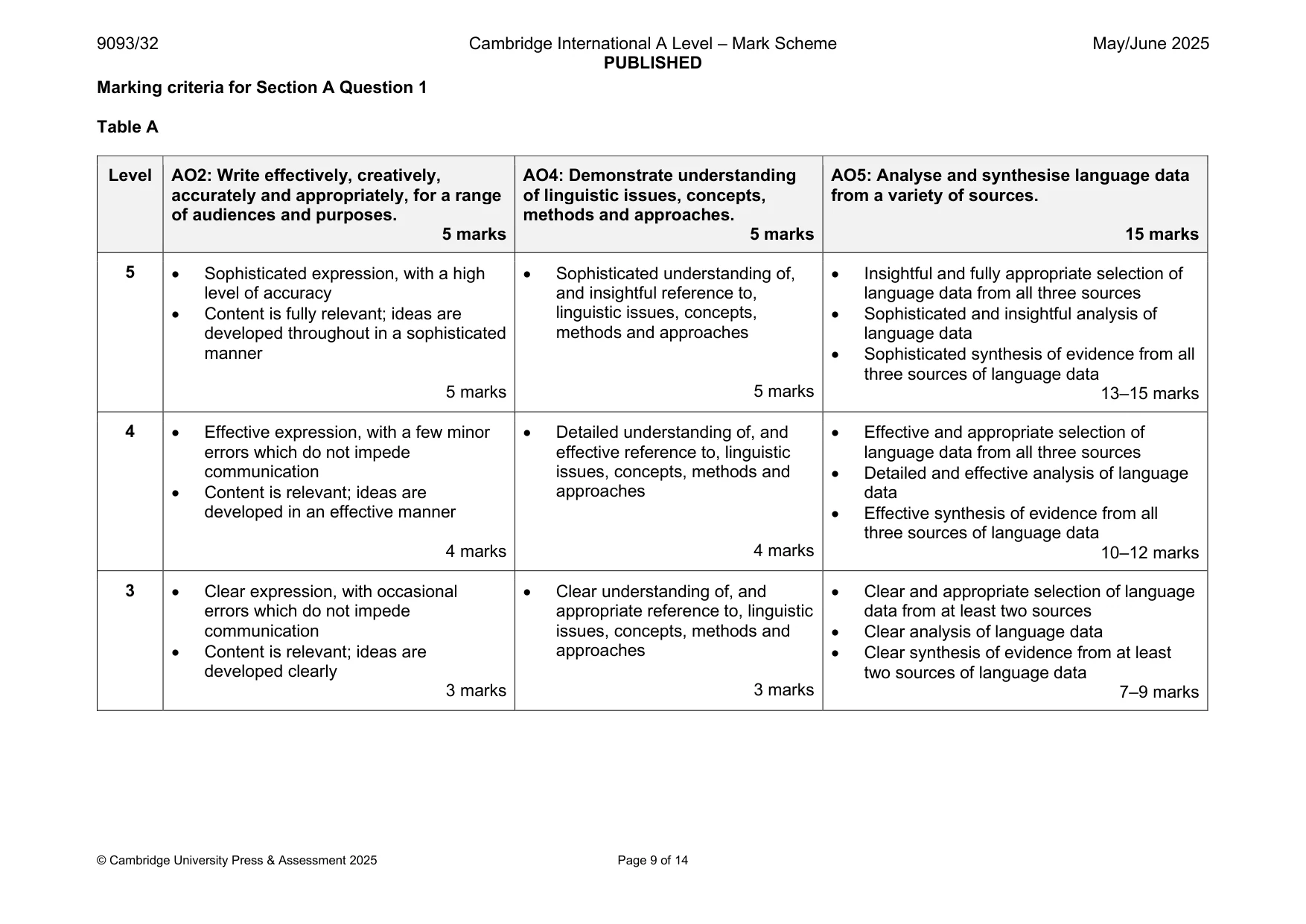
9093/32 Cambridge International A Level – Mark Scheme PUBLISHED May/June 2025 © Cambridge University Press & Assessment 2025 Page 9 of 14 Marking criteria for Section A Question 1 Table A Level AO2: Write effectively, creatively, accurately and appropriately, for a range of audiences and purposes. 5 marks AO4: Demonstrate understanding of linguistic issues, concepts, methods and approaches. 5 marks AO5: Analyse and synthesise language data from a variety of sources. 15 marks 5 • Sophisticated expression, with a high level of accuracy • Content is fully relevant; ideas are developed throughout in a sophisticated manner 5 marks • Sophisticated understanding of, and insightful reference to, linguistic issues, concepts, methods and approaches 5 marks • Insightful and fully appropriate selection of language data from all three sources • Sophisticated and insightful analysis of language data • Sophisticated synthesis of evidence from all three sources of language data 13–15 marks 4 • Effective expression, with a few minor errors which do not impede communication • Content is relevant; ideas are developed in an effective manner 4 marks • Detailed understanding of, and effective reference to, linguistic issues, concepts, methods and approaches 4 marks • Effective and appropriate selection of language data from all three sources • Detailed and effective analysis of language data • Effective synthesis of evidence from all three sources of language data 10–12 marks 3 • Clear expression, with occasional errors which do not impede communication • Content is relevant; ideas are developed clearly 3 marks • Clear understanding of, and appropriate reference to, linguistic issues, concepts, methods and approaches 3 marks • Clear and appropriate selection of language data from at least two sources • Clear analysis of language data • Clear synthesis of evidence from at least two sources of language data 7–9 marks
Mark scheme, page 10
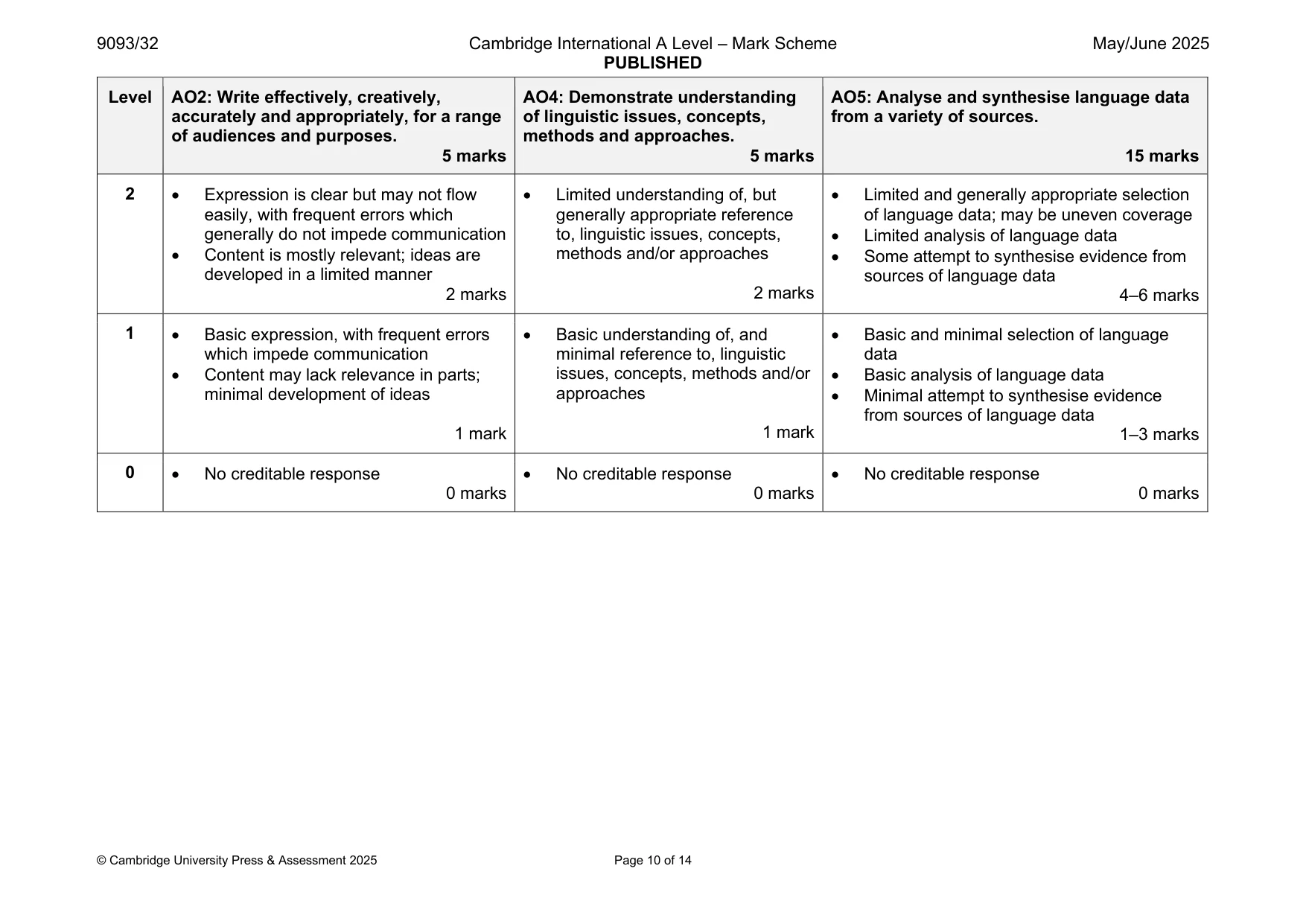
9093/32 Cambridge International A Level – Mark Scheme PUBLISHED May/June 2025 © Cambridge University Press & Assessment 2025 Page 10 of 14 Level AO2: Write effectively, creatively, accurately and appropriately, for a range of audiences and purposes. 5 marks AO4: Demonstrate understanding of linguistic issues, concepts, methods and approaches. 5 marks AO5: Analyse and synthesise language data from a variety of sources. 15 marks 2 • Expression is clear but may not flow easily, with frequent errors which generally do not impede communication • Content is mostly relevant; ideas are developed in a limited manner 2 marks • Limited understanding of, but generally appropriate reference to, linguistic issues, concepts, methods and/or approaches 2 marks • Limited and generally appropriate selection of language data; may be uneven coverage • Limited analysis of language data • Some attempt to synthesise evidence from sources of language data 4–6 marks 1 • Basic expression, with frequent errors which impede communication • Content may lack relevance in parts; minimal development of ideas 1 mark • Basic understanding of, and minimal reference to, linguistic issues, concepts, methods and/or approaches 1 mark • Basic and minimal selection of language data • Basic analysis of language data • Minimal attempt to synthesise evidence from sources of language data 1–3 marks 0 • No creditable response 0 marks • No creditable response 0 marks • No creditable response 0 marks
Mark scheme, page 11
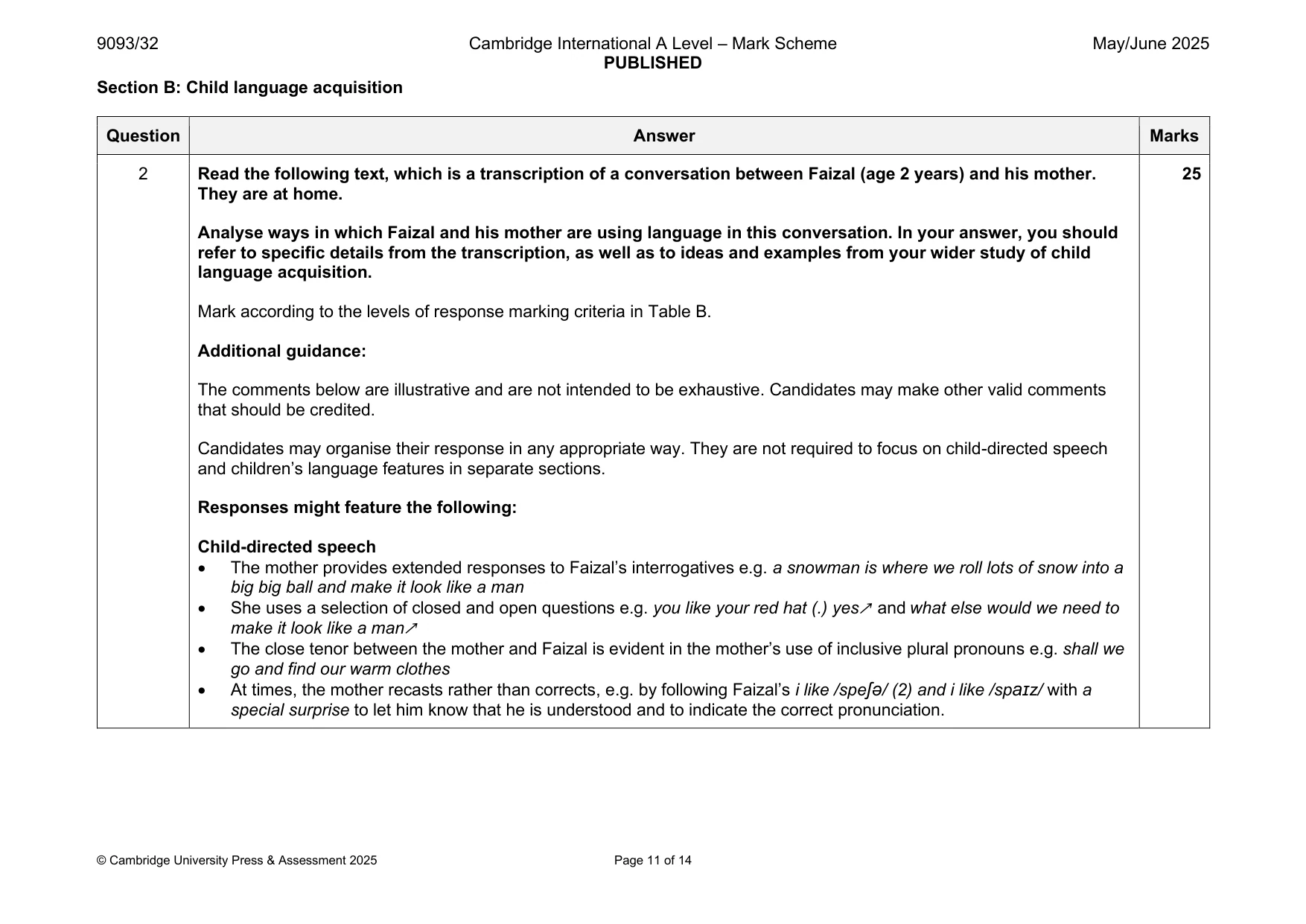
9093/32 Cambridge International A Level – Mark Scheme PUBLISHED May/June 2025 © Cambridge University Press & Assessment 2025 Page 11 of 14 Section B: Child language acquisition Question Answer Marks 2 Read the following text, which is a transcription of a conversation between Faizal (age 2 years) and his mother. They are at home. Analyse ways in which Faizal and his mother are using language in this conversation. In your answer, you should refer to specific details from the transcription, as well as to ideas and examples from your wider study of child language acquisition. Mark according to the levels of response marking criteria in Table B. Additional guidance: The comments below are illustrative and are not intended to be exhaustive. Candidates may make other valid comments that should be credited. Candidates may organise their response in any appropriate way. They are not required to focus on child-directed speech and children’s language features in separate sections. Responses might feature the following: Child-directed speech • The mother provides extended responses to Faizal’s interrogatives e.g. a snowman is where we roll lots of snow into a big big ball and make it look like a man • She uses a selection of closed and open questions e.g. you like your red hat (.) yes↗ and what else would we need to make it look like a man↗ • The close tenor between the mother and Faizal is evident in the mother’s use of inclusive plural pronouns e.g. shall we go and find our warm clothes • At times, the mother recasts rather than corrects, e.g. by following Faizal’s i like /speʃə/ (2) and i like /spaɪz/ with a special surprise to let him know that he is understood and to indicate the correct pronunciation. 25
Mark scheme, page 12
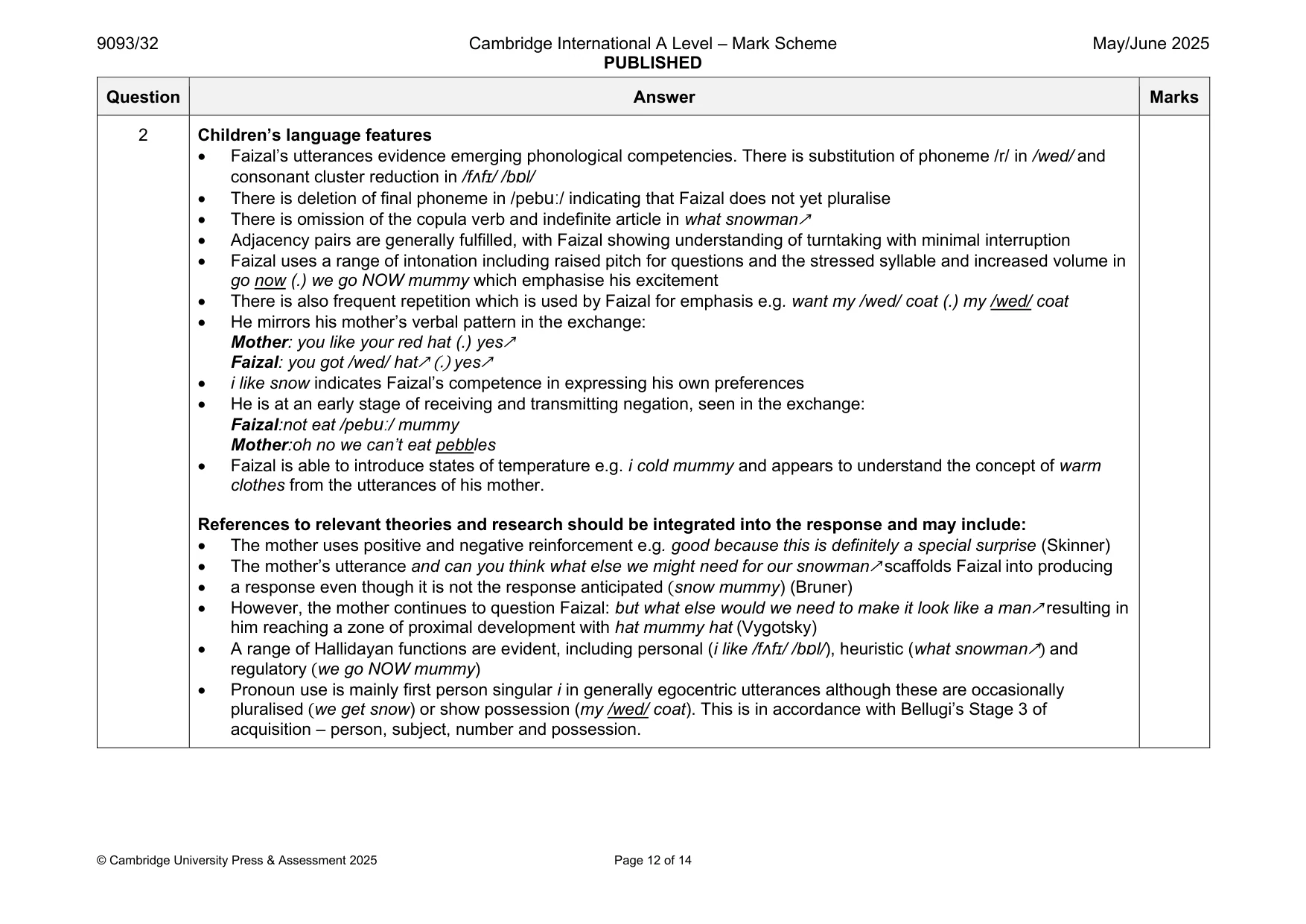
9093/32 Cambridge International A Level – Mark Scheme PUBLISHED May/June 2025 © Cambridge University Press & Assessment 2025 Page 12 of 14 Question Answer Marks 2 Children’s language features • Faizal’s utterances evidence emerging phonological competencies. There is substitution of phoneme /r/ in /wed/ and consonant cluster reduction in /fʌfɪ/ /bɒl/ • There is deletion of final phoneme in /pebuː/ indicating that Faizal does not yet pluralise • There is omission of the copula verb and indefinite article in what snowman↗ • Adjacency pairs are generally fulfilled, with Faizal showing understanding of turntaking with minimal interruption • Faizal uses a range of intonation including raised pitch for questions and the stressed syllable and increased volume in go now (.) we go NOW mummy which emphasise his excitement • There is also frequent repetition which is used by Faizal for emphasis e.g. want my /wed/ coat (.) my /wed/ coat • He mirrors his mother’s verbal pattern in the exchange: Mother: you like your red hat (.) yes↗ Faizal: you got /wed/ hat↗ (.) yes↗ • i like snow indicates Faizal’s competence in expressing his own preferences • He is at an early stage of receiving and transmitting negation, seen in the exchange: Faizal:not eat /pebuː/ mummy Mother:oh no we can’t eat pebbles • Faizal is able to introduce states of temperature e.g. i cold mummy and appears to understand the concept of warm clothes from the utterances of his mother. References to relevant theories and research should be integrated into the response and may include: • The mother uses positive and negative reinforcement e.g. good because this is definitely a special surprise (Skinner) • The mother’s utterance and can you think what else we might need for our snowman↗ scaffolds Faizal into producing • a response even though it is not the response anticipated (snow mummy) (Bruner) • However, the mother continues to question Faizal: but what else would we need to make it look like a man↗ resulting in him reaching a zone of proximal development with hat mummy hat (Vygotsky) • A range of Hallidayan functions are evident, including personal (i like /fʌfɪ/ /bɒl/), heuristic (what snowman↗) and regulatory (we go NOW mummy) • Pronoun use is mainly first person singular i in generally egocentric utterances although these are occasionally pluralised (we get snow) or show possession (my /wed/ coat). This is in accordance with Bellugi’s Stage 3 of acquisition – person, subject, number and possession.
Mark scheme, page 13
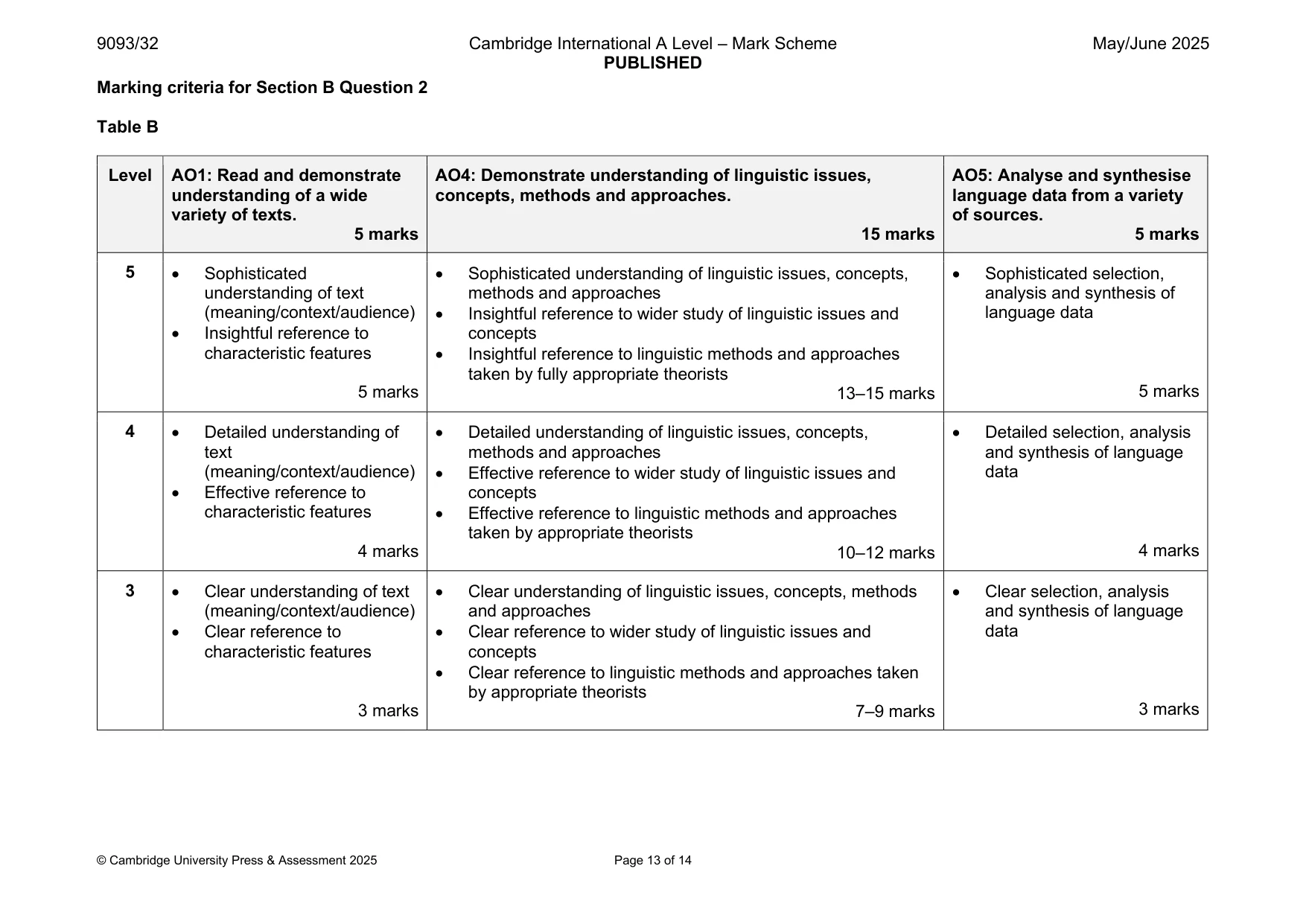
9093/32 Cambridge International A Level – Mark Scheme PUBLISHED May/June 2025 © Cambridge University Press & Assessment 2025 Page 13 of 14 Marking criteria for Section B Question 2 Table B Level AO1: Read and demonstrate understanding of a wide variety of texts. 5 marks AO4: Demonstrate understanding of linguistic issues, concepts, methods and approaches. 15 marks AO5: Analyse and synthesise language data from a variety of sources. 5 marks 5 • Sophisticated understanding of text (meaning/context/audience) • Insightful reference to characteristic features 5 marks • Sophisticated understanding of linguistic issues, concepts, methods and approaches • Insightful reference to wider study of linguistic issues and concepts • Insightful reference to linguistic methods and approaches taken by fully appropriate theorists 13–15 marks • Sophisticated selection, analysis and synthesis of language data 5 marks 4 • Detailed understanding of text (meaning/context/audience) • Effective reference to characteristic features 4 marks • Detailed understanding of linguistic issues, concepts, methods and approaches • Effective reference to wider study of linguistic issues and concepts • Effective reference to linguistic methods and approaches taken by appropriate theorists 10–12 marks • Detailed selection, analysis and synthesis of language data 4 marks 3 • Clear understanding of text (meaning/context/audience) • Clear reference to characteristic features 3 marks • Clear understanding of linguistic issues, concepts, methods and approaches • Clear reference to wider study of linguistic issues and concepts • Clear reference to linguistic methods and approaches taken by appropriate theorists 7–9 marks • Clear selection, analysis and synthesis of language data 3 marks
Mark scheme, page 14
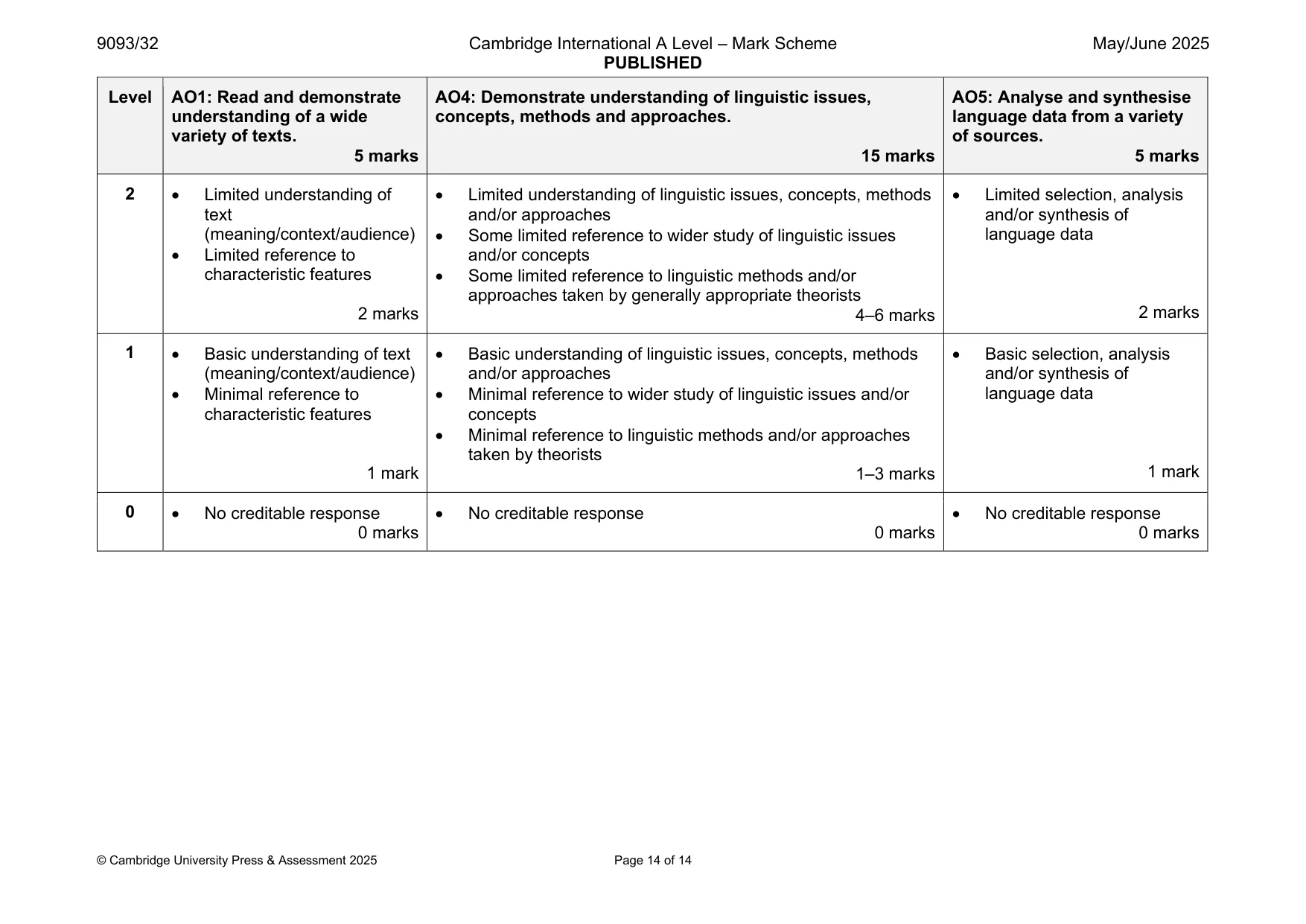
9093/32 Cambridge International A Level – Mark Scheme PUBLISHED May/June 2025 © Cambridge University Press & Assessment 2025 Page 14 of 14 Level AO1: Read and demonstrate understanding of a wide variety of texts. 5 marks AO4: Demonstrate understanding of linguistic issues, concepts, methods and approaches. 15 marks AO5: Analyse and synthesise language data from a variety of sources. 5 marks 2 • Limited understanding of text (meaning/context/audience) • Limited reference to characteristic features 2 marks • Limited understanding of linguistic issues, concepts, methods and/or approaches • Some limited reference to wider study of linguistic issues and/or concepts • Some limited reference to linguistic methods and/or approaches taken by generally appropriate theorists 4–6 marks • Limited selection, analysis and/or synthesis of language data 2 marks 1 • Basic understanding of text (meaning/context/audience) • Minimal reference to characteristic features 1 mark • Basic understanding of linguistic issues, concepts, methods and/or approaches • Minimal reference to wider study of linguistic issues and/or concepts • Minimal reference to linguistic methods and/or approaches taken by theorists 1–3 marks • Basic selection, analysis and/or synthesis of language data 1 mark 0 • No creditable response 0 marks • No creditable response 0 marks • No creditable response 0 marks
What you needed in this session
Cambridge’s own grade thresholds for 2025 May/June, Paper 3 · Variant 2. A higher threshold means an easier paper — the bar moves with how the cohort did.