Cambridge A Level English - Language AS and A Level (from 2014) 9093 — 2024 May/June Paper 3 · Variant 3
9093/33/M/J/24 · 50 marks · 135 min
The question paper and its mark scheme, free to read here and free to download. This is Cambridge’s own paper, exactly as it was sat.
Question paper8 pages

Mark scheme13 pages
Answers below. Sit the paper first if you are practising.
Paper as text
Question paper, page 1
This document has 8 pages. Any blank pages are indicated. [Turn over Cambridge International AS & A Level ENGLISH LANGUAGE 9093/33 Paper 3 Language Analysis May/June 2024 2 hours 15 minutes You must answer on the enclosed answer booklet. You will need: Answer booklet (enclosed) INSTRUCTIONS ● Answer all questions. ● Follow the instructions on the front cover of the answer booklet. If you need additional answer paper, ask the invigilator for a continuation booklet. ● Dictionaries are not allowed. INFORMATION ● The total mark for this paper is 50. ● The number of marks for each question or part question is shown in brackets [ ]. * 6 1 1 3 0 6 1 0 3 0 * DC (PQ/CB) 329087/5 © UCLES 2024
Question paper, page 2
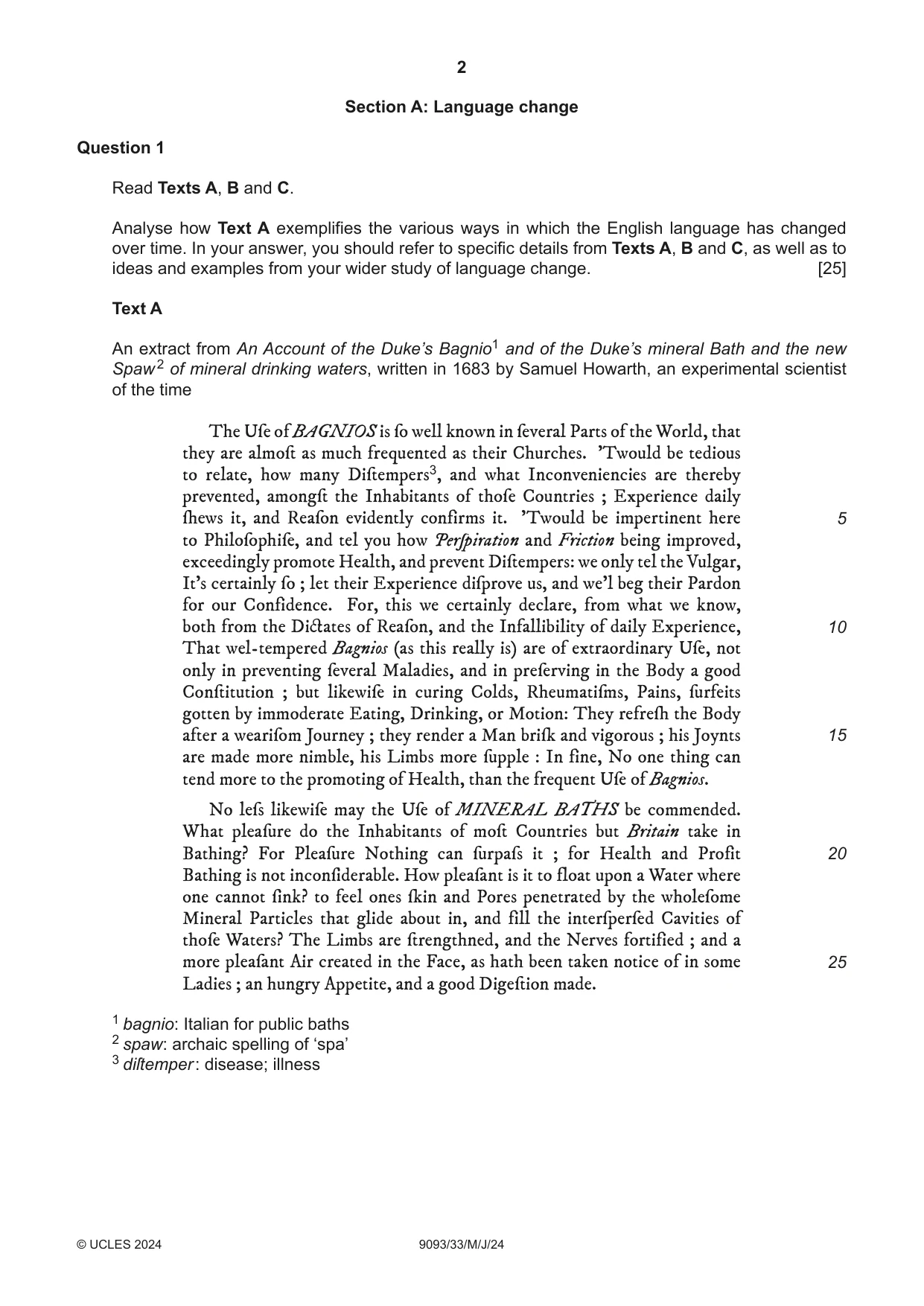
2 9093/33/M/J/24 © UCLES 2024 Section A: Language change Question 1 Read Texts A, B and C. Analyse how Text A exemplifies the various ways in which the English language has changed over time. In your answer, you should refer to specific details from Texts A, B and C, as well as to ideas and examples from your wider study of language change. [25] Text A An extract from An Account of the Duke’s Bagnio1 and of the Duke’s mineral Bath and the new Spaw 2 of mineral drinking waters, written in 1683 by Samuel Howarth, an experimental scientist of the time The Uſe of BAGNIOS is ſo well known in ſeveral Parts of the World, that they are almoſt as much frequented as their Churches. 'Twould be tedious to relate, how many Diſtempers3, and what Inconveniencies are thereby prevented, amongſt the Inhabitants of thoſe Countries ; Experience daily ſhews it, and Reaſon evidently confirms it. ’Twould be impertinent here to Philoſophiſe, and tel you how Perſpiration and Friction being improved, exceedingly promote Health, and prevent Diſtempers: we only tel the Vulgar, It’s certainly ſo ; let their Experience diſprove us, and we’l beg their Pardon for our Confidence. For, this we certainly declare, from what we know, both from the Dictates of Reaſon, and the Infallibility of daily Experience, That wel-tempered Bagnios (as this really is) are of extraordinary Uſe, not only in preventing ſeveral Maladies, and in preſerving in the Body a good Conſtitution ; but likewiſe in curing Colds, Rheumatiſms, Pains, ſurfeits gotten by immoderate Eating, Drinking, or Motion: They refreſh the Body after a weariſom Journey ; they render a Man briſk and vigorous ; his Joynts are made more nimble, his Limbs more ſupple : In fine, No one thing can tend more to the promoting of Health, than the frequent Uſe of Bagnios. No leſs likewiſe may the Uſe of MINERAL BATHS be commended. What pleaſure do the Inhabitants of moſt Countries but Britain take in Bathing? For Pleaſure Nothing can ſurpaſs it ; for Health and Profit Bathing is not inconſiderable. How pleaſant is it to float upon a Water where one cannot ſink? to feel ones ſkin and Pores penetrated by the wholeſome Mineral Particles that glide about in, and fill the interſperſed Cavities of thoſe Waters? The Limbs are ſtrengthned, and the Nerves fortified ; and a more pleaſant Air created in the Face, as hath been taken notice of in some Ladies ; an hungry Appetite, and a good Digeſtion made. 1 bagnio: Italian for public baths 2 spaw: archaic spelling of ‘spa’ 3 diſtemper : disease; illness 5 10 15 20 25
Question paper, page 3
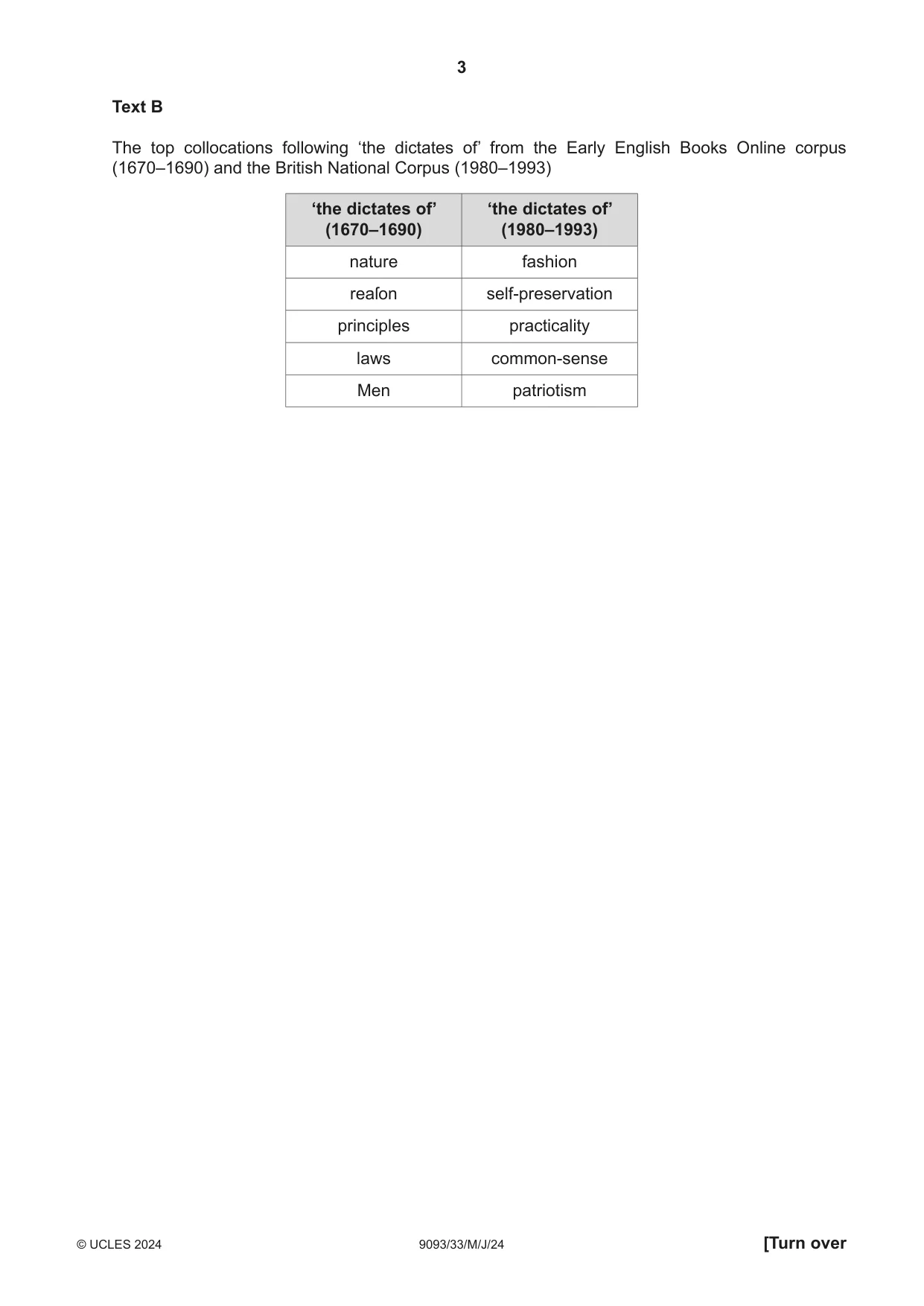
3 9093/33/M/J/24 © UCLES 2024 [Turn over Text B The top collocations following ‘the dictates of’ from the Early English Books Online corpus (1670–1690) and the British National Corpus (1980–1993) ‘the dictates of’ (1670–1690) ‘the dictates of’ (1980–1993) nature fashion reaſon self-preservation principles practicality laws common-sense Men patriotism
Question paper, page 4
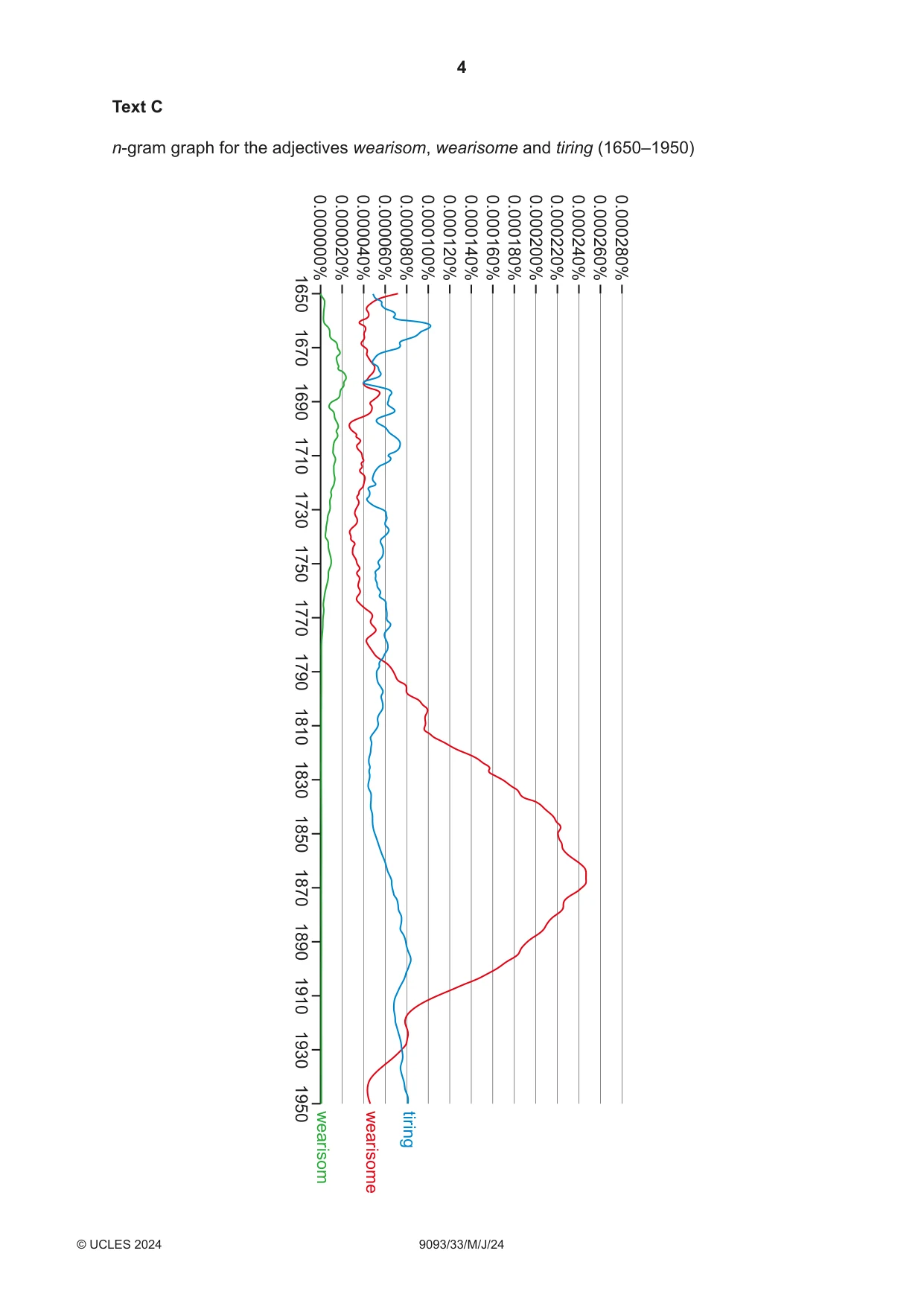
4 9093/33/M/J/24 © UCLES 2024 Text C n-gram graph for the adjectives wearisom, wearisome and tiring (1650–1950) 1650 1670 1690 1710 1730 1750 1770 1790 1810 1830 1850 1870 1890 1910 1930 1950 0.000000% 0.000020% 0.000040% 0.000060% 0.000080% 0.000100% 0.000120% 0.000140% 0.000160% 0.000180% 0.000200% 0.000220% 0.000240% 0.000260% 0.000280% tiring wearisome wearisom
Question paper, page 5
5 9093/33/M/J/24 © UCLES 2024 [Turn over BLANK PAGE
Question paper, page 6
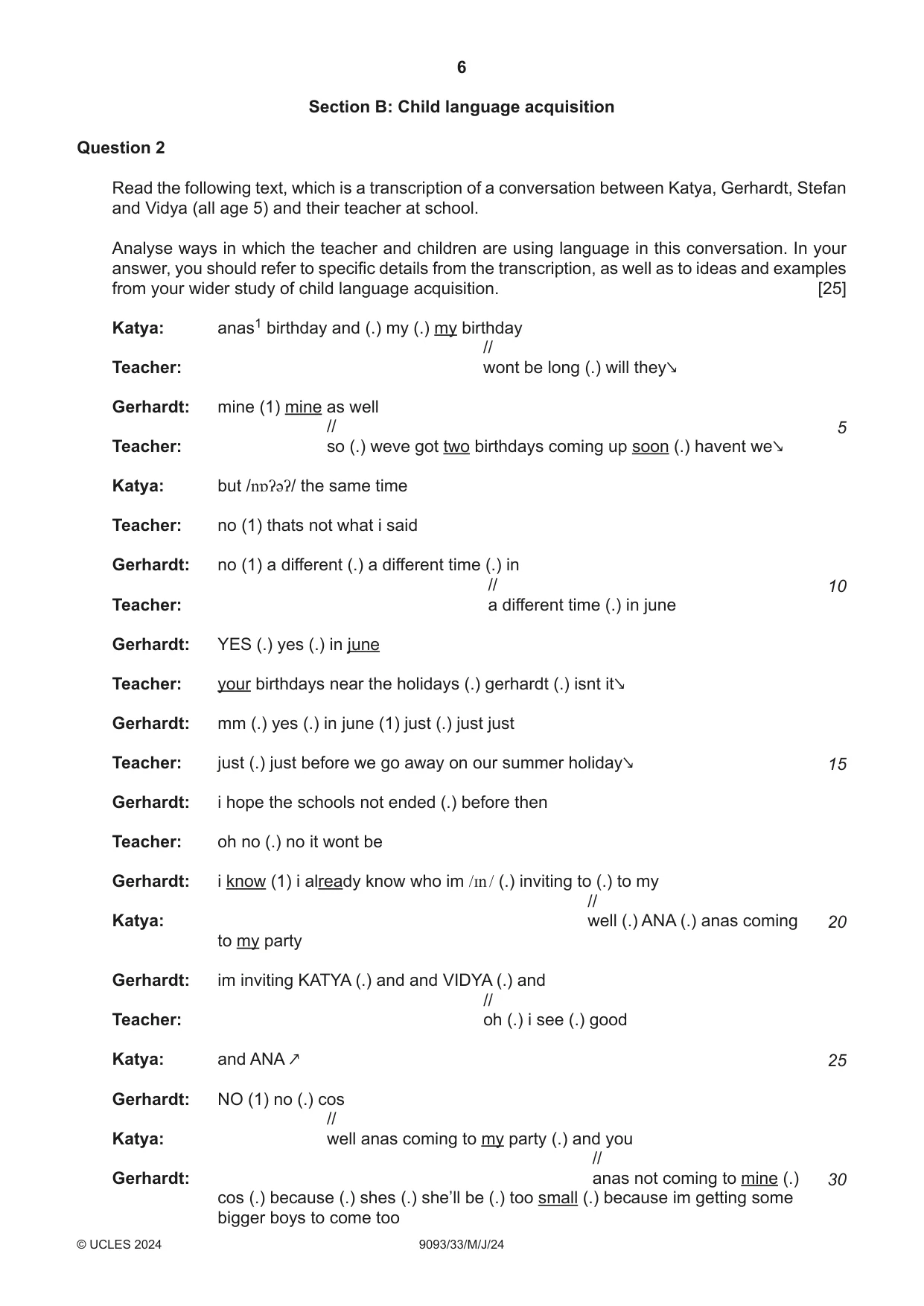
6 9093/33/M/J/24 © UCLES 2024 Section B: Child language acquisition Question 2 Read the following text, which is a transcription of a conversation between Katya, Gerhardt, Stefan and Vidya (all age 5) and their teacher at school. Analyse ways in which the teacher and children are using language in this conversation. In your answer, you should refer to specific details from the transcription, as well as to ideas and examples from your wider study of child language acquisition. [25] Katya: anas1 birthday and (.) my (.) my birthday // Teacher: wont be long (.) will they↘ Gerhardt: mine (1) mine as well // Teacher: so (.) weve got two birthdays coming up soon (.) havent we↘ Katya: but /nɒʔəʔ/ the same time Teacher: no (1) thats not what i said Gerhardt: no (1) a different (.) a different time (.) in // Teacher: a different time (.) in june Gerhardt: YES (.) yes (.) in june Teacher: your birthdays near the holidays (.) gerhardt (.) isnt it↘ Gerhardt: mm (.) yes (.) in june (1) just (.) just just Teacher: just (.) just before we go away on our summer holiday↘ Gerhardt: i hope the schools not ended (.) before then Teacher: oh no (.) no it wont be Gerhardt: i know (1) i already know who im /ɪn / (.) inviting to (.) to my // Katya: well (.) ANA (.) anas coming to my party Gerhardt: im inviting KATYA (.) and and VIDYA (.) and // Teacher: oh (.) i see (.) good Katya: and ANA ↗ Gerhardt: NO (1) no (.) cos // Katya: well anas coming to my party (.) and you // Gerhardt: anas not coming to mine (.) cos (.) because (.) shes (.) she’ll be (.) too small (.) because im getting some bigger boys to come too 5 10 15 20 25 30
Question paper, page 7
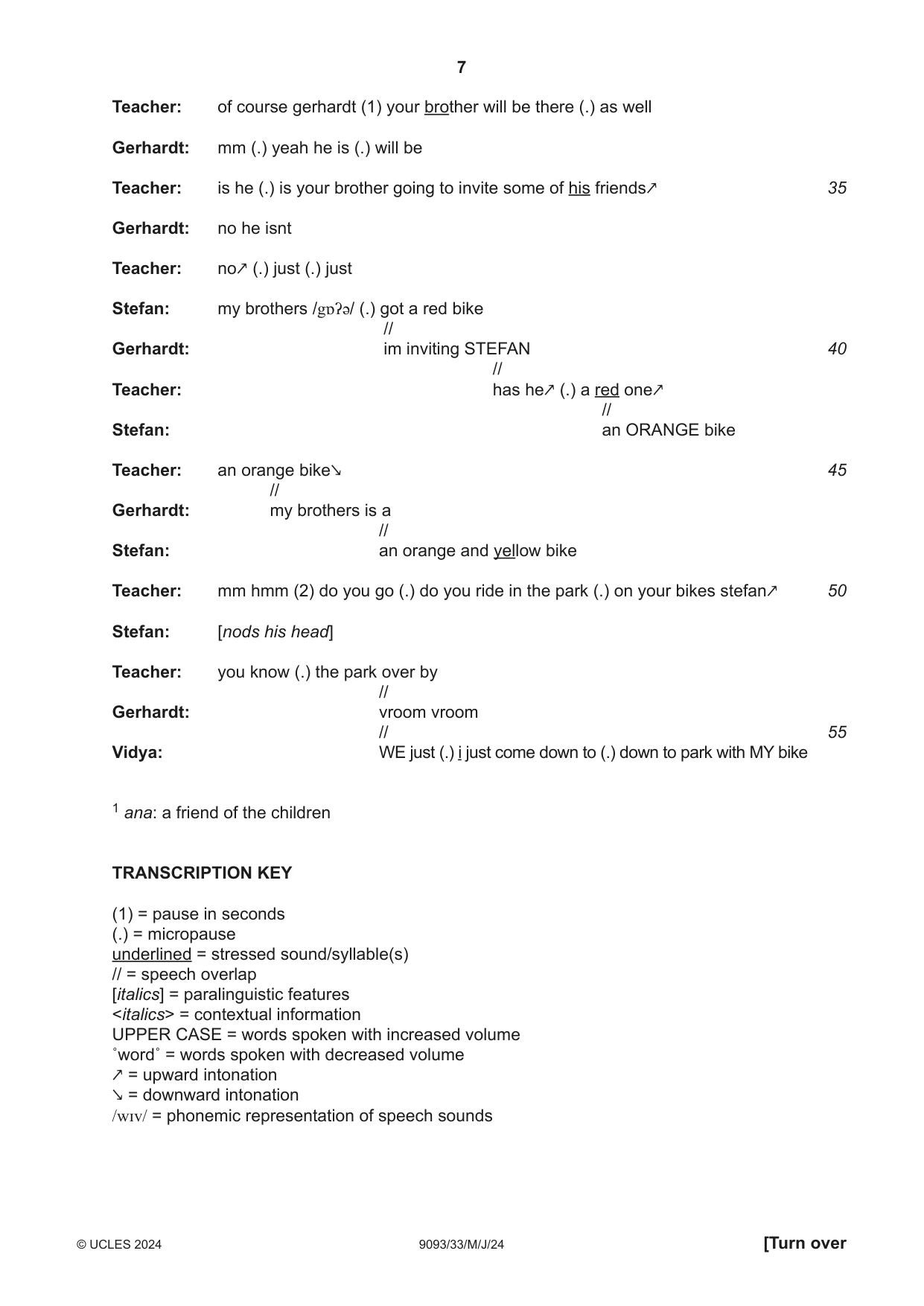
7 9093/33/M/J/24 © UCLES 2024 [Turn over Teacher: of course gerhardt (1) your brother will be there (.) as well Gerhardt: mm (.) yeah he is (.) will be Teacher: is he (.) is your brother going to invite some of his friends↗ Gerhardt: no he isnt Teacher: no↗ (.) just (.) just Stefan: my brothers /gɒʔə/ (.) got a red bike // Gerhardt: im inviting STEFAN // Teacher: has he↗ (.) a red one↗ // Stefan: an ORANGE bike Teacher: an orange bike↘ // Gerhardt: my brothers is a // Stefan: an orange and yellow bike Teacher: mm hmm (2) do you go (.) do you ride in the park (.) on your bikes stefan↗ Stefan: [nods his head] Teacher: you know (.) the park over by // Gerhardt: vroom vroom // Vidya: WE just (.) i just come down to (.) down to park with MY bike 1 ana: a friend of the children TRANSCRIPTION KEY (1) = pause in seconds (.) = micropause underlined = stressed sound/syllable(s) // = speech overlap [italics] = paralinguistic features <italics> = contextual information UPPER CASE = words spoken with increased volume ˚word˚ = words spoken with decreased volume ↗ = upward intonation ↘ = downward intonation /wɪv/ = phonemic representation of speech sounds 35 40 45 50 55
Question paper, page 8
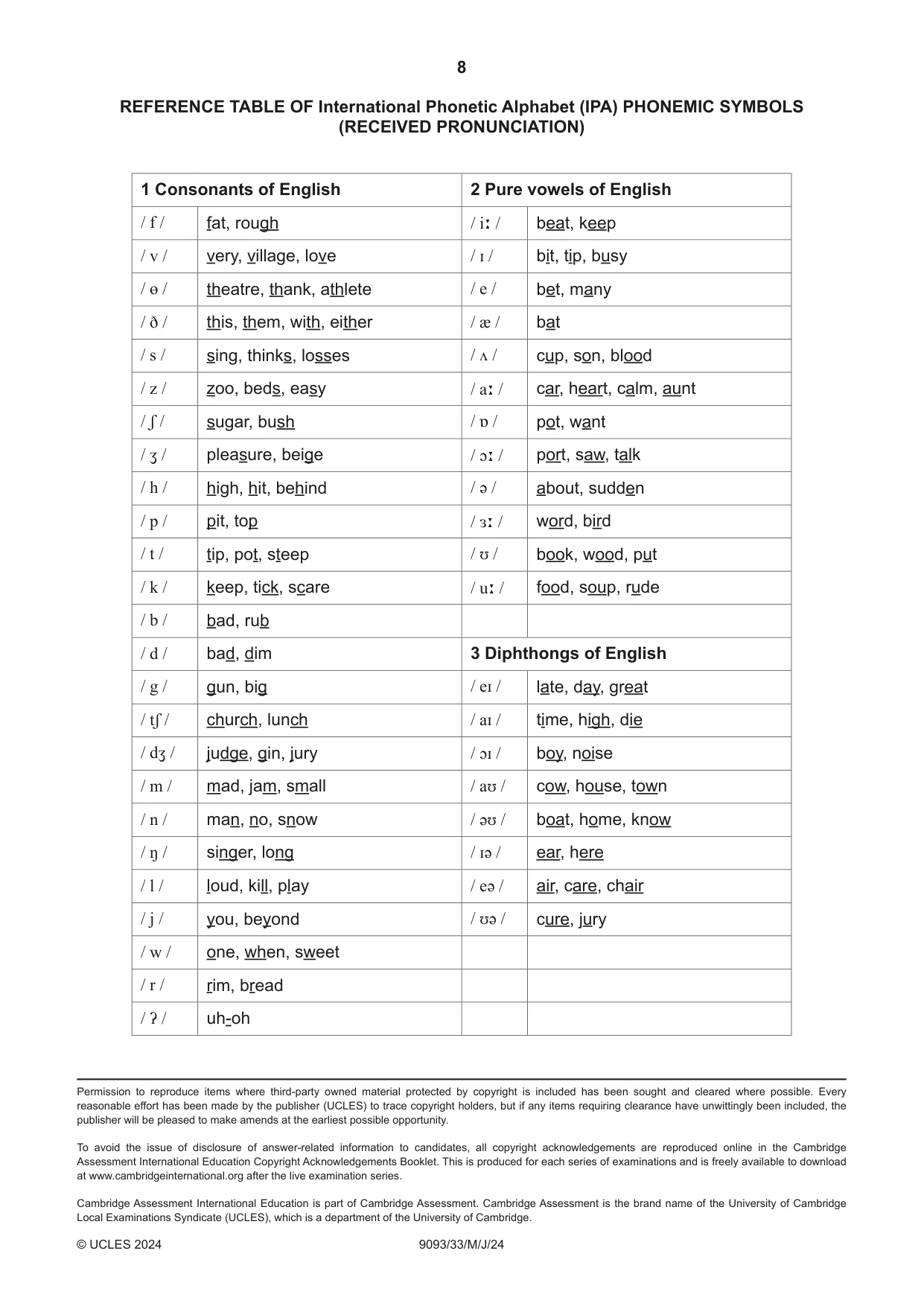
8 9093/33/M/J/24 © UCLES 2024 REFERENCE TABLE OF International Phonetic Alphabet (IPA) PHONEMIC SYMBOLS (RECEIVED PRONUNCIATION) 1 Consonants of English 2 Pure vowels of English / f / fat, rough / iː / beat, keep / v / very, village, love / ɪ / bit, tip, busy / ɵ / theatre, thank, athlete / e / bet, many / ð / this, them, with, either / æ / bat / s / sing, thinks, losses / ʌ / cup, son, blood / z / zoo, beds, easy / aː / car, heart, calm, aunt / ʃ / sugar, bush / ɒ / pot, want / ʒ / pleasure, beige / ɔː / port, saw, talk / h / high, hit, behind / ə / about, sudden / p / pit, top / ɜː / word, bird / t / tip, pot, steep / ʊ / book, wood, put / k / keep, tick, scare / uː / food, soup, rude / b / bad, rub / d / bad, dim 3 Diphthongs of English / g / gun, big / eɪ / late, day, great / tʃ / church, lunch / aɪ / time, high, die / dʒ / judge, gin, jury / ɔɪ / boy, noise / m / mad, jam, small / aʊ / cow, house, town / n / man, no, snow / əʊ / boat, home, know / ŋ / singer, long / ɪə / ear, here / l / loud, kill, play / eə / air, care, chair / j / you, beyond / ʊə / cure, jury / w / one, when, sweet / r / rim, bread / ʔ / uh-oh Permission to reproduce items where third-party owned material protected by copyright is included has been sought and cleared where possible. Every reasonable effort has been made by the publisher (UCLES) to trace copyright holders, but if any items requiring clearance have unwittingly been included, the publisher will be pleased to make amends at the earliest possible opportunity. To avoid the issue of disclosure of answer-related information to candidates, all copyright acknowledgements are reproduced online in the Cambridge Assessment International Education Copyright Acknowledgements Booklet. This is produced for each series of examinations and is freely available to download at www.cambridgeinternational.org after the live examination series. Cambridge Assessment International Education is part of Cambridge Assessment. Cambridge Assessment is the brand name of the University of Cambridge Local Examinations Syndicate (UCLES), which is a department of the University of Cambridge.
Mark scheme, page 1
This document consists of 13 printed pages. © Cambridge University Press & Assessment 2024 [Turn over Cambridge International A Level ENGLISH LANGUAGE 9093/33 Paper 3 Language Analysis May/June 2024 MARK SCHEME Maximum Mark: 50 Published This mark scheme is published as an aid to teachers and candidates, to indicate the requirements of the examination. It shows the basis on which Examiners were instructed to award marks. It does not indicate the details of the discussions that took place at an Examiners’ meeting before marking began, which would have considered the acceptability of alternative answers. Mark schemes should be read in conjunction with the question paper and the Principal Examiner Report for Teachers. Cambridge International will not enter into discussions about these mark schemes. Cambridge International is publishing the mark schemes for the May/June 2024 series for most Cambridge IGCSE, Cambridge International A and AS Level and Cambridge Pre-U components, and some Cambridge O Level components.
Mark scheme, page 2
9093/33 Cambridge International A Level – Mark Scheme PUBLISHED May/June 2024 © Cambridge University Press & Assessment 2024 Page 2 of 13 Generic Marking Principles These general marking principles must be applied by all examiners when marking candidate answers. They should be applied alongside the specific content of the mark scheme or generic level descriptions for a question. Each question paper and mark scheme will also comply with these marking principles. GENERIC MARKING PRINCIPLE 1: Marks must be awarded in line with: the specific content of the mark scheme or the generic level descriptors for the question the specific skills defined in the mark scheme or in the generic level descriptors for the question the standard of response required by a candidate as exemplified by the standardisation scripts. GENERIC MARKING PRINCIPLE 2: Marks awarded are always whole marks (not half marks, or other fractions). GENERIC MARKING PRINCIPLE 3: Marks must be awarded positively: marks are awarded for correct/valid answers, as defined in the mark scheme. However, credit is given for valid answers which go beyond the scope of the syllabus and mark scheme, referring to your Team Leader as appropriate marks are awarded when candidates clearly demonstrate what they know and can do marks are not deducted for errors marks are not deducted for omissions answers should only be judged on the quality of spelling, punctuation and grammar when these features are specifically assessed by the question as indicated by the mark scheme. The meaning, however, should be unambiguous. GENERIC MARKING PRINCIPLE 4: Rules must be applied consistently, e.g. in situations where candidates have not followed instructions or in the application of generic level descriptors.
Mark scheme, page 3
9093/33 Cambridge International A Level – Mark Scheme PUBLISHED May/June 2024 © Cambridge University Press & Assessment 2024 Page 3 of 13 GENERIC MARKING PRINCIPLE 5: Marks should be awarded using the full range of marks defined in the mark scheme for the question (however; the use of the full mark range may be limited according to the quality of the candidate responses seen). GENERIC MARKING PRINCIPLE 6: Marks awarded are based solely on the requirements as defined in the mark scheme. Marks should not be awarded with grade thresholds or grade descriptors in mind.
Mark scheme, page 4
9093/33 Cambridge International A Level – Mark Scheme PUBLISHED May/June 2024 © Cambridge University Press & Assessment 2024 Page 4 of 13 English & Media subject specific general marking principles (To be read in conjunction with the Generic Marking Principles (and requiring further guidance on how to place marks within levels)) Components using level descriptors: We use level descriptors as a guide to broad understanding of the qualities normally expected of, or typical of, work in a level. Level descriptors are a means of general guidance, and should not be interpreted as hurdle statements. Where indicative content notes are supplied for a question, these are not a prescription of required content, and must not be treated as such. Alternative correct points and unexpected answers in candidates’ scripts must be given marks that fairly reflect the knowledge and skills demonstrated. While we may have legitimate expectations as to the ground most answers may occupy, we must at all times be prepared to meet candidates on their chosen ground, provided it is relevant ground (e.g. clearly related to and derived from a relevant passage/text and meeting the mark scheme requirements for the question).
Mark scheme, page 5
9093/33 Cambridge International A Level – Mark Scheme PUBLISHED May/June 2024 © Cambridge University Press & Assessment 2024 Page 5 of 13 English Language specific marking instructions: AO1 Read and demonstrate understanding of a wide variety of texts. (Understanding) Marks should be awarded for the accuracy of the candidate’s understanding of the text and its features, not for any analysis of them which is recognised under AO3. Where comparison is required, marks should be awarded for the candidate’s recognition of similarities and differences between the texts and their features, not for any consequent analysis. When awarding a ‘best-fit’ mark within a Level for each AO, consider each bullet point equally. AO2 Write effectively, creatively, accurately and appropriately, for a range of audiences and purposes. (Writing) Marks should be awarded equally on the basis of the level of the candidate’s written expression (range of features used and accuracy) and the development of their writing (its organisation and relevance to task and audience). When awarding a ‘best-fit’ mark within a Level for each AO, consider each bullet point equally. AO4: Demonstrate understanding of linguistic issues, concepts, methods and approaches. (Conceptualisation) Marks should be awarded equally on the basis of the level of the candidate’s understanding of the relevant issues, concepts, methods and approaches represented both in the text(s) and in their wider studies. When awarding a ‘best-fit’ mark within a Level for each AO, consider each bullet point equally. AO5: Analyse and synthesise language data from a variety of sources. (Data handling) Marks should be awarded equally on the basis of the level of the candidate’s selection, analysis and synthesis of language data. When awarding a ‘best-fit’ mark within a Level for each AO, consider each bullet point equally. Higher marks should be awarded where candidates identify patterns and offer thoughtful and plausible explanations for the features they are discussing. Weaker answers may spot features or describe individual cases of language change without reference to broader considerations or examples.
Mark scheme, page 6
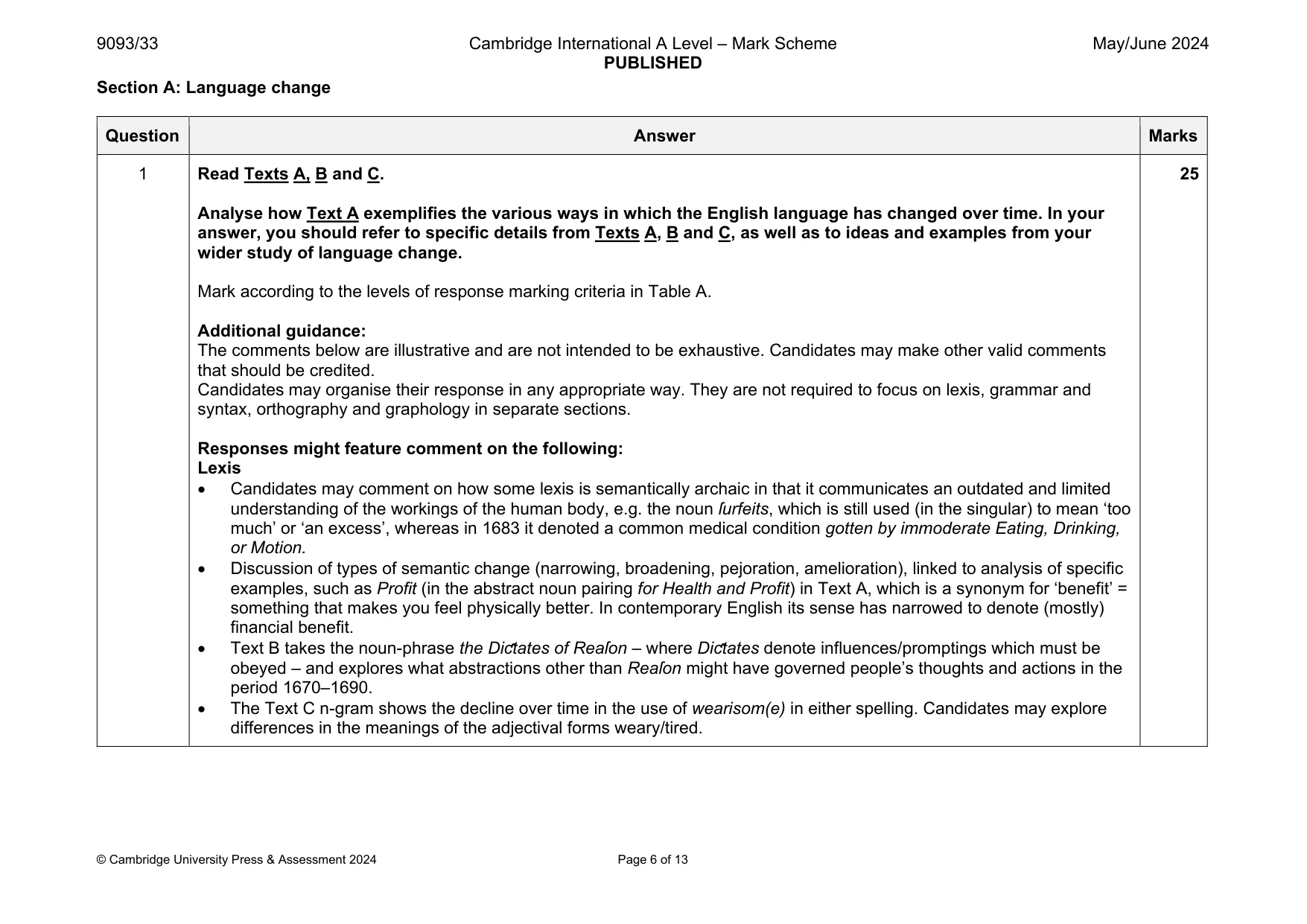
9093/33 Cambridge International A Level – Mark Scheme PUBLISHED May/June 2024 © Cambridge University Press & Assessment 2024 Page 6 of 13 Section A: Language change Question Answer Marks 1 Read Texts A, B and C. Analyse how Text A exemplifies the various ways in which the English language has changed over time. In your answer, you should refer to specific details from Texts A, B and C, as well as to ideas and examples from your wider study of language change. Mark according to the levels of response marking criteria in Table A. Additional guidance: The comments below are illustrative and are not intended to be exhaustive. Candidates may make other valid comments that should be credited. Candidates may organise their response in any appropriate way. They are not required to focus on lexis, grammar and syntax, orthography and graphology in separate sections. Responses might feature comment on the following: Lexis Candidates may comment on how some lexis is semantically archaic in that it communicates an outdated and limited understanding of the workings of the human body, e.g. the noun ſurfeits, which is still used (in the singular) to mean ‘too much’ or ‘an excess’, whereas in 1683 it denoted a common medical condition gotten by immoderate Eating, Drinking, or Motion. Discussion of types of semantic change (narrowing, broadening, pejoration, amelioration), linked to analysis of specific examples, such as Profit (in the abstract noun pairing for Health and Profit) in Text A, which is a synonym for ‘benefit’ = something that makes you feel physically better. In contemporary English its sense has narrowed to denote (mostly) financial benefit. Text B takes the noun-phrase the Diƈtates of Reaſon – where Diƈtates denote influences/promptings which must be obeyed – and explores what abstractions other than Reaſon might have governed people’s thoughts and actions in the period 1670–1690. The Text C n-gram shows the decline over time in the use of wearisom(e) in either spelling. Candidates may explore differences in the meanings of the adjectival forms weary/tired. 25
Mark scheme, page 7
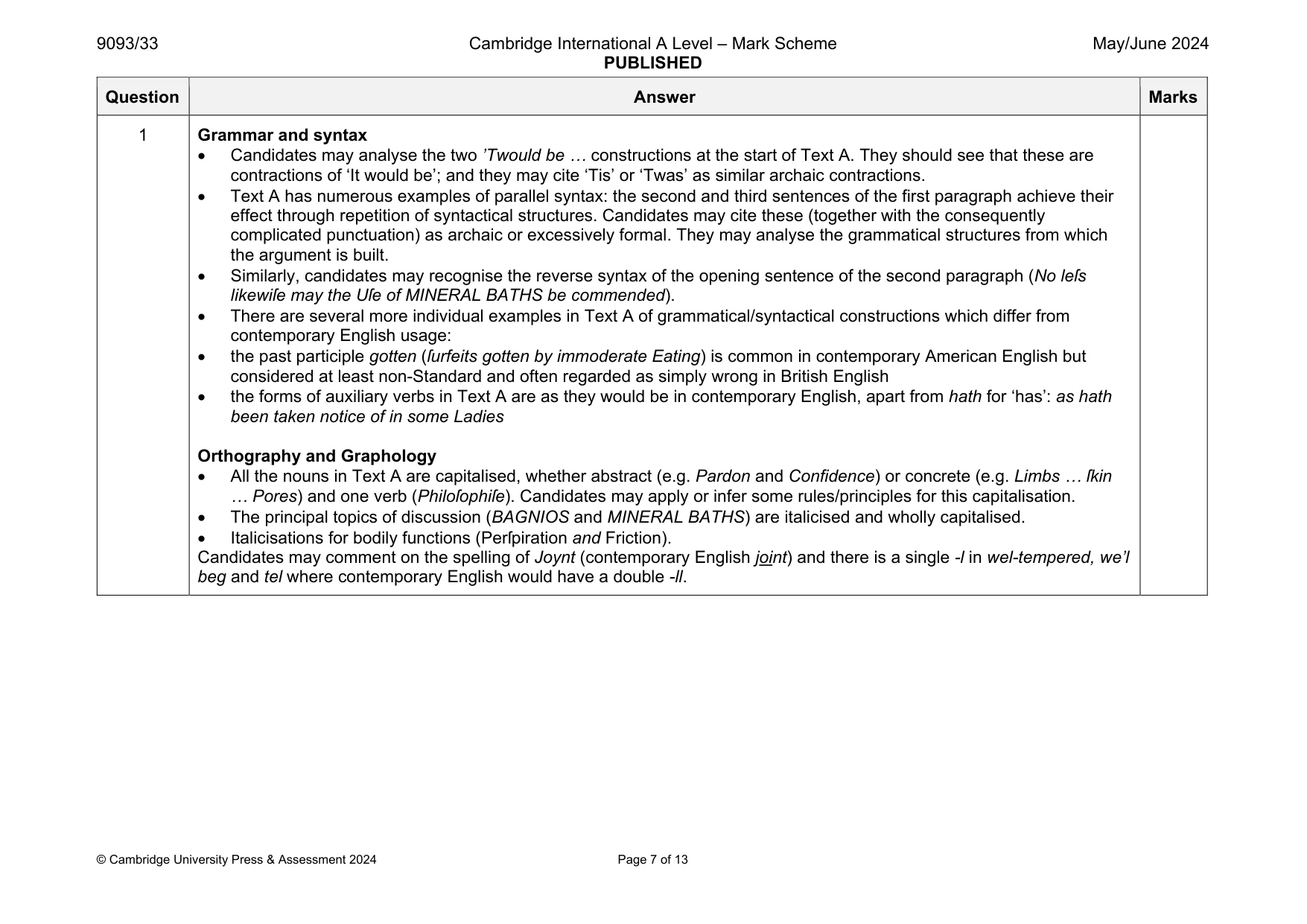
9093/33 Cambridge International A Level – Mark Scheme PUBLISHED May/June 2024 © Cambridge University Press & Assessment 2024 Page 7 of 13 Question Answer Marks 1 Grammar and syntax Candidates may analyse the two ’Twould be … constructions at the start of Text A. They should see that these are contractions of ‘It would be’; and they may cite ‘Tis’ or ‘Twas’ as similar archaic contractions. Text A has numerous examples of parallel syntax: the second and third sentences of the first paragraph achieve their effect through repetition of syntactical structures. Candidates may cite these (together with the consequently complicated punctuation) as archaic or excessively formal. They may analyse the grammatical structures from which the argument is built. Similarly, candidates may recognise the reverse syntax of the opening sentence of the second paragraph (No leſs likewiſe may the Uſe of MINERAL BATHS be commended). There are several more individual examples in Text A of grammatical/syntactical constructions which differ from contemporary English usage: the past participle gotten (ſurfeits gotten by immoderate Eating) is common in contemporary American English but considered at least non-Standard and often regarded as simply wrong in British English the forms of auxiliary verbs in Text A are as they would be in contemporary English, apart from hath for ‘has’: as hath been taken notice of in some Ladies Orthography and Graphology All the nouns in Text A are capitalised, whether abstract (e.g. Pardon and Confidence) or concrete (e.g. Limbs … ſkin … Pores) and one verb (Philoſophiſe). Candidates may apply or infer some rules/principles for this capitalisation. The principal topics of discussion (BAGNIOS and MINERAL BATHS) are italicised and wholly capitalised. Italicisations for bodily functions (Perſpiration and Friction). Candidates may comment on the spelling of Joynt (contemporary English joint) and there is a single -l in wel-tempered, we’l beg and tel where contemporary English would have a double -ll.
Mark scheme, page 8
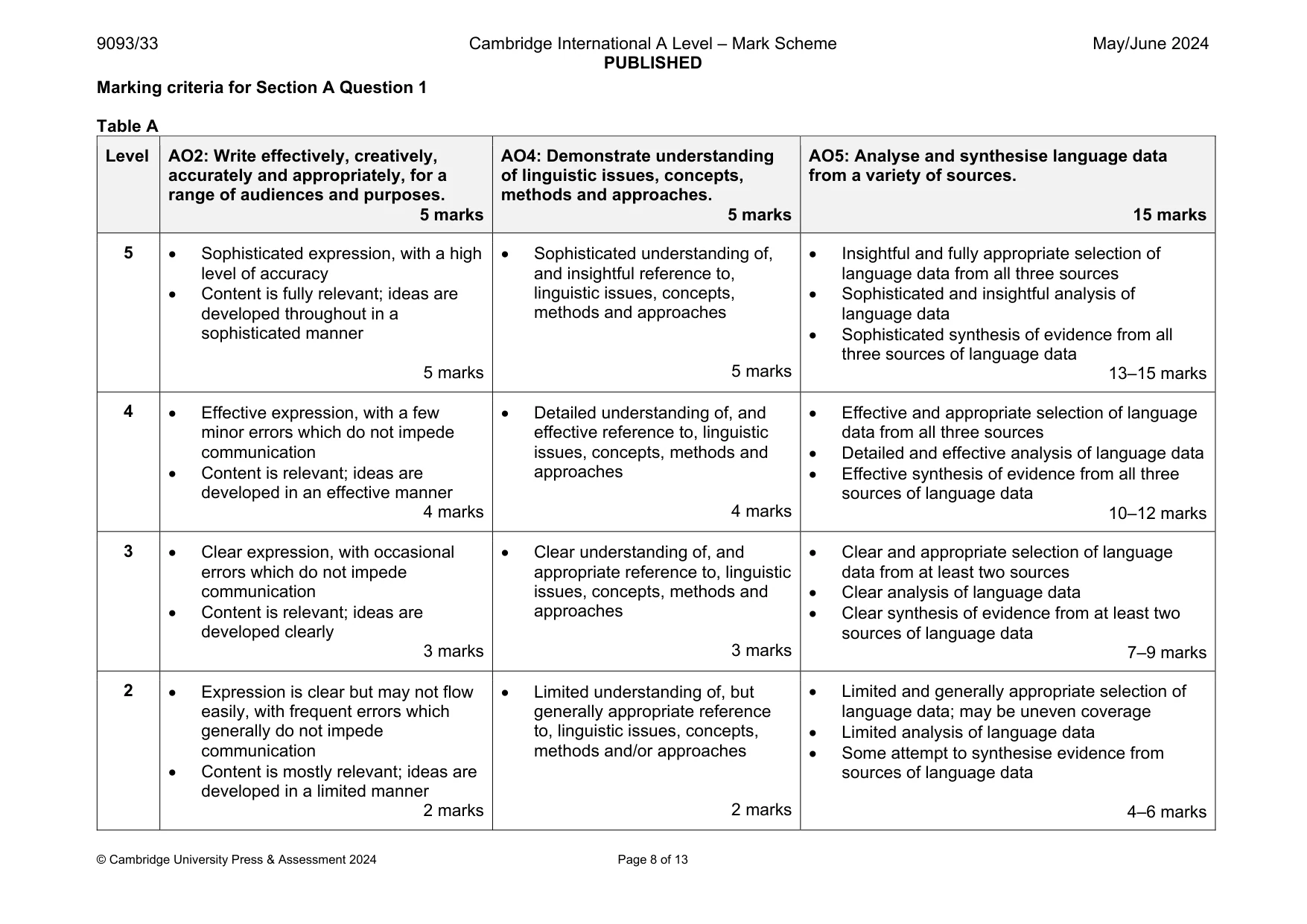
9093/33 Cambridge International A Level – Mark Scheme PUBLISHED May/June 2024 © Cambridge University Press & Assessment 2024 Page 8 of 13 Marking criteria for Section A Question 1 Table A Level AO2: Write effectively, creatively, accurately and appropriately, for a range of audiences and purposes. 5 marks AO4: Demonstrate understanding of linguistic issues, concepts, methods and approaches. 5 marks AO5: Analyse and synthesise language data from a variety of sources. 15 marks 5 Sophisticated expression, with a high level of accuracy Content is fully relevant; ideas are developed throughout in a sophisticated manner 5 marks Sophisticated understanding of, and insightful reference to, linguistic issues, concepts, methods and approaches 5 marks Insightful and fully appropriate selection of language data from all three sources Sophisticated and insightful analysis of language data Sophisticated synthesis of evidence from all three sources of language data 13–15 marks 4 Effective expression, with a few minor errors which do not impede communication Content is relevant; ideas are developed in an effective manner 4 marks Detailed understanding of, and effective reference to, linguistic issues, concepts, methods and approaches 4 marks Effective and appropriate selection of language data from all three sources Detailed and effective analysis of language data Effective synthesis of evidence from all three sources of language data 10–12 marks 3 Clear expression, with occasional errors which do not impede communication Content is relevant; ideas are developed clearly 3 marks Clear understanding of, and appropriate reference to, linguistic issues, concepts, methods and approaches 3 marks Clear and appropriate selection of language data from at least two sources Clear analysis of language data Clear synthesis of evidence from at least two sources of language data 7–9 marks 2 Expression is clear but may not flow easily, with frequent errors which generally do not impede communication Content is mostly relevant; ideas are developed in a limited manner 2 marks Limited understanding of, but generally appropriate reference to, linguistic issues, concepts, methods and/or approaches 2 marks Limited and generally appropriate selection of language data; may be uneven coverage Limited analysis of language data Some attempt to synthesise evidence from sources of language data 4–6 marks
Mark scheme, page 9
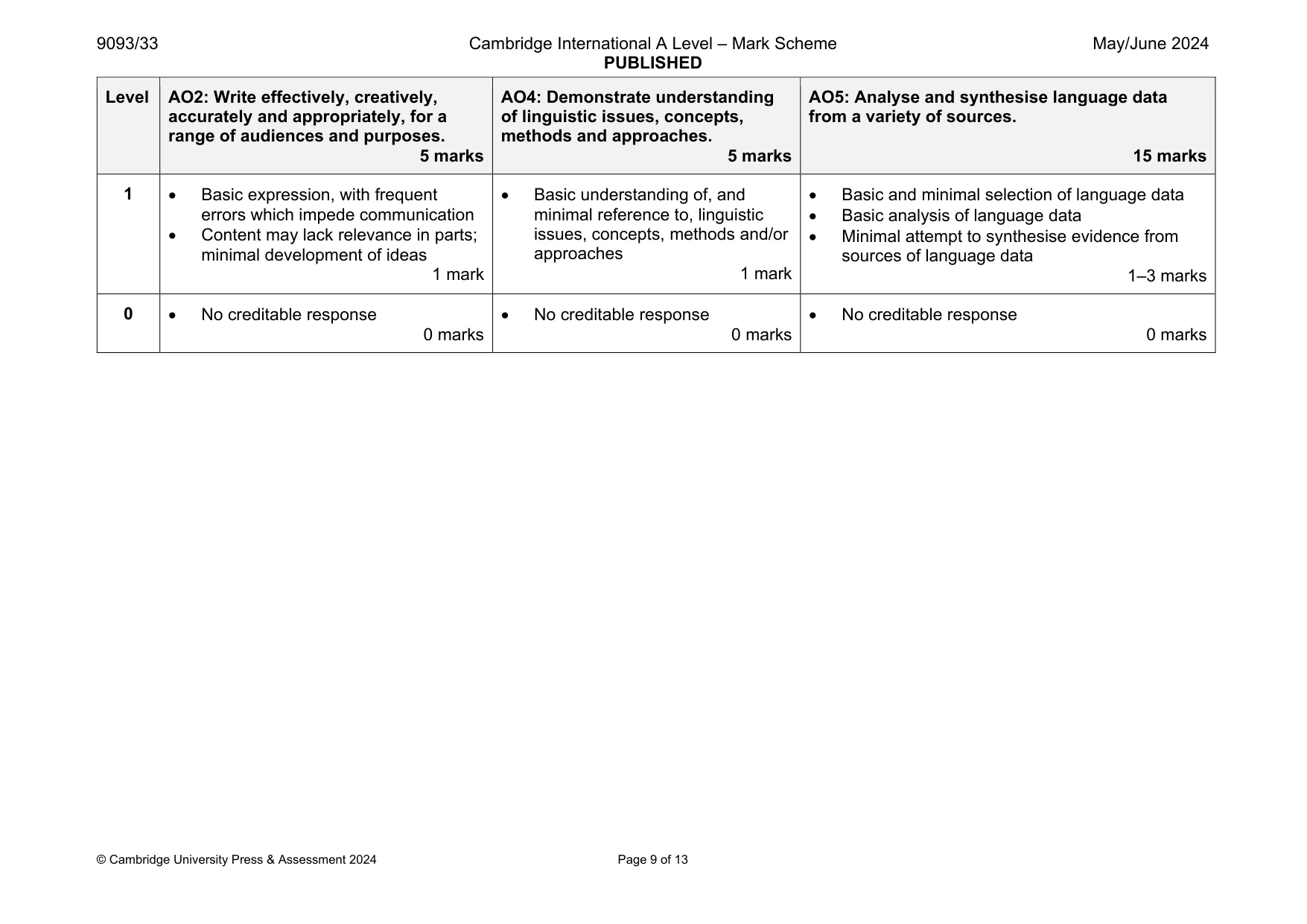
9093/33 Cambridge International A Level – Mark Scheme PUBLISHED May/June 2024 © Cambridge University Press & Assessment 2024 Page 9 of 13 Level AO2: Write effectively, creatively, accurately and appropriately, for a range of audiences and purposes. 5 marks AO4: Demonstrate understanding of linguistic issues, concepts, methods and approaches. 5 marks AO5: Analyse and synthesise language data from a variety of sources. 15 marks 1 Basic expression, with frequent errors which impede communication Content may lack relevance in parts; minimal development of ideas 1 mark Basic understanding of, and minimal reference to, linguistic issues, concepts, methods and/or approaches 1 mark Basic and minimal selection of language data Basic analysis of language data Minimal attempt to synthesise evidence from sources of language data 1–3 marks 0 No creditable response 0 marks No creditable response 0 marks No creditable response 0 marks
Mark scheme, page 10
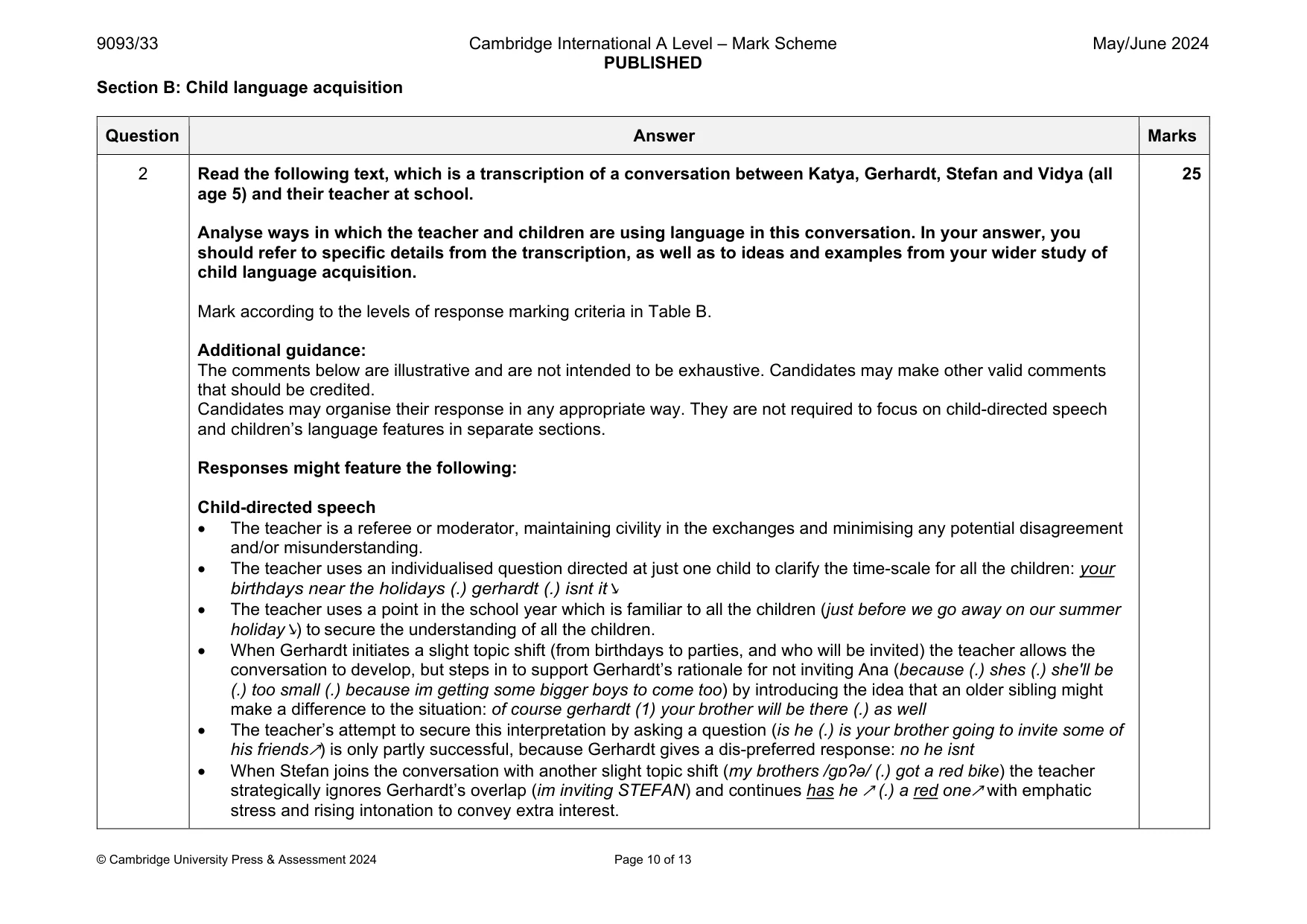
9093/33 Cambridge International A Level – Mark Scheme PUBLISHED May/June 2024 © Cambridge University Press & Assessment 2024 Page 10 of 13 Section B: Child language acquisition Question Answer Marks 2 Read the following text, which is a transcription of a conversation between Katya, Gerhardt, Stefan and Vidya (all age 5) and their teacher at school. Analyse ways in which the teacher and children are using language in this conversation. In your answer, you should refer to specific details from the transcription, as well as to ideas and examples from your wider study of child language acquisition. Mark according to the levels of response marking criteria in Table B. Additional guidance: The comments below are illustrative and are not intended to be exhaustive. Candidates may make other valid comments that should be credited. Candidates may organise their response in any appropriate way. They are not required to focus on child-directed speech and children’s language features in separate sections. Responses might feature the following: Child-directed speech The teacher is a referee or moderator, maintaining civility in the exchanges and minimising any potential disagreement and/or misunderstanding. The teacher uses an individualised question directed at just one child to clarify the time-scale for all the children: your birthdays near the holidays (.) gerhardt (.) isnt it↘ The teacher uses a point in the school year which is familiar to all the children (just before we go away on our summer holiday↘) to secure the understanding of all the children. When Gerhardt initiates a slight topic shift (from birthdays to parties, and who will be invited) the teacher allows the conversation to develop, but steps in to support Gerhardt’s rationale for not inviting Ana (because (.) shes (.) she'll be (.) too small (.) because im getting some bigger boys to come too) by introducing the idea that an older sibling might make a difference to the situation: of course gerhardt (1) your brother will be there (.) as well The teacher’s attempt to secure this interpretation by asking a question (is he (.) is your brother going to invite some of his friends↗) is only partly successful, because Gerhardt gives a dis-preferred response: no he isnt When Stefan joins the conversation with another slight topic shift (my brothers /gɒʔə/ (.) got a red bike) the teacher strategically ignores Gerhardt’s overlap (im inviting STEFAN) and continues has he ↗ (.) a red one↗ with emphatic stress and rising intonation to convey extra interest. 25
Mark scheme, page 11
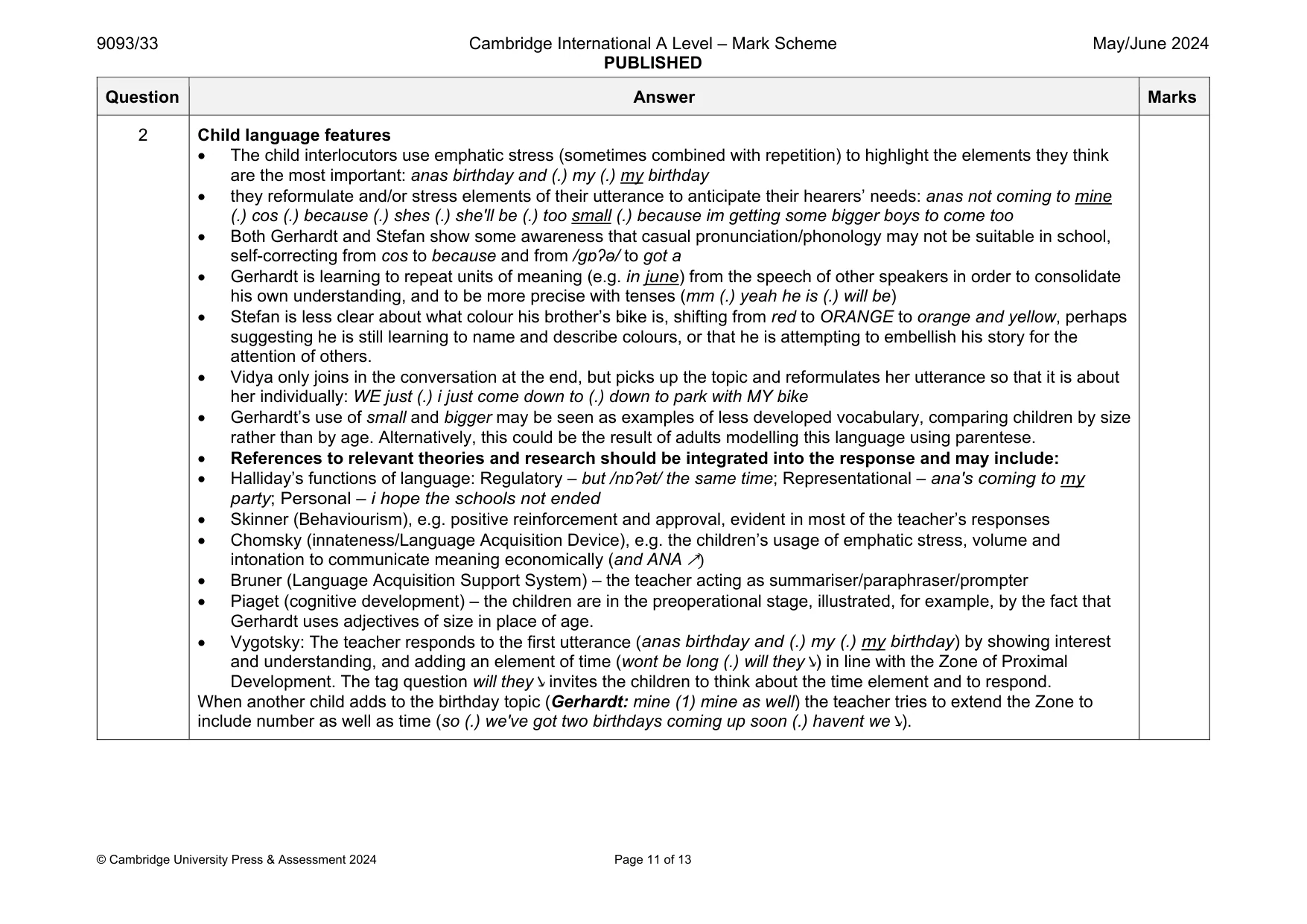
9093/33 Cambridge International A Level – Mark Scheme PUBLISHED May/June 2024 © Cambridge University Press & Assessment 2024 Page 11 of 13 Question Answer Marks 2 Child language features The child interlocutors use emphatic stress (sometimes combined with repetition) to highlight the elements they think are the most important: anas birthday and (.) my (.) my birthday they reformulate and/or stress elements of their utterance to anticipate their hearers’ needs: anas not coming to mine (.) cos (.) because (.) shes (.) she'll be (.) too small (.) because im getting some bigger boys to come too Both Gerhardt and Stefan show some awareness that casual pronunciation/phonology may not be suitable in school, self-correcting from cos to because and from /gɒʔə/ to got a Gerhardt is learning to repeat units of meaning (e.g. in june) from the speech of other speakers in order to consolidate his own understanding, and to be more precise with tenses (mm (.) yeah he is (.) will be) Stefan is less clear about what colour his brother’s bike is, shifting from red to ORANGE to orange and yellow, perhaps suggesting he is still learning to name and describe colours, or that he is attempting to embellish his story for the attention of others. Vidya only joins in the conversation at the end, but picks up the topic and reformulates her utterance so that it is about her individually: WE just (.) i just come down to (.) down to park with MY bike Gerhardt’s use of small and bigger may be seen as examples of less developed vocabulary, comparing children by size rather than by age. Alternatively, this could be the result of adults modelling this language using parentese. References to relevant theories and research should be integrated into the response and may include: Halliday’s functions of language: Regulatory – but /nɒʔət/ the same time; Representational – ana's coming to my party; Personal – i hope the schools not ended Skinner (Behaviourism), e.g. positive reinforcement and approval, evident in most of the teacher’s responses Chomsky (innateness/Language Acquisition Device), e.g. the children’s usage of emphatic stress, volume and intonation to communicate meaning economically (and ANA ↗) Bruner (Language Acquisition Support System) – the teacher acting as summariser/paraphraser/prompter Piaget (cognitive development) – the children are in the preoperational stage, illustrated, for example, by the fact that Gerhardt uses adjectives of size in place of age. Vygotsky: The teacher responds to the first utterance (anas birthday and (.) my (.) my birthday) by showing interest and understanding, and adding an element of time (wont be long (.) will they↘) in line with the Zone of Proximal Development. The tag question will they↘ invites the children to think about the time element and to respond. When another child adds to the birthday topic (Gerhardt: mine (1) mine as well) the teacher tries to extend the Zone to include number as well as time (so (.) we've got two birthdays coming up soon (.) havent we↘).
Mark scheme, page 12
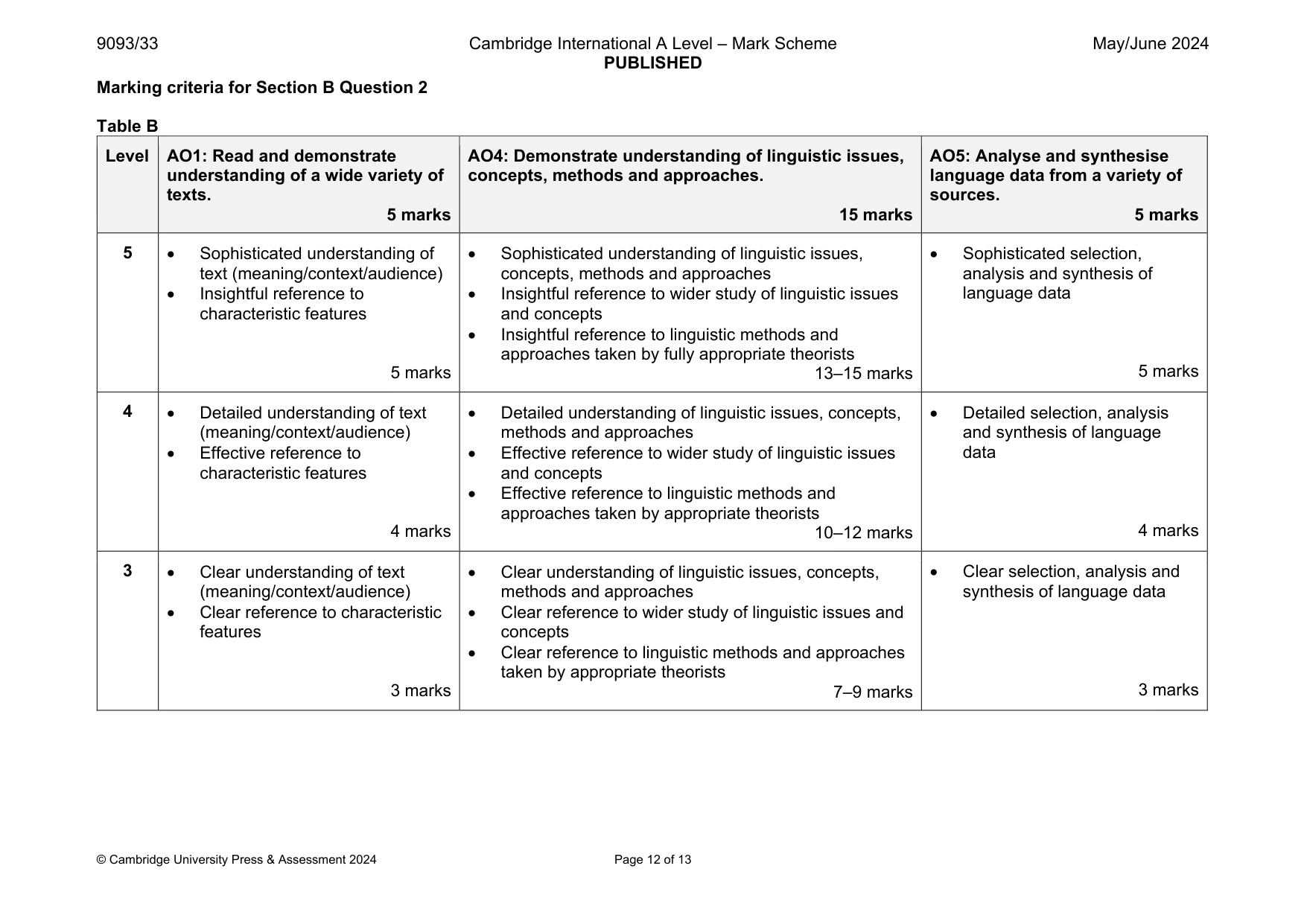
9093/33 Cambridge International A Level – Mark Scheme PUBLISHED May/June 2024 © Cambridge University Press & Assessment 2024 Page 12 of 13 Marking criteria for Section B Question 2 Table B Level AO1: Read and demonstrate understanding of a wide variety of texts. 5 marks AO4: Demonstrate understanding of linguistic issues, concepts, methods and approaches. 15 marks AO5: Analyse and synthesise language data from a variety of sources. 5 marks 5 Sophisticated understanding of text (meaning/context/audience) Insightful reference to characteristic features 5 marks Sophisticated understanding of linguistic issues, concepts, methods and approaches Insightful reference to wider study of linguistic issues and concepts Insightful reference to linguistic methods and approaches taken by fully appropriate theorists 13–15 marks Sophisticated selection, analysis and synthesis of language data 5 marks 4 Detailed understanding of text (meaning/context/audience) Effective reference to characteristic features 4 marks Detailed understanding of linguistic issues, concepts, methods and approaches Effective reference to wider study of linguistic issues and concepts Effective reference to linguistic methods and approaches taken by appropriate theorists 10–12 marks Detailed selection, analysis and synthesis of language data 4 marks 3 Clear understanding of text (meaning/context/audience) Clear reference to characteristic features 3 marks Clear understanding of linguistic issues, concepts, methods and approaches Clear reference to wider study of linguistic issues and concepts Clear reference to linguistic methods and approaches taken by appropriate theorists 7–9 marks Clear selection, analysis and synthesis of language data 3 marks
Mark scheme, page 13
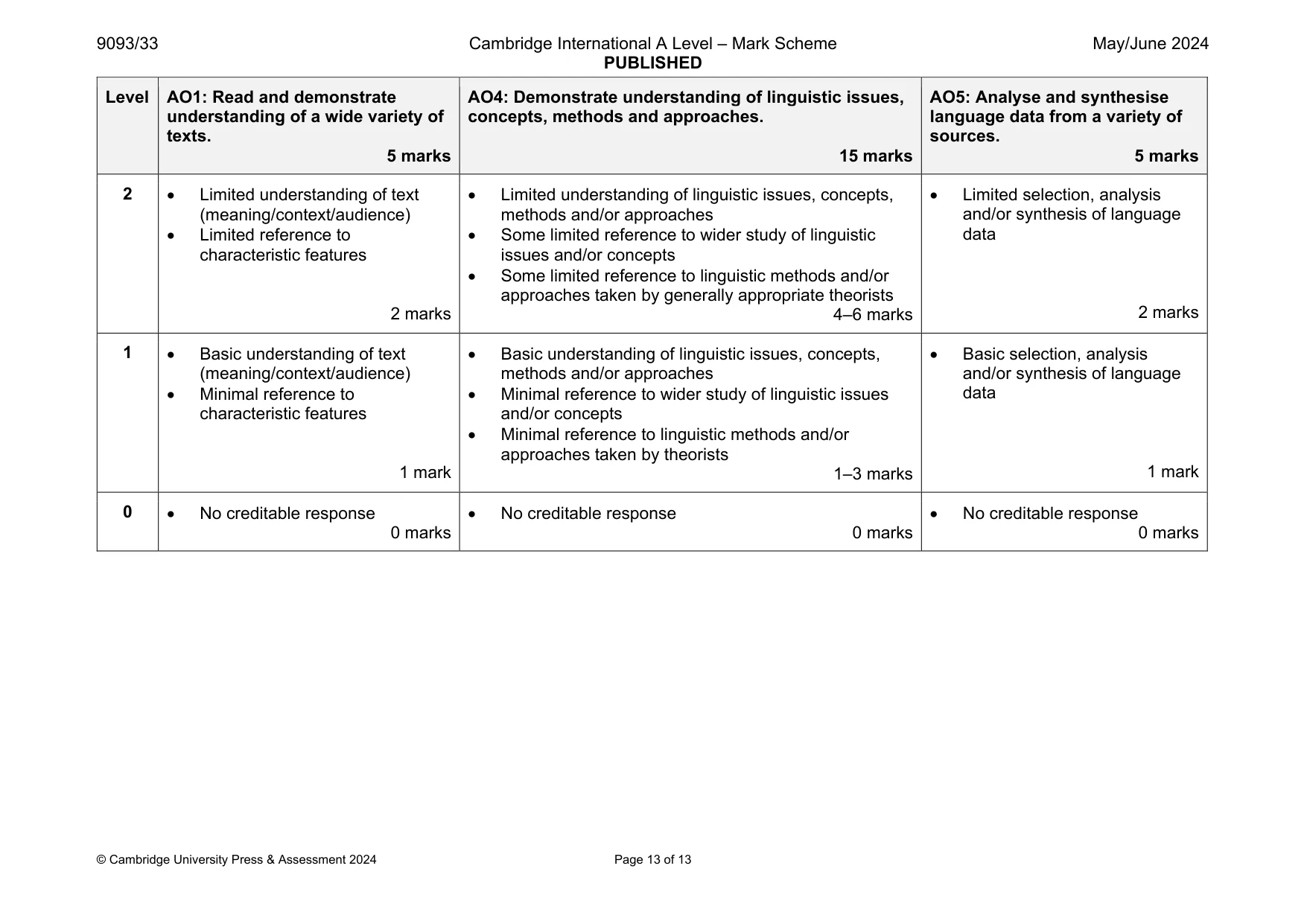
9093/33 Cambridge International A Level – Mark Scheme PUBLISHED May/June 2024 © Cambridge University Press & Assessment 2024 Page 13 of 13 Level AO1: Read and demonstrate understanding of a wide variety of texts. 5 marks AO4: Demonstrate understanding of linguistic issues, concepts, methods and approaches. 15 marks AO5: Analyse and synthesise language data from a variety of sources. 5 marks 2 Limited understanding of text (meaning/context/audience) Limited reference to characteristic features 2 marks Limited understanding of linguistic issues, concepts, methods and/or approaches Some limited reference to wider study of linguistic issues and/or concepts Some limited reference to linguistic methods and/or approaches taken by generally appropriate theorists 4–6 marks Limited selection, analysis and/or synthesis of language data 2 marks 1 Basic understanding of text (meaning/context/audience) Minimal reference to characteristic features 1 mark Basic understanding of linguistic issues, concepts, methods and/or approaches Minimal reference to wider study of linguistic issues and/or concepts Minimal reference to linguistic methods and/or approaches taken by theorists 1–3 marks Basic selection, analysis and/or synthesis of language data 1 mark 0 No creditable response 0 marks No creditable response 0 marks No creditable response 0 marks
What you needed in this session
Cambridge’s own grade thresholds for 2024 May/June, Paper 3 · Variant 3. A higher threshold means an easier paper — the bar moves with how the cohort did.