Cambridge A Level English - Language AS and A Level (from 2014) 9093 — 2024 May/June Paper 3 · Variant 1
9093/31/M/J/24 · 50 marks · 135 min
The question paper and its mark scheme, free to read here and free to download. This is Cambridge’s own paper, exactly as it was sat.
Question paper8 pages

Mark scheme13 pages
Answers below. Sit the paper first if you are practising.
Paper as text
Question paper, page 1
This document has 8 pages. Any blank pages are indicated. [Turn over Cambridge International AS & A Level ENGLISH LANGUAGE 9093/31 Paper 3 Language Analysis May/June 2024 2 hours 15 minutes You must answer on the enclosed answer booklet. You will need: Answer booklet (enclosed) INSTRUCTIONS ● Answer all questions. ● Follow the instructions on the front cover of the answer booklet. If you need additional answer paper, ask the invigilator for a continuation booklet. ● Dictionaries are not allowed. INFORMATION ● The total mark for this paper is 50. ● The number of marks for each question or part question is shown in brackets [ ]. * 4 7 2 9 0 5 7 9 7 5 * DC (PQ/CB) 329086/4 © UCLES 2024
Question paper, page 2
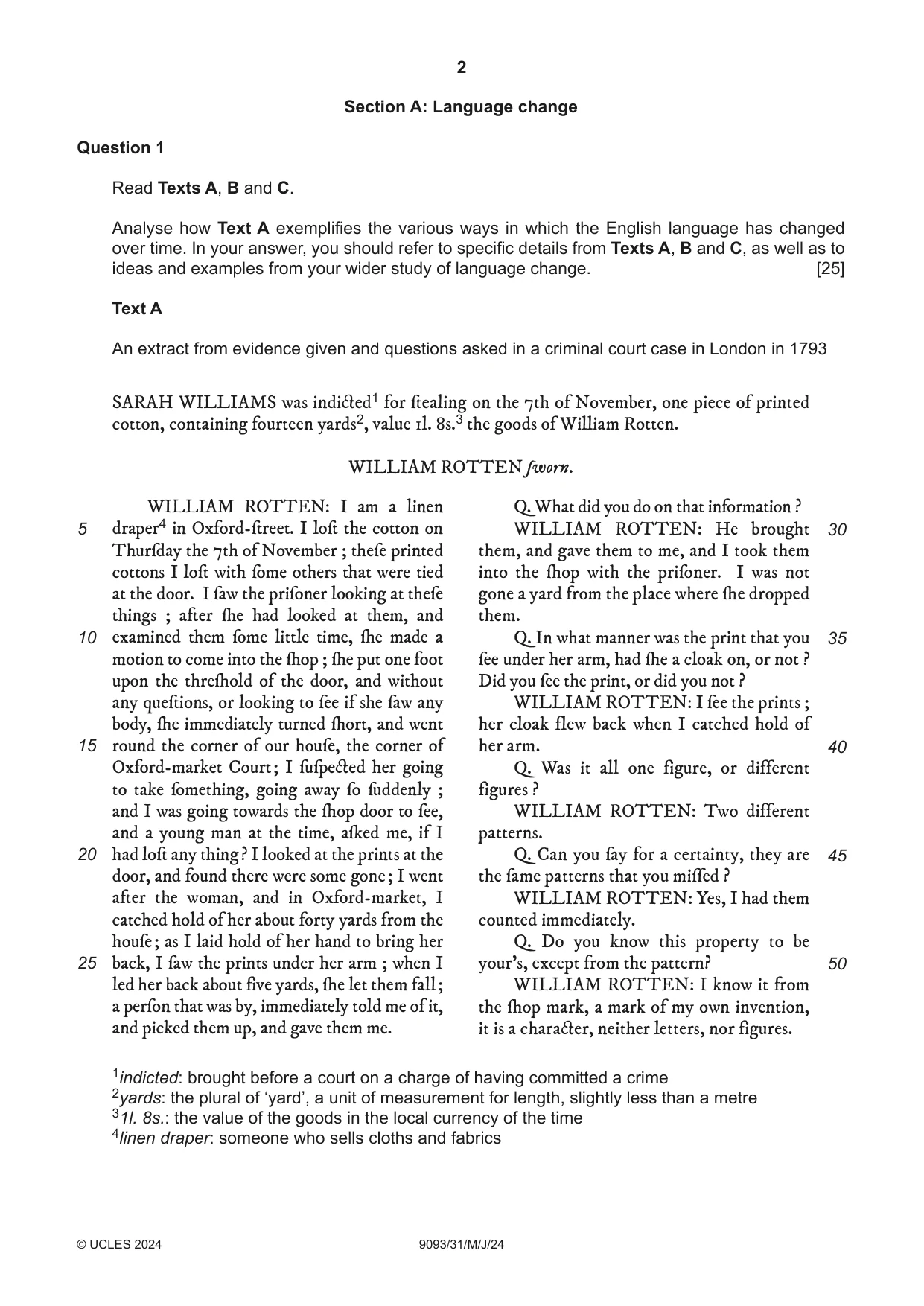
2 9093/31/M/J/24 © UCLES 2024 Section A: Language change Question 1 Read Texts A, B and C. Analyse how Text A exemplifies the various ways in which the English language has changed over time. In your answer, you should refer to specific details from Texts A, B and C, as well as to ideas and examples from your wider study of language change. [25] Text A An extract from evidence given and questions asked in a criminal court case in London in 1793 SARAH WILLIAMS was indicted1 for ſtealing on the 7th of November, one piece of printed cotton, containing fourteen yards2, value 1l. 8s.3 the goods of William Rotten. WILLIAM ROTTEN ſworn. WILLIAM ROTTEN: I am a linen draper4 in Oxford-ſtreet. I loſt the cotton on Thurſday the 7th of November ; theſe printed cottons I loſt with ſome others that were tied at the door. I ſaw the priſoner looking at theſe things ; after ſhe had looked at them, and examined them ſome little time, ſhe made a motion to come into the ſhop ; ſhe put one foot upon the threſhold of the door, and without any queſtions, or looking to ſee if she ſaw any body, ſhe immediately turned ſhort, and went round the corner of our houſe, the corner of Oxford-market Court ; I ſuſpected her going to take ſomething, going away ſo ſuddenly ; and I was going towards the ſhop door to ſee, and a young man at the time, aſked me, if I had loſt any thing ? I looked at the prints at the door, and found there were some gone ; I went after the woman, and in Oxford-market, I catched hold of her about forty yards from the houſe ; as I laid hold of her hand to bring her back, I ſaw the prints under her arm ; when I led her back about five yards, ſhe let them fall ; a perſon that was by, immediately told me of it, and picked them up, and gave them me. Q. What did you do on that information ? WILLIAM ROTTEN: He brought them, and gave them to me, and I took them into the ſhop with the priſoner. I was not gone a yard from the place where ſhe dropped them. Q. In what manner was the print that you ſee under her arm, had ſhe a cloak on, or not ? Did you ſee the print, or did you not ? WILLIAM ROTTEN: I ſee the prints ; her cloak flew back when I catched hold of her arm. Q. Was it all one figure, or different figures ? WILLIAM ROTTEN: Two different patterns. Q. Can you ſay for a certainty, they are the ſame patterns that you miſſed ? WILLIAM ROTTEN: Yes, I had them counted immediately. Q. Do you know this property to be your’s, except from the pattern? WILLIAM ROTTEN: I know it from the ſhop mark, a mark of my own invention, it is a character, neither letters, nor figures. 1indicted: brought before a court on a charge of having committed a crime 2yards: the plural of ‘yard’, a unit of measurement for length, slightly less than a metre 31l. 8s.: the value of the goods in the local currency of the time 4linen draper: someone who sells cloths and fabrics 5 10 15 20 25 30 35 40 45 50
Question paper, page 3
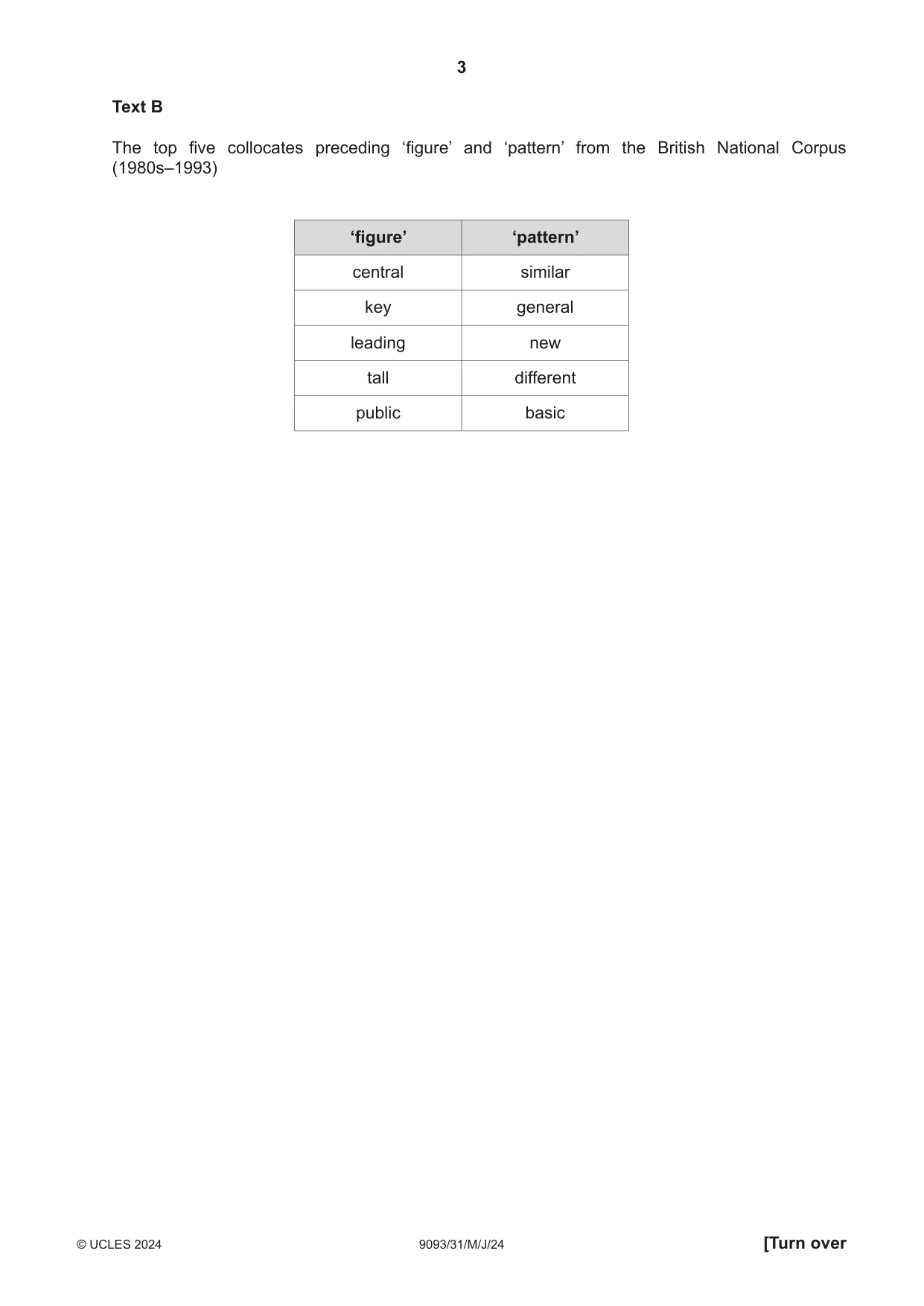
3 9093/31/M/J/24 © UCLES 2024 [Turn over Text B The top five collocates preceding ‘figure’ and ‘pattern’ from the British National Corpus (1980s–1993) ‘figure’ ‘pattern’ central similar key general leading new tall different public basic
Question paper, page 4
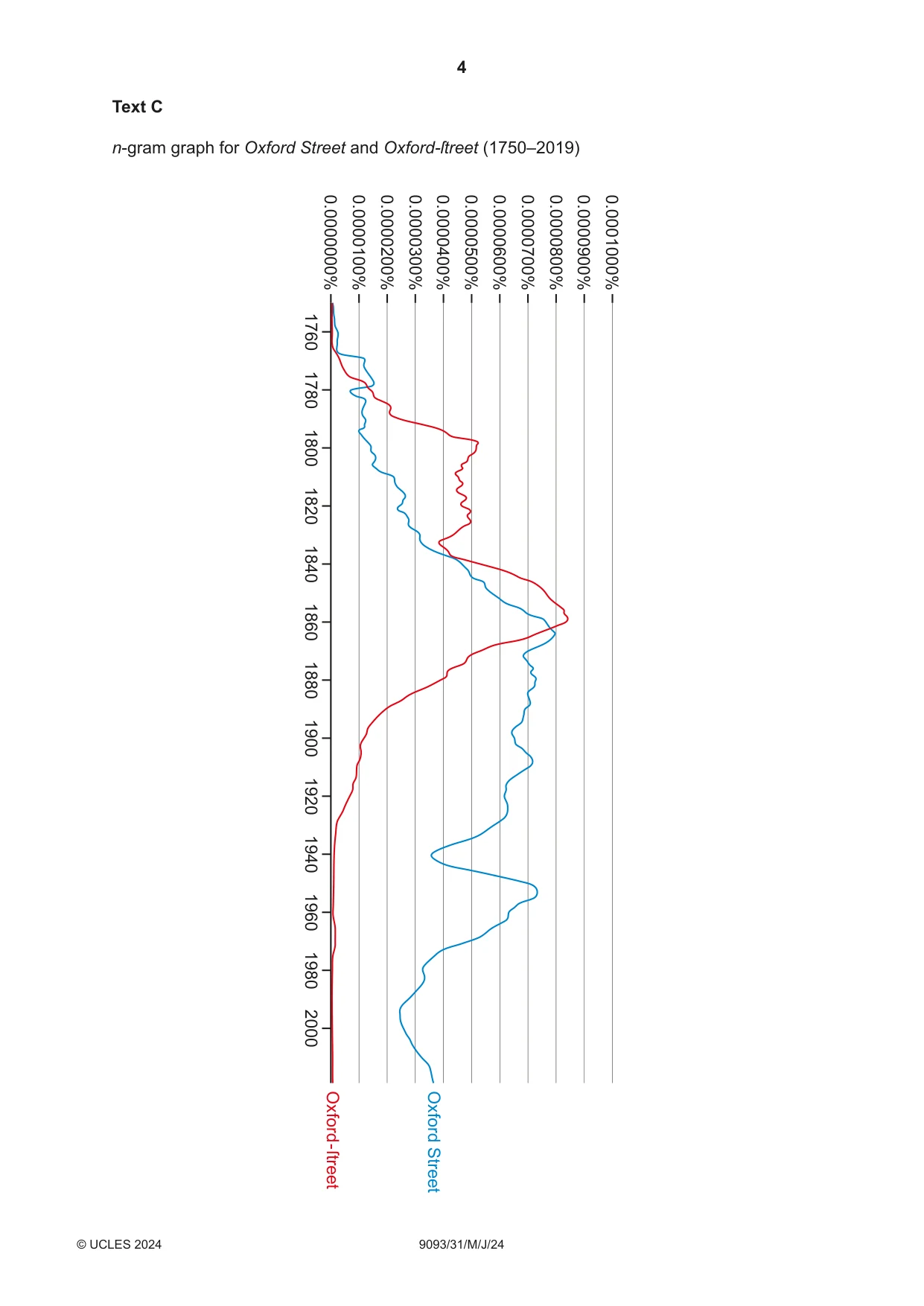
4 9093/31/M/J/24 © UCLES 2024 Text C n-gram graph for Oxford Street and Oxford-ſtreet (1750–2019) 1760 0.0000000% 0.0000100% 0.0000200% 0.0000300% 0.0000400% 0.0000500% 0.0000600% 0.0000700% 0.0000800% 0.0000900% 0.0001000% 1780 1800 Oxford Street Oxford - ſtreet 1820 1840 1860 1880 1900 1920 1940 1960 1980 2000
Question paper, page 5
5 9093/31/M/J/24 © UCLES 2024 [Turn over BLANK PAGE
Question paper, page 6
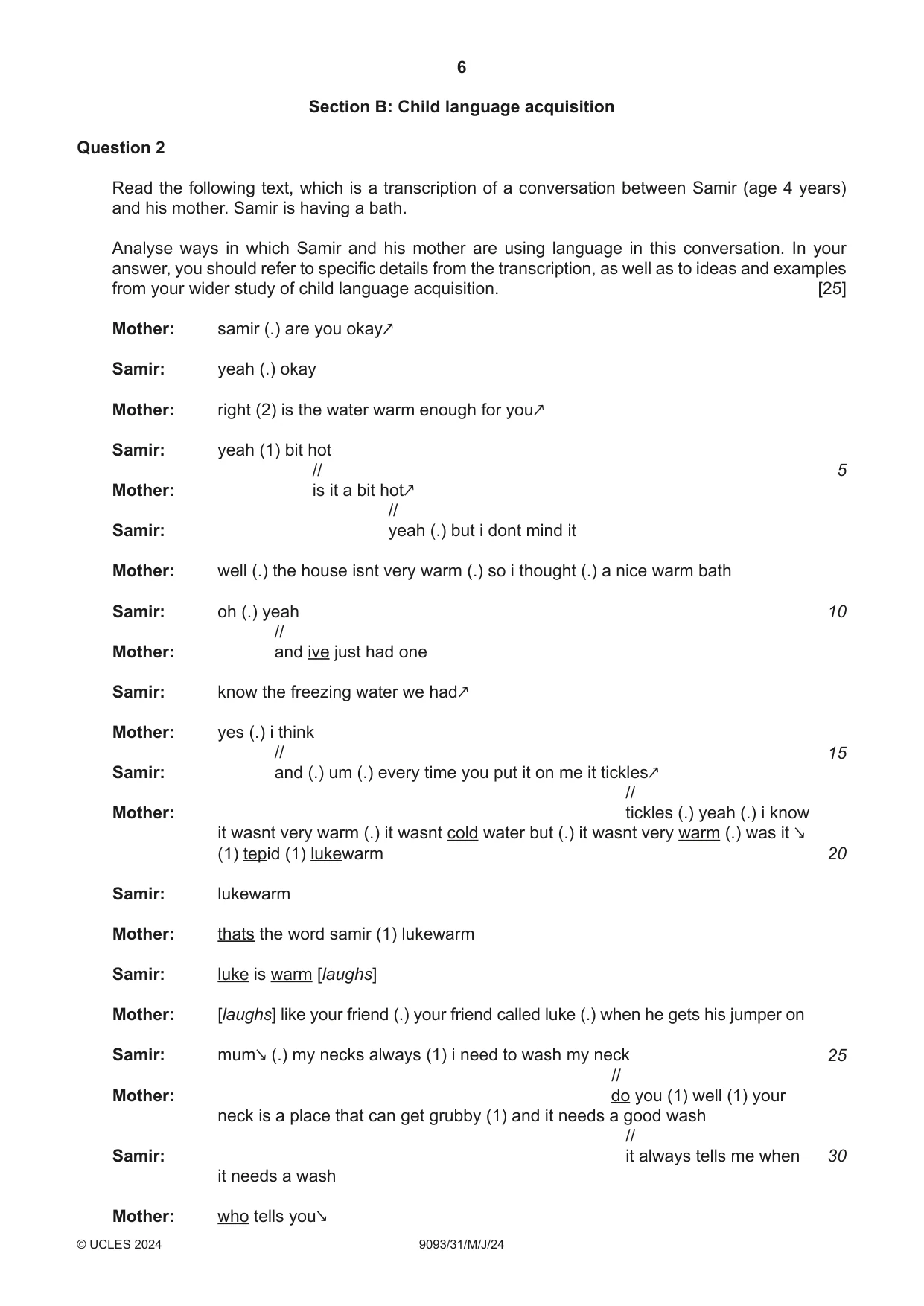
6 9093/31/M/J/24 © UCLES 2024 Section B: Child language acquisition Question 2 Read the following text, which is a transcription of a conversation between Samir (age 4 years) and his mother. Samir is having a bath. Analyse ways in which Samir and his mother are using language in this conversation. In your answer, you should refer to specific details from the transcription, as well as to ideas and examples from your wider study of child language acquisition. [25] Mother: samir (.) are you okay↗ Samir: yeah (.) okay Mother: right (2) is the water warm enough for you↗ Samir: yeah (1) bit hot // Mother: is it a bit hot↗ // Samir: yeah (.) but i dont mind it Mother: well (.) the house isnt very warm (.) so i thought (.) a nice warm bath Samir: oh (.) yeah // Mother: and ive just had one Samir: know the freezing water we had↗ Mother: yes (.) i think // Samir: and (.) um (.) every time you put it on me it tickles↗ // Mother: tickles (.) yeah (.) i know it wasnt very warm (.) it wasnt cold water but (.) it wasnt very warm (.) was it ↘ (1) tepid (1) lukewarm Samir: lukewarm Mother: thats the word samir (1) lukewarm Samir: luke is warm [laughs] Mother: [laughs] like your friend (.) your friend called luke (.) when he gets his jumper on Samir: mum↘ (.) my necks always (1) i need to wash my neck // Mother: do you (1) well (1) your neck is a place that can get grubby (1) and it needs a good wash // Samir: it always tells me when it needs a wash Mother: who tells you↘ 5 10 15 20 25 30
Question paper, page 7
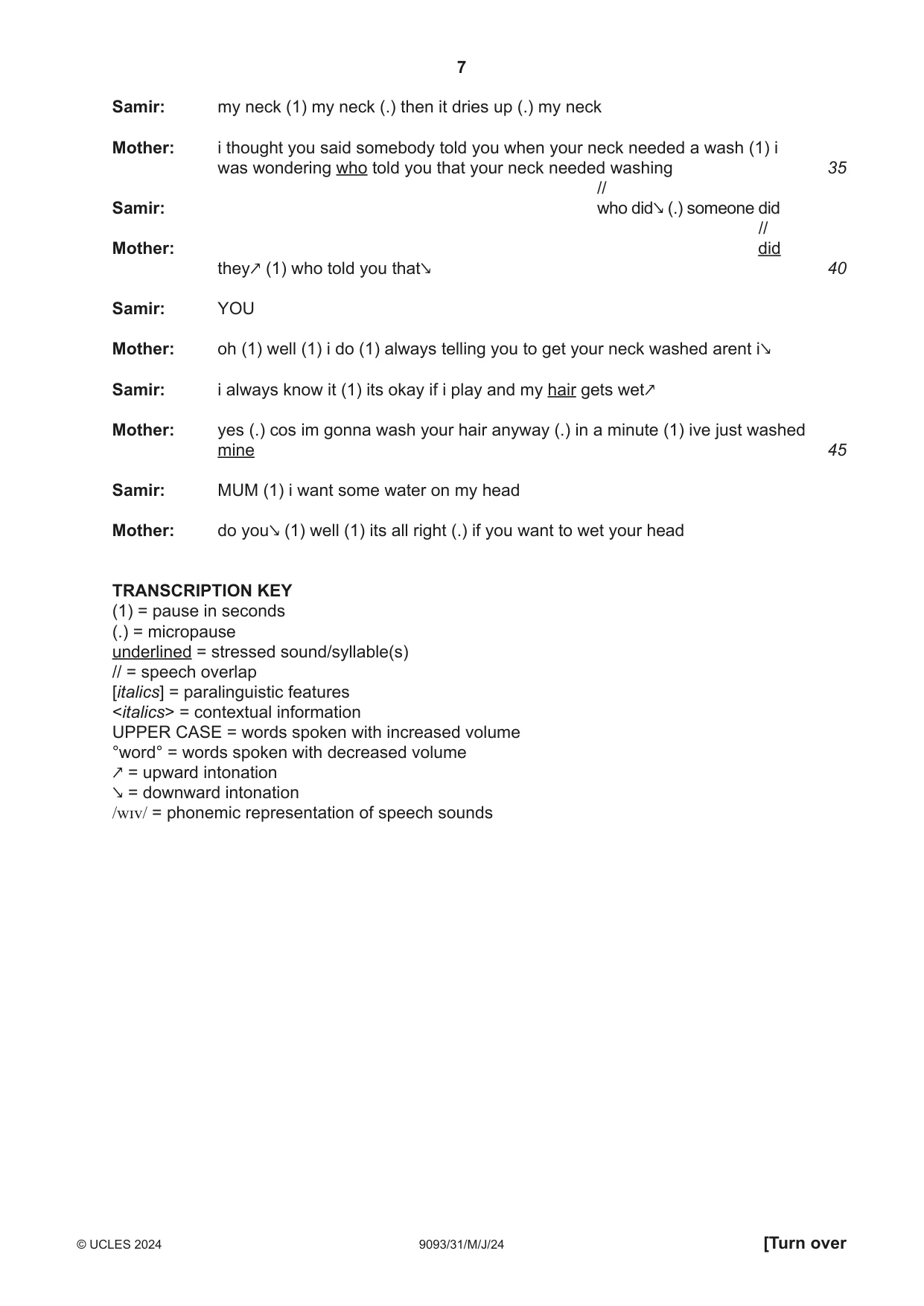
7 9093/31/M/J/24 © UCLES 2024 [Turn over Samir: my neck (1) my neck (.) then it dries up (.) my neck Mother: i thought you said somebody told you when your neck needed a wash (1) i was wondering who told you that your neck needed washing // Samir: who did↘ (.) someone did // Mother: did they↗ (1) who told you that↘ Samir: YOU Mother: oh (1) well (1) i do (1) always telling you to get your neck washed arent i↘ Samir: i always know it (1) its okay if i play and my hair gets wet↗ Mother: yes (.) cos im gonna wash your hair anyway (.) in a minute (1) ive just washed mine Samir: MUM (1) i want some water on my head Mother: do you↘ (1) well (1) its all right (.) if you want to wet your head TRANSCRIPTION KEY (1) = pause in seconds (.) = micropause underlined = stressed sound/syllable(s) // = speech overlap [italics] = paralinguistic features <italics> = contextual information UPPER CASE = words spoken with increased volume °word° = words spoken with decreased volume ↗ = upward intonation ↘ = downward intonation /wɪv/ = phonemic representation of speech sounds 35 40 45
Question paper, page 8
8 9093/31/M/J/24 © UCLES 2024 Permission to reproduce items where third-party owned material protected by copyright is included has been sought and cleared where possible. Every reasonable effort has been made by the publisher (UCLES) to trace copyright holders, but if any items requiring clearance have unwittingly been included, the publisher will be pleased to make amends at the earliest possible opportunity. To avoid the issue of disclosure of answer-related information to candidates, all copyright acknowledgements are reproduced online in the Cambridge Assessment International Education Copyright Acknowledgements Booklet. This is produced for each series of examinations and is freely available to download at www.cambridgeinternational.org after the live examination series. Cambridge Assessment International Education is part of Cambridge Assessment. Cambridge Assessment is the brand name of the University of Cambridge Local Examinations Syndicate (UCLES), which is a department of the University of Cambridge. REFERENCE TABLE OF International Phonetic Alphabet (IPA) PHONEMIC SYMBOLS (RECEIVED PRONUNCIATION) 1 Consonants of English 2 Pure vowels of English / f / fat, rough / iː / beat, keep / v / very, village, love / ɪ / bit, tip, busy / ɵ / theatre, thank, athlete / e / bet, many / ð / this, them, with, either / æ / bat / s / sing, thinks, losses / ʌ / cup, son, blood / z / zoo, beds, easy / aː / car, heart, calm, aunt / ʃ / sugar, bush / ɒ / pot, want / ʒ / pleasure, beige / ɔː / port, saw, talk / h / high, hit, behind / ə / about, sudden / p / pit, top / ɜː / word, bird / t / tip, pot, steep / ʊ / book, wood, put / k / keep, tick, scare / uː / food, soup, rude / b / bad, rub / d / bad, dim 3 Diphthongs of English / g / gun, big / eɪ / late, day, great / tʃ / church, lunch / aɪ / time, high, die / dʒ / judge, gin, jury / ɔɪ / boy, noise / m / mad, jam, small / aʊ / cow, house, town / n / man, no, snow / əʊ / boat, home, know / ŋ / singer, long / ɪə / ear, here / l / loud, kill, play / eə / air, care, chair / j / you, beyond / ʊə / cure, jury / w / one, when, sweet / r / rim, bread / ʔ / uh-oh
Mark scheme, page 1
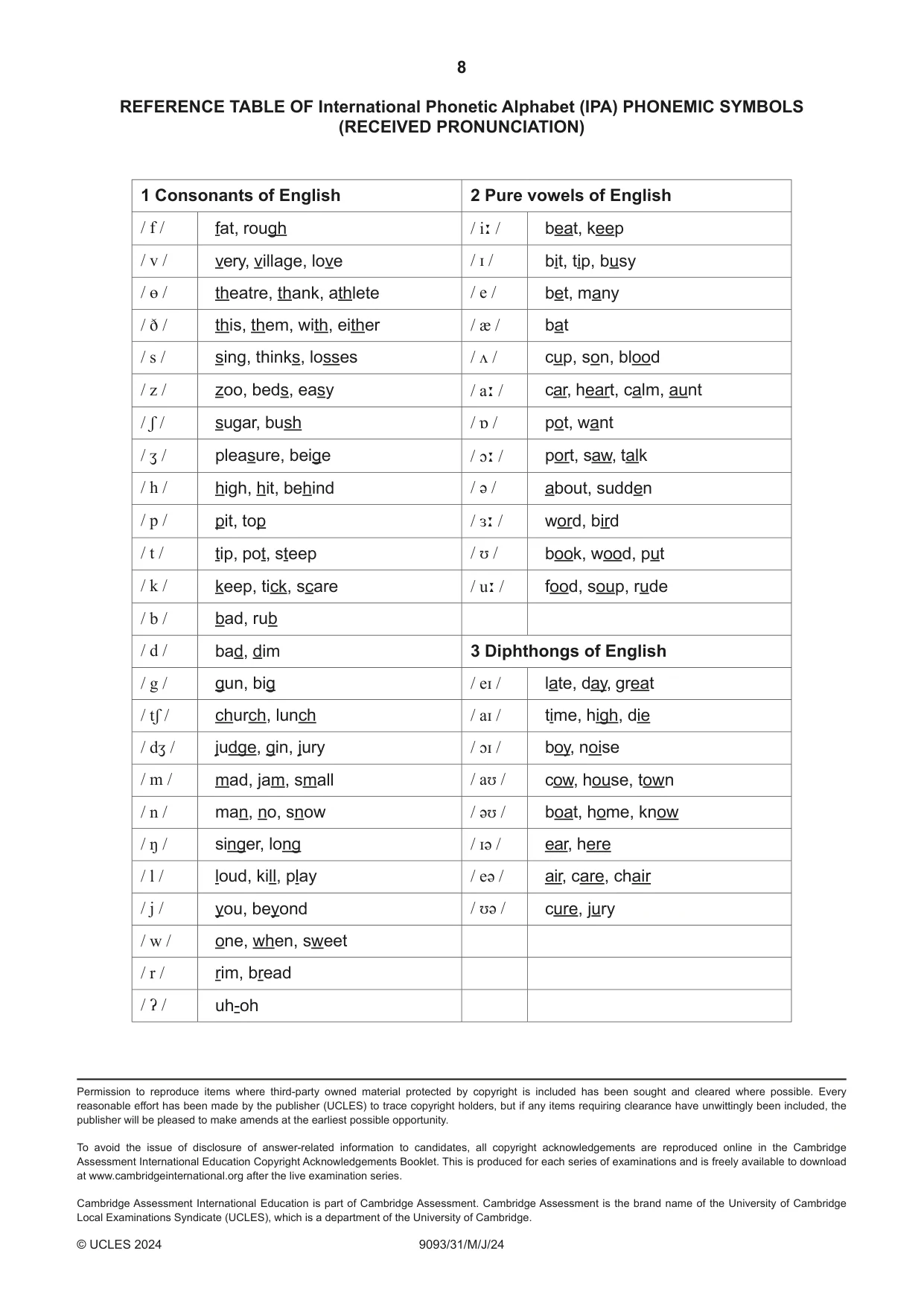
This document consists of 13 printed pages. © Cambridge University Press & Assessment 2024 [Turn over Cambridge International A Level ENGLISH LANGUAGE 9093/31 Paper 3 Language Analysis May/June 2024 MARK SCHEME Maximum Mark: 50 Published This mark scheme is published as an aid to teachers and candidates, to indicate the requirements of the examination. It shows the basis on which Examiners were instructed to award marks. It does not indicate the details of the discussions that took place at an Examiners’ meeting before marking began, which would have considered the acceptability of alternative answers. Mark schemes should be read in conjunction with the question paper and the Principal Examiner Report for Teachers. Cambridge International will not enter into discussions about these mark schemes. Cambridge International is publishing the mark schemes for the May/June 2024 series for most Cambridge IGCSE, Cambridge International A and AS Level and Cambridge Pre-U components, and some Cambridge O Level components.
Mark scheme, page 2
9093/31 Cambridge International A Level – Mark Scheme PUBLISHED May/June 2024 © Cambridge University Press & Assessment 2024 Page 2 of 13 Generic Marking Principles These general marking principles must be applied by all examiners when marking candidate answers. They should be applied alongside the specific content of the mark scheme or generic level descriptions for a question. Each question paper and mark scheme will also comply with these marking principles. GENERIC MARKING PRINCIPLE 1: Marks must be awarded in line with: the specific content of the mark scheme or the generic level descriptors for the question the specific skills defined in the mark scheme or in the generic level descriptors for the question the standard of response required by a candidate as exemplified by the standardisation scripts. GENERIC MARKING PRINCIPLE 2: Marks awarded are always whole marks (not half marks, or other fractions). GENERIC MARKING PRINCIPLE 3: Marks must be awarded positively: marks are awarded for correct/valid answers, as defined in the mark scheme. However, credit is given for valid answers which go beyond the scope of the syllabus and mark scheme, referring to your Team Leader as appropriate marks are awarded when candidates clearly demonstrate what they know and can do marks are not deducted for errors marks are not deducted for omissions answers should only be judged on the quality of spelling, punctuation and grammar when these features are specifically assessed by the question as indicated by the mark scheme. The meaning, however, should be unambiguous. GENERIC MARKING PRINCIPLE 4: Rules must be applied consistently, e.g. in situations where candidates have not followed instructions or in the application of generic level descriptors.
Mark scheme, page 3
9093/31 Cambridge International A Level – Mark Scheme PUBLISHED May/June 2024 © Cambridge University Press & Assessment 2024 Page 3 of 13 GENERIC MARKING PRINCIPLE 5: Marks should be awarded using the full range of marks defined in the mark scheme for the question (however; the use of the full mark range may be limited according to the quality of the candidate responses seen). GENERIC MARKING PRINCIPLE 6: Marks awarded are based solely on the requirements as defined in the mark scheme. Marks should not be awarded with grade thresholds or grade descriptors in mind.
Mark scheme, page 4
9093/31 Cambridge International A Level – Mark Scheme PUBLISHED May/June 2024 © Cambridge University Press & Assessment 2024 Page 4 of 13 English & Media subject specific general marking principles (To be read in conjunction with the Generic Marking Principles (and requiring further guidance on how to place marks within levels)) Components using level descriptors: We use level descriptors as a guide to broad understanding of the qualities normally expected of, or typical of, work in a level. Level descriptors are a means of general guidance, and should not be interpreted as hurdle statements. Where indicative content notes are supplied for a question, these are not a prescription of required content, and must not be treated as such. Alternative correct points and unexpected answers in candidates’ scripts must be given marks that fairly reflect the knowledge and skills demonstrated. While we may have legitimate expectations as to the ground most answers may occupy, we must at all times be prepared to meet candidates on their chosen ground, provided it is relevant ground (e.g. clearly related to and derived from a relevant passage/text and meeting the mark scheme requirements for the question).
Mark scheme, page 5
9093/31 Cambridge International A Level – Mark Scheme PUBLISHED May/June 2024 © Cambridge University Press & Assessment 2024 Page 5 of 13 English Language specific marking instructions: AO1 Read and demonstrate understanding of a wide variety of texts. (Understanding) Marks should be awarded for the accuracy of the candidate’s understanding of the text and its features, not for any analysis of them which is recognised under AO3. Where comparison is required, marks should be awarded for the candidate’s recognition of similarities and differences between the texts and their features, not for any consequent analysis. When awarding a ‘best-fit’ mark within a Level for each AO, consider each bullet point equally. AO2 Write effectively, creatively, accurately and appropriately, for a range of audiences and purposes. (Writing) Marks should be awarded equally on the basis of the level of the candidate’s written expression (range of features used and accuracy) and the development of their writing (its organisation and relevance to task and audience). When awarding a ‘best-fit’ mark within a Level for each AO, consider each bullet point equally. AO4: Demonstrate understanding of linguistic issues, concepts, methods and approaches. (Conceptualisation) Marks should be awarded equally on the basis of the level of the candidate’s understanding of the relevant issues, concepts, methods and approaches represented both in the text(s) and in their wider studies. When awarding a ‘best-fit’ mark within a Level for each AO, consider each bullet point equally. AO5: Analyse and synthesise language data from a variety of sources. (Data handling) Marks should be awarded equally on the basis of the level of the candidate’s selection, analysis and synthesis of language data. When awarding a ‘best-fit’ mark within a Level for each AO, consider each bullet point equally. Higher marks should be awarded where candidates identify patterns and offer thoughtful and plausible explanations for the features they are discussing. Weaker answers may spot features or describe individual cases of language change without reference to broader considerations or examples.
Mark scheme, page 6
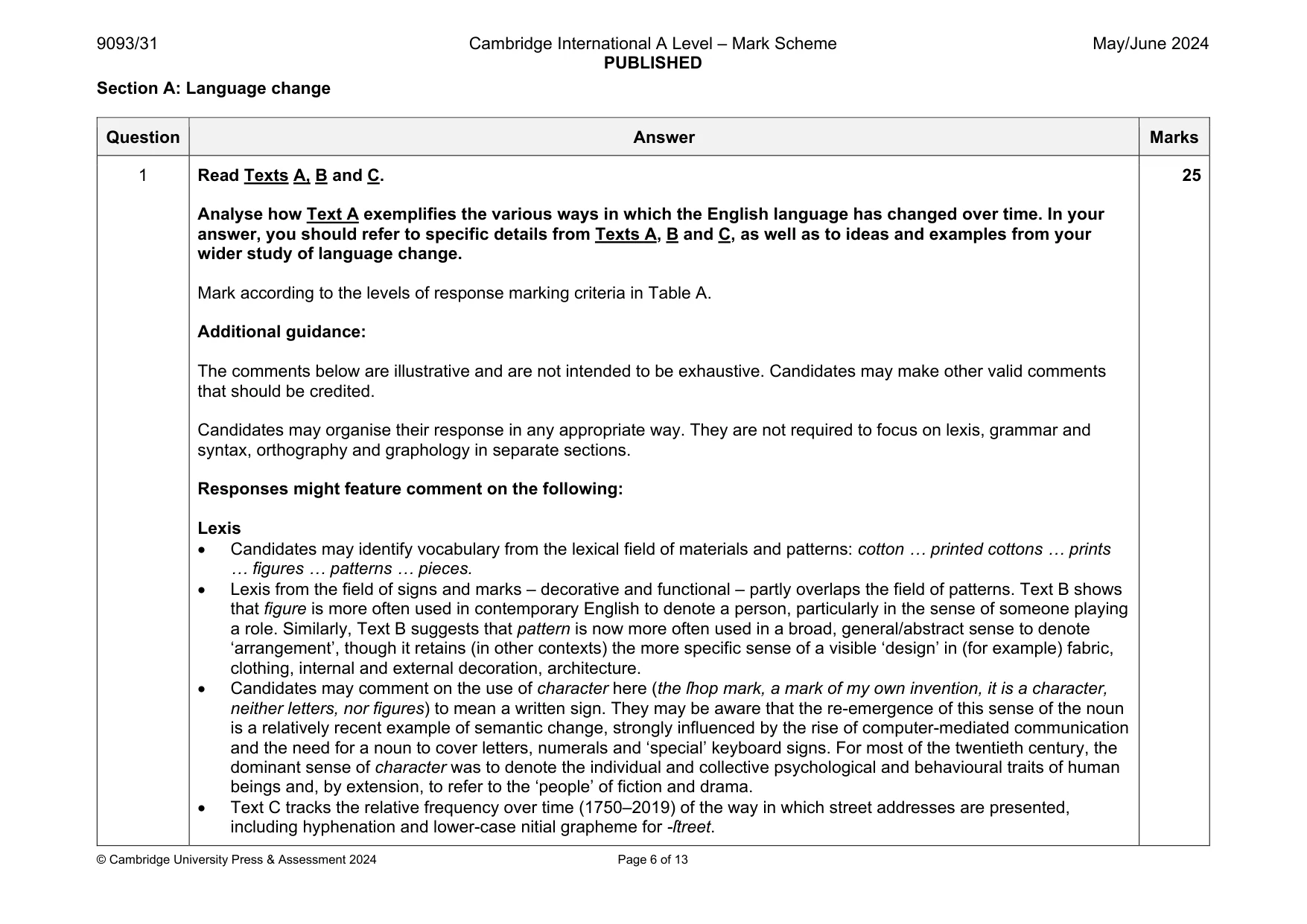
9093/31 Cambridge International A Level – Mark Scheme PUBLISHED May/June 2024 © Cambridge University Press & Assessment 2024 Page 6 of 13 Section A: Language change Question Answer Marks 1 Read Texts A, B and C. Analyse how Text A exemplifies the various ways in which the English language has changed over time. In your answer, you should refer to specific details from Texts A, B and C, as well as to ideas and examples from your wider study of language change. Mark according to the levels of response marking criteria in Table A. Additional guidance: The comments below are illustrative and are not intended to be exhaustive. Candidates may make other valid comments that should be credited. Candidates may organise their response in any appropriate way. They are not required to focus on lexis, grammar and syntax, orthography and graphology in separate sections. Responses might feature comment on the following: Lexis Candidates may identify vocabulary from the lexical field of materials and patterns: cotton … printed cottons … prints … figures … patterns … pieces. Lexis from the field of signs and marks – decorative and functional – partly overlaps the field of patterns. Text B shows that figure is more often used in contemporary English to denote a person, particularly in the sense of someone playing a role. Similarly, Text B suggests that pattern is now more often used in a broad, general/abstract sense to denote ‘arrangement’, though it retains (in other contexts) the more specific sense of a visible ‘design’ in (for example) fabric, clothing, internal and external decoration, architecture. Candidates may comment on the use of character here (the ſhop mark, a mark of my own invention, it is a character, neither letters, nor figures) to mean a written sign. They may be aware that the re-emergence of this sense of the noun is a relatively recent example of semantic change, strongly influenced by the rise of computer-mediated communication and the need for a noun to cover letters, numerals and ‘special’ keyboard signs. For most of the twentieth century, the dominant sense of character was to denote the individual and collective psychological and behavioural traits of human beings and, by extension, to refer to the ‘people’ of fiction and drama. Text C tracks the relative frequency over time (1750–2019) of the way in which street addresses are presented, including hyphenation and lower-case nitial grapheme for -ſtreet. 25
Mark scheme, page 7
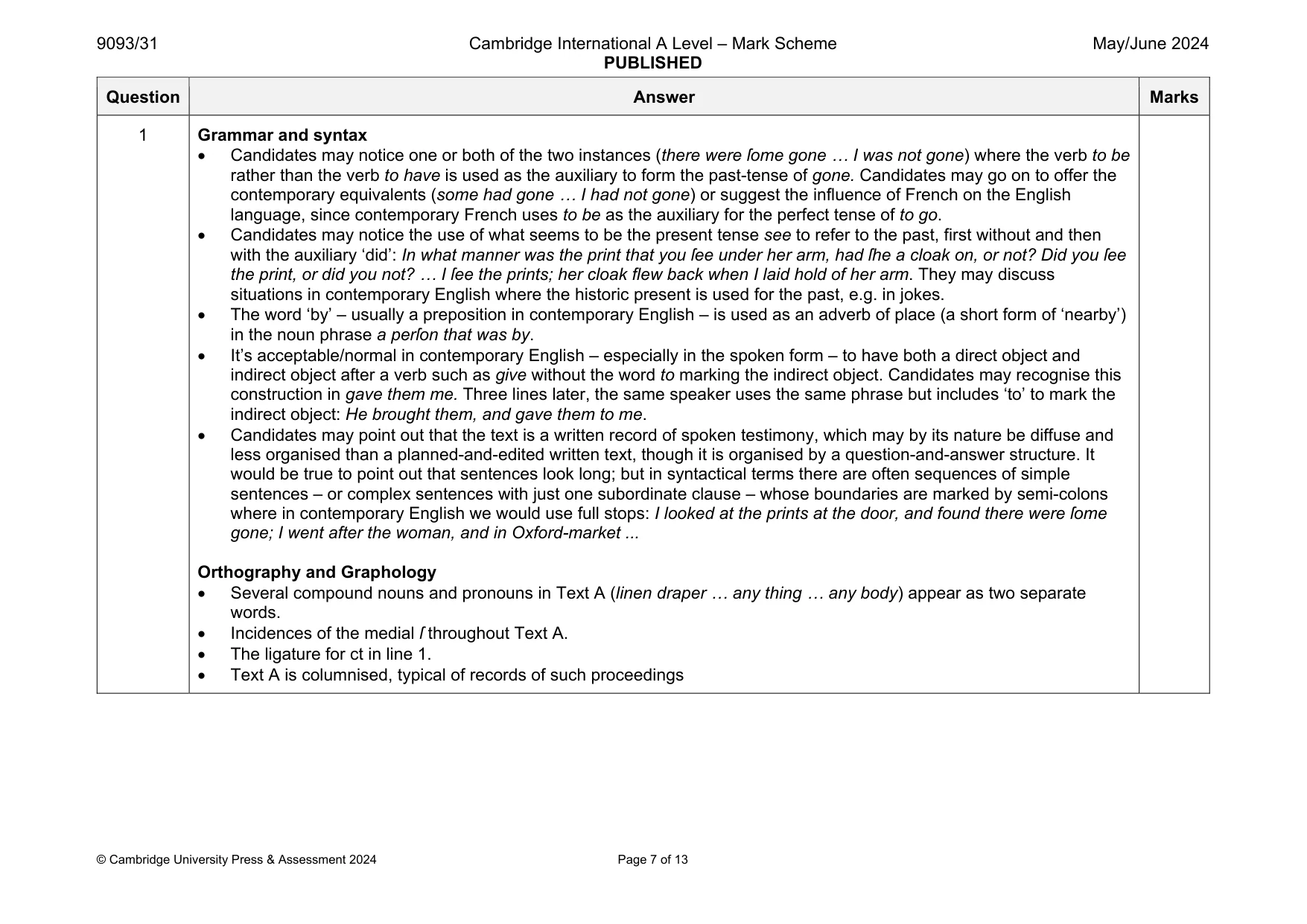
9093/31 Cambridge International A Level – Mark Scheme PUBLISHED May/June 2024 © Cambridge University Press & Assessment 2024 Page 7 of 13 Question Answer Marks 1 Grammar and syntax Candidates may notice one or both of the two instances (there were ſome gone … I was not gone) where the verb to be rather than the verb to have is used as the auxiliary to form the past-tense of gone. Candidates may go on to offer the contemporary equivalents (some had gone … I had not gone) or suggest the influence of French on the English language, since contemporary French uses to be as the auxiliary for the perfect tense of to go. Candidates may notice the use of what seems to be the present tense see to refer to the past, first without and then with the auxiliary ‘did’: In what manner was the print that you ſee under her arm, had ſhe a cloak on, or not? Did you ſee the print, or did you not? … I ſee the prints; her cloak flew back when I laid hold of her arm. They may discuss situations in contemporary English where the historic present is used for the past, e.g. in jokes. The word ‘by’ – usually a preposition in contemporary English – is used as an adverb of place (a short form of ‘nearby’) in the noun phrase a perſon that was by. It’s acceptable/normal in contemporary English – especially in the spoken form – to have both a direct object and indirect object after a verb such as give without the word to marking the indirect object. Candidates may recognise this construction in gave them me. Three lines later, the same speaker uses the same phrase but includes ‘to’ to mark the indirect object: He brought them, and gave them to me. Candidates may point out that the text is a written record of spoken testimony, which may by its nature be diffuse and less organised than a planned-and-edited written text, though it is organised by a question-and-answer structure. It would be true to point out that sentences look long; but in syntactical terms there are often sequences of simple sentences – or complex sentences with just one subordinate clause – whose boundaries are marked by semi-colons where in contemporary English we would use full stops: I looked at the prints at the door, and found there were ſome gone; I went after the woman, and in Oxford-market ... Orthography and Graphology Several compound nouns and pronouns in Text A (linen draper … any thing … any body) appear as two separate words. Incidences of the medial ſ throughout Text A. The ligature for ct in line 1. Text A is columnised, typical of records of such proceedings
Mark scheme, page 8
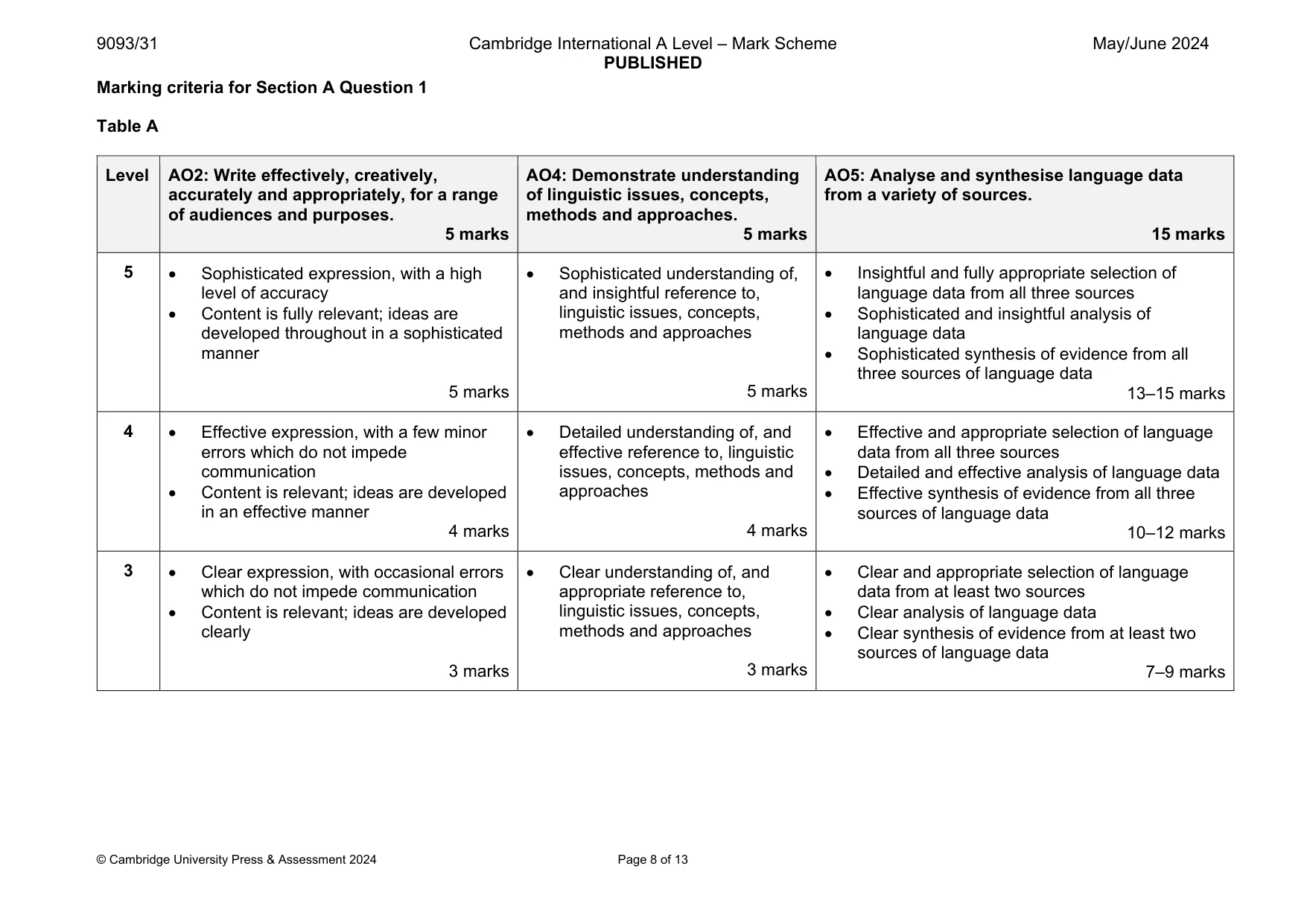
9093/31 Cambridge International A Level – Mark Scheme PUBLISHED May/June 2024 © Cambridge University Press & Assessment 2024 Page 8 of 13 Marking criteria for Section A Question 1 Table A Level AO2: Write effectively, creatively, accurately and appropriately, for a range of audiences and purposes. 5 marks AO4: Demonstrate understanding of linguistic issues, concepts, methods and approaches. 5 marks AO5: Analyse and synthesise language data from a variety of sources. 15 marks 5 Sophisticated expression, with a high level of accuracy Content is fully relevant; ideas are developed throughout in a sophisticated manner 5 marks Sophisticated understanding of, and insightful reference to, linguistic issues, concepts, methods and approaches 5 marks Insightful and fully appropriate selection of language data from all three sources Sophisticated and insightful analysis of language data Sophisticated synthesis of evidence from all three sources of language data 13–15 marks 4 Effective expression, with a few minor errors which do not impede communication Content is relevant; ideas are developed in an effective manner 4 marks Detailed understanding of, and effective reference to, linguistic issues, concepts, methods and approaches 4 marks Effective and appropriate selection of language data from all three sources Detailed and effective analysis of language data Effective synthesis of evidence from all three sources of language data 10–12 marks 3 Clear expression, with occasional errors which do not impede communication Content is relevant; ideas are developed clearly 3 marks Clear understanding of, and appropriate reference to, linguistic issues, concepts, methods and approaches 3 marks Clear and appropriate selection of language data from at least two sources Clear analysis of language data Clear synthesis of evidence from at least two sources of language data 7–9 marks
Mark scheme, page 9
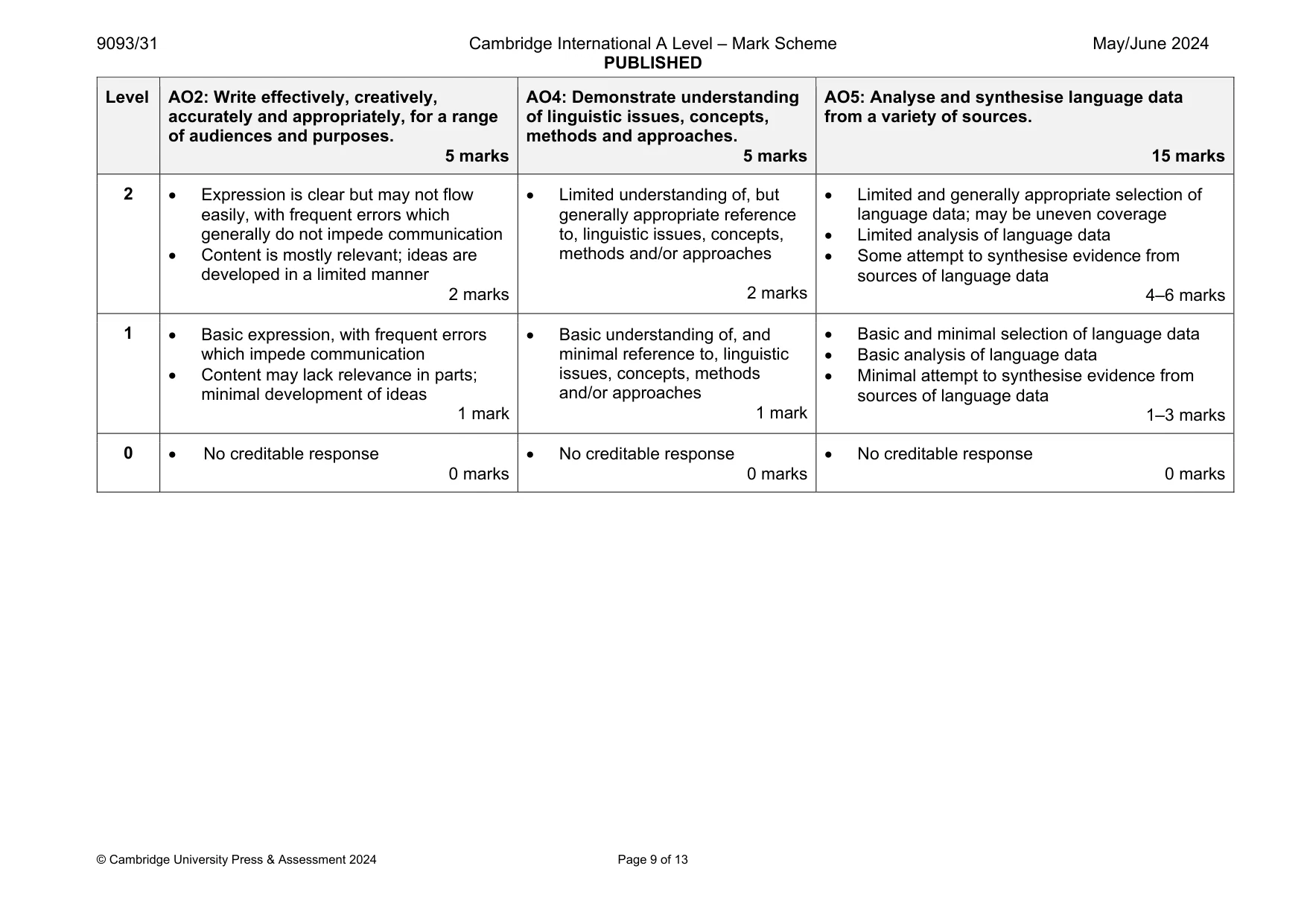
9093/31 Cambridge International A Level – Mark Scheme PUBLISHED May/June 2024 © Cambridge University Press & Assessment 2024 Page 9 of 13 Level AO2: Write effectively, creatively, accurately and appropriately, for a range of audiences and purposes. 5 marks AO4: Demonstrate understanding of linguistic issues, concepts, methods and approaches. 5 marks AO5: Analyse and synthesise language data from a variety of sources. 15 marks 2 Expression is clear but may not flow easily, with frequent errors which generally do not impede communication Content is mostly relevant; ideas are developed in a limited manner 2 marks Limited understanding of, but generally appropriate reference to, linguistic issues, concepts, methods and/or approaches 2 marks Limited and generally appropriate selection of language data; may be uneven coverage Limited analysis of language data Some attempt to synthesise evidence from sources of language data 4–6 marks 1 Basic expression, with frequent errors which impede communication Content may lack relevance in parts; minimal development of ideas 1 mark Basic understanding of, and minimal reference to, linguistic issues, concepts, methods and/or approaches 1 mark Basic and minimal selection of language data Basic analysis of language data Minimal attempt to synthesise evidence from sources of language data 1–3 marks 0 No creditable response 0 marks No creditable response 0 marks No creditable response 0 marks
Mark scheme, page 10
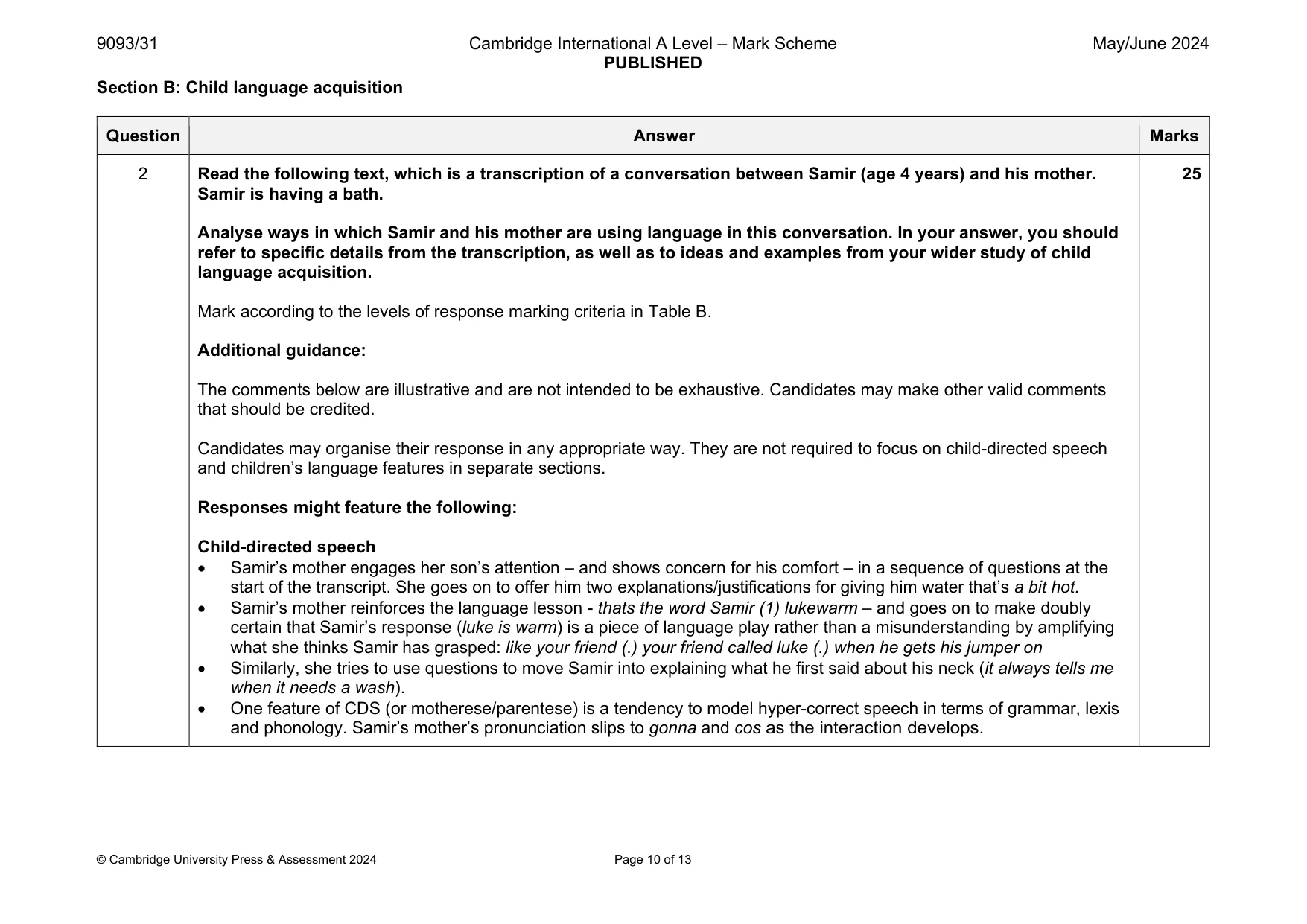
9093/31 Cambridge International A Level – Mark Scheme PUBLISHED May/June 2024 © Cambridge University Press & Assessment 2024 Page 10 of 13 Section B: Child language acquisition Question Answer Marks 2 Read the following text, which is a transcription of a conversation between Samir (age 4 years) and his mother. Samir is having a bath. Analyse ways in which Samir and his mother are using language in this conversation. In your answer, you should refer to specific details from the transcription, as well as to ideas and examples from your wider study of child language acquisition. Mark according to the levels of response marking criteria in Table B. Additional guidance: The comments below are illustrative and are not intended to be exhaustive. Candidates may make other valid comments that should be credited. Candidates may organise their response in any appropriate way. They are not required to focus on child-directed speech and children’s language features in separate sections. Responses might feature the following: Child-directed speech Samir’s mother engages her son’s attention – and shows concern for his comfort – in a sequence of questions at the start of the transcript. She goes on to offer him two explanations/justifications for giving him water that’s a bit hot. Samir’s mother reinforces the language lesson - thats the word Samir (1) lukewarm – and goes on to make doubly certain that Samir’s response (luke is warm) is a piece of language play rather than a misunderstanding by amplifying what she thinks Samir has grasped: like your friend (.) your friend called luke (.) when he gets his jumper on Similarly, she tries to use questions to move Samir into explaining what he first said about his neck (it always tells me when it needs a wash). One feature of CDS (or motherese/parentese) is a tendency to model hyper-correct speech in terms of grammar, lexis and phonology. Samir’s mother’s pronunciation slips to gonna and cos as the interaction develops. 25
Mark scheme, page 11
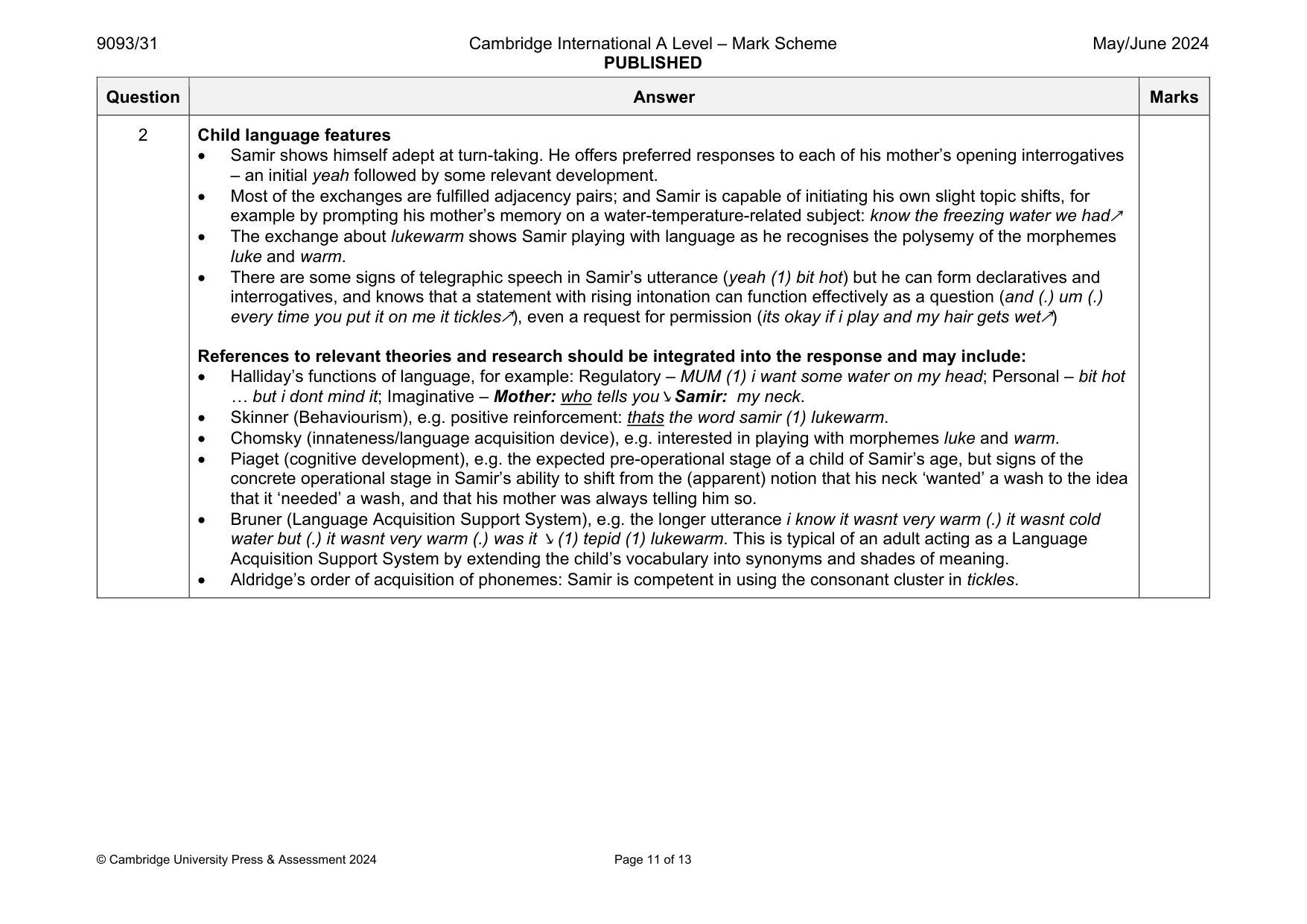
9093/31 Cambridge International A Level – Mark Scheme PUBLISHED May/June 2024 © Cambridge University Press & Assessment 2024 Page 11 of 13 Question Answer Marks 2 Child language features Samir shows himself adept at turn-taking. He offers preferred responses to each of his mother’s opening interrogatives – an initial yeah followed by some relevant development. Most of the exchanges are fulfilled adjacency pairs; and Samir is capable of initiating his own slight topic shifts, for example by prompting his mother’s memory on a water-temperature-related subject: know the freezing water we had↗ The exchange about lukewarm shows Samir playing with language as he recognises the polysemy of the morphemes luke and warm. There are some signs of telegraphic speech in Samir’s utterance (yeah (1) bit hot) but he can form declaratives and interrogatives, and knows that a statement with rising intonation can function effectively as a question (and (.) um (.) every time you put it on me it tickles↗), even a request for permission (its okay if i play and my hair gets wet↗) References to relevant theories and research should be integrated into the response and may include: Halliday’s functions of language, for example: Regulatory – MUM (1) i want some water on my head; Personal – bit hot … but i dont mind it; Imaginative – Mother: who tells you↘ Samir: my neck. Skinner (Behaviourism), e.g. positive reinforcement: thats the word samir (1) lukewarm. Chomsky (innateness/language acquisition device), e.g. interested in playing with morphemes luke and warm. Piaget (cognitive development), e.g. the expected pre-operational stage of a child of Samir’s age, but signs of the concrete operational stage in Samir’s ability to shift from the (apparent) notion that his neck ‘wanted’ a wash to the idea that it ‘needed’ a wash, and that his mother was always telling him so. Bruner (Language Acquisition Support System), e.g. the longer utterance i know it wasnt very warm (.) it wasnt cold water but (.) it wasnt very warm (.) was it ↘ (1) tepid (1) lukewarm. This is typical of an adult acting as a Language Acquisition Support System by extending the child’s vocabulary into synonyms and shades of meaning. Aldridge’s order of acquisition of phonemes: Samir is competent in using the consonant cluster in tickles.
Mark scheme, page 12
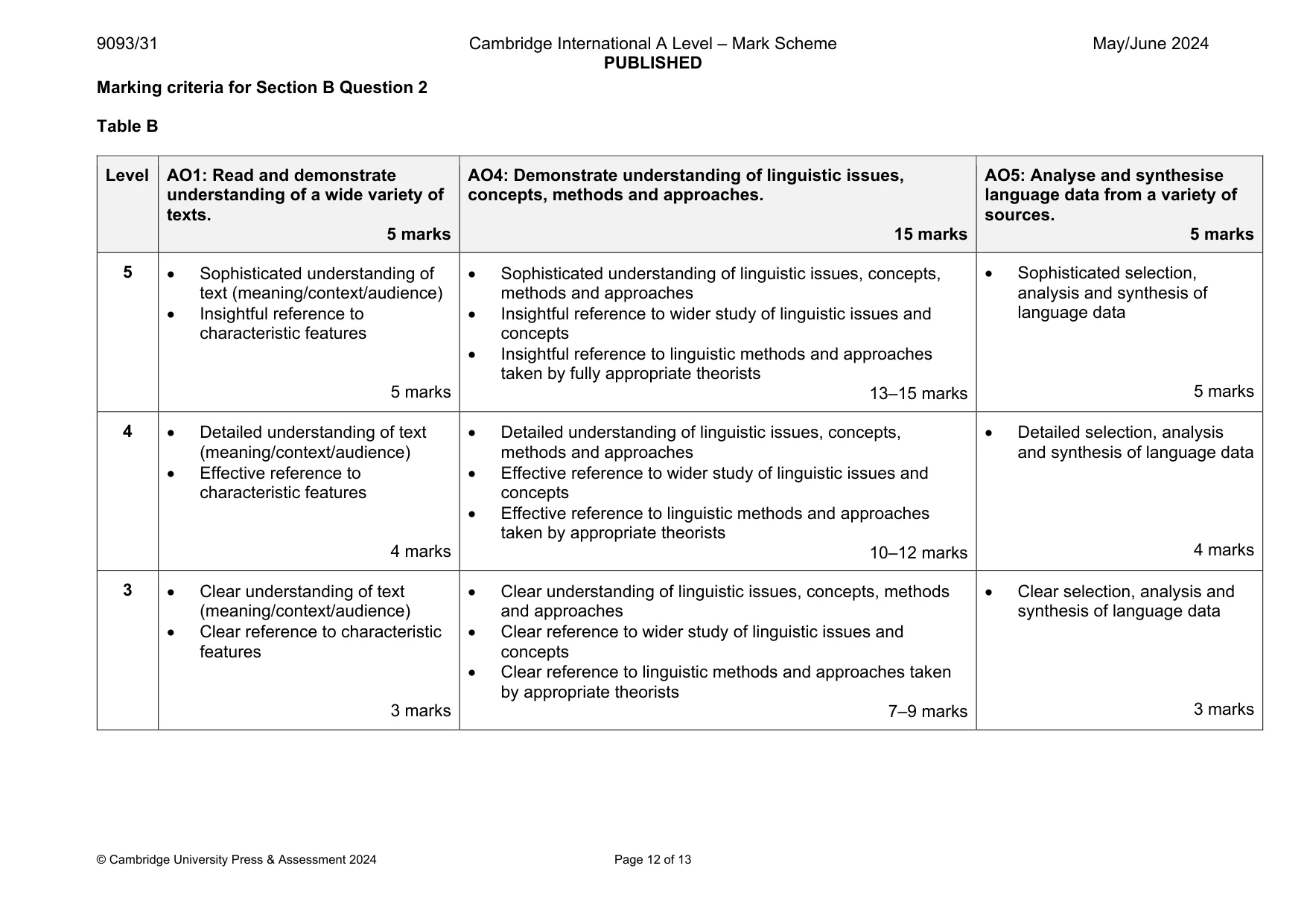
9093/31 Cambridge International A Level – Mark Scheme PUBLISHED May/June 2024 © Cambridge University Press & Assessment 2024 Page 12 of 13 Marking criteria for Section B Question 2 Table B Level AO1: Read and demonstrate understanding of a wide variety of texts. 5 marks AO4: Demonstrate understanding of linguistic issues, concepts, methods and approaches. 15 marks AO5: Analyse and synthesise language data from a variety of sources. 5 marks 5 Sophisticated understanding of text (meaning/context/audience) Insightful reference to characteristic features 5 marks Sophisticated understanding of linguistic issues, concepts, methods and approaches Insightful reference to wider study of linguistic issues and concepts Insightful reference to linguistic methods and approaches taken by fully appropriate theorists 13–15 marks Sophisticated selection, analysis and synthesis of language data 5 marks 4 Detailed understanding of text (meaning/context/audience) Effective reference to characteristic features 4 marks Detailed understanding of linguistic issues, concepts, methods and approaches Effective reference to wider study of linguistic issues and concepts Effective reference to linguistic methods and approaches taken by appropriate theorists 10–12 marks Detailed selection, analysis and synthesis of language data 4 marks 3 Clear understanding of text (meaning/context/audience) Clear reference to characteristic features 3 marks Clear understanding of linguistic issues, concepts, methods and approaches Clear reference to wider study of linguistic issues and concepts Clear reference to linguistic methods and approaches taken by appropriate theorists 7–9 marks Clear selection, analysis and synthesis of language data 3 marks
Mark scheme, page 13
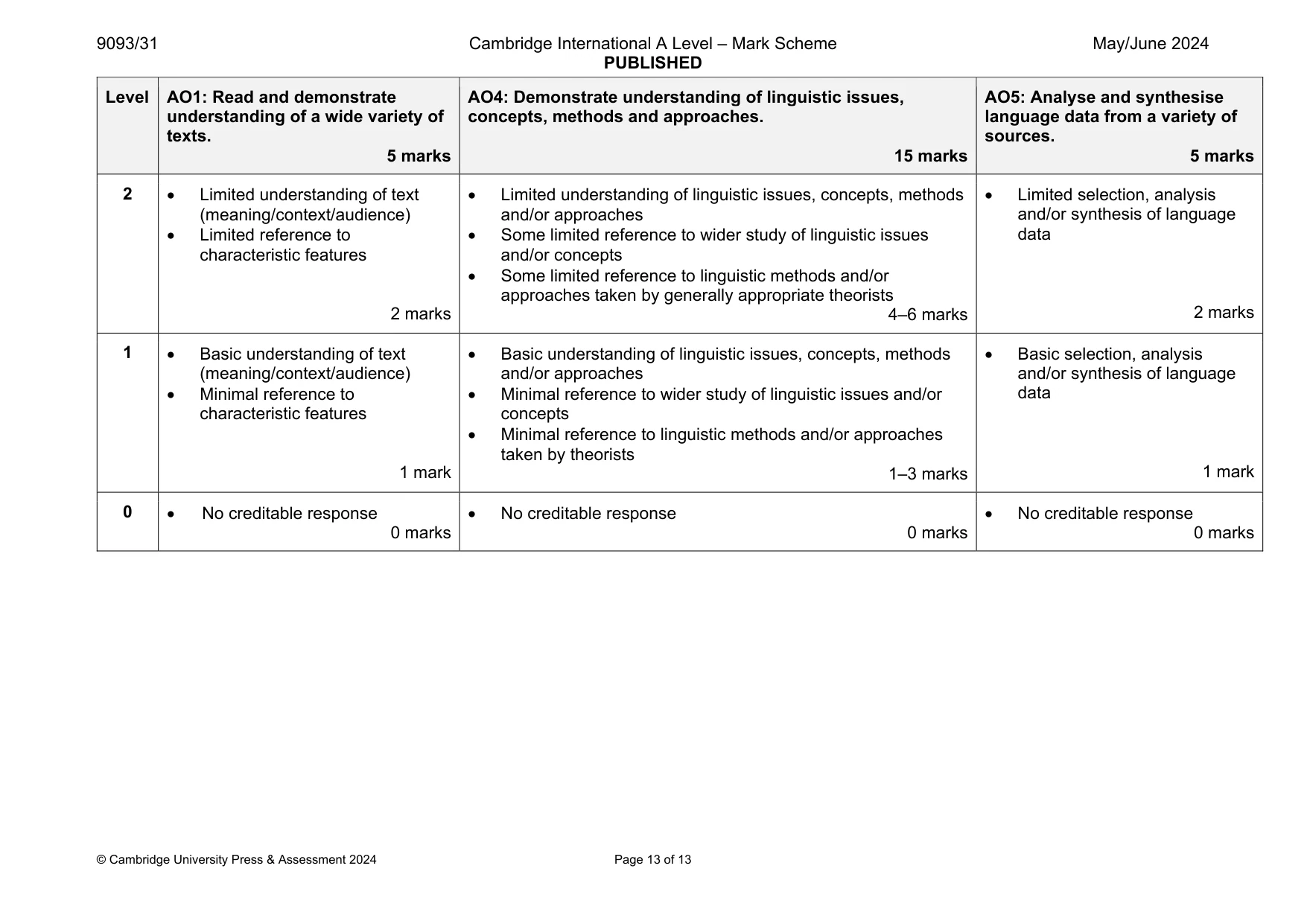
9093/31 Cambridge International A Level – Mark Scheme PUBLISHED May/June 2024 © Cambridge University Press & Assessment 2024 Page 13 of 13 Level AO1: Read and demonstrate understanding of a wide variety of texts. 5 marks AO4: Demonstrate understanding of linguistic issues, concepts, methods and approaches. 15 marks AO5: Analyse and synthesise language data from a variety of sources. 5 marks 2 Limited understanding of text (meaning/context/audience) Limited reference to characteristic features 2 marks Limited understanding of linguistic issues, concepts, methods and/or approaches Some limited reference to wider study of linguistic issues and/or concepts Some limited reference to linguistic methods and/or approaches taken by generally appropriate theorists 4–6 marks Limited selection, analysis and/or synthesis of language data 2 marks 1 Basic understanding of text (meaning/context/audience) Minimal reference to characteristic features 1 mark Basic understanding of linguistic issues, concepts, methods and/or approaches Minimal reference to wider study of linguistic issues and/or concepts Minimal reference to linguistic methods and/or approaches taken by theorists 1–3 marks Basic selection, analysis and/or synthesis of language data 1 mark 0 No creditable response 0 marks No creditable response 0 marks No creditable response 0 marks
What you needed in this session
Cambridge’s own grade thresholds for 2024 May/June, Paper 3 · Variant 1. A higher threshold means an easier paper — the bar moves with how the cohort did.