Cambridge A Level English - Language AS and A Level (from 2014) 9093 — 2023 May/June Paper 4 · Variant 2
9093/42/M/J/23 · 50 marks · ≈56 min
The question paper and its mark scheme, free to read here and free to download. This is Cambridge’s own paper, exactly as it was sat.
Question paper8 pages




Mark scheme9 pages
Answers below. Sit the paper first if you are practising.
Paper as text
Question paper, page 1
This document has 8 pages. Any blank pages are indicated. [Turn over Cambridge International AS & A Level * 5 7 2 0 1 3 7 7 4 8 * DC (EF) 313368/1 © UCLES 2023 ENGLISH LANGUAGE 9093/42 Paper 4 Language Topics May/June 2023 2 hours 15 minutes You must answer on the enclosed answer booklet. You will need: Answer booklet (enclosed) INSTRUCTIONS ● Answer all questions. ● Follow the instructions on the front cover of the answer booklet. If you need additional answer paper, ask the invigilator for a continuation booklet. ● Dictionaries are not allowed. INFORMATION ● The total mark for this paper is 50. ● The number of marks for each question or part question is shown in brackets [ ].
Question paper, page 2
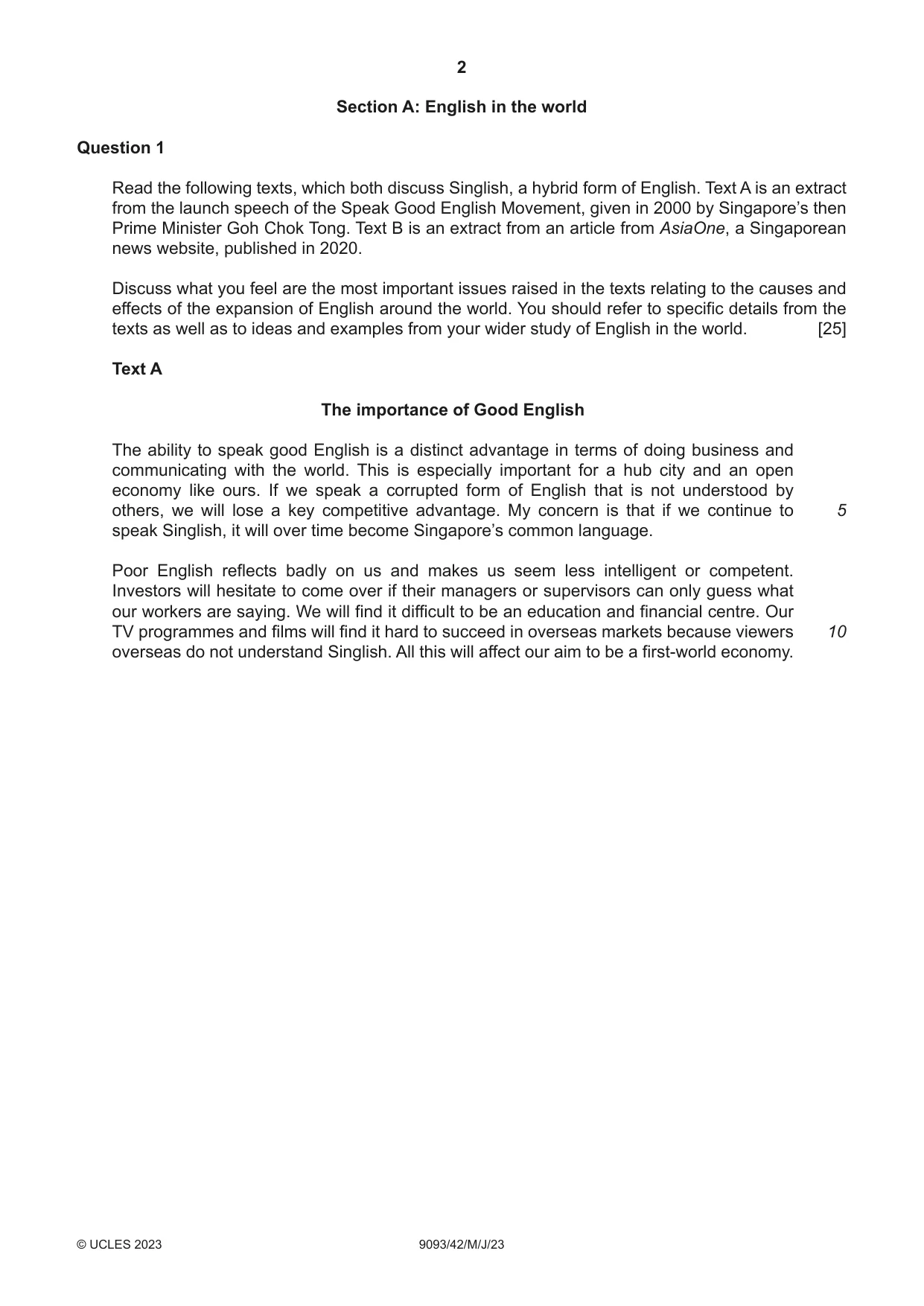
2 9093/42/M/J/23 © UCLES 2023 Section A: English in the world Question 1 Read the following texts, which both discuss Singlish, a hybrid form of English. Text A is an extract from the launch speech of the Speak Good English Movement, given in 2000 by Singapore’s then Prime Minister Goh Chok Tong. Text B is an extract from an article from AsiaOne, a Singaporean news website, published in 2020. Discuss what you feel are the most important issues raised in the texts relating to the causes and effects of the expansion of English around the world. You should refer to specific details from the texts as well as to ideas and examples from your wider study of English in the world. [25] Text A The importance of Good English The ability to speak good English is a distinct advantage in terms of doing business and communicating with the world. This is especially important for a hub city and an open economy like ours. If we speak a corrupted form of English that is not understood by others, we will lose a key competitive advantage. My concern is that if we continue to speak Singlish, it will over time become Singapore’s common language. Poor English reflects badly on us and makes us seem less intelligent or competent. Investors will hesitate to come over if their managers or supervisors can only guess what our workers are saying. We will find it difficult to be an education and financial centre. Our TV programmes and films will find it hard to succeed in overseas markets because viewers overseas do not understand Singlish. All this will affect our aim to be a first‑world economy. 5 10
Question paper, page 3
3 9093/42/M/J/23 © UCLES 2023 [Turn over Text B English language tuition centre founder’s call to abolish Singlish The founder of an English language tuition centre took to Facebook to lay out several arguments on why Singlish – the colloquial patois of Singaporeans – needs to be, in his opinion, ‘cancelled’. Though many Singaporeans proudly identify with a creole to call their own – a unique hodgepodge of our four official languages and other dialects – the government has actively tried to counter the usage of Singlish with a campaign called the Speak Good English Movement since 2000. Content removed due to copyright restrictions.
Question paper, page 4
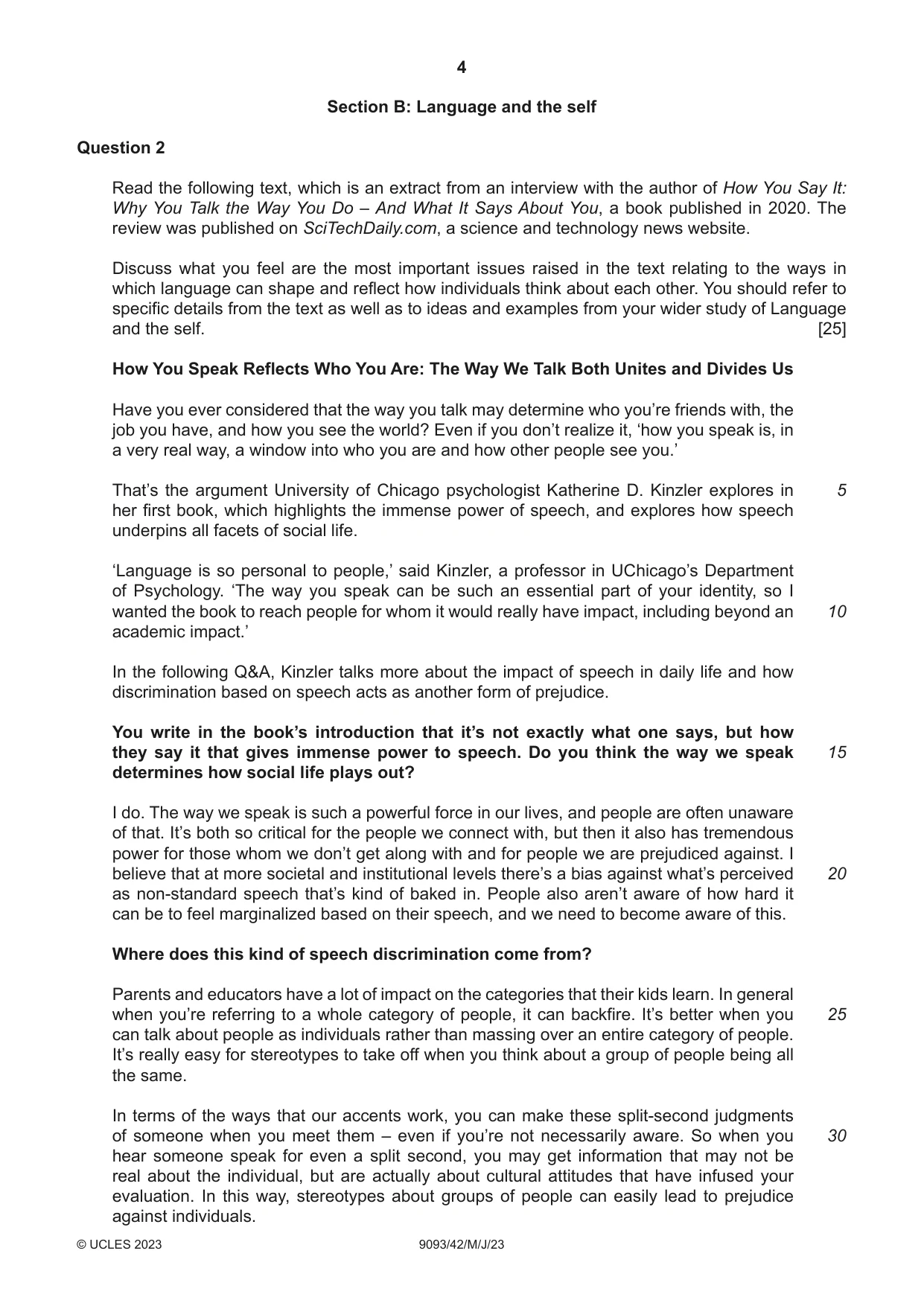
4 9093/42/M/J/23 © UCLES 2023 Section B: Language and the self Question 2 Read the following text, which is an extract from an interview with the author of How You Say It: Why You Talk the Way You Do – And What It Says About You, a book published in 2020. The review was published on SciTechDaily.com, a science and technology news website. Discuss what you feel are the most important issues raised in the text relating to the ways in which language can shape and reflect how individuals think about each other. You should refer to specific details from the text as well as to ideas and examples from your wider study of Language and the self. [25] How You Speak Reflects Who You Are: The Way We Talk Both Unites and Divides Us Have you ever considered that the way you talk may determine who you’re friends with, the job you have, and how you see the world? Even if you don’t realize it, ‘how you speak is, in a very real way, a window into who you are and how other people see you.’ That’s the argument University of Chicago psychologist Katherine D. Kinzler explores in her first book, which highlights the immense power of speech, and explores how speech underpins all facets of social life. ‘Language is so personal to people,’ said Kinzler, a professor in UChicago’s Department of Psychology. ‘The way you speak can be such an essential part of your identity, so I wanted the book to reach people for whom it would really have impact, including beyond an academic impact.’ In the following Q&A, Kinzler talks more about the impact of speech in daily life and how discrimination based on speech acts as another form of prejudice. You write in the book’s introduction that it’s not exactly what one says, but how they say it that gives immense power to speech. Do you think the way we speak determines how social life plays out? I do. The way we speak is such a powerful force in our lives, and people are often unaware of that. It’s both so critical for the people we connect with, but then it also has tremendous power for those whom we don’t get along with and for people we are prejudiced against. I believe that at more societal and institutional levels there’s a bias against what’s perceived as non‑standard speech that’s kind of baked in. People also aren’t aware of how hard it can be to feel marginalized based on their speech, and we need to become aware of this. Where does this kind of speech discrimination come from? Parents and educators have a lot of impact on the categories that their kids learn. In general when you’re referring to a whole category of people, it can backfire. It’s better when you can talk about people as individuals rather than massing over an entire category of people. It’s really easy for stereotypes to take off when you think about a group of people being all the same. In terms of the ways that our accents work, you can make these split‑second judgments of someone when you meet them – even if you’re not necessarily aware. So when you hear someone speak for even a split second, you may get information that may not be real about the individual, but are actually about cultural attitudes that have infused your evaluation. In this way, stereotypes about groups of people can easily lead to prejudice against individuals. 5 10 15 20 25 30
Question paper, page 5
5 9093/42/M/J/23 © UCLES 2023 BLANK PAGE
Question paper, page 6
6 9093/42/M/J/23 © UCLES 2023 BLANK PAGE
Question paper, page 7
7 9093/42/M/J/23 © UCLES 2023 BLANK PAGE
Question paper, page 8
8 9093/42/M/J/23 © UCLES 2023 Permission to reproduce items where third‑party owned material protected by copyright is included has been sought and cleared where possible. Every reasonable effort has been made by the publisher (UCLES) to trace copyright holders, but if any items requiring clearance have unwittingly been included, the publisher will be pleased to make amends at the earliest possible opportunity. To avoid the issue of disclosure of answer‑related information to candidates, all copyright acknowledgements are reproduced online in the Cambridge Assessment International Education Copyright Acknowledgements Booklet. This is produced for each series of examinations and is freely available to download at www.cambridgeinternational.org after the live examination series. Cambridge Assessment International Education is part of Cambridge Assessment. Cambridge Assessment is the brand name of the University of Cambridge Local Examinations Syndicate (UCLES), which is a department of the University of Cambridge. BLANK PAGE
Mark scheme, page 1
This document consists of 9 printed pages. © UCLES 2023 [Turn over Cambridge International A Level ENGLISH LANGUAGE 9093/42 Paper 4 Language Topics May/June 2023 MARK SCHEME Maximum Mark: 50 Published This mark scheme is published as an aid to teachers and candidates, to indicate the requirements of the examination. It shows the basis on which Examiners were instructed to award marks. It does not indicate the details of the discussions that took place at an Examiners’ meeting before marking began, which would have considered the acceptability of alternative answers. Mark schemes should be read in conjunction with the question paper and the Principal Examiner Report for Teachers. Cambridge International will not enter into discussions about these mark schemes. Cambridge International is publishing the mark schemes for the May/June 2023 series for most Cambridge IGCSE, Cambridge International A and AS Level and Cambridge Pre-U components, and some Cambridge O Level components.
Mark scheme, page 2
9093/42 Cambridge International A Level – Mark Scheme PUBLISHED May/June 2023 © UCLES 2023 Page 2 of 9 Generic Marking Principles These general marking principles must be applied by all examiners when marking candidate answers. They should be applied alongside the specific content of the mark scheme or generic level descriptors for a question. Each question paper and mark scheme will also comply with these marking principles. GENERIC MARKING PRINCIPLE 1: Marks must be awarded in line with: the specific content of the mark scheme or the generic level descriptors for the question the specific skills defined in the mark scheme or in the generic level descriptors for the question the standard of response required by a candidate as exemplified by the standardisation scripts. GENERIC MARKING PRINCIPLE 2: Marks awarded are always whole marks (not half marks, or other fractions). GENERIC MARKING PRINCIPLE 3: Marks must be awarded positively: marks are awarded for correct/valid answers, as defined in the mark scheme. However, credit is given for valid answers which go beyond the scope of the syllabus and mark scheme, referring to your Team Leader as appropriate marks are awarded when candidates clearly demonstrate what they know and can do marks are not deducted for errors marks are not deducted for omissions answers should only be judged on the quality of spelling, punctuation and grammar when these features are specifically assessed by the question as indicated by the mark scheme. The meaning, however, should be unambiguous. GENERIC MARKING PRINCIPLE 4: Rules must be applied consistently, e.g. in situations where candidates have not followed instructions or in the application of generic level descriptors.
Mark scheme, page 3
9093/42 Cambridge International A Level – Mark Scheme PUBLISHED May/June 2023 © UCLES 2023 Page 3 of 9 GENERIC MARKING PRINCIPLE 5: Marks should be awarded using the full range of marks defined in the mark scheme for the question (however; the use of the full mark range may be limited according to the quality of the candidate responses seen). GENERIC MARKING PRINCIPLE 6: Marks awarded are based solely on the requirements as defined in the mark scheme. Marks should not be awarded with grade thresholds or grade descriptors in mind.
Mark scheme, page 4
9093/42 Cambridge International A Level – Mark Scheme PUBLISHED May/June 2023 © UCLES 2023 Page 4 of 9 English & Media subject specific general marking principles (To be read in conjunction with the Generic Marking Principles (and requiring further guidance on how to place marks within levels)) Components using level descriptors: We use level descriptors as a guide to broad understanding of the qualities normally expected of, or typical of, work in a level. Level descriptors are a means of general guidance, and should not be interpreted as hurdle statements. Where indicative content notes are supplied for a question, these are not a prescription of required content, and must not be treated as such. Alternative correct points and unexpected answers in candidates’ scripts must be given marks that fairly reflect the knowledge and skills demonstrated. While we may have legitimate expectations as to the ground most answers may occupy, we must at all times be prepared to meet candidates on their chosen ground, provided it is relevant ground (e.g. clearly related to and derived from a relevant passage/text and meeting the mark scheme requirements for the question).
Mark scheme, page 5
9093/42 Cambridge International A Level – Mark Scheme PUBLISHED May/June 2023 © UCLES 2023 Page 5 of 9 English Language specific marking instructions: AO1 Read and demonstrate understanding of a wide variety of texts. (Understanding) Marks should be awarded for the accuracy of the candidate’s understanding of the text and its features, not for any analysis of them which is recognised under AO3. Where comparison is required, marks should be awarded for the candidate’s recognition of similarities and differences between the texts and their features, not for any consequent analysis. When awarding a ‘best-fit’ mark within a Level for each AO, consider each bullet point equally. AO2 Write effectively, creatively, accurately and appropriately, for a range of audiences and purposes. (Writing) Marks should be awarded equally on the basis of the level of the candidate’s written expression (range of features used and accuracy) and the development of their writing (its organisation and relevance to task and audience). When awarding a ‘best-fit’ mark within a Level for each AO, consider each bullet point equally. AO4: Demonstrate understanding of linguistic issues, concepts, methods and approaches. (Conceptualisation) Marks should be awarded equally on the basis of the level of the candidate’s understanding of the relevant issues, concepts, methods and approaches represented both in the text(s) and in their wider studies. When awarding a ‘best-fit’ mark within a Level for each AO, consider each bullet point equally.
Mark scheme, page 6
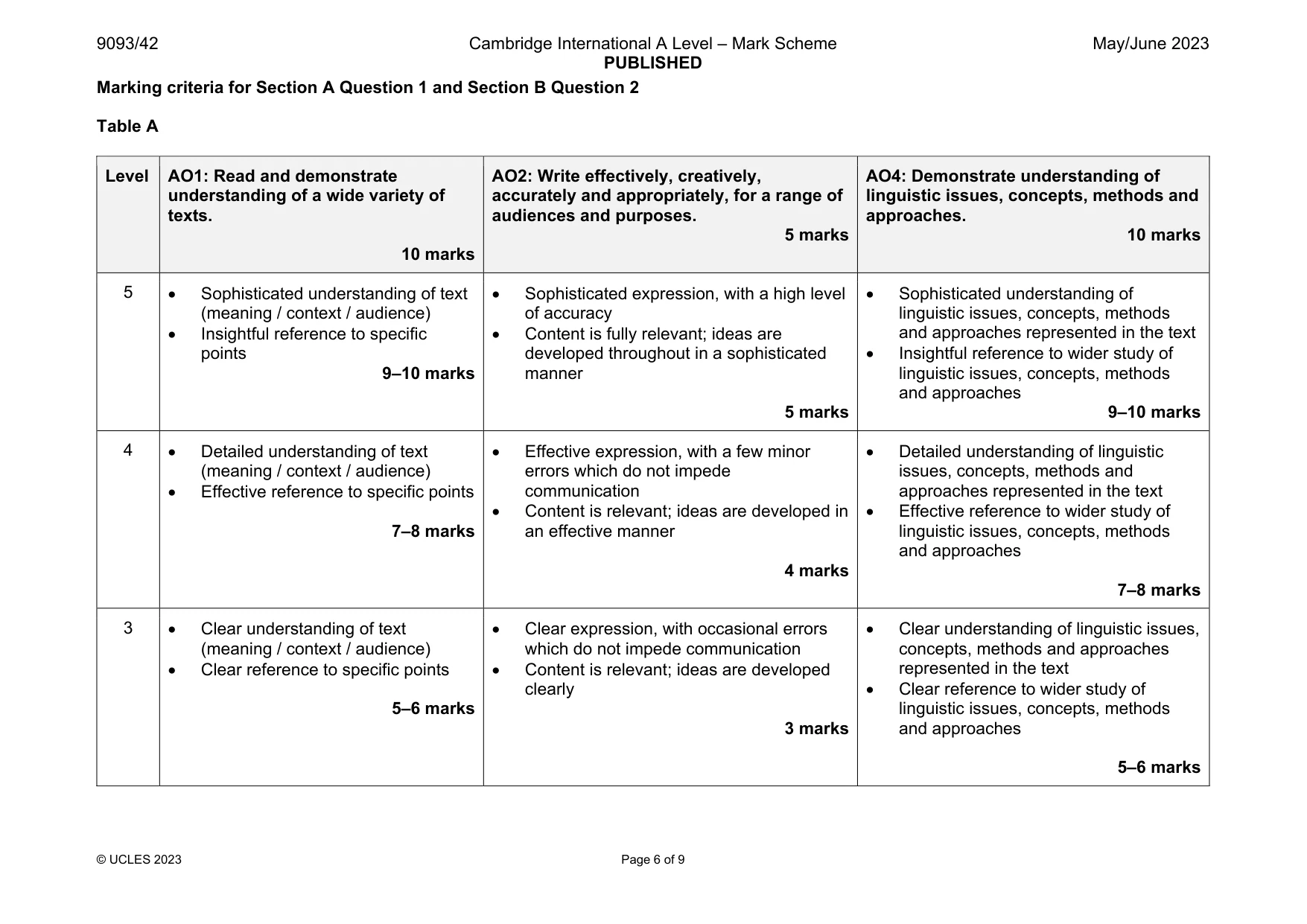
9093/42 Cambridge International A Level – Mark Scheme PUBLISHED May/June 2023 © UCLES 2023 Page 6 of 9 Marking criteria for Section A Question 1 and Section B Question 2 Table A Level AO1: Read and demonstrate understanding of a wide variety of texts. 10 marks AO2: Write effectively, creatively, accurately and appropriately, for a range of audiences and purposes. 5 marks AO4: Demonstrate understanding of linguistic issues, concepts, methods and approaches. 10 marks 5 Sophisticated understanding of text (meaning / context / audience) Insightful reference to specific points 9–10 marks Sophisticated expression, with a high level of accuracy Content is fully relevant; ideas are developed throughout in a sophisticated manner 5 marks Sophisticated understanding of linguistic issues, concepts, methods and approaches represented in the text Insightful reference to wider study of linguistic issues, concepts, methods and approaches 9–10 marks 4 Detailed understanding of text (meaning / context / audience) Effective reference to specific points 7–8 marks Effective expression, with a few minor errors which do not impede communication Content is relevant; ideas are developed in an effective manner 4 marks Detailed understanding of linguistic issues, concepts, methods and approaches represented in the text Effective reference to wider study of linguistic issues, concepts, methods and approaches 7–8 marks 3 Clear understanding of text (meaning / context / audience) Clear reference to specific points 5–6 marks Clear expression, with occasional errors which do not impede communication Content is relevant; ideas are developed clearly 3 marks Clear understanding of linguistic issues, concepts, methods and approaches represented in the text Clear reference to wider study of linguistic issues, concepts, methods and approaches 5–6 marks
Mark scheme, page 7
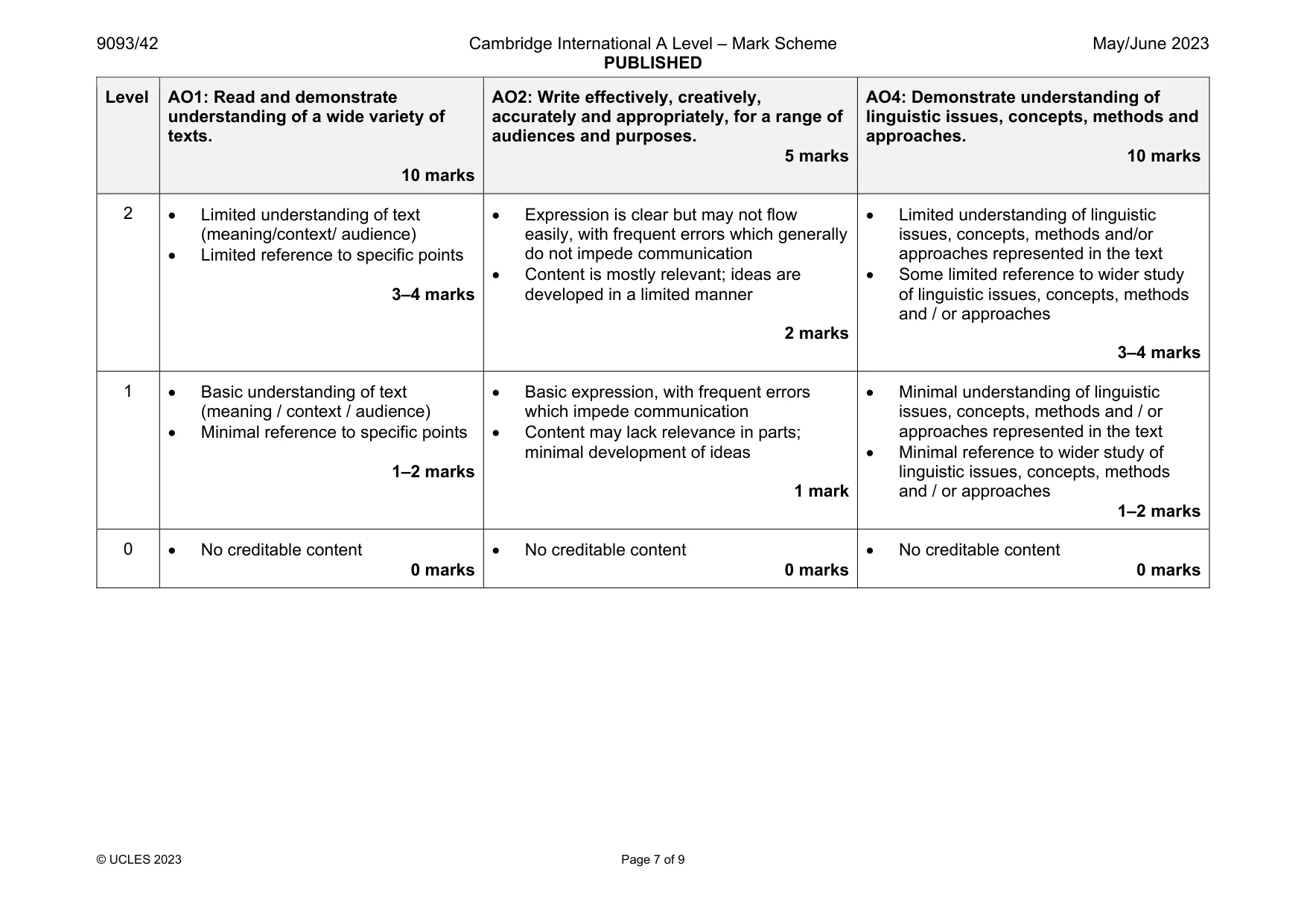
9093/42 Cambridge International A Level – Mark Scheme PUBLISHED May/June 2023 © UCLES 2023 Page 7 of 9 Level AO1: Read and demonstrate understanding of a wide variety of texts. 10 marks AO2: Write effectively, creatively, accurately and appropriately, for a range of audiences and purposes. 5 marks AO4: Demonstrate understanding of linguistic issues, concepts, methods and approaches. 10 marks 2 Limited understanding of text (meaning/context/ audience) Limited reference to specific points 3–4 marks Expression is clear but may not flow easily, with frequent errors which generally do not impede communication Content is mostly relevant; ideas are developed in a limited manner 2 marks Limited understanding of linguistic issues, concepts, methods and/or approaches represented in the text Some limited reference to wider study of linguistic issues, concepts, methods and / or approaches 3–4 marks 1 Basic understanding of text (meaning / context / audience) Minimal reference to specific points 1–2 marks Basic expression, with frequent errors which impede communication Content may lack relevance in parts; minimal development of ideas 1 mark Minimal understanding of linguistic issues, concepts, methods and / or approaches represented in the text Minimal reference to wider study of linguistic issues, concepts, methods and / or approaches 1–2 marks 0 No creditable content 0 marks No creditable content 0 marks No creditable content 0 marks
Mark scheme, page 8
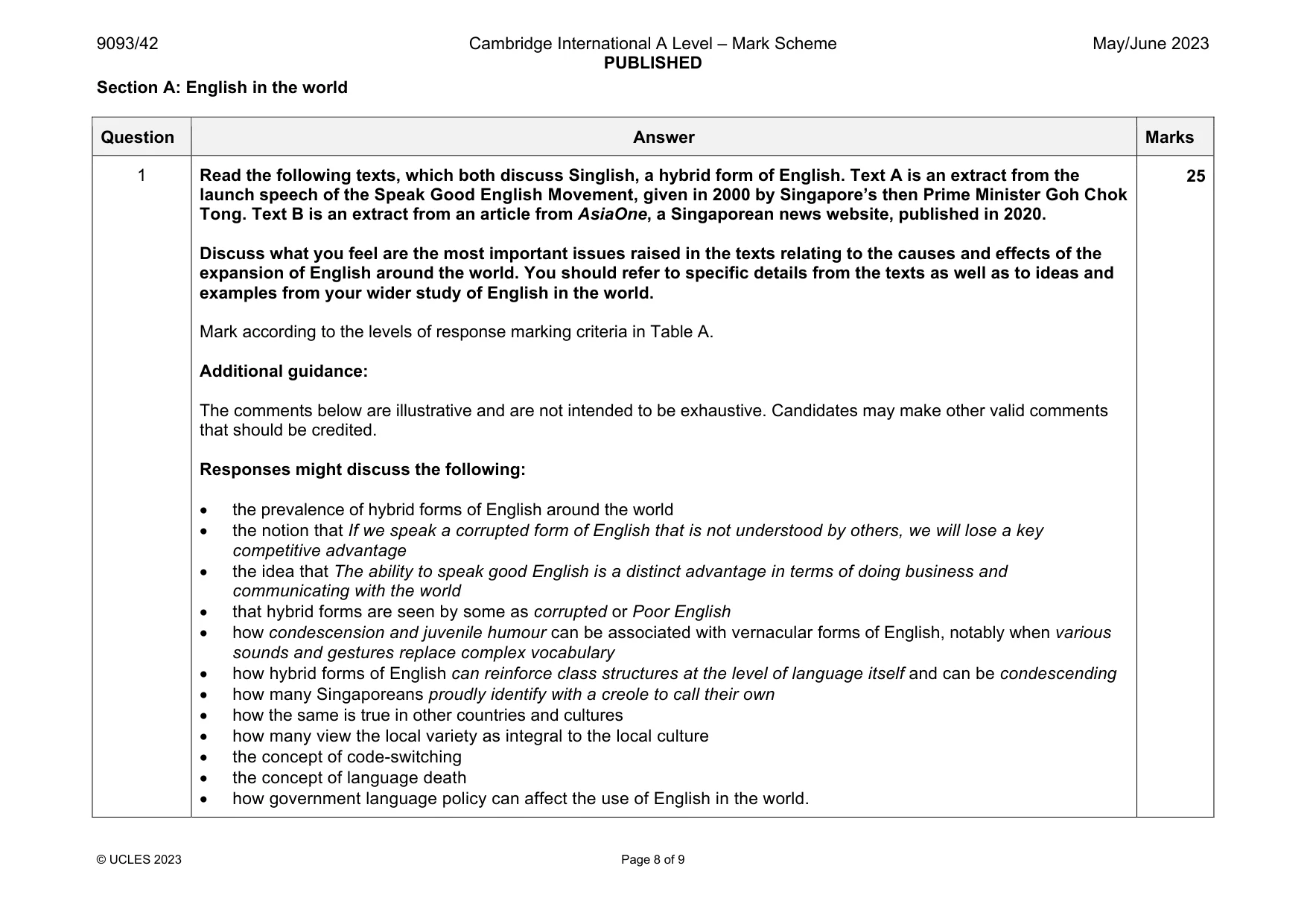
9093/42 Cambridge International A Level – Mark Scheme PUBLISHED May/June 2023 © UCLES 2023 Page 8 of 9 Section A: English in the world Question Answer Marks 1 Read the following texts, which both discuss Singlish, a hybrid form of English. Text A is an extract from the launch speech of the Speak Good English Movement, given in 2000 by Singapore’s then Prime Minister Goh Chok Tong. Text B is an extract from an article from AsiaOne, a Singaporean news website, published in 2020. Discuss what you feel are the most important issues raised in the texts relating to the causes and effects of the expansion of English around the world. You should refer to specific details from the texts as well as to ideas and examples from your wider study of English in the world. Mark according to the levels of response marking criteria in Table A. Additional guidance: The comments below are illustrative and are not intended to be exhaustive. Candidates may make other valid comments that should be credited. Responses might discuss the following: the prevalence of hybrid forms of English around the world the notion that If we speak a corrupted form of English that is not understood by others, we will lose a key competitive advantage the idea that The ability to speak good English is a distinct advantage in terms of doing business and communicating with the world that hybrid forms are seen by some as corrupted or Poor English how condescension and juvenile humour can be associated with vernacular forms of English, notably when various sounds and gestures replace complex vocabulary how hybrid forms of English can reinforce class structures at the level of language itself and can be condescending how many Singaporeans proudly identify with a creole to call their own how the same is true in other countries and cultures how many view the local variety as integral to the local culture the concept of code-switching the concept of language death how government language policy can affect the use of English in the world. 25
Mark scheme, page 9
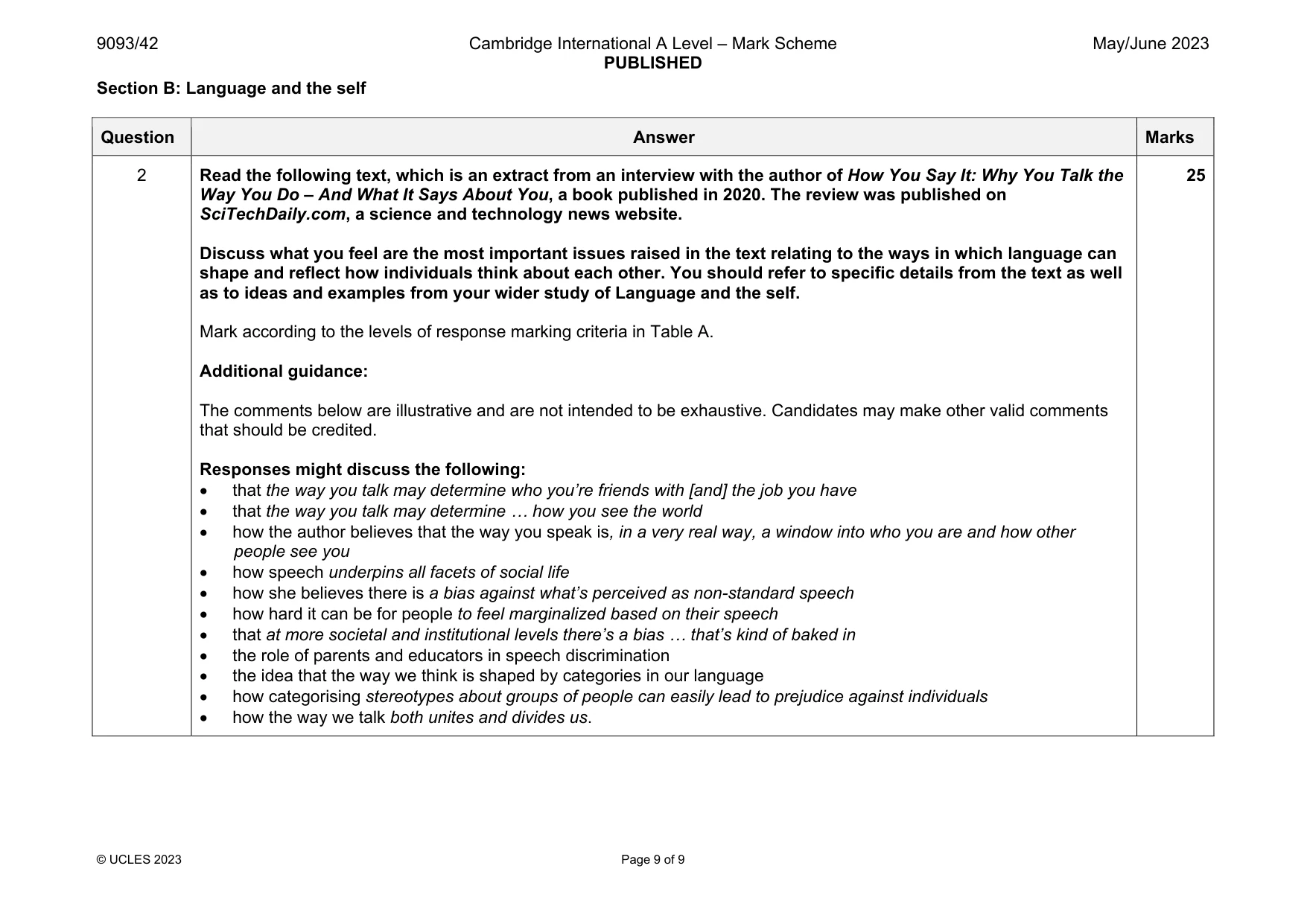
9093/42 Cambridge International A Level – Mark Scheme PUBLISHED May/June 2023 © UCLES 2023 Page 9 of 9 Section B: Language and the self Question Answer Marks 2 Read the following text, which is an extract from an interview with the author of How You Say It: Why You Talk the Way You Do – And What It Says About You, a book published in 2020. The review was published on SciTechDaily.com, a science and technology news website. Discuss what you feel are the most important issues raised in the text relating to the ways in which language can shape and reflect how individuals think about each other. You should refer to specific details from the text as well as to ideas and examples from your wider study of Language and the self. Mark according to the levels of response marking criteria in Table A. Additional guidance: The comments below are illustrative and are not intended to be exhaustive. Candidates may make other valid comments that should be credited. Responses might discuss the following: that the way you talk may determine who you’re friends with [and] the job you have that the way you talk may determine … how you see the world how the author believes that the way you speak is, in a very real way, a window into who you are and how other people see you how speech underpins all facets of social life how she believes there is a bias against what’s perceived as non-standard speech how hard it can be for people to feel marginalized based on their speech that at more societal and institutional levels there’s a bias … that’s kind of baked in the role of parents and educators in speech discrimination the idea that the way we think is shaped by categories in our language how categorising stereotypes about groups of people can easily lead to prejudice against individuals how the way we talk both unites and divides us. 25
What you needed in this session
Cambridge’s own grade thresholds for 2023 May/June, Paper 4 · Variant 2. A higher threshold means an easier paper — the bar moves with how the cohort did.