Cambridge A Level English - Language AS and A Level (from 2014) 9093 — 2024 Feb/March Paper 4 · Variant 2
9093/42/F/M/24 · 50 marks · 135 min
The question paper and its mark scheme, free to read here and free to download. This is Cambridge’s own paper, exactly as it was sat.
Question paper4 pages
Mark scheme8 pages
Answers below. Sit the paper first if you are practising.
Paper as text
Question paper, page 1
This document has 4 pages. [Turn over Cambridge International AS & A Level * 7 9 0 7 4 9 5 2 9 6 * DC (KS) 327708/1 © UCLES 2024 ENGLISH LANGUAGE 9093/42 Paper 4 Language Topics February/March 2024 2 hours 15 minutes You must answer on the enclosed answer booklet. You will need: Answer booklet (enclosed) INSTRUCTIONS ● Answer all questions. ● Follow the instructions on the front cover of the answer booklet. If you need additional answer paper, ask the invigilator for a continuation booklet. ● Dictionaries are not allowed. INFORMATION ● The total mark for this paper is 50. ● The number of marks for each question or part question is shown in brackets [ ].
Question paper, page 2
2 9093/42/F/M/24 © UCLES 2024 Section A: English in the world Question 1 Read the following text, which is an extract from a review of Rosemary C. Salomone’s book The Rise of English – Global Politics and the Power of Language. The review was published in the New York Times in 2022. Discuss what you feel are the most important issues raised in the text relating to the present and future status of English in an international context. You should refer to specific details from the text as well as to ideas and examples from your wider study of English in the world. [25] How the English Language Conquered the World Rosemary Salomone’s The Rise of English explores the language wars being fought all over the world, revealing the political, economic and cultural stakes behind these wars, and showing that so far English is winning. For now, though, ‘the constitutional commitment to language equality in South Africa is aspirational at best,’ and ‘English reigns supreme for its economic power.’ Content removed due to copyright restrictions.
Question paper, page 3
3 9093/42/F/M/24 © UCLES 2024 [Turn over Section B: Language and the self Question 2 Read the following text, which is an article from the American newspaper The Seattle Times. It was published in 2021. Discuss what you consider to be the most important issues raised in the text relating to the ways in which language can shape and reflect personal and social identity. You should refer to specific details from the text as well as to ideas and examples from your wider study of Language and the self. [25] Native American women are reclaiming their language In 1980, when fourth-grader Quirina Geary’s class learned about Spanish missions and the Native American tribes they conquered, she proudly announced that her family was part of the Mutsun tribe, which lived for thousands of years in what is now Central California. Content removed due to copyright restrictions.
Question paper, page 4
4 9093/42/F/M/24 © UCLES 2024 Clues like this show you how connected people are to the lands.’ Permission to reproduce items where third-party owned material protected by copyright is included has been sought and cleared where possible. Every reasonable effort has been made by the publisher (UCLES) to trace copyright holders, but if any items requiring clearance have unwittingly been included, the publisher will be pleased to make amends at the earliest possible opportunity. To avoid the issue of disclosure of answer-related information to candidates, all copyright acknowledgements are reproduced online in the Cambridge Assessment International Education Copyright Acknowledgements Booklet. This is produced for each series of examinations and is freely available to download at www.cambridgeinternational.org after the live examination series. Cambridge Assessment International Education is part of Cambridge Assessment. Cambridge Assessment is the brand name of the University of Cambridge Local Examinations Syndicate (UCLES), which is a department of the University of Cambridge. Content removed due to copyright restrictions.
Mark scheme, page 1
This document consists of 8 printed pages. © Cambridge University Press & Assessment 2024 [Turn over Cambridge International A Level ENGLISH LANGUAGE 9093/42 Paper 4 Language Topics February/March 2024 MARK SCHEME Maximum Mark: 50 Published This mark scheme is published as an aid to teachers and candidates, to indicate the requirements of the examination. It shows the basis on which Examiners were instructed to award marks. It does not indicate the details of the discussions that took place at an Examiners’ meeting before marking began, which would have considered the acceptability of alternative answers. Mark schemes should be read in conjunction with the question paper and the Principal Examiner Report for Teachers. Cambridge International will not enter into discussions about these mark schemes. Cambridge International is publishing the mark schemes for the February/March 2024 series for most Cambridge IGCSE, Cambridge International A and AS Level components, and some Cambridge O Level components.
Mark scheme, page 2
9093/42 Cambridge International A Level – Mark Scheme PUBLISHED February/March 2024 © Cambridge University Press & Assessment 2024 Page 2 of 8 Generic Marking Principles These general marking principles must be applied by all examiners when marking candidate answers. They should be applied alongside the specific content of the mark scheme or generic level descriptions for a question. Each question paper and mark scheme will also comply with these marking principles. GENERIC MARKING PRINCIPLE 1: Marks must be awarded in line with: • the specific content of the mark scheme or the generic level descriptors for the question • the specific skills defined in the mark scheme or in the generic level descriptors for the question • the standard of response required by a candidate as exemplified by the standardisation scripts. GENERIC MARKING PRINCIPLE 2: Marks awarded are always whole marks (not half marks, or other fractions). GENERIC MARKING PRINCIPLE 3: Marks must be awarded positively: • marks are awarded for correct/valid answers, as defined in the mark scheme. However, credit is given for valid answers which go beyond the scope of the syllabus and mark scheme, referring to your Team Leader as appropriate • marks are awarded when candidates clearly demonstrate what they know and can do • marks are not deducted for errors • marks are not deducted for omissions • answers should only be judged on the quality of spelling, punctuation and grammar when these features are specifically assessed by the question as indicated by the mark scheme. The meaning, however, should be unambiguous. GENERIC MARKING PRINCIPLE 4: Rules must be applied consistently, e.g. in situations where candidates have not followed instructions or in the application of generic level descriptors.
Mark scheme, page 3
9093/42 Cambridge International A Level – Mark Scheme PUBLISHED February/March 2024 © Cambridge University Press & Assessment 2024 Page 3 of 8 GENERIC MARKING PRINCIPLE 5: Marks should be awarded using the full range of marks defined in the mark scheme for the question (however; the use of the full mark range may be limited according to the quality of the candidate responses seen). GENERIC MARKING PRINCIPLE 6: Marks awarded are based solely on the requirements as defined in the mark scheme. Marks should not be awarded with grade thresholds or grade descriptors in mind.
Mark scheme, page 4
9093/42 Cambridge International A Level – Mark Scheme PUBLISHED February/March 2024 © Cambridge University Press & Assessment 2024 Page 4 of 8 English & Media subject specific general marking principles (To be read in conjunction with the Generic Marking Principles (and requiring further guidance on how to place marks within levels)) Components using level descriptors: • We use level descriptors as a guide to broad understanding of the qualities normally expected of, or typical of, work in a level. • Level descriptors are a means of general guidance, and should not be interpreted as hurdle statements. • Where indicative content notes are supplied for a question, these are not a prescription of required content, and must not be treated as such. Alternative correct points and unexpected answers in candidates’ scripts must be given marks that fairly reflect the knowledge and skills demonstrated. • While we may have legitimate expectations as to the ground most answers may occupy, we must at all times be prepared to meet candidates on their chosen ground, provided it is relevant ground (e.g. clearly related to and derived from a relevant passage/text and meeting the mark scheme requirements for the question).
Mark scheme, page 5
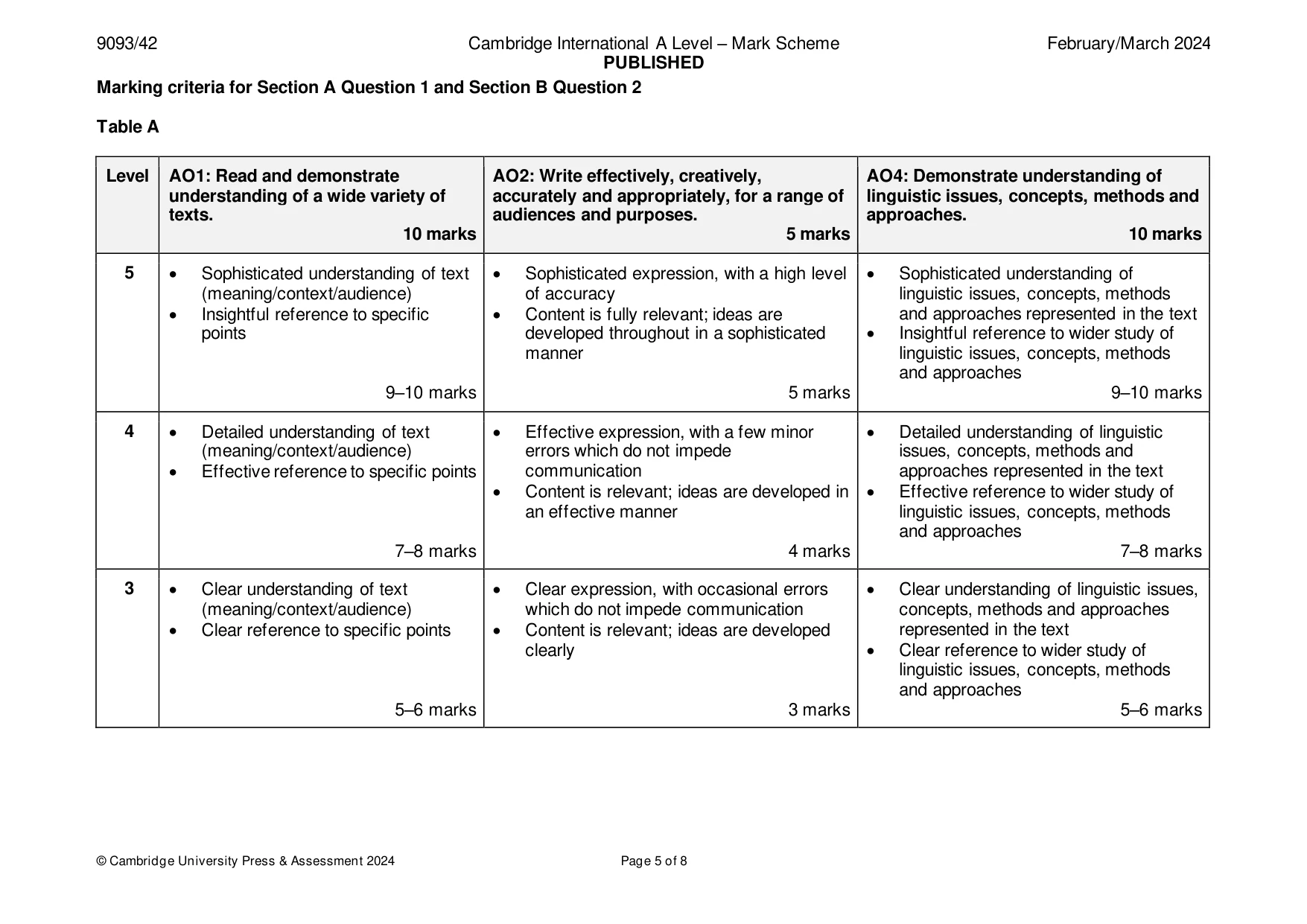
9093/42 Cambridge International A Level – Mark Scheme PUBLISHED February/March 2024 © Cambridge University Press & Assessment 2024 Page 5 of 8 Marking criteria for Section A Question 1 and Section B Question 2 Table A Level AO1: Read and demonstrate understanding of a wide variety of texts. 10 marks AO2: Write effectively, creatively, accurately and appropriately, for a range of audiences and purposes. 5 marks AO4: Demonstrate understanding of linguistic issues, concepts, methods and approaches. 10 marks 5 • Sophisticated understanding of text (meaning/context/audience) • Insightful reference to specific points 9–10 marks • Sophisticated expression, with a high level of accuracy • Content is fully relevant; ideas are developed throughout in a sophisticated manner 5 marks • Sophisticated understanding of linguistic issues, concepts, methods and approaches represented in the text • Insightful reference to wider study of linguistic issues, concepts, methods and approaches 9–10 marks 4 • Detailed understanding of text (meaning/context/audience) • Effective reference to specific points 7–8 marks • Effective expression, with a few minor errors which do not impede communication • Content is relevant; ideas are developed in an effective manner 4 marks • Detailed understanding of linguistic issues, concepts, methods and approaches represented in the text • Effective reference to wider study of linguistic issues, concepts, methods and approaches 7–8 marks 3 • Clear understanding of text (meaning/context/audience) • Clear reference to specific points 5–6 marks • Clear expression, with occasional errors which do not impede communication • Content is relevant; ideas are developed clearly 3 marks • Clear understanding of linguistic issues, concepts, methods and approaches represented in the text • Clear reference to wider study of linguistic issues, concepts, methods and approaches 5–6 marks
Mark scheme, page 6
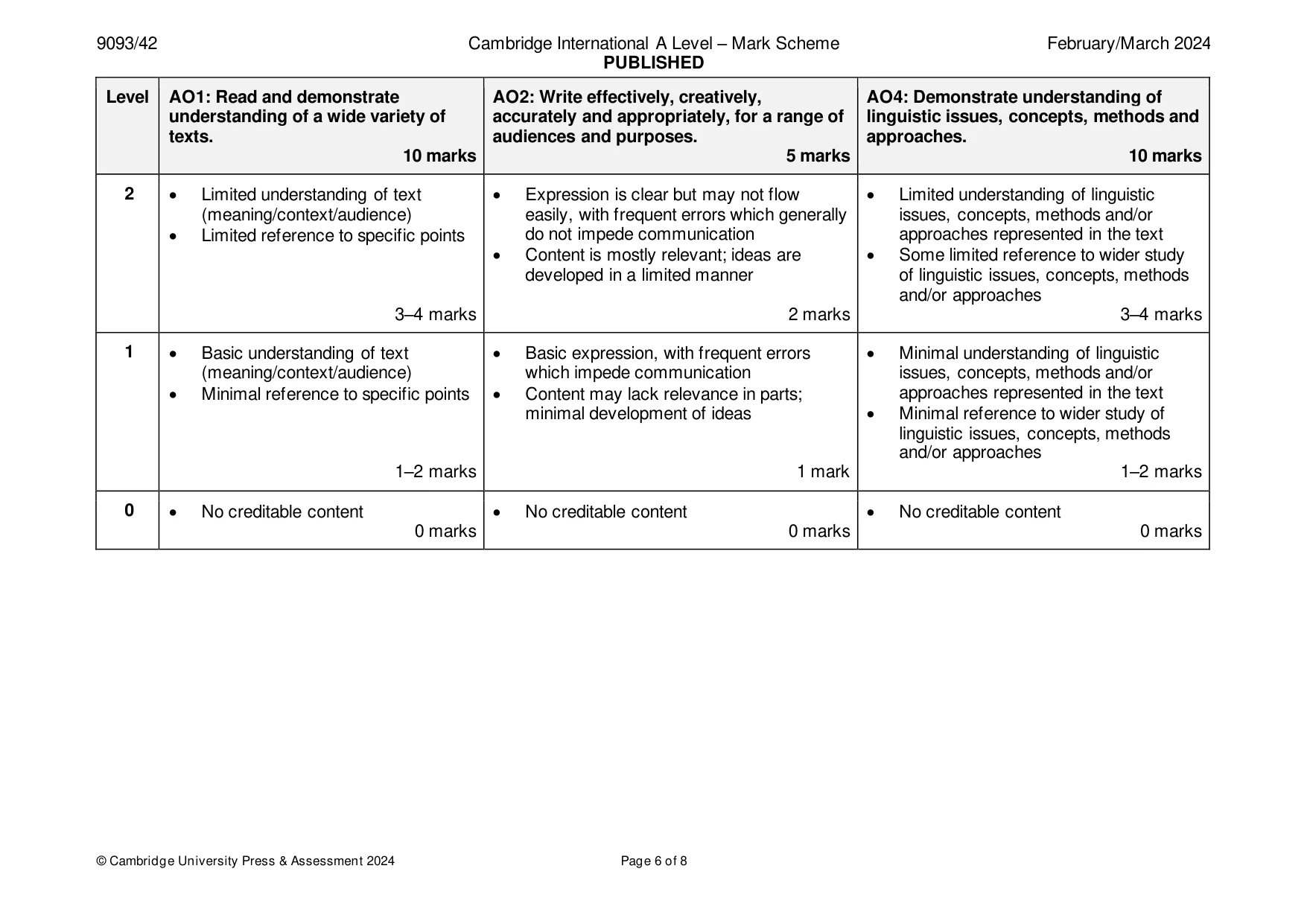
9093/42 Cambridge International A Level – Mark Scheme PUBLISHED February/March 2024 © Cambridge University Press & Assessment 2024 Page 6 of 8 Level AO1: Read and demonstrate understanding of a wide variety of texts. 10 marks AO2: Write effectively, creatively, accurately and appropriately, for a range of audiences and purposes. 5 marks AO4: Demonstrate understanding of linguistic issues, concepts, methods and approaches. 10 marks 2 • Limited understanding of text (meaning/context/audience) • Limited reference to specific points 3–4 marks • Expression is clear but may not flow easily, with frequent errors which generally do not impede communication • Content is mostly relevant; ideas are developed in a limited manner 2 marks • Limited understanding of linguistic issues, concepts, methods and/or approaches represented in the text • Some limited reference to wider study of linguistic issues, concepts, methods and/or approaches 3–4 marks 1 • Basic understanding of text (meaning/context/audience) • Minimal reference to specific points 1–2 marks • Basic expression, with frequent errors which impede communication • Content may lack relevance in parts; minimal development of ideas 1 mark • Minimal understanding of linguistic issues, concepts, methods and/or approaches represented in the text • Minimal reference to wider study of linguistic issues, concepts, methods and/or approaches 1–2 marks 0 • No creditable content 0 marks • No creditable content 0 marks • No creditable content 0 marks
Mark scheme, page 7
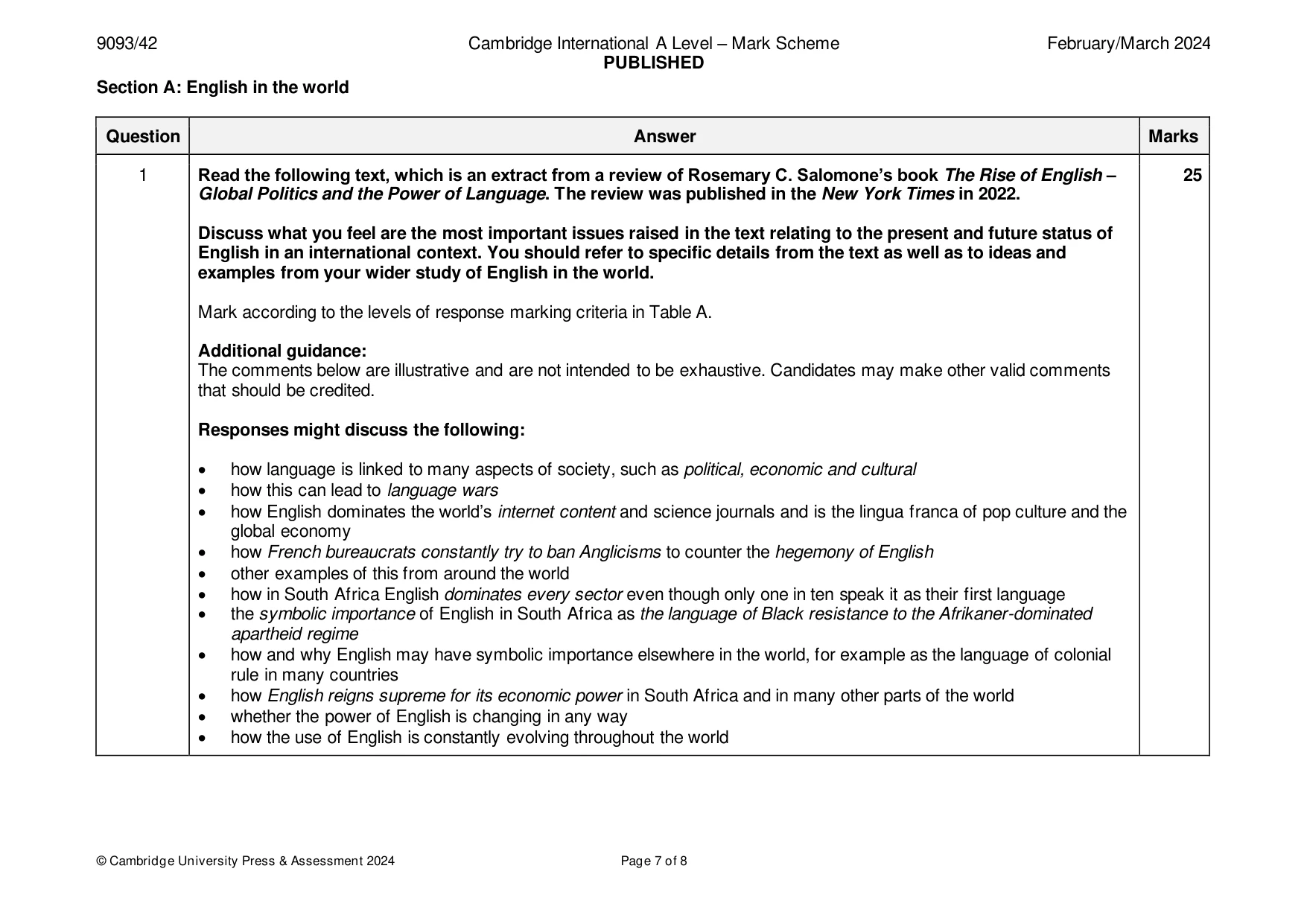
9093/42 Cambridge International A Level – Mark Scheme PUBLISHED February/March 2024 © Cambridge University Press & Assessment 2024 Page 7 of 8 Section A: English in the world Question Answer Marks 1 Read the following text, which is an extract from a review of Rosemary C. Salomone’s book The Rise of English – Global Politics and the Power of Language. The review was published in the New York Times in 2022. Discuss what you feel are the most important issues raised in the text relating to the present and future status of English in an international context. You should refer to specific details from the text as well as to ideas and examples from your wider study of English in the world. Mark according to the levels of response marking criteria in Table A. Additional guidance: The comments below are illustrative and are not intended to be exhaustive. Candidates may make other valid comments that should be credited. Responses might discuss the following: • how language is linked to many aspects of society, such as political, economic and cultural • how this can lead to language wars • how English dominates the world’s internet content and science journals and is the lingua franca of pop culture and the global economy • how French bureaucrats constantly try to ban Anglicisms to counter the hegemony of English • other examples of this from around the world • how in South Africa English dominates every sector even though only one in ten speak it as their first language • the symbolic importance of English in South Africa as the language of Black resistance to the Afrikaner-dominated apartheid regime • how and why English may have symbolic importance elsewhere in the world, for example as the language of colonial rule in many countries • how English reigns supreme for its economic power in South Africa and in many other parts of the world • whether the power of English is changing in any way • how the use of English is constantly evolving throughout the world 25
Mark scheme, page 8
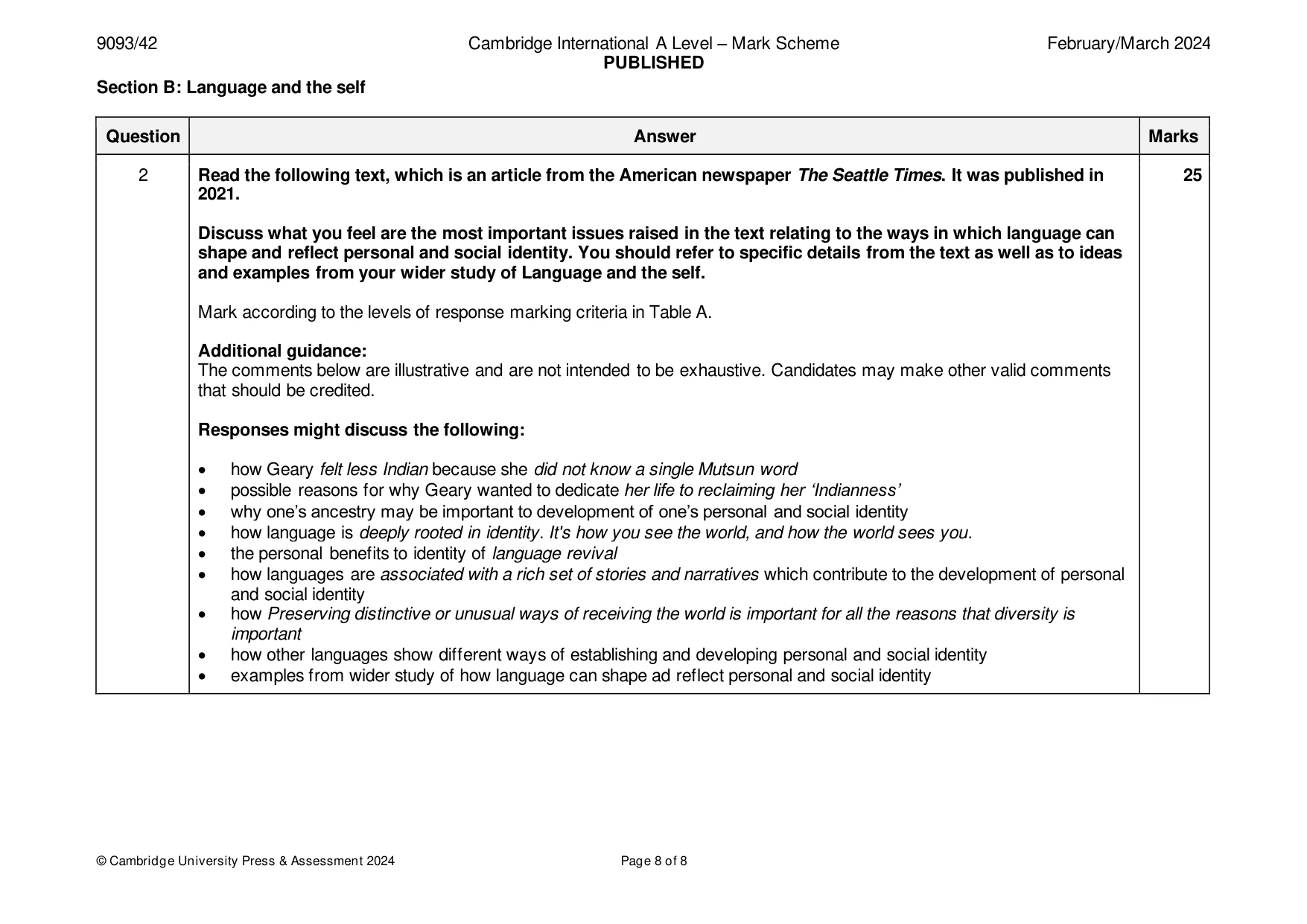
9093/42 Cambridge International A Level – Mark Scheme PUBLISHED February/March 2024 © Cambridge University Press & Assessment 2024 Page 8 of 8 Section B: Language and the self Question Answer Marks 2 Read the following text, which is an article from the American newspaper The Seattle Times. It was published in 2021. Discuss what you feel are the most important issues raised in the text relating to the ways in which language can shape and reflect personal and social identity. You should refer to specific details from the text as well as to ideas and examples from your wider study of Language and the self. Mark according to the levels of response marking criteria in Table A. Additional guidance: The comments below are illustrative and are not intended to be exhaustive. Candidates may make other valid comments that should be credited. Responses might discuss the following: • how Geary felt less Indian because she did not know a single Mutsun word • possible reasons for why Geary wanted to dedicate her life to reclaiming her ‘Indianness’ • why one’s ancestry may be important to development of one’s personal and social identity • how language is deeply rooted in identity. It's how you see the world, and how the world sees you. • the personal benefits to identity of language revival • how languages are associated with a rich set of stories and narratives which contribute to the development of personal and social identity • how Preserving distinctive or unusual ways of receiving the world is important for all the reasons that diversity is important • how other languages show different ways of establishing and developing personal and social identity • examples from wider study of how language can shape ad reflect personal and social identity 25
What you needed in this session
Cambridge’s own grade thresholds for 2024 Feb/March, Paper 4 · Variant 2. A higher threshold means an easier paper — the bar moves with how the cohort did.