Cambridge A Level English - Language AS and A Level (from 2014) 9093 — 2024 May/June Paper 4 · Variant 2
9093/42/M/J/24 · 50 marks · 135 min
The question paper and its mark scheme, free to read here and free to download. This is Cambridge’s own paper, exactly as it was sat.
Question paper8 pages




Mark scheme9 pages
Answers below. Sit the paper first if you are practising.
Paper as text
Question paper, page 1
This document has 8 pages. Any blank pages are indicated. [Turn over * 0 8 5 2 0 0 4 3 8 3 * Cambridge International AS & A Level DC (DE) 329908 © UCLES 2024 ENGLISH LANGUAGE 9093/42 Paper 4 Language Topics May/June 2024 2 hours 15 minutes You must answer on the enclosed answer booklet. You will need: Answer booklet (enclosed) INSTRUCTIONS ● Answer all questions. ● Follow the instructions on the front cover of the answer booklet. If you need additional answer paper, ask the invigilator for a continuation booklet. ● Dictionaries are not allowed. INFORMATION ● The total mark for this paper is 50. ● The number of marks for each question or part question is shown in brackets [ ].
Question paper, page 2
2 9093/42/M/J/24 © UCLES 2024 Section A: English in the world Question 1 Read the following two texts. Text A is an extract from an article in the American newspaper The Wall Street Journal. It was published in 2021. Text B is an extract from an article in the Zimbabwean newspaper The Herald. It was published in 2022. Discuss what you feel are the most important issues raised in the texts relating to the changing use of English in an international context. You should refer to specific details from the texts as well as to ideas and examples from your wider study of English in the world. [25] Text A The Downside of English’s Dominance Relying solely on English inevitably limits the world’s collective knowledge base. While apps like Apple’s Gentle Reader make foreign language newspapers and magazines instantly available in English on computers and iPhones, the end product is only an imperfect facsimile of what speakers of the original language are absorbing. Content removed due to copyright restrictions.
Question paper, page 3
3 9093/42/M/J/24 © UCLES 2024 [Turn over Text B English language education loses appeal in China The English learning rush started in China in the 1980s when the country was gradually opening its doors after a prolonged period of isolation. In the last two decades of the 20th century, those who could speak English and had overseas degrees were among the most highly-paid in the country. Years of vigorous language education has greatly improved the English literacy of the ordinary Chinese. Being able to chat casually with a foreigner in the street is no longer an enviable skill. On a deeper level, the economic landscape in China is changing. China’s sustained growth, in contrast to economic and social challenges in the West, is tipping the psychological scale in the Chinese job-hunters. In 2018, foreign companies became the least preferred employers in a survey of college graduates. In 2021, 135 Chinese companies made it to the Fortune 5001, against 122 from the US. Today, Chinese graduates generally prefer civil service and the State-owned enterprises for job security or domestic Internet giants for high salaries. Western companies find it hard to compete on either front. Naturally, English language education has suffered a heavy blow. Some are saying with tongue in cheek that fitness training and learning English used to be the top two choices for a young person if they wanted something of a change; now it seems there is only fitness training left. 1Fortune 500: an annual list of 500 of the largest companies in the USA, compiled by Fortune magazine 5 10 15 20
Question paper, page 4
4 9093/42/M/J/24 © UCLES 2024 Section B: Language and the self Question 2 Read the following text, which is an extract from an article published in 2019 on PBS.com, the website of an American public broadcaster. Discuss what you feel are the most important issues raised in the text relating to the ways in which language can shape and reflect personal and social identity. You should refer to specific details from the text as well as to ideas and examples from your wider study of Language and the self. [25] How secret languages thrive behind bars Prison language, or language created by inmates while incarcerated, has a long and vivid history, and is likely as old as the modern prison itself. Content removed due to copyright restrictions.
Question paper, page 5
5 9093/42/M/J/24 © UCLES 2024 Sometimes, this can be a humorous pursuit. Other times, it’s a matter of life or death. Content removed due to copyright restrictions.
Question paper, page 6
6 9093/42/M/J/24 © UCLES 2024 BLANK PAGE
Question paper, page 7
7 9093/42/M/J/24 © UCLES 2024 BLANK PAGE
Question paper, page 8
8 9093/42/M/J/24 © UCLES 2024 Permission to reproduce items where third-party owned material protected by copyright is included has been sought and cleared where possible. Every reasonable effort has been made by the publisher (UCLES) to trace copyright holders, but if any items requiring clearance have unwittingly been included, the publisher will be pleased to make amends at the earliest possible opportunity. To avoid the issue of disclosure of answer-related information to candidates, all copyright acknowledgements are reproduced online in the Cambridge Assessment International Education Copyright Acknowledgements Booklet. This is produced for each series of examinations and is freely available to download at www.cambridgeinternational.org after the live examination series. Cambridge Assessment International Education is part of Cambridge Assessment. Cambridge Assessment is the brand name of the University of Cambridge Local Examinations Syndicate (UCLES), which is a department of the University of Cambridge. BLANK PAGE
Mark scheme, page 1
This document consists of 9 printed pages. © Cambridge University Press & Assessment 2024 [Turn over Cambridge International A Level ENGLISH LANGUAGE 9093/42 Paper 4 Language Topics May/June 2024 MARK SCHEME Maximum Mark: 50 Published This mark scheme is published as an aid to teachers and candidates, to indicate the requirements of the examination. It shows the basis on which Examiners were instructed to award marks. It does not indicate the details of the discussions that took place at an Examiners’ meeting before marking began, which would have considered the acceptability of alternative answers. Mark schemes should be read in conjunction with the question paper and the Principal Examiner Report for Teachers. Cambridge International will not enter into discussions about these mark schemes. Cambridge International is publishing the mark schemes for the May/June 2024 series for most Cambridge IGCSE, Cambridge International A and AS Level and Cambridge Pre-U components, and some Cambridge O Level components.
Mark scheme, page 2
9093/42 Cambridge International A Level – Mark Scheme PUBLISHED May/June 2024 © Cambridge University Press & Assessment 2024 Page 2 of 9 Generic Marking Principles These general marking principles must be applied by all examiners when marking candidate answers. They should be applied alongside the specific content of the mark scheme or generic level descriptions for a question. Each question paper and mark scheme will also comply with these marking principles. GENERIC MARKING PRINCIPLE 1: Marks must be awarded in line with: the specific content of the mark scheme or the generic level descriptors for the question the specific skills defined in the mark scheme or in the generic level descriptors for the question the standard of response required by a candidate as exemplified by the standardisation scripts. GENERIC MARKING PRINCIPLE 2: Marks awarded are always whole marks (not half marks, or other fractions). GENERIC MARKING PRINCIPLE 3: Marks must be awarded positively: marks are awarded for correct/valid answers, as defined in the mark scheme. However, credit is given for valid answers which go beyond the scope of the syllabus and mark scheme, referring to your Team Leader as appropriate marks are awarded when candidates clearly demonstrate what they know and can do marks are not deducted for errors marks are not deducted for omissions answers should only be judged on the quality of spelling, punctuation and grammar when these features are specifically assessed by the question as indicated by the mark scheme. The meaning, however, should be unambiguous. GENERIC MARKING PRINCIPLE 4: Rules must be applied consistently, e.g. in situations where candidates have not followed instructions or in the application of generic level descriptors.
Mark scheme, page 3
9093/42 Cambridge International A Level – Mark Scheme PUBLISHED May/June 2024 © Cambridge University Press & Assessment 2024 Page 3 of 9 GENERIC MARKING PRINCIPLE 5: Marks should be awarded using the full range of marks defined in the mark scheme for the question (however; the use of the full mark range may be limited according to the quality of the candidate responses seen). GENERIC MARKING PRINCIPLE 6: Marks awarded are based solely on the requirements as defined in the mark scheme. Marks should not be awarded with grade thresholds or grade descriptors in mind.
Mark scheme, page 4
9093/42 Cambridge International A Level – Mark Scheme PUBLISHED May/June 2024 © Cambridge University Press & Assessment 2024 Page 4 of 9 English & Media subject specific general marking principles (To be read in conjunction with the Generic Marking Principles (and requiring further guidance on how to place marks within levels)) Components using level descriptors: We use level descriptors as a guide to broad understanding of the qualities normally expected of, or typical of, work in a level. Level descriptors are a means of general guidance, and should not be interpreted as hurdle statements. Where indicative content notes are supplied for a question, these are not a prescription of required content, and must not be treated as such. Alternative correct points and unexpected answers in candidates’ scripts must be given marks that fairly reflect the knowledge and skills demonstrated. While we may have legitimate expectations as to the ground most answers may occupy, we must at all times be prepared to meet candidates on their chosen ground, provided it is relevant ground (e.g. clearly related to and derived from a relevant passage/text and meeting the mark scheme requirements for the question). Components using point-based marking: Point marking is often used to reward knowledge, understanding and application of skills. We give credit where the candidate’s answer shows relevant knowledge, understanding and application of skills in answering the question. We do not give credit where the answer shows confusion. From this it follows that we: a DO credit answers which are worded differently from the mark scheme if they clearly convey the same meaning (unless the mark scheme requires a specific term). b DO credit alternative answers/examples which are not written in the mark scheme if they are correct. c DO credit answers where candidates give more than one correct answer in one prompt/numbered/scaffolded space where extended writing is required rather than list-type answers. For example, questions that require n reasons (e.g. State two reasons…). d DO NOT credit answers simply for using a ‘key term’ unless that is all that is required. (Check for evidence it is understood and not used wrongly.). e DO NOT credit answers which are obviously self-contradicting or trying to cover all possibilities. f DO NOT give further credit for what is effectively repetition of a correct point already credited unless the language itself is being tested. This applies equally to ‘mirror statements’ (i.e. polluted/not polluted). g DO NOT require spellings to be correct, unless this is part of the test. However spellings of syllabus terms must allow for clear and unambiguous separation from other syllabus terms with which they may be confused (e.g. Corrasion/Corrosion).
Mark scheme, page 5
9093/42 Cambridge International A Level – Mark Scheme PUBLISHED May/June 2024 © Cambridge University Press & Assessment 2024 Page 5 of 9 English Language specific marking instructions: AO1 Read and demonstrate understanding of a wide variety of texts. (Understanding) Marks should be awarded for the accuracy of the candidate’s understanding of the text and its features, not for any analysis of them which is recognised under AO3. Where comparison is required, marks should be awarded for the candidate’s recognition of similarities and differences between the texts and their features, not for any consequent analysis. When awarding a ‘best-fit’ mark within a Level for each AO, consider each bullet point equally. AO2 Write effectively, creatively, accurately and appropriately, for a range of audiences and purposes. (Writing) Marks should be awarded equally on the basis of the level of the candidate’s written expression (range of features used and accuracy) and the development of their writing (its organisation and relevance to task and audience). When awarding a ‘best-fit’ mark within a Level for each AO, consider each bullet point equally. AO4: Demonstrate understanding of linguistic issues, concepts, methods and approaches. (Conceptualisation) Marks should be awarded equally on the basis of the level of the candidate’s understanding of the relevant issues, concepts, methods and approaches represented both in the text(s) and in their wider studies. When awarding a ‘best-fit’ mark within a Level for each AO, consider each bullet point equally.
Mark scheme, page 6
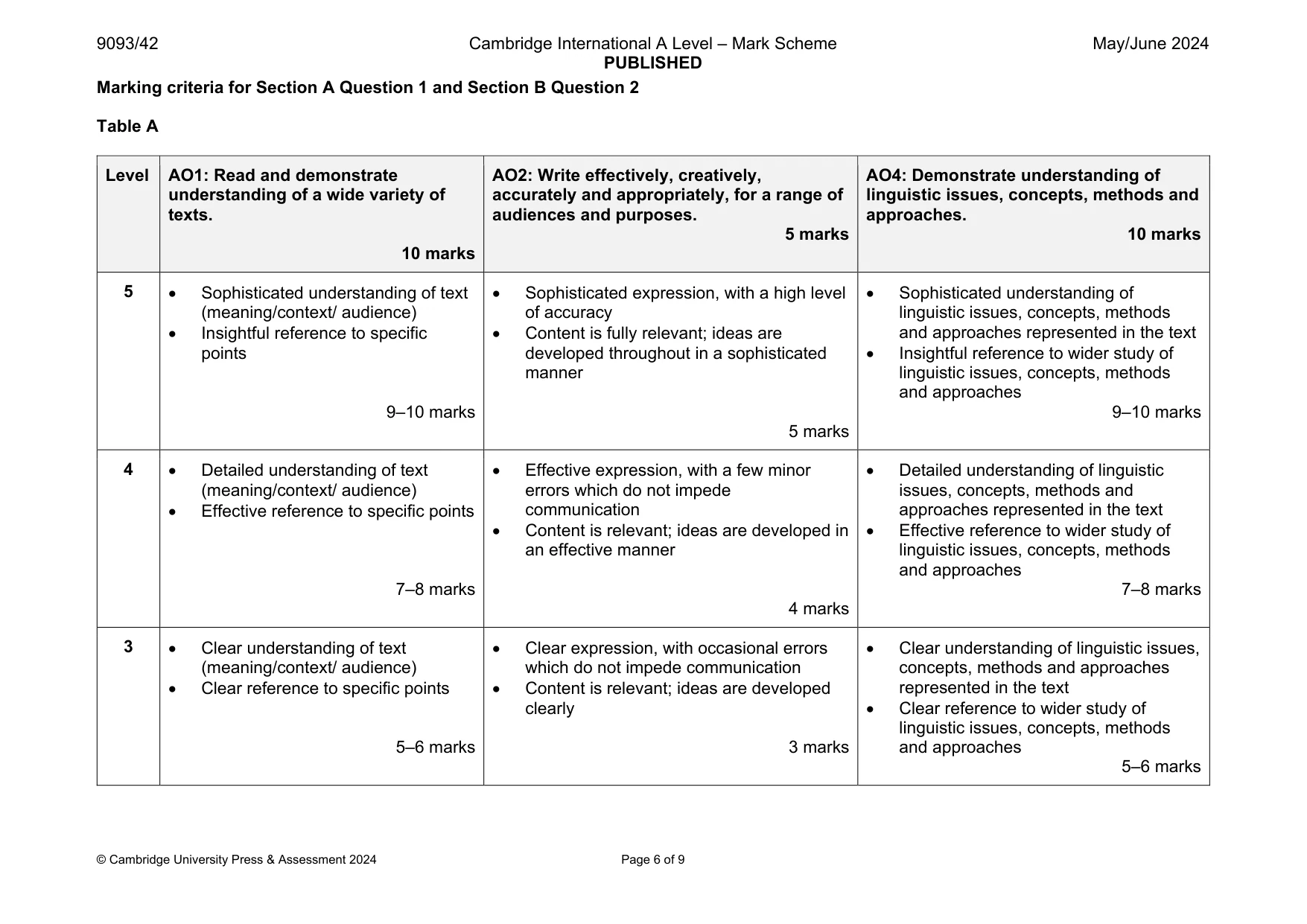
9093/42 Cambridge International A Level – Mark Scheme PUBLISHED May/June 2024 © Cambridge University Press & Assessment 2024 Page 6 of 9 Marking criteria for Section A Question 1 and Section B Question 2 Table A Level AO1: Read and demonstrate understanding of a wide variety of texts. 10 marks AO2: Write effectively, creatively, accurately and appropriately, for a range of audiences and purposes. 5 marks AO4: Demonstrate understanding of linguistic issues, concepts, methods and approaches. 10 marks 5 Sophisticated understanding of text (meaning/context/ audience) Insightful reference to specific points 9–10 marks Sophisticated expression, with a high level of accuracy Content is fully relevant; ideas are developed throughout in a sophisticated manner 5 marks Sophisticated understanding of linguistic issues, concepts, methods and approaches represented in the text Insightful reference to wider study of linguistic issues, concepts, methods and approaches 9–10 marks 4 Detailed understanding of text (meaning/context/ audience) Effective reference to specific points 7–8 marks Effective expression, with a few minor errors which do not impede communication Content is relevant; ideas are developed in an effective manner 4 marks Detailed understanding of linguistic issues, concepts, methods and approaches represented in the text Effective reference to wider study of linguistic issues, concepts, methods and approaches 7–8 marks 3 Clear understanding of text (meaning/context/ audience) Clear reference to specific points 5–6 marks Clear expression, with occasional errors which do not impede communication Content is relevant; ideas are developed clearly 3 marks Clear understanding of linguistic issues, concepts, methods and approaches represented in the text Clear reference to wider study of linguistic issues, concepts, methods and approaches 5–6 marks
Mark scheme, page 7
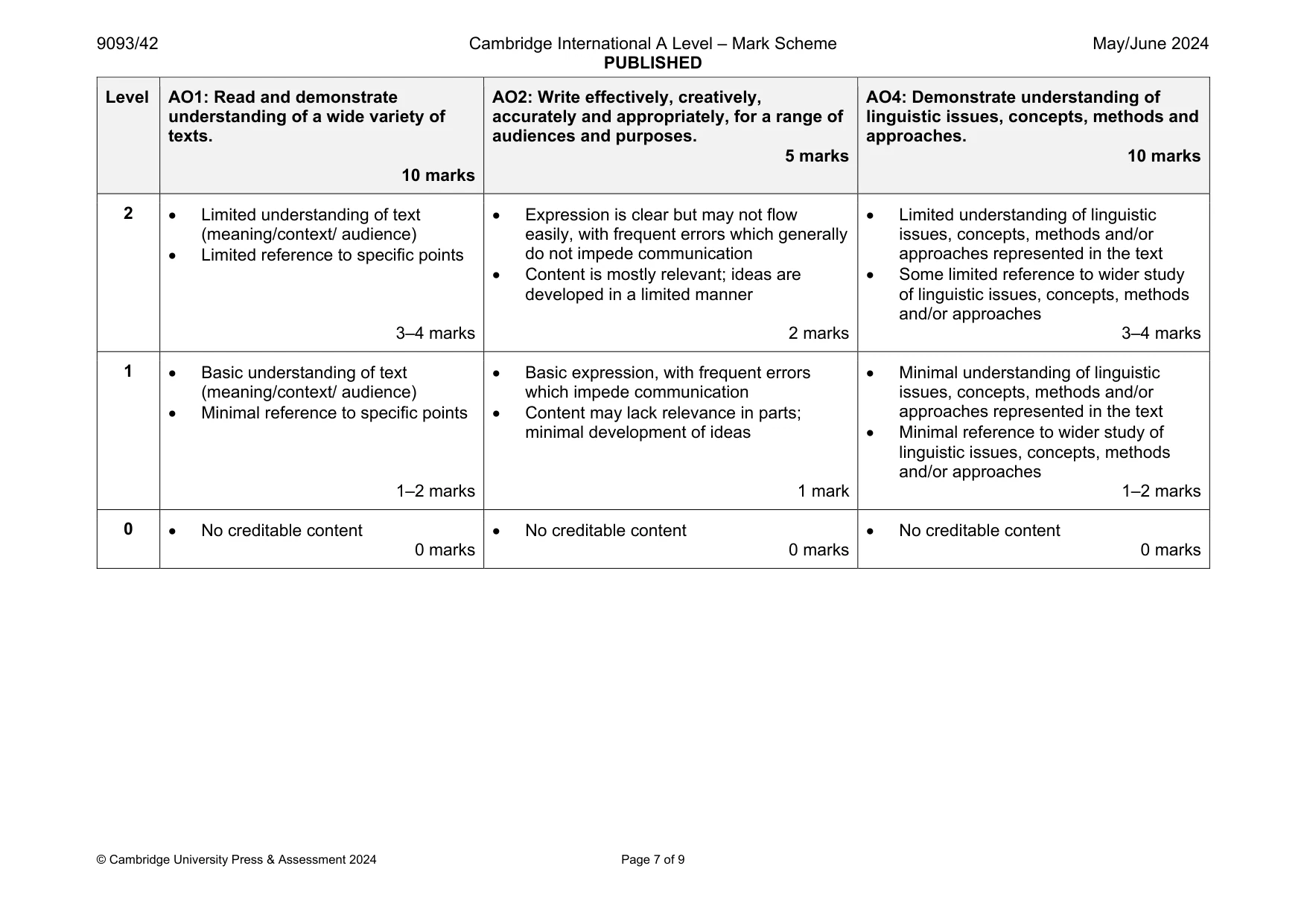
9093/42 Cambridge International A Level – Mark Scheme PUBLISHED May/June 2024 © Cambridge University Press & Assessment 2024 Page 7 of 9 Level AO1: Read and demonstrate understanding of a wide variety of texts. 10 marks AO2: Write effectively, creatively, accurately and appropriately, for a range of audiences and purposes. 5 marks AO4: Demonstrate understanding of linguistic issues, concepts, methods and approaches. 10 marks 2 Limited understanding of text (meaning/context/ audience) Limited reference to specific points 3–4 marks Expression is clear but may not flow easily, with frequent errors which generally do not impede communication Content is mostly relevant; ideas are developed in a limited manner 2 marks Limited understanding of linguistic issues, concepts, methods and/or approaches represented in the text Some limited reference to wider study of linguistic issues, concepts, methods and/or approaches 3–4 marks 1 Basic understanding of text (meaning/context/ audience) Minimal reference to specific points 1–2 marks Basic expression, with frequent errors which impede communication Content may lack relevance in parts; minimal development of ideas 1 mark Minimal understanding of linguistic issues, concepts, methods and/or approaches represented in the text Minimal reference to wider study of linguistic issues, concepts, methods and/or approaches 1–2 marks 0 No creditable content 0 marks No creditable content 0 marks No creditable content 0 marks
Mark scheme, page 8
9093/42 Cambridge International A Level – Mark Scheme PUBLISHED May/June 2024 © Cambridge University Press & Assessment 2024 Page 8 of 9 Section A: English in the world Question Answer Marks 1 Read the following two texts. Text A is an extract from an article in the American newspaper The Wall Street Journal. It was published in 2021. Text B is an extract from an article in the Zimbabwean newspaper The Herald. It was published in 2022. Discuss what you feel are the most important issues raised in the texts relating to the changing use of English in an international context. You should refer to specific details from the texts as well as to ideas and examples from your wider study of English in the world. Mark according to the levels of response marking criteria in Table A. Additional guidance: The comments below are illustrative and are not intended to be exhaustive. Candidates may make other valid comments that should be credited. Responses might discuss the following: how Relying solely on English inevitably limits the world’s collective knowledge base how, in spite of the hegemony of English for several decades Only a quarter of the world’s population is minimally competent in English how, this means that Monolingual English-speakers can’t effectively communicate with three-quarters of the world how and why they risk becoming politically and culturally isolated how and why the attraction of English is waning in China how and why, in China, foreign companies have become the least preferred employers how, as a result, English language education has suffered a heavy blow how this changing trend may be apparent in other countries how this changing trend may develop in the future 25
Mark scheme, page 9
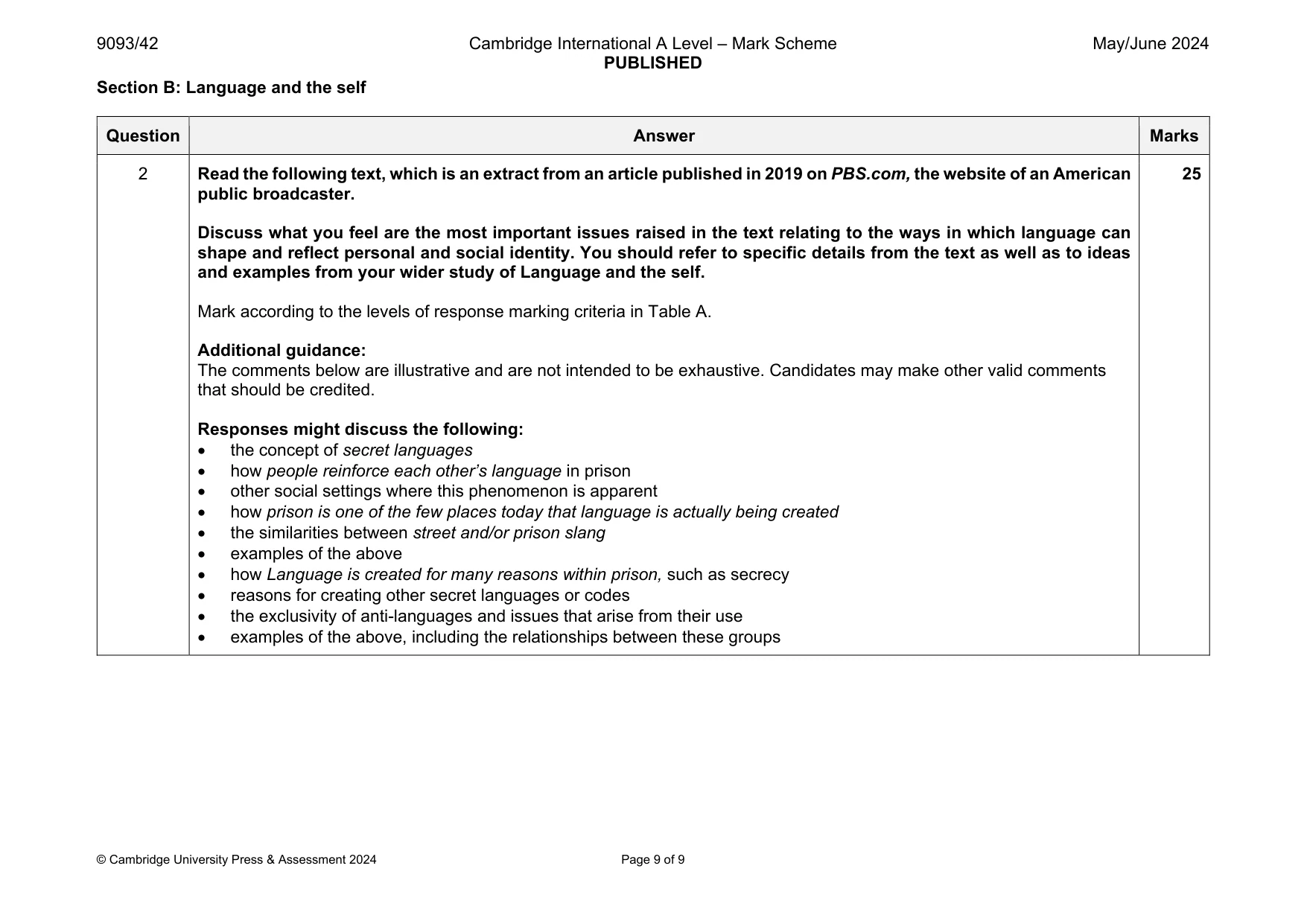
9093/42 Cambridge International A Level – Mark Scheme PUBLISHED May/June 2024 © Cambridge University Press & Assessment 2024 Page 9 of 9 Section B: Language and the self Question Answer Marks 2 Read the following text, which is an extract from an article published in 2019 on PBS.com, the website of an American public broadcaster. Discuss what you feel are the most important issues raised in the text relating to the ways in which language can shape and reflect personal and social identity. You should refer to specific details from the text as well as to ideas and examples from your wider study of Language and the self. Mark according to the levels of response marking criteria in Table A. Additional guidance: The comments below are illustrative and are not intended to be exhaustive. Candidates may make other valid comments that should be credited. Responses might discuss the following: the concept of secret languages how people reinforce each other’s language in prison other social settings where this phenomenon is apparent how prison is one of the few places today that language is actually being created the similarities between street and/or prison slang examples of the above how Language is created for many reasons within prison, such as secrecy reasons for creating other secret languages or codes the exclusivity of anti-languages and issues that arise from their use examples of the above, including the relationships between these groups 25
What you needed in this session
Cambridge’s own grade thresholds for 2024 May/June, Paper 4 · Variant 2. A higher threshold means an easier paper — the bar moves with how the cohort did.