Cambridge A Level English - Language AS and A Level (from 2014) 9093 — 2025 Feb/March Paper 4 · Variant 2
9093/42/F/M/25 · 50 marks · 135 min
The question paper and its mark scheme, free to read here and free to download. This is Cambridge’s own paper, exactly as it was sat.
Question paper8 pages



Mark scheme9 pages
Answers below. Sit the paper first if you are practising.
Paper as text
Question paper, page 1
This document has 8 pages. Any blank pages are indicated. [Turn over Cambridge International AS & A Level DC (CE) 343508/2 © UCLES 2025 * 0 2 4 1 7 1 3 5 3 4 * ENGLISH LANGUAGE 9093/42 Paper 4 Language Topics February/March 2025 2 hours 15 minutes You must answer on the enclosed answer booklet. You will need: Answer booklet (enclosed) INSTRUCTIONS ● Answer all questions. ● Follow the instructions on the front cover of the answer booklet. If you need additional answer paper, ask the invigilator for a continuation booklet. ● Dictionaries are not allowed. INFORMATION ● The total mark for this paper is 50. ● The number of marks for each question or part question is shown in brackets [ ].
Question paper, page 2
2 9093/42/F/M/25 © UCLES 2025 Section A: English in the world Question 1 Read the following text, which is an extract from an article on the American website Wired in 2023. Discuss what you feel are the most important issues raised in the text relating to the causes and effects of the expansion of English around the world. You should refer to specific details from the text as well as to ideas and examples from your wider study of English in the world. [25] ChatGPT Is Cutting Non-English Languages Out of the AI1 Revolution AI chatbots are less fluent in languages other than English, threatening to amplify existing bias in global commerce and innovation. Content removed due to copyright restrictions.
Question paper, page 3
3 9093/42/F/M/25 © UCLES 2025 [Turn over That could further a spiral of imposition and influence of English. Content removed due to copyright restrictions.
Question paper, page 4
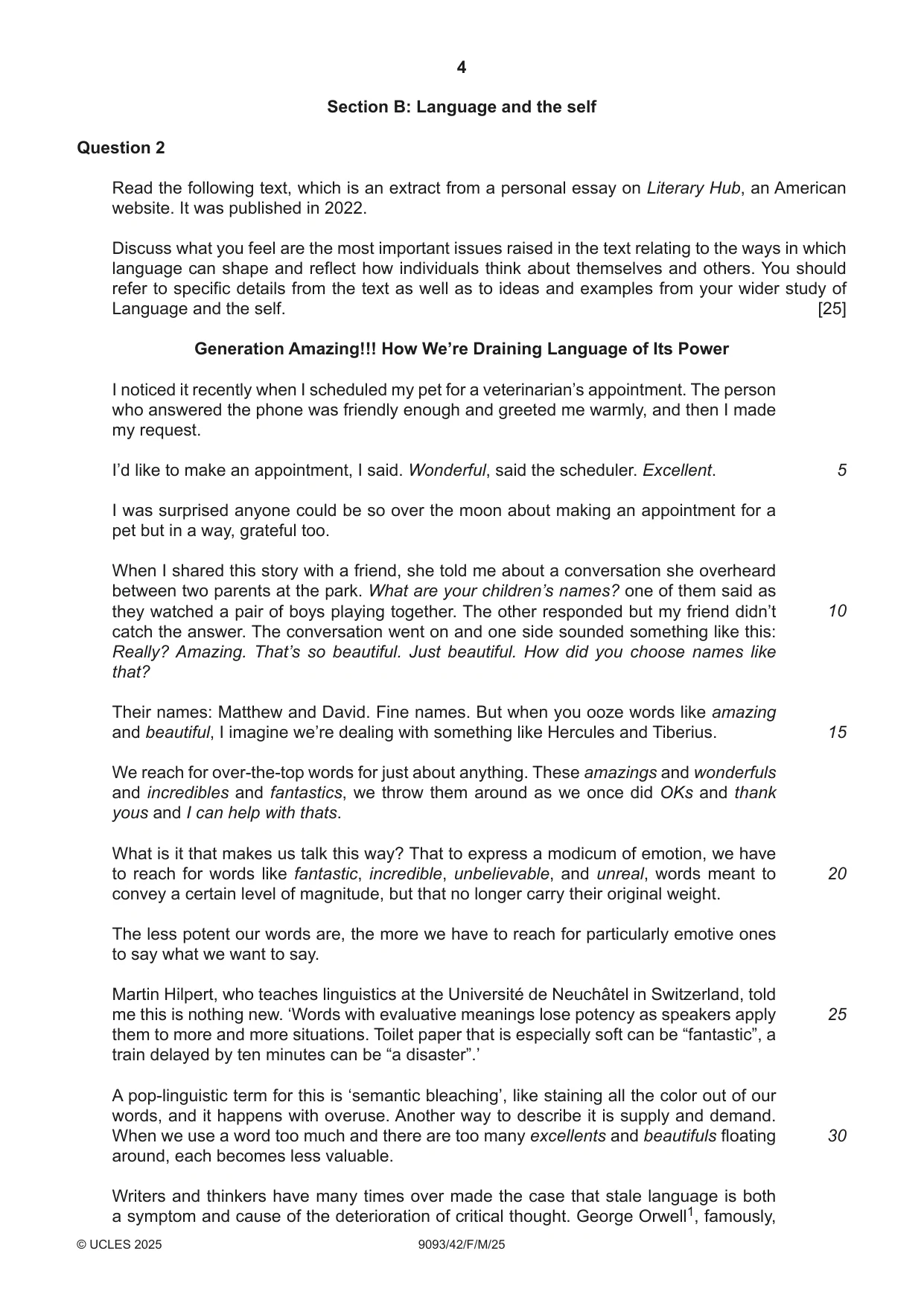
4 9093/42/F/M/25 © UCLES 2025 Section B: Language and the self Question 2 Read the following text, which is an extract from a personal essay on Literary Hub, an American website. It was published in 2022. Discuss what you feel are the most important issues raised in the text relating to the ways in which language can shape and reflect how individuals think about themselves and others. You should refer to specific details from the text as well as to ideas and examples from your wider study of Language and the self. [25] Generation Amazing!!! How We’re Draining Language of Its Power I noticed it recently when I scheduled my pet for a veterinarian’s appointment. The person who answered the phone was friendly enough and greeted me warmly, and then I made my request. I’d like to make an appointment, I said. Wonderful, said the scheduler. Excellent. I was surprised anyone could be so over the moon about making an appointment for a pet but in a way, grateful too. When I shared this story with a friend, she told me about a conversation she overheard between two parents at the park. What are your children’s names? one of them said as they watched a pair of boys playing together. The other responded but my friend didn’t catch the answer. The conversation went on and one side sounded something like this: Really? Amazing. That’s so beautiful. Just beautiful. How did you choose names like that? Their names: Matthew and David. Fine names. But when you ooze words like amazing and beautiful, I imagine we’re dealing with something like Hercules and Tiberius. We reach for over-the-top words for just about anything. These amazings and wonderfuls and incredibles and fantastics, we throw them around as we once did OKs and thank yous and I can help with thats. What is it that makes us talk this way? That to express a modicum of emotion, we have to reach for words like fantastic, incredible, unbelievable, and unreal, words meant to convey a certain level of magnitude, but that no longer carry their original weight. The less potent our words are, the more we have to reach for particularly emotive ones to say what we want to say. Martin Hilpert, who teaches linguistics at the Université de Neuchâtel in Switzerland, told me this is nothing new. ‘Words with evaluative meanings lose potency as speakers apply them to more and more situations. Toilet paper that is especially soft can be “fantastic”, a train delayed by ten minutes can be “a disaster”.’ A pop-linguistic term for this is ‘semantic bleaching’, like staining all the color out of our words, and it happens with overuse. Another way to describe it is supply and demand. When we use a word too much and there are too many excellents and beautifuls floating around, each becomes less valuable. Writers and thinkers have many times over made the case that stale language is both a symptom and cause of the deterioration of critical thought. George Orwell1, famously, 5 10 15 20 25 30
Question paper, page 5
5 9093/42/F/M/25 © UCLES 2025 for one. He writes in ‘Politics and the English Language’ that a speaker who uses tired language has ‘gone some distance toward turning himself into a machine. The appropriate noises are coming out of his larynx, but his brain is not involved as it would be if he were choosing his words for himself.’ 1George Orwell: English novelist and writer 35
Question paper, page 6
6 9093/42/F/M/25 © UCLES 2025 BLANK PAGE
Question paper, page 7
7 9093/42/F/M/25 © UCLES 2025 BLANK PAGE
Question paper, page 8
8 9093/42/F/M/25 © UCLES 2025 Permission to reproduce items where third-party owned material protected by copyright is included has been sought and cleared where possible. Every reasonable effort has been made by the publisher (UCLES) to trace copyright holders, but if any items requiring clearance have unwittingly been included, the publisher will be pleased to make amends at the earliest possible opportunity. To avoid the issue of disclosure of answer-related information to candidates, all copyright acknowledgements are reproduced online in the Cambridge Assessment International Education Copyright Acknowledgements Booklet. This is produced for each series of examinations and is freely available to download at www.cambridgeinternational.org after the live examination series. Cambridge Assessment International Education is part of Cambridge Assessment. Cambridge Assessment is the brand name of the University of Cambridge Local Examinations Syndicate (UCLES), which is a department of the University of Cambridge. BLANK PAGE
Mark scheme, page 1
This document consists of 9 printed pages. © Cambridge University Press & Assessment 2025 [Turn over Cambridge International AS & A Level ENGLISH LANGUAGE 9093/42 Paper 4 Language Topics February/March 2025 MARK SCHEME Maximum Mark: 50 Published This mark scheme is published as an aid to teachers and candidates, to indicate the requirements of the examination. It shows the basis on which Examiners were instructed to award marks. It does not indicate the details of the discussions that took place at an Examiners’ meeting before marking began, which would have considered the acceptability of alternative answers. Mark schemes should be read in conjunction with the question paper and the Principal Examiner Report for Teachers. Cambridge International will not enter into discussions about these mark schemes. Cambridge International is publishing the mark schemes for the February/March 2025 series for most Cambridge IGCSE, Cambridge International A and AS Level components, and some Cambridge O Level components.
Mark scheme, page 2
9093/42 Cambridge International AS & Level – Mark Scheme PUBLISHED February/March 2025 © Cambridge University Press & Assessment 2025 Page 2 of 9 Generic Marking Principles These general marking principles must be applied by all examiners when marking candidate answers. They should be applied alon gside the specific content of the mark scheme or generic level descriptions for a question. Each question paper and mark scheme will also comply with these marking principles. GENERIC MARKING PRINCIPLE 1: Marks must be awarded in line with: • the specific content of the mark scheme or the generic level descriptors for the question • the specific skills defined in the mark scheme or in the generic level descriptors for the question • the standard of response required by a candidate as exemplified by the standardisation scripts. GENERIC MARKING PRINCIPLE 2: Marks awarded are always whole marks (not half marks, or other fractions). GENERIC MARKING PRINCIPLE 3: Marks must be awarded positively: • marks are awarded for correct/valid answers, as defined in the mark scheme. However, credit is given for valid answers which go beyond the scope of the syllabus and mark scheme, referring to your Team Leader as appropriate • marks are awarded when candidates clearly demonstrate what they know and can do • marks are not deducted for errors • marks are not deducted for omissions • answers should only be judged on the quality of spelling, punctuation and grammar when these features are specifically assessed by the question as indicated by the mark scheme. The meaning, however, should be unambiguous. GENERIC MARKING PRINCIPLE 4: Rules must be applied consistently, e.g. in situations where candidates have not followed instructions or in the application of generic level descriptors.
Mark scheme, page 3
9093/42 Cambridge International AS & Level – Mark Scheme PUBLISHED February/March 2025 © Cambridge University Press & Assessment 2025 Page 3 of 9 GENERIC MARKING PRINCIPLE 5: Marks should be awarded using the full range of marks defined in the mark scheme for the question (however; the use of the full mark range may be limited according to the quality of the candidate responses seen). GENERIC MARKING PRINCIPLE 6: Marks awarded are based solely on the requirements as defined in the mark scheme. Marks should not be awarded with grade thre sholds or grade descriptors in mind. English & Media subject specific general marking principles (To be read in conjunction with the Generic Marking Principles (and requiring further guidance on how to place marks within l evels)) Components using level descriptors: • We use level descriptors as a guide to broad understanding of the qualities normally expected of, or typical of, work in a le vel. • Level descriptors are a means of general guidance and should not be interpreted as hurdle statements. • Where indicative content notes are supplied for a question, these are not a prescription of required content, and must not be treated as such. Alternative correct points and unexpected answers in candidates’ scripts must be given marks that fairly reflect the knowledg e and skills demonstrated. • While we may have legitimate expectations as to the ground most answers may occupy, we must at all times be prepared to meet candidates on their chosen ground, provided it is relevant ground (e.g. clearly related to and derived from a relevant passag e/text and meeting the mark scheme requirements for the question).
Mark scheme, page 4
9093/42 Cambridge International AS & Level – Mark Scheme PUBLISHED February/March 2025 © Cambridge University Press & Assessment 2025 Page 4 of 9 Annotations guidance for centres Examiners use a system of annotations as a shorthand for communicating their marking decisions to one another. Examiners are trained during the standardisation process on how and when to use annotations. The purpose of annotations is to inform the standard isation and monitoring processes and guide the supervising examiners when they are checking the work of examiners within their team. The meaning of annotations and how they are used is specific to each component and is understood by all examiners who mark the component. We publish annotations in our mark schemes to help centres understand the annotations they may see on copies of scripts. Note that there may not be a direct correlation between the number of annotations on a script and the mark awarded. Similarly, the use of an annotation may not be an indication of the quality of the response. The annotations listed below were available to examiners marking this component in this series. Annotations Annotation Meaning Assessment Objective 1 Assessment Objective 2 Assessment Objective 4 Repetition Omission Requires clarity Seen [Highlighter] Inaccurate Not relevant
Mark scheme, page 5
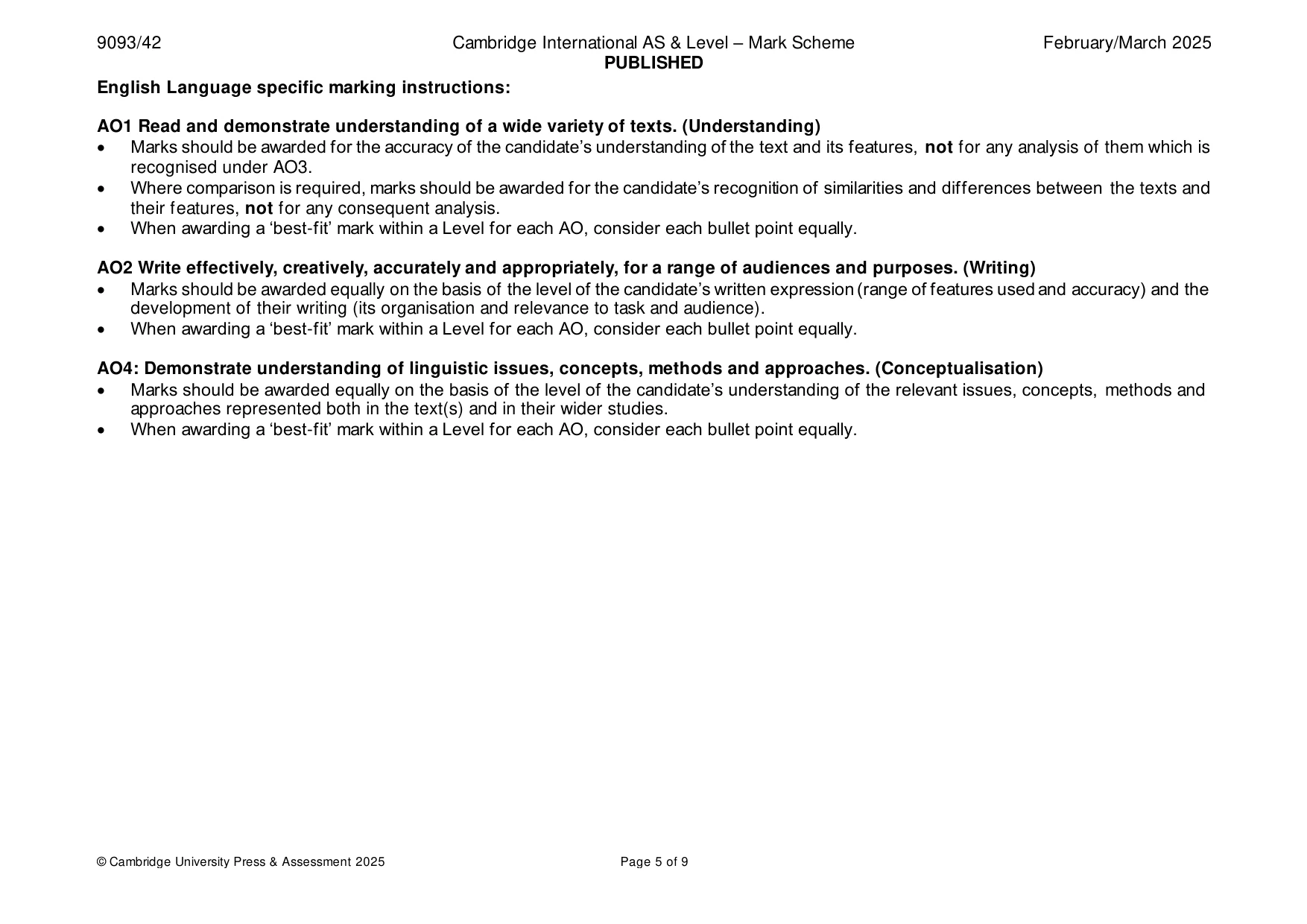
9093/42 Cambridge International AS & Level – Mark Scheme PUBLISHED February/March 2025 © Cambridge University Press & Assessment 2025 Page 5 of 9 English Language specific marking instructions: AO1 Read and demonstrate understanding of a wide variety of texts. (Understanding) • Marks should be awarded for the accuracy of the candidate’s understanding of the text and its features, not for any analysis of them which is recognised under AO3. • Where comparison is required, marks should be awarded for the candidate’s recognition of similarities and differences between the texts and their features, not for any consequent analysis. • When awarding a ‘best-fit’ mark within a Level for each AO, consider each bullet point equally. AO2 Write effectively, creatively, accurately and appropriately, for a range of audiences and purposes. (Writing) • Marks should be awarded equally on the basis of the level of the candidate’s written expression (range of features used and accuracy) and the development of their writing (its organisation and relevance to task and audience). • When awarding a ‘best-fit’ mark within a Level for each AO, consider each bullet point equally. AO4: Demonstrate understanding of linguistic issues, concepts, methods and approaches. (Conceptualisation) • Marks should be awarded equally on the basis of the level of the candidate’s understanding of the relevant issues, concepts, methods and approaches represented both in the text(s) and in their wider studies. • When awarding a ‘best-fit’ mark within a Level for each AO, consider each bullet point equally.
Mark scheme, page 6
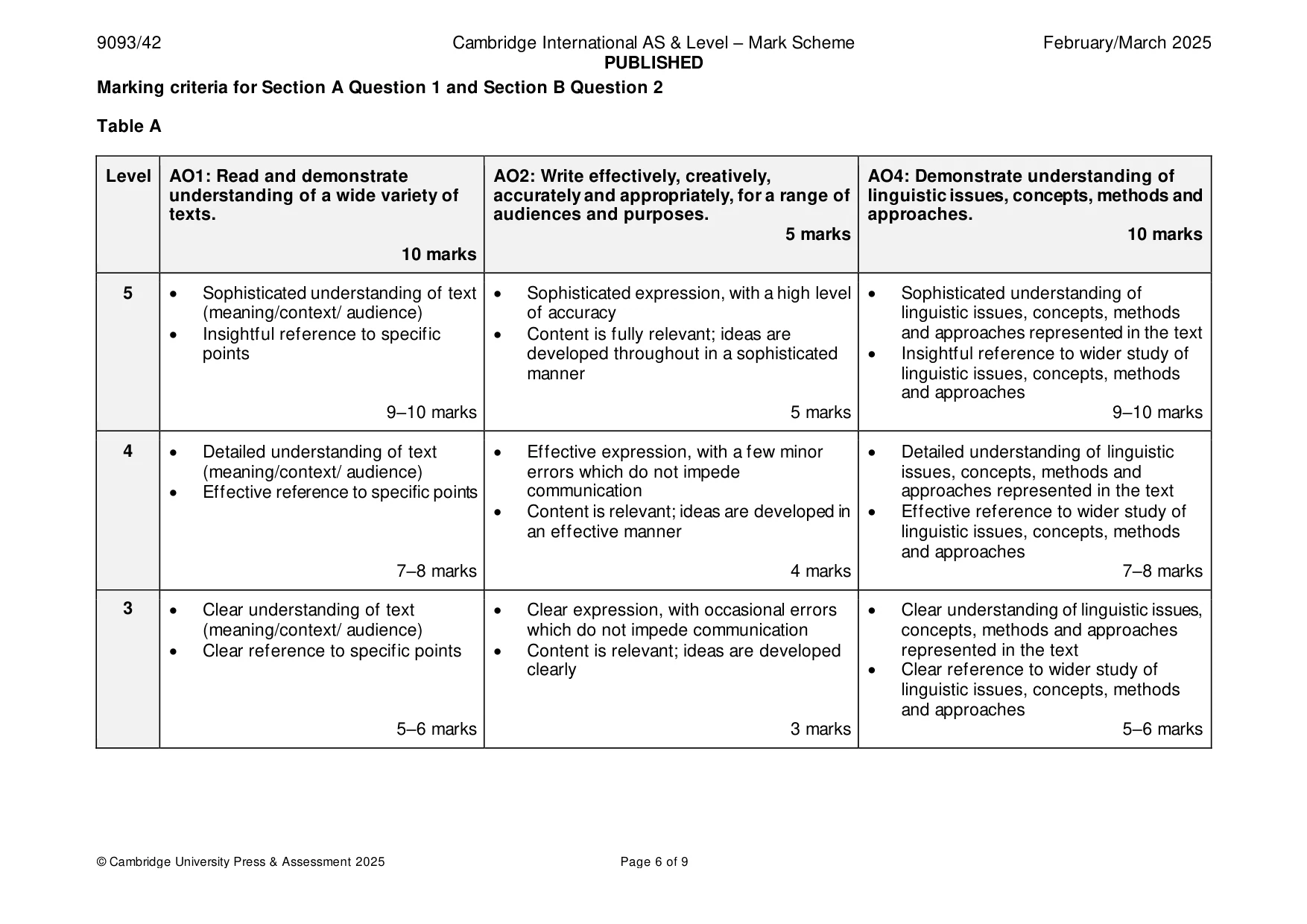
9093/42 Cambridge International AS & Level – Mark Scheme PUBLISHED February/March 2025 © Cambridge University Press & Assessment 2025 Page 6 of 9 Marking criteria for Section A Question 1 and Section B Question 2 Table A Level AO1: Read and demonstrate understanding of a wide variety of texts. 10 marks AO2: Write effectively, creatively, accurately and appropriately, for a range of audiences and purposes. 5 marks AO4: Demonstrate understanding of linguistic issues, concepts, methods and approaches. 10 marks 5 • Sophisticated understanding of text (meaning/context/ audience) • Insightful reference to specific points 9–10 marks • Sophisticated expression, with a high level of accuracy • Content is fully relevant; ideas are developed throughout in a sophisticated manner 5 marks • Sophisticated understanding of linguistic issues, concepts, methods and approaches represented in the text • Insightful reference to wider study of linguistic issues, concepts, methods and approaches 9–10 marks 4 • Detailed understanding of text (meaning/context/ audience) • Effective reference to specific points 7–8 marks • Effective expression, with a few minor errors which do not impede communication • Content is relevant; ideas are developed in an effective manner 4 marks • Detailed understanding of linguistic issues, concepts, methods and approaches represented in the text • Effective reference to wider study of linguistic issues, concepts, methods and approaches 7–8 marks 3 • Clear understanding of text (meaning/context/ audience) • Clear reference to specific points 5–6 marks • Clear expression, with occasional errors which do not impede communication • Content is relevant; ideas are developed clearly 3 marks • Clear understanding of linguistic issues, concepts, methods and approaches represented in the text • Clear reference to wider study of linguistic issues, concepts, methods and approaches 5–6 marks
Mark scheme, page 7
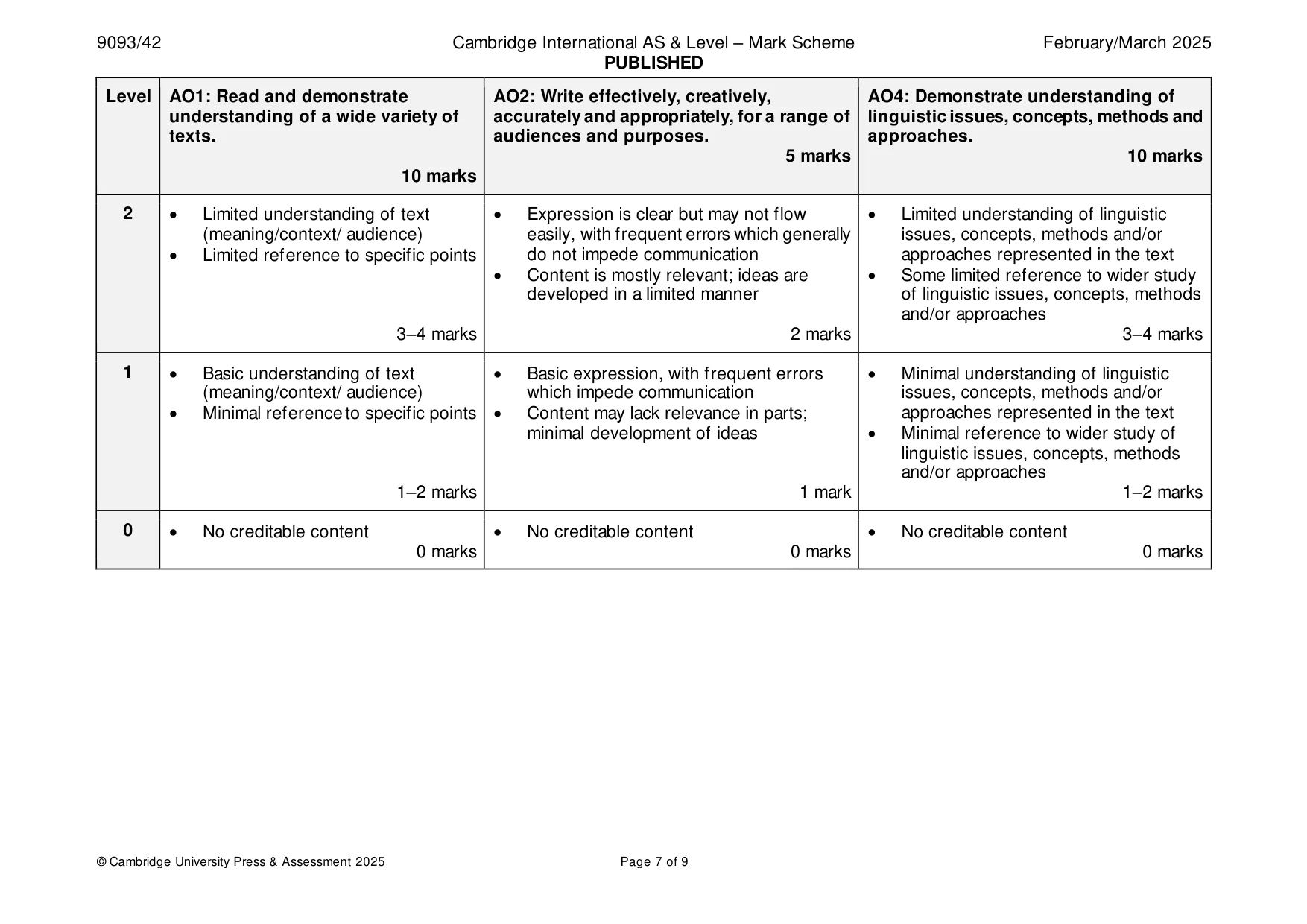
9093/42 Cambridge International AS & Level – Mark Scheme PUBLISHED February/March 2025 © Cambridge University Press & Assessment 2025 Page 7 of 9 Level AO1: Read and demonstrate understanding of a wide variety of texts. 10 marks AO2: Write effectively, creatively, accurately and appropriately, for a range of audiences and purposes. 5 marks AO4: Demonstrate understanding of linguistic issues, concepts, methods and approaches. 10 marks 2 • Limited understanding of text (meaning/context/ audience) • Limited reference to specific points 3–4 marks • Expression is clear but may not flow easily, with frequent errors which generally do not impede communication • Content is mostly relevant; ideas are developed in a limited manner 2 marks • Limited understanding of linguistic issues, concepts, methods and/or approaches represented in the text • Some limited reference to wider study of linguistic issues, concepts, methods and/or approaches 3–4 marks 1 • Basic understanding of text (meaning/context/ audience) • Minimal reference to specific points 1–2 marks • Basic expression, with frequent errors which impede communication • Content may lack relevance in parts; minimal development of ideas 1 mark • Minimal understanding of linguistic issues, concepts, methods and/or approaches represented in the text • Minimal reference to wider study of linguistic issues, concepts, methods and/or approaches 1–2 marks 0 • No creditable content 0 marks • No creditable content 0 marks • No creditable content 0 marks
Mark scheme, page 8
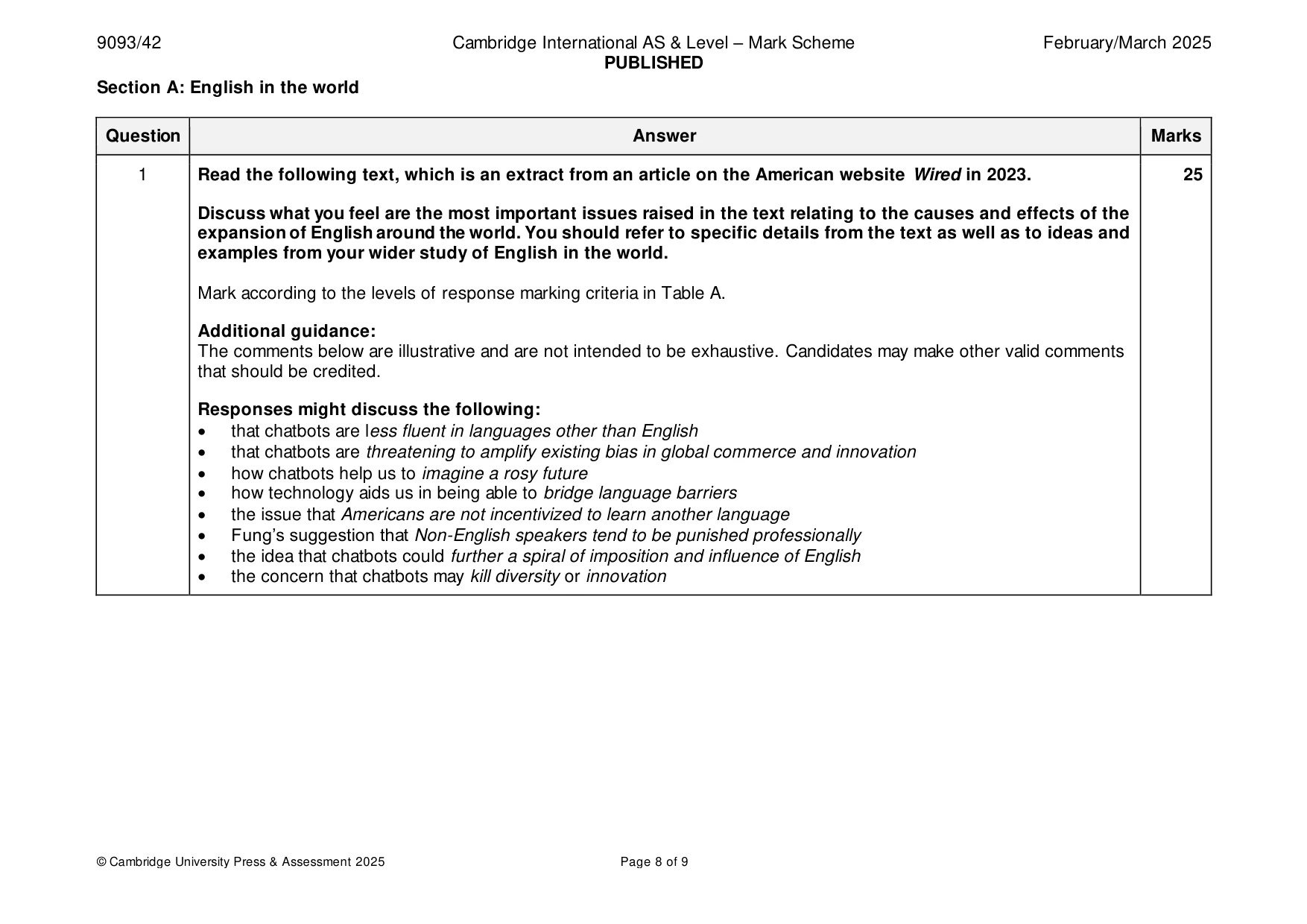
9093/42 Cambridge International AS & Level – Mark Scheme PUBLISHED February/March 2025 © Cambridge University Press & Assessment 2025 Page 8 of 9 Section A: English in the world Question Answer Marks 1 Read the following text, which is an extract from an article on the American website Wired in 2023. Discuss what you feel are the most important issues raised in the text relating to the causes and effects of the expansion of English around the world. You should refer to specific details from the text as well as to ideas and examples from your wider study of English in the world. Mark according to the levels of response marking criteria in Table A. Additional guidance: The comments below are illustrative and are not intended to be exhaustive. Candidates may make other valid comments that should be credited. Responses might discuss the following: • that chatbots are less fluent in languages other than English • that chatbots are threatening to amplify existing bias in global commerce and innovation • how chatbots help us to imagine a rosy future • how technology aids us in being able to bridge language barriers • the issue that Americans are not incentivized to learn another language • Fung’s suggestion that Non-English speakers tend to be punished professionally • the idea that chatbots could further a spiral of imposition and influence of English • the concern that chatbots may kill diversity or innovation 25
Mark scheme, page 9
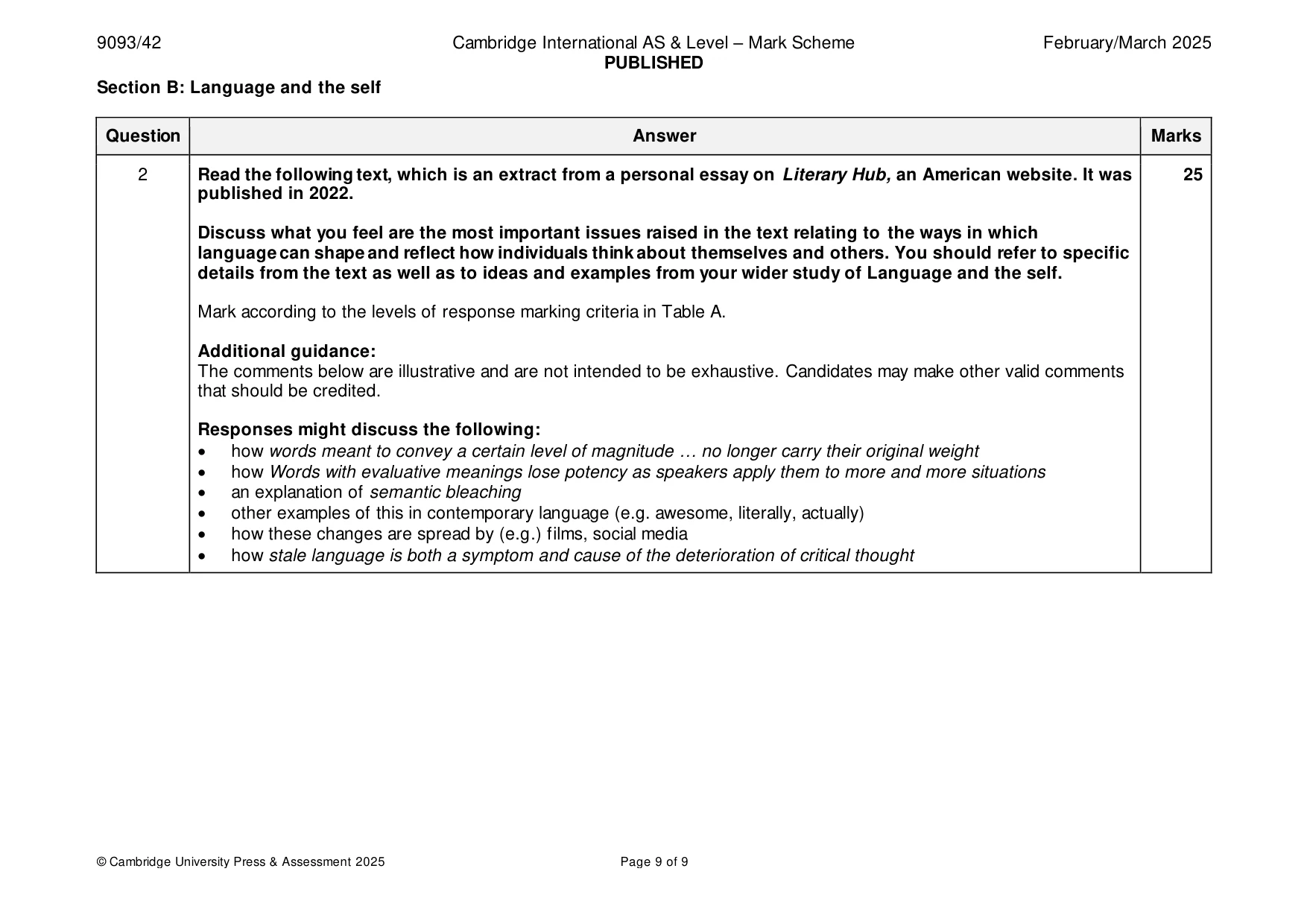
9093/42 Cambridge International AS & Level – Mark Scheme PUBLISHED February/March 2025 © Cambridge University Press & Assessment 2025 Page 9 of 9 Section B: Language and the self Question Answer Marks 2 Read the following text, which is an extract from a personal essay on Literary Hub, an American website. It was published in 2022. Discuss what you feel are the most important issues raised in the text relating to the ways in which language can shape and reflect how individuals think about themselves and others. You should refer to specific details from the text as well as to ideas and examples from your wider study of Language and the self. Mark according to the levels of response marking criteria in Table A. Additional guidance: The comments below are illustrative and are not intended to be exhaustive. Candidates may make other valid comments that should be credited. Responses might discuss the following: • how words meant to convey a certain level of magnitude … no longer carry their original weight • how Words with evaluative meanings lose potency as speakers apply them to more and more situations • an explanation of semantic bleaching • other examples of this in contemporary language (e.g. awesome, literally, actually) • how these changes are spread by (e.g.) films, social media • how stale language is both a symptom and cause of the deterioration of critical thought 25
What you needed in this session
Cambridge’s own grade thresholds for 2025 Feb/March, Paper 4 · Variant 2. A higher threshold means an easier paper — the bar moves with how the cohort did.