Cambridge A Level English - Language AS and A Level (from 2014) 9093 — 2025 Oct/Nov Paper 4 · Variant 2
9093/42/O/N/25 · 50 marks · 135 min
The question paper and its mark scheme, free to read here and free to download. This is Cambridge’s own paper, exactly as it was sat.
Question paper8 pages



Mark scheme10 pages
Answers below. Sit the paper first if you are practising.
Paper as text
Question paper, page 1
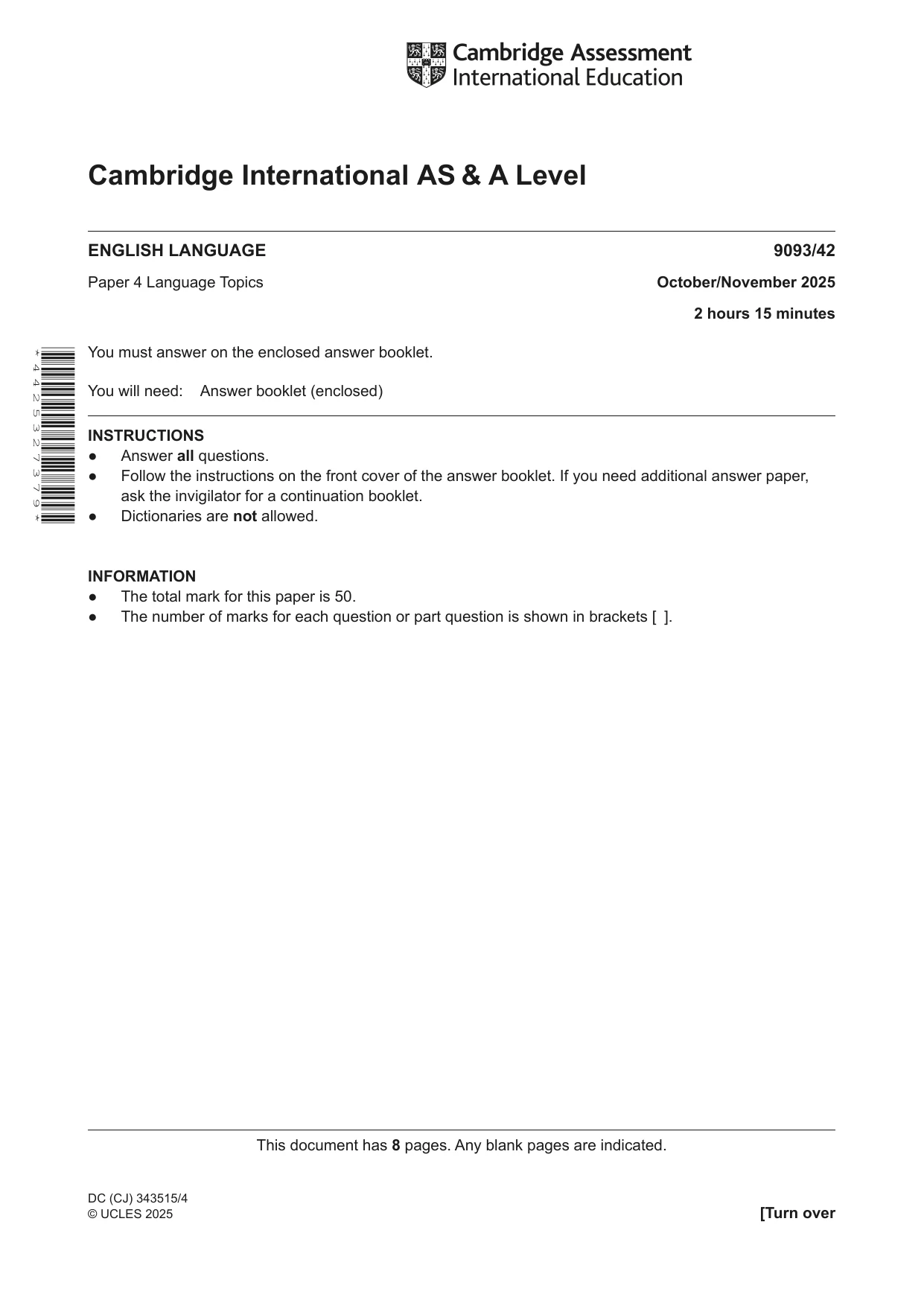
This document has 8 pages. Any blank pages are indicated. [Turn over Cambridge International AS & A Level ENGLISH LANGUAGE 9093/42 Paper 4 Language Topics October/November 2025 2 hours 15 minutes You must answer on the enclosed answer booklet. You will need: Answer booklet (enclosed) INSTRUCTIONS ● Answer all questions. ● Follow the instructions on the front cover of the answer booklet. If you need additional answer paper, ask the invigilator for a continuation booklet. ● Dictionaries are not allowed. INFORMATION ● The total mark for this paper is 50. ● The number of marks for each question or part question is shown in brackets [ ]. * 4 4 2 5 3 2 7 3 7 9 * DC (CJ) 343515/4 © UCLES 2025
Question paper, page 2
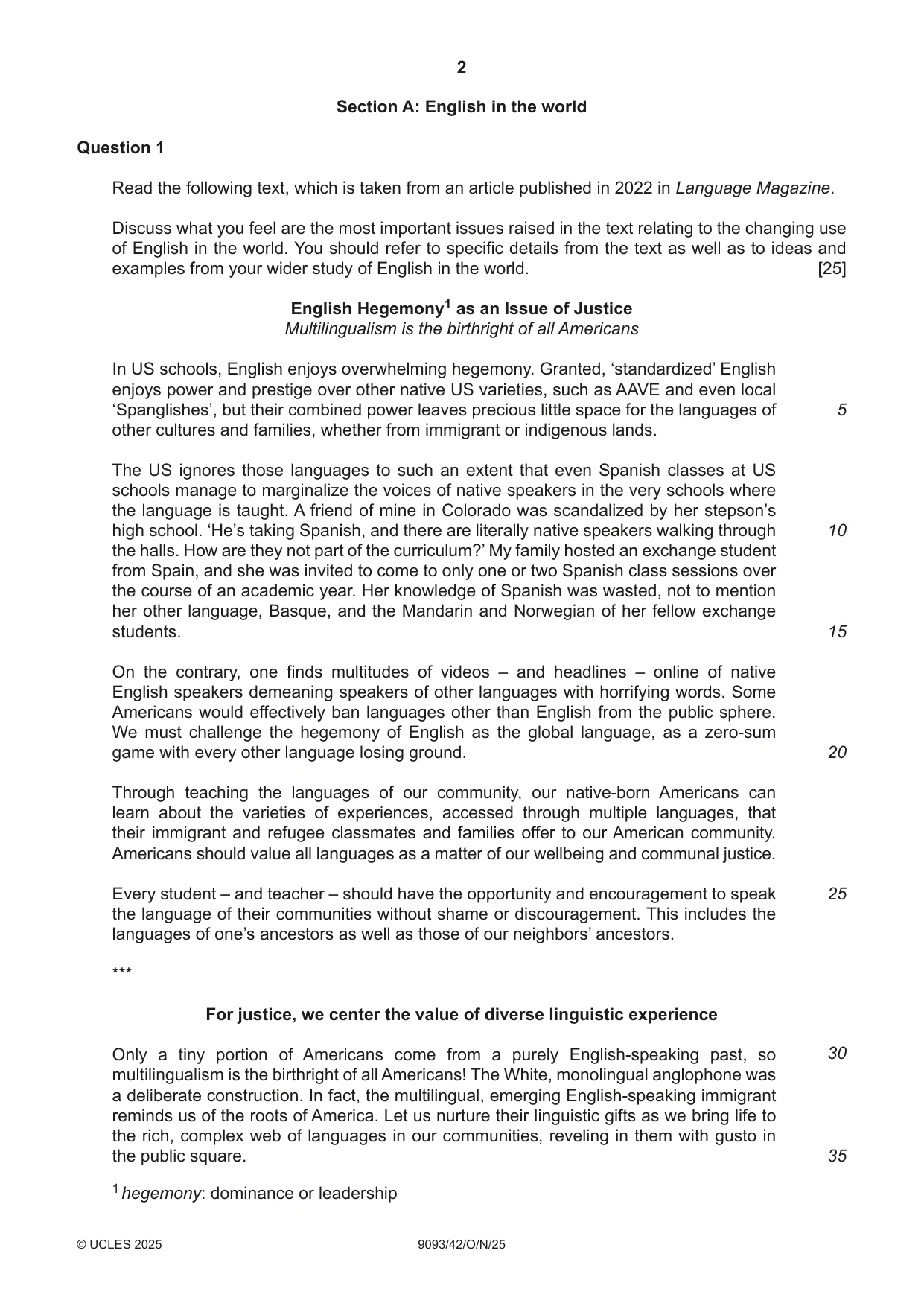
2 9093/42/O/N/25 © UCLES 2025 Section A: English in the world Question 1 Read the following text, which is taken from an article published in 2022 in Language Magazine. Discuss what you feel are the most important issues raised in the text relating to the changing use of English in the world. You should refer to specific details from the text as well as to ideas and examples from your wider study of English in the world. [25] English Hegemony1 as an Issue of Justice Multilingualism is the birthright of all Americans In US schools, English enjoys overwhelming hegemony. Granted, ‘standardized’ English enjoys power and prestige over other native US varieties, such as AAVE and even local ‘Spanglishes’, but their combined power leaves precious little space for the languages of other cultures and families, whether from immigrant or indigenous lands. The US ignores those languages to such an extent that even Spanish classes at US schools manage to marginalize the voices of native speakers in the very schools where the language is taught. A friend of mine in Colorado was scandalized by her stepson’s high school. ‘He’s taking Spanish, and there are literally native speakers walking through the halls. How are they not part of the curriculum?’ My family hosted an exchange student from Spain, and she was invited to come to only one or two Spanish class sessions over the course of an academic year. Her knowledge of Spanish was wasted, not to mention her other language, Basque, and the Mandarin and Norwegian of her fellow exchange students. On the contrary, one finds multitudes of videos – and headlines – online of native English speakers demeaning speakers of other languages with horrifying words. Some Americans would effectively ban languages other than English from the public sphere. We must challenge the hegemony of English as the global language, as a zero-sum game with every other language losing ground. Through teaching the languages of our community, our native-born Americans can learn about the varieties of experiences, accessed through multiple languages, that their immigrant and refugee classmates and families offer to our American community. Americans should value all languages as a matter of our wellbeing and communal justice. Every student – and teacher – should have the opportunity and encouragement to speak the language of their communities without shame or discouragement. This includes the languages of one’s ancestors as well as those of our neighbors’ ancestors. *** For justice, we center the value of diverse linguistic experience Only a tiny portion of Americans come from a purely English-speaking past, so multilingualism is the birthright of all Americans! The White, monolingual anglophone was a deliberate construction. In fact, the multilingual, emerging English-speaking immigrant reminds us of the roots of America. Let us nurture their linguistic gifts as we bring life to the rich, complex web of languages in our communities, reveling in them with gusto in the public square. 1 hegemony: dominance or leadership 5 10 15 20 25 30 35
Question paper, page 3
3 9093/42/O/N/25 © UCLES 2025 [Turn over Turn over for Question 2
Question paper, page 4
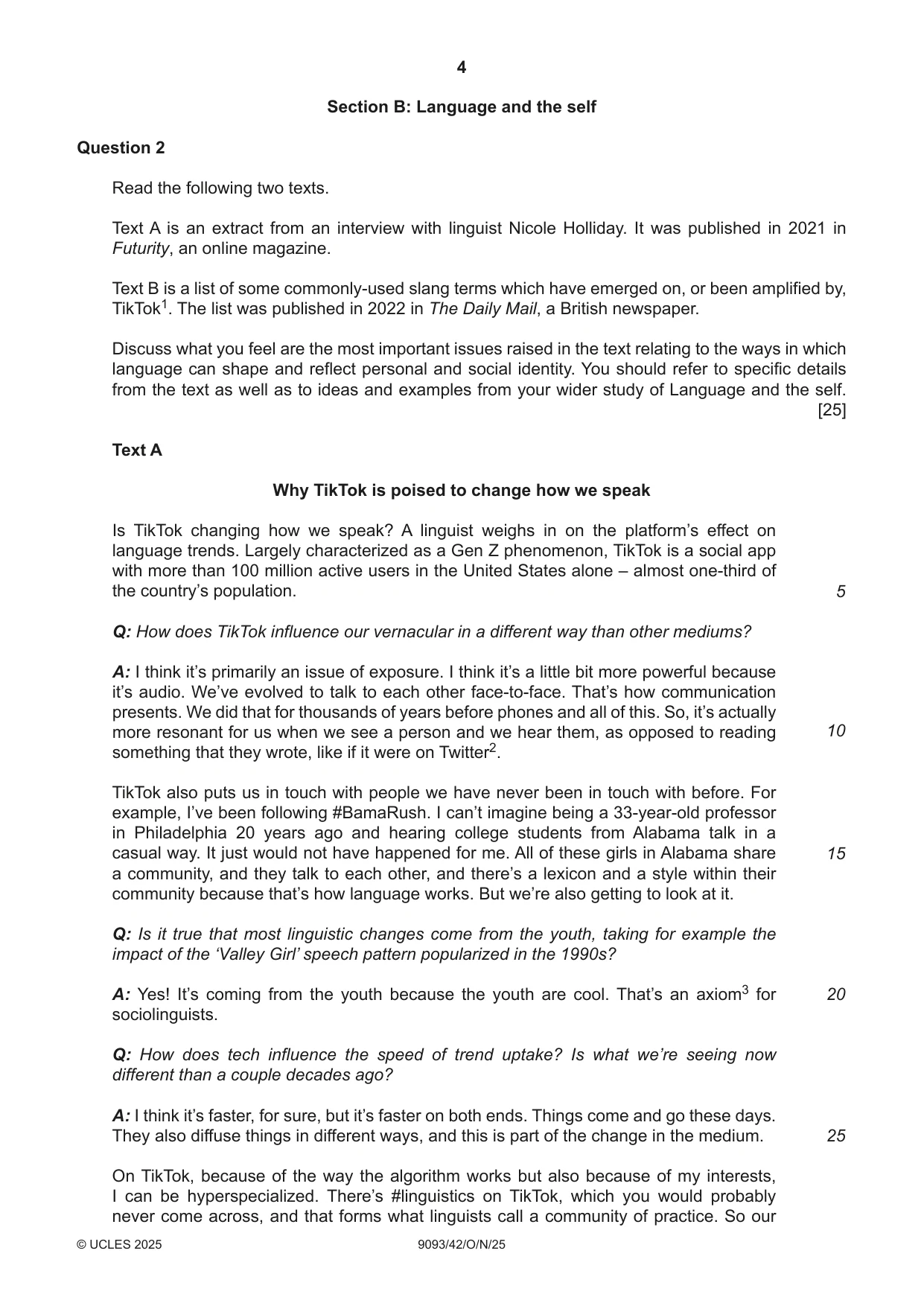
4 9093/42/O/N/25 © UCLES 2025 Section B: Language and the self Question 2 Read the following two texts. Text A is an extract from an interview with linguist Nicole Holliday. It was published in 2021 in Futurity, an online magazine. Text B is a list of some commonly-used slang terms which have emerged on, or been amplified by, TikTok1. The list was published in 2022 in The Daily Mail, a British newspaper. Discuss what you feel are the most important issues raised in the text relating to the ways in which language can shape and reflect personal and social identity. You should refer to specific details from the text as well as to ideas and examples from your wider study of Language and the self. [25] Text A Why TikTok is poised to change how we speak Is TikTok changing how we speak? A linguist weighs in on the platform’s effect on language trends. Largely characterized as a Gen Z phenomenon, TikTok is a social app with more than 100 million active users in the United States alone – almost one-third of the country’s population. Q: How does TikTok influence our vernacular in a different way than other mediums? A: I think it’s primarily an issue of exposure. I think it’s a little bit more powerful because it’s audio. We’ve evolved to talk to each other face-to-face. That’s how communication presents. We did that for thousands of years before phones and all of this. So, it’s actually more resonant for us when we see a person and we hear them, as opposed to reading something that they wrote, like if it were on Twitter2. TikTok also puts us in touch with people we have never been in touch with before. For example, I’ve been following #BamaRush. I can’t imagine being a 33-year-old professor in Philadelphia 20 years ago and hearing college students from Alabama talk in a casual way. It just would not have happened for me. All of these girls in Alabama share a community, and they talk to each other, and there’s a lexicon and a style within their community because that’s how language works. But we’re also getting to look at it. Q: Is it true that most linguistic changes come from the youth, taking for example the impact of the ‘Valley Girl’ speech pattern popularized in the 1990s? A: Yes! It’s coming from the youth because the youth are cool. That’s an axiom3 for sociolinguists. Q: How does tech influence the speed of trend uptake? Is what we’re seeing now different than a couple decades ago? A: I think it’s faster, for sure, but it’s faster on both ends. Things come and go these days. They also diffuse things in different ways, and this is part of the change in the medium. On TikTok, because of the way the algorithm works but also because of my interests, I can be hyperspecialized. There’s #linguistics on TikTok, which you would probably never come across, and that forms what linguists call a community of practice. So our 5 10 15 20 25
Question paper, page 5
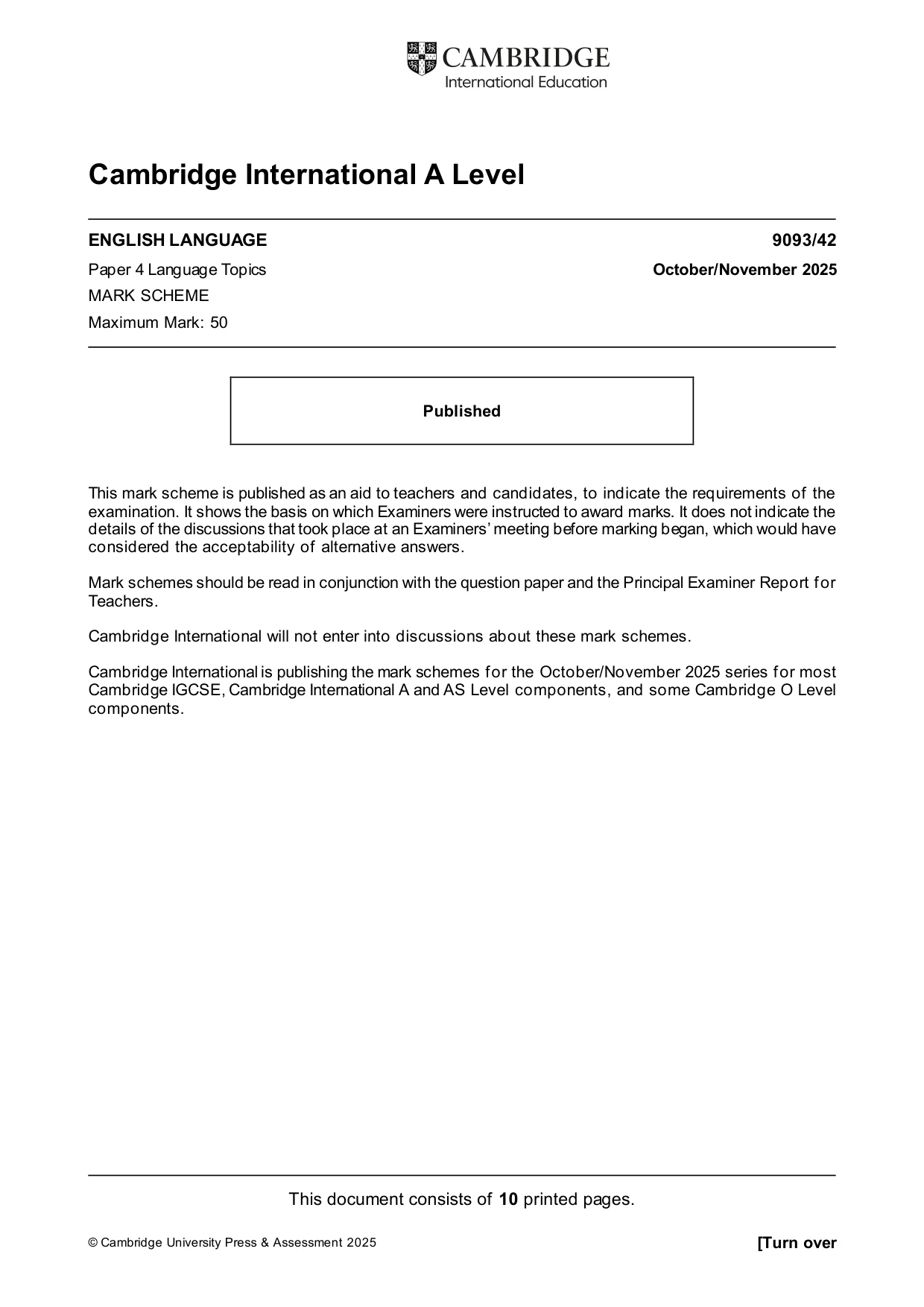
5 9093/42/O/N/25 © UCLES 2025 communities of practice can be hyperspecialized for the stuff that we’re interested in, and also they can be anywhere in the world. We can talk instantaneously, mediated via video chat, with anybody. So that just causes things to move really quickly. 1 TikTok: social media site for video sharing 2 Twitter : microblogging site rebranded ‘X’ in 2023 3 Axiom: an established rule Text B TikTok Meaning Quiet quitting A reclaiming of work-life balance Pick me girl A girl who tries to impress others by being different or quirky Vibe check Measure how cool someone is Simp Somebody who shows excessive sympathy and attention towards another person Villain era Refers to a shift in a person’s priorities as they reject the societal pressure to always play nice 30 5
Question paper, page 6
6 9093/42/O/N/25 © UCLES 2025 BLANK PAGE
Question paper, page 7
7 9093/42/O/N/25 © UCLES 2025 BLANK PAGE
Question paper, page 8
8 9093/42/O/N/25 © UCLES 2025 Permission to reproduce items where third-party owned material protected by copyright is included has been sought and cleared where possible. Every reasonable effort has been made by the publisher (UCLES) to trace copyright holders, but if any items requiring clearance have unwittingly been included, the publisher will be pleased to make amends at the earliest possible opportunity. To avoid the issue of disclosure of answer-related information to candidates, all copyright acknowledgements are reproduced online in the Cambridge Assessment International Education Copyright Acknowledgements Booklet. This is produced for each series of examinations and is freely available to download at www.cambridgeinternational.org after the live examination series. Cambridge Assessment International Education is part of Cambridge Assessment. Cambridge Assessment is the brand name of the University of Cambridge Local Examinations Syndicate (UCLES), which is a department of the University of Cambridge. BLANK PAGE
Mark scheme, page 1
This document consists of 10 printed pages. © Cambridge University Press & Assessment 2025 [Turn over Cambridge International A Level ENGLISH LANGUAGE 9093/42 Paper 4 Language Topics October/November 2025 MARK SCHEME Maximum Mark: 50 Published This mark scheme is published as an aid to teachers and candidates, to indicate the requirements of the examination. It shows the basis on which Examiners were instructed to award marks. It does not indicate the details of the discussions that took place at an Examiners’ meeting before marking began, which would have considered the acceptability of alternative answers. Mark schemes should be read in conjunction with the question paper and the Principal Examiner Report for Teachers. Cambridge International will not enter into discussions about these mark schemes. Cambridge International is publishing the mark schemes for the October/November 2025 series for most Cambridge IGCSE, Cambridge International A and AS Level components, and some Cambridge O Level components.
Mark scheme, page 2
9093/42 Cambridge International A Level – Mark Scheme PUBLISHED October/November 2025 © Cambridge University Press & Assessment 2025 Page 2 of 10 Generic Marking Principles These general marking principles must be applied by all examiners when marking candidate answers. They should be applied alon gside the specific content of the mark scheme or generic level descriptions for a question. Each question paper and mark scheme will also comply with these marking principles. GENERIC MARKING PRINCIPLE 1: Marks must be awarded in line with: • the specific content of the mark scheme or the generic level descriptors for the question • the specific skills defined in the mark scheme or in the generic level descriptors for the question • the standard of response required by a candidate as exemplified by the standardisation scripts. GENERIC MARKING PRINCIPLE 2: Marks awarded are always whole marks (not half marks, or other fractions). GENERIC MARKING PRINCIPLE 3: Marks must be awarded positively: • marks are awarded for correct/valid answers, as defined in the mark scheme. However, credit is given for valid answers which go beyond the scope of the syllabus and mark scheme, referring to your Team Leader as appropriate • marks are awarded when candidates clearly demonstrate what they know and can do • marks are not deducted for errors • marks are not deducted for omissions • answers should only be judged on the quality of spelling, punctuation and grammar when these features are specifically assessed by the question as indicated by the mark scheme. The meaning, however, should be unambiguous. GENERIC MARKING PRINCIPLE 4: Rules must be applied consistently, e.g. in situations where candidates have not followed instructions or in the application of generic level descriptors.
Mark scheme, page 3
9093/42 Cambridge International A Level – Mark Scheme PUBLISHED October/November 2025 © Cambridge University Press & Assessment 2025 Page 3 of 10 GENERIC MARKING PRINCIPLE 5: Marks should be awarded using the full range of marks defined in the mark scheme for the question (however; the use of the full mark range may be limited according to the quality of the candidate responses seen). GENERIC MARKING PRINCIPLE 6: Marks awarded are based solely on the requirements as defined in the mark scheme. Marks should not be awarded with grade thre sholds or grade descriptors in mind.
Mark scheme, page 4
9093/42 Cambridge International A Level – Mark Scheme PUBLISHED October/November 2025 © Cambridge University Press & Assessment 2025 Page 4 of 10 English & Media subject specific general marking principles (To be read in conjunction with the Generic Marking Principles (and requiring further guidance on how to place marks within l evels)) Components using level descriptors: • We use level descriptors as a guide to broad understanding of the qualities normally expected of, or typical of, work in a le vel. • Level descriptors are a means of general guidance and should not be interpreted as hurdle statements. • Where indicative content notes are supplied for a question, these are not a prescription of required content, and must not be treated as such. Alternative correct points and unexpected answers in candidates’ scripts must be given marks that fairly reflect the knowledg e and skills demonstrated. • While we may have legitimate expectations as to the ground most answers may occupy, we must at all times be prepared to meet candidates on their chosen ground, provided it is relevant ground (e.g. clearly related to and derived from a relevant passag e/text and meeting the mark scheme requirements for the question).
Mark scheme, page 5
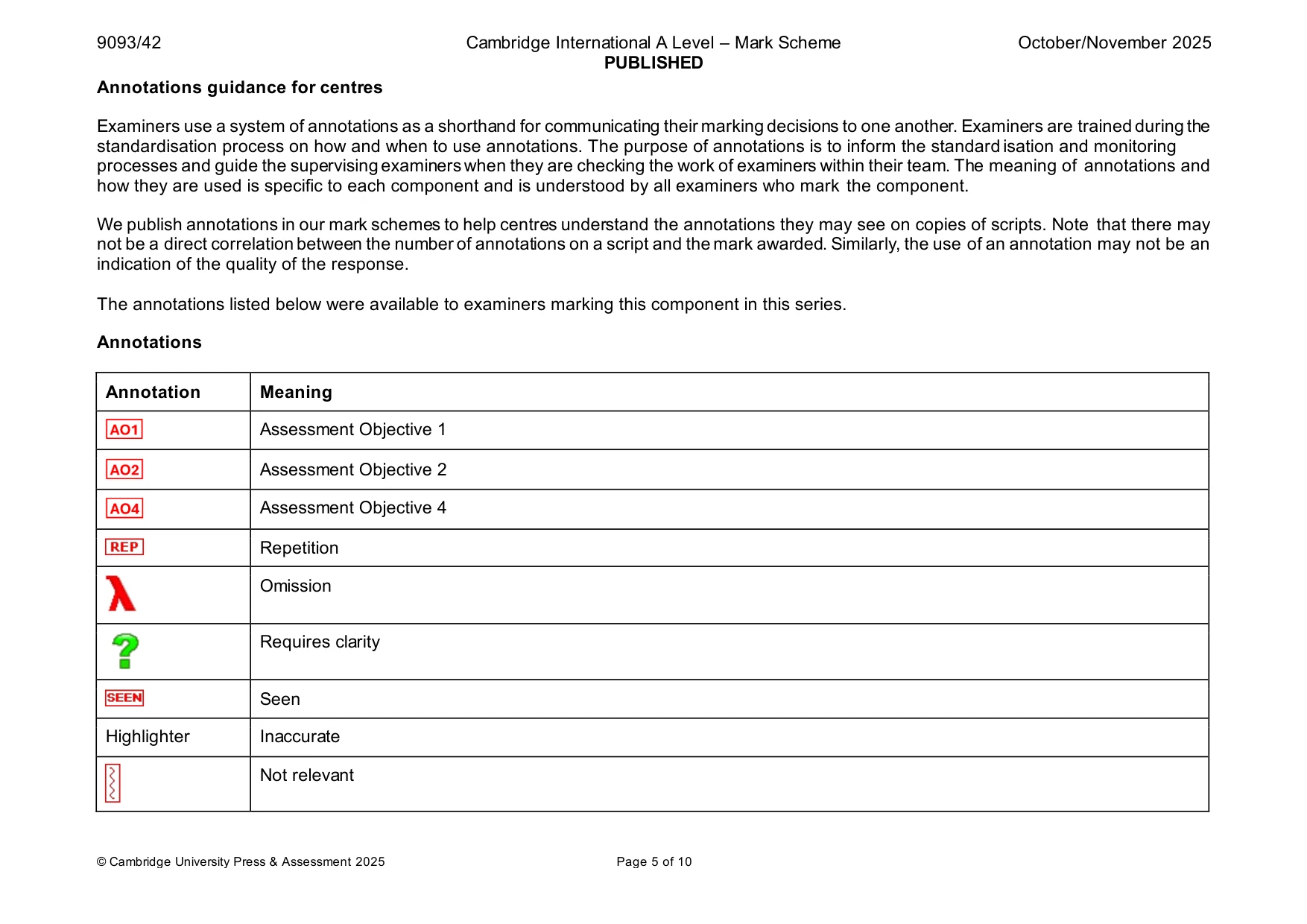
9093/42 Cambridge International A Level – Mark Scheme PUBLISHED October/November 2025 © Cambridge University Press & Assessment 2025 Page 5 of 10 Annotations guidance for centres Examiners use a system of annotations as a shorthand for communicating their marking decisions to one another. Examiners are trained during the standardisation process on how and when to use annotations. The purpose of annotations is to inform the standard isation and monitoring processes and guide the supervising examiners when they are checking the work of examiners within their team. The meaning of annotations and how they are used is specific to each component and is understood by all examiners who mark the component. We publish annotations in our mark schemes to help centres understand the annotations they may see on copies of scripts. Note that there may not be a direct correlation between the number of annotations on a script and the mark awarded. Similarly, the use of an annotation may not be an indication of the quality of the response. The annotations listed below were available to examiners marking this component in this series. Annotations Annotation Meaning Assessment Objective 1 Assessment Objective 2 Assessment Objective 4 Repetition Omission Requires clarity Seen Highlighter Inaccurate Not relevant
Mark scheme, page 6
9093/42 Cambridge International A Level – Mark Scheme PUBLISHED October/November 2025 © Cambridge University Press & Assessment 2025 Page 6 of 10 English Language specific marking instructions: AO1 Read and demonstrate understanding of a wide variety of texts. (Understanding) • Marks should be awarded for the accuracy of the candidate’s understanding of the text and its features, not for any analysis of them which is recognised under AO3. • Where comparison is required, marks should be awarded for the candidate’s recognition of similarities and differences between the texts and their features, not for any consequent analysis. • When awarding a ‘best-fit’ mark within a Level for each AO, consider each bullet point equally. AO2 Write effectively, creatively, accurately and appropriately, for a range of audiences and purposes. (Writing) • Marks should be awarded equally on the basis of the level of the candidate’s written expression (range of features used and accuracy) and the development of their writing (its organisation and relevance to task and audience). • When awarding a ‘best-fit’ mark within a Level for each AO, consider each bullet point equally. AO4: Demonstrate understanding of linguistic issues, concepts, methods and approaches. (Conceptualisation) • Marks should be awarded equally on the basis of the level of the candidate’s understanding of the relevant issues, concepts, methods and approaches represented both in the text(s) and in their wider studies. • When awarding a ‘best-fit’ mark within a Level for each AO, consider each bullet point equally.
Mark scheme, page 7
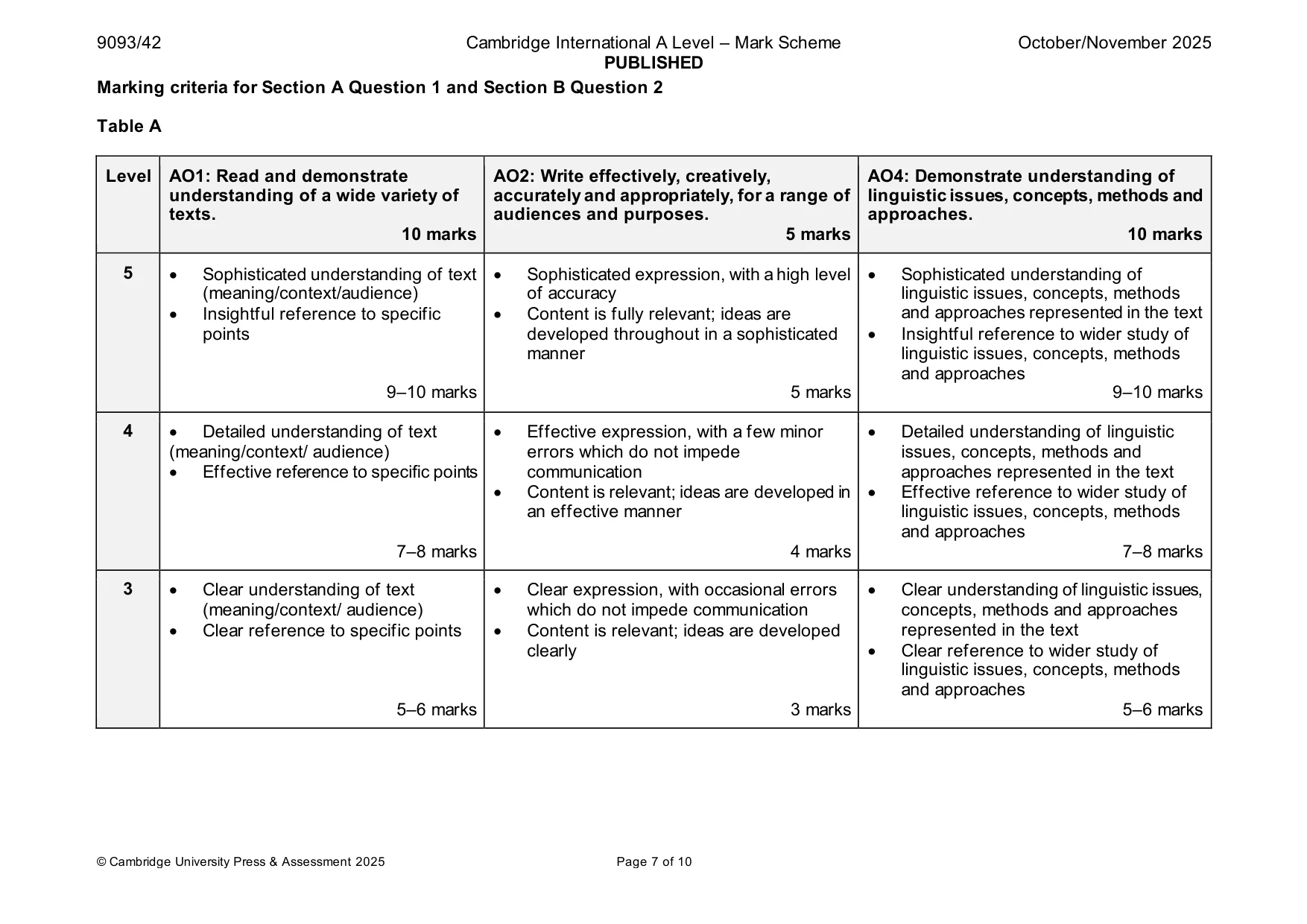
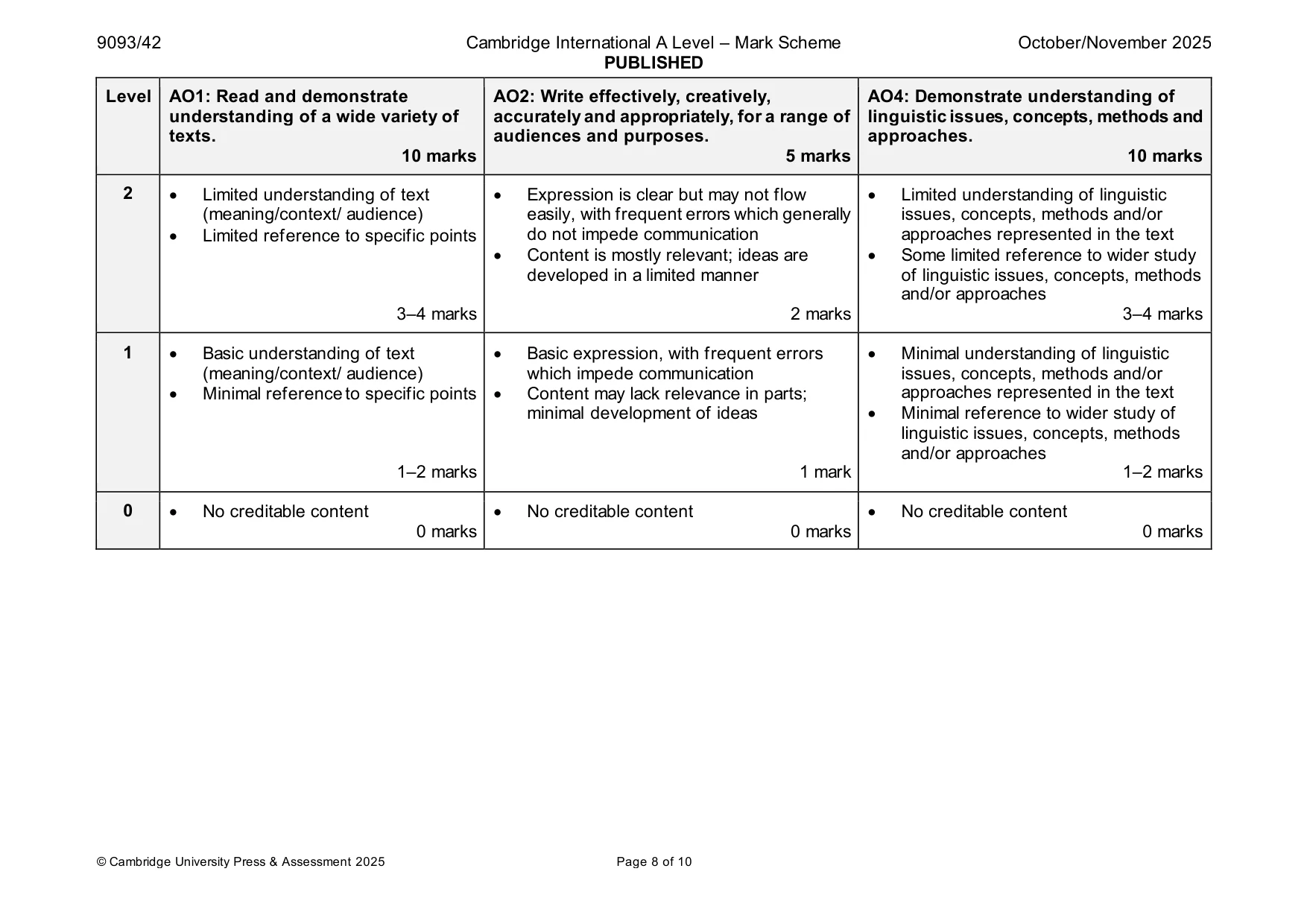
9093/42 Cambridge International A Level – Mark Scheme PUBLISHED October/November 2025 © Cambridge University Press & Assessment 2025 Page 7 of 10 Marking criteria for Section A Question 1 and Section B Question 2 Table A Level AO1: Read and demonstrate understanding of a wide variety of texts. 10 marks AO2: Write effectively, creatively, accurately and appropriately, for a range of audiences and purposes. 5 marks AO4: Demonstrate understanding of linguistic issues, concepts, methods and approaches. 10 marks 5 • Sophisticated understanding of text (meaning/context/audience) • Insightful reference to specific points 9–10 marks • Sophisticated expression, with a high level of accuracy • Content is fully relevant; ideas are developed throughout in a sophisticated manner 5 marks • Sophisticated understanding of linguistic issues, concepts, methods and approaches represented in the text • Insightful reference to wider study of linguistic issues, concepts, methods and approaches 9–10 marks 4 • Detailed understanding of text (meaning/context/ audience) • Effective reference to specific points 7–8 marks • Effective expression, with a few minor errors which do not impede communication • Content is relevant; ideas are developed in an effective manner 4 marks • Detailed understanding of linguistic issues, concepts, methods and approaches represented in the text • Effective reference to wider study of linguistic issues, concepts, methods and approaches 7–8 marks 3 • Clear understanding of text (meaning/context/ audience) • Clear reference to specific points 5–6 marks • Clear expression, with occasional errors which do not impede communication • Content is relevant; ideas are developed clearly 3 marks • Clear understanding of linguistic issues, concepts, methods and approaches represented in the text • Clear reference to wider study of linguistic issues, concepts, methods and approaches 5–6 marks
Mark scheme, page 8
9093/42 Cambridge International A Level – Mark Scheme PUBLISHED October/November 2025 © Cambridge University Press & Assessment 2025 Page 8 of 10 Level AO1: Read and demonstrate understanding of a wide variety of texts. 10 marks AO2: Write effectively, creatively, accurately and appropriately, for a range of audiences and purposes. 5 marks AO4: Demonstrate understanding of linguistic issues, concepts, methods and approaches. 10 marks 2 • Limited understanding of text (meaning/context/ audience) • Limited reference to specific points 3–4 marks • Expression is clear but may not flow easily, with frequent errors which generally do not impede communication • Content is mostly relevant; ideas are developed in a limited manner 2 marks • Limited understanding of linguistic issues, concepts, methods and/or approaches represented in the text • Some limited reference to wider study of linguistic issues, concepts, methods and/or approaches 3–4 marks 1 • Basic understanding of text (meaning/context/ audience) • Minimal reference to specific points 1–2 marks • Basic expression, with frequent errors which impede communication • Content may lack relevance in parts; minimal development of ideas 1 mark • Minimal understanding of linguistic issues, concepts, methods and/or approaches represented in the text • Minimal reference to wider study of linguistic issues, concepts, methods and/or approaches 1–2 marks 0 • No creditable content 0 marks • No creditable content 0 marks • No creditable content 0 marks
Mark scheme, page 9
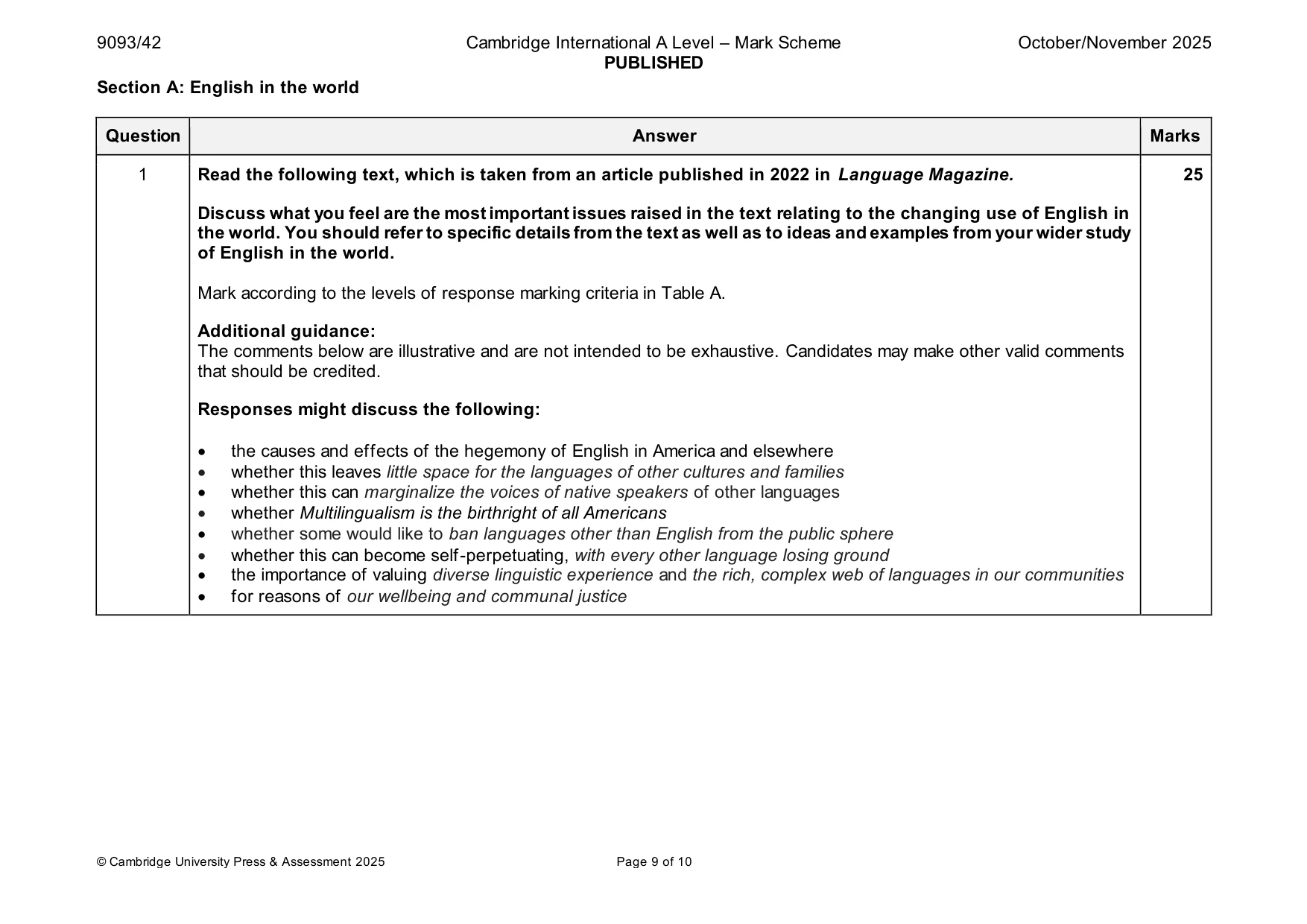
9093/42 Cambridge International A Level – Mark Scheme PUBLISHED October/November 2025 © Cambridge University Press & Assessment 2025 Page 9 of 10 Section A: English in the world Question Answer Marks 1 Read the following text, which is taken from an article published in 2022 in Language Magazine. Discuss what you feel are the most important issues raised in the text relating to the changing use of English in the world. You should refer to specific details from the text as well as to ideas and examples from your wider study of English in the world. Mark according to the levels of response marking criteria in Table A. Additional guidance: The comments below are illustrative and are not intended to be exhaustive. Candidates may make other valid comments that should be credited. Responses might discuss the following: • the causes and effects of the hegemony of English in America and elsewhere • whether this leaves little space for the languages of other cultures and families • whether this can marginalize the voices of native speakers of other languages • whether Multilingualism is the birthright of all Americans • whether some would like to ban languages other than English from the public sphere • whether this can become self-perpetuating, with every other language losing ground • the importance of valuing diverse linguistic experience and the rich, complex web of languages in our communities • for reasons of our wellbeing and communal justice 25
Mark scheme, page 10
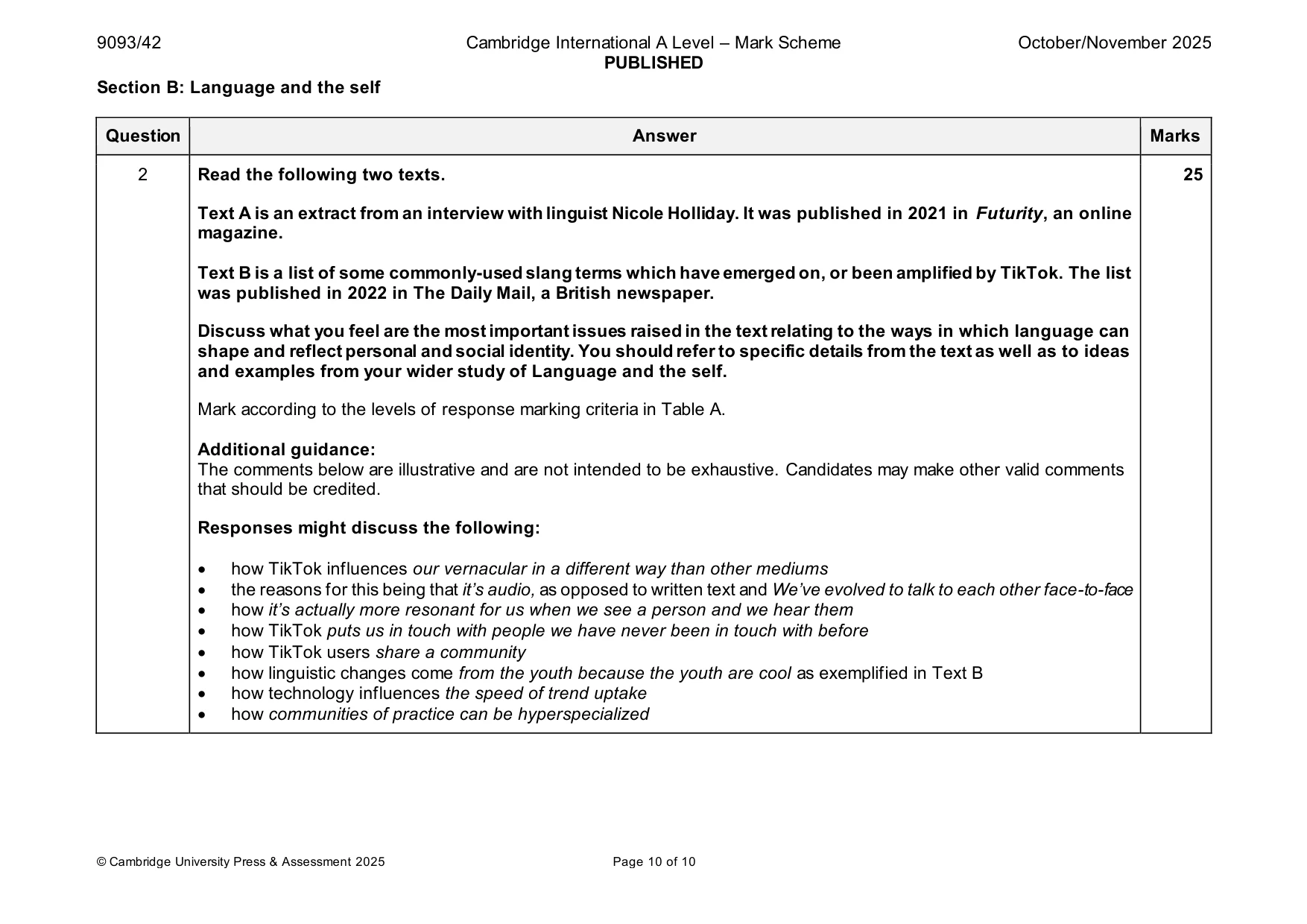
9093/42 Cambridge International A Level – Mark Scheme PUBLISHED October/November 2025 © Cambridge University Press & Assessment 2025 Page 10 of 10 Section B: Language and the self Question Answer Marks 2 Read the following two texts. Text A is an extract from an interview with linguist Nicole Holliday. It was published in 2021 in Futurity, an online magazine. Text B is a list of some commonly-used slang terms which have emerged on, or been amplified by TikTok. The list was published in 2022 in The Daily Mail, a British newspaper. Discuss what you feel are the most important issues raised in the text relating to the ways in which language can shape and reflect personal and social identity. You should refer to specific details from the text as well as to ideas and examples from your wider study of Language and the self. Mark according to the levels of response marking criteria in Table A. Additional guidance: The comments below are illustrative and are not intended to be exhaustive. Candidates may make other valid comments that should be credited. Responses might discuss the following: • how TikTok influences our vernacular in a different way than other mediums • the reasons for this being that it’s audio, as opposed to written text and We’ve evolved to talk to each other face-to-face • how it’s actually more resonant for us when we see a person and we hear them • how TikTok puts us in touch with people we have never been in touch with before • how TikTok users share a community • how linguistic changes come from the youth because the youth are cool as exemplified in Text B • how technology influences the speed of trend uptake • how communities of practice can be hyperspecialized 25
What you needed in this session
Cambridge’s own grade thresholds for 2025 Oct/Nov, Paper 4 · Variant 2. A higher threshold means an easier paper — the bar moves with how the cohort did.