Cambridge A Level English - Language AS and A Level (from 2014) 9093 — 2024 Oct/Nov Paper 4 · Variant 2
9093/42/O/N/24 · 50 marks · 135 min
The question paper and its mark scheme, free to read here and free to download. This is Cambridge’s own paper, exactly as it was sat.
Question paper8 pages


Mark scheme8 pages
Answers below. Sit the paper first if you are practising.
Paper as text
Question paper, page 1
[Turn over Cambridge International AS & A Level This document has 8 pages. Any blank pages are indicated. * 3 0 7 7 4 1 7 8 0 8 * DC (WW) 336941/1 © UCLES 2024 ENGLISH LANGUAGE 9093/42 Paper 4 Language Topics October/November 2024 2 hours 15 minutes You must answer on the enclosed answer booklet. You will need: Answer booklet (enclosed) INSTRUCTIONS ● Answer all questions. ● Follow the instructions on the front cover of the answer booklet. If you need additional answer paper, ask the invigilator for a continuation booklet. ● Dictionaries are not allowed. INFORMATION ● The total mark for this paper is 50. ● The number of marks for each question or part question is shown in brackets [ ].
Question paper, page 2
2 9093/42/O/N/24 © UCLES 2024 Section A: English in the world Question 1 Read the following text, which is an extract from an article published on The Conversation website in 2021. Discuss what you feel are the most important issues raised in the text relating to the present and future status of English in the world. You should refer to specific details from the text as well as to ideas and examples from your wider study of English in the world. [25] The English language dominates global conservation science – which leaves 1 in 3 research papers virtually ignored English is considered the language of international science. But our new research reveals how important scientific knowledge in other languages is going untapped. This oversight squanders opportunities to help improve the plight of the one million species facing extinction. We reviewed almost 420 000 peer-reviewed papers on biodiversity conservation, published in 16 languages other than English. Many non-English-language papers provided evidence on the effectiveness of conservation measures, but they are often not disseminated to the wider scientific community. History shows many valuable scientific breakthroughs were originally published in a language other than English. The structure of a Nobel Prize-winning antimalarial drug was first published in 1977 in simplified Chinese. Evidence-based conservation is crucial for tackling the Earth’s biodiversity crisis. Our research shows more effort is needed to transcend language barriers in science, maximising scientific contributions to conservation and helping save life on this planet. Conservation game-changer Most scientists speak English as a first or second language. And many academic reward programs are skewed towards getting published in international English-language journals. But important evidence in biodiversity conservation is routinely generated by field conservationists and scientists who are less fluent in English. They often prefer publishing work in their first language – which for many, is not English. More than one-third of scientific documents on biodiversity conservation are published in languages other than English. However, such knowledge is rarely used at the international level. Take, for example, the Intergovernmental Science-Policy Platform on Biodiversity and Ecosystem Services (IPBES). Analysis of the IPBES biodiversity assessment reports has found 96% of references cited are written in English. Clearly, tackling any global challenge, including the biodiversity crisis, hinges on tapping into the best available knowledge, whichever language it’s produced in. Our translatE project aims to overcome the language barriers to improve this information flow. Most English-language evidence on what works in conservation relates to Europe and North America. In some highly biodiverse regions where conservation is needed most, such as Latin America, evidence is desperately lacking. 5 10 15 20 25 30
Question paper, page 3
3 9093/42/O/N/24 © UCLES 2024 [Turn over Research in languages other than English is especially common in regions where English-language studies are scarce, such as Latin America, Russia and East Asia. Tapping global knowledge Making the best use of non-English-language science can be a quick, cost-effective way to fill gaps in English-language science. Our research recommends more effort to synthesise non-English-language studies, and making this knowledge available in English so it can be disseminated to a global audience. And research projects should seek to involve native speakers of different languages. For our research, we worked with 62 collaborators who, collectively, are native speakers of 17 languages. To have the best chance of halting Earth’s extinction crisis, we must harness the skills, experience and knowledge of people from around the world. We also urge wider disciplines to reassess the untapped potential of non-English science to address other global challenges. 35 40 45
Question paper, page 4
4 9093/42/O/N/24 © UCLES 2024 Section B: Language and the self Question 2 Read the following text, which is an extract from an article published on the website of Human Resources Online in 2022. Discuss what you feel are the most important issues raised in the text relating to the ways in which language can shape and reflect personal and social identity. You should refer to specific details from the text as well as to ideas and examples from your wider study of Language and the self. [25] Words matter: How to use inclusive language in the workplace While the concepts of diversity and inclusivity may have been around in society for a long time, the support and emphasis around them is a much newer process for businesses. Content removed due to copyright restrictions.
Question paper, page 5
5 9093/42/O/N/24 © UCLES 2024 Inclusive language would instead use ‘everyone’ or ‘team’. Content removed due to copyright restrictions.
Question paper, page 6
6 9093/42/O/N/24 © UCLES 2024 BLANK PAGE
Question paper, page 7
7 9093/42/O/N/24 © UCLES 2024 BLANK PAGE
Question paper, page 8
8 9093/42/O/N/24 © UCLES 2024 Permission to reproduce items where third-party owned material protected by copyright is included has been sought and cleared where possible. Every reasonable effort has been made by the publisher (UCLES) to trace copyright holders, but if any items requiring clearance have unwittingly been included, the publisher will be pleased to make amends at the earliest possible opportunity. To avoid the issue of disclosure of answer-related information to candidates, all copyright acknowledgements are reproduced online in the Cambridge Assessment International Education Copyright Acknowledgements Booklet. This is produced for each series of examinations and is freely available to download at www.cambridgeinternational.org after the live examination series. Cambridge Assessment International Education is part of Cambridge Assessment. Cambridge Assessment is the brand name of the University of Cambridge Local Examinations Syndicate (UCLES), which is a department of the University of Cambridge. BLANK PAGE
Mark scheme, page 1
This document consists of 8 printed pages. © Cambridge University Press & Assessment 2024 [Turn over Cambridge International A Level ENGLISH LANGUAGE 9093/42 Paper 4 Language Topics October/November 2024 MARK SCHEME Maximum Mark: 50 Published This mark scheme is published as an aid to teachers and candidates, to indicate the requirements of the examination. It shows the basis on which Examiners were instructed to award marks. It does not indicate the details of the discussions that took place at an Examiners’ meeting before marking began, which would have considered the acceptability of alternative answers. Mark schemes should be read in conjunction with the question paper and the Principal Examiner Report for Teachers. Cambridge International will not enter into discussions about these mark schemes. Cambridge International is publishing the mark schemes for the October/November 2024 series for most Cambridge IGCSE, Cambridge International A and AS Level components, and some Cambridge O Level components.
Mark scheme, page 2
9093/42 Cambridge International A Level – Mark Scheme PUBLISHED October/November 2024 © Cambridge University Press & Assessment 2024 Page 2 of 8 Generic Marking Principles These general marking principles must be applied by all examiners when marking candidate answers. They should be applied alongside the specific content of the mark scheme or generic level descriptions for a question. Each question paper and mark scheme will also comply with these marking principles. GENERIC MARKING PRINCIPLE 1: Marks must be awarded in line with: • the specific content of the mark scheme or the generic level descriptors for the question • the specific skills defined in the mark scheme or in the generic level descriptors for the question • the standard of response required by a candidate as exemplified by the standardisation scripts. GENERIC MARKING PRINCIPLE 2: Marks awarded are always whole marks (not half marks, or other fractions). GENERIC MARKING PRINCIPLE 3: Marks must be awarded positively: • marks are awarded for correct/valid answers, as defined in the mark scheme. However, credit is given for valid answers which go beyond the scope of the syllabus and mark scheme, referring to your Team Leader as appropriate • marks are awarded when candidates clearly demonstrate what they know and can do • marks are not deducted for errors • marks are not deducted for omissions • answers should only be judged on the quality of spelling, punctuation and grammar when these features are specifically assessed by the question as indicated by the mark scheme. The meaning, however, should be unambiguous. GENERIC MARKING PRINCIPLE 4: Rules must be applied consistently, e.g. in situations where candidates have not followed instructions or in the application of generic level descriptors.
Mark scheme, page 3
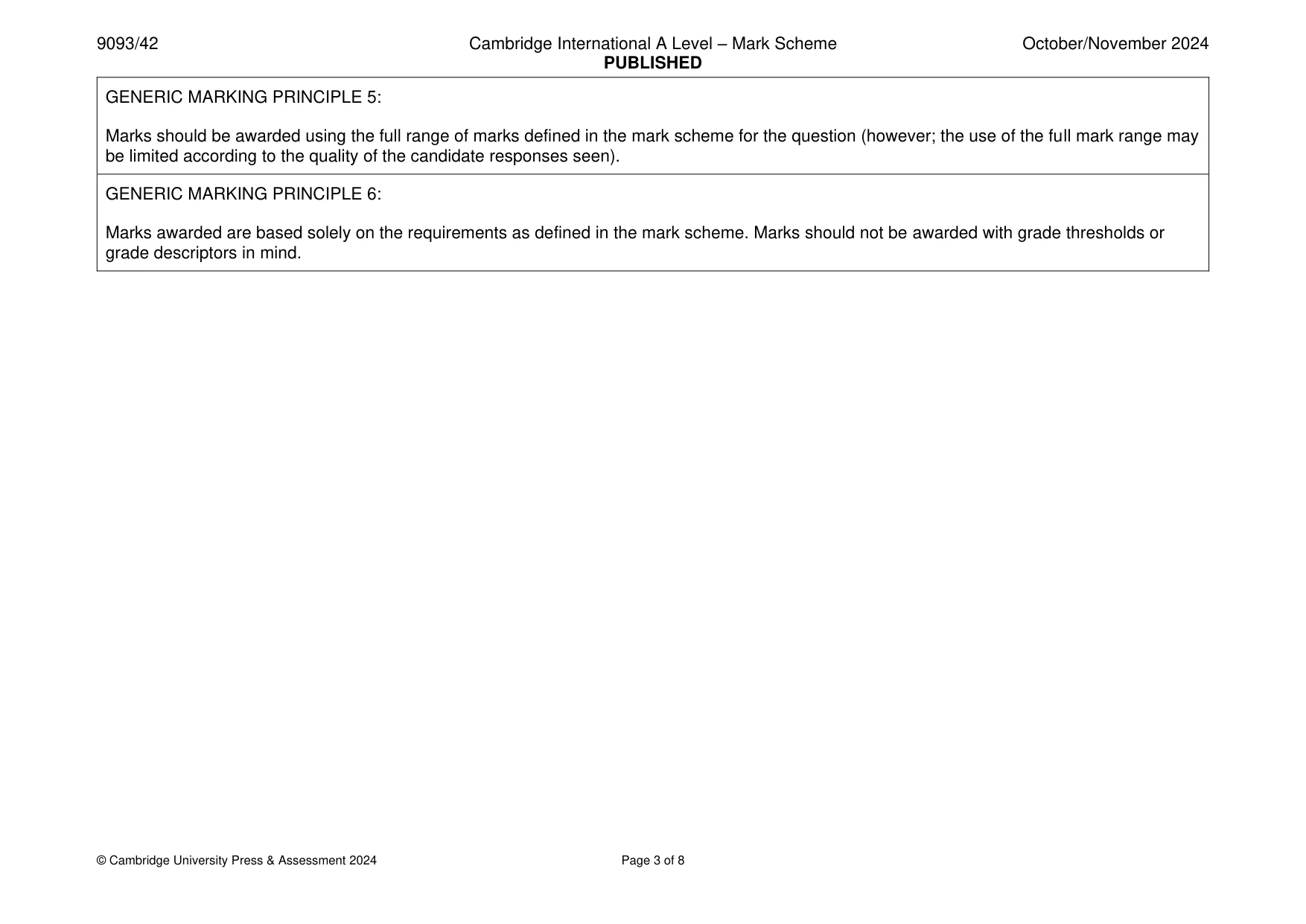
9093/42 Cambridge International A Level – Mark Scheme PUBLISHED October/November 2024 © Cambridge University Press & Assessment 2024 Page 3 of 8 GENERIC MARKING PRINCIPLE 5: Marks should be awarded using the full range of marks defined in the mark scheme for the question (however; the use of the full mark range may be limited according to the quality of the candidate responses seen). GENERIC MARKING PRINCIPLE 6: Marks awarded are based solely on the requirements as defined in the mark scheme. Marks should not be awarded with grade thresholds or grade descriptors in mind.
Mark scheme, page 4
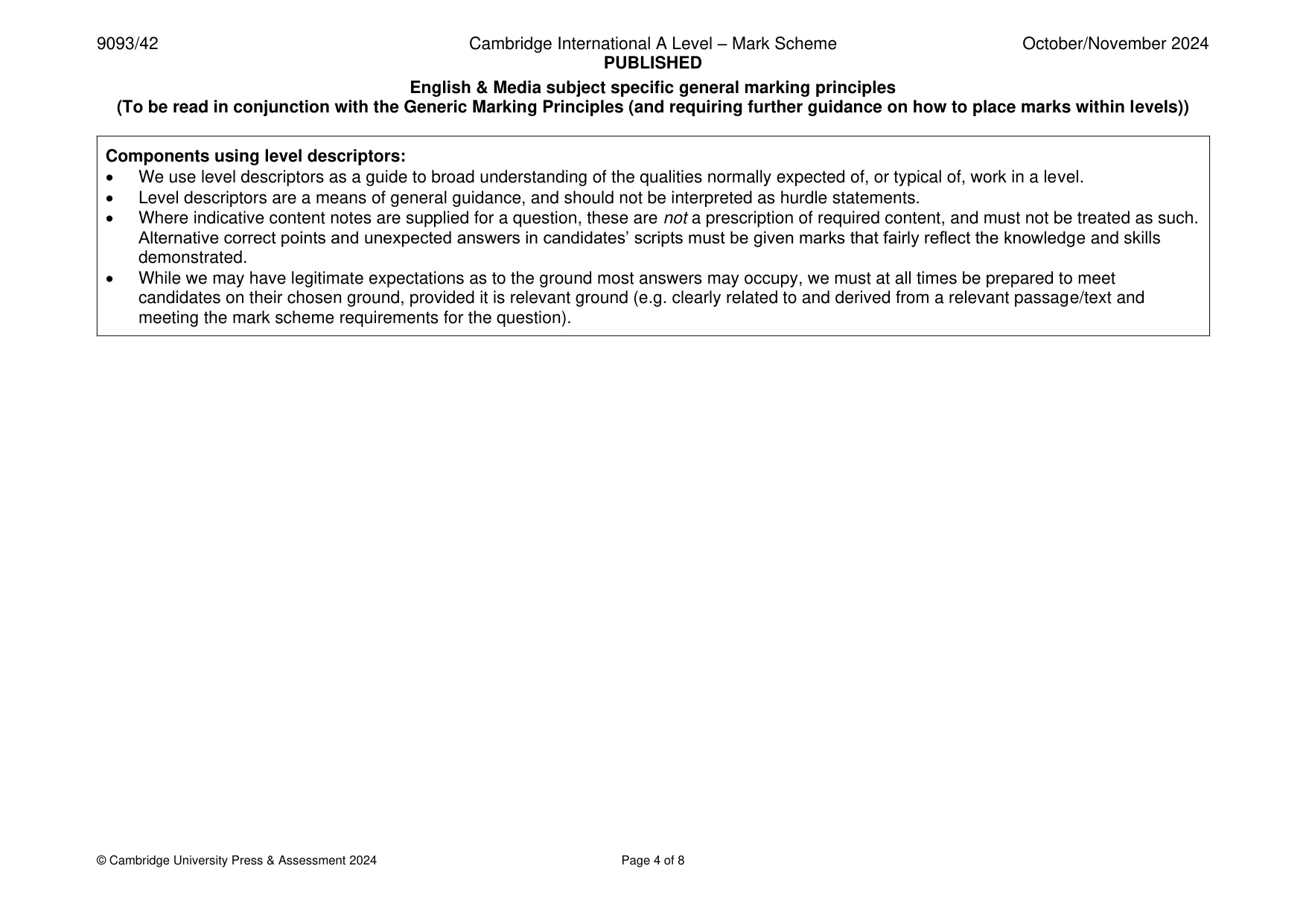
9093/42 Cambridge International A Level – Mark Scheme PUBLISHED October/November 2024 © Cambridge University Press & Assessment 2024 Page 4 of 8 English & Media subject specific general marking principles (To be read in conjunction with the Generic Marking Principles (and requiring further guidance on how to place marks within levels)) Components using level descriptors: • We use level descriptors as a guide to broad understanding of the qualities normally expected of, or typical of, work in a level. • Level descriptors are a means of general guidance, and should not be interpreted as hurdle statements. • Where indicative content notes are supplied for a question, these are not a prescription of required content, and must not be treated as such. Alternative correct points and unexpected answers in candidates’ scripts must be given marks that fairly reflect the knowledge and skills demonstrated. • While we may have legitimate expectations as to the ground most answers may occupy, we must at all times be prepared to meet candidates on their chosen ground, provided it is relevant ground (e.g. clearly related to and derived from a relevant passage/text and meeting the mark scheme requirements for the question).
Mark scheme, page 5
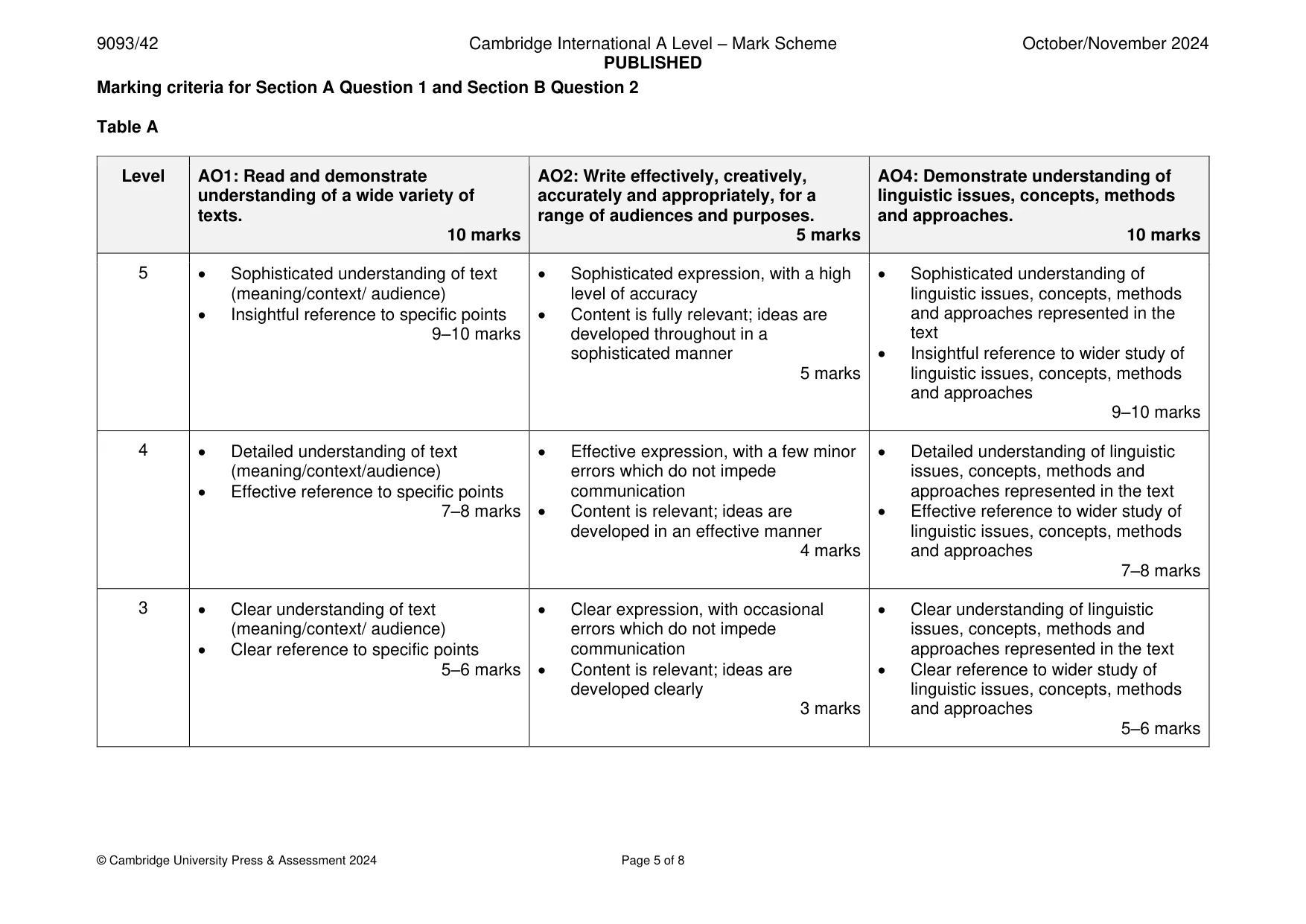
9093/42 Cambridge International A Level – Mark Scheme PUBLISHED October/November 2024 © Cambridge University Press & Assessment 2024 Page 5 of 8 Marking criteria for Section A Question 1 and Section B Question 2 Table A Level AO1: Read and demonstrate understanding of a wide variety of texts. 10 marks AO2: Write effectively, creatively, accurately and appropriately, for a range of audiences and purposes. 5 marks AO4: Demonstrate understanding of linguistic issues, concepts, methods and approaches. 10 marks 5 • Sophisticated understanding of text (meaning/context/ audience) • Insightful reference to specific points 9–10 marks • Sophisticated expression, with a high level of accuracy • Content is fully relevant; ideas are developed throughout in a sophisticated manner 5 marks • Sophisticated understanding of linguistic issues, concepts, methods and approaches represented in the text • Insightful reference to wider study of linguistic issues, concepts, methods and approaches 9–10 marks 4 • Detailed understanding of text (meaning/context/audience) • Effective reference to specific points 7–8 marks • Effective expression, with a few minor errors which do not impede communication • Content is relevant; ideas are developed in an effective manner 4 marks • Detailed understanding of linguistic issues, concepts, methods and approaches represented in the text • Effective reference to wider study of linguistic issues, concepts, methods and approaches 7–8 marks 3 • Clear understanding of text (meaning/context/ audience) • Clear reference to specific points 5–6 marks • Clear expression, with occasional errors which do not impede communication • Content is relevant; ideas are developed clearly 3 marks • Clear understanding of linguistic issues, concepts, methods and approaches represented in the text • Clear reference to wider study of linguistic issues, concepts, methods and approaches 5–6 marks
Mark scheme, page 6
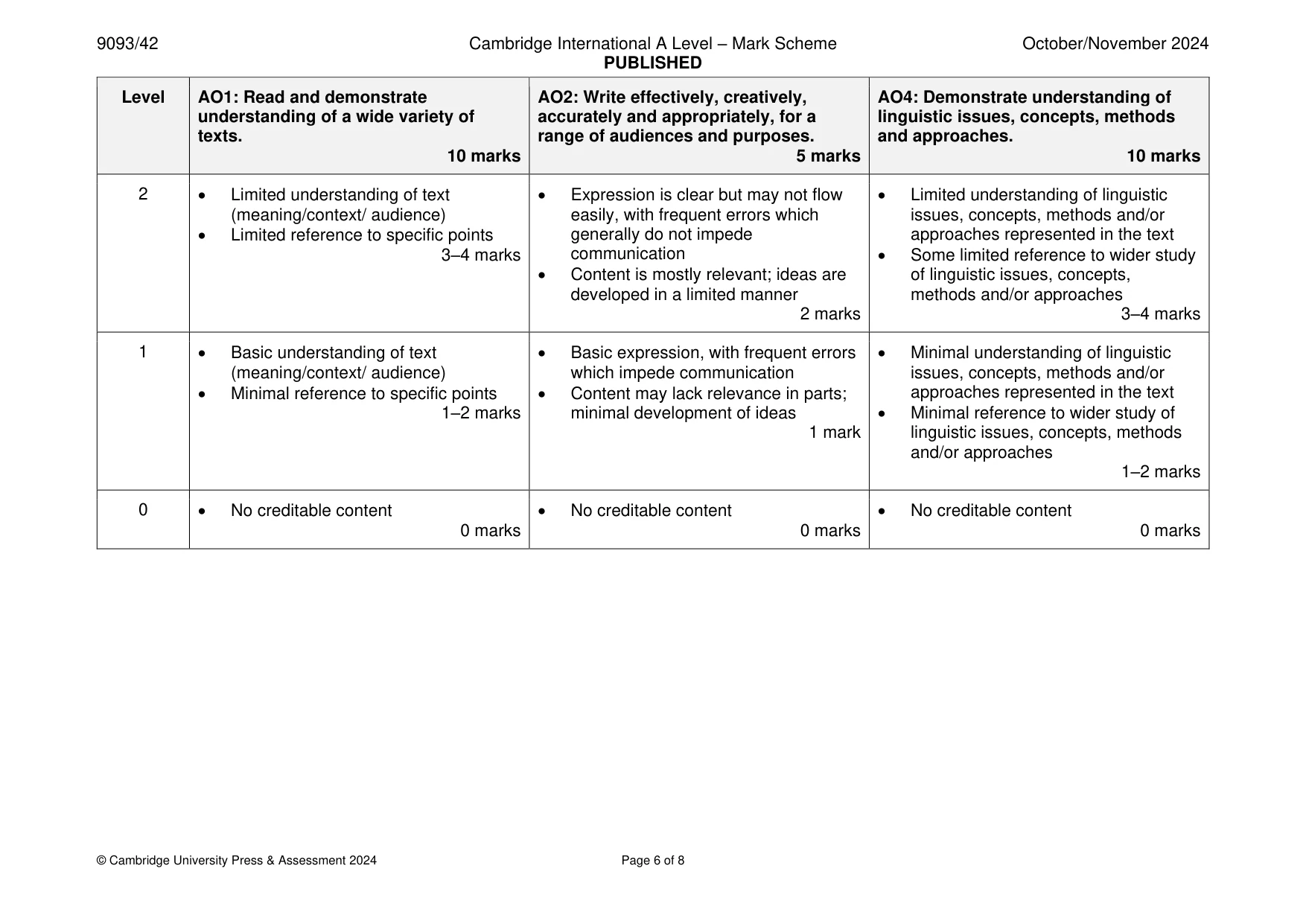
9093/42 Cambridge International A Level – Mark Scheme PUBLISHED October/November 2024 © Cambridge University Press & Assessment 2024 Page 6 of 8 Level AO1: Read and demonstrate understanding of a wide variety of texts. 10 marks AO2: Write effectively, creatively, accurately and appropriately, for a range of audiences and purposes. 5 marks AO4: Demonstrate understanding of linguistic issues, concepts, methods and approaches. 10 marks 2 • Limited understanding of text (meaning/context/ audience) • Limited reference to specific points 3–4 marks • Expression is clear but may not flow easily, with frequent errors which generally do not impede communication • Content is mostly relevant; ideas are developed in a limited manner 2 marks • Limited understanding of linguistic issues, concepts, methods and/or approaches represented in the text • Some limited reference to wider study of linguistic issues, concepts, methods and/or approaches 3–4 marks 1 • Basic understanding of text (meaning/context/ audience) • Minimal reference to specific points 1–2 marks • Basic expression, with frequent errors which impede communication • Content may lack relevance in parts; minimal development of ideas 1 mark • Minimal understanding of linguistic issues, concepts, methods and/or approaches represented in the text • Minimal reference to wider study of linguistic issues, concepts, methods and/or approaches 1–2 marks 0 • No creditable content 0 marks • No creditable content 0 marks • No creditable content 0 marks
Mark scheme, page 7
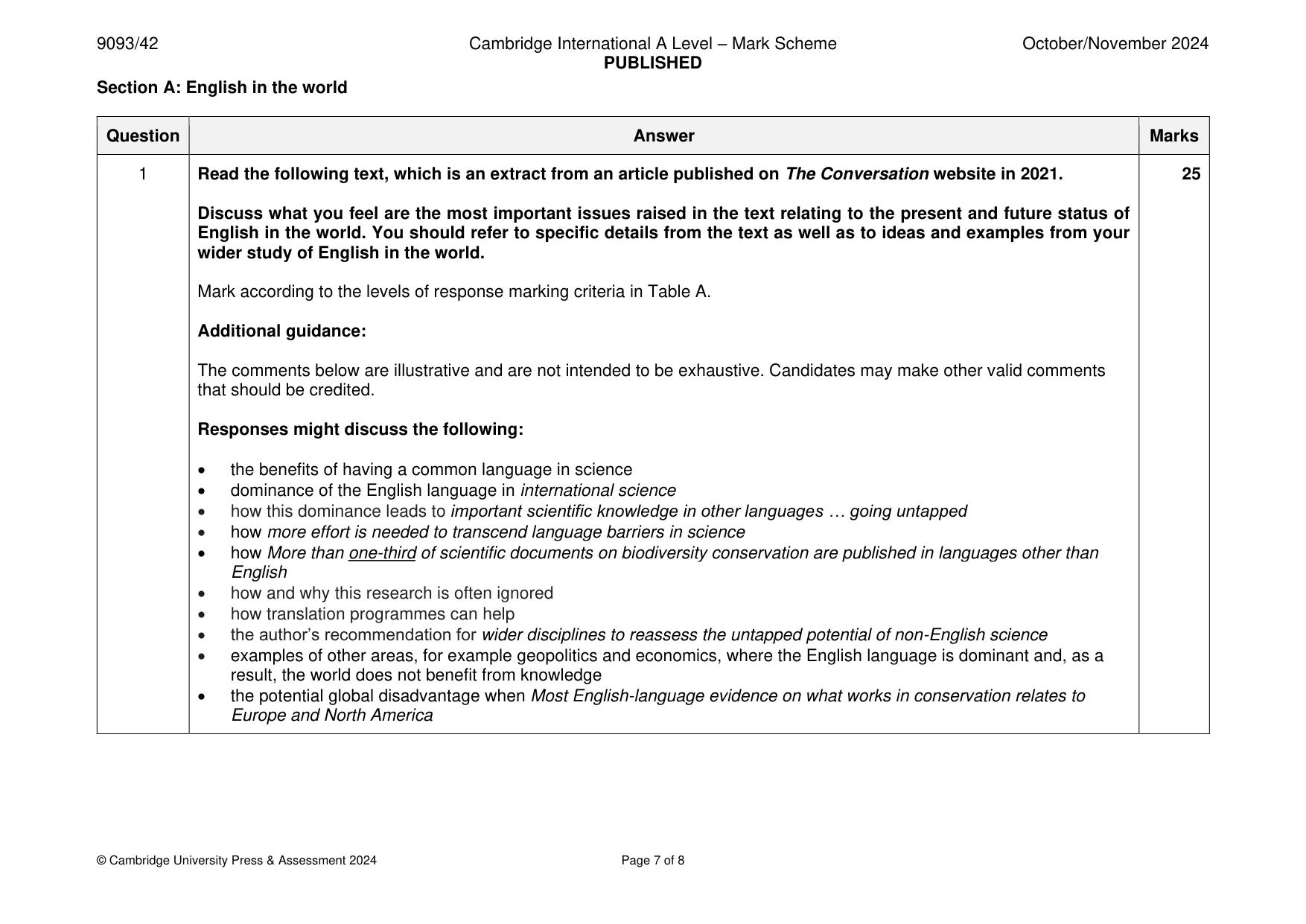
9093/42 Cambridge International A Level – Mark Scheme PUBLISHED October/November 2024 © Cambridge University Press & Assessment 2024 Page 7 of 8 Section A: English in the world Question Answer Marks 1 Read the following text, which is an extract from an article published on The Conversation website in 2021. Discuss what you feel are the most important issues raised in the text relating to the present and future status of English in the world. You should refer to specific details from the text as well as to ideas and examples from your wider study of English in the world. Mark according to the levels of response marking criteria in Table A. Additional guidance: The comments below are illustrative and are not intended to be exhaustive. Candidates may make other valid comments that should be credited. Responses might discuss the following: • the benefits of having a common language in science • dominance of the English language in international science • how this dominance leads to important scientific knowledge in other languages … going untapped • how more effort is needed to transcend language barriers in science • how More than one-third of scientific documents on biodiversity conservation are published in languages other than English • how and why this research is often ignored • how translation programmes can help • the author’s recommendation for wider disciplines to reassess the untapped potential of non-English science • examples of other areas, for example geopolitics and economics, where the English language is dominant and, as a result, the world does not benefit from knowledge • the potential global disadvantage when Most English-language evidence on what works in conservation relates to Europe and North America 25
Mark scheme, page 8
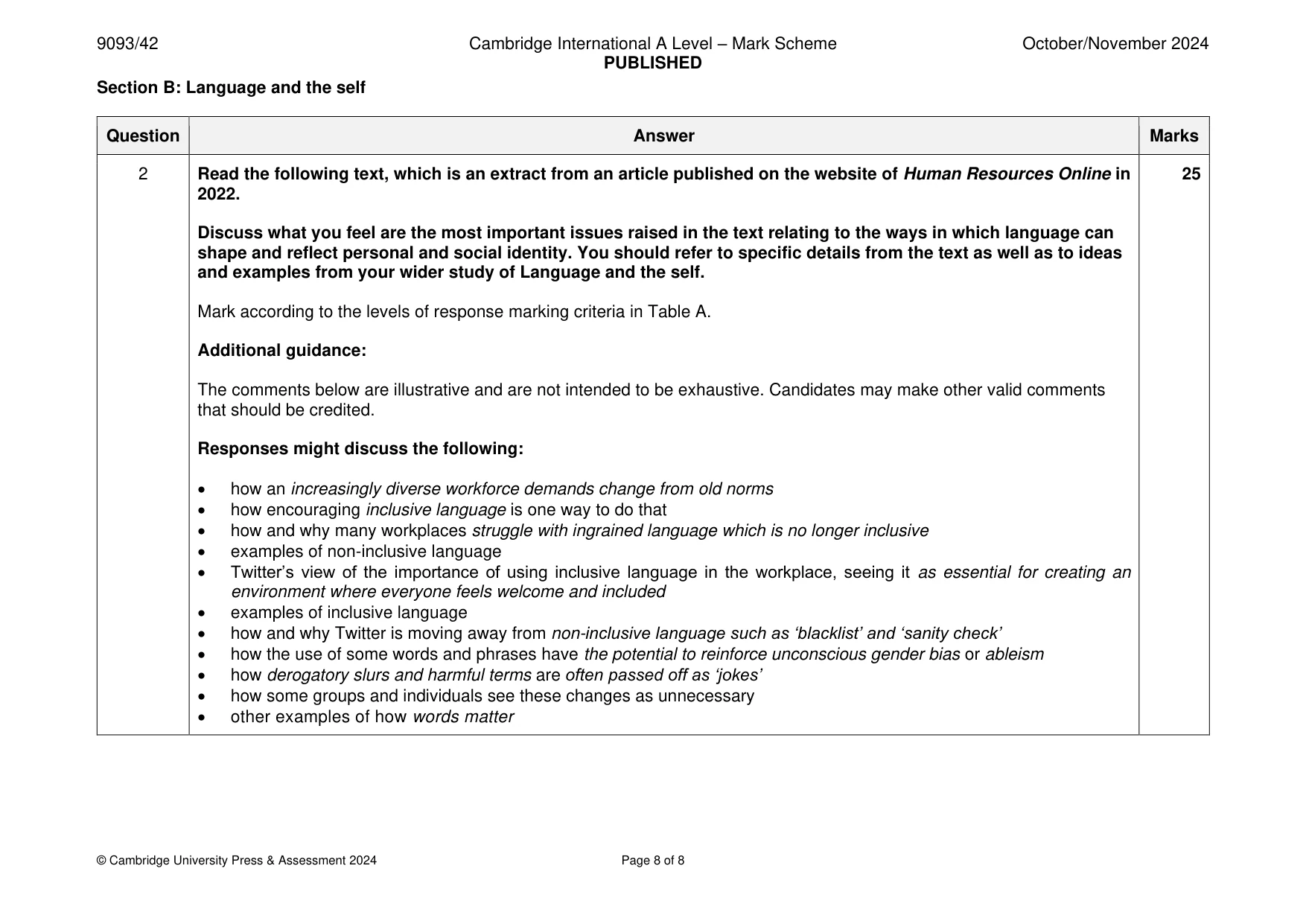
9093/42 Cambridge International A Level – Mark Scheme PUBLISHED October/November 2024 © Cambridge University Press & Assessment 2024 Page 8 of 8 Section B: Language and the self Question Answer Marks 2 Read the following text, which is an extract from an article published on the website of Human Resources Online in 2022. Discuss what you feel are the most important issues raised in the text relating to the ways in which language can shape and reflect personal and social identity. You should refer to specific details from the text as well as to ideas and examples from your wider study of Language and the self. Mark according to the levels of response marking criteria in Table A. Additional guidance: The comments below are illustrative and are not intended to be exhaustive. Candidates may make other valid comments that should be credited. Responses might discuss the following: • how an increasingly diverse workforce demands change from old norms • how encouraging inclusive language is one way to do that • how and why many workplaces struggle with ingrained language which is no longer inclusive • examples of non-inclusive language • Twitter’s view of the importance of using inclusive language in the workplace, seeing it as essential for creating an environment where everyone feels welcome and included • examples of inclusive language • how and why Twitter is moving away from non-inclusive language such as ‘blacklist’ and ‘sanity check’ • how the use of some words and phrases have the potential to reinforce unconscious gender bias or ableism • how derogatory slurs and harmful terms are often passed off as ‘jokes’ • how some groups and individuals see these changes as unnecessary • other examples of how words matter 25
What you needed in this session
Cambridge’s own grade thresholds for 2024 Oct/Nov, Paper 4 · Variant 2. A higher threshold means an easier paper — the bar moves with how the cohort did.