Cambridge A Level English - Language AS and A Level (from 2014) 9093 — 2023 May/June Paper 4 · Variant 1
9093/41/M/J/23 · 50 marks · ≈56 min
The question paper and its mark scheme, free to read here and free to download. This is Cambridge’s own paper, exactly as it was sat.
Question paper8 pages



Mark scheme9 pages
Answers below. Sit the paper first if you are practising.
Paper as text
Question paper, page 1
This document has 8 pages. Any blank pages are indicated. [Turn over Cambridge International AS & A Level ENGLISH LANGUAGE 9093/41 Paper 4 Language Topics May/June 2023 2 hours 15 minutes You must answer on the enclosed answer booklet. You will need: Answer booklet (enclosed) INSTRUCTIONS ● Answer all questions. ● Follow the instructions on the front cover of the answer booklet. If you need additional answer paper, ask the invigilator for a continuation booklet. ● Dictionaries are not allowed. INFORMATION ● The total mark for this paper is 50. ● The number of marks for each question or part question is shown in brackets [ ]. * 2 8 3 2 3 9 6 3 6 6 * DC (PQ) 313388/1 © UCLES 2023
Question paper, page 2
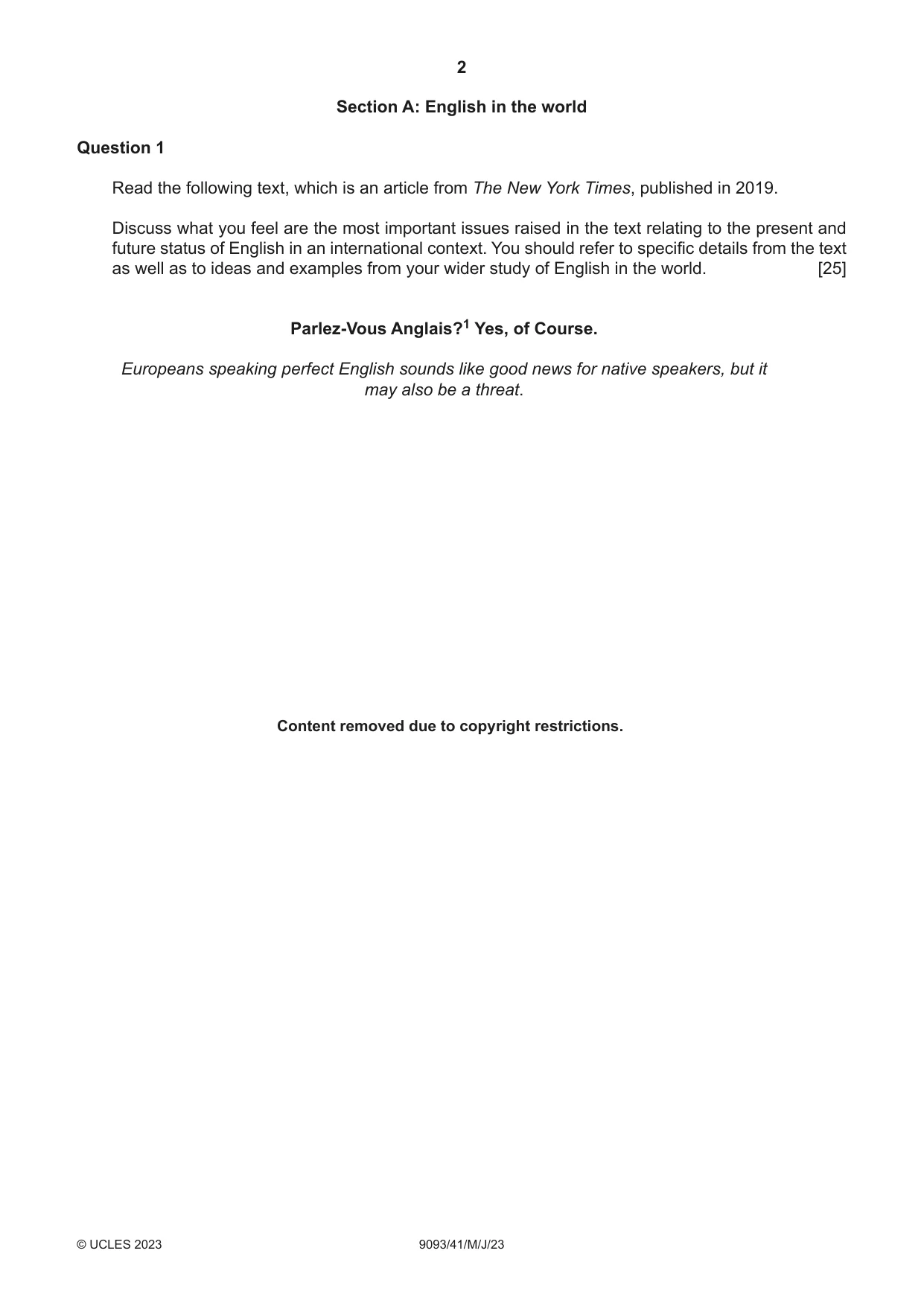
2 9093/41/M/J/23 © UCLES 2023 Section A: English in the world Question 1 Read the following text, which is an article from The New York Times, published in 2019. Discuss what you feel are the most important issues raised in the text relating to the present and future status of English in an international context. You should refer to specific details from the text as well as to ideas and examples from your wider study of English in the world. [25] Parlez-Vous Anglais?1 Yes, of Course. Europeans speaking perfect English sounds like good news for native speakers, but it may also be a threat. Content removed due to copyright restrictions.
Question paper, page 3
3 9093/41/M/J/23 © UCLES 2023 [Turn over If all we know is English, we won’t know what the rest of the world is saying about us. Content removed due to copyright restrictions.
Question paper, page 4
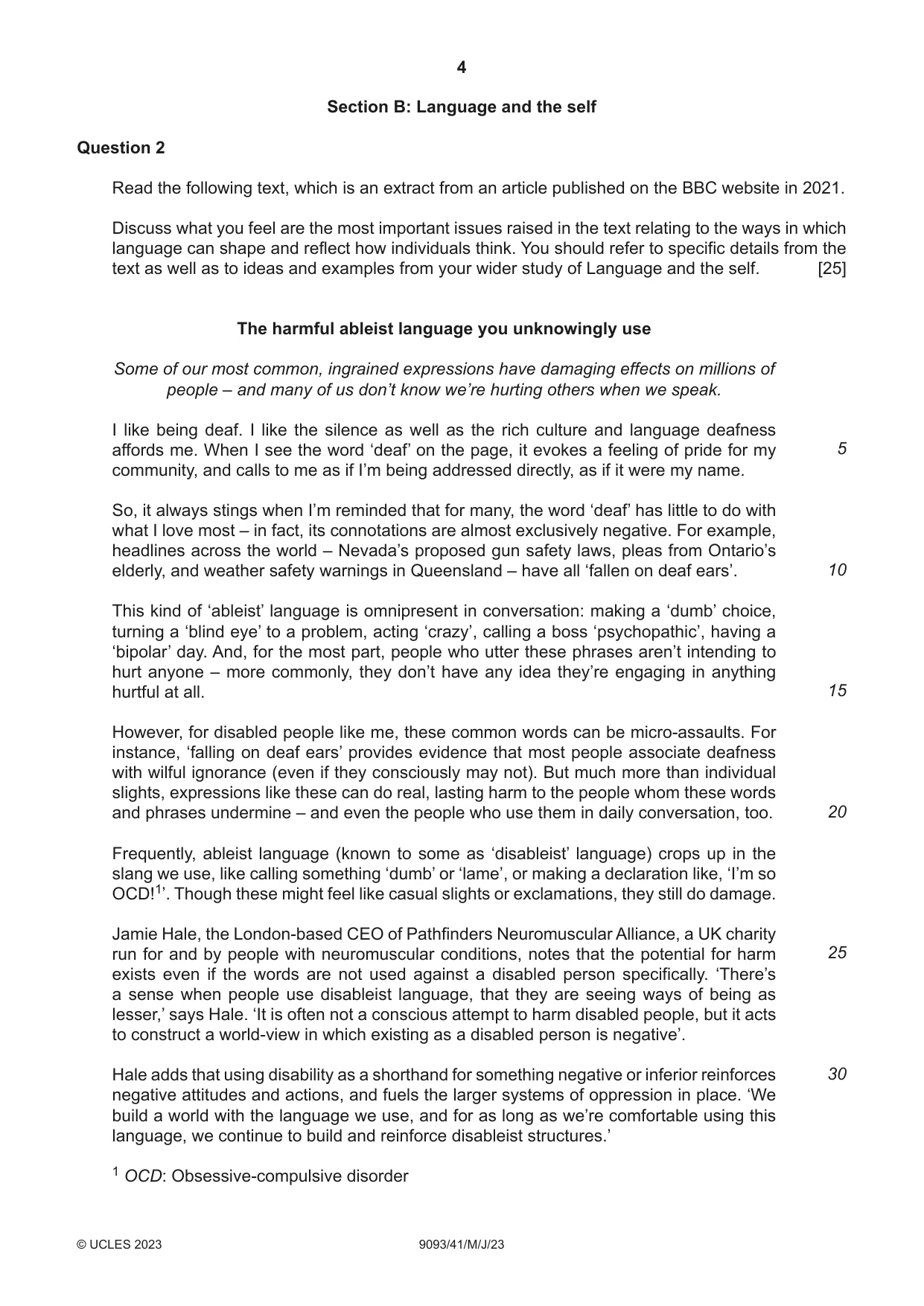
4 9093/41/M/J/23 © UCLES 2023 Section B: Language and the self Question 2 Read the following text, which is an extract from an article published on the BBC website in 2021. Discuss what you feel are the most important issues raised in the text relating to the ways in which language can shape and reflect how individuals think. You should refer to specific details from the text as well as to ideas and examples from your wider study of Language and the self. [25] The harmful ableist language you unknowingly use Some of our most common, ingrained expressions have damaging effects on millions of people – and many of us don’t know we’re hurting others when we speak. I like being deaf. I like the silence as well as the rich culture and language deafness affords me. When I see the word ‘deaf’ on the page, it evokes a feeling of pride for my community, and calls to me as if I’m being addressed directly, as if it were my name. So, it always stings when I’m reminded that for many, the word ‘deaf’ has little to do with what I love most – in fact, its connotations are almost exclusively negative. For example, headlines across the world – Nevada’s proposed gun safety laws, pleas from Ontario’s elderly, and weather safety warnings in Queensland – have all ‘fallen on deaf ears’. This kind of ‘ableist’ language is omnipresent in conversation: making a ‘dumb’ choice, turning a ‘blind eye’ to a problem, acting ‘crazy’, calling a boss ‘psychopathic’, having a ‘bipolar’ day. And, for the most part, people who utter these phrases aren’t intending to hurt anyone – more commonly, they don’t have any idea they’re engaging in anything hurtful at all. However, for disabled people like me, these common words can be micro-assaults. For instance, ‘falling on deaf ears’ provides evidence that most people associate deafness with wilful ignorance (even if they consciously may not). But much more than individual slights, expressions like these can do real, lasting harm to the people whom these words and phrases undermine – and even the people who use them in daily conversation, too. Frequently, ableist language (known to some as ‘disableist’ language) crops up in the slang we use, like calling something ‘dumb’ or ‘lame’, or making a declaration like, ‘I’m so OCD!1’. Though these might feel like casual slights or exclamations, they still do damage. Jamie Hale, the London-based CEO of Pathfinders Neuromuscular Alliance, a UK charity run for and by people with neuromuscular conditions, notes that the potential for harm exists even if the words are not used against a disabled person specifically. ‘There’s a sense when people use disableist language, that they are seeing ways of being as lesser,’ says Hale. ‘It is often not a conscious attempt to harm disabled people, but it acts to construct a world-view in which existing as a disabled person is negative’. Hale adds that using disability as a shorthand for something negative or inferior reinforces negative attitudes and actions, and fuels the larger systems of oppression in place. ‘We build a world with the language we use, and for as long as we’re comfortable using this language, we continue to build and reinforce disableist structures.’ 5 10 15 20 25 30 1 OCD: Obsessive-compulsive disorder
Question paper, page 5
5 9093/41/M/J/23 © UCLES 2023 BLANK PAGE
Question paper, page 6
6 9093/41/M/J/23 © UCLES 2023 BLANK PAGE
Question paper, page 7
7 9093/41/M/J/23 © UCLES 2023 BLANK PAGE
Question paper, page 8
8 9093/41/M/J/23 © UCLES 2023 Permission to reproduce items where third-party owned material protected by copyright is included has been sought and cleared where possible. Every reasonable effort has been made by the publisher (UCLES) to trace copyright holders, but if any items requiring clearance have unwittingly been included, the publisher will be pleased to make amends at the earliest possible opportunity. To avoid the issue of disclosure of answer-related information to candidates, all copyright acknowledgements are reproduced online in the Cambridge Assessment International Education Copyright Acknowledgements Booklet. This is produced for each series of examinations and is freely available to download at www.cambridgeinternational.org after the live examination series. Cambridge Assessment International Education is part of Cambridge Assessment. Cambridge Assessment is the brand name of the University of Cambridge Local Examinations Syndicate (UCLES), which is a department of the University of Cambridge. BLANK PAGE
Mark scheme, page 1
This document consists of 9 printed pages. © UCLES 2023 [Turn over Cambridge International A Level ENGLISH LANGUAGE 9093/41 Paper 4 Language Topics May/June 2023 MARK SCHEME Maximum Mark: 50 Published This mark scheme is published as an aid to teachers and candidates, to indicate the requirements of the examination. It shows the basis on which Examiners were instructed to award marks. It does not indicate the details of the discussions that took place at an Examiners’ meeting before marking began, which would have considered the acceptability of alternative answers. Mark schemes should be read in conjunction with the question paper and the Principal Examiner Report for Teachers. Cambridge International will not enter into discussions about these mark schemes. Cambridge International is publishing the mark schemes for the May/June 2023 series for most Cambridge IGCSE, Cambridge International A and AS Level and Cambridge Pre-U components, and some Cambridge O Level components.
Mark scheme, page 2
9093/41 Cambridge International A Level – Mark Scheme PUBLISHED May/June 2023 © UCLES 2023 Page 2 of 9 Generic Marking Principles These general marking principles must be applied by all examiners when marking candidate answers. They should be applied alongside the specific content of the mark scheme or generic level descriptors for a question. Each question paper and mark scheme will also comply with these marking principles. GENERIC MARKING PRINCIPLE 1: Marks must be awarded in line with: the specific content of the mark scheme or the generic level descriptors for the question the specific skills defined in the mark scheme or in the generic level descriptors for the question the standard of response required by a candidate as exemplified by the standardisation scripts. GENERIC MARKING PRINCIPLE 2: Marks awarded are always whole marks (not half marks, or other fractions). GENERIC MARKING PRINCIPLE 3: Marks must be awarded positively: marks are awarded for correct/valid answers, as defined in the mark scheme. However, credit is given for valid answers which go beyond the scope of the syllabus and mark scheme, referring to your Team Leader as appropriate marks are awarded when candidates clearly demonstrate what they know and can do marks are not deducted for errors marks are not deducted for omissions answers should only be judged on the quality of spelling, punctuation and grammar when these features are specifically assessed by the question as indicated by the mark scheme. The meaning, however, should be unambiguous. GENERIC MARKING PRINCIPLE 4: Rules must be applied consistently, e.g. in situations where candidates have not followed instructions or in the application of generic level descriptors.
Mark scheme, page 3
9093/41 Cambridge International A Level – Mark Scheme PUBLISHED May/June 2023 © UCLES 2023 Page 3 of 9 GENERIC MARKING PRINCIPLE 5: Marks should be awarded using the full range of marks defined in the mark scheme for the question (however; the use of the full mark range may be limited according to the quality of the candidate responses seen). GENERIC MARKING PRINCIPLE 6: Marks awarded are based solely on the requirements as defined in the mark scheme. Marks should not be awarded with grade thresholds or grade descriptors in mind.
Mark scheme, page 4
9093/41 Cambridge International A Level – Mark Scheme PUBLISHED May/June 2023 © UCLES 2023 Page 4 of 9 English & Media subject specific general marking principles (To be read in conjunction with the Generic Marking Principles (and requiring further guidance on how to place marks within levels)) Components using level descriptors: We use level descriptors as a guide to broad understanding of the qualities normally expected of, or typical of, work in a level. Level descriptors are a means of general guidance, and should not be interpreted as hurdle statements. Where indicative content notes are supplied for a question, these are not a prescription of required content, and must not be treated as such. Alternative correct points and unexpected answers in candidates’ scripts must be given marks that fairly reflect the knowledge and skills demonstrated. While we may have legitimate expectations as to the ground most answers may occupy, we must at all times be prepared to meet candidates on their chosen ground, provided it is relevant ground (e.g. clearly related to and derived from a relevant passage / text and meeting the mark scheme requirements for the question).
Mark scheme, page 5
9093/41 Cambridge International A Level – Mark Scheme PUBLISHED May/June 2023 © UCLES 2023 Page 5 of 9 English Language specific marking instructions: AO1 Read and demonstrate understanding of a wide variety of texts. (Understanding) Marks should be awarded for the accuracy of the candidate’s understanding of the text and its features, not for any analysis of them which is recognised under AO3. Where comparison is required, marks should be awarded for the candidate’s recognition of similarities and differences between the texts and their features, not for any consequent analysis. When awarding a ‘best-fit’ mark within a Level for each AO, consider each bullet point equally. AO2 Write effectively, creatively, accurately and appropriately, for a range of audiences and purposes. (Writing) Marks should be awarded equally on the basis of the level of the candidate’s written expression (range of features used and accuracy) and the development of their writing (its organisation and relevance to task and audience). When awarding a ‘best-fit’ mark within a Level for each AO, consider each bullet point equally. AO4: Demonstrate understanding of linguistic issues, concepts, methods and approaches. (Conceptualisation) Marks should be awarded equally on the basis of the level of the candidate’s understanding of the relevant issues, concepts, methods and approaches represented both in the text(s) and in their wider studies. When awarding a ‘best-fit’ mark within a Level for each AO, consider each bullet point equally.
Mark scheme, page 6
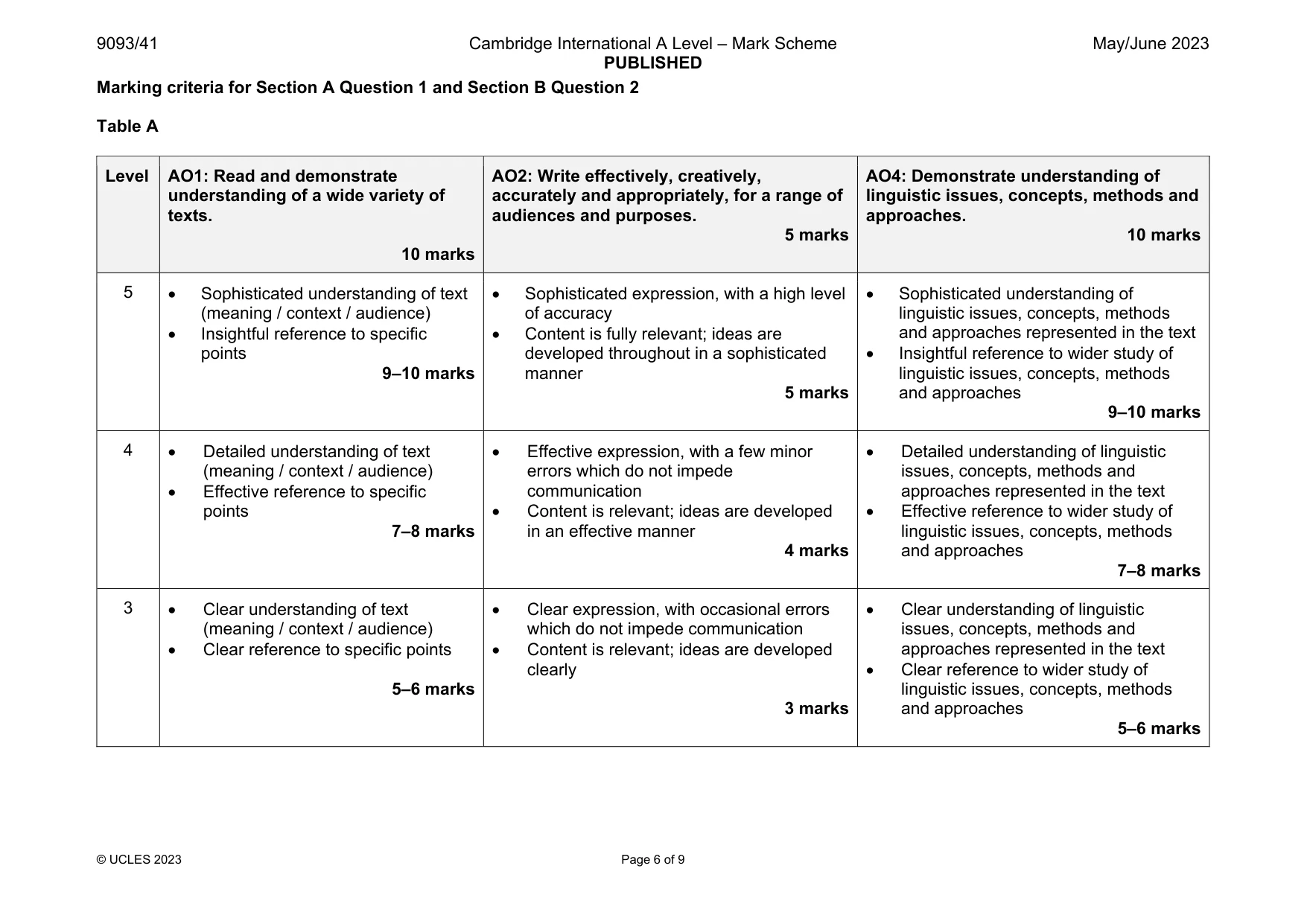
9093/41 Cambridge International A Level – Mark Scheme PUBLISHED May/June 2023 © UCLES 2023 Page 6 of 9 Marking criteria for Section A Question 1 and Section B Question 2 Table A Level AO1: Read and demonstrate understanding of a wide variety of texts. 10 marks AO2: Write effectively, creatively, accurately and appropriately, for a range of audiences and purposes. 5 marks AO4: Demonstrate understanding of linguistic issues, concepts, methods and approaches. 10 marks 5 Sophisticated understanding of text (meaning / context / audience) Insightful reference to specific points 9–10 marks Sophisticated expression, with a high level of accuracy Content is fully relevant; ideas are developed throughout in a sophisticated manner 5 marks Sophisticated understanding of linguistic issues, concepts, methods and approaches represented in the text Insightful reference to wider study of linguistic issues, concepts, methods and approaches 9–10 marks 4 Detailed understanding of text (meaning / context / audience) Effective reference to specific points 7–8 marks Effective expression, with a few minor errors which do not impede communication Content is relevant; ideas are developed in an effective manner 4 marks Detailed understanding of linguistic issues, concepts, methods and approaches represented in the text Effective reference to wider study of linguistic issues, concepts, methods and approaches 7–8 marks 3 Clear understanding of text (meaning / context / audience) Clear reference to specific points 5–6 marks Clear expression, with occasional errors which do not impede communication Content is relevant; ideas are developed clearly 3 marks Clear understanding of linguistic issues, concepts, methods and approaches represented in the text Clear reference to wider study of linguistic issues, concepts, methods and approaches 5–6 marks
Mark scheme, page 7
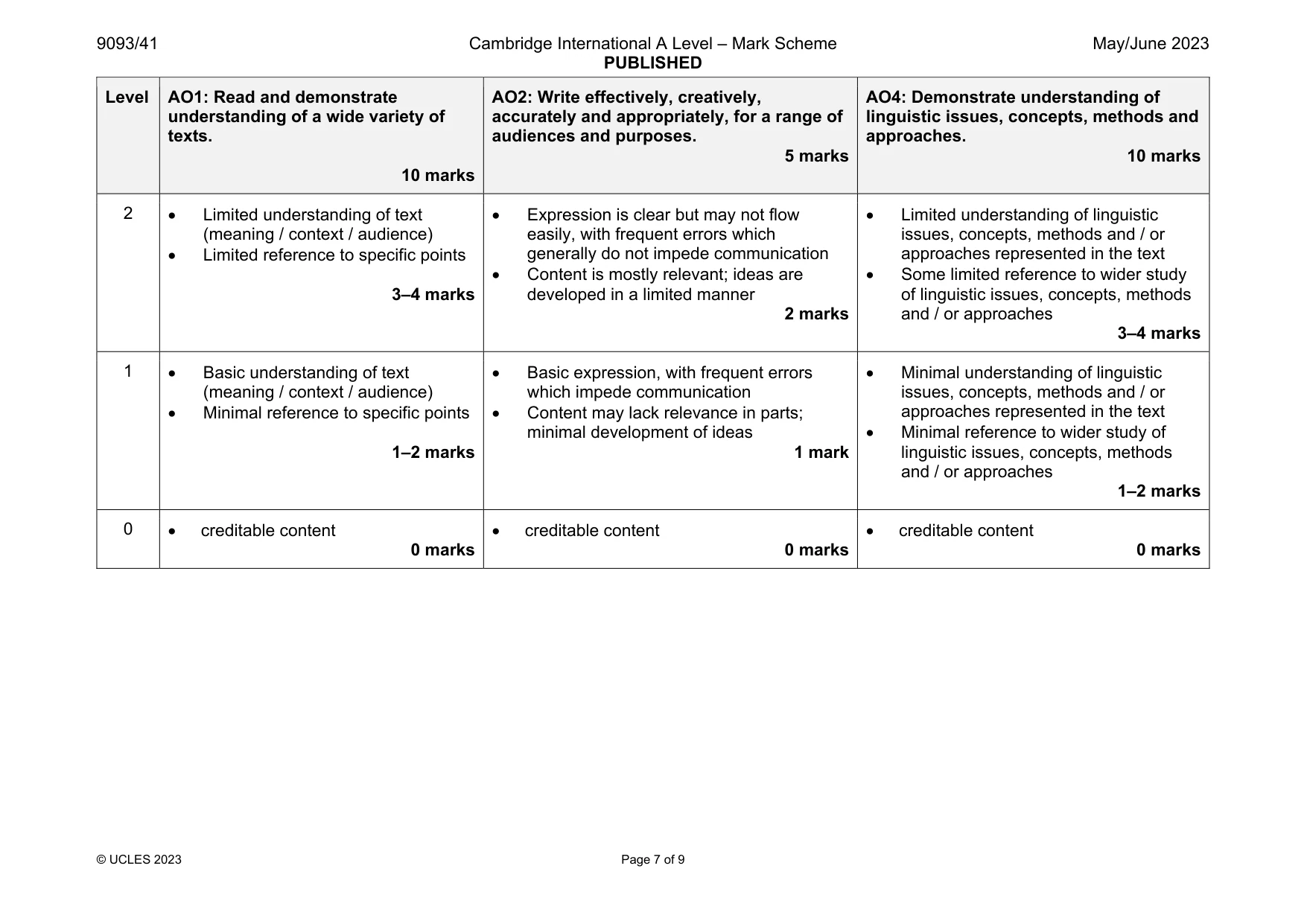
9093/41 Cambridge International A Level – Mark Scheme PUBLISHED May/June 2023 © UCLES 2023 Page 7 of 9 Level AO1: Read and demonstrate understanding of a wide variety of texts. 10 marks AO2: Write effectively, creatively, accurately and appropriately, for a range of audiences and purposes. 5 marks AO4: Demonstrate understanding of linguistic issues, concepts, methods and approaches. 10 marks 2 Limited understanding of text (meaning / context / audience) Limited reference to specific points 3–4 marks Expression is clear but may not flow easily, with frequent errors which generally do not impede communication Content is mostly relevant; ideas are developed in a limited manner 2 marks Limited understanding of linguistic issues, concepts, methods and / or approaches represented in the text Some limited reference to wider study of linguistic issues, concepts, methods and / or approaches 3–4 marks 1 Basic understanding of text (meaning / context / audience) Minimal reference to specific points 1–2 marks Basic expression, with frequent errors which impede communication Content may lack relevance in parts; minimal development of ideas 1 mark Minimal understanding of linguistic issues, concepts, methods and / or approaches represented in the text Minimal reference to wider study of linguistic issues, concepts, methods and / or approaches 1–2 marks 0 creditable content 0 marks creditable content 0 marks creditable content 0 marks
Mark scheme, page 8
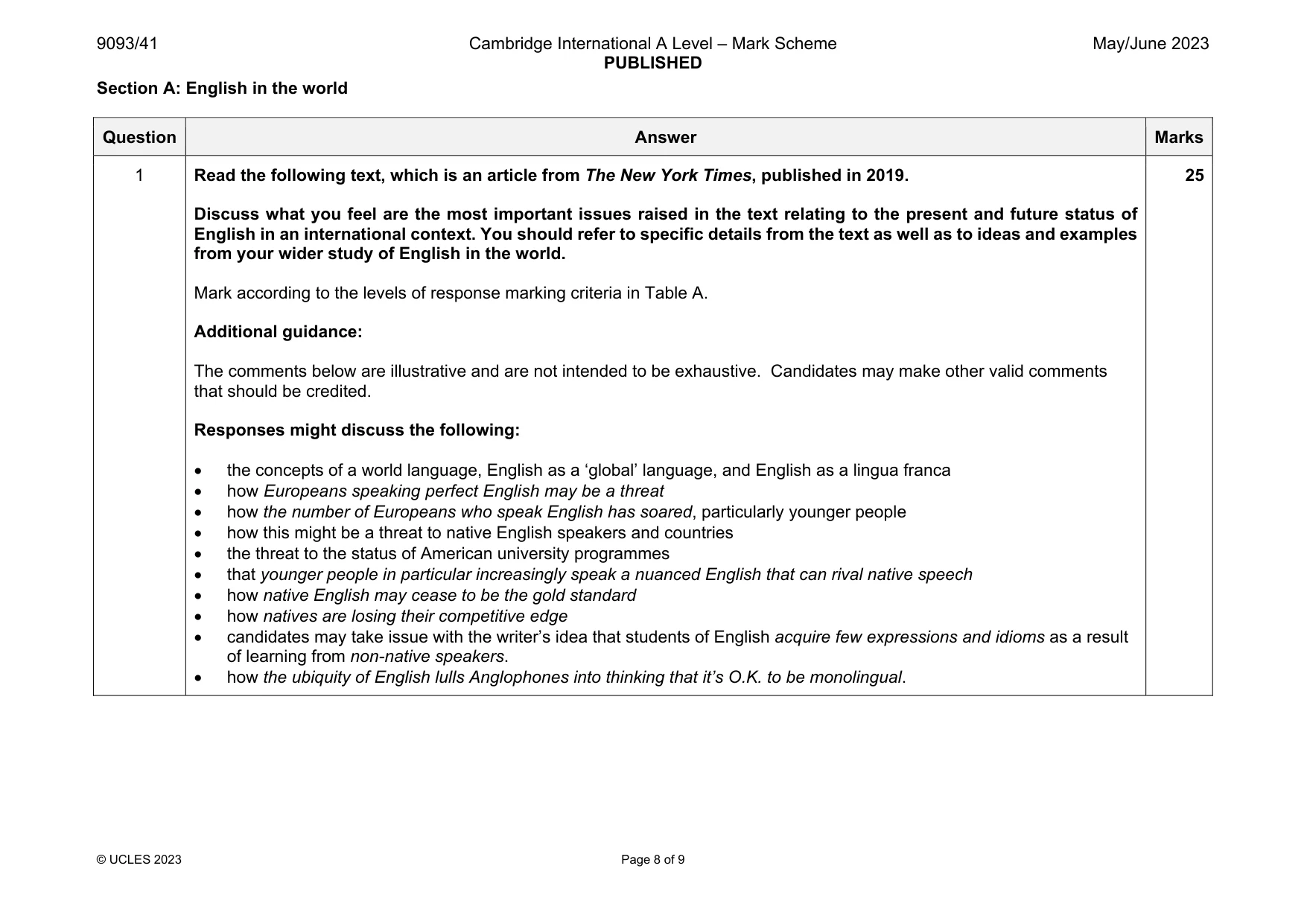
9093/41 Cambridge International A Level – Mark Scheme PUBLISHED May/June 2023 © UCLES 2023 Page 8 of 9 Section A: English in the world Question Answer Marks 1 Read the following text, which is an article from The New York Times, published in 2019. Discuss what you feel are the most important issues raised in the text relating to the present and future status of English in an international context. You should refer to specific details from the text as well as to ideas and examples from your wider study of English in the world. Mark according to the levels of response marking criteria in Table A. Additional guidance: The comments below are illustrative and are not intended to be exhaustive. Candidates may make other valid comments that should be credited. Responses might discuss the following: the concepts of a world language, English as a ‘global’ language, and English as a lingua franca how Europeans speaking perfect English may be a threat how the number of Europeans who speak English has soared, particularly younger people how this might be a threat to native English speakers and countries the threat to the status of American university programmes that younger people in particular increasingly speak a nuanced English that can rival native speech how native English may cease to be the gold standard how natives are losing their competitive edge candidates may take issue with the writer’s idea that students of English acquire few expressions and idioms as a result of learning from non-native speakers. how the ubiquity of English lulls Anglophones into thinking that it’s O.K. to be monolingual. 25
Mark scheme, page 9
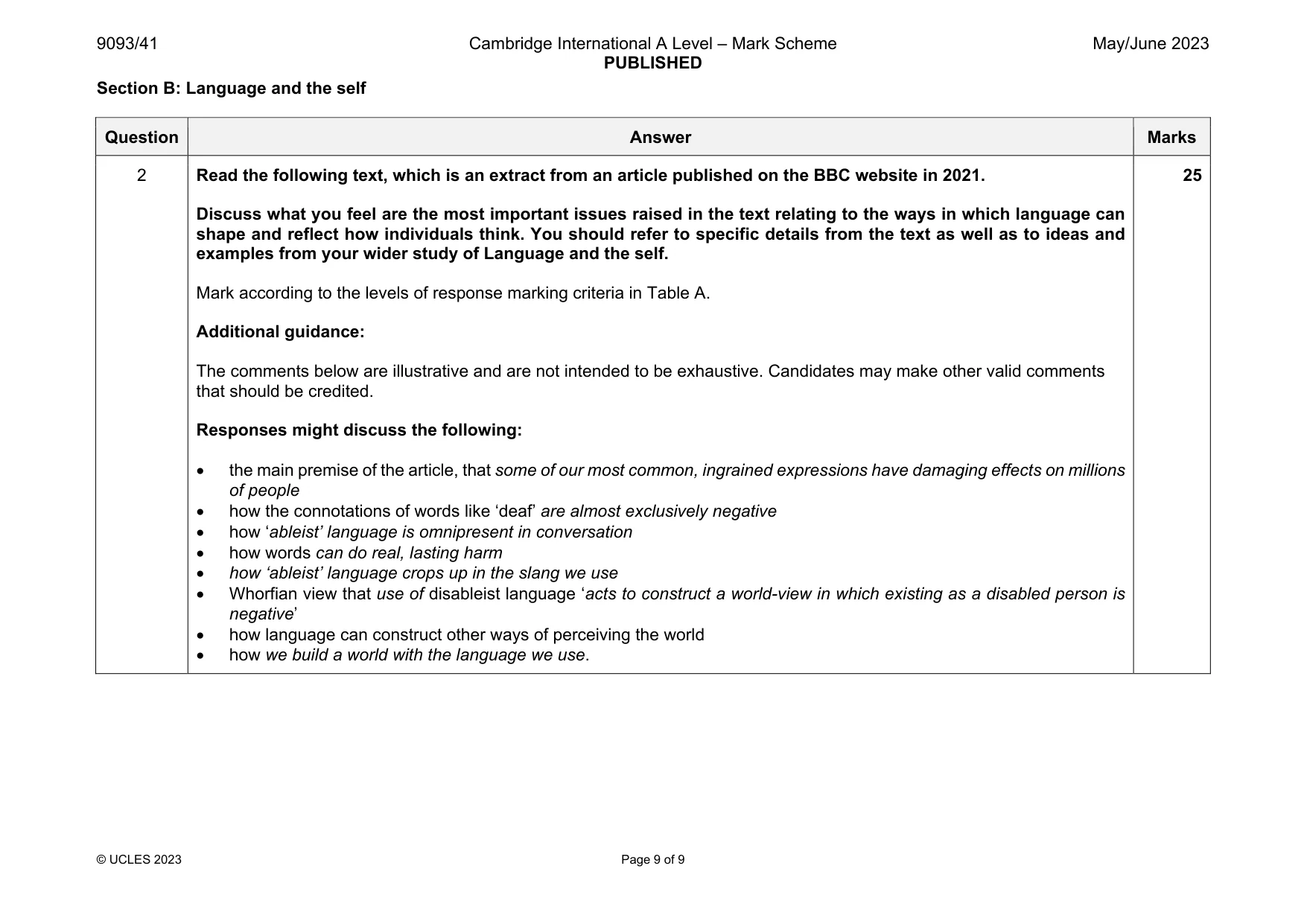
9093/41 Cambridge International A Level – Mark Scheme PUBLISHED May/June 2023 © UCLES 2023 Page 9 of 9 Section B: Language and the self Question Answer Marks 2 Read the following text, which is an extract from an article published on the BBC website in 2021. Discuss what you feel are the most important issues raised in the text relating to the ways in which language can shape and reflect how individuals think. You should refer to specific details from the text as well as to ideas and examples from your wider study of Language and the self. Mark according to the levels of response marking criteria in Table A. Additional guidance: The comments below are illustrative and are not intended to be exhaustive. Candidates may make other valid comments that should be credited. Responses might discuss the following: the main premise of the article, that some of our most common, ingrained expressions have damaging effects on millions of people how the connotations of words like ‘deaf’ are almost exclusively negative how ‘ableist’ language is omnipresent in conversation how words can do real, lasting harm how ‘ableist’ language crops up in the slang we use Whorfian view that use of disableist language ‘acts to construct a world-view in which existing as a disabled person is negative’ how language can construct other ways of perceiving the world how we build a world with the language we use. 25
What you needed in this session
Cambridge’s own grade thresholds for 2023 May/June, Paper 4 · Variant 1. A higher threshold means an easier paper — the bar moves with how the cohort did.