Cambridge A Level English - Language AS and A Level (from 2014) 9093 — 2023 May/June Paper 4 · Variant 3
9093/43/M/J/23 · 50 marks · ≈56 min
The question paper and its mark scheme, free to read here and free to download. This is Cambridge’s own paper, exactly as it was sat.
Question paper4 pages
Mark scheme9 pages
Answers below. Sit the paper first if you are practising.
Paper as text
Question paper, page 1
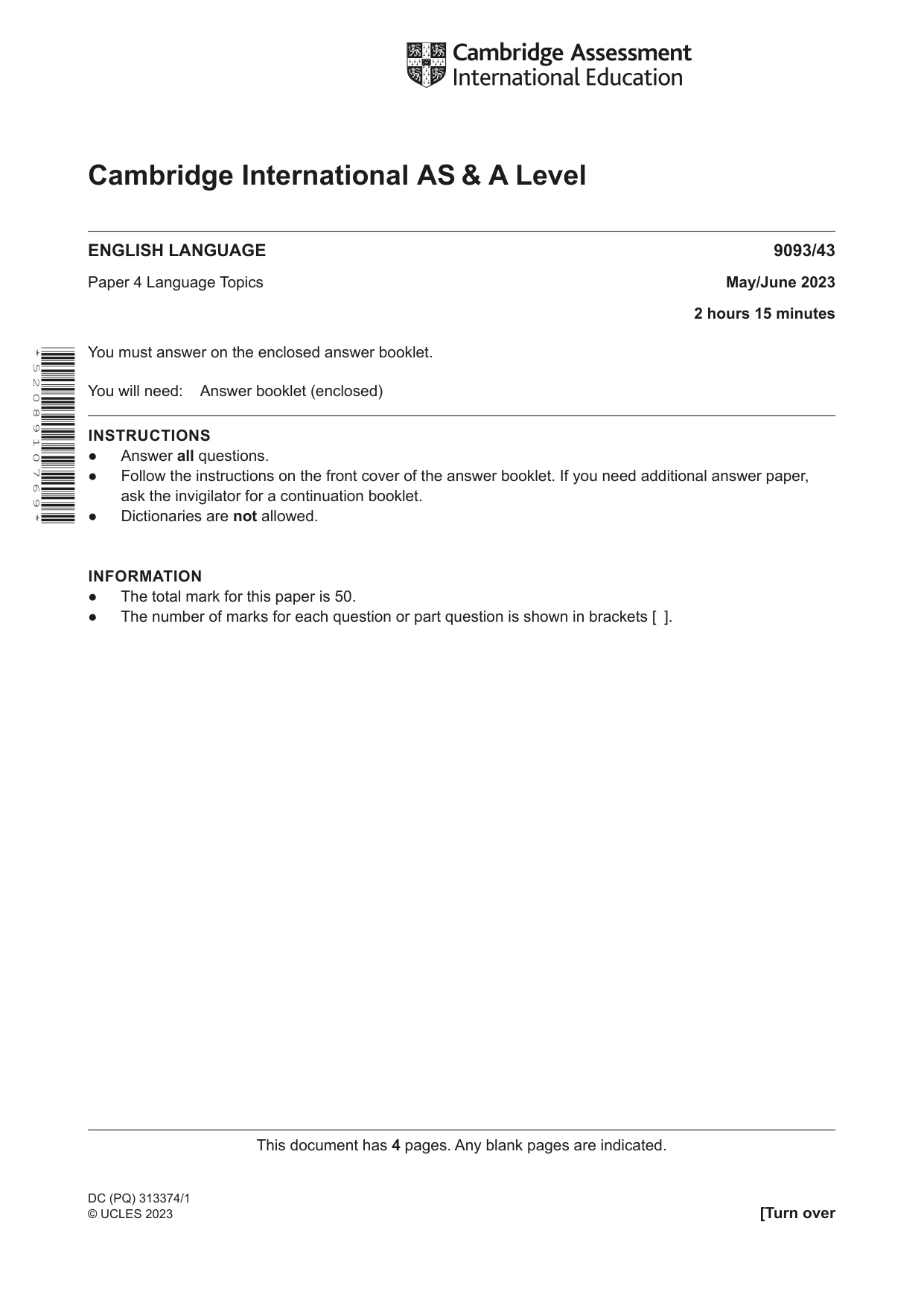
This document has 4 pages. Any blank pages are indicated. [Turn over Cambridge International AS & A Level ENGLISH LANGUAGE 9093/43 Paper 4 Language Topics May/June 2023 2 hours 15 minutes You must answer on the enclosed answer booklet. You will need: Answer booklet (enclosed) INSTRUCTIONS ● Answer all questions. ● Follow the instructions on the front cover of the answer booklet. If you need additional answer paper, ask the invigilator for a continuation booklet. ● Dictionaries are not allowed. INFORMATION ● The total mark for this paper is 50. ● The number of marks for each question or part question is shown in brackets [ ]. * 5 2 0 8 9 1 0 7 6 9 * DC (PQ) 313374/1 © UCLES 2023
Question paper, page 2
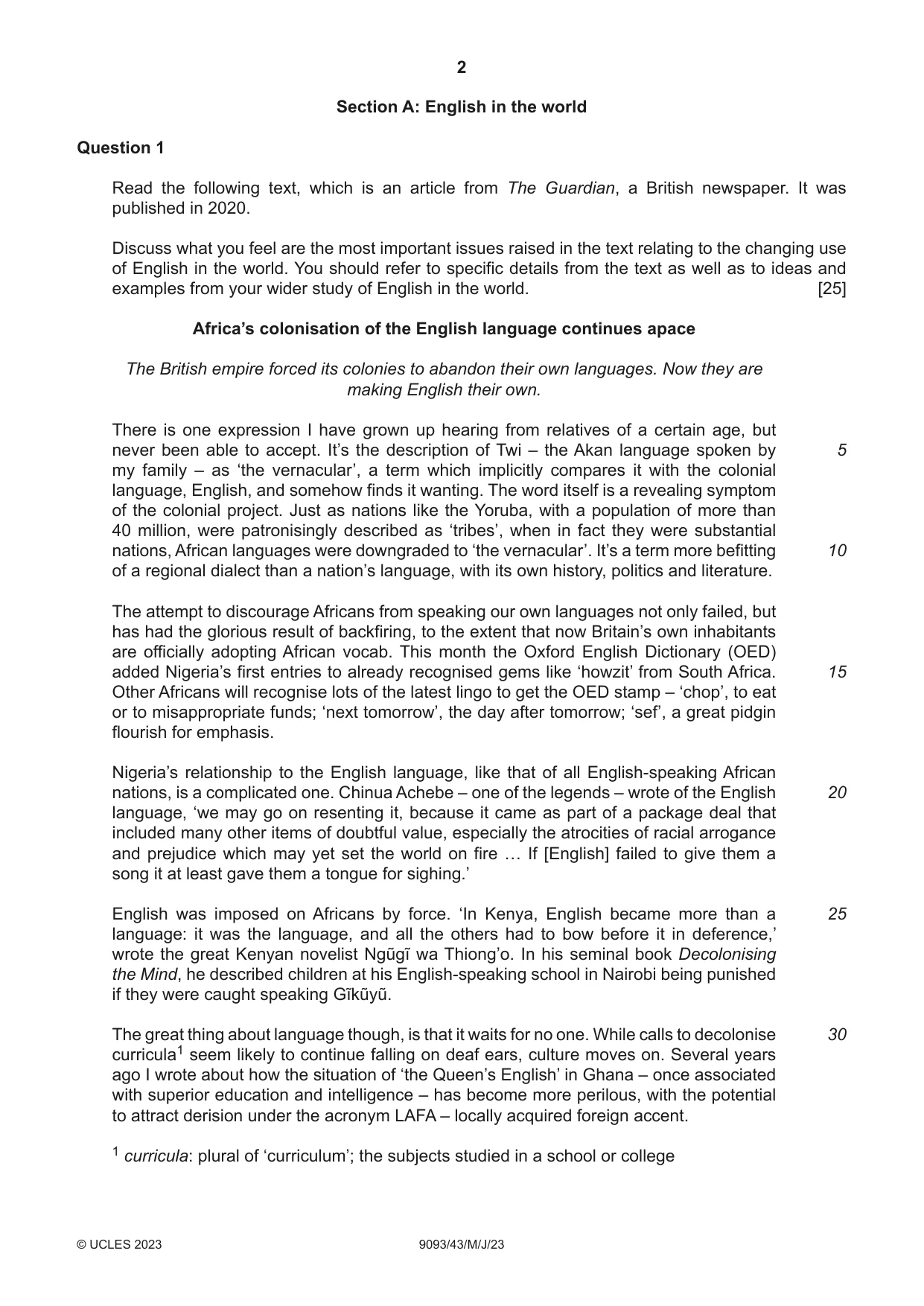
2 9093/43/M/J/23 © UCLES 2023 Section A: English in the world Question 1 Read the following text, which is an article from The Guardian, a British newspaper. It was published in 2020. Discuss what you feel are the most important issues raised in the text relating to the changing use of English in the world. You should refer to specific details from the text as well as to ideas and examples from your wider study of English in the world. [25] Africa’s colonisation of the English language continues apace The British empire forced its colonies to abandon their own languages. Now they are making English their own. There is one expression I have grown up hearing from relatives of a certain age, but never been able to accept. It’s the description of Twi – the Akan language spoken by my family – as ‘the vernacular’, a term which implicitly compares it with the colonial language, English, and somehow finds it wanting. The word itself is a revealing symptom of the colonial project. Just as nations like the Yoruba, with a population of more than 40 million, were patronisingly described as ‘tribes’, when in fact they were substantial nations, African languages were downgraded to ‘the vernacular’. It’s a term more befitting of a regional dialect than a nation’s language, with its own history, politics and literature. The attempt to discourage Africans from speaking our own languages not only failed, but has had the glorious result of backfiring, to the extent that now Britain’s own inhabitants are officially adopting African vocab. This month the Oxford English Dictionary (OED) added Nigeria’s first entries to already recognised gems like ‘howzit’ from South Africa. Other Africans will recognise lots of the latest lingo to get the OED stamp – ‘chop’, to eat or to misappropriate funds; ‘next tomorrow’, the day after tomorrow; ‘sef’, a great pidgin flourish for emphasis. Nigeria’s relationship to the English language, like that of all English-speaking African nations, is a complicated one. Chinua Achebe – one of the legends – wrote of the English language, ‘we may go on resenting it, because it came as part of a package deal that included many other items of doubtful value, especially the atrocities of racial arrogance and prejudice which may yet set the world on fire … If [English] failed to give them a song it at least gave them a tongue for sighing.’ English was imposed on Africans by force. ‘In Kenya, English became more than a language: it was the language, and all the others had to bow before it in deference,’ wrote the great Kenyan novelist Ngũgĩ wa Thiong’o. In his seminal book Decolonising the Mind, he described children at his English-speaking school in Nairobi being punished if they were caught speaking Gĩkũyũ. The great thing about language though, is that it waits for no one. While calls to decolonise curricula1 seem likely to continue falling on deaf ears, culture moves on. Several years ago I wrote about how the situation of ‘the Queen’s English’ in Ghana – once associated with superior education and intelligence – has become more perilous, with the potential to attract derision under the acronym LAFA – locally acquired foreign accent. 1 curricula: plural of ‘curriculum’; the subjects studied in a school or college 5 10 15 20 25 30
Question paper, page 3
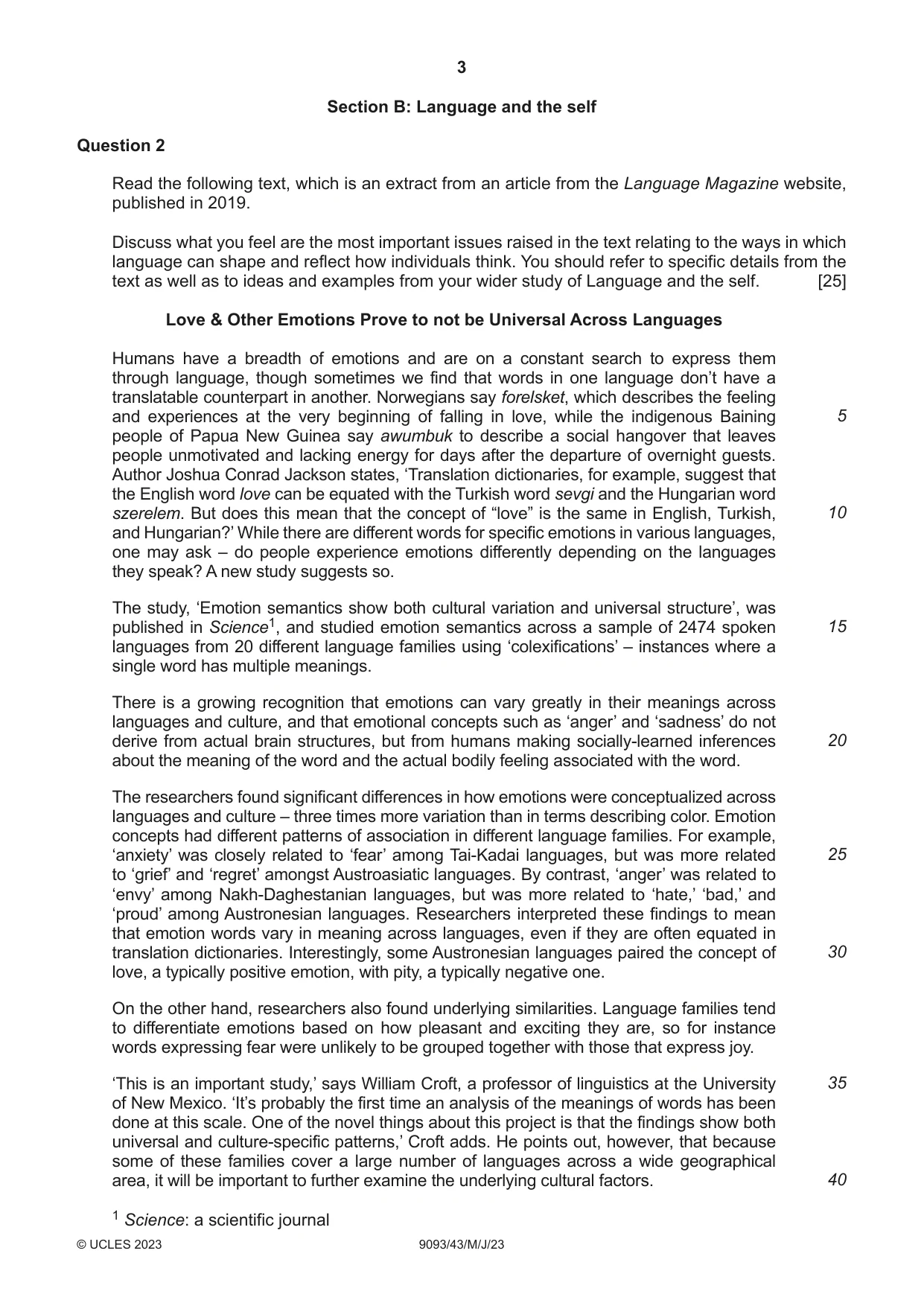
3 9093/43/M/J/23 © UCLES 2023 Section B: Language and the self Question 2 Read the following text, which is an extract from an article from the Language Magazine website, published in 2019. Discuss what you feel are the most important issues raised in the text relating to the ways in which language can shape and reflect how individuals think. You should refer to specific details from the text as well as to ideas and examples from your wider study of Language and the self. [25] Love & Other Emotions Prove to not be Universal Across Languages Humans have a breadth of emotions and are on a constant search to express them through language, though sometimes we find that words in one language don’t have a translatable counterpart in another. Norwegians say forelsket, which describes the feeling and experiences at the very beginning of falling in love, while the indigenous Baining people of Papua New Guinea say awumbuk to describe a social hangover that leaves people unmotivated and lacking energy for days after the departure of overnight guests. Author Joshua Conrad Jackson states, ‘Translation dictionaries, for example, suggest that the English word love can be equated with the Turkish word sevgi and the Hungarian word szerelem. But does this mean that the concept of “love” is the same in English, Turkish, and Hungarian?’ While there are different words for specific emotions in various languages, one may ask – do people experience emotions differently depending on the languages they speak? A new study suggests so. The study, ‘Emotion semantics show both cultural variation and universal structure’, was published in Science1, and studied emotion semantics across a sample of 2474 spoken languages from 20 different language families using ‘colexifications’ – instances where a single word has multiple meanings. There is a growing recognition that emotions can vary greatly in their meanings across languages and culture, and that emotional concepts such as ‘anger’ and ‘sadness’ do not derive from actual brain structures, but from humans making socially-learned inferences about the meaning of the word and the actual bodily feeling associated with the word. The researchers found significant differences in how emotions were conceptualized across languages and culture – three times more variation than in terms describing color. Emotion concepts had different patterns of association in different language families. For example, ‘anxiety’ was closely related to ‘fear’ among Tai-Kadai languages, but was more related to ‘grief’ and ‘regret’ amongst Austroasiatic languages. By contrast, ‘anger’ was related to ‘envy’ among Nakh-Daghestanian languages, but was more related to ‘hate,’ ‘bad,’ and ‘proud’ among Austronesian languages. Researchers interpreted these findings to mean that emotion words vary in meaning across languages, even if they are often equated in translation dictionaries. Interestingly, some Austronesian languages paired the concept of love, a typically positive emotion, with pity, a typically negative one. On the other hand, researchers also found underlying similarities. Language families tend to differentiate emotions based on how pleasant and exciting they are, so for instance words expressing fear were unlikely to be grouped together with those that express joy. ‘This is an important study,’ says William Croft, a professor of linguistics at the University of New Mexico. ‘It’s probably the first time an analysis of the meanings of words has been done at this scale. One of the novel things about this project is that the findings show both universal and culture-specific patterns,’ Croft adds. He points out, however, that because some of these families cover a large number of languages across a wide geographical area, it will be important to further examine the underlying cultural factors. 5 10 15 20 25 30 35 40 1 Science: a scientific journal
Question paper, page 4
4 9093/43/M/J/23 © UCLES 2023 Permission to reproduce items where third-party owned material protected by copyright is included has been sought and cleared where possible. Every reasonable effort has been made by the publisher (UCLES) to trace copyright holders, but if any items requiring clearance have unwittingly been included, the publisher will be pleased to make amends at the earliest possible opportunity. To avoid the issue of disclosure of answer-related information to candidates, all copyright acknowledgements are reproduced online in the Cambridge Assessment International Education Copyright Acknowledgements Booklet. This is produced for each series of examinations and is freely available to download at www.cambridgeinternational.org after the live examination series. Cambridge Assessment International Education is part of Cambridge Assessment. Cambridge Assessment is the brand name of the University of Cambridge Local Examinations Syndicate (UCLES), which is a department of the University of Cambridge. BLANK PAGE
Mark scheme, page 1
This document consists of 9 printed pages. © UCLES 2023 [Turn over Cambridge International A Level ENGLISH LANGUAGE 9093/43 Paper 4 Language Topics May/June 2023 MARK SCHEME Maximum Mark: 50 Published This mark scheme is published as an aid to teachers and candidates, to indicate the requirements of the examination. It shows the basis on which Examiners were instructed to award marks. It does not indicate the details of the discussions that took place at an Examiners’ meeting before marking began, which would have considered the acceptability of alternative answers. Mark schemes should be read in conjunction with the question paper and the Principal Examiner Report for Teachers. Cambridge International will not enter into discussions about these mark schemes. Cambridge International is publishing the mark schemes for the May/June 2023 series for most Cambridge IGCSE, Cambridge International A and AS Level and Cambridge Pre-U components, and some Cambridge O Level components.
Mark scheme, page 2
9093/43 Cambridge International A Level – Mark Scheme PUBLISHED May/June 2023 © UCLES 2023 Page 2 of 9 Generic Marking Principles These general marking principles must be applied by all examiners when marking candidate answers. They should be applied alongside the specific content of the mark scheme or generic level descriptors for a question. Each question paper and mark scheme will also comply with these marking principles. GENERIC MARKING PRINCIPLE 1: Marks must be awarded in line with: the specific content of the mark scheme or the generic level descriptors for the question the specific skills defined in the mark scheme or in the generic level descriptors for the question the standard of response required by a candidate as exemplified by the standardisation scripts. GENERIC MARKING PRINCIPLE 2: Marks awarded are always whole marks (not half marks, or other fractions). GENERIC MARKING PRINCIPLE 3: Marks must be awarded positively: marks are awarded for correct/valid answers, as defined in the mark scheme. However, credit is given for valid answers which go beyond the scope of the syllabus and mark scheme, referring to your Team Leader as appropriate marks are awarded when candidates clearly demonstrate what they know and can do marks are not deducted for errors marks are not deducted for omissions answers should only be judged on the quality of spelling, punctuation and grammar when these features are specifically assessed by the question as indicated by the mark scheme. The meaning, however, should be unambiguous. GENERIC MARKING PRINCIPLE 4: Rules must be applied consistently, e.g. in situations where candidates have not followed instructions or in the application of generic level descriptors.
Mark scheme, page 3
9093/43 Cambridge International A Level – Mark Scheme PUBLISHED May/June 2023 © UCLES 2023 Page 3 of 9 GENERIC MARKING PRINCIPLE 5: Marks should be awarded using the full range of marks defined in the mark scheme for the question (however; the use of the full mark range may be limited according to the quality of the candidate responses seen). GENERIC MARKING PRINCIPLE 6: Marks awarded are based solely on the requirements as defined in the mark scheme. Marks should not be awarded with grade thresholds or grade descriptors in mind.
Mark scheme, page 4
9093/43 Cambridge International A Level – Mark Scheme PUBLISHED May/June 2023 © UCLES 2023 Page 4 of 9 English & Media subject specific general marking principles (To be read in conjunction with the Generic Marking Principles (and requiring further guidance on how to place marks within levels)) Components using level descriptors: We use level descriptors as a guide to broad understanding of the qualities normally expected of, or typical of, work in a level. Level descriptors are a means of general guidance, and should not be interpreted as hurdle statements. Where indicative content notes are supplied for a question, these are not a prescription of required content, and must not be treated as such. Alternative correct points and unexpected answers in candidates’ scripts must be given marks that fairly reflect the knowledge and skills demonstrated. While we may have legitimate expectations as to the ground most answers may occupy, we must at all times be prepared to meet candidates on their chosen ground, provided it is relevant ground (e.g. clearly related to and derived from a relevant passage/text and meeting the mark scheme requirements for the question).
Mark scheme, page 5
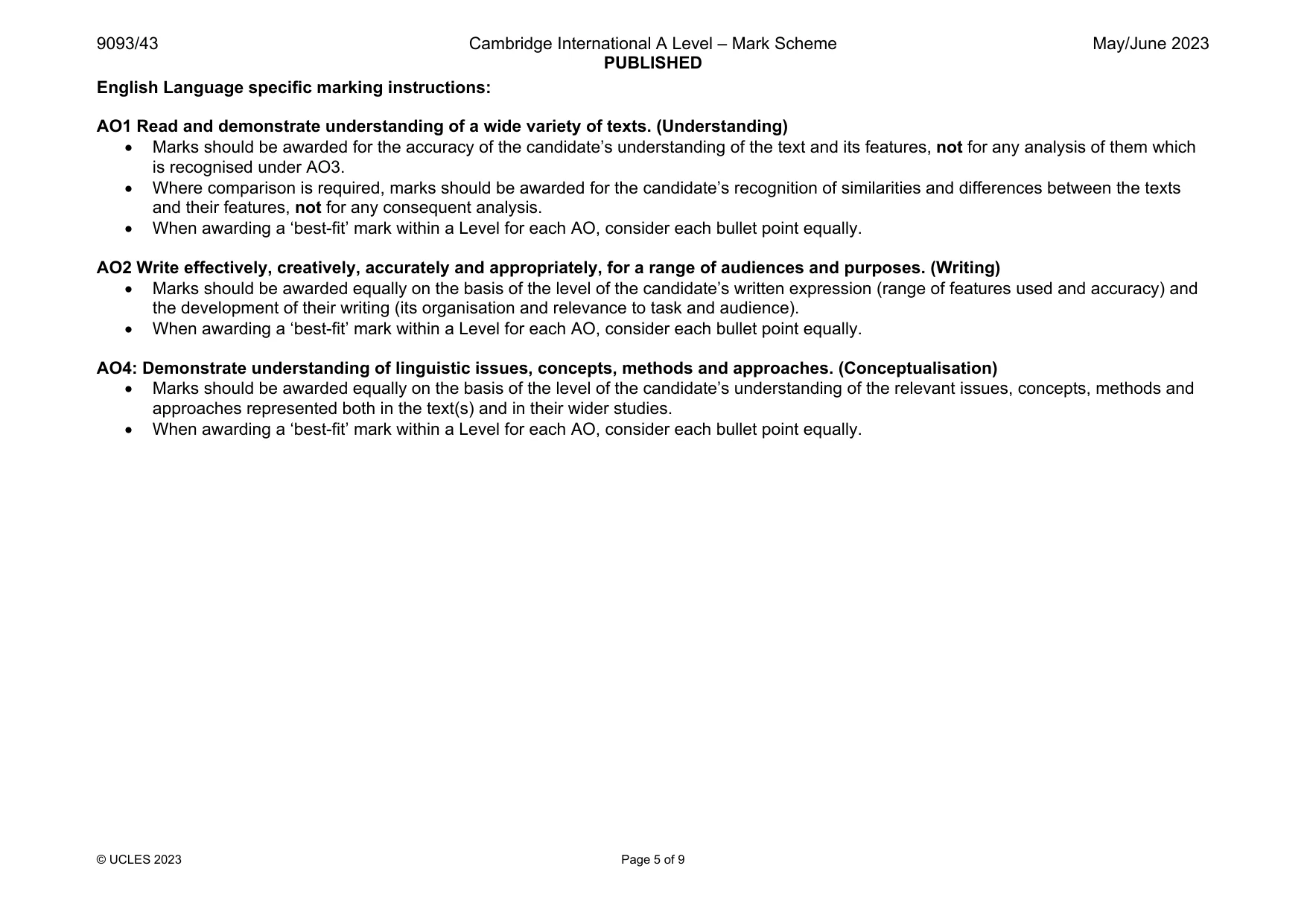
9093/43 Cambridge International A Level – Mark Scheme PUBLISHED May/June 2023 © UCLES 2023 Page 5 of 9 English Language specific marking instructions: AO1 Read and demonstrate understanding of a wide variety of texts. (Understanding) Marks should be awarded for the accuracy of the candidate’s understanding of the text and its features, not for any analysis of them which is recognised under AO3. Where comparison is required, marks should be awarded for the candidate’s recognition of similarities and differences between the texts and their features, not for any consequent analysis. When awarding a ‘best-fit’ mark within a Level for each AO, consider each bullet point equally. AO2 Write effectively, creatively, accurately and appropriately, for a range of audiences and purposes. (Writing) Marks should be awarded equally on the basis of the level of the candidate’s written expression (range of features used and accuracy) and the development of their writing (its organisation and relevance to task and audience). When awarding a ‘best-fit’ mark within a Level for each AO, consider each bullet point equally. AO4: Demonstrate understanding of linguistic issues, concepts, methods and approaches. (Conceptualisation) Marks should be awarded equally on the basis of the level of the candidate’s understanding of the relevant issues, concepts, methods and approaches represented both in the text(s) and in their wider studies. When awarding a ‘best-fit’ mark within a Level for each AO, consider each bullet point equally.
Mark scheme, page 6
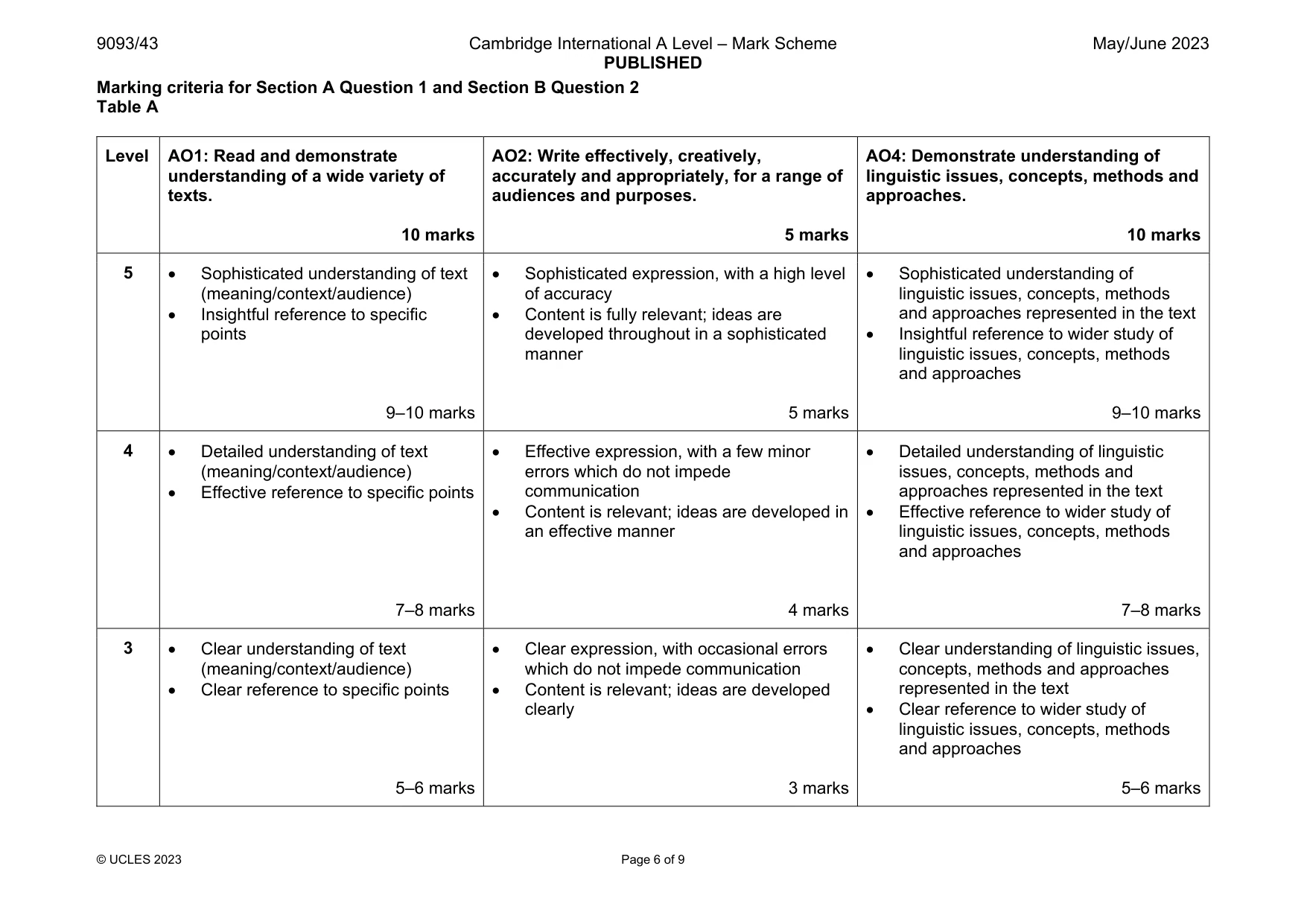
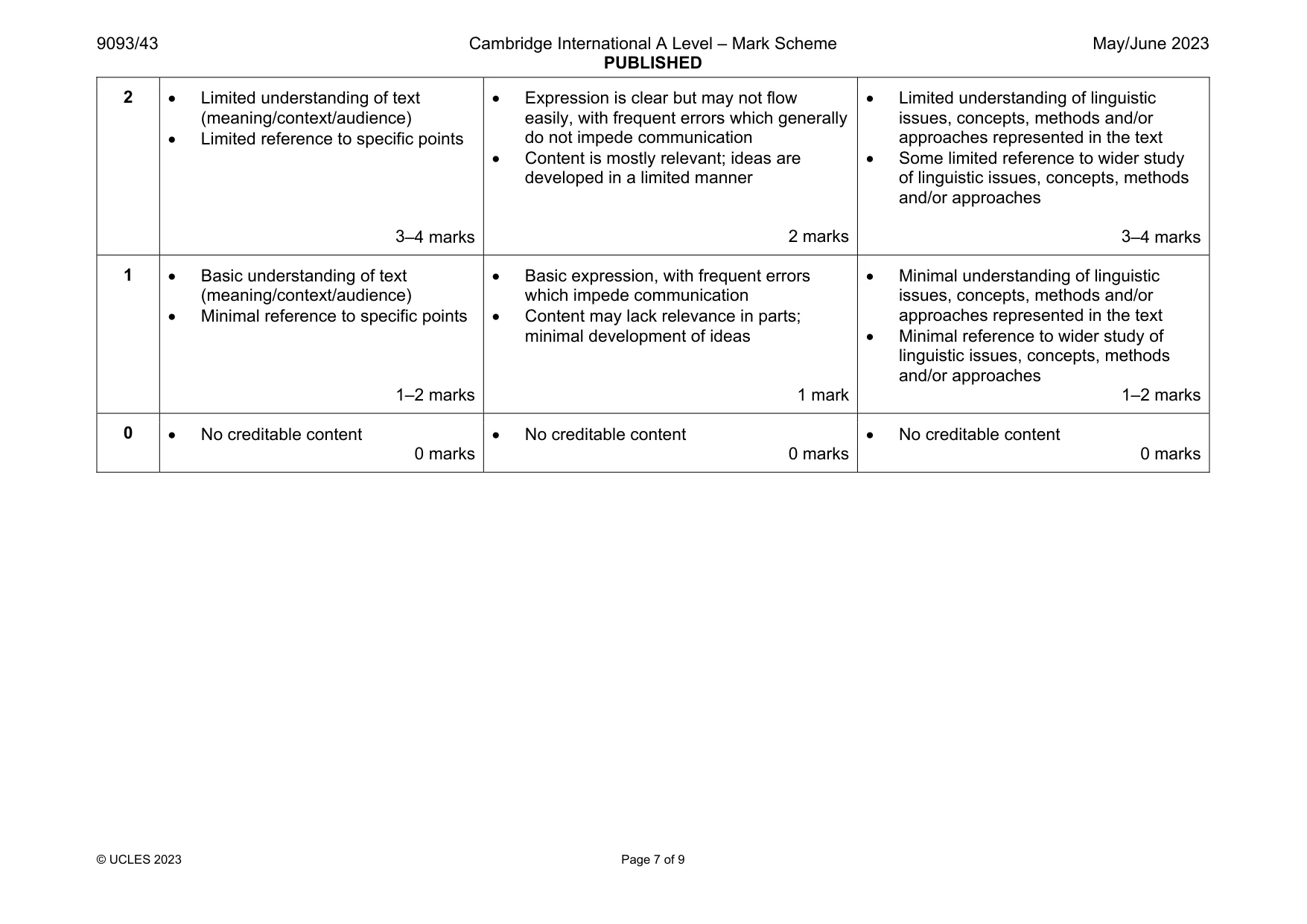
9093/43 Cambridge International A Level – Mark Scheme PUBLISHED May/June 2023 © UCLES 2023 Page 6 of 9 Marking criteria for Section A Question 1 and Section B Question 2 Table A Level AO1: Read and demonstrate understanding of a wide variety of texts. 10 marks AO2: Write effectively, creatively, accurately and appropriately, for a range of audiences and purposes. 5 marks AO4: Demonstrate understanding of linguistic issues, concepts, methods and approaches. 10 marks 5 Sophisticated understanding of text (meaning/context/audience) Insightful reference to specific points 9–10 marks Sophisticated expression, with a high level of accuracy Content is fully relevant; ideas are developed throughout in a sophisticated manner 5 marks Sophisticated understanding of linguistic issues, concepts, methods and approaches represented in the text Insightful reference to wider study of linguistic issues, concepts, methods and approaches 9–10 marks 4 Detailed understanding of text (meaning/context/audience) Effective reference to specific points 7–8 marks Effective expression, with a few minor errors which do not impede communication Content is relevant; ideas are developed in an effective manner 4 marks Detailed understanding of linguistic issues, concepts, methods and approaches represented in the text Effective reference to wider study of linguistic issues, concepts, methods and approaches 7–8 marks 3 Clear understanding of text (meaning/context/audience) Clear reference to specific points 5–6 marks Clear expression, with occasional errors which do not impede communication Content is relevant; ideas are developed clearly 3 marks Clear understanding of linguistic issues, concepts, methods and approaches represented in the text Clear reference to wider study of linguistic issues, concepts, methods and approaches 5–6 marks
Mark scheme, page 7
9093/43 Cambridge International A Level – Mark Scheme PUBLISHED May/June 2023 © UCLES 2023 Page 7 of 9 2 Limited understanding of text (meaning/context/audience) Limited reference to specific points 3–4 marks Expression is clear but may not flow easily, with frequent errors which generally do not impede communication Content is mostly relevant; ideas are developed in a limited manner 2 marks Limited understanding of linguistic issues, concepts, methods and/or approaches represented in the text Some limited reference to wider study of linguistic issues, concepts, methods and/or approaches 3–4 marks 1 Basic understanding of text (meaning/context/audience) Minimal reference to specific points 1–2 marks Basic expression, with frequent errors which impede communication Content may lack relevance in parts; minimal development of ideas 1 mark Minimal understanding of linguistic issues, concepts, methods and/or approaches represented in the text Minimal reference to wider study of linguistic issues, concepts, methods and/or approaches 1–2 marks 0 No creditable content 0 marks No creditable content 0 marks No creditable content 0 marks
Mark scheme, page 8
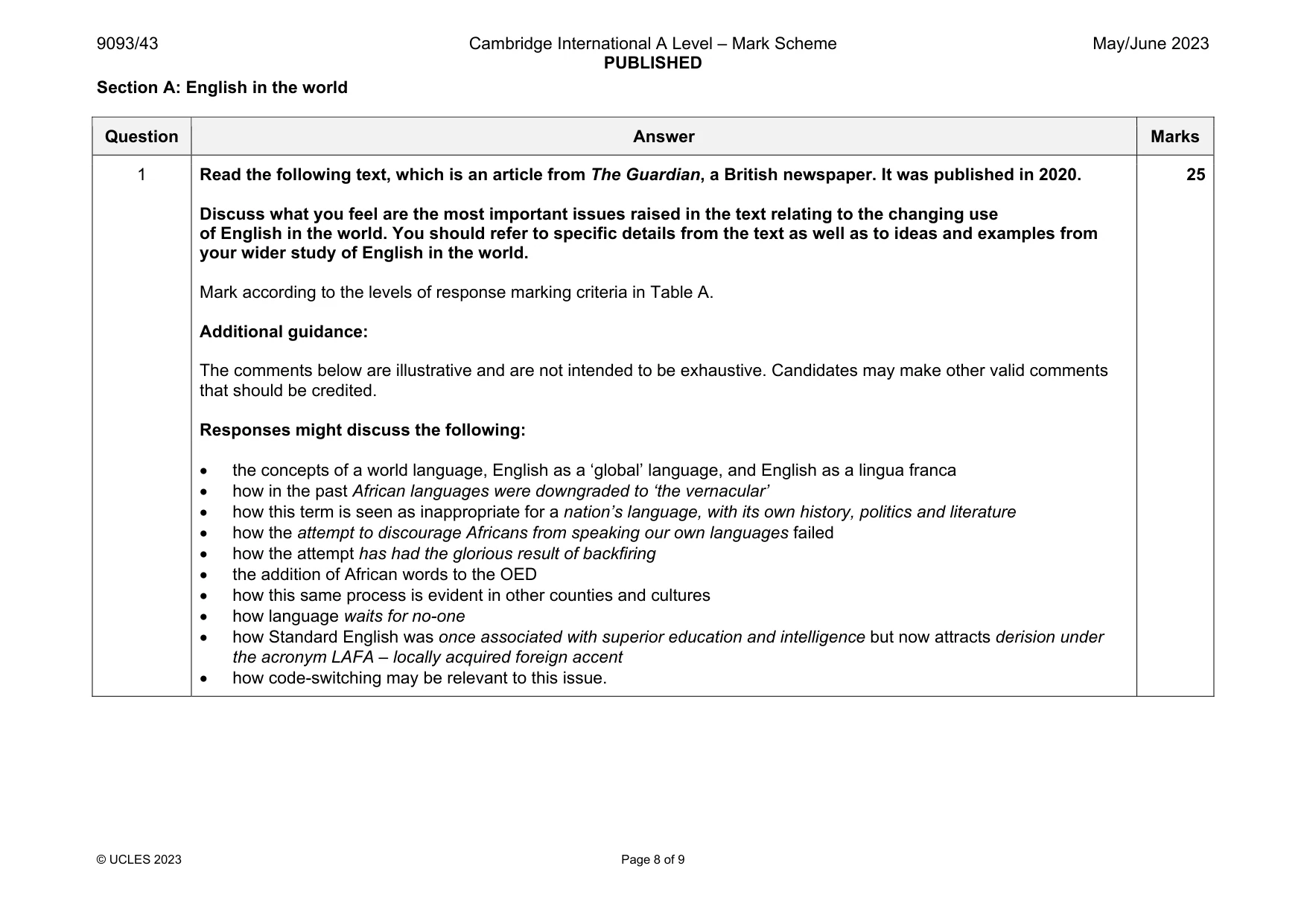
9093/43 Cambridge International A Level – Mark Scheme PUBLISHED May/June 2023 © UCLES 2023 Page 8 of 9 Section A: English in the world Question Answer Marks 1 Read the following text, which is an article from The Guardian, a British newspaper. It was published in 2020. Discuss what you feel are the most important issues raised in the text relating to the changing use of English in the world. You should refer to specific details from the text as well as to ideas and examples from your wider study of English in the world. Mark according to the levels of response marking criteria in Table A. Additional guidance: The comments below are illustrative and are not intended to be exhaustive. Candidates may make other valid comments that should be credited. Responses might discuss the following: the concepts of a world language, English as a ‘global’ language, and English as a lingua franca how in the past African languages were downgraded to ‘the vernacular’ how this term is seen as inappropriate for a nation’s language, with its own history, politics and literature how the attempt to discourage Africans from speaking our own languages failed how the attempt has had the glorious result of backfiring the addition of African words to the OED how this same process is evident in other counties and cultures how language waits for no-one how Standard English was once associated with superior education and intelligence but now attracts derision under the acronym LAFA – locally acquired foreign accent how code-switching may be relevant to this issue. 25
Mark scheme, page 9
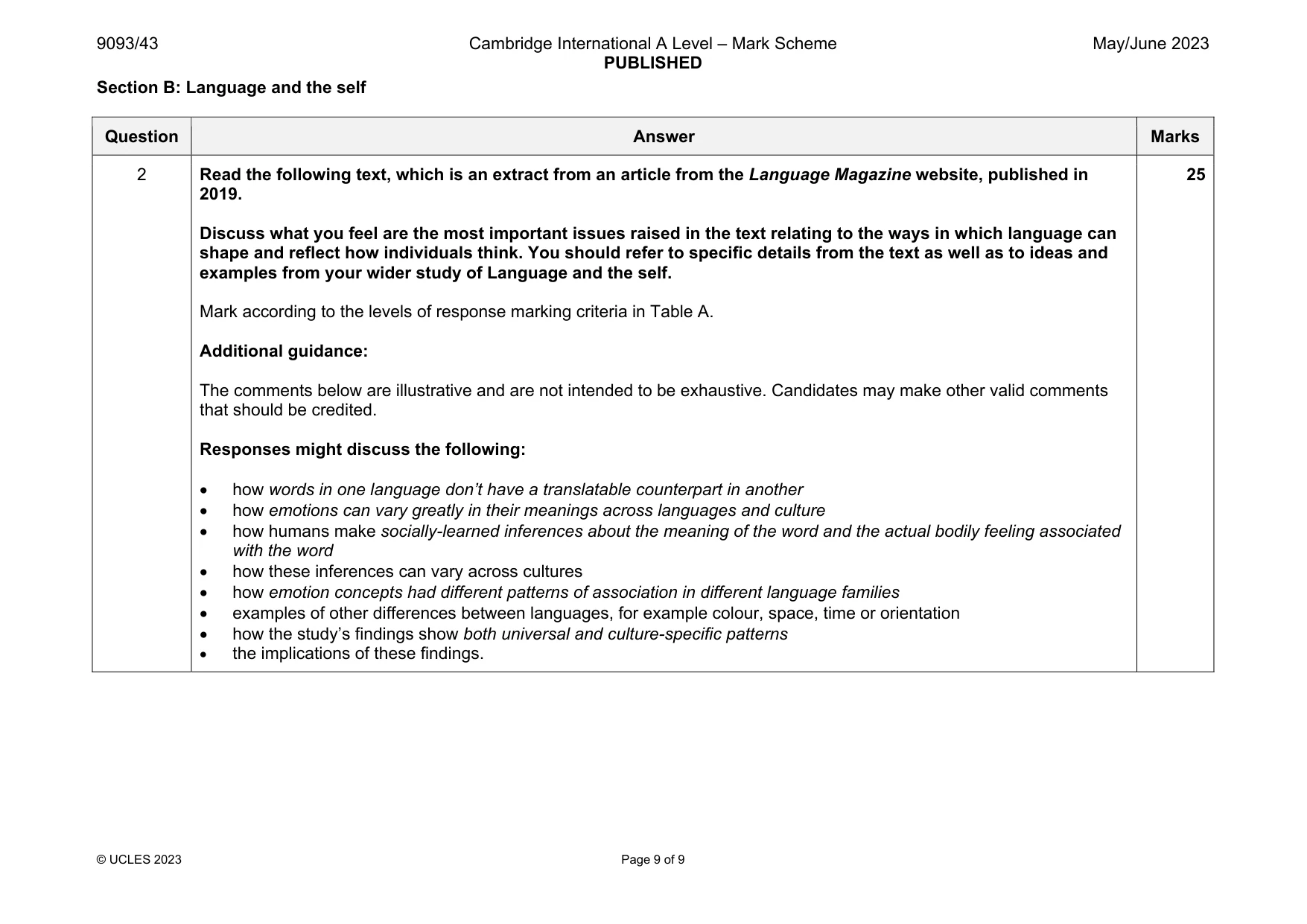
9093/43 Cambridge International A Level – Mark Scheme PUBLISHED May/June 2023 © UCLES 2023 Page 9 of 9 Section B: Language and the self Question Answer Marks 2 Read the following text, which is an extract from an article from the Language Magazine website, published in 2019. Discuss what you feel are the most important issues raised in the text relating to the ways in which language can shape and reflect how individuals think. You should refer to specific details from the text as well as to ideas and examples from your wider study of Language and the self. Mark according to the levels of response marking criteria in Table A. Additional guidance: The comments below are illustrative and are not intended to be exhaustive. Candidates may make other valid comments that should be credited. Responses might discuss the following: how words in one language don’t have a translatable counterpart in another how emotions can vary greatly in their meanings across languages and culture how humans make socially-learned inferences about the meaning of the word and the actual bodily feeling associated with the word how these inferences can vary across cultures how emotion concepts had different patterns of association in different language families examples of other differences between languages, for example colour, space, time or orientation how the study’s findings show both universal and culture-specific patterns the implications of these findings. 25
What you needed in this session
Cambridge’s own grade thresholds for 2023 May/June, Paper 4 · Variant 3. A higher threshold means an easier paper — the bar moves with how the cohort did.