Cambridge A Level English - Language AS and A Level (from 2014) 9093 — 2022 Oct/Nov Paper 3 · Variant 2
9093/32/O/N/22 · 50 marks · ≈56 min
The question paper and its mark scheme, free to read here and free to download. This is Cambridge’s own paper, exactly as it was sat.
Question paper8 pages

Mark scheme13 pages
Answers below. Sit the paper first if you are practising.
Paper as text
Question paper, page 1
This document has 8 pages. Any blank pages are indicated. [Turn over Cambridge International AS & A Level ENGLISH LANGUAGE 9093/32 Paper 3 Language Analysis October/November 2022 2 hours 15 minutes You must answer on the enclosed answer booklet. You will need: Answer booklet (enclosed) INSTRUCTIONS ● Answer all questions. ● Follow the instructions on the front cover of the answer booklet. If you need additional answer paper, ask the invigilator for a continuation booklet. ● Dictionaries are not allowed. INFORMATION ● The total mark for this paper is 50. ● The number of marks for each question or part question is shown in brackets [ ]. * 4 3 7 7 2 8 1 4 7 2 * DC (CJ/CGW) 303494/3 © UCLES 2022
Question paper, page 2
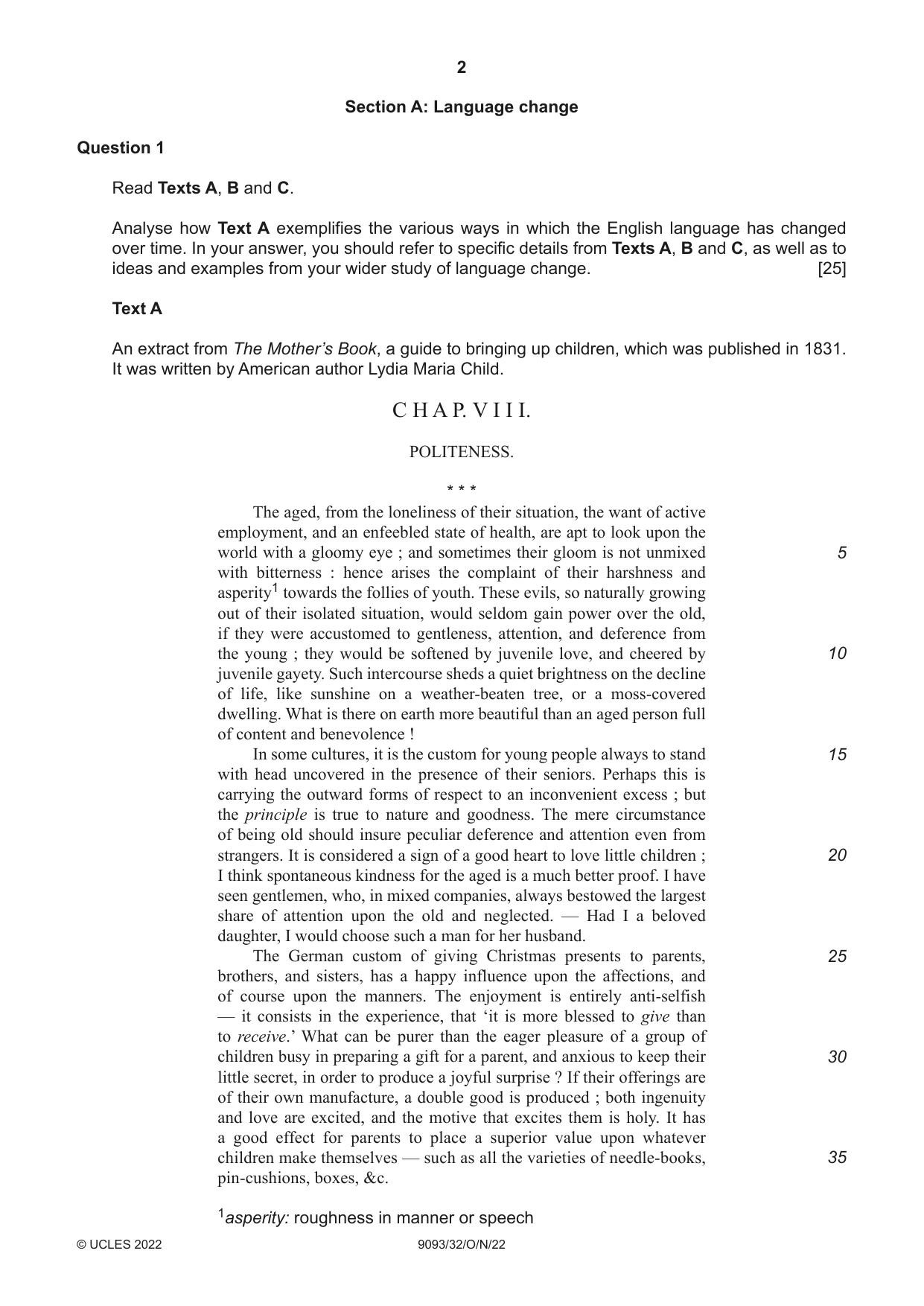
2 9093/32/O/N/22 © UCLES 2022 Section A: Language change Question 1 Read Texts A, B and C. Analyse how Text A exemplifies the various ways in which the English language has changed over time. In your answer, you should refer to specific details from Texts A, B and C, as well as to ideas and examples from your wider study of language change. [25] Text A An extract from The Mother’s Book, a guide to bringing up children, which was published in 1831. It was written by American author Lydia Maria Child. C H A P. V I I I. POLITENESS. * * * The aged, from the loneliness of their situation, the want of active employment, and an enfeebled state of health, are apt to look upon the world with a gloomy eye ; and sometimes their gloom is not unmixed with bitterness : hence arises the complaint of their harshness and asperity1 towards the follies of youth. These evils, so naturally growing out of their isolated situation, would seldom gain power over the old, if they were accustomed to gentleness, attention, and deference from the young ; they would be softened by juvenile love, and cheered by juvenile gayety. Such intercourse sheds a quiet brightness on the decline of life, like sunshine on a weather-beaten tree, or a moss-covered dwelling. What is there on earth more beautiful than an aged person full of content and benevolence ! In some cultures, it is the custom for young people always to stand with head uncovered in the presence of their seniors. Perhaps this is carrying the outward forms of respect to an inconvenient excess ; but the principle is true to nature and goodness. The mere circumstance of being old should insure peculiar deference and attention even from strangers. It is considered a sign of a good heart to love little children ; I think spontaneous kindness for the aged is a much better proof. I have seen gentlemen, who, in mixed companies, always bestowed the largest share of attention upon the old and neglected. — Had I a beloved daughter, I would choose such a man for her husband. The German custom of giving Christmas presents to parents, brothers, and sisters, has a happy influence upon the affections, and of course upon the manners. The enjoyment is entirely anti-selfish — it consists in the experience, that ‘it is more blessed to give than to receive.’ What can be purer than the eager pleasure of a group of children busy in preparing a gift for a parent, and anxious to keep their little secret, in order to produce a joyful surprise ? If their offerings are of their own manufacture, a double good is produced ; both ingenuity and love are excited, and the motive that excites them is holy. It has a good effect for parents to place a superior value upon whatever children make themselves — such as all the varieties of needle-books, pin-cushions, boxes, &c. 1asperity: roughness in manner or speech 5 10 15 20 25 30 35
Question paper, page 3
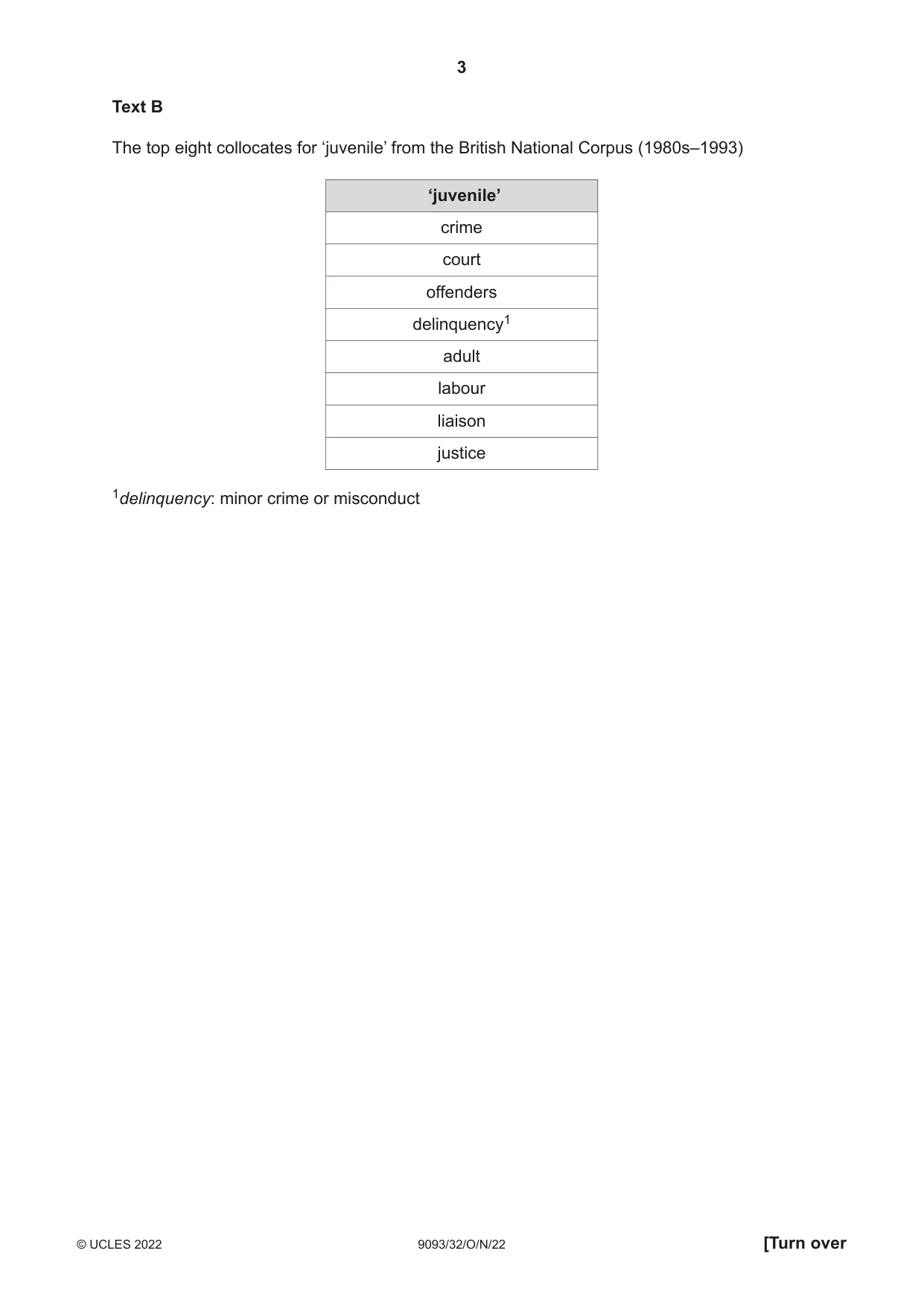
3 9093/32/O/N/22 © UCLES 2022 [Turn over Text B The top eight collocates for ‘juvenile’ from the British National Corpus (1980s–1993) ‘juvenile’ crime court offenders delinquency1 adult labour liaison justice 1delinquency: minor crime or misconduct
Question paper, page 4
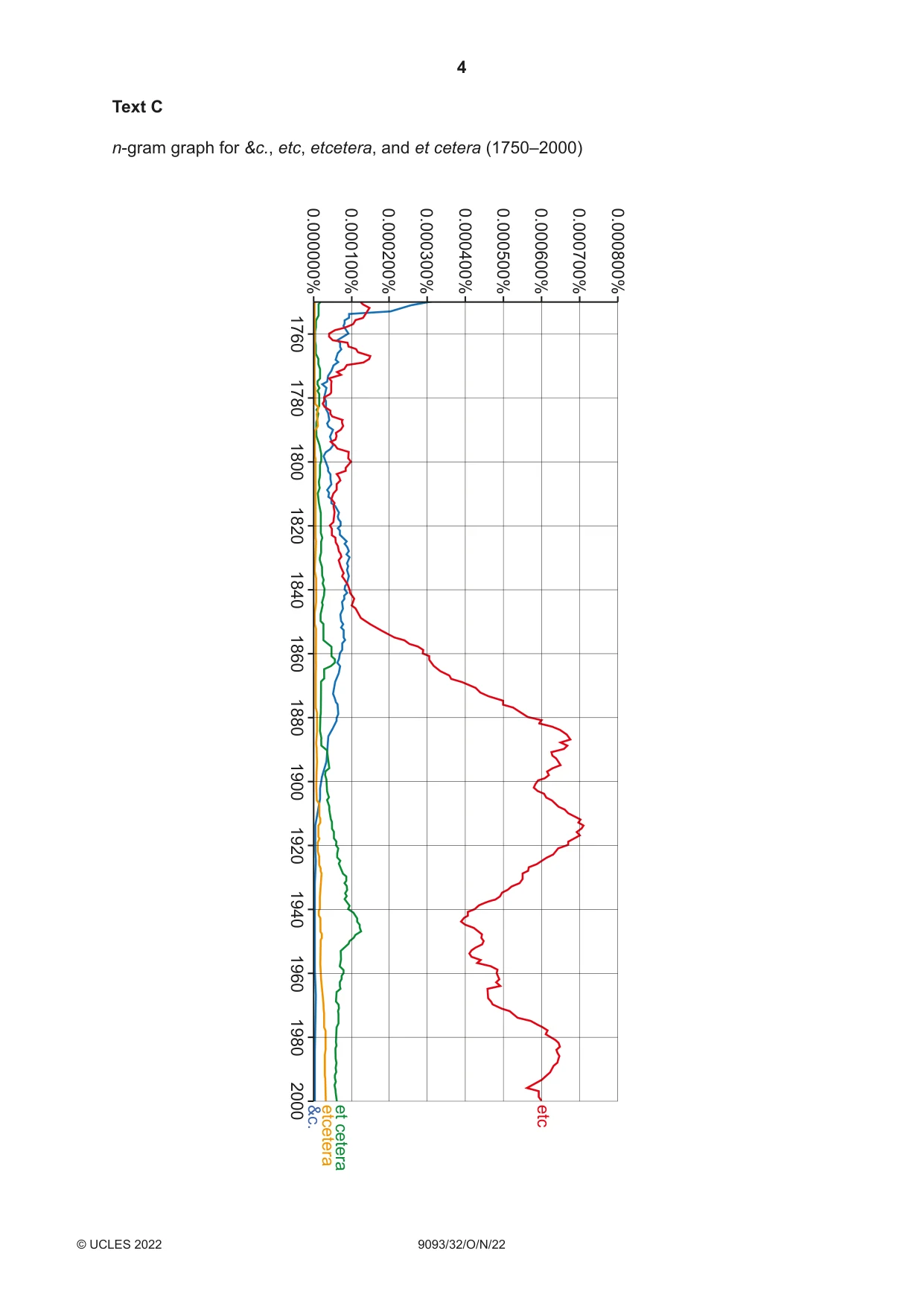
4 9093/32/O/N/22 © UCLES 2022 Text C n-gram graph for &c., etc, etcetera, and et cetera (1750–2000) 0.000800% 0.000700% 0.000600% 0.000500% 0.000400% 0.000300% 0.000200% 0.000100% 0.000000% 1760 1780 1820 1800 1840 1880 1860 1900 1940 etc et cetera etcetera &c. 1920 1960 2000 1980
Question paper, page 5
5 9093/32/O/N/22 © UCLES 2022 [Turn over BLANK PAGE
Question paper, page 6
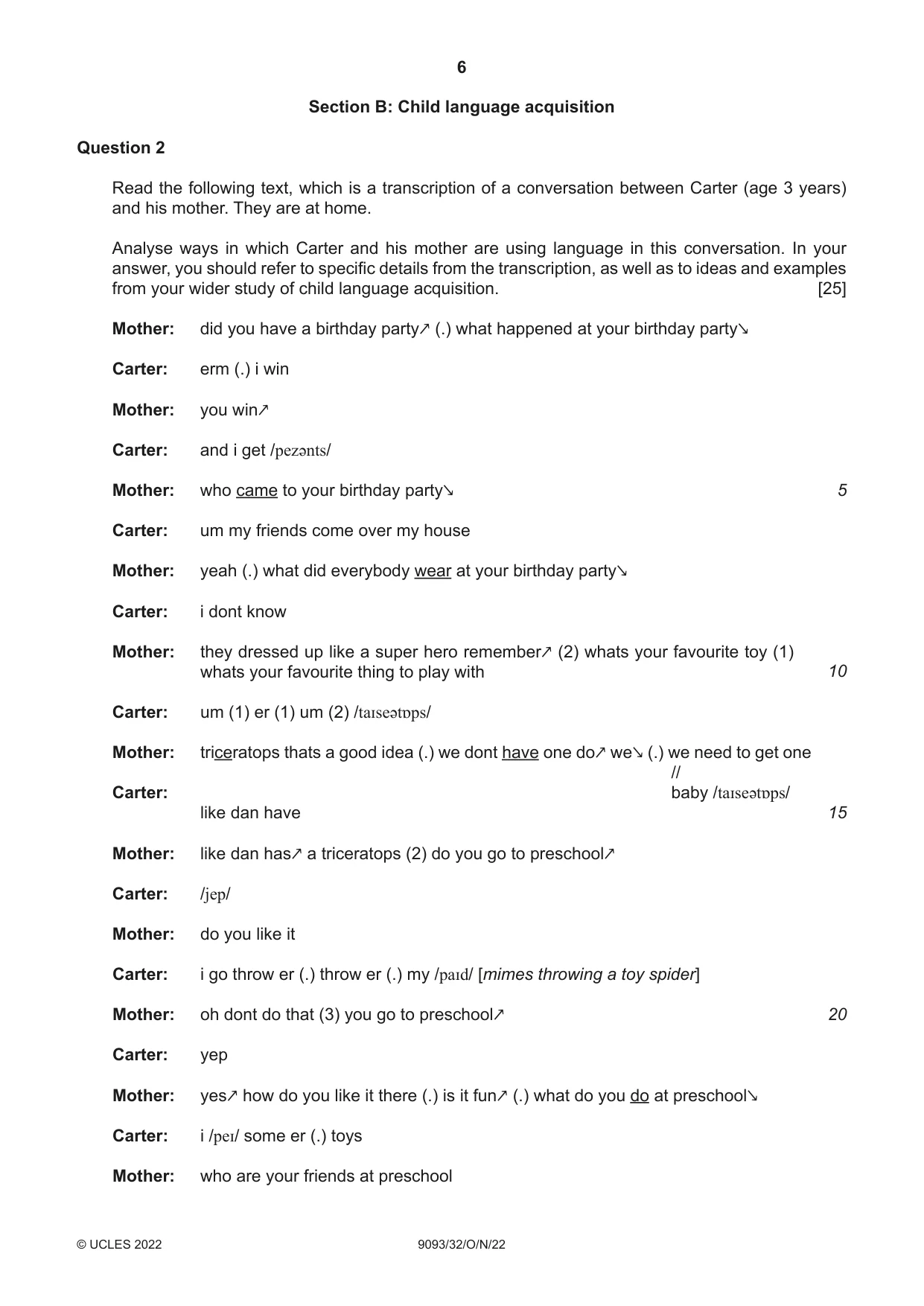
6 9093/32/O/N/22 © UCLES 2022 Section B: Child language acquisition Question 2 Read the following text, which is a transcription of a conversation between Carter (age 3 years) and his mother. They are at home. Analyse ways in which Carter and his mother are using language in this conversation. In your answer, you should refer to specific details from the transcription, as well as to ideas and examples from your wider study of child language acquisition. [25] Mother: did you have a birthday party↗ (.) what happened at your birthday party↘ Carter: erm (.) i win Mother: you win↗ Carter: and i get /pezənts/ Mother: who came to your birthday party↘ Carter: um my friends come over my house Mother: yeah (.) what did everybody wear at your birthday party↘ Carter: i dont know Mother: they dressed up like a super hero remember↗ (2) whats your favourite toy (1) whats your favourite thing to play with Carter: um (1) er (1) um (2) /taɪseətɒps/ Mother: triceratops thats a good idea (.) we dont have one do↗ we↘ (.) we need to get one // Carter: baby /taɪseətɒps/ like dan have Mother: like dan has↗ a triceratops (2) do you go to preschool↗ Carter: /jep/ Mother: do you like it Carter: i go throw er (.) throw er (.) my /paɪd/ [mimes throwing a toy spider] Mother: oh dont do that (3) you go to preschool↗ Carter: yep Mother: yes↗ how do you like it there (.) is it fun↗ (.) what do you do at preschool↘ Carter: i /peɪ/ some er (.) toys Mother: who are your friends at preschool 5 10 15 20
Question paper, page 7
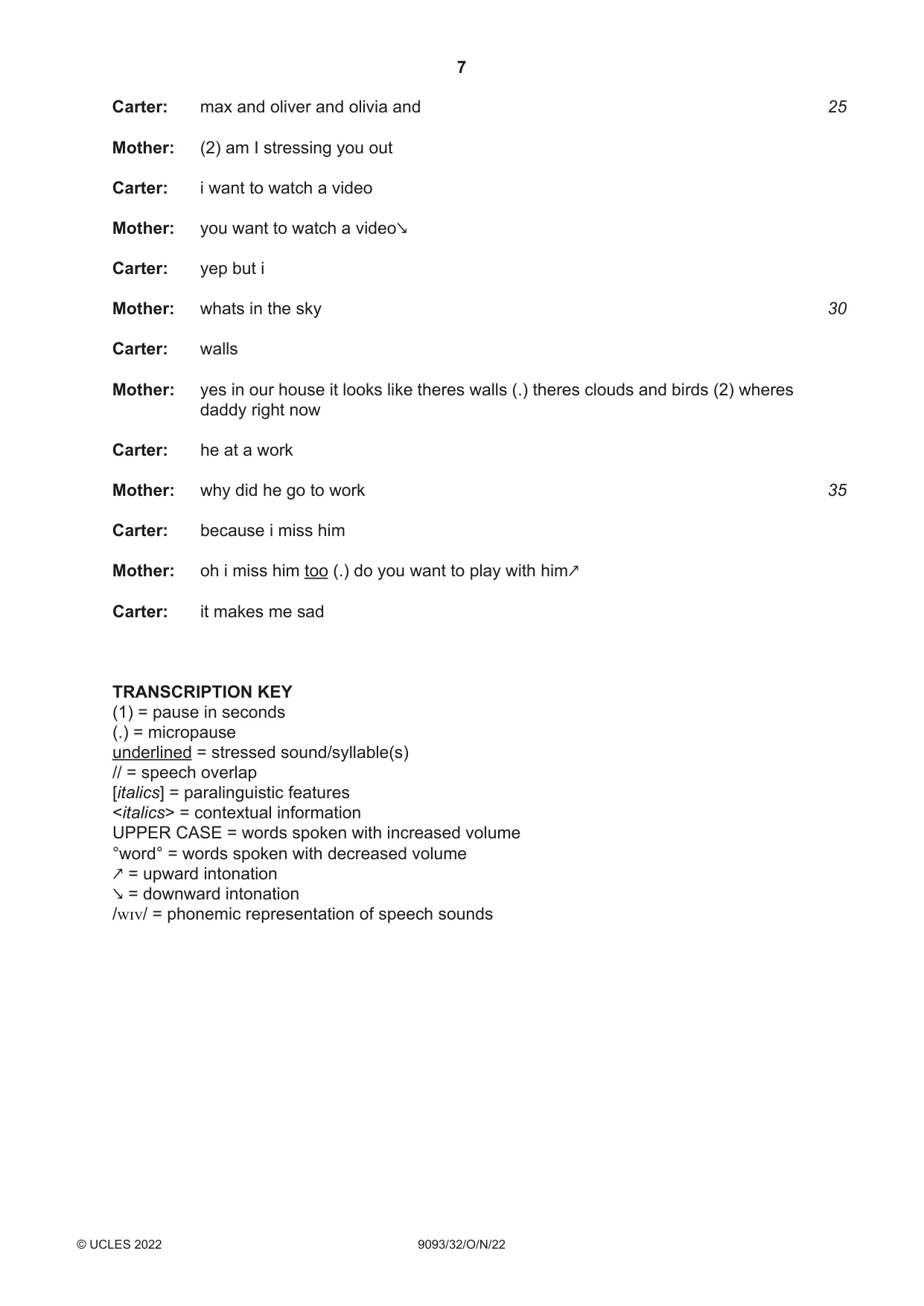
7 9093/32/O/N/22 © UCLES 2022 Carter: max and oliver and olivia and Mother: (2) am I stressing you out Carter: i want to watch a video Mother: you want to watch a video↘ Carter: yep but i Mother: whats in the sky Carter: walls Mother: yes in our house it looks like theres walls (.) theres clouds and birds (2) wheres daddy right now Carter: he at a work Mother: why did he go to work Carter: because i miss him Mother: oh i miss him too (.) do you want to play with him↗ Carter: it makes me sad TRANSCRIPTION KEY (1) = pause in seconds (.) = micropause underlined = stressed sound/syllable(s) // = speech overlap [italics] = paralinguistic features <italics> = contextual information UPPER CASE = words spoken with increased volume °word° = words spoken with decreased volume ↗ = upward intonation ↘ = downward intonation /wɪv/ = phonemic representation of speech sounds 25 30 35
Question paper, page 8
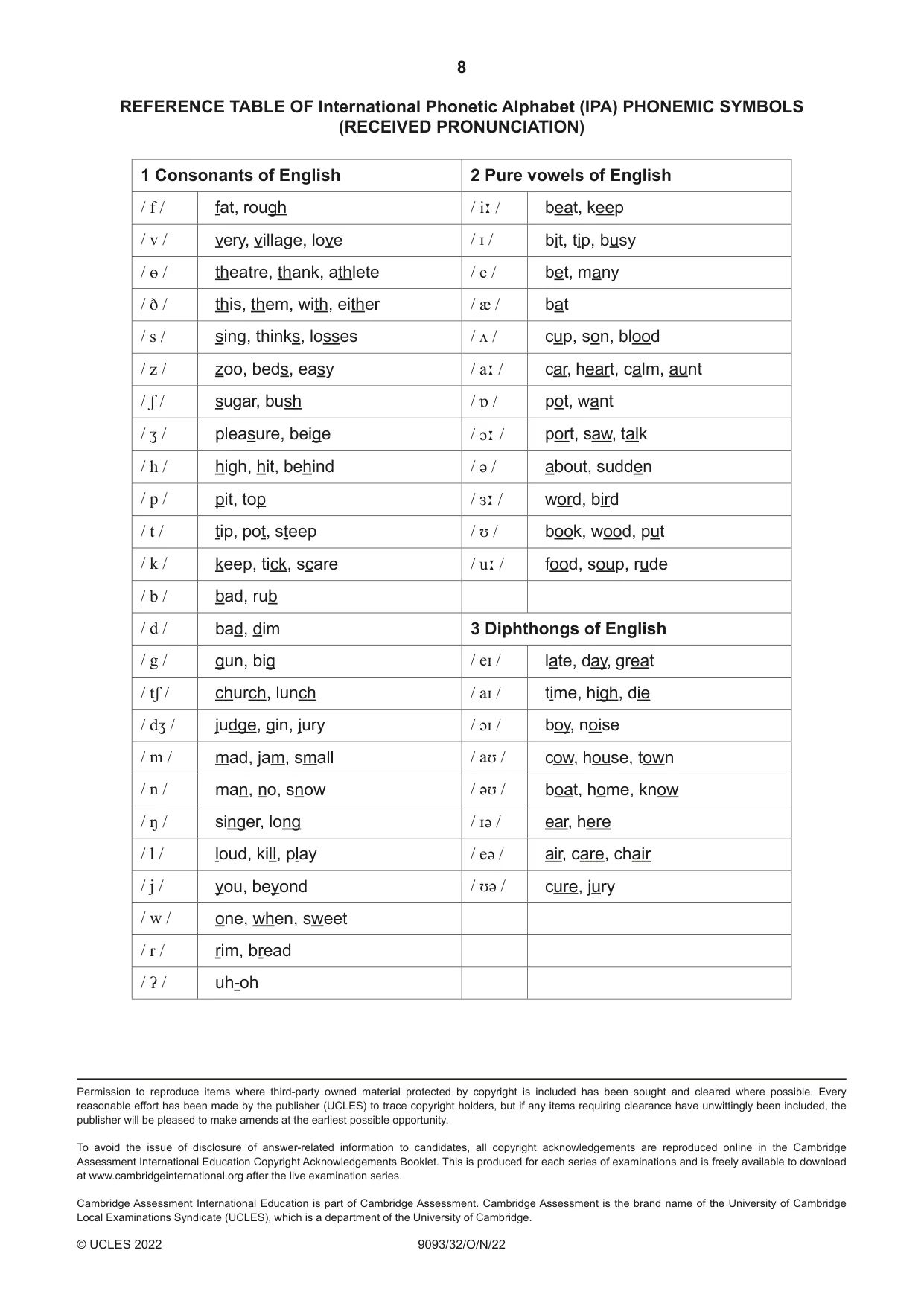
8 9093/32/O/N/22 © UCLES 2022 Permission to reproduce items where third-party owned material protected by copyright is included has been sought and cleared where possible. Every reasonable effort has been made by the publisher (UCLES) to trace copyright holders, but if any items requiring clearance have unwittingly been included, the publisher will be pleased to make amends at the earliest possible opportunity. To avoid the issue of disclosure of answer-related information to candidates, all copyright acknowledgements are reproduced online in the Cambridge Assessment International Education Copyright Acknowledgements Booklet. This is produced for each series of examinations and is freely available to download at www.cambridgeinternational.org after the live examination series. Cambridge Assessment International Education is part of Cambridge Assessment. Cambridge Assessment is the brand name of the University of Cambridge Local Examinations Syndicate (UCLES), which is a department of the University of Cambridge. REFERENCE TABLE OF International Phonetic Alphabet (IPA) PHONEMIC SYMBOLS (RECEIVED PRONUNCIATION) 1 Consonants of English 2 Pure vowels of English / f / fat, rough / iː / beat, keep / v / very, village, love / ɪ / bit, tip, busy / ɵ / theatre, thank, athlete / e / bet, many / ð / this, them, with, either / æ / bat / s / sing, thinks, losses / ʌ / cup, son, blood / z / zoo, beds, easy / aː / car, heart, calm, aunt / ʃ / sugar, bush / ɒ / pot, want / ʒ / pleasure, beige / ɔː / port, saw, talk / h / high, hit, behind / ə / about, sudden / p / pit, top / ɜː / word, bird / t / tip, pot, steep / ʊ / book, wood, put / k / keep, tick, scare / uː / food, soup, rude / b / bad, rub / d / bad, dim 3 Diphthongs of English / g / gun, big / eɪ / late, day, great / tʃ / church, lunch / aɪ / time, high, die / dʒ / judge, gin, jury / ɔɪ / boy, noise / m / mad, jam, small / aʊ / cow, house, town / n / man, no, snow / əʊ / boat, home, know / ŋ / singer, long / ɪə / ear, here / l / loud, kill, play / eə / air, care, chair / j / you, beyond / ʊə / cure, jury / w / one, when, sweet / r / rim, bread / ʔ / uh-oh
Mark scheme, page 1
This document consists of 13 printed pages. © UCLES 2022 [Turn over Cambridge International A Level ENGLISH LANGUAGE 9093/32 Paper 3 Language Analysis October/November 2022 MARK SCHEME Maximum Mark: 50 Published This mark scheme is published as an aid to teachers and candidates, to indicate the requirements of the examination. It shows the basis on which Examiners were instructed to award marks. It does not indicate the details of the discussions that took place at an Examiners’ meeting before marking began, which would have considered the acceptability of alternative answers. Mark schemes should be read in conjunction with the question paper and the Principal Examiner Report for Teachers. Cambridge International will not enter into discussions about these mark schemes. Cambridge International is publishing the mark schemes for the October/November 2022 series for most Cambridge IGCSE™, Cambridge International A and AS Level components and some Cambridge O Level components.
Mark scheme, page 2
9093/32 Cambridge International A Level – Mark Scheme PUBLISHED October/November 2022 © UCLES 2022 Page 2 of 13 Generic Marking Principles These general marking principles must be applied by all examiners when marking candidate answers. They should be applied alongside the specific content of the mark scheme or generic level descriptors for a question. Each question paper and mark scheme will also comply with these marking principles. GENERIC MARKING PRINCIPLE 1: Marks must be awarded in line with: • the specific content of the mark scheme or the generic level descriptors for the question • the specific skills defined in the mark scheme or in the generic level descriptors for the question • the standard of response required by a candidate as exemplified by the standardisation scripts. GENERIC MARKING PRINCIPLE 2: Marks awarded are always whole marks (not half marks, or other fractions). GENERIC MARKING PRINCIPLE 3: Marks must be awarded positively: • marks are awarded for correct/valid answers, as defined in the mark scheme. However, credit is given for valid answers which go beyond the scope of the syllabus and mark scheme, referring to your Team Leader as appropriate • marks are awarded when candidates clearly demonstrate what they know and can do • marks are not deducted for errors • marks are not deducted for omissions • answers should only be judged on the quality of spelling, punctuation and grammar when these features are specifically assessed by the question as indicated by the mark scheme. The meaning, however, should be unambiguous. GENERIC MARKING PRINCIPLE 4: Rules must be applied consistently, e.g. in situations where candidates have not followed instructions or in the application of generic level descriptors.
Mark scheme, page 3
9093/32 Cambridge International A Level – Mark Scheme PUBLISHED October/November 2022 © UCLES 2022 Page 3 of 13 GENERIC MARKING PRINCIPLE 5: Marks should be awarded using the full range of marks defined in the mark scheme for the question (however; the use of the full mark range may be limited according to the quality of the candidate responses seen). GENERIC MARKING PRINCIPLE 6: Marks awarded are based solely on the requirements as defined in the mark scheme. Marks should not be awarded with grade thresholds or grade descriptors in mind.
Mark scheme, page 4
9093/32 Cambridge International A Level – Mark Scheme PUBLISHED October/November 2022 © UCLES 2022 Page 4 of 13 English & Media subject specific general marking principles (To be read in conjunction with the Generic Marking Principles (and requiring further guidance on how to place marks within levels)) Components using level descriptors: • We use level descriptors as a guide to broad understanding of the qualities normally expected of, or typical of, work in a level. • Level descriptors are a means of general guidance, and should not be interpreted as hurdle statements. • Where indicative content notes are supplied for a question, these are not a prescription of required content, and must not be treated as such. Alternative correct points and unexpected answers in candidates’ scripts must be given marks that fairly reflect the knowledge and skills demonstrated. • While we may have legitimate expectations as to the ground most answers may occupy, we must at all times be prepared to meet candidates on their chosen ground, provided it is relevant ground (e.g. clearly related to and derived from a relevant passage/text and meeting the mark scheme requirements for the question).
Mark scheme, page 5
9093/32 Cambridge International A Level – Mark Scheme PUBLISHED October/November 2022 © UCLES 2022 Page 5 of 13 English Language specific marking instructions: AO1 Read and demonstrate understanding of a wide variety of texts. (Understanding) • Marks should be awarded for the accuracy of the candidate’s understanding of the text and its features, not for any analysis of them which is recognised under AO3. • Where comparison is required, marks should be awarded for the candidate’s recognition of similarities and differences between the texts and their features, not for any consequent analysis. • When awarding a ‘best-fit’ mark within a Level for each AO, consider each bullet point equally. AO2 Write effectively, creatively, accurately and appropriately, for a range of audiences and purposes. (Writing) • Marks should be awarded equally on the basis of the level of the candidate’s written expression (range of features used and accuracy) and the development of their writing (its organisation and relevance to task and audience). • When awarding a ‘best-fit’ mark within a Level for each AO, consider each bullet point equally. AO4: Demonstrate understanding of linguistic issues, concepts, methods and approaches. (Conceptualisation) • Marks should be awarded equally on the basis of the level of the candidate’s understanding of the relevant issues, concepts, methods and approaches represented both in the text(s) and in their wider studies. • When awarding a ‘best-fit’ mark within a Level for each AO, consider each bullet point equally. AO5: Analyse and synthesise language data from a variety of sources. (Data handling) • Marks should be awarded equally on the basis of the level of the candidate’s selection, analysis and synthesis of language data. • When awarding a ‘best-fit’ mark within a Level for each AO, consider each bullet point equally. Higher marks should be awarded where candidates identify patterns and offer thoughtful and plausible explanations for the features they are discussing. Weaker answers may spot features or describe individual cases of language change without reference to broader considerations or examples.
Mark scheme, page 6
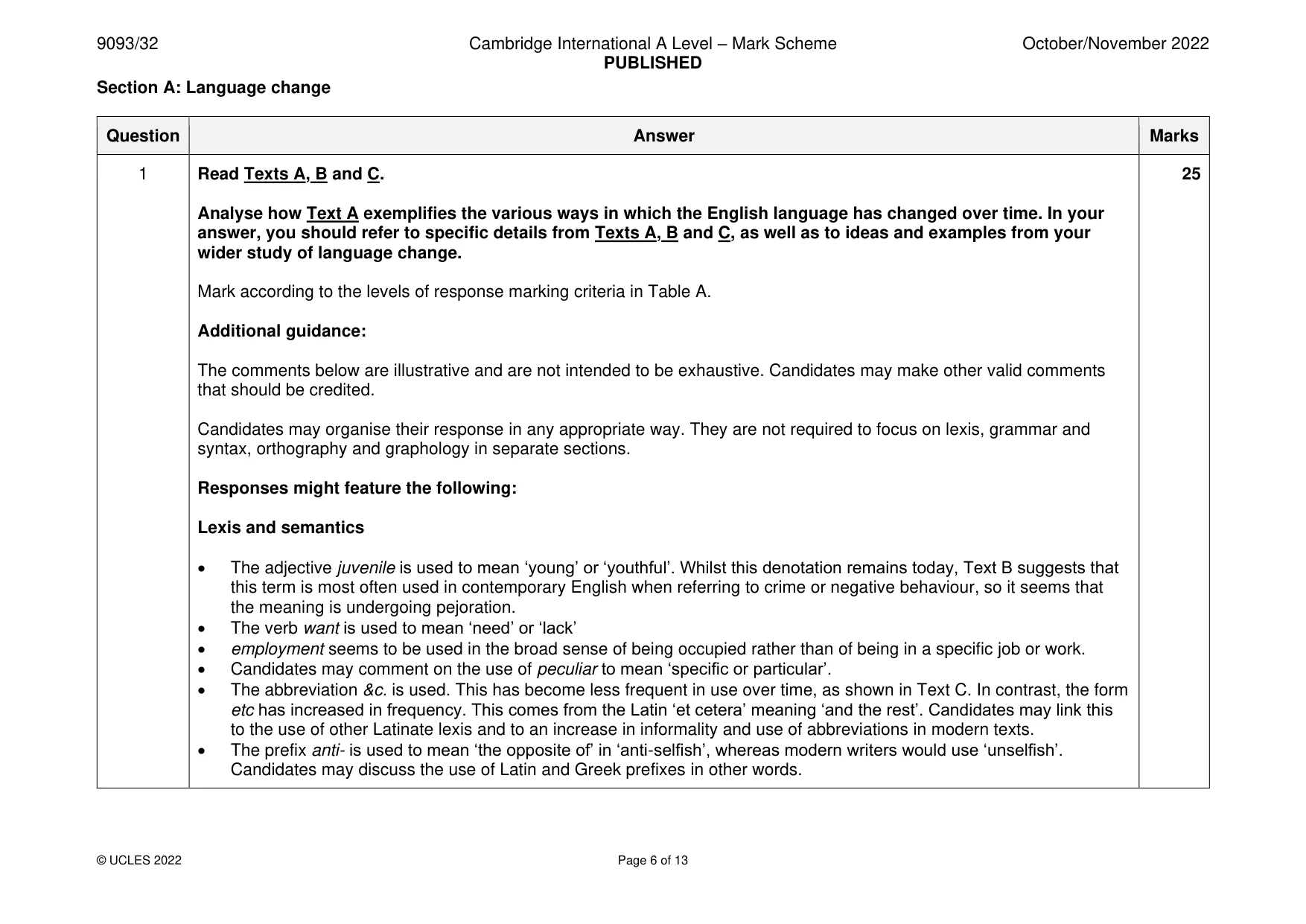
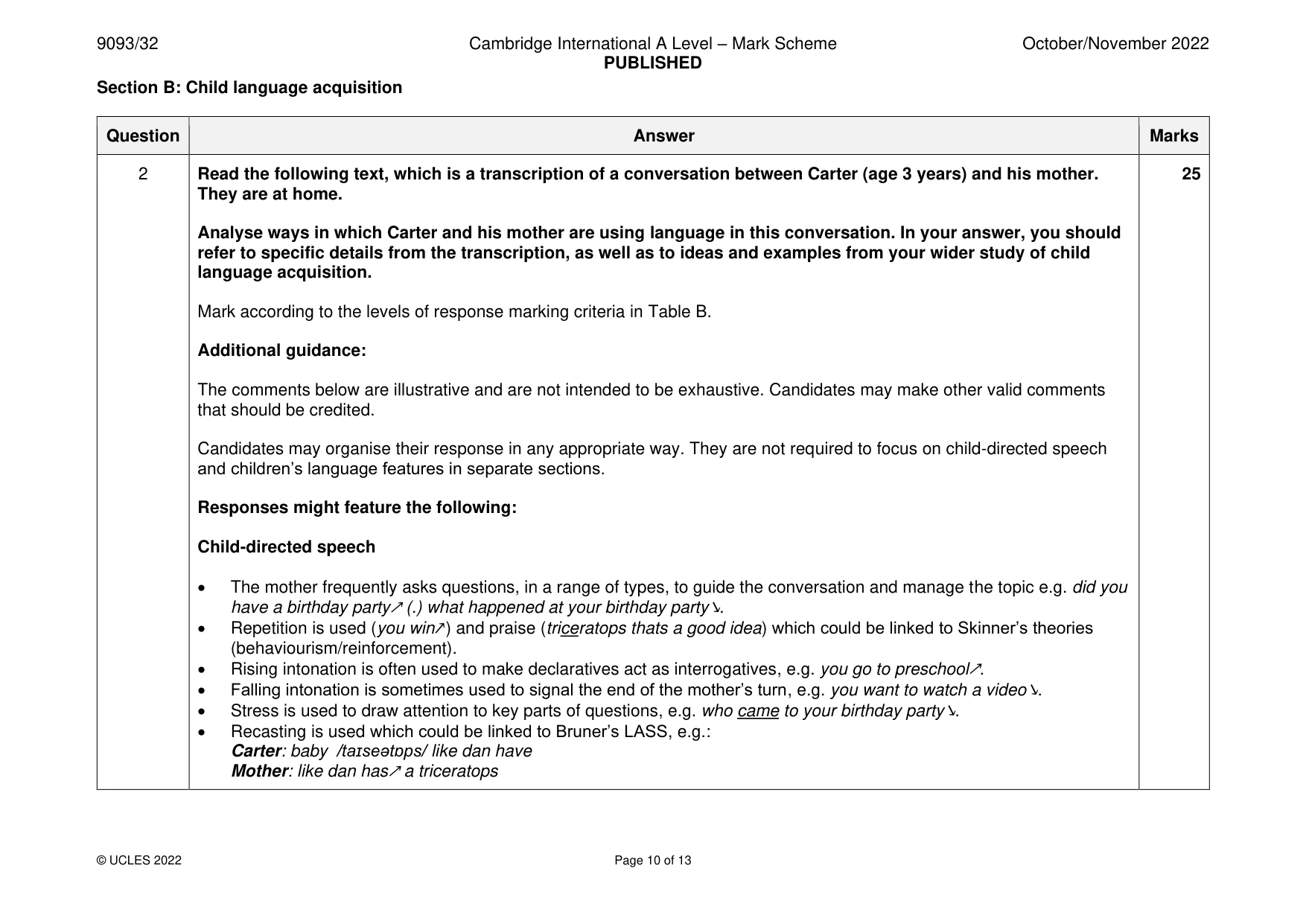
9093/32 Cambridge International A Level – Mark Scheme PUBLISHED October/November 2022 © UCLES 2022 Page 6 of 13 Section A: Language change Question Answer Marks 1 Read Texts A, B and C. Analyse how Text A exemplifies the various ways in which the English language has changed over time. In your answer, you should refer to specific details from Texts A, B and C, as well as to ideas and examples from your wider study of language change. Mark according to the levels of response marking criteria in Table A. Additional guidance: The comments below are illustrative and are not intended to be exhaustive. Candidates may make other valid comments that should be credited. Candidates may organise their response in any appropriate way. They are not required to focus on lexis, grammar and syntax, orthography and graphology in separate sections. Responses might feature the following: Lexis and semantics • The adjective juvenile is used to mean ‘young’ or ‘youthful’. Whilst this denotation remains today, Text B suggests that this term is most often used in contemporary English when referring to crime or negative behaviour, so it seems that the meaning is undergoing pejoration. • The verb want is used to mean ‘need’ or ‘lack’ • employment seems to be used in the broad sense of being occupied rather than of being in a specific job or work. • Candidates may comment on the use of peculiar to mean ‘specific or particular’. • The abbreviation &c. is used. This has become less frequent in use over time, as shown in Text C. In contrast, the form etc has increased in frequency. This comes from the Latin ‘et cetera’ meaning ‘and the rest’. Candidates may link this to the use of other Latinate lexis and to an increase in informality and use of abbreviations in modern texts. • The prefix anti- is used to mean ‘the opposite of’ in ‘anti-selfish’, whereas modern writers would use ‘unselfish’. Candidates may discuss the use of Latin and Greek prefixes in other words. 25
Mark scheme, page 7
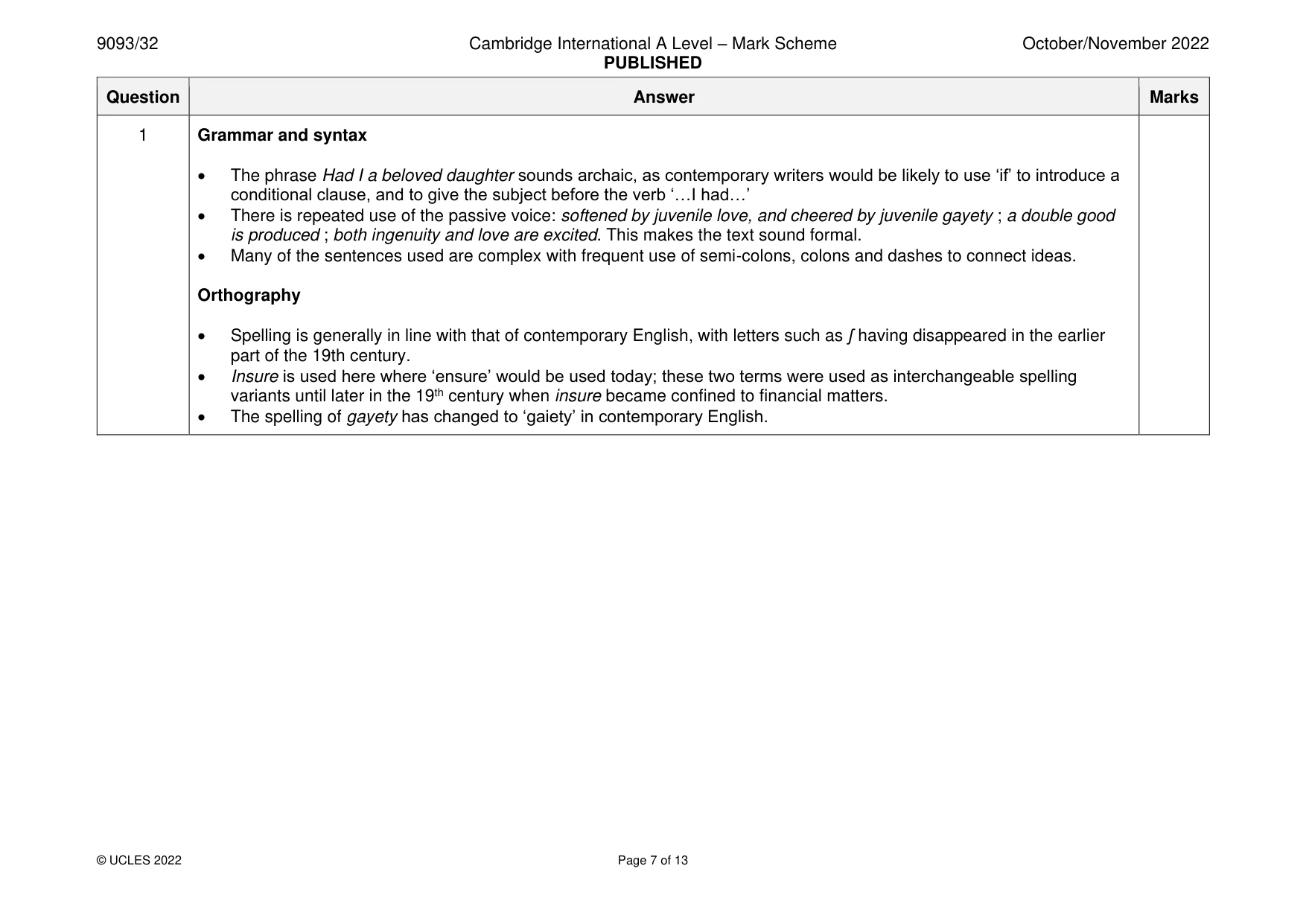
9093/32 Cambridge International A Level – Mark Scheme PUBLISHED October/November 2022 © UCLES 2022 Page 7 of 13 Question Answer Marks 1 Grammar and syntax • The phrase Had I a beloved daughter sounds archaic, as contemporary writers would be likely to use ‘if’ to introduce a conditional clause, and to give the subject before the verb ‘…I had…’ • There is repeated use of the passive voice: softened by juvenile love, and cheered by juvenile gayety ; a double good is produced ; both ingenuity and love are excited. This makes the text sound formal. • Many of the sentences used are complex with frequent use of semi-colons, colons and dashes to connect ideas. Orthography • Spelling is generally in line with that of contemporary English, with letters such as ʃ having disappeared in the earlier part of the 19th century. • Insure is used here where ‘ensure’ would be used today; these two terms were used as interchangeable spelling variants until later in the 19th century when insure became confined to financial matters. • The spelling of gayety has changed to ‘gaiety’ in contemporary English.
Mark scheme, page 8
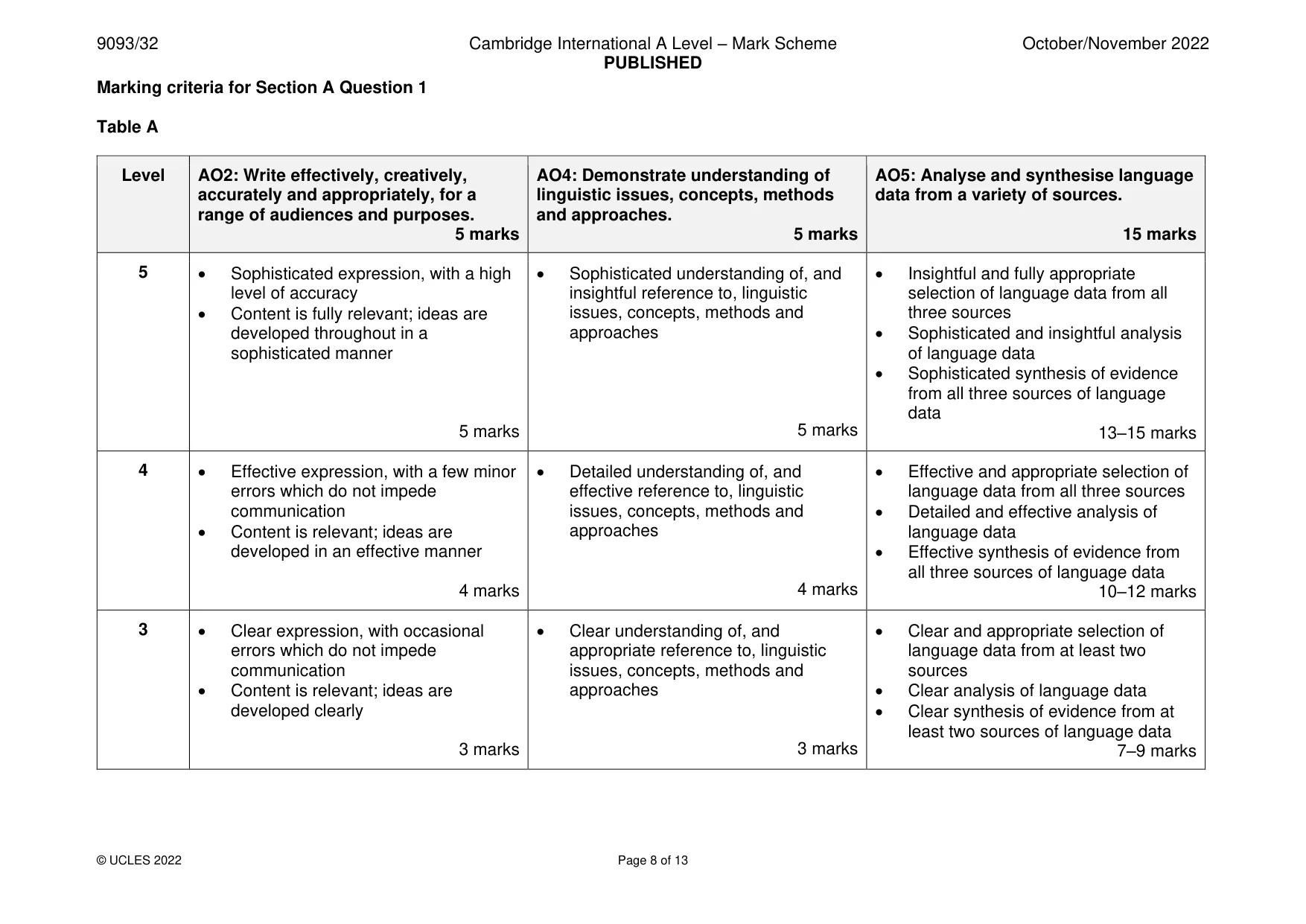
9093/32 Cambridge International A Level – Mark Scheme PUBLISHED October/November 2022 © UCLES 2022 Page 8 of 13 Marking criteria for Section A Question 1 Table A Level AO2: Write effectively, creatively, accurately and appropriately, for a range of audiences and purposes. 5 marks AO4: Demonstrate understanding of linguistic issues, concepts, methods and approaches. 5 marks AO5: Analyse and synthesise language data from a variety of sources. 15 marks 5 • Sophisticated expression, with a high level of accuracy • Content is fully relevant; ideas are developed throughout in a sophisticated manner 5 marks • Sophisticated understanding of, and insightful reference to, linguistic issues, concepts, methods and approaches 5 marks • Insightful and fully appropriate selection of language data from all three sources • Sophisticated and insightful analysis of language data • Sophisticated synthesis of evidence from all three sources of language data 13–15 marks 4 • Effective expression, with a few minor errors which do not impede communication • Content is relevant; ideas are developed in an effective manner 4 marks • Detailed understanding of, and effective reference to, linguistic issues, concepts, methods and approaches 4 marks • Effective and appropriate selection of language data from all three sources • Detailed and effective analysis of language data • Effective synthesis of evidence from all three sources of language data 10–12 marks 3 • Clear expression, with occasional errors which do not impede communication • Content is relevant; ideas are developed clearly 3 marks • Clear understanding of, and appropriate reference to, linguistic issues, concepts, methods and approaches 3 marks • Clear and appropriate selection of language data from at least two sources • Clear analysis of language data • Clear synthesis of evidence from at least two sources of language data 7–9 marks
Mark scheme, page 9
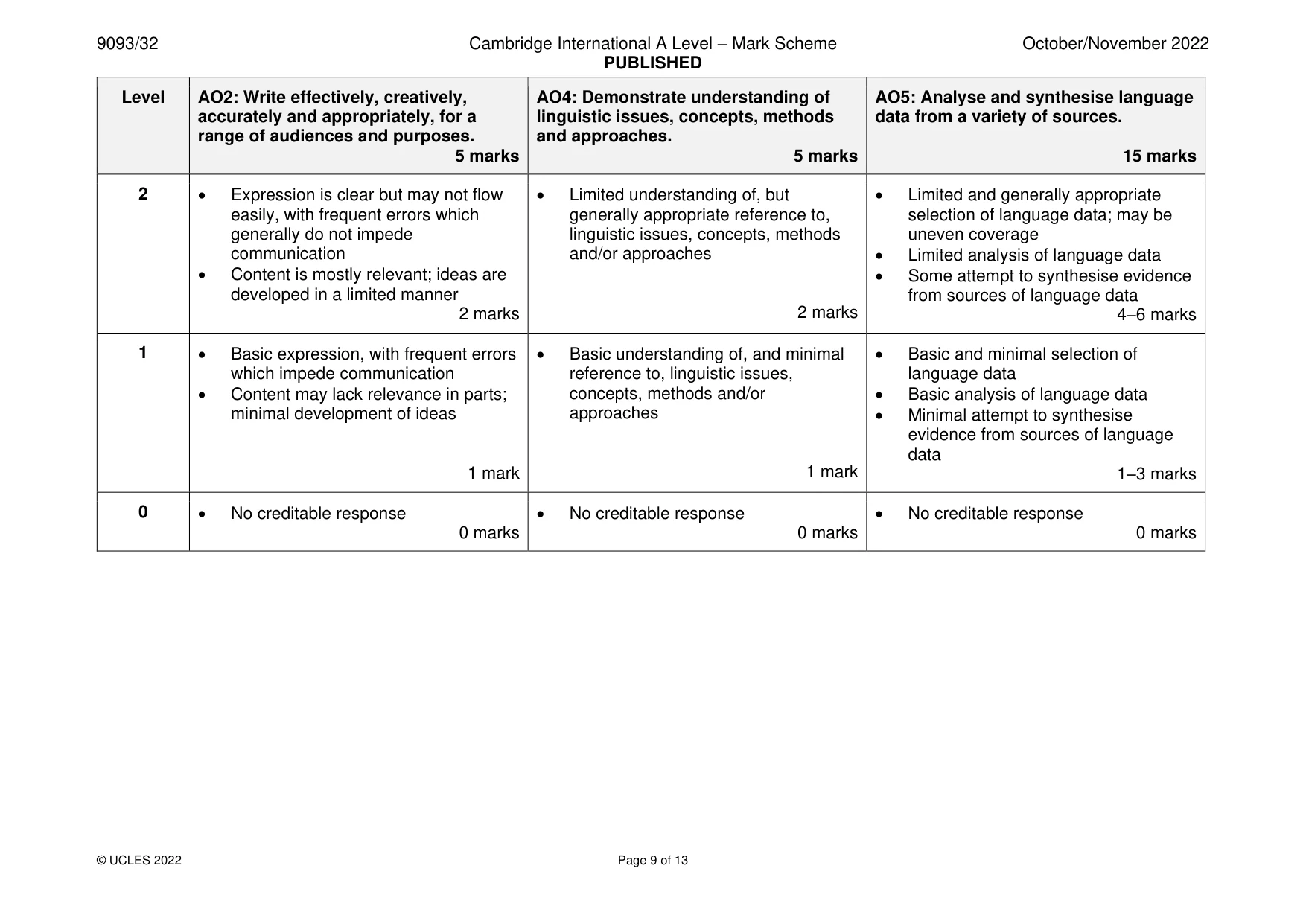
9093/32 Cambridge International A Level – Mark Scheme PUBLISHED October/November 2022 © UCLES 2022 Page 9 of 13 Level AO2: Write effectively, creatively, accurately and appropriately, for a range of audiences and purposes. 5 marks AO4: Demonstrate understanding of linguistic issues, concepts, methods and approaches. 5 marks AO5: Analyse and synthesise language data from a variety of sources. 15 marks 2 • Expression is clear but may not flow easily, with frequent errors which generally do not impede communication • Content is mostly relevant; ideas are developed in a limited manner 2 marks • Limited understanding of, but generally appropriate reference to, linguistic issues, concepts, methods and/or approaches 2 marks • Limited and generally appropriate selection of language data; may be uneven coverage • Limited analysis of language data • Some attempt to synthesise evidence from sources of language data 4–6 marks 1 • Basic expression, with frequent errors which impede communication • Content may lack relevance in parts; minimal development of ideas 1 mark • Basic understanding of, and minimal reference to, linguistic issues, concepts, methods and/or approaches 1 mark • Basic and minimal selection of language data • Basic analysis of language data • Minimal attempt to synthesise evidence from sources of language data 1–3 marks 0 • No creditable response 0 marks • No creditable response 0 marks • No creditable response 0 marks
Mark scheme, page 10
9093/32 Cambridge International A Level – Mark Scheme PUBLISHED October/November 2022 © UCLES 2022 Page 10 of 13 Section B: Child language acquisition Question Answer Marks 2 Read the following text, which is a transcription of a conversation between Carter (age 3 years) and his mother. They are at home. Analyse ways in which Carter and his mother are using language in this conversation. In your answer, you should refer to specific details from the transcription, as well as to ideas and examples from your wider study of child language acquisition. Mark according to the levels of response marking criteria in Table B. Additional guidance: The comments below are illustrative and are not intended to be exhaustive. Candidates may make other valid comments that should be credited. Candidates may organise their response in any appropriate way. They are not required to focus on child-directed speech and children’s language features in separate sections. Responses might feature the following: Child-directed speech • The mother frequently asks questions, in a range of types, to guide the conversation and manage the topic e.g. did you have a birthday party↗ (.) what happened at your birthday party↘. • Repetition is used (you win↗) and praise (triceratops thats a good idea) which could be linked to Skinner’s theories (behaviourism/reinforcement). • Rising intonation is often used to make declaratives act as interrogatives, e.g. you go to preschool↗. • Falling intonation is sometimes used to signal the end of the mother’s turn, e.g. you want to watch a video↘. • Stress is used to draw attention to key parts of questions, e.g. who came to your birthday party↘. • Recasting is used which could be linked to Bruner’s LASS, e.g.: Carter: baby /taɪseətɒps/ like dan have Mother: like dan has↗ a triceratops 25
Mark scheme, page 11
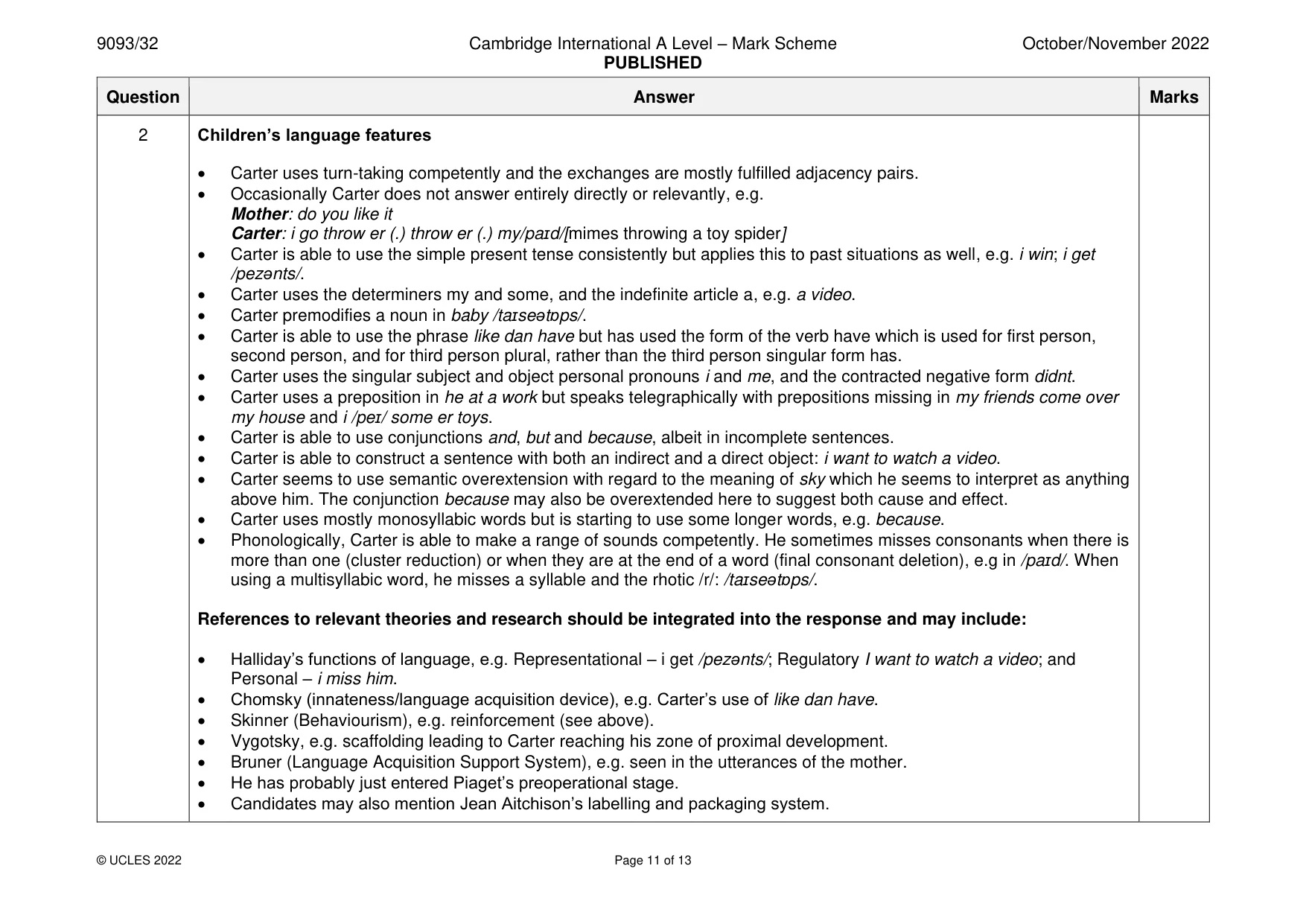
9093/32 Cambridge International A Level – Mark Scheme PUBLISHED October/November 2022 © UCLES 2022 Page 11 of 13 Question Answer Marks 2 Children’s language features • Carter uses turn-taking competently and the exchanges are mostly fulfilled adjacency pairs. • Occasionally Carter does not answer entirely directly or relevantly, e.g. Mother: do you like it Carter: i go throw er (.) throw er (.) my/paɪd/[mimes throwing a toy spider] • Carter is able to use the simple present tense consistently but applies this to past situations as well, e.g. i win; i get /pezənts/. • Carter uses the determiners my and some, and the indefinite article a, e.g. a video. • Carter premodifies a noun in baby /taɪseətɒps/. • Carter is able to use the phrase like dan have but has used the form of the verb have which is used for first person, second person, and for third person plural, rather than the third person singular form has. • Carter uses the singular subject and object personal pronouns i and me, and the contracted negative form didnt. • Carter uses a preposition in he at a work but speaks telegraphically with prepositions missing in my friends come over my house and i /peɪ/ some er toys. • Carter is able to use conjunctions and, but and because, albeit in incomplete sentences. • Carter is able to construct a sentence with both an indirect and a direct object: i want to watch a video. • Carter seems to use semantic overextension with regard to the meaning of sky which he seems to interpret as anything above him. The conjunction because may also be overextended here to suggest both cause and effect. • Carter uses mostly monosyllabic words but is starting to use some longer words, e.g. because. • Phonologically, Carter is able to make a range of sounds competently. He sometimes misses consonants when there is more than one (cluster reduction) or when they are at the end of a word (final consonant deletion), e.g in /paɪd/. When using a multisyllabic word, he misses a syllable and the rhotic /r/: /taɪseətɒps/. References to relevant theories and research should be integrated into the response and may include: • Halliday’s functions of language, e.g. Representational – i get /pezənts/; Regulatory I want to watch a video; and Personal – i miss him. • Chomsky (innateness/language acquisition device), e.g. Carter’s use of like dan have. • Skinner (Behaviourism), e.g. reinforcement (see above). • Vygotsky, e.g. scaffolding leading to Carter reaching his zone of proximal development. • Bruner (Language Acquisition Support System), e.g. seen in the utterances of the mother. • He has probably just entered Piaget’s preoperational stage. • Candidates may also mention Jean Aitchison’s labelling and packaging system.
Mark scheme, page 12
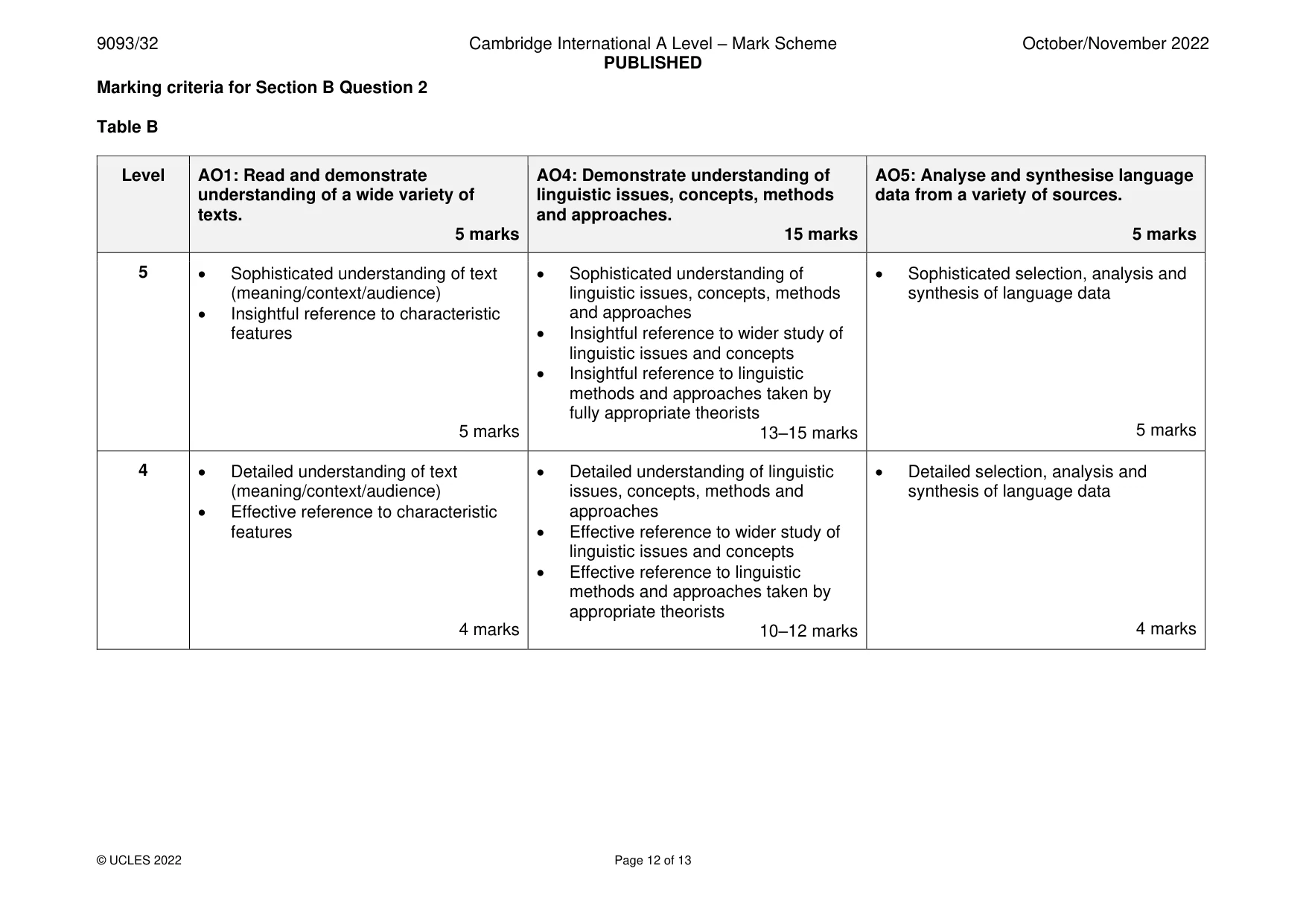
9093/32 Cambridge International A Level – Mark Scheme PUBLISHED October/November 2022 © UCLES 2022 Page 12 of 13 Marking criteria for Section B Question 2 Table B Level AO1: Read and demonstrate understanding of a wide variety of texts. 5 marks AO4: Demonstrate understanding of linguistic issues, concepts, methods and approaches. 15 marks AO5: Analyse and synthesise language data from a variety of sources. 5 marks 5 • Sophisticated understanding of text (meaning/context/audience) • Insightful reference to characteristic features 5 marks • Sophisticated understanding of linguistic issues, concepts, methods and approaches • Insightful reference to wider study of linguistic issues and concepts • Insightful reference to linguistic methods and approaches taken by fully appropriate theorists 13–15 marks • Sophisticated selection, analysis and synthesis of language data 5 marks 4 • Detailed understanding of text (meaning/context/audience) • Effective reference to characteristic features 4 marks • Detailed understanding of linguistic issues, concepts, methods and approaches • Effective reference to wider study of linguistic issues and concepts • Effective reference to linguistic methods and approaches taken by appropriate theorists 10–12 marks • Detailed selection, analysis and synthesis of language data 4 marks
Mark scheme, page 13
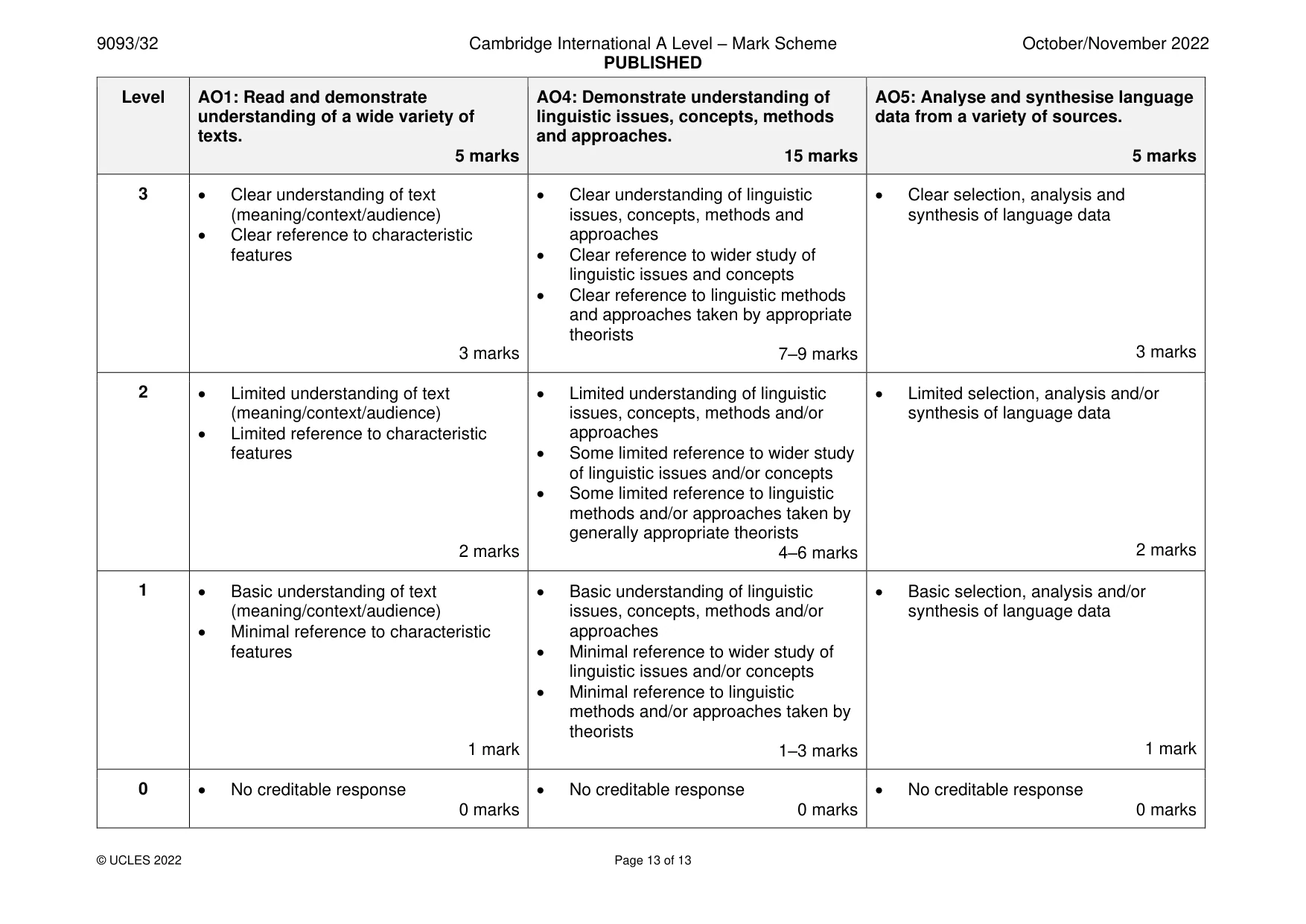
9093/32 Cambridge International A Level – Mark Scheme PUBLISHED October/November 2022 © UCLES 2022 Page 13 of 13 Level AO1: Read and demonstrate understanding of a wide variety of texts. 5 marks AO4: Demonstrate understanding of linguistic issues, concepts, methods and approaches. 15 marks AO5: Analyse and synthesise language data from a variety of sources. 5 marks 3 • Clear understanding of text (meaning/context/audience) • Clear reference to characteristic features 3 marks • Clear understanding of linguistic issues, concepts, methods and approaches • Clear reference to wider study of linguistic issues and concepts • Clear reference to linguistic methods and approaches taken by appropriate theorists 7–9 marks • Clear selection, analysis and synthesis of language data 3 marks 2 • Limited understanding of text (meaning/context/audience) • Limited reference to characteristic features 2 marks • Limited understanding of linguistic issues, concepts, methods and/or approaches • Some limited reference to wider study of linguistic issues and/or concepts • Some limited reference to linguistic methods and/or approaches taken by generally appropriate theorists 4–6 marks • Limited selection, analysis and/or synthesis of language data 2 marks 1 • Basic understanding of text (meaning/context/audience) • Minimal reference to characteristic features 1 mark • Basic understanding of linguistic issues, concepts, methods and/or approaches • Minimal reference to wider study of linguistic issues and/or concepts • Minimal reference to linguistic methods and/or approaches taken by theorists 1–3 marks • Basic selection, analysis and/or synthesis of language data 1 mark 0 • No creditable response 0 marks • No creditable response 0 marks • No creditable response 0 marks
What you needed in this session
Cambridge’s own grade thresholds for 2022 Oct/Nov, Paper 3 · Variant 2. A higher threshold means an easier paper — the bar moves with how the cohort did.