Cambridge A Level English - Language AS and A Level (from 2014) 9093 — 2022 Oct/Nov Paper 3 · Variant 1
9093/31/O/N/22 · 50 marks · ≈56 min
The question paper and its mark scheme, free to read here and free to download. This is Cambridge’s own paper, exactly as it was sat.
Question paper8 pages

Mark scheme13 pages
Answers below. Sit the paper first if you are practising.
Paper as text
Question paper, page 1
[Turn over DC (CJ) 311355 © UCLES 2022 This document has 8 pages. Any blank pages are indicated. * 8 3 1 7 8 3 3 9 0 0 * ENGLISH LANGUAGE 9093/31 Paper 3 Language Analysis October/November 2022 2 hours 15 minutes You must answer on the enclosed answer booklet. You will need: Answer booklet (enclosed) INSTRUCTIONS ● Answer all questions. ● Follow the instructions on the front cover of the answer booklet. If you need additional answer paper, ask the invigilator for a continuation booklet. ● Dictionaries are not allowed. INFORMATION ● The total mark for this paper is 50. ● The number of marks for each question or part question is shown in brackets [ ]. Cambridge International AS & A Level
Question paper, page 2
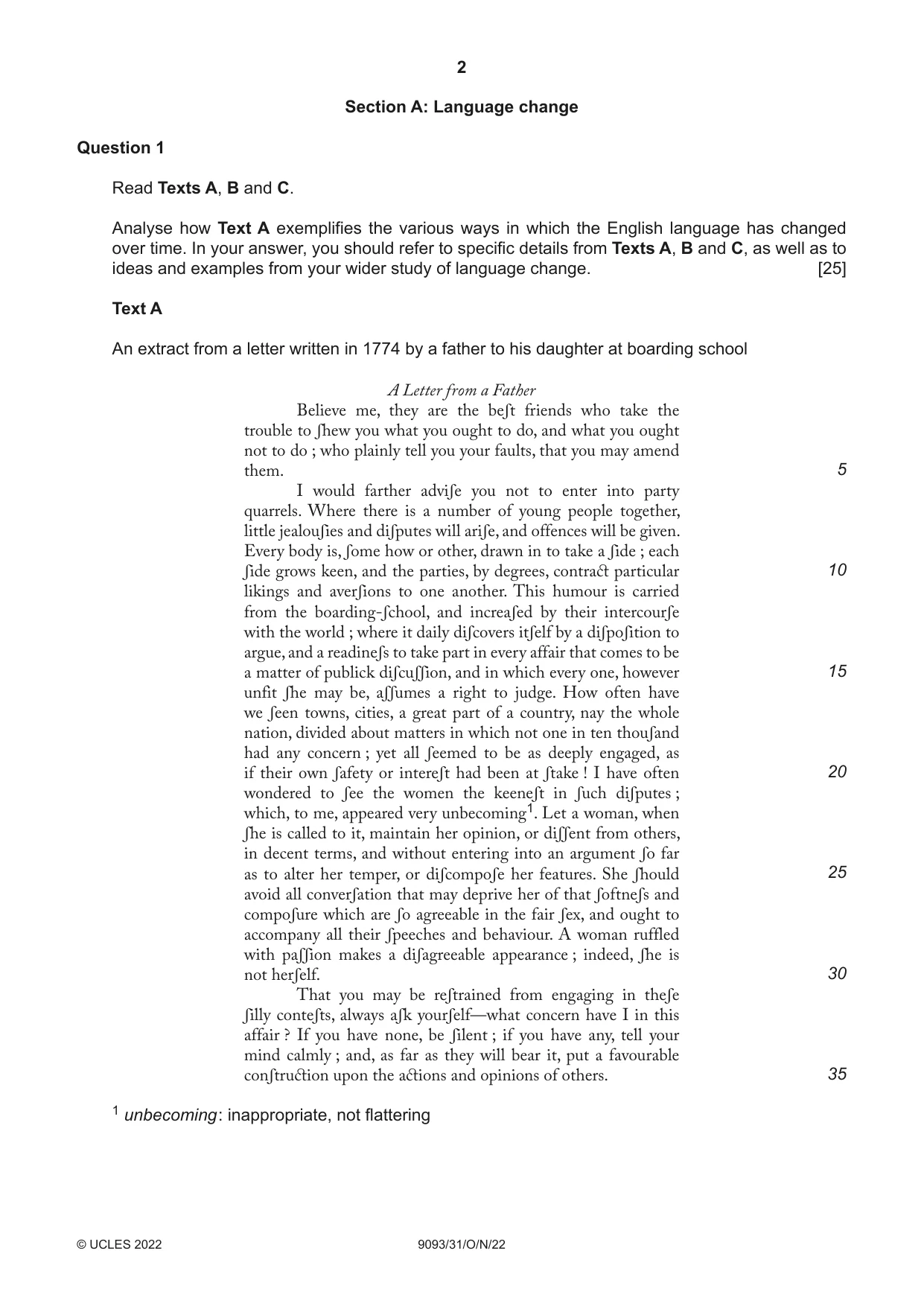
2 9093/31/O/N/22 © UCLES 2022 Section A: Language change Question 1 Read Texts A, B and C. Analyse how Text A exemplifies the various ways in which the English language has changed over time. In your answer, you should refer to specific details from Texts A, B and C, as well as to ideas and examples from your wider study of language change. [25] Text A An extract from a letter written in 1774 by a father to his daughter at boarding school A Letter from a Father Believe me, they are the beʃt friends who take the trouble to ʃhew you what you ought to do, and what you ought not to do ; who plainly tell you your faults, that you may amend them. I would farther adviʃe you not to enter into party quarrels. Where there is a number of young people together, little jealouʃies and diʃputes will ariʃe, and offences will be given. Every body is, ʃome how or other, drawn in to take a ʃide ; each ʃide grows keen, and the parties, by degrees, contract particular likings and averʃions to one another. This humour is carried from the boarding-ʃchool, and increaʃed by their intercourʃe with the world ; where it daily diʃcovers itʃelf by a diʃpoʃition to argue, and a readineʃs to take part in every affair that comes to be a matter of publick diʃcuʃʃion, and in which every one, however unfit ʃhe may be, aʃʃumes a right to judge. How often have we ʃeen towns, cities, a great part of a country, nay the whole nation, divided about matters in which not one in ten thouʃand had any concern ; yet all ʃeemed to be as deeply engaged, as if their own ʃafety or intereʃt had been at ʃtake ! I have often wondered to ʃee the women the keeneʃt in ʃuch diʃputes ; which, to me, appeared very unbecoming1. Let a woman, when ʃhe is called to it, maintain her opinion, or diʃʃent from others, in decent terms, and without entering into an argument ʃo far as to alter her temper, or diʃcompoʃe her features. She ʃhould avoid all converʃation that may deprive her of that ʃoftneʃs and compoʃure which are ʃo agreeable in the fair ʃex, and ought to accompany all their ʃpeeches and behaviour. A woman ruffled with paʃʃion makes a diʃagreeable appearance ; indeed, ʃhe is not herʃelf. That you may be reʃtrained from engaging in theʃe ʃilly conteʃts, always aʃk yourʃelf—what concern have I in this affair ? If you have none, be ʃilent ; if you have any, tell your mind calmly ; and, as far as they will bear it, put a favourable conʃtruction upon the actions and opinions of others. 1 unbecoming: inappropriate, not flattering 5 10 15 20 25 30 35
Question paper, page 3
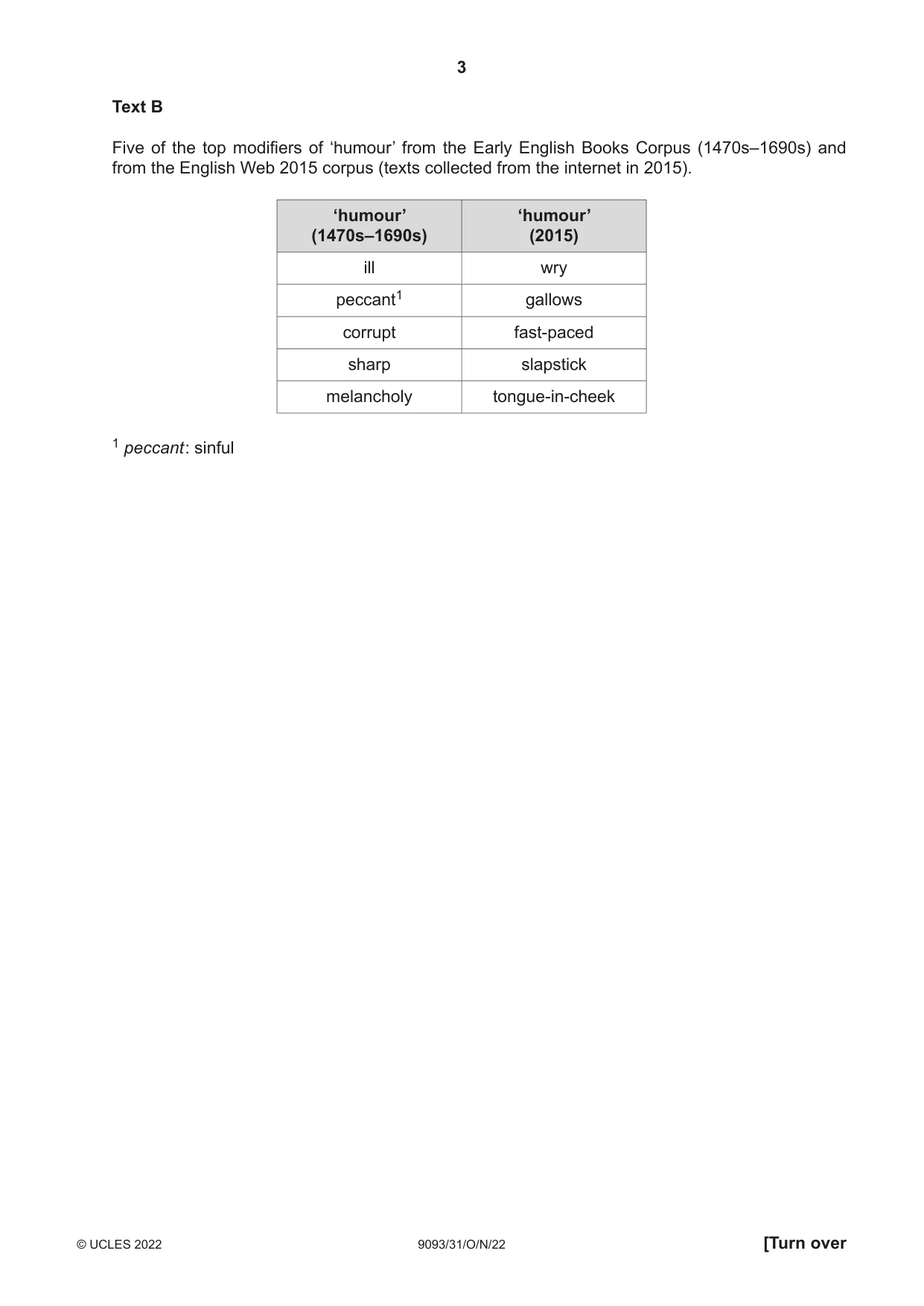
3 9093/31/O/N/22 © UCLES 2022 [Turn over Text B Five of the top modifiers of ‘humour’ from the Early English Books Corpus (1470s–1690s) and from the English Web 2015 corpus (texts collected from the internet in 2015). ‘humour’ (1470s–1690s) ‘humour’ (2015) ill wry peccant1 gallows corrupt fast-paced sharp slapstick melancholy tongue-in-cheek 1 peccant: sinful
Question paper, page 4
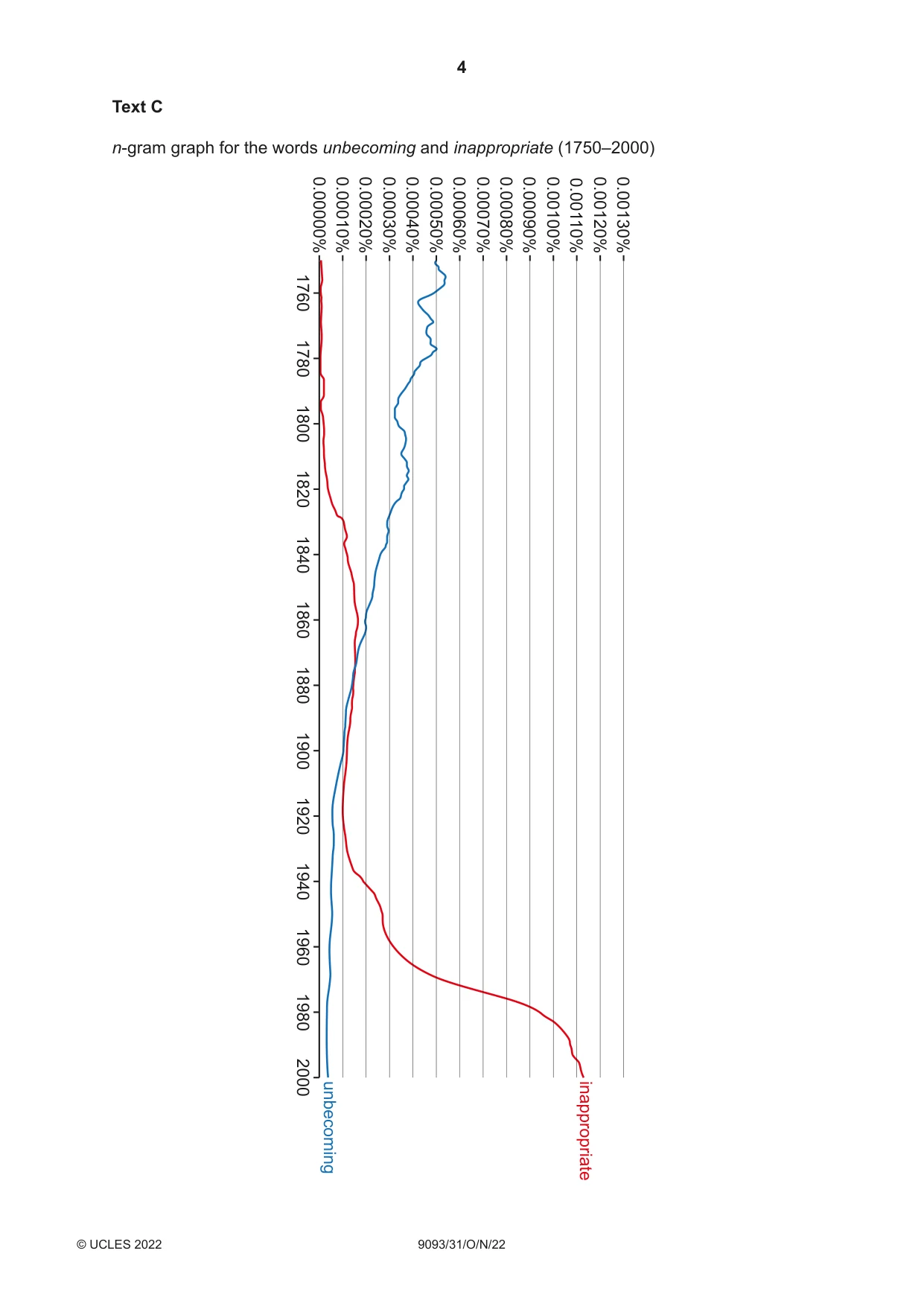
4 9093/31/O/N/22 © UCLES 2022 Text C n-gram graph for the words unbecoming and inappropriate (1750–2000) 0.00130% 0.00120% 0.00110% 0.00100% 0.00090% 0.00080% 0.00070% 0.00060% 0.00050% 0.00040% 0.00030% 0.00020% 0.00010% 0.00000% 1760 1780 1820 1800 1840 1880 1860 1900 1940 unbecoming inappropriate 1920 1960 2000 1980
Question paper, page 5
5 9093/31/O/N/22 © UCLES 2022 [Turn over BLANK PAGE
Question paper, page 6
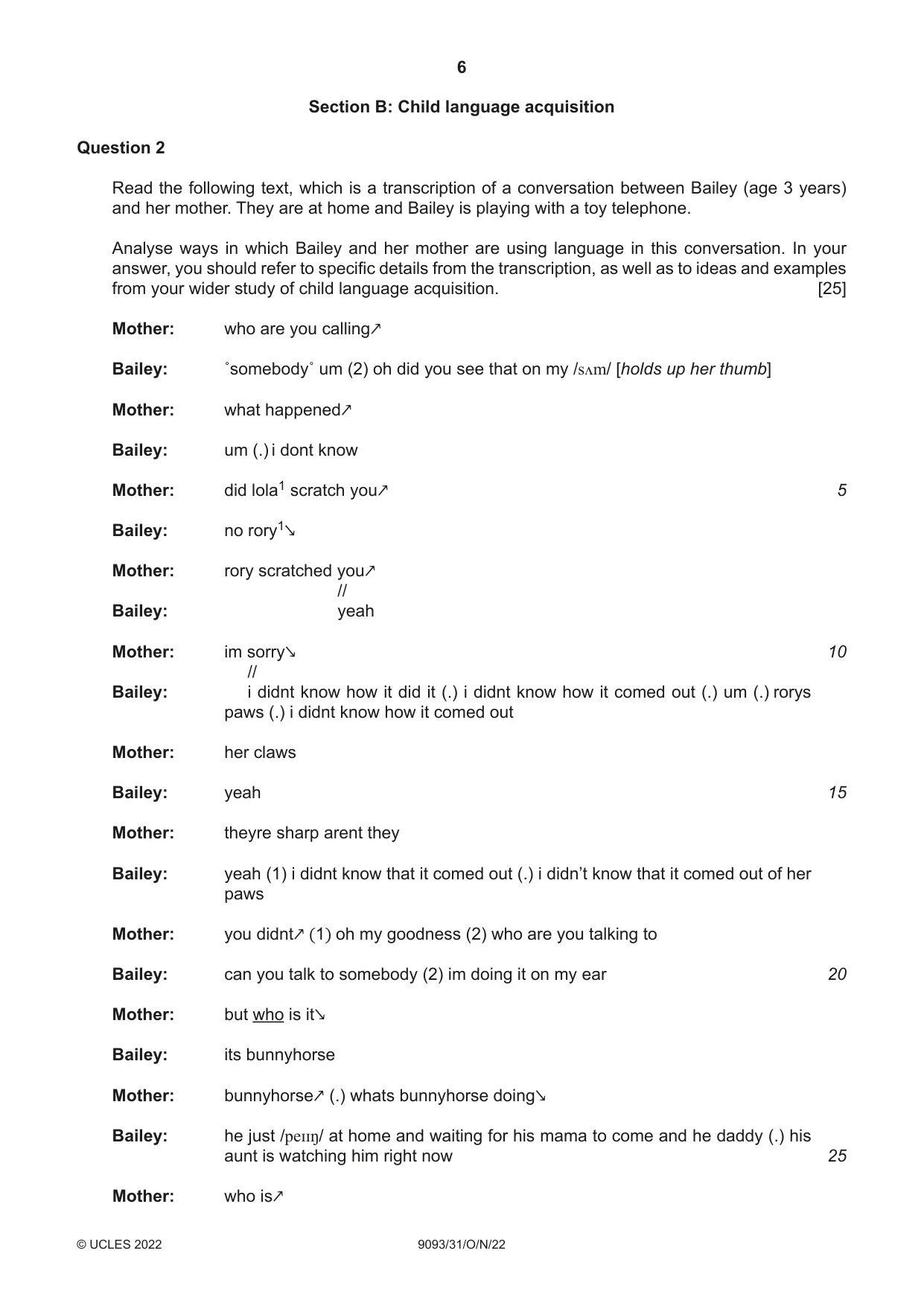
6 9093/31/O/N/22 © UCLES 2022 Section B: Child language acquisition Question 2 Read the following text, which is a transcription of a conversation between Bailey (age 3 years) and her mother. They are at home and Bailey is playing with a toy telephone. Analyse ways in which Bailey and her mother are using language in this conversation. In your answer, you should refer to specific details from the transcription, as well as to ideas and examples from your wider study of child language acquisition. [25] Mother : who are you calling↗ Bailey : ˚somebody˚ um (2) oh did you see that on my /sʌm/ [holds up her thumb] Mother : what happened↗ Bailey : um (.) i dont know Mother : did lola1 scratch you↗ Bailey : no rory1↘ Mother : rory scratched you↗ // Bailey : yeah Mother : im sorry↘ // Bailey : i didnt know how it did it (.) i didnt know how it comed out (.) um (.) rorys paws (.) i didnt know how it comed out Mother : her claws Bailey : yeah Mother : theyre sharp arent they Bailey : yeah (1) i didnt know that it comed out (.) i didn’t know that it comed out of her paws Mother : you didnt↗ (1) oh my goodness (2) who are you talking to Bailey : can you talk to somebody (2) im doing it on my ear Mother : but who is it↘ Bailey : its bunnyhorse Mother : bunnyhorse↗ (.) whats bunnyhorse doing↘ Bailey : he just /peɪɪŋ/ at home and waiting for his mama to come and he daddy (.) his aunt is watching him right now Mother : who is↗ 5 10 15 20 25
Question paper, page 7
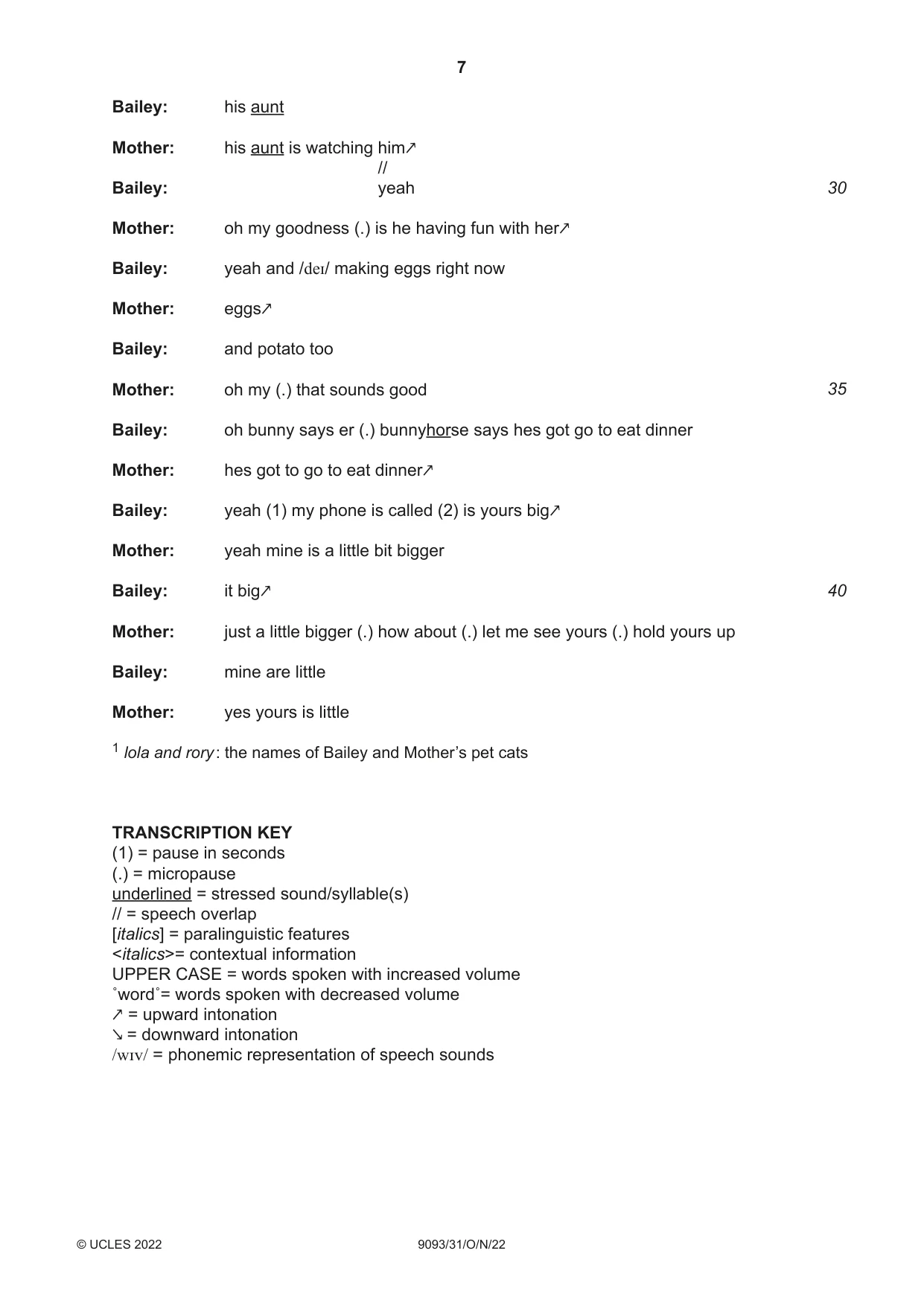
7 9093/31/O/N/22 © UCLES 2022 Bailey : his aunt Mother : his aunt is watching him↗ // Bailey : yeah Mother : oh my goodness (.) is he having fun with her↗ Bailey : yeah and /deɪ/ making eggs right now Mother : eggs↗ Bailey : and potato too Mother : oh my (.) that sounds good Bailey : oh bunny says er (.) bunnyhorse says hes got go to eat dinner Mother : hes got to go to eat dinner↗ Bailey : yeah (1) my phone is called (2) is yours big↗ Mother : yeah mine is a little bit bigger Bailey : it big↗ Mother : just a little bigger (.) how about (.) let me see yours (.) hold yours up Bailey : mine are little Mother : yes yours is little 1 lola and rory : the names of Bailey and Mother’s pet cats TRANSCRIPTION KEY (1) = pause in seconds (.) = micropause underlined = stressed sound/syllable(s) // = speech overlap [italics] = paralinguistic features <italics>= contextual information UPPER CASE = words spoken with increased volume ˚word˚= words spoken with decreased volume ↗ = upward intonation ↘ = downward intonation /wɪv/ = phonemic representation of speech sounds 30 35 40
Question paper, page 8
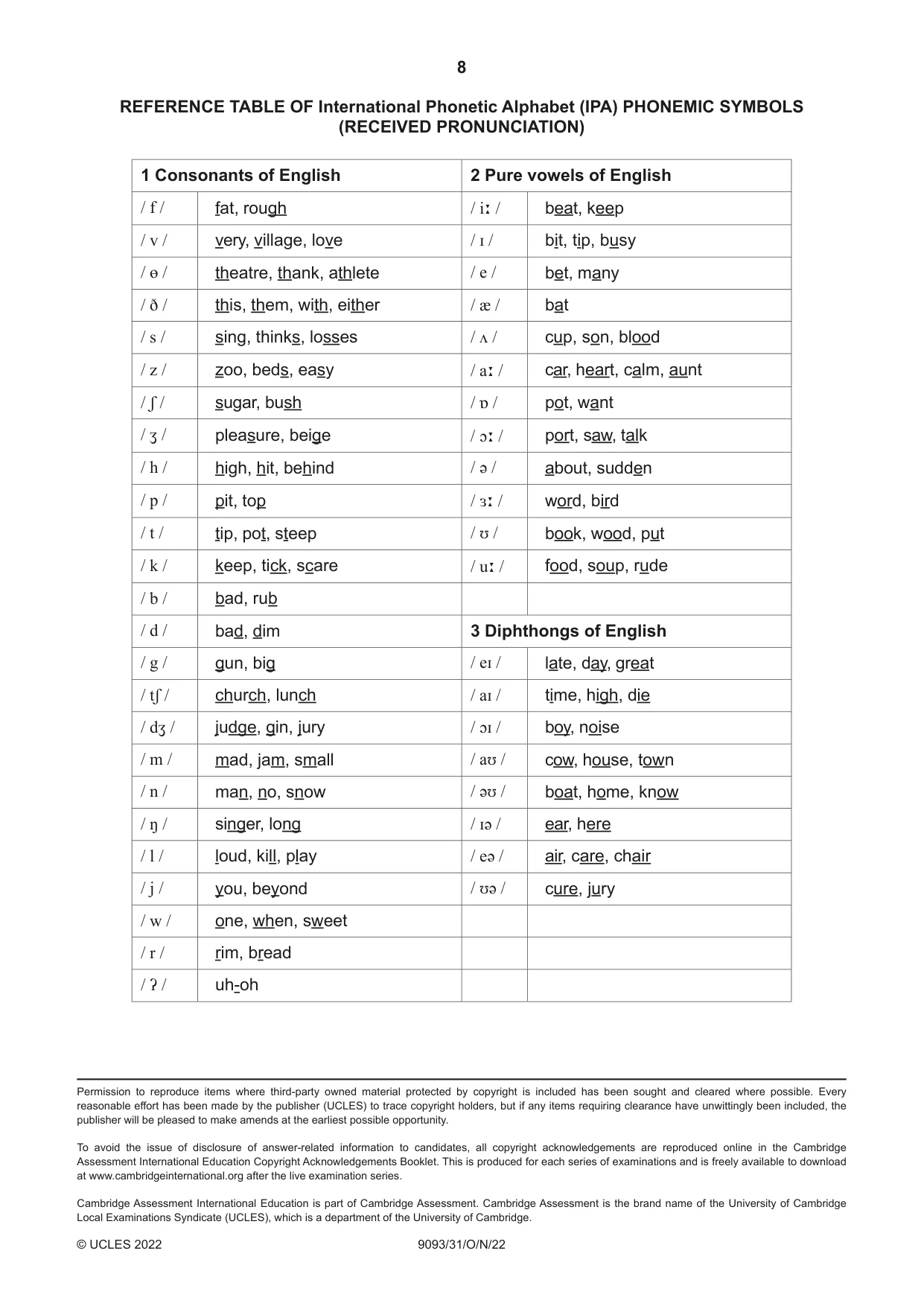
8 9093/31/O/N/22 © UCLES 2022 Permission to reproduce items where third-party owned material protected by copyright is included has been sought and cleared where possible. Every reasonable effort has been made by the publisher (UCLES) to trace copyright holders, but if any items requiring clearance have unwittingly been included, the publisher will be pleased to make amends at the earliest possible opportunity. To avoid the issue of disclosure of answer-related information to candidates, all copyright acknowledgements are reproduced online in the Cambridge Assessment International Education Copyright Acknowledgements Booklet. This is produced for each series of examinations and is freely available to download at www.cambridgeinternational.org after the live examination series. Cambridge Assessment International Education is part of Cambridge Assessment. Cambridge Assessment is the brand name of the University of Cambridge Local Examinations Syndicate (UCLES), which is a department of the University of Cambridge. REFERENCE TABLE OF International Phonetic Alphabet (IPA) PHONEMIC SYMBOLS (RECEIVED PRONUNCIATION) 1 Consonants of English 2 Pure vowels of English / f / fat, rough / iː / beat, keep / v / very, village, love / ɪ / bit, tip, busy / ɵ / theatre, thank, athlete / e / bet, many / ð / this, them, with, either / æ / bat / s / sing, thinks, losses / ʌ / cup, son, blood / z / zoo, beds, easy / aː / car, heart, calm, aunt / ʃ / sugar, bush / ɒ / pot, want / ʒ / pleasure, beige / ɔː / port, saw, talk / h / high, hit, behind / ə / about, sudden / p / pit, top / ɜː / word, bird / t / tip, pot, steep / ʊ / book, wood, put / k / keep, tick, scare / uː / food, soup, rude / b / bad, rub / d / bad, dim 3 Diphthongs of English / g / gun, big / eɪ / late, day, great / tʃ / church, lunch / aɪ / time, high, die / dʒ / judge, gin, jury / ɔɪ / boy, noise / m / mad, jam, small / aʊ / cow, house, town / n / man, no, snow / əʊ / boat, home, know / ŋ / singer, long / ɪə / ear, here / l / loud, kill, play / eə / air, care, chair / j / you, beyond / ʊə / cure, jury / w / one, when, sweet / r / rim, bread / ʔ / uh-oh
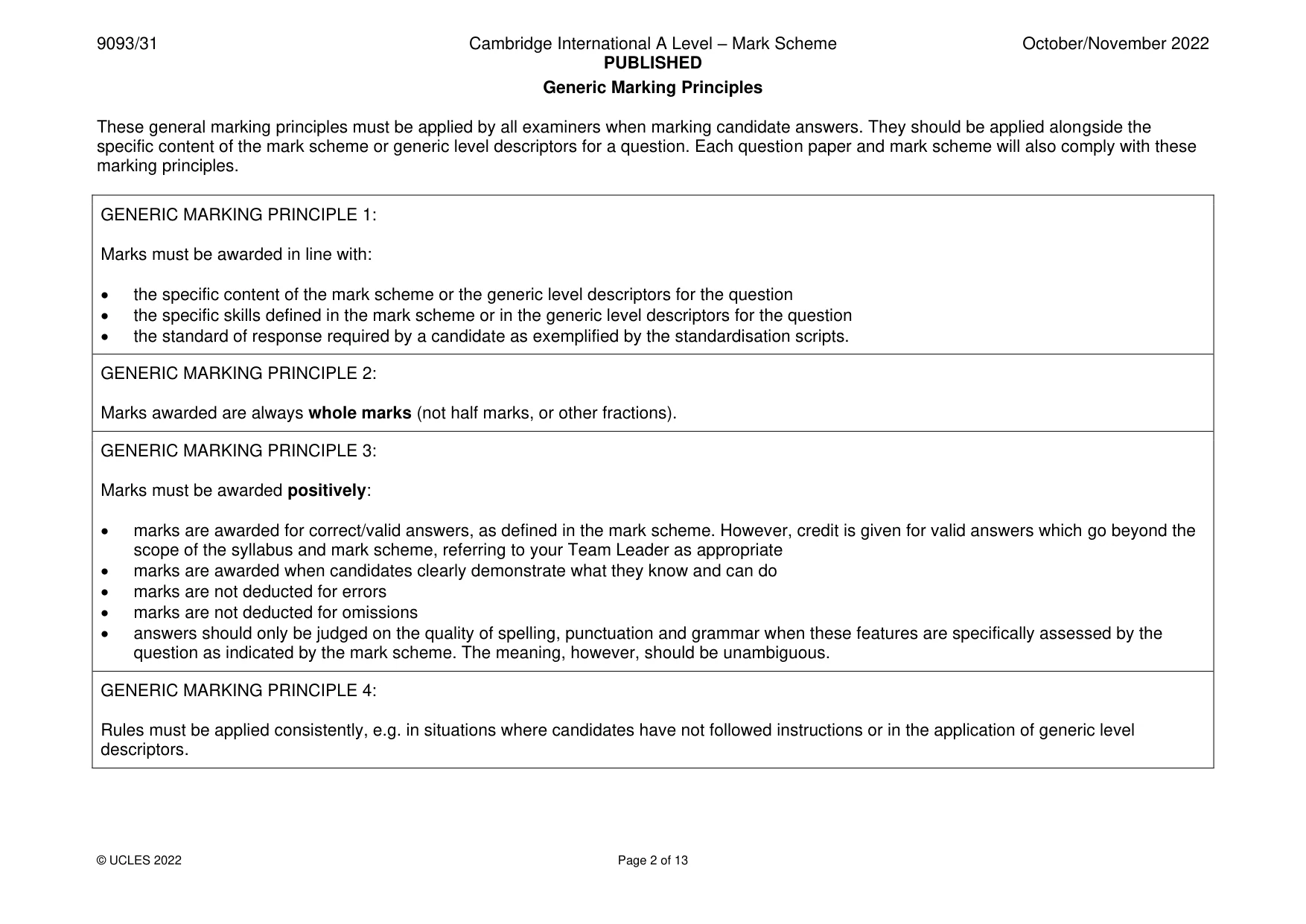
Mark scheme, page 1
This document consists of 13 printed pages. © UCLES 2022 [Turn over Cambridge International A Level ENGLISH LANGUAGE 9093/31 Paper 3 Language Analysis October/November 2022 MARK SCHEME Maximum Mark: 50 Published This mark scheme is published as an aid to teachers and candidates, to indicate the requirements of the examination. It shows the basis on which Examiners were instructed to award marks. It does not indicate the details of the discussions that took place at an Examiners’ meeting before marking began, which would have considered the acceptability of alternative answers. Mark schemes should be read in conjunction with the question paper and the Principal Examiner Report for Teachers. Cambridge International will not enter into discussions about these mark schemes. Cambridge International is publishing the mark schemes for the October/November 2022 series for most Cambridge IGCSE™, Cambridge International A and AS Level components and some Cambridge O Level components.
Mark scheme, page 2
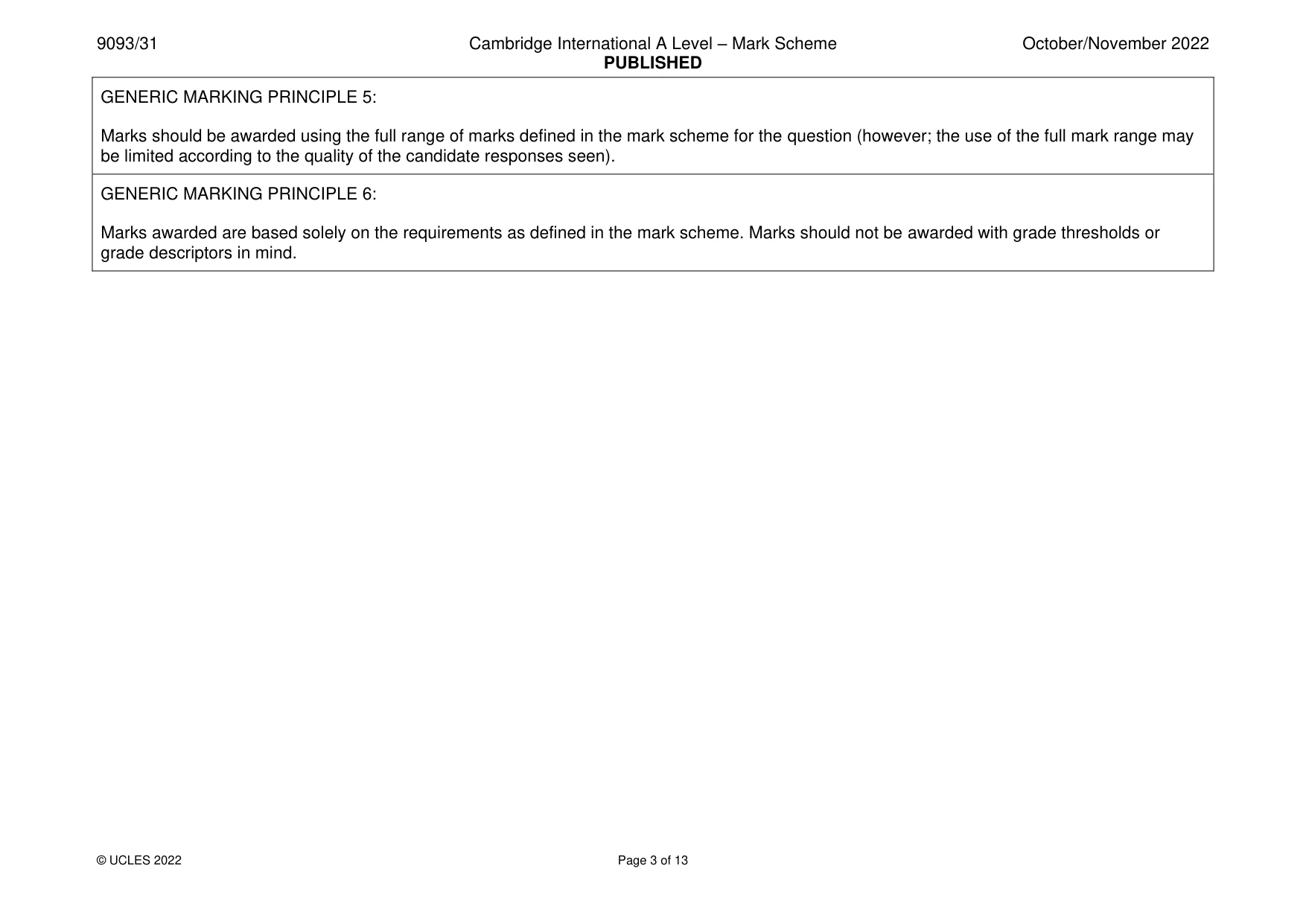
9093/31 Cambridge International A Level – Mark Scheme PUBLISHED October/November 2022 © UCLES 2022 Page 2 of 13 Generic Marking Principles These general marking principles must be applied by all examiners when marking candidate answers. They should be applied alongside the specific content of the mark scheme or generic level descriptors for a question. Each question paper and mark scheme will also comply with these marking principles. GENERIC MARKING PRINCIPLE 1: Marks must be awarded in line with: • the specific content of the mark scheme or the generic level descriptors for the question • the specific skills defined in the mark scheme or in the generic level descriptors for the question • the standard of response required by a candidate as exemplified by the standardisation scripts. GENERIC MARKING PRINCIPLE 2: Marks awarded are always whole marks (not half marks, or other fractions). GENERIC MARKING PRINCIPLE 3: Marks must be awarded positively: • marks are awarded for correct/valid answers, as defined in the mark scheme. However, credit is given for valid answers which go beyond the scope of the syllabus and mark scheme, referring to your Team Leader as appropriate • marks are awarded when candidates clearly demonstrate what they know and can do • marks are not deducted for errors • marks are not deducted for omissions • answers should only be judged on the quality of spelling, punctuation and grammar when these features are specifically assessed by the question as indicated by the mark scheme. The meaning, however, should be unambiguous. GENERIC MARKING PRINCIPLE 4: Rules must be applied consistently, e.g. in situations where candidates have not followed instructions or in the application of generic level descriptors.
Mark scheme, page 3
9093/31 Cambridge International A Level – Mark Scheme PUBLISHED October/November 2022 © UCLES 2022 Page 3 of 13 GENERIC MARKING PRINCIPLE 5: Marks should be awarded using the full range of marks defined in the mark scheme for the question (however; the use of the full mark range may be limited according to the quality of the candidate responses seen). GENERIC MARKING PRINCIPLE 6: Marks awarded are based solely on the requirements as defined in the mark scheme. Marks should not be awarded with grade thresholds or grade descriptors in mind.
Mark scheme, page 4
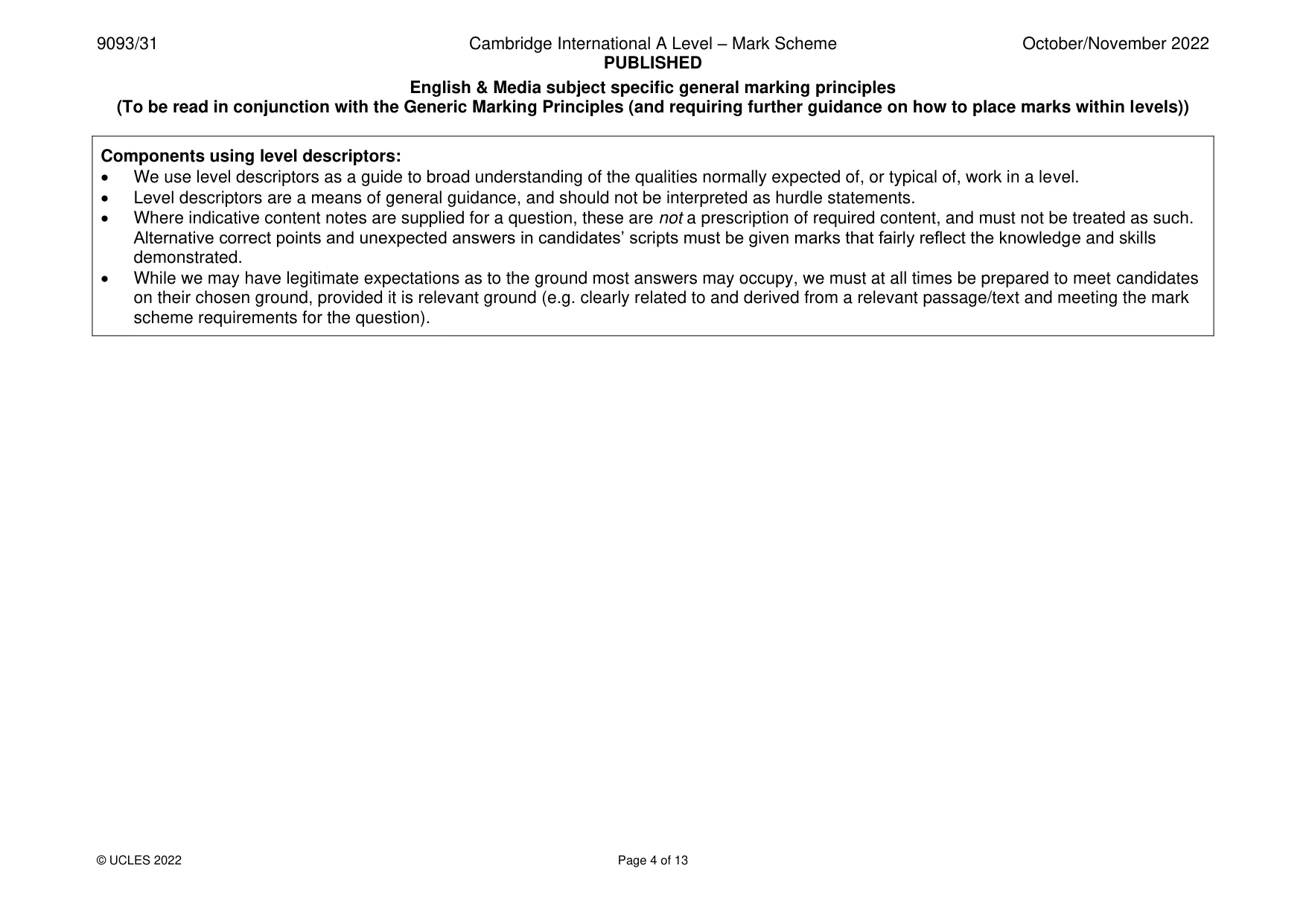
9093/31 Cambridge International A Level – Mark Scheme PUBLISHED October/November 2022 © UCLES 2022 Page 4 of 13 English & Media subject specific general marking principles (To be read in conjunction with the Generic Marking Principles (and requiring further guidance on how to place marks within levels)) Components using level descriptors: • We use level descriptors as a guide to broad understanding of the qualities normally expected of, or typical of, work in a level. • Level descriptors are a means of general guidance, and should not be interpreted as hurdle statements. • Where indicative content notes are supplied for a question, these are not a prescription of required content, and must not be treated as such. Alternative correct points and unexpected answers in candidates’ scripts must be given marks that fairly reflect the knowledge and skills demonstrated. • While we may have legitimate expectations as to the ground most answers may occupy, we must at all times be prepared to meet candidates on their chosen ground, provided it is relevant ground (e.g. clearly related to and derived from a relevant passage/text and meeting the mark scheme requirements for the question).
Mark scheme, page 5
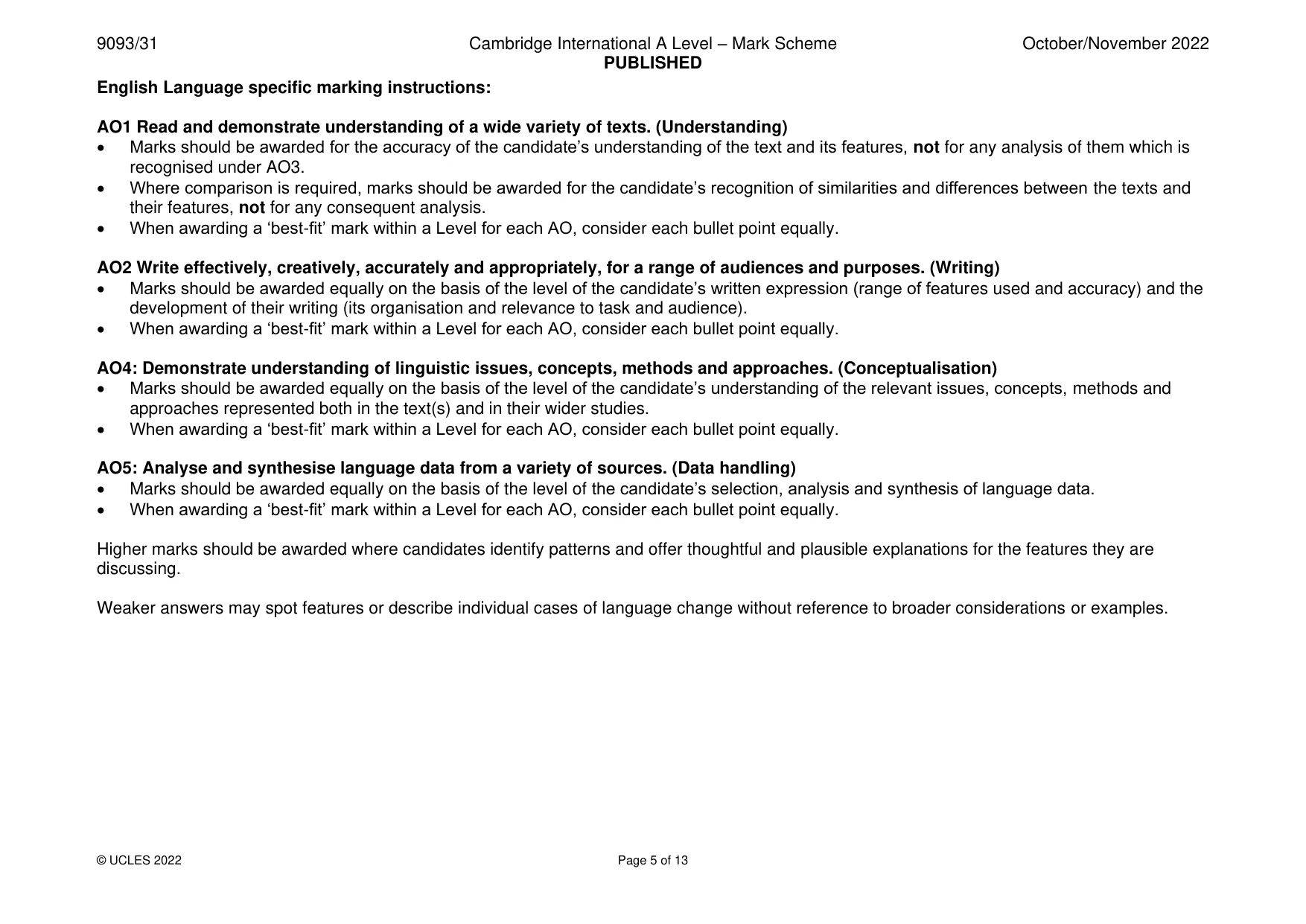
9093/31 Cambridge International A Level – Mark Scheme PUBLISHED October/November 2022 © UCLES 2022 Page 5 of 13 English Language specific marking instructions: AO1 Read and demonstrate understanding of a wide variety of texts. (Understanding) • Marks should be awarded for the accuracy of the candidate’s understanding of the text and its features, not for any analysis of them which is recognised under AO3. • Where comparison is required, marks should be awarded for the candidate’s recognition of similarities and differences between the texts and their features, not for any consequent analysis. • When awarding a ‘best-fit’ mark within a Level for each AO, consider each bullet point equally. AO2 Write effectively, creatively, accurately and appropriately, for a range of audiences and purposes. (Writing) • Marks should be awarded equally on the basis of the level of the candidate’s written expression (range of features used and accuracy) and the development of their writing (its organisation and relevance to task and audience). • When awarding a ‘best-fit’ mark within a Level for each AO, consider each bullet point equally. AO4: Demonstrate understanding of linguistic issues, concepts, methods and approaches. (Conceptualisation) • Marks should be awarded equally on the basis of the level of the candidate’s understanding of the relevant issues, concepts, methods and approaches represented both in the text(s) and in their wider studies. • When awarding a ‘best-fit’ mark within a Level for each AO, consider each bullet point equally. AO5: Analyse and synthesise language data from a variety of sources. (Data handling) • Marks should be awarded equally on the basis of the level of the candidate’s selection, analysis and synthesis of language data. • When awarding a ‘best-fit’ mark within a Level for each AO, consider each bullet point equally. Higher marks should be awarded where candidates identify patterns and offer thoughtful and plausible explanations for the features they are discussing. Weaker answers may spot features or describe individual cases of language change without reference to broader considerations or examples.
Mark scheme, page 6
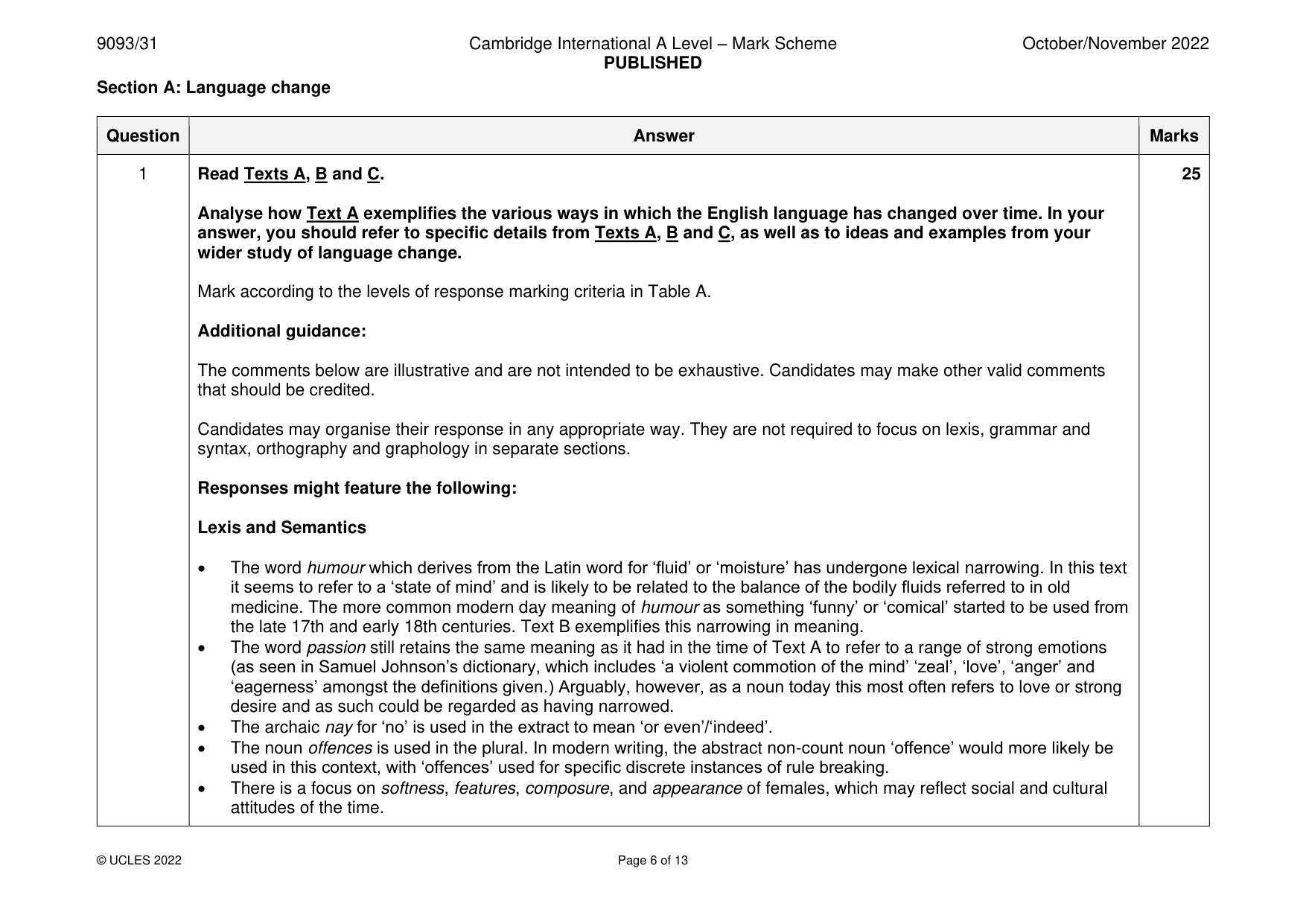
9093/31 Cambridge International A Level – Mark Scheme PUBLISHED October/November 2022 © UCLES 2022 Page 6 of 13 Section A: Language change Question Answer Marks 1 Read Texts A, B and C. Analyse how Text A exemplifies the various ways in which the English language has changed over time. In your answer, you should refer to specific details from Texts A, B and C, as well as to ideas and examples from your wider study of language change. Mark according to the levels of response marking criteria in Table A. Additional guidance: The comments below are illustrative and are not intended to be exhaustive. Candidates may make other valid comments that should be credited. Candidates may organise their response in any appropriate way. They are not required to focus on lexis, grammar and syntax, orthography and graphology in separate sections. Responses might feature the following: Lexis and Semantics • The word humour which derives from the Latin word for ‘fluid’ or ‘moisture’ has undergone lexical narrowing. In this text it seems to refer to a ‘state of mind’ and is likely to be related to the balance of the bodily fluids referred to in old medicine. The more common modern day meaning of humour as something ‘funny’ or ‘comical’ started to be used from the late 17th and early 18th centuries. Text B exemplifies this narrowing in meaning. • The word passion still retains the same meaning as it had in the time of Text A to refer to a range of strong emotions (as seen in Samuel Johnson’s dictionary, which includes ‘a violent commotion of the mind’ ‘zeal’, ‘love’, ‘anger’ and ‘eagerness’ amongst the definitions given.) Arguably, however, as a noun today this most often refers to love or strong desire and as such could be regarded as having narrowed. • The archaic nay for ‘no’ is used in the extract to mean ‘or even’/‘indeed’. • The noun offences is used in the plural. In modern writing, the abstract non-count noun ‘offence’ would more likely be used in this context, with ‘offences’ used for specific discrete instances of rule breaking. • There is a focus on softness, features, composure, and appearance of females, which may reflect social and cultural attitudes of the time. 25
Mark scheme, page 7
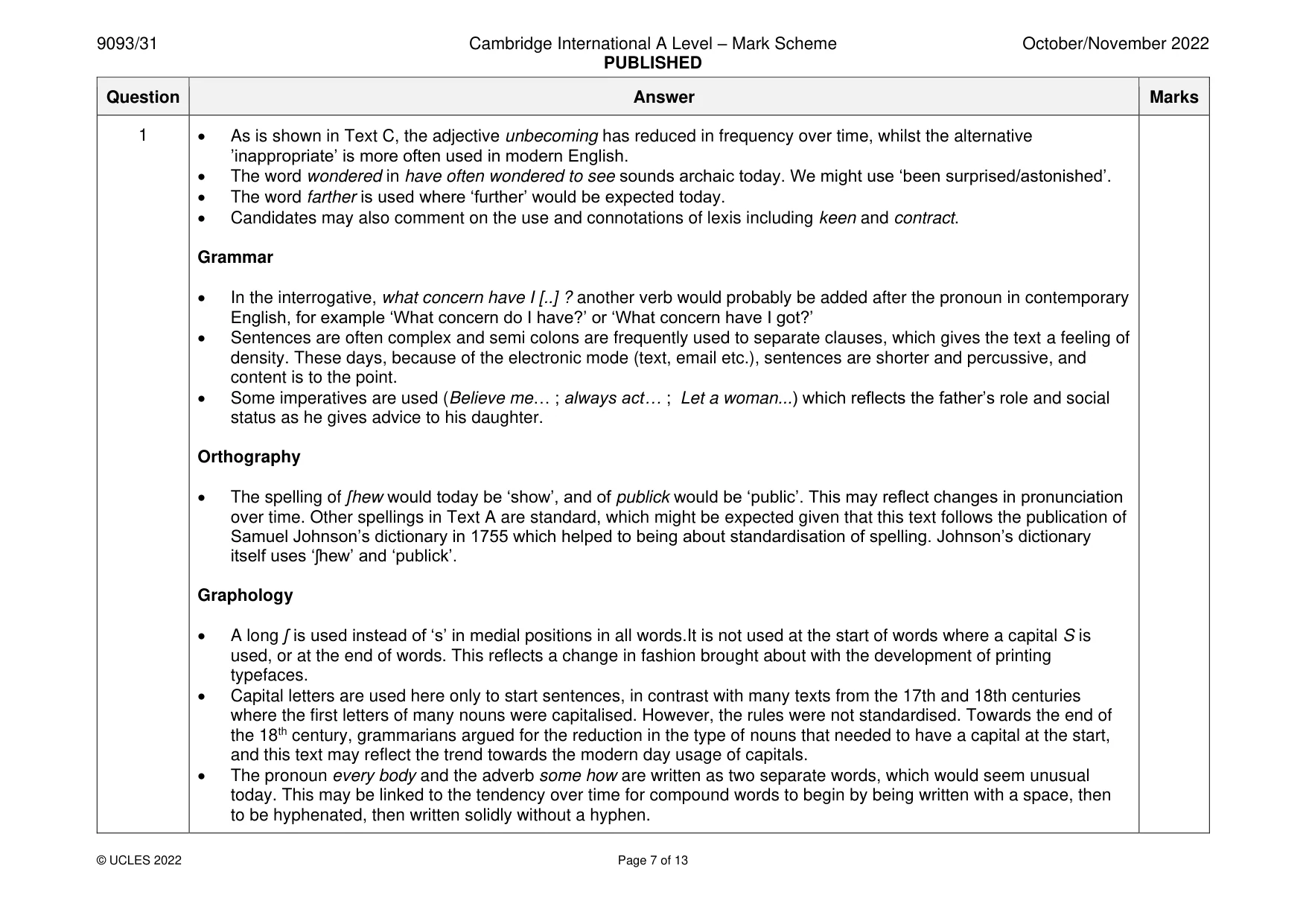
9093/31 Cambridge International A Level – Mark Scheme PUBLISHED October/November 2022 © UCLES 2022 Page 7 of 13 Question Answer Marks 1 • As is shown in Text C, the adjective unbecoming has reduced in frequency over time, whilst the alternative ’inappropriate’ is more often used in modern English. • The word wondered in have often wondered to see sounds archaic today. We might use ‘been surprised/astonished’. • The word farther is used where ‘further’ would be expected today. • Candidates may also comment on the use and connotations of lexis including keen and contract. Grammar • In the interrogative, what concern have I [..] ? another verb would probably be added after the pronoun in contemporary English, for example ‘What concern do I have?’ or ‘What concern have I got?’ • Sentences are often complex and semi colons are frequently used to separate clauses, which gives the text a feeling of density. These days, because of the electronic mode (text, email etc.), sentences are shorter and percussive, and content is to the point. • Some imperatives are used (Believe me… ; always act… ; Let a woman...) which reflects the father’s role and social status as he gives advice to his daughter. Orthography • The spelling of ʃhew would today be ‘show’, and of publick would be ‘public’. This may reflect changes in pronunciation over time. Other spellings in Text A are standard, which might be expected given that this text follows the publication of Samuel Johnson’s dictionary in 1755 which helped to being about standardisation of spelling. Johnson’s dictionary itself uses ‘ʃhew’ and ‘publick’. Graphology • A long ʃ is used instead of ‘s’ in medial positions in all words.It is not used at the start of words where a capital S is used, or at the end of words. This reflects a change in fashion brought about with the development of printing typefaces. • Capital letters are used here only to start sentences, in contrast with many texts from the 17th and 18th centuries where the first letters of many nouns were capitalised. However, the rules were not standardised. Towards the end of the 18th century, grammarians argued for the reduction in the type of nouns that needed to have a capital at the start, and this text may reflect the trend towards the modern day usage of capitals. • The pronoun every body and the adverb some how are written as two separate words, which would seem unusual today. This may be linked to the tendency over time for compound words to begin by being written with a space, then to be hyphenated, then written solidly without a hyphen.
Mark scheme, page 8
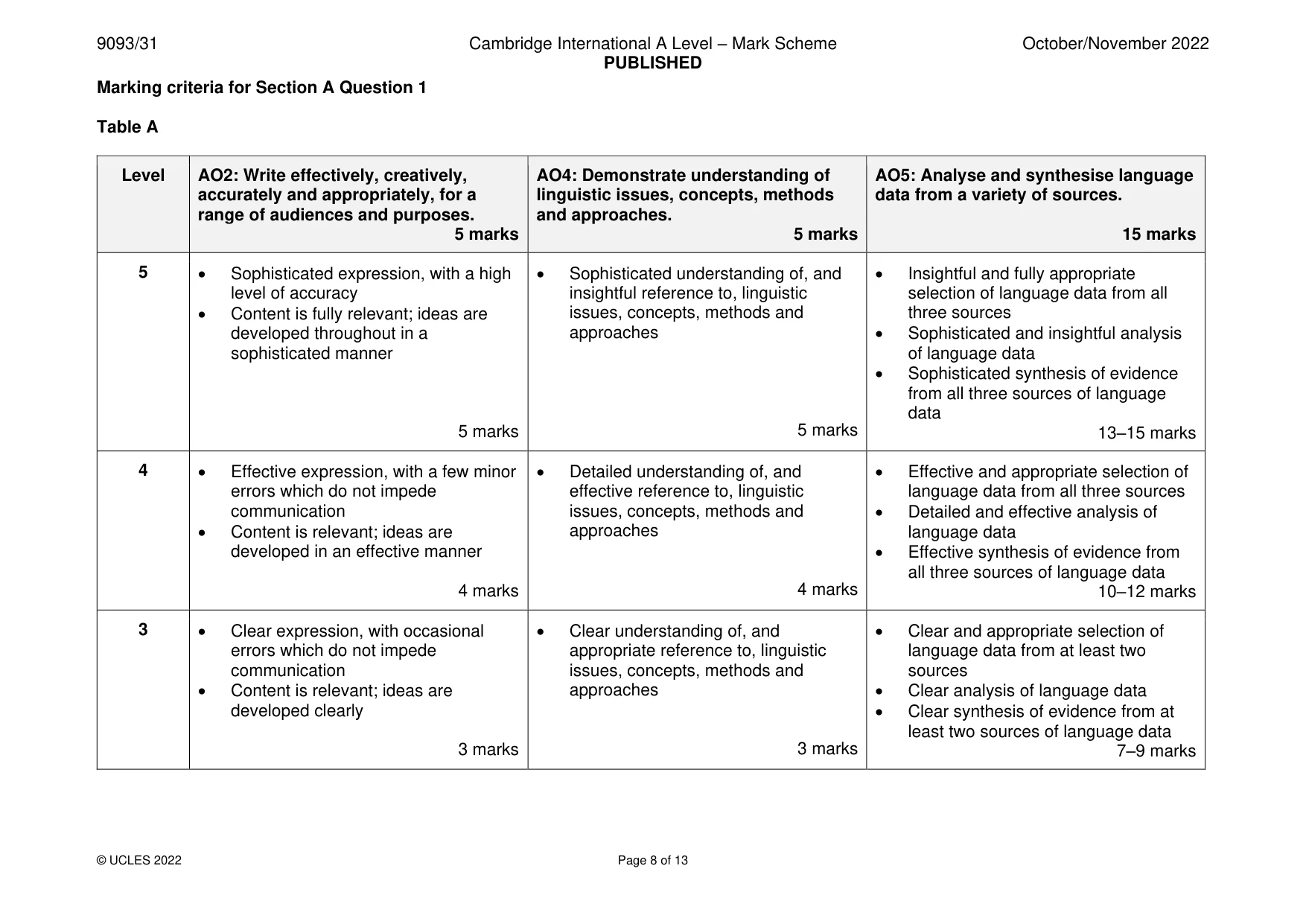
9093/31 Cambridge International A Level – Mark Scheme PUBLISHED October/November 2022 © UCLES 2022 Page 8 of 13 Marking criteria for Section A Question 1 Table A Level AO2: Write effectively, creatively, accurately and appropriately, for a range of audiences and purposes. 5 marks AO4: Demonstrate understanding of linguistic issues, concepts, methods and approaches. 5 marks AO5: Analyse and synthesise language data from a variety of sources. 15 marks 5 • Sophisticated expression, with a high level of accuracy • Content is fully relevant; ideas are developed throughout in a sophisticated manner 5 marks • Sophisticated understanding of, and insightful reference to, linguistic issues, concepts, methods and approaches 5 marks • Insightful and fully appropriate selection of language data from all three sources • Sophisticated and insightful analysis of language data • Sophisticated synthesis of evidence from all three sources of language data 13–15 marks 4 • Effective expression, with a few minor errors which do not impede communication • Content is relevant; ideas are developed in an effective manner 4 marks • Detailed understanding of, and effective reference to, linguistic issues, concepts, methods and approaches 4 marks • Effective and appropriate selection of language data from all three sources • Detailed and effective analysis of language data • Effective synthesis of evidence from all three sources of language data 10–12 marks 3 • Clear expression, with occasional errors which do not impede communication • Content is relevant; ideas are developed clearly 3 marks • Clear understanding of, and appropriate reference to, linguistic issues, concepts, methods and approaches 3 marks • Clear and appropriate selection of language data from at least two sources • Clear analysis of language data • Clear synthesis of evidence from at least two sources of language data 7–9 marks
Mark scheme, page 9
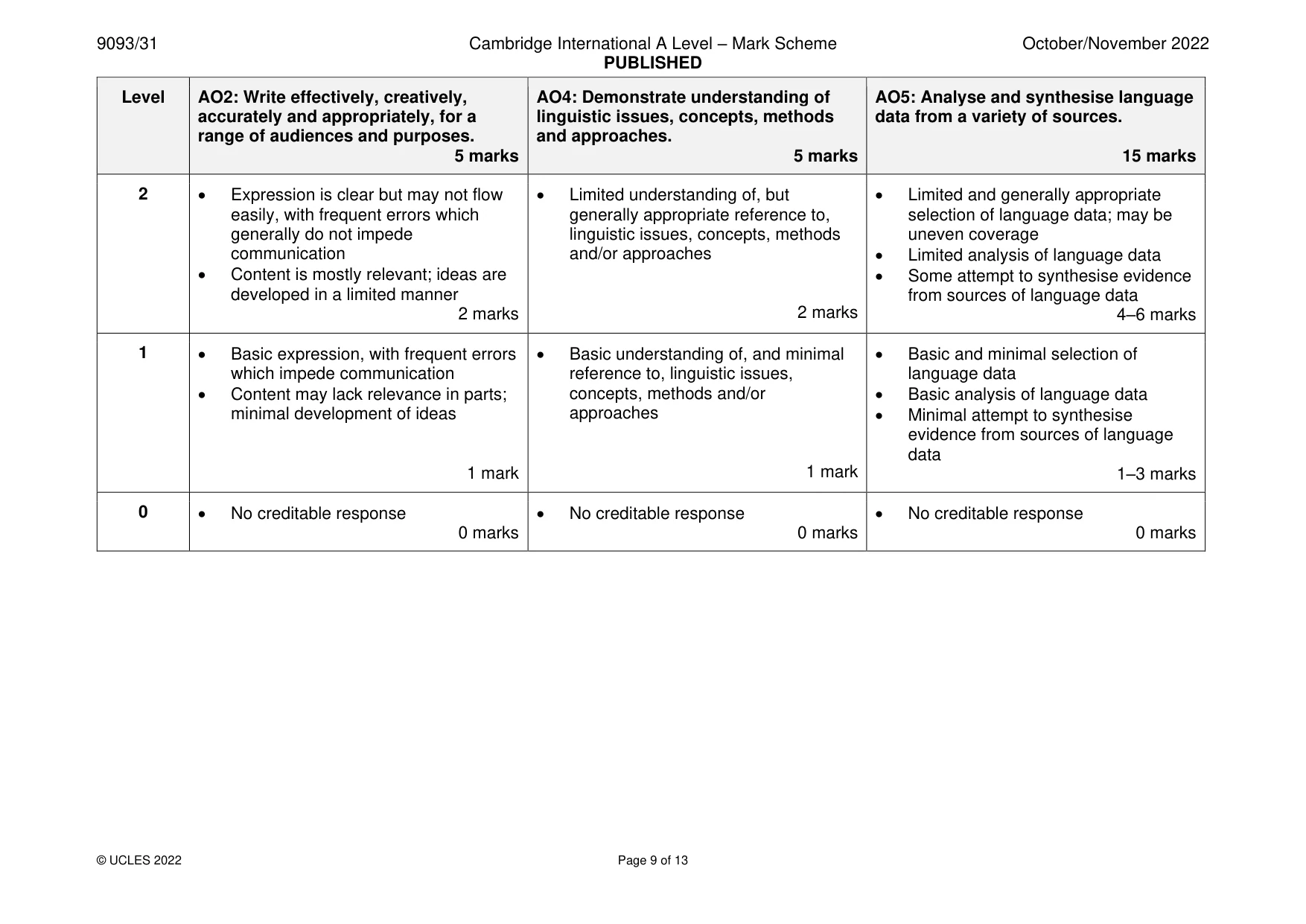
9093/31 Cambridge International A Level – Mark Scheme PUBLISHED October/November 2022 © UCLES 2022 Page 9 of 13 Level AO2: Write effectively, creatively, accurately and appropriately, for a range of audiences and purposes. 5 marks AO4: Demonstrate understanding of linguistic issues, concepts, methods and approaches. 5 marks AO5: Analyse and synthesise language data from a variety of sources. 15 marks 2 • Expression is clear but may not flow easily, with frequent errors which generally do not impede communication • Content is mostly relevant; ideas are developed in a limited manner 2 marks • Limited understanding of, but generally appropriate reference to, linguistic issues, concepts, methods and/or approaches 2 marks • Limited and generally appropriate selection of language data; may be uneven coverage • Limited analysis of language data • Some attempt to synthesise evidence from sources of language data 4–6 marks 1 • Basic expression, with frequent errors which impede communication • Content may lack relevance in parts; minimal development of ideas 1 mark • Basic understanding of, and minimal reference to, linguistic issues, concepts, methods and/or approaches 1 mark • Basic and minimal selection of language data • Basic analysis of language data • Minimal attempt to synthesise evidence from sources of language data 1–3 marks 0 • No creditable response 0 marks • No creditable response 0 marks • No creditable response 0 marks
Mark scheme, page 10
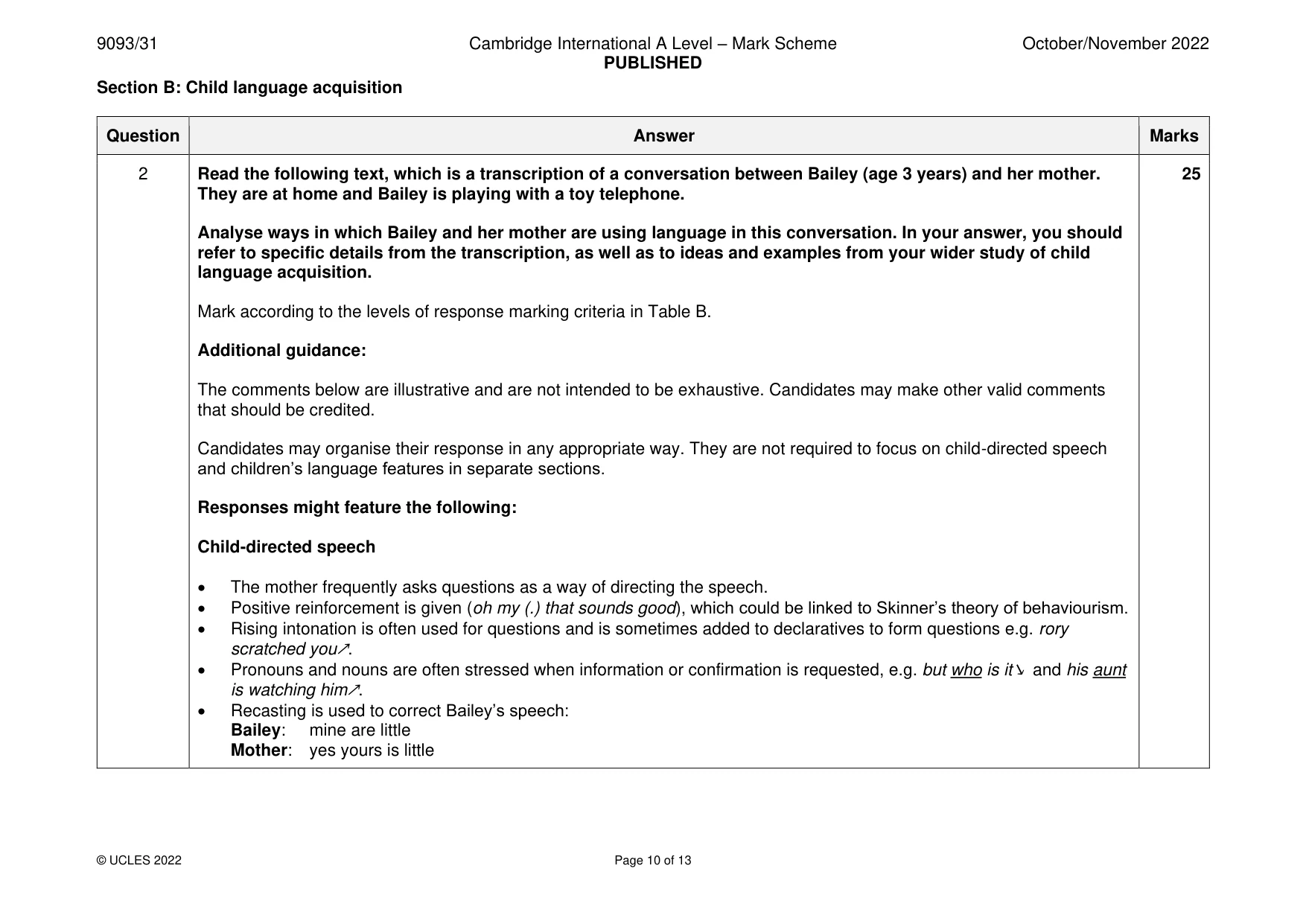
9093/31 Cambridge International A Level – Mark Scheme PUBLISHED October/November 2022 © UCLES 2022 Page 10 of 13 Section B: Child language acquisition Question Answer Marks 2 Read the following text, which is a transcription of a conversation between Bailey (age 3 years) and her mother. They are at home and Bailey is playing with a toy telephone. Analyse ways in which Bailey and her mother are using language in this conversation. In your answer, you should refer to specific details from the transcription, as well as to ideas and examples from your wider study of child language acquisition. Mark according to the levels of response marking criteria in Table B. Additional guidance: The comments below are illustrative and are not intended to be exhaustive. Candidates may make other valid comments that should be credited. Candidates may organise their response in any appropriate way. They are not required to focus on child-directed speech and children’s language features in separate sections. Responses might feature the following: Child-directed speech • The mother frequently asks questions as a way of directing the speech. • Positive reinforcement is given (oh my (.) that sounds good), which could be linked to Skinner’s theory of behaviourism. • Rising intonation is often used for questions and is sometimes added to declaratives to form questions e.g. rory scratched you↗. • Pronouns and nouns are often stressed when information or confirmation is requested, e.g. but who is it↘ and his aunt is watching him↗. • Recasting is used to correct Bailey’s speech: Bailey: mine are little Mother: yes yours is little 25
Mark scheme, page 11
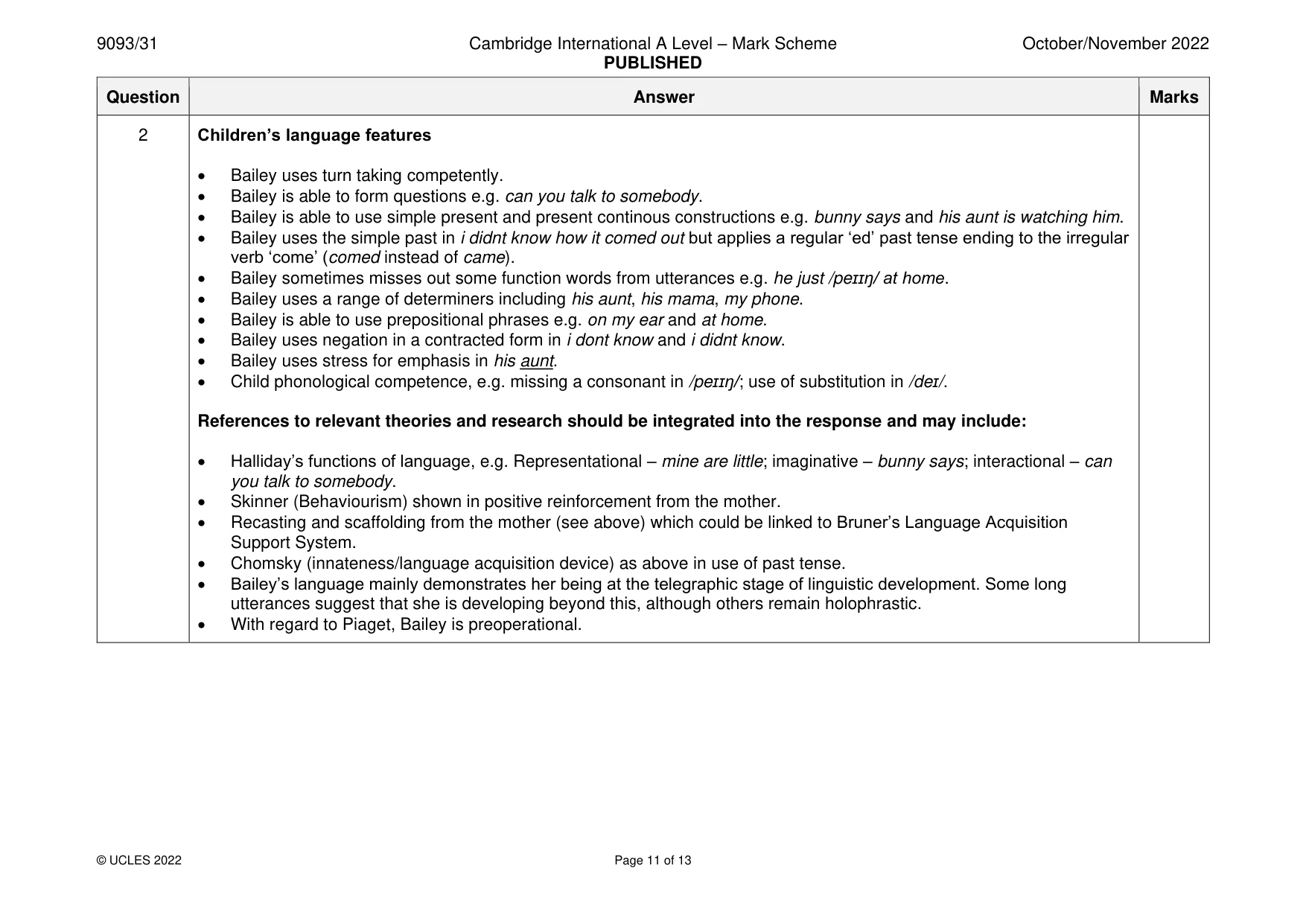
9093/31 Cambridge International A Level – Mark Scheme PUBLISHED October/November 2022 © UCLES 2022 Page 11 of 13 Question Answer Marks 2 Children’s language features • Bailey uses turn taking competently. • Bailey is able to form questions e.g. can you talk to somebody. • Bailey is able to use simple present and present continous constructions e.g. bunny says and his aunt is watching him. • Bailey uses the simple past in i didnt know how it comed out but applies a regular ‘ed’ past tense ending to the irregular verb ‘come’ (comed instead of came). • Bailey sometimes misses out some function words from utterances e.g. he just /peɪɪŋ/ at home. • Bailey uses a range of determiners including his aunt, his mama, my phone. • Bailey is able to use prepositional phrases e.g. on my ear and at home. • Bailey uses negation in a contracted form in i dont know and i didnt know. • Bailey uses stress for emphasis in his aunt. • Child phonological competence, e.g. missing a consonant in /peɪɪŋ/; use of substitution in /deɪ/. References to relevant theories and research should be integrated into the response and may include: • Halliday’s functions of language, e.g. Representational – mine are little; imaginative – bunny says; interactional – can you talk to somebody. • Skinner (Behaviourism) shown in positive reinforcement from the mother. • Recasting and scaffolding from the mother (see above) which could be linked to Bruner’s Language Acquisition Support System. • Chomsky (innateness/language acquisition device) as above in use of past tense. • Bailey’s language mainly demonstrates her being at the telegraphic stage of linguistic development. Some long utterances suggest that she is developing beyond this, although others remain holophrastic. • With regard to Piaget, Bailey is preoperational.
Mark scheme, page 12
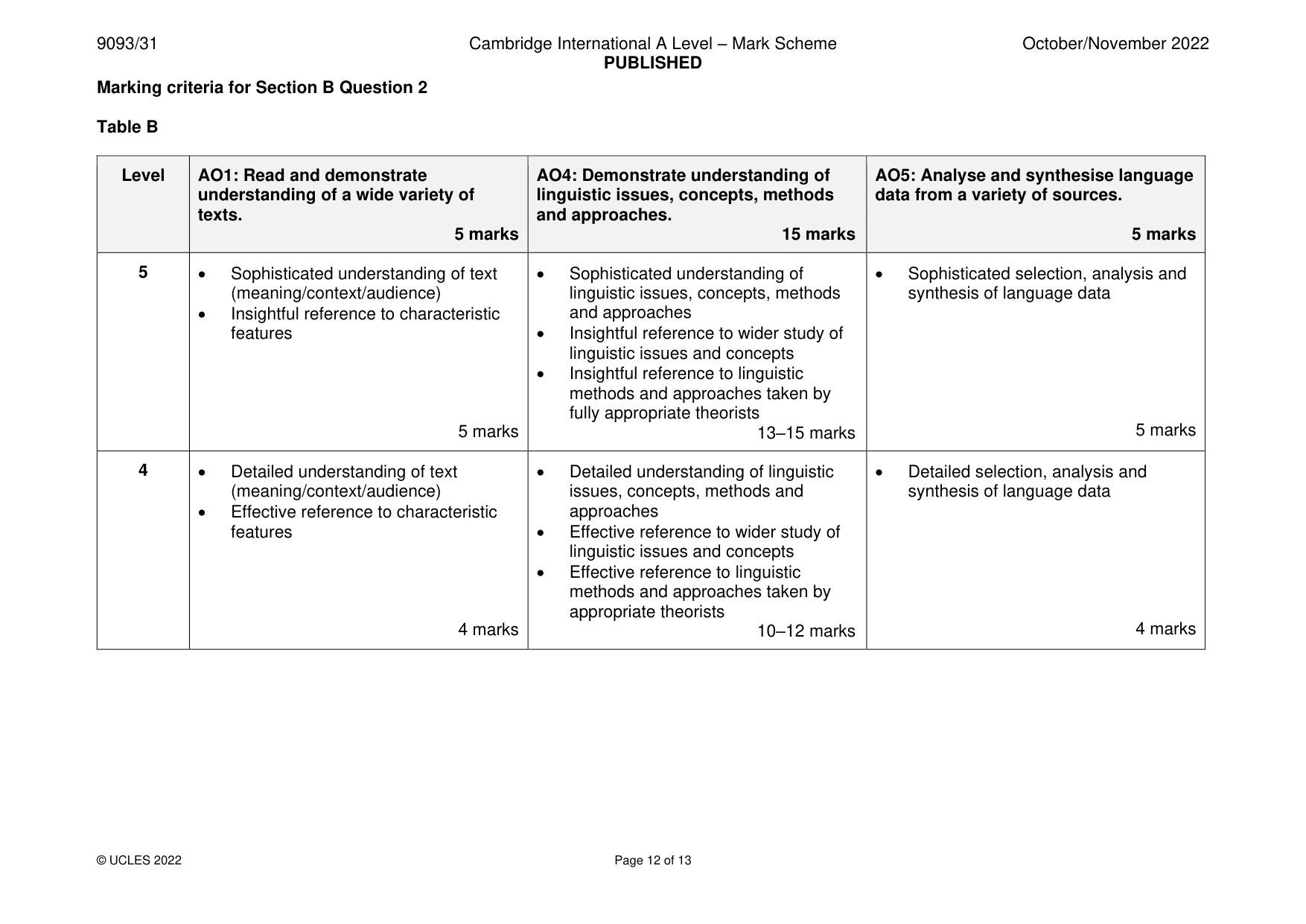
9093/31 Cambridge International A Level – Mark Scheme PUBLISHED October/November 2022 © UCLES 2022 Page 12 of 13 Marking criteria for Section B Question 2 Table B Level AO1: Read and demonstrate understanding of a wide variety of texts. 5 marks AO4: Demonstrate understanding of linguistic issues, concepts, methods and approaches. 15 marks AO5: Analyse and synthesise language data from a variety of sources. 5 marks 5 • Sophisticated understanding of text (meaning/context/audience) • Insightful reference to characteristic features 5 marks • Sophisticated understanding of linguistic issues, concepts, methods and approaches • Insightful reference to wider study of linguistic issues and concepts • Insightful reference to linguistic methods and approaches taken by fully appropriate theorists 13–15 marks • Sophisticated selection, analysis and synthesis of language data 5 marks 4 • Detailed understanding of text (meaning/context/audience) • Effective reference to characteristic features 4 marks • Detailed understanding of linguistic issues, concepts, methods and approaches • Effective reference to wider study of linguistic issues and concepts • Effective reference to linguistic methods and approaches taken by appropriate theorists 10–12 marks • Detailed selection, analysis and synthesis of language data 4 marks
Mark scheme, page 13
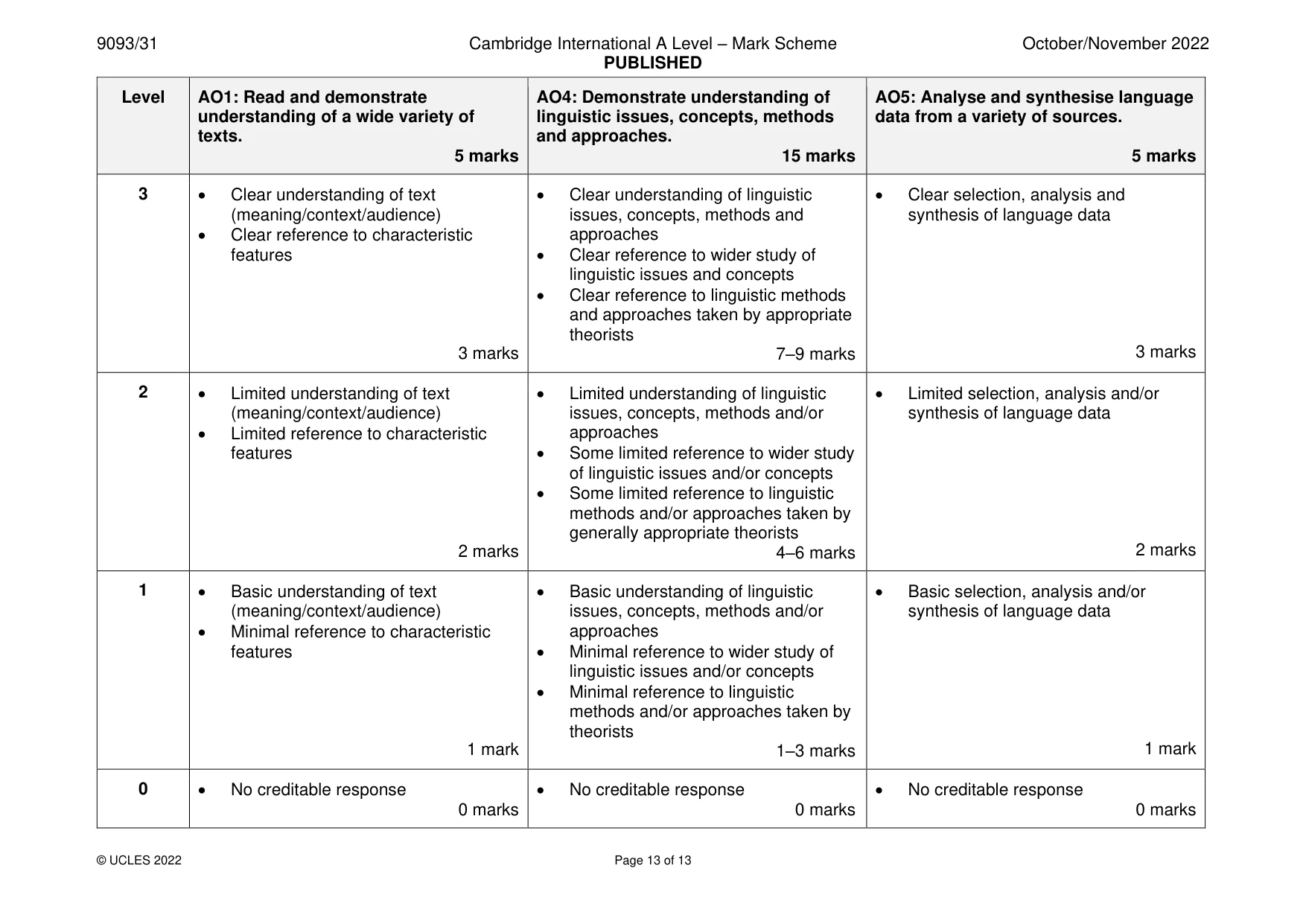
9093/31 Cambridge International A Level – Mark Scheme PUBLISHED October/November 2022 © UCLES 2022 Page 13 of 13 Level AO1: Read and demonstrate understanding of a wide variety of texts. 5 marks AO4: Demonstrate understanding of linguistic issues, concepts, methods and approaches. 15 marks AO5: Analyse and synthesise language data from a variety of sources. 5 marks 3 • Clear understanding of text (meaning/context/audience) • Clear reference to characteristic features 3 marks • Clear understanding of linguistic issues, concepts, methods and approaches • Clear reference to wider study of linguistic issues and concepts • Clear reference to linguistic methods and approaches taken by appropriate theorists 7–9 marks • Clear selection, analysis and synthesis of language data 3 marks 2 • Limited understanding of text (meaning/context/audience) • Limited reference to characteristic features 2 marks • Limited understanding of linguistic issues, concepts, methods and/or approaches • Some limited reference to wider study of linguistic issues and/or concepts • Some limited reference to linguistic methods and/or approaches taken by generally appropriate theorists 4–6 marks • Limited selection, analysis and/or synthesis of language data 2 marks 1 • Basic understanding of text (meaning/context/audience) • Minimal reference to characteristic features 1 mark • Basic understanding of linguistic issues, concepts, methods and/or approaches • Minimal reference to wider study of linguistic issues and/or concepts • Minimal reference to linguistic methods and/or approaches taken by theorists 1–3 marks • Basic selection, analysis and/or synthesis of language data 1 mark 0 • No creditable response 0 marks • No creditable response 0 marks • No creditable response 0 marks
What you needed in this session
Cambridge’s own grade thresholds for 2022 Oct/Nov, Paper 3 · Variant 1. A higher threshold means an easier paper — the bar moves with how the cohort did.