Cambridge A Level English - Language AS and A Level (from 2014) 9093 — 2021 Oct/Nov Paper 3 · Variant 2
9093/32/O/N/21 · 50 marks · ≈56 min
The question paper and its mark scheme, free to read here and free to download. This is Cambridge’s own paper, exactly as it was sat.
Question paper8 pages
Mark scheme13 pages
Answers below. Sit the paper first if you are practising.
Paper as text
Question paper, page 1
This document has 8 pages. Cambridge International AS & A Level ENGLISH LANGUAGE 9093/32 Paper 3 Language Analysis October/November 2021 2 hours 15 minutes You must answer on the enclosed answer booklet. You will need: Answer booklet (enclosed) INSTRUCTIONS ● Answer all questions. ● Follow the instructions on the front cover of the answer booklet. If you need additional answer paper, ask the invigilator for a continuation booklet. ● Dictionaries are not allowed. INFORMATION ● The total mark for this paper is 50. ● The number of marks for each question or part question is shown in brackets [ ]. DC (LK/CB) 201563/4 © UCLES 2021 [Turn over * 8 7 6 5 9 5 0 5 3 6 *
Question paper, page 2
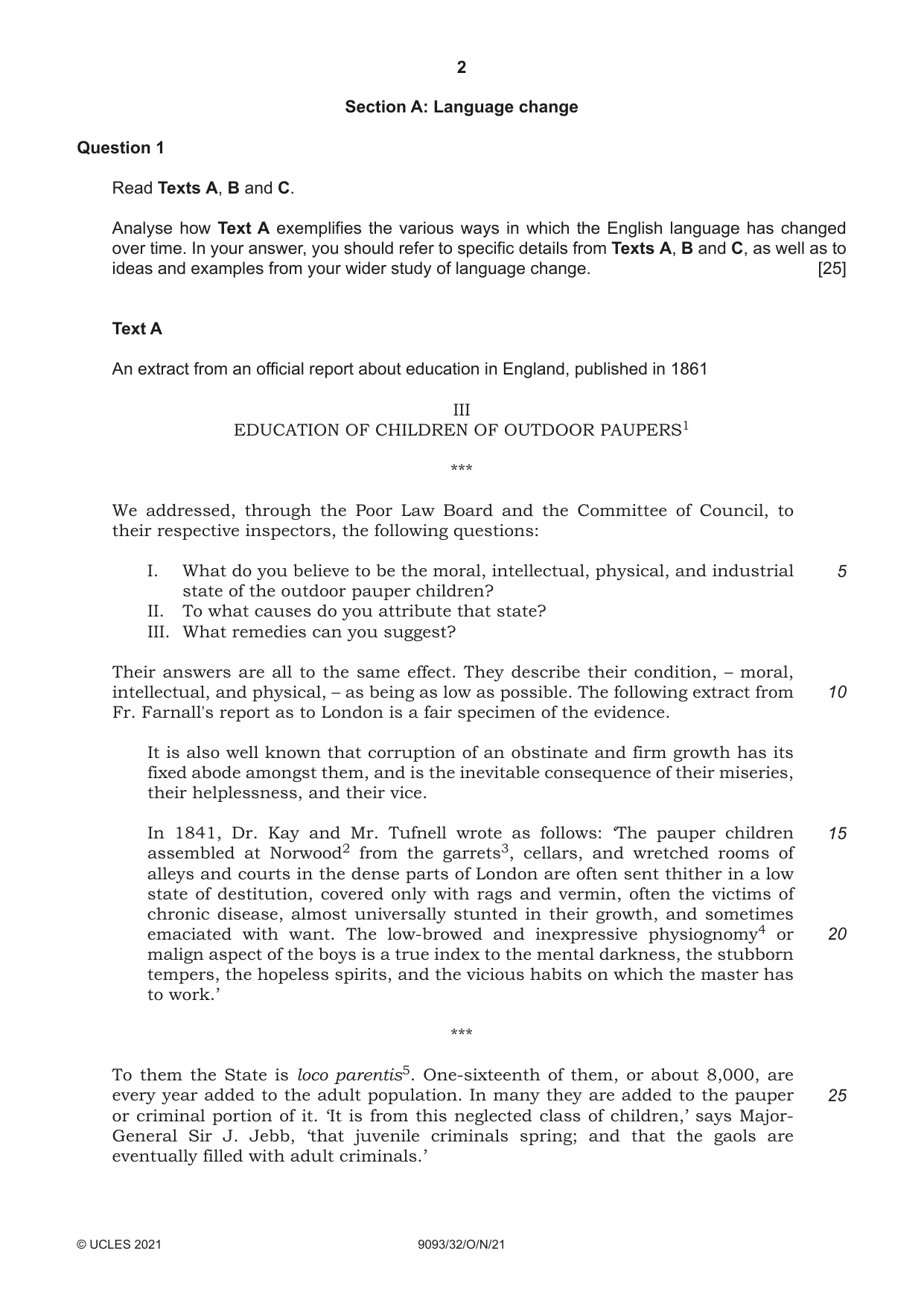
2 9093/32/O/N/21 © UCLES 2021 Section A: Language change Question 1 Read Texts A, B and C. Analyse how Text A exemplifies the various ways in which the English language has changed over time. In your answer, you should refer to specific details from Texts A, B and C, as well as to ideas and examples from your wider study of language change. [25] Text A An extract from an official report about education in England, published in 1861 III EDUCATION OF CHILDREN OF OUTDOOR PAUPERS1 *** We addressed, through the Poor Law Board and the Committee of Council, to their respective inspectors, the following questions: I. What do you believe to be the moral, intellectual, physical, and industrial state of the outdoor pauper children? II. To what causes do you attribute that state? III. What remedies can you suggest? Their answers are all to the same effect. They describe their condition, – moral, intellectual, and physical, – as being as low as possible. The following extract from Fr. Farnall's report as to London is a fair specimen of the evidence. It is also well known that corruption of an obstinate and firm growth has its fixed abode amongst them, and is the inevitable consequence of their miseries, their helplessness, and their vice. In 1841, Dr. Kay and Mr. Tufnell wrote as follows: ‘The pauper children assembled at Norwood2 from the garrets3, cellars, and wretched rooms of alleys and courts in the dense parts of London are often sent thither in a low state of destitution, covered only with rags and vermin, often the victims of chronic disease, almost universally stunted in their growth, and sometimes emaciated with want. The low-browed and inexpressive physiognomy4 or malign aspect of the boys is a true index to the mental darkness, the stubborn tempers, the hopeless spirits, and the vicious habits on which the master has to work.’ *** To them the State is loco parentis5. One-sixteenth of them, or about 8,000, are every year added to the adult population. In many they are added to the pauper or criminal portion of it. ‘It is from this neglected class of children,’ says Major- General Sir J. Jebb, ‘that juvenile criminals spring; and that the gaols are eventually filled with adult criminals.’ 5 10 15 20 25
Question paper, page 3
3 9093/32/O/N/21 © UCLES 2021 [Turn over As a general rule it may be said that these children, as they grow up, are divided between the gaol and the workhouse6; they form the hereditary pauper and criminal class. If we could withdraw them from the influences which now corrupt them, we should cut off the principal roots of pauperism and crime. We have already shown that all who have considered the subject believe that the creation of district and separate schools is the only remedy for the evils of the workhouse schools. Notes: 1paupers: people living in poverty 2Norwood: the name of an orphanage 3garrets: small attic rooms 4physiognomy: the physical appearance of the face 5loco parentis: Latin for ‘in the place of a parent’ 6workhouse: buildings where, from the 17th to early 20th centuries, people who were too poor to afford housing would work in exchange for food and lodging. 30 35
Question paper, page 4
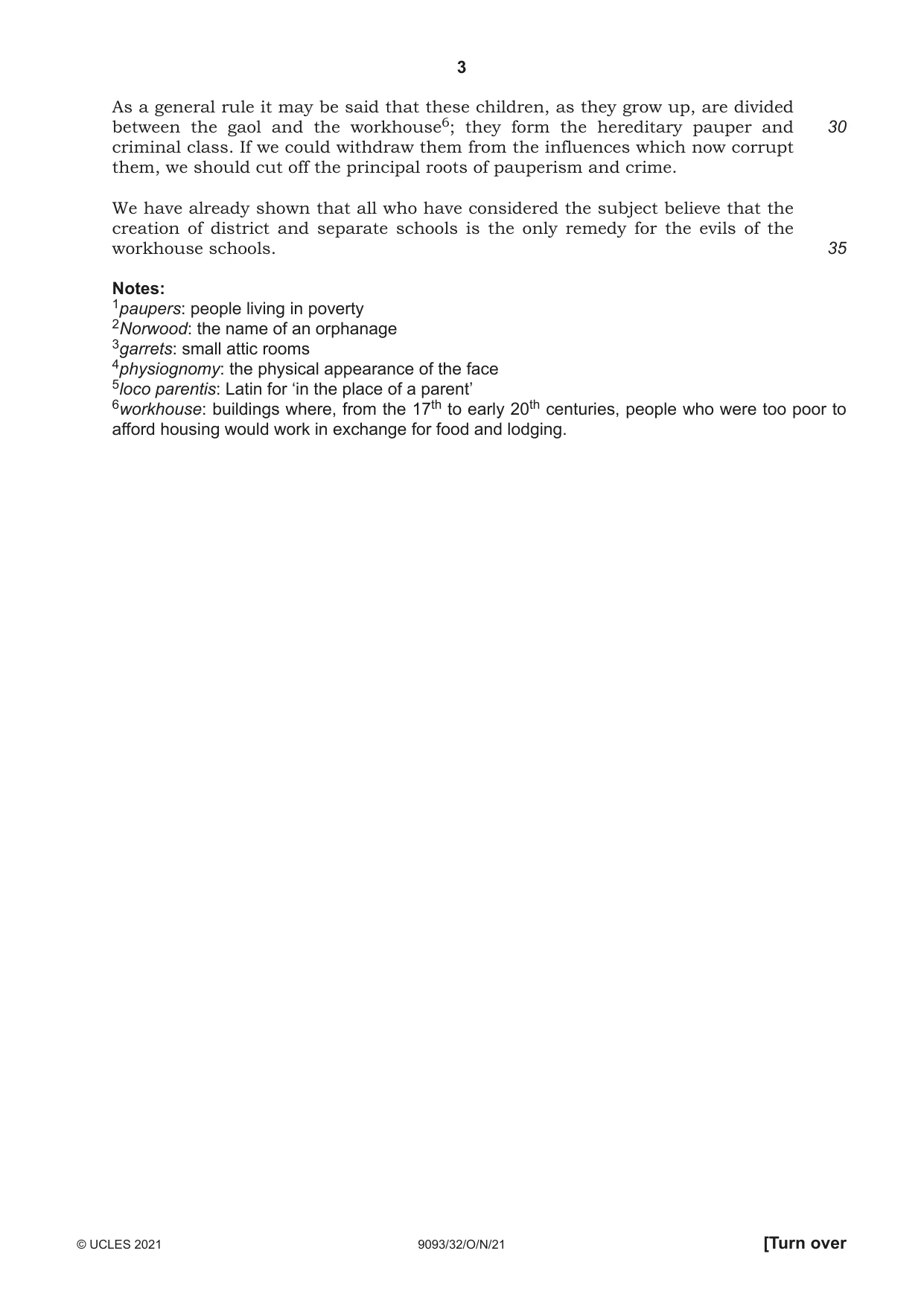
4 9093/32/O/N/21 © UCLES 2021 Text B The top six nouns used alongside ‘class’ with ‘and’/‘or’, from the English Historical Book Collection corpus (books from 1473 to 1800) and in the English Web 2015 corpus (texts collected from the internet in 2015) ‘class and/or …’ 1473–1800 ‘class and/or …’ 2015 rankes race century workshop rank gender division seminar nobility group sort ethnicity
Question paper, page 5
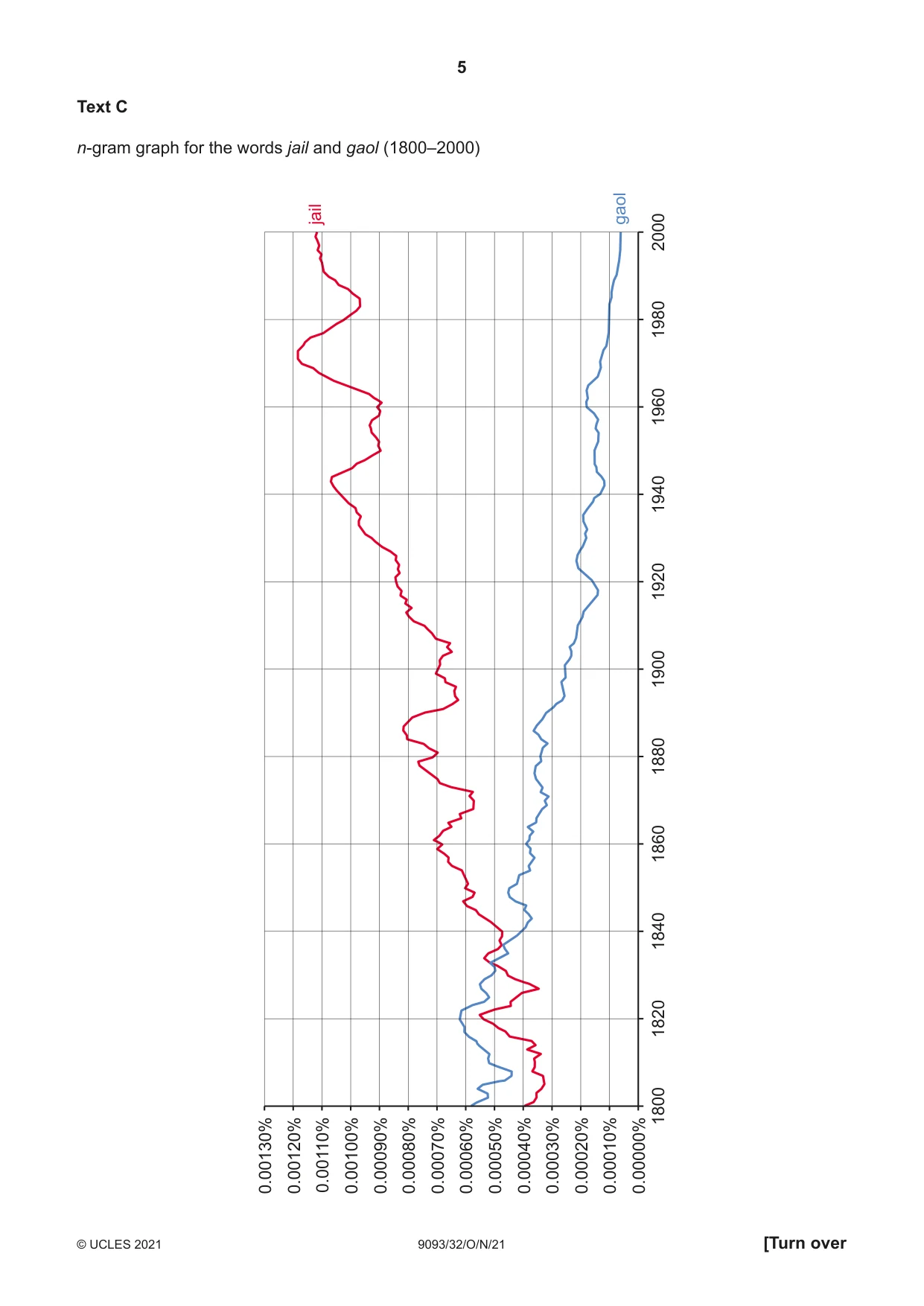
5 9093/32/O/N/21 © UCLES 2021 [Turn over Text C n-gram graph for the words jail and gaol (1800–2000) 1800 0.00000% 0.00010% 0.00020% 0.00030% 0.00040% 0.00050% 0.00060% 0.00070% 0.00080% 0.00090% 0.00100% 0.00110% 0.00120% 0.00130% 1820 1840 1860 1880 1900 1920 1940 1960 1980 2000 gaol jail
Question paper, page 6
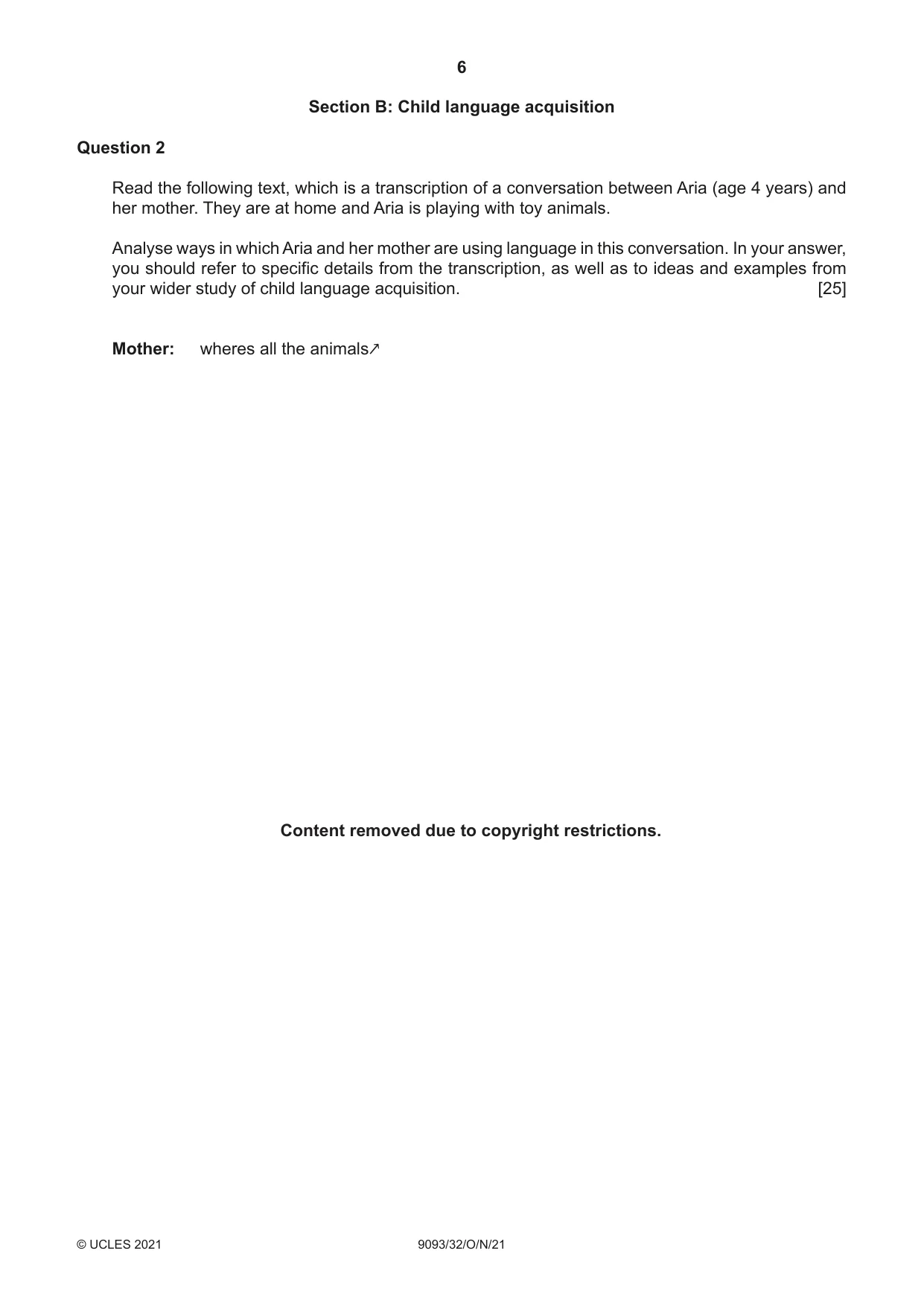
6 9093/32/O/N/21 © UCLES 2021 Section B: Child language acquisition Question 2 Read the following text, which is a transcription of a conversation between Aria (age 4 years) and her mother. They are at home and Aria is playing with toy animals. Analyse ways in which Aria and her mother are using language in this conversation. In your answer, you should refer to specific details from the transcription, as well as to ideas and examples from your wider study of child language acquisition. [25] Mother: wheres all the animals↗ Content removed due to copyright restrictions.
Question paper, page 7
7 9093/32/O/N/21 © UCLES 2021 Aria: °thank you° Content removed due to copyright restrictions.
Question paper, page 8
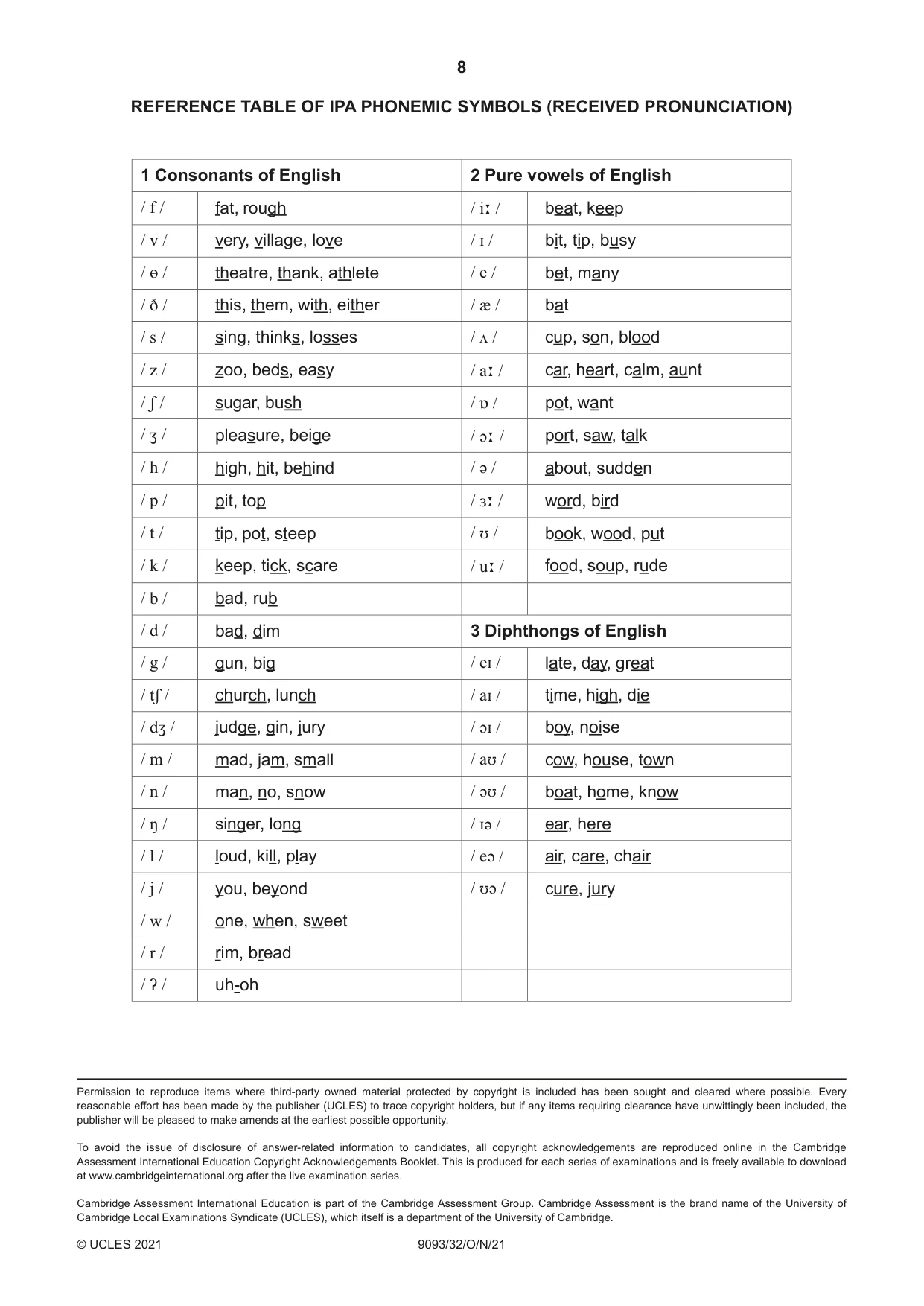
8 9093/32/O/N/21 © UCLES 2021 Permission to reproduce items where third-party owned material protected by copyright is included has been sought and cleared where possible. Every reasonable effort has been made by the publisher (UCLES) to trace copyright holders, but if any items requiring clearance have unwittingly been included, the publisher will be pleased to make amends at the earliest possible opportunity. To avoid the issue of disclosure of answer-related information to candidates, all copyright acknowledgements are reproduced online in the Cambridge Assessment International Education Copyright Acknowledgements Booklet. This is produced for each series of examinations and is freely available to download at www.cambridgeinternational.org after the live examination series. Cambridge Assessment International Education is part of the Cambridge Assessment Group. Cambridge Assessment is the brand name of the University of Cambridge Local Examinations Syndicate (UCLES), which itself is a department of the University of Cambridge. REFERENCE TABLE OF IPA PHONEMIC SYMBOLS (RECEIVED PRONUNCIATION) 1 Consonants of English 2 Pure vowels of English / f / fat, rough / iː / beat, keep / v / very, village, love / ɪ / bit, tip, busy / ɵ / theatre, thank, athlete / e / bet, many / ð / this, them, with, either / æ / bat / s / sing, thinks, losses / ʌ / cup, son, blood / z / zoo, beds, easy / aː / car, heart, calm, aunt / ʃ / sugar, bush / ɒ / pot, want / ʒ / pleasure, beige / ɔː / port, saw, talk / h / high, hit, behind / ə / about, sudden / p / pit, top / ɜː / word, bird / t / tip, pot, steep / ʊ / book, wood, put / k / keep, tick, scare / uː / food, soup, rude / b / bad, rub / d / bad, dim 3 Diphthongs of English / g / gun, big / eɪ / late, day, great / tʃ / church, lunch / aɪ / time, high, die / dʒ / judge, gin, jury / ɔɪ / boy, noise / m / mad, jam, small / aʊ / cow, house, town / n / man, no, snow / əʊ / boat, home, know / ŋ / singer, long / ɪə / ear, here / l / loud, kill, play / eə / air, care, chair / j / you, beyond / ʊə / cure, jury / w / one, when, sweet / r / rim, bread / ʔ / uh-oh
Mark scheme, page 1
This document consists of 13 printed pages. © UCLES 2021 [Turn over Cambridge International A Level ENGLISH LANGUAGE 9093/32 Paper 3 Language Analysis October/November 2021 MARK SCHEME Maximum Mark: 50 Published This mark scheme is published as an aid to teachers and candidates, to indicate the requirements of the examination. It shows the basis on which Examiners were instructed to award marks. It does not indicate the details of the discussions that took place at an Examiners’ meeting before marking began, which would have considered the acceptability of alternative answers. Mark schemes should be read in conjunction with the question paper and the Principal Examiner Report for Teachers. Cambridge International will not enter into discussions about these mark schemes. Cambridge International is publishing the mark schemes for the October/November 2021 series for most Cambridge IGCSE™, Cambridge International A and AS Level components and some Cambridge O Level components.
Mark scheme, page 2
9093/32 Cambridge International A Level – Mark Scheme PUBLISHED October/November 2021 © UCLES 2021 Page 2 of 13 Generic Marking Principles These general marking principles must be applied by all examiners when marking candidate answers. They should be applied alongside the specific content of the mark scheme or generic level descriptors for a question. Each question paper and mark scheme will also comply with these marking principles. GENERIC MARKING PRINCIPLE 1: Marks must be awarded in line with: • the specific content of the mark scheme or the generic level descriptors for the question • the specific skills defined in the mark scheme or in the generic level descriptors for the question • the standard of response required by a candidate as exemplified by the standardisation scripts. GENERIC MARKING PRINCIPLE 2: Marks awarded are always whole marks (not half marks, or other fractions). GENERIC MARKING PRINCIPLE 3: Marks must be awarded positively: • marks are awarded for correct/valid answers, as defined in the mark scheme. However, credit is given for valid answers which go beyond the scope of the syllabus and mark scheme, referring to your Team Leader as appropriate • marks are awarded when candidates clearly demonstrate what they know and can do • marks are not deducted for errors • marks are not deducted for omissions • answers should only be judged on the quality of spelling, punctuation and grammar when these features are specifically assessed by the question as indicated by the mark scheme. The meaning, however, should be unambiguous. GENERIC MARKING PRINCIPLE 4: Rules must be applied consistently, e.g. in situations where candidates have not followed instructions or in the application of generic level descriptors.
Mark scheme, page 3
9093/32 Cambridge International A Level – Mark Scheme PUBLISHED October/November 2021 © UCLES 2021 Page 3 of 13 GENERIC MARKING PRINCIPLE 5: Marks should be awarded using the full range of marks defined in the mark scheme for the question (however; the use of the full mark range may be limited according to the quality of the candidate responses seen). GENERIC MARKING PRINCIPLE 6: Marks awarded are based solely on the requirements as defined in the mark scheme. Marks should not be awarded with grade thresholds or grade descriptors in mind.
Mark scheme, page 4
9093/32 Cambridge International A Level – Mark Scheme PUBLISHED October/November 2021 © UCLES 2021 Page 4 of 13 English & Media subject specific general marking principles (To be read in conjunction with the Generic Marking Principles (and requiring further guidance on how to place marks within levels)) Components using level descriptors: • We use level descriptors as a guide to broad understanding of the qualities normally expected of, or typical of, work in a level. • Level descriptors are a means of general guidance, and should not be interpreted as hurdle statements. • Where indicative content notes are supplied for a question, these are not a prescription of required content, and must not be treated as such. Alternative correct points and unexpected answers in candidates’ scripts must be given marks that fairly reflect the knowledge and skills demonstrated. • While we may have legitimate expectations as to the ground most answers may occupy, we must at all times be prepared to meet candidates on their chosen ground, provided it is relevant ground (e.g. clearly related to and derived from a relevant passage/text and meeting the mark scheme requirements for the question).
Mark scheme, page 5
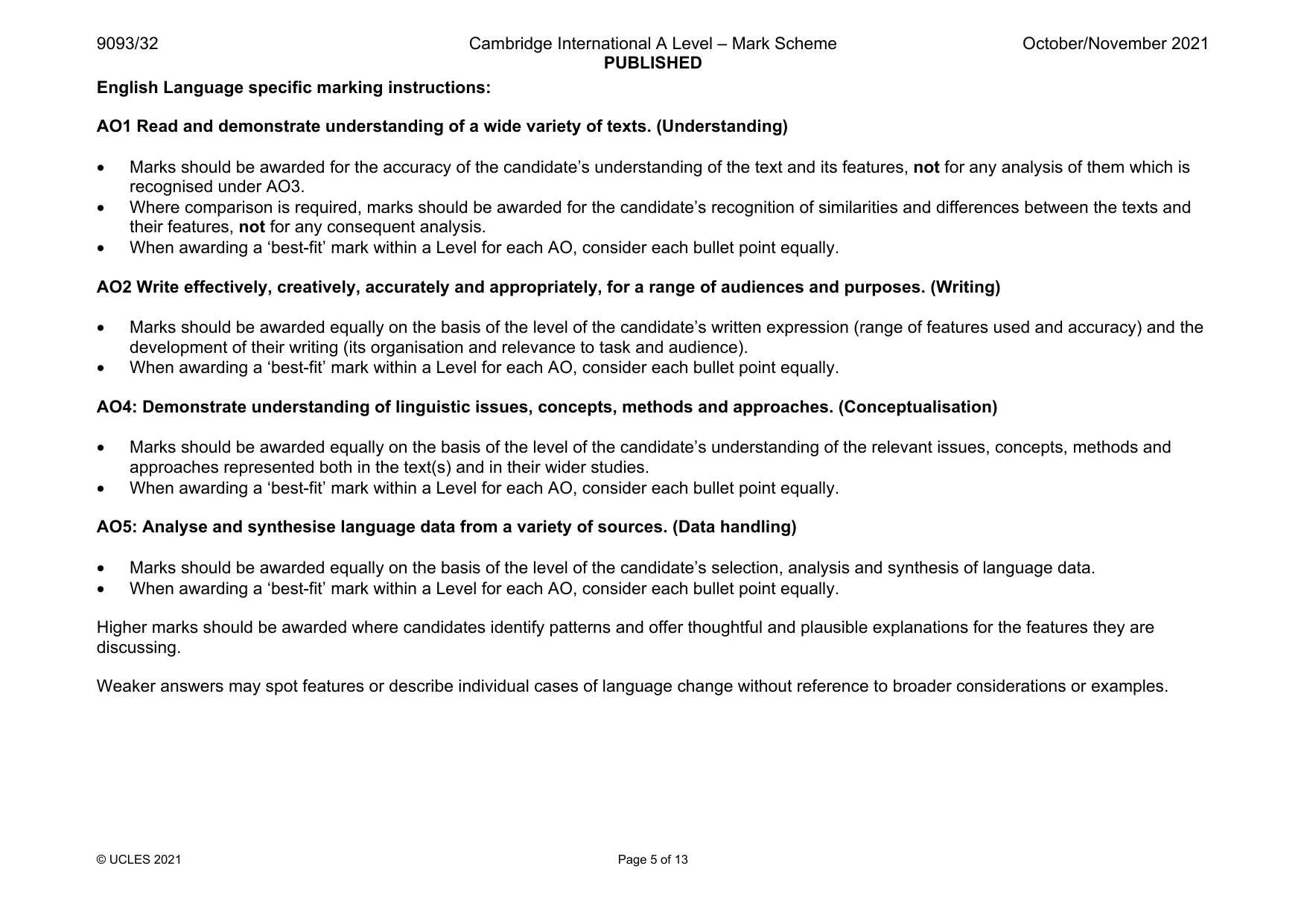
9093/32 Cambridge International A Level – Mark Scheme PUBLISHED October/November 2021 © UCLES 2021 Page 5 of 13 English Language specific marking instructions: AO1 Read and demonstrate understanding of a wide variety of texts. (Understanding) • Marks should be awarded for the accuracy of the candidate’s understanding of the text and its features, not for any analysis of them which is recognised under AO3. • Where comparison is required, marks should be awarded for the candidate’s recognition of similarities and differences between the texts and their features, not for any consequent analysis. • When awarding a ‘best-fit’ mark within a Level for each AO, consider each bullet point equally. AO2 Write effectively, creatively, accurately and appropriately, for a range of audiences and purposes. (Writing) • Marks should be awarded equally on the basis of the level of the candidate’s written expression (range of features used and accuracy) and the development of their writing (its organisation and relevance to task and audience). • When awarding a ‘best-fit’ mark within a Level for each AO, consider each bullet point equally. AO4: Demonstrate understanding of linguistic issues, concepts, methods and approaches. (Conceptualisation) • Marks should be awarded equally on the basis of the level of the candidate’s understanding of the relevant issues, concepts, methods and approaches represented both in the text(s) and in their wider studies. • When awarding a ‘best-fit’ mark within a Level for each AO, consider each bullet point equally. AO5: Analyse and synthesise language data from a variety of sources. (Data handling) • Marks should be awarded equally on the basis of the level of the candidate’s selection, analysis and synthesis of language data. • When awarding a ‘best-fit’ mark within a Level for each AO, consider each bullet point equally. Higher marks should be awarded where candidates identify patterns and offer thoughtful and plausible explanations for the features they are discussing. Weaker answers may spot features or describe individual cases of language change without reference to broader considerations or examples.
Mark scheme, page 6
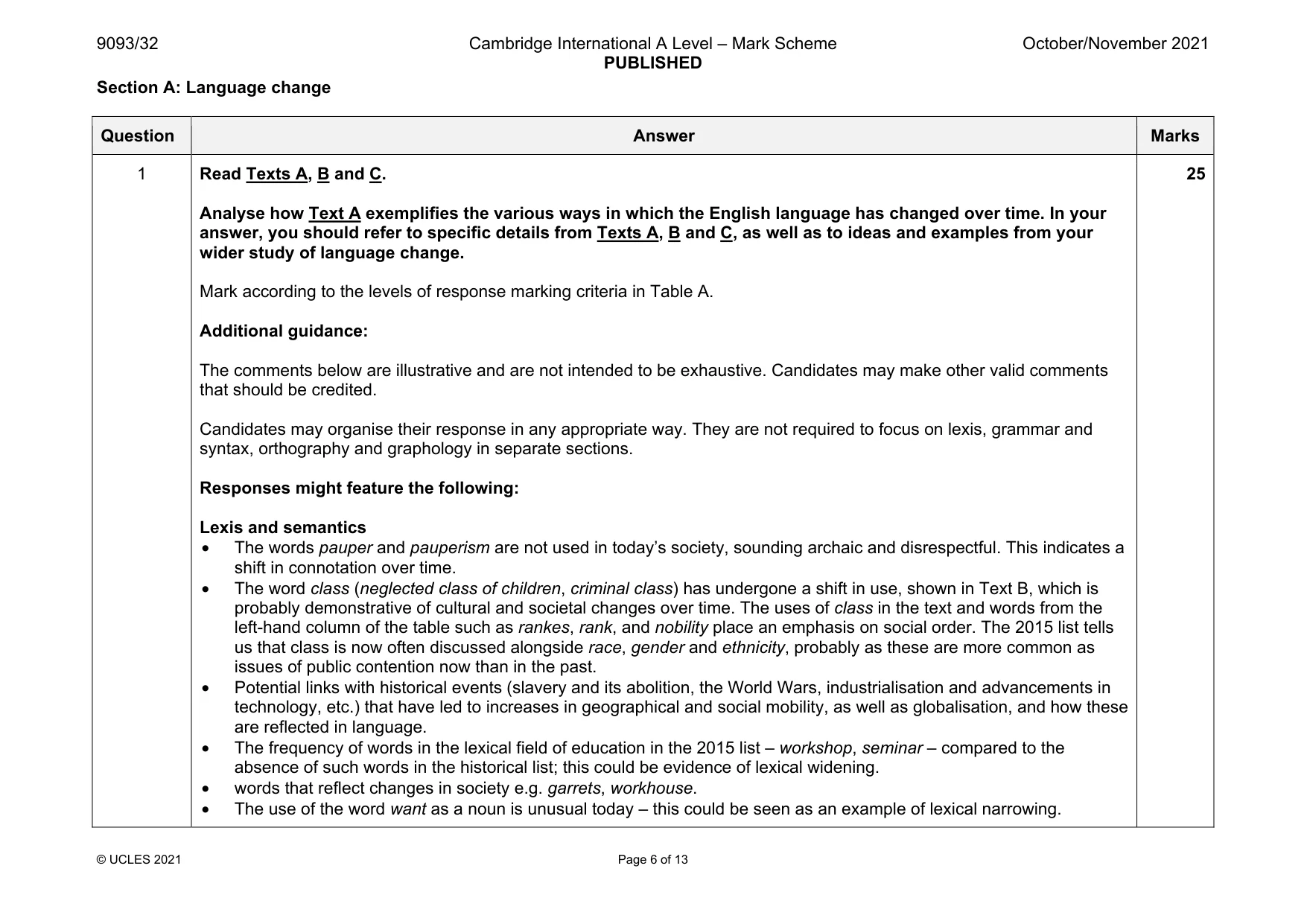
9093/32 Cambridge International A Level – Mark Scheme PUBLISHED October/November 2021 © UCLES 2021 Page 6 of 13 Section A: Language change Question Answer Marks 1 Read Texts A, B and C. Analyse how Text A exemplifies the various ways in which the English language has changed over time. In your answer, you should refer to specific details from Texts A, B and C, as well as to ideas and examples from your wider study of language change. Mark according to the levels of response marking criteria in Table A. Additional guidance: The comments below are illustrative and are not intended to be exhaustive. Candidates may make other valid comments that should be credited. Candidates may organise their response in any appropriate way. They are not required to focus on lexis, grammar and syntax, orthography and graphology in separate sections. Responses might feature the following: Lexis and semantics • The words pauper and pauperism are not used in today’s society, sounding archaic and disrespectful. This indicates a shift in connotation over time. • The word class (neglected class of children, criminal class) has undergone a shift in use, shown in Text B, which is probably demonstrative of cultural and societal changes over time. The uses of class in the text and words from the left-hand column of the table such as rankes, rank, and nobility place an emphasis on social order. The 2015 list tells us that class is now often discussed alongside race, gender and ethnicity, probably as these are more common as issues of public contention now than in the past. • Potential links with historical events (slavery and its abolition, the World Wars, industrialisation and advancements in technology, etc.) that have led to increases in geographical and social mobility, as well as globalisation, and how these are reflected in language. • The frequency of words in the lexical field of education in the 2015 list – workshop, seminar – compared to the absence of such words in the historical list; this could be evidence of lexical widening. • words that reflect changes in society e.g. garrets, workhouse. • The use of the word want as a noun is unusual today – this could be seen as an example of lexical narrowing. 25
Mark scheme, page 7
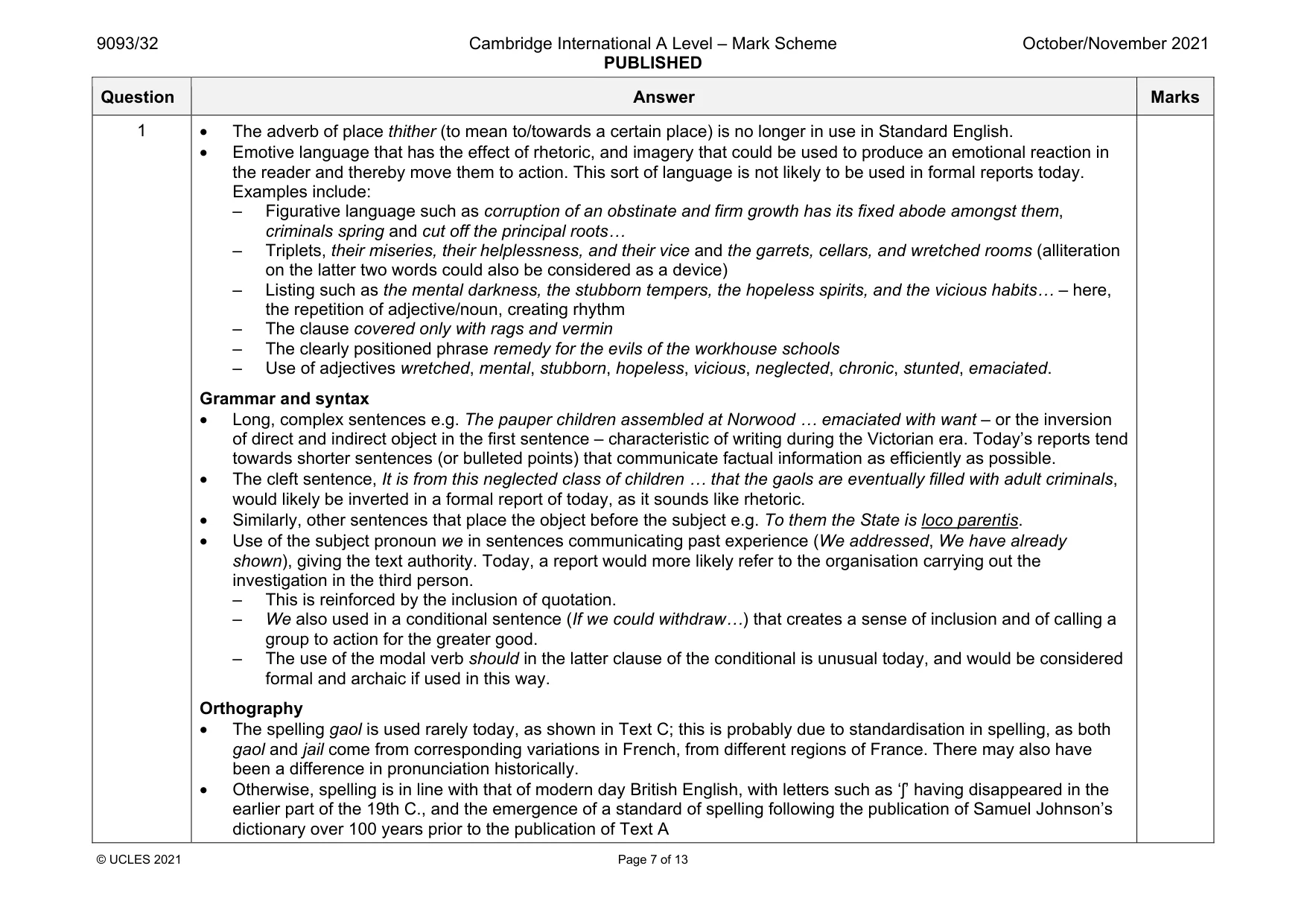
9093/32 Cambridge International A Level – Mark Scheme PUBLISHED October/November 2021 © UCLES 2021 Page 7 of 13 Question Answer Marks 1 • The adverb of place thither (to mean to/towards a certain place) is no longer in use in Standard English. • Emotive language that has the effect of rhetoric, and imagery that could be used to produce an emotional reaction in the reader and thereby move them to action. This sort of language is not likely to be used in formal reports today. Examples include: – Figurative language such as corruption of an obstinate and firm growth has its fixed abode amongst them, criminals spring and cut off the principal roots… – Triplets, their miseries, their helplessness, and their vice and the garrets, cellars, and wretched rooms (alliteration on the latter two words could also be considered as a device) – Listing such as the mental darkness, the stubborn tempers, the hopeless spirits, and the vicious habits… – here, the repetition of adjective/noun, creating rhythm – The clause covered only with rags and vermin – The clearly positioned phrase remedy for the evils of the workhouse schools – Use of adjectives wretched, mental, stubborn, hopeless, vicious, neglected, chronic, stunted, emaciated. Grammar and syntax • Long, complex sentences e.g. The pauper children assembled at Norwood … emaciated with want – or the inversion of direct and indirect object in the first sentence – characteristic of writing during the Victorian era. Today’s reports tend towards shorter sentences (or bulleted points) that communicate factual information as efficiently as possible. • The cleft sentence, It is from this neglected class of children … that the gaols are eventually filled with adult criminals, would likely be inverted in a formal report of today, as it sounds like rhetoric. • Similarly, other sentences that place the object before the subject e.g. To them the State is loco parentis. • Use of the subject pronoun we in sentences communicating past experience (We addressed, We have already shown), giving the text authority. Today, a report would more likely refer to the organisation carrying out the investigation in the third person. – This is reinforced by the inclusion of quotation. – We also used in a conditional sentence (If we could withdraw…) that creates a sense of inclusion and of calling a group to action for the greater good. – The use of the modal verb should in the latter clause of the conditional is unusual today, and would be considered formal and archaic if used in this way. Orthography • The spelling gaol is used rarely today, as shown in Text C; this is probably due to standardisation in spelling, as both gaol and jail come from corresponding variations in French, from different regions of France. There may also have been a difference in pronunciation historically. • Otherwise, spelling is in line with that of modern day British English, with letters such as ‘ʃ’ having disappeared in the earlier part of the 19th C., and the emergence of a standard of spelling following the publication of Samuel Johnson’s dictionary over 100 years prior to the publication of Text A
Mark scheme, page 8
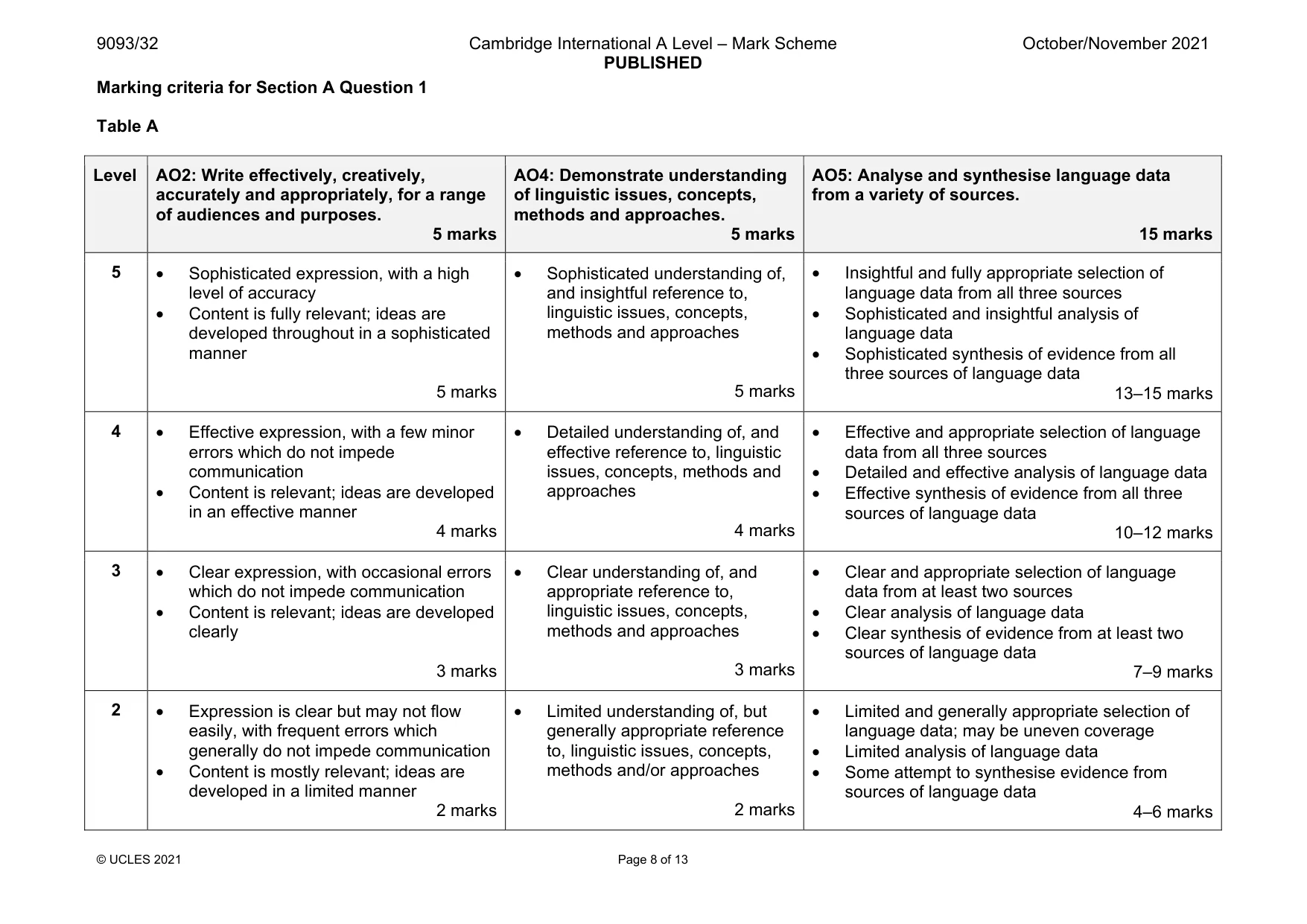
9093/32 Cambridge International A Level – Mark Scheme PUBLISHED October/November 2021 © UCLES 2021 Page 8 of 13 Marking criteria for Section A Question 1 Table A Level AO2: Write effectively, creatively, accurately and appropriately, for a range of audiences and purposes. 5 marks AO4: Demonstrate understanding of linguistic issues, concepts, methods and approaches. 5 marks AO5: Analyse and synthesise language data from a variety of sources. 15 marks 5 • Sophisticated expression, with a high level of accuracy • Content is fully relevant; ideas are developed throughout in a sophisticated manner 5 marks • Sophisticated understanding of, and insightful reference to, linguistic issues, concepts, methods and approaches 5 marks • Insightful and fully appropriate selection of language data from all three sources • Sophisticated and insightful analysis of language data • Sophisticated synthesis of evidence from all three sources of language data 13–15 marks 4 • Effective expression, with a few minor errors which do not impede communication • Content is relevant; ideas are developed in an effective manner 4 marks • Detailed understanding of, and effective reference to, linguistic issues, concepts, methods and approaches 4 marks • Effective and appropriate selection of language data from all three sources • Detailed and effective analysis of language data • Effective synthesis of evidence from all three sources of language data 10–12 marks 3 • Clear expression, with occasional errors which do not impede communication • Content is relevant; ideas are developed clearly 3 marks • Clear understanding of, and appropriate reference to, linguistic issues, concepts, methods and approaches 3 marks • Clear and appropriate selection of language data from at least two sources • Clear analysis of language data • Clear synthesis of evidence from at least two sources of language data 7–9 marks 2 • Expression is clear but may not flow easily, with frequent errors which generally do not impede communication • Content is mostly relevant; ideas are developed in a limited manner 2 marks • Limited understanding of, but generally appropriate reference to, linguistic issues, concepts, methods and/or approaches 2 marks • Limited and generally appropriate selection of language data; may be uneven coverage • Limited analysis of language data • Some attempt to synthesise evidence from sources of language data 4–6 marks
Mark scheme, page 9
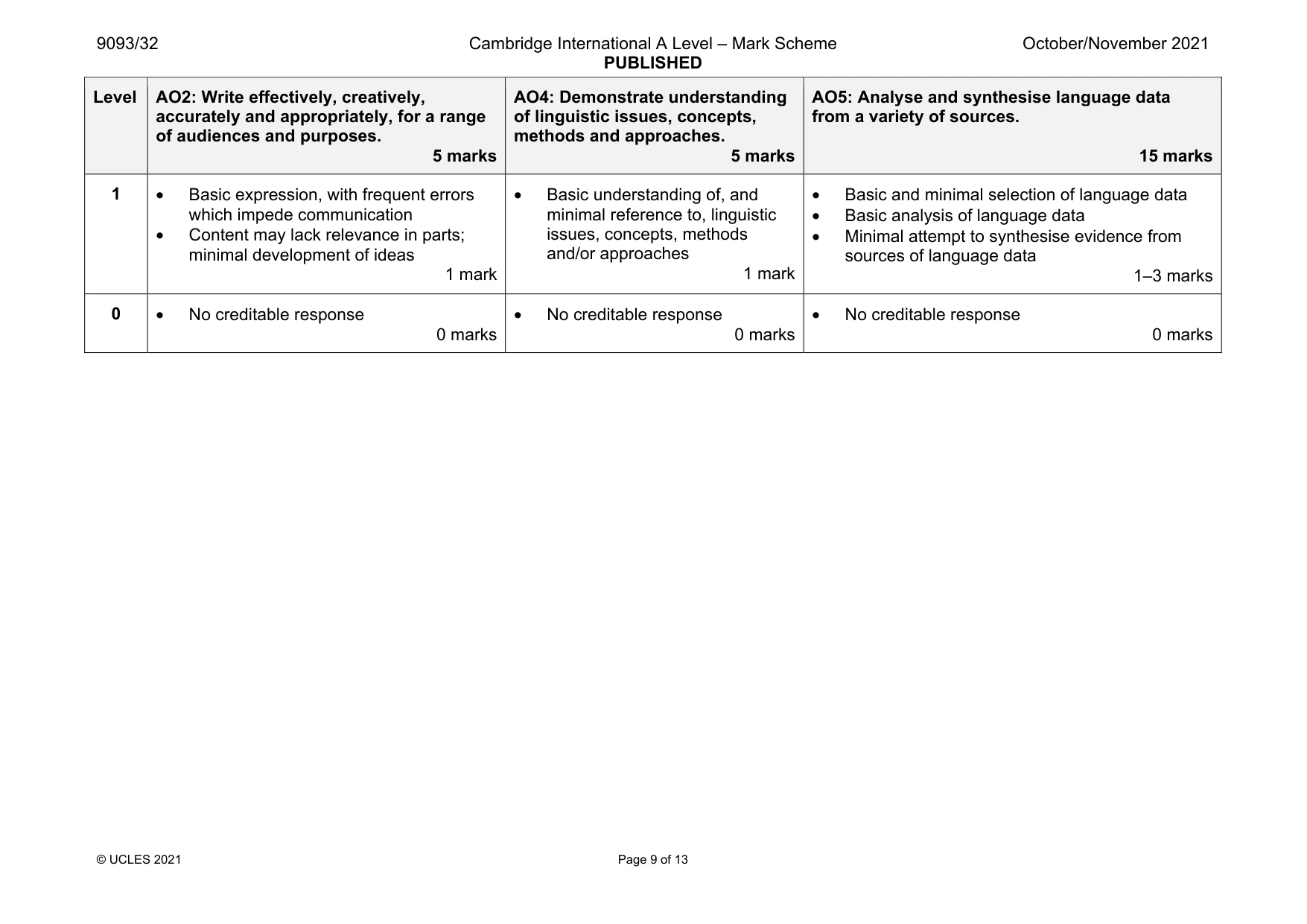
9093/32 Cambridge International A Level – Mark Scheme PUBLISHED October/November 2021 © UCLES 2021 Page 9 of 13 Level AO2: Write effectively, creatively, accurately and appropriately, for a range of audiences and purposes. 5 marks AO4: Demonstrate understanding of linguistic issues, concepts, methods and approaches. 5 marks AO5: Analyse and synthesise language data from a variety of sources. 15 marks 1 • Basic expression, with frequent errors which impede communication • Content may lack relevance in parts; minimal development of ideas 1 mark • Basic understanding of, and minimal reference to, linguistic issues, concepts, methods and/or approaches 1 mark • Basic and minimal selection of language data • Basic analysis of language data • Minimal attempt to synthesise evidence from sources of language data 1–3 marks 0 • No creditable response 0 marks • No creditable response 0 marks • No creditable response 0 marks
Mark scheme, page 10
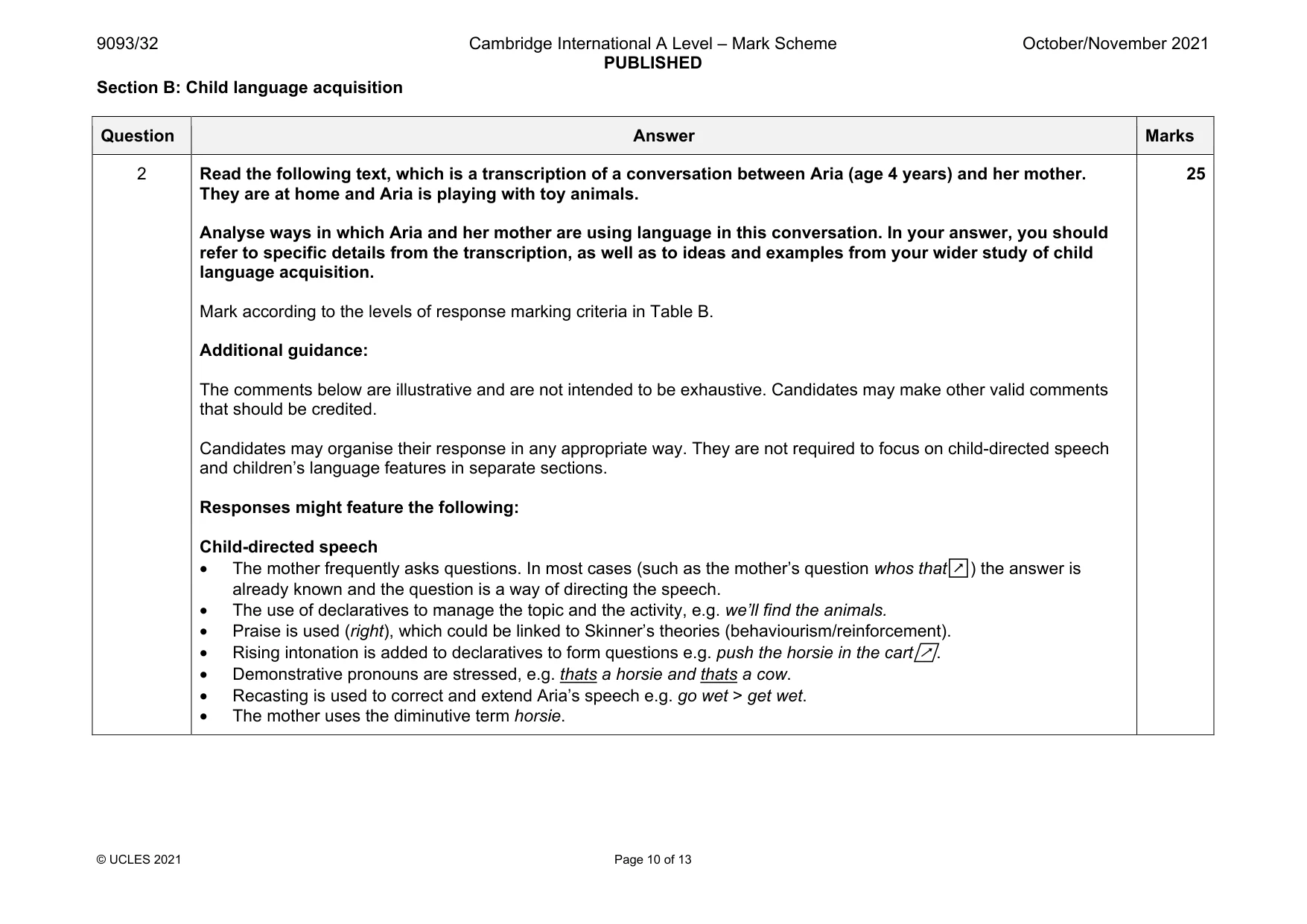
9093/32 Cambridge International A Level – Mark Scheme PUBLISHED October/November 2021 © UCLES 2021 Page 10 of 13 Section B: Child language acquisition Question Answer Marks 2 Read the following text, which is a transcription of a conversation between Aria (age 4 years) and her mother. They are at home and Aria is playing with toy animals. Analyse ways in which Aria and her mother are using language in this conversation. In your answer, you should refer to specific details from the transcription, as well as to ideas and examples from your wider study of child language acquisition. Mark according to the levels of response marking criteria in Table B. Additional guidance: The comments below are illustrative and are not intended to be exhaustive. Candidates may make other valid comments that should be credited. Candidates may organise their response in any appropriate way. They are not required to focus on child-directed speech and children’s language features in separate sections. Responses might feature the following: Child-directed speech • The mother frequently asks questions. In most cases (such as the mother’s question whos that↗) the answer is already known and the question is a way of directing the speech. • The use of declaratives to manage the topic and the activity, e.g. we’ll find the animals. • Praise is used (right), which could be linked to Skinner’s theories (behaviourism/reinforcement). • Rising intonation is added to declaratives to form questions e.g. push the horsie in the cart↗. • Demonstrative pronouns are stressed, e.g. thats a horsie and thats a cow. • Recasting is used to correct and extend Aria’s speech e.g. go wet > get wet. • The mother uses the diminutive term horsie. 25
Mark scheme, page 11
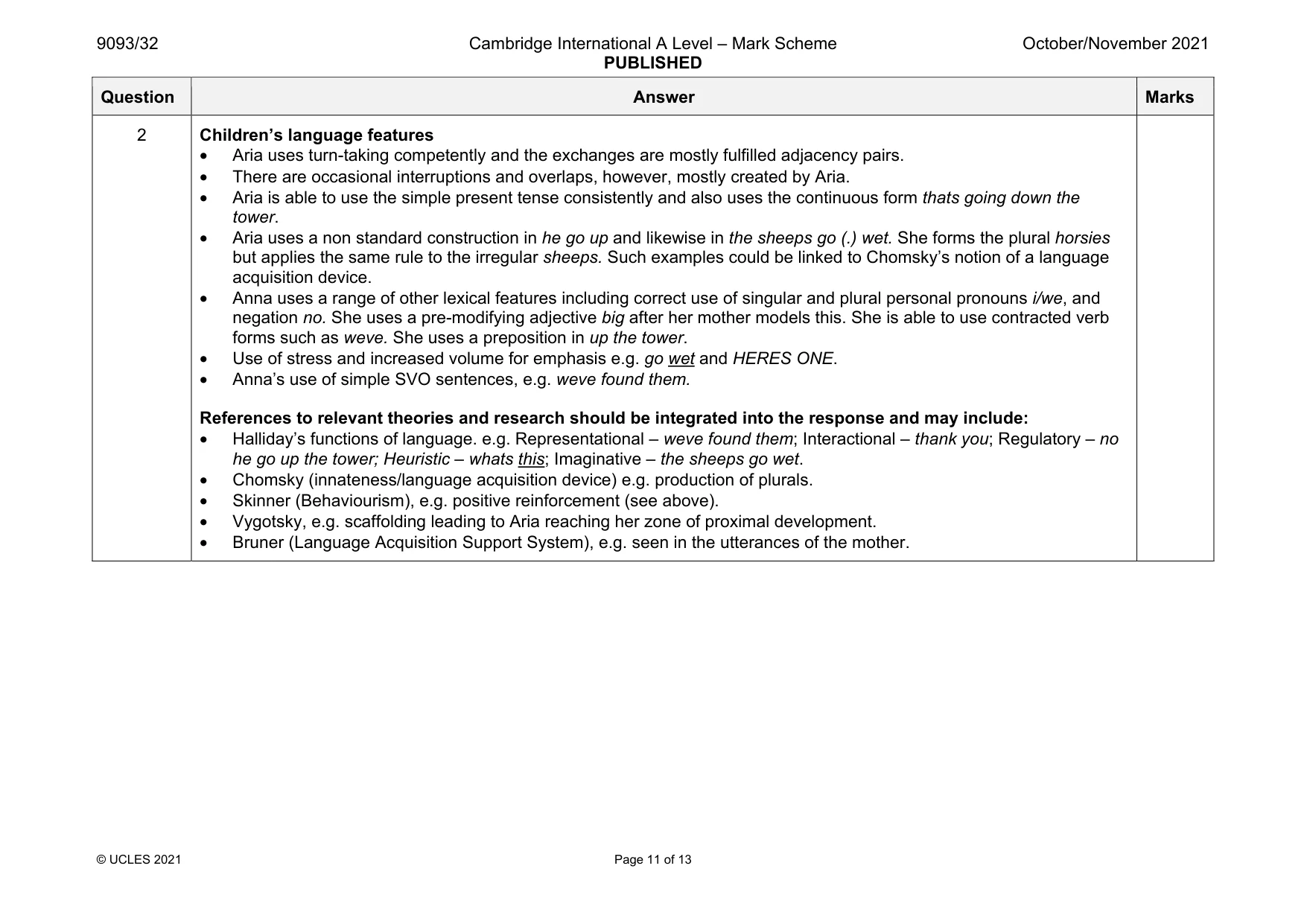
9093/32 Cambridge International A Level – Mark Scheme PUBLISHED October/November 2021 © UCLES 2021 Page 11 of 13 Question Answer Marks 2 Children’s language features • Aria uses turn-taking competently and the exchanges are mostly fulfilled adjacency pairs. • There are occasional interruptions and overlaps, however, mostly created by Aria. • Aria is able to use the simple present tense consistently and also uses the continuous form thats going down the tower. • Aria uses a non standard construction in he go up and likewise in the sheeps go (.) wet. She forms the plural horsies but applies the same rule to the irregular sheeps. Such examples could be linked to Chomsky’s notion of a language acquisition device. • Anna uses a range of other lexical features including correct use of singular and plural personal pronouns i/we, and negation no. She uses a pre-modifying adjective big after her mother models this. She is able to use contracted verb forms such as weve. She uses a preposition in up the tower. • Use of stress and increased volume for emphasis e.g. go wet and HERES ONE. • Anna’s use of simple SVO sentences, e.g. weve found them. References to relevant theories and research should be integrated into the response and may include: • Halliday’s functions of language. e.g. Representational – weve found them; Interactional – thank you; Regulatory – no he go up the tower; Heuristic – whats this; Imaginative – the sheeps go wet. • Chomsky (innateness/language acquisition device) e.g. production of plurals. • Skinner (Behaviourism), e.g. positive reinforcement (see above). • Vygotsky, e.g. scaffolding leading to Aria reaching her zone of proximal development. • Bruner (Language Acquisition Support System), e.g. seen in the utterances of the mother.
Mark scheme, page 12
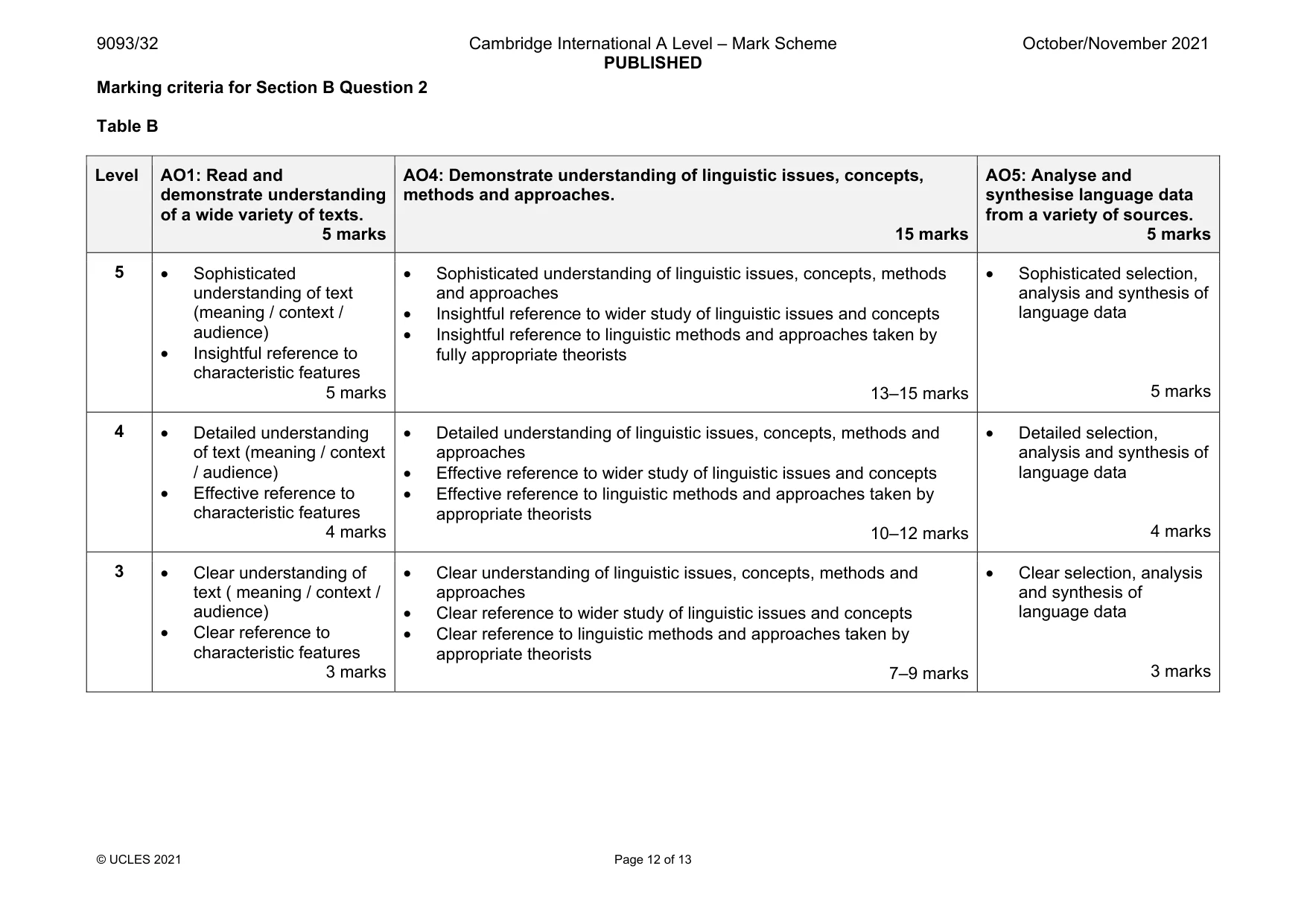
9093/32 Cambridge International A Level – Mark Scheme PUBLISHED October/November 2021 © UCLES 2021 Page 12 of 13 Marking criteria for Section B Question 2 Table B Level AO1: Read and demonstrate understanding of a wide variety of texts. 5 marks AO4: Demonstrate understanding of linguistic issues, concepts, methods and approaches. 15 marks AO5: Analyse and synthesise language data from a variety of sources. 5 marks 5 • Sophisticated understanding of text (meaning / context / audience) • Insightful reference to characteristic features 5 marks • Sophisticated understanding of linguistic issues, concepts, methods and approaches • Insightful reference to wider study of linguistic issues and concepts • Insightful reference to linguistic methods and approaches taken by fully appropriate theorists 13–15 marks • Sophisticated selection, analysis and synthesis of language data 5 marks 4 • Detailed understanding of text (meaning / context / audience) • Effective reference to characteristic features 4 marks • Detailed understanding of linguistic issues, concepts, methods and approaches • Effective reference to wider study of linguistic issues and concepts • Effective reference to linguistic methods and approaches taken by appropriate theorists 10–12 marks • Detailed selection, analysis and synthesis of language data 4 marks 3 • Clear understanding of text ( meaning / context / audience) • Clear reference to characteristic features 3 marks • Clear understanding of linguistic issues, concepts, methods and approaches • Clear reference to wider study of linguistic issues and concepts • Clear reference to linguistic methods and approaches taken by appropriate theorists 7–9 marks • Clear selection, analysis and synthesis of language data 3 marks
Mark scheme, page 13
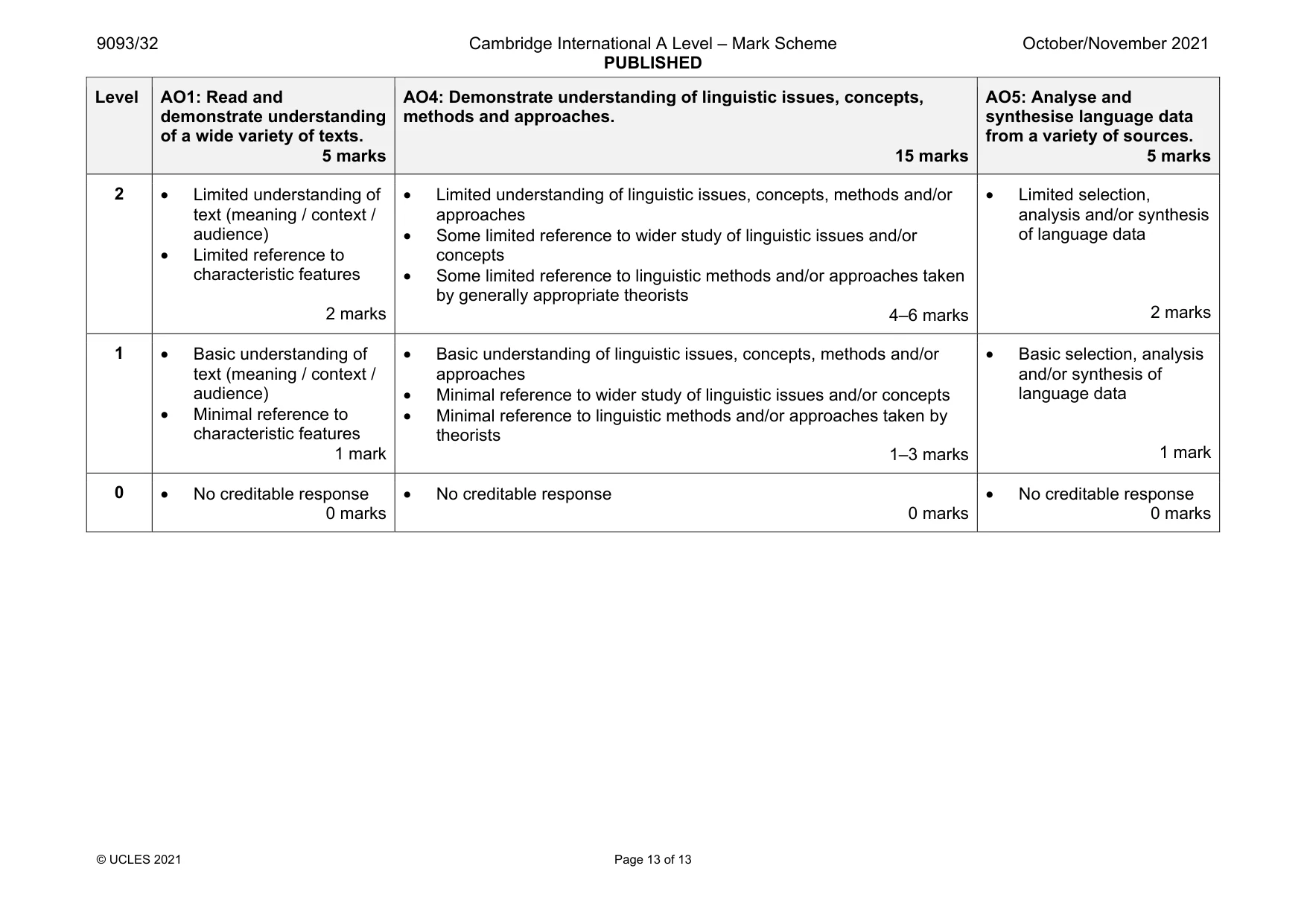
9093/32 Cambridge International A Level – Mark Scheme PUBLISHED October/November 2021 © UCLES 2021 Page 13 of 13 Level AO1: Read and demonstrate understanding of a wide variety of texts. 5 marks AO4: Demonstrate understanding of linguistic issues, concepts, methods and approaches. 15 marks AO5: Analyse and synthesise language data from a variety of sources. 5 marks 2 • Limited understanding of text (meaning / context / audience) • Limited reference to characteristic features 2 marks • Limited understanding of linguistic issues, concepts, methods and/or approaches • Some limited reference to wider study of linguistic issues and/or concepts • Some limited reference to linguistic methods and/or approaches taken by generally appropriate theorists 4–6 marks • Limited selection, analysis and/or synthesis of language data 2 marks 1 • Basic understanding of text (meaning / context / audience) • Minimal reference to characteristic features 1 mark • Basic understanding of linguistic issues, concepts, methods and/or approaches • Minimal reference to wider study of linguistic issues and/or concepts • Minimal reference to linguistic methods and/or approaches taken by theorists 1–3 marks • Basic selection, analysis and/or synthesis of language data 1 mark 0 • No creditable response 0 marks • No creditable response 0 marks • No creditable response 0 marks
What you needed in this session
Cambridge’s own grade thresholds for 2021 Oct/Nov, Paper 3 · Variant 2. A higher threshold means an easier paper — the bar moves with how the cohort did.