Cambridge A Level English - Language AS and A Level (from 2014) 9093 — 2021 Oct/Nov Paper 3 · Variant 1
9093/31/O/N/21 · 50 marks · ≈56 min
The question paper and its mark scheme, free to read here and free to download. This is Cambridge’s own paper, exactly as it was sat.
Question paper8 pages
Mark scheme13 pages
Answers below. Sit the paper first if you are practising.
Paper as text
Question paper, page 1
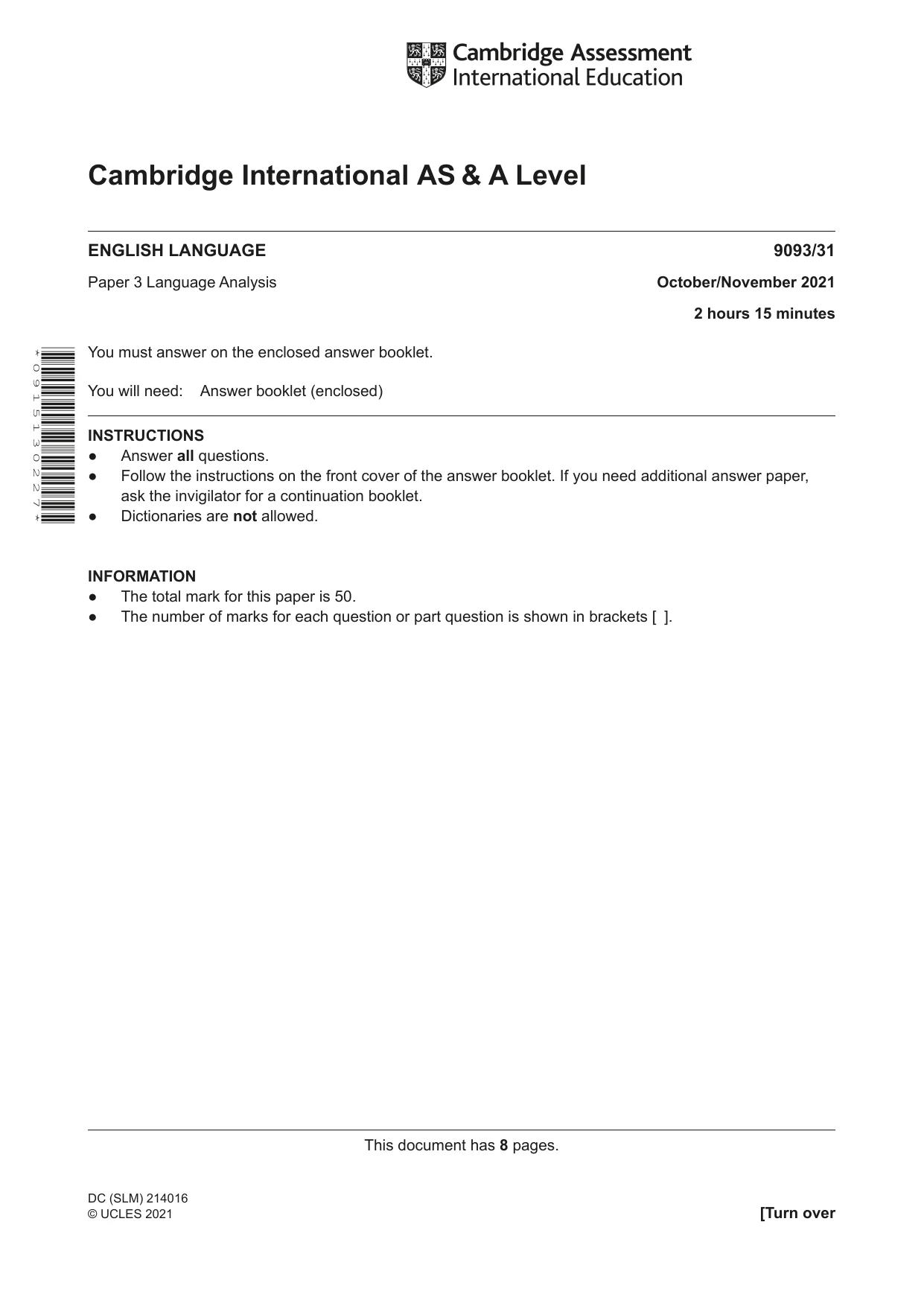
This document has 8 pages. Cambridge International AS & A Level DC (SLM) 214016 © UCLES 2021 [Turn over * 0 9 1 5 1 3 0 2 2 7 * ENGLISH LANGUAGE 9093/31 Paper 3 Language Analysis October/November 2021 2 hours 15 minutes You must answer on the enclosed answer booklet. You will need: Answer booklet (enclosed) INSTRUCTIONS ● Answer all questions. ● Follow the instructions on the front cover of the answer booklet. If you need additional answer paper, ask the invigilator for a continuation booklet. ● Dictionaries are not allowed. INFORMATION ● The total mark for this paper is 50. ● The number of marks for each question or part question is shown in brackets [ ].
Question paper, page 2
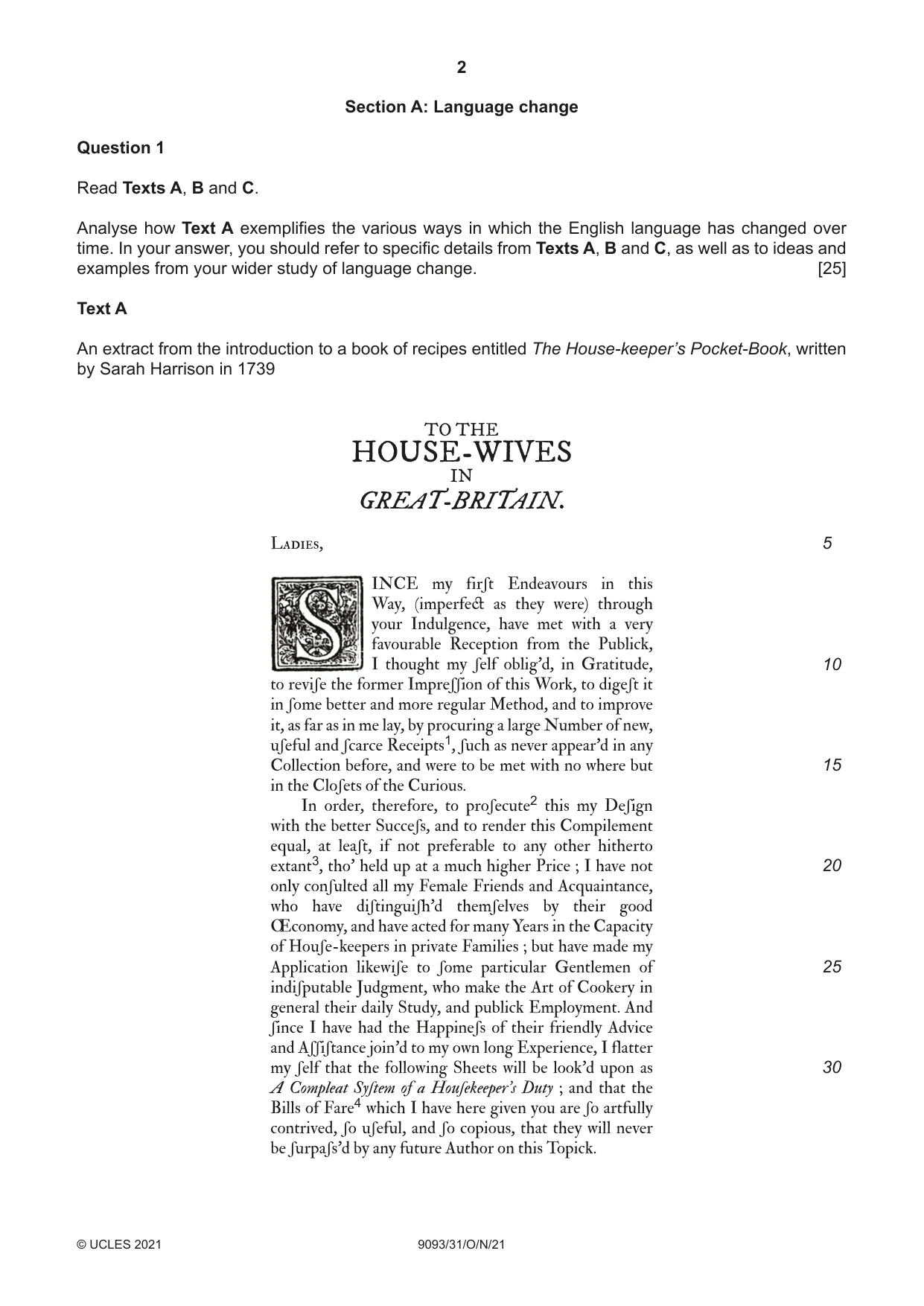
2 9093/31/O/N/21 © UCLES 2021 Section A: Language change Question 1 Read Texts A, B and C. Analyse how Text A exemplifies the various ways in which the English language has changed over time. In your answer, you should refer to specific details from Texts A, B and C, as well as to ideas and examples from your wider study of language change. [25] Text A An extract from the introduction to a book of recipes entitled The House-keeper’s Pocket-Book, written by Sarah Harrison in 1739 TO THE HOUSE-WIVES IN GREAT-BRITAIN. Ladies, INCE my firʃt Endeavours in this Way, (imperfect as they were) through your Indulgence, have met with a very favourable Reception from the Publick, I thought my ʃelf oblig’d, in Gratitude, to reviʃe the former Impreʃʃion of this Work, to digeʃt it in ʃome better and more regular Method, and to improve it, as far as in me lay, by procuring a large Number of new, uʃeful and ʃcarce Receipts1, ʃuch as never appear’d in any Collection before, and were to be met with no where but in the Cloʃets of the Curious. In order, therefore, to proʃecute2 this my Deʃign with the better Succeʃs, and to render this Compilement equal, at leaʃt, if not preferable to any other hitherto extant3, tho’ held up at a much higher Price ; I have not only conʃulted all my Female Friends and Acquaintance, who have diʃtinguiʃh’d themʃelves by their good Œconomy, and have acted for many Years in the Capacity of Houʃe-keepers in private Families ; but have made my Application likewiʃe to ʃome particular Gentlemen of indiʃputable Judgment, who make the Art of Cookery in general their daily Study, and publick Employment. And ʃince I have had the Happineʃs of their friendly Advice and Aʃʃiʃtance join’d to my own long Experience, I flatter my ʃelf that the following Sheets will be look'd upon as A Compleat Syʃtem of a Houʃekeeper’s Duty ; and that the Bills of Fare4 which I have here given you are ʃo artfully contrived, ʃo uʃeful, and ʃo copious, that they will never be ʃurpaʃs’d by any future Author on this Topick. 5 10 15 20 25 30
Question paper, page 3
3 9093/31/O/N/21 © UCLES 2021 [Turn over *** To conclude, and that I may not treʃpaʃs too far on your Patience and good Nature, or take up too much of your Time from the more important Affairs of your Families, I hereby ingenuouʃly acknowledge, that I have exerted all the Art and Induʃtry I can boaʃt of, in the Completion of this POCKET-BOOK, compil’d for your Service, and intended as your Daily Remembrancer ; and that I am not conʃcious to my ʃelf of having omitted one Article of any real Importance to be further known ; and therefore, ʃuch as it now appears to be, I freely ʃubmit it to the Cenʃure or Approbation5 of the candid and impartial Reader. I am, with all due Submiʃʃion and Reʃpect, Ladies, Your moʃt humble, and obedient Servant, Sarah Harrison. Notes: 1 Receipts: recipes 2 proʃecute: complete 3 hitherto extant : previously in existence 4 Bills of Fare: lists of food; menus 5 Cenʃure or Approbation: criticism or approval 35 40 45 50
Question paper, page 4
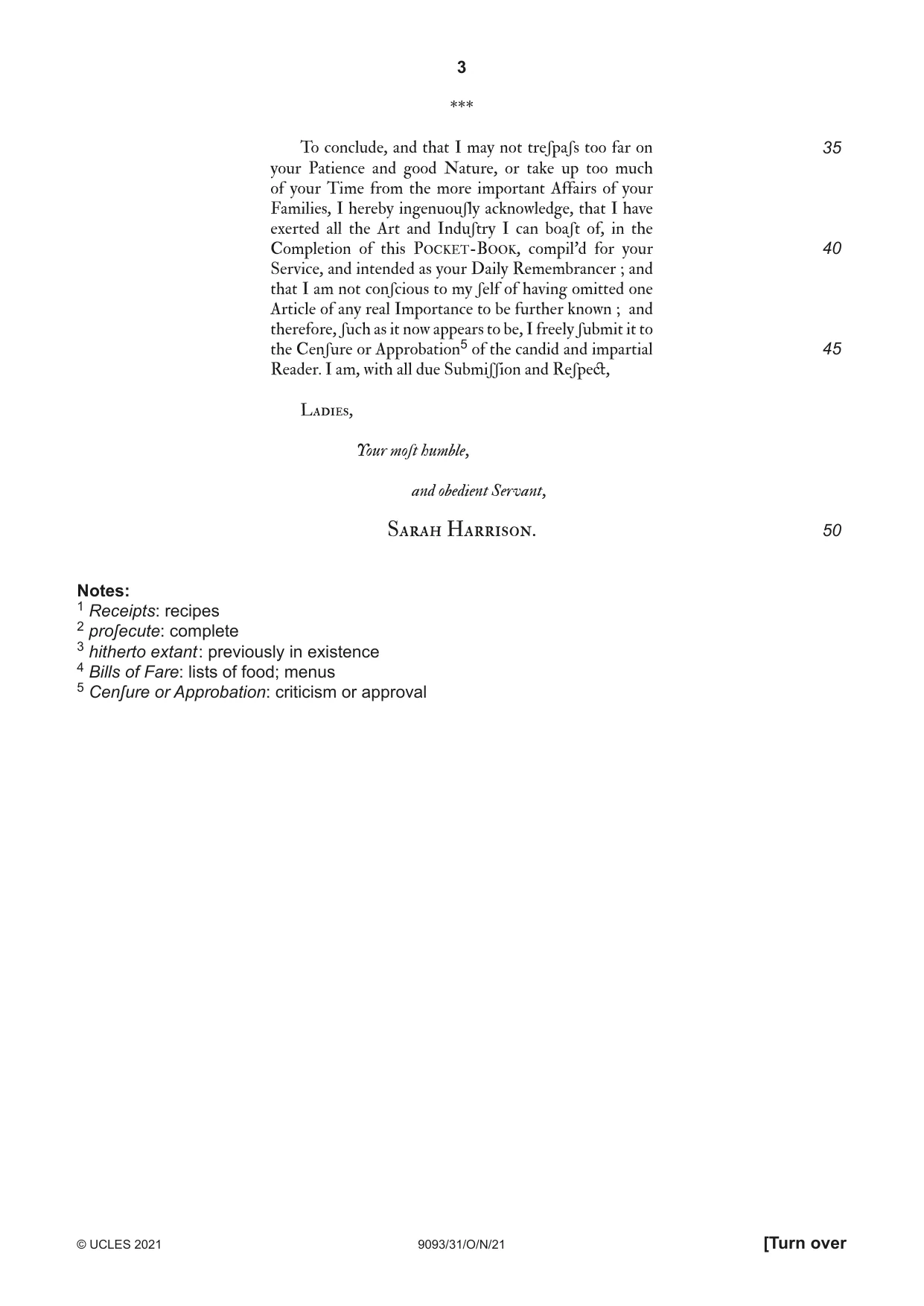
4 9093/31/O/N/21 © UCLES 2021 Text B The top six objects of the verb ‘prosecute’ in the English Historical Book Collection corpus (books from 1473 to 1800) and in the English Web 2015 corpus (texts collected from the internet in 2015) ‘prosecute...’ 1473–1800 ‘prosecute...’ 2015 design attorney war perpetrator voyage offender victory trafficker warre criminal sute crime
Question paper, page 5
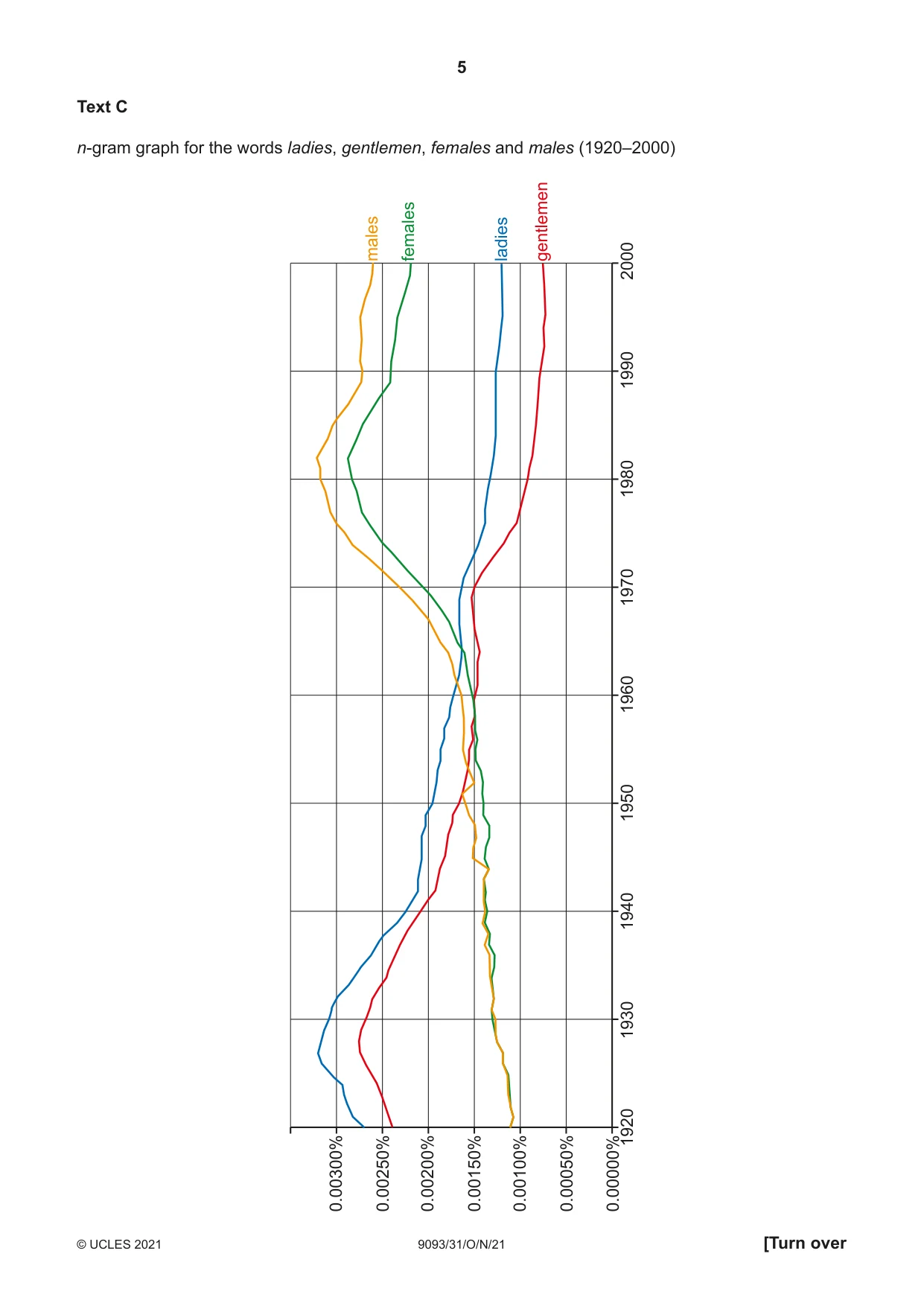
5 9093/31/O/N/21 © UCLES 2021 [Turn over Text C n-gram graph for the words ladies, gentlemen, females and males (1920–2000) 0.00000% 0.00050% 0.00100% 0.00150% 0.00200% 0.00250% 0.00300% 1940 1960 1980 1990 1930 1950 1970 2000 1920 females males gentlemen ladies
Question paper, page 6
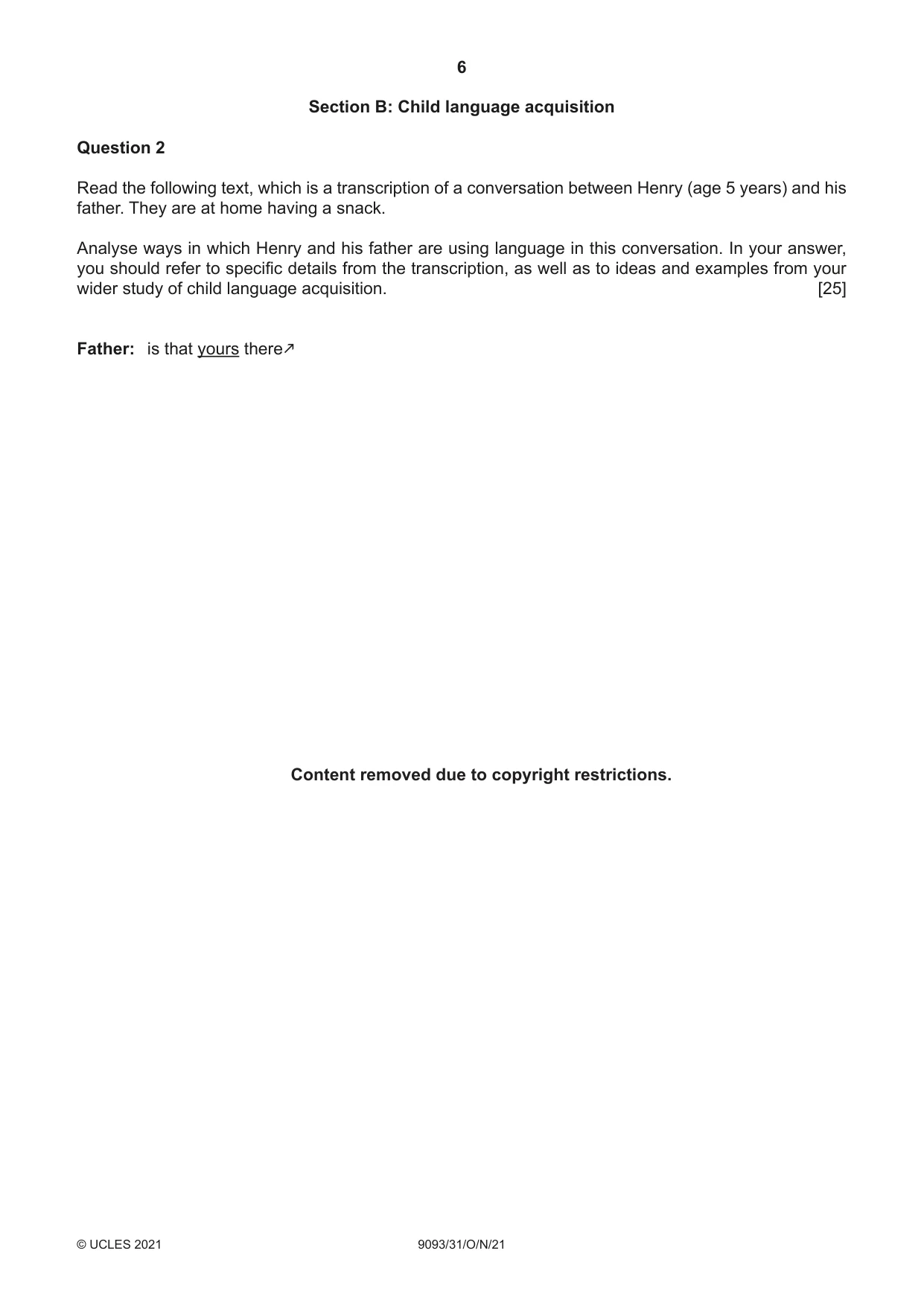
6 9093/31/O/N/21 © UCLES 2021 Section B: Child language acquisition Question 2 Read the following text, which is a transcription of a conversation between Henry (age 5 years) and his father. They are at home having a snack. Analyse ways in which Henry and his father are using language in this conversation. In your answer, you should refer to specific details from the transcription, as well as to ideas and examples from your wider study of child language acquisition. [25] Father: is that yours therek Content removed due to copyright restrictions.
Question paper, page 7
7 9093/31/O/N/21 © UCLES 2021 Henry: okay Content removed due to copyright restrictions.
Question paper, page 8
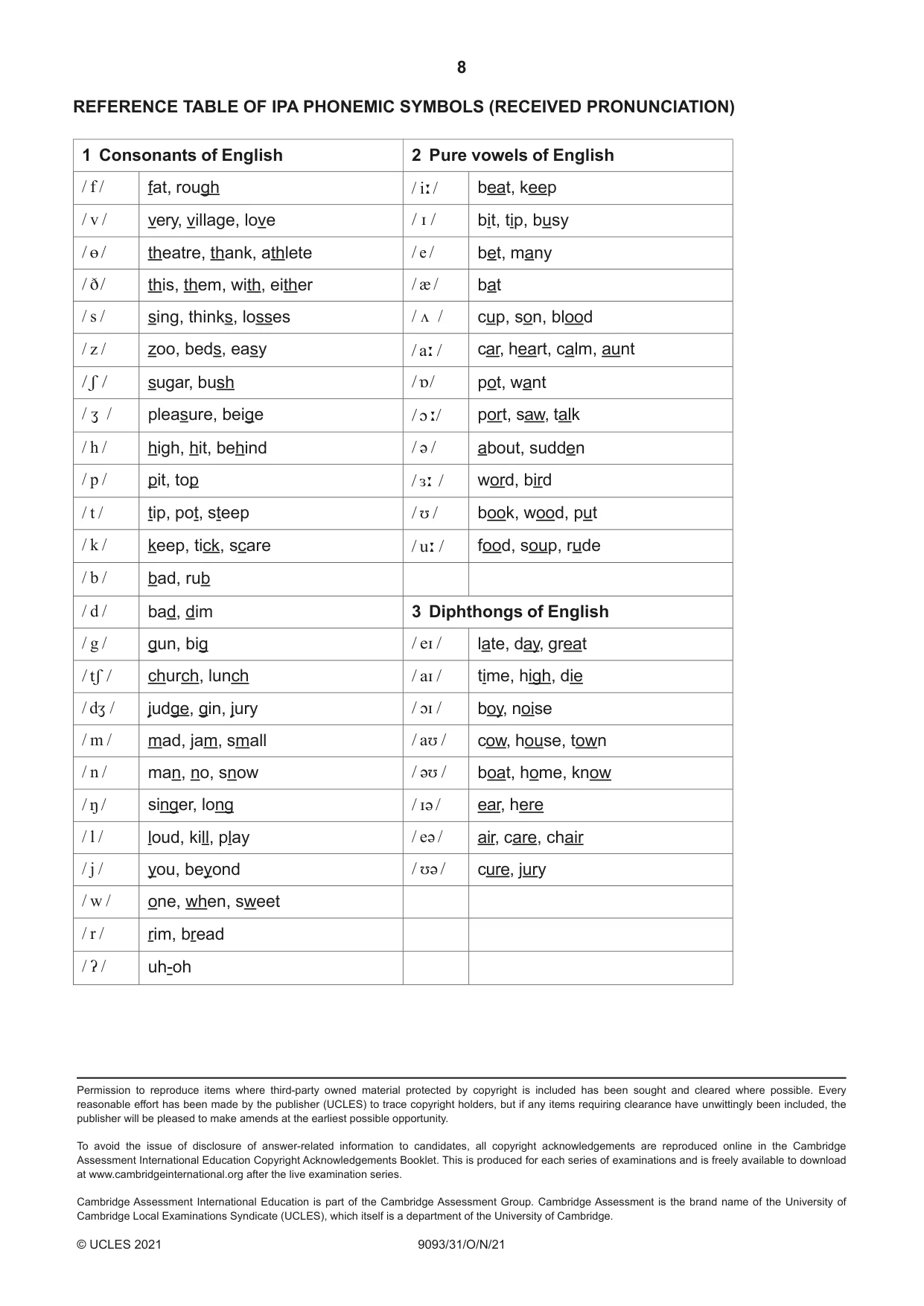
8 9093/31/O/N/21 © UCLES 2021 REFERENCE TABLE OF IPA PHONEMIC SYMBOLS (RECEIVED PRONUNCIATION) 1 Consonants of English 2 Pure vowels of English / f / fat, rough / iː / beat, keep / v / very, village, love / ɪ / bit, tip, busy / ɵ / theatre, thank, athlete / e / bet, many / ð/ this, them, with, either / æ / bat / s / sing, thinks, losses / ʌ / cup, son, blood / z / zoo, beds, easy / aː / car, heart, calm, aunt / ʃ / sugar, bush / ɒ / pot, want / ʒ / pleasure, beige / ɔː/ port, saw, talk / h / high, hit, behind / ə / about, sudden / p / pit, top / ɜː / word, bird / t / tip, pot, steep / ʊ / book, wood, put / k / keep, tick, scare / uː / food, soup, rude / b / bad, rub / d / bad, dim 3 Diphthongs of English / g / gun, big / eɪ / late, day, great / tʃ / church, lunch / aɪ / time, high, die / dʒ / judge, gin, jury / ɔɪ / boy, noise / m / mad, jam, small / aʊ / cow, house, town / n / man, no, snow / əʊ / boat, home, know / ŋ / singer, long / ɪə / ear, here / l / loud, kill, play / eə / air, care, chair / j / you, beyond / ʊə / cure, jury / w / one, when, sweet / r / rim, bread / ʔ / uh-oh Permission to reproduce items where third-party owned material protected by copyright is included has been sought and cleared where possible. Every reasonable effort has been made by the publisher (UCLES) to trace copyright holders, but if any items requiring clearance have unwittingly been included, the publisher will be pleased to make amends at the earliest possible opportunity. To avoid the issue of disclosure of answer-related information to candidates, all copyright acknowledgements are reproduced online in the Cambridge Assessment International Education Copyright Acknowledgements Booklet. This is produced for each series of examinations and is freely available to download at www.cambridgeinternational.org after the live examination series. Cambridge Assessment International Education is part of the Cambridge Assessment Group. Cambridge Assessment is the brand name of the University of Cambridge Local Examinations Syndicate (UCLES), which itself is a department of the University of Cambridge.
Mark scheme, page 1
This document consists of 13 printed pages. © UCLES 2021 [Turn over Cambridge International A Level ENGLISH LANGUAGE 9093/31 Paper 3 Language Analysis October/November 2021 MARK SCHEME Maximum Mark: 50 Published This mark scheme is published as an aid to teachers and candidates, to indicate the requirements of the examination. It shows the basis on which Examiners were instructed to award marks. It does not indicate the details of the discussions that took place at an Examiners’ meeting before marking began, which would have considered the acceptability of alternative answers. Mark schemes should be read in conjunction with the question paper and the Principal Examiner Report for Teachers. Cambridge International will not enter into discussions about these mark schemes. Cambridge International is publishing the mark schemes for the October/November 2021 series for most Cambridge IGCSE™, Cambridge International A and AS Level components and some Cambridge O Level components.
Mark scheme, page 2
9093/31 Cambridge International A Level – Mark Scheme PUBLISHED October/November 2021 © UCLES 2021 Page 2 of 13 Generic Marking Principles These general marking principles must be applied by all examiners when marking candidate answers. They should be applied alongside the specific content of the mark scheme or generic level descriptors for a question. Each question paper and mark scheme will also comply with these marking principles. GENERIC MARKING PRINCIPLE 1: Marks must be awarded in line with: • the specific content of the mark scheme or the generic level descriptors for the question • the specific skills defined in the mark scheme or in the generic level descriptors for the question • the standard of response required by a candidate as exemplified by the standardisation scripts. GENERIC MARKING PRINCIPLE 2: Marks awarded are always whole marks (not half marks, or other fractions). GENERIC MARKING PRINCIPLE 3: Marks must be awarded positively: • marks are awarded for correct/valid answers, as defined in the mark scheme. However, credit is given for valid answers which go beyond the scope of the syllabus and mark scheme, referring to your Team Leader as appropriate • marks are awarded when candidates clearly demonstrate what they know and can do • marks are not deducted for errors • marks are not deducted for omissions • answers should only be judged on the quality of spelling, punctuation and grammar when these features are specifically assessed by the question as indicated by the mark scheme. The meaning, however, should be unambiguous. GENERIC MARKING PRINCIPLE 4: Rules must be applied consistently, e.g. in situations where candidates have not followed instructions or in the application of generic level descriptors.
Mark scheme, page 3
9093/31 Cambridge International A Level – Mark Scheme PUBLISHED October/November 2021 © UCLES 2021 Page 3 of 13 GENERIC MARKING PRINCIPLE 5: Marks should be awarded using the full range of marks defined in the mark scheme for the question (however; the use of the full mark range may be limited according to the quality of the candidate responses seen). GENERIC MARKING PRINCIPLE 6: Marks awarded are based solely on the requirements as defined in the mark scheme. Marks should not be awarded with grade thresholds or grade descriptors in mind.
Mark scheme, page 4
9093/31 Cambridge International A Level – Mark Scheme PUBLISHED October/November 2021 © UCLES 2021 Page 4 of 13 English & Media subject specific general marking principles (To be read in conjunction with the Generic Marking Principles (and requiring further guidance on how to place marks within levels)) Components using level descriptors: • We use level descriptors as a guide to broad understanding of the qualities normally expected of, or typical of, work in a level. • Level descriptors are a means of general guidance, and should not be interpreted as hurdle statements. • Where indicative content notes are supplied for a question, these are not a prescription of required content, and must not be treated as such. Alternative correct points and unexpected answers in candidates’ scripts must be given marks that fairly reflect the knowledge and skills demonstrated. • While we may have legitimate expectations as to the ground most answers may occupy, we must at all times be prepared to meet candidates on their chosen ground, provided it is relevant ground (e.g. clearly related to and derived from a relevant passage/text and meeting the mark scheme requirements for the question).
Mark scheme, page 5
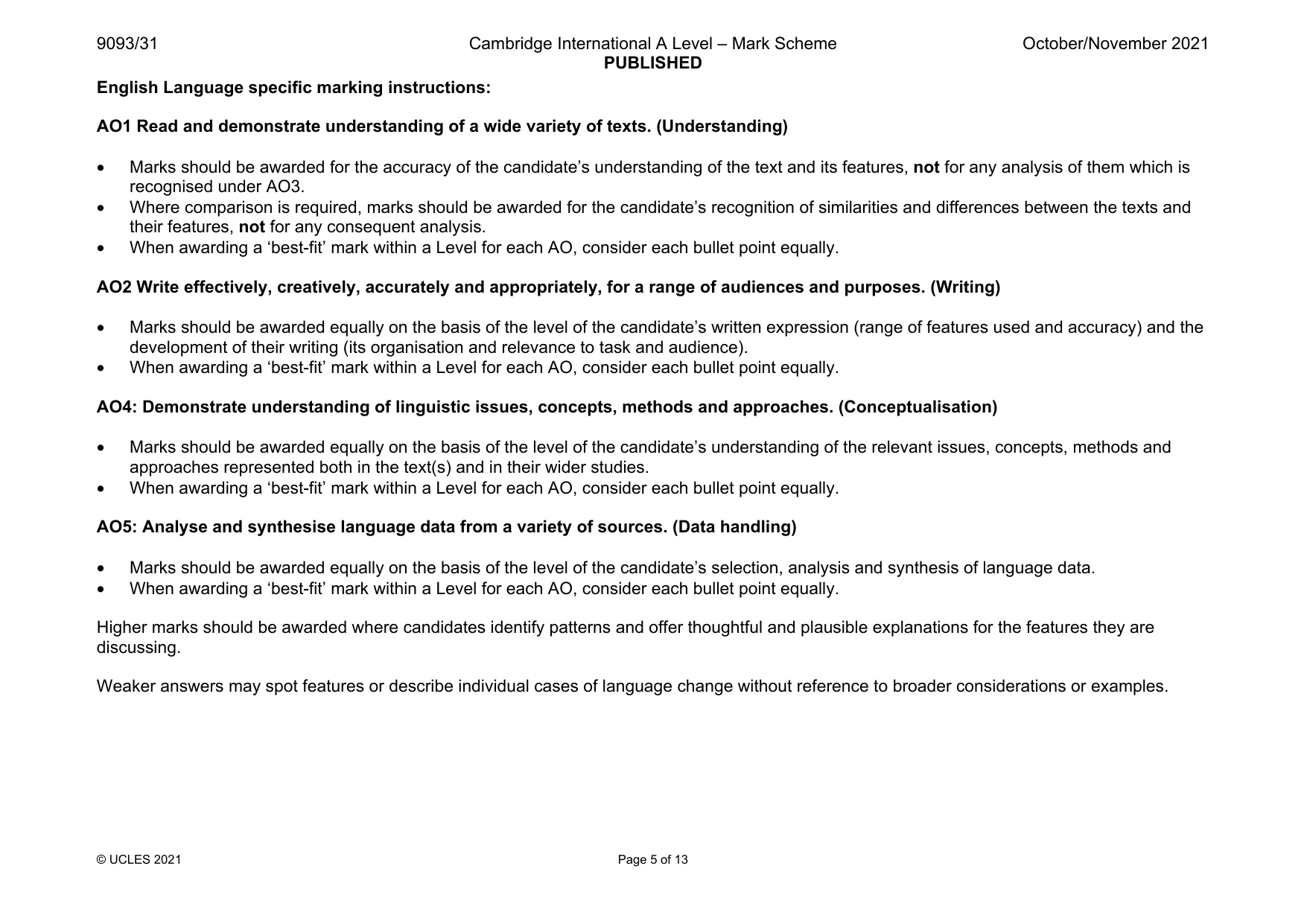
9093/31 Cambridge International A Level – Mark Scheme PUBLISHED October/November 2021 © UCLES 2021 Page 5 of 13 English Language specific marking instructions: AO1 Read and demonstrate understanding of a wide variety of texts. (Understanding) • Marks should be awarded for the accuracy of the candidate’s understanding of the text and its features, not for any analysis of them which is recognised under AO3. • Where comparison is required, marks should be awarded for the candidate’s recognition of similarities and differences between the texts and their features, not for any consequent analysis. • When awarding a ‘best-fit’ mark within a Level for each AO, consider each bullet point equally. AO2 Write effectively, creatively, accurately and appropriately, for a range of audiences and purposes. (Writing) • Marks should be awarded equally on the basis of the level of the candidate’s written expression (range of features used and accuracy) and the development of their writing (its organisation and relevance to task and audience). • When awarding a ‘best-fit’ mark within a Level for each AO, consider each bullet point equally. AO4: Demonstrate understanding of linguistic issues, concepts, methods and approaches. (Conceptualisation) • Marks should be awarded equally on the basis of the level of the candidate’s understanding of the relevant issues, concepts, methods and approaches represented both in the text(s) and in their wider studies. • When awarding a ‘best-fit’ mark within a Level for each AO, consider each bullet point equally. AO5: Analyse and synthesise language data from a variety of sources. (Data handling) • Marks should be awarded equally on the basis of the level of the candidate’s selection, analysis and synthesis of language data. • When awarding a ‘best-fit’ mark within a Level for each AO, consider each bullet point equally. Higher marks should be awarded where candidates identify patterns and offer thoughtful and plausible explanations for the features they are discussing. Weaker answers may spot features or describe individual cases of language change without reference to broader considerations or examples.
Mark scheme, page 6
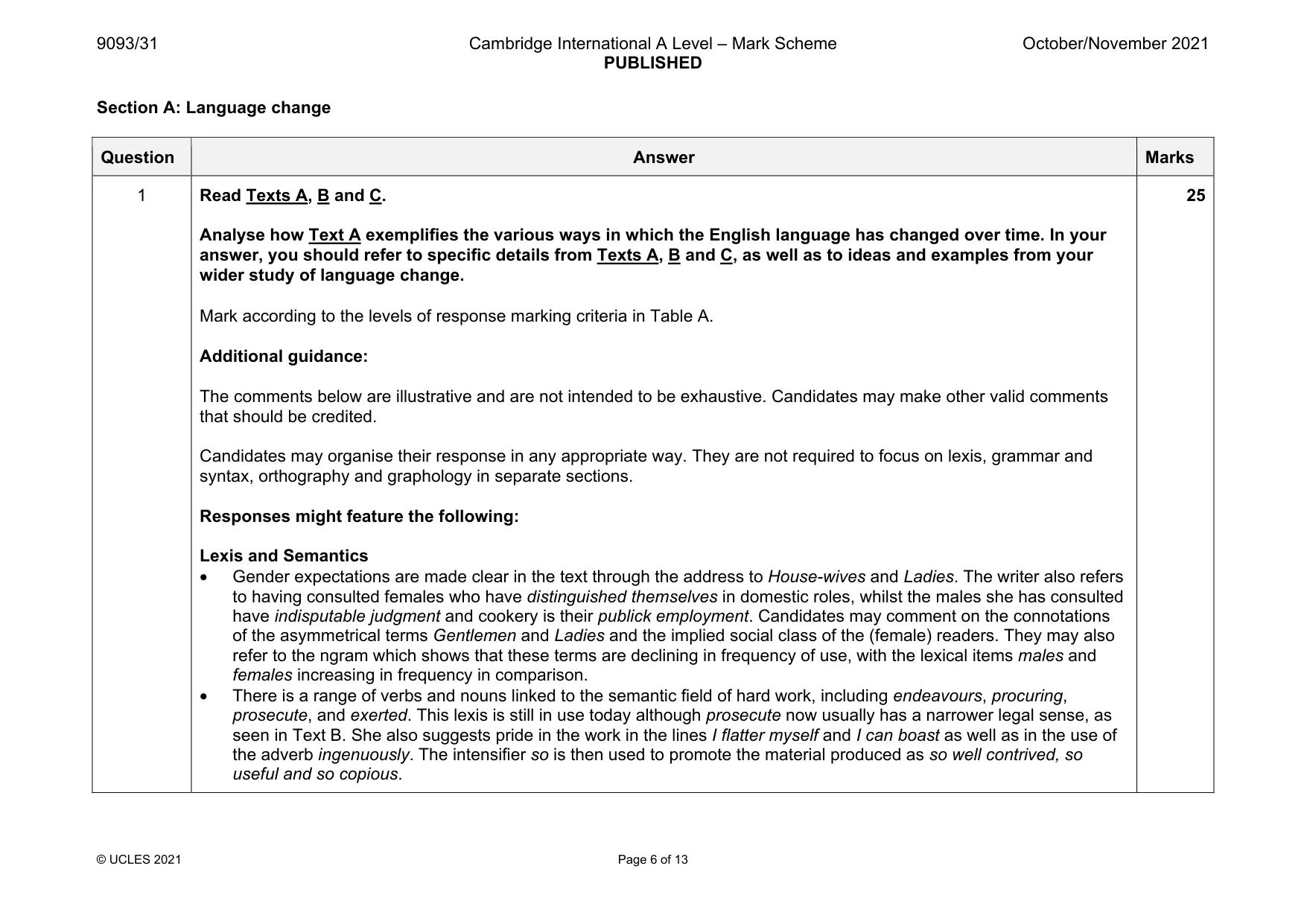
9093/31 Cambridge International A Level – Mark Scheme PUBLISHED October/November 2021 © UCLES 2021 Page 6 of 13 Section A: Language change Question Answer Marks 1 Read Texts A, B and C. Analyse how Text A exemplifies the various ways in which the English language has changed over time. In your answer, you should refer to specific details from Texts A, B and C, as well as to ideas and examples from your wider study of language change. Mark according to the levels of response marking criteria in Table A. Additional guidance: The comments below are illustrative and are not intended to be exhaustive. Candidates may make other valid comments that should be credited. Candidates may organise their response in any appropriate way. They are not required to focus on lexis, grammar and syntax, orthography and graphology in separate sections. Responses might feature the following: Lexis and Semantics • Gender expectations are made clear in the text through the address to House-wives and Ladies. The writer also refers to having consulted females who have distinguished themselves in domestic roles, whilst the males she has consulted have indisputable judgment and cookery is their publick employment. Candidates may comment on the connotations of the asymmetrical terms Gentlemen and Ladies and the implied social class of the (female) readers. They may also refer to the ngram which shows that these terms are declining in frequency of use, with the lexical items males and females increasing in frequency in comparison. • There is a range of verbs and nouns linked to the semantic field of hard work, including endeavours, procuring, prosecute, and exerted. This lexis is still in use today although prosecute now usually has a narrower legal sense, as seen in Text B. She also suggests pride in the work in the lines I flatter myself and I can boast as well as in the use of the adverb ingenuously. The intensifier so is then used to promote the material produced as so well contrived, so useful and so copious. 25
Mark scheme, page 7
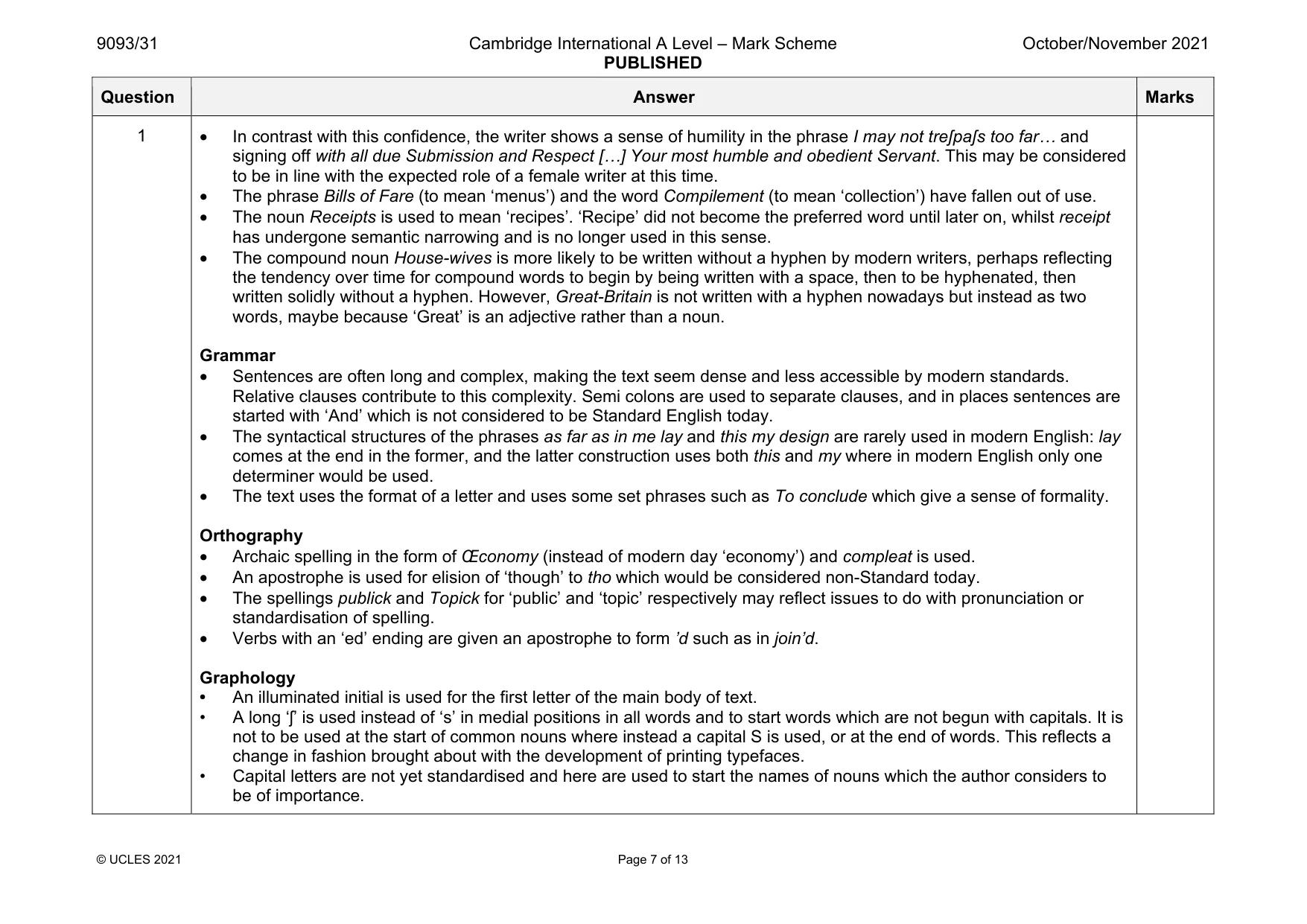
9093/31 Cambridge International A Level – Mark Scheme PUBLISHED October/November 2021 © UCLES 2021 Page 7 of 13 Question Answer Marks 1 • In contrast with this confidence, the writer shows a sense of humility in the phrase I may not treʃpaʃs too far… and signing off with all due Submission and Respect […] Your most humble and obedient Servant. This may be considered to be in line with the expected role of a female writer at this time. • The phrase Bills of Fare (to mean ‘menus’) and the word Compilement (to mean ‘collection’) have fallen out of use. • The noun Receipts is used to mean ‘recipes’. ‘Recipe’ did not become the preferred word until later on, whilst receipt has undergone semantic narrowing and is no longer used in this sense. • The compound noun House-wives is more likely to be written without a hyphen by modern writers, perhaps reflecting the tendency over time for compound words to begin by being written with a space, then to be hyphenated, then written solidly without a hyphen. However, Great-Britain is not written with a hyphen nowadays but instead as two words, maybe because ‘Great’ is an adjective rather than a noun. Grammar • Sentences are often long and complex, making the text seem dense and less accessible by modern standards. Relative clauses contribute to this complexity. Semi colons are used to separate clauses, and in places sentences are started with ‘And’ which is not considered to be Standard English today. • The syntactical structures of the phrases as far as in me lay and this my design are rarely used in modern English: lay comes at the end in the former, and the latter construction uses both this and my where in modern English only one determiner would be used. • The text uses the format of a letter and uses some set phrases such as To conclude which give a sense of formality. Orthography • Archaic spelling in the form of Œconomy (instead of modern day ‘economy’) and compleat is used. • An apostrophe is used for elision of ‘though’ to tho which would be considered non-Standard today. • The spellings publick and Topick for ‘public’ and ‘topic’ respectively may reflect issues to do with pronunciation or standardisation of spelling. • Verbs with an ‘ed’ ending are given an apostrophe to form ’d such as in join’d. Graphology • An illuminated initial is used for the first letter of the main body of text. • A long ‘ʃ’ is used instead of ‘s’ in medial positions in all words and to start words which are not begun with capitals. It is not to be used at the start of common nouns where instead a capital S is used, or at the end of words. This reflects a change in fashion brought about with the development of printing typefaces. • Capital letters are not yet standardised and here are used to start the names of nouns which the author considers to be of importance.
Mark scheme, page 8
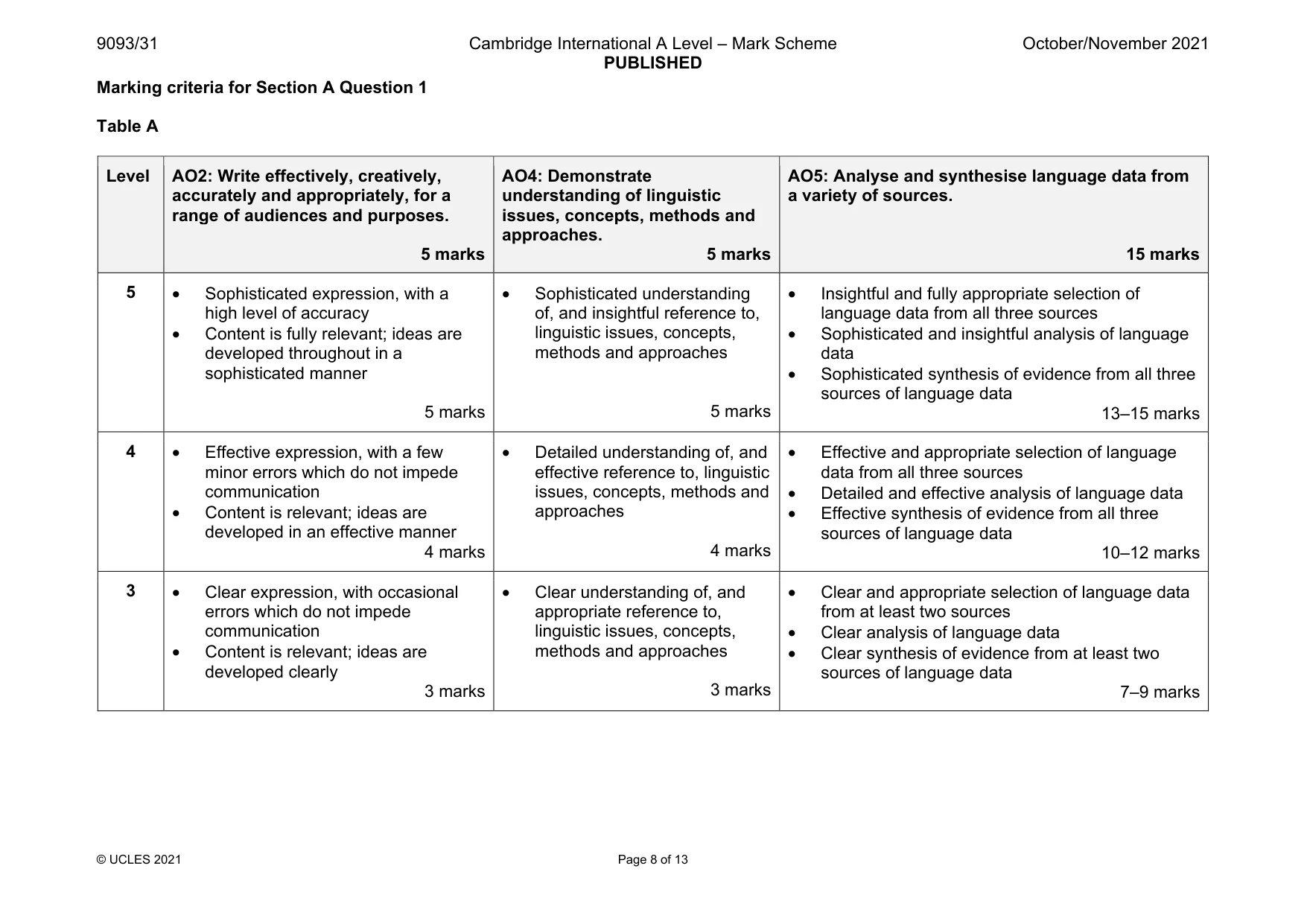
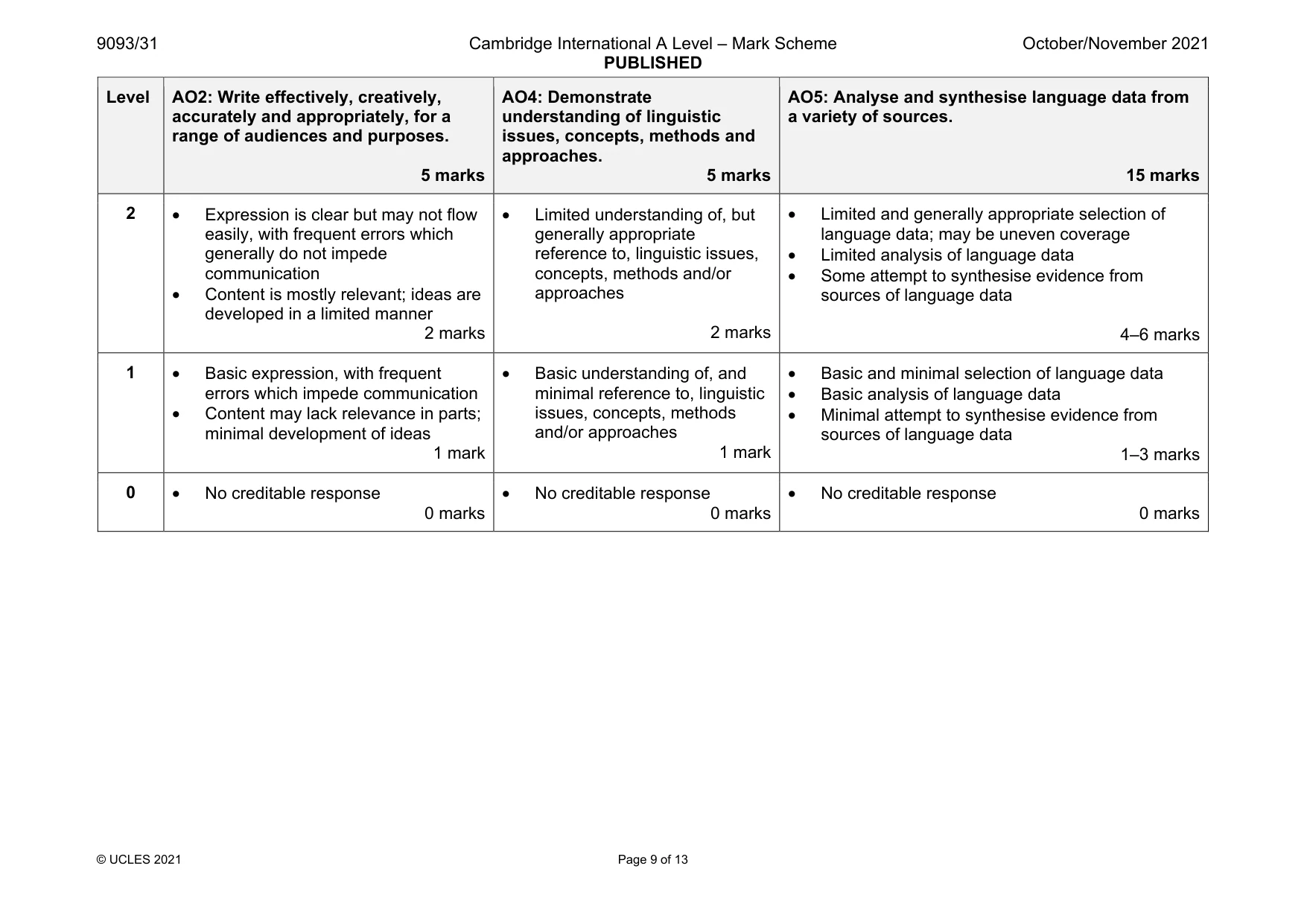
9093/31 Cambridge International A Level – Mark Scheme PUBLISHED October/November 2021 © UCLES 2021 Page 8 of 13 Marking criteria for Section A Question 1 Table A Level AO2: Write effectively, creatively, accurately and appropriately, for a range of audiences and purposes. 5 marks AO4: Demonstrate understanding of linguistic issues, concepts, methods and approaches. 5 marks AO5: Analyse and synthesise language data from a variety of sources. 15 marks 5 • Sophisticated expression, with a high level of accuracy • Content is fully relevant; ideas are developed throughout in a sophisticated manner 5 marks • Sophisticated understanding of, and insightful reference to, linguistic issues, concepts, methods and approaches 5 marks • Insightful and fully appropriate selection of language data from all three sources • Sophisticated and insightful analysis of language data • Sophisticated synthesis of evidence from all three sources of language data 13–15 marks 4 • Effective expression, with a few minor errors which do not impede communication • Content is relevant; ideas are developed in an effective manner 4 marks • Detailed understanding of, and effective reference to, linguistic issues, concepts, methods and approaches 4 marks • Effective and appropriate selection of language data from all three sources • Detailed and effective analysis of language data • Effective synthesis of evidence from all three sources of language data 10–12 marks 3 • Clear expression, with occasional errors which do not impede communication • Content is relevant; ideas are developed clearly 3 marks • Clear understanding of, and appropriate reference to, linguistic issues, concepts, methods and approaches 3 marks • Clear and appropriate selection of language data from at least two sources • Clear analysis of language data • Clear synthesis of evidence from at least two sources of language data 7–9 marks
Mark scheme, page 9
9093/31 Cambridge International A Level – Mark Scheme PUBLISHED October/November 2021 © UCLES 2021 Page 9 of 13 Level AO2: Write effectively, creatively, accurately and appropriately, for a range of audiences and purposes. 5 marks AO4: Demonstrate understanding of linguistic issues, concepts, methods and approaches. 5 marks AO5: Analyse and synthesise language data from a variety of sources. 15 marks 2 • Expression is clear but may not flow easily, with frequent errors which generally do not impede communication • Content is mostly relevant; ideas are developed in a limited manner 2 marks • Limited understanding of, but generally appropriate reference to, linguistic issues, concepts, methods and/or approaches 2 marks • Limited and generally appropriate selection of language data; may be uneven coverage • Limited analysis of language data • Some attempt to synthesise evidence from sources of language data 4–6 marks 1 • Basic expression, with frequent errors which impede communication • Content may lack relevance in parts; minimal development of ideas 1 mark • Basic understanding of, and minimal reference to, linguistic issues, concepts, methods and/or approaches 1 mark • Basic and minimal selection of language data • Basic analysis of language data • Minimal attempt to synthesise evidence from sources of language data 1–3 marks 0 • No creditable response 0 marks • No creditable response 0 marks • No creditable response 0 marks
Mark scheme, page 10
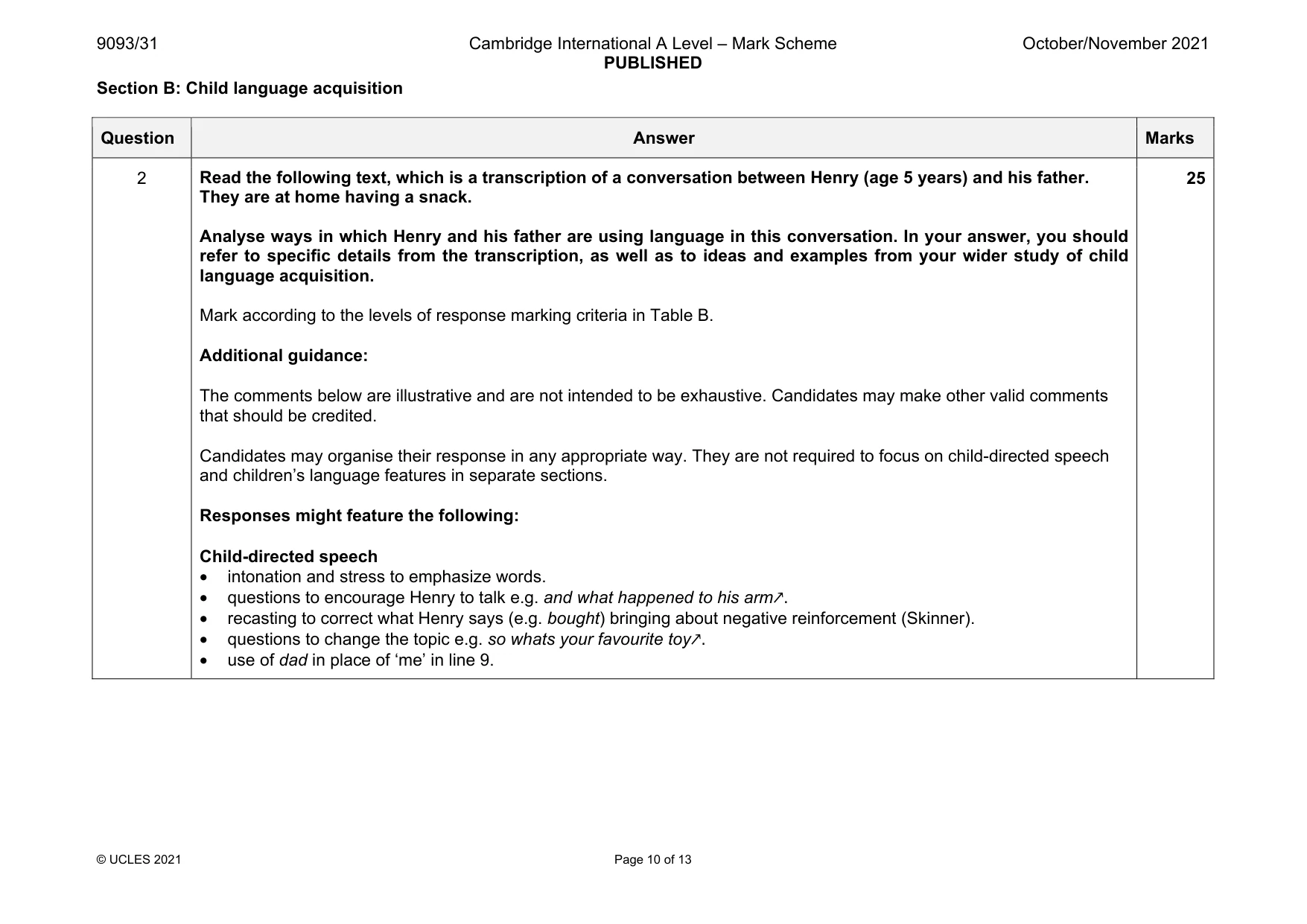
9093/31 Cambridge International A Level – Mark Scheme PUBLISHED October/November 2021 © UCLES 2021 Page 10 of 13 Section B: Child language acquisition Question Answer Marks 2 Read the following text, which is a transcription of a conversation between Henry (age 5 years) and his father. They are at home having a snack. Analyse ways in which Henry and his father are using language in this conversation. In your answer, you should refer to specific details from the transcription, as well as to ideas and examples from your wider study of child language acquisition. Mark according to the levels of response marking criteria in Table B. Additional guidance: The comments below are illustrative and are not intended to be exhaustive. Candidates may make other valid comments that should be credited. Candidates may organise their response in any appropriate way. They are not required to focus on child-directed speech and children’s language features in separate sections. Responses might feature the following: Child-directed speech • intonation and stress to emphasize words. • questions to encourage Henry to talk e.g. and what happened to his arm↗. • recasting to correct what Henry says (e.g. bought) bringing about negative reinforcement (Skinner). • questions to change the topic e.g. so whats your favourite toy↗. • use of dad in place of ‘me’ in line 9. 25
Mark scheme, page 11
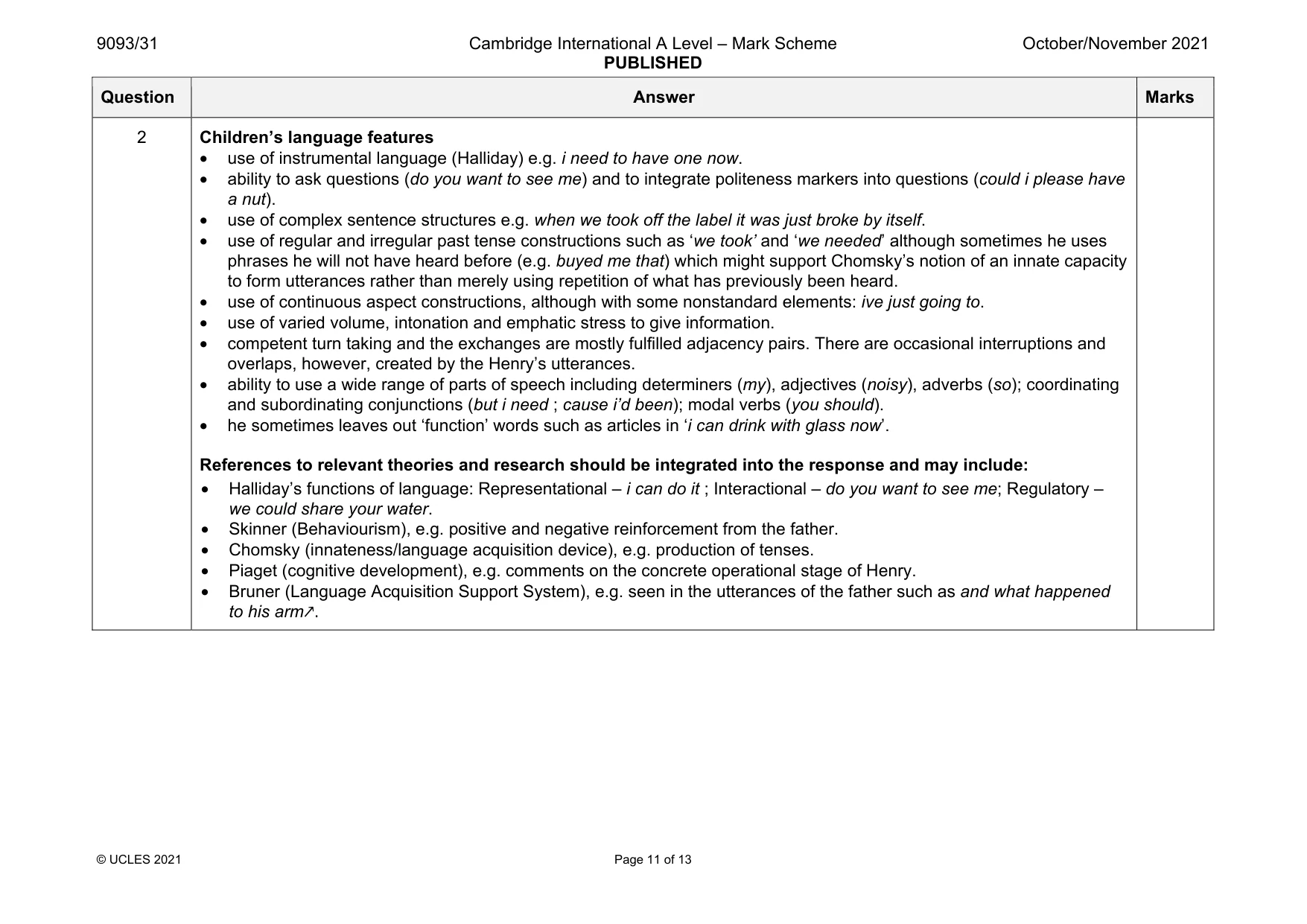
9093/31 Cambridge International A Level – Mark Scheme PUBLISHED October/November 2021 © UCLES 2021 Page 11 of 13 Question Answer Marks 2 Children’s language features • use of instrumental language (Halliday) e.g. i need to have one now. • ability to ask questions (do you want to see me) and to integrate politeness markers into questions (could i please have a nut). • use of complex sentence structures e.g. when we took off the label it was just broke by itself. • use of regular and irregular past tense constructions such as ‘we took’ and ‘we needed’ although sometimes he uses phrases he will not have heard before (e.g. buyed me that) which might support Chomsky’s notion of an innate capacity to form utterances rather than merely using repetition of what has previously been heard. • use of continuous aspect constructions, although with some nonstandard elements: ive just going to. • use of varied volume, intonation and emphatic stress to give information. • competent turn taking and the exchanges are mostly fulfilled adjacency pairs. There are occasional interruptions and overlaps, however, created by the Henry’s utterances. • ability to use a wide range of parts of speech including determiners (my), adjectives (noisy), adverbs (so); coordinating and subordinating conjunctions (but i need ; cause i’d been); modal verbs (you should). • he sometimes leaves out ‘function’ words such as articles in ‘i can drink with glass now’. References to relevant theories and research should be integrated into the response and may include: • Halliday’s functions of language: Representational – i can do it ; Interactional – do you want to see me; Regulatory – we could share your water. • Skinner (Behaviourism), e.g. positive and negative reinforcement from the father. • Chomsky (innateness/language acquisition device), e.g. production of tenses. • Piaget (cognitive development), e.g. comments on the concrete operational stage of Henry. • Bruner (Language Acquisition Support System), e.g. seen in the utterances of the father such as and what happened to his arm↗.
Mark scheme, page 12
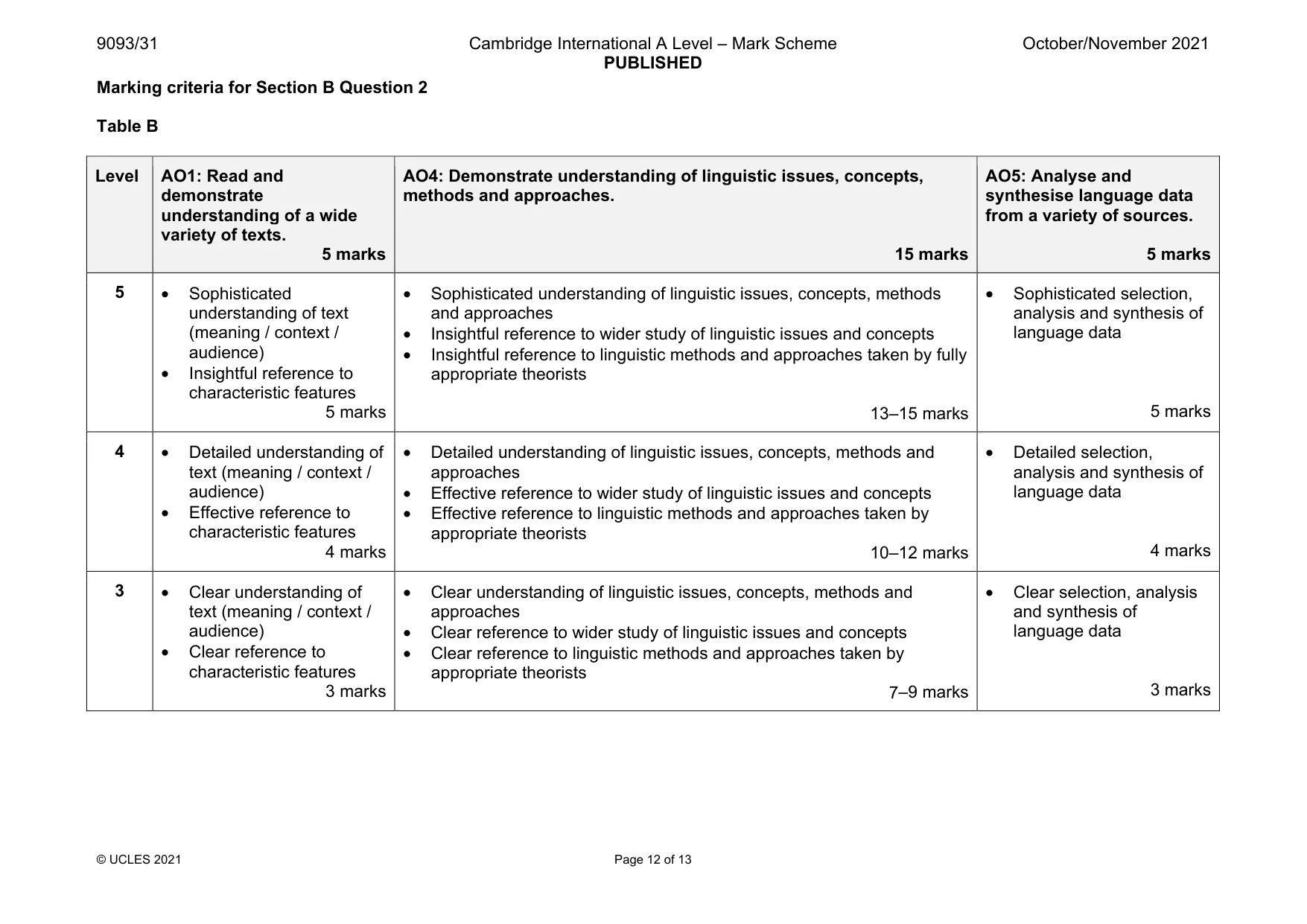
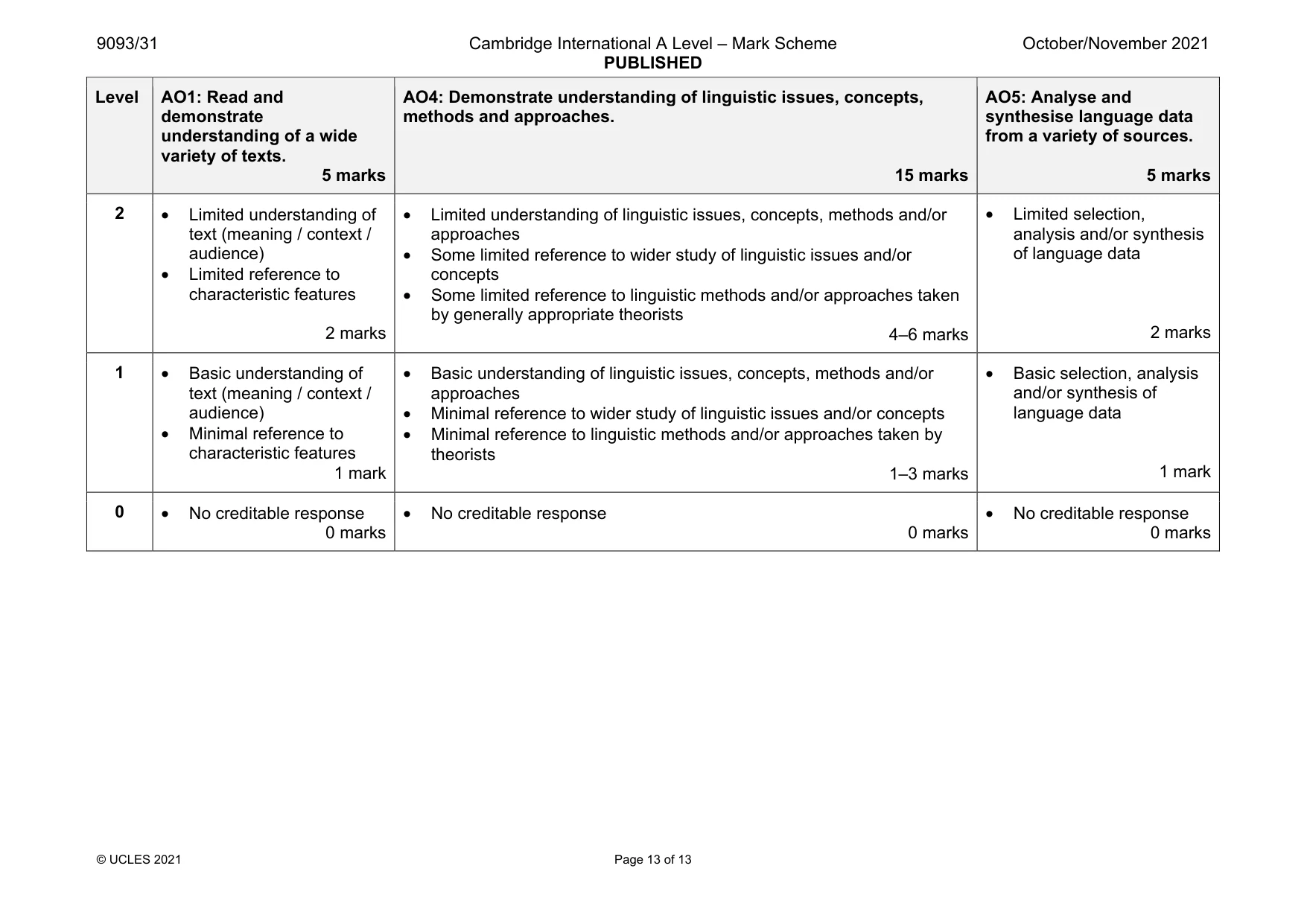
9093/31 Cambridge International A Level – Mark Scheme PUBLISHED October/November 2021 © UCLES 2021 Page 12 of 13 Marking criteria for Section B Question 2 Table B Level AO1: Read and demonstrate understanding of a wide variety of texts. 5 marks AO4: Demonstrate understanding of linguistic issues, concepts, methods and approaches. 15 marks AO5: Analyse and synthesise language data from a variety of sources. 5 marks 5 • Sophisticated understanding of text (meaning / context / audience) • Insightful reference to characteristic features 5 marks • Sophisticated understanding of linguistic issues, concepts, methods and approaches • Insightful reference to wider study of linguistic issues and concepts • Insightful reference to linguistic methods and approaches taken by fully appropriate theorists 13–15 marks • Sophisticated selection, analysis and synthesis of language data 5 marks 4 • Detailed understanding of text (meaning / context / audience) • Effective reference to characteristic features 4 marks • Detailed understanding of linguistic issues, concepts, methods and approaches • Effective reference to wider study of linguistic issues and concepts • Effective reference to linguistic methods and approaches taken by appropriate theorists 10–12 marks • Detailed selection, analysis and synthesis of language data 4 marks 3 • Clear understanding of text (meaning / context / audience) • Clear reference to characteristic features 3 marks • Clear understanding of linguistic issues, concepts, methods and approaches • Clear reference to wider study of linguistic issues and concepts • Clear reference to linguistic methods and approaches taken by appropriate theorists 7–9 marks • Clear selection, analysis and synthesis of language data 3 marks
Mark scheme, page 13
9093/31 Cambridge International A Level – Mark Scheme PUBLISHED October/November 2021 © UCLES 2021 Page 13 of 13 Level AO1: Read and demonstrate understanding of a wide variety of texts. 5 marks AO4: Demonstrate understanding of linguistic issues, concepts, methods and approaches. 15 marks AO5: Analyse and synthesise language data from a variety of sources. 5 marks 2 • Limited understanding of text (meaning / context / audience) • Limited reference to characteristic features 2 marks • Limited understanding of linguistic issues, concepts, methods and/or approaches • Some limited reference to wider study of linguistic issues and/or concepts • Some limited reference to linguistic methods and/or approaches taken by generally appropriate theorists 4–6 marks • Limited selection, analysis and/or synthesis of language data 2 marks 1 • Basic understanding of text (meaning / context / audience) • Minimal reference to characteristic features 1 mark • Basic understanding of linguistic issues, concepts, methods and/or approaches • Minimal reference to wider study of linguistic issues and/or concepts • Minimal reference to linguistic methods and/or approaches taken by theorists 1–3 marks • Basic selection, analysis and/or synthesis of language data 1 mark 0 • No creditable response 0 marks • No creditable response 0 marks • No creditable response 0 marks
What you needed in this session
Cambridge’s own grade thresholds for 2021 Oct/Nov, Paper 3 · Variant 1. A higher threshold means an easier paper — the bar moves with how the cohort did.