Cambridge A Level English - Language AS and A Level (from 2014) 9093 — 2020 Oct/Nov Paper 3 · Variant 2
9093/32/O/N/20 · 50 marks · ≈56 min
The question paper and its mark scheme, free to read here and free to download. This is Cambridge’s own paper, exactly as it was sat.
Question paper8 pages

Mark scheme6 pages
Answers below. Sit the paper first if you are practising.
Paper as text
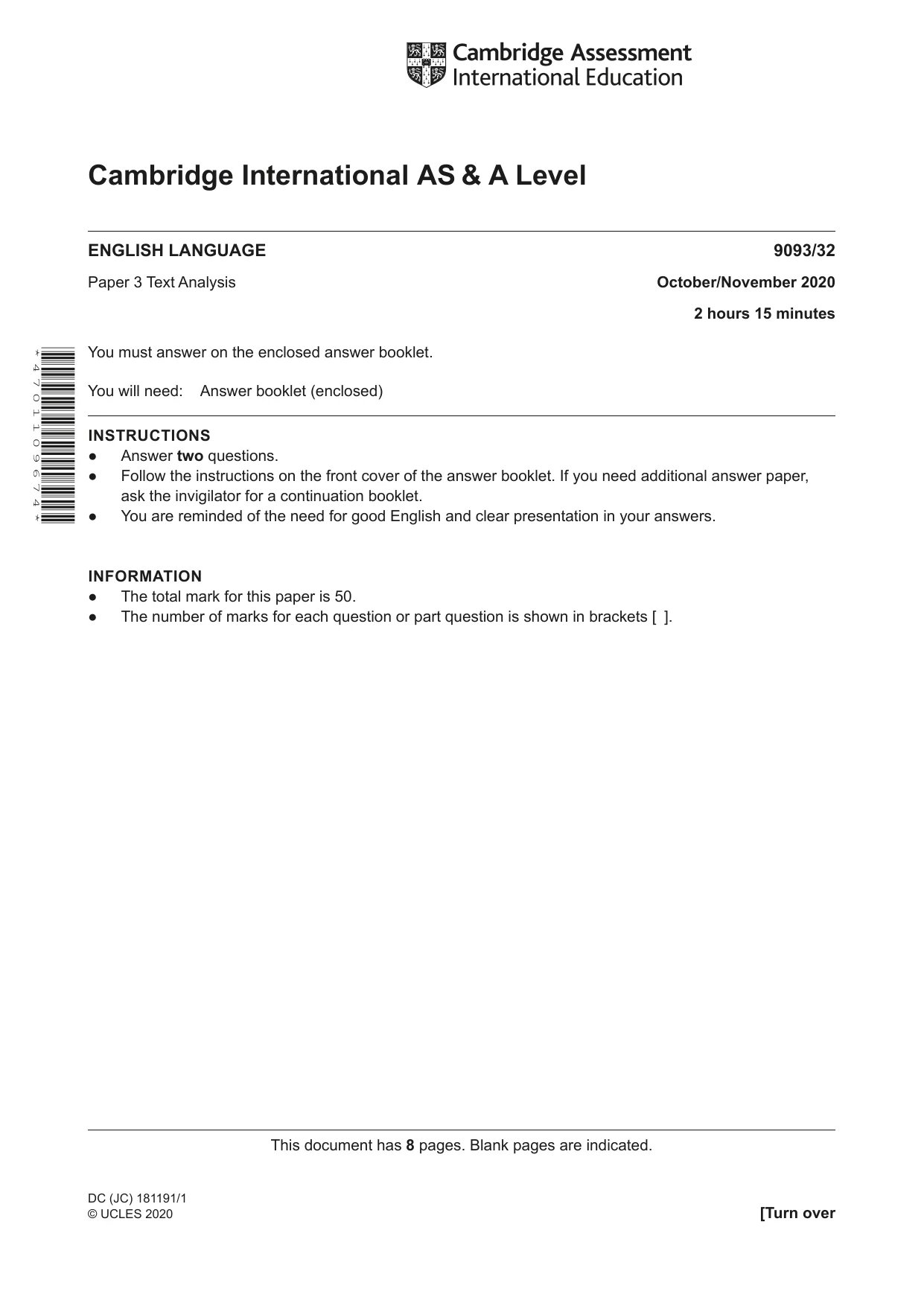
Question paper, page 1
Cambridge International AS & A Level * 4 7 0 1 1 0 9 6 7 4 * DC (JC) 181191/1 © UCLES 2020 [Turn over This document has 8 pages. Blank pages are indicated. ENGLISH LANGUAGE 9093/32 Paper 3 Text Analysis October/November 2020 2 hours 15 minutes You must answer on the enclosed answer booklet. You will need: Answer booklet (enclosed) INSTRUCTIONS ● Answer two questions. ● Follow the instructions on the front cover of the answer booklet. If you need additional answer paper, ask the invigilator for a continuation booklet. ● You are reminded of the need for good English and clear presentation in your answers. INFORMATION ● The total mark for this paper is 50. ● The number of marks for each question or part question is shown in brackets [ ].
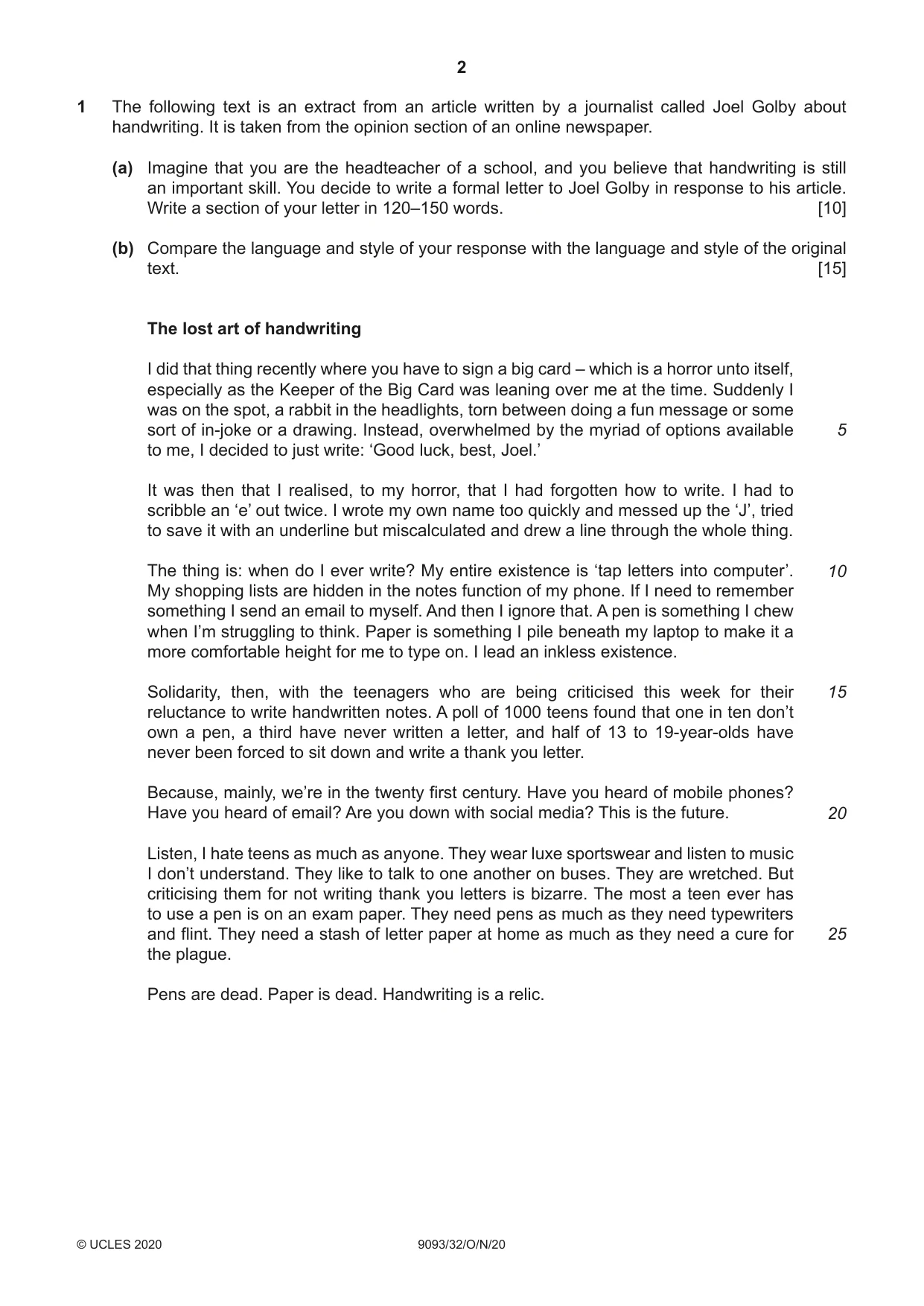
Question paper, page 2
2 9093/32/O/N/20 © UCLES 2020 1 The following text is an extract from an article written by a journalist called Joel Golby about handwriting. It is taken from the opinion section of an online newspaper. (a) Imagine that you are the headteacher of a school, and you believe that handwriting is still an important skill. You decide to write a formal letter to Joel Golby in response to his article. Write a section of your letter in 120–150 words. [10] (b) Compare the language and style of your response with the language and style of the original text. [15] The lost art of handwriting I did that thing recently where you have to sign a big card – which is a horror unto itself, especially as the Keeper of the Big Card was leaning over me at the time. Suddenly I was on the spot, a rabbit in the headlights, torn between doing a fun message or some sort of in-joke or a drawing. Instead, overwhelmed by the myriad of options available to me, I decided to just write: ‘Good luck, best, Joel.’ It was then that I realised, to my horror, that I had forgotten how to write. I had to scribble an ‘e’ out twice. I wrote my own name too quickly and messed up the ‘J’, tried to save it with an underline but miscalculated and drew a line through the whole thing. The thing is: when do I ever write? My entire existence is ‘tap letters into computer’. My shopping lists are hidden in the notes function of my phone. If I need to remember something I send an email to myself. And then I ignore that. A pen is something I chew when I’m struggling to think. Paper is something I pile beneath my laptop to make it a more comfortable height for me to type on. I lead an inkless existence. Solidarity, then, with the teenagers who are being criticised this week for their reluctance to write handwritten notes. A poll of 1000 teens found that one in ten don’t own a pen, a third have never written a letter, and half of 13 to 19-year-olds have never been forced to sit down and write a thank you letter. Because, mainly, we’re in the twenty first century. Have you heard of mobile phones? Have you heard of email? Are you down with social media? This is the future. Listen, I hate teens as much as anyone. They wear luxe sportswear and listen to music I don’t understand. They like to talk to one another on buses. They are wretched. But criticising them for not writing thank you letters is bizarre. The most a teen ever has to use a pen is on an exam paper. They need pens as much as they need typewriters and flint. They need a stash of letter paper at home as much as they need a cure for the plague. Pens are dead. Paper is dead. Handwriting is a relic. 5 10 15 20 25
Question paper, page 3
3 9093/32/O/N/20 © UCLES 2020 [Turn over BLANK PAGE
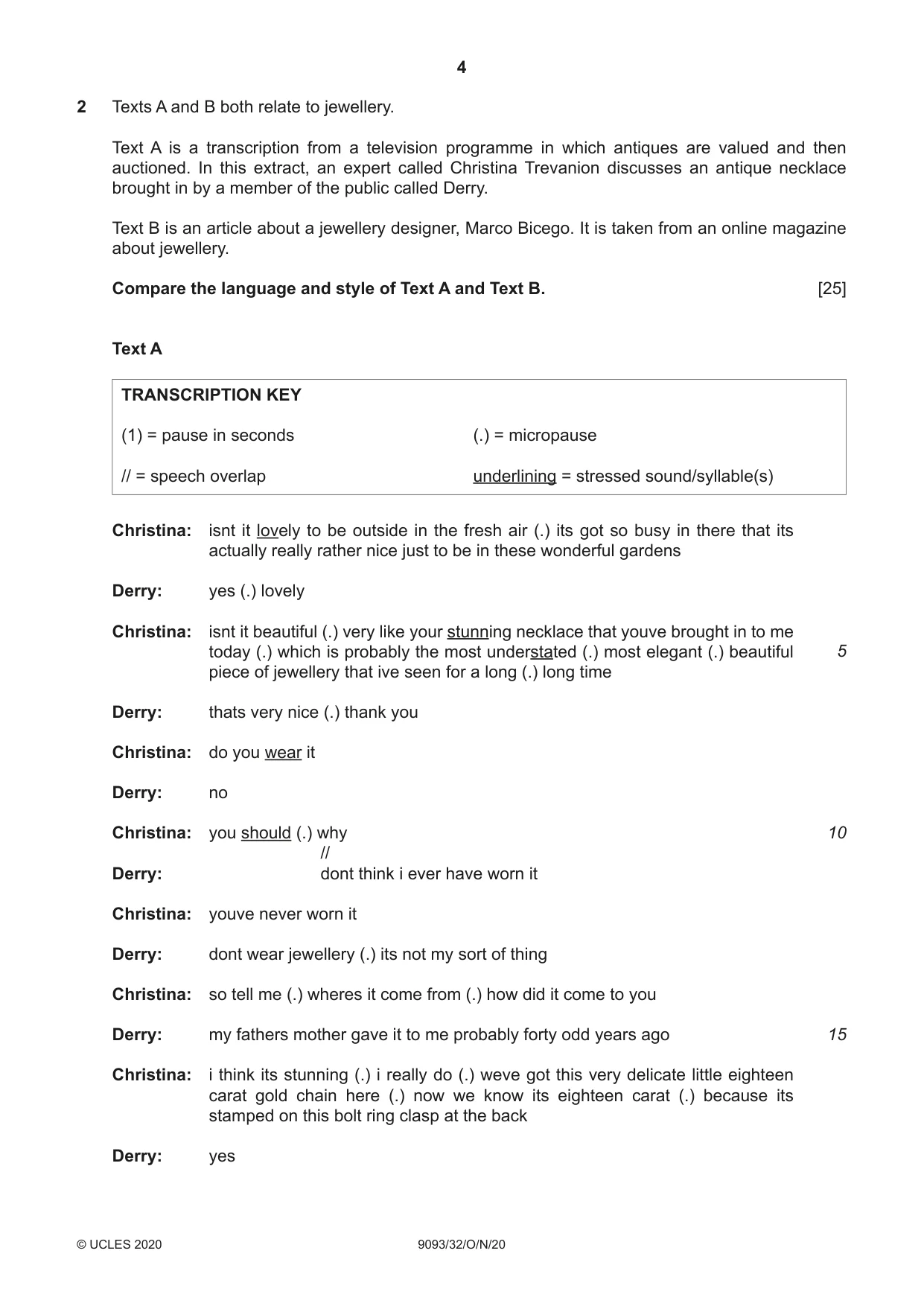
Question paper, page 4
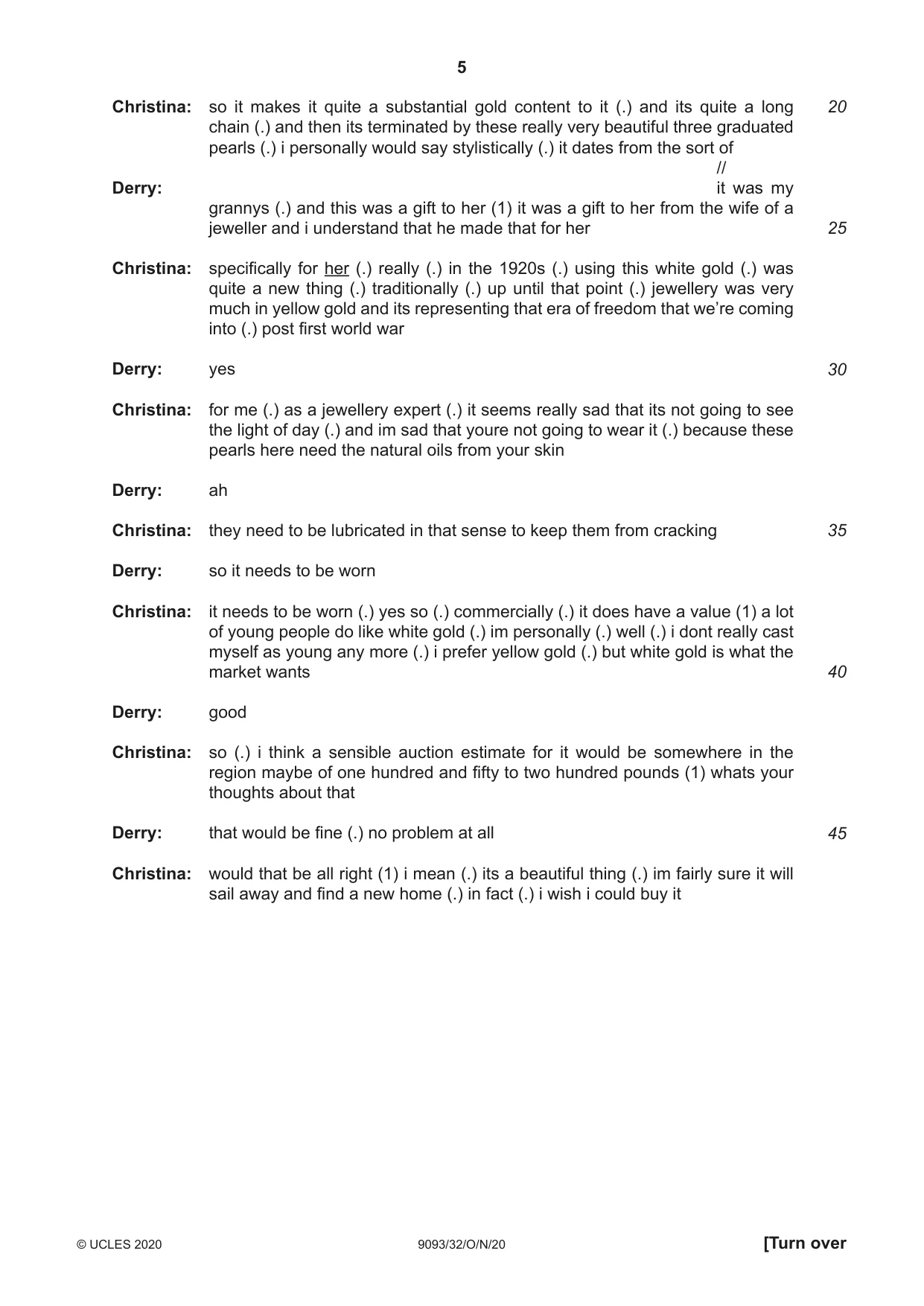
4 9093/32/O/N/20 © UCLES 2020 2 Texts A and B both relate to jewellery. Text A is a transcription from a television programme in which antiques are valued and then auctioned. In this extract, an expert called Christina Trevanion discusses an antique necklace brought in by a member of the public called Derry. Text B is an article about a jewellery designer, Marco Bicego. It is taken from an online magazine about jewellery. Compare the language and style of Text A and Text B. [25] Text A Christina: isnt it lovely to be outside in the fresh air (.) its got so busy in there that its actually really rather nice just to be in these wonderful gardens Derry: yes (.) lovely Christina: isnt it beautiful (.) very like your stunning necklace that youve brought in to me today (.) which is probably the most understated (.) most elegant (.) beautiful piece of jewellery that ive seen for a long (.) long time Derry: thats very nice (.) thank you Christina: do you wear it Derry: no Christina: you should (.) why // Derry: dont think i ever have worn it Christina: youve never worn it Derry: dont wear jewellery (.) its not my sort of thing Christina: so tell me (.) wheres it come from (.) how did it come to you Derry: my fathers mother gave it to me probably forty odd years ago Christina: i think its stunning (.) i really do (.) weve got this very delicate little eighteen carat gold chain here (.) now we know its eighteen carat (.) because its stamped on this bolt ring clasp at the back Derry: yes TRANSCRIPTION KEY (1) = pause in seconds (.) = micropause // = speech overlap underlining = stressed sound/syllable(s) 5 10 15
Question paper, page 5
5 9093/32/O/N/20 © UCLES 2020 [Turn over Christina: so it makes it quite a substantial gold content to it (.) and its quite a long chain (.) and then its terminated by these really very beautiful three graduated pearls (.) i personally would say stylistically (.) it dates from the sort of // Derry: it was my grannys (.) and this was a gift to her (1) it was a gift to her from the wife of a jeweller and i understand that he made that for her Christina: specifically for her (.) really (.) in the 1920s (.) using this white gold (.) was quite a new thing (.) traditionally (.) up until that point (.) jewellery was very much in yellow gold and its representing that era of freedom that we’re coming into (.) post first world war Derry: yes Christina: for me (.) as a jewellery expert (.) it seems really sad that its not going to see the light of day (.) and im sad that youre not going to wear it (.) because these pearls here need the natural oils from your skin Derry: ah Christina: they need to be lubricated in that sense to keep them from cracking Derry: so it needs to be worn Christina: it needs to be worn (.) yes so (.) commercially (.) it does have a value (1) a lot of young people do like white gold (.) im personally (.) well (.) i dont really cast myself as young any more (.) i prefer yellow gold (.) but white gold is what the market wants Derry: good Christina: so (.) i think a sensible auction estimate for it would be somewhere in the region maybe of one hundred and fifty to two hundred pounds (1) whats your thoughts about that Derry: that would be fine (.) no problem at all Christina: would that be all right (1) i mean (.) its a beautiful thing (.) im fairly sure it will sail away and find a new home (.) in fact (.) i wish i could buy it 20 25 30 35 40 45
Question paper, page 6
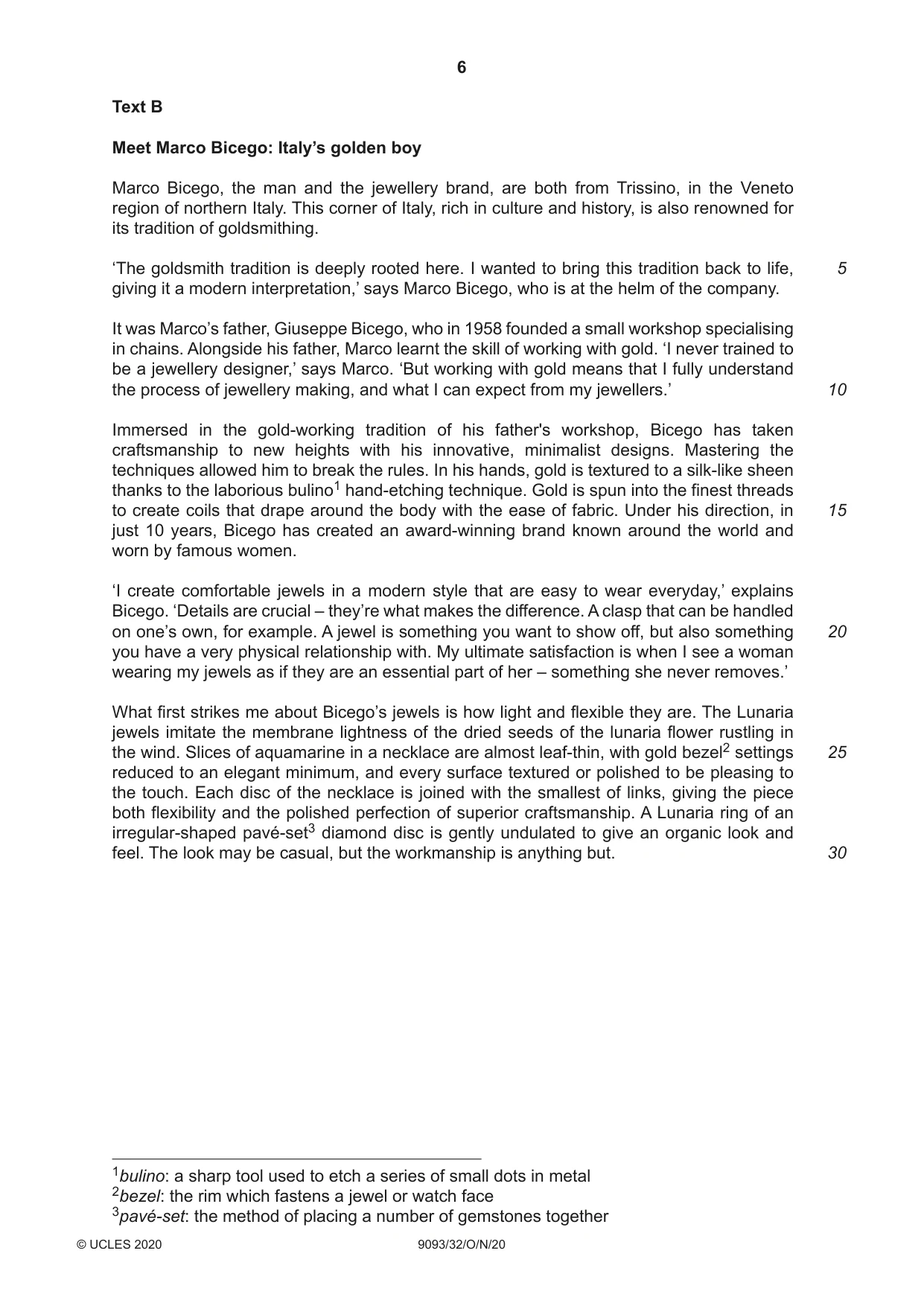
6 9093/32/O/N/20 © UCLES 2020 Text B Meet Marco Bicego: Italy’s golden boy Marco Bicego, the man and the jewellery brand, are both from Trissino, in the Veneto region of northern Italy. This corner of Italy, rich in culture and history, is also renowned for its tradition of goldsmithing. ‘The goldsmith tradition is deeply rooted here. I wanted to bring this tradition back to life, giving it a modern interpretation,’ says Marco Bicego, who is at the helm of the company. It was Marco’s father, Giuseppe Bicego, who in 1958 founded a small workshop specialising in chains. Alongside his father, Marco learnt the skill of working with gold. ‘I never trained to be a jewellery designer,’ says Marco. ‘But working with gold means that I fully understand the process of jewellery making, and what I can expect from my jewellers.’ Immersed in the gold-working tradition of his father's workshop, Bicego has taken craftsmanship to new heights with his innovative, minimalist designs. Mastering the techniques allowed him to break the rules. In his hands, gold is textured to a silk-like sheen thanks to the laborious bulino1 hand-etching technique. Gold is spun into the finest threads to create coils that drape around the body with the ease of fabric. Under his direction, in just 10 years, Bicego has created an award-winning brand known around the world and worn by famous women. ‘I create comfortable jewels in a modern style that are easy to wear everyday,’ explains Bicego. ‘Details are crucial – they’re what makes the difference. A clasp that can be handled on one’s own, for example. A jewel is something you want to show off, but also something you have a very physical relationship with. My ultimate satisfaction is when I see a woman wearing my jewels as if they are an essential part of her – something she never removes.’ What first strikes me about Bicego’s jewels is how light and flexible they are. The Lunaria jewels imitate the membrane lightness of the dried seeds of the lunaria flower rustling in the wind. Slices of aquamarine in a necklace are almost leaf-thin, with gold bezel2 settings reduced to an elegant minimum, and every surface textured or polished to be pleasing to the touch. Each disc of the necklace is joined with the smallest of links, giving the piece both flexibility and the polished perfection of superior craftsmanship. A Lunaria ring of an irregular-shaped pavé-set3 diamond disc is gently undulated to give an organic look and feel. The look may be casual, but the workmanship is anything but. 1bulino: a sharp tool used to etch a series of small dots in metal 2bezel: the rim which fastens a jewel or watch face 3pavé-set: the method of placing a number of gemstones together 5 10 15 20 25 30
Question paper, page 7
7 9093/32/O/N/20 © UCLES 2020 BLANK PAGE
Question paper, page 8
8 9093/32/O/N/20 © UCLES 2020 Permission to reproduce items where third-party owned material protected by copyright is included has been sought and cleared where possible. Every reasonable effort has been made by the publisher (UCLES) to trace copyright holders, but if any items requiring clearance have unwittingly been included, the publisher will be pleased to make amends at the earliest possible opportunity. To avoid the issue of disclosure of answer-related information to candidates, all copyright acknowledgements are reproduced online in the Cambridge Assessment International Education Copyright Acknowledgements Booklet. This is produced for each series of examinations and is freely available to download at www.cambridgeinternational.org after the live examination series. Cambridge Assessment International Education is part of the Cambridge Assessment Group. Cambridge Assessment is the brand name of the University of Cambridge Local Examinations Syndicate (UCLES), which itself is a department of the University of Cambridge. BLANK PAGE
Mark scheme, page 1
This document consists of 6 printed pages. © UCLES 2020 [Turn over Cambridge International A Level ENGLISH LANGUAGE 9093/32 Paper 3 Text Analysis October/November 2020 MARK SCHEME Maximum Mark: 50 Published This mark scheme is published as an aid to teachers and candidates, to indicate the requirements of the examination. It shows the basis on which Examiners were instructed to award marks. It does not indicate the details of the discussions that took place at an Examiners’ meeting before marking began, which would have considered the acceptability of alternative answers. Mark schemes should be read in conjunction with the question paper and the Principal Examiner Report for Teachers. Cambridge International will not enter into discussions about these mark schemes. Cambridge International is publishing the mark schemes for the October/November 2020 series for most Cambridge IGCSE™, Cambridge International A and AS Level and Cambridge Pre-U components, and some Cambridge O Level components.
Mark scheme, page 2
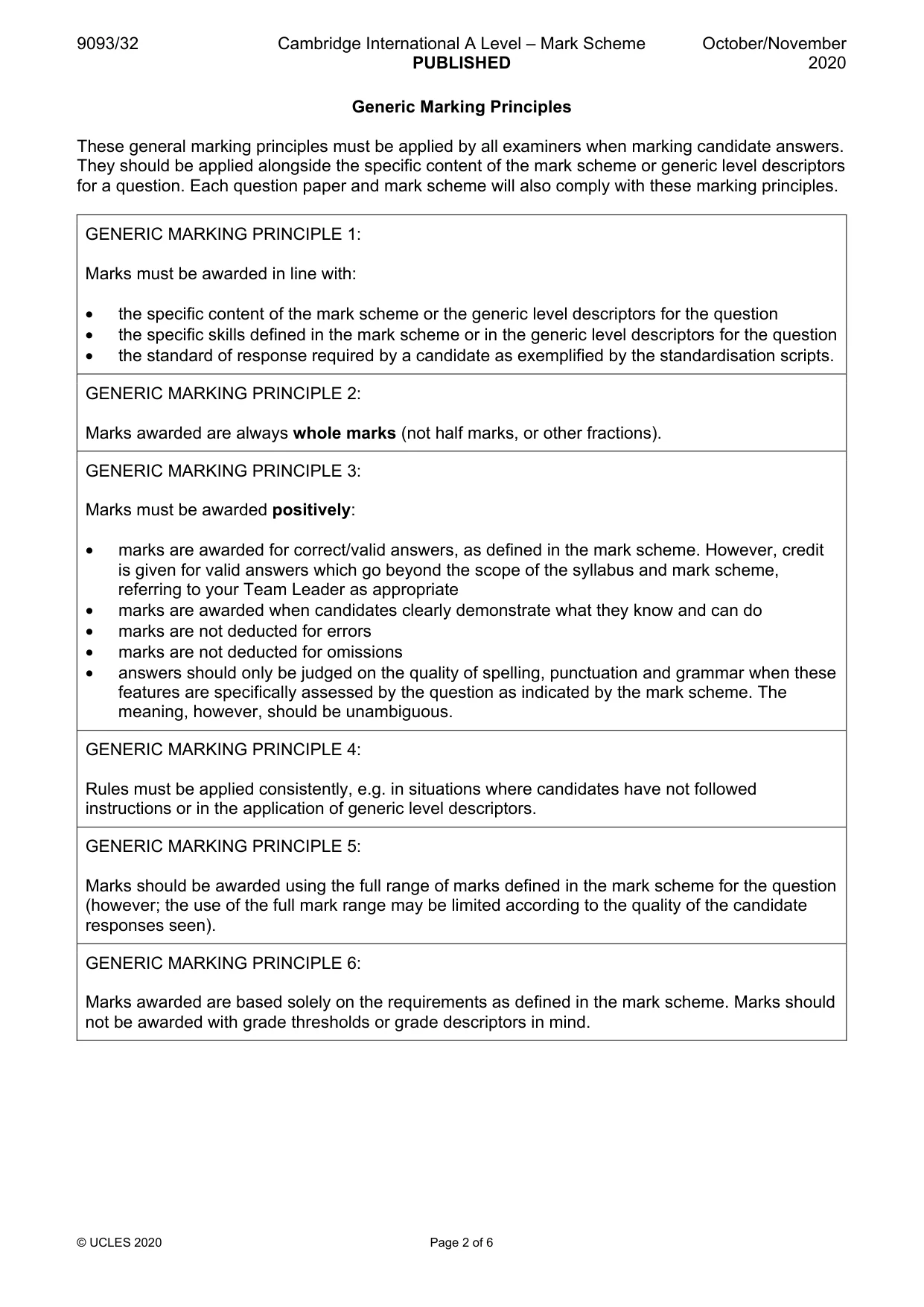
9093/32 Cambridge International A Level – Mark Scheme PUBLISHED October/November 2020 © UCLES 2020 Page 2 of 6 Generic Marking Principles These general marking principles must be applied by all examiners when marking candidate answers. They should be applied alongside the specific content of the mark scheme or generic level descriptors for a question. Each question paper and mark scheme will also comply with these marking principles. GENERIC MARKING PRINCIPLE 1: Marks must be awarded in line with: • the specific content of the mark scheme or the generic level descriptors for the question • the specific skills defined in the mark scheme or in the generic level descriptors for the question • the standard of response required by a candidate as exemplified by the standardisation scripts. GENERIC MARKING PRINCIPLE 2: Marks awarded are always whole marks (not half marks, or other fractions). GENERIC MARKING PRINCIPLE 3: Marks must be awarded positively: • marks are awarded for correct/valid answers, as defined in the mark scheme. However, credit is given for valid answers which go beyond the scope of the syllabus and mark scheme, referring to your Team Leader as appropriate • marks are awarded when candidates clearly demonstrate what they know and can do • marks are not deducted for errors • marks are not deducted for omissions • answers should only be judged on the quality of spelling, punctuation and grammar when these features are specifically assessed by the question as indicated by the mark scheme. The meaning, however, should be unambiguous. GENERIC MARKING PRINCIPLE 4: Rules must be applied consistently, e.g. in situations where candidates have not followed instructions or in the application of generic level descriptors. GENERIC MARKING PRINCIPLE 5: Marks should be awarded using the full range of marks defined in the mark scheme for the question (however; the use of the full mark range may be limited according to the quality of the candidate responses seen). GENERIC MARKING PRINCIPLE 6: Marks awarded are based solely on the requirements as defined in the mark scheme. Marks should not be awarded with grade thresholds or grade descriptors in mind.
Mark scheme, page 3
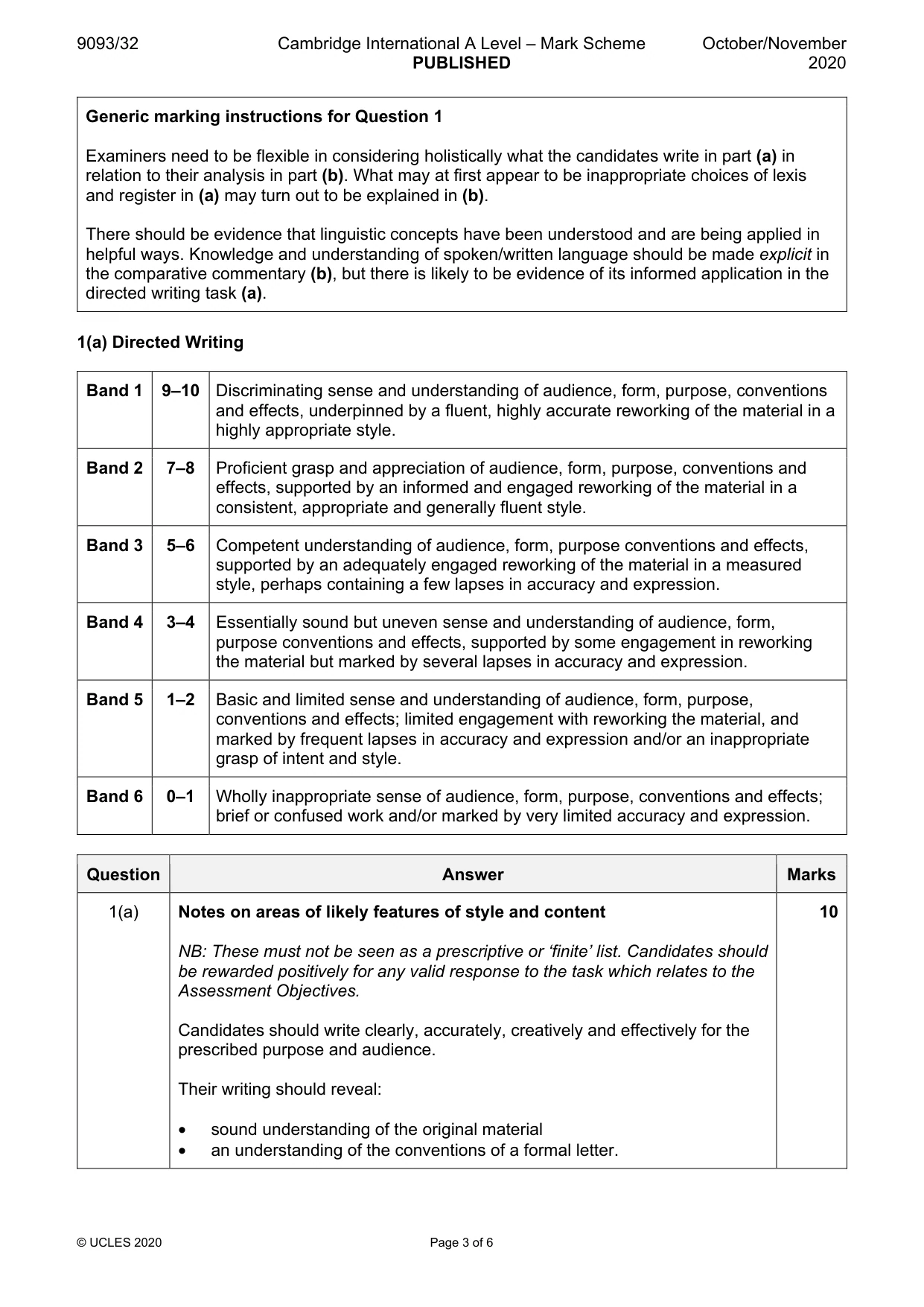
9093/32 Cambridge International A Level – Mark Scheme PUBLISHED October/November 2020 © UCLES 2020 Page 3 of 6 Generic marking instructions for Question 1 Examiners need to be flexible in considering holistically what the candidates write in part (a) in relation to their analysis in part (b). What may at first appear to be inappropriate choices of lexis and register in (a) may turn out to be explained in (b). There should be evidence that linguistic concepts have been understood and are being applied in helpful ways. Knowledge and understanding of spoken/written language should be made explicit in the comparative commentary (b), but there is likely to be evidence of its informed application in the directed writing task (a). 1(a) Directed Writing Band 1 9–10 Discriminating sense and understanding of audience, form, purpose, conventions and effects, underpinned by a fluent, highly accurate reworking of the material in a highly appropriate style. Band 2 7–8 Proficient grasp and appreciation of audience, form, purpose, conventions and effects, supported by an informed and engaged reworking of the material in a consistent, appropriate and generally fluent style. Band 3 5–6 Competent understanding of audience, form, purpose conventions and effects, supported by an adequately engaged reworking of the material in a measured style, perhaps containing a few lapses in accuracy and expression. Band 4 3–4 Essentially sound but uneven sense and understanding of audience, form, purpose conventions and effects, supported by some engagement in reworking the material but marked by several lapses in accuracy and expression. Band 5 1–2 Basic and limited sense and understanding of audience, form, purpose, conventions and effects; limited engagement with reworking the material, and marked by frequent lapses in accuracy and expression and/or an inappropriate grasp of intent and style. Band 6 0–1 Wholly inappropriate sense of audience, form, purpose, conventions and effects; brief or confused work and/or marked by very limited accuracy and expression. Question Answer Marks 1(a) Notes on areas of likely features of style and content NB: These must not be seen as a prescriptive or ‘finite’ list. Candidates should be rewarded positively for any valid response to the task which relates to the Assessment Objectives. Candidates should write clearly, accurately, creatively and effectively for the prescribed purpose and audience. Their writing should reveal: • sound understanding of the original material • an understanding of the conventions of a formal letter. 10
Mark scheme, page 4
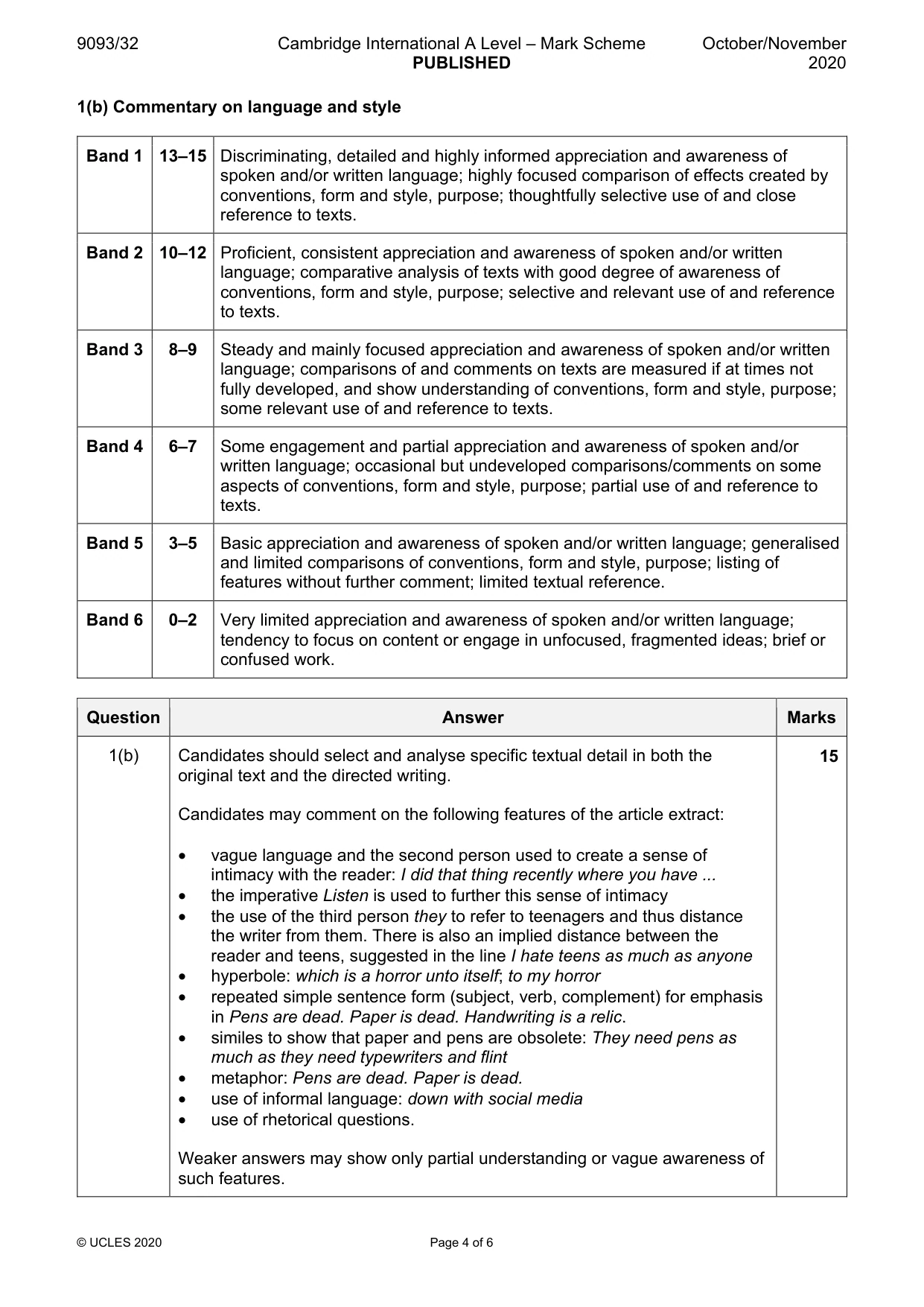
9093/32 Cambridge International A Level – Mark Scheme PUBLISHED October/November 2020 © UCLES 2020 Page 4 of 6 1(b) Commentary on language and style Band 1 13–15 Discriminating, detailed and highly informed appreciation and awareness of spoken and/or written language; highly focused comparison of effects created by conventions, form and style, purpose; thoughtfully selective use of and close reference to texts. Band 2 10–12 Proficient, consistent appreciation and awareness of spoken and/or written language; comparative analysis of texts with good degree of awareness of conventions, form and style, purpose; selective and relevant use of and reference to texts. Band 3 8–9 Steady and mainly focused appreciation and awareness of spoken and/or written language; comparisons of and comments on texts are measured if at times not fully developed, and show understanding of conventions, form and style, purpose; some relevant use of and reference to texts. Band 4 6–7 Some engagement and partial appreciation and awareness of spoken and/or written language; occasional but undeveloped comparisons/comments on some aspects of conventions, form and style, purpose; partial use of and reference to texts. Band 5 3–5 Basic appreciation and awareness of spoken and/or written language; generalised and limited comparisons of conventions, form and style, purpose; listing of features without further comment; limited textual reference. Band 6 0–2 Very limited appreciation and awareness of spoken and/or written language; tendency to focus on content or engage in unfocused, fragmented ideas; brief or confused work. Question Answer Marks 1(b) Candidates should select and analyse specific textual detail in both the original text and the directed writing. Candidates may comment on the following features of the article extract: • vague language and the second person used to create a sense of intimacy with the reader: I did that thing recently where you have ... • the imperative Listen is used to further this sense of intimacy • the use of the third person they to refer to teenagers and thus distance the writer from them. There is also an implied distance between the reader and teens, suggested in the line I hate teens as much as anyone • hyperbole: which is a horror unto itself; to my horror • repeated simple sentence form (subject, verb, complement) for emphasis in Pens are dead. Paper is dead. Handwriting is a relic. • similes to show that paper and pens are obsolete: They need pens as much as they need typewriters and flint • metaphor: Pens are dead. Paper is dead. • use of informal language: down with social media • use of rhetorical questions. Weaker answers may show only partial understanding or vague awareness of such features. 15
Mark scheme, page 5
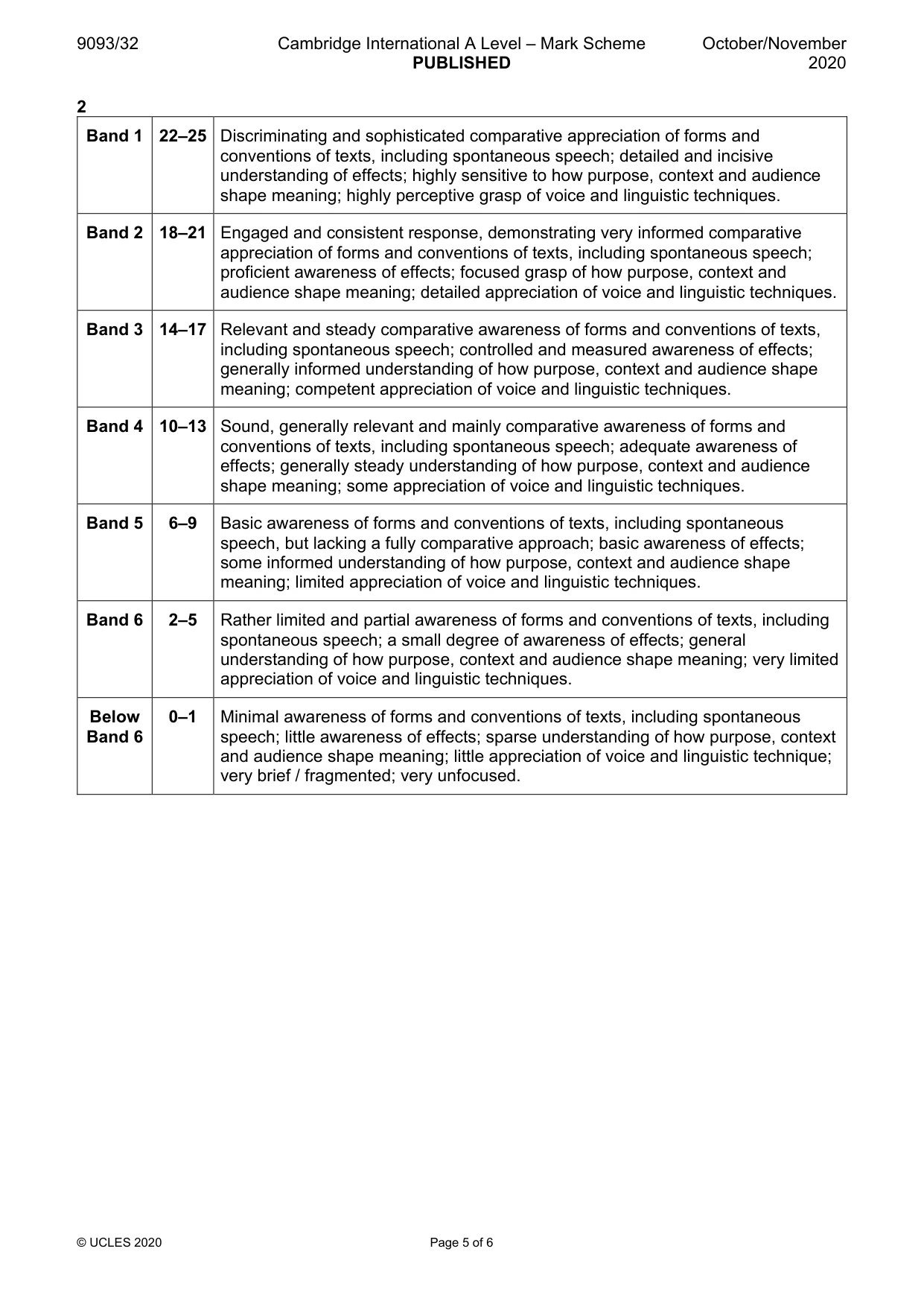
9093/32 Cambridge International A Level – Mark Scheme PUBLISHED October/November 2020 © UCLES 2020 Page 5 of 6 2 Band 1 22–25 Discriminating and sophisticated comparative appreciation of forms and conventions of texts, including spontaneous speech; detailed and incisive understanding of effects; highly sensitive to how purpose, context and audience shape meaning; highly perceptive grasp of voice and linguistic techniques. Band 2 18–21 Engaged and consistent response, demonstrating very informed comparative appreciation of forms and conventions of texts, including spontaneous speech; proficient awareness of effects; focused grasp of how purpose, context and audience shape meaning; detailed appreciation of voice and linguistic techniques. Band 3 14–17 Relevant and steady comparative awareness of forms and conventions of texts, including spontaneous speech; controlled and measured awareness of effects; generally informed understanding of how purpose, context and audience shape meaning; competent appreciation of voice and linguistic techniques. Band 4 10–13 Sound, generally relevant and mainly comparative awareness of forms and conventions of texts, including spontaneous speech; adequate awareness of effects; generally steady understanding of how purpose, context and audience shape meaning; some appreciation of voice and linguistic techniques. Band 5 6–9 Basic awareness of forms and conventions of texts, including spontaneous speech, but lacking a fully comparative approach; basic awareness of effects; some informed understanding of how purpose, context and audience shape meaning; limited appreciation of voice and linguistic techniques. Band 6 2–5 Rather limited and partial awareness of forms and conventions of texts, including spontaneous speech; a small degree of awareness of effects; general understanding of how purpose, context and audience shape meaning; very limited appreciation of voice and linguistic techniques. Below Band 6 0–1 Minimal awareness of forms and conventions of texts, including spontaneous speech; little awareness of effects; sparse understanding of how purpose, context and audience shape meaning; little appreciation of voice and linguistic technique; very brief / fragmented; very unfocused.
Mark scheme, page 6
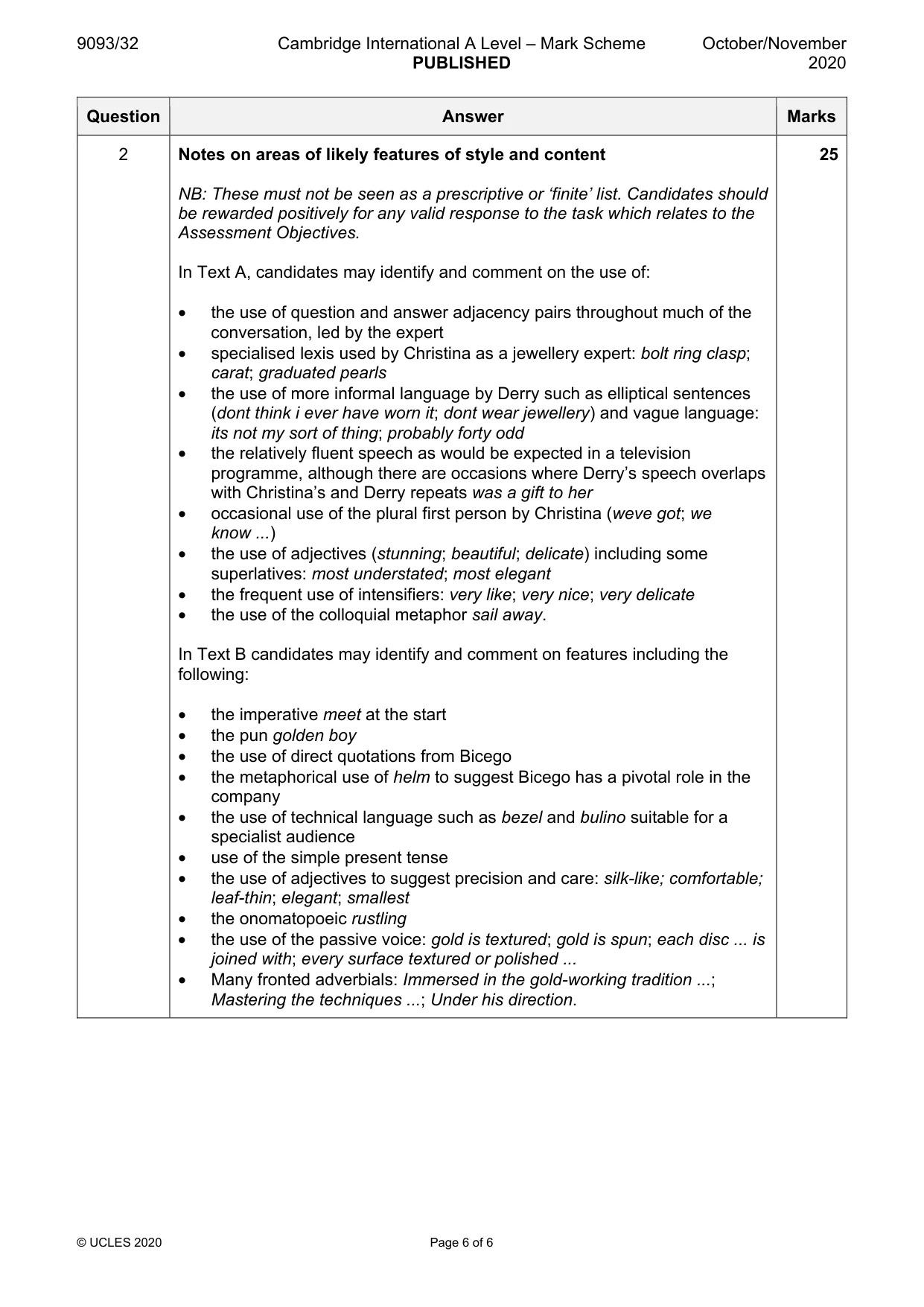
9093/32 Cambridge International A Level – Mark Scheme PUBLISHED October/November 2020 © UCLES 2020 Page 6 of 6 Question Answer Marks 2 Notes on areas of likely features of style and content NB: These must not be seen as a prescriptive or ‘finite’ list. Candidates should be rewarded positively for any valid response to the task which relates to the Assessment Objectives. In Text A, candidates may identify and comment on the use of: • the use of question and answer adjacency pairs throughout much of the conversation, led by the expert • specialised lexis used by Christina as a jewellery expert: bolt ring clasp; carat; graduated pearls • the use of more informal language by Derry such as elliptical sentences (dont think i ever have worn it; dont wear jewellery) and vague language: its not my sort of thing; probably forty odd • the relatively fluent speech as would be expected in a television programme, although there are occasions where Derry’s speech overlaps with Christina’s and Derry repeats was a gift to her • occasional use of the plural first person by Christina (weve got; we know ...) • the use of adjectives (stunning; beautiful; delicate) including some superlatives: most understated; most elegant • the frequent use of intensifiers: very like; very nice; very delicate • the use of the colloquial metaphor sail away. In Text B candidates may identify and comment on features including the following: • the imperative meet at the start • the pun golden boy • the use of direct quotations from Bicego • the metaphorical use of helm to suggest Bicego has a pivotal role in the company • the use of technical language such as bezel and bulino suitable for a specialist audience • use of the simple present tense • the use of adjectives to suggest precision and care: silk-like; comfortable; leaf-thin; elegant; smallest • the onomatopoeic rustling • the use of the passive voice: gold is textured; gold is spun; each disc ... is joined with; every surface textured or polished ... • Many fronted adverbials: Immersed in the gold-working tradition ...; Mastering the techniques ...; Under his direction. 25
What you needed in this session
Cambridge’s own grade thresholds for 2020 Oct/Nov, Paper 3 · Variant 2. A higher threshold means an easier paper — the bar moves with how the cohort did.